Student: Malea Ioana-Alexandra
Grupa: 8212
Prof. coordonator: Mihai Frumușelu
1
Tourism in Romania is focused on the country's natural
landscapes and its history, and forms a major component of
the economy of Romania. The number of tourists increased
from 4.8 million in 2002 to 8.9 million in 2008, while tourism
related revenues grew from $400 million in 2002 to $607
million in 2004. As such tourism is becoming an increasingly
important source for Romania's gross domestic product
(GDP). Domestic and international tourism in Romania
attracted €880 million overall investments in 2005 and
generated about 4% of the country's GDP, supporting 0.8
million jobs - the second largest component in the services
sector after commerce. Two-thirds of all major trade fairs in
Central Europe are held in Romania, each year; attracting 2 to
3 million business travelers, about 20% of whom are
foreigners.
2
History
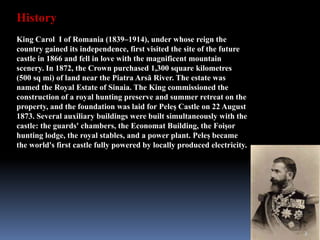
King Carol I of Romania (1839–1914), under whose reign the
country gained its independence, first visited the site of the future
castle in 1866 and fell in love with the magnificent mountain
scenery. In 1872, the Crown purchased 1,300 square kilometres
(500 sq mi) of land near the Piatra Arsă River. The estate was
named the Royal Estate of Sinaia. The King commissioned the
construction of a royal hunting preserve and summer retreat on the
property, and the foundation was laid for Peleș Castle on 22 August
1873. Several auxiliary buildings were built simultaneously with the
castle: the guards' chambers, the Economat Building, the Foişor
hunting lodge, the royal stables, and a power plant. Peleș became
the world's first castle fully powered by locally produced electricity.
3
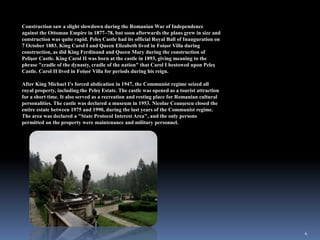
Construction saw a slight slowdown during the Romanian War of Independence
against the Ottoman Empire in 1877–78, but soon afterwards the plans grew in size and
construction was quite rapid. Peleș Castle had its official Royal Ball of Inauguration on
7 October 1883. King Carol I and Queen Elizabeth lived in Foişor Villa during
construction, as did King Ferdinand and Queen Mary during the construction of
Pelişor Castle. King Carol II was born at the castle in 1893, giving meaning to the
phrase "cradle of the dynasty, cradle of the nation" that Carol I bestowed upon Peleș
Castle. Carol II lived in Foișor Villa for periods during his reign.
After King Michael I's forced abdication in 1947, the Communist regime seized all
royal property, including the Peleș Estate. The castle was opened as a tourist attraction
for a short time. It also served as a recreation and resting place for Romanian cultural
personalities. The castle was declared a museum in 1953. Nicolae Ceauşescu closed the
entire estate between 1975 and 1990, during the last years of the Communist regime.
The area was declared a "State Protocol Interest Area", and the only persons
permitted on the property were maintenance and military personnel.
4
5
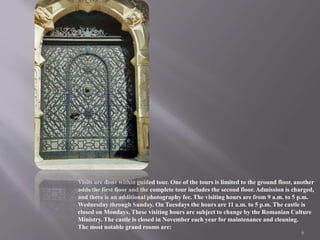
Visits are done within guided tour. One of the tours is limited to the ground floor, another
adds the first floor and the complete tour includes the second floor. Admission is charged,
and there is an additional photography fee. The visiting hours are from 9 a.m. to 5 p.m.
Wednesday through Sunday. On Tuesdays the hours are 11 a.m. to 5 p.m. The castle is
closed on Mondays. These visiting hours are subject to change by the Romanian Culture
Ministry. The castle is closed in November each year for maintenance and cleaning.
The most notable grand rooms are:
6
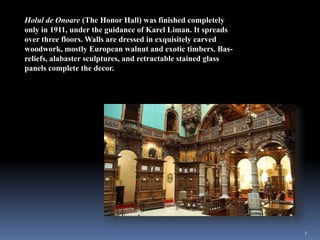
Holul de Onoare (The Honor Hall) was finished completely
only in 1911, under the guidance of Karel Liman. It spreads
over three floors. Walls are dressed in exquisitely carved
woodwork, mostly European walnut and exotic timbers. Bas-
reliefs, alabaster sculptures, and retractable stained glass
panels complete the decor.
7
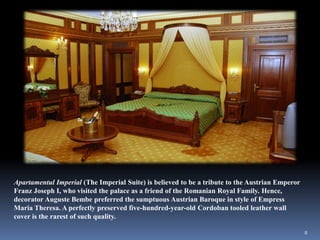
Apartamentul Imperial (The Imperial Suite) is believed to be a tribute to the Austrian Emperor
Franz Joseph I, who visited the palace as a friend of the Romanian Royal Family. Hence,
decorator Auguste Bembe preferred the sumptuous Austrian Baroque in style of Empress
Maria Theresa. A perfectly preserved five-hundred-year-old Cordoban tooled leather wall
cover is the rarest of such quality.
8
9
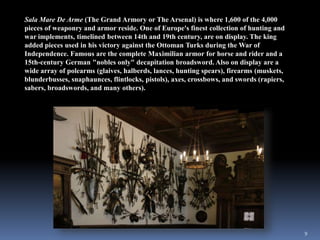
Sala Mare De Arme (The Grand Armory or The Arsenal) is where 1,600 of the 4,000
pieces of weaponry and armor reside. One of Europe's finest collection of hunting and
war implements, timelined between 14th and 19th century, are on display. The king
added pieces used in his victory against the Ottoman Turks during the War of
Independence. Famous are the complete Maximilian armor for horse and rider and a
15th-century German "nobles only" decapitation broadsword. Also on display are a
wide array of polearms (glaives, halberds, lances, hunting spears), firearms (muskets,
blunderbusses, snaphaunces, flintlocks, pistols), axes, crossbows, and swords (rapiers,
sabers, broadswords, and many others).
10
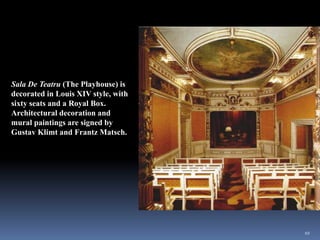
Sala De Teatru (The Playhouse) is
decorated in Louis XIV style, with
sixty seats and a Royal Box.
Architectural decoration and
mural paintings are signed by
Gustav Klimt and Frantz Matsch.
11
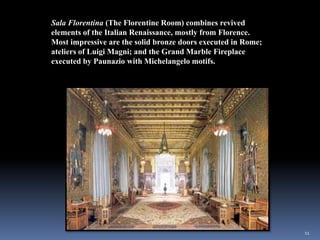
Sala Florentina (The Florentine Room) combines revived
elements of the Italian Renaissance, mostly from Florence.
Most impressive are the solid bronze doors executed in Rome;
ateliers of Luigi Magni; and the Grand Marble Fireplace
executed by Paunazio with Michelangelo motifs.
12
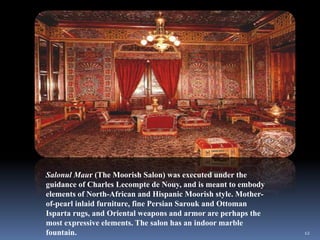
Salonul Maur (The Moorish Salon) was executed under the
guidance of Charles Lecompte de Nouy, and is meant to embody
elements of North-African and Hispanic Moorish style. Mother-
of-pearl inlaid furniture, fine Persian Sarouk and Ottoman
Isparta rugs, and Oriental weapons and armor are perhaps the
most expressive elements. The salon has an indoor marble
fountain.
13
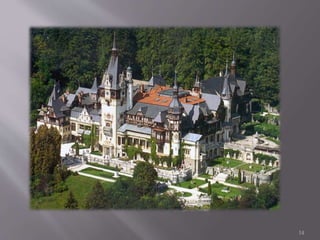
The complex is northwest of the town
of Sinaia, which is 60 kilometres (37
mi) from Braşov and 135 kilometres
(84 mi) from Bucharest. Nestled in the
southeastern Carpathian Mountains,
the complex is composed of three
monuments: Peleş Castle, Pelişor
Chateau, and Foişor Huntin.
14

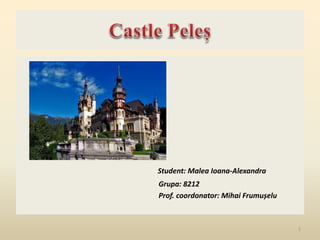
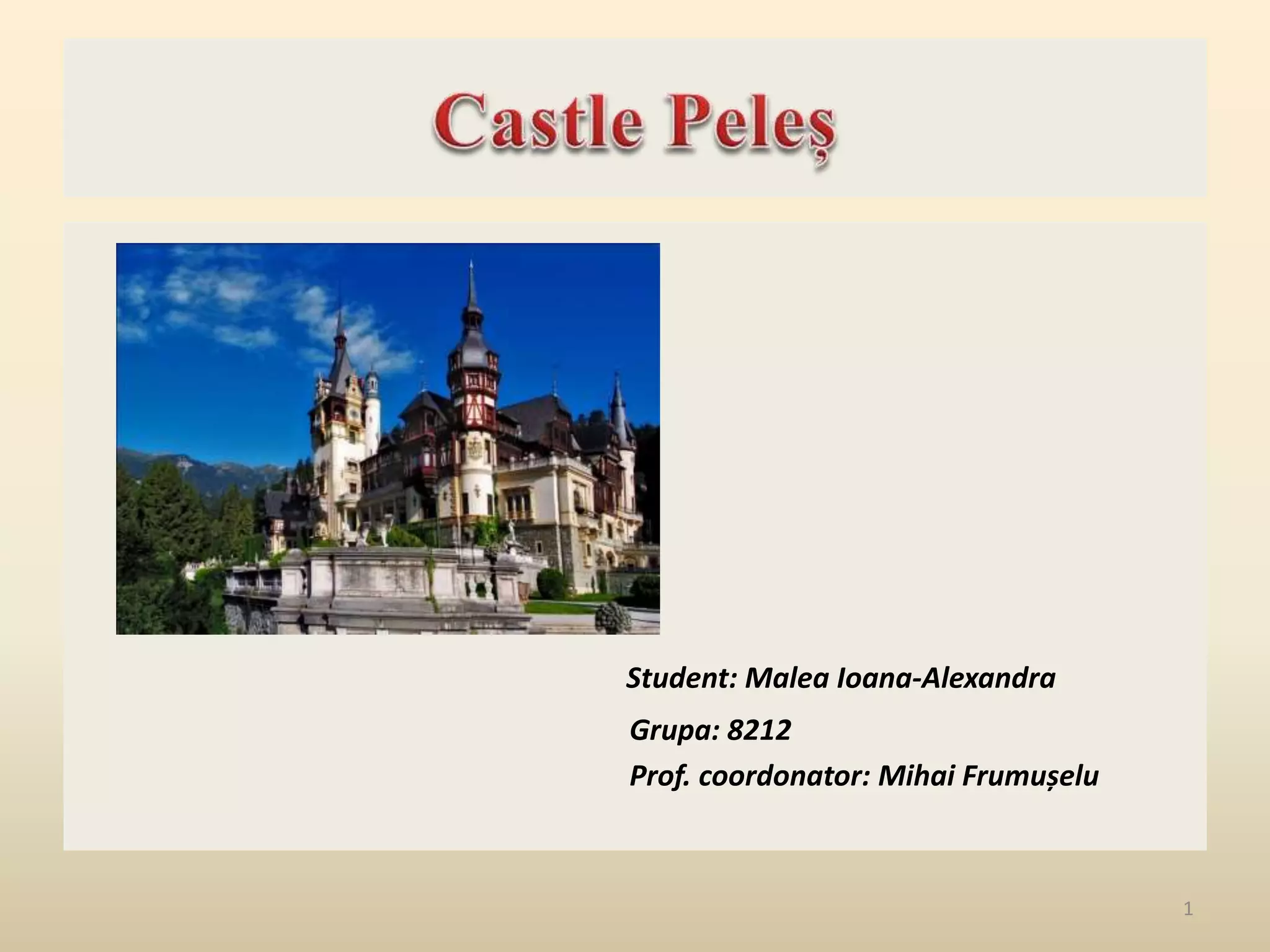
Castle peleș

  • 1.
    Student: Malea Ioana-Alexandra Grupa:8212 Prof. coordonator: Mihai Frumușelu 1
  • 2.
    Tourism in Romaniais focused on the country's natural landscapes and its history, and forms a major component of the economy of Romania. The number of tourists increased from 4.8 million in 2002 to 8.9 million in 2008, while tourism related revenues grew from $400 million in 2002 to $607 million in 2004. As such tourism is becoming an increasingly important source for Romania's gross domestic product (GDP). Domestic and international tourism in Romania attracted €880 million overall investments in 2005 and generated about 4% of the country's GDP, supporting 0.8 million jobs - the second largest component in the services sector after commerce. Two-thirds of all major trade fairs in Central Europe are held in Romania, each year; attracting 2 to 3 million business travelers, about 20% of whom are foreigners. 2
  • 3.
    History King Carol Iof Romania (1839–1914), under whose reign the country gained its independence, first visited the site of the future castle in 1866 and fell in love with the magnificent mountain scenery. In 1872, the Crown purchased 1,300 square kilometres (500 sq mi) of land near the Piatra Arsă River. The estate was named the Royal Estate of Sinaia. The King commissioned the construction of a royal hunting preserve and summer retreat on the property, and the foundation was laid for Peleș Castle on 22 August 1873. Several auxiliary buildings were built simultaneously with the castle: the guards' chambers, the Economat Building, the Foişor hunting lodge, the royal stables, and a power plant. Peleș became the world's first castle fully powered by locally produced electricity. 3
  • 4.
    Construction saw aslight slowdown during the Romanian War of Independence against the Ottoman Empire in 1877–78, but soon afterwards the plans grew in size and construction was quite rapid. Peleș Castle had its official Royal Ball of Inauguration on 7 October 1883. King Carol I and Queen Elizabeth lived in Foişor Villa during construction, as did King Ferdinand and Queen Mary during the construction of Pelişor Castle. King Carol II was born at the castle in 1893, giving meaning to the phrase "cradle of the dynasty, cradle of the nation" that Carol I bestowed upon Peleș Castle. Carol II lived in Foișor Villa for periods during his reign. After King Michael I's forced abdication in 1947, the Communist regime seized all royal property, including the Peleș Estate. The castle was opened as a tourist attraction for a short time. It also served as a recreation and resting place for Romanian cultural personalities. The castle was declared a museum in 1953. Nicolae Ceauşescu closed the entire estate between 1975 and 1990, during the last years of the Communist regime. The area was declared a "State Protocol Interest Area", and the only persons permitted on the property were maintenance and military personnel. 4
  • 5.
  • 6.
    Visits are donewithin guided tour. One of the tours is limited to the ground floor, another adds the first floor and the complete tour includes the second floor. Admission is charged, and there is an additional photography fee. The visiting hours are from 9 a.m. to 5 p.m. Wednesday through Sunday. On Tuesdays the hours are 11 a.m. to 5 p.m. The castle is closed on Mondays. These visiting hours are subject to change by the Romanian Culture Ministry. The castle is closed in November each year for maintenance and cleaning. The most notable grand rooms are: 6
  • 7.
    Holul de Onoare(The Honor Hall) was finished completely only in 1911, under the guidance of Karel Liman. It spreads over three floors. Walls are dressed in exquisitely carved woodwork, mostly European walnut and exotic timbers. Bas- reliefs, alabaster sculptures, and retractable stained glass panels complete the decor. 7
  • 8.
    Apartamentul Imperial (TheImperial Suite) is believed to be a tribute to the Austrian Emperor Franz Joseph I, who visited the palace as a friend of the Romanian Royal Family. Hence, decorator Auguste Bembe preferred the sumptuous Austrian Baroque in style of Empress Maria Theresa. A perfectly preserved five-hundred-year-old Cordoban tooled leather wall cover is the rarest of such quality. 8
  • 9.
    9 Sala Mare DeArme (The Grand Armory or The Arsenal) is where 1,600 of the 4,000 pieces of weaponry and armor reside. One of Europe's finest collection of hunting and war implements, timelined between 14th and 19th century, are on display. The king added pieces used in his victory against the Ottoman Turks during the War of Independence. Famous are the complete Maximilian armor for horse and rider and a 15th-century German "nobles only" decapitation broadsword. Also on display are a wide array of polearms (glaives, halberds, lances, hunting spears), firearms (muskets, blunderbusses, snaphaunces, flintlocks, pistols), axes, crossbows, and swords (rapiers, sabers, broadswords, and many others).
  • 10.
    10 Sala De Teatru(The Playhouse) is decorated in Louis XIV style, with sixty seats and a Royal Box. Architectural decoration and mural paintings are signed by Gustav Klimt and Frantz Matsch.
  • 11.
    11 Sala Florentina (TheFlorentine Room) combines revived elements of the Italian Renaissance, mostly from Florence. Most impressive are the solid bronze doors executed in Rome; ateliers of Luigi Magni; and the Grand Marble Fireplace executed by Paunazio with Michelangelo motifs.
  • 12.
    12 Salonul Maur (TheMoorish Salon) was executed under the guidance of Charles Lecompte de Nouy, and is meant to embody elements of North-African and Hispanic Moorish style. Mother- of-pearl inlaid furniture, fine Persian Sarouk and Ottoman Isparta rugs, and Oriental weapons and armor are perhaps the most expressive elements. The salon has an indoor marble fountain.
  • 13.
    13 The complex isnorthwest of the town of Sinaia, which is 60 kilometres (37 mi) from Braşov and 135 kilometres (84 mi) from Bucharest. Nestled in the southeastern Carpathian Mountains, the complex is composed of three monuments: Peleş Castle, Pelişor Chateau, and Foişor Huntin.
  • 14.