The prezentation was made by students from class 4.c Heiszki Gábor Kešiar Szabolcs Szilárd Ágnes  Vida Anita Postcard from Komárno
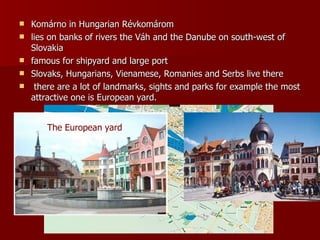
Komárno in Hungarian Révkomárom lies on banks of rivers the Váh and the Danube on south-west of Slovakia famous for shipyard and large port Slovaks, Hungarians, Vienamese, Romanies and Serbs live there there are a lot of landmarks, sights and parks for example the most attractive one is European yard.   The European yard
 
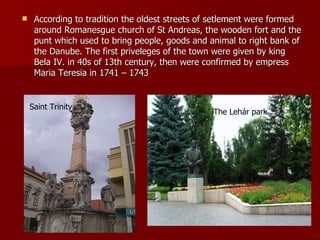
According to tradition the oldest streets of setlement were formed around Romanesgue church of St Andreas, the wooden fort and the punt which used to bring people, goods and animal to right bank of the Danube. The first priveleges of the town were given by king Bela IV. in 40s of 13th century, then were confirmed by empress Maria Teresia in 1741 – 1743   The Lehár park Saint Trinity
St. Andreas Cathedral the city's most important church, one of the city's dominant building. It  was built between 1768-1771 in Baroque style to have today's form. A cemetery was around the church. But the city was growing quickly and it was needed a bigger church. A new one was built 1723-1734 beside an old church.   But according the tradition the ill-built church 28th December 1738 collapsed  when a cart ran for the church's cracking wall. After again the Jesuits undertook the church's reconstruction In June 1763 the horrible earthquake wrecked its wall again. But it was rebuit 1768-1771 and topped with lower towers after another earthquake the church wasn´t destroyed
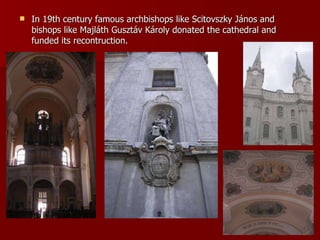
In 19th century famous archbishops like Scitovszky János and bishops like Majláth Gusztáv Károly donated the cathedral and funded its recontruction.
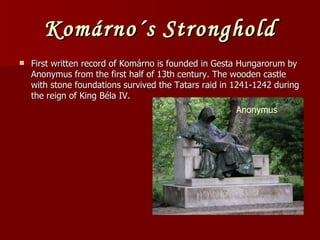
Komárno´s Stronghold First written record of Komárno is founded in Gesta Hungarorum by Anonymus from the first half of 13th century. The wooden castle with stone foundations survived the Tatars raid in 1241-1242 during the reign of King Béla IV. Anonymus
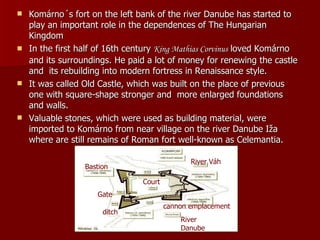
Komárno´s fort on the left bank of the river Danube has started to play an important role in the dependences of The Hungarian Kingdom   In the first half of 16th century  King Mat hias Corvinus  loved Komárno and its surroundings. He paid a lot of money for renewing the castle and  its rebuilding into modern fortress in Renaissance style. It was called Old Castle, which was built on the place of previous one with square-shape stronger and  more enlarged foundations and walls. Valuable stones, which were used as building material, were imported to Komárno from near village on the river Danube Iža where are still remains of Roman fort well-known as Celemantia.  Gate River Danube River Váh Bastion ditch Court cannon emplacement
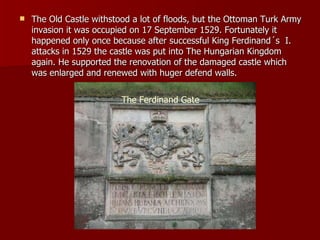
The Old Castle withstood a lot of floods, but the Ottoman Turk Army invasion it was occupied on 17 September 1529. Fortunately it happened only once because after successful King Ferdinand´s  I. attacks in 1529 the castle was put into The Hungarian Kingdom again. He supported the renovation of the damaged castle  which was enlarged and renewed with huger defend walls. The Ferdinand Gate
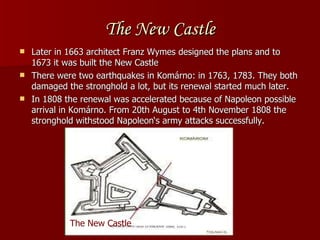
The New Castle Later in 1663 architect Franz Wymes designed the plans and to 1673 it was built the New Castle   There were two earthquakes in Komárno: in 1763, 1783. They both damaged the stronghold a lot, but its renewal started much later. In 1808 the renewal was accelerated because of Napoleon possible arrival in Komárno. From 20th August to 4th November 1808 the  stronghold withstood Napoleon‘s army attacks successfully. The New Castle
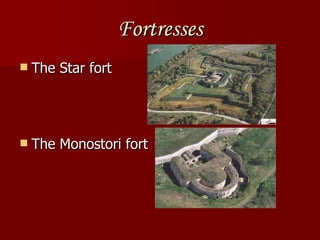
Fortresses The Star fort The Monostori fort
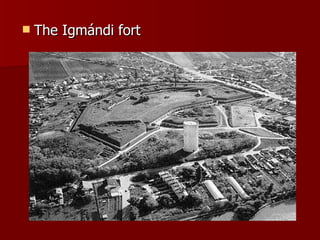
The Igmándi fort
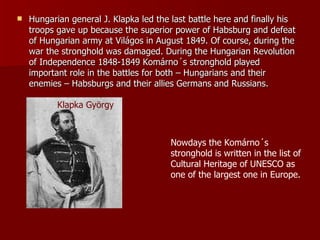
Hungarian general J. Klapka led the last battle here and finally his troops gave up because the superior power of Habsburg and defeat of Hungarian army at Világos in August 1849. Of course, during the war the stronghold was damaged. During the Hungarian Revolution of Independence 1848-1849 Komárno´s stronghold played  important role in the battles for both – Hungarians and their enemies – Habsburgs and their allies Germans and Russians. Klapka György Nowdays the Komárno´s stronghold is written in the list of Cultural Heritage of UNESCO as one of the largest one in Europe.
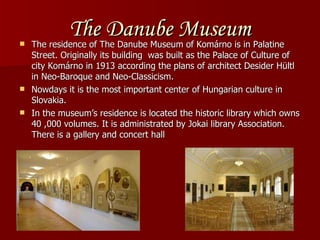
The Danube Museum The residence of The Danube Museum of Komárno is in Palatine Street. Originally its building  was built as the Palace of Culture of city Komárno in 1913 according the plans of architect Desider Hültl in Neo-Baroque and Neo-Classicism. Nowdays it is the most important center of Hungarian culture in Slovakia. In the museum’s residence is located the historic library which owns 40 ,000 volumes. It is administrated by Jokai library Association. There is a gallery and concert hall
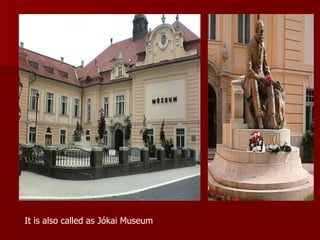
It is also called as Jókai Museum
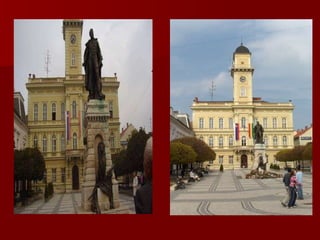
The Town Hall The most characteristic memory of the neo-classicism in Komárno is the Tow Hall. The previous baroque Town Hall was bulit in 1719.  It was rebuilt in1725 and there was fomes the square with tiles covered over. But in1763 the earthquake destroyed the building.  It was rebuilt again in 1766. The Town Hall´s  tower cowered with copper was bulit and its top was decorated with the symbol of the Habsburg monarchy.  Later its building and square turned into the victim of the revolution for freedom in 1848-49. According the plans of Gorstenbergen and Arvé in 1875 the building was transformed into a two-storey building. Nowdays a visitor can see the statue of general Klapka György in the middle of Klapka György square, who was a captain of the stronghold in 1849.
 
The Zichy Palace O ne of the most beautiful building in the centre of the city Komarno is the Zichy palace. This building was built by count Zichy in the 1s t  half of the 17th century, originally in Renaissance style. The earthquake in 1763 collapsed this building. Later it was rebuilt in classicism with two new wings. In 1989 the local government allowed to renew the building.Now in the upper stairs there is a constant exhibition,which introduces the history of the city Komárno.
 

Komárno prz.

  • 1.
    The prezentation wasmade by students from class 4.c Heiszki Gábor Kešiar Szabolcs Szilárd Ágnes Vida Anita Postcard from Komárno
  • 2.
    Komárno in HungarianRévkomárom lies on banks of rivers the Váh and the Danube on south-west of Slovakia famous for shipyard and large port Slovaks, Hungarians, Vienamese, Romanies and Serbs live there there are a lot of landmarks, sights and parks for example the most attractive one is European yard. The European yard
  • 3.
  • 4.
    According to traditionthe oldest streets of setlement were formed around Romanesgue church of St Andreas, the wooden fort and the punt which used to bring people, goods and animal to right bank of the Danube. The first priveleges of the town were given by king Bela IV. in 40s of 13th century, then were confirmed by empress Maria Teresia in 1741 – 1743 The Lehár park Saint Trinity
  • 5.
    St. Andreas Cathedralthe city's most important church, one of the city's dominant building. It was built between 1768-1771 in Baroque style to have today's form. A cemetery was around the church. But the city was growing quickly and it was needed a bigger church. A new one was built 1723-1734 beside an old church. But according the tradition the ill-built church 28th December 1738 collapsed when a cart ran for the church's cracking wall. After again the Jesuits undertook the church's reconstruction In June 1763 the horrible earthquake wrecked its wall again. But it was rebuit 1768-1771 and topped with lower towers after another earthquake the church wasn´t destroyed
  • 6.
    In 19th centuryfamous archbishops like Scitovszky János and bishops like Majláth Gusztáv Károly donated the cathedral and funded its recontruction.
  • 7.
    Komárno´s Stronghold Firstwritten record of Komárno is founded in Gesta Hungarorum by Anonymus from the first half of 13th century. The wooden castle with stone foundations survived the Tatars raid in 1241-1242 during the reign of King Béla IV. Anonymus
  • 8.
    Komárno´s fort onthe left bank of the river Danube has started to play an important role in the dependences of The Hungarian Kingdom In the first half of 16th century King Mat hias Corvinus loved Komárno and its surroundings. He paid a lot of money for renewing the castle and its rebuilding into modern fortress in Renaissance style. It was called Old Castle, which was built on the place of previous one with square-shape stronger and more enlarged foundations and walls. Valuable stones, which were used as building material, were imported to Komárno from near village on the river Danube Iža where are still remains of Roman fort well-known as Celemantia. Gate River Danube River Váh Bastion ditch Court cannon emplacement
  • 9.
    The Old Castlewithstood a lot of floods, but the Ottoman Turk Army invasion it was occupied on 17 September 1529. Fortunately it happened only once because after successful King Ferdinand´s I. attacks in 1529 the castle was put into The Hungarian Kingdom again. He supported the renovation of the damaged castle which was enlarged and renewed with huger defend walls. The Ferdinand Gate
  • 10.
    The New CastleLater in 1663 architect Franz Wymes designed the plans and to 1673 it was built the New Castle There were two earthquakes in Komárno: in 1763, 1783. They both damaged the stronghold a lot, but its renewal started much later. In 1808 the renewal was accelerated because of Napoleon possible arrival in Komárno. From 20th August to 4th November 1808 the stronghold withstood Napoleon‘s army attacks successfully. The New Castle
  • 11.
    Fortresses The Starfort The Monostori fort
  • 12.
  • 13.
    Hungarian general J.Klapka led the last battle here and finally his troops gave up because the superior power of Habsburg and defeat of Hungarian army at Világos in August 1849. Of course, during the war the stronghold was damaged. During the Hungarian Revolution of Independence 1848-1849 Komárno´s stronghold played important role in the battles for both – Hungarians and their enemies – Habsburgs and their allies Germans and Russians. Klapka György Nowdays the Komárno´s stronghold is written in the list of Cultural Heritage of UNESCO as one of the largest one in Europe.
  • 14.
    The Danube MuseumThe residence of The Danube Museum of Komárno is in Palatine Street. Originally its building was built as the Palace of Culture of city Komárno in 1913 according the plans of architect Desider Hültl in Neo-Baroque and Neo-Classicism. Nowdays it is the most important center of Hungarian culture in Slovakia. In the museum’s residence is located the historic library which owns 40 ,000 volumes. It is administrated by Jokai library Association. There is a gallery and concert hall
  • 15.
    It is alsocalled as Jókai Museum
  • 16.
    The Town HallThe most characteristic memory of the neo-classicism in Komárno is the Tow Hall. The previous baroque Town Hall was bulit in 1719. It was rebuilt in1725 and there was fomes the square with tiles covered over. But in1763 the earthquake destroyed the building. It was rebuilt again in 1766. The Town Hall´s tower cowered with copper was bulit and its top was decorated with the symbol of the Habsburg monarchy. Later its building and square turned into the victim of the revolution for freedom in 1848-49. According the plans of Gorstenbergen and Arvé in 1875 the building was transformed into a two-storey building. Nowdays a visitor can see the statue of general Klapka György in the middle of Klapka György square, who was a captain of the stronghold in 1849.
  • 17.
  • 18.
    The Zichy PalaceO ne of the most beautiful building in the centre of the city Komarno is the Zichy palace. This building was built by count Zichy in the 1s t half of the 17th century, originally in Renaissance style. The earthquake in 1763 collapsed this building. Later it was rebuilt in classicism with two new wings. In 1989 the local government allowed to renew the building.Now in the upper stairs there is a constant exhibition,which introduces the history of the city Komárno.
  • 19.