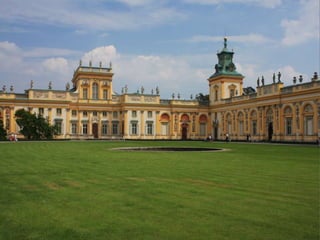
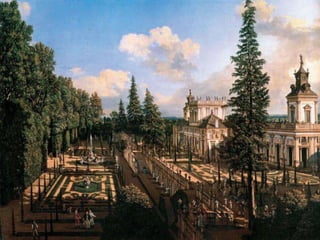
It  is a royal palace located in the  Wilanów  district,   Warsaw. Wilanów Palace survived the time of Poland's partitions and both World Wars and has preserved its authentic historical qualities, also is one of the most important monuments of Polish culture. The palace and park in Wilanów is not only a priceless testimony to the splendour of Poland in the past, but also a place for cultural events and concerts, including Summer Royal Concerts in the Rose Garden and the International Summer Early Music Academy. Since 2006, the palace has been a member of the international association of European Royal Residences.
 
Wilanów Palace was built for the Polish king John III Sobieski in the last quarter of the 17th century and later was enlarged by other owners. After the death of John III Sobieski in 1696, the palace was owned by his sons and later by the famous magnate families Sieniawskis, Czartoryskis, Lubomirskis, Potockis and Branicki family of the Korczak coat of arms. The palace was damaged by German forces in World War II,  but it was not demolished after the 1944 Warsaw Uprising. After the war, the palace was renovated, and most of the collection stolen by Germany was repatriated. In 1962 it was reopened to the public.
 
The structure was designed by Augustyn Wincenty Locci. The most prominent Polish and foreign artists participated in the decoration of the palace interiors. It was entrusted to painters Martino Altomonte, Jan Rayzner of Lviv, Michelangelo Palloni, sculptor Stefan Szwaner and stucco decorators Szymon Józef Bellotti, Antoni of Wilanów and Abraham Paris.
 
Websites with which I used: http://en.wikipedia.org/wiki/Wilan%C3%B3w_Palace

Adrian

  • 1.
  • 2.
    It  is a royalpalace located in the  Wilanów district, Warsaw. Wilanów Palace survived the time of Poland's partitions and both World Wars and has preserved its authentic historical qualities, also is one of the most important monuments of Polish culture. The palace and park in Wilanów is not only a priceless testimony to the splendour of Poland in the past, but also a place for cultural events and concerts, including Summer Royal Concerts in the Rose Garden and the International Summer Early Music Academy. Since 2006, the palace has been a member of the international association of European Royal Residences.
  • 3.
  • 4.
    Wilanów Palace wasbuilt for the Polish king John III Sobieski in the last quarter of the 17th century and later was enlarged by other owners. After the death of John III Sobieski in 1696, the palace was owned by his sons and later by the famous magnate families Sieniawskis, Czartoryskis, Lubomirskis, Potockis and Branicki family of the Korczak coat of arms. The palace was damaged by German forces in World War II, but it was not demolished after the 1944 Warsaw Uprising. After the war, the palace was renovated, and most of the collection stolen by Germany was repatriated. In 1962 it was reopened to the public.
  • 5.
  • 6.
    The structure wasdesigned by Augustyn Wincenty Locci. The most prominent Polish and foreign artists participated in the decoration of the palace interiors. It was entrusted to painters Martino Altomonte, Jan Rayzner of Lviv, Michelangelo Palloni, sculptor Stefan Szwaner and stucco decorators Szymon Józef Bellotti, Antoni of Wilanów and Abraham Paris.
  • 7.
  • 8.