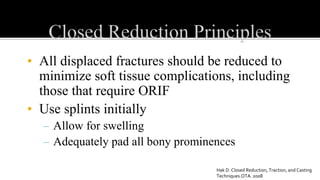
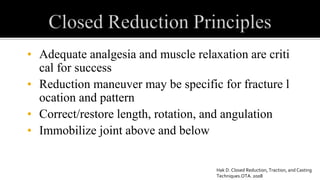
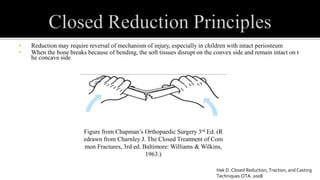
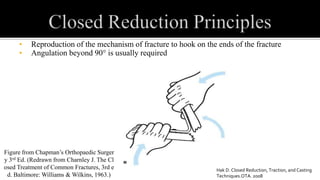
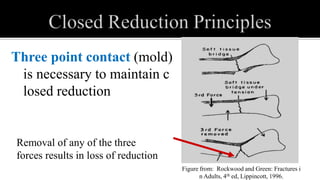
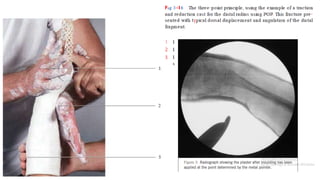
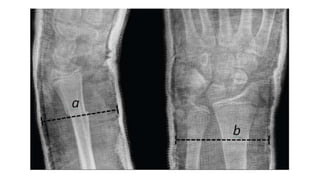
This document discusses techniques for closed reduction and casting of fractures. It notes that displaced fractures should be reduced to minimize soft tissue complications. Adequate analgesia and muscle relaxation are critical for successful reduction. The reduction maneuver depends on the fracture location and pattern, and must restore proper length, rotation, and angulation. Longitudinal traction alone may not allow reduction if an intact soft tissue hinge is present. Reproduction of the fracture mechanism is often needed, sometimes requiring angulation beyond 90 degrees. A well-molded three-point cast is necessary to maintain reduction, and a cast with a cast index below 0.7 has been shown to help prevent redisplacement of distal forearm fractures.