Nigeria is the world's largest producer of cassava, a
staple that is the most important crop by
produc on, and the second most important by
consump on (FAO, 2014). The Niger Delta
produces 14 million tonnes of cassava a year,
accoun ng for a third of na onal output, and
contribu ng about 34% of total household income
for cassava farmers in the region.
Despite the importance of the value chain,
inefficiencies in produc on and processing have
given rise to a subop mal cassava industry. Most
farmers use few agricultural inputs, have li le or
no mechanisa on and recycle local stems from
previous harvests. These all contribute to
poor yields as Nigeria's average yield of
7.7 MT per hectare, compares dismally
to the 23.4 MT and 22.2 MT
average yield per hectare
produced in Indonesia
and Thailand (FAO,
2014). There
are
Constraints
MADE
Cassava Value ain
Interven on
Market Development in the Niger Delta (MADE),
a DFID funded programme being implemented
by Development Alterna ves Incorporated (DAI).
MADE is a rural and agricultural market systems
development programme using the Making
Markets Work for the Poor approach (M4P) to
design systemic and sustainable interven ons
that generate propoor and inclusive growth in
nine Niger Delta states: Abia, Akwa Ibom,
Bayelsa, Cross River, Delta, Edo, Imo, Ondo and
Rivers. The goal is to facilitate increases in
incomes for at least 150,000 poor people, of
whom 50% must be women.
The programme design is based on the
recogni on that poverty is the result of the
structure of market systems in which the poor
par cipate and that when markets work
efficiently and produce equitable outcomes for
the poor, such markets become powerful
vehicles for delivering growth and poverty
reduc on. MADE is currently implemen ng
interven ons in agricultural inputs, finished
leather goods, cassava, fisheries, palm oil and
small-scale poultry value chains.
Overview
There are opportuni es to vastly improve
produc on output per hectare and diversify
cassava processing from food products such as
garri, fufu, and lafun into cassava products such
as ethanol, chips, syrups, starch and high-quality
cassava flour (HQCF) .
The MADE cassava sector strategy seeks to
facilitate improved linkages between cassava
farming clusters and produce processors; whilst
improving efficiencies, quality standards, and
growth in the tradi onal and industrial end
market (especially for garri, flour and feedmills).
Currently MADE is implemen ng an interven on
that addresses produc on and processing
constraints to improve profitability for
smallholder farmers. The ini a ves are
facilita ng an improved distribu on of quality
agricultural inputs, increasing access to Good
Agricultural Prac ces (GAP) training and building
linkages between processors and farmers to
reduce postharvest losses. The pilot ac vi es
were implemented in six states (i.e. Abia, Akwa
Ibom, Bayelsa, Cross River, Delta, Rivers) and has
now scaled to Edo, Ondo and Imo.
Improving produc vity through the adop on of
good agronomic prac ces
The ini a ve is an access to skills ini a ve with
two ac vity streams focused on: (a) improving
the rural distribu on of crop produc on
products and improved varie es of cassava and
(b) facilita ng an improved adop on of Good
Agricultural Prac ces (GAP). The ini a ve
addresses market failures of the support market
system for agricultural inputs by facilita ng an
improved distribu on network reaching
smallholder cassava farmers. It also involves
ac vi es to increase knowledge of the benefits
and applica on methods of agricultural inputs
through capacity building of farmers on good
agricultural prac ces using demonstra on plots.
Partners: Contec Global Agro Limited (CGAL),
Candel, Saro Agrosciences, De-Philajoms Agro
Allied Industries, Godilogo Farms, Egofarms, Josy
Integrated Services, Winosa Global Resources,
Candel, Saroagrosciences.
Establishing linkages between processors of
high quality cassava deriva ves and
smallholder farmers for uptake of fresh
roots.
This access to markets ini a ve focuses on
Intervention
Strategy
MADECassava Value ain
Interven on
and to use their products. A careful analysis of input
companies' percep on of incen ves and benefit to them
will ensure this risk doesn't limit impact of this ini a ve.
Farmer behaviour: Driven by price a rac veness of other
markets, farmers could break the out-grower agreement
by not selling to the processors.
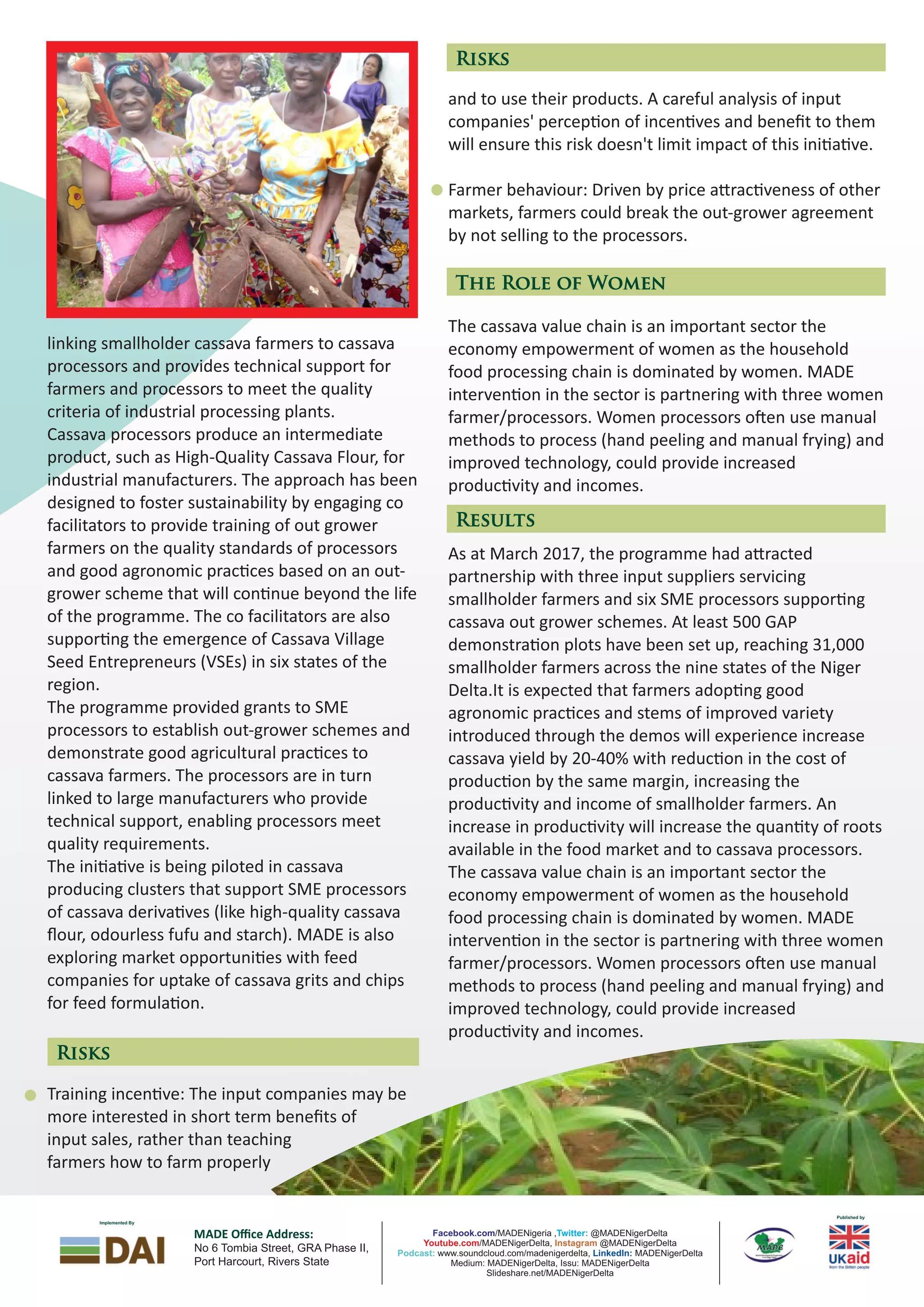
The cassava value chain is an important sector the
economy empowerment of women as the household
food processing chain is dominated by women. MADE
interven on in the sector is partnering with three women
farmer/processors. Women processors o en use manual
methods to process (hand peeling and manual frying) and
improved technology, could provide increased
produc vity and incomes.
As at March 2017, the programme had a racted
partnership with three input suppliers servicing
smallholder farmers and six SME processors suppor ng
cassava out grower schemes. At least 500 GAP
demonstra on plots have been set up, reaching 31,000
smallholder farmers across the nine states of the Niger
Delta.It is expected that farmers adop ng good
agronomic prac ces and stems of improved variety
introduced through the demos will experience increase
cassava yield by 20-40% with reduc on in the cost of
produc on by the same margin, increasing the
produc vity and income of smallholder farmers. An
increase in produc vity will increase the quan ty of roots
available in the food market and to cassava processors.
The cassava value chain is an important sector the
economy empowerment of women as the household
food processing chain is dominated by women. MADE
interven on in the sector is partnering with three women
farmer/processors. Women processors o en use manual
methods to process (hand peeling and manual frying) and
improved technology, could provide increased
produc vity and incomes.
linking smallholder cassava farmers to cassava
processors and provides technical support for
farmers and processors to meet the quality
criteria of industrial processing plants.
Cassava processors produce an intermediate
product, such as High-Quality Cassava Flour, for
industrial manufacturers. The approach has been
designed to foster sustainability by engaging co
facilitators to provide training of out grower
farmers on the quality standards of processors
and good agronomic prac ces based on an out-
grower scheme that will con nue beyond the life
of the programme. The co facilitators are also
suppor ng the emergence of Cassava Village
Seed Entrepreneurs (VSEs) in six states of the
region.
The programme provided grants to SME
processors to establish out-grower schemes and
demonstrate good agricultural prac ces to
cassava farmers. The processors are in turn
linked to large manufacturers who provide
technical support, enabling processors meet
quality requirements.
The ini a ve is being piloted in cassava
producing clusters that support SME processors
of cassava deriva ves (like high-quality cassava
flour, odourless fufu and starch). MADE is also
exploring market opportuni es with feed
companies for uptake of cassava grits and chips
for feed formula on.
Training incen ve: The input companies may be
more interested in short term benefits of
input sales, rather than teaching
farmers how to farm properly
Risks
The Role of Women
Risks
Results
MADE Office Address:
No 6 T A Phase II,ombia Street, GR
Port Har ourc t, Rivers State
Published by
Implemented By
Facebook.com/MADENigeria , @MADENigerDeltaTwitter:
/MADENigerDelta, @MADENigerDeltaYoutube.com Instagram
www.soundcloud.com/madenigerdelta, MADENigerDeltaPodcast: LinkedIn:
Medium: MADENigerDelta, Issu: MADENigerDelta
Slideshare.net/MADENigerDelta

Cassava Value Chain

  • 1.
    Nigeria is theworld's largest producer of cassava, a staple that is the most important crop by produc on, and the second most important by consump on (FAO, 2014). The Niger Delta produces 14 million tonnes of cassava a year, accoun ng for a third of na onal output, and contribu ng about 34% of total household income for cassava farmers in the region. Despite the importance of the value chain, inefficiencies in produc on and processing have given rise to a subop mal cassava industry. Most farmers use few agricultural inputs, have li le or no mechanisa on and recycle local stems from previous harvests. These all contribute to poor yields as Nigeria's average yield of 7.7 MT per hectare, compares dismally to the 23.4 MT and 22.2 MT average yield per hectare produced in Indonesia and Thailand (FAO, 2014). There are Constraints MADE Cassava Value ain Interven on Market Development in the Niger Delta (MADE), a DFID funded programme being implemented by Development Alterna ves Incorporated (DAI). MADE is a rural and agricultural market systems development programme using the Making Markets Work for the Poor approach (M4P) to design systemic and sustainable interven ons that generate propoor and inclusive growth in nine Niger Delta states: Abia, Akwa Ibom, Bayelsa, Cross River, Delta, Edo, Imo, Ondo and Rivers. The goal is to facilitate increases in incomes for at least 150,000 poor people, of whom 50% must be women. The programme design is based on the recogni on that poverty is the result of the structure of market systems in which the poor par cipate and that when markets work efficiently and produce equitable outcomes for the poor, such markets become powerful vehicles for delivering growth and poverty reduc on. MADE is currently implemen ng interven ons in agricultural inputs, finished leather goods, cassava, fisheries, palm oil and small-scale poultry value chains. Overview
  • 2.
    There are opportunies to vastly improve produc on output per hectare and diversify cassava processing from food products such as garri, fufu, and lafun into cassava products such as ethanol, chips, syrups, starch and high-quality cassava flour (HQCF) . The MADE cassava sector strategy seeks to facilitate improved linkages between cassava farming clusters and produce processors; whilst improving efficiencies, quality standards, and growth in the tradi onal and industrial end market (especially for garri, flour and feedmills). Currently MADE is implemen ng an interven on that addresses produc on and processing constraints to improve profitability for smallholder farmers. The ini a ves are facilita ng an improved distribu on of quality agricultural inputs, increasing access to Good Agricultural Prac ces (GAP) training and building linkages between processors and farmers to reduce postharvest losses. The pilot ac vi es were implemented in six states (i.e. Abia, Akwa Ibom, Bayelsa, Cross River, Delta, Rivers) and has now scaled to Edo, Ondo and Imo. Improving produc vity through the adop on of good agronomic prac ces The ini a ve is an access to skills ini a ve with two ac vity streams focused on: (a) improving the rural distribu on of crop produc on products and improved varie es of cassava and (b) facilita ng an improved adop on of Good Agricultural Prac ces (GAP). The ini a ve addresses market failures of the support market system for agricultural inputs by facilita ng an improved distribu on network reaching smallholder cassava farmers. It also involves ac vi es to increase knowledge of the benefits and applica on methods of agricultural inputs through capacity building of farmers on good agricultural prac ces using demonstra on plots. Partners: Contec Global Agro Limited (CGAL), Candel, Saro Agrosciences, De-Philajoms Agro Allied Industries, Godilogo Farms, Egofarms, Josy Integrated Services, Winosa Global Resources, Candel, Saroagrosciences. Establishing linkages between processors of high quality cassava deriva ves and smallholder farmers for uptake of fresh roots. This access to markets ini a ve focuses on Intervention Strategy MADECassava Value ain Interven on
  • 3.
    and to usetheir products. A careful analysis of input companies' percep on of incen ves and benefit to them will ensure this risk doesn't limit impact of this ini a ve. Farmer behaviour: Driven by price a rac veness of other markets, farmers could break the out-grower agreement by not selling to the processors. The cassava value chain is an important sector the economy empowerment of women as the household food processing chain is dominated by women. MADE interven on in the sector is partnering with three women farmer/processors. Women processors o en use manual methods to process (hand peeling and manual frying) and improved technology, could provide increased produc vity and incomes. As at March 2017, the programme had a racted partnership with three input suppliers servicing smallholder farmers and six SME processors suppor ng cassava out grower schemes. At least 500 GAP demonstra on plots have been set up, reaching 31,000 smallholder farmers across the nine states of the Niger Delta.It is expected that farmers adop ng good agronomic prac ces and stems of improved variety introduced through the demos will experience increase cassava yield by 20-40% with reduc on in the cost of produc on by the same margin, increasing the produc vity and income of smallholder farmers. An increase in produc vity will increase the quan ty of roots available in the food market and to cassava processors. The cassava value chain is an important sector the economy empowerment of women as the household food processing chain is dominated by women. MADE interven on in the sector is partnering with three women farmer/processors. Women processors o en use manual methods to process (hand peeling and manual frying) and improved technology, could provide increased produc vity and incomes. linking smallholder cassava farmers to cassava processors and provides technical support for farmers and processors to meet the quality criteria of industrial processing plants. Cassava processors produce an intermediate product, such as High-Quality Cassava Flour, for industrial manufacturers. The approach has been designed to foster sustainability by engaging co facilitators to provide training of out grower farmers on the quality standards of processors and good agronomic prac ces based on an out- grower scheme that will con nue beyond the life of the programme. The co facilitators are also suppor ng the emergence of Cassava Village Seed Entrepreneurs (VSEs) in six states of the region. The programme provided grants to SME processors to establish out-grower schemes and demonstrate good agricultural prac ces to cassava farmers. The processors are in turn linked to large manufacturers who provide technical support, enabling processors meet quality requirements. The ini a ve is being piloted in cassava producing clusters that support SME processors of cassava deriva ves (like high-quality cassava flour, odourless fufu and starch). MADE is also exploring market opportuni es with feed companies for uptake of cassava grits and chips for feed formula on. Training incen ve: The input companies may be more interested in short term benefits of input sales, rather than teaching farmers how to farm properly Risks The Role of Women Risks Results MADE Office Address: No 6 T A Phase II,ombia Street, GR Port Har ourc t, Rivers State Published by Implemented By Facebook.com/MADENigeria , @MADENigerDeltaTwitter: /MADENigerDelta, @MADENigerDeltaYoutube.com Instagram www.soundcloud.com/madenigerdelta, MADENigerDeltaPodcast: LinkedIn: Medium: MADENigerDelta, Issu: MADENigerDelta Slideshare.net/MADENigerDelta