1
Small-Scale Cassava Processing and Vertical Integration Into the
Cassava Sub-Sector in Uganda
by
Jane Nabawanuka-Oputa and J.A. Agona
National Post Harvest Program
Agricultural Research Institute
Kampala, Uganda
Introduction
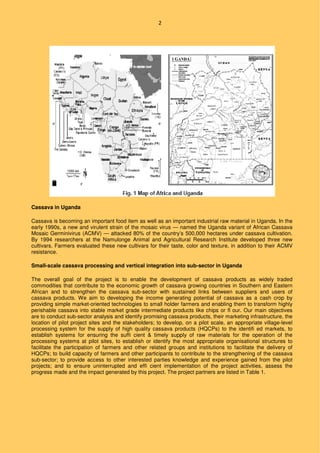
Uganda is a landlocked country astride the equator, about 800 km inland from the Indian Ocean (Fig. 1). It
lies on the northwestern shores of Lake Victoria. The area of Uganda is about 241,551 km2 where about 26.8
million people live. The agricultural sector dominates the Ugandan economy and most industries and services
in the country depend on the agricultural sector. The contribution of agriculture to total GDP was about 33% in
2004.
2
Cassava in Uganda
Cassava is becoming an important food item as well as an important industrial raw material in Uganda. In the
early 1990s, a new and virulent strain of the mosaic virus — named the Uganda variant of African Cassava
Mosaic Germinivirus (ACMV) — attacked 80% of the country’s 500,000 hectares under cassava cultivation.
By 1994 researchers at the Namulonge Animal and Agricultural Research Institute developed three new
cultivars. Farmers evaluated these new cultivars for their taste, color and texture, in addition to their ACMV
resistance.
Small-scale cassava processing and vertical integration into sub-sector in Uganda
The overall goal of the project is to enable the development of cassava products as widely traded
commodities that contribute to the economic growth of cassava growing countries in Southern and Eastern
African and to strengthen the cassava sub-sector with sustained links between suppliers and users of
cassava products. We aim to developing the income generating potential of cassava as a cash crop by
providing simple market-oriented technologies to small holder farmers and enabling them to transform highly
perishable cassava into stable market grade intermediate products like chips or fl our. Our main objectives
are to conduct sub-sector analysis and identify promising cassava products, their marketing infrastructure, the
location of pilot project sites and the stakeholders; to develop, on a pilot scale, an appropriate village-level
processing system for the supply of high quality cassava products (HQCPs) to the identifi ed markets, to
establish systems for ensuring the suffi cient & timely supply of raw materials for the operation of the
processing systems at pilot sites, to establish or identify the most appropriate organisational structures to
facilitate the participation of farmers and other related groups and institutions to facilitate the delivery of
HQCPs; to build capacity of farmers and other participants to contribute to the strengthening of the cassava
sub-sector; to provide access to other interested parties knowledge and experience gained from the pilot
projects; and to ensure uninterrupted and effi cient implementation of the project activities, assess the
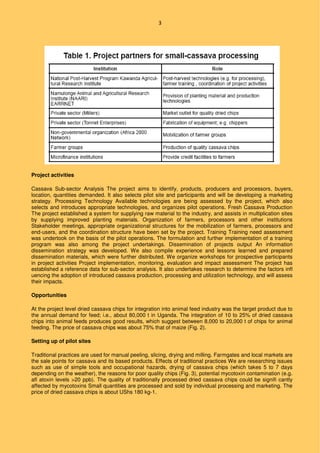
progress made and the impact generated by this project. The project partners are listed in Table 1.
3
Project activities
Cassava Sub-sector Analysis The project aims to identify, products, producers and processors, buyers,
location, quantities demanded. It also selects pilot site and participants and will be developing a marketing
strategy. Processing Technology Available technologies are being assessed by the project, which also
selects and introduces appropriate technologies, and organizes pilot operations. Fresh Cassava Production
The project established a system for supplying raw material to the industry, and assists in multiplication sites
by supplying improved planting materials. Organization of farmers, processors and other institutions
Stakeholder meetings, appropriate organizational structures for the mobilization of farmers, processors and
end-users, and the coordination structure have been set by the project. Training Training need assessment
was undertook on the basis of the pilot operations. The formulation and further implementation of a training
program was also among the project undertakings. Dissemination of projects output An information
dissemination strategy was developed. We also compile experience and lessons learned and prepared
dissemination materials, which were further distributed. We organize workshops for prospective participants
in project activities Project implementation, monitoring, evaluation and impact assessment The project has
established a reference data for sub-sector analysis. It also undertakes research to determine the factors infl
uencing the adoption of introduced cassava production, processing and utilization technology, and will assess
their impacts.
Opportunities
At the project level dried cassava chips for integration into animal feed industry was the target product due to
the annual demand for feed; i.e., about 80,000 t in Uganda. The integration of 10 to 25% of dried cassava
chips into animal feeds produces good results, which suggest between 8,000 to 20,000 t of chips for animal
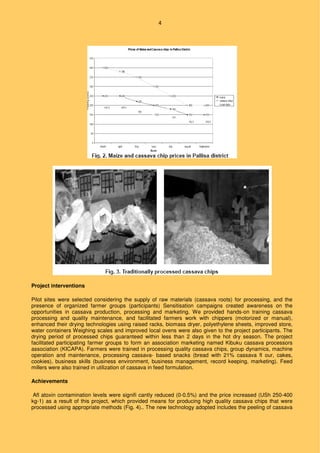
feeding. The price of cassava chips was about 75% that of maize (Fig. 2).
Setting up of pilot sites
Traditional practices are used for manual peeling, slicing, drying and milling. Farmgates and local markets are
the sale points for cassava and its based products. Effects of traditional practices We are researching issues
such as use of simple tools and occupational hazards, drying of cassava chips (which takes 5 to 7 days
depending on the weather), the reasons for poor quality chips (Fig. 3), potential mycotoxin contamination (e.g.
afl atoxin levels >20 ppb). The quality of traditionally processed dried cassava chips could be signifi cantly
affected by mycotoxins Small quantities are processed and sold by individual processing and marketing. The
price of dried cassava chips is about UShs 180 kg-1.
4
Project interventions
Pilot sites were selected considering the supply of raw materials (cassava roots) for processing, and the
presence of organized farmer groups (participants) Sensitisation campaigns created awareness on the
opportunities in cassava production, processing and marketing. We provided hands-on training cassava
processing and quality maintenance, and facilitated farmers work with chippers (motorized or manual),
enhanced their drying technologies using raised racks, biomass dryer, polyethylene sheets, improved store,
water containers Weighing scales and improved local ovens were also given to the project participants. The
drying period of processed chips guaranteed within less than 2 days in the hot dry season. The project
facilitated participating farmer groups to form an association marketing named Kibuku cassava processors
association (KICAPA). Farmers were trained in processing quality cassava chips, group dynamics, machine
operation and maintenance, processing cassava- based snacks (bread with 21% cassava fl our, cakes,
cookies), business skills (business environment, business management, record keeping, marketing). Feed
millers were also trained in utilization of cassava in feed formulation.
Achievements
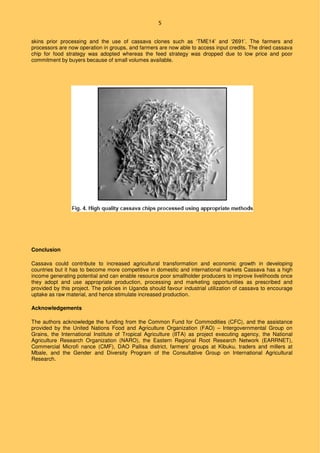
Afl atoxin contamination levels were signifi cantly reduced (0-0.5%) and the price increased (USh 250-400
kg-1) as a result of this project, which provided means for producing high quality cassava chips that were
processed using appropriate methods (Fig. 4).. The new technology adopted includes the peeling of cassava
5
skins prior processing and the use of cassava clones such as ‘TME14’ and ‘2691’. The farmers and
processors are now operation in groups, and farmers are now able to access input credits. The dried cassava
chip for food strategy was adopted whereas the feed strategy was dropped due to low price and poor
commitment by buyers because of small volumes available.
Conclusion
Cassava could contribute to increased agricultural transformation and economic growth in developing
countries but it has to become more competitive in domestic and international markets Cassava has a high
income generating potential and can enable resource poor smallholder producers to improve livelihoods once
they adopt and use appropriate production, processing and marketing opportunities as prescribed and
provided by this project. The policies in Uganda should favour industrial utilization of cassava to encourage
uptake as raw material, and hence stimulate increased production.
Acknowledgements
The authors acknowledge the funding from the Common Fund for Commodities (CFC), and the assistance
provided by the United Nations Food and Agriculture Organization (FAO) – Intergovernmental Group on
Grains, the International Institute of Tropical Agriculture (IITA) as project executing agency, the National
Agriculture Research Organization (NARO), the Eastern Regional Root Research Network (EARRNET),
Commercial Microfi nance (CMF), DAO Pallisa district, farmers’ groups at Kibuku, traders and millers at
Mbale, and the Gender and Diversity Program of the Consultative Group on International Agricultural
Research.

Cassava processing

  • 1.
    1 Small-Scale Cassava Processingand Vertical Integration Into the Cassava Sub-Sector in Uganda by Jane Nabawanuka-Oputa and J.A. Agona National Post Harvest Program Agricultural Research Institute Kampala, Uganda Introduction Uganda is a landlocked country astride the equator, about 800 km inland from the Indian Ocean (Fig. 1). It lies on the northwestern shores of Lake Victoria. The area of Uganda is about 241,551 km2 where about 26.8 million people live. The agricultural sector dominates the Ugandan economy and most industries and services in the country depend on the agricultural sector. The contribution of agriculture to total GDP was about 33% in 2004.
  • 2.
    2 Cassava in Uganda Cassavais becoming an important food item as well as an important industrial raw material in Uganda. In the early 1990s, a new and virulent strain of the mosaic virus — named the Uganda variant of African Cassava Mosaic Germinivirus (ACMV) — attacked 80% of the country’s 500,000 hectares under cassava cultivation. By 1994 researchers at the Namulonge Animal and Agricultural Research Institute developed three new cultivars. Farmers evaluated these new cultivars for their taste, color and texture, in addition to their ACMV resistance. Small-scale cassava processing and vertical integration into sub-sector in Uganda The overall goal of the project is to enable the development of cassava products as widely traded commodities that contribute to the economic growth of cassava growing countries in Southern and Eastern African and to strengthen the cassava sub-sector with sustained links between suppliers and users of cassava products. We aim to developing the income generating potential of cassava as a cash crop by providing simple market-oriented technologies to small holder farmers and enabling them to transform highly perishable cassava into stable market grade intermediate products like chips or fl our. Our main objectives are to conduct sub-sector analysis and identify promising cassava products, their marketing infrastructure, the location of pilot project sites and the stakeholders; to develop, on a pilot scale, an appropriate village-level processing system for the supply of high quality cassava products (HQCPs) to the identifi ed markets, to establish systems for ensuring the suffi cient & timely supply of raw materials for the operation of the processing systems at pilot sites, to establish or identify the most appropriate organisational structures to facilitate the participation of farmers and other related groups and institutions to facilitate the delivery of HQCPs; to build capacity of farmers and other participants to contribute to the strengthening of the cassava sub-sector; to provide access to other interested parties knowledge and experience gained from the pilot projects; and to ensure uninterrupted and effi cient implementation of the project activities, assess the progress made and the impact generated by this project. The project partners are listed in Table 1.
  • 3.
    3 Project activities Cassava Sub-sectorAnalysis The project aims to identify, products, producers and processors, buyers, location, quantities demanded. It also selects pilot site and participants and will be developing a marketing strategy. Processing Technology Available technologies are being assessed by the project, which also selects and introduces appropriate technologies, and organizes pilot operations. Fresh Cassava Production The project established a system for supplying raw material to the industry, and assists in multiplication sites by supplying improved planting materials. Organization of farmers, processors and other institutions Stakeholder meetings, appropriate organizational structures for the mobilization of farmers, processors and end-users, and the coordination structure have been set by the project. Training Training need assessment was undertook on the basis of the pilot operations. The formulation and further implementation of a training program was also among the project undertakings. Dissemination of projects output An information dissemination strategy was developed. We also compile experience and lessons learned and prepared dissemination materials, which were further distributed. We organize workshops for prospective participants in project activities Project implementation, monitoring, evaluation and impact assessment The project has established a reference data for sub-sector analysis. It also undertakes research to determine the factors infl uencing the adoption of introduced cassava production, processing and utilization technology, and will assess their impacts. Opportunities At the project level dried cassava chips for integration into animal feed industry was the target product due to the annual demand for feed; i.e., about 80,000 t in Uganda. The integration of 10 to 25% of dried cassava chips into animal feeds produces good results, which suggest between 8,000 to 20,000 t of chips for animal feeding. The price of cassava chips was about 75% that of maize (Fig. 2). Setting up of pilot sites Traditional practices are used for manual peeling, slicing, drying and milling. Farmgates and local markets are the sale points for cassava and its based products. Effects of traditional practices We are researching issues such as use of simple tools and occupational hazards, drying of cassava chips (which takes 5 to 7 days depending on the weather), the reasons for poor quality chips (Fig. 3), potential mycotoxin contamination (e.g. afl atoxin levels >20 ppb). The quality of traditionally processed dried cassava chips could be signifi cantly affected by mycotoxins Small quantities are processed and sold by individual processing and marketing. The price of dried cassava chips is about UShs 180 kg-1.
  • 4.
    4 Project interventions Pilot siteswere selected considering the supply of raw materials (cassava roots) for processing, and the presence of organized farmer groups (participants) Sensitisation campaigns created awareness on the opportunities in cassava production, processing and marketing. We provided hands-on training cassava processing and quality maintenance, and facilitated farmers work with chippers (motorized or manual), enhanced their drying technologies using raised racks, biomass dryer, polyethylene sheets, improved store, water containers Weighing scales and improved local ovens were also given to the project participants. The drying period of processed chips guaranteed within less than 2 days in the hot dry season. The project facilitated participating farmer groups to form an association marketing named Kibuku cassava processors association (KICAPA). Farmers were trained in processing quality cassava chips, group dynamics, machine operation and maintenance, processing cassava- based snacks (bread with 21% cassava fl our, cakes, cookies), business skills (business environment, business management, record keeping, marketing). Feed millers were also trained in utilization of cassava in feed formulation. Achievements Afl atoxin contamination levels were signifi cantly reduced (0-0.5%) and the price increased (USh 250-400 kg-1) as a result of this project, which provided means for producing high quality cassava chips that were processed using appropriate methods (Fig. 4).. The new technology adopted includes the peeling of cassava
  • 5.
    5 skins prior processingand the use of cassava clones such as ‘TME14’ and ‘2691’. The farmers and processors are now operation in groups, and farmers are now able to access input credits. The dried cassava chip for food strategy was adopted whereas the feed strategy was dropped due to low price and poor commitment by buyers because of small volumes available. Conclusion Cassava could contribute to increased agricultural transformation and economic growth in developing countries but it has to become more competitive in domestic and international markets Cassava has a high income generating potential and can enable resource poor smallholder producers to improve livelihoods once they adopt and use appropriate production, processing and marketing opportunities as prescribed and provided by this project. The policies in Uganda should favour industrial utilization of cassava to encourage uptake as raw material, and hence stimulate increased production. Acknowledgements The authors acknowledge the funding from the Common Fund for Commodities (CFC), and the assistance provided by the United Nations Food and Agriculture Organization (FAO) – Intergovernmental Group on Grains, the International Institute of Tropical Agriculture (IITA) as project executing agency, the National Agriculture Research Organization (NARO), the Eastern Regional Root Research Network (EARRNET), Commercial Microfi nance (CMF), DAO Pallisa district, farmers’ groups at Kibuku, traders and millers at Mbale, and the Gender and Diversity Program of the Consultative Group on International Agricultural Research.