PAGE 1 | MADE CASE STUDYPAGE 1 | MADE CASE STUDY
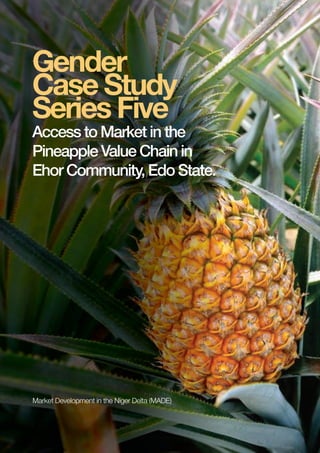
Gender
Case Study
Series Five
Access to Market in the
Pineapple Value Chain in
Ehor Community, Edo State.
Market Development in the Niger Delta (MADE)
PAGE 2 | MADE CASE STUDY
Background and
Overview of the Pineapple
Intervention
One of the banes of women’s economic empowerment
across agricultural value chains (as in other
entrepreneurship endeavours), has been limited
access to market. This of course is not unconnected
to the systemic patriarchal culture that limits women’s
access to resources, information, mobility and other
avenues that will ease access to markets. Thus, Access
to Market for Rural Producers is a key strategy of
MADE aimed at facilitating linkages between farmers
across value chains to aggregators and off-takers. The
pineapple farmers came in contact with Hills Harvest,
an agribusiness supply chain company based in Lagos
who was invited by MADE into Edo State to explore
sourcing opportunities for crops with comparative
advantage within the state including pineapple. Hills
harvest identified and mapped the pineapple farmers
within the state including the women pineapple farmers
in Ehor community. Hills Harvest trained the women on
on post-harvest handling of pineapple so as to reduce
post-harvest losses and to enable them meet offtakers’
requirements. With this improved knowledge, the
farmers were able to supply over 500 tons of pineapple
to Hills Harvest through its local aggregator and with at
least 20 women farmers benefiting from offtakers.
Gender Barriers and Norms
in the Context Of WEE
As with other sampled communities and across value
chains, the gender dynamics reflect male domination
in major decision-making roles. Although men are in
charge, there is largely a peaceful relationship in the
domestic sphere as the men listen to the advice of their
wives. As in other agricultural contexts under review,
deeply rooted culture has a significant influence in
economic livelihoods in the Ehor community. According
to the FGD participants, most women work and provide
for the home more than the men, though, the men
control the usage of the finance (this is similar to the
other experiences under review). There are no formal
laws restricting women from agricultural business.
However, due to cultural dynamics, men have easy
access to farmland either through inheritance or they
acquire it with their money (and they have more access
to finance than the women). To navigate this barrier, the
women would mostly look for land to lease between
3-5yrs or more, depending on the financial capacity of
the woman. Most of the women in Ehor are using their
husband’s farmland. Pineapple farming requires more
strength hence women pay for labourers while men
can easily handle the labour in their farmland. They
pay between 80,000 – 120,000 naira to labourers. So,
in addition to the gender dynamics, there are also the
physiological limitations faced by the women.
In terms of the power dynamics involved in economic
decision making in the home, the man largely decides
for the home on how money is spent because most of
the women assist their husband to sell their harvest
and some of them also use their husbands’ farmland.
However, the women that have their own personal
farmland and also pay labourers to work on the farm
seem to have more financial control over their finances
than the women who are largely dependent on their
husbands’ farmland or lease. So, this explains the fact
that access to, and ownership of, means of production
across value chains determine the level of women’s
economic decision-making strength.
GENDER CASE STUDY SERIES FIVE
Access to Market in the Pineapple Value Chain in
Ehor Community, Edo State.
PAGE 3 | MADE CASE STUDY
But in general, men have the final control as one of
the key informant pineapple farm owner asserted “No
matter the money a woman has made for herself the
man has the disbursement power over the money.”
Regarding the gender dynamics and decision-making
in the market, the men cultivate and the women plant
andharvest.Alongtheline,whilethemenarecultivating
tubers the women spice the land with legumes. In Ehor,
cocoyam, yams, pineapple, etc. are called ‘men crops’
whiletomatoes,pepper,okra,vegetables,etc.arecalled
‘women crops’. The men crops are obviously the more
lucrative ones. Most men support their women during
cultivation but the single women face all the farming
expenses on their own and there is a comparative
variation in their harvest. For instance, one of the FGD
participants revealed that when her husband was alive,
she would normally harvest between 15 – 20 dozens of
pineapple daily because the house responsibility was
not solely on her but when she lost her husband and
responsibility increased, she had to harvest between
100 – 130 dozens of pineapple daily to meet the
domestic demands.
The women are engaged largely in taking the farm
products to the market to sell but according to one of
the FGD participants (and validated by the others) “the
men collect the money after sales and decide what
happens to the money.”
The Intervention with
MADE Nigeria:
Benefits of the Approach
As a result of the initial meeting with MADE and having
benefited from the sensitisation talk, the pineapple
farmers in Ehor community were linked to Hill Harvest
off-taker and this linkage proved quite beneficial to the
farmers. In line with MADE’s M4P market approach,
MADE helped to facilitate access to market for the
farmers as well as build their capacity in agricultural
best management practices.
Transformations and
Persistent Challenges
The access to market linkage by MADE was very useful
and strategic because after the linkage, each pineapple
farmer harvested between 70-180 dozens of pineapple
daily during pineapple season. Bearing in mind the fact
that the market in Ehor is normally saturated, getting
guaranteed buyers from other locations helped them
increase their sales. In terms of how they benefited
from this access to market linkage, they highlighted the
following –
•	 Products are harvested and sold directly from
the farm, hence stress of moving large products
has stopped;
•	 Cost [5000-8000 naira] of transporting
products from farm to market has been saved;
•	 Sales have improved significantly as large
quantity of pineapples is off taken by Hill
Harvest (albeit not regular). This is due to
the fact that the quantity harvested has to be
sufficiently large for Hills Harvest to fill a truck
and off-take;
•	 Reduced market loss;
•	 The pineapples are sold fresher than before.
However, there were a couple of challenges
encountered in the access to market intervention.
These include the fact that Hill Harvest did not give
quantity specification hence pineapple farmers
encountered product wastage. The issue of wastage is
usually a significant drawback for women’s economic
empowerment across agricultural value chains and
requires mitigation strategies at the onset of the
respective value chain intervention. Also, off taking
was not regular with Hill Harvest, hence the lack of
consistency meant that the women sold to another
independent buyer but likely at a lower price. It also
meant that some other women they tried to mobilise/
sensitise lost interest.
PAGE 3 | MADE CASE STUDY
PAGE 4 | MADE CASE STUDY
Conclusions
In terms of how the market approach can be replicated in other communities, it was suggested that the visibility of
the Ehor success can encourage replication in other communities but not without regular off-taking strategies. Also,
a pineapple demo plot on the importance of fertilizer and how it can be applied will bring about success stories.
Further suggestions include:
• Hill Harvest should off-take regularly. They should also specify and agree minimum quantity for offtake in
order to manage expectations of the women;
• The quantity needed by Hill Harvest should be made known to the farmers before coming for off-take to
avoid wastage or spoilage;
• MADE should help identify more off-takers e.g. Fruit juice processing factories. However, as further
gathered from MADE, Hills Harvest is in the process of acquiring the local pineapple plant factory in Ehor
where the pineapples will be processed;
• Linkages to financial support to acquire more labourers and farmland;
• MADE should advocate for government to finalize plans to open the factory they built in Ehor. Further
information from MADE in the context of this recommendation, revealed that the factory was acquired by
an individual investor who got a loan using the property. The factory became moribund after a number of
operations. It is presently (as of the time of the report under review) in the care of the Asset Management
Corporation of Nigeria (AMCON) who has received a request for the purchase/change of ownership by
Hills Harvest.
Access to market is no doubt a huge factor in women’s economic empowerment, and the Pineapple case study
has demonstrated the importance of this strategy. There will be need to expand this initiative/model for a wider
outreach.
PAGE 5 | MADE CASE STUDY

Gender case five

  • 1.
    PAGE 1 |MADE CASE STUDYPAGE 1 | MADE CASE STUDY Gender Case Study Series Five Access to Market in the Pineapple Value Chain in Ehor Community, Edo State. Market Development in the Niger Delta (MADE)
  • 2.
    PAGE 2 |MADE CASE STUDY Background and Overview of the Pineapple Intervention One of the banes of women’s economic empowerment across agricultural value chains (as in other entrepreneurship endeavours), has been limited access to market. This of course is not unconnected to the systemic patriarchal culture that limits women’s access to resources, information, mobility and other avenues that will ease access to markets. Thus, Access to Market for Rural Producers is a key strategy of MADE aimed at facilitating linkages between farmers across value chains to aggregators and off-takers. The pineapple farmers came in contact with Hills Harvest, an agribusiness supply chain company based in Lagos who was invited by MADE into Edo State to explore sourcing opportunities for crops with comparative advantage within the state including pineapple. Hills harvest identified and mapped the pineapple farmers within the state including the women pineapple farmers in Ehor community. Hills Harvest trained the women on on post-harvest handling of pineapple so as to reduce post-harvest losses and to enable them meet offtakers’ requirements. With this improved knowledge, the farmers were able to supply over 500 tons of pineapple to Hills Harvest through its local aggregator and with at least 20 women farmers benefiting from offtakers. Gender Barriers and Norms in the Context Of WEE As with other sampled communities and across value chains, the gender dynamics reflect male domination in major decision-making roles. Although men are in charge, there is largely a peaceful relationship in the domestic sphere as the men listen to the advice of their wives. As in other agricultural contexts under review, deeply rooted culture has a significant influence in economic livelihoods in the Ehor community. According to the FGD participants, most women work and provide for the home more than the men, though, the men control the usage of the finance (this is similar to the other experiences under review). There are no formal laws restricting women from agricultural business. However, due to cultural dynamics, men have easy access to farmland either through inheritance or they acquire it with their money (and they have more access to finance than the women). To navigate this barrier, the women would mostly look for land to lease between 3-5yrs or more, depending on the financial capacity of the woman. Most of the women in Ehor are using their husband’s farmland. Pineapple farming requires more strength hence women pay for labourers while men can easily handle the labour in their farmland. They pay between 80,000 – 120,000 naira to labourers. So, in addition to the gender dynamics, there are also the physiological limitations faced by the women. In terms of the power dynamics involved in economic decision making in the home, the man largely decides for the home on how money is spent because most of the women assist their husband to sell their harvest and some of them also use their husbands’ farmland. However, the women that have their own personal farmland and also pay labourers to work on the farm seem to have more financial control over their finances than the women who are largely dependent on their husbands’ farmland or lease. So, this explains the fact that access to, and ownership of, means of production across value chains determine the level of women’s economic decision-making strength. GENDER CASE STUDY SERIES FIVE Access to Market in the Pineapple Value Chain in Ehor Community, Edo State.
  • 3.
    PAGE 3 |MADE CASE STUDY But in general, men have the final control as one of the key informant pineapple farm owner asserted “No matter the money a woman has made for herself the man has the disbursement power over the money.” Regarding the gender dynamics and decision-making in the market, the men cultivate and the women plant andharvest.Alongtheline,whilethemenarecultivating tubers the women spice the land with legumes. In Ehor, cocoyam, yams, pineapple, etc. are called ‘men crops’ whiletomatoes,pepper,okra,vegetables,etc.arecalled ‘women crops’. The men crops are obviously the more lucrative ones. Most men support their women during cultivation but the single women face all the farming expenses on their own and there is a comparative variation in their harvest. For instance, one of the FGD participants revealed that when her husband was alive, she would normally harvest between 15 – 20 dozens of pineapple daily because the house responsibility was not solely on her but when she lost her husband and responsibility increased, she had to harvest between 100 – 130 dozens of pineapple daily to meet the domestic demands. The women are engaged largely in taking the farm products to the market to sell but according to one of the FGD participants (and validated by the others) “the men collect the money after sales and decide what happens to the money.” The Intervention with MADE Nigeria: Benefits of the Approach As a result of the initial meeting with MADE and having benefited from the sensitisation talk, the pineapple farmers in Ehor community were linked to Hill Harvest off-taker and this linkage proved quite beneficial to the farmers. In line with MADE’s M4P market approach, MADE helped to facilitate access to market for the farmers as well as build their capacity in agricultural best management practices. Transformations and Persistent Challenges The access to market linkage by MADE was very useful and strategic because after the linkage, each pineapple farmer harvested between 70-180 dozens of pineapple daily during pineapple season. Bearing in mind the fact that the market in Ehor is normally saturated, getting guaranteed buyers from other locations helped them increase their sales. In terms of how they benefited from this access to market linkage, they highlighted the following – • Products are harvested and sold directly from the farm, hence stress of moving large products has stopped; • Cost [5000-8000 naira] of transporting products from farm to market has been saved; • Sales have improved significantly as large quantity of pineapples is off taken by Hill Harvest (albeit not regular). This is due to the fact that the quantity harvested has to be sufficiently large for Hills Harvest to fill a truck and off-take; • Reduced market loss; • The pineapples are sold fresher than before. However, there were a couple of challenges encountered in the access to market intervention. These include the fact that Hill Harvest did not give quantity specification hence pineapple farmers encountered product wastage. The issue of wastage is usually a significant drawback for women’s economic empowerment across agricultural value chains and requires mitigation strategies at the onset of the respective value chain intervention. Also, off taking was not regular with Hill Harvest, hence the lack of consistency meant that the women sold to another independent buyer but likely at a lower price. It also meant that some other women they tried to mobilise/ sensitise lost interest. PAGE 3 | MADE CASE STUDY
  • 4.
    PAGE 4 |MADE CASE STUDY Conclusions In terms of how the market approach can be replicated in other communities, it was suggested that the visibility of the Ehor success can encourage replication in other communities but not without regular off-taking strategies. Also, a pineapple demo plot on the importance of fertilizer and how it can be applied will bring about success stories. Further suggestions include: • Hill Harvest should off-take regularly. They should also specify and agree minimum quantity for offtake in order to manage expectations of the women; • The quantity needed by Hill Harvest should be made known to the farmers before coming for off-take to avoid wastage or spoilage; • MADE should help identify more off-takers e.g. Fruit juice processing factories. However, as further gathered from MADE, Hills Harvest is in the process of acquiring the local pineapple plant factory in Ehor where the pineapples will be processed; • Linkages to financial support to acquire more labourers and farmland; • MADE should advocate for government to finalize plans to open the factory they built in Ehor. Further information from MADE in the context of this recommendation, revealed that the factory was acquired by an individual investor who got a loan using the property. The factory became moribund after a number of operations. It is presently (as of the time of the report under review) in the care of the Asset Management Corporation of Nigeria (AMCON) who has received a request for the purchase/change of ownership by Hills Harvest. Access to market is no doubt a huge factor in women’s economic empowerment, and the Pineapple case study has demonstrated the importance of this strategy. There will be need to expand this initiative/model for a wider outreach.
  • 5.
    PAGE 5 |MADE CASE STUDY