Cassandra - lesson learned
Andrzej Ludwikowski
About me?
- http://aludwikowski.blogspot.com/
- https://github.com/aludwiko
- @aludwikowski
- SoftwareMill
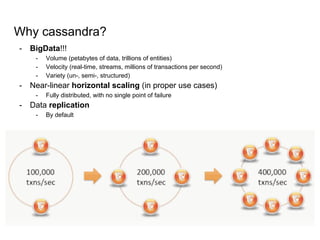
Why cassandra?
- BigData!!!
- Volume (petabytes of data, trillions of entities)
- Velocity (real-time, streams, millions of transactions per second)
- Variety (un-, semi-, structured)
- Near-linear horizontal scaling (in proper use cases)
- Fully distributed, with no single point of failure
- Data replication
- By default
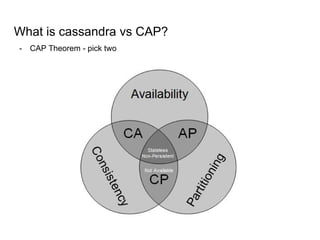
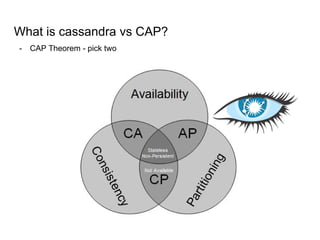
What is cassandra vs CAP?
- CAP Theorem - pick two
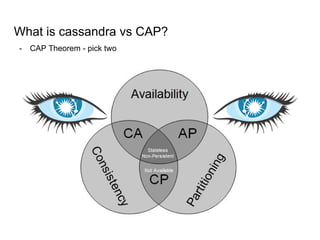
What is cassandra vs CAP?
- CAP Theorem - pick two
What is cassandra vs CAP?
- CAP Theorem - pick two
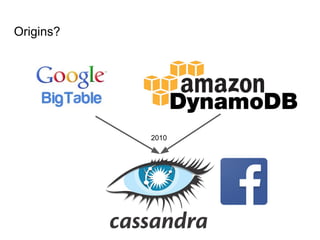
Origins?
2010
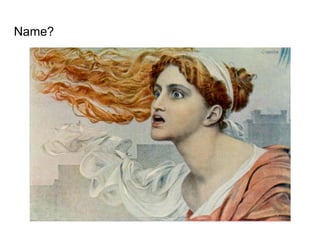
Name?
Name?
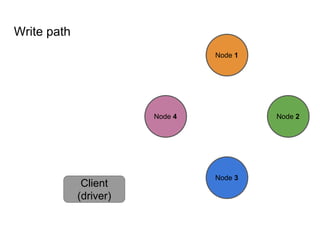
Write path
Node 1
Node 2
Node 3
Node 4
Client
(driver)
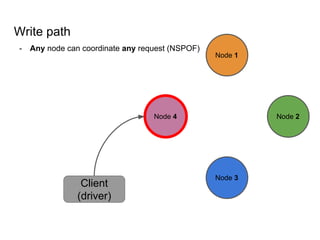
Write path
Node 1
Node 2
Node 3
Node 4
Client
(driver)
- Any node can coordinate any request (NSPOF)
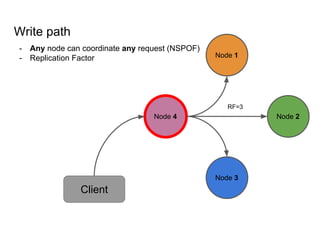
- Replication Factor
Write path
Node 1
Node 2
Node 3
Node 4
Client
RF=3
- Any node can coordinate any request (NSPOF)
- Replication Factor
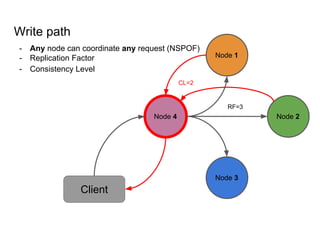
- Consistency Level
Write path
Node 1
Node 2
Node 3
Node 4
Client
RF=3
CL=2
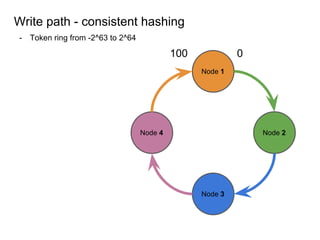
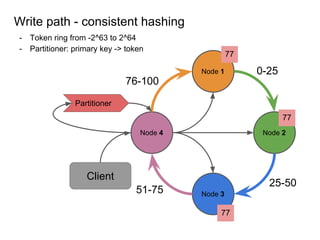
- Token ring from -2^63 to 2^64
Write path - consistent hashing
Node 1
Node 2
Node 3
Node 4
0100
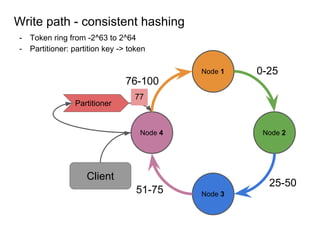
- Token ring from -2^63 to 2^64
- Partitioner: partition key -> token
Write path - consistent hashing
Node 1
Node 2
Node 3
Node 4
Client
Partitioner
0-25
25-50
51-75
76-100
77
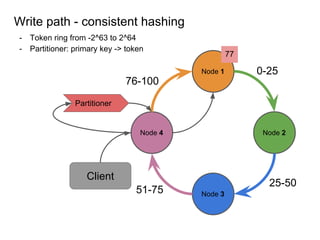
- Token ring from -2^63 to 2^64
- Partitioner: primary key -> token
Write path - consistent hashing
Node 1
Node 2
Node 3
Node 4
Client
Partitioner
0-25
25-50
51-75
76-100
77
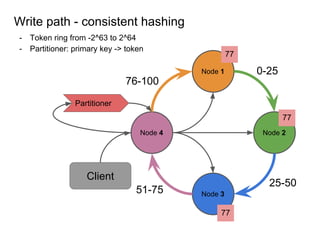
- Token ring from -2^63 to 2^64
- Partitioner: primary key -> token
Write path - consistent hashing
Node 1
Node 2
Node 3
Node 4
Client
Partitioner
0-25
25-50
51-75
76-100
77
77
77
- Token ring from -2^63 to 2^64
- Partitioner: primary key -> token
Write path - consistent hashing
Node 1
Node 2
Node 3
Node 4
Client
0-25
Partitioner
77
25-50
51-75
76-100
77
77
DEMO
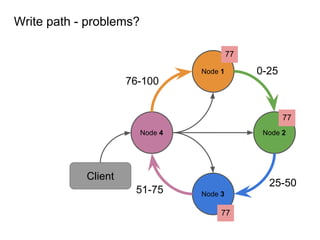
Write path - problems?
Node 1
Node 2
Node 3
Node 4
Client
0-25
77
25-50
51-75
76-100
77
77
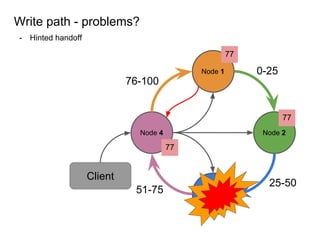
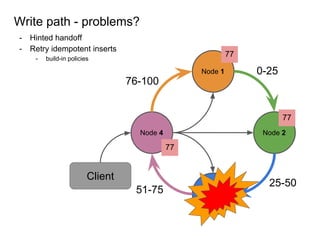
- Hinted handoff
Write path - problems?
Node 1
Node 2
Node 3
Node 4
Client
0-25
77
25-50
51-75
76-100
77
77
- Hinted handoff
- Retry idempotent inserts
- build-in policies
Write path - problems?
Node 1
Node 2
Node 3
Node 4
Client
0-25
77
25-50
51-75
76-100
77
77
- Hinted handoff
- Retry idempotent inserts
- build-in policies
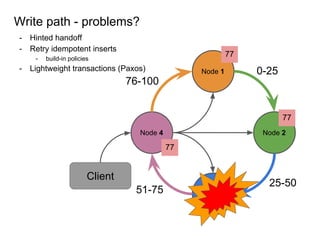
- Lightweight transactions (Paxos)
Write path - problems?
Node 1
Node 2
Node 3
Node 4
Client
0-25
77
25-50
51-75
76-100
77
77
- Hinted handoff
- Retry idempotent inserts
- build-in policies
- Lightweight transactions (Paxos)
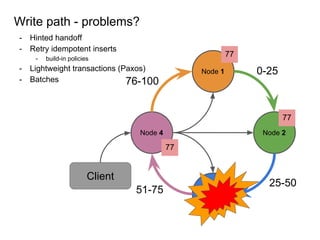
- Batches
Write path - problems?
Node 1
Node 2
Node 3
Node 4
Client
0-25
77
25-50
51-75
76-100
77
77
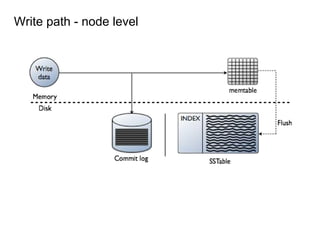
Write path - node level
Write path - why so fast?
- Commit log - append only
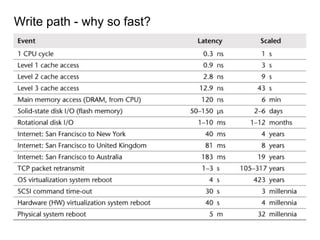
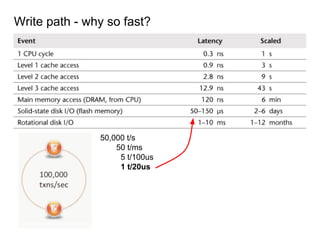
Write path - why so fast?
50,000 t/s
50 t/ms
5 t/100us
1 t/20us
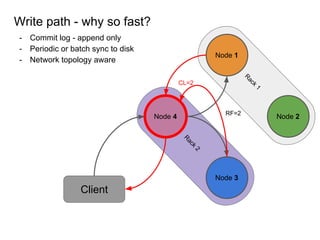
Write path - why so fast?
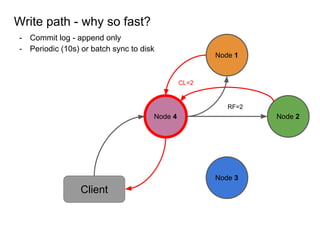
- Commit log - append only
- Periodic (10s) or batch sync to disk
Node 1
Node 2
Node 3
Node 4
Client
RF=2
CL=2
D
asdd
R
ack
2
R
ack
1
Write path - why so fast?
- Commit log - append only
- Periodic or batch sync to disk
- Network topology aware
Node 1
Node 2
Node 3
Node 4
Client
RF=2
CL=2
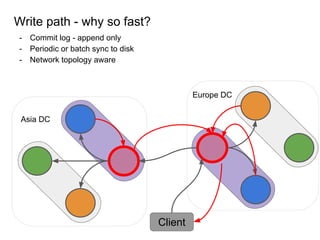
Write path - why so fast?
Client
- Commit log - append only
- Periodic or batch sync to disk
- Network topology aware
Asia DC
Europe DC
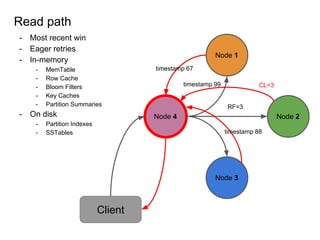
- Most recent win
- Eager retries
- In-memory
- MemTable
- Row Cache
- Bloom Filters
- Key Caches
- Partition Summaries
- On disk
- Partition Indexes
- SSTables
Node 1
Node 2
Node 3
Node 4
Client
RF=3
CL=3
Read path
timestamp 67
timestamp 99
timestamp 88
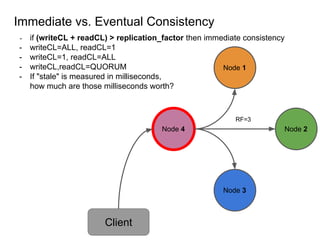
Immediate vs. Eventual Consistency
- if (writeCL + readCL) > replication_factor then immediate consistency
- writeCL=ALL, readCL=1
- writeCL=1, readCL=ALL
- writeCL,readCL=QUORUM
- If "stale" is measured in milliseconds,
how much are those milliseconds worth?
Node 1
Node 2
Node 3
Node 4
Client
RF=3
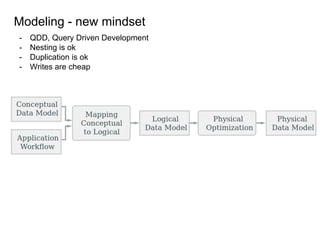
Modeling - new mindset
- QDD, Query Driven Development
- Nesting is ok
- Duplication is ok
- Writes are cheap
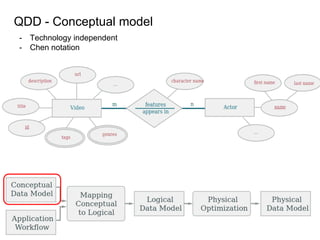
QDD - Conceptual model
- Technology independent
- Chen notation
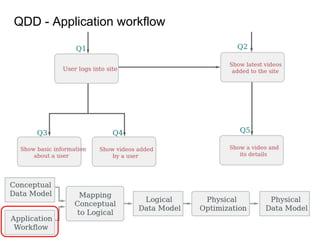
QDD - Application workflow
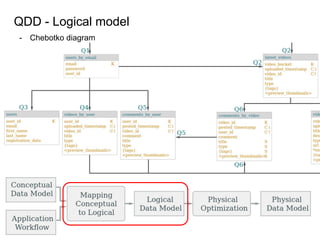
QDD - Logical model
- Chebotko diagram
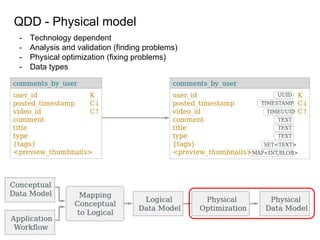
QDD - Physical model
- Technology dependent
- Analysis and validation (finding problems)
- Physical optimization (fixing problems)
- Data types
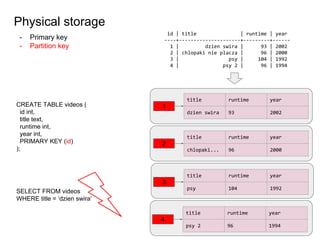
Physical storage
- Primary key
- Partition key
CREATE TABLE videos (
id int,
title text,
runtime int,
year int,
PRIMARY KEY (id)
);
id | title | runtime | year
----+---------------------+---------+------
1 | dzien swira | 93 | 2002
2 | chlopaki nie placza | 96 | 2000
3 | psy | 104 | 1992
4 | psy 2 | 96 | 1994
1
title runtime year
dzien swira 93 2002
2
title runtime year
chlopaki... 96 2000
3
title runtime year
psy 104 1992
4
title runtime year
psy 2 96 1994
SELECT FROM videos
WHERE title = ‘dzien swira’
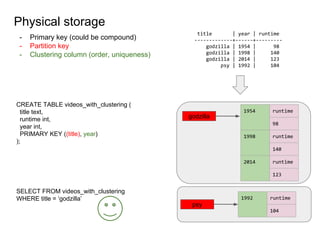
Physical storage
CREATE TABLE videos_with_clustering (
title text,
runtime int,
year int,
PRIMARY KEY ((title), year)
);
- Primary key (could be compound)
- Partition key
- Clustering column (order, uniqueness)
title | year | runtime
-------------+------+---------
godzilla | 1954 | 98
godzilla | 1998 | 140
godzilla | 2014 | 123
psy | 1992 | 104
godzilla
1954 runtime
98
1998 runtime
140
2014 runtime
123
1992 runtime
104
psy
SELECT FROM videos_with_clustering
WHERE title = ‘godzilla’
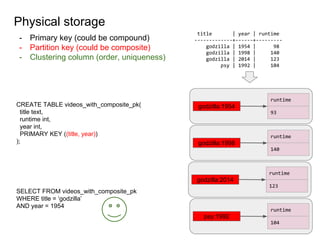
Physical storage
CREATE TABLE videos_with_composite_pk(
title text,
runtime int,
year int,
PRIMARY KEY ((title, year))
);
- Primary key (could be compound)
- Partition key (could be composite)
- Clustering column (order, uniqueness)
title | year | runtime
-------------+------+---------
godzilla | 1954 | 98
godzilla | 1998 | 140
godzilla | 2014 | 123
psy | 1992 | 104
godzilla:1954
runtime
93
godzilla:1998
runtime
140
godzilla:2014
runtime
123
psy:1992
runtime
104
SELECT FROM videos_with_composite_pk
WHERE title = ‘godzilla’
AND year = 1954
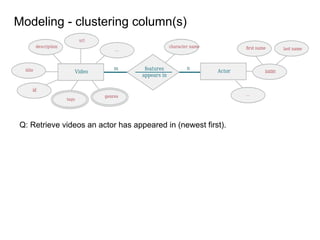
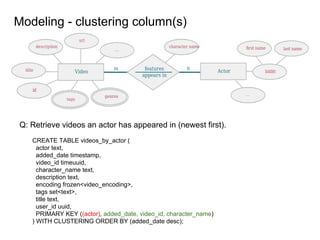
Modeling - clustering column(s)
Q: Retrieve videos an actor has appeared in (newest first).
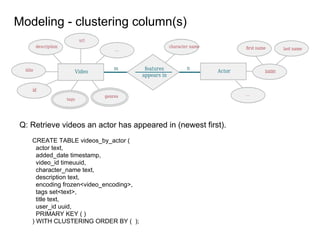
Modeling - clustering column(s)
CREATE TABLE videos_by_actor (
actor text,
added_date timestamp,
video_id timeuuid,
character_name text,
description text,
encoding frozen<video_encoding>,
tags set<text>,
title text,
user_id uuid,
PRIMARY KEY ( )
) WITH CLUSTERING ORDER BY ( );
Q: Retrieve videos an actor has appeared in (newest first).
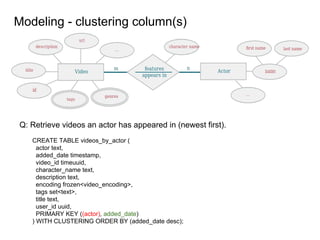
Modeling - clustering column(s)
CREATE TABLE videos_by_actor (
actor text,
added_date timestamp,
video_id timeuuid,
character_name text,
description text,
encoding frozen<video_encoding>,
tags set<text>,
title text,
user_id uuid,
PRIMARY KEY ((actor), added_date)
) WITH CLUSTERING ORDER BY (added_date desc);
Q: Retrieve videos an actor has appeared in (newest first).
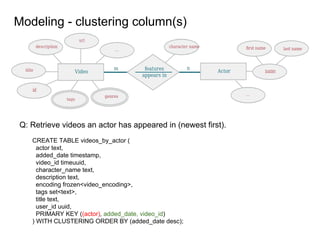
Modeling - clustering column(s)
CREATE TABLE videos_by_actor (
actor text,
added_date timestamp,
video_id timeuuid,
character_name text,
description text,
encoding frozen<video_encoding>,
tags set<text>,
title text,
user_id uuid,
PRIMARY KEY ((actor), added_date, video_id)
) WITH CLUSTERING ORDER BY (added_date desc);
Q: Retrieve videos an actor has appeared in (newest first).
Modeling - clustering column(s)
CREATE TABLE videos_by_actor (
actor text,
added_date timestamp,
video_id timeuuid,
character_name text,
description text,
encoding frozen<video_encoding>,
tags set<text>,
title text,
user_id uuid,
PRIMARY KEY ((actor), added_date, video_id, character_name)
) WITH CLUSTERING ORDER BY (added_date desc);
Q: Retrieve videos an actor has appeared in (newest first).
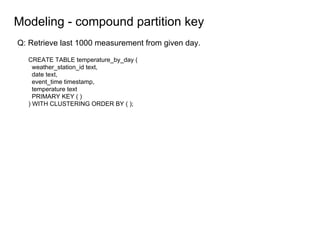
Modeling - compound partition key
CREATE TABLE temperature_by_day (
weather_station_id text,
date text,
event_time timestamp,
temperature text
PRIMARY KEY ( )
) WITH CLUSTERING ORDER BY ( );
Q: Retrieve last 1000 measurement from given day.
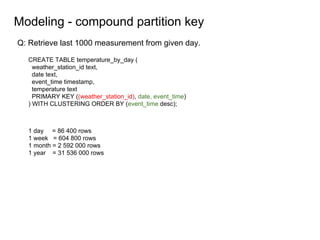
Modeling - compound partition key
CREATE TABLE temperature_by_day (
weather_station_id text,
date text,
event_time timestamp,
temperature text
PRIMARY KEY ((weather_station_id), date, event_time)
) WITH CLUSTERING ORDER BY (event_time desc);
Q: Retrieve last 1000 measurement from given day.
1 day = 86 400 rows
1 week = 604 800 rows
1 month = 2 592 000 rows
1 year = 31 536 000 rows
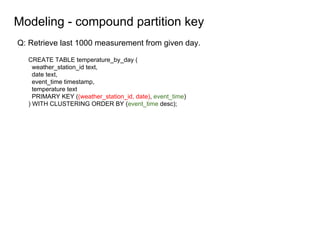
Modeling - compound partition key
CREATE TABLE temperature_by_day (
weather_station_id text,
date text,
event_time timestamp,
temperature text
PRIMARY KEY ((weather_station_id, date), event_time)
) WITH CLUSTERING ORDER BY (event_time desc);
Q: Retrieve last 1000 measurement from given day.
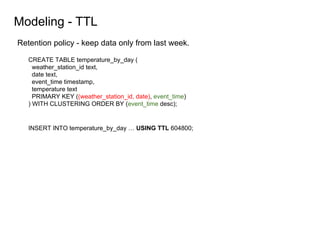
Modeling - TTL
CREATE TABLE temperature_by_day (
weather_station_id text,
date text,
event_time timestamp,
temperature text
PRIMARY KEY ((weather_station_id, date), event_time)
) WITH CLUSTERING ORDER BY (event_time desc);
Retention policy - keep data only from last week.
INSERT INTO temperature_by_day … USING TTL 604800;
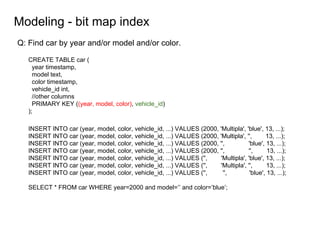
Modeling - bit map index
CREATE TABLE car (
year timestamp,
model text,
color timestamp,
vehicle_id int,
//other columns
PRIMARY KEY ((year, model, color), vehicle_id)
);
Q: Find car by year and/or model and/or color.
INSERT INTO car (year, model, color, vehicle_id, ...) VALUES (2000, 'Multipla', 'blue', 13, ...);
INSERT INTO car (year, model, color, vehicle_id, ...) VALUES (2000, 'Multipla', '', 13, ...);
INSERT INTO car (year, model, color, vehicle_id, ...) VALUES (2000, '', 'blue', 13, ...);
INSERT INTO car (year, model, color, vehicle_id, ...) VALUES (2000, '', '', 13, ...);
INSERT INTO car (year, model, color, vehicle_id, ...) VALUES ('', 'Multipla', 'blue', 13, ...);
INSERT INTO car (year, model, color, vehicle_id, ...) VALUES ('', 'Multipla', '', 13, ...);
INSERT INTO car (year, model, color, vehicle_id, ...) VALUES ('', '', 'blue', 13, ...);
SELECT * FROM car WHERE year=2000 and model=’’ and color=’blue’;
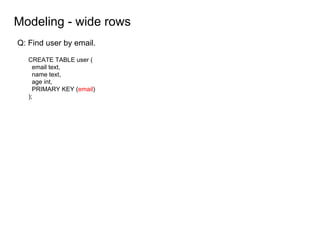
Modeling - wide rows
CREATE TABLE user (
email text,
name text,
age int,
PRIMARY KEY (email)
);
Q: Find user by email.
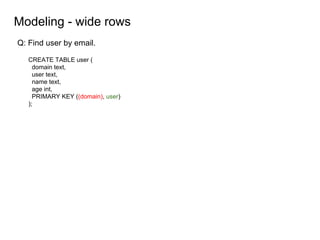
Modeling - wide rows
CREATE TABLE user (
domain text,
user text,
name text,
age int,
PRIMARY KEY ((domain), user)
);
Q: Find user by email.
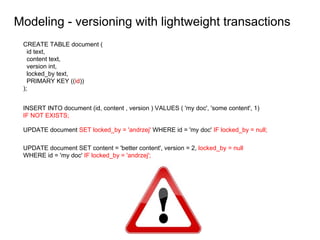
Modeling - versioning with lightweight transactions
CREATE TABLE document (
id text,
content text,
version int,
locked_by text,
PRIMARY KEY ((id))
);
INSERT INTO document (id, content , version ) VALUES ( 'my doc', 'some content', 1)
IF NOT EXISTS;
UPDATE document SET locked_by = 'andrzej' WHERE id = 'my doc' IF locked_by = null;
UPDATE document SET content = 'better content', version = 2, locked_by = null
WHERE id = 'my doc' IF locked_by = 'andrzej';
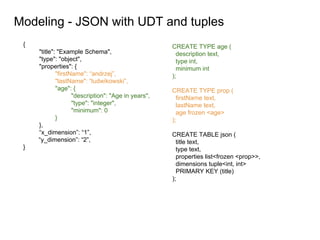
Modeling - JSON with UDT and tuples
{
"title": "Example Schema",
"type": "object",
"properties": {
"firstName": “andrzej”,
"lastName": “ludwikowski”,
"age": {
"description": "Age in years",
"type": "integer",
"minimum": 0
}
},
“x_dimension”: “1”,
“y_dimension”: “2”,
}
CREATE TYPE age (
description text,
type int,
minimum int
);
CREATE TYPE prop (
firstName text,
lastName text,
age frozen <age>
);
CREATE TABLE json (
title text,
type text,
properties list<frozen <prop>>,
dimensions tuple<int, int>
PRIMARY KEY (title)
);
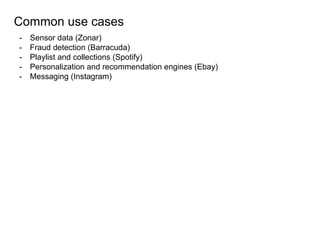
Common use cases
- Sensor data (Zonar)
- Fraud detection (Barracuda)
- Playlist and collections (Spotify)
- Personalization and recommendation engines (Ebay)
- Messaging (Instagram)
Common anti use cases
- Queue
- Search engine
Cassandra  - lesson learned

Cassandra - lesson learned

  • 1.
    Cassandra - lessonlearned Andrzej Ludwikowski
  • 2.
    About me? - http://aludwikowski.blogspot.com/ -https://github.com/aludwiko - @aludwikowski - SoftwareMill
  • 3.
    Why cassandra? - BigData!!! -Volume (petabytes of data, trillions of entities) - Velocity (real-time, streams, millions of transactions per second) - Variety (un-, semi-, structured) - Near-linear horizontal scaling (in proper use cases) - Fully distributed, with no single point of failure - Data replication - By default
  • 4.
    What is cassandravs CAP? - CAP Theorem - pick two
  • 5.
    What is cassandravs CAP? - CAP Theorem - pick two
  • 6.
    What is cassandravs CAP? - CAP Theorem - pick two
  • 7.
  • 8.
  • 9.
  • 10.
    Write path Node 1 Node2 Node 3 Node 4 Client (driver)
  • 11.
    Write path Node 1 Node2 Node 3 Node 4 Client (driver) - Any node can coordinate any request (NSPOF)
  • 12.
    - Any nodecan coordinate any request (NSPOF) - Replication Factor Write path Node 1 Node 2 Node 3 Node 4 Client RF=3
  • 13.
    - Any nodecan coordinate any request (NSPOF) - Replication Factor - Consistency Level Write path Node 1 Node 2 Node 3 Node 4 Client RF=3 CL=2
  • 14.
    - Token ringfrom -2^63 to 2^64 Write path - consistent hashing Node 1 Node 2 Node 3 Node 4 0100
  • 15.
    - Token ringfrom -2^63 to 2^64 - Partitioner: partition key -> token Write path - consistent hashing Node 1 Node 2 Node 3 Node 4 Client Partitioner 0-25 25-50 51-75 76-100 77
  • 16.
    - Token ringfrom -2^63 to 2^64 - Partitioner: primary key -> token Write path - consistent hashing Node 1 Node 2 Node 3 Node 4 Client Partitioner 0-25 25-50 51-75 76-100 77
  • 17.
    - Token ringfrom -2^63 to 2^64 - Partitioner: primary key -> token Write path - consistent hashing Node 1 Node 2 Node 3 Node 4 Client Partitioner 0-25 25-50 51-75 76-100 77 77 77
  • 18.
    - Token ringfrom -2^63 to 2^64 - Partitioner: primary key -> token Write path - consistent hashing Node 1 Node 2 Node 3 Node 4 Client 0-25 Partitioner 77 25-50 51-75 76-100 77 77
  • 19.
  • 20.
    Write path -problems? Node 1 Node 2 Node 3 Node 4 Client 0-25 77 25-50 51-75 76-100 77 77
  • 21.
    - Hinted handoff Writepath - problems? Node 1 Node 2 Node 3 Node 4 Client 0-25 77 25-50 51-75 76-100 77 77
  • 22.
    - Hinted handoff -Retry idempotent inserts - build-in policies Write path - problems? Node 1 Node 2 Node 3 Node 4 Client 0-25 77 25-50 51-75 76-100 77 77
  • 23.
    - Hinted handoff -Retry idempotent inserts - build-in policies - Lightweight transactions (Paxos) Write path - problems? Node 1 Node 2 Node 3 Node 4 Client 0-25 77 25-50 51-75 76-100 77 77
  • 24.
    - Hinted handoff -Retry idempotent inserts - build-in policies - Lightweight transactions (Paxos) - Batches Write path - problems? Node 1 Node 2 Node 3 Node 4 Client 0-25 77 25-50 51-75 76-100 77 77
  • 25.
    Write path -node level
  • 26.
    Write path -why so fast? - Commit log - append only
  • 27.
    Write path -why so fast?
  • 28.
    Write path -why so fast? 50,000 t/s 50 t/ms 5 t/100us 1 t/20us
  • 29.
    Write path -why so fast? - Commit log - append only - Periodic (10s) or batch sync to disk Node 1 Node 2 Node 3 Node 4 Client RF=2 CL=2
  • 30.
    D asdd R ack 2 R ack 1 Write path -why so fast? - Commit log - append only - Periodic or batch sync to disk - Network topology aware Node 1 Node 2 Node 3 Node 4 Client RF=2 CL=2
  • 31.
    Write path -why so fast? Client - Commit log - append only - Periodic or batch sync to disk - Network topology aware Asia DC Europe DC
  • 32.
    - Most recentwin - Eager retries - In-memory - MemTable - Row Cache - Bloom Filters - Key Caches - Partition Summaries - On disk - Partition Indexes - SSTables Node 1 Node 2 Node 3 Node 4 Client RF=3 CL=3 Read path timestamp 67 timestamp 99 timestamp 88
  • 33.
    Immediate vs. EventualConsistency - if (writeCL + readCL) > replication_factor then immediate consistency - writeCL=ALL, readCL=1 - writeCL=1, readCL=ALL - writeCL,readCL=QUORUM - If "stale" is measured in milliseconds, how much are those milliseconds worth? Node 1 Node 2 Node 3 Node 4 Client RF=3
  • 34.
    Modeling - newmindset - QDD, Query Driven Development - Nesting is ok - Duplication is ok - Writes are cheap
  • 35.
    QDD - Conceptualmodel - Technology independent - Chen notation
  • 36.
  • 37.
    QDD - Logicalmodel - Chebotko diagram
  • 38.
    QDD - Physicalmodel - Technology dependent - Analysis and validation (finding problems) - Physical optimization (fixing problems) - Data types
  • 39.
    Physical storage - Primarykey - Partition key CREATE TABLE videos ( id int, title text, runtime int, year int, PRIMARY KEY (id) ); id | title | runtime | year ----+---------------------+---------+------ 1 | dzien swira | 93 | 2002 2 | chlopaki nie placza | 96 | 2000 3 | psy | 104 | 1992 4 | psy 2 | 96 | 1994 1 title runtime year dzien swira 93 2002 2 title runtime year chlopaki... 96 2000 3 title runtime year psy 104 1992 4 title runtime year psy 2 96 1994 SELECT FROM videos WHERE title = ‘dzien swira’
  • 40.
    Physical storage CREATE TABLEvideos_with_clustering ( title text, runtime int, year int, PRIMARY KEY ((title), year) ); - Primary key (could be compound) - Partition key - Clustering column (order, uniqueness) title | year | runtime -------------+------+--------- godzilla | 1954 | 98 godzilla | 1998 | 140 godzilla | 2014 | 123 psy | 1992 | 104 godzilla 1954 runtime 98 1998 runtime 140 2014 runtime 123 1992 runtime 104 psy SELECT FROM videos_with_clustering WHERE title = ‘godzilla’
  • 41.
    Physical storage CREATE TABLEvideos_with_composite_pk( title text, runtime int, year int, PRIMARY KEY ((title, year)) ); - Primary key (could be compound) - Partition key (could be composite) - Clustering column (order, uniqueness) title | year | runtime -------------+------+--------- godzilla | 1954 | 98 godzilla | 1998 | 140 godzilla | 2014 | 123 psy | 1992 | 104 godzilla:1954 runtime 93 godzilla:1998 runtime 140 godzilla:2014 runtime 123 psy:1992 runtime 104 SELECT FROM videos_with_composite_pk WHERE title = ‘godzilla’ AND year = 1954
  • 42.
    Modeling - clusteringcolumn(s) Q: Retrieve videos an actor has appeared in (newest first).
  • 43.
    Modeling - clusteringcolumn(s) CREATE TABLE videos_by_actor ( actor text, added_date timestamp, video_id timeuuid, character_name text, description text, encoding frozen<video_encoding>, tags set<text>, title text, user_id uuid, PRIMARY KEY ( ) ) WITH CLUSTERING ORDER BY ( ); Q: Retrieve videos an actor has appeared in (newest first).
  • 44.
    Modeling - clusteringcolumn(s) CREATE TABLE videos_by_actor ( actor text, added_date timestamp, video_id timeuuid, character_name text, description text, encoding frozen<video_encoding>, tags set<text>, title text, user_id uuid, PRIMARY KEY ((actor), added_date) ) WITH CLUSTERING ORDER BY (added_date desc); Q: Retrieve videos an actor has appeared in (newest first).
  • 45.
    Modeling - clusteringcolumn(s) CREATE TABLE videos_by_actor ( actor text, added_date timestamp, video_id timeuuid, character_name text, description text, encoding frozen<video_encoding>, tags set<text>, title text, user_id uuid, PRIMARY KEY ((actor), added_date, video_id) ) WITH CLUSTERING ORDER BY (added_date desc); Q: Retrieve videos an actor has appeared in (newest first).
  • 46.
    Modeling - clusteringcolumn(s) CREATE TABLE videos_by_actor ( actor text, added_date timestamp, video_id timeuuid, character_name text, description text, encoding frozen<video_encoding>, tags set<text>, title text, user_id uuid, PRIMARY KEY ((actor), added_date, video_id, character_name) ) WITH CLUSTERING ORDER BY (added_date desc); Q: Retrieve videos an actor has appeared in (newest first).
  • 47.
    Modeling - compoundpartition key CREATE TABLE temperature_by_day ( weather_station_id text, date text, event_time timestamp, temperature text PRIMARY KEY ( ) ) WITH CLUSTERING ORDER BY ( ); Q: Retrieve last 1000 measurement from given day.
  • 48.
    Modeling - compoundpartition key CREATE TABLE temperature_by_day ( weather_station_id text, date text, event_time timestamp, temperature text PRIMARY KEY ((weather_station_id), date, event_time) ) WITH CLUSTERING ORDER BY (event_time desc); Q: Retrieve last 1000 measurement from given day. 1 day = 86 400 rows 1 week = 604 800 rows 1 month = 2 592 000 rows 1 year = 31 536 000 rows
  • 49.
    Modeling - compoundpartition key CREATE TABLE temperature_by_day ( weather_station_id text, date text, event_time timestamp, temperature text PRIMARY KEY ((weather_station_id, date), event_time) ) WITH CLUSTERING ORDER BY (event_time desc); Q: Retrieve last 1000 measurement from given day.
  • 50.
    Modeling - TTL CREATETABLE temperature_by_day ( weather_station_id text, date text, event_time timestamp, temperature text PRIMARY KEY ((weather_station_id, date), event_time) ) WITH CLUSTERING ORDER BY (event_time desc); Retention policy - keep data only from last week. INSERT INTO temperature_by_day … USING TTL 604800;
  • 51.
    Modeling - bitmap index CREATE TABLE car ( year timestamp, model text, color timestamp, vehicle_id int, //other columns PRIMARY KEY ((year, model, color), vehicle_id) ); Q: Find car by year and/or model and/or color. INSERT INTO car (year, model, color, vehicle_id, ...) VALUES (2000, 'Multipla', 'blue', 13, ...); INSERT INTO car (year, model, color, vehicle_id, ...) VALUES (2000, 'Multipla', '', 13, ...); INSERT INTO car (year, model, color, vehicle_id, ...) VALUES (2000, '', 'blue', 13, ...); INSERT INTO car (year, model, color, vehicle_id, ...) VALUES (2000, '', '', 13, ...); INSERT INTO car (year, model, color, vehicle_id, ...) VALUES ('', 'Multipla', 'blue', 13, ...); INSERT INTO car (year, model, color, vehicle_id, ...) VALUES ('', 'Multipla', '', 13, ...); INSERT INTO car (year, model, color, vehicle_id, ...) VALUES ('', '', 'blue', 13, ...); SELECT * FROM car WHERE year=2000 and model=’’ and color=’blue’;
  • 52.
    Modeling - widerows CREATE TABLE user ( email text, name text, age int, PRIMARY KEY (email) ); Q: Find user by email.
  • 53.
    Modeling - widerows CREATE TABLE user ( domain text, user text, name text, age int, PRIMARY KEY ((domain), user) ); Q: Find user by email.
  • 54.
    Modeling - versioningwith lightweight transactions CREATE TABLE document ( id text, content text, version int, locked_by text, PRIMARY KEY ((id)) ); INSERT INTO document (id, content , version ) VALUES ( 'my doc', 'some content', 1) IF NOT EXISTS; UPDATE document SET locked_by = 'andrzej' WHERE id = 'my doc' IF locked_by = null; UPDATE document SET content = 'better content', version = 2, locked_by = null WHERE id = 'my doc' IF locked_by = 'andrzej';
  • 55.
    Modeling - JSONwith UDT and tuples { "title": "Example Schema", "type": "object", "properties": { "firstName": “andrzej”, "lastName": “ludwikowski”, "age": { "description": "Age in years", "type": "integer", "minimum": 0 } }, “x_dimension”: “1”, “y_dimension”: “2”, } CREATE TYPE age ( description text, type int, minimum int ); CREATE TYPE prop ( firstName text, lastName text, age frozen <age> ); CREATE TABLE json ( title text, type text, properties list<frozen <prop>>, dimensions tuple<int, int> PRIMARY KEY (title) );
  • 56.
    Common use cases -Sensor data (Zonar) - Fraud detection (Barracuda) - Playlist and collections (Spotify) - Personalization and recommendation engines (Ebay) - Messaging (Instagram)
  • 57.
    Common anti usecases - Queue - Search engine