MARTHANDAM
EXPERIMENT
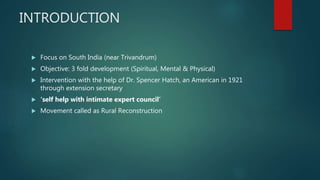
INTRODUCTION
 Focus on South India (near Trivandrum)
 Objective: 3 fold development (Spiritual, Mental & Physical)
 Intervention with the help of Dr. Spencer Hatch, an American in 1921
through extension secretary
 ‘self help with intimate expert council’
 Movement called as Rural Reconstruction
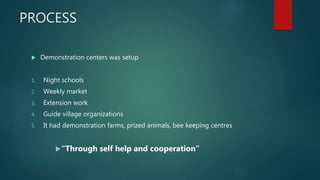
PROCESS
 Demonstration centers was setup
1. Night schools
2. Weekly market
3. Extension work
4. Guide village organizations
5. It had demonstration farms, prized animals, bee keeping centres
“Through self help and cooperation”
Cont.
 Spiritual development
 Mental development
 Physical development
 Social development
 Economic development
RESULTS ACHIEVED
 Systematic and well organized intervention by professionals
 Workers helped other states of Baroda, Mysore, Cochin etc.
 Change in the attitude of rural people
 Animators (village sevika)
 Tried to understand the felt needs rather than perceived needs as in Sriniketan
experiment.
 More focus on stereotype activities and marketing
 Successful output: egg selling club, honey club
SHORTCOMINGS
 Inadequate funds
 Insufficient govt. help
 Activities organized in Marthandam & village workers don’t stay in villages
 Religious bias
 Program was centered only on one person.After his death, conflict in
questions regarding the leadership between YMCA & church association
SUGGESTIONS:
 fostering knowledge transfer and innovation in agriculture.
 sustainable forest management;
 promoting food chain organization and animal welfare
 restoring, preserving and enhancing ecosystems related to agriculture
 promoting resource efficiency and
 promoting social inclusion, poverty reduction and economic development
in rural areas.

Marthandam expt

  • 1.
  • 2.
    INTRODUCTION  Focus onSouth India (near Trivandrum)  Objective: 3 fold development (Spiritual, Mental & Physical)  Intervention with the help of Dr. Spencer Hatch, an American in 1921 through extension secretary  ‘self help with intimate expert council’  Movement called as Rural Reconstruction
  • 3.
    PROCESS  Demonstration centerswas setup 1. Night schools 2. Weekly market 3. Extension work 4. Guide village organizations 5. It had demonstration farms, prized animals, bee keeping centres “Through self help and cooperation”
  • 4.
    Cont.  Spiritual development Mental development  Physical development  Social development  Economic development
  • 5.
    RESULTS ACHIEVED  Systematicand well organized intervention by professionals  Workers helped other states of Baroda, Mysore, Cochin etc.  Change in the attitude of rural people  Animators (village sevika)  Tried to understand the felt needs rather than perceived needs as in Sriniketan experiment.  More focus on stereotype activities and marketing  Successful output: egg selling club, honey club
  • 6.
    SHORTCOMINGS  Inadequate funds Insufficient govt. help  Activities organized in Marthandam & village workers don’t stay in villages  Religious bias  Program was centered only on one person.After his death, conflict in questions regarding the leadership between YMCA & church association
  • 7.
    SUGGESTIONS:  fostering knowledgetransfer and innovation in agriculture.  sustainable forest management;  promoting food chain organization and animal welfare  restoring, preserving and enhancing ecosystems related to agriculture  promoting resource efficiency and  promoting social inclusion, poverty reduction and economic development in rural areas.