Minnesota Governor’s
Task Force on Broadband
July 21, 2016 Meeting
Minnesota government entity and
contractor data security and
breach notification
Melissa Krasnow
1
Minnesota Government Data Practices
Act
Minnesota Director Data Security Risk
Oversight
Other State Laws
Recommendations
2
Minnesota Government
Data Practices Act
3
Covered Governmental Entities
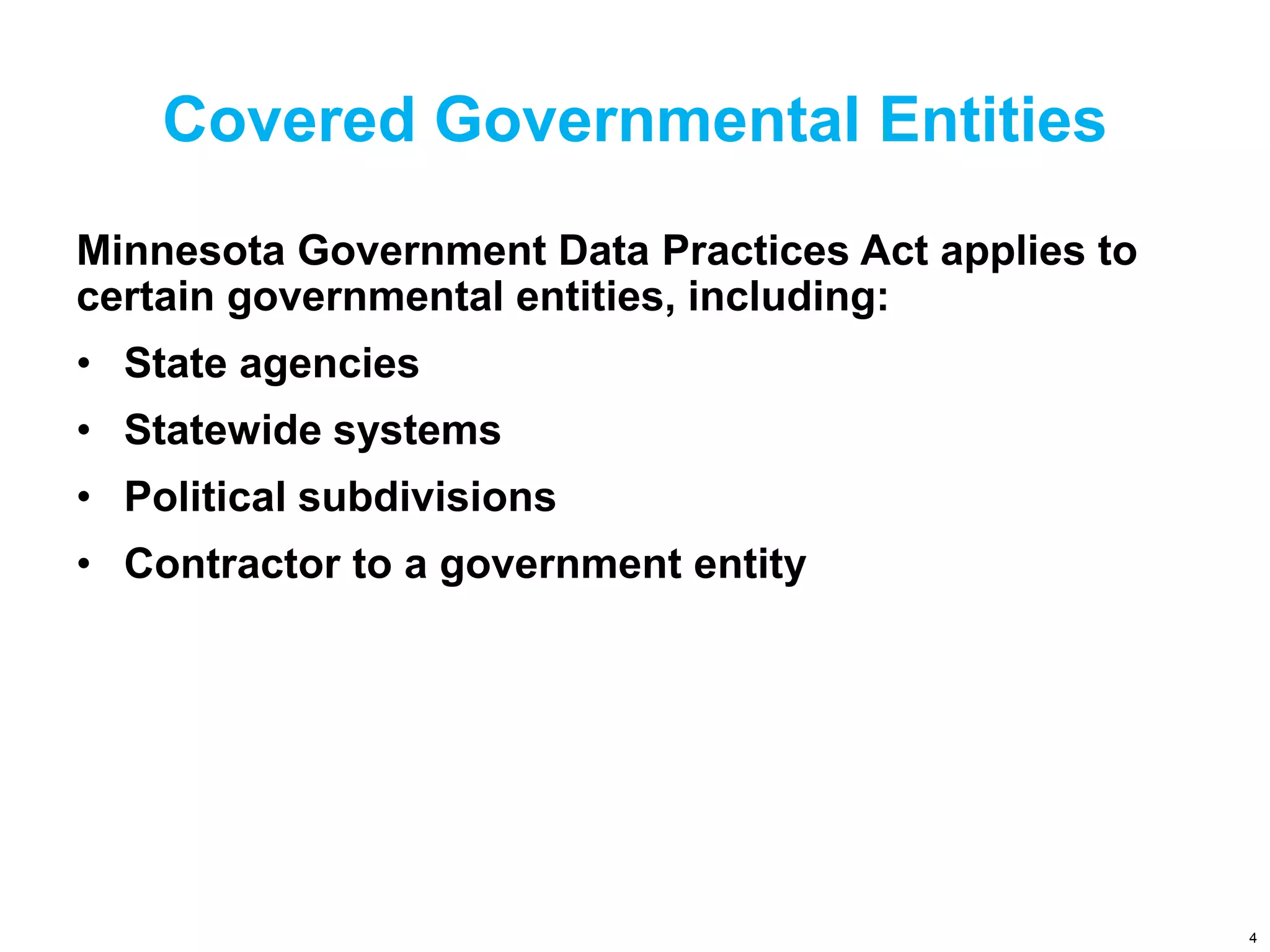
Minnesota Government Data Practices Act applies to
certain governmental entities, including:
• State agencies
• Statewide systems
• Political subdivisions
• Contractor to a government entity
4
Example of Government Entity
Contract Provision
The requirements of Minnesota Statutes § 13.05, subd. 11 apply to
this contract. The CONTRACTOR and GOVERNMENT ENTITY
must comply with the Minnesota Government Data Practices Act,
Minnesota Statutes Chapter 13, as it applies to all data provided
by GOVERNMENT ENTITY in accordance with this contract, and
as it applies to all data, created, collected, received, stored, used,
maintained or disseminated by the CONTRACTOR in accordance
with this contract. The civil remedies of Minnesota Statute §13.08
apply to the release of the data referred to in this clause by either
the CONTRACTOR or GOVERNMENT ENTITY. In the event the
CONTRACTOR receives a request to release the data referred to in
this clause, the CONTRACTOR must immediately notify
GOVERNMENT ENTITY. GOVERNMENT ENTITY will give the
CONTRACTOR instructions concerning the release of the data to
the requesting party before the data is released.
5
Some Data Definitions
Confidential data on individuals: data made not public
and inaccessible to the individual subject of the data
Data on individuals: all government data where an
individual is or can be identified as the subject of that
data, unless the name or other identifying data can be
clearly demonstrated to be only incidental to the data
and the data are not accessed by the name or other
identifying data of an individual
Government data: all data collected, created, received,
maintained or disseminated by any government entity
regardless of physical form, storage media or
conditions of use
6
Some Data Definitions (con’t)
Personal information: an individual's first name or first initial and
last name together with one or more of the following data
elements (when the data element is not secured by a method of
technology that makes electronic data unreadable or unusable or
was secured and the means necessary for reading or using the
data was also acquired):
• Social Security number
• driver's license number or Minnesota identification card
number
• account number or credit or debit card number, together with
any required security code, access code, or password that
would permit access to an individual's financial account
Private data on individuals: data made by statute or federal law
applicable to the data: (i) not public and (ii) accessible to the
individual subject of those data
7
Data Security
• Establish appropriate security safeguards for all records
containing data on individuals, including procedures for
ensuring that data that are not public are only accessible
to persons whose work assignment reasonably requires
access to the data and is only being accessed by those
persons for purposes described in the procedure
• Develop a policy incorporating these procedures
• Destroy not public data in a way that prevents its
contents from being determined when being disposed of
• Conduct a comprehensive security assessment of any
personal information maintained by the government
entity at least annually
8
Breach Notification Definitions
Breach of the security of the data: unauthorized
acquisition of data maintained by a government entity
that compromises the security and classification of the
data
Unauthorized acquisition: a person has obtained,
accessed or viewed government data without the
informed consent of the individuals who are the
subjects of the data or statutory authority and with the
intent to use the data for nongovernmental purposes
9
Written Breach Notification
Notification of a breach to:
• any individual who is the subject of the data and whose
private or confidential data was, or is reasonably believed
to have been, acquired by an unauthorized person and
inform the individual that: (1) a report will be prepared, (2)
how the individual may obtain access to the report and
(3) that the individual may request delivery of the report
by mail or e-mail, in the most expedient time possible and
without unreasonable delay
• all consumer reporting agencies that compile and
maintain files on consumers on a nationwide basis of the
timing, distribution, and content of the notices where
there are more than 1,000 individuals to be notified at one
time, without unreasonable delay
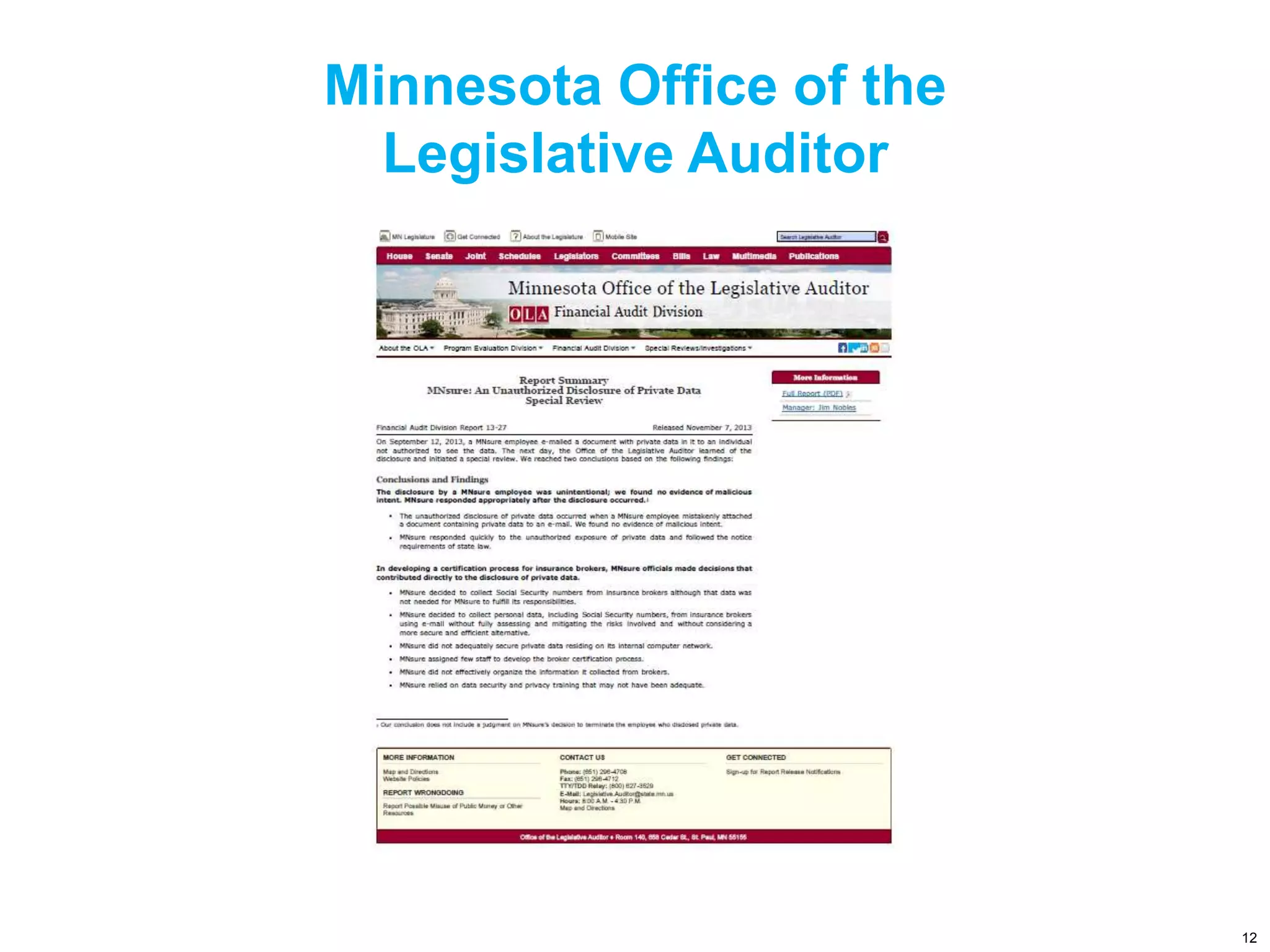
See also slide 12, Minnesota Office of the Legislative
Auditor
10
Breach Notification Investigation Report
Responsible authority must prepare a report on the facts
and results of the investigation upon completion of an
investigation into a breach
If the breach involves unauthorized access to or acquisition
of data by an employee, contractor or agent of the
government entity, the report must include, at a minimum:
• a description of the type of data that were accessed or
acquired
• the number of individuals whose data was improperly
accessed or acquired
• if there has been final disposition of disciplinary action,
the name of each employee determined to be responsible
for the unauthorized access or acquisition
• the final disposition of any disciplinary action taken
against each employee in response
11
Minnesota Office of the
Legislative Auditor
12
Remedies and Penalties
• Action for damages
• Injunction
• Action to compel compliance
• Criminal penalty where willful violation or knowing
unauthorized acquisition of not public data
13
Minnesota Director
Data Security Risk Oversight
14
Minnesota Business Corporations
A director shall discharge the duties of the position of
director in good faith, in a manner the director
reasonably believes to be in the best interests of the
corporation, and with the care an ordinarily prudent
person in a like position would exercise under similar
circumstances. A person who so performs those
duties is not liable by reason of being or having been a
director of the corporation.
Good faith means “honesty in fact in the conduct of the
act or transaction concerned.”
15
Minnesota D&O Litigation:
Target Shareholder Derivative Lawsuit
• Target’s board appointed a Special Litigation
Committee which determined it was not in Target’s
best interests to pursue the derivative claims
• Special Litigation Committee’s motion for approval
and dismissal and Defendants’ motions to dismiss
were granted via order on July 7, 2016
• Notice of order must be furnished in a Form 8-K to
the SEC and provided by electronic mail to counsel
for the shareholder who made demand on Target’s
board
• If no shareholder seeks to intervene within 30 days
of Target furnishing notice of order to the SEC, this
matter will be dismissed with prejudice
16
Other State Laws
17
Other State Laws
• Other states have laws that differ from the Minnesota
Government Data Practices Act
• Other state laws cover specific areas such as open
records/public records, data security or breach
notification
See
http://www.house.leg.state.mn.us/hrd/issinfo/datacom
mission_overview2014.pdf
18
State Data Security Laws
• 12 states have laws addressing security procedures
that apply to businesses
• Minnesota does not have a data security law that
applies to businesses
• Some state data security laws apply to both
businesses and government entities (for example,
Illinois)
• Other state data security laws apply to businesses
only (for example, California)
19
State Breach Notification Laws
• 47 states, plus the District of Columbia, Guam,
Puerto Rico and the Virgin Islands, have breach
notification laws for businesses (including separate
Minnesota breach notification law, Minn. Stat. §
325E.61, for businesses)
• Alabama, New Mexico and South Dakota do not have
breach notification laws
• Some state breach notification laws apply to both
businesses and government entities (for example,
Illinois)
• There are separate state breach notification laws for
businesses and government entities in other states
(for example, California)
20
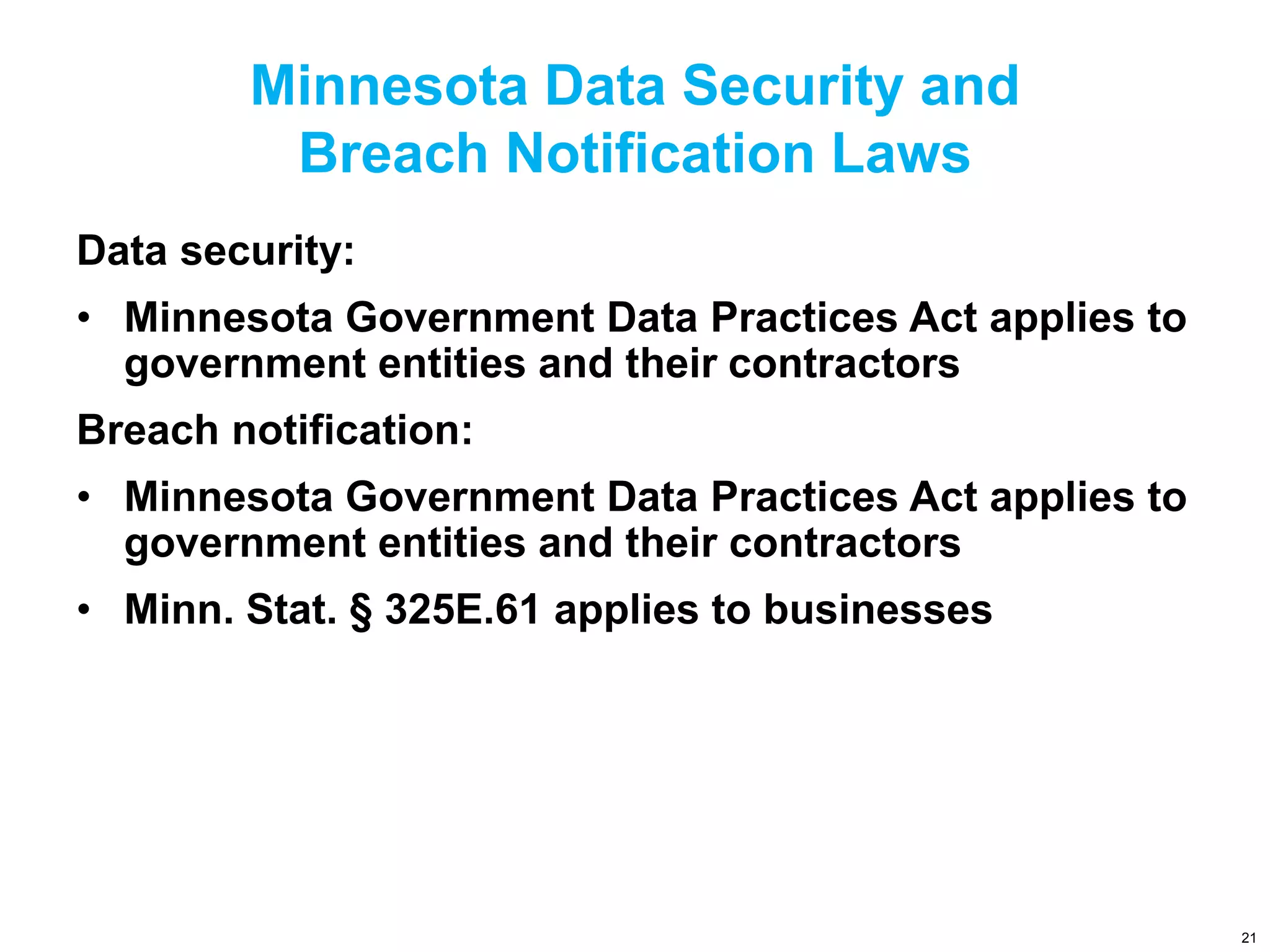
Minnesota Data Security and
Breach Notification Laws
Data security:
• Minnesota Government Data Practices Act applies to
government entities and their contractors
Breach notification:
• Minnesota Government Data Practices Act applies to
government entities and their contractors
• Minn. Stat. § 325E.61 applies to businesses
21
Recommendations
22
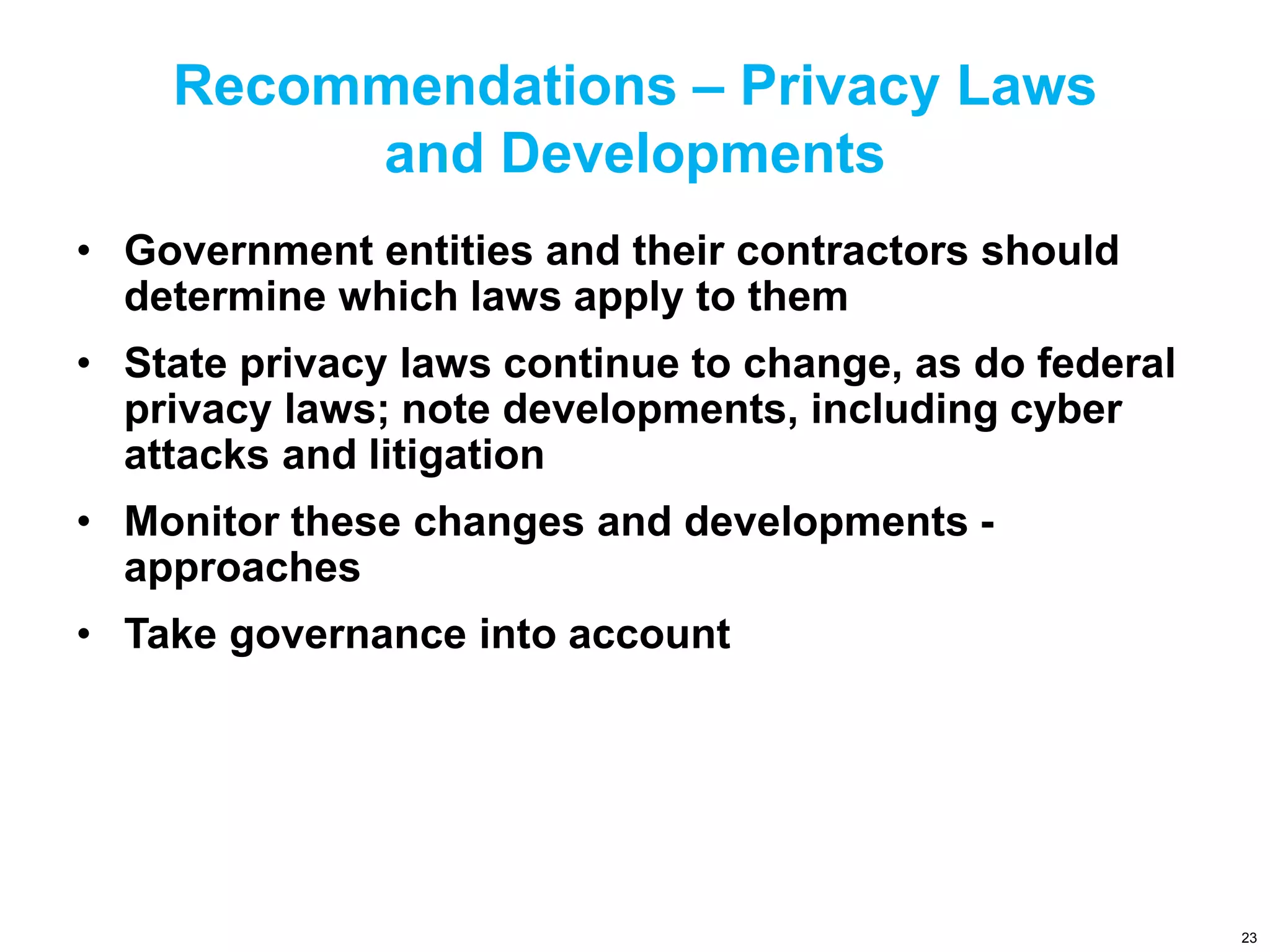
Recommendations – Privacy Laws
and Developments
• Government entities and their contractors should
determine which laws apply to them
• State privacy laws continue to change, as do federal
privacy laws; note developments, including cyber
attacks and litigation
• Monitor these changes and developments -
approaches
• Take governance into account
23
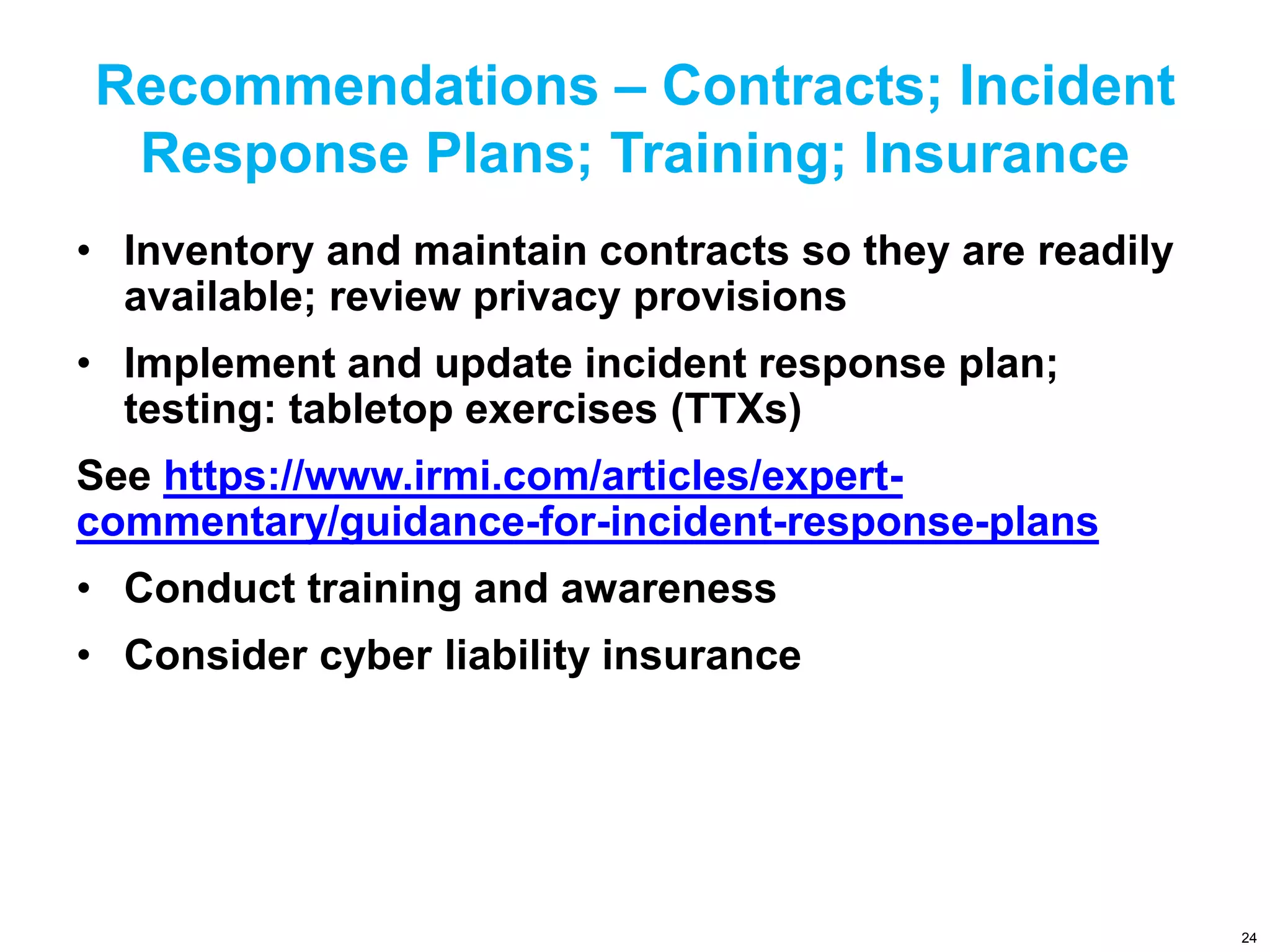
Recommendations – Contracts; Incident
Response Plans; Training; Insurance
• Inventory and maintain contracts so they are readily
available; review privacy provisions
• Implement and update incident response plan;
testing: tabletop exercises (TTXs)
See https://www.irmi.com/articles/expert-
commentary/guidance-for-incident-response-plans
• Conduct training and awareness
• Consider cyber liability insurance
24

Cyber Security from MN Government perspective

  • 1.
    Minnesota Governor’s Task Forceon Broadband July 21, 2016 Meeting Minnesota government entity and contractor data security and breach notification Melissa Krasnow 1
  • 2.
    Minnesota Government DataPractices Act Minnesota Director Data Security Risk Oversight Other State Laws Recommendations 2
  • 3.
  • 4.
    Covered Governmental Entities MinnesotaGovernment Data Practices Act applies to certain governmental entities, including: • State agencies • Statewide systems • Political subdivisions • Contractor to a government entity 4
  • 5.
    Example of GovernmentEntity Contract Provision The requirements of Minnesota Statutes § 13.05, subd. 11 apply to this contract. The CONTRACTOR and GOVERNMENT ENTITY must comply with the Minnesota Government Data Practices Act, Minnesota Statutes Chapter 13, as it applies to all data provided by GOVERNMENT ENTITY in accordance with this contract, and as it applies to all data, created, collected, received, stored, used, maintained or disseminated by the CONTRACTOR in accordance with this contract. The civil remedies of Minnesota Statute §13.08 apply to the release of the data referred to in this clause by either the CONTRACTOR or GOVERNMENT ENTITY. In the event the CONTRACTOR receives a request to release the data referred to in this clause, the CONTRACTOR must immediately notify GOVERNMENT ENTITY. GOVERNMENT ENTITY will give the CONTRACTOR instructions concerning the release of the data to the requesting party before the data is released. 5
  • 6.
    Some Data Definitions Confidentialdata on individuals: data made not public and inaccessible to the individual subject of the data Data on individuals: all government data where an individual is or can be identified as the subject of that data, unless the name or other identifying data can be clearly demonstrated to be only incidental to the data and the data are not accessed by the name or other identifying data of an individual Government data: all data collected, created, received, maintained or disseminated by any government entity regardless of physical form, storage media or conditions of use 6
  • 7.
    Some Data Definitions(con’t) Personal information: an individual's first name or first initial and last name together with one or more of the following data elements (when the data element is not secured by a method of technology that makes electronic data unreadable or unusable or was secured and the means necessary for reading or using the data was also acquired): • Social Security number • driver's license number or Minnesota identification card number • account number or credit or debit card number, together with any required security code, access code, or password that would permit access to an individual's financial account Private data on individuals: data made by statute or federal law applicable to the data: (i) not public and (ii) accessible to the individual subject of those data 7
  • 8.
    Data Security • Establishappropriate security safeguards for all records containing data on individuals, including procedures for ensuring that data that are not public are only accessible to persons whose work assignment reasonably requires access to the data and is only being accessed by those persons for purposes described in the procedure • Develop a policy incorporating these procedures • Destroy not public data in a way that prevents its contents from being determined when being disposed of • Conduct a comprehensive security assessment of any personal information maintained by the government entity at least annually 8
  • 9.
    Breach Notification Definitions Breachof the security of the data: unauthorized acquisition of data maintained by a government entity that compromises the security and classification of the data Unauthorized acquisition: a person has obtained, accessed or viewed government data without the informed consent of the individuals who are the subjects of the data or statutory authority and with the intent to use the data for nongovernmental purposes 9
  • 10.
    Written Breach Notification Notificationof a breach to: • any individual who is the subject of the data and whose private or confidential data was, or is reasonably believed to have been, acquired by an unauthorized person and inform the individual that: (1) a report will be prepared, (2) how the individual may obtain access to the report and (3) that the individual may request delivery of the report by mail or e-mail, in the most expedient time possible and without unreasonable delay • all consumer reporting agencies that compile and maintain files on consumers on a nationwide basis of the timing, distribution, and content of the notices where there are more than 1,000 individuals to be notified at one time, without unreasonable delay See also slide 12, Minnesota Office of the Legislative Auditor 10
  • 11.
    Breach Notification InvestigationReport Responsible authority must prepare a report on the facts and results of the investigation upon completion of an investigation into a breach If the breach involves unauthorized access to or acquisition of data by an employee, contractor or agent of the government entity, the report must include, at a minimum: • a description of the type of data that were accessed or acquired • the number of individuals whose data was improperly accessed or acquired • if there has been final disposition of disciplinary action, the name of each employee determined to be responsible for the unauthorized access or acquisition • the final disposition of any disciplinary action taken against each employee in response 11
  • 12.
    Minnesota Office ofthe Legislative Auditor 12
  • 13.
    Remedies and Penalties •Action for damages • Injunction • Action to compel compliance • Criminal penalty where willful violation or knowing unauthorized acquisition of not public data 13
  • 14.
  • 15.
    Minnesota Business Corporations Adirector shall discharge the duties of the position of director in good faith, in a manner the director reasonably believes to be in the best interests of the corporation, and with the care an ordinarily prudent person in a like position would exercise under similar circumstances. A person who so performs those duties is not liable by reason of being or having been a director of the corporation. Good faith means “honesty in fact in the conduct of the act or transaction concerned.” 15
  • 16.
    Minnesota D&O Litigation: TargetShareholder Derivative Lawsuit • Target’s board appointed a Special Litigation Committee which determined it was not in Target’s best interests to pursue the derivative claims • Special Litigation Committee’s motion for approval and dismissal and Defendants’ motions to dismiss were granted via order on July 7, 2016 • Notice of order must be furnished in a Form 8-K to the SEC and provided by electronic mail to counsel for the shareholder who made demand on Target’s board • If no shareholder seeks to intervene within 30 days of Target furnishing notice of order to the SEC, this matter will be dismissed with prejudice 16
  • 17.
  • 18.
    Other State Laws •Other states have laws that differ from the Minnesota Government Data Practices Act • Other state laws cover specific areas such as open records/public records, data security or breach notification See http://www.house.leg.state.mn.us/hrd/issinfo/datacom mission_overview2014.pdf 18
  • 19.
    State Data SecurityLaws • 12 states have laws addressing security procedures that apply to businesses • Minnesota does not have a data security law that applies to businesses • Some state data security laws apply to both businesses and government entities (for example, Illinois) • Other state data security laws apply to businesses only (for example, California) 19
  • 20.
    State Breach NotificationLaws • 47 states, plus the District of Columbia, Guam, Puerto Rico and the Virgin Islands, have breach notification laws for businesses (including separate Minnesota breach notification law, Minn. Stat. § 325E.61, for businesses) • Alabama, New Mexico and South Dakota do not have breach notification laws • Some state breach notification laws apply to both businesses and government entities (for example, Illinois) • There are separate state breach notification laws for businesses and government entities in other states (for example, California) 20
  • 21.
    Minnesota Data Securityand Breach Notification Laws Data security: • Minnesota Government Data Practices Act applies to government entities and their contractors Breach notification: • Minnesota Government Data Practices Act applies to government entities and their contractors • Minn. Stat. § 325E.61 applies to businesses 21
  • 22.
  • 23.
    Recommendations – PrivacyLaws and Developments • Government entities and their contractors should determine which laws apply to them • State privacy laws continue to change, as do federal privacy laws; note developments, including cyber attacks and litigation • Monitor these changes and developments - approaches • Take governance into account 23
  • 24.
    Recommendations – Contracts;Incident Response Plans; Training; Insurance • Inventory and maintain contracts so they are readily available; review privacy provisions • Implement and update incident response plan; testing: tabletop exercises (TTXs) See https://www.irmi.com/articles/expert- commentary/guidance-for-incident-response-plans • Conduct training and awareness • Consider cyber liability insurance 24