Bob Gardner
The ACHIEVE Research Partnership: Action for
        Health Equity Interventions
                Dec 2, 2009


                 © The Wellesley Institute
                www.wellesleyinstitute.com
• understanding the scale, impact and roots of existing
  health disparities in Ontario
• why we need a comprehensive health equity strategy to
  address these pervasive disparities:
   • macro level social and economic policy
   • within the health system
   • through specific service interventions
• analyzing where evaluation fits:
   •   driving more effective equity-focused planning
   •   underpinning more effective program and service interventions
   •   grounding more effective and innovative collaborations
   •   supporting strategic coherence across all these levels


                                                                       2
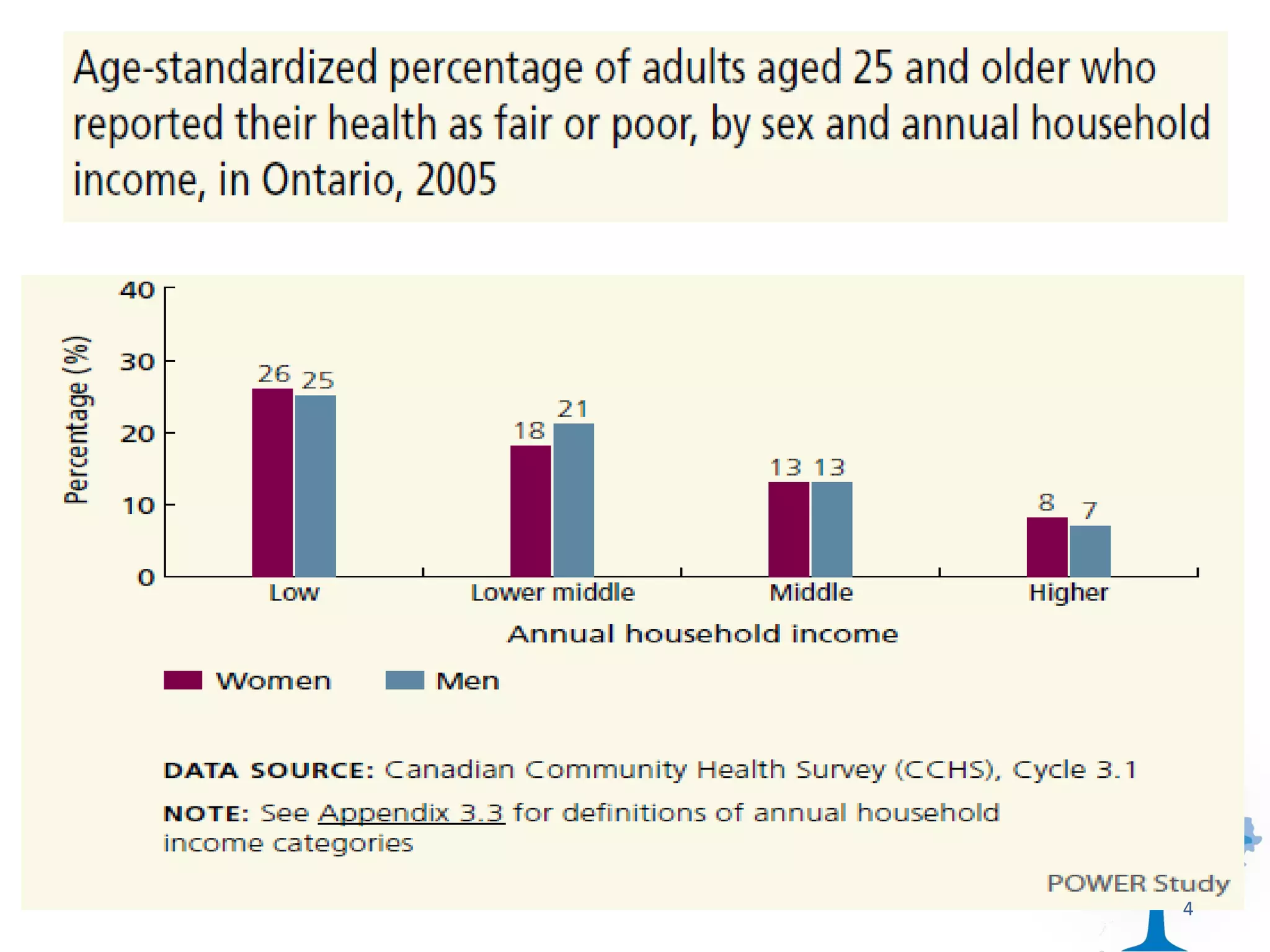
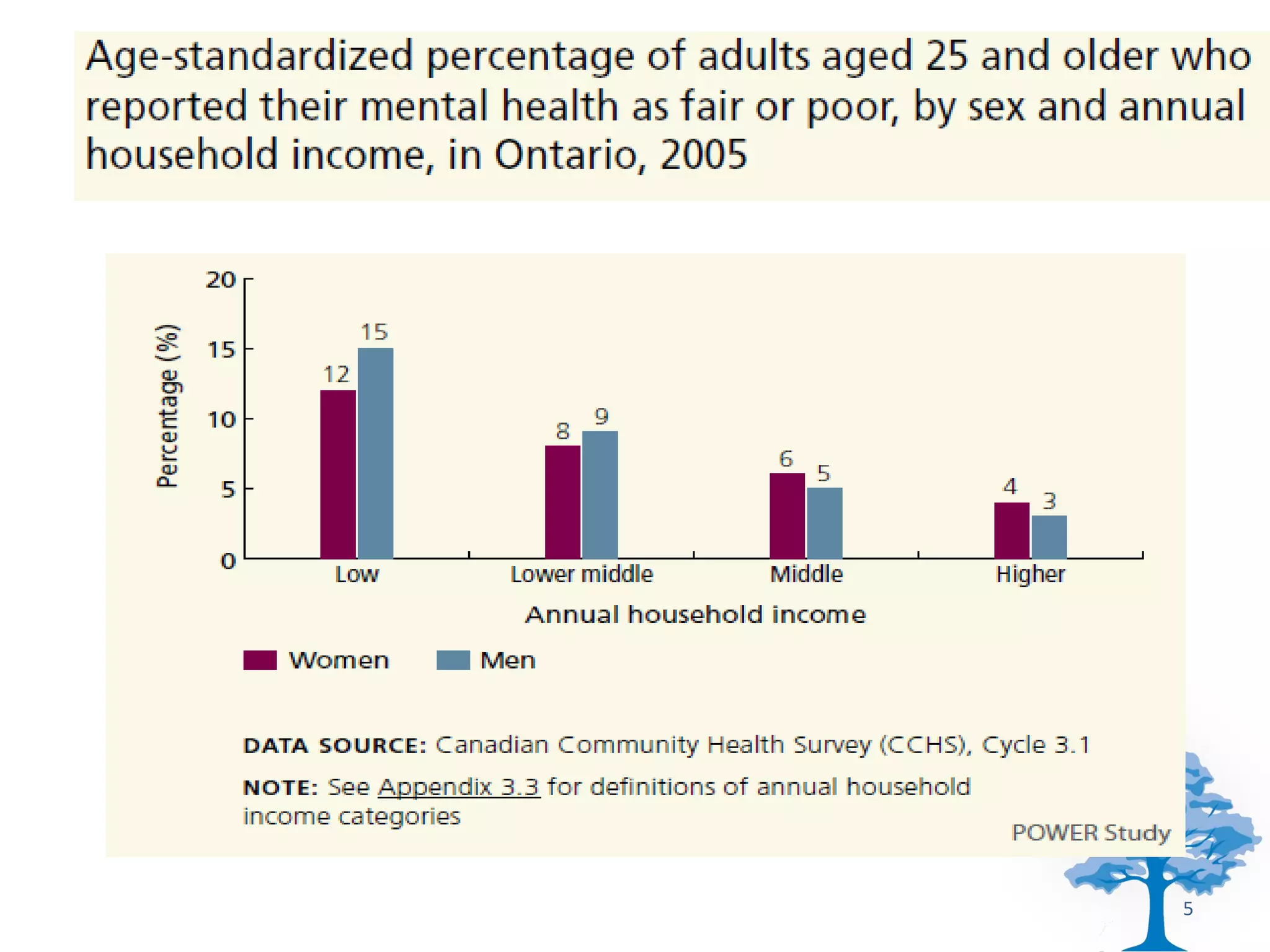
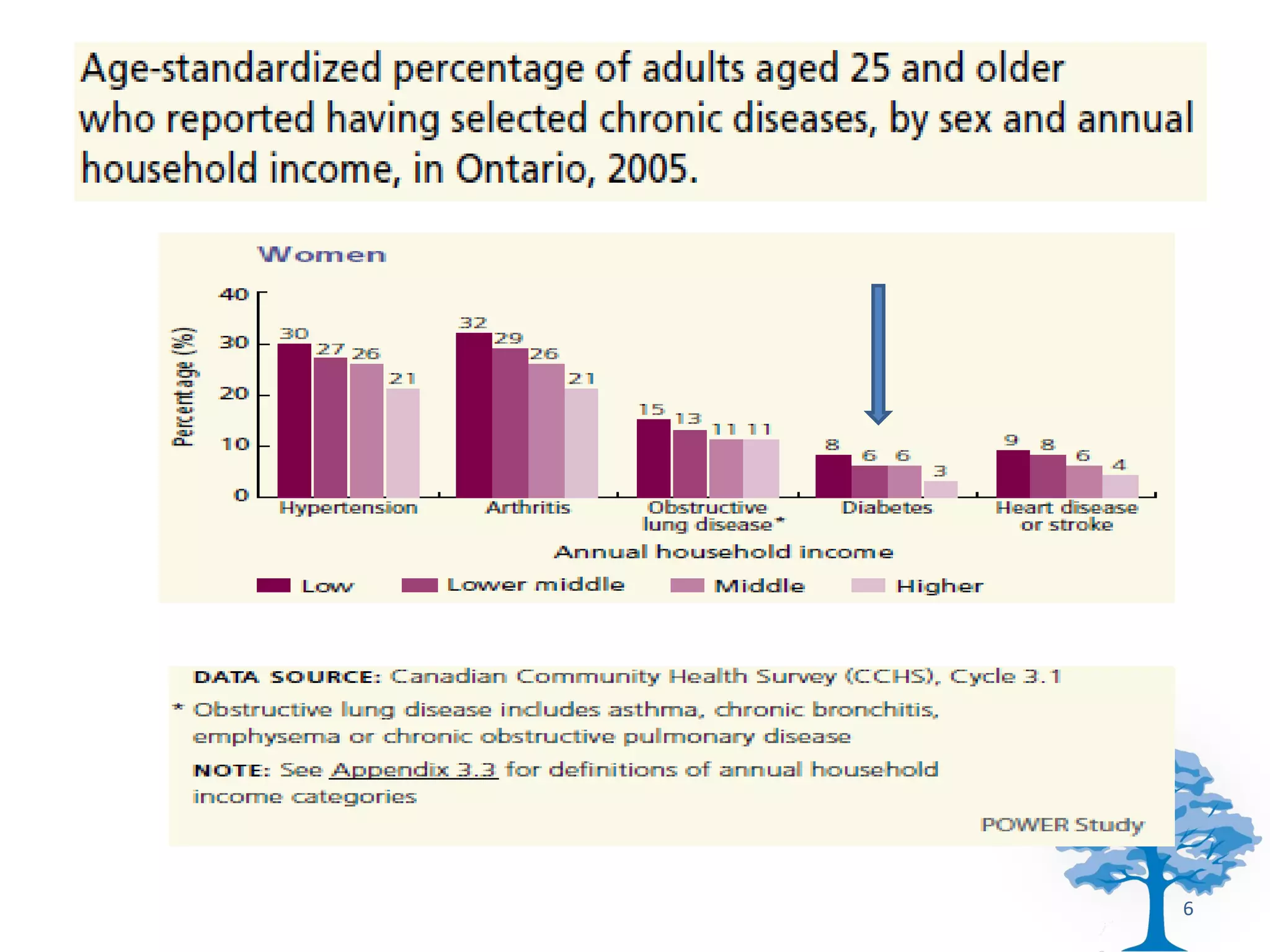
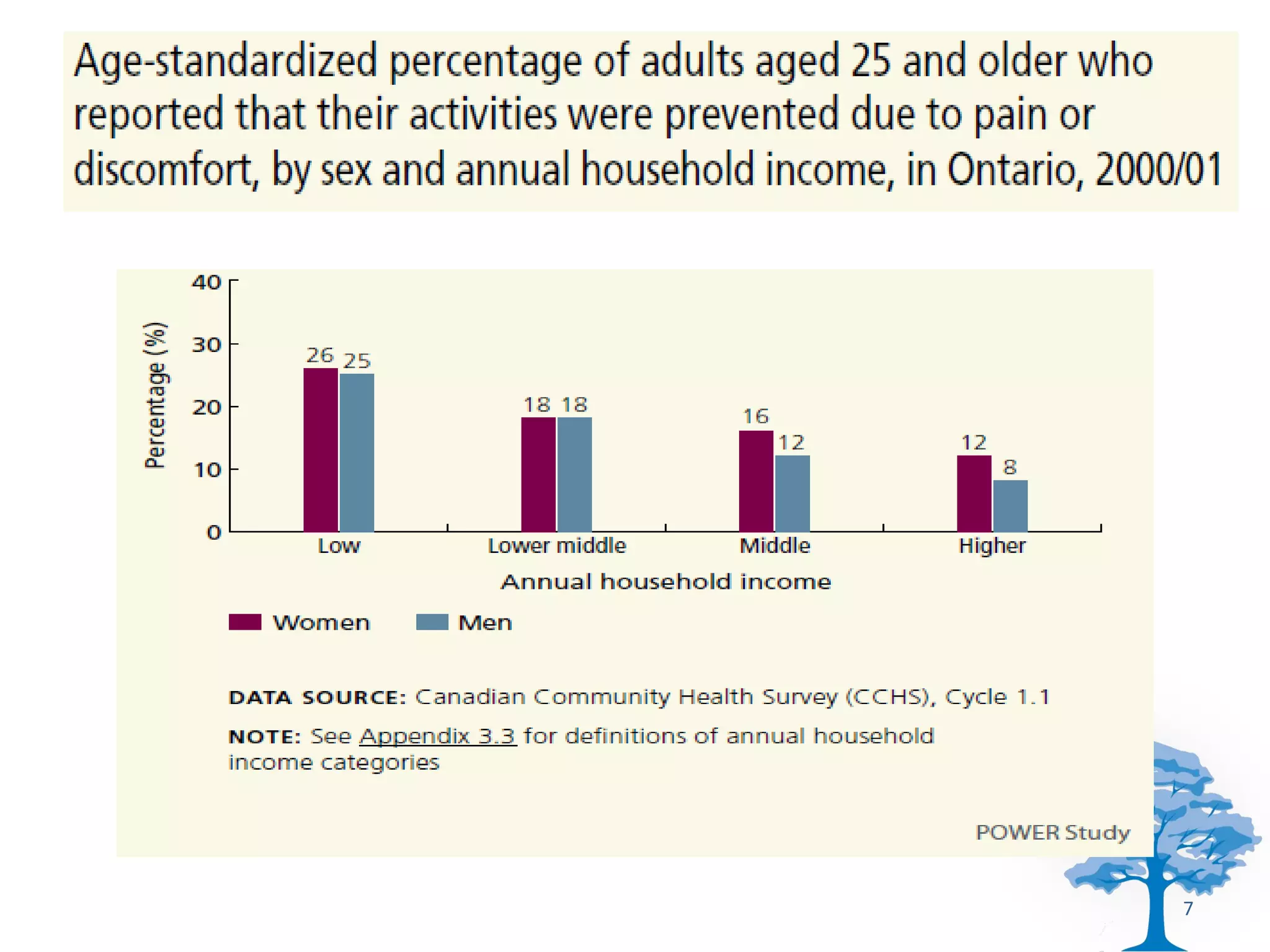
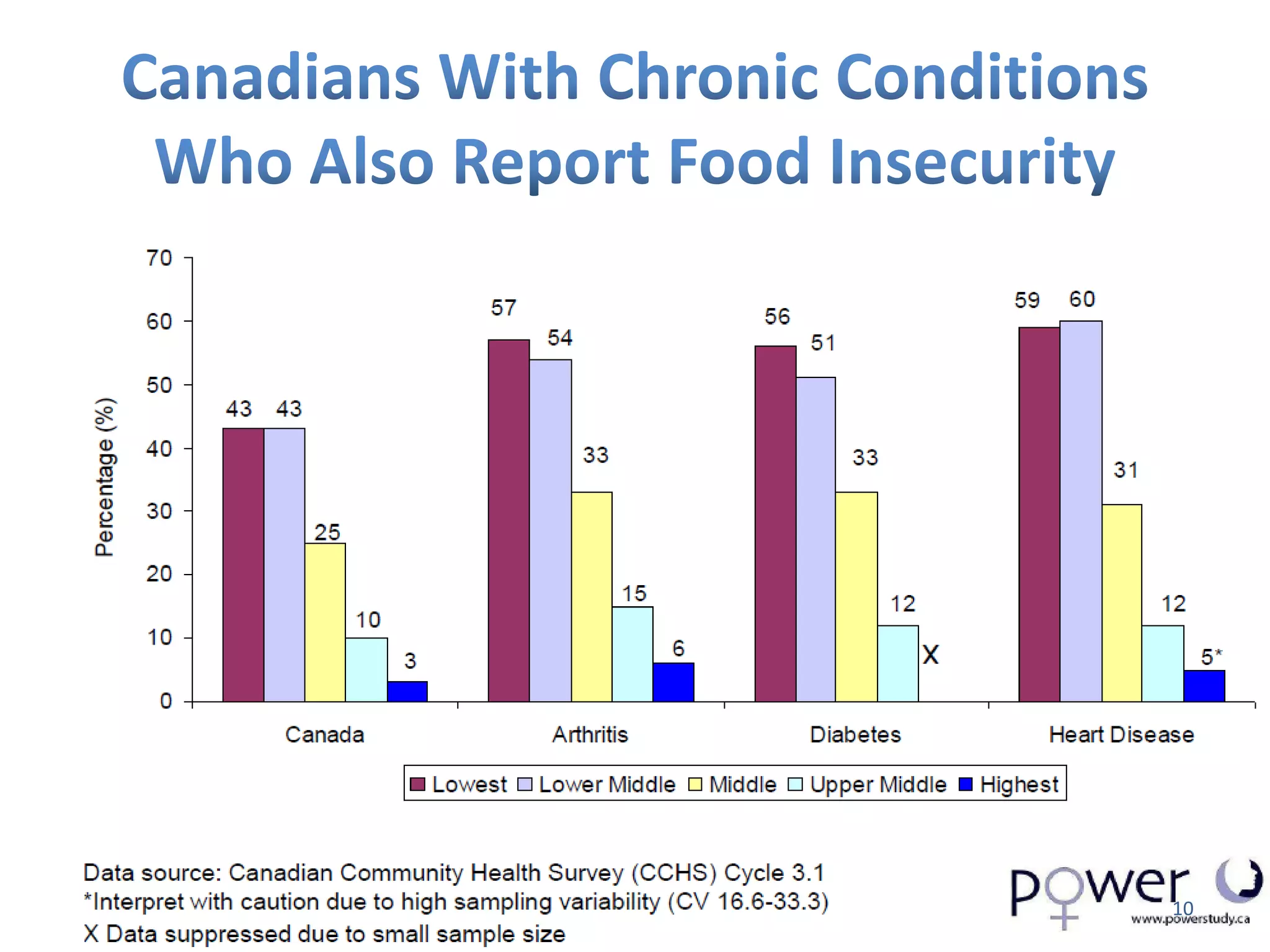
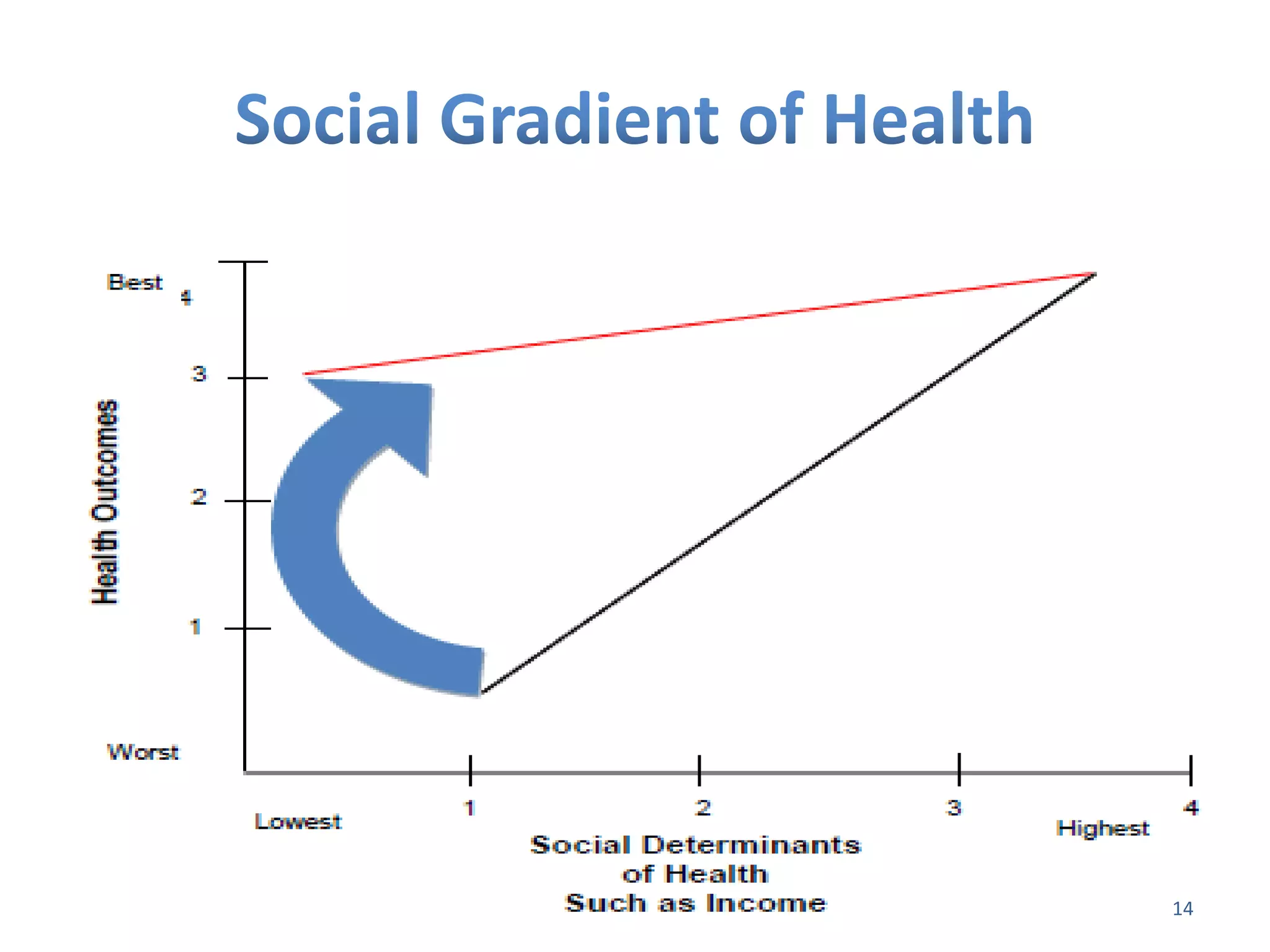
• there is a clear gradient in health in which people with lower
  income, education or other indicators of social inequality
  and exclusion tend to have poorer health + major differences
  between women and men
• the gap between the health status of the best off and most
  disadvantaged can be huge – and damaging
   • difference btwn life expectancy of top and bottom income decile in
     Canada = 7.4 years for men and 4.5 for women
   • more sophisticated analyses add the pronounced gradient in morbidity
     to mortality → taking account of quality of life and developing data on
     health adjusted life expectancy
   • even higher disparities btwn top and bottom = 11.4 years for men and
     9.7 for women (Statistics Canada Health Reports Dec 09)
• in addition, there are systemic disparities in access to and
  quality of care within the healthcare system

                                                                           3
4
5
6
7
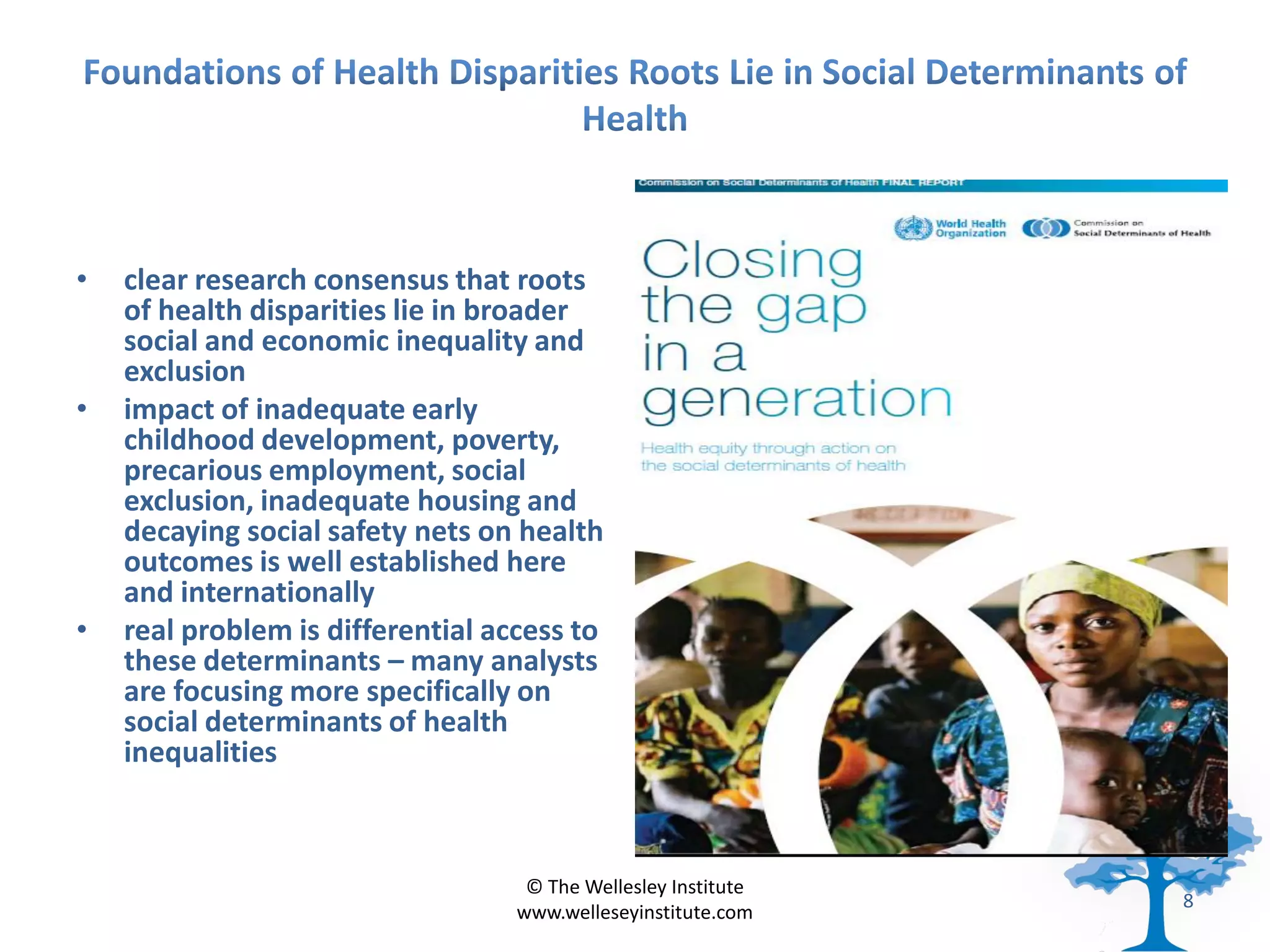
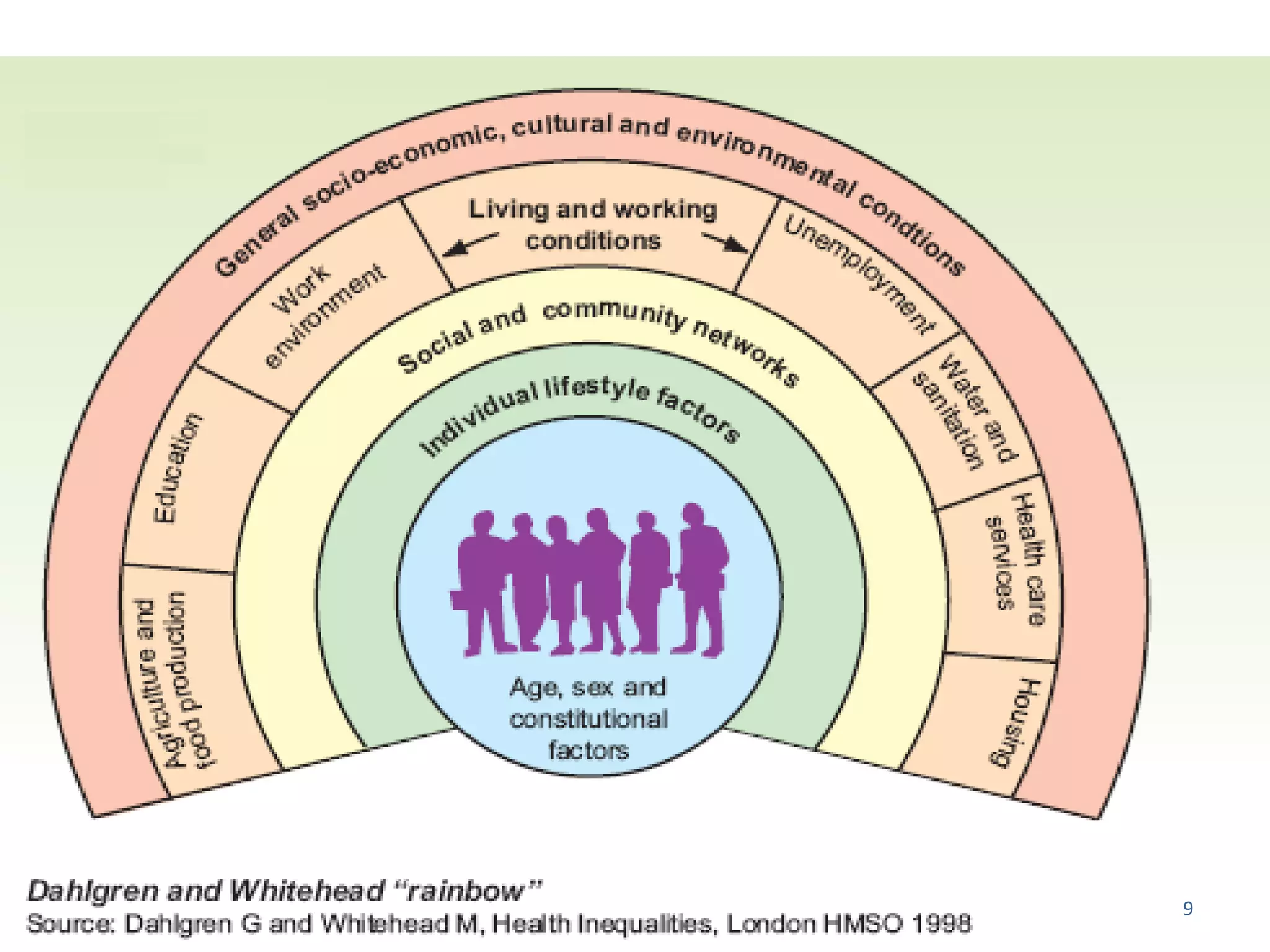
•   clear research consensus that roots
    of health disparities lie in broader
    social and economic inequality and
    exclusion
•   impact of inadequate early
    childhood development, poverty,
    precarious employment, social
    exclusion, inadequate housing and
    decaying social safety nets on health
    outcomes is well established here
    and internationally
•   real problem is differential access to
    these determinants – many analysts
    are focusing more specifically on
    social determinants of health
    inequalities


                                    © The Wellesley Institute
                                                                8
                                   www.welleseyinstitute.com
9
10
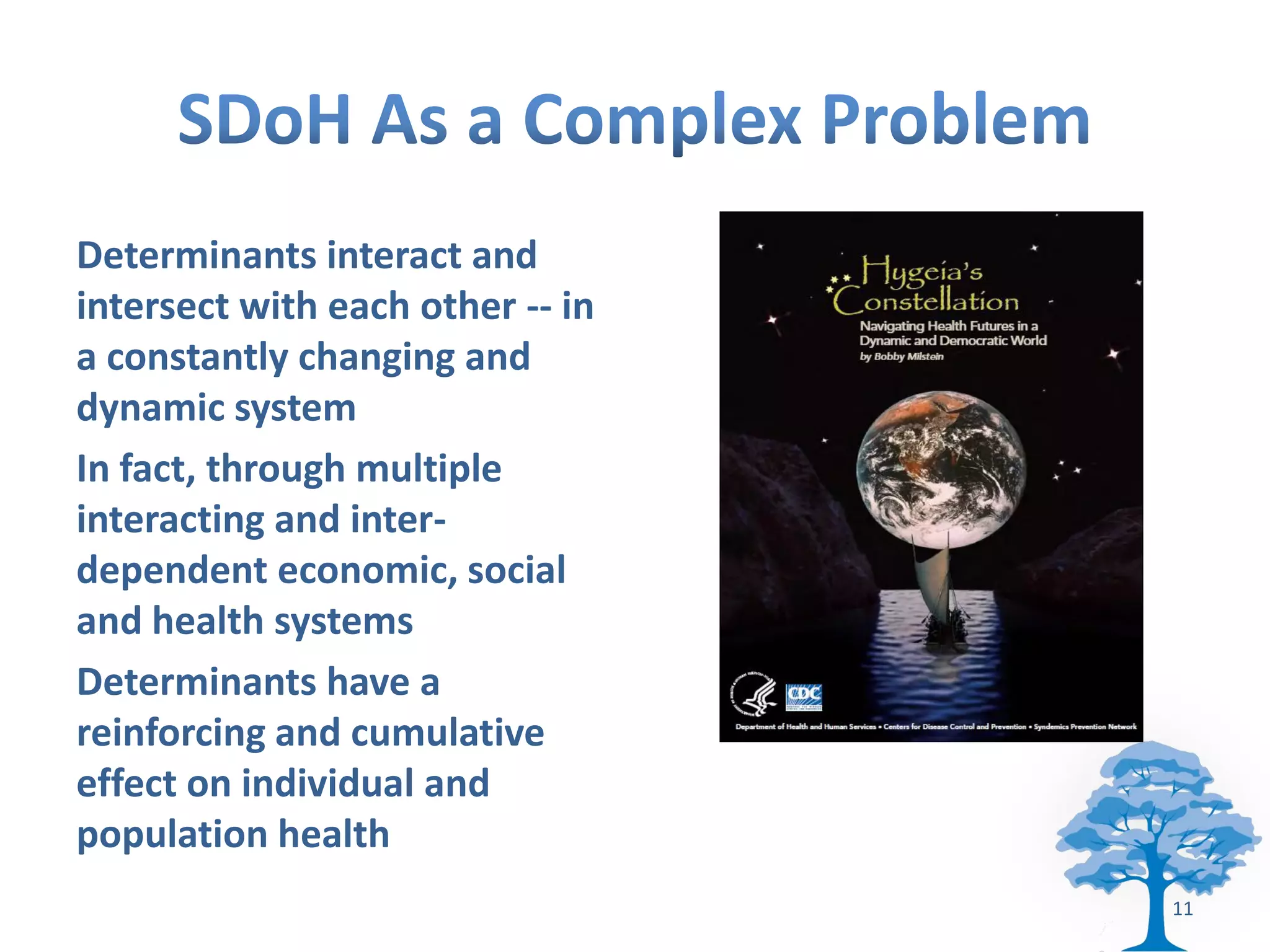
Determinants interact and
intersect with each other -- in
a constantly changing and
dynamic system
In fact, through multiple
interacting and inter-
dependent economic, social
and health systems
Determinants have a
reinforcing and cumulative
effect on individual and
population health
                                  11
• Health disparities or inequities are differences in health
  outcomes that are avoidable, unfair and systematically
  related to social inequality and disadvantage

• This concept:
   • is clear, understandable and actionable
   • identifies the problem that policies will try to solve
   • is tied to widely accepted notions of fairness and social justice

• The goal of health equity strategy is to reduce or eliminate
  socially and institutionally structured health inequalities and
  differential outcomes

                                                                         12
• a positive and forward-looking definition = equal opportunities
  for good health
• health equity is a broad concept that also prioritizes diversity:
   • reflecting the increasing diversity of Ontario society and the fact that
     racism and ethno-cultural differences are important determinants of
     health disparities
   • recognizing that services that reflect and speak to the diversity of
     cultures -- cultural competence – are essential to an equitable system
• and can encompass equity-focused health promotion
   • recognizing that vulnerable populations face more complex and
     serious barriers to good health
   • recognizing that programs and plans need to always take this social
     context and constraints into account
• achieving health equity would extend far beyond enhancing
  individual and collective well-being

                                                                            13
14
• health disparities can seem so overwhelming and their
  underlying social determinants so intractable → can be
  paralyzing

• think big and think strategically, but get going
   • make best judgment from evidence and experience
   • experiment and innovate
   • learn lessons and adjust – why evaluation is so crucial
   • gradually build up coherent sets of policy and program
     actions – and keep evaluating

• need to start somewhere – and we’re in health systems


                                                           15
• need action addressing health disparities at multiple
  levels:
   • macro social and economic policy
   • broad strategic frameworks within health and other
     systems
   • policies and strategies for particular issues – chronic
     conditions, primary care, e health
   • specific service interventions geared to specific outcomes
     or places
• interventions at every one of these levels are complex
• impact is inter-dependent and contingent → need
  coherent overall strategy

                                                                  16
• we want policy and program interventions to have:
   • the most impact in reducing disparities
   • that sustain that impact over the long-term
• reducing overall social and economic inequality may
  be the most significant single way to reduce health
  disparities
→need to reduce unequal distribution of social and
  economic resources – of SDoH
→ requires a significant commitment and re-orientation
  of social and economic policy and fundamental
  institutional arrangements
                                                      17
• there is always much to be learned from policies, programs
  and initiatives in other jurisdictions
• a number of countries have made lessening health
  disparities a top national priority and have developed cross-
  sectoral policy frameworks and/or action plans:
   • England, Scotland, Australia, New Zealand
   • many European countries
• also increasing international and high-level attention:
   • WHO Commission on Social Determinants of Health
   • European Union, with its Closing the Gap project to tackle health disparities
• look broadly for policy solutions, and adapt flexibly to
  local/provincial circumstances


                                                                                     18
• coordinated national policy to reduce health disparities
  by reducing the number of people at risk of social and
  economic vulnerability
• national public health strategy has 12 key objectives –
  five of which, defined as fundamental to all the others,
  are about improving social and economic determinants
   • also focus on inclusive labour market, anti-discrimination, childcare,
     affordable housing and other policies
   • equitable access to improved health care was seen to be just one part
     of this broader package
• emphasized partnerships with community service
  providers and organizations – in both policy
  development and service delivery

                                                                          19
• reducing health disparities – and underlying social
  and economic inequality – are complex challenges
• developing and mobilizing health policy is a classic
  ‘wicked problem’:
   •   the issue crosses policy fields and jurisdictional boundaries
   •   involves many govt and external stakeholders
   •   is shaped by forces beyond govt control
   •   is necessarily long-term
   •   won’t align neatly with party/govt interests and electoral
       cycles


                                                                   20
• but goal is reducing health disparities – is that ultimate evaluation
  criteria?
    • disparities do not appear to be lessening in countries with good
       strategies
     …. but these effects are necessarily long-term?
    • no evidence that comprehensive policies work is the wrong conclusion
    …. but have not been evaluating properly to conclude interventions don't
       work
• Britain has reviewed its comprehensive policies:
    •   no decline in disparities – perhaps worsening
    •   mixed results on specific objectives – some on target, some not
    •   can't conclude that interventions don’t work – too soon to tell
    •   but did conclude that evaluation was not properly built into policy and
        program design


                                                                              21
• might need more modest immediate to mid-term evaluation approaches
  and objectives – more process than outcomes?
• is there coherence in strategies and objectives across policy fields and
  departments?
    • more specifically, comprehensive strategies are generally accompanied
       by efforts for greater ‘joined-up’ government coordination and
       collaboration
    • can evaluate processes
• are priorities and directions aligned towards common goals and vision?
• were the right stakeholders involved – in the right ways – in developing
  policy?
• is strategy based on best available theory, evidence and experience?
• is strategy comprehensive – are critical components missing or under-
  developed?
                                                                         22
• even though roots of health disparities lie in far wider social
  and economic inequality
• how the health system is organized and how services and
  care are delivered is still crucial to tackling health disparities
• many countries have developed comprehensive multi-
  sectoral strategies to reduce health disparities
• in all of them, transforming the health system is an
  indispensable element, including:
   • reducing barriers to equitable access to high quality care
   • targeted interventions to improve the health of the poorest, fastest
   • up-stream investments in primary and preventative care directed to
     most vulnerable
   • delivering these services in coordinated way at community/local level


                                                                         23
1. it’s in the health system that the most disadvantaged
   in SDoH terms end up sicker and needing care
  • equitable healthcare and proactive health promotion can help to
    mediate the harshest impact of the wider social determinants of
    health on health disadvantaged populations and communities
2. in addition, there are systemic disparities in access
   and quality of healthcare that need to be addressed
  •   people lower down the social hierarchy tend to have poorer access
      to health services, even though they may have more complex needs
      and require more care
  •   unless we address inequitable access and quality, healthcare and
      health promotion could make overall disparities even worse
  •   at the least, the goal is to ensure equitable access to care/support
      for all who need it, regardless of their social position


                                                                         24
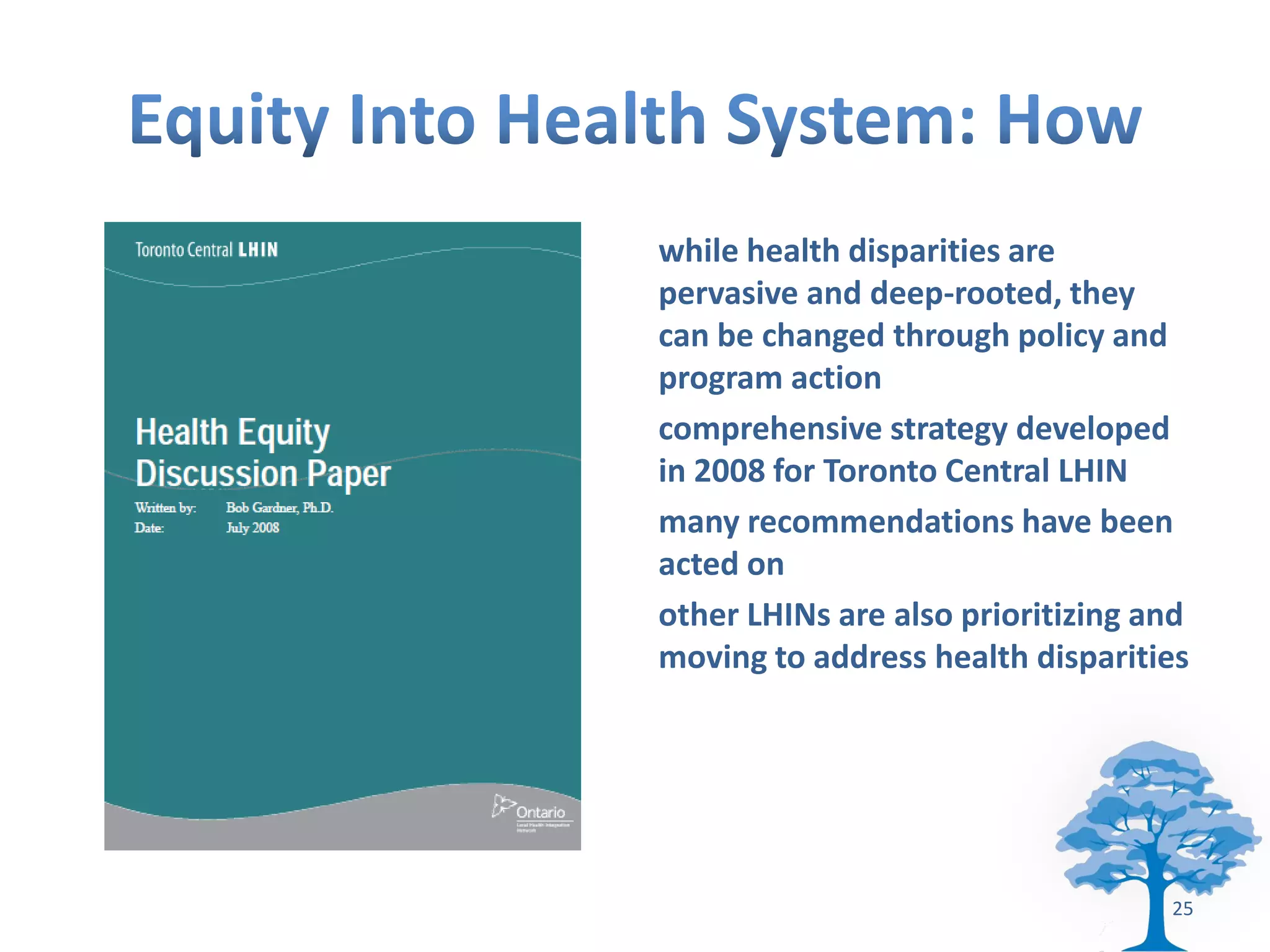
while health disparities are
pervasive and deep-rooted, they
can be changed through policy and
program action
comprehensive strategy developed
in 2008 for Toronto Central LHIN
many recommendations have been
acted on
other LHINs are also prioritizing and
moving to address health disparities


                                   25
• given impact of wider SDoH, cannot expect even the most
  progressive and equitable health system to lead to major
  reductions in disparities of outcomes
• goal is to ensure equitable access to high quality healthcare
  regardless of social position
• can do this through a two pronged strategy :
   1.   building health equity into all health planning and delivery
      •     doesn’t mean all programs are all about equity
      •     but all take equity into account in planning their services and
            outreach
   2. targeting some resources or programs specifically to addressing
        disadvantaged populations or key access barriers
      •     looking for investments and interventions that will have the highest
            impact on reducing health disparities or enhancing the
            opportunities for good health of the most vulnerable


                                                                               26
• one critical component of this strategic
  approach is good planning
• to develop effective planning, we need:
  • clear strategy
  • coherent approach
  • repertoire of effective tools and techniques
  • with support for planning authorities and
    practitioners to effectively use them
  • good actionable information
• and then drilling down: what is our ‘theory’ of
  how equity-focused planning works?
                                                    27
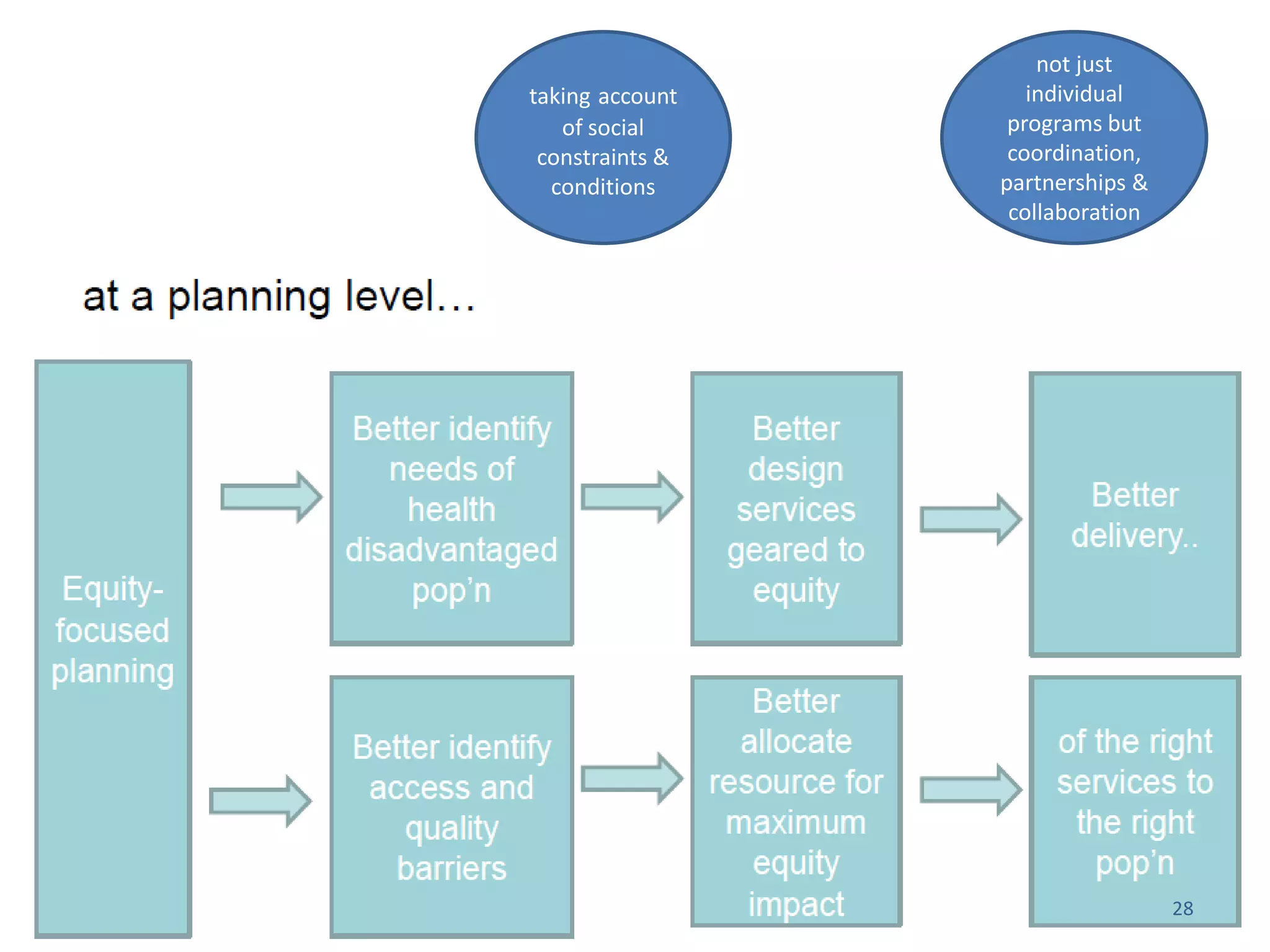
not just
taking account      individual
   of social      programs but
 constraints &    coordination,
  conditions     partnerships &
                  collaboration


                                  28
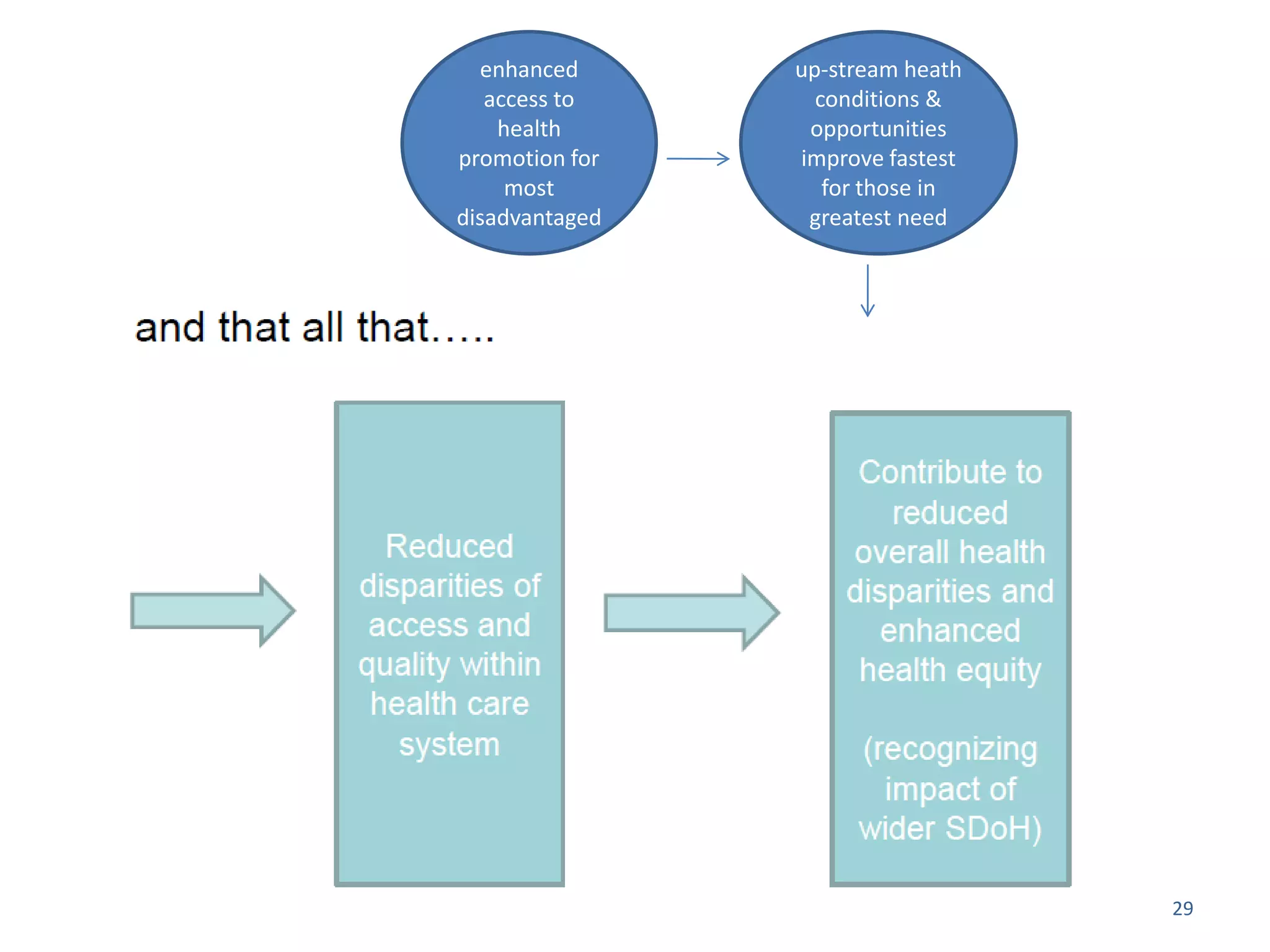
enhanced      up-stream heath
   access to      conditions &
    health       opportunities
promotion for   improve fastest
     most          for those in
disadvantaged    greatest need


                                  29
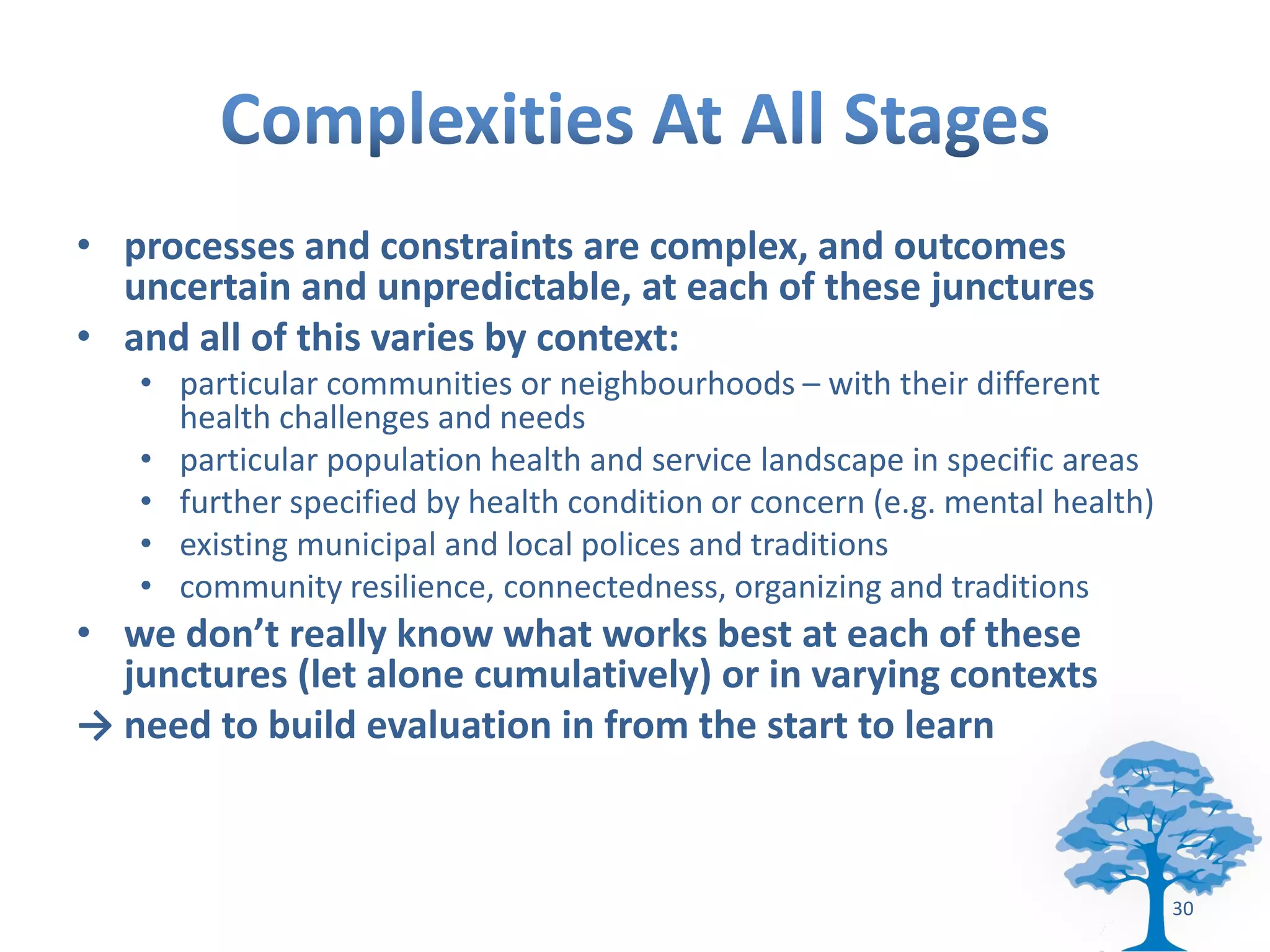
• processes and constraints are complex, and outcomes
  uncertain and unpredictable, at each of these junctures
• and all of this varies by context:
   • particular communities or neighbourhoods – with their different
     health challenges and needs
   • particular population health and service landscape in specific areas
   • further specified by health condition or concern (e.g. mental health)
   • existing municipal and local polices and traditions
   • community resilience, connectedness, organizing and traditions
• we don’t really know what works best at each of these
  junctures (let alone cumulatively) or in varying contexts
→ need to build evaluation in from the start to learn


                                                                             30
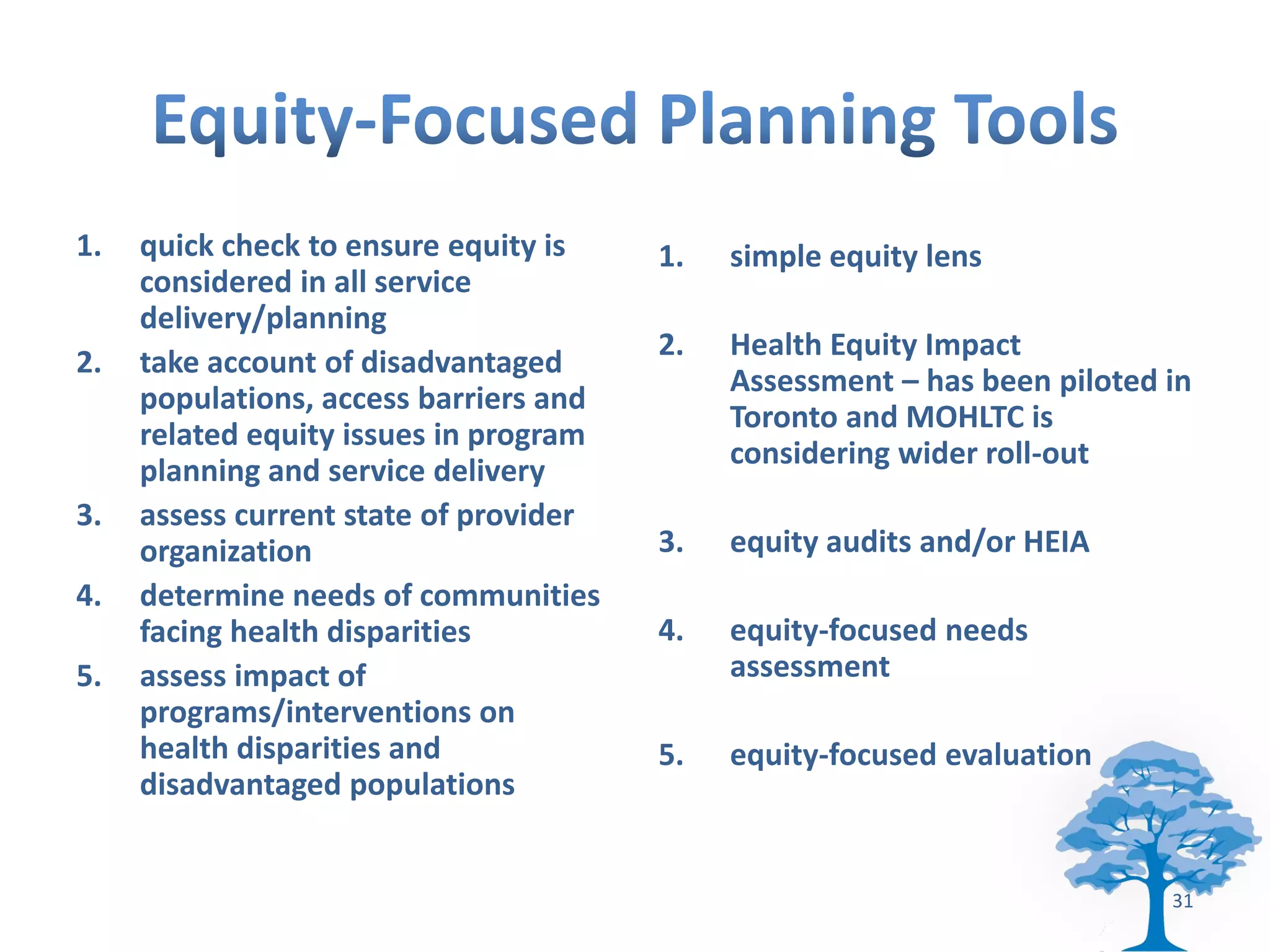
1.   quick check to ensure equity is    1.   simple equity lens
     considered in all service
     delivery/planning
                                        2.   Health Equity Impact
2.   take account of disadvantaged
                                             Assessment – has been piloted in
     populations, access barriers and
                                             Toronto and MOHLTC is
     related equity issues in program
                                             considering wider roll-out
     planning and service delivery
3.   assess current state of provider
     organization                       3.   equity audits and/or HEIA
4.   determine needs of communities
     facing health disparities          4.   equity-focused needs
5.   assess impact of                        assessment
     programs/interventions on
     health disparities and             5.   equity-focused evaluation
     disadvantaged populations


                                                                           31
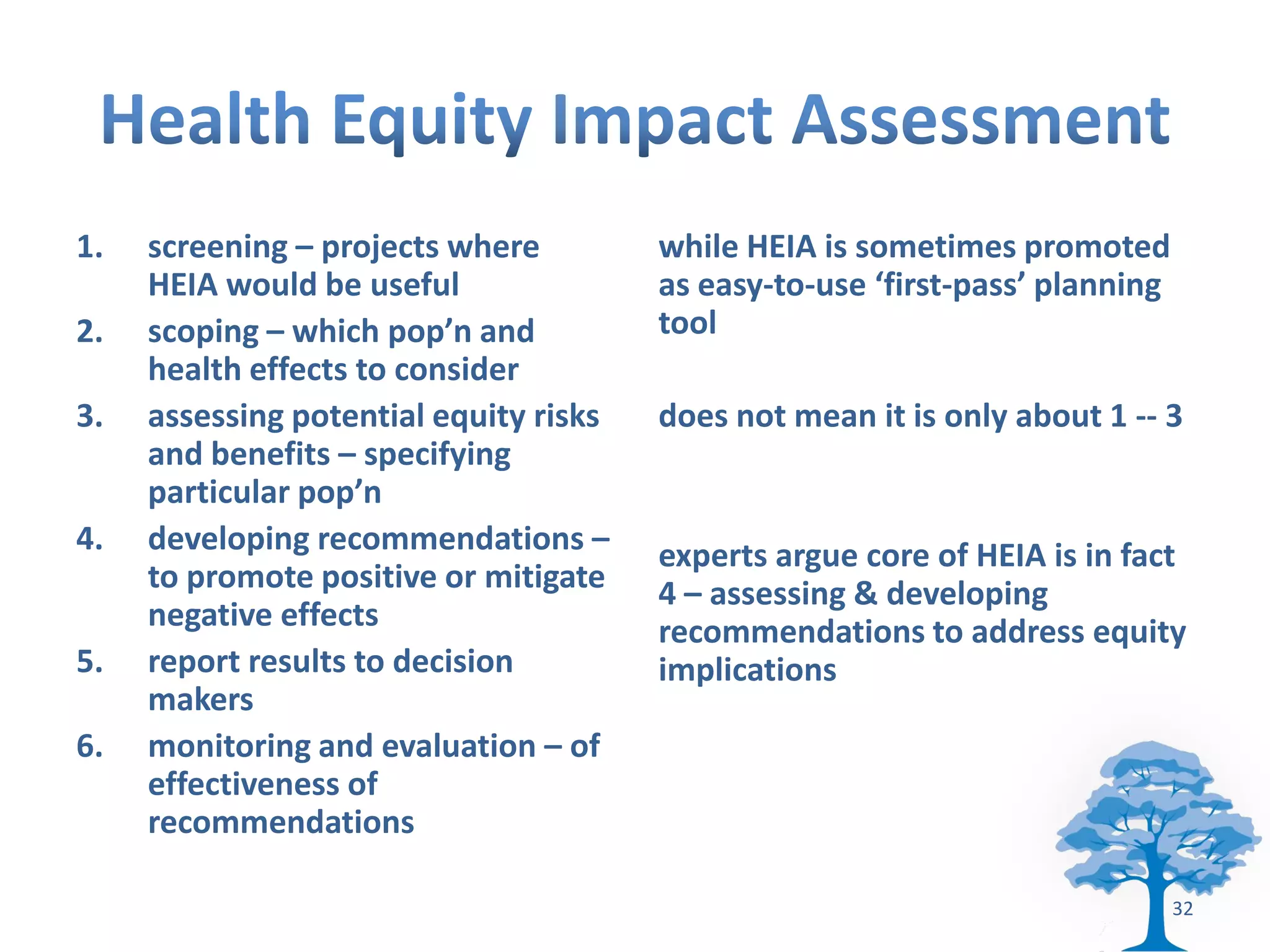
1.   screening – projects where         while HEIA is sometimes promoted
     HEIA would be useful               as easy-to-use ‘first-pass’ planning
2.   scoping – which pop’n and          tool
     health effects to consider
3.   assessing potential equity risks   does not mean it is only about 1 -- 3
     and benefits – specifying
     particular pop’n
4.   developing recommendations –       experts argue core of HEIA is in fact
     to promote positive or mitigate    4 – assessing & developing
     negative effects                   recommendations to address equity
5.   report results to decision         implications
     makers
6.   monitoring and evaluation – of
     effectiveness of
     recommendations

                                                                               32
• a premise of the draft Ontario HEIA – and many others – is
  that:
   • assessing the potential impact of initiatives on particular populations
     requires solid understanding of that population's health status, needs
     and context
   • this can benefit from ongoing community engagement with the
     population and/or specific needs assessment
• analyzing possible mitigation strategies will also benefit
  from engaging the affected population in designing the
  necessary service changes
• similarly, the stage of monitoring and assessing the impact
  of the initiative – and how HEIA contributed -- also needs:
   • research and input from the affected population on impact
   • outcome data stratified by population and determinants


                                                                           33
• comprehensive policies on health equity from other
  countries all include:
   • setting clear strategic objectives and targets
   • defining indicators – that build on available reliable data
     and make the most sense in the particular context
   • closely monitoring progress against the indicators or
     targets
   • disseminating the results widely for public scrutiny
• key driver of system change = building equity
  targets and objectives into routine performance
  management and provider planning


                                                                   34
• we know there will be broad targets for priorities such as diabetes
  and mental health → build equity into these targets:
   • several LHINs have identified areas where diabetes incidence is
     highest → equity target = reduce differences in incidence,
     complications and rates of hospitalization among areas across Central
   • similarly, systemic inequities in depression → equity target = reduce
     those differences by gender, income, region
   • looking up-stream → equity target = ensuring take-up of health
     promotion programs does not vary inequitably by income level,
     neigbourhood, gender, race, etc.
• many programs assess their services through client satisfaction
  surveys and similar methods
   • providers look for high and improving satisfaction → equity target =
     reduce any differences in satisfaction by gender, income, ethno-cultural
     background, etc.


                                                                                35
• MOHLTC flow funds to LHINS, who in turn allocate funds to
  health service providers
• these funding programs, and the accountability agreements
  that go with them with providers, provide an opportunity to
  build in specific equity expectations
• expectations will vary by community and provider, but could
  include:
   • undertaking appropriate equity-focused planning
   • providing sufficient services in languages of community and
     appropriate interpretation
   • identifying areas where access to services is inequitable and
     developing plans to address barriers and gaps
   • ensuring service utilization matches appropriately with demography
     and needs of their catchment profile
   • developing specific services or outreach to particular disadvantaged
     populations – homeless, isolated seniors, etc.


                                                                            36
• greater chance of success for equity strategy if aligned with
  provincial priorities
• MOHLTC and MHP priorities such as mental health and
  diabetes are particularly sensitive to social conditions
   • chronic disease prevention and management programs cannot be successful
     unless they take account of social conditions and constraints
   • various supports designed to enable people with mental health challenges to
     live in the community also need to take into account their social conditions
• Wellesley and Canadian Mental Health Association–Ontario
  partnered on input to current discussions about mental
  health strategy:
   • stressed that programs had to take account of SDoH in ways discussed here
   • highlighted healthy communities approach
   • highlighted the potential of specific planning tools such as Mental Health
     Impact Assessment


                                                                                    37
• identify key priorities and imperatives for wider health
  system transformation
• equity also supports other system drivers
   • better access to primary care is key to reducing pressure
     on ER wait times and ALC
   • reducing language barriers to good care through better
     interpretation can reduce mis-diagnoses and over-
     prescriptions → enhanced quality and cost effectiveness
   • reducing higher expenditures on vulnerable populations
     due to health disparities → can contribute to overall and
     sustainability

                                                                 38
• a promising direction several LHINs have taken up is to have
  providers undertake specific equity planning exercises designed
  to:
   • identify access barriers, disadvantaged populations, service gaps and
     opportunities in their catchement areas and spheres
   • develop programs and services to address those gaps and better meet
     healthcare needs of disadvantaged communities
• these provider plans have the potential to:
   • raise awareness of equity within the organizations
   • build equity into planning, resource allocation and routine delivery
   • pull their many existing initiatives together into a coherent overall
     equity strategy
   • build connections among providers for addressing common equity
     issues


                                                                             39
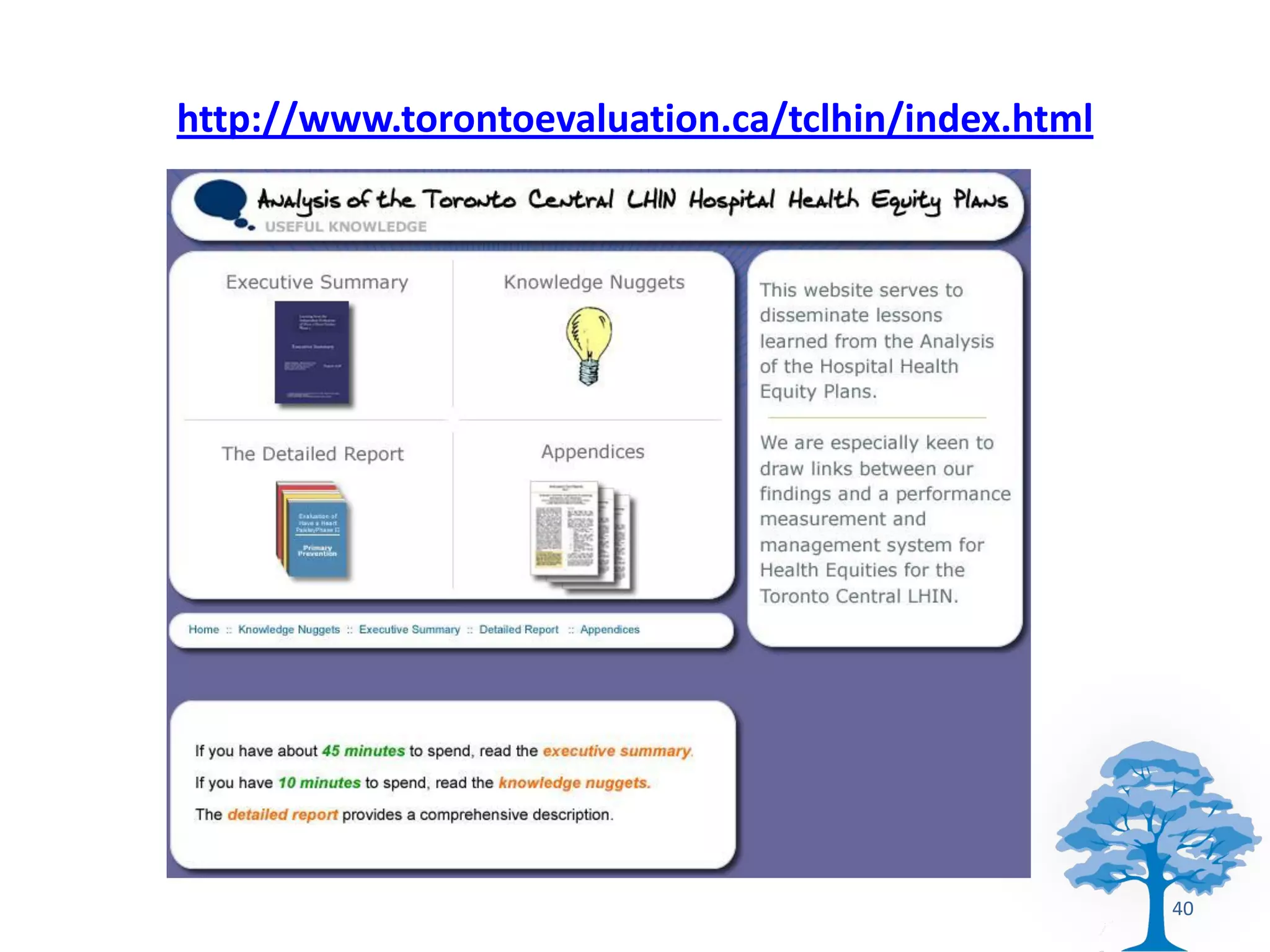
http://www.torontoevaluation.ca/tclhin/index.html


                                                    40
• target services to specific areas or populations:
    • those facing the harshest disparities – to improve the health of the worst
      off fastest
    • or those most in need of specific services
    • or to the worst barriers to equitable access to high-quality services
• this requires sophisticated analyses of the bases of disparities:
    • i.e. is the main problem language barriers, lack of coordination among
      providers, sheer lack of services in particular neighbourhoods, etc.
    • which requires good local research and detailed information – speaks to
      great potential of community-based research to provide rich local needs
      assessments and evaluation data
    • involvement of local communities and stakeholders in planning and
      priority setting is critical to understanding the real local problems

                                                                                   41
• language was a major theme in Toronto hospital equity plans
• we identified acting on this barrier as potential ‘quick win’ in
  analysis of plans
• TC LHIN is funding project to explore innovative ways to
  streamlining and enhancing access to interpretation
• build in evaluation:
   •   can track improvements in volume of interpretation provided
   •   but need to match that against need
   •   need to also assess quality
   •   need to assess impact on improving access to (which?) services
       for (which?) populations


                                                                        42
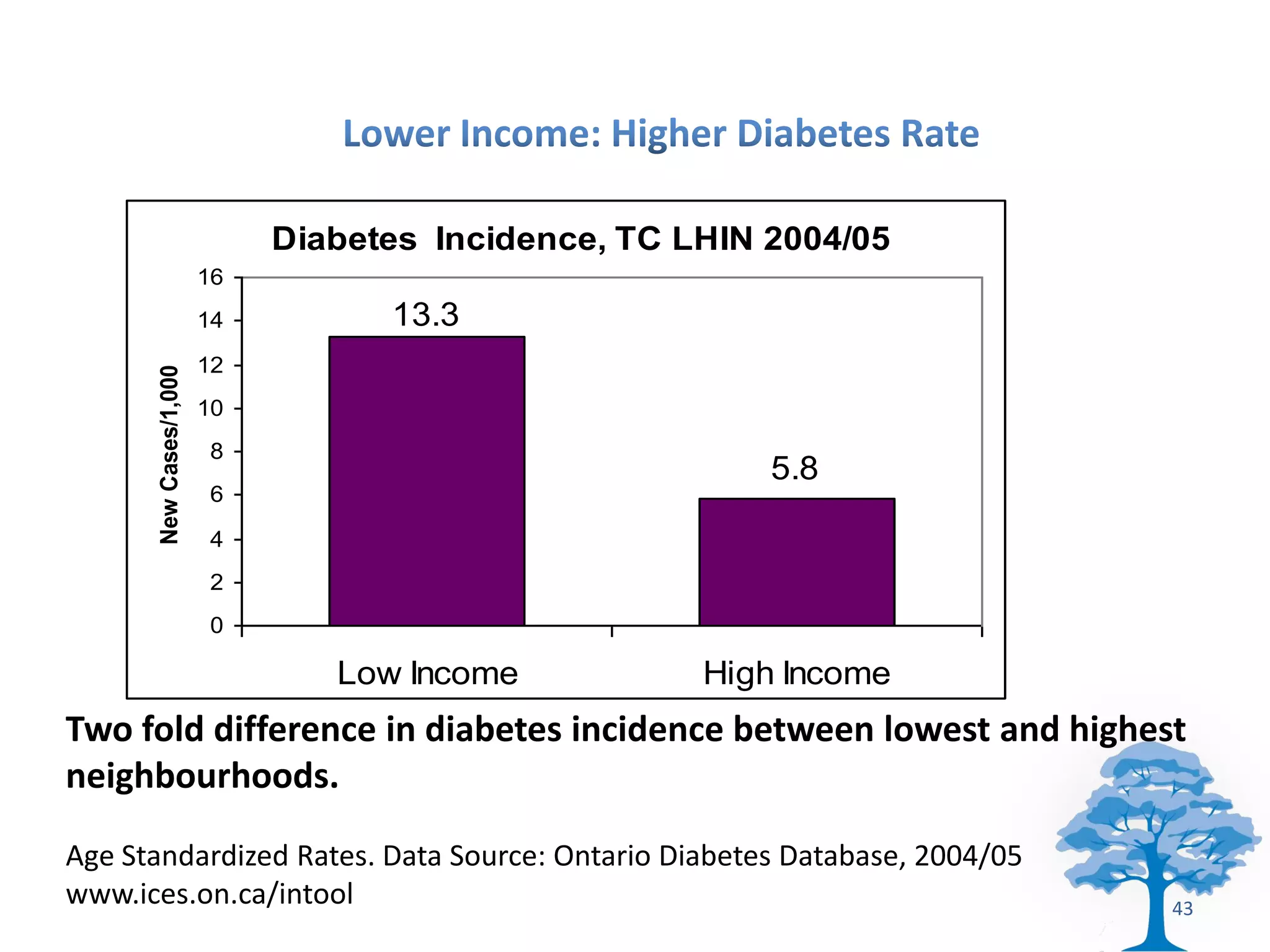
Diabetes Incidence, TC LHIN 2004/05
                        16
                        14         13.3
                        12
      New Cases/1,000


                        10
                        8
                                                         5.8
                        6

                        4
                        2
                        0

                                Low Income           High Income
Two fold difference in diabetes incidence between lowest and highest
neighbourhoods.

Age Standardized Rates. Data Source: Ontario Diabetes Database, 2004/05
www.ices.on.ca/intool                                                     43
• investing in better chronic care prevention and management
  are vital elements of health reform and major provincial
  priority
• up-stream initiatives need to be planned and implemented
  through an equity lens
   • very clear gradient in incidence – and impact – of chronic conditions
   • some populations and communities need greater support to prevent
     and manage chronic conditions
       – poor, Aboriginal and other vulnerable communities face greater incidence
         and greater challenges in managing diabetes
       – at the same, time these communities tend to have less access to safe
         open space and recreational facilities to encourage exercise
       – the Toronto diabetes atlas produced by ICES found that only 25% of in
         low-income neighbourhoods participated in weekly sports – versus 75%
         form high-income
       – built environment is also key -- Atlas found that people -n low-income
         areas walked more for transportation purposes but less for exercise


                                                                               44
• a very interesting example is the integrated diabetes
  program developed out of the London InterCommunity
  Health Centre:
   – far greater incidence and impact in local Hispanic community
   – CHC, community groups and others worked closely together to
     concrete services in these areas of greatest need
   – language specific and culturally sensitive services
   – preventative and promotion services offered where people went –
     e.g. shopping malls
   – also saw that social conditions had to be addressed → referrals to
     social service support, advocacy around employment and other
     problems


                                                                          45
• more emphasis on health promotion is vital to long-term
  sustainability of system and individual health
   • consistent data on variations of risk factors along the social
     gradient
   • anti-smoking, exercise and other health promotion programs
     need to explicitly consider the particular social, cultural and
     economic factors that shape risky behaviour in poorer
     communities– not just the usual focus on individual behaviour
     and lifestyle
   • need to customize and concentrate health promotion programs
     for most disadvantaged
   • if this isn’t done → universal programs can unintentionally
     widen disparities as better off take up programs more
   • need to also build local community needs and a priority for
     disadvantaged into decisions on where to locate new programs

                                                                   46
• hub-style multi-service centres in which a range of health and
  employment, child care, language, literacy, training and social
  services are provided out of single ‘one stop' locations
• Winnipeg Regional Health Authority and Manitoba Family
  Services and Housing have partnered on a new model to
  integrate health and social service delivery – one-stop access
  models in various communities to deliver a broad range of
  health and social services directly and to refer on to other
  agencies when services aren’t available
• Ontario provincial associations representing CHCs, mental
  health and community service agencies have been promoting
  idea -- including to LHIN CEO provincial planning table

                                                                47
• British example of comprehensive policy: Health Action
  Zones and other models were designed to combine
  community economic development with targeted healthcare
  and social service improvements
• in Canada, some Regional Health Authorities have
  developed operational and planning links with local social
  services or emphasized community capacity building:
   • Saskatoon is developing cross-sectoral action on health equity:
       • began from local research documenting shocking disparities among
         neighbourhoods
       • focusing interventions in the poorest neighbourhoods – locating services
         in schools, relying on First Nations elders to guide programming, etc.
       • wide collaboration among public health, municipality, business,
         community, Aboriginal and other leaders

                                                                                    48
• increasing international, Cdn and Ont interest in more
  strategic and realist evaluation
• figuring our what interventions and approaches work, for
  which populations, in what contexts and why
• also drawing on more community-based and participatory
  approaches
• this is absolutely crucial for equity strategy:
   • to identify ‘successful’ policies and programs that most effectively
     reduce access barriers or support the most health disadvantaged
     populations
   • to guide investment in directions that will have the most equity impact


                                                                          49
• at immediate levels:
    • service and client objectives were built into program plan – were they met?
    • does service provide good quality care?
    • does it work for those with most complex needs or from most disadvantaged
      circumstances?
• more equity-orientated:
    • if service is targeted to equity objectives -- does it support the particular
      population or address the particular access barrier as anticipated
    • standard analysis of impact against objectives
• more generally:
    • can’t just measure activity – number or % of pop’n that participated in a
      program
    • does this delivery help to lessen disparities in access for disadvantaged
      populations or reduce access/quality barriers
    • need to measure health outcomes – even when impact only shows up in long-
      term


                                                                                      50
• does the overall strategy deliver the right mix of:
    • quick wins to build momentum and address pressing immediate
        problems
    • longer-term and/or wider scale interventions
• are the many initiatives coordinated effectively?
• is it the particular service – better primary care – or the
  context/combination – delivered out of comprehensive community
  centres – that makes the difference?
• are interventions aligned coherently to build towards common strategic
  directions?
• how can we evaluate the cumulative impact of many equity-focused
  interventions – let alone of their degree of coherence and coordination?


                                                                         51
• can’t go for simplistic indicators
    • e.g. lowering the overall incidence of diabetes
    • a number of researchers and LHINs have identified areas where diabetes
      incidence is highest
→ equity target = reduce differences in incidence between populations or
  areas
    • need to evaluate if and how programs have met these equity objectives
    • in fact, we should expect a successful strategy to lead to incidence getting
      worse in the short tem as more disadvantaged people at greater risk of
      diabetes are being identified and brought into the system to get care
• want to identify specific interventions or directions that have high equity
  impact:
    • ensuring access and use of primary health care does not vary inequitably by
      income level, immigration status, neigbourhood, gender, race, etc.
    • in fact, concentrating services in most disadvantaged communities with
      greatest needs


                                                                                     52
• a good service target has been proposed for diabetes =
  high/increasing % of people who get best standard care
   • there is clear clinical consensus on what this best standard care
     constitutes and how to measure it
→ equity target = reduce inequitable differences in quality care
   • so we need to evaluate % who get the highest standard care by
     gender, income, ethno-cultural background
   • and assess any inequitable variations in outcomes in terms of
     complications and rates of hospitalization
• many programs assess their services through client satisfaction
  surveys and similar methods
   • providers look for high and improving satisfaction → equity
     target = reduce any differences in satisfaction by gender,
     income, ethno-cultural background, etc.


                                                                         53
• if goal is to increase the % of kids who exercise regularly
    • equity target is to reduce the differentials in % of kids who
      exercise by neighbourhood, gender, ethno-cultural background,
      etc.
    • and that won’t be just a question of education and awareness
      but facilities and proactive empowerment of kids and
      communities in which they live
• if goal is increasing overall exercise rates and decreasing smoking
  → equity target = reduce those differences by gender, income,
  region
• drilling down: to achieve these equity targets, we need to:
    • ensure take-up of health promotion programs does not vary
      inequitably by income level, neigbourhood, gender, race, etc.
    • in fact, take-up – and sticking with the programs – needs to be
      highest in most disadvantaged communities with greatest needs

                                                                   54
• don’t just want to evaluate results for those who make it through
  the doors of service providers
• but also disadvantaged populations who are not being reached
   • need to assess who isn’t signing up?
   • and once signed up for particular program, are there inequitable
      variations in who sticks with the program?
• need to differentiate those with greatest need = who programs
  most need to reach and keep to have an impact
→ develop funding and evaluation weighting that recognizes more
  complex needs and challenges of most disadvantaged, and builds
  this into incentive system
→ again, to guide investment in policy directions and program
  interventions that will have the strongest equity impact

                                                                   55
• huge number of community and front-line initiatives already addressing
  equity and health promotion across province
• + equity focused planning will yield useful information on existing
  system barriers and the needs of disadvantaged populations, and on
  promising and successful program interventions
• we need to be able to:
    • collate and analyze all the useful intelligence gained from equity-focused
      planning
    • capture and share information on local initiatives, and build on local front-line
      insights
    • share the resulting knowledge across regions – and beyond
    • assess the most promising initiatives or directions
    • scale up promising initiatives across the province where appropriate
• central role of evaluation in all this

                                                                                     56
1. Where would you start and what would be your
   most important challenges in developing a
   comprehensive cross-sectoral strategy to reduce
   health disparities in ten years? How would you
   build in an effective evaluation framework?
2. Outline a strategy to reduce the incidence and
   impact of diabetes in Toronto and set up an
   evaluation framework for it.
3. Develop a plan and set up an evaluation framework
   for community-based programs in Parkdale to
   reduce the incidence and impact of diabetes.

                                                       57
• back to bigger picture
• following is a roadmap for comprehensive
  integrated policy action on determinants of
  health and health inequality


                                                58
1. look widely for ideas and inspiration from jurisdictions with comprehensive
   health equity policies, and adapt flexibly to Canadian, provincial and local needs
   and opportunities;
2. address the fundamental social determinants of health inequality – macro policy
   is crucial, reducing overall social and economic inequality and enhancing social
   mobility are the pre-conditions for reducing health disparities over the long-
   term;
3. develop a coherent overall strategy, but split it into actionable and manageable
   components that can be moved on;
4. act across silos – inter-sectoral and cross-government collaboration and
   coordination are vital;
5. set and monitor targets and incentives – cascading through all levels of
   government and program action;


                                                                                    59
6  rigorously evaluate the outcomes and potential of program initiatives and
   investments – to build on successes and scale up what is working;
7 act on equity within the health system:
   • making equity a core objective and driver of health system reform – every bit
       as important as quality and sustainability;
   • eliminating unfair and inefficient barriers to access to the care people need;
   • targeting interventions and enhanced services to the most health
       disadvantaged populations;
8 invest in those levers and spheres that have the most impact on health
  disparities such as:
   • enhanced primary care for the most under-served or disadvantaged
       populations;
   • integrated health, child development, language, settlement, employment, and
       other community-based social services;


                                                                                 60
9 act locally – through well-focussed regional, local or neighbourhood cross-
   sectoral collaborations and integrated initiatives;
10 invest up-stream through an equity lens – in health promotion, chronic care
   prevention and management, and tackling the roots of health disparities;
11 build on the enormous amount of local imagination and innovation going on
   among service providers and communities across the country;
12 pull all this innovation, experience and learning together into a continually
   evolving repertoire of effective program and policy instruments, and into a
   coherent and coordinated overall strategy for health equity.


                                                                                   61
• these speaking notes and further resources on
  policy directions to enhance health equity, health
  reform and the social determinants of health are
  available on our site at
  http://wellesleyinstitute.com
• my email is bob@wellesleyinstitute.com
• I would be interested in any comments on the ideas
  in this presentation and any information or analysis
  on initiatives or experience that address health
  equity

                                                     62
The Wellesley Institute advances urban health through rigorous research,
  pragmatic policy solutions, social innovation, and community action.


                                                                           63

Making Evaluations Matter for 'Wicked' Policy Problems; Supporting Strategy, Policy and Interventions to Drive Health Equity

  • 1.
    Bob Gardner The ACHIEVEResearch Partnership: Action for Health Equity Interventions Dec 2, 2009 © The Wellesley Institute www.wellesleyinstitute.com
  • 2.
    • understanding thescale, impact and roots of existing health disparities in Ontario • why we need a comprehensive health equity strategy to address these pervasive disparities: • macro level social and economic policy • within the health system • through specific service interventions • analyzing where evaluation fits: • driving more effective equity-focused planning • underpinning more effective program and service interventions • grounding more effective and innovative collaborations • supporting strategic coherence across all these levels 2
  • 3.
    • there isa clear gradient in health in which people with lower income, education or other indicators of social inequality and exclusion tend to have poorer health + major differences between women and men • the gap between the health status of the best off and most disadvantaged can be huge – and damaging • difference btwn life expectancy of top and bottom income decile in Canada = 7.4 years for men and 4.5 for women • more sophisticated analyses add the pronounced gradient in morbidity to mortality → taking account of quality of life and developing data on health adjusted life expectancy • even higher disparities btwn top and bottom = 11.4 years for men and 9.7 for women (Statistics Canada Health Reports Dec 09) • in addition, there are systemic disparities in access to and quality of care within the healthcare system 3
  • 4.
  • 5.
  • 6.
  • 7.
  • 8.
    clear research consensus that roots of health disparities lie in broader social and economic inequality and exclusion • impact of inadequate early childhood development, poverty, precarious employment, social exclusion, inadequate housing and decaying social safety nets on health outcomes is well established here and internationally • real problem is differential access to these determinants – many analysts are focusing more specifically on social determinants of health inequalities © The Wellesley Institute 8 www.welleseyinstitute.com
  • 9.
  • 10.
  • 11.
    Determinants interact and intersectwith each other -- in a constantly changing and dynamic system In fact, through multiple interacting and inter- dependent economic, social and health systems Determinants have a reinforcing and cumulative effect on individual and population health 11
  • 12.
    • Health disparitiesor inequities are differences in health outcomes that are avoidable, unfair and systematically related to social inequality and disadvantage • This concept: • is clear, understandable and actionable • identifies the problem that policies will try to solve • is tied to widely accepted notions of fairness and social justice • The goal of health equity strategy is to reduce or eliminate socially and institutionally structured health inequalities and differential outcomes 12
  • 13.
    • a positiveand forward-looking definition = equal opportunities for good health • health equity is a broad concept that also prioritizes diversity: • reflecting the increasing diversity of Ontario society and the fact that racism and ethno-cultural differences are important determinants of health disparities • recognizing that services that reflect and speak to the diversity of cultures -- cultural competence – are essential to an equitable system • and can encompass equity-focused health promotion • recognizing that vulnerable populations face more complex and serious barriers to good health • recognizing that programs and plans need to always take this social context and constraints into account • achieving health equity would extend far beyond enhancing individual and collective well-being 13
  • 14.
  • 15.
    • health disparitiescan seem so overwhelming and their underlying social determinants so intractable → can be paralyzing • think big and think strategically, but get going • make best judgment from evidence and experience • experiment and innovate • learn lessons and adjust – why evaluation is so crucial • gradually build up coherent sets of policy and program actions – and keep evaluating • need to start somewhere – and we’re in health systems 15
  • 16.
    • need actionaddressing health disparities at multiple levels: • macro social and economic policy • broad strategic frameworks within health and other systems • policies and strategies for particular issues – chronic conditions, primary care, e health • specific service interventions geared to specific outcomes or places • interventions at every one of these levels are complex • impact is inter-dependent and contingent → need coherent overall strategy 16
  • 17.
    • we wantpolicy and program interventions to have: • the most impact in reducing disparities • that sustain that impact over the long-term • reducing overall social and economic inequality may be the most significant single way to reduce health disparities →need to reduce unequal distribution of social and economic resources – of SDoH → requires a significant commitment and re-orientation of social and economic policy and fundamental institutional arrangements 17
  • 18.
    • there isalways much to be learned from policies, programs and initiatives in other jurisdictions • a number of countries have made lessening health disparities a top national priority and have developed cross- sectoral policy frameworks and/or action plans: • England, Scotland, Australia, New Zealand • many European countries • also increasing international and high-level attention: • WHO Commission on Social Determinants of Health • European Union, with its Closing the Gap project to tackle health disparities • look broadly for policy solutions, and adapt flexibly to local/provincial circumstances 18
  • 19.
    • coordinated nationalpolicy to reduce health disparities by reducing the number of people at risk of social and economic vulnerability • national public health strategy has 12 key objectives – five of which, defined as fundamental to all the others, are about improving social and economic determinants • also focus on inclusive labour market, anti-discrimination, childcare, affordable housing and other policies • equitable access to improved health care was seen to be just one part of this broader package • emphasized partnerships with community service providers and organizations – in both policy development and service delivery 19
  • 20.
    • reducing healthdisparities – and underlying social and economic inequality – are complex challenges • developing and mobilizing health policy is a classic ‘wicked problem’: • the issue crosses policy fields and jurisdictional boundaries • involves many govt and external stakeholders • is shaped by forces beyond govt control • is necessarily long-term • won’t align neatly with party/govt interests and electoral cycles 20
  • 21.
    • but goalis reducing health disparities – is that ultimate evaluation criteria? • disparities do not appear to be lessening in countries with good strategies …. but these effects are necessarily long-term? • no evidence that comprehensive policies work is the wrong conclusion …. but have not been evaluating properly to conclude interventions don't work • Britain has reviewed its comprehensive policies: • no decline in disparities – perhaps worsening • mixed results on specific objectives – some on target, some not • can't conclude that interventions don’t work – too soon to tell • but did conclude that evaluation was not properly built into policy and program design 21
  • 22.
    • might needmore modest immediate to mid-term evaluation approaches and objectives – more process than outcomes? • is there coherence in strategies and objectives across policy fields and departments? • more specifically, comprehensive strategies are generally accompanied by efforts for greater ‘joined-up’ government coordination and collaboration • can evaluate processes • are priorities and directions aligned towards common goals and vision? • were the right stakeholders involved – in the right ways – in developing policy? • is strategy based on best available theory, evidence and experience? • is strategy comprehensive – are critical components missing or under- developed? 22
  • 23.
    • even thoughroots of health disparities lie in far wider social and economic inequality • how the health system is organized and how services and care are delivered is still crucial to tackling health disparities • many countries have developed comprehensive multi- sectoral strategies to reduce health disparities • in all of them, transforming the health system is an indispensable element, including: • reducing barriers to equitable access to high quality care • targeted interventions to improve the health of the poorest, fastest • up-stream investments in primary and preventative care directed to most vulnerable • delivering these services in coordinated way at community/local level 23
  • 24.
    1. it’s inthe health system that the most disadvantaged in SDoH terms end up sicker and needing care • equitable healthcare and proactive health promotion can help to mediate the harshest impact of the wider social determinants of health on health disadvantaged populations and communities 2. in addition, there are systemic disparities in access and quality of healthcare that need to be addressed • people lower down the social hierarchy tend to have poorer access to health services, even though they may have more complex needs and require more care • unless we address inequitable access and quality, healthcare and health promotion could make overall disparities even worse • at the least, the goal is to ensure equitable access to care/support for all who need it, regardless of their social position 24
  • 25.
    while health disparitiesare pervasive and deep-rooted, they can be changed through policy and program action comprehensive strategy developed in 2008 for Toronto Central LHIN many recommendations have been acted on other LHINs are also prioritizing and moving to address health disparities 25
  • 26.
    • given impactof wider SDoH, cannot expect even the most progressive and equitable health system to lead to major reductions in disparities of outcomes • goal is to ensure equitable access to high quality healthcare regardless of social position • can do this through a two pronged strategy : 1. building health equity into all health planning and delivery • doesn’t mean all programs are all about equity • but all take equity into account in planning their services and outreach 2. targeting some resources or programs specifically to addressing disadvantaged populations or key access barriers • looking for investments and interventions that will have the highest impact on reducing health disparities or enhancing the opportunities for good health of the most vulnerable 26
  • 27.
    • one criticalcomponent of this strategic approach is good planning • to develop effective planning, we need: • clear strategy • coherent approach • repertoire of effective tools and techniques • with support for planning authorities and practitioners to effectively use them • good actionable information • and then drilling down: what is our ‘theory’ of how equity-focused planning works? 27
  • 28.
    not just taking account individual of social programs but constraints & coordination, conditions partnerships & collaboration 28
  • 29.
    enhanced up-stream heath access to conditions & health opportunities promotion for improve fastest most for those in disadvantaged greatest need 29
  • 30.
    • processes andconstraints are complex, and outcomes uncertain and unpredictable, at each of these junctures • and all of this varies by context: • particular communities or neighbourhoods – with their different health challenges and needs • particular population health and service landscape in specific areas • further specified by health condition or concern (e.g. mental health) • existing municipal and local polices and traditions • community resilience, connectedness, organizing and traditions • we don’t really know what works best at each of these junctures (let alone cumulatively) or in varying contexts → need to build evaluation in from the start to learn 30
  • 31.
    1. quick check to ensure equity is 1. simple equity lens considered in all service delivery/planning 2. Health Equity Impact 2. take account of disadvantaged Assessment – has been piloted in populations, access barriers and Toronto and MOHLTC is related equity issues in program considering wider roll-out planning and service delivery 3. assess current state of provider organization 3. equity audits and/or HEIA 4. determine needs of communities facing health disparities 4. equity-focused needs 5. assess impact of assessment programs/interventions on health disparities and 5. equity-focused evaluation disadvantaged populations 31
  • 32.
    1. screening – projects where while HEIA is sometimes promoted HEIA would be useful as easy-to-use ‘first-pass’ planning 2. scoping – which pop’n and tool health effects to consider 3. assessing potential equity risks does not mean it is only about 1 -- 3 and benefits – specifying particular pop’n 4. developing recommendations – experts argue core of HEIA is in fact to promote positive or mitigate 4 – assessing & developing negative effects recommendations to address equity 5. report results to decision implications makers 6. monitoring and evaluation – of effectiveness of recommendations 32
  • 33.
    • a premiseof the draft Ontario HEIA – and many others – is that: • assessing the potential impact of initiatives on particular populations requires solid understanding of that population's health status, needs and context • this can benefit from ongoing community engagement with the population and/or specific needs assessment • analyzing possible mitigation strategies will also benefit from engaging the affected population in designing the necessary service changes • similarly, the stage of monitoring and assessing the impact of the initiative – and how HEIA contributed -- also needs: • research and input from the affected population on impact • outcome data stratified by population and determinants 33
  • 34.
    • comprehensive policieson health equity from other countries all include: • setting clear strategic objectives and targets • defining indicators – that build on available reliable data and make the most sense in the particular context • closely monitoring progress against the indicators or targets • disseminating the results widely for public scrutiny • key driver of system change = building equity targets and objectives into routine performance management and provider planning 34
  • 35.
    • we knowthere will be broad targets for priorities such as diabetes and mental health → build equity into these targets: • several LHINs have identified areas where diabetes incidence is highest → equity target = reduce differences in incidence, complications and rates of hospitalization among areas across Central • similarly, systemic inequities in depression → equity target = reduce those differences by gender, income, region • looking up-stream → equity target = ensuring take-up of health promotion programs does not vary inequitably by income level, neigbourhood, gender, race, etc. • many programs assess their services through client satisfaction surveys and similar methods • providers look for high and improving satisfaction → equity target = reduce any differences in satisfaction by gender, income, ethno-cultural background, etc. 35
  • 36.
    • MOHLTC flowfunds to LHINS, who in turn allocate funds to health service providers • these funding programs, and the accountability agreements that go with them with providers, provide an opportunity to build in specific equity expectations • expectations will vary by community and provider, but could include: • undertaking appropriate equity-focused planning • providing sufficient services in languages of community and appropriate interpretation • identifying areas where access to services is inequitable and developing plans to address barriers and gaps • ensuring service utilization matches appropriately with demography and needs of their catchment profile • developing specific services or outreach to particular disadvantaged populations – homeless, isolated seniors, etc. 36
  • 37.
    • greater chanceof success for equity strategy if aligned with provincial priorities • MOHLTC and MHP priorities such as mental health and diabetes are particularly sensitive to social conditions • chronic disease prevention and management programs cannot be successful unless they take account of social conditions and constraints • various supports designed to enable people with mental health challenges to live in the community also need to take into account their social conditions • Wellesley and Canadian Mental Health Association–Ontario partnered on input to current discussions about mental health strategy: • stressed that programs had to take account of SDoH in ways discussed here • highlighted healthy communities approach • highlighted the potential of specific planning tools such as Mental Health Impact Assessment 37
  • 38.
    • identify keypriorities and imperatives for wider health system transformation • equity also supports other system drivers • better access to primary care is key to reducing pressure on ER wait times and ALC • reducing language barriers to good care through better interpretation can reduce mis-diagnoses and over- prescriptions → enhanced quality and cost effectiveness • reducing higher expenditures on vulnerable populations due to health disparities → can contribute to overall and sustainability 38
  • 39.
    • a promisingdirection several LHINs have taken up is to have providers undertake specific equity planning exercises designed to: • identify access barriers, disadvantaged populations, service gaps and opportunities in their catchement areas and spheres • develop programs and services to address those gaps and better meet healthcare needs of disadvantaged communities • these provider plans have the potential to: • raise awareness of equity within the organizations • build equity into planning, resource allocation and routine delivery • pull their many existing initiatives together into a coherent overall equity strategy • build connections among providers for addressing common equity issues 39
  • 40.
  • 41.
    • target servicesto specific areas or populations: • those facing the harshest disparities – to improve the health of the worst off fastest • or those most in need of specific services • or to the worst barriers to equitable access to high-quality services • this requires sophisticated analyses of the bases of disparities: • i.e. is the main problem language barriers, lack of coordination among providers, sheer lack of services in particular neighbourhoods, etc. • which requires good local research and detailed information – speaks to great potential of community-based research to provide rich local needs assessments and evaluation data • involvement of local communities and stakeholders in planning and priority setting is critical to understanding the real local problems 41
  • 42.
    • language wasa major theme in Toronto hospital equity plans • we identified acting on this barrier as potential ‘quick win’ in analysis of plans • TC LHIN is funding project to explore innovative ways to streamlining and enhancing access to interpretation • build in evaluation: • can track improvements in volume of interpretation provided • but need to match that against need • need to also assess quality • need to assess impact on improving access to (which?) services for (which?) populations 42
  • 43.
    Diabetes Incidence, TCLHIN 2004/05 16 14 13.3 12 New Cases/1,000 10 8 5.8 6 4 2 0 Low Income High Income Two fold difference in diabetes incidence between lowest and highest neighbourhoods. Age Standardized Rates. Data Source: Ontario Diabetes Database, 2004/05 www.ices.on.ca/intool 43
  • 44.
    • investing inbetter chronic care prevention and management are vital elements of health reform and major provincial priority • up-stream initiatives need to be planned and implemented through an equity lens • very clear gradient in incidence – and impact – of chronic conditions • some populations and communities need greater support to prevent and manage chronic conditions – poor, Aboriginal and other vulnerable communities face greater incidence and greater challenges in managing diabetes – at the same, time these communities tend to have less access to safe open space and recreational facilities to encourage exercise – the Toronto diabetes atlas produced by ICES found that only 25% of in low-income neighbourhoods participated in weekly sports – versus 75% form high-income – built environment is also key -- Atlas found that people -n low-income areas walked more for transportation purposes but less for exercise 44
  • 45.
    • a veryinteresting example is the integrated diabetes program developed out of the London InterCommunity Health Centre: – far greater incidence and impact in local Hispanic community – CHC, community groups and others worked closely together to concrete services in these areas of greatest need – language specific and culturally sensitive services – preventative and promotion services offered where people went – e.g. shopping malls – also saw that social conditions had to be addressed → referrals to social service support, advocacy around employment and other problems 45
  • 46.
    • more emphasison health promotion is vital to long-term sustainability of system and individual health • consistent data on variations of risk factors along the social gradient • anti-smoking, exercise and other health promotion programs need to explicitly consider the particular social, cultural and economic factors that shape risky behaviour in poorer communities– not just the usual focus on individual behaviour and lifestyle • need to customize and concentrate health promotion programs for most disadvantaged • if this isn’t done → universal programs can unintentionally widen disparities as better off take up programs more • need to also build local community needs and a priority for disadvantaged into decisions on where to locate new programs 46
  • 47.
    • hub-style multi-servicecentres in which a range of health and employment, child care, language, literacy, training and social services are provided out of single ‘one stop' locations • Winnipeg Regional Health Authority and Manitoba Family Services and Housing have partnered on a new model to integrate health and social service delivery – one-stop access models in various communities to deliver a broad range of health and social services directly and to refer on to other agencies when services aren’t available • Ontario provincial associations representing CHCs, mental health and community service agencies have been promoting idea -- including to LHIN CEO provincial planning table 47
  • 48.
    • British exampleof comprehensive policy: Health Action Zones and other models were designed to combine community economic development with targeted healthcare and social service improvements • in Canada, some Regional Health Authorities have developed operational and planning links with local social services or emphasized community capacity building: • Saskatoon is developing cross-sectoral action on health equity: • began from local research documenting shocking disparities among neighbourhoods • focusing interventions in the poorest neighbourhoods – locating services in schools, relying on First Nations elders to guide programming, etc. • wide collaboration among public health, municipality, business, community, Aboriginal and other leaders 48
  • 49.
    • increasing international,Cdn and Ont interest in more strategic and realist evaluation • figuring our what interventions and approaches work, for which populations, in what contexts and why • also drawing on more community-based and participatory approaches • this is absolutely crucial for equity strategy: • to identify ‘successful’ policies and programs that most effectively reduce access barriers or support the most health disadvantaged populations • to guide investment in directions that will have the most equity impact 49
  • 50.
    • at immediatelevels: • service and client objectives were built into program plan – were they met? • does service provide good quality care? • does it work for those with most complex needs or from most disadvantaged circumstances? • more equity-orientated: • if service is targeted to equity objectives -- does it support the particular population or address the particular access barrier as anticipated • standard analysis of impact against objectives • more generally: • can’t just measure activity – number or % of pop’n that participated in a program • does this delivery help to lessen disparities in access for disadvantaged populations or reduce access/quality barriers • need to measure health outcomes – even when impact only shows up in long- term 50
  • 51.
    • does theoverall strategy deliver the right mix of: • quick wins to build momentum and address pressing immediate problems • longer-term and/or wider scale interventions • are the many initiatives coordinated effectively? • is it the particular service – better primary care – or the context/combination – delivered out of comprehensive community centres – that makes the difference? • are interventions aligned coherently to build towards common strategic directions? • how can we evaluate the cumulative impact of many equity-focused interventions – let alone of their degree of coherence and coordination? 51
  • 52.
    • can’t gofor simplistic indicators • e.g. lowering the overall incidence of diabetes • a number of researchers and LHINs have identified areas where diabetes incidence is highest → equity target = reduce differences in incidence between populations or areas • need to evaluate if and how programs have met these equity objectives • in fact, we should expect a successful strategy to lead to incidence getting worse in the short tem as more disadvantaged people at greater risk of diabetes are being identified and brought into the system to get care • want to identify specific interventions or directions that have high equity impact: • ensuring access and use of primary health care does not vary inequitably by income level, immigration status, neigbourhood, gender, race, etc. • in fact, concentrating services in most disadvantaged communities with greatest needs 52
  • 53.
    • a goodservice target has been proposed for diabetes = high/increasing % of people who get best standard care • there is clear clinical consensus on what this best standard care constitutes and how to measure it → equity target = reduce inequitable differences in quality care • so we need to evaluate % who get the highest standard care by gender, income, ethno-cultural background • and assess any inequitable variations in outcomes in terms of complications and rates of hospitalization • many programs assess their services through client satisfaction surveys and similar methods • providers look for high and improving satisfaction → equity target = reduce any differences in satisfaction by gender, income, ethno-cultural background, etc. 53
  • 54.
    • if goalis to increase the % of kids who exercise regularly • equity target is to reduce the differentials in % of kids who exercise by neighbourhood, gender, ethno-cultural background, etc. • and that won’t be just a question of education and awareness but facilities and proactive empowerment of kids and communities in which they live • if goal is increasing overall exercise rates and decreasing smoking → equity target = reduce those differences by gender, income, region • drilling down: to achieve these equity targets, we need to: • ensure take-up of health promotion programs does not vary inequitably by income level, neigbourhood, gender, race, etc. • in fact, take-up – and sticking with the programs – needs to be highest in most disadvantaged communities with greatest needs 54
  • 55.
    • don’t justwant to evaluate results for those who make it through the doors of service providers • but also disadvantaged populations who are not being reached • need to assess who isn’t signing up? • and once signed up for particular program, are there inequitable variations in who sticks with the program? • need to differentiate those with greatest need = who programs most need to reach and keep to have an impact → develop funding and evaluation weighting that recognizes more complex needs and challenges of most disadvantaged, and builds this into incentive system → again, to guide investment in policy directions and program interventions that will have the strongest equity impact 55
  • 56.
    • huge numberof community and front-line initiatives already addressing equity and health promotion across province • + equity focused planning will yield useful information on existing system barriers and the needs of disadvantaged populations, and on promising and successful program interventions • we need to be able to: • collate and analyze all the useful intelligence gained from equity-focused planning • capture and share information on local initiatives, and build on local front-line insights • share the resulting knowledge across regions – and beyond • assess the most promising initiatives or directions • scale up promising initiatives across the province where appropriate • central role of evaluation in all this 56
  • 57.
    1. Where wouldyou start and what would be your most important challenges in developing a comprehensive cross-sectoral strategy to reduce health disparities in ten years? How would you build in an effective evaluation framework? 2. Outline a strategy to reduce the incidence and impact of diabetes in Toronto and set up an evaluation framework for it. 3. Develop a plan and set up an evaluation framework for community-based programs in Parkdale to reduce the incidence and impact of diabetes. 57
  • 58.
    • back tobigger picture • following is a roadmap for comprehensive integrated policy action on determinants of health and health inequality 58
  • 59.
    1. look widelyfor ideas and inspiration from jurisdictions with comprehensive health equity policies, and adapt flexibly to Canadian, provincial and local needs and opportunities; 2. address the fundamental social determinants of health inequality – macro policy is crucial, reducing overall social and economic inequality and enhancing social mobility are the pre-conditions for reducing health disparities over the long- term; 3. develop a coherent overall strategy, but split it into actionable and manageable components that can be moved on; 4. act across silos – inter-sectoral and cross-government collaboration and coordination are vital; 5. set and monitor targets and incentives – cascading through all levels of government and program action; 59
  • 60.
    6 rigorouslyevaluate the outcomes and potential of program initiatives and investments – to build on successes and scale up what is working; 7 act on equity within the health system: • making equity a core objective and driver of health system reform – every bit as important as quality and sustainability; • eliminating unfair and inefficient barriers to access to the care people need; • targeting interventions and enhanced services to the most health disadvantaged populations; 8 invest in those levers and spheres that have the most impact on health disparities such as: • enhanced primary care for the most under-served or disadvantaged populations; • integrated health, child development, language, settlement, employment, and other community-based social services; 60
  • 61.
    9 act locally– through well-focussed regional, local or neighbourhood cross- sectoral collaborations and integrated initiatives; 10 invest up-stream through an equity lens – in health promotion, chronic care prevention and management, and tackling the roots of health disparities; 11 build on the enormous amount of local imagination and innovation going on among service providers and communities across the country; 12 pull all this innovation, experience and learning together into a continually evolving repertoire of effective program and policy instruments, and into a coherent and coordinated overall strategy for health equity. 61
  • 62.
    • these speakingnotes and further resources on policy directions to enhance health equity, health reform and the social determinants of health are available on our site at http://wellesleyinstitute.com • my email is bob@wellesleyinstitute.com • I would be interested in any comments on the ideas in this presentation and any information or analysis on initiatives or experience that address health equity 62
  • 63.
    The Wellesley Instituteadvances urban health through rigorous research, pragmatic policy solutions, social innovation, and community action. 63