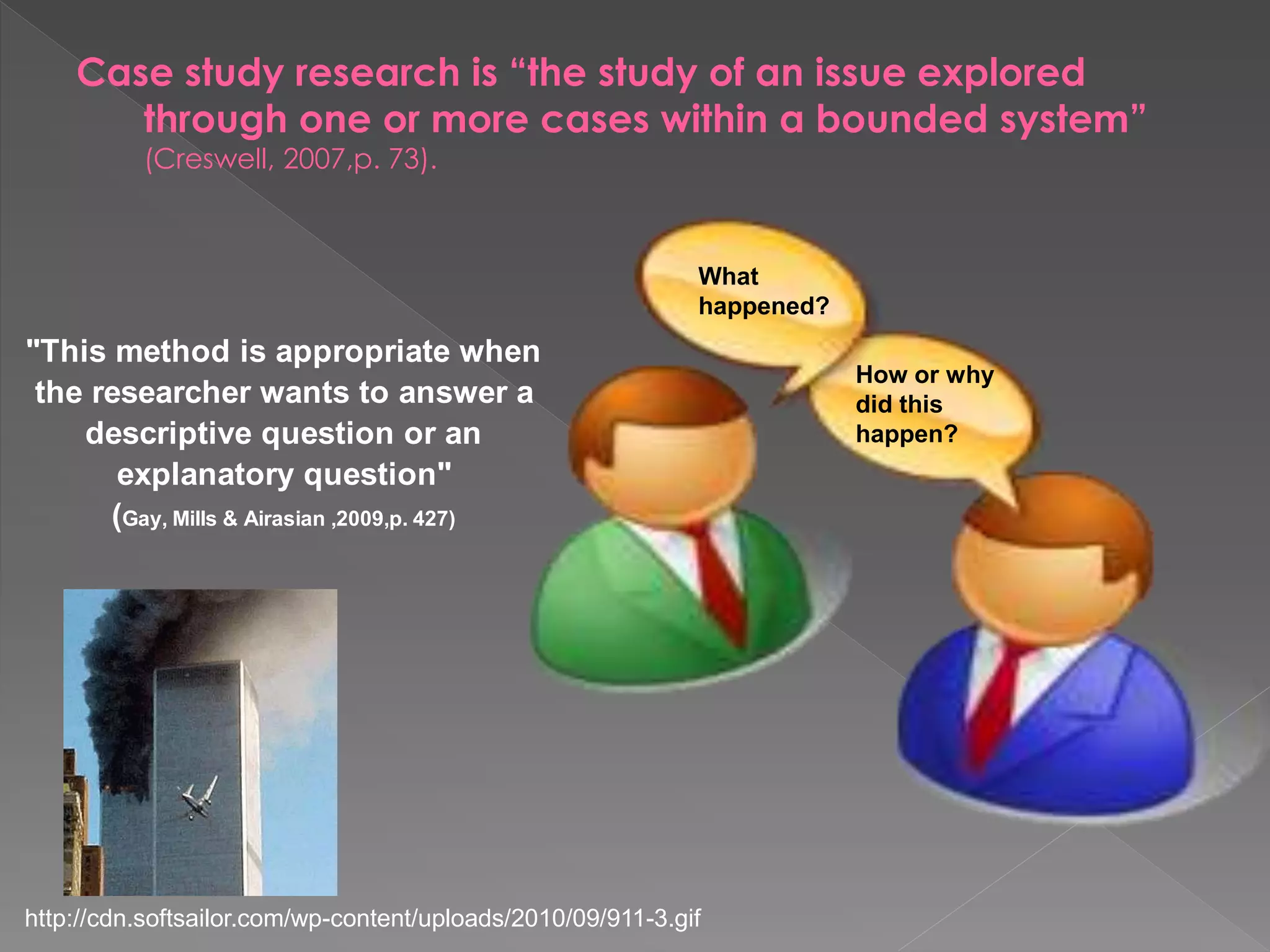
Case study research is “the study of an issue explored
through one or more cases within a bounded system”
(Creswell, 2007,p. 73).
"This method is appropriate when
the researcher wants to answer a
descriptive question or an
explanatory question"
(Gay, Mills & Airasian ,2009,p. 427)
What
happened?
How or why
did this
happen?
http://cdn.softsailor.com/wp-content/uploads/2010/09/911-3.gif
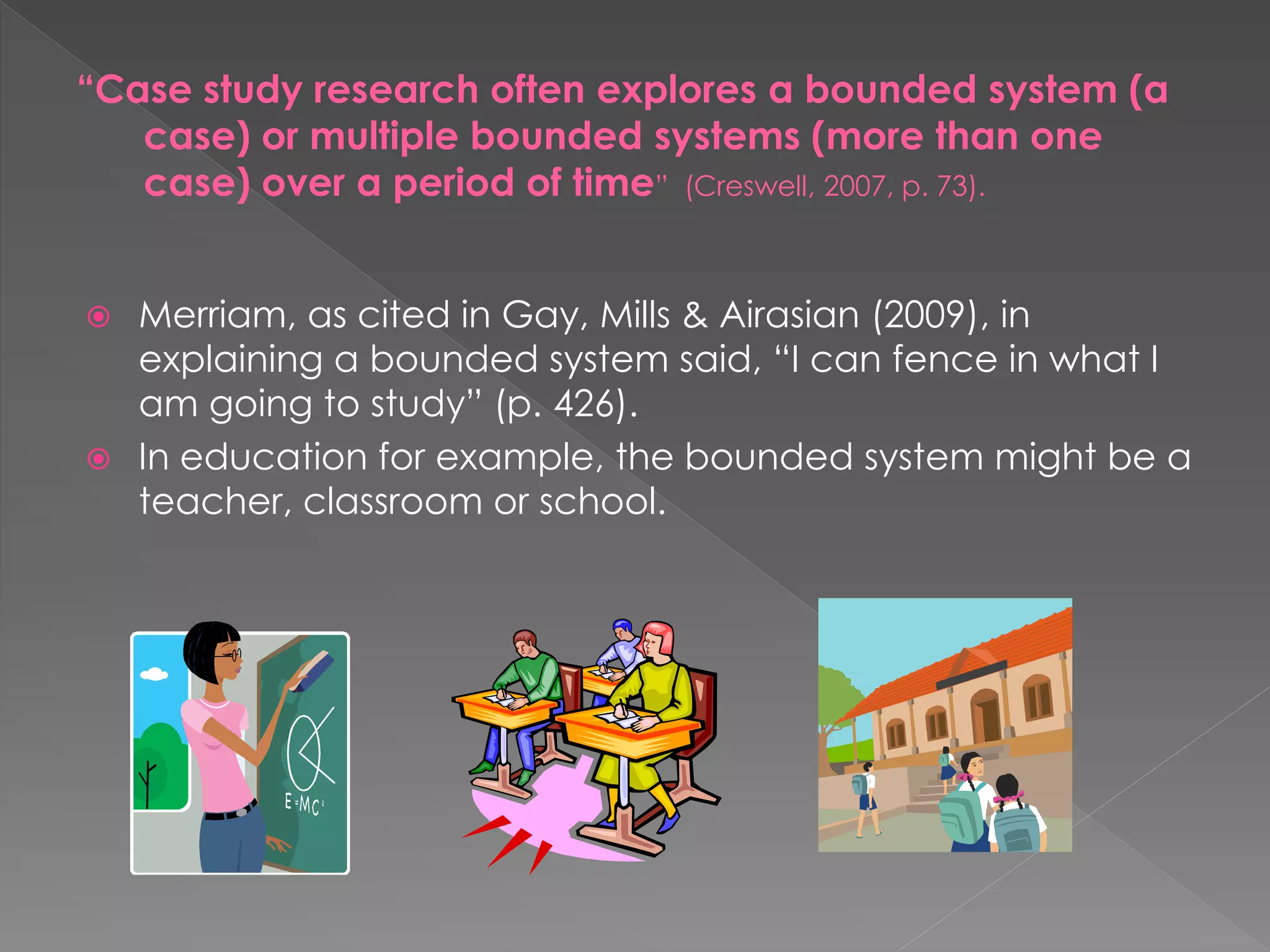
 Merriam, as cited in Gay, Mills & Airasian (2009), in
explaining a bounded system said, “I can fence in what I
am going to study” (p. 426).
 In education for example, the bounded system might be a
teacher, classroom or school.
“Case study research often explores a bounded system (a
case) or multiple bounded systems (more than one
case) over a period of time” (Creswell, 2007, p. 73).
“Case study research can be presented as a strategy of
inquiry, a methodology or a comprehensive research
strategy”(Creswell, 2007, p. 73).
CASE STUDY
 Creswell (2007) identifies the different
types of case studies as:
• The collective or multiple case study in
which “one issue or concern is selected,
but the inquirer selects multiple case
studies to illustrate the issue” (p. 74).
• The intrinsic case study in which case
focuses on itself. (p. 74).
1) Determine if a case study method is suitable
to the research problem.
2) Ascertain suitable case or cases.
3) Collect extensive data relying on numerous
sources of information, such as “observations,
interviews, documents, and audiovisual
materials” (Creswell, 2007, p. 75).
4) Analyse data in either a holistic or embedded
manner.
5) Report on the meaning or implications of the
case or cases.
(Creswell, 2007, p. 74-75)
 It can often be
difficult for
researchers to
identify a suitable
case or cases
(Creswell, 2007, p.
75).
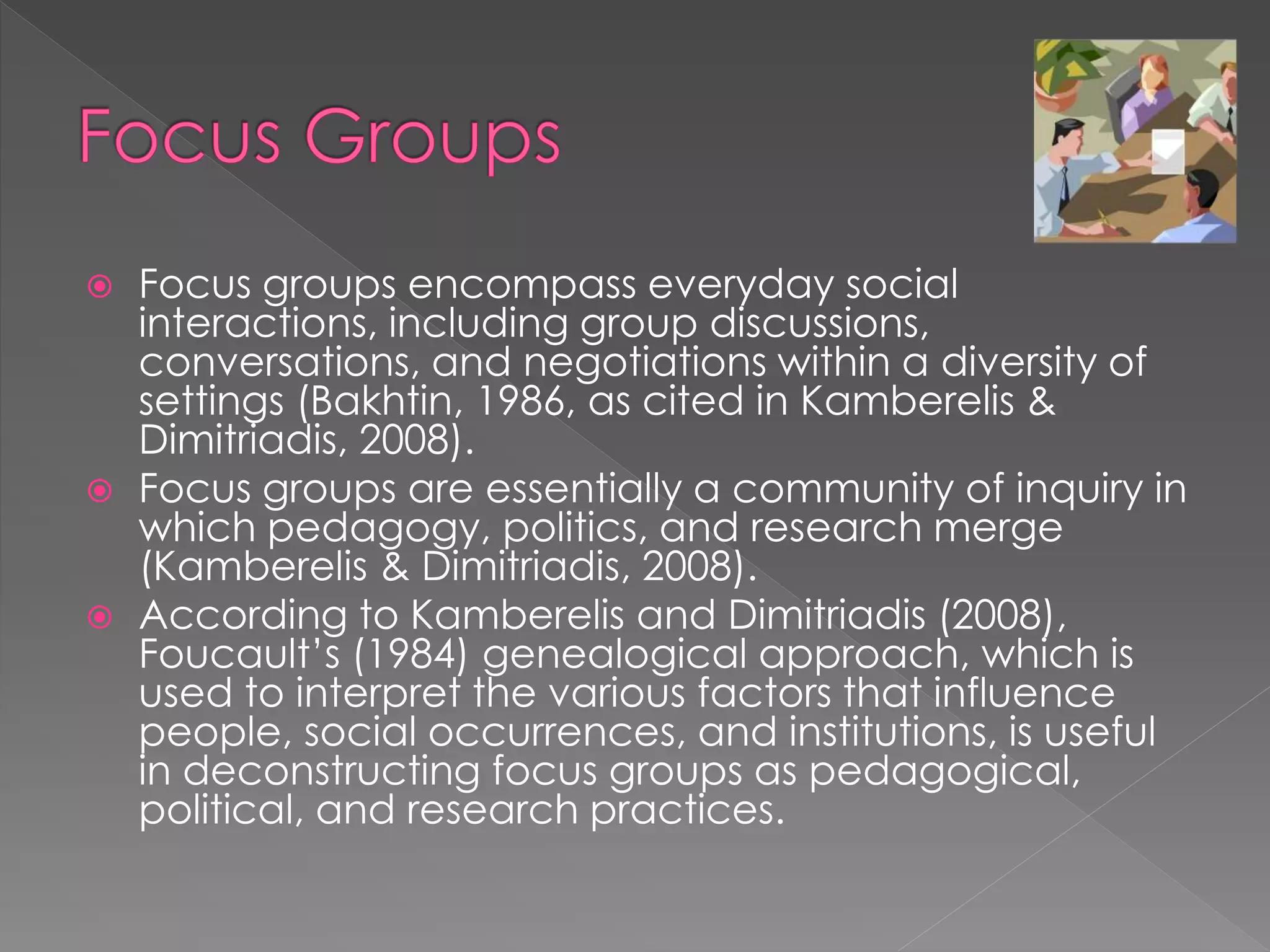
 Focus groups encompass everyday social
interactions, including group discussions,
conversations, and negotiations within a diversity of
settings (Bakhtin, 1986, as cited in Kamberelis &
Dimitriadis, 2008).
 Focus groups are essentially a community of inquiry in
which pedagogy, politics, and research merge
(Kamberelis & Dimitriadis, 2008).
 According to Kamberelis and Dimitriadis (2008),
Foucault’s (1984) genealogical approach, which is
used to interpret the various factors that influence
people, social occurrences, and institutions, is useful
in deconstructing focus groups as pedagogical,
political, and research practices.
 Paulo Freire - through literacy programs, Freire
encouraged people to reflect on their circumstances
and to make an effort to improve their lives, often
through political action. Freire viewed education as
a tool for collective empowerment. In Freire’s view,
liberation and transformation are never fully
complete (Kamberelis & Dimitriadis, 2008).
 Jonathan Kozol - drew on Freire’s emancipatory work
in literacy programs and advocated for complex and
rich word use in deconstructing meanings within
social and political contexts. His study circles were
held in unofficial locations and facilitated the
empowerment of the people from within (Kamberelis
& Dimitriadis, 2008).
 Consciousness-raising groups (CRGs) served to formulate theory based
on the experiences of women in second and third wave feminism that
could lead to their empowerment (Kamberelis & Dimitriadis, 2008).
 Esther Madriz (2000) perceived focus groups in feminism as places in
which women could feel safe, share their experiences with one another,
and regain control of their lives within a nurturing environment, enabling
them to speak out against social injustices (as cited in Kamberelis &
Dimitriadis, 2008).
 Abortion, incest, and sexual and physical abuse were some of the issues
that emerged and were recognized as requiring political and legislative
action (Eisenstein, 1984, as cited in Kamberelis & Dimitriadis, 2008).
 Third wave feminism emphasized the involvement of women of different
ethnicities, classes, ages, background, and sexual identities (Kamberelis
& Dimitriadis, 2008).
 Informal spaces enabled women to freely share their experiences in
third wave feminism, shedding light on social issues and initiating positive
change (Kamberelis & Dimitriadis, 2008).
 Paul Lazarsfeld and Robert Merton – conducted focus
groups in 1941 to assess people’s perceptions of WWII in
order to continue developing propaganda. These focus
groups were conducted within formal, face-to-face
settings with predetermined themes (expressed content)
(Kamberelis & Dimitriadis, 2008).
 Janice Radway – held focus groups to interpret the
dynamics surrounding women’s interest in romance novels
(socially constructed audience analysis) (Kamberelis &
Dimitriadis, 2008).
 According to Kamberelis and Dimitriadis (2008), focus
groups allow the participants more involvement and in the
research process, decentralizing the role of the researcher
and providing a more democratic style of research.
 Creswell, J. W. (2007). Qualitative inquiry
and research design: Choosing among five
approaches (2nd ed.). Thousand Oaks, CA:
Sage.
 Kamberelis, G. & Dimitriadis, G. (2008).
Focus groups: Strategic articulations of
pedagogy, politics, and inquiry. In Denzin,
N.K. &Lincoln, Y. S. (Eds.), Collecting and
interpreting qualitative materials (3rd ed., p.
375-402). Thousand Oaks, CA: Sage.

Case studyppt

  • 2.
    Case study researchis “the study of an issue explored through one or more cases within a bounded system” (Creswell, 2007,p. 73). "This method is appropriate when the researcher wants to answer a descriptive question or an explanatory question" (Gay, Mills & Airasian ,2009,p. 427) What happened? How or why did this happen? http://cdn.softsailor.com/wp-content/uploads/2010/09/911-3.gif
  • 3.
     Merriam, ascited in Gay, Mills & Airasian (2009), in explaining a bounded system said, “I can fence in what I am going to study” (p. 426).  In education for example, the bounded system might be a teacher, classroom or school. “Case study research often explores a bounded system (a case) or multiple bounded systems (more than one case) over a period of time” (Creswell, 2007, p. 73).
  • 4.
    “Case study researchcan be presented as a strategy of inquiry, a methodology or a comprehensive research strategy”(Creswell, 2007, p. 73).
  • 5.
  • 7.
     Creswell (2007)identifies the different types of case studies as: • The collective or multiple case study in which “one issue or concern is selected, but the inquirer selects multiple case studies to illustrate the issue” (p. 74). • The intrinsic case study in which case focuses on itself. (p. 74).
  • 8.
    1) Determine ifa case study method is suitable to the research problem. 2) Ascertain suitable case or cases. 3) Collect extensive data relying on numerous sources of information, such as “observations, interviews, documents, and audiovisual materials” (Creswell, 2007, p. 75). 4) Analyse data in either a holistic or embedded manner. 5) Report on the meaning or implications of the case or cases. (Creswell, 2007, p. 74-75)
  • 9.
     It canoften be difficult for researchers to identify a suitable case or cases (Creswell, 2007, p. 75).
  • 10.
     Focus groupsencompass everyday social interactions, including group discussions, conversations, and negotiations within a diversity of settings (Bakhtin, 1986, as cited in Kamberelis & Dimitriadis, 2008).  Focus groups are essentially a community of inquiry in which pedagogy, politics, and research merge (Kamberelis & Dimitriadis, 2008).  According to Kamberelis and Dimitriadis (2008), Foucault’s (1984) genealogical approach, which is used to interpret the various factors that influence people, social occurrences, and institutions, is useful in deconstructing focus groups as pedagogical, political, and research practices.
  • 11.
     Paulo Freire- through literacy programs, Freire encouraged people to reflect on their circumstances and to make an effort to improve their lives, often through political action. Freire viewed education as a tool for collective empowerment. In Freire’s view, liberation and transformation are never fully complete (Kamberelis & Dimitriadis, 2008).  Jonathan Kozol - drew on Freire’s emancipatory work in literacy programs and advocated for complex and rich word use in deconstructing meanings within social and political contexts. His study circles were held in unofficial locations and facilitated the empowerment of the people from within (Kamberelis & Dimitriadis, 2008).
  • 12.
     Consciousness-raising groups(CRGs) served to formulate theory based on the experiences of women in second and third wave feminism that could lead to their empowerment (Kamberelis & Dimitriadis, 2008).  Esther Madriz (2000) perceived focus groups in feminism as places in which women could feel safe, share their experiences with one another, and regain control of their lives within a nurturing environment, enabling them to speak out against social injustices (as cited in Kamberelis & Dimitriadis, 2008).  Abortion, incest, and sexual and physical abuse were some of the issues that emerged and were recognized as requiring political and legislative action (Eisenstein, 1984, as cited in Kamberelis & Dimitriadis, 2008).  Third wave feminism emphasized the involvement of women of different ethnicities, classes, ages, background, and sexual identities (Kamberelis & Dimitriadis, 2008).  Informal spaces enabled women to freely share their experiences in third wave feminism, shedding light on social issues and initiating positive change (Kamberelis & Dimitriadis, 2008).
  • 13.
     Paul Lazarsfeldand Robert Merton – conducted focus groups in 1941 to assess people’s perceptions of WWII in order to continue developing propaganda. These focus groups were conducted within formal, face-to-face settings with predetermined themes (expressed content) (Kamberelis & Dimitriadis, 2008).  Janice Radway – held focus groups to interpret the dynamics surrounding women’s interest in romance novels (socially constructed audience analysis) (Kamberelis & Dimitriadis, 2008).  According to Kamberelis and Dimitriadis (2008), focus groups allow the participants more involvement and in the research process, decentralizing the role of the researcher and providing a more democratic style of research.
  • 14.
     Creswell, J.W. (2007). Qualitative inquiry and research design: Choosing among five approaches (2nd ed.). Thousand Oaks, CA: Sage.  Kamberelis, G. & Dimitriadis, G. (2008). Focus groups: Strategic articulations of pedagogy, politics, and inquiry. In Denzin, N.K. &Lincoln, Y. S. (Eds.), Collecting and interpreting qualitative materials (3rd ed., p. 375-402). Thousand Oaks, CA: Sage.