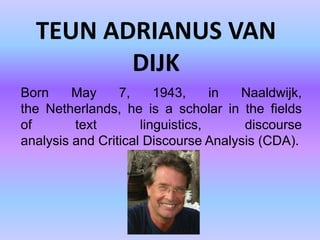
TEUN ADRIANUS VAN
         DIJK
Born     May     7,     1943,     in Naaldwijk,
the Netherlands, he is a scholar in the fields
of       text        linguistics,     discourse
analysis and Critical Discourse Analysis (CDA).
He founded six international journals: Text
& Talk, Discourse & Society, Discourse
Studies, Discourse & Communication and
the internet journal in Spanish Discurso &
Sociedad, of which he still edits the last
four.
HIS MAJOR CONTRIBUTIONS

• He contributed to the development of the
  psychology of text processing. Since the
  1980s his work in CDA focused especially
  on the study of the discursive reproduction
  of racism by what he calls the 'symbolic
  elites' (politicians, journalists, scholars,
  writers), and the theories of ideology and
  context.
For the benefit of translation, Van Dijk has a
 Model: Context, Social Cognition and Memory.

• Contextual Frame:

 “The discourse can not and should not be studied
 separately from their various kinds of context. To
 understand the different properties 'internal'
 speech in semantic and strategic levels, we
 cannot ignore the role of the conditions,
 functions, effects and circumstances of the
 production and comprehension of discourse”
 (Van Dijk 1997a: 113)
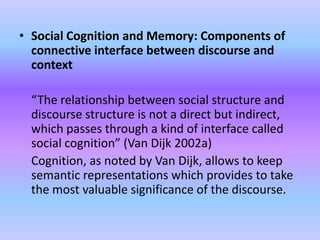
• Social Cognition and Memory: Components of
  connective interface between discourse and
  context

 “The relationship between social structure and
 discourse structure is not a direct but indirect,
 which passes through a kind of interface called
 social cognition” (Van Dijk 2002a)
 Cognition, as noted by Van Dijk, allows to keep
 semantic representations which provides to take
 the most valuable significance of the discourse.
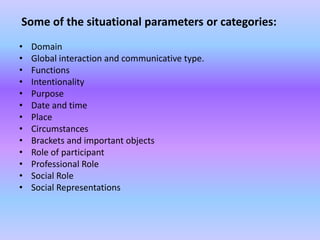
Some of the situational parameters or categories:
•   Domain
•   Global interaction and communicative type.
•   Functions
•   Intentionality
•   Purpose
•   Date and time
•   Place
•   Circumstances
•   Brackets and important objects
•   Role of participant
•   Professional Role
•   Social Role
•   Social Representations
References
• http://es.scribd.com/doc/35560522/Van-Dijk-
  Teun-Texto-y-Contexto
• http://es.scribd.com/doc/35560522/Van-Dijk-
  Teun-Texto-y-Contexto
• http://www.scielo.br/scielo.php?pid=S0102-
  44502009000200008&script=sci_arttext

Presentación1

  • 1.
    TEUN ADRIANUS VAN DIJK Born May 7, 1943, in Naaldwijk, the Netherlands, he is a scholar in the fields of text linguistics, discourse analysis and Critical Discourse Analysis (CDA).
  • 2.
    He founded sixinternational journals: Text & Talk, Discourse & Society, Discourse Studies, Discourse & Communication and the internet journal in Spanish Discurso & Sociedad, of which he still edits the last four.
  • 3.
    HIS MAJOR CONTRIBUTIONS •He contributed to the development of the psychology of text processing. Since the 1980s his work in CDA focused especially on the study of the discursive reproduction of racism by what he calls the 'symbolic elites' (politicians, journalists, scholars, writers), and the theories of ideology and context.
  • 4.
    For the benefitof translation, Van Dijk has a Model: Context, Social Cognition and Memory. • Contextual Frame: “The discourse can not and should not be studied separately from their various kinds of context. To understand the different properties 'internal' speech in semantic and strategic levels, we cannot ignore the role of the conditions, functions, effects and circumstances of the production and comprehension of discourse” (Van Dijk 1997a: 113)
  • 5.
    • Social Cognitionand Memory: Components of connective interface between discourse and context “The relationship between social structure and discourse structure is not a direct but indirect, which passes through a kind of interface called social cognition” (Van Dijk 2002a) Cognition, as noted by Van Dijk, allows to keep semantic representations which provides to take the most valuable significance of the discourse.
  • 6.
    Some of thesituational parameters or categories: • Domain • Global interaction and communicative type. • Functions • Intentionality • Purpose • Date and time • Place • Circumstances • Brackets and important objects • Role of participant • Professional Role • Social Role • Social Representations
  • 8.
    References • http://es.scribd.com/doc/35560522/Van-Dijk- Teun-Texto-y-Contexto • http://es.scribd.com/doc/35560522/Van-Dijk- Teun-Texto-y-Contexto • http://www.scielo.br/scielo.php?pid=S0102- 44502009000200008&script=sci_arttext