“ Disaster Risk Reduction Beyond Micro Financing: A Holistic Approach to Poverty Eradication”  Presented by:  MARK A. CERVANTES Program Specialist Disaster Risk Reduction and Climate Change Adaptation International Institute of Rural Reconstruction  4th Microfinance Best Practices Forum (MBPF) June 9-10, 2011, Mariott Hotel, Cebu City
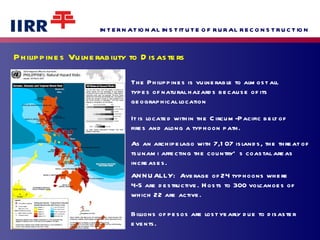
Philippines Vulnerability to Disasters  The Philippines is vulnerable to almost all types of natural hazards because of its  geographical location It is located within the Circum-Pacific belt of fires and along a typhoon path. As an archipelago with 7,107 islands, the threat of tsunami affecting the country’s coastal areas increases.  ANNUALLY:  Average of 24 typhoons where 4-5 are destructive. Hosts to 300 volcanoes of which 22 are active.  Billions of pesos are lost yearly due to disaster events.
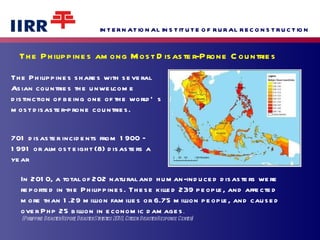
The Philippines among Most Disaster-Prone Countries The Philippines shares with several Asian countries the unwelcome distinction of being one of the world’s most disaster-prone countries.  701 disaster incidents from 1900 – 1991 or almost eight (8) disasters a year on the average annually.  In 2010, a total of 202 natural and human-induced disasters were  reported in the Philippines. These killed 239 people, and affected  more than 1.29 million families or 6.75 million people, and caused over Php 25 billion in economic damages . (Philippine Disaster Report, Disaster Statistics 2010, Citizen Disaster Response Center)
Climate Change is REAL! on the average annually.
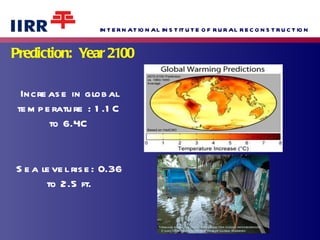
Prediction:  Year 2100    Increase in global temperature : 1.1C to 6.4C Sea level rise: 0.36 to 2.5 ft.
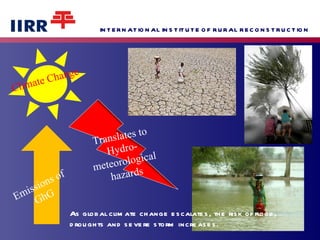
Climate Change  Emissions of GhG Translates to Hydro-meteorological hazards As global climate change escalates, the risk of flood, droughts and severe storm increases.
According to the 4 th  Assessment Report of the Inter-government Panel on Climate Change (IPCC), rising global temperature will cause increasing drought in mid-latitudes and semi-arid latitudes, increase water stress in many parts of the world, increased damage from storms, and coastal flooding affecting millions more people each year.  A 2 degree Celsius increase in temperature have grave impacts to the natural ecosystem. Plants will unable to grow and marine life may become extinct.
Climate Change increases “disaster risk” in a number of ways: -It changes the magnitude & frequency of extreme events (flood, drought, sea level rise, typhoons); - It changes average climatic conditions & climate variability, affecting underlying risk factors and generates new threats, which a region may have no experience in dealing with.
In 2008, agriculture and fisheries comprise 15 % of the country’s gross domestic product valued at PhP 1.1 trillion at current prices (NSCB, 2008). In 2009, 34 % of the total employed labor force is in agriculture (NSO, 2009). The Agriculture Sector
Effects of Climate Change to Agriculture Climate change and its insidious effects on crop productivity poses a serious threat to agriculture and hence to food security.  Increase in temperature due to climate change will intensify heat and drought stress in crops. Crops in areas with limited water supply are gravely affected by the increase in temperature that would reduce significantly crop yield.
Climate change will adversely affect the country’s watersheds and their population of around 24 M, the forests and their biodiversity, also affecting 1.5 M of agricultural lands dependent on these areas for irrigation water.
Effects of Climate change to Fisheries Hotter water, as a result of increase in temperature, has negative effects on the fisheries sector. It affects coral reefs resulting to poorer reef health and coral bleaching. Hotter water is related to high sedimentation and high wave activity which affect seagrassess resulting to reduction of seagrass population.
Flooding and inundation in the coastal areas are expected to increase due to accelerated sea level rise and increasing frequencies of cyclones and coastal storms.  Sea level rise causes loss of arable lands. It amplifies soil salinity in low-lying agricultural lands and causes seawater intrusion into groundwater resources.  It even results to coastal habitat drowning.
An effect of climate change in water quality is anticipated to be in the form of decreased oxygen level which may result to fish kill. This comes along with ocean acidification which affects mariculture and reduces production.
Approximately 50 M people are at risk from these climatic hazards, many of them marginal communities of fishers, because 70% of the country’s human settlements are located in its 32,400 km coastline.  In terms of impact on food security, climate change could seriously affect coastal fisheries providing around 40-60 % of total fish catch, representing 4 % of the country’s gross national product and 70 % of the populations’ total animal protein intake. Over-all, the Philippines’ coastal and marine resources directly provide food and employment to around 1 M Filipinos.
Disaster Risk Reduction:  A framework and tool that determines the degree of risk and describes measures to increase capacities and reduce hazard impact on the elements at risk so that disaster will be avoided.   The Way Forward… Disaster Risk Reduction & Climate Change Adaptation
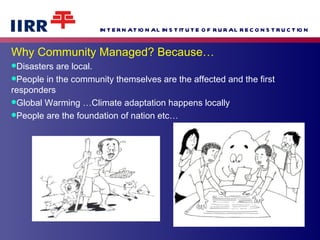
Why Community Managed? Because… Disasters are local.  People in the community themselves are the affected and the first responders  Global Warming …Climate adaptation happens locally People are the foundation of nation etc…
“ DRR in Micro Finance (why not?)”
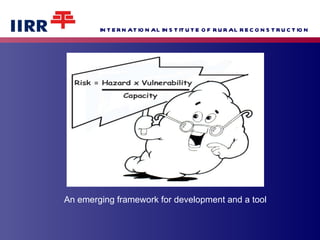
An emerging framework for development and a tool
Delivery of financial services does not necessarily make clients and communities resilient against HAZARD /RISK events. Vulnerability goes beyond economic empowerment (i.e. informal settlers, island people, Indigenous Peoples) Disaster can be prevented and mitigated Why?
Why? Enhances MFI’s risk management strategies as a basis for pre-disaster planning to protect clients Reality check: Chain of risk ( post disaster liquidity problem, loss of livelihood, clients inability to pay, increase overdues, bad debts) ‘ enhances social performance by putting the client and community at the center of the process ’
To what End? Bridge the gap between D and D: Disaster and Development  Finance Decrease vulnerability and increase capacity of clients and MFIs against hazards= Building Resilient clients and Communities Enhance practices of MFI on social dimension
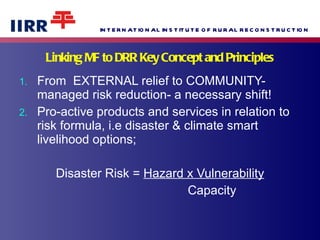
Linking MF to DRR Key Concept and Principles From  EXTERNAL relief to COMMUNITY-managed risk reduction- a necessary shift! Pro-active products and services in relation to risk formula, i.e disaster & climate smart livelihood options; Disaster Risk =  Hazard x Vulnerability Capacity
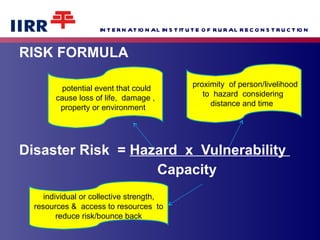
RISK FORMULA Disaster Risk  =  Hazard  x  Vulnerability  Capacity  individual or collective strength,  resources &  access to resources  to reduce risk/bounce back proximity  of person/livelihood to  hazard  considering  distance and time  potential event that could cause loss of life,  damage , property or environment
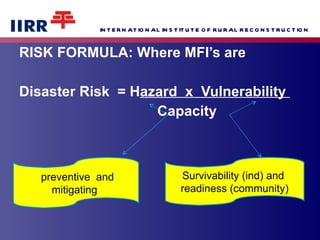
RISK FORMULA: Where MFI’s are  Disaster Risk  = H azard  x  Vulnerability  Capacity  Survivability (ind) and  readiness (community) preventive  and mitigating
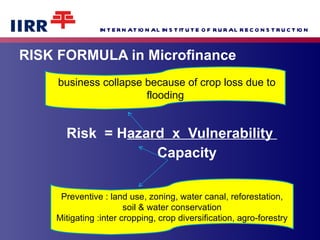
RISK FORMULA in Microfinance Risk  = H azard  x  Vulnerability  Capacity  business collapse because of crop loss due to flooding Preventive : land use, zoning, water canal, reforestation, soil & water conservation Mitigating :inter cropping, crop diversification, agro-forestry
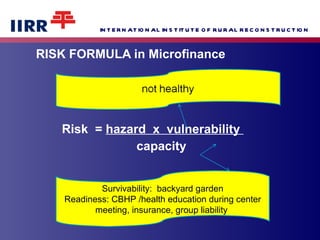
RISK FORMULA in Microfinance Risk  =  hazard  x  vulnerability  capacity  Survivability:  backyard garden Readiness: CBHP /health education during center meeting, insurance, group liability
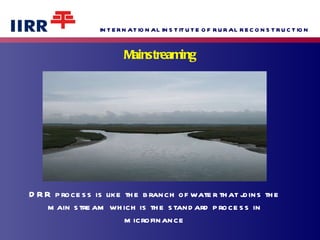
Mainstreaming DRR process is like the branch of water that joins the main stream which is the standard process in microfinance
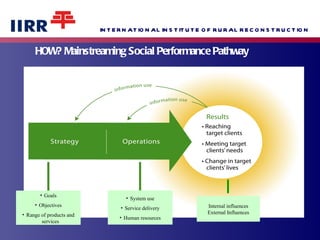
HOW? Mainstreaming Social Performance Pathway Goals Objectives Range of products and services System use Service delivery Human resources Internal influences External Influences
How? Mainstreaming  Social Performance  (social bottom) A. STRATEGY-  mainstreaming DRR vision, goal, objective Mission  – inclusion of client and community resilience  against hazard events, of putting client at the center of  the process  Goals  – inclusion of target clients with high degree of  vulnerability to risk  Objective- inclusion of risk assessment to target client  and communities ‘ deliberate  not incidental’
How? Mainstreaming Product Design :  Risk reduction measures ( i.e. savings for rebuilding of houses after the seasonal  tidal surges;  savings for 3-day consumption in case hazard strikes ,crop /agri-insurance)  Development plan (microfinance and water, microfinance and solar, disaster –proof housing, credit for organic  fertilizers, etc )  B. Operations Community participation : disaster risk assessments for and by the community  leading to identification of gaps and risk reduction measures  (note: MFI staff as facilitator only)
How?  Incentives program / Loan approval criteria:  garbage segregation, backyard garden, community projects for environmental promotion, composting, less use of chemicals & no anti-environment practices, etc  Training : DRR orientation
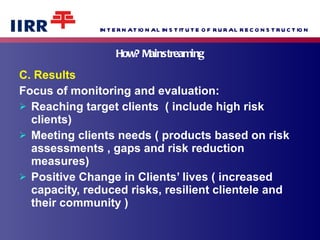
How? Mainstreaming C. Results Focus of monitoring and evaluation: Reaching target clients  ( include high risk clients) Meeting clients needs ( products based on risk assessments , gaps and risk reduction measures) Positive Change in Clients’ lives ( increased capacity, reduced risks, resilient clientele and their community )
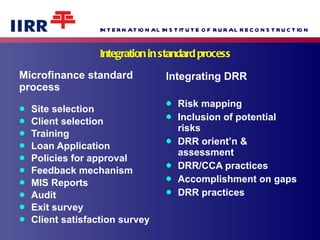
Integration in standard process Microfinance standard process Site selection Client selection Training Loan Application Policies for approval Feedback mechanism MIS Reports Audit Exit survey Client satisfaction survey Integrating DRR Risk mapping  Inclusion of potential risks DRR orient’n & assessment DRR/CCA practices Accomplishment on gaps DRR practices
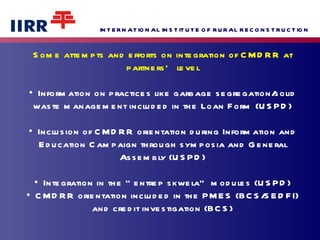
Some attempts and efforts on integration of CMDRR at partners’ level •  Information on practices like garbage segregation/solid waste management included in the Loan Form (USPD) •  Inclusion of CMDRR orientation during Information and Education Campaign through symposia and General Assembly (USPD) •  Integration in the “entrep skwela” modules (USPD) • CMDRR orientation included in the PMES (BCS/SEDFI) and credit investigation (BCS)
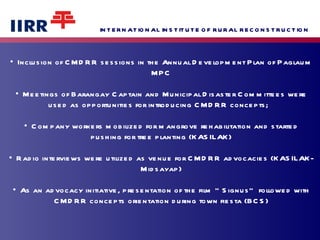
•  Inclusion of CMDRR sessions in the Annual Development Plan of Paglaum MPC •  Meetings of Barangay Captain and Municipal Disaster Committees were used as opportunities for introducing CMDRR concepts;  •  Company workers mobilized for mangrove rehabilitation and started pushing for tree planting (KASILAK) •  Radio interviews were utilized as venue for CMDRR advocacies (KASILAK-Midsayap) •  As an advocacy initiative, presentation of the film “Signus” followed with CMDRR concepts orientation during town fiesta (BCS)
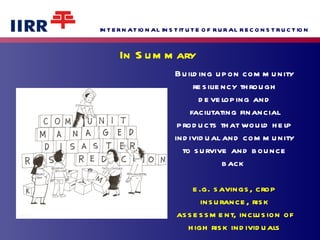
In Summary  Building upon community resiliency through developing and facilitating financial products that would help individual and community to survive and bounce back  e.g. savings, crop insurance, risk assessment, inclusion of high risk individuals
CHALLENGES “ BUY-IN “of staff, management and policy-makers and the community ( literacy, social classes) Commitment: technical person, incentive ( not necessarily monetary- i.e. deloading); Mind set: from “messianic” to “facilitator”: old ( ready-made/standard products) vs new ( community-identified products)  ‘ if there is a will there is a way’
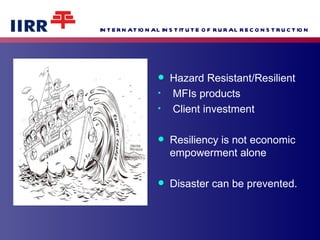
Hazard Resistant/Resilient MFIs products  Client investment Resiliency is not economic empowerment alone Disaster can be prevented.
Acknowledgement  Mr. Rusty Binas,  Global Advisor on DRR, Cordaid Ms. Rose Rivera,  Micro Finance Sector, Cordaid Sheila Vergara,  Training and Capacity Building Specialist, IIRR Dr. Oscar Zamora,  Dean, Graduate Studies, UPLB
Thank You