A Competitive Analysis and Strategic Response to: The Australian Airline Industry
INDUSTRY OVERVIEW The Australian airline industry has experienced major changes to its policy and operating environment since the late 1990s, the industry has a lopsided two airline structure;  Qantas Virgin
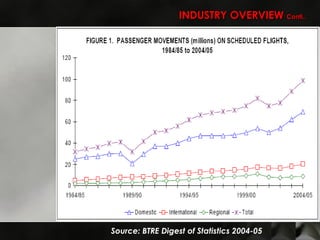
INDUSTRY OVERVIEW  Conti.. Source: BTRE Digest of Statistics 2004-05
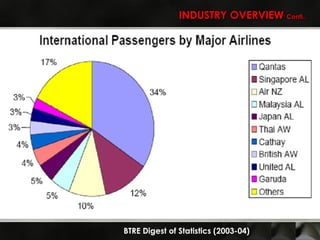
INDUSTRY OVERVIEW  Conti.. BTRE Digest of Statistics (2003-04)
Macro-Environment Analysis
MACRO- ENVIRONMENT ANALYSIS In order for their present business strategy to succeed, both organizations would need to understand the competitive environment in which their businesses reside.  The macro-environment describes all factors which influence the company as a whole but are out of their direct control including wider social, political, economic factors, direct or indirect competition.  The two main analysis used are: PEST and  Porter’s Five Forces.
PEST ANALYSIS PEST describes all factors affecting the company under the areas of: Political-Legal Economic Socio-Cultural  and  Technology
Political-Legal Impacts The liberal policy environment has also favoured new entrants. While the domestic airline industry is largely deregulated, Australia's international airline industry remains quite regulated at the Commonwealth level. Australia's international aviation policy has been 'multiple designations'.  The industry deregulation in 1990s has given way to a more restrained form of competition between Qantas and Virgin.
Economic Impacts The recent past events like 11th of September and SARS has affected flight security in the eyes of the customers.  Every environmental issue including the impact of increase of fuel, which either affects basic costs of flights or affects the likeability of customers to book a flight. Since the demised on Ansett, the potential for increased competition in the domestic airline industry through the emergence of new carriers is generally more favorable now than in the past.
Socio-Cultural Impacts The labour markets is tight, especially in skilled fields requiring more motivation.   The demand for personnel in distant countries will increase the need for foreign-language training. Industrialization and technology have raised educational levels .   Generational Gap -Organisations will be faced with challenges of bridging the gap between these generations.
Technological Impacts The growth of the information industries is creating a knowledge-dependent global society and information will be the primary commodity of more and more industries. New and larger airplane designs would enable airline companies to achieve better economies of scale.
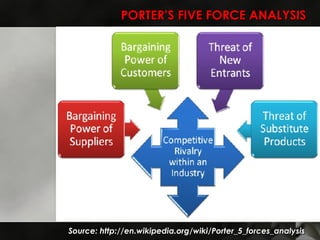
PORTER’S FIVE FORCE ANALYSIS Source: http://en.wikipedia.org/wiki/Porter_5_forces_analysis
Intensity of Competitor Rivalry Lopsided two airline structure, open skies and multiple designations has created fierce competition among local competition on the domestic front (Qantas / Virgin Blue) Low differentiation factor – airlines could distinguish as either normal carriers or low cost carriers. Barriers of exit are high. A lot of money and effort would need to be invested to start-up the venture. Matured industry with low growth potential. Growth could only be achieved either through diversification or at the expense of the competitor.
Risk of Potential Entrant Medium to high barriers of entry because of industry knowledge requirements. Cost and time to market advantages of existing players due to experience curve and political barriers. The launching of Jetstar by Qantas may pre-empt the entry of another low-cost competitor in Australia
Bargaining Power of Customers Low switching costs. Price could be a factor for leisure travellers while business travellers may look into an airlines dependability / schedule.
Bargaining Power of Suppliers The supplier has a low bargaining power as there are other suppliers competing for business. Coupled with slow / unstable economic conditions buyers have a stronger bargaining power. There is a high switching costs between suppliers due to technology and infrastructure investment.
Threats of Substitutes The price customers are willing to pay for a product depends, in part, on the availability of substitute products. The absence of close substitutes for a product, as in the airline industry means that consumers are comparatively insensitive to substitutes pricing.
OPPORTUNITIES AND THREATS
OPPORTUNITIES Qantas has a lot of opportunity to grow on the regional front. Its brand, trunk routes and financial strength could be used as opportunities to compete against other regional airlines which fly to Australia e.g. Malaysian Airlines, Thai Airways, and Singapore Airlines etc. Virgin Blue could tap on the government policy on multiple designations whereby it allows more than one Australian airline to operate international air services.
THREATS Escalating cost of fuel, aviation insurance and the unstable political global situation is a major factor of insecurity in the airline business. The demise of Ansett and the governments open skies policy could see a potential threat of entrant from an international airline.
RECOMMENDATION
RECOMMENDATION It is recommended that companies critically consider the issues below in their strategy setting and implementation, order to enable them attain competitive advantage within the industry: Operational Cost Cutting  Commission Cost Cutting  Working towards differentiation strategies  Workforce efficiencies
CONCLUSION
CONCLUSION To attain competitive advantage, individual companies would need to consider the above mentioned factors and other more. This will therefore pressure companies to be more productive, to be faster and more agile, to accelerate innovation, to provide quality products, better services, generate greater returns and to fully utilize resources within the organisation to respond and pre-empt these challenges coming from its environment
THANK YOU

Competitve Analysis Presentation

  • 1.
    A Competitive Analysisand Strategic Response to: The Australian Airline Industry
  • 2.
    INDUSTRY OVERVIEW TheAustralian airline industry has experienced major changes to its policy and operating environment since the late 1990s, the industry has a lopsided two airline structure; Qantas Virgin
  • 3.
    INDUSTRY OVERVIEW Conti.. Source: BTRE Digest of Statistics 2004-05
  • 4.
    INDUSTRY OVERVIEW Conti.. BTRE Digest of Statistics (2003-04)
  • 5.
  • 6.
    MACRO- ENVIRONMENT ANALYSISIn order for their present business strategy to succeed, both organizations would need to understand the competitive environment in which their businesses reside. The macro-environment describes all factors which influence the company as a whole but are out of their direct control including wider social, political, economic factors, direct or indirect competition. The two main analysis used are: PEST and Porter’s Five Forces.
  • 7.
    PEST ANALYSIS PESTdescribes all factors affecting the company under the areas of: Political-Legal Economic Socio-Cultural and Technology
  • 8.
    Political-Legal Impacts Theliberal policy environment has also favoured new entrants. While the domestic airline industry is largely deregulated, Australia's international airline industry remains quite regulated at the Commonwealth level. Australia's international aviation policy has been 'multiple designations'. The industry deregulation in 1990s has given way to a more restrained form of competition between Qantas and Virgin.
  • 9.
    Economic Impacts Therecent past events like 11th of September and SARS has affected flight security in the eyes of the customers. Every environmental issue including the impact of increase of fuel, which either affects basic costs of flights or affects the likeability of customers to book a flight. Since the demised on Ansett, the potential for increased competition in the domestic airline industry through the emergence of new carriers is generally more favorable now than in the past.
  • 10.
    Socio-Cultural Impacts Thelabour markets is tight, especially in skilled fields requiring more motivation.   The demand for personnel in distant countries will increase the need for foreign-language training. Industrialization and technology have raised educational levels .   Generational Gap -Organisations will be faced with challenges of bridging the gap between these generations.
  • 11.
    Technological Impacts Thegrowth of the information industries is creating a knowledge-dependent global society and information will be the primary commodity of more and more industries. New and larger airplane designs would enable airline companies to achieve better economies of scale.
  • 12.
    PORTER’S FIVE FORCEANALYSIS Source: http://en.wikipedia.org/wiki/Porter_5_forces_analysis
  • 13.
    Intensity of CompetitorRivalry Lopsided two airline structure, open skies and multiple designations has created fierce competition among local competition on the domestic front (Qantas / Virgin Blue) Low differentiation factor – airlines could distinguish as either normal carriers or low cost carriers. Barriers of exit are high. A lot of money and effort would need to be invested to start-up the venture. Matured industry with low growth potential. Growth could only be achieved either through diversification or at the expense of the competitor.
  • 14.
    Risk of PotentialEntrant Medium to high barriers of entry because of industry knowledge requirements. Cost and time to market advantages of existing players due to experience curve and political barriers. The launching of Jetstar by Qantas may pre-empt the entry of another low-cost competitor in Australia
  • 15.
    Bargaining Power ofCustomers Low switching costs. Price could be a factor for leisure travellers while business travellers may look into an airlines dependability / schedule.
  • 16.
    Bargaining Power ofSuppliers The supplier has a low bargaining power as there are other suppliers competing for business. Coupled with slow / unstable economic conditions buyers have a stronger bargaining power. There is a high switching costs between suppliers due to technology and infrastructure investment.
  • 17.
    Threats of SubstitutesThe price customers are willing to pay for a product depends, in part, on the availability of substitute products. The absence of close substitutes for a product, as in the airline industry means that consumers are comparatively insensitive to substitutes pricing.
  • 18.
  • 19.
    OPPORTUNITIES Qantas hasa lot of opportunity to grow on the regional front. Its brand, trunk routes and financial strength could be used as opportunities to compete against other regional airlines which fly to Australia e.g. Malaysian Airlines, Thai Airways, and Singapore Airlines etc. Virgin Blue could tap on the government policy on multiple designations whereby it allows more than one Australian airline to operate international air services.
  • 20.
    THREATS Escalating costof fuel, aviation insurance and the unstable political global situation is a major factor of insecurity in the airline business. The demise of Ansett and the governments open skies policy could see a potential threat of entrant from an international airline.
  • 21.
  • 22.
    RECOMMENDATION It isrecommended that companies critically consider the issues below in their strategy setting and implementation, order to enable them attain competitive advantage within the industry: Operational Cost Cutting Commission Cost Cutting Working towards differentiation strategies Workforce efficiencies
  • 23.
  • 24.
    CONCLUSION To attaincompetitive advantage, individual companies would need to consider the above mentioned factors and other more. This will therefore pressure companies to be more productive, to be faster and more agile, to accelerate innovation, to provide quality products, better services, generate greater returns and to fully utilize resources within the organisation to respond and pre-empt these challenges coming from its environment
  • 25.