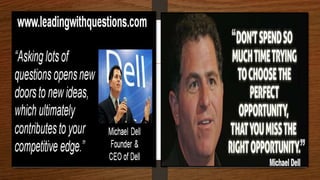
Michael Dell
Case study
1
Introduction
2
Introduction
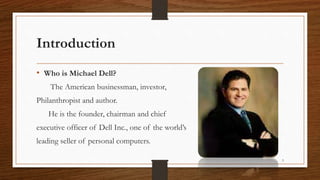
• Who is Michael Dell?
The American businessman, investor,
Philanthropist and author.
He is the founder, chairman and chief
executive officer of Dell Inc., one of the world’s
leading seller of personal computers.
3
Conti..
• 41st richest person in the world.
• Net worth of US $ 20.1 billion.
• In 2011, 12% ownership of the company.
• Also invested in other companies managed by a firm MSD capital.
4
Conti..
• At the age of 24,
“Entrepreneur of the year”, from Inc. magazine.
• Top CEO in American business from Worth magazine.
• “CEO” of the year from financial world and chief executive magazines.
• In 2013, received Franklin Institute’s Bower award for business leadership.
5
Conti..
• Writings:
“Direct from Dell”, which is an account of his early life, company’s
founding, growth and missteps, as well as lessons learned.
• Philanthropist:
“ Michael and Susan Dell foundation”, was established which focuses on
urban education and childhood health.
6
Conti..
• Dell Incorporation:
The main business of Dell Company is selling
the product of laptops, netbooks and desktops.
Dell Company is selling different kinds of models
of laptops.
7
Personal life
8
Personal life
• Born in February 23, 1965 in Texas, America.
• His father was an orthodontist.
• His mother was a financial consultant and stockbroker.
• At age eight he applied to take a high school equivalency exam, hoping to get
out of the school and into the business world faster.
9
Conti..
• By his early teens, he was using the money he earned from part time jobs to
invest in stocks and precious metals.
• Gadgets and everything electronic continued to fascinate him.
• At the age of 15 he bought one of the first Apple computers and
immediately disassembled it to see if he could put it back together.
10
Conti..
• In high school, he took a job selling newspaper subscriptions.
• He used his data research skills to identify an untapped customer base,
earning $18,000 in a single year.
• He rewarded himself with a new computer and a BMW and was soon
planning a business venture on his own.
11
Conti..
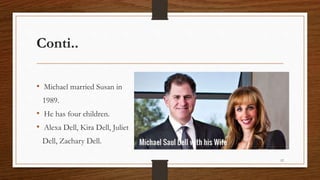
• Michael married Susan in
1989.
• He has four children.
• Alexa Dell, Kira Dell, Juliet
Dell, Zachary Dell.
12
Conti..
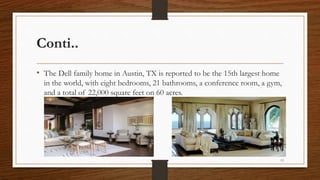
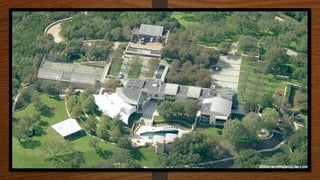
• The Dell family home in Austin, TX is reported to be the 15th largest home
in the world, with eight bedrooms, 21 bathrooms, a conference room, a gym,
and a total of 22,000 square feet on 60 acres.
13
14
Philanthropy
15
Conti…
• Founded in 1999.
• Headquarters West Lake Hills, Texas.
• Susan Dell – Cofounder.
• Susan and Michael Dell have supported the foundation primarily through
investing the proceeds of sales of shares of Dell Inc.
16
Conti..
• The Michael & Susan Dell Foundation is dedicated to improving the lives of
children living in urban poverty around the world.
• Its offices are in Austin, TX and New Delhi, India, and Cape Town, South
Africa.
• The foundation has committed more than $1 billion (as of January 1, 2014)
to global children’s issues and community initiatives to date.
17
18
Conti..
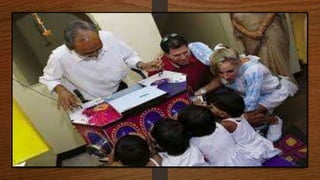
• The Dell family foundation funds programs that foster :
1. high-quality public education
2. childhood health,
3. improve the economic stability of families living in poverty.
19
20
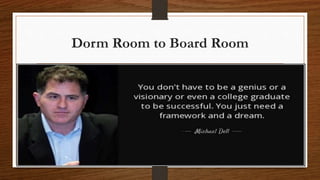
Dorm Room to Board Room
21
To
DORM ROOM BOARD ROOM
22
Dorm Room To Board Room
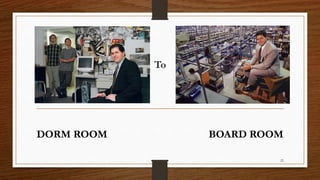
• Dell purchased unsold IBM PCs from retailers at cost, adding additional
memory and disk drives and selling them at prices 10-15 % below retail.
• With an initial investment of $1000 he registered the business with state of
Texas.
• Minimal advertisement.
23
Conti..
• Quickly brought him a large customer base on campus.
• He inspired from the feedback.
• Outside contracts followed quickly.
• He moved off campus, filling a large apartment with computer parts and
assembled new computers.
24
Conti..
• Although he had promised his parents to curtail his business activities and
concentrate on his studies.
• By spring vacation he had to break the news: his venture was writing sales of
$80,000 a month. He was ready to quit school and run his business full-time.
He incorporated the company -- initially called PC's Limited
25
Conti..
• PC’s limited (1986) was offering first toll free technical support service.
• Dell continued to offer customers a discount of 10% below his competitors
through the application of “just-in-time” supply practices.
• Dell purchased parts based on orders and only assembled machines for
immediate delivery.
• With no inventory or spare parts to store, the company enjoyed
grammatically lower over head then its competitors.
26
Conti..
• With his enormous volume of sales Dell could insist that his suppliers
maintain warehouses near his factories to speed up the process of order.
• In 1988;
He changed firm’s name to “Dell Computer Corporation” and Company
became public.
• He is the youngest CEO to head the Forutne500 company when the
company was first included on the list in 1992.
27
Conti..
• Dell Computer was also a pioneer of online commerce, selling computers
over the burgeoning World Wide Web(1996).
• the Dell web site immediately sold 30 to 50 computers a day.
• By the end of the decade, Dell's daily online sales were $18 million.
• The name was further shortened to Dell Inc.
28
Conti..
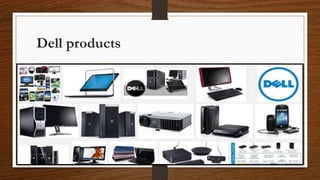
Products by dell company:
• Desktops
• Servers
• Notebooks
• Pen Drives
• Smart Phones
29
Conti..
• Peripherals
• Printers
• Televisions
• Scanners
30
Dell products
31
Dorm Room to Board Room
32
Business Strategies
33
Conti..
• Strartegy#1
Develop the fast-passed, close-knit company culture with the attitude of a
challenger.
• Main idea:
1. Have a common goal, everyone understands.
2. Be hiring ahead of your objectives.
3. Get everyone involve in seeking good talent.
34
Conti..
4. Drive company growth through personal employ growth.
5. Have managers that are immersed and personally involved.
• Strategy#2
Build a company where the employees have strong sense of ownership.
• Main Idea:
1. Make learning new skills are necessity rather than an option.
35
Conti..
2. Allow smart experimentation, with a tolerance for failure.
3. Learn about problems as quickly as possible.
4. 4. Communicate what’s happening and what’s planned.
5. Set a single goal everyone can rally around.
36
Conti..
• Strategy#3:
Understand what costumers experience whenever they use your product.
• Main idea
1. Learning about customers experiences outside your industry.
2. Developing new products from the customers perspective.
3. Knowing your customers intimately.
37
Conti..
4. Becoming your customers advocate.
• Strategy#4:
Find new way to add value and exceed expectations from the customers
perspective.
• Main idea:
1. Looking at the big picture issues.
2. Becoming a valued advisor for your customers.
38
Conti..
3. Separating facts from hype.
4. Turning customers into teaching.
• Strategy#5
Forge strong alliance with your suppliers in order to strengthen your
competitive edge.
• Main idea:
1. Define where you add value and where partners are better.
39
Conti..
2. Keep it simple.
3. Stay very close to your suppliers.
• Strategy#6:
Bring suppliers and technology partners into your inner circle , and let
them have a meaningful input.
Main idea:
1. Reverse the demand-- supply equation.
40
Conti..
2. Trade information for inventory.
• Strategy#7
Differentiate your product to create a sustainable competitive edge.
• Main idea:
1. Focus Customer needs, not what the competition deliver .
2. Find ways to use competitors strengths against them.
41
Conti..
2. Look for opportunities and move to explore them quickly.
3. Execute well.
4. Stay ahead of competition not behind them.
• Strategy# 8
Thrive on the changes the expanding connected economy is going to
generate for your business.
42
Conti..
• Main idea:
1. Plan for change as an opportunity to grow.
2. Apply the internet to breaking down traditional boundaries.
3. Readjust priorities around new prevailing factors.
4. Use the internet to achieve high growth.
5. Use the communication capabilities to expand links.
43
Customer Relationship
Management Strategy
44
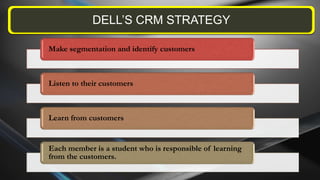
Make segmentation and identify customers
Listen to their customers
Learn from customers
Each member is a student who is responsible of learning
from the customers.
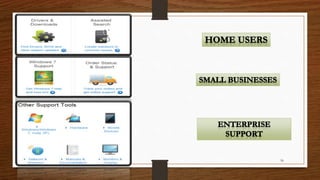
DELL’S CRM STRATEGY
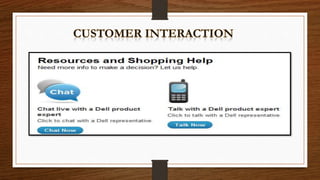
Pre-Sales customer support
Post-Sales customer support
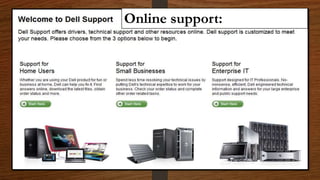
Online support:
Marketing Strategy
52
Marketing Strategy
Dell Inc. marketing strategy is based on segmentation.
• Backbone of Dell computers.
• Based on segmentation, company takes its positioning and modifies its
offerings for each segment’s customers.
53
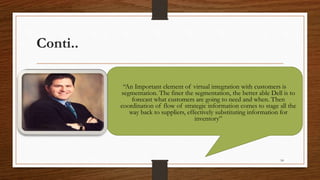
Conti..
54
“An Important element of virtual integration with customers is
segmentation. The finer the segmentation, the better able Dell is to
forecast what customers are going to need and when. Then
coordination of flow of strategic information comes to stage all the
way back to suppliers, effectively substituting information for
inventory”
Conti..
• Focusing on Personal Users.
• In the early 2000s, Dell attempted to diversify its business by targeting
personal consumers, such as families and students that needed to purchase
computers.
• Dell's Retail Strategy.
• In the fall of 2007, Dell announced partnerships with major computer
retailers, including Wal-Mart, Best Buy and Office works.
55
56
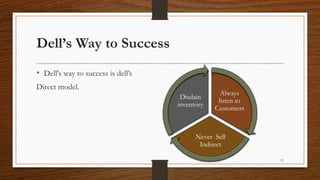
Dell’s Way to Success
57
• Dell's way to success is dell’s
Direct model.
Always
listen to
Customers
Never Sell
Indirect
Disdain
inventory
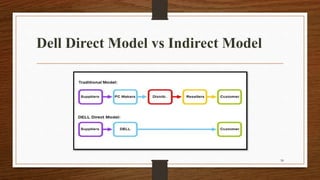
Dell Direct Model vs Indirect Model
58
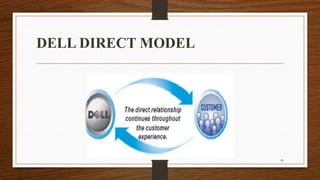
DELL DIRECT MODEL
59
Conti..
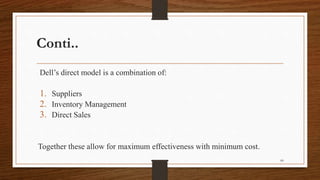
Dell’s direct model is a combination of:
1. Suppliers
2. Inventory Management
3. Direct Sales
Together these allow for maximum effectiveness with minimum cost.
60
Conti..
1. Suppliers:
Dell gets the parts from the suppliers and assembles them as per required
by the customers. Dell selected the suppliers on the bases of:
• Quality of products
• Cost
• Time management
61
62
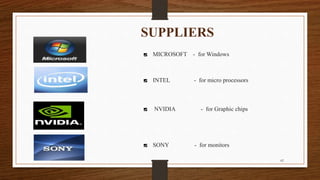
MICROSOFT - for Windows
INTEL - for micro processors
NVIDIA - for Graphic chips
SONY - for monitors
SUPPLIERS
Conti..
2. INVENTORY MANAGEMENT
• In contrast to others who produce –to stock, dell first receives the order and
the money and only then starts to build, using that money to purchase from
supplier.
• Therefore there is customization of products for each and every customer.
63
Conti..
• While other companies had to guess, DELL knew exactly what its customers
wanted before manufacturing the product.
• Others had to maintain inventory as there existed middlemen, so to support
reseller and retail
channels.
64
Conti..
3. Direct sales:
• Michael Dell revolutionized the personnel computer industry by skipping
the middle man and selling computers directly to customer at home.
• He also innovated PC manufacturing by developing a process to mass-
produce individually made-to-order computers, a process that Dell still uses
to power the backbone of their personal computer business to this day.
65
Conti..
• Dell then enabled customers to order these personalized computers directly
online, as one of the first online retailers selling personal computers that
could be custom-ordered and shipped directly to your home.
• His innovations in manufacturing and distribution have made him one of
the most successful businessmen of his time.
66
Conti..
• Dell determined that he could compete with retail computer dealers by
selling direct to consumers at a lower price and offering better technical
service.
• In spring 1986 Dell introduced the fastest personal computer of the time, a
12-megahertz 286 processor.
67
Conti..
• The price of $1,995 compared favorably with IBM's price of $3,995 for a 6-
megahertz 286 processor.
• The machine caught the attention of the news media and excellent
performance reviews and a cover story in PC Week. Sales exploded to $60
million that year.
68
Advantages of direct Model
In doing so, Dell will meet customer expectations of:
• Highest quality
• Leading technology
• Competitive pricing
• Individual and company accountability
69
Conti..
• Best-in-class service and support
• Flexible customization capability
• Superior corporate citizenship
• Financial stability"
70
Lessons by Michael
Dell
From : Direct from Dell
71
Conti..
• Think unconventionally:
Plenty of people told Dell that his 'direct' approach to selling computers
would never work on a large scale. "It's fun to do things that people don't
think are possible or likely" he says. Consequently, questioning conventional
wisdom became a basic element of the culture of the firm.
72
Conti..
• Despise the status quo:
Dell staff are told to think like entrepreneurs or as if they are owners of
Dell. They are much more likely to take risks. He tells staff: "There's not risk
in preserving the status quo, but there's no profit, either."
73
Conti..
• Set big goals that may just be doable:
At the end of 1986 the company set a goal to achieve $1 billion in sales by
1992 and to expand internationally. By 1992 it was doing twice this. Setting a
large goal makes you think about how you will achieve it.
74
Conti..
• Love change:
'Being on the cover of Fortune doesn't guarantee you anything' Dell says. In
the computer industry, no-one can rest on their laurels; you need a climate of
perpetual change and be a voracious learner to foresee what is happening
and provide for it. Dell even surfs the Web after his kids have gone to sleep
to see what people in chat rooms are saying about the company.
75
Conti..
• Focus on your possibilities, not your competitors:
A simple tip, easily forgotten in the stress of the business arena, but which
assists creative solutions. Don't act from fear; measure yourself not by others
but by an absolute standard of excellence.
76
77
Conti...
• FIND A PROBLEM AND FIX IT:
Every breakthrough business idea begins with solving a common problem.
The bigger the problem, the bigger the opportunity.
78
Conti..
• FIND A PURPOSE:
While a passion and a problem might be enough to start a business, it’s
purpose that brings fulfillment . Our purpose is to enable human potential by
accelerating the adoption of technology on a global scale, and in turn
opening the door to growth, productivity and opportunity for people
everywhere.
79
Position of Dell
Incorporation
80
Position of Dell Inc.
• Dell is continuing to emphasize a customer promise to create the most
secure and manageable IT solutions.
• Dell has wrapped its core IT strengths with new thoughtfully designed and
attractive products geared for enhanced productivity in a variety of customer
use cases.
81
Conti..
• Dell was the No. 1 storage solutions provider in the first half of 2014.
• Dell maintained its No. 2 share position in the global x86 server market.
• Dell Software registered double-digit revenue growth year-over-year.
• Dell is ranked by Gartner No. 1 in Worldwide IT Services for Healthcare
Providers.
• Dell delivers year-over-year growth across every region globally.
82
Conti..
• Today, Dell is the world’s fastest growing integrated IT company.
“ Our strategy is resonating with customers worldwide as they look for a
stable, reliable end-to-end solutions provider to meet their business
and IT needs,” said Michael Dell, chairman and CEO.
83
Conti..
• As a private company, Dell has accelerated investments in research and
development, the channel, the customer experience and sales to deliver
industry-leading growth and innovation.
• With the ability to pursue a long-term strategy with 100 percent customer
focus, Dell increasingly stands alone as an integrated provider of the end-to-
end solutions that matter most to customers.
84
Conti..
• Dell has employed as many as 78,000 people worldwide, which is five times
as many people as are employed at the University of Texas, where the
company was born.
• Dell products are now also sold in Wal-Mart, Staples, and other retail outlets.
85
86
Lessons From Michael
Dell’s Life
Case study
88
Lessons..
1. Every customer is important.
2. Innovation is incremental and continual.
3. Innovators are their own market research departments.
4. Collaboration leads to the best ideas.
5. Participation is powerful.
89
90
91

Case study of michael dell

  • 1.
  • 2.
  • 3.
    Introduction • Who isMichael Dell? The American businessman, investor, Philanthropist and author. He is the founder, chairman and chief executive officer of Dell Inc., one of the world’s leading seller of personal computers. 3
  • 4.
    Conti.. • 41st richestperson in the world. • Net worth of US $ 20.1 billion. • In 2011, 12% ownership of the company. • Also invested in other companies managed by a firm MSD capital. 4
  • 5.
    Conti.. • At theage of 24, “Entrepreneur of the year”, from Inc. magazine. • Top CEO in American business from Worth magazine. • “CEO” of the year from financial world and chief executive magazines. • In 2013, received Franklin Institute’s Bower award for business leadership. 5
  • 6.
    Conti.. • Writings: “Direct fromDell”, which is an account of his early life, company’s founding, growth and missteps, as well as lessons learned. • Philanthropist: “ Michael and Susan Dell foundation”, was established which focuses on urban education and childhood health. 6
  • 7.
    Conti.. • Dell Incorporation: Themain business of Dell Company is selling the product of laptops, netbooks and desktops. Dell Company is selling different kinds of models of laptops. 7
  • 8.
  • 9.
    Personal life • Bornin February 23, 1965 in Texas, America. • His father was an orthodontist. • His mother was a financial consultant and stockbroker. • At age eight he applied to take a high school equivalency exam, hoping to get out of the school and into the business world faster. 9
  • 10.
    Conti.. • By hisearly teens, he was using the money he earned from part time jobs to invest in stocks and precious metals. • Gadgets and everything electronic continued to fascinate him. • At the age of 15 he bought one of the first Apple computers and immediately disassembled it to see if he could put it back together. 10
  • 11.
    Conti.. • In highschool, he took a job selling newspaper subscriptions. • He used his data research skills to identify an untapped customer base, earning $18,000 in a single year. • He rewarded himself with a new computer and a BMW and was soon planning a business venture on his own. 11
  • 12.
    Conti.. • Michael marriedSusan in 1989. • He has four children. • Alexa Dell, Kira Dell, Juliet Dell, Zachary Dell. 12
  • 13.
    Conti.. • The Dellfamily home in Austin, TX is reported to be the 15th largest home in the world, with eight bedrooms, 21 bathrooms, a conference room, a gym, and a total of 22,000 square feet on 60 acres. 13
  • 14.
  • 15.
  • 16.
    Conti… • Founded in1999. • Headquarters West Lake Hills, Texas. • Susan Dell – Cofounder. • Susan and Michael Dell have supported the foundation primarily through investing the proceeds of sales of shares of Dell Inc. 16
  • 17.
    Conti.. • The Michael& Susan Dell Foundation is dedicated to improving the lives of children living in urban poverty around the world. • Its offices are in Austin, TX and New Delhi, India, and Cape Town, South Africa. • The foundation has committed more than $1 billion (as of January 1, 2014) to global children’s issues and community initiatives to date. 17
  • 18.
  • 19.
    Conti.. • The Dellfamily foundation funds programs that foster : 1. high-quality public education 2. childhood health, 3. improve the economic stability of families living in poverty. 19
  • 20.
  • 21.
    Dorm Room toBoard Room 21
  • 22.
  • 23.
    Dorm Room ToBoard Room • Dell purchased unsold IBM PCs from retailers at cost, adding additional memory and disk drives and selling them at prices 10-15 % below retail. • With an initial investment of $1000 he registered the business with state of Texas. • Minimal advertisement. 23
  • 24.
    Conti.. • Quickly broughthim a large customer base on campus. • He inspired from the feedback. • Outside contracts followed quickly. • He moved off campus, filling a large apartment with computer parts and assembled new computers. 24
  • 25.
    Conti.. • Although hehad promised his parents to curtail his business activities and concentrate on his studies. • By spring vacation he had to break the news: his venture was writing sales of $80,000 a month. He was ready to quit school and run his business full-time. He incorporated the company -- initially called PC's Limited 25
  • 26.
    Conti.. • PC’s limited(1986) was offering first toll free technical support service. • Dell continued to offer customers a discount of 10% below his competitors through the application of “just-in-time” supply practices. • Dell purchased parts based on orders and only assembled machines for immediate delivery. • With no inventory or spare parts to store, the company enjoyed grammatically lower over head then its competitors. 26
  • 27.
    Conti.. • With hisenormous volume of sales Dell could insist that his suppliers maintain warehouses near his factories to speed up the process of order. • In 1988; He changed firm’s name to “Dell Computer Corporation” and Company became public. • He is the youngest CEO to head the Forutne500 company when the company was first included on the list in 1992. 27
  • 28.
    Conti.. • Dell Computerwas also a pioneer of online commerce, selling computers over the burgeoning World Wide Web(1996). • the Dell web site immediately sold 30 to 50 computers a day. • By the end of the decade, Dell's daily online sales were $18 million. • The name was further shortened to Dell Inc. 28
  • 29.
    Conti.. Products by dellcompany: • Desktops • Servers • Notebooks • Pen Drives • Smart Phones 29
  • 30.
    Conti.. • Peripherals • Printers •Televisions • Scanners 30
  • 31.
  • 32.
    Dorm Room toBoard Room 32
  • 33.
  • 34.
    Conti.. • Strartegy#1 Develop thefast-passed, close-knit company culture with the attitude of a challenger. • Main idea: 1. Have a common goal, everyone understands. 2. Be hiring ahead of your objectives. 3. Get everyone involve in seeking good talent. 34
  • 35.
    Conti.. 4. Drive companygrowth through personal employ growth. 5. Have managers that are immersed and personally involved. • Strategy#2 Build a company where the employees have strong sense of ownership. • Main Idea: 1. Make learning new skills are necessity rather than an option. 35
  • 36.
    Conti.. 2. Allow smartexperimentation, with a tolerance for failure. 3. Learn about problems as quickly as possible. 4. 4. Communicate what’s happening and what’s planned. 5. Set a single goal everyone can rally around. 36
  • 37.
    Conti.. • Strategy#3: Understand whatcostumers experience whenever they use your product. • Main idea 1. Learning about customers experiences outside your industry. 2. Developing new products from the customers perspective. 3. Knowing your customers intimately. 37
  • 38.
    Conti.. 4. Becoming yourcustomers advocate. • Strategy#4: Find new way to add value and exceed expectations from the customers perspective. • Main idea: 1. Looking at the big picture issues. 2. Becoming a valued advisor for your customers. 38
  • 39.
    Conti.. 3. Separating factsfrom hype. 4. Turning customers into teaching. • Strategy#5 Forge strong alliance with your suppliers in order to strengthen your competitive edge. • Main idea: 1. Define where you add value and where partners are better. 39
  • 40.
    Conti.. 2. Keep itsimple. 3. Stay very close to your suppliers. • Strategy#6: Bring suppliers and technology partners into your inner circle , and let them have a meaningful input. Main idea: 1. Reverse the demand-- supply equation. 40
  • 41.
    Conti.. 2. Trade informationfor inventory. • Strategy#7 Differentiate your product to create a sustainable competitive edge. • Main idea: 1. Focus Customer needs, not what the competition deliver . 2. Find ways to use competitors strengths against them. 41
  • 42.
    Conti.. 2. Look foropportunities and move to explore them quickly. 3. Execute well. 4. Stay ahead of competition not behind them. • Strategy# 8 Thrive on the changes the expanding connected economy is going to generate for your business. 42
  • 43.
    Conti.. • Main idea: 1.Plan for change as an opportunity to grow. 2. Apply the internet to breaking down traditional boundaries. 3. Readjust priorities around new prevailing factors. 4. Use the internet to achieve high growth. 5. Use the communication capabilities to expand links. 43
  • 44.
  • 45.
    Make segmentation andidentify customers Listen to their customers Learn from customers Each member is a student who is responsible of learning from the customers. DELL’S CRM STRATEGY
  • 46.
  • 49.
  • 50.
  • 52.
  • 53.
    Marketing Strategy Dell Inc.marketing strategy is based on segmentation. • Backbone of Dell computers. • Based on segmentation, company takes its positioning and modifies its offerings for each segment’s customers. 53
  • 54.
    Conti.. 54 “An Important elementof virtual integration with customers is segmentation. The finer the segmentation, the better able Dell is to forecast what customers are going to need and when. Then coordination of flow of strategic information comes to stage all the way back to suppliers, effectively substituting information for inventory”
  • 55.
    Conti.. • Focusing onPersonal Users. • In the early 2000s, Dell attempted to diversify its business by targeting personal consumers, such as families and students that needed to purchase computers. • Dell's Retail Strategy. • In the fall of 2007, Dell announced partnerships with major computer retailers, including Wal-Mart, Best Buy and Office works. 55
  • 56.
  • 57.
    Dell’s Way toSuccess 57 • Dell's way to success is dell’s Direct model. Always listen to Customers Never Sell Indirect Disdain inventory
  • 58.
    Dell Direct Modelvs Indirect Model 58
  • 59.
  • 60.
    Conti.. Dell’s direct modelis a combination of: 1. Suppliers 2. Inventory Management 3. Direct Sales Together these allow for maximum effectiveness with minimum cost. 60
  • 61.
    Conti.. 1. Suppliers: Dell getsthe parts from the suppliers and assembles them as per required by the customers. Dell selected the suppliers on the bases of: • Quality of products • Cost • Time management 61
  • 62.
    62 MICROSOFT - forWindows INTEL - for micro processors NVIDIA - for Graphic chips SONY - for monitors SUPPLIERS
  • 63.
    Conti.. 2. INVENTORY MANAGEMENT •In contrast to others who produce –to stock, dell first receives the order and the money and only then starts to build, using that money to purchase from supplier. • Therefore there is customization of products for each and every customer. 63
  • 64.
    Conti.. • While othercompanies had to guess, DELL knew exactly what its customers wanted before manufacturing the product. • Others had to maintain inventory as there existed middlemen, so to support reseller and retail channels. 64
  • 65.
    Conti.. 3. Direct sales: •Michael Dell revolutionized the personnel computer industry by skipping the middle man and selling computers directly to customer at home. • He also innovated PC manufacturing by developing a process to mass- produce individually made-to-order computers, a process that Dell still uses to power the backbone of their personal computer business to this day. 65
  • 66.
    Conti.. • Dell thenenabled customers to order these personalized computers directly online, as one of the first online retailers selling personal computers that could be custom-ordered and shipped directly to your home. • His innovations in manufacturing and distribution have made him one of the most successful businessmen of his time. 66
  • 67.
    Conti.. • Dell determinedthat he could compete with retail computer dealers by selling direct to consumers at a lower price and offering better technical service. • In spring 1986 Dell introduced the fastest personal computer of the time, a 12-megahertz 286 processor. 67
  • 68.
    Conti.. • The priceof $1,995 compared favorably with IBM's price of $3,995 for a 6- megahertz 286 processor. • The machine caught the attention of the news media and excellent performance reviews and a cover story in PC Week. Sales exploded to $60 million that year. 68
  • 69.
    Advantages of directModel In doing so, Dell will meet customer expectations of: • Highest quality • Leading technology • Competitive pricing • Individual and company accountability 69
  • 70.
    Conti.. • Best-in-class serviceand support • Flexible customization capability • Superior corporate citizenship • Financial stability" 70
  • 71.
    Lessons by Michael Dell From: Direct from Dell 71
  • 72.
    Conti.. • Think unconventionally: Plentyof people told Dell that his 'direct' approach to selling computers would never work on a large scale. "It's fun to do things that people don't think are possible or likely" he says. Consequently, questioning conventional wisdom became a basic element of the culture of the firm. 72
  • 73.
    Conti.. • Despise thestatus quo: Dell staff are told to think like entrepreneurs or as if they are owners of Dell. They are much more likely to take risks. He tells staff: "There's not risk in preserving the status quo, but there's no profit, either." 73
  • 74.
    Conti.. • Set biggoals that may just be doable: At the end of 1986 the company set a goal to achieve $1 billion in sales by 1992 and to expand internationally. By 1992 it was doing twice this. Setting a large goal makes you think about how you will achieve it. 74
  • 75.
    Conti.. • Love change: 'Beingon the cover of Fortune doesn't guarantee you anything' Dell says. In the computer industry, no-one can rest on their laurels; you need a climate of perpetual change and be a voracious learner to foresee what is happening and provide for it. Dell even surfs the Web after his kids have gone to sleep to see what people in chat rooms are saying about the company. 75
  • 76.
    Conti.. • Focus onyour possibilities, not your competitors: A simple tip, easily forgotten in the stress of the business arena, but which assists creative solutions. Don't act from fear; measure yourself not by others but by an absolute standard of excellence. 76
  • 77.
  • 78.
    Conti... • FIND APROBLEM AND FIX IT: Every breakthrough business idea begins with solving a common problem. The bigger the problem, the bigger the opportunity. 78
  • 79.
    Conti.. • FIND APURPOSE: While a passion and a problem might be enough to start a business, it’s purpose that brings fulfillment . Our purpose is to enable human potential by accelerating the adoption of technology on a global scale, and in turn opening the door to growth, productivity and opportunity for people everywhere. 79
  • 80.
  • 81.
    Position of DellInc. • Dell is continuing to emphasize a customer promise to create the most secure and manageable IT solutions. • Dell has wrapped its core IT strengths with new thoughtfully designed and attractive products geared for enhanced productivity in a variety of customer use cases. 81
  • 82.
    Conti.. • Dell wasthe No. 1 storage solutions provider in the first half of 2014. • Dell maintained its No. 2 share position in the global x86 server market. • Dell Software registered double-digit revenue growth year-over-year. • Dell is ranked by Gartner No. 1 in Worldwide IT Services for Healthcare Providers. • Dell delivers year-over-year growth across every region globally. 82
  • 83.
    Conti.. • Today, Dellis the world’s fastest growing integrated IT company. “ Our strategy is resonating with customers worldwide as they look for a stable, reliable end-to-end solutions provider to meet their business and IT needs,” said Michael Dell, chairman and CEO. 83
  • 84.
    Conti.. • As aprivate company, Dell has accelerated investments in research and development, the channel, the customer experience and sales to deliver industry-leading growth and innovation. • With the ability to pursue a long-term strategy with 100 percent customer focus, Dell increasingly stands alone as an integrated provider of the end-to- end solutions that matter most to customers. 84
  • 85.
    Conti.. • Dell hasemployed as many as 78,000 people worldwide, which is five times as many people as are employed at the University of Texas, where the company was born. • Dell products are now also sold in Wal-Mart, Staples, and other retail outlets. 85
  • 86.
  • 88.
  • 89.
    Lessons.. 1. Every customeris important. 2. Innovation is incremental and continual. 3. Innovators are their own market research departments. 4. Collaboration leads to the best ideas. 5. Participation is powerful. 89
  • 90.
  • 91.