Anders Mærøe - X Triin Tartes - Y
“Bringing humanity back to air travel” - D. Neeleman
VALUE
><
Summary
JetBlue
From 9 to 50+
departures per day
in 11 months
Founded 1999
Commenced 2000
6th biggest airline
company in the US
Low-cost airline for
an underserved
segment
2
5,2% domestic
market share
X & Y
Success story of
innovating with ICT
paradigm
VALUE
><
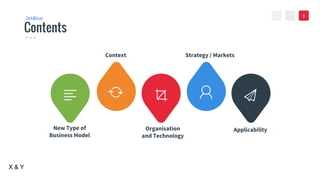
Contents
JetBlue
New Type of
Business Model
Organisation
and Technology
Applicability
Context Strategy / Markets
3
X & Y
VALUE
><
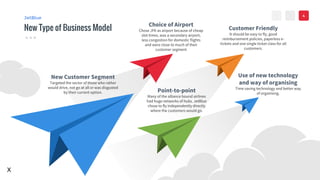
New Type of Business Model
JetBlue
New Customer Segment
Targeted the sector of those who rather
would drive, not go at all or was disgusted
by their current option.
Choice of Airport
Chose JFK as airport because of cheap
slot times, was a secondary airport,
less congestion for domestic flights
and were close to much of their
customer segment
Customer Friendly
It should be easy to fly, good
reimbursement policies, paperless e-
tickets and one single ticket class for all
customers.
Use of new technology
and way of organising
Time saving technology and better way
of organising.
Point-to-point
Many of the alliance bound airlines
had huge networks of hubs. JetBlue
chose to fly independently directly
where the customers would go.
4
X
VALUE
><
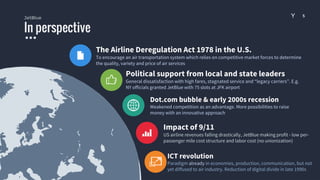
In perspective
JetBlue 5
The Airline Deregulation Act 1978 in the U.S.
To encourage an air transportation system which relies on competitive market forces to determine
the quality, variety and price of air services
Impact of 9/11
US airline revenues falling drastically, JetBlue making profit - low per-
passenger mile cost structure and labor cost (no unionization)
Dot.com bubble & early 2000s recession
Weakened competition as an advantage. More possibilities to raise
money with an innovative approach
ICT revolution
Paradigm already in economies, production, communication, but not
yet diffused to air industry. Reduction of digital divide in late 1990s
Political support from local and state leaders
General dissatisfaction with high fares, stagnated service and “legacy carriers”. E.g.
NY officials granted JetBlue with 75 slots at JFK airport
Y
VALUE
>< 6
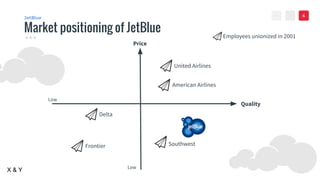
Market positioning of JetBlue
JetBlue
Delta
SouthwestFrontier
United Airlines
American Airlines
Quality
Price
Low
Low
X & Y
Employees unionized in 2001
VALUE
><
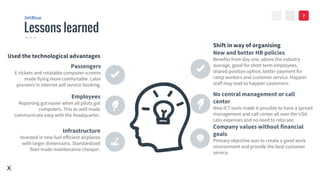
Lessons learned
JetBlue
New and better HR policies
Benefits from day one, above the industry
average, good for short term employees,
shared position option, better payment for
ramp workers and customer service. Happier
staff may lead to happier customers.
No central management or call
center
New ICT tools made it possible to have a spread
management and call center all over the USA.
Less expenses and no need to relocate.
Company values without financial
goals
Primary objective was to create a good work
environment and provide the best customer
service.
Passengers
E-tickets and rotatable computer screens
made flying more comfortable. Later
pioneers in internet self service booking.
Employees
Reporting got easier when all pilots got
computers. This as well made
communicate easy with the headquarter.
Infrastructure
Invested in new fuel efficient airplanes
with larger dimensions. Standardized
fleet made maintenance cheaper.
7
Used the technological advantages
Shift in way of organising
X
VALUE
><
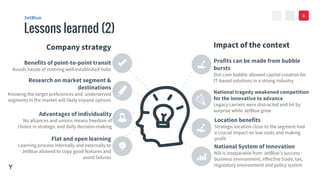
Lessons learned (2)
JetBlue
Profits can be made from bubble
bursts
Dot-com bubble allowed capital creation for
IT-based solutions in a strong industry
National tragedy weakened competition
for the innovative to advance
Legacy carriers were distracted and hit by
surprise while JetBlue grew
Location benefits
Strategic location close to the segment had
a crucial impact on low costs and making
profit
Benefits of point-to-point transit
Avoids hassle of entering well-established hubs
Research on market segment &
destinations
Knowing the target preferences and underserved
segments in the market will likely expand options
Advantages of individuality
No alliances and unions means freedom of
choice in strategic and daily decision-making
Flat and open learning
Learning process internally and externally to
JetBlue allowed to copy good features and
avoid failures
8
Company strategy Impact of the context
Y
National System of Innovation
NSI is inseparable from JetBlue’s success -
business environment, effective trade, tax,
regulatory environment and policy system
VALUE
><
Applicability
JetBlue
Other transport industry companies
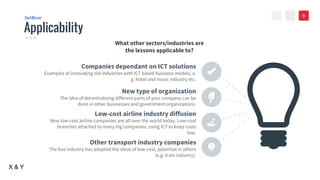
The bus industry has adopted the ideas of low-cost, potential in others
(e.g. train industry).
Low-cost airline industry diffusion
New low-cost airline companies are all over the world today. Low-cost
branches attached to many big companies, using ICT to keep costs
low.
New type of organization
The idea of decentralizing different parts of your company can be
done in other businesses and government organizations.
Companies dependant on ICT solutions
Examples of innovating old industries with ICT based business models, e.
g. hotel and music industry etc.
9
What other sectors/industries are
the lessons applicable to?
X & Y
VALUE
><
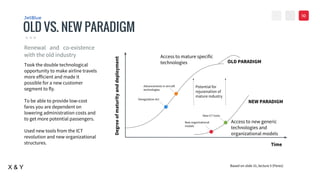
Took the double technological
opportunity to make airline travels
more efficient and made it
possible for a new customer
segment to fly.
To be able to provide low-cost
fares you are dependent on
lowering administration costs and
to get more potential passengers.
Used new tools from the ICT
revolution and new organizational
structures.
Renewal and co-existence
with the old industry
OLD VS. NEW PARADIGM
JetBlue 10
OLD PARADIGM
NEW PARADIGM
Access to mature specific
technologies
Access to new generic
technologies and
organizational models
Potential for
rejuvenation of
mature industry
Time
Degreeofmaturityanddeployment
Based on slide 31, lecture 5 (Perez)
Deregulation Act
New ICT tools
New organizational
models
Advancements in aircraft
technologies
X & Y
VALUE
>< 11
X & Y
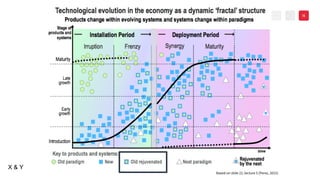
Based on slide 22, lecture 5 (Perez, 2015)
VALUE
><
References
JetBlue
Perez, C. Effect Of Context Changes On Viable Strategies: Installation and Deployment; Core and Periphery, lecture 5, slide 31, last viewed 27. September
2015
Market Realist.com, Must-know: JetBlue’s competitive airline positioning, A key overview of JetBlue Airways, last viewed 27. September 2015, http:
//marketrealist.com/2014/07/must-know-jetblues-competitive-airline-positioning/
Gittel, Jody Hoffer & O’reilly, Charles 2001, JetBlue Airways: Starting from Scratch, Harvard Business School
12
X & Y
United States Department of Transportation, Airline Domestic Market Share July 2014 - June 2015, last viewed 27. September 2015, http://www.
transtats.bts.gov/
Perez, C. Effect Of Context Changes On Viable Strategies: Installation and Deployment; Core and Periphery, lecture 5, slide 22, last viewed 27. September
2015
International Air Transport Association (2011) The Impact of September 11 2001 on Aviation, last viewed 27. September 2015, http://www.iata.
org/pressroom/Documents/impact-http://www.aabri.com/manuscripts/10478.pdf9-11-aviation.pdf
JetBlue.com, Where we Jet, last viewed 27. September 2015, http://www.jetblue.com/WhereWeJet/
Randall, K. 2007, The Jetblue Fiasco: Private profit vs the public interest, last viewed 26. September 2015, https://www.wsws.org/en/articles/2007/03/jet-m02.html
Brizek, M. 200, JetBlue Airways, Trouble in the Sky, Journal of Aviation Management and Education, last viewed 27. September 2015, http://www.aabri.
com/manuscripts/10478.pdf
Aras, G., Crowther, D. 2012, Governance and Social Responsibility: International Perspectives, pp 28-29
VALUE
><
Thank you!
JetBlue 13

Case study of JetBlue

  • 1.
    Anders Mærøe -X Triin Tartes - Y “Bringing humanity back to air travel” - D. Neeleman
  • 2.
    VALUE >< Summary JetBlue From 9 to50+ departures per day in 11 months Founded 1999 Commenced 2000 6th biggest airline company in the US Low-cost airline for an underserved segment 2 5,2% domestic market share X & Y Success story of innovating with ICT paradigm
  • 3.
    VALUE >< Contents JetBlue New Type of BusinessModel Organisation and Technology Applicability Context Strategy / Markets 3 X & Y
  • 4.
    VALUE >< New Type ofBusiness Model JetBlue New Customer Segment Targeted the sector of those who rather would drive, not go at all or was disgusted by their current option. Choice of Airport Chose JFK as airport because of cheap slot times, was a secondary airport, less congestion for domestic flights and were close to much of their customer segment Customer Friendly It should be easy to fly, good reimbursement policies, paperless e- tickets and one single ticket class for all customers. Use of new technology and way of organising Time saving technology and better way of organising. Point-to-point Many of the alliance bound airlines had huge networks of hubs. JetBlue chose to fly independently directly where the customers would go. 4 X
  • 5.
    VALUE >< In perspective JetBlue 5 TheAirline Deregulation Act 1978 in the U.S. To encourage an air transportation system which relies on competitive market forces to determine the quality, variety and price of air services Impact of 9/11 US airline revenues falling drastically, JetBlue making profit - low per- passenger mile cost structure and labor cost (no unionization) Dot.com bubble & early 2000s recession Weakened competition as an advantage. More possibilities to raise money with an innovative approach ICT revolution Paradigm already in economies, production, communication, but not yet diffused to air industry. Reduction of digital divide in late 1990s Political support from local and state leaders General dissatisfaction with high fares, stagnated service and “legacy carriers”. E.g. NY officials granted JetBlue with 75 slots at JFK airport Y
  • 6.
    VALUE >< 6 Market positioningof JetBlue JetBlue Delta SouthwestFrontier United Airlines American Airlines Quality Price Low Low X & Y Employees unionized in 2001
  • 7.
    VALUE >< Lessons learned JetBlue New andbetter HR policies Benefits from day one, above the industry average, good for short term employees, shared position option, better payment for ramp workers and customer service. Happier staff may lead to happier customers. No central management or call center New ICT tools made it possible to have a spread management and call center all over the USA. Less expenses and no need to relocate. Company values without financial goals Primary objective was to create a good work environment and provide the best customer service. Passengers E-tickets and rotatable computer screens made flying more comfortable. Later pioneers in internet self service booking. Employees Reporting got easier when all pilots got computers. This as well made communicate easy with the headquarter. Infrastructure Invested in new fuel efficient airplanes with larger dimensions. Standardized fleet made maintenance cheaper. 7 Used the technological advantages Shift in way of organising X
  • 8.
    VALUE >< Lessons learned (2) JetBlue Profitscan be made from bubble bursts Dot-com bubble allowed capital creation for IT-based solutions in a strong industry National tragedy weakened competition for the innovative to advance Legacy carriers were distracted and hit by surprise while JetBlue grew Location benefits Strategic location close to the segment had a crucial impact on low costs and making profit Benefits of point-to-point transit Avoids hassle of entering well-established hubs Research on market segment & destinations Knowing the target preferences and underserved segments in the market will likely expand options Advantages of individuality No alliances and unions means freedom of choice in strategic and daily decision-making Flat and open learning Learning process internally and externally to JetBlue allowed to copy good features and avoid failures 8 Company strategy Impact of the context Y National System of Innovation NSI is inseparable from JetBlue’s success - business environment, effective trade, tax, regulatory environment and policy system
  • 9.
    VALUE >< Applicability JetBlue Other transport industrycompanies The bus industry has adopted the ideas of low-cost, potential in others (e.g. train industry). Low-cost airline industry diffusion New low-cost airline companies are all over the world today. Low-cost branches attached to many big companies, using ICT to keep costs low. New type of organization The idea of decentralizing different parts of your company can be done in other businesses and government organizations. Companies dependant on ICT solutions Examples of innovating old industries with ICT based business models, e. g. hotel and music industry etc. 9 What other sectors/industries are the lessons applicable to? X & Y
  • 10.
    VALUE >< Took the doubletechnological opportunity to make airline travels more efficient and made it possible for a new customer segment to fly. To be able to provide low-cost fares you are dependent on lowering administration costs and to get more potential passengers. Used new tools from the ICT revolution and new organizational structures. Renewal and co-existence with the old industry OLD VS. NEW PARADIGM JetBlue 10 OLD PARADIGM NEW PARADIGM Access to mature specific technologies Access to new generic technologies and organizational models Potential for rejuvenation of mature industry Time Degreeofmaturityanddeployment Based on slide 31, lecture 5 (Perez) Deregulation Act New ICT tools New organizational models Advancements in aircraft technologies X & Y
  • 11.
    VALUE >< 11 X &Y Based on slide 22, lecture 5 (Perez, 2015)
  • 12.
    VALUE >< References JetBlue Perez, C. EffectOf Context Changes On Viable Strategies: Installation and Deployment; Core and Periphery, lecture 5, slide 31, last viewed 27. September 2015 Market Realist.com, Must-know: JetBlue’s competitive airline positioning, A key overview of JetBlue Airways, last viewed 27. September 2015, http: //marketrealist.com/2014/07/must-know-jetblues-competitive-airline-positioning/ Gittel, Jody Hoffer & O’reilly, Charles 2001, JetBlue Airways: Starting from Scratch, Harvard Business School 12 X & Y United States Department of Transportation, Airline Domestic Market Share July 2014 - June 2015, last viewed 27. September 2015, http://www. transtats.bts.gov/ Perez, C. Effect Of Context Changes On Viable Strategies: Installation and Deployment; Core and Periphery, lecture 5, slide 22, last viewed 27. September 2015 International Air Transport Association (2011) The Impact of September 11 2001 on Aviation, last viewed 27. September 2015, http://www.iata. org/pressroom/Documents/impact-http://www.aabri.com/manuscripts/10478.pdf9-11-aviation.pdf JetBlue.com, Where we Jet, last viewed 27. September 2015, http://www.jetblue.com/WhereWeJet/ Randall, K. 2007, The Jetblue Fiasco: Private profit vs the public interest, last viewed 26. September 2015, https://www.wsws.org/en/articles/2007/03/jet-m02.html Brizek, M. 200, JetBlue Airways, Trouble in the Sky, Journal of Aviation Management and Education, last viewed 27. September 2015, http://www.aabri. com/manuscripts/10478.pdf Aras, G., Crowther, D. 2012, Governance and Social Responsibility: International Perspectives, pp 28-29
  • 13.