Launching Krispy Natural:
Cracking the Product
Management Code
Harvard Business School Case
Candler Enterprises
A multinational beverage and snack goods
manufacturer
Snack Food Division - Pemberton
Packaged food bars, Cookies, and other
sweet baked goods.
Pemberton Products
Popular brands - Softies cookies and
Homestyle muffins and doughnuts
Pemberton was a market leader in the
U.S. cookie and bakery snacks
segments of the sweet snack market
It contributed 28% of Candler’s total sales
Pemberton utilized a company-owned direct
store delivery (DSD) distribution system
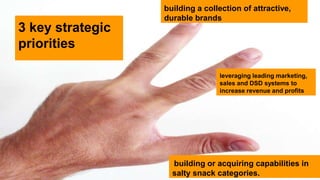
3 key strategic
priorities
building a collection of attractive,
durable brands
leveraging leading marketing,
sales and DSD systems to
increase revenue and profits
building or acquiring capabilities in
salty snack categories.
Why did Pemberton
plan to enter salty
snacks category?
In US Market
Crackers were the top salty snack
74% of consumer, consumed crackers on
a regular basis and 34% ate them as part
of regular weekly diet
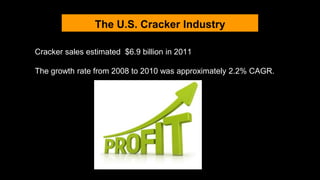
The U.S. Cracker Industry
Cracker sales estimated $6.9 billion in 2011
The growth rate from 2008 to 2010 was approximately 2.2% CAGR.
The Top 3 U.S. Cracker Manufacturers
Kraft Food Inc
Kellogg Co
Pepperidge Farm
Cracker Categories
All other - constitutes almost 75 %
Saltines and crackers with filling - each 9 %
Graham crackers,bread sticks and matzoh
crackers - the less prefered
Consumer Behaviour
Standalone flavor was the number one criterion in cracker purchase decisions
Conveniently packaged in easily portable quantities
Healthfulness - an important factor
- general trend of Americans looking to improve physical health
and fitness
In 2008 Pemberton took the first steps to enter the salty
snack market with the acquisition of Krispy Inc., a
privately held manufacturer of single-serve cracker packages that
operated three production plants and competed in the crackers-
with-filling and “all other" cracker segments
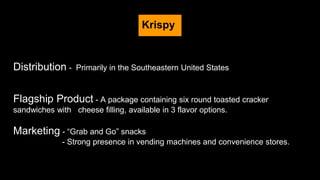
Krispy
Distribution - Primarily in the Southeastern United States
Flagship Product - A package containing six round toasted cracker
sandwiches with cheese filling, available in 3 flavor options.
Marketing - “Grab and Go” snacks
- Strong presence in vending machines and convenience stores.
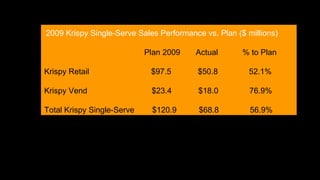
2009 Krispy Single-Serve Sales Performance vs. Plan ($ millions)
Plan 2009 Actual % to Plan
Krispy Retail $97.5 $50.8 52.1%
Krispy Vend $23.4 $18.0 76.9%
Total Krispy Single-Serve $120.9 $68.8 56.9%
But,what
went
wrong
Limited
product line
A taste
survey - low
flavor
satisfaction
scores
But they didn't stop there!
They decided to give a retry as the
cracker market looked promising
3 points to note!
1.Market expected to grow 10-14% per year
2.Big companies losing shares to other smaller brands
3.Consumer dissatisfaction with the flavor and taste
experience of current cracker brands
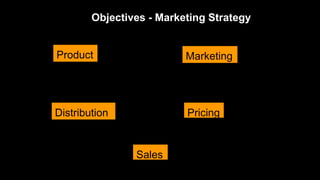
Objectives - Marketing Strategy
Product Marketing
Distribution Pricing
Sales
New Improvements
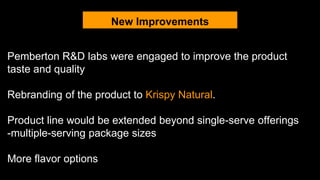
Pemberton R&D labs were engaged to improve the product
taste and quality
Rebranding of the product to Krispy Natural.
Product line would be extended beyond single-serve offerings
-multiple-serving package sizes
More flavor options
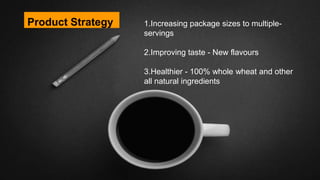
Product Strategy 1.Increasing package sizes to multiple-
servings
2.Improving taste - New flavours
3.Healthier - 100% whole wheat and other
all natural ingredients
Marketing Strategy
Emphasized
on heavy
promotion
and
advertisement
Pull Strategy - spending
and trade promotions
- Price discounts
Distribution
DSD
Distribution
Hired Krispy
Force - more
effectiveness
Longer shelf life for
crackers
Pricing
Premium pricing strategy
But! Not visually => mean less quantity for same
price
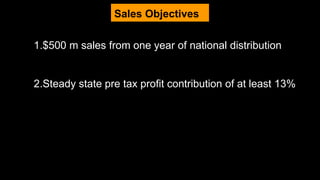
Sales Objectives
1.$500 m sales from one year of national distribution
2.Steady state pre tax profit contribution of at least 13%
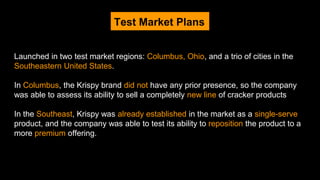
Test Market Plans
Launched in two test market regions: Columbus, Ohio, and a trio of cities in the
Southeastern United States.
In Columbus, the Krispy brand did not have any prior presence, so the company
was able to assess its ability to sell a completely new line of cracker products
In the Southeast, Krispy was already established in the market as a single-serve
product, and the company was able to test its ability to reposition the product to a
more premium offering.
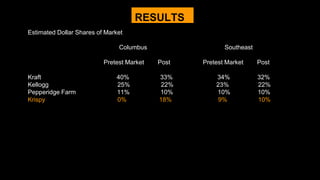
Estimated Dollar Shares of Market
Columbus Southeast
Pretest Market Post Pretest Market Post
Kraft 40% 33% 34% 32%
Kellogg 25% 22% 23% 22%
Pepperidge Farm 11% 10% 10% 10%
Krispy 0% 18% 9% 10%
RESULTS
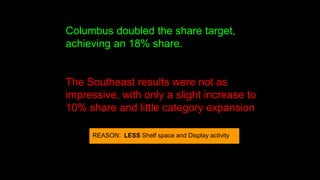
Columbus doubled the share target,
achieving an 18% share.
The Southeast results were not as
impressive, with only a slight increase to
10% share and little category expansion
REASON: LESS Shelf space and Display activity
Ramp-up
to
National
Rollout
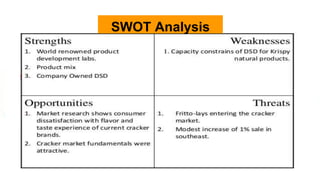
SWOT Analysis
Why should they go for a National ROLL OUT
1.Grabbed 18% market share in columbus
2.Big industries losing shares
3.Projected National Roll out results are promising
4.Krispy’s products tasted better (60% taste preference compared to others)
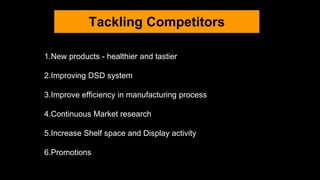
Tackling Competitors
1.New products - healthier and tastier
2.Improving DSD system
3.Improve efficiency in manufacturing process
4.Continuous Market research
5.Increase Shelf space and Display activity
6.Promotions
THANK YOU
Created by Santhosh S,IIT Madras during a Marketing Internship Under Prof. Sameer Mathur ,IIM Lucknow
DISCLAIMER

Case study - Krispy Natural

  • 1.
    Launching Krispy Natural: Crackingthe Product Management Code Harvard Business School Case
  • 2.
    Candler Enterprises A multinationalbeverage and snack goods manufacturer Snack Food Division - Pemberton
  • 3.
    Packaged food bars,Cookies, and other sweet baked goods. Pemberton Products Popular brands - Softies cookies and Homestyle muffins and doughnuts Pemberton was a market leader in the U.S. cookie and bakery snacks segments of the sweet snack market It contributed 28% of Candler’s total sales Pemberton utilized a company-owned direct store delivery (DSD) distribution system
  • 4.
    3 key strategic priorities buildinga collection of attractive, durable brands leveraging leading marketing, sales and DSD systems to increase revenue and profits building or acquiring capabilities in salty snack categories.
  • 5.
    Why did Pemberton planto enter salty snacks category?
  • 6.
    In US Market Crackerswere the top salty snack 74% of consumer, consumed crackers on a regular basis and 34% ate them as part of regular weekly diet
  • 7.
    The U.S. CrackerIndustry Cracker sales estimated $6.9 billion in 2011 The growth rate from 2008 to 2010 was approximately 2.2% CAGR.
  • 8.
    The Top 3U.S. Cracker Manufacturers Kraft Food Inc Kellogg Co Pepperidge Farm
  • 9.
    Cracker Categories All other- constitutes almost 75 % Saltines and crackers with filling - each 9 % Graham crackers,bread sticks and matzoh crackers - the less prefered
  • 10.
    Consumer Behaviour Standalone flavorwas the number one criterion in cracker purchase decisions Conveniently packaged in easily portable quantities Healthfulness - an important factor - general trend of Americans looking to improve physical health and fitness
  • 11.
    In 2008 Pembertontook the first steps to enter the salty snack market with the acquisition of Krispy Inc., a privately held manufacturer of single-serve cracker packages that operated three production plants and competed in the crackers- with-filling and “all other" cracker segments
  • 12.
    Krispy Distribution - Primarilyin the Southeastern United States Flagship Product - A package containing six round toasted cracker sandwiches with cheese filling, available in 3 flavor options. Marketing - “Grab and Go” snacks - Strong presence in vending machines and convenience stores.
  • 13.
    2009 Krispy Single-ServeSales Performance vs. Plan ($ millions) Plan 2009 Actual % to Plan Krispy Retail $97.5 $50.8 52.1% Krispy Vend $23.4 $18.0 76.9% Total Krispy Single-Serve $120.9 $68.8 56.9%
  • 14.
  • 15.
    But they didn'tstop there! They decided to give a retry as the cracker market looked promising
  • 16.
    3 points tonote! 1.Market expected to grow 10-14% per year 2.Big companies losing shares to other smaller brands 3.Consumer dissatisfaction with the flavor and taste experience of current cracker brands
  • 17.
    Objectives - MarketingStrategy Product Marketing Distribution Pricing Sales
  • 18.
    New Improvements Pemberton R&Dlabs were engaged to improve the product taste and quality Rebranding of the product to Krispy Natural. Product line would be extended beyond single-serve offerings -multiple-serving package sizes More flavor options
  • 19.
    Product Strategy 1.Increasingpackage sizes to multiple- servings 2.Improving taste - New flavours 3.Healthier - 100% whole wheat and other all natural ingredients
  • 20.
    Marketing Strategy Emphasized on heavy promotion and advertisement PullStrategy - spending and trade promotions - Price discounts
  • 21.
    Distribution DSD Distribution Hired Krispy Force -more effectiveness Longer shelf life for crackers
  • 22.
    Pricing Premium pricing strategy But!Not visually => mean less quantity for same price
  • 23.
    Sales Objectives 1.$500 msales from one year of national distribution 2.Steady state pre tax profit contribution of at least 13%
  • 24.
    Test Market Plans Launchedin two test market regions: Columbus, Ohio, and a trio of cities in the Southeastern United States. In Columbus, the Krispy brand did not have any prior presence, so the company was able to assess its ability to sell a completely new line of cracker products In the Southeast, Krispy was already established in the market as a single-serve product, and the company was able to test its ability to reposition the product to a more premium offering.
  • 25.
    Estimated Dollar Sharesof Market Columbus Southeast Pretest Market Post Pretest Market Post Kraft 40% 33% 34% 32% Kellogg 25% 22% 23% 22% Pepperidge Farm 11% 10% 10% 10% Krispy 0% 18% 9% 10% RESULTS
  • 26.
    Columbus doubled theshare target, achieving an 18% share. The Southeast results were not as impressive, with only a slight increase to 10% share and little category expansion REASON: LESS Shelf space and Display activity
  • 27.
  • 28.
  • 29.
    Why should theygo for a National ROLL OUT 1.Grabbed 18% market share in columbus 2.Big industries losing shares 3.Projected National Roll out results are promising 4.Krispy’s products tasted better (60% taste preference compared to others)
  • 30.
    Tackling Competitors 1.New products- healthier and tastier 2.Improving DSD system 3.Improve efficiency in manufacturing process 4.Continuous Market research 5.Increase Shelf space and Display activity 6.Promotions
  • 31.
    THANK YOU Created bySanthosh S,IIT Madras during a Marketing Internship Under Prof. Sameer Mathur ,IIM Lucknow DISCLAIMER