


HARVARD BUSINESS SCHOOL CASE
LAUNCHING KRISPY NATURAL
CRACKING THE PRODUCT MANAGEMENT CODE
What is Krispy Natural ?
Krispy natural is a salty snack from
Pemberton which was introduced in
2009 in U.S.
Harvard Business School Case
What is Pemberton ?
Harvard Business School Case
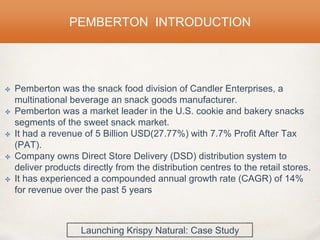
✤ Pemberton was the snack food division of Candler Enterprises, a
multinational beverage an snack goods manufacturer.
✤ Pemberton was a market leader in the U.S. cookie and bakery snacks
segments of the sweet snack market.
✤ It had a revenue of 5 Billion USD(27.77%) with 7.7% Profit After Tax
(PAT).
✤ Company owns Direct Store Delivery (DSD) distribution system to
deliver products directly from the distribution centres to the retail stores.
✤ It has experienced a compounded annual growth rate (CAGR) of 14%
for revenue over the past 5 years
PEMBERTON INTRODUCTION
Launching Krispy Natural: Case Study
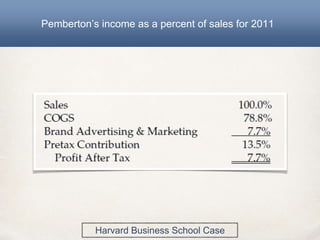
Pemberton’s income as a percent of sales for 2011
Harvard Business School Case
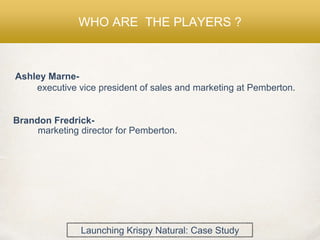
WHO ARE THE PLAYERS ?
Ashley Marne-
executive vice president of sales and marketing at Pemberton.
Brandon Fredrick-
marketing director for Pemberton.
Launching Krispy Natural: Case Study
What is the present situation ?
Harvard Business School Case
✤ Pemberton had just concluded market tests in Columbus, Ohio as
well as three cities in the Southeast.
✤ Columbus market share results were double what the company
had projected.
✤ The Southeast results fell well below management’s expectations.
PRESENT SITUATION
The results are DISPARATE
Mr. Fredrick has to find the solution for the upcoming problem for
counter attacking its competitors and strategise for national roll out
of the krispy natural.
Harvard Business School Case
But let's first
analyse the
market conditions
Launching Krispy Natural: Case Study
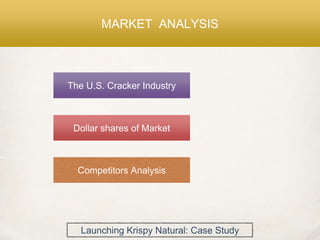
MARKET ANALYSIS
The U.S. Cracker Industry
Dollar shares of Market
Competitors Analysis
Launching Krispy Natural: Case Study
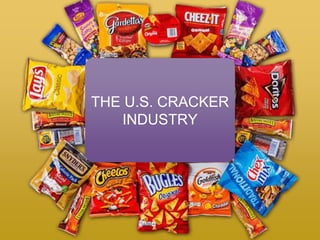
THE U.S. CRACKER
INDUSTRY
THE U.S. CRACKER INDUSTRY (1/2)
✤ Retail cracker sales in the U.S. reached an estimated $6.9 billion in 2011.
✤ Comprised of -
1. "All other" segment (75%)
2. Crackers with saltines and crackers with filling (each 9%)
3. Graham crackers and rest ( 7%).
✤ The growth rate for the overall cracker industry from 2008 to 2010 was
approximately 2.2% CAGR.
✤ A Mintel study of salty snacks in the United States reported that 74%
of respondents consumed crackers on a regular basis and 34% ate
them as part of regular weekly diet.
Launching Krispy Natural: Case Study
THE U.S. CRACKER INDUSTRY (2/2)
✤ Crackers were the top salty snack, slightly ahead of potato
chips.
✤ Standalone flavour (i.e., without toppings or dips) was the
number one criterion in cracker purchase decisions.
✤ The Mintel study reported that 53% of respondents
considered overall healthfulness an important factor in their
cracker purchase decisions.
Harvard Business School Case
"ALL OTHER" CRACKER'S
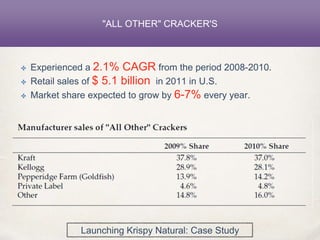
✤ Experienced a 2.1% CAGR from the period 2008-2010.
✤ Retail sales of $ 5.1 billion in 2011 in U.S.
✤ Market share expected to grow by 6-7% every year.
Launching Krispy Natural: Case Study
CRACKERS WITH FILLINGS
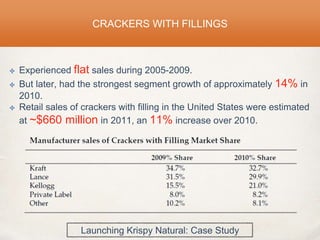
✤ Experienced flat sales during 2005-2009.
✤ But later, had the strongest segment growth of approximately 14% in
2010.
✤ Retail sales of crackers with filling in the United States were estimated
at ~$660 million in 2011, an 11% increase over 2010.
Launching Krispy Natural: Case Study
Estimated Dollar Market
Harvard Business School Case
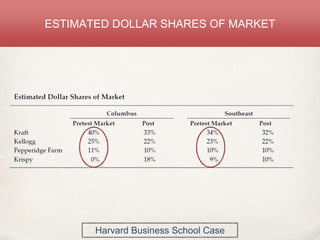
ESTIMATED DOLLAR SHARES OF MARKET
Harvard Business School Case
COMPETITIVE ANALYSIS
Harvard Business School Case
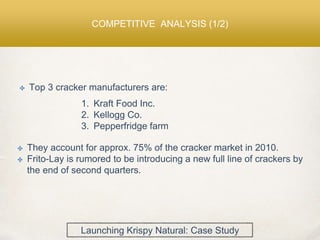
COMPETITIVE ANALYSIS (1/2)
✤ Top 3 cracker manufacturers are:
1. Kraft Food Inc.
2. Kellogg Co.
3. Pepperfridge farm
✤ They account for approx. 75% of the cracker market in 2010.
✤ Frito-Lay is rumored to be introducing a new full line of crackers by
the end of second quarters.
Launching Krispy Natural: Case Study
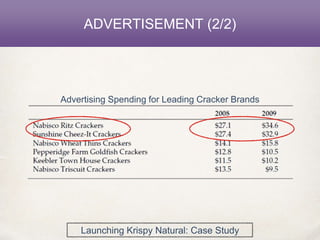
ADVERTISEMENT (2/2)
Advertising Spending for Leading Cracker Brands
MARKETING INSIGHTS
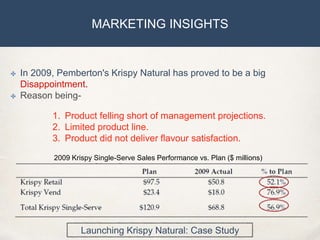
✤ In 2009, Pemberton's Krispy Natural has proved to be a big
Disappointment.
✤ Reason being-
1. Product felling short of management projections.
2. Limited product line.
3. Product did not deliver flavour satisfaction.
2009 Krispy Single-Serve Sales Performance vs. Plan ($ millions)
Launching Krispy Natural: Case Study
KRISPY RELAUNCH
✤ The overall market was large and segments like crackers-with-
filling were expected to grow 10-14% per year.
✤ Internal market research consumer dissatisfaction with the flavor
and taste experience of current cracker brands.
✤ Powerhouse Kraft continued to lose share to Pepperidge Farm
and other smaller brands.
REASONS:
Harvard Business School Case
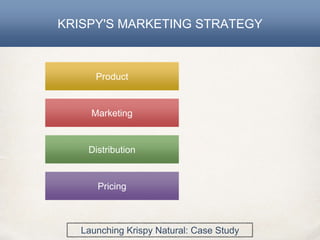
KRISPY'S MARKETING STRATEGY
Product
Marketing
Distribution
Pricing
Launching Krispy Natural: Case Study
PRODUCT (1/4)
✤ Multiple-serving packaging
✤ Focused on improving taste
✤ Health conscious
✤ More flavour options
✤ Choice of better ingredients
Harvard Business School Case
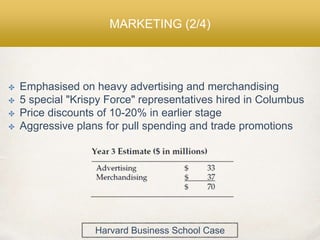
MARKETING (2/4)
✤ Emphasised on heavy advertising and merchandising
✤ 5 special "Krispy Force" representatives hired in Columbus
✤ Price discounts of 10-20% in earlier stage
✤ Aggressive plans for pull spending and trade promotions
Harvard Business School Case
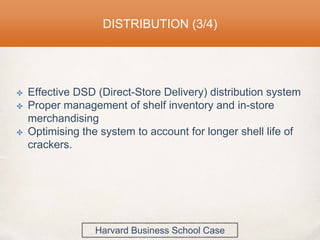
DISTRIBUTION (3/4)
✤ Effective DSD (Direct-Store Delivery) distribution system
✤ Proper management of shelf inventory and in-store
merchandising
✤ Optimising the system to account for longer shell life of
crackers.
Harvard Business School Case
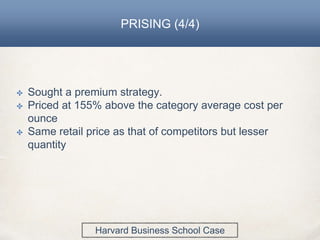
PRISING (4/4)
✤ Sought a premium strategy.
✤ Priced at 155% above the category average cost per
ounce
✤ Same retail price as that of competitors but lesser
quantity
Harvard Business School Case
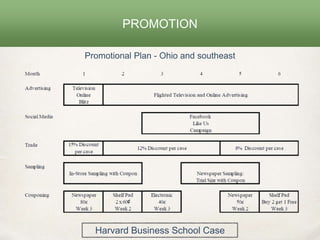
PROMOTION
Promotional Plan - Ohio and southeast
Harvard Business School Case
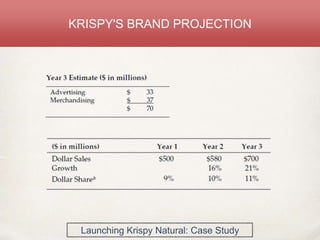
KRISPY'S BRAND PROJECTION
Launching Krispy Natural: Case Study
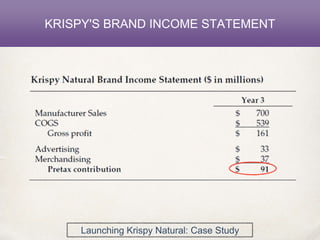
KRISPY'S BRAND INCOME STATEMENT
Launching Krispy Natural: Case Study
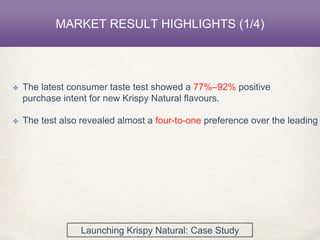
MARKET RESULT HIGHLIGHTS (1/4)
Launching Krispy Natural: Case Study
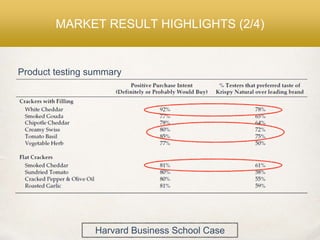
✤ The latest consumer taste test showed a 77%–92% positive
purchase intent for new Krispy Natural flavours.
✤ The test also revealed almost a four-to-one preference over the leading
Product testing summary
MARKET RESULT HIGHLIGHTS (2/4)
Harvard Business School Case
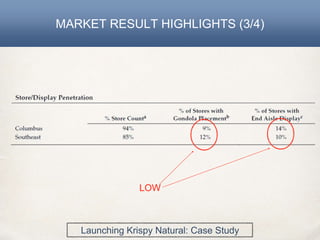
MARKET RESULT HIGHLIGHTS (3/4)
Launching Krispy Natural: Case Study
LOW
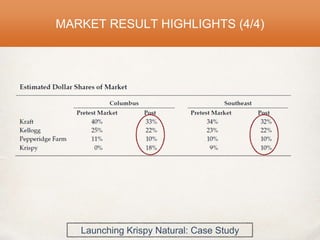
MARKET RESULT HIGHLIGHTS (4/4)
Launching Krispy Natural: Case Study
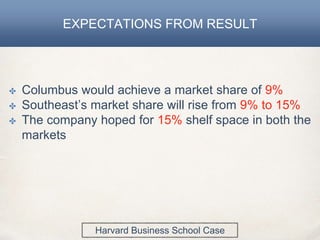
EXPECTATIONS FROM RESULT
✤ Columbus would achieve a market share of 9%
✤ Southeast’s market share will rise from 9% to 15%
✤ The company hoped for 15% shelf space in both the
markets
Harvard Business School Case
REALITY
✤ Columbus doubled the share target, achieving 18% market
share from expected 9%.
✤ 30% category expansion in Columbus.
✤ Southeast had a slight increase to just 10% from an existing
9%.
✤ Little category expansion in southeast.
Harvard Business School Case
There is discrepancy between
expectation and reality
Harvard Business School Case
SALES AND CHANNEL RESPONSES
✤ Pemberton sales managers were pleased with the Krispy Natural
product and felt the trade was very interested in the new offering.
✤ The large chain headquarter buyers were impressed with the
consumer research results and inventory turn estimates.
✤ They also loved all the promotional activity and consumer advertising.
✤ The pull marketing really created a buzz and customers were coming
to the stores asking for Krispy Natural by name.
BUT
Harvard Business School Case
BUT
✤ However one industry analyst thought that the positive test market
results were driven by significant price discounts, couponing, and
sampling, which were not sustainable.
✤ Also, few felt the taste preference claims of Krispy Natural were
inflated and the flavour was no better than current brand offerings.
This is the main problem for Brandon Fredrick
Launching Krispy Natural: Case Study
What are the problems
concerning Brandon ?
Launching Krispy Natural: Case Study
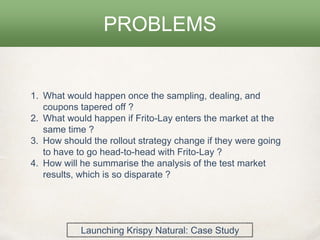
PROBLEMS
1. What would happen once the sampling, dealing, and
coupons tapered off ?
2. What would happen if Frito-Lay enters the market at the
same time ?
3. How should the rollout strategy change if they were going
to have to go head-to-head with Frito-Lay ?
4. How will he summarise the analysis of the test market
results, which is so disparate ?
Launching Krispy Natural: Case Study
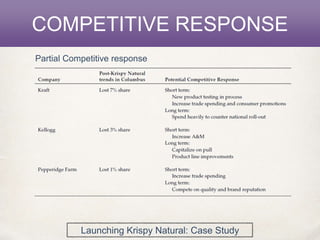
COMPETITIVE RESPONSE
Partial Competitive response
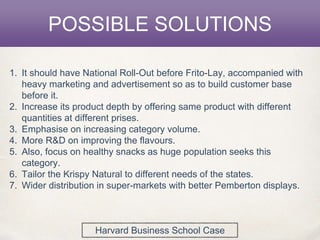
POSSIBLE SOLUTIONS
1. It should have National Roll-Out before Frito-Lay, accompanied with
heavy marketing and advertisement so as to build customer base
before it.
2. Increase its product depth by offering same product with different
quantities at different prises.
3. Emphasise on increasing category volume.
4. More R&D on improving the flavours.
5. Also, focus on healthy snacks as huge population seeks this
category.
6. Tailor the Krispy Natural to different needs of the states.
7. Wider distribution in super-markets with better Pemberton displays.
Harvard Business School Case
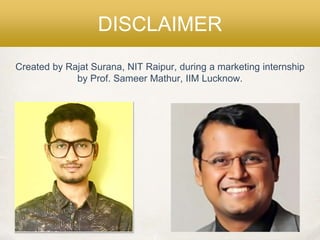
DISCLAIMER
Created by Rajat Surana, NIT Raipur, during a marketing internship
by Prof. Sameer Mathur, IIM Lucknow.

Launching Krispy Natural: Cracking the Product Management Code

  • 1.
    HARVARD BUSINESS SCHOOLCASE LAUNCHING KRISPY NATURAL CRACKING THE PRODUCT MANAGEMENT CODE
  • 2.
    What is KrispyNatural ?
  • 3.
    Krispy natural isa salty snack from Pemberton which was introduced in 2009 in U.S. Harvard Business School Case
  • 4.
    What is Pemberton? Harvard Business School Case
  • 5.
    ✤ Pemberton wasthe snack food division of Candler Enterprises, a multinational beverage an snack goods manufacturer. ✤ Pemberton was a market leader in the U.S. cookie and bakery snacks segments of the sweet snack market. ✤ It had a revenue of 5 Billion USD(27.77%) with 7.7% Profit After Tax (PAT). ✤ Company owns Direct Store Delivery (DSD) distribution system to deliver products directly from the distribution centres to the retail stores. ✤ It has experienced a compounded annual growth rate (CAGR) of 14% for revenue over the past 5 years PEMBERTON INTRODUCTION Launching Krispy Natural: Case Study
  • 6.
    Pemberton’s income asa percent of sales for 2011 Harvard Business School Case
  • 7.
    WHO ARE THEPLAYERS ? Ashley Marne- executive vice president of sales and marketing at Pemberton. Brandon Fredrick- marketing director for Pemberton. Launching Krispy Natural: Case Study
  • 8.
    What is thepresent situation ? Harvard Business School Case
  • 9.
    ✤ Pemberton hadjust concluded market tests in Columbus, Ohio as well as three cities in the Southeast. ✤ Columbus market share results were double what the company had projected. ✤ The Southeast results fell well below management’s expectations. PRESENT SITUATION The results are DISPARATE Mr. Fredrick has to find the solution for the upcoming problem for counter attacking its competitors and strategise for national roll out of the krispy natural. Harvard Business School Case
  • 10.
    But let's first analysethe market conditions Launching Krispy Natural: Case Study
  • 11.
    MARKET ANALYSIS The U.S.Cracker Industry Dollar shares of Market Competitors Analysis Launching Krispy Natural: Case Study
  • 12.
  • 13.
    THE U.S. CRACKERINDUSTRY (1/2) ✤ Retail cracker sales in the U.S. reached an estimated $6.9 billion in 2011. ✤ Comprised of - 1. "All other" segment (75%) 2. Crackers with saltines and crackers with filling (each 9%) 3. Graham crackers and rest ( 7%). ✤ The growth rate for the overall cracker industry from 2008 to 2010 was approximately 2.2% CAGR. ✤ A Mintel study of salty snacks in the United States reported that 74% of respondents consumed crackers on a regular basis and 34% ate them as part of regular weekly diet. Launching Krispy Natural: Case Study
  • 14.
    THE U.S. CRACKERINDUSTRY (2/2) ✤ Crackers were the top salty snack, slightly ahead of potato chips. ✤ Standalone flavour (i.e., without toppings or dips) was the number one criterion in cracker purchase decisions. ✤ The Mintel study reported that 53% of respondents considered overall healthfulness an important factor in their cracker purchase decisions. Harvard Business School Case
  • 15.
    "ALL OTHER" CRACKER'S ✤Experienced a 2.1% CAGR from the period 2008-2010. ✤ Retail sales of $ 5.1 billion in 2011 in U.S. ✤ Market share expected to grow by 6-7% every year. Launching Krispy Natural: Case Study
  • 16.
    CRACKERS WITH FILLINGS ✤Experienced flat sales during 2005-2009. ✤ But later, had the strongest segment growth of approximately 14% in 2010. ✤ Retail sales of crackers with filling in the United States were estimated at ~$660 million in 2011, an 11% increase over 2010. Launching Krispy Natural: Case Study
  • 17.
    Estimated Dollar Market HarvardBusiness School Case
  • 18.
    ESTIMATED DOLLAR SHARESOF MARKET Harvard Business School Case
  • 19.
  • 20.
    COMPETITIVE ANALYSIS (1/2) ✤Top 3 cracker manufacturers are: 1. Kraft Food Inc. 2. Kellogg Co. 3. Pepperfridge farm ✤ They account for approx. 75% of the cracker market in 2010. ✤ Frito-Lay is rumored to be introducing a new full line of crackers by the end of second quarters. Launching Krispy Natural: Case Study
  • 21.
    Launching Krispy Natural:Case Study ADVERTISEMENT (2/2) Advertising Spending for Leading Cracker Brands
  • 22.
    MARKETING INSIGHTS ✤ In2009, Pemberton's Krispy Natural has proved to be a big Disappointment. ✤ Reason being- 1. Product felling short of management projections. 2. Limited product line. 3. Product did not deliver flavour satisfaction. 2009 Krispy Single-Serve Sales Performance vs. Plan ($ millions) Launching Krispy Natural: Case Study
  • 23.
    KRISPY RELAUNCH ✤ Theoverall market was large and segments like crackers-with- filling were expected to grow 10-14% per year. ✤ Internal market research consumer dissatisfaction with the flavor and taste experience of current cracker brands. ✤ Powerhouse Kraft continued to lose share to Pepperidge Farm and other smaller brands. REASONS: Harvard Business School Case
  • 24.
  • 25.
    PRODUCT (1/4) ✤ Multiple-servingpackaging ✤ Focused on improving taste ✤ Health conscious ✤ More flavour options ✤ Choice of better ingredients Harvard Business School Case
  • 26.
    MARKETING (2/4) ✤ Emphasisedon heavy advertising and merchandising ✤ 5 special "Krispy Force" representatives hired in Columbus ✤ Price discounts of 10-20% in earlier stage ✤ Aggressive plans for pull spending and trade promotions Harvard Business School Case
  • 27.
    DISTRIBUTION (3/4) ✤ EffectiveDSD (Direct-Store Delivery) distribution system ✤ Proper management of shelf inventory and in-store merchandising ✤ Optimising the system to account for longer shell life of crackers. Harvard Business School Case
  • 28.
    PRISING (4/4) ✤ Soughta premium strategy. ✤ Priced at 155% above the category average cost per ounce ✤ Same retail price as that of competitors but lesser quantity Harvard Business School Case
  • 29.
    PROMOTION Promotional Plan -Ohio and southeast Harvard Business School Case
  • 30.
    KRISPY'S BRAND PROJECTION LaunchingKrispy Natural: Case Study
  • 31.
    KRISPY'S BRAND INCOMESTATEMENT Launching Krispy Natural: Case Study
  • 32.
  • 33.
    MARKET RESULT HIGHLIGHTS(1/4) Launching Krispy Natural: Case Study ✤ The latest consumer taste test showed a 77%–92% positive purchase intent for new Krispy Natural flavours. ✤ The test also revealed almost a four-to-one preference over the leading
  • 34.
    Product testing summary MARKETRESULT HIGHLIGHTS (2/4) Harvard Business School Case
  • 35.
    MARKET RESULT HIGHLIGHTS(3/4) Launching Krispy Natural: Case Study LOW
  • 36.
    MARKET RESULT HIGHLIGHTS(4/4) Launching Krispy Natural: Case Study
  • 37.
    EXPECTATIONS FROM RESULT ✤Columbus would achieve a market share of 9% ✤ Southeast’s market share will rise from 9% to 15% ✤ The company hoped for 15% shelf space in both the markets Harvard Business School Case
  • 38.
    REALITY ✤ Columbus doubledthe share target, achieving 18% market share from expected 9%. ✤ 30% category expansion in Columbus. ✤ Southeast had a slight increase to just 10% from an existing 9%. ✤ Little category expansion in southeast. Harvard Business School Case
  • 39.
    There is discrepancybetween expectation and reality Harvard Business School Case
  • 40.
    SALES AND CHANNELRESPONSES ✤ Pemberton sales managers were pleased with the Krispy Natural product and felt the trade was very interested in the new offering. ✤ The large chain headquarter buyers were impressed with the consumer research results and inventory turn estimates. ✤ They also loved all the promotional activity and consumer advertising. ✤ The pull marketing really created a buzz and customers were coming to the stores asking for Krispy Natural by name. BUT Harvard Business School Case
  • 41.
    BUT ✤ However oneindustry analyst thought that the positive test market results were driven by significant price discounts, couponing, and sampling, which were not sustainable. ✤ Also, few felt the taste preference claims of Krispy Natural were inflated and the flavour was no better than current brand offerings. This is the main problem for Brandon Fredrick Launching Krispy Natural: Case Study
  • 42.
    What are theproblems concerning Brandon ? Launching Krispy Natural: Case Study
  • 43.
    PROBLEMS 1. What wouldhappen once the sampling, dealing, and coupons tapered off ? 2. What would happen if Frito-Lay enters the market at the same time ? 3. How should the rollout strategy change if they were going to have to go head-to-head with Frito-Lay ? 4. How will he summarise the analysis of the test market results, which is so disparate ? Launching Krispy Natural: Case Study
  • 44.
    Launching Krispy Natural:Case Study COMPETITIVE RESPONSE Partial Competitive response
  • 46.
    POSSIBLE SOLUTIONS 1. Itshould have National Roll-Out before Frito-Lay, accompanied with heavy marketing and advertisement so as to build customer base before it. 2. Increase its product depth by offering same product with different quantities at different prises. 3. Emphasise on increasing category volume. 4. More R&D on improving the flavours. 5. Also, focus on healthy snacks as huge population seeks this category. 6. Tailor the Krispy Natural to different needs of the states. 7. Wider distribution in super-markets with better Pemberton displays. Harvard Business School Case
  • 48.
    DISCLAIMER Created by RajatSurana, NIT Raipur, during a marketing internship by Prof. Sameer Mathur, IIM Lucknow.