Case Study: Launching Krispy
Natural: Cracking the Product
Management Code
Introducing Pemberton
Pemberton and Krispy
Pemberton was the snack food division of Candler
Enterprises, a multinational beverage and snack goods
manufacturer.
In 2008 Pemberton acquired Krispy Inc., a privately
held manufacturer of single-serve cracker packages.
Who are Pemberton?
Pemberton was a market leader in the U.S. cookie and
bakery snacks segments of the sweet snack market.
Their main products were cookies and baked items, and
their market-leading brands were Softies cookies and
Homestyle muffins and doughnuts.
Pemberton’s success
Candler’s 2011 revenue was $18 billion, with
Pemberton contributing approximately $5 billion in
sales, with a profit of 7.7% after tax.
Achieved an annual CAGR of 14%.
Brand Value
Constant Innovation in Products
Pemberton’s 3 Key Strategic
Priorities
1] Building a collection of profitable
brands
Softies
cookies
Homestyle
muffins
and
doughnuts
Krispy Inc.
The brands
Pemberton hold,
with many more to
be possibly acquired.
2] Marketing, sales and DSD systems to
increase revenue and profits
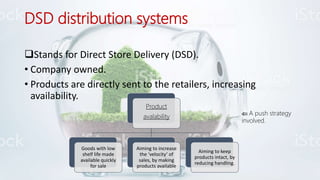
DSD distribution systems
Stands for Direct Store Delivery (DSD).
• Company owned.
• Products are directly sent to the retailers, increasing
availability.
Product
avalability
Goods with low
shelf life made
available quickly
for sale
Aiming to increase
the ‘velocity’ of
sales, by making
products available
Aiming to keep
products intact, by
reducing handling.
 A push strategy
involved.
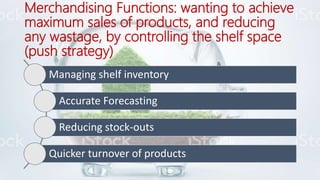
Merchandising Functions: wanting to achieve
maximum sales of products, and reducing
any wastage, by controlling the shelf space
(push strategy)
Managing shelf inventory
Accurate Forecasting
Reducing stock-outs
Quicker turnover of products
3] Building or acquiring capabilities in salty snack
categories (extension of product line).
Kraft
Food
Inc.
 Nabisco
brands
Kellogg
Co.

Sunshine,
Keebler, Carrs
and Austin
brands
Pepperid
ge Farm
 Goldfish
brands
These brands
(competitors, 3/4th of
the market shares)
were dominating the
market of crackers, a
major salty snack
category. Being the
major competitors to
Pemberton, they were
hurdles for it to enter
the market.
Where next?
The Cracker Business!
Market Research and Analysis
Analyzing the consumer market, a Mintel
study suggests…
In spite of competition, crackers are frequently and regularly consumed snacks.
74% of the respondents consumer crackers regularly, and 34% of them as a part of their weekly diet. Thus more demand than potato chips even.
Standalone flavor (i.e., without toppings or dips) was the number one criterion in cracker purchase decisions.
over half of the respondents liked crackers that were conveniently packaged in easily portable quantities
respondents considered overall healthfulness an important factor in their cracker purchase decisions
Analyzing the competitors and their
products (the competitive situation)
“All other” crackers
Experienced a 2.1% CAGR for the period from 2008 to 2010
Retail: ~$5.1 billion in 2011, a 6.2% increase over 2010
Growth driven by healthier, premium-priced product introductions
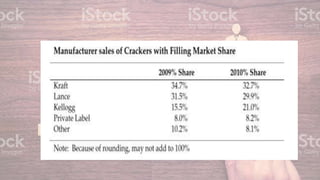
Crackers with Fillings
crackers-with-filling segment experienced the strongest segment growth of approximately
14% in 2010.
Annual growth was forecasted between 10–14% for the segment over the next several
years
Retail sales in the United States were estimated at ~$660 million in 2011, an 11%
increase over 2010.
Kraft Foods Inc. led the segment with approximately 33% market share in 2010.
Pemberton steps in with the Krispy
Product Line
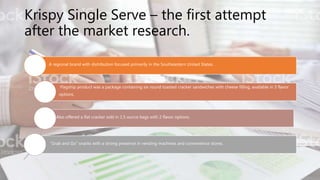
Krispy Single Serve – the first attempt
after the market research.
A regional brand with distribution focused primarily in the Southeastern United States.
Flagship product was a package containing six round toasted cracker sandwiches with cheese filling, available in 3 flavor
options.
Also offered a flat cracker sold in 1.5 ounce bags with 2 flavor options.
“Grab and Go” snacks with a strong presence in vending machines and convenience stores.
Why did it not work?
Limited product line (lower sales), which made it difficult to
have any sort of presence in supermarkets
Taste survey showed the product did not deliver the flavor
satisfaction scores we expected.
Competitive facts of the hour
The overall market was large and segments like crackers-with-filling were expected to
grow 10-14% per year
Kraft continued to lose share to Pepperidge Farm and other smaller brands. A falling
competitor; noting the traits of the leading.
Market research suggested consumer dissatisfaction with the flavor and taste experience
of current cracker brands.
Conclusions from the discussions and
debates
Krispy team suggested specific changes to the marketing strategy
Pemberton R&D labs were engaged to improve the product taste and quality, leading to the rebranding of the product
line- Krispy Naturals.
Product line would be extended beyond single-serve offerings
Multiple-serving package sizes and more flavor options were critical to gain a foothold in supermarkets and to compete with
established brands.
Krispy Relaunch
Product Marketing
Distribution Pricing
Krispy Natural
Marketing
Strategy
Product Strategy
increasing package sizes to multiple-servings.
Improving taste (supporting a pull strategy- hoping to create demands).
Using natural ingredients to make the crackers, and maintaining the nutritious values
Having a variety of flavors in cream filled and flat crackers.
Marketing strategy
Aggressive plans for pull spending and trade promotions.
Discounts. (along with the variety in taste suggested a pull strategy)
Advertisements and promotional activities.
Distribution strategy
DSD considered a critical strategy.
Operational test in 2010, to check test the distribution logistics.
Shelf life greatly considered, thus continued efforts to greater efficiency of the system.
Pricing Strategy
Premium pricing strategy.
Pricing of approximately 155% the category average cost per ounce .
Retail price for each package would be similar to competitors in the category,
but there would be less quantity or weight in the Krispy Natural package.
The 16-week test period
Test Market Plans
In September of 2011, Krispy Natural was launched in two test
market regions: Columbus, Ohio, and a trio of cities in the
Southeastern United States.
The company hoped to secure 15% of shelf space in each
supermarket’s cracker section.
Test Market Plans- Columbus
No prior presence, thus a great chance to test how well a new
line f product would do.
“Krispy Force”- 5 representatives were hired, who solely focused
on selling the Krispy Naturals product line.
Was expected that Columbus would achieve a 9% share of the
cracker category in the test market.
Test Market Plans- Southeast
 Krispy was already established in this market as a single-serve
product, thus providing a ground to test brand’s repositioning
to a premium brand.
 Plans to increase share in the Southeast from its current 9%
share to 15%.
Regular Pemberton DSD route delivery representatives worked
with regional and district sales managers, to promote sales.
Advertisements similar to Columbus region.
Results
Brand turned out to have given competition to others.
Columbus
- acquired 18% share, i.e. double the expected value, by stealing
shares.
- category volume had increased by 30%.
Southeast
- results were not as impressive
- only a slight increase to 10% share
- little category expansion
- actual shelf space and display activity was below what the team
expected
Sales and Channel Response
 The large chain headquarter buyers were impressed with the
consumer research results and inventory turn estimates.
 They also loved all the promotional activity and consumer
advertising.
The pull marketing really created a buzz and customers were
coming to the stores asking for Krispy Natural by name.”
Sales managers were pleased with the Krispy Natural product
and felt the trade was very interested in the new offering.
What to take care of further?
An industry analyst suggested that good results were
driven by significant price discounts, couponing, and
sampling, which are not sustainable at a larger scale.
Many claimed the taste preference claims of Krispy
Natural were inflated and the flavor was no better
than current brand offerings.
 Frito-Lay might be introducing a new full line of
crackers by the end of the second quarter.
Competitors bucking up to recover.
DISCLAIMER
Created by Deepanwita Roy, MIT, Manipal, Karnataka during
a Marketing Internship under Prof. Sameer Mathur, IIM
Lucknow.

Krispies

  • 1.
    Case Study: LaunchingKrispy Natural: Cracking the Product Management Code
  • 2.
  • 3.
    Pemberton and Krispy Pembertonwas the snack food division of Candler Enterprises, a multinational beverage and snack goods manufacturer. In 2008 Pemberton acquired Krispy Inc., a privately held manufacturer of single-serve cracker packages.
  • 4.
    Who are Pemberton? Pembertonwas a market leader in the U.S. cookie and bakery snacks segments of the sweet snack market. Their main products were cookies and baked items, and their market-leading brands were Softies cookies and Homestyle muffins and doughnuts.
  • 5.
    Pemberton’s success Candler’s 2011revenue was $18 billion, with Pemberton contributing approximately $5 billion in sales, with a profit of 7.7% after tax. Achieved an annual CAGR of 14%.
  • 6.
  • 7.
    Pemberton’s 3 KeyStrategic Priorities
  • 8.
    1] Building acollection of profitable brands Softies cookies Homestyle muffins and doughnuts Krispy Inc. The brands Pemberton hold, with many more to be possibly acquired.
  • 9.
    2] Marketing, salesand DSD systems to increase revenue and profits
  • 10.
    DSD distribution systems Standsfor Direct Store Delivery (DSD). • Company owned. • Products are directly sent to the retailers, increasing availability. Product avalability Goods with low shelf life made available quickly for sale Aiming to increase the ‘velocity’ of sales, by making products available Aiming to keep products intact, by reducing handling.  A push strategy involved.
  • 11.
    Merchandising Functions: wantingto achieve maximum sales of products, and reducing any wastage, by controlling the shelf space (push strategy) Managing shelf inventory Accurate Forecasting Reducing stock-outs Quicker turnover of products
  • 12.
    3] Building oracquiring capabilities in salty snack categories (extension of product line). Kraft Food Inc.  Nabisco brands Kellogg Co.  Sunshine, Keebler, Carrs and Austin brands Pepperid ge Farm  Goldfish brands These brands (competitors, 3/4th of the market shares) were dominating the market of crackers, a major salty snack category. Being the major competitors to Pemberton, they were hurdles for it to enter the market.
  • 13.
  • 14.
  • 15.
    Analyzing the consumermarket, a Mintel study suggests… In spite of competition, crackers are frequently and regularly consumed snacks. 74% of the respondents consumer crackers regularly, and 34% of them as a part of their weekly diet. Thus more demand than potato chips even. Standalone flavor (i.e., without toppings or dips) was the number one criterion in cracker purchase decisions. over half of the respondents liked crackers that were conveniently packaged in easily portable quantities respondents considered overall healthfulness an important factor in their cracker purchase decisions
  • 16.
    Analyzing the competitorsand their products (the competitive situation)
  • 17.
    “All other” crackers Experienceda 2.1% CAGR for the period from 2008 to 2010 Retail: ~$5.1 billion in 2011, a 6.2% increase over 2010 Growth driven by healthier, premium-priced product introductions
  • 19.
    Crackers with Fillings crackers-with-fillingsegment experienced the strongest segment growth of approximately 14% in 2010. Annual growth was forecasted between 10–14% for the segment over the next several years Retail sales in the United States were estimated at ~$660 million in 2011, an 11% increase over 2010. Kraft Foods Inc. led the segment with approximately 33% market share in 2010.
  • 21.
    Pemberton steps inwith the Krispy Product Line
  • 22.
    Krispy Single Serve– the first attempt after the market research. A regional brand with distribution focused primarily in the Southeastern United States. Flagship product was a package containing six round toasted cracker sandwiches with cheese filling, available in 3 flavor options. Also offered a flat cracker sold in 1.5 ounce bags with 2 flavor options. “Grab and Go” snacks with a strong presence in vending machines and convenience stores.
  • 23.
    Why did itnot work? Limited product line (lower sales), which made it difficult to have any sort of presence in supermarkets Taste survey showed the product did not deliver the flavor satisfaction scores we expected.
  • 25.
    Competitive facts ofthe hour The overall market was large and segments like crackers-with-filling were expected to grow 10-14% per year Kraft continued to lose share to Pepperidge Farm and other smaller brands. A falling competitor; noting the traits of the leading. Market research suggested consumer dissatisfaction with the flavor and taste experience of current cracker brands.
  • 26.
    Conclusions from thediscussions and debates Krispy team suggested specific changes to the marketing strategy Pemberton R&D labs were engaged to improve the product taste and quality, leading to the rebranding of the product line- Krispy Naturals. Product line would be extended beyond single-serve offerings Multiple-serving package sizes and more flavor options were critical to gain a foothold in supermarkets and to compete with established brands.
  • 27.
  • 28.
  • 29.
    Product Strategy increasing packagesizes to multiple-servings. Improving taste (supporting a pull strategy- hoping to create demands). Using natural ingredients to make the crackers, and maintaining the nutritious values Having a variety of flavors in cream filled and flat crackers.
  • 31.
    Marketing strategy Aggressive plansfor pull spending and trade promotions. Discounts. (along with the variety in taste suggested a pull strategy) Advertisements and promotional activities.
  • 33.
    Distribution strategy DSD considereda critical strategy. Operational test in 2010, to check test the distribution logistics. Shelf life greatly considered, thus continued efforts to greater efficiency of the system.
  • 34.
    Pricing Strategy Premium pricingstrategy. Pricing of approximately 155% the category average cost per ounce . Retail price for each package would be similar to competitors in the category, but there would be less quantity or weight in the Krispy Natural package.
  • 35.
  • 36.
    Test Market Plans InSeptember of 2011, Krispy Natural was launched in two test market regions: Columbus, Ohio, and a trio of cities in the Southeastern United States. The company hoped to secure 15% of shelf space in each supermarket’s cracker section.
  • 37.
    Test Market Plans-Columbus No prior presence, thus a great chance to test how well a new line f product would do. “Krispy Force”- 5 representatives were hired, who solely focused on selling the Krispy Naturals product line. Was expected that Columbus would achieve a 9% share of the cracker category in the test market.
  • 38.
    Test Market Plans-Southeast  Krispy was already established in this market as a single-serve product, thus providing a ground to test brand’s repositioning to a premium brand.  Plans to increase share in the Southeast from its current 9% share to 15%. Regular Pemberton DSD route delivery representatives worked with regional and district sales managers, to promote sales. Advertisements similar to Columbus region.
  • 40.
    Results Brand turned outto have given competition to others. Columbus - acquired 18% share, i.e. double the expected value, by stealing shares. - category volume had increased by 30%. Southeast - results were not as impressive - only a slight increase to 10% share - little category expansion - actual shelf space and display activity was below what the team expected
  • 41.
    Sales and ChannelResponse  The large chain headquarter buyers were impressed with the consumer research results and inventory turn estimates.  They also loved all the promotional activity and consumer advertising. The pull marketing really created a buzz and customers were coming to the stores asking for Krispy Natural by name.” Sales managers were pleased with the Krispy Natural product and felt the trade was very interested in the new offering.
  • 43.
    What to takecare of further?
  • 44.
    An industry analystsuggested that good results were driven by significant price discounts, couponing, and sampling, which are not sustainable at a larger scale. Many claimed the taste preference claims of Krispy Natural were inflated and the flavor was no better than current brand offerings.  Frito-Lay might be introducing a new full line of crackers by the end of the second quarter. Competitors bucking up to recover.
  • 46.
    DISCLAIMER Created by DeepanwitaRoy, MIT, Manipal, Karnataka during a Marketing Internship under Prof. Sameer Mathur, IIM Lucknow.