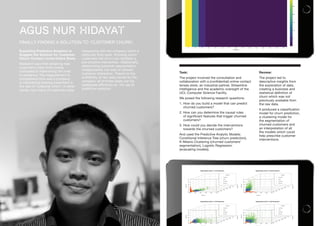
AGUS NUR HIDAYAT
FINALLY FINDING
A SOLUTION TO
‘CUSTOMER CHURN’
AGUS NUR HIDAYAT
FINALLY FINDING A SOLUTION TO ‘CUSTOMER CHURN’.
Exploiting Predictive Analytics to
Suggest the Solution for Customer
Churn: Contact Lense Online Store.
Research says that obtaining new
customers costs more money
compared to maintaining the ones
in existence. The measurement to
comprehend how well a company
is maintaining existing customers is
the rate of ‘customer churn’. In other
words, how many of customers stop
transacting with the company within a
particular time-span. Knowing which
customers will churn can facilitate a
pre-emptive intervention. Additionally,
determining customer segmentation
independently can lead to tailored
customer interaction. Thanks to the
availability of raw data owned by the
company, all of those tasks can be
addressed efficiently by the use of
predictive analytics.
Task:
The project involved the consultation and
collaboration with a (confidential) online contact
lenses store, an industrial partner, Streamline
Intelligence and the academic oversight of the
UCL Computer Science Facility.
We posed the following research questions:
1. How do you build a model that can predict
churned customers?
2. How can you determine the causal rules
of significant features that trigger churned
customers?
3. How could you decide the interventions
towards the churned customers?
And used the Predictive Analytic Models:
Conditional Inference Tree (churn prediction),
K-Means Clustering (churned customers’
segmentation), Logistic Regression
(evaluating models).
Review:
The project led to
descriptive insights from
the exploration of data,
creating a business and
statistical definition of
churn which was not
previously available from
the raw data.
It produced a classification
model for churn prediction,
a clustering model for
the segmentation of
churned customers and
an interpretation of all
the models which could
help prescribe customer
interventions.
What makes this project unique?
The client had many different
products within its online range,
all of which had different rates of
churn. The challenge was to create
a unified model which could be
applied across the whole business.
We selected variables to use in the
model and ran a range of predictive
analytic techniques to see which
was the best predictor. The aim
was to create models that are easy
for the client to understand in the
context of their own business.
What was the moment you
realised you wanted to do
what you are doing today?
I worked as a software engineer
before, in a position which involved
building database systems. The raw
data is often used by companies
for operational purposes without
ever realizing its potential use as a
strategic asset. I wanted to learn
how to extract the insights from
this raw data and how to interpret
it properly to provide insights that
are actually helpful to the company
in terms of their business decision-
making process.
What has been a highlight so far?
My decision to study overseas at
UCL has been really important.
Not only has it strengthened my
skill set with a Master’s degree
from a top university but meeting
so many new people from different
backgrounds has definitely widened
my perspective.
What have you learnt
along the way?
Stop wasting your time by blaming
yourself after failing. If you don’t
fail, you don’t learn. Rather than
being gloomy, learn from your
mistakes and be a better version of
yourself. And if opportunity doesn’t
knock, build a door.
What excites you about the
opportunities with data today
and in the future
Reliable data can help prevent
the cloudy business assumptions
that can mislead both customers
and the actual employees of
the company. In my opinion, the
satisfaction of customers and
employees are two key factors that
drive the success of a company.
Rather than solely trying to develop
sophisticated algorithms to improve
the results of of learning models,
we should also explore how the
models themselves can be applied
to and impact business decision-
making.
////
QA
WE SAT DOWN WITH AGUS AND ASKED HIM A FEW
QUESTIONS ABOUT HIS PROJECT AND ASK WHAT HE
THINKS THE FUTURE HOLDS FOR HIMSELF.
“Meeting so
many new
people from
different
backgrounds
widened my
perspective”
Case Study - Agus

Case Study - Agus

  • 1.
    AGUS NUR HIDAYAT FINALLYFINDING A SOLUTION TO ‘CUSTOMER CHURN’
  • 2.
    AGUS NUR HIDAYAT FINALLYFINDING A SOLUTION TO ‘CUSTOMER CHURN’. Exploiting Predictive Analytics to Suggest the Solution for Customer Churn: Contact Lense Online Store. Research says that obtaining new customers costs more money compared to maintaining the ones in existence. The measurement to comprehend how well a company is maintaining existing customers is the rate of ‘customer churn’. In other words, how many of customers stop transacting with the company within a particular time-span. Knowing which customers will churn can facilitate a pre-emptive intervention. Additionally, determining customer segmentation independently can lead to tailored customer interaction. Thanks to the availability of raw data owned by the company, all of those tasks can be addressed efficiently by the use of predictive analytics. Task: The project involved the consultation and collaboration with a (confidential) online contact lenses store, an industrial partner, Streamline Intelligence and the academic oversight of the UCL Computer Science Facility. We posed the following research questions: 1. How do you build a model that can predict churned customers? 2. How can you determine the causal rules of significant features that trigger churned customers? 3. How could you decide the interventions towards the churned customers? And used the Predictive Analytic Models: Conditional Inference Tree (churn prediction), K-Means Clustering (churned customers’ segmentation), Logistic Regression (evaluating models). Review: The project led to descriptive insights from the exploration of data, creating a business and statistical definition of churn which was not previously available from the raw data. It produced a classification model for churn prediction, a clustering model for the segmentation of churned customers and an interpretation of all the models which could help prescribe customer interventions.
  • 3.
    What makes thisproject unique? The client had many different products within its online range, all of which had different rates of churn. The challenge was to create a unified model which could be applied across the whole business. We selected variables to use in the model and ran a range of predictive analytic techniques to see which was the best predictor. The aim was to create models that are easy for the client to understand in the context of their own business. What was the moment you realised you wanted to do what you are doing today? I worked as a software engineer before, in a position which involved building database systems. The raw data is often used by companies for operational purposes without ever realizing its potential use as a strategic asset. I wanted to learn how to extract the insights from this raw data and how to interpret it properly to provide insights that are actually helpful to the company in terms of their business decision- making process. What has been a highlight so far? My decision to study overseas at UCL has been really important. Not only has it strengthened my skill set with a Master’s degree from a top university but meeting so many new people from different backgrounds has definitely widened my perspective. What have you learnt along the way? Stop wasting your time by blaming yourself after failing. If you don’t fail, you don’t learn. Rather than being gloomy, learn from your mistakes and be a better version of yourself. And if opportunity doesn’t knock, build a door. What excites you about the opportunities with data today and in the future Reliable data can help prevent the cloudy business assumptions that can mislead both customers and the actual employees of the company. In my opinion, the satisfaction of customers and employees are two key factors that drive the success of a company. Rather than solely trying to develop sophisticated algorithms to improve the results of of learning models, we should also explore how the models themselves can be applied to and impact business decision- making. //// QA WE SAT DOWN WITH AGUS AND ASKED HIM A FEW QUESTIONS ABOUT HIS PROJECT AND ASK WHAT HE THINKS THE FUTURE HOLDS FOR HIMSELF. “Meeting so many new people from different backgrounds widened my perspective”