AI Ethics Framework Workshop Report
Policy Lab, Digital Government Policy and Innovation, DFSI
28 Feb 2019
• Artificial intelligence, machine learning, and automated decision-making technologies offer exciting possibilities for NSW
Government program delivery and meaningful work.
• New technologies are imperfect. With AI, mistakes can be replicated at a tremendous speed and uneven distribution of
entitlements can reinforce issues like inequality and bias.
• NSW Policy Lab held a two-hour workshop on 28 Feb for three purposes:
• Ensure common understanding of key concepts through short presentations on Gradient Institute’s AI technical
knowledge and The Ethic Centre’s ethical policy intent considerations.
• Understand what clusters and agencies hope to achieve with AI using an ‘Optimistic Future’ exercise.
• Develop an initial understanding of what kind of policy and guidance will be needed to enable ethical uses of AI
by the NSW government through a ‘Hopes and Fears’ exercise.
• There was overwhelming interest from different clusters, agencies and other organisations, including academia, justice,
health, education and environment; 35 attendees participated in the workshop.
• This workshop was intended to help shape a process to understand, define and deliver a policy framework that will
enable the ethical use of AI.
Background
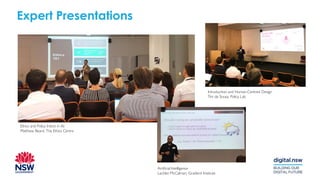
Ethics and Policy Intent in AI
Matthew Beard, The Ethics Centre
Introduction and Human-Centred Design
Tim de Sousa, Policy Lab
Artificial Intelligence
Lachlan McCalman, Gradient Institute
Expert Presentations
TOP FIVE INSIGHTS
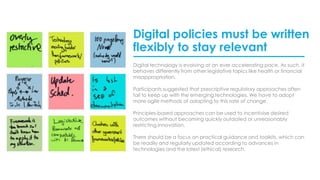
Digital policies must be written
flexibly to stay relevant
Digital technology is evolving at an ever accelerating pace. As such, it
behaves differently from other legislative topics like health or financial
misappropriation.
Participants suggested that prescriptive regulatory approaches often
fail to keep up with the emerging technologies. We have to adopt
more agile methods of adapting to this rate of change.
Principles-based approaches can be used to incentivise desired
outcomes without becoming quickly outdated or unreasonably
restricting innovation.
There should be a focus on practical guidance and toolkits, which can
be readily and regularly updated according to advances in
technologies and the latest (ethical) research.
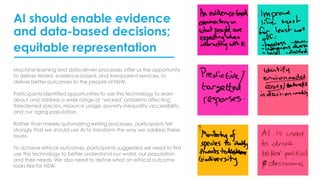
AI should enable evidence
and data-based decisions;
equitable representation
Machine learning and data-driven processes offer us the opportunity
to deliver tested, evidence-based, and transparent services, to
deliver better outcomes to the people of NSW.
Participants identified opportunities to use this technology to learn
about and address a wide range of ‘wicked’ problems affecting
threatened species, resource usage, poverty inequality, accessibility,
and our aging population.
Rather than merely automating exiting processes, participants felt
strongly that we should use AI to transform the way we address these
issues.
To achieve ethical outcomes, participants suggested we need to first
use this technology to better understand our world, our population
and their needs. We also need to define what an ethical outcome
looks like for NSW.
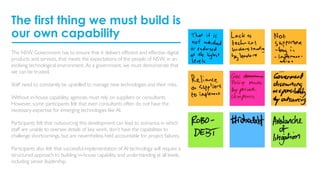
The first thing we must build is
our own capability
The NSW Government has to ensure that it delivers efficient and effective digital
products and services, that meets the expectations of the people of NSW, in an
evolving technological environment. As a government, we must demonstrate that
we can be trusted.
Staff need to constantly be upskilled to manage new technologies and their risks.
Without in-house capability, agencies must rely on suppliers or consultants.
However, some participants felt that even consultants often do not have the
necessary expertise for emerging technologies like AI.
Participants felt that outsourcing this development can lead to scenarios in which
staff are unable to oversee details of key work, don’t have the capabilities to
challenge shortcomings, but are nevertheless held accountable for project failures.
Participants also felt that successful implementation of AI technology will require a
structured approach to building in-house capability and understanding at all levels,
including senior leadership.
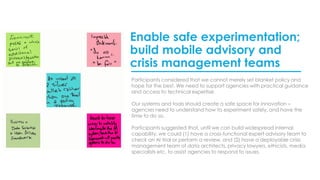
Enable safe experimentation;
build mobile advisory and
crisis management teams
Participants considered that we cannot merely set blanket policy and
hope for the best. We need to support agencies with practical guidance
and access to technical expertise.
Our systems and tools should create a safe space for innovation –
agencies need to understand how to experiment safely, and have the
time to do so.
Participants suggested that, until we can build widespread internal
capability, we could (1) have a cross-functional expert advisory team to
check an AI trial or perform a review, and (2) have a deployable crisis
management team of data architects, privacy lawyers, ethicists, media
specialists etc. to assist agencies to respond to issues.
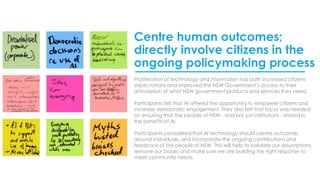
Centre human outcomes;
directly involve citizens in the
ongoing policymaking process
Proliferation of technology and information has both increased citizens’
expectations and improved the NSW Government’s access to their
articulation of what NSW government products and services they need.
Participants felt that AI offered the opportunity to empower citizens and
increase democratic engagement. They also felt that focus was needed
on ensuring that the people of NSW - and not just institutions - shared in
the benefits of AI.
Participants considered that AI technology should centre outcomes
around individuals, and incorporate the ongoing contributions and
feedback of the people of NSW. This will help to validate our assumptions,
remove our biases and make sure we are building the right response to
meet community needs.
OPTIMISTIC FUTURE
[In the future] we’ll see a shift in
wellness frameworks where
countries will have to compete
on being the best place to live.
- Pia Andrews, ED, DGPI
Scope
• To design transformative outcomes, we must
be willing to think beyond just iterating our
current solutions.
• To set the scene, we asked participants to
imagine an optimistic version of what AI-
enabled life could look like by 2050.
• We guided this discussion by asking
participants to adopt one of 5 different
personas, and imagine how AI could be used
to improve their lives.
”
“
In 2050,
how should AI be used
to make NSW
the best place to live?
Because we need help to stop reoffending.
Because you could be me by 2050.
Because in 2050, we’ll be your age now.
Because what we do impact you and change the world.
Jeff Bezos
Amazon
Tim Cook
Apple
Mark Zuckerberg
Facebook
Sundar Pichai
Google
Because we don’t have a voice unless you speak for us.
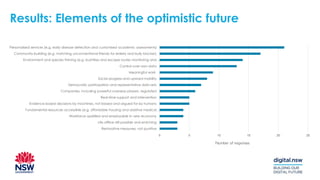
0 5 10 15 20 25
Restorative measures, not punitive
Life offline still possible and enriching
Workforce upskilled and employable in new economy
Fundamental resources accessible (e.g. affordable housing and assistive medical…
Evidence-based decisions by machines, not biased and argued for by humans
Real-time support and intervention
Companies, including powerful overseas players, regulated
Democratic participation and representative data sets
Social progress and upward mobility
Meaningful work
Control over own data
Environment and species thriving (e.g. bushfires and escape routes monitoring and…
Community-building (e.g. matching unconventional friends for elderly and bully blocker)
Personalised services (e.g. early disease detection and customised academic assessments)
Results: Elements of the optimistic future
Number of responses
NSW AI Ethics Policy Framework
Hopes and Fears
Scope
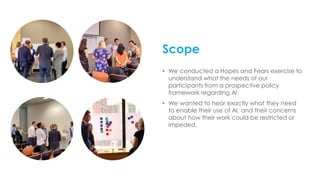
• We conducted a Hopes and Fears exercise to
understand what the needs of our
participants from a prospective policy
framework regarding AI.
• We wanted to hear exactly what they need
to enable their use of AI, and their concerns
about how their work could be restricted or
impeded.
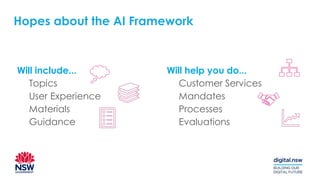
Hopes about the AI Framework
Will include...
Topics
User Experience
Materials
Guidance
Will help you do...
Customer Services
Mandates
Processes
Evaluations
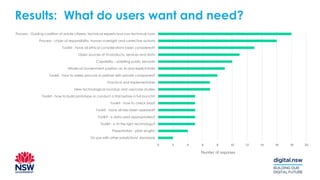
Results: What do users want and need?
0 2 4 6 8 10 12 14 16 18 20
On par with other jurisdictions' standards
Presentation - plain english
Toolkit - is AI the right technology?
Toolkit - is data used appropriately?
Toolkit - have all risks been assessed?
Toolkit - how to check bias?
Toolkit - how to build prototype or conduct a trial before a full launch?
New technological roundup and use/case studies
Practical and Implementable
Toolkit - how to safely procure or partner with private companies?
Whole-of-Government position on AI and explicit limits
Capability - upskilling public servants
Open sources of AI products, services and data
Toolkit - have all ethical considerations been considered?
Process - chain of responsibility, human oversight and corrective actions
Process - Guiding coalition of astute citizens, technical experts and non-technical tools
Number of responses
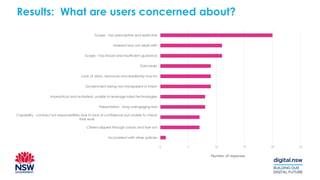
Concerns about the AI Framework
• Won’t cover…
• Won’t help me…
• Won’t let me…
Results: What are users concerned about?
0 5 10 15 20 25
Inconsistent with other policies
Citizens slipped through cracks and lose out
Capability - contract out responsibilities due to lack of confidence but unable to check
their work
Presentation - long unengaging text
Impractical and outdated, unable to leverage latest technologies
Government being non-transparent in intent
Lack of vision, resources and leadership buy-ins
Data leaks
Scope - Too broad and insufficient guidance
Inherent bias not dealt with
Scope - Too prescriptive and restrictive
Number of responses
FEEDBACK
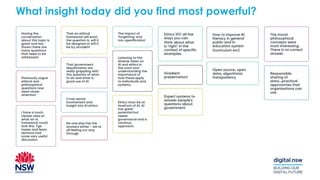
What insight today did you find most powerful?
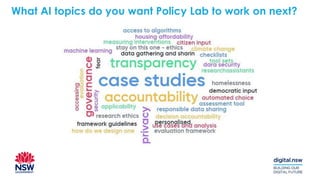
What AI topics do you want Policy Lab to work on next?
NEXT STEPS
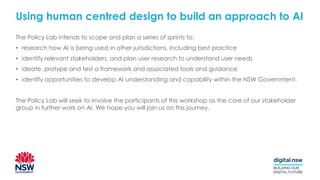
Using human centred design to build an approach to AI
The Policy Lab intends to scope and plan a series of sprints to:
• research how AI is being used in other jurisdictions, including best practice
• identify relevant stakeholders, and plan user research to understand user needs
• ideate, protype and test a framework and associated tools and guidance
• identify opportunities to develop AI understanding and capability within the NSW Government.
The Policy Lab will seek to involve the participants of this workshop as the core of our stakeholder
group in further work on AI. We hope you will join us on this journey.
Get in Touch
Website
Social
Email
https://www.digital.nsw.gov.au/policylab
policylab@finance.nsw.gov.au
Twitter: @PolicyLabAU
Yammer: Human-Centred Policy Design

AI Ethics Workshop Summary Report

  • 1.
    AI Ethics FrameworkWorkshop Report Policy Lab, Digital Government Policy and Innovation, DFSI 28 Feb 2019
  • 2.
    • Artificial intelligence,machine learning, and automated decision-making technologies offer exciting possibilities for NSW Government program delivery and meaningful work. • New technologies are imperfect. With AI, mistakes can be replicated at a tremendous speed and uneven distribution of entitlements can reinforce issues like inequality and bias. • NSW Policy Lab held a two-hour workshop on 28 Feb for three purposes: • Ensure common understanding of key concepts through short presentations on Gradient Institute’s AI technical knowledge and The Ethic Centre’s ethical policy intent considerations. • Understand what clusters and agencies hope to achieve with AI using an ‘Optimistic Future’ exercise. • Develop an initial understanding of what kind of policy and guidance will be needed to enable ethical uses of AI by the NSW government through a ‘Hopes and Fears’ exercise. • There was overwhelming interest from different clusters, agencies and other organisations, including academia, justice, health, education and environment; 35 attendees participated in the workshop. • This workshop was intended to help shape a process to understand, define and deliver a policy framework that will enable the ethical use of AI. Background
  • 3.
    Ethics and PolicyIntent in AI Matthew Beard, The Ethics Centre Introduction and Human-Centred Design Tim de Sousa, Policy Lab Artificial Intelligence Lachlan McCalman, Gradient Institute Expert Presentations
  • 4.
  • 5.
    Digital policies mustbe written flexibly to stay relevant Digital technology is evolving at an ever accelerating pace. As such, it behaves differently from other legislative topics like health or financial misappropriation. Participants suggested that prescriptive regulatory approaches often fail to keep up with the emerging technologies. We have to adopt more agile methods of adapting to this rate of change. Principles-based approaches can be used to incentivise desired outcomes without becoming quickly outdated or unreasonably restricting innovation. There should be a focus on practical guidance and toolkits, which can be readily and regularly updated according to advances in technologies and the latest (ethical) research.
  • 6.
    AI should enableevidence and data-based decisions; equitable representation Machine learning and data-driven processes offer us the opportunity to deliver tested, evidence-based, and transparent services, to deliver better outcomes to the people of NSW. Participants identified opportunities to use this technology to learn about and address a wide range of ‘wicked’ problems affecting threatened species, resource usage, poverty inequality, accessibility, and our aging population. Rather than merely automating exiting processes, participants felt strongly that we should use AI to transform the way we address these issues. To achieve ethical outcomes, participants suggested we need to first use this technology to better understand our world, our population and their needs. We also need to define what an ethical outcome looks like for NSW.
  • 7.
    The first thingwe must build is our own capability The NSW Government has to ensure that it delivers efficient and effective digital products and services, that meets the expectations of the people of NSW, in an evolving technological environment. As a government, we must demonstrate that we can be trusted. Staff need to constantly be upskilled to manage new technologies and their risks. Without in-house capability, agencies must rely on suppliers or consultants. However, some participants felt that even consultants often do not have the necessary expertise for emerging technologies like AI. Participants felt that outsourcing this development can lead to scenarios in which staff are unable to oversee details of key work, don’t have the capabilities to challenge shortcomings, but are nevertheless held accountable for project failures. Participants also felt that successful implementation of AI technology will require a structured approach to building in-house capability and understanding at all levels, including senior leadership.
  • 8.
    Enable safe experimentation; buildmobile advisory and crisis management teams Participants considered that we cannot merely set blanket policy and hope for the best. We need to support agencies with practical guidance and access to technical expertise. Our systems and tools should create a safe space for innovation – agencies need to understand how to experiment safely, and have the time to do so. Participants suggested that, until we can build widespread internal capability, we could (1) have a cross-functional expert advisory team to check an AI trial or perform a review, and (2) have a deployable crisis management team of data architects, privacy lawyers, ethicists, media specialists etc. to assist agencies to respond to issues.
  • 9.
    Centre human outcomes; directlyinvolve citizens in the ongoing policymaking process Proliferation of technology and information has both increased citizens’ expectations and improved the NSW Government’s access to their articulation of what NSW government products and services they need. Participants felt that AI offered the opportunity to empower citizens and increase democratic engagement. They also felt that focus was needed on ensuring that the people of NSW - and not just institutions - shared in the benefits of AI. Participants considered that AI technology should centre outcomes around individuals, and incorporate the ongoing contributions and feedback of the people of NSW. This will help to validate our assumptions, remove our biases and make sure we are building the right response to meet community needs.
  • 10.
  • 11.
    [In the future]we’ll see a shift in wellness frameworks where countries will have to compete on being the best place to live. - Pia Andrews, ED, DGPI Scope • To design transformative outcomes, we must be willing to think beyond just iterating our current solutions. • To set the scene, we asked participants to imagine an optimistic version of what AI- enabled life could look like by 2050. • We guided this discussion by asking participants to adopt one of 5 different personas, and imagine how AI could be used to improve their lives. ” “
  • 12.
    In 2050, how shouldAI be used to make NSW the best place to live? Because we need help to stop reoffending. Because you could be me by 2050. Because in 2050, we’ll be your age now. Because what we do impact you and change the world. Jeff Bezos Amazon Tim Cook Apple Mark Zuckerberg Facebook Sundar Pichai Google Because we don’t have a voice unless you speak for us.
  • 13.
    0 5 1015 20 25 Restorative measures, not punitive Life offline still possible and enriching Workforce upskilled and employable in new economy Fundamental resources accessible (e.g. affordable housing and assistive medical… Evidence-based decisions by machines, not biased and argued for by humans Real-time support and intervention Companies, including powerful overseas players, regulated Democratic participation and representative data sets Social progress and upward mobility Meaningful work Control over own data Environment and species thriving (e.g. bushfires and escape routes monitoring and… Community-building (e.g. matching unconventional friends for elderly and bully blocker) Personalised services (e.g. early disease detection and customised academic assessments) Results: Elements of the optimistic future Number of responses
  • 14.
    NSW AI EthicsPolicy Framework Hopes and Fears
  • 15.
    Scope • We conducteda Hopes and Fears exercise to understand what the needs of our participants from a prospective policy framework regarding AI. • We wanted to hear exactly what they need to enable their use of AI, and their concerns about how their work could be restricted or impeded.
  • 16.
    Hopes about theAI Framework Will include... Topics User Experience Materials Guidance Will help you do... Customer Services Mandates Processes Evaluations
  • 17.
    Results: What dousers want and need? 0 2 4 6 8 10 12 14 16 18 20 On par with other jurisdictions' standards Presentation - plain english Toolkit - is AI the right technology? Toolkit - is data used appropriately? Toolkit - have all risks been assessed? Toolkit - how to check bias? Toolkit - how to build prototype or conduct a trial before a full launch? New technological roundup and use/case studies Practical and Implementable Toolkit - how to safely procure or partner with private companies? Whole-of-Government position on AI and explicit limits Capability - upskilling public servants Open sources of AI products, services and data Toolkit - have all ethical considerations been considered? Process - chain of responsibility, human oversight and corrective actions Process - Guiding coalition of astute citizens, technical experts and non-technical tools Number of responses
  • 18.
    Concerns about theAI Framework • Won’t cover… • Won’t help me… • Won’t let me…
  • 19.
    Results: What areusers concerned about? 0 5 10 15 20 25 Inconsistent with other policies Citizens slipped through cracks and lose out Capability - contract out responsibilities due to lack of confidence but unable to check their work Presentation - long unengaging text Impractical and outdated, unable to leverage latest technologies Government being non-transparent in intent Lack of vision, resources and leadership buy-ins Data leaks Scope - Too broad and insufficient guidance Inherent bias not dealt with Scope - Too prescriptive and restrictive Number of responses
  • 20.
  • 21.
    What insight todaydid you find most powerful?
  • 22.
    What AI topicsdo you want Policy Lab to work on next?
  • 23.
  • 24.
    Using human centreddesign to build an approach to AI The Policy Lab intends to scope and plan a series of sprints to: • research how AI is being used in other jurisdictions, including best practice • identify relevant stakeholders, and plan user research to understand user needs • ideate, protype and test a framework and associated tools and guidance • identify opportunities to develop AI understanding and capability within the NSW Government. The Policy Lab will seek to involve the participants of this workshop as the core of our stakeholder group in further work on AI. We hope you will join us on this journey.
  • 25.