
Case Studies
Nescafe Ultra Premium
The Brief A major development in the Nescafe UP’s brand strategy was to narrow the target audience that all marketing communications were aimed at.Extensive work by the brand team had re-defined the audience that Nescafe UP would target.Two target audiences called Roast & Ground Dippers and Instant Dippers had been identified – c1.7m HH’sThe brief was how, from a data perspective, do we find this audience to allow a major dm sampling campaign to take place
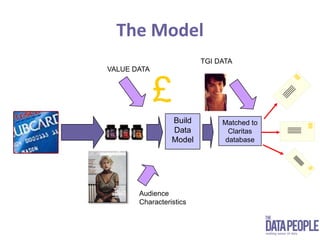
The SolutionNescafe did not have marketing data of their ownThere was not sufficient volumes of external data to purchase that identified ‘dipping’In order to get the quantity and quality of data needed we proposed data modellingIn simple terms, this meant creating a profile of the people we wanted and then finding lookalikes.The secret lay in having the most accurate profile at the startWe recommended using Tesco Clubcard data to create the profile that the data model would be built aroundThe model would then be applied to external lifestyle data sources
The ModelTGI DATAVALUE DATA£Build Data ModelMatched to Claritas databaseAudienceCharacteristics
The ResultsThe data model used in the direct marketing campaign proved to be highly successfulThe mailing delivered £280k uplift in the first three months aloneThe mailing had an impact on customers behaviour resulting in sustained change over a year – once customers had tried it they remained loyalCustomers moved from the targeted product areas of Freeze Dried and R&G proving the model’s accuracyAt a brand level customers were most likely to have moved from Kenco Ultra Premium and other Premium freeze dried coffees
Loctite
The BriefHistorical events and staff changes had led to there being a number of different unlinked customer and prospect databasesWhilst these were being used as a growing repository of new leads as they arose, the following operations were not routinely performed:company name & address validation or cleansingidentification of “gone-aways”linking multiple records for the same companytracking the progress and outcome of leads receivedLoctite required help in formulating the requirements for a consolidated ‘single view’ customer database
The SolutionWe conducted a short, intensive consultancy exercise: to review in detail the business requirements that should drive the future database systemto identify the functional and information requirements of key decision-makers and members of staff within the businessto critique the current databases in more detail and document their strengths and weaknessesto recommend a database solution going forward:proposing the most appropriate database software solutionretaining and building on the strengths of the existing systems
The SolutionProposing a single company view that links and makes available all information relating to an individual companydefining a closed-loop approach which tracks leads from outset to outcomedefining rigorous data capture, cleansing and maintenance processesproposing a suite of reports tailored to the needs of key decision-makers identifying staff training needs and suggesting an appropriate programmeaddressing questions of core data fields and standardisation of data formats
The SolutionIn-boundLeads DashboardManagement ReportingSingle CustomerDatabaseData CaptureData AppendingData Cleaning De-DuplicationSales ForceLead GenerationMarketingSales OutcomesSales Tracking
The ResultsThe consultancy was completed within 3 weeks of being agreedAs a result of this work a comprehensive brief was developed to appoint the database solution providerContinued consultancy was provided to assist the tendering and appointment process
Yorkshire & Humber Strategic Health Authority (NHS)
The BriefCoverage rates in the cervical screening programme in the Yorkshire and the Humber were in rapid declineIf nothing was done to address this decline then Primary Care Trusts would struggle to meet the national coverage targetsA social marketing intervention will be undertaken to halt the steady decline in coverage rates amongst 25-34 year oldsOur brief was to profile this age group to get a clearer understanding of which sections of society non-attendance of cervical screening is greatest so that a targeted research programme could be undertaken
The SolutionThe first challenge was to ascertain whether we could access data on non-attendees.We were able to access full post code data on non-attendance for each of the 14 PCTs in the SHA but no other data would be made available to protect patient confidentialityWorking in partnership with Yorkshire & Humber Public Health Observatory we profiled the non-attendance data against 5 geo-demographic classification systemsWe analysed the data at regional and PCT level and split the age bands into 25-29 and 30-34 sub age bandsWe also profiled the general female population for the above to allow for indexing
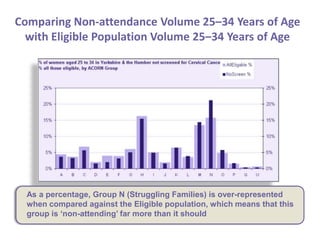
Comparing Non-attendance Volume 25–34 Years of Age with Eligible Population Volume 25–34 Years of AgeAs a percentage, Group N (Struggling Families) is over-represented when compared against the Eligible population, which means that this group is ‘non-attending’ far more than it should
The ResultsThe data profiling clearly showed Group N (Struggling Families) to be the dominant target audience when it comes to non-attendanceThis group is consistently prevalent amongst all PCTs profiledHigh incidence of young single mums appear to be a key feature after further analysisThis key audience comes out through all the classification systemsThis will be a difficult group to influence but we now need to understand ‘why’ they are not attending their screenings and what messages and service offerings will positively influence their behaviour
Holmes Place
The BriefLike many of its competitors, Holmes Place concentrated on acquisition during the unprecedented growth phase of the industryCustomer retention and improved targeting for acquisition were recognised as important business drivers as:competition increased cost of acquisition increasedattrition rates exceeded 50% per annumLittle was known about the customer, and no estimates of customer value and what drives it had been evaluatedThe brief was to understand the customer better to allow for smarter and more efficient marketing activity
The SolutionThe first step was to take the client’s membership and transaction databases and combine themAppend demographic and lifestyle informationIdentify valuable customers – including length of membership and additional spend (e.g. personal training)Profiles for each club by value band were compiledIn addition, value groupings by type of membership and by number of visits to clubs were made
The SolutionKey variables – transactional and lifestyle - for predicting closure of membership  were identifiedThe resulting model was applied to the customer base to predict the likelihood of attrition Although there are many factors affecting renewal of membership (such as moving away from the area), many members do not renew because of their lack of usage of the facilities availableThe models allowed us to identify the probability of each member renewing, and allows communication strategies to be put into practice for valuable but potentially disloyal customers
The ResultsTargeting for new customers has been revitalised After years of reducing returns from marketing targeted by demographics only, the new models coupled with data cleaning processes have resulted in a five-fold increase in response ratesCosts per new member have been reducedAverage value of each new member acquired was increasedEarly indications are that the modelling of likely defectors, coupled with communications designed to retain them, is starting to reduce churn rates
Alliance & Leicester
The BriefAlliance & Leicester had been using cold contact lists to direct potential customers to their web site, with limited successRegistered users of the site were segmented by answers to basic financial questions only upon registrationCommunications to registered users had minimal tailoringWith results from nearly 2 years’ activity now available, our brief was to optimise results – Increase visits to the site from dm activityMaximise the potential value of visitors to the site
The SolutionThe first step was to take the client’s database of registered users, plus a sample file of non-respondents, and append lifestyle and demographic overlays to the dataCHAID modelling based on each set of overlays was carried out and gains charts compared to improve targeting The client’s registered user base was segmented in terms of their long-term behaviour in relation to the siteThe resulting 6 clusters were profiled in terms of their likely financial requirements and long-term value potentialThe rules for optimum allocation to segments were modelled using discriminant analysis
The SolutionA series of new questions at registration were identified to give the client data to allocate the new user immediately to the appropriate segment
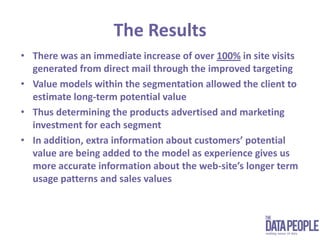
The ResultsThere was an immediate increase of over 100% in site visits generated from direct mail through the improved targetingValue models within the segmentation allowed the client to estimate long-term potential valueThus determining the products advertised and marketing investment for each segmentIn addition, extra information about customers’ potential value are being added to the model as experience gives us more accurate information about the web-site’s longer term usage patterns and sales values
Jordans Cereal
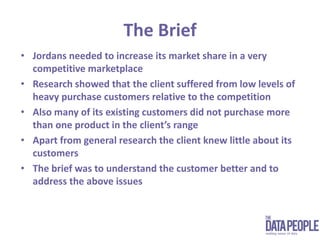
The BriefJordans needed to increase its market share in a very competitive marketplaceResearch showed that the client suffered from low levels of heavy purchase customers relative to the competition Also many of its existing customers did not purchase more than one product in the client’s rangeApart from general research the client knew little about its customersThe brief was to understand the customer better and to address the above issues
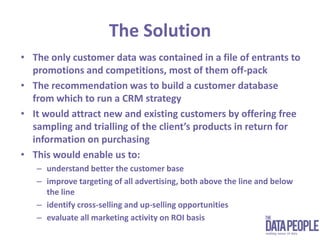
The SolutionThe only customer data was contained in a file of entrants to promotions and competitions, most of them off-packThe recommendation was to build a customer database from which to run a CRM strategyIt would attract new and existing customers by offering free sampling and trialling of the client’s products in return for information on purchasing This would enable us to: understand better the customer baseimprove targeting of all advertising, both above the line and below the lineidentify cross-selling and up-selling opportunitiesevaluate all marketing activity on ROI basis
The SolutionPrior to any analysis, the client’s data was cleaned, enhanced and de-duped, and compiled into a relational databaseSegmentation using appended demographics, lifestyle and attitudinal data was undertakenSeveral down-market segments of “coupon clippers” rather than existing customers were identified and excludedA re-specified database was compiled to record mailings, coupon redemptions, purchasing data, demographics and lifestyle data
The ResultsMailings and door-drops have attracted more “tasters” than was anticipated, most of whom have volunteered information on the brands they buy and how often Purchasing information is now being used as a vehicle for cross-selling purposes, and to identify customers who may be persuaded to buy larger packs more regularlyThe database now forms an integral part of the client’s knowledge base, and is helping to drive above-the-line activity as well as traditional direct marketing
NTL
The BriefNTL, suppliers of TV, telephone and BroadBand services via cable, had experienced a significant reduction in acquisition rates from their direct marketing – for new BroadBand services as well as their more traditional fare of Analogue and Digital TV and Telephone servicesWith little understanding of the types of customer which were responding to different product offers, they had resorted to mailing everyone with generic offers, and hoping that “something would stick” Of course, less and less was sticking and they need help to market smarter
The SolutionInitially, demographic and lifestyle data was matched and appended to the company’s customer and prospect baseProfiles were built of customers with each product combination (analogue or digital TV, telephone, BroadBand – the latter at different speeds) and compared with the company’s defined catchment areaWithin each product combination, cluster analysis identified different groups with different requirements and different lifestyles, identifying opportunities for targeted creative treatments and offersAs a result, CHAID analyses for each product combination were carried out
The SolutionThe models allowed us to rank every prospect and existing customer in terms of their likelihood to respond to each product offeringCustomers were further classified into segments using cluster analysis, so we were able to:rank all customers and prospects in terms of their likelihood to respond to each product offeringidentify the best product offering(s) for each customer or prospectuse appropriate creative treatments and offers for each customer or prospectuse different approaches and compile different offers for existing customers and prospects
The ResultsTesting of the models against control groups have verified the efficiency of the modelling as well as providing additional information for segmentationSignificantly improved response rates have resulted, enabling the client to obtain more new customers and additional cross-selling for the same budgetIn addition, all new residents in the client’s catchment area can now be scored and the appropriate product offering and creative treatment assigned to them as soon as fresh data is received about the customer or prospect
South Western Electricity
The BriefIn the de-regulated electricity market, there has always been a perceived danger of utilities “cherry-picking” profitable customers and using price to deter poorer customersHigher fuel prices for prepayment customers were seen as penalising poorer customers, based on the assumption that only those poorer customers used prepayment methodsThe Government put pressure on utilities to introduce pricing regimes for prepayment fuel to reduce the incidence of fuel povertyThe client wanted to test the assumed relationship between prepayment methods and fuel poverty to enable it to respond to regulatory pressure regarding prepayment fuel charges
The SolutionSegmentation and profiling of the utility’s prepayment customer database with appended lifestyle data, identified several discrete clusters of customers who take advantage of the prepayment facilitySimplistically, they can be divided into two groups:the relatively poor, who use prepayment out of necessity e.g. for fuel budgeting purposesthose who choose the prepayment option because it suits their lifestyle e.g. young professionals, perhaps renting privately A section of the former are estimated to be fuel poor, but very few of the second group are classified as such
The ResultsThe client used the results of this research to convince government bodies and charity organisations that prepayment fuel purchase and fuel poverty are not necessarily related Subsidising prepayment costs would be wasteful since it would have the by-product of also helping much more wealthy sectors of the community.The analysis of prepayment customers differed significantly between areas of the country, with many more relatively wealthy prepayment fuel purchasers in London and the South East than in more rural areas of the UKSo a national prepayment price regime would help the poor more in some areas than in others.
South Western Electricity
The BriefLoyalty to existing fuel suppliers is an important element of utilities’ marketing strategy in the de-regulated market and paramount to continued profitabilityWe were asked to identify likely defectors – to and from the utility, in each catchment area and by combination of fuel – to enable an appropriate communications strategy to be implemented
The SolutionSegmentation and profiling of “switchers” (those customers who have already switched their fuel supplier) identified discrete groups of people, with different reasons for switchingDiscriminant modelling of the separate groups of switchers allowed us to predict switching by an average of 3 times greater accuracy than chance alone
The ResultsThe client was able to develop communications strategies with their creative agencies aimed at the most “vulnerable” customers, both inside and outside their catchment areas Each target group received a different message depending on their profile and likely reasons for switchingAs a result, customer acquisition costs have been reduced dramatically, and communication strategies for potentially disloyal customers have shown extremely positive returns on investment
Cif
The BriefJif had been in the market place for 28 years (since 1973). Housewives had literally been using it for years.In January 2001, Jif changed its name to Cif  because of Global RealignmentThe challenge was to migrate as many consumers as possible from Jif to CifExtensive research had identified considerable resistance to any change of name amongst Jif's core audienceOur brief was to Identify the most valuable Jif Cream users who would be resistant to the change
The SolutionThere were approx. 400k over 55yr. old Jif Cream consumers on Cif’s database. To find more users, we used external data sources.In addition we needed to identify the most vulnerable and valuable consumers - ‘The cream of the Cream users’To find these 'change resistors' we used Social Value Groups (which groups consumer according to their values, beliefs and motivations)Three Social Value Groups (SVGs) - Social Resistors, Survivors and Belongers -  were overlaid onto 55+ Jif Cream usersSVGs also gave us the flexibility to be able to tailor messages to a particular group's 'hot buttons'
The SolutionThe three SVG data sets were then run against TNS tracking information to enable us to identify the most valuable consumersThere were 200k consumers who were identified as most valuable and vulnerable – ‘Cream of the Cream users’There were also another 800k Jif consumers who formed the next layer in terms of value and vulnerability - ‘Heavy Cream users’The 200k most valuable and vulnerable consumers were targeted with a two stage mailing The 800k heavy cream users received a simple one stage mailer
The Solution
The ResultsContrary to the fear of losing sales the brand value has in fact increased by 9% overall The first ‘Cream of the Cream users’ mailing achieved a 32% coupon redemption rate and the follow-up mailing generated a staggering 58% responseThe sophisticated targeting undertaken to identify the target audience was used in future communications to these groups

TDP Case Studies

  • 1.
  • 2.
  • 3.
    The Brief Amajor development in the Nescafe UP’s brand strategy was to narrow the target audience that all marketing communications were aimed at.Extensive work by the brand team had re-defined the audience that Nescafe UP would target.Two target audiences called Roast & Ground Dippers and Instant Dippers had been identified – c1.7m HH’sThe brief was how, from a data perspective, do we find this audience to allow a major dm sampling campaign to take place
  • 4.
    The SolutionNescafe didnot have marketing data of their ownThere was not sufficient volumes of external data to purchase that identified ‘dipping’In order to get the quantity and quality of data needed we proposed data modellingIn simple terms, this meant creating a profile of the people we wanted and then finding lookalikes.The secret lay in having the most accurate profile at the startWe recommended using Tesco Clubcard data to create the profile that the data model would be built aroundThe model would then be applied to external lifestyle data sources
  • 5.
    The ModelTGI DATAVALUEDATA£Build Data ModelMatched to Claritas databaseAudienceCharacteristics
  • 6.
    The ResultsThe datamodel used in the direct marketing campaign proved to be highly successfulThe mailing delivered £280k uplift in the first three months aloneThe mailing had an impact on customers behaviour resulting in sustained change over a year – once customers had tried it they remained loyalCustomers moved from the targeted product areas of Freeze Dried and R&G proving the model’s accuracyAt a brand level customers were most likely to have moved from Kenco Ultra Premium and other Premium freeze dried coffees
  • 7.
  • 8.
    The BriefHistorical eventsand staff changes had led to there being a number of different unlinked customer and prospect databasesWhilst these were being used as a growing repository of new leads as they arose, the following operations were not routinely performed:company name & address validation or cleansingidentification of “gone-aways”linking multiple records for the same companytracking the progress and outcome of leads receivedLoctite required help in formulating the requirements for a consolidated ‘single view’ customer database
  • 9.
    The SolutionWe conducteda short, intensive consultancy exercise: to review in detail the business requirements that should drive the future database systemto identify the functional and information requirements of key decision-makers and members of staff within the businessto critique the current databases in more detail and document their strengths and weaknessesto recommend a database solution going forward:proposing the most appropriate database software solutionretaining and building on the strengths of the existing systems
  • 10.
    The SolutionProposing asingle company view that links and makes available all information relating to an individual companydefining a closed-loop approach which tracks leads from outset to outcomedefining rigorous data capture, cleansing and maintenance processesproposing a suite of reports tailored to the needs of key decision-makers identifying staff training needs and suggesting an appropriate programmeaddressing questions of core data fields and standardisation of data formats
  • 11.
    The SolutionIn-boundLeads DashboardManagementReportingSingle CustomerDatabaseData CaptureData AppendingData Cleaning De-DuplicationSales ForceLead GenerationMarketingSales OutcomesSales Tracking
  • 12.
    The ResultsThe consultancywas completed within 3 weeks of being agreedAs a result of this work a comprehensive brief was developed to appoint the database solution providerContinued consultancy was provided to assist the tendering and appointment process
  • 13.
    Yorkshire & HumberStrategic Health Authority (NHS)
  • 14.
    The BriefCoverage ratesin the cervical screening programme in the Yorkshire and the Humber were in rapid declineIf nothing was done to address this decline then Primary Care Trusts would struggle to meet the national coverage targetsA social marketing intervention will be undertaken to halt the steady decline in coverage rates amongst 25-34 year oldsOur brief was to profile this age group to get a clearer understanding of which sections of society non-attendance of cervical screening is greatest so that a targeted research programme could be undertaken
  • 15.
    The SolutionThe firstchallenge was to ascertain whether we could access data on non-attendees.We were able to access full post code data on non-attendance for each of the 14 PCTs in the SHA but no other data would be made available to protect patient confidentialityWorking in partnership with Yorkshire & Humber Public Health Observatory we profiled the non-attendance data against 5 geo-demographic classification systemsWe analysed the data at regional and PCT level and split the age bands into 25-29 and 30-34 sub age bandsWe also profiled the general female population for the above to allow for indexing
  • 16.
    Comparing Non-attendance Volume25–34 Years of Age with Eligible Population Volume 25–34 Years of AgeAs a percentage, Group N (Struggling Families) is over-represented when compared against the Eligible population, which means that this group is ‘non-attending’ far more than it should
  • 17.
    The ResultsThe dataprofiling clearly showed Group N (Struggling Families) to be the dominant target audience when it comes to non-attendanceThis group is consistently prevalent amongst all PCTs profiledHigh incidence of young single mums appear to be a key feature after further analysisThis key audience comes out through all the classification systemsThis will be a difficult group to influence but we now need to understand ‘why’ they are not attending their screenings and what messages and service offerings will positively influence their behaviour
  • 18.
  • 19.
    The BriefLike manyof its competitors, Holmes Place concentrated on acquisition during the unprecedented growth phase of the industryCustomer retention and improved targeting for acquisition were recognised as important business drivers as:competition increased cost of acquisition increasedattrition rates exceeded 50% per annumLittle was known about the customer, and no estimates of customer value and what drives it had been evaluatedThe brief was to understand the customer better to allow for smarter and more efficient marketing activity
  • 20.
    The SolutionThe firststep was to take the client’s membership and transaction databases and combine themAppend demographic and lifestyle informationIdentify valuable customers – including length of membership and additional spend (e.g. personal training)Profiles for each club by value band were compiledIn addition, value groupings by type of membership and by number of visits to clubs were made
  • 21.
    The SolutionKey variables– transactional and lifestyle - for predicting closure of membership were identifiedThe resulting model was applied to the customer base to predict the likelihood of attrition Although there are many factors affecting renewal of membership (such as moving away from the area), many members do not renew because of their lack of usage of the facilities availableThe models allowed us to identify the probability of each member renewing, and allows communication strategies to be put into practice for valuable but potentially disloyal customers
  • 22.
    The ResultsTargeting fornew customers has been revitalised After years of reducing returns from marketing targeted by demographics only, the new models coupled with data cleaning processes have resulted in a five-fold increase in response ratesCosts per new member have been reducedAverage value of each new member acquired was increasedEarly indications are that the modelling of likely defectors, coupled with communications designed to retain them, is starting to reduce churn rates
  • 23.
  • 24.
    The BriefAlliance &Leicester had been using cold contact lists to direct potential customers to their web site, with limited successRegistered users of the site were segmented by answers to basic financial questions only upon registrationCommunications to registered users had minimal tailoringWith results from nearly 2 years’ activity now available, our brief was to optimise results – Increase visits to the site from dm activityMaximise the potential value of visitors to the site
  • 25.
    The SolutionThe firststep was to take the client’s database of registered users, plus a sample file of non-respondents, and append lifestyle and demographic overlays to the dataCHAID modelling based on each set of overlays was carried out and gains charts compared to improve targeting The client’s registered user base was segmented in terms of their long-term behaviour in relation to the siteThe resulting 6 clusters were profiled in terms of their likely financial requirements and long-term value potentialThe rules for optimum allocation to segments were modelled using discriminant analysis
  • 26.
    The SolutionA seriesof new questions at registration were identified to give the client data to allocate the new user immediately to the appropriate segment
  • 27.
    The ResultsThere wasan immediate increase of over 100% in site visits generated from direct mail through the improved targetingValue models within the segmentation allowed the client to estimate long-term potential valueThus determining the products advertised and marketing investment for each segmentIn addition, extra information about customers’ potential value are being added to the model as experience gives us more accurate information about the web-site’s longer term usage patterns and sales values
  • 28.
  • 29.
    The BriefJordans neededto increase its market share in a very competitive marketplaceResearch showed that the client suffered from low levels of heavy purchase customers relative to the competition Also many of its existing customers did not purchase more than one product in the client’s rangeApart from general research the client knew little about its customersThe brief was to understand the customer better and to address the above issues
  • 30.
    The SolutionThe onlycustomer data was contained in a file of entrants to promotions and competitions, most of them off-packThe recommendation was to build a customer database from which to run a CRM strategyIt would attract new and existing customers by offering free sampling and trialling of the client’s products in return for information on purchasing This would enable us to: understand better the customer baseimprove targeting of all advertising, both above the line and below the lineidentify cross-selling and up-selling opportunitiesevaluate all marketing activity on ROI basis
  • 31.
    The SolutionPrior toany analysis, the client’s data was cleaned, enhanced and de-duped, and compiled into a relational databaseSegmentation using appended demographics, lifestyle and attitudinal data was undertakenSeveral down-market segments of “coupon clippers” rather than existing customers were identified and excludedA re-specified database was compiled to record mailings, coupon redemptions, purchasing data, demographics and lifestyle data
  • 32.
    The ResultsMailings anddoor-drops have attracted more “tasters” than was anticipated, most of whom have volunteered information on the brands they buy and how often Purchasing information is now being used as a vehicle for cross-selling purposes, and to identify customers who may be persuaded to buy larger packs more regularlyThe database now forms an integral part of the client’s knowledge base, and is helping to drive above-the-line activity as well as traditional direct marketing
  • 33.
  • 34.
    The BriefNTL, suppliersof TV, telephone and BroadBand services via cable, had experienced a significant reduction in acquisition rates from their direct marketing – for new BroadBand services as well as their more traditional fare of Analogue and Digital TV and Telephone servicesWith little understanding of the types of customer which were responding to different product offers, they had resorted to mailing everyone with generic offers, and hoping that “something would stick” Of course, less and less was sticking and they need help to market smarter
  • 35.
    The SolutionInitially, demographicand lifestyle data was matched and appended to the company’s customer and prospect baseProfiles were built of customers with each product combination (analogue or digital TV, telephone, BroadBand – the latter at different speeds) and compared with the company’s defined catchment areaWithin each product combination, cluster analysis identified different groups with different requirements and different lifestyles, identifying opportunities for targeted creative treatments and offersAs a result, CHAID analyses for each product combination were carried out
  • 36.
    The SolutionThe modelsallowed us to rank every prospect and existing customer in terms of their likelihood to respond to each product offeringCustomers were further classified into segments using cluster analysis, so we were able to:rank all customers and prospects in terms of their likelihood to respond to each product offeringidentify the best product offering(s) for each customer or prospectuse appropriate creative treatments and offers for each customer or prospectuse different approaches and compile different offers for existing customers and prospects
  • 37.
    The ResultsTesting ofthe models against control groups have verified the efficiency of the modelling as well as providing additional information for segmentationSignificantly improved response rates have resulted, enabling the client to obtain more new customers and additional cross-selling for the same budgetIn addition, all new residents in the client’s catchment area can now be scored and the appropriate product offering and creative treatment assigned to them as soon as fresh data is received about the customer or prospect
  • 38.
  • 39.
    The BriefIn thede-regulated electricity market, there has always been a perceived danger of utilities “cherry-picking” profitable customers and using price to deter poorer customersHigher fuel prices for prepayment customers were seen as penalising poorer customers, based on the assumption that only those poorer customers used prepayment methodsThe Government put pressure on utilities to introduce pricing regimes for prepayment fuel to reduce the incidence of fuel povertyThe client wanted to test the assumed relationship between prepayment methods and fuel poverty to enable it to respond to regulatory pressure regarding prepayment fuel charges
  • 40.
    The SolutionSegmentation andprofiling of the utility’s prepayment customer database with appended lifestyle data, identified several discrete clusters of customers who take advantage of the prepayment facilitySimplistically, they can be divided into two groups:the relatively poor, who use prepayment out of necessity e.g. for fuel budgeting purposesthose who choose the prepayment option because it suits their lifestyle e.g. young professionals, perhaps renting privately A section of the former are estimated to be fuel poor, but very few of the second group are classified as such
  • 41.
    The ResultsThe clientused the results of this research to convince government bodies and charity organisations that prepayment fuel purchase and fuel poverty are not necessarily related Subsidising prepayment costs would be wasteful since it would have the by-product of also helping much more wealthy sectors of the community.The analysis of prepayment customers differed significantly between areas of the country, with many more relatively wealthy prepayment fuel purchasers in London and the South East than in more rural areas of the UKSo a national prepayment price regime would help the poor more in some areas than in others.
  • 42.
  • 43.
    The BriefLoyalty toexisting fuel suppliers is an important element of utilities’ marketing strategy in the de-regulated market and paramount to continued profitabilityWe were asked to identify likely defectors – to and from the utility, in each catchment area and by combination of fuel – to enable an appropriate communications strategy to be implemented
  • 44.
    The SolutionSegmentation andprofiling of “switchers” (those customers who have already switched their fuel supplier) identified discrete groups of people, with different reasons for switchingDiscriminant modelling of the separate groups of switchers allowed us to predict switching by an average of 3 times greater accuracy than chance alone
  • 45.
    The ResultsThe clientwas able to develop communications strategies with their creative agencies aimed at the most “vulnerable” customers, both inside and outside their catchment areas Each target group received a different message depending on their profile and likely reasons for switchingAs a result, customer acquisition costs have been reduced dramatically, and communication strategies for potentially disloyal customers have shown extremely positive returns on investment
  • 46.
  • 47.
    The BriefJif hadbeen in the market place for 28 years (since 1973). Housewives had literally been using it for years.In January 2001, Jif changed its name to Cif because of Global RealignmentThe challenge was to migrate as many consumers as possible from Jif to CifExtensive research had identified considerable resistance to any change of name amongst Jif's core audienceOur brief was to Identify the most valuable Jif Cream users who would be resistant to the change
  • 48.
    The SolutionThere wereapprox. 400k over 55yr. old Jif Cream consumers on Cif’s database. To find more users, we used external data sources.In addition we needed to identify the most vulnerable and valuable consumers - ‘The cream of the Cream users’To find these 'change resistors' we used Social Value Groups (which groups consumer according to their values, beliefs and motivations)Three Social Value Groups (SVGs) - Social Resistors, Survivors and Belongers - were overlaid onto 55+ Jif Cream usersSVGs also gave us the flexibility to be able to tailor messages to a particular group's 'hot buttons'
  • 49.
    The SolutionThe threeSVG data sets were then run against TNS tracking information to enable us to identify the most valuable consumersThere were 200k consumers who were identified as most valuable and vulnerable – ‘Cream of the Cream users’There were also another 800k Jif consumers who formed the next layer in terms of value and vulnerability - ‘Heavy Cream users’The 200k most valuable and vulnerable consumers were targeted with a two stage mailing The 800k heavy cream users received a simple one stage mailer
  • 50.
  • 51.
    The ResultsContrary tothe fear of losing sales the brand value has in fact increased by 9% overall The first ‘Cream of the Cream users’ mailing achieved a 32% coupon redemption rate and the follow-up mailing generated a staggering 58% responseThe sophisticated targeting undertaken to identify the target audience was used in future communications to these groups