




.1Analysing a Case Study
Case study - Purpose2To provide students with experience of the management problems that actual organizations faceA case study presents an account of what happened to a business or Industry over a number of yearsIt Chronicles the events that managers had to deal with, and charts the manager’s responseManager’s responses involved changing strategy either at business level or corporate level
Case study - Benefits3Case study analysis is valuable in management courses – Provide experiences of organisational problems that one probably have not the opportunity to experience firsthand. 	In a short period one can appreciate and analyse the problems faced by many different companies and understand how managers tried to deal with them
Case study - Benefits4Cases illustrates the theory and content of management. The meaning and implications are made clearer when they are applied to case studies. 	The theory and concepts help reveal what is going on in the companies studied and to evaluate the solutions that specific companies adapted to deal with their problems
Case study - Benefits5Case study can be used as a conceptual tool to probe what happened and what or who is responsible and to provide solutions Remember: No one knows what the right answer isAll that managers can do is to make the best guessIn uncertain time, managers can use cases to see how theory can be put into practice.
Case study - Benefits6Case study provide an opportunity to participate in class and gain experience in presenting ideas to othersCase study help managers to organise views and conclusionsOthers may have different views. Be prepared to debate
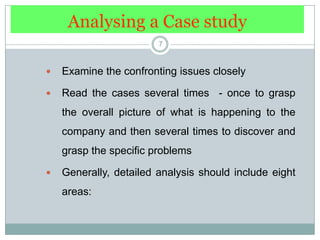
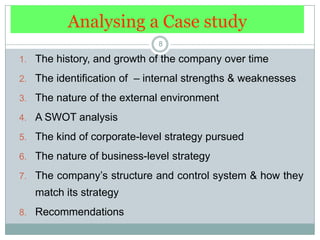
Analysing a Case study7Examine the confronting issues closelyRead the cases several times  - once to grasp the overall picture of what is happening to the company and then several times to discover and grasp the specific problemsGenerally, detailed analysis should include eight areas:
Analysing a Case study8The history, and growth of the company over timeThe identification of  – internal strengths & weaknessesThe nature of the external environmentA SWOT analysisThe kind of corporate-level strategy pursuedThe nature of business-level strategyThe company’s structure and control system & how they match its strategyRecommendations
Writing a case study analysis9Structure of report is criticalFirst part: All reports begin with an introduction to the caseOutline briefly what the company does, how it developed historically, what problems it is experiencing, and how you are going to approach the issuesDiscuss the strengths & weaknesses, identify external environment, & companies business strategy and corporate level strategies
Writing a case study analysis10Second part: Do the SWOT analysisAnalyse & discuss the nature of problems of the company’s business level and corporate level strategiesAnalyse its structure & control systemUse headings and subheadings to structure the analysisTailor the sections and subsections to the specific issues in the case
Writing a case study analysis11Third part: Present solutions & recommendationsBe comprehensive and ensure synergy with the previous analysisThe recommendations section will reveal – how much work is put into the case Do not repeat in summary large pieces of factual information from the case. Avoid being descriptive, Be analytical
Writing a case study analysis12Sections & subsections of discussion should flow logically and smoothly from one to the nextAvoid grammatical and spelling errorsIn some cases, latest information may not be available. If possible do research and provide updated informationSometimes questions are provided. Use these questions as a guide for writing a case analysis
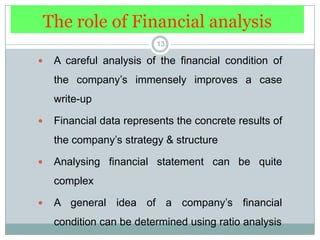
The role of Financial analysis13A careful analysis of the financial condition of the company’s immensely improves a case write-upFinancial data represents the concrete results of the company’s strategy & structureAnalysing financial statement can be quite complexA general idea of a company’s financial condition can be determined using ratio analysis
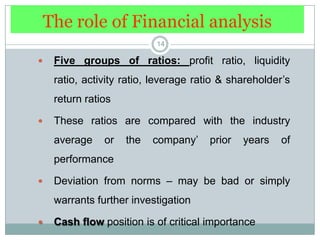
The role of Financial analysis14Five groups of ratios: profit ratio, liquidity ratio, activity ratio, leverage ratio & shareholder’s return ratiosThese ratios are compared with the industry average or the company’ prior years of performanceDeviation from norms – may be bad or simply warrants further investigationCash flow position is of critical importance

Case study

  • 1.
  • 2.
    Case study -Purpose2To provide students with experience of the management problems that actual organizations faceA case study presents an account of what happened to a business or Industry over a number of yearsIt Chronicles the events that managers had to deal with, and charts the manager’s responseManager’s responses involved changing strategy either at business level or corporate level
  • 3.
    Case study -Benefits3Case study analysis is valuable in management courses – Provide experiences of organisational problems that one probably have not the opportunity to experience firsthand. In a short period one can appreciate and analyse the problems faced by many different companies and understand how managers tried to deal with them
  • 4.
    Case study -Benefits4Cases illustrates the theory and content of management. The meaning and implications are made clearer when they are applied to case studies. The theory and concepts help reveal what is going on in the companies studied and to evaluate the solutions that specific companies adapted to deal with their problems
  • 5.
    Case study -Benefits5Case study can be used as a conceptual tool to probe what happened and what or who is responsible and to provide solutions Remember: No one knows what the right answer isAll that managers can do is to make the best guessIn uncertain time, managers can use cases to see how theory can be put into practice.
  • 6.
    Case study -Benefits6Case study provide an opportunity to participate in class and gain experience in presenting ideas to othersCase study help managers to organise views and conclusionsOthers may have different views. Be prepared to debate
  • 7.
    Analysing a Casestudy7Examine the confronting issues closelyRead the cases several times - once to grasp the overall picture of what is happening to the company and then several times to discover and grasp the specific problemsGenerally, detailed analysis should include eight areas:
  • 8.
    Analysing a Casestudy8The history, and growth of the company over timeThe identification of – internal strengths & weaknessesThe nature of the external environmentA SWOT analysisThe kind of corporate-level strategy pursuedThe nature of business-level strategyThe company’s structure and control system & how they match its strategyRecommendations
  • 9.
    Writing a casestudy analysis9Structure of report is criticalFirst part: All reports begin with an introduction to the caseOutline briefly what the company does, how it developed historically, what problems it is experiencing, and how you are going to approach the issuesDiscuss the strengths & weaknesses, identify external environment, & companies business strategy and corporate level strategies
  • 10.
    Writing a casestudy analysis10Second part: Do the SWOT analysisAnalyse & discuss the nature of problems of the company’s business level and corporate level strategiesAnalyse its structure & control systemUse headings and subheadings to structure the analysisTailor the sections and subsections to the specific issues in the case
  • 11.
    Writing a casestudy analysis11Third part: Present solutions & recommendationsBe comprehensive and ensure synergy with the previous analysisThe recommendations section will reveal – how much work is put into the case Do not repeat in summary large pieces of factual information from the case. Avoid being descriptive, Be analytical
  • 12.
    Writing a casestudy analysis12Sections & subsections of discussion should flow logically and smoothly from one to the nextAvoid grammatical and spelling errorsIn some cases, latest information may not be available. If possible do research and provide updated informationSometimes questions are provided. Use these questions as a guide for writing a case analysis
  • 13.
    The role ofFinancial analysis13A careful analysis of the financial condition of the company’s immensely improves a case write-upFinancial data represents the concrete results of the company’s strategy & structureAnalysing financial statement can be quite complexA general idea of a company’s financial condition can be determined using ratio analysis
  • 14.
    The role ofFinancial analysis14Five groups of ratios: profit ratio, liquidity ratio, activity ratio, leverage ratio & shareholder’s return ratiosThese ratios are compared with the industry average or the company’ prior years of performanceDeviation from norms – may be bad or simply warrants further investigationCash flow position is of critical importance