Serving the Community
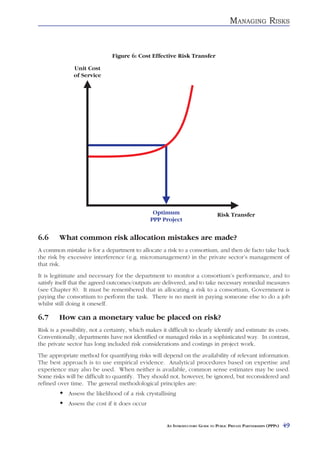
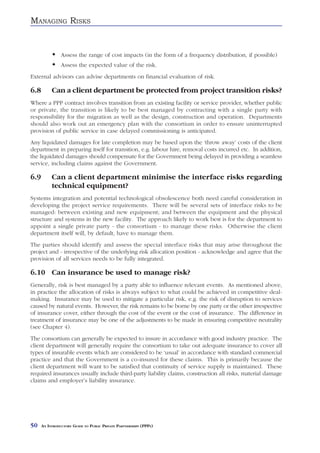
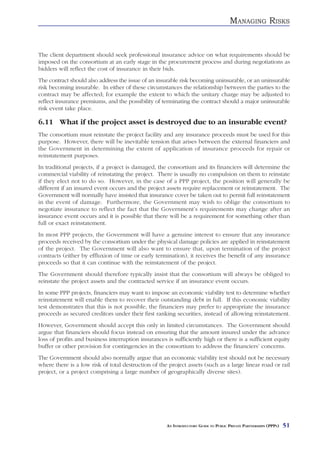
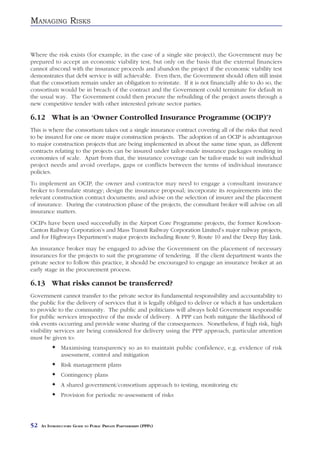
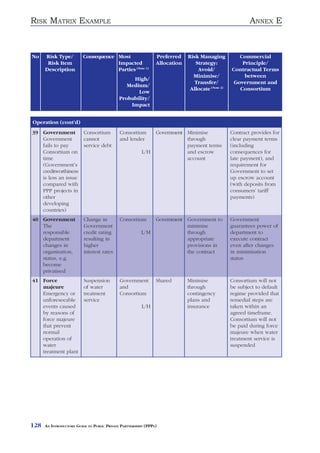
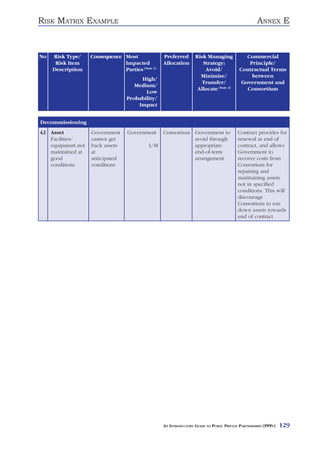
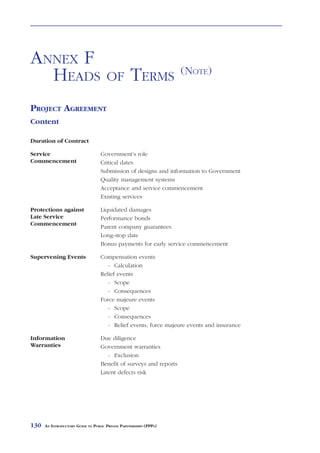
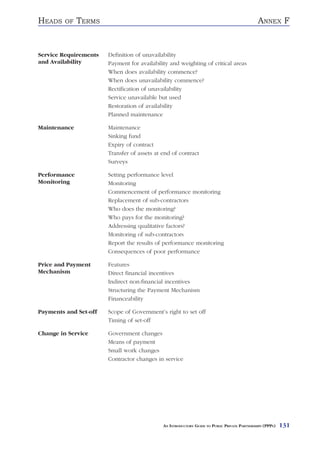
By Using the Private Sector


An Introductory Guide to
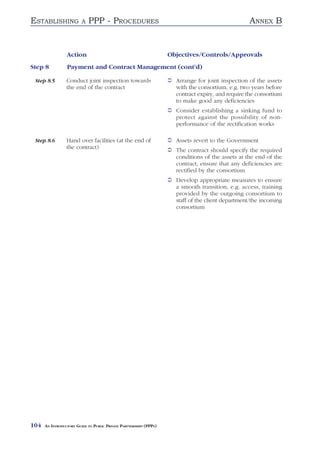
Public Private Partnerships (PPPs)
March 2008
(Second Edition)
EFFICIENCY UNIT
VISION AND MISSION


V    ision Statement
     To be the preferred consulting partner for all government bureaux and departments and to advance the
     delivery of world-class public services to the people of Hong Kong.


M      ission Statement
        To provide strategic and implementable solutions to all our clients as they seek to deliver people-based
        government services. We do this by combining our extensive understanding of policies, our specialised
        knowledge and our broad contacts and linkages throughout the Government and the private sector.
        In doing this, we join our clients in contributing to the advancement of the community while also
        providing a fulfilling career for all members of our team.


Other Efficiency Unit Documents
The Efficiency Unit (EU) has produced a number of detailed guides including on policy and practice,
outsourcing and contract management. These may be found on the EU website at www.eu.gov.hk.


Throughout this document the term department is used to describe all government agencies.


                                                          AN INTRODUCTORY GUIDE TO PUBLIC PRIVATE PARTNERSHIPS (PPPS)   1
FOREWORD

There has been a tremendous growth internationally in the use of the Public Private Partnership
(PPP) approach to deliver large scale, long term facilities and services for the community. More and
more governments, including many in Asia, have come to appreciate the improvements in service
quality and value for money that well prepared PPP projects can achieve. PPPs are now an established
part of public procurement in advanced and developing countries alike.
Naturally there have been challenges and many lessons have been learnt. This 2nd Edition of the
PPP Guide has been prepared so that we in Hong Kong learn from the lessons and experience built
up locally and overseas and ensure that our PPP projects follow up to date best practices.
It is clear that properly prepared PPPs can contribute significantly to achieving the Government’s
well-established policy of ‘small government, big market’. PPPs encourage the creation of private
sector jobs and business opportunities, whilst avoiding the unnecessary creation of civil service jobs.
The advice in this Guide has drawn heavily upon the experiences and excellent publications in
Australia, especially Victoria, and the United Kingdom. The EU also wishes to acknowledge with
gratitude the helpful suggestions and comments made by our colleagues in many departments and
bureaux. Many Hong Kong and overseas individuals in both the public and private sectors have
made valuable contributions in producing this 2nd edition. We are most grateful to them all.
The Efficiency Unit stands ready to assist departments to examine and grasp the many PPP opportunities
that are now available.


Head, Efficiency Unit


2   AN INTRODUCTORY GUIDE TO PUBLIC PRIVATE PARTNERSHIPS (PPPS)
C ONTENTS
                                                                                                        Page

Introduction                                                                                              4
1     What is a PPP and what are the Benefits?                                                            5
2     Comparing PPPs and Conventional Procurement                                                       19
3     Establishing a PPP Project                                                                        24
4     Making the Business Case                                                                          31
5     Getting the Right Deal with the Right Private Partner                                             36
6     Managing Risks                                                                                    46
7     Funding and Payment                                                                               54
8     Managing Performance                                                                              61
9     Changes of Circumstance                                                                           68
10    Staffing Issues                                                                                   72
11    Legal Rights and Powers                                                                           74
12    Land Issues                                                                                       80
13    Probity and Corruption                                                                            85
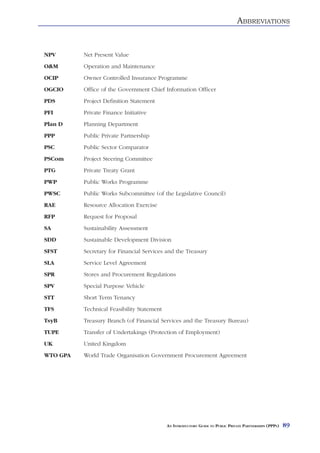
Abbreviations                                                                                           88
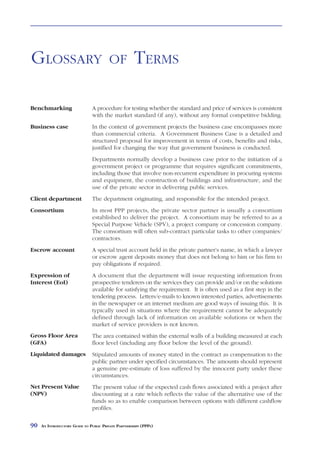
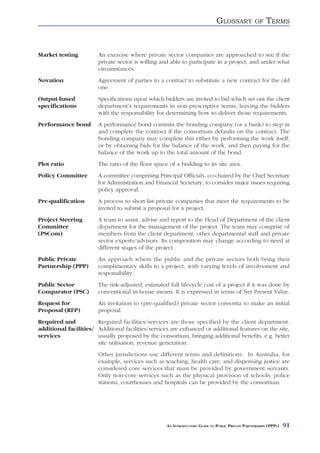
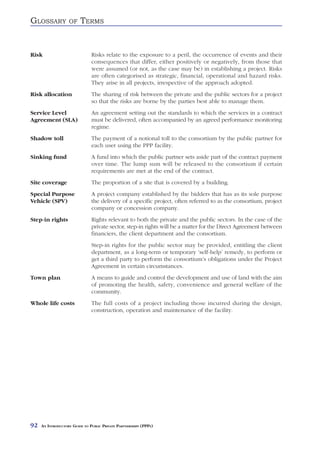
Glossary of Terms                                                                                       90
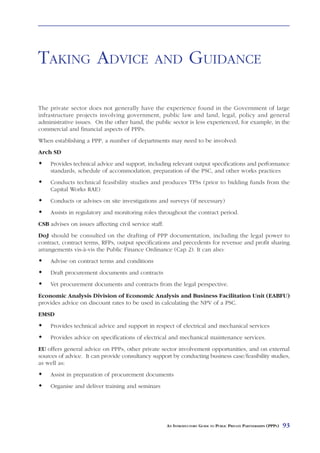
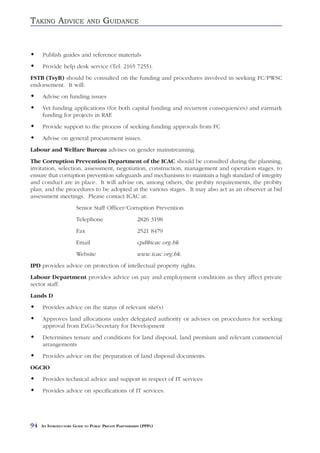
Taking Advice and Guidance                                                                              93
Annex A: Indicative Timeline                                                                            96
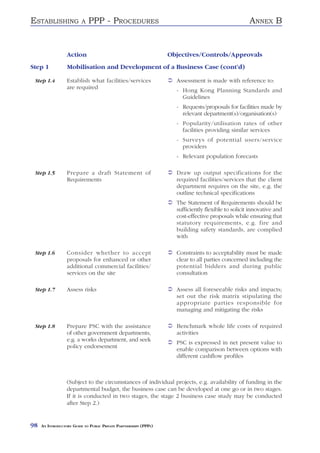
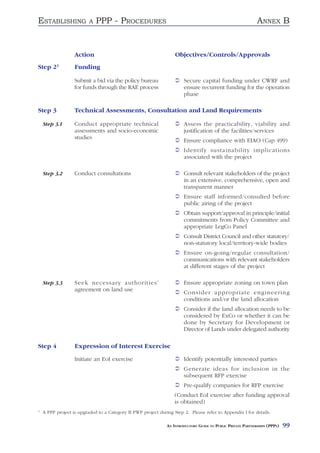
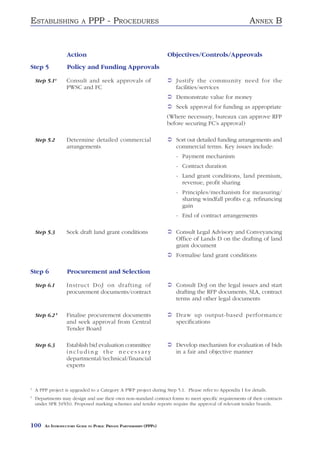
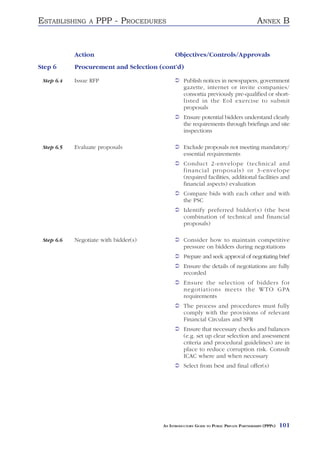
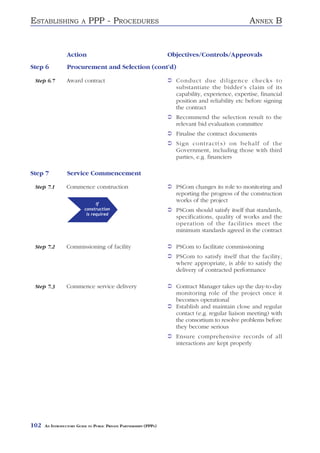
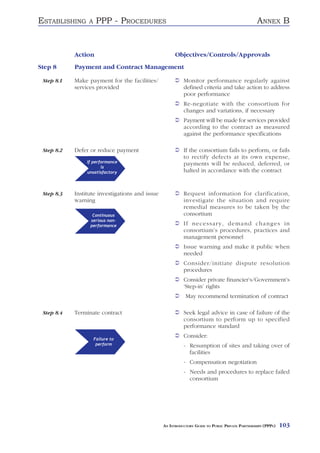
Annex B: Establishing a PPP - Procedures                                                                97
         Appendix I: Funding Procedures for PPP Projects                                               105
Annex C: Establishing a PPP - Flowchart                                                                107
Annex D: Constructing a Public Sector Comparator                                                       110
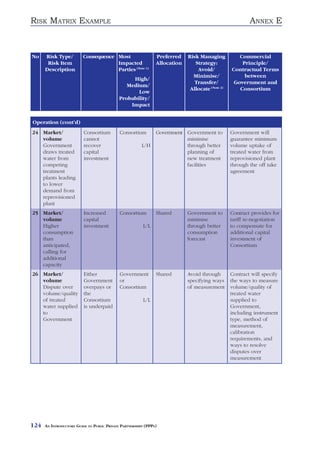
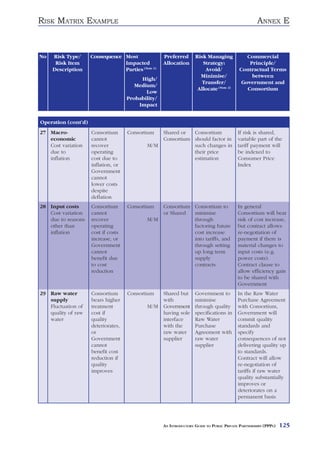
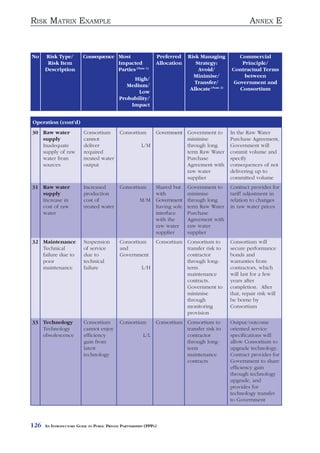
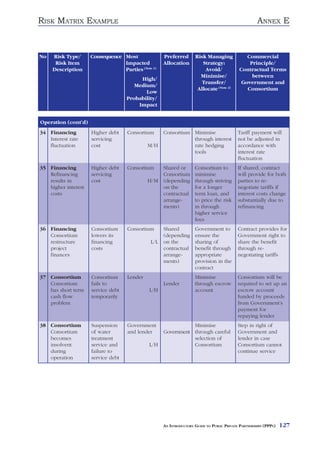
Annex E: Risk Matrix Example                                                                           116
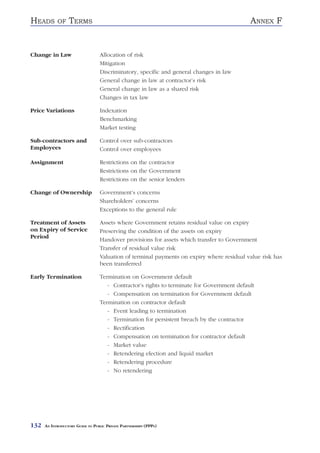
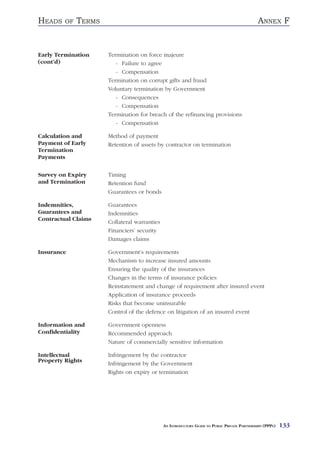
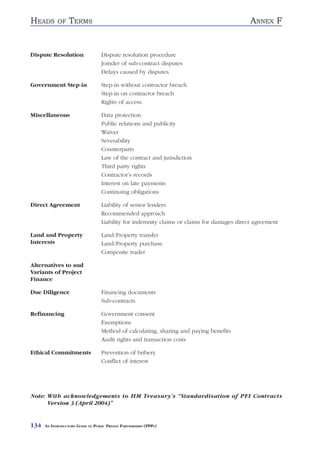
Annex F: Heads of Terms                                                                                130
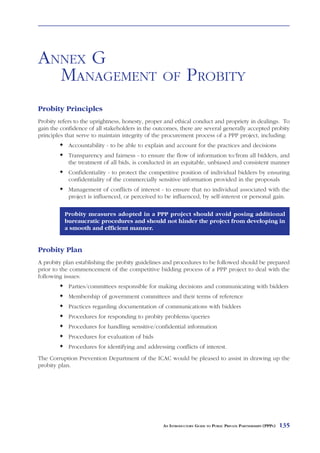
Annex G: Management of Probity                                                                         135


                                                 AN INTRODUCTORY GUIDE TO PUBLIC PRIVATE PARTNERSHIPS (PPPS)   3
INTRODUCTION

This PPP Guide is intended to help Hong Kong civil servants to develop innovative and practical
ways to use PPPs to deliver public services.
Other guides published by the Efficiency Unit (EU) may be viewed at the EU website at
www.eu.gov.hk.
The Guide focuses principally on PPPs that involve the use of private financing of the facilities
required to deliver a facility or services; this may be associated with the granting of a
franchise or concession to deliver some or all of those services. It is acknowledged that
many PPPs in Hong Kong will use mainly public funding, and users of the Guide should
interpret the Guide appropriately when government funded models are being considered.
The Guide introduces the use of the PPP approach to procurement in Hong Kong by posing and
answering a number of questions. It has been developed mainly for use by the civil service but is
made available to the private sector to enhance its understanding of the Government’s approach.
Users of the Guide should recognise that it is not definitive and many departments should be
consulted in individual cases (see “Taking Advice and Guidance”).
PPPs are used in many jurisdictions. Definitions, legal requirements and procedures, practices,
terminology and acronyms etc. naturally do vary. This Guide draws on the relevant experience
elsewhere that is considered most appropriate to Hong Kong’s circumstances. We have used
terminology etc. most familiar to Hong Kong. Some of the other terminology used overseas is cited
in the Glossary of Terms.
The EU welcomes comments and feedback from users of this Guide.


4   AN INTRODUCTORY GUIDE TO PUBLIC PRIVATE PARTNERSHIPS (PPPS)
1 WHAT IS A PPP                                        AND WHAT ARE
  THE BENEFITS?

1.1     What is a Public Private Partnership (PPP)?
A PPP is a contractual arrangement involving the private sector in the delivery of public services. As
the name suggests, this is based on a partnership approach, where the responsibility for the delivery
of services is shared between the public and private sectors, both of which bring their complementary
skills to the enterprise.
PPPs bring together the public and private sectors in a long-term contractual relationship to deliver
high quality public services. The private sector becomes a long-term service provider rather than a
simple upfront asset builder. Departments are more involved as regulators and procurers of services
rather than direct providers of services to the public.
PPPs differ from other forms of private sector involvement such as: outsourcing, where the public
sector directly procures services through shorter-term contracts; privatisation where a government
owned entity or asset is transferred to the private sector in perpetuity and the government’s role if
any is reduced to that of regulator; and private sector provision where the government has no
involvement in the provision of a service as the demand is being adequately served by the market.
PPPs may be developed with a number of objectives in mind:
            Enhancing significantly the availability of improved public services by contributing to
            increases in the quality and quantity of investment in facilities and services
            Realising the full potential of public sector assets to provide greater value for money for
            the taxpayer and the wider community
            Removing inefficiencies and developing imaginative approaches to the delivery of public
            services
            Investing in high quality facilities that minimise long term maintenance and operating
            costs
            Managing and minimising the cost to government of risks associated with long term,
            complex projects
            Allowing stakeholders such as users, taxpayers, and employees to receive a fair share of
            the benefits of a PPP.
PPPs should not be used as a means to overcome budgetary constraints or bypass the proper fund
bidding procedures, or else this will effectively be a hypothecation of revenue. Client departments
should always have overriding policy justification for pursuing a project, whether by means of PPP
or other approaches.

1.2     How do other governments view PPPs as part of their procurement
        strategies?
Many overseas administrations currently include PPPs within their procurement strategies, for example:


                                                     AN INTRODUCTORY GUIDE TO PUBLIC PRIVATE PARTNERSHIPS (PPPS)   5
WHAT        IS A     PPP      AND WHAT ARE THE                    BENEFITS?


                Partnerships Victoria policy says “where public infrastructure and ancillary services are
                required, the government will make no assumption that either the public or the private
                sector is the best provider. Consideration will be given to the whole of life costing of the
                infrastructure and the benefits of risk transferral in each case. If it is clear that the private
                sector can deliver the service more cost effectively than government, it will be invited to
                do so, subject to the arrangement passing a public interest test”
                The United Kingdom (UK) Government states that it “is committed to securing, over the
                long term, the most cost effective infrastructure for the public services. To achieve this,
                it seeks to ensure that investment uses the appropriate procurement option which can
                offer the best value for money, and that there is no inherent bias between procurement
                options. Consequently, its approach is based on an objective assessment of where it can
                offer value for money, where it can meet the government’s requirements of efficiency,
                equity and accountability, and where the value for money it offers is not at the cost of
                the terms and conditions of staff”.
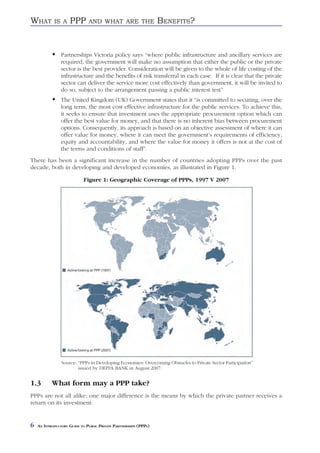
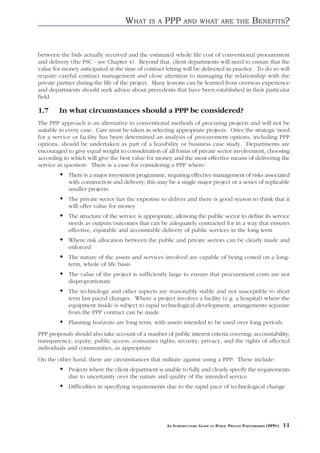
There has been a significant increase in the number of countries adopting PPPs over the past
decade, both in developing and developed economies, as illustrated in Figure 1.

                            Figure 1: Geographic Coverage of PPPs, 1997 V 2007


                Source: “PPPs in Developing Economies: Overcoming Obstacles to Private Sector Participation”
                        issued by DEPFA BANK in August 2007.


1.3        What form may a PPP take?
PPPs are not all alike; one major difference is the means by which the private partner receives a
return on its investment:


6   AN INTRODUCTORY GUIDE TO PUBLIC PRIVATE PARTNERSHIPS (PPPS)
WHAT        IS A    PPP       AND WHAT ARE THE                    BENEFITS?


                 Financially free-standing projects where the services are provided for the use of the
                 public which pays the private partner direct. These are often economic infrastructure
                 projects, such as toll-charging road bridges and tunnels
                 Projects that provide services to the public at less than cost and the payments to the
                 private partner involve a mix of public subsidy from the government and end-user
                 charges imposed on consumers of the services. Examples of such services are sports
                 centres, where the consumer pays a subsidised fee for the use or hire of facilities and
                 equipment
                 Services that are provided direct to the government, which pays the private partner for
                 those services. These are often social infrastructure projects, overseas examples of
                 which include prisons, government office accommodation, and hospitals.
A PPP may take one of several forms including:
                 Private Finance Initiatives (PFI)
                 Franchises and concessions
                 Joint ventures and wider market initiatives
                 Partnership companies and investments.
Please refer to the “Serving the Community By Using the Private Sector - Policy and Practice”
(Second Edition) published by the EU in January 2007 for elaboration on these forms.
It is important to remember that the detailed arrangements for PPPs can and should be crafted
individually to suit the particular circumstances that are encountered in each instance. For example,
if a new prison is required, the client department would need to consider carefully whether the
private partner should be invited to provide all services - including custodial duties - or be limited to
non-custodial tasks.

1.4         What forms of PPP are suitable for Hong Kong?
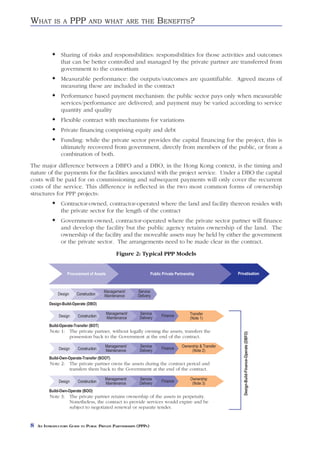
There are a number of common contractual structures that are considered to be PPPs (see Figure 2).
These are often known by acronyms such as: DBO1 (Design-Build-Operate); BOOT (Build-Own-
Operate-Transfer), BOT (Build-Operate-Transfer) and BOO (Build-Own-Operate) - these are all
forms of DBFO (Design-Build-Finance-Operate). PPPs in Hong Kong are most likely to adopt the
DBFO model or the DBO model. Under DBFO, there is a concession agreement where the public
sector specifies the outputs it requires from the PPP facility, the basis for payment for those outputs,
and the risk-sharing arrangements. The private sector is involved in designing, building, providing
core and/or ancillary operations services, maintaining, financing and sometimes owning the PPP
facilities. A DBFO scheme usually has the following characteristics:
                 Long term contracts: typically 10 - 30 years; the contract length will often be for a
                 number of years related to but usually a little shorter than the expected initial life of the
                 facility or the main assets
                 Outcome/output specifications: public service requirements would normally be framed
                 as output specifications, instead of prescriptive input specifications and design
                 A private sector legal entity, a consortium formed by multiple companies, also known as
                 a Special Purpose Vehicle (SPV), a Project Company or a Concession Company

1
    A DBO contract usually involves a much shorter period of private financing, with government paying the contractor for the cost of
    designing and constructing facilities upon the commissioning of the facilities constructed. Government retains more risk under a
    DBO than a DBFO contract.


                                                                      AN INTRODUCTORY GUIDE TO PUBLIC PRIVATE PARTNERSHIPS (PPPS)   7
WHAT        IS A        PPP     AND WHAT ARE THE                      BENEFITS?


                Sharing of risks and responsibilities: responsibilities for those activities and outcomes
                that can be better controlled and managed by the private partner are transferred from
                government to the consortium
                Measurable performance: the outputs/outcomes are quantifiable. Agreed means of
                measuring these are included in the contract
                Performance based payment mechanism: the public sector pays only when measurable
                services/performance are delivered; and payment may be varied according to service
                quantity and quality
                Flexible contract with mechanisms for variations
                Private financing comprising equity and debt
                Funding: while the private sector provides the capital financing for the project, this is
                ultimately recovered from government, directly from members of the public, or from a
                combination of both.
The major difference between a DBFO and a DBO, in the Hong Kong context, is the timing and
nature of the payments for the facilities associated with the project service. Under a DBO the capital
costs will be paid for on commissioning and subsequent payments will only cover the recurrent
costs of the service. This difference is reflected in the two most common forms of ownership
structures for PPP projects:
                Contractor-owned, contractor-operated where the land and facility thereon resides with
                the private sector for the length of the contract
                Government-owned, contractor-operated where the private sector partner will finance
                and develop the facility but the public agency retains ownership of the land. The
                ownership of the facility and the moveable assets may be held by either the government
                or the private sector. The arrangements need to be made clear in the contract.

                                                 Figure 2: Typical PPP Models


                    Procurement of Assets                         Public Private Partnership               Privatisation


                                         Management/      Service
              Design     Construction    Maintenance      Delivery
          Design-Build-Operate (DBO)

                                            Management/    Service      Finance          Transfer
               Design     Construction      Maintenance    Delivery                      (Note 1)
          Build-Operate-Transfer (BOT)
          Note 1: The private partner, without legally owning the assets, transfers the
                                                                                                              Design-Build-Finance-Operate (DBFO)


                  possession back to the Government at the end of the contract.
                                         Management/       Service      Finance     Ownership & Transfer
               Design     Construction   Maintenance       Delivery                      (Note 2)
          Build-Own-Operate-Transfer (BOOT)
          Note 2: The private partner owns the assets during the contract period and
                  transfers them back to the Government at the end of the contract.

                                         Management/       Service                       Ownership
               Design     Construction   Maintenance       Delivery     Finance           (Note 3)
          Build-Own-Operate (BOO)
          Note 3: The private partner retains ownership of the assets in perpetuity.
                  Nonetheless, the contract to provide services would expire and be
                  subject to negotiated renewal or separate tender.


8   AN INTRODUCTORY GUIDE TO PUBLIC PRIVATE PARTNERSHIPS (PPPS)
WHAT      IS A   PPP     AND WHAT ARE THE                    BENEFITS?


1.5     What are the benefits of a PPP?
The introduction of private sector management is an effective way of bringing commercial disciplines
into the provision of public services. Even where the government wishes public services to be
delivered below cost, this can be achieved through using the private sector to deliver, with the
government continuing to provide a subsidy. The efficiencies that will be delivered by using a PPP
contract is likely, however, to reduce the level of subsidy required.
The private sector’s usual incentives, coupled with the competitive pressures of the marketplace,
can lead to better quality services delivered earlier and for lower cost than under traditional means
of public sector procurement. The bottom line incentives that motivate the private sector are a more
powerful management tool than public sector controls, irrespective of how hard the public sector
tries to replicate those same incentives in its own approach.
Despite its dedication, experience and skills, the public sector is, in many circumstances, unlikely to
match the innovation, creativity and efficiency of the private sector. This is often because the public
sector faces constraints such as budgetary and borrowing restrictions. In some circumstances, PPPs
may be attractive to governments because they can provide private funds in place of public sector
capital to develop facilities and/or services. However, the principal reason that governments have
pursued PPPs has been to achieve value for money. The specific benefits will depend on the specific
project. Generally, benefits that may be achieved include:

For the Public Sector:
            Lifecycle cost management: as the consortium has complete responsibility for the
            design, build, maintenance, and operation of a service, it is best placed to optimise the
            design for economy in construction, operations and maintenance. This optimisation is
            less likely to be achieved using conventional procurement approaches where design,
            construction, maintenance and operations are undertaken by different entities. Under a
            PPP, greater attention to design and quality building materials is likely to lead to higher
            construction costs (and reduced recurrent costs/improved operational efficiencies)
            Construction management: as the consortium is not being paid specifically for the
            construction but for the delivery of a service it is fully incentivised to achieve accelerated
            completion of capital works projects; and substantial improvement in the quality and
            durability of construction, reducing the risk of cost overruns
            Innovative solutions: by not specifying how a service should be delivered or how an
            asset has to be designed and built, but by simply spelling out the services it needs and
            the outputs/outcomes desired, government can engage the private sectorís capacity to
            innovate and deliver improved value for money
            Sharing government assets/facilities with third-party users: sharing government
            facilities with other users can contain costs for government and provide public services
            more economically. Many government facilities/assets are capable of being shared with
            other users: for example, space in government buildings and government owned
            intellectual property such as educational material. A consortium with expertise in managing
            such assets will be able to optimise the use of and return on such assets
            Sharing responsibilities with the private sector: government’s core competency
            should be identifying public needs and crafting public policies and objectives and,
            therefore, defining the service requirements and desired outcomes. The private sector is
            often better equipped to actually provide services - ranging from managing construction
            and maintenance of assets, to day-to-day operations


                                                       AN INTRODUCTORY GUIDE TO PUBLIC PRIVATE PARTNERSHIPS (PPPS)   9
WHAT        IS A     PPP       AND WHAT ARE THE                     BENEFITS?


                Saving resources: assuming that savings are achieved, in comparison with the Public
                Sector Comparator (PSC), there should be a freeing of resources for other public services.

For the Private Sector:
                Business opportunities: being engaged to deliver a full suite of services e.g. design,
                construction, operations and maintenance, some of which were traditionally performed
                in-house by public agencies or performed by multiple private companies
                Export opportunities: the experience of and base provided by a continuing stream of
                PPP work in Hong Kong will increase the competitiveness of Hong Kong based service
                providers when bidding for work in the region and farther afield.

For the Wider Community:
                Bond markets: the third party financing commonly associated with PPPs provides an
                opportunity to further strengthen Hong Kongís growing bond market
                Regulation of service provision: as the procurer, rather than the deliverer of the
                service, the government can monitor and regulate the quality of delivery and the
                compliance with staff, health-related, environmental, financial/tariff, legal and commercial
                issues with less likelihood of conflict of interest, real or perceived
                Job creation: the opportunity to develop and expand businesses, outside the constraints
                of the civil service, will encourage employment opportunities
                Small government: transferring the responsibility for delivery of some public services
                to the private sector can help constrain the size of the civil service to that required to
                develop policy and to deliver those services which it is considered only the public
                sector should provide.

1.6        How accurate are claims that PPPs provide good value for money?
As with all forms of procurement there are examples of good and bad performance by contractors
and examples of well and poorly structured contracts. Nonetheless, there is a substantial and growing
pool of data - mainly derived from reviews carried out by independent third parties, including
government auditors - which leads to the conclusion that better value for money (see Question 4.3)
is being achieved by using PPPs through optimal risk allocation and other efficiency measures. One
review of a range of sectors in the UK found that on average cost savings of 17% were achieved
compared to the public sector alternatives; another, in the Institute of Public Policy Review report
‘Building Better Partnerships’ published in 2002, indicated lower savings in the range of just 2% to
3%. Nonetheless, this and other studies concluded that value for money was being realised in a
variety of ways. For instance, the Institute of Public Policy Review report concluded that high
quality facilities were being delivered on time and on budget; innovation in design was apparent;
working environments had improved; and risk transfer to the private sector had been real. A UK
National Audit Office study showed that almost three times as many projects were delivered within
time and budget when using PPPs than when using conventional procurement.
According to the Report on Operational PFI Projects by Partnerships UK in March 2006, 66% of
public sector respondents rate the performance of their service provider as either “Very Good” or
“Good” and 30% rate performance as “Satisfactory”, with less than 4% rating performance as “Poor”
or “Very Poor”. Over 97% of public sector contract managers rate their relationships with the service
provider as either “Very good”, “Good” or “Satisfactory”, and none rate their relationship as “Very
Poor”. For Hong Kong departments, the initial value for money test will be a risk adjusted comparison


10    AN INTRODUCTORY GUIDE TO PUBLIC PRIVATE PARTNERSHIPS (PPPS)
WHAT     IS A   PPP      AND WHAT ARE THE                    BENEFITS?


between the bids actually received and the estimated whole life cost of conventional procurement
and delivery (the PSC - see Chapter 4). Beyond that, client departments will need to ensure that the
value for money anticipated at the time of contract letting will be delivered in practice. To do so will
require careful contract management and close attention to managing the relationship with the
private partner during the life of the project. Many lessons can be learned from overseas experience
and departments should seek advice about precedents that have been established in their particular
field.

1.7     In what circumstances should a PPP be considered?
The PPP approach is an alternative to conventional methods of procuring projects and will not be
suitable in every case. Care must be taken in selecting appropriate projects. Once the strategic need
for a service or facility has been determined an analysis of procurement options, including PPP
options, should be undertaken as part of a feasibility or business case study. Departments are
encouraged to give equal weight to consideration of all forms of private sector involvement, choosing
according to which will give the best value for money and the most effective means of delivering the
service in question. There is a case for considering a PPP where:
            There is a major investment programme, requiring effective management of risks associated
            with construction and delivery; this may be a single major project or a series of replicable
            smaller projects
            The private sector has the expertise to deliver and there is good reason to think that it
            will offer value for money
            The structure of the service is appropriate, allowing the public sector to define its service
            needs as outputs/outcomes that can be adequately contracted for in a way that ensures
            effective, equitable and accountable delivery of public services in the long term
            Where risk allocation between the public and private sectors can be clearly made and
            enforced
            The nature of the assets and services involved are capable of being costed on a long-
            term, whole of life basis
            The value of the project is sufficiently large to ensure that procurement costs are not
            disproportionate
            The technology and other aspects are reasonably stable and not susceptible to short
            term fast paced changes. Where a project involves a facility (e.g. a hospital) where the
            equipment inside is subject to rapid technological development, arrangements separate
            from the PPP contract can be made
            Planning horizons are long term, with assets intended to be used over long periods.
PPP proposals should also take account of a number of public interest criteria covering: accountability;
transparency; equity; public access; consumer rights; security; privacy, and the rights of affected
individuals and communities, as appropriate.
On the other hand, there are circumstances that militate against using a PPP. These include:
            Projects where the client department is unable to fully and clearly specify the requirements
            due to uncertainty over the nature and quality of the intended service
            Difficulties in specifying requirements due to the rapid pace of technological change


                                                     AN INTRODUCTORY GUIDE TO PUBLIC PRIVATE PARTNERSHIPS (PPPS)   11
WHAT         IS A      PPP     AND WHAT ARE THE                     BENEFITS?


                 Difficulties in substituting suppliers due to the need to integrate proprietary technologies
                 Lack of third party finance leading to the excessive reliance on corporate borrowing by
                 the private partner and an absence of arms length due diligence
                 Costs of delivering the projects being overly dominated by the annual running costs
                 associated with delivering the service requirement, rather than being balanced by the
                 up-front costs of investment in the project assets.
These circumstances have often appeared in Information Technology (IT) PPP projects, and less
often in other PPP projects, with the result that the hoped for benefits have not always been achieved.
In some jurisdictions, governments have stopped using PPPs for information and communications
technology projects; in others they limit them to shorter contracts e.g. five to eight years.

1.8         What types of project have been completed using the PPP
            approach?
Hong Kong has a long history of attracting private sector investment and operating skills to deliver
public services, most notably major infrastructure facilities such as the cross-harbour and other
tunnels developed using the BOT approach. A number of projects are at different stages of
development, or have, for example, had feasibility studies conducted on them.
Overseas, there are many successful examples, covering a wide range of economic and social
infrastructure facilities built, and public services delivered, using PPP approaches. Examples from a
number of overseas jurisdictions include:

     Airports, airport management, and flight control                 Railways/light rail/trams
     Arts and culture facilities                                      Renewable energy
     Court buildings and facilities, and information                  Residential accommodation for students,
     systems                                                          nurses, doctors, military personnel, etc
     Defence equipment, maintenance, training, and                    Scientific, and research and development
     procurement support                                              facilities
     Education (schools, police/military colleges, universities)      Solid waste management facilities, refuse
                                                                      transfer, recycling, incineration, landfills
     Fleet management services (land, sea and air, civilian and
     defence)                                                         Roads/bridges/tunnels (with and without tolls)
     Hospitals, clinics, medical equipment                            Sports stadiums, leisure and recreation centres
     Information and communications technology services               Street lighting
     Office new provisioning, in situ reprovisioning, and             Support services, such as laundry and food,
     relocation                                                       for hospitals/prisons/elderly homes
     Police, fire and ambulance stations                              Training-fire services, flying, etc
     Port facilities                                                  Urban regeneration
     Prisons and prisoner escort                                      Water and waste water treatment plants


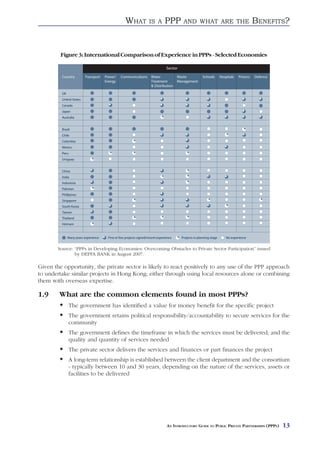
Figure 3 is an international comparison of the PPP experience of selected economies.


12    AN INTRODUCTORY GUIDE TO PUBLIC PRIVATE PARTNERSHIPS (PPPS)
WHAT       IS A   PPP      AND WHAT ARE THE                    BENEFITS?


         Figure 3: International Comparison of Experience in PPPs - Selected Economies


        Source: “PPPs in Developing Economies: Overcoming Obstacles to Private Sector Participation” issued
                by DEPFA BANK in August 2007.

Given the opportunity, the private sector is likely to react positively to any use of the PPP approach
to undertake similar projects in Hong Kong; either through using local resources alone or combining
them with overseas expertise.

1.9     What are the common elements found in most PPPs?
            The government has identified a value for money benefit for the specific project
            The government retains political responsibility/accountability to secure services for the
            community
            The government defines the timeframe in which the services must be delivered; and the
            quality and quantity of services needed
            The private sector delivers the services and finances or part finances the project
            A long-term relationship is established between the client department and the consortium
            - typically between 10 and 30 years, depending on the nature of the services, assets or
            facilities to be delivered


                                                          AN INTRODUCTORY GUIDE TO PUBLIC PRIVATE PARTNERSHIPS (PPPS)   13
WHAT       IS A     PPP       AND WHAT ARE THE                     BENEFITS?


               The different functions of design, construction, maintenance and operation are integrated
               to release the synergies between them and discourage low-capital/high-operating
               expenditure solutions
               Risks are allocated and shared between the public and private sectors
               There is an emphasis on output and outcome-based specifications
               A whole life approach to cost is taken.

1.10 What is the government’s fundamental role in PPPs?
               Set policy, identify opportunities, and define objectives
               Ensure transparency and probity in the procurement process
               Identify and propose the allocation of risks
               Identify needs in terms of output/outcome specifications that encourage flexibility and
               innovation in the manner of performance
               Set and ensure the achievement of standards for health, safety, and the environment
               Establish, monitor and enforce the levels of service
               Ensure value for money is achieved
               Determine and manage reward mechanisms and tariff structures
               Provide a clear regulatory framework and perform regulatory functions
               Safeguard the interests of customers and the general public
               In some PPP projects government will still provide the front line staff.
To ensure the successful establishment and implementation of a programme of PPP projects, the
government needs to foster the development of the private sector market by ensuring an adequate
flow of projects and good and certain procedures for requesting and accepting proposals.

1.11 What is the private sector’s fundamental role in PPPs?
The private sector’s role is to provide commercially effective solutions to assist government to
achieve its outcomes by achieving defined levels of performance in service delivery; and providing:
               Expertise and innovation
               Access to private financing, as appropriate
               A sufficient return to investors and other stakeholders.
The private sector will normally establish a consortium to provide the facility and deliver the service.
The consortium may be able to design, build and operate the facility and provide any ancillary
services. Alternatively, it may contract with appropriate third parties to deliver the relevant services.

1.12 How is a PPP project structured?
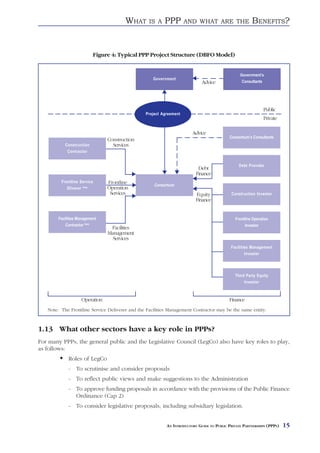
A typical structure for a PPP project under the DBFO model is shown in Figure 4:


14   AN INTRODUCTORY GUIDE TO PUBLIC PRIVATE PARTNERSHIPS (PPPS)
WHAT      IS A   PPP        AND WHAT ARE THE                   BENEFITS?


                           Figure 4: Typical PPP Project Structure (DBFO Model)


                                                                                                Government’s
                                                    Government
                                                                            Advice               Consultants


                                                                                                              Public
                                                Project Agreement
                                                                                                              Private

                                                                       Advice
                                                                                           Consortium’s Consultants
                                Construction
           Construction           Services
            Contractor


                                                                                                Debt Provider
                                                                          Debt
                                                                         Finance
         Frontline Service      Frontline           Consortium
            Dliverer Note       Operation
                                 Services                                Equity             Construction Investor
                                                                         Finance


        Facilities Management                                                                 Frontline Operation
            Contractor Note                                                                         Investor
                                 Facilities
                                Management
                                  Services
                                                                                           Facilities Management
                                                                                                   Investor


                                                                                              Third Party Equity
                                                                                                   Investor


                    Operation                                                             Finance
   Note: The Frontline Service Deliverer and the Facilities Management Contractor may be the same entity.


1.13 What other sectors have a key role in PPPs?
For many PPPs, the general public and the Legislative Council (LegCo) also have key roles to play,
as follows:
             Roles of LegCo
             - To scrutinise and consider proposals
             - To reflect public views and make suggestions to the Administration
             - To approve funding proposals in accordance with the provisions of the Public Finance
               Ordinance (Cap 2)
             - To consider legislative proposals, including subsidiary legislation.


                                                          AN INTRODUCTORY GUIDE TO PUBLIC PRIVATE PARTNERSHIPS (PPPS)   15
WHAT       IS A     PPP       AND WHAT ARE THE                     BENEFITS?


               Role of the general public
               - To express their views and suggestions to the Administration on proposals. This may
                 include, for example, issues concerning location or nature of facilities, the quality
                 and quantity of services, environmental concerns, and fees and charges.

1.14 Is PPP just another name for privatisation?
No. Privatisation means the transfer of an existing government entity or asset to the private sector in
perpetuity, through an asset sale, a share sale or a management buy-out. After privatisation,
government’s involvement is limited to a regulatory role, if required. With a PPP, government
retains ultimate responsibility for the delivery of services throughout the contract.
Although some PPPs may involve existing government assets being transferred to the private partner,
in Hong Kong this will normally only be for the duration of the contract, not in perpetuity. Moreover,
after the expiry of the contract term the service obligation will revert to government.
On occasion, as with a privatisation, a PPP may also involve the opportunity for civil servants to
transfer, permanently or temporarily, to the private sector; however, such a transfer would not be
mandatory.

1.15 Why use a PPP instead of a trading fund or corporatisation
     approach?
Under the Trading Funds Ordinance (Cap 430) the LegCo may by resolution establish a trading fund
to manage and account for the operation of a government service provided to the Government,
public bodies or persons other than the Government. A trading fund is expected to cover its
expenditure by its revenue. LegCo prescribes the services to be provided by the trading fund. A
trading fund is thus an accounting arrangement that frees a department (or part of it) from the
normal appropriation procedures. A trading fund otherwise remains very much as part of the civil
service, with the constraints on exploiting commercial strengths that go with it.
A corporation is established by law to carry out specified activities in accordance with established
commercial principles. Whilst the government is the whole or main shareholder the corporation is
not part of the civil service. The corporation is generally free to manage staff and other resources in
accordance with private sector principles, to explore and exploit new commercial opportunities,
and to adjust fees and charges in response to market conditions.
Departments may use a PPP approach rather than a trading fund or corporation for a variety of
reasons, including:
               The time required for the drafting and enactment of legislation
               The ready availability of capable service providers in the private sector
               The services required will not generate sufficient revenue to be commercially viable,
               and thus require a public subsidy
               Insufficient staff/skills to provide the service in-house.

1.16 Can a PPP project be let by way of a land lease?
Some PPP projects are let by way of land lease. However, in Hong Kong, the land lease tends only
to commit the selected consortium to its proposal for the “hardware” (e.g. the concept plans). There
is usually nothing in the lease conditions committing the consortium to honouring its proposed


16   AN INTRODUCTORY GUIDE TO PUBLIC PRIVATE PARTNERSHIPS (PPPS)
WHAT     IS A   PPP      AND WHAT ARE THE                    BENEFITS?


plans on the management and operation of the facilities after completion of the “hardware”, although
these plans formed part of the technical proposal in the tender assessment. Monitoring of the
project implementation through enforcement of lease conditions may be inefficient and unsatisfactory
for these projects.
If a PPP project is to be let by way of a land lease, government should attach to the land lease or
include separately a management or service agreement. This is to ensure that the consortium is
contractually committed to deliver its technical proposal, basing on which the project was awarded,
for the future management and operation of the facilities to be developed. There should also be
effective means to ensure compliance. An integrated and efficient mechanism, e.g. a multi-departmental
Project Steering Committee (PSCom), should be set up to monitor the implementation of the project
after it is let to ensure that the consortium makes good its proposal to meet the project objectives.
If the consortium proposes modifications to the approved plans after the award of a project, government
should adopt a coordinated and objective approach to conduct an overall assessment/evaluation of
the merits of such modifications. Departments concerned should make reference to the consortium’s
original proposal to ensure that the proposed modifications are no less favourable to the government.
Where justified, government should impose additional premiums as for lease modifications.

1.17 Will PPPs restrict the opportunities for local service providers?
Local players with local knowledge, and the necessary experience and expertise, would be well
placed to participate in bidding consortia, or act as sub-contractor(s). Care should be taken that this
takes account of local availability, reliability, quality and pricing, and does not result in service
solutions that reduce the value for money to the government, and World Trade Organisation
Government Procurement Agreement (WTO GPA) provisions are not breached (See Chapter 5).
Many PPP projects will require skills and resources not available within a single company. Much
will depend on the details of each individual project. Thus bidders are likely to be consortia. While
small and medium enterprises are unlikely to feature as consortium members in larger projects, they
will have opportunities to participate at the sub-contractor level. This is little different from the
picture under conventional procurement where major construction companies would be likely to
take the leading contractual roles.

1.18 Who ultimately will be accountable for the success of the project/
     service?
There are different levels of accountability in PPP projects, as there are in other procurement methods.
The client department is responsible for establishing the levels of service required, mainly by means
of output/outcome specifications; for conducting a fair and transparent contracting exercise; and
monitoring the performance of the selected private partner and ensuring value for money is achieved.
The private partner is accountable to the client department for performing up to the standards
specified in the contract. Ultimately, the project involves the delivery of public services and the
government remains accountable to the public.

1.19 Are there good practices and lessons learnt from previous PPP
     projects?
The EU has identified the following good practices and lessons learnt from local PPP experiences:


                                                     AN INTRODUCTORY GUIDE TO PUBLIC PRIVATE PARTNERSHIPS (PPPS)   17
WHAT       IS A     PPP       AND WHAT ARE THE                     BENEFITS?


Success Factors:
               High level support
               - Obtain top level support/commitment at an early stage
               Project champion
               - Assign a project leader at sufficiently high level (preferably at directorate level) to
                 lead the project
               Maintain momentum
               - Set a realistic project plan with appropriate milestones for different stages of the
                 project development process
               - Adhere to the project plan (which will help maintain the enthusiasm and confidence
                 of both the management and staff)
               Market testing
               - Conduct a market testing exercise to assess private market interest and capability as
                 well as to solicit market feedback
               Stakeholder consultation
               - Consider staffing issues at an early stage
               - Inform staff early and regularly of developments
               - Provide opportunity for staff to contribute to the development of PPP proposals
               - Conduct public consultation at the earliest possible stage and maintain on-going
                 dialogue throughout the preparatory and implementation phases
               - Involve all interested parties in the consultation exercise.

Obstacles:
               Problems with land use amendments
               - Consider shifting to the PPP partner the responsibility to seek land use amendments
               Lack of confidence in the PPP approach, and insufficient experience and expertise
               - Seek assistance/advice from the EU and other experts when considering the use of
                 PPPs
               Long contract durations
               - Put in place procedures to manage change
               Technological changes
               - Be mindful of suitability of PPPs for projects involving rapid pace of technological
                 change
               Lack of public acceptance on the use of PPPs
               - Avoid granting disproportionate property/commercial development rights
               - Set the strategy/plan for stakeholder consultation at the very beginning
               - Consult and enlist support of the public and LegCo at the earliest possible stage
               - Put emphasis on some key messages during the stakeholder consultation exercise.


18   AN INTRODUCTORY GUIDE TO PUBLIC PRIVATE PARTNERSHIPS (PPPS)
WHAT      IS A   PPP     AND WHAT ARE THE                    BENEFITS?


2 COMPARING PPPS AND
  CONVENTIONAL PROCUREMENT
2.1     How does the PPP approach compare with conventional
        procurement?
Both approaches require the client department to start by:
            Establishing the need for a service, a facility or a set of facilities; in some instances
            ‘bundling’ a number of smaller projects may be used to secure economies of scale
            Identifying a likely location or locations for the service or facilities (this is occasionally
            not required for a PPP project delivering only a service, not a facility)
            Establishing whether there is general budgetary cover for any associated government
            expenditures, both capital and recurrent. Many projects will not be entirely self-financing
            Considering affordability and value for money issues.
Thereafter, the two approaches may diverge considerably. A PPP focuses on the procurement of a
service, even though commonly associated with the construction of a facility to deliver the service.
The conventional approach starts with the main focus on acquiring a facility. There are also
considerable differences as to the sequence of events. Procurement activities concerning design,
construction, operation and maintenance of a facility, which are generally dealt with separately
under the conventional approach, tend to be grouped under the PPP approach. The PPP approach
also tends to shift some responsibilities from works departments such as Architectural Services
Department (Arch SD) to the client department and/or the private partner.
ETWB Technical Circular (Works) No. 4/2006 stipulates the guidelines and procedures for the delivery
of projects in the Capital Works Programme (CWP). ETWB Technical Circular (Works) No. 32/2004
provides a reference guide on procurement approaches and associated project delivery techniques
commonly adopted for public works.


                                                     AN INTRODUCTORY GUIDE TO PUBLIC PRIVATE PARTNERSHIPS (PPPS)   19
COMPARING PPPS                     AND     CONVENTIONAL PROCUREMENT


2.2        How does the procurement of a facility compare?
                Conventional approach                                              PPP approach

      The client department would seek the assistance               The fundamental approach to procuring a facility
      of one of the works departments in designing                  via a PPP is to define the facility in terms of the
      the facility or in the case of design and build               service which it is to provide
      contracts, to prepare performance specifications
                                                                    The client department would form a PSCom
      for the facility
                                                                    incorporating its own and other departmental
      The client department would form a PSCom                      staff, as well as outside expertise, if required, to
      incorporating its own and other departmental                  oversee the project (see Chapter 3)
      staff, as well as outside expertise, if required, to
                                                                    The PSCom would prepare documents,
      oversee the project
                                                                    including output-based performance
      Once pre-contract planning is completed and                   specifications, to request proposals for a private
      resource allocation approvals are obtained, works             sector consortium to design, build, finance,
      departments would call for tenders from private               operate and maintain the facility for a specified
      contractors to construct or to design and build               period, e.g. between 10-30 years
      the facility in accordance with its specifications
                                                                    Following internal approval, the client
      (unless approval is obtained pursuant to Financial
                                                                    department would seek approval of the Policy
      Circular No. 2/2003, tender invitation should start
                                                                    Committee before conducting consultations,
      after funding is secured)
                                                                    including LegCo Panels, and then obtaining
      Following internal approval, the client department            endorsement of the LegCo’s FC
      would conduct public consultation including the
                                                                    The successful consortium bidder would be the
      consultation with relevant LegCo Panels before
                                                                    one that satisfies the mandatory requirements
      obtaining endorsement of LegCo’s Finance
                                                                    specified with respect to the ability of the facility
      Committee (FC)
                                                                    to deliver the service required, the quality of
      The successful bidder would be the one that                   design, construction and operation and on terms
      satisfies the minimum requirements specified with             which provide best value for money
      respect to quality of service or product and scores
                                                                    In assessing the conforming proposals received,
      the highest mark in the tender evaluation which
                                                                    the PSCom will in most cases benchmark them
      weighs both the technical and cost aspects
                                                                    against an estimate of the full lifecycle cost of
      Separate specialist contracts might be let to                 the project if it was done by the conventional
      different private contractors for specialist                  in-house approach
      equipment and facilities
                                                                    The client department and its advisors will deal
      During construction of the facility, the works                solely with the consortium. The consortium
      department would monitor all aspects of the                   bidder will manage the specialist contractors.
      construction including process, quality and cost,             Under a PPP, the appropriate member of the
      on terms that provide best value                              PSCom or an independent third party will verify
                                                                    the facility as fit for the purpose. Only then will
      Upon completion of construction of the facility,
                                                                    payment for commissioning, under a DBO, or
      the works department would inspect the works
                                                                    services received, under a DBFO, be paid
      and, when appropriate, certify that the works
      have been completed and the final payment will
      be made to the contractor


20    AN INTRODUCTORY GUIDE TO PUBLIC PRIVATE PARTNERSHIPS (PPPS)
COMPARING PPPS                AND     CONVENTIONAL PROCUREMENT


2.3       How does the procurement of a service compare?
              Conventional approach                                            PPP approach

      The service element of the project is divorced           The PPP approach requires the client
      from the asset acquisition phase; any risk that          department to focus on the long-term quality
      the facility will not deliver the service quality        of the service outcomes required and structure
      required lies with the client department                 the procurement process accordingly.
                                                               Consortium bidders will be provided with
      The client department would make arrangements
                                                               targets and incentives to ensure that the
      for the operational aspects of the facility. This
                                                               outcomes are achieved
      would include cleaning and security, and the
      maintenance and repair of the facility. This may         As well as defining the facility acquired in terms
      involve a mixture of permanent and contract staff        of service delivery, a range of further services
      from the client department, Electrical and               will often be procured
      Mechanical Services Department (EMSD) and
                                                               Sometimes these will be the subject of a
      works departments, and a mix of different
                                                               separate ‘Operation and Maintenance (O&M)’
      outsourcing contracts
                                                               contract, which may include mid-life capital
                                                               expenditure. Services such as operation of
                                                               water supply/sewerage services, office
                                                               cleaning, or road maintenance could be
                                                               covered under these types of contract. Such
                                                               contracts may also cover service with respect
                                                               to existing assets


2.4       How does the funding of, and payment for, a facility/service differ?
              Conventional approach                                            PPP approach

      The funding of the capital and recurrent costs           The government would normally pay the
      would normally come from a range of different            winning bidder only after the facility was
      sources within the government                            operational, and then payments would be only
                                                               for “availability” and services provided according
      The costs of the preparatory design and
                                                               to the contractual specifications
      supervisory work for the construction contracts
      and the capital costs of construction works would        Payments under a PPP will most often be
      be met from the Capital Works Reserve Fund               combined within a unitary charge, paid at regular
      (CWRF)                                                   intervals throughout the life of the project. The
                                                               unitary charge will incorporate elements of
      Progress payments for the facility would be made
                                                               amortised capital costs paid out of the CWRF
      upon certified completion of different stages of
                                                               and/or recurrent costs paid out of the client
      design and construction
                                                               department’s Recurrent Account
      The operational costs would be met from the
                                                               An alternative, under a DBO, is for initial capital
      client department’s Recurrent Account
                                                               costs to be paid during the construction/upon
      Occasional expenditure on replacement plant and          commissioning of the facility, and only recurrent
      equipment would come under the department’s              and capital replenishment costs to be covered
      Capital Account/CWRF as appropriate                      by the unitary charge


                                                          AN INTRODUCTORY GUIDE TO PUBLIC PRIVATE PARTNERSHIPS (PPPS)   21
COMPARING PPPS                     AND     CONVENTIONAL PROCUREMENT


         Conventional approach (cont’d)                                     PPP approach (cont’d)
      Similarly, in works departments, expenditure                  Payments would be subject to satisfactory
      under various departmental subheads would take                performance in the provision of services on the
      place over the life of the facility                           part of the consortium
                                                                    Payments could include incentive elements
                                                                    where performance targets are set
                                                                    If the consortium fails to meet performance
                                                                    standards by delivering the services as specified
                                                                    in the contract, or fails to rectify defects at its
                                                                    own expense within specified timeframes, the
                                                                    payments will be abated, deferred, or halted in
                                                                    accordance with the terms of the contract


2.5        How in each case will the whole life costs be assessed?
                Conventional approach                                             PPP approach

      Usually only direct incremental costs are assessed            Estimates of the whole life costs of the facility/
                                                                    service will be developed by the public sector,
      The government does not always prepare an
                                                                    for the purpose of benchmarking bids, and by
      assessment of the likely full costs of providing
                                                                    the private sector; using the same period of time
      services over the lifecycle of a facility
                                                                    to ensure a common basis for comparison
      The estimated cost is only an estimate, and cannot
                                                                    The bidder’s price will normally incorporate a
      be assured unless a binding contract for its
                                                                    formula to take account of inflation/deflation
      provision has been let
                                                                    Costs are expressed on a Net Present Value
      Subject to budgetary and management control,
                                                                    (NPV) basis to enable comparison between
      the costs of a new facility/service are open-ended
                                                                    options with different cashflow profiles
                                                                    The consortium is committed to the costs it
                                                                    submits in its bid, which are then included in
                                                                    the signed contract


2.6        Are PPPs more adversarial than conventional procurement?
PPP projects are based on long-term relationships where a successful outcome is best achieved
through partnership. This should be less adversarial. If it is to be so, it is essential that departments
and contractors work together closely to achieve successful outcomes. The main elements of a
successful relationship between the public and private sectors are to:
                Select a consortium that shares similar attitudes and approaches to key issues
                Adopt a partnership attitude supported by the right contractual framework and a high
                level of detail and clarity in the definition of service level requirements and risk allocation
                Have the right skills mix present at the right time
                Have the desire to make partnership work in practice
                Maintain transparency by all parties.


22    AN INTRODUCTORY GUIDE TO PUBLIC PRIVATE PARTNERSHIPS (PPPS)
COMPARING PPPS              AND     CONVENTIONAL PROCUREMENT


A PPP contract may become adversarial if these principles are not followed. Partnership does not
mean the client department accepting poor performance; it means ensuring the consortium achieves
its performance goals as specified in the contract (see Chapter 8).

2.7     Do PPP projects take longer to get underway?
A PPP involves one set of contracts to cover the whole lifecycle of a service; conventional procurement
is more sequential, involving first a design contract, then a construction contract (or a design and
build contract), and finally one or more service contracts. As a result visible progress on a conventional
project is often quicker. Experience elsewhere has shown that faster construction under a PPP
recovers much of the time spent on the longer preparatory period. Annex A shows a typical
timeline. Australian and UK experience in deal closure has seen dramatically reduced times for
finalising PPP contracts. This is largely due to the development of detailed contractual terms over
time which have evolved and represent an acceptable balance of risk and reward to both the public
and private sectors.

2.8     If a PPP proposal does not provide value for money, will this lead
        to delay?
In the absence of receiving a value for money PPP bid, the department should reconsider whether
to continue with the PPP approach. If so, much of the preparatory work for the PPP procurement,
e.g. outcome specifications and designs submitted by PPP bidders may be used for the conventional
approach. Client departments should not assume they become the owner of designs submitted in
bid documents (without any contract acceptance in place). One approach is to put in PPP procurement
documents a clause to the effect that the client department can use submitted architectural and other
designs even though the PPP approach itself was not accepted or the bid by that particular private
sector proponent was not accepted. Such a clause must be carefully drafted and both the commercial
and intellectual property rights issues should be addressed.
Government must exercise good faith in this respect. Careless or reckless use of this contingency
could easily damage the reputation of the Government’s PPP programme in the eyes of the business
community. It should be noted that in other countries, bidders sometimes submit outline designs
only (because of time and cost constraints) in response to the Request for Proposal (RFP). These are
then developed into detailed designs during the negotiating phase. Departments would need to
ensure that the issue of liability in case of design failure is addressed.


                                                      AN INTRODUCTORY GUIDE TO PUBLIC PRIVATE PARTNERSHIPS (PPPS)   23
ESTABLISHING               A   PPP PROJECT


3 ESTABLISHING                                               A      PPP PROJECT

3.1        When does the client department decide to use the PPP approach?
Once the client department has identified a project or a service that is required, and is considered to
have potential as a PPP, a feasibility study (a stage 1 business case study - see Chapter 4) should be
conducted. A decision to proceed with the PPP approach would usually follow from the feasibility
study recommendations which should address the following:
                Providing service specifications, which can be agreed upon by stakeholders and tested
                in the market
                Assessing the financial viability of the project
                Whether the client department has the necessary legal powers to let successfully a
                contract for the provision of the service in question and, if not, what can be done to
                address the absence of such powers e.g. amending existing legislation.

3.2        Do we need to create a Public Works Programme (PWP) item for
           PPP projects?
For publicly-funded PPP projects, e.g. DBO contracts it is obvious that a PWP item should be
created. However, it is equally important for a number of reasons that a PWP item should be
created for privately financed projects, including those that are expected to be financially free
standing:
                To ensure that funding support is secured for any capital or recurrent implications
                arising from the project
                To enable departments to proceed with the various technical and other studies that
                departments need to conduct prior to the RFP using the appropriate CWRF Block Votes
                (not exceeding $21M in cost) as in the conventional PWP process
                To demonstrate to potential bidders that government can procure the project in the
                conventional way if no value for money PPP bids are received or the PPP process does
                not result in a satisfactory outcome.

3.3        Must we decide on the PPP approach before creating a Category C
           PWP item?
Departments are required to prepare a Project Definition Statement (PDS) (viz. project justifications
and the user requirements/service specifications) and a Technical Feasibility Statement (TFS) (mainly
to establish the technical feasibility on a prima facie basis with a reasonable cost estimate) which are
prerequisites for creating a Category C PWP item. It is not necessary to have decided on the PPP
approach by this stage. If the department intends to pursue a PPP approach it may conduct a PPP
business case study either before upgrading a Category C project to Category B, if the departmental
budget has funds available. Where appropriate, the cost of such studies can be charged to the
relevant CWRF block votes after the project has Category B status.


24    AN INTRODUCTORY GUIDE TO PUBLIC PRIVATE PARTNERSHIPS (PPPS)
ESTABLISHING               A   PPP PROJECT


3.4     Is there a minimum capital cost for a PPP project?
The cost involved in procuring PPP projects dictates that it is not worthwhile to do so for small value
projects. For example, the UK Treasury has indicated a minimum capital value of £20M is appropriate,
whilst Singapore has set the bar at S$50M.
As a rule of thumb, any proposed project with an expected capital cost of less than HK$300M would
likely find the traditional procurement approach more suitable.
Projects with a capital value of less than $300M can still be pursued as PPPs if, for example, two or
more similar projects can be bundled into one PPP contract. Alternatively, a series of replicable
smaller projects, e.g. schools (with capital costs of about $100M) may still be suitable as the costs of
procurement will fall as more similar projects are implemented.

3.5     Do we need community endorsement of a project proposal?
Like any project, the ultimate success of any PPP project is due, in part, to ensuring that those
individuals or bodies who are directly interested in the project are kept fully informed and properly
consulted at all stages of the project. Stakeholder consultation should therefore be:
            Extensive and involve all interested parties
            Open and transparent, providing as much information as possible
            Conducted at the earliest stage possible
            On-going, maintaining effective dialogue throughout the preparatory and implementation
            phases
            Comprehensive, covering all aspects of the project that are of interest to stakeholders.
The Chief Executive, in his 2007 Election Platform Policy Blueprint, stated that the focus of decision
making in the future Government would be public engagement. There is no hard and fast rule for
conducting public engagement and bureaux/departments should tailor their engagement plans to
suit individual circumstances. It is important to match different stages of the public engagement
process into the development of a PPP project.
Typical stakeholders in a PPP project include:
            Relevant policy bureaux/departments
            Service users
            Staff members being affected
            Politicians, interest/pressure groups
            Local community
            General public.
The level of consultation for a PPP project may need to be greater than that for a conventional
procurement. There can be considerable misunderstanding of the PPP process. The principles of
transparency and accountability mean that it is important for the client department to explain the
project to interested and affected parties. For example, using a PPP for the provision of a hospital
may only involve the delivery of physical facilities and ancillary services, with the clinical services
continuing to be publicly provided. However, the public and staff might fear that public health care
was being privatised. Early and thorough communication with all stakeholders can minimise the
likelihood of such misunderstandings.


                                                     AN INTRODUCTORY GUIDE TO PUBLIC PRIVATE PARTNERSHIPS (PPPS)   25
ESTABLISHING               A   PPP PROJECT


The stakeholders in a prison redevelopment PPP project, for example, would include:
                Security Bureau
                Correctional Services Department
                Financial Services and the Treasury Bureau (FSTB)
                Prisoner welfare groups
                Prison visitors
                Correctional Services Department staff/staff associations
                LegCo Members
                Local communities near the prison site, e.g. relevant District Councils
                General public.
Communication will require careful handling in those cases where existing services are to be transferred
from the public to the private sector.

3.6        Is Legislative Council (LegCo) approval of a financially free-
           standing project necessary?
A financially free-standing project would not require any formal financial approvals from LegCo.
However, it should be borne in mind that most PPP contracts are likely to be lengthy and of
relatively high value. Departments are advised to consult the appropriate LegCo Panel in line with
policies on accountability and transparency. Potential bidders, and their financiers, would take into
account the degree of political support for a project when considering whether to bid, and how to
price their bid. Apart from the required approval from the Executive Council (ExCo), a project
where the Government intends to grant land for less than the market value would normally require
consultation with the LegCo. A further consideration is whether Government retains risks that
would have consequences for the public purse. Such risks would include discriminatory changes in
legislation or regulation, e.g. more stringent air emission standards for an incinerator, or higher
quality standards for a water treatment works. Potential bidders would also see LegCo endorsement
as providing greater certainty that the project will be successfully implemented.
In privately financed projects lenders will wish to confirm as a condition precedent to the drawdown
of any loans that all required approvals are in place. There should be no uncertainty surrounding
the need for LegCo approval. Where a bidder requests loan guarantee or other forms of financial
undertaking from Government, this requires FC’s approval.

3.7        What funding approvals are required?
After establishing the stage 1 business case for a project, the client department should submit via its
policy bureau a bid for funds through the Resource Allocation Exercise (RAE) process. For capital
costs, the bureau will need to secure capital funding under the CWRF. For other costs required
during the operation phase, the bureau will need to confirm whether it can absorb the recurrent
funding or whether it needs topping up from the centre.
The bureau may need to invite the Policy Committee and/or ExCo where appropriate, to approve
the PPP proposal, having regard to the staff, land and financial implications. Specifically, the Policy
Committee/ExCo paper will need to set out not only the costs involved but also in consultation with
the Treasury Branch (TsyB) of FSTB, an assessment of whether and how the proposal will affect the
budgetary expenditure guidelines, and whether revenue will be diverted to the private sector or
otherwise hypothecated (see Question 7.5).

26    AN INTRODUCTORY GUIDE TO PUBLIC PRIVATE PARTNERSHIPS (PPPS)
ESTABLISHING               A   PPP PROJECT


The client department would normally present the project first to the relevant LegCo Panel. Thereafter,
the department will need to seek approval from the Public Works Subcommittee (PWSC) and FC for
the capital works funding involved. The recurrent funding required would be examined by TsyB in
the context of the PWSC submission. FC’s approval is required for other forms of financial undertaking
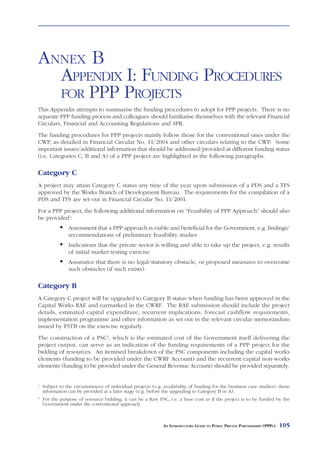
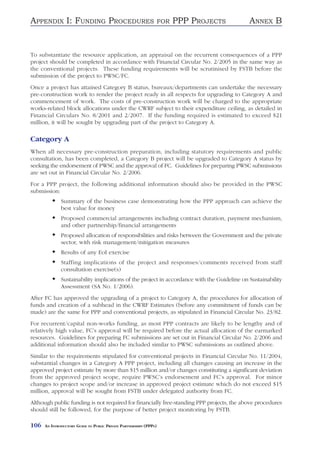
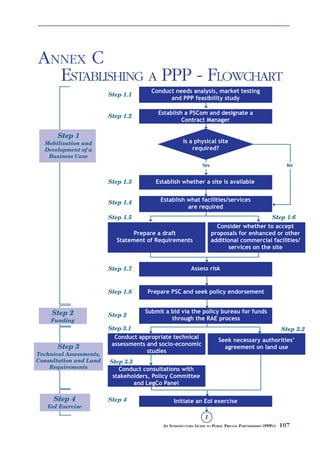
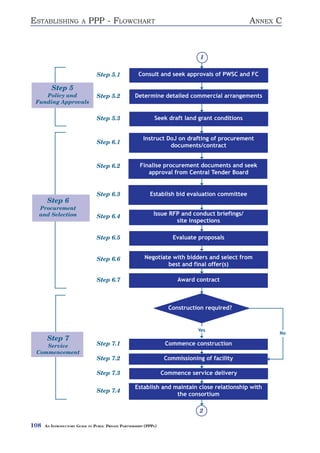
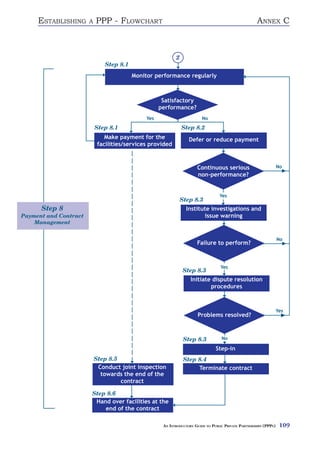
of Government, e.g. loan guarantee. A set of procedures, and a procurement flowchart are at
Annexes B and C respectively.

3.8     Should client departments conduct technical assessments prior
        to inviting proposals?
Departments will need to ensure that the relevant legislation, e.g. the Environmental Impact Assessment
Ordinance (EIAO) (Cap 499), is complied with in respect of designated projects.
Departments should conduct appropriate preliminary environmental, traffic and engineering feasibility
assessments, sustainability, socio-economic, heritage and regulatory/business impact studies, as part
of the business case exercise, before inviting proposals in order to assess the practicability, viability
and justification of the desired facility or service. The information derived from these will help
potential bidders in the preparation of realistic proposals, as well as guiding the client department
on the standards that can be expected of bidders. It will also give comfort to potential bidders about
the risks that they will have to bear, and will tend to lead to lower bid prices if those risks are
identified and capable of quantification at an early stage.
The client department will make available, with express provisions disclaiming liability, the data,
information, and reports obtained from these assessments. Bidders will therefore carry the risk of
making their own assessments and the time required for any studies that the successful bidder will
have to conduct should be factored into the project timetable.

3.9     Are PPPs consistent with Government’s sustainable development
        policy?
Yes. The Sustainability Assessment (SA) system integrates sustainability principles into the government’s
decision-making process. It provides a structured framework for departments to identify the
sustainability implications associated with a major proposal, including a PPP.
Departments are required to use the SA as a planning tool as they commence the planning or
formulation of new proposals that may bring about significant or prolonged implications on economic,
social and/or environmental conditions. Departments are required to:
            Include a paragraph in their submissions to the Policy Committee or ExCo setting out
            the sustainability implications
            Conduct a SA of their proposals before public consultation, and incorporate the main SA
            findings into relevant consultation documents
            Incorporate the requirement for SA into their business case, planning or feasibility studies
This requires prior clearance with the Sustainable Development Division (SDD). Departments are
encouraged to consult the SDD as early as possible.
The Guideline on Sustainability Assessment (SA No. 1/2006) can be downloaded by departments
from http://sdu.host.ccgo.hksarg/index.htm .


                                                     AN INTRODUCTORY GUIDE TO PUBLIC PRIVATE PARTNERSHIPS (PPPS)   27
ESTABLISHING              A   PPP PROJECT


3.10 Can we encourage ‘green’ or ‘sustainable’ buildings?
Experience in numerous PPP markets demonstrates that PPPs provide a good opportunity to encourage
green or sustainable buildings.
Green buildings are more environmentally friendly than the norm and, typically, will involve less
wasteful construction, use less water and energy, and produce fewer polluting emissions and waste.
Sustainable buildings embrace economic and social dimensions as well as being environmentally
more friendly.
Many traditionally procured buildings are neither green nor sustainable, largely because of the
disconnection between designers, constructors and users. The whole of life approach used in PPPs
encourages and incentivises the development of green and sustainable buildings.
The Building Environmental Assessment Method Society provides advice and assistance to both
public and private sectors.

3.11 Are green and sustainable buildings more expensive?
The cost of designing and building green and sustainable buildings may be higher than traditional
approaches. However, the lifecycle costs will often be lower, and a building’s productivity should
be higher, producing better value for money.
The greatest impact on producing green and sustainable buildings is achieved during the design
stage. Over the lifetime of a typical office building the costs of running a public service constitute
about 75% of the total cost, compared to less than 10% for the construction cost, including less than
1% for the design. A modest increase in upfront investment in the design can produce significant
cost reductions and other benefits over the life of the facility.
Apart from environmental benefits and cost reductions, well designed buildings can improve occupant
comfort which, in turn, improves productivity, and reduces staff sick leave etc.

3.12 Do we need to take account of the rights of minority or
     disadvantaged groups?
We expect all contractors to comply with any legislative requirements. There are also requirements
for contractors to avoid exploitation of non-skilled workers. Please see the EU’s Policy and Practice
Guide and the User Guide to Contract Management for details. In addition, client departments will
seek to get a private partner that aligns with its own values and beliefs (see Question 5.1), which
should include respect for the rights and needs of all members of the community.

3.13 Are there any specific gender issues?
Any department considering legislation, public policy or programmes is required to promote the
elimination of discrimination against women. In the PPP context this might, for example, involve
ensuring that the contractor’s female employees are given equal employment opportunities and pay.
The Labour and Welfare Bureau can advise details of gender mainstreaming requirements.

3.14 Can the private sector propose unsolicited projects?
The private sector may bring unsolicited ideas to the Government but, usually, a competitive bidding
procedure would still be required to demonstrate value for money and to guarantee probity.


28   AN INTRODUCTORY GUIDE TO PUBLIC PRIVATE PARTNERSHIPS (PPPS)
ESTABLISHING               A   PPP PROJECT


Although the risk of entering into a competitive process on the basis of a submitted idea might deter
the private sector from bringing such ideas forward, only in limited circumstances would the
Government grant a private party an exclusive mandate to fully develop a proposal on a non-
competitive basis. Such circumstances would be rare, e.g. where the intellectual property in the
proposal is of such outstanding value that a competitive market for the service would not exist. The
client department would still have to satisfy itself that good value for money would be achieved and
alternative means to deliver the same end result did not exist.

3.15 What should be the duration of a PPP contract?
The underlying principle is that the duration selected should result in best value for money. Subject
to circumstances, it is generally most efficient if the contract length is somewhere between a half and
the whole of the useful life of the main assets. Factors such as service requirements of the client
department and the likely terms of debt obtained by the private partner will also be relevant. A
shorter contract duration might require debt to be paid off and equity returns to be earned over an
artificially short period, putting upward pressure on the payments to be made by the client department.
A longer duration would allow a longer debt service period.
In some overseas PPP projects, contract periods are well short of the design life of the asset, to
ensure that a valuable residual interest in the asset is available to the government at the end of the
contract. The transfer conditions in the contract need to be crafted to this end. A positive aspect for
the financial community in this scenario is that the asset and its residual value could then be used for
redevelopment.
If the client department’s period of service requirement is significantly shorter than the life of the
main assets, the department would be advised to reconsider the whole project, not just the PPP
approach.

3.16 What is the Project Steering Committee (PSCom)?
This is similar to the ‘Project Steering Committee’ used in the management of multi-disciplinary
projects by works departments. The role of the PSCom would be to oversee the progress of the
project from start to finish, give general direction of the project and make major policy decisions.
The PSCom is not a contract administrator for the day-to-day contract administration.
The PSCom will either be chaired by or report to the officer in the client department with overall
authority for the project. The composition of a PSCom should be limited to an optimal size for
effective operation. For example, sub-groups on different expertise fields could be formed separately
and only the sub-group chairman representing the interest and concerns of the corresponding sub-
group members would be members of the PSCom.
The PSCom should contain the experience and expertise appropriate to its needs, and include/
employ the services of an experienced Contract Manager responsible for day-to-day management
and capable of ensuring adherence to the desired project timetable. In addition to members of the
client department’s own staff, the PSCom might include architects, engineers with various
specialisations, lawyers, and financial advisors; it may contain individuals from both within and
outside the government; and its composition may change according to need at different stages of the
project.
Where advisors to the PSCom are employed from outside government, the client department will
need to ensure against any conflict of interest arising. The client department should contractually
prohibit advisors from later working on the same project for private sector bidders where this might
risk the tailoring of advice or the use of inside information.


                                                     AN INTRODUCTORY GUIDE TO PUBLIC PRIVATE PARTNERSHIPS (PPPS)   29
ESTABLISHING              A   PPP PROJECT


Under the conventional procurement approach the Works Branch and works departments may
serve as the works agent of the client department. Under the PPP approach, the client department
is responsible for forming its own PSCom which should possess the necessary skills and knowledge
to manage the contract during different stages of the project.

3.17 Is there a role for the works departments on the PSCom?
Departments should generally invite staff from works departments to join the PSCom, where they
can act as technical advisors and assist in drawing up the output/outcome specifications, setting
performance standards and advising on work practices. Works departments may also assist in a
regulatory and monitoring role throughout the contract period.

3.18 Why appoint outside advisors to the PSCom?
The public sector has limited experience and expertise in delivering PPP projects. External advisors
can often offer a wider range of skills and commercial perspectives and experience than is available
in-house, e.g. writing output/outcome specifications; negotiating complex infrastructure contracts
that underpin PPP transactions; understanding the financial products that investment bankers promote
to underwrite such transactions; and in contract management (see Chapter 8). Appointing the right
consultants and making sensible use of them will help to address this skills deficit. Heads of
Department should seek to transfer such skills to in-house staff wherever practicable, for example,
by teaming up in-house staff with outside consultants. At each stage in the PPP approach, the client
department should undertake a competitive tendering process to employ the necessary outside
advisors. The EU will be able to provide help in assessing the need for and recruiting the necessary
outside advisors.


30   AN INTRODUCTORY GUIDE TO PUBLIC PRIVATE PARTNERSHIPS (PPPS)
ESTABLISHING               A   PPP PROJECT


4 MAKING                         THE           BUSINESS CASE

4.1      How do we make the case for a PPP?
As with any major government project that involves changing the way government business is done
the first step is to ensure that there is a case (a business case) for proceeding. A business case
addresses the issues that the proposal seeks to resolve. It will include the compelling case for
change, in terms of the existing and future business needs; the options considered; the preferred
option that represents the optimum balance of estimated expenditure and revenue, anticipated
savings, expected benefits and the risks identified together with risk allocation and mitigation proposals;
and an implementation plan to achieve the intended outcome.

4.2      How do we develop a business case?
In the early stages it might not be clear whether a PPP or another delivery option will best resolve
the issues being considered. Therefore, the development of the business case for a PPP will often
be done in two stages. The stage 1 business case study involves a high level selection from among
the different delivery options the one that best meets the service needs. In the stage 1 business case
study, the options to be evaluated should include those of the public sector (e.g. in-house provision,
contracting-in, trading fund, corporatisation, etc.) and private sector (e.g. contracting-out/outsourcing,
PPP, etc.). To be considered as having a prima facie case, a PPP should meet most, if not all, of the
following criteria:
            There is a major investment programme, requiring effective management of risks associated
            with construction and delivery
            The private sector has the expertise to deliver the programme and there is good reason
            to think that it will offer value for money
            The structure of the service is appropriate, allowing the public sector to define its needs
            as service outputs that can be adequately contracted for in a way that ensures effective,
            equitable and accountable delivery of public services in the long term
            Risk allocation between the public and private sectors can be clearly made and enforced
            The nature of the assets and services identified as part of the project are capable of
            being costed on a long-term, whole of life basis
            The value of the project is sufficiently large to ensure that procurement costs are not
            disproportionate
            The technology and other aspects are stable and not susceptible to short-term fast paced
            changes
            Planning horizons are long term, with assets intended to be used over long periods.
If this exercise provides a prima facie case for a PPP, resources would then have to be invested in
the stage 2 business case study. The stage 2 business case study focuses on confirming the justifications
for the PPP option and setting out its details and requirements so that a final go ahead can be sought
prior to the procurement. The stage 2 business case study should include a detailed analysis of the


                                                      AN INTRODUCTORY GUIDE TO PUBLIC PRIVATE PARTNERSHIPS (PPPS)   31
MAKING          THE     BUSINESS CASE


likely costs, benefits and risks of the PPP option to the government, baseline costs, PSC, critical
success factors, project management and implementation plan, procurement strategy, risk management
strategy, benefits realisation plan, etc.
It should be noted that some of the issues will be covered in both stages 1 and 2 of the business case
study, e.g. evaluation of options, selection of the preferred option, etc. Stage 1 addresses the issues
at a higher level and in less detail. With more information available, stage 2 will review, validate and
update the assumptions and estimates made earlier and map out the way forward. For example
high level cost estimates gathered from a market-testing exercise might be sufficient for comparing
different options in stage 1; whereas a properly prepared PSC will be required to demonstrate value
for money of a PPP in stage 2.
The EU plans to issue a Government Business Case Guide in 2008 to provide more guidance on the
conduct of business case studies.

4.3        What is value for money?
As with other procurement methods, the lowest priced option does not necessarily offer the best
value for money. Value for money refers to the best available outcome taking account of all
benefits, costs, and risks over the whole life of the procurement. Value for money is determined
through a comparative analysis of the benefits, costs and risks of the available procurement alternatives.
Assessing the value of these variables requires a degree of judgment and the use of both quantitative
and qualitative analysis. Value for money combines economy, efficiency and effectiveness. It can
manifest itself as:
                Delivery of a service capability at a lower cost
                Greater certainty of an expected financial outcome due to less exposure to significant
                risk
                Increased benefits to the end user of a service due to the public sector’s focus on service
                delivery rather than asset procurement.
Assessment of value for money is not in itself affected by the budget impact of alternative procurement
methods. The assessment should also be independent of the accounting classification of a private
financing arrangement i.e. whether or not any borrowing is off the government’s balance sheet. The
budgetary implications of alternative procurement methods should be considered separately as part
of the government resource management framework. PPP procurement inclusive of private financing
should be used where it offers superior value for money compared with other procurement methods.
4.4        What is a Public Sector Comparator (PSC)?
A PSC is an estimated, risk-adjusted, cost of the government itself delivering the project output. The
PSC is expressed in terms of the net present cost to the government of providing the output under
a public procurement, using a discounted cashflow analysis that adjusts the future value of the
expected cashflow to a common reference date. This enables comparison with bids and makes
allowance for the imputed cost of government borrowing. The PSC has three core components:
                Raw PSC: the base cost of delivering the services specified in the project brief under the
                public procurement method where the underlying asset is owned by and the service
                delivered by the public sector
                Competitive neutrality adjustment: this removes any net advantages or disadvantages
                that accrue to a government run service by virtue of its public ownership, e.g. the non-
                payment of insurance premiums or taxes by a government run transport service


32    AN INTRODUCTORY GUIDE TO PUBLIC PRIVATE PARTNERSHIPS (PPPS)
MAKING          THE     BUSINESS CASE


            The value of transferable risks: risks which the government would bear under a public
            procurement but is likely to transfer to the private sector.
A further component, the value of retained risks (risks that are likely to be retained by the government
and are reflected in the Raw PSC) may be calculated and added to each private sector bid. This will
be necessary if different bidders accept different levels of risk transfer.

4.5     Why do we need a PSC?
While competition encourages the private sector to submit more efficient bids, there is often a need
to have a PSC to objectively compare the costs of the best PPP option against the public sector
alternative.
In addition to providing the basis of comparison between the PPP and the public sector alternative,
creating a PSC has the following benefits:
            Encourages the early appraisal of project risks and their allocation between the public
            and private sectors
            Improves bidder confidence in the tendering process and encourages bidder competition
            Encourages the closer alignment of private sector bids with government needs and risk
            transfer profiles, thus reducing bidding costs and timescales.
The PSC is part of a broader value assessment of bids and bidders that takes into account qualitative
as well as quantitative factors.

4.6     Must we always construct a PSC?
A PSC need not be constructed where a firm decision has been made that the PPP approach is to be
followed for policy or qualitative reasons, or where no public money is involved because the project
is financially free-standing. Nonetheless, to establish value for money and make the business case
for the project, a Raw PSC will normally be constructed, especially if there is to be some public
contribution such as the creation of infrastructure, or if public land is to be provided at less than full
market value. A further advantage to creating a PSC is to provide a benchmark of what the government
believes is an appropriate level of investment.
It is advisable to construct an initial PSC as early as possible. This allows the client department to
ascertain the expected full cost of pursuing the project by traditional means. Second, it allows the
client department to inform potential private partners of the scale of the project at an early stage.

4.7     How is the PSC developed?
Annex D provides an outline of how to construct a PSC.
External help from consultants will often be required.

4.8     How accurate are calculations of the PSC?
The PSC is an estimate based on an outline Reference Project. Experience overseas indicates that
the PSC cannot be calculated exactly. It should be expressed as a range of values (reflecting the
accuracy and reliability of the available information) and used as only one component of the overall
value assessment, not as a pass/fail test. Other components used in assessing the value for money
of bids may include:


                                                      AN INTRODUCTORY GUIDE TO PUBLIC PRIVATE PARTNERSHIPS (PPPS)   33
MAKING          THE     BUSINESS CASE


                The quality/quantity/range of service deliverables
                The operational commencement date
                Any non-quantifiable risks absorbed by the private partner
                The reputation and financial standing of the private partner.
These components may be evaluated prior to consideration of the costs.
There is a general tendency worldwide for project estimates to be over optimistic both as to cost and
time to complete. The UK National Audit Office has shown that this tendency is mitigated in more
than three out of four cases when using a PPP. In Hong Kong, an EU analysis has shown that the
tendency to over optimistic forecasting is more prevalent with regard to time than it is to cost; in any
case care needs to be taken to ensure that the PSC uses valid and carefully constructed estimates for
time, cost, etc. However, it is sometimes difficult to assess the on-costs in estimating the construction
costs of certain facilities due to the lack of relevant examples.

4.9        Is it advisable to disclose the PSC to bidders?
The PSC will often be public knowledge by the time of the RFP as it will normally have been
disclosed to LegCo’s FC in the course of obtaining funding approval to proceed with the project.
According to Stores and Procurement Regulations (SPR), if the estimated contract value has been
disclosed to the public, departments should, in all fairness, inform bidders of the estimated contract
value. However, if the information has not been disclosed publicly (e.g. in financially free-standing
projects), it is not necessary to disclose the PSC. Providing the PSC to bidders will discourage them
from submitting bids that are higher than what is in effect the project’s financial ceiling and, provided
that there is sufficient competition among bidders, it would not discourage bidders from submitting
low bid prices.

4.10 Can the PSC be updated during the procurement process?
Once a business case is established, it may not be worthwhile to update the PSC (except for
circumstances where there is a lengthy lapse of time) unless the bidding prices are much higher than
the PSC and the client department has to reassess whether to proceed with the PPP project. Current
practice in the UK is not to update the PSC as it is used only to determine the case for the project to
be a PPP. The competitive bidding process is used to determine what is the best value for money
proposal.

4.11 Should the client department allow additional services to be
     provided under the contract?
Departments should consider whether to seek or be prepared to accept proposals for enhanced
facilities/services or other commercial facilities on the site, having due regard to their impact on the
delivery of the required services. The benefits of permitting the provision of facilities/services over
and above those required by the client department may include:
                Better site utilisation
                The provision of additional facilities/services for the community
                Additional revenue for the consortium/government
                Cheaper public facilities/services.


34    AN INTRODUCTORY GUIDE TO PUBLIC PRIVATE PARTNERSHIPS (PPPS)
MAKING          THE     BUSINESS CASE


The provision of additional services/facilities might make a major contribution to the value for
money and even the viability of a project. If so, bidders’ proposals for and proven abilities in
providing such facilities should be a key factor in proposal evaluation. If the department is prepared
to accept additional services/facilities, it should ensure that any constraints are made clear to all
concerned in the process of developing the project, and should be made clear in the RFP
documentation. Constraints might include:
             Compatibility with the zoning on the town plan
             Restrictions on the development parameters permitted for the site such as the Gross
             Floor Area (GFA), plot ratio, building height and site coverage
             Sensitivities over issues such as alcohol, tobacco and gambling-related or immoral activities
             The ratio of required to additional activities
             Other policy and political considerations.
For some constraints, the department might wish to work with other government departments to
minimise their effect on the project.
If the consortium is allowed to keep income from the provision of additional facilities/services, then
sufficient management controls and sanctions must be in place to ensure that the consortium will
not be distracted from the delivery of the required services, which may be less profitable than the
additional services, e.g. the relative share of the additional services and the timing of the revenue
generated. Care should be taken to avoid any hypothecation of revenue.
The client department may wish to provide sufficient flexibility for the consortium to introduce or
change additional activities after the award of contract, subject to the client department’s agreement
where appropriate. The client department will also wish to satisfy itself concerning sharing the
benefits arising from the additional services, and the fees charged to the public.
Departments will need to decide the status of additional services/facilities in the event of the termination
of the PPP contract; whether at the contracted date or earlier due to the exercise of step-in rights.
They should consider whether the additional services/facilities should or should not revert to the
government along with the required services/facilities; and, if so, what conditions would apply and
what would need to be done to manage the hand-over.
Client departments should note that insofar as land sales are concerned, there is a policy regarding
an administrative ban for major modifications within five years of a land sale. These refer to
modification proposals for substantial changes/relaxation in respect of the user restriction or
development parameters as specified in the land sale conditions. This is to safeguard against
possible criticism from other developers i.e. those who were not successful could complain that they
would have put in a much higher bid for the site if they had known that the government was
prepared to grant such modifications. Other developers who had not submitted any bids previously
might also make similar complaints.
See also Question 7.15.


                                                       AN INTRODUCTORY GUIDE TO PUBLIC PRIVATE PARTNERSHIPS (PPPS)   35
GETTING          THE     RIGHT DEAL               WITH THE          RIGHT PRIVATE PARTNER


5 GETTING THE RIGHT DEAL WITH
  THE RIGHT PRIVATE PARTNER

5.1        How do departments get the right private partner?
As with all private sector involvement exercises, a client department will seek to:
                Conduct market testing to discover if the private sector is willing and able to perform the
                required tasks
                Give potential bidders the opportunity to provide feedback on the proposed scheme
                Give sufficient publicity and time for potential bidders to prepare proposals
                Provide output/outcome performance specifications that clearly identify the service
                requirements
                Arrange briefings and site inspections to ensure potential bidders understand clearly the
                requirements before submitting their proposals
                Look for good alignment of the selected consortium with the client department’s values
                and beliefs
                Put in place an objective and fair bid assessment process
                Conduct thorough due diligence to substantiate the preferred bidders’ claims (capability,
                experience, expertise, financial position etc).
The Government wants to encourage the further development of high quality service providers in
the market for public services. This requires that a competitive selection process be used which
insists on quality services, socially-responsible terms and conditions, and high safety standards. If
the Government lays down reasonable expectations, abides by them over time, and provides a level
playing field, quality firms will be attracted to the market. This will make it difficult for less socially-
responsible service providers to survive. Experience shows that it is competition that delivers the
benefits from PPPs, not private provision per se.

5.2        What are the key steps to take in selecting a PPP consortium?
For most PPP projects, the following are the usual steps:
                Conduct a market testing exercise
                Issue request for Expression of Interest (EoI) from the private sector
                Pre-qualification of private sector companies including those that have submitted an EoI
                Issue RFP to pre-qualified private sector companies
                Exclude proposals not meeting mandatory essential requirements


36    AN INTRODUCTORY GUIDE TO PUBLIC PRIVATE PARTNERSHIPS (PPPS)
GETTING      THE    RIGHT DEAL          WITH THE          RIGHT PRIVATE PARTNER


            Conduct assessment on the proposals. Negotiate with the one or two best conforming
            bidders to achieve improvements to bids whilst under competitive pressure. SPR 385(e)
            states that negotiations shall normally be conducted with only a single tenderer. SPR 300(a)(ii)
            allows departments to seek the Secretary for Financial Services and the Treasury’s (SFST)
            approval not to follow SPRs in respect of franchises, concessions etc. (most PPPs are
            franchises, concessions etc.) It is not normal government practice to negotiate the land
            premium, if any
            Select a preferred bidder or bidders to develop detailed, fully negotiated contract
            documents (reserve the right to revert to alternative bidders if contract negotiations
            break down)
            Request best and final offer
            Recommend the preferred bidder to the relevant bid evaluation committee.

5.3     What is the difference between market testing and Expression of
        Interest (EoI) exercises?
Market testing is an exercise conducted early on, typically during the PPP business case study,
where private sector companies are approached to see if the private sector is willing and able to
participate in a project, and under what circumstances.
Market testing is especially useful when a particular service is being considered as a PPP for the first
time. Early disclosure of government’s intentions gives the private sector the necessary time to
consider forming business relationships, recruiting staff, acquiring technology and so on.
An EoI takes place after policy approval for the PPP approach has been granted. In response to an
invitation, companies may indicate their interest in, and ideas for, a project with a view to being
invited to submit a proposal at a later stage.

5.4     Do we need to conduct EoI and pre-qualification exercises?
An EoI enables client departments to gauge the extent of the available market as well as tap the
experience and expertise of interested parties before finalising the scope of basic requirements and
additional services/facilities. EoIs are particularly useful when the client department is proposing a
PPP approach in a new area. Departments should not expect potential bidders to disclose valuable
or commercially sensitive information in an EoI submission. An EoI is not usually used to establish
a bidder list; if it is this should be made very clear.
A pre-qualification process can reduce the number of bidders to a manageable number. Best
practice suggests that a short-list of three to four bidders is sufficient to create adequate competition
and cover the risk of a party withdrawing, so long as there is adequate confidence in the capability
and motivation of the bidders. A short-list of more than four is likely to lead to some bidders losing
interest, as their chance of success (20% or less) may not warrant the significant investment of time
and resources in preparing a bid.
The proposal and selection processes for substantial PPP projects can be very costly, both for
bidders and the client department. Bidders will be sensitive to costs, and should not be compelled
to incur excessive costs as a result of unnecessary bid requirements. For some projects, if it can save
time and effort all round, the EoI and pre-qualification exercises may be conducted in one go. Care
will need to be taken to ensure that sufficiently detailed information can be provided to bidders to
achieve the purpose of the combined exercise.


                                                      AN INTRODUCTORY GUIDE TO PUBLIC PRIVATE PARTNERSHIPS (PPPS)   37
GETTING          THE     RIGHT DEAL               WITH THE          RIGHT PRIVATE PARTNER


The PSCom should recommend to the Head of Department, in the light of submissions received,
which of those expressing an interest and/or pre-qualifying are to be invited to submit proposals.

5.5        What information should we give at the pre-qualification and
           Request for Proposal (RFP) stages?
The objective must be to give potential partners as much accurate and pertinent information about
the client department’s intentions as early as possible. This is to enable potential bidders to put
together coherent, sound and innovative proposals, in the full knowledge of the requirements and
risks involved, and reduce the likelihood of misunderstandings, withdrawal of bids etc.
The most important document to be prepared when inviting proposals will be a properly scoped
output/outcome based specification that clearly articulates the department’s needs and service
objectives. A clear scope will result in a better assessment of the project’s feasibility and enhance
the private sector’s ability to identify and offer best value for money. In many cases the client
department will need to undertake some early studies and/or specific site investigation in order to
expedite the contracting process and remove avoidable uncertainties that would otherwise affect the
costs of the project. Achieving a balance between clear specifications and scope for innovation may
be challenging; whatever firm requirements are identified should be clearly identified as such for
conforming bids, whilst allowing and encouraging alternative proposals also.
Information to be given to potential bidders may include:
                Carefully designed draft output/outcome-focused specifications
                A preliminary timeframe for delivery of the service/facility and whether early completion/
                delivery is desired or not
                Land status (i.e. ownership) of the relevant site(s)
                Where a land lease is involved, the Tender Notice and the Conditions of Sale
                Zoning on the statutory town plan(s)
                Information on whether a planning application under the Town Planning Ordinance
                (Cap 131) or rezoning of the site(s) is required
                Environmental, traffic, SA or other assessments required from the contractor or already
                done
                Draft Service Level Agreement (SLA)
                Draft contract (also see Questions 5.7-5.9)
                Proposed performance indicators
                Proposed step-in and termination provisions
                Avenues of redress/appeal on the part of the private partner
                Matrix of proposed risk allocation
                Preliminary/final Raw PSC estimate
                Affordability constraints
                Bid evaluation criteria
                Insurance cover requirements


38    AN INTRODUCTORY GUIDE TO PUBLIC PRIVATE PARTNERSHIPS (PPPS)
GETTING      THE    RIGHT DEAL        WITH THE          RIGHT PRIVATE PARTNER


            Whether bidders are required/encouraged to employ serving civil servants, and the
            terms of transfer requirements
            Whether bidders may be allowed/encouraged to provide additional services/facilities
            Whether a lump sum premium or other income/revenue is expected by the government
            Client department’s proposed payment mechanism(s) (including rewards and abatements)
            What opportunity there will be for bidders to comment/suggest amendments to the
            payment mechanism
            Whether more than one successful bidder is envisaged or desired.
Clearly, the information to be provided at the pre-qualification stage may be less precise and
comprehensive than that provided at the proposal stage. Information provided by the department
must be carefully scrutinised prior to its issue. Client departments should take steps to protect
themselves from liability for negligence by using appropriate disclaimer clauses.

5.6     What information do we want from the private sector at the pre-
        qualification and RFP stages?
            Clear statements of information such as:
            - Detailed refurbishment and replacement schedules for project assets
            - What insurances will be put in place
            - The terms of employment of project staff
            - Demonstration of a commitment to ethical practices
            - Relevant experience of consortium members
            - Qualifications and experience of key staff
            - Disclosure on possible conflicts of interest and the proposed mitigation measures
            - Probity issues
            - Consortium members’ financial standing
            - Record of compliance with labour ordinances
            - Delivery approach and methodologies
            - Record of innovation
            - Ideas on basis for remuneration of the consortium.

5.7     Why do PPPs require output/outcome performance specifications?
Output/outcome-based performance specifications should be used in all types of private sector
involvement projects. They allow the private sector as much flexibility as possible to produce
innovative, cost-effective designs of services and infrastructure, on a whole-life cost basis, taking
advantage of new and labour-saving technologies and techniques. For example, in a community
facility project, instead of input specifications requiring the installation of permanent seating for
1 000 people, the output specifications might require that seating for 1 000 people shall be provided
when required. This allows the use of temporary seating. At other times the space could be utilised
for other purposes. Nonetheless, some aspects must be specified such as the means of escape and
fire services requirements for the 1 000 people would have to be permanent features.


                                                   AN INTRODUCTORY GUIDE TO PUBLIC PRIVATE PARTNERSHIPS (PPPS)   39
GETTING          THE     RIGHT DEAL               WITH THE          RIGHT PRIVATE PARTNER


Output/outcome specifications need to be carefully drafted to drive the behaviour and performance
of the consortium and its contractors throughout the life of the project. They should also avoid
setting unrealistically high standards; for an existing service if standards higher than those that are
currently being achieved are requested then they should be reflected in the benchmarked estimated
cost of conventional procurement (the PSC).

5.8        When might inputs need to be defined?
Despite the desire to maximise flexibility, it is difficult to achieve 100% use of output/outcome
specifications and it will usually be necessary to use some input-based specifications or even an
outline design for reference or to ensure a specific need is met, where the facility interfaces with
other facilities or there is an interaction with surroundings.
Consideration should be given to the need for contracts to contain defined inputs so as to protect
the Government’s interests in the event of disputes. For example, an input to provide an Olympic
size swimming pool could contain the usual construction schedules and contracts requiring a certain
aggregate mix, sand quality and prohibited use of open bags etc. If cracks appear later in the pool
walls there are likely to be arguments advanced by the consortium as to the extent of its liability (it
may claim mitigation of their liability under the contract due to relief events and possibly even force
majeure and compensation events - see Chapter 11). The government will wish to point to and rely
upon a breach of the input requirements as to aggregate mix, sand quality and use of open bags etc.

5.9        What are inputs, outputs and outcomes?
Inputs refer to the resources deployed by the contractor in the production and delivery of services.
Inputs commonly include labour, physical resources, administrative services and computer systems.
A typical input specification might be “The contractor shall deploy one security guard at all times at
each entrance of all buildings in the estate and security gates shall be locked between 11 pm - 6 am”.
Outputs refer to the immediate result of the contractor’s activities. A typical output specification
might be “The contractor shall ensure that each entrance of all buildings in the estate is monitored
at all times by security staff, and that they respond to requests for assistance within one minute”.
Outcomes refer to the longer term impacts of the contractor’s activities. A typical outcome specification
might be “The contractor shall take steps to reduce the numbers of reported crimes within the estate
by at least 1% each year”.
Whilst the use of output/outcome specifications is strongly advocated it is acknowledged that,
sometimes, it is necessary to use input specifications to ensure that the public and the department’s
requirements are met. For example, in a housing estate it is likely that residents will want to see the
physical presence of security guards even though their safety may well be achieved satisfactorily
and cost-effectively by the use of electronic and mechanical means. Departments should not lose
sight of the human touch.

5.10 What help can be given to bidders during the bidding process?
Whilst care must be taken to ensure against actual or perceived favouritism during the bidding
process, client departments must be diligent in ensuring that bidders have sufficient access to
comprehensive information to provide the best possible proposals. Clarification of requirements
should be provided on demand (and shared with all bidders). So long as probity requirements,
including documentation of meetings and equality of access and information, are observed, such
clarifications can be face-to-face as well as in writing.


40    AN INTRODUCTORY GUIDE TO PUBLIC PRIVATE PARTNERSHIPS (PPPS)
GETTING       THE    RIGHT DEAL         WITH THE          RIGHT PRIVATE PARTNER


Procurement should be managed carefully with communication between bidders and the client
department going through a single central point. This should help avoid ambiguity, the provision of
conflicting information, and duplicate or multiple requests for similar information. Proposal evaluation
criteria, for example, should be provided clearly and unambiguously so that bidders are aware of
the issues that are of most importance to client departments.
At the pre-qualification and/or the initial competitive bidding stages, there may be drawbacks in
providing certain information, such as a draft SLA and/or a detailed draft contract. If client departments
inform bidders of the detailed contractual terms too early, the scope for negotiating will be limited;
the government may be disadvantaged and may not get the best out of what is intended to be an
innovative process. On the other hand nugatory work by bidders and client departments may result
if bidders are not given clear indications of which items are non-negotiable. SPR 345(c) requires the
tender documents to cover a number of things including general and special conditions of contracts.
Departments are advised to consult the Department of Justice (DoJ) and FSTB in specific cases.

5.11 How is the principle of non-discrimination applied?
All bidding exercises must be conducted in accordance with the principle of non-discrimination.
The Government cannot negotiate with a non-conforming bidder with a view to modifying or
waiving essential requirements. Otherwise, it would be unfair to other bidders and potential bidders.
Depending on the nature of the particular PPP in question, the rules of the WTO GPA do not apply
to a concession or franchise. However, it is still necessary for the Government to act fairly. Accordingly,
the Government is not free to modify or waive the essential requirements or contractual terms after
the closing of the tender exercise without regard to the principle of non-discrimination. For that
reason the minimum mandatory/essential requirements specified should be limited to those that are
truly essential.

5.12 Does the World Trade Organisation Government Procurement
     Agreement (WTO GPA) apply to PPPs?
Hong Kong’s commitments under the WTO GPA do not cover franchise arrangements, BOT contracts
and public works concession contracts. Accordingly, most PPPs complying with the recommended
procedures in this Guide will not be covered by the WTO GPA. Departments may wish to check
with the International Law Division of DoJ whether specific projects are covered by the WTO GPA.
The object of the WTO GPA is to provide open and fair competition amongst domestic and foreign
suppliers and service providers through procedures designed to ensure that all tenderers are treated
by procurement entities covered by the WTO GPA on an equal footing. It prescribes a set of
requirements regarding non-discriminatory treatment of goods, services and service suppliers,
qualification of suppliers, tender procedures, tender specifications and challenge procedures. The
government’s procurement principles of open and fair competition, transparency, value for money
and public accountability are consistent with the spirit and objective of the WTO GPA.

5.13 How does the department negotiate a detailed contract?
The negotiation process can involve the two parties physically meeting and negotiating face to face;
it can involve the passing of draft documents backwards and forwards; or it can involve a combination
of both. Passing draft documents between the two parties is the norm.


                                                      AN INTRODUCTORY GUIDE TO PUBLIC PRIVATE PARTNERSHIPS (PPPS)   41
GETTING         THE     RIGHT DEAL               WITH THE          RIGHT PRIVATE PARTNER


The key objective of the procurement process is to select the right consortium for the project. The
bidding and negotiation process must be carefully managed. Negotiating on the detailed terms of
the project will only be possible if the Government avoids setting out overly detailed terms/
requirements in the procurement documents in the first place, i.e. if the Government only sets out
minimum mandatory/essential requirements in the documents and leaves the detailed terms to be
negotiated with the bidders. This flexible approach can encourage innovative solutions by inviting
the private sector to come up with proposals but it departs from conventional practice in relation to
procurement through an “invitation to tender” (ITT). For PPPs, the Government does not issue an
ITT but a RFP. Accordingly, the words “tender” and “tenderers” should be avoided in the RFP
documents.
The challenge is to create a bidding environment that balances on the one hand the client department’s
desire for certainty, the need to maintain competitive tension, and avoid deal creep, and on the
other hand the bidders’ wishes to reduce bid costs, and have clear requirements against which to
provide innovative solutions. In time the development of standardised contracts, based upon local
PPP experience, may assist in these objectives.

5.14 Can we negotiate detailed contracts with more than one bidder?
Negotiating detailed contracts with more than one bidder is common overseas to secure the most
favourable terms for government, especially where two bids are similar. Approval from SFST is
required to negotiate with more than one party. The aim is to maintain the competitive environment
as long as possible, to find the right pricing structures and risk allocations and therefore to achieve
the best terms. From the Government’s perspective this achieves a balance between certainty and
competition, though care will be needed to guard against compensation claims from losing bidders.
If detailed negotiations are conducted with more than one bidder, Government will normally negotiate
with each bidder on the basis of a set of common terms. Doing so ensures greater simplicity for the
client department in terms of its comparison of bids. However, it also carries some risk of loss of
innovation and achieving optimum pricing proposals. Nonetheless, the client department should
ensure that the RFPs provide clear, well drafted and market oriented requirements and risk allocations
to reduce the probability of excessive or highly material variations between bidders. The department
will normally use the same negotiating team for negotiations with different bidders and determine
the baseline and the parameters before the start of the negotiation process. The department should
be adequately resourced to be able to rapidly and thoroughly evaluate the variations proposed, and
ensure that all material variations have been fully evaluated by the end of the negotiation phase.
It is very important that the Government communicates the process to bidders at an early stage and
does not deviate from it. If Government negotiates with only one bidder it should still retain at least
one bidder in reserve and not announce the existence of a preferred bidder until the completion of
negotiations.
The cost of the procurement process - particularly the negotiation phase - can be extremely high,
both for the private sector and the Government. If the costs are too high, taking the chance of
success into account, many potential bidders will be discouraged from participation with the
consequent loss of competition, innovation etc. An appropriate balance needs to be achieved. In
some jurisdictions, compensation packages for short-listed bidders are set, or agreed, in advance to
encourage full participation. This is not Hong Kong Government practice.


42   AN INTRODUCTORY GUIDE TO PUBLIC PRIVATE PARTNERSHIPS (PPPS)
GETTING       THE   RIGHT DEAL         WITH THE          RIGHT PRIVATE PARTNER


5.15 Who should be in the Government’s negotiating team?
One of the challenges facing departments is that few civil servants have experience in negotiating
complex commercial contracts. Other jurisdictions faced similar problems when they started their
PPP programmes.
Whilst there are no fixed requirements on the make-up of the Government’s negotiating team there
are a number of lessons learned from elsewhere:
            In the early projects senior departmental management must commit a considerable
            amount of their time and attention
            The lead negotiator must have the authority to negotiate (within the confines of the
            approved negotiating brief)
            One of the negotiating team members will often carry on as the Contract Manager (see
            Chapter 8) after the deal is closed, providing continuity and the institutional memory
            The lead negotiator may be brought in from either another department or the private
            sector if the client department does not have the experience and expertise. Departments
            will need to manage carefully real or potential conflict of interest.
            The negotiating team should be kept as small as possible to avoid becoming unwieldy.

5.16 Are bid preparation and contract management onerous and time-
     consuming?
Structuring, assessing bids or, awarding and implementing a PPP contract will be a challenging
process. Client departments will need a strong in-house team with appropriate external advisory
support (see Chapter 8). The bidding process may involve inviting initial proposals from the private
sector, evaluation of those proposals, discussion and negotiation with individual bidders in order to
obtain best and final offers, and finally selection of the proposal offering the greatest value for
money. Once the facility is in operation, the client department will focus on monitoring performance
against defined criteria.

5.17 Can the client department select more than one successful bidder?
The selection of one consortium, after a competitive bidding process, is the norm. However, there
may be circumstances where the client department prefers more than one party to provide the
required facilities/services. This might be to ensure that existing competition continues; to prevent
the replacement of a public monopoly by a private monopoly; or to reduce the risk of service
disruption in the event of staff disputes, bankruptcy etc. In such circumstances, the client department
should make clear in the RFP that it is prepared to consider engaging with more than one partner;
explain what those circumstances are; and request bidders to put in separate proposals for these
different circumstances. Alternatively, client departments could, subject to legal clearance, break up
the contract and state clearly that no bidder will be offered more than one contract. The method of
determining which contract goes to whom should be clearly spelt out in the RFP document.
The successful bidders would have well-defined service areas so that they were not required to
compete directly with each other after the competitive bidding process. For example, the Hong
Kong Hospital Authority has replaced some of its in-house catering with PPP arrangements at two of
its five geographical ‘clusters’ of hospitals.


                                                    AN INTRODUCTORY GUIDE TO PUBLIC PRIVATE PARTNERSHIPS (PPPS)   43
GETTING         THE     RIGHT DEAL               WITH THE          RIGHT PRIVATE PARTNER


5.18 Can a project proceed if the lowest conforming bid exceeds the
     PSC?
A PSC may be a range rather than an absolute number. If, for example, the lowest conforming bid
fell within the range of costs for the PSC, and there were other benefits in terms of quality of service,
additional services etc, then the client department would likely feel comfortable to proceed. If the
lowest price conforming bid exceeds the PSC the client department would need to ascertain whether
there were any other value for money justifications, apart from the price, that would warrant the
project proceeding.

5.19 What if the successful bid is considered too expensive?
Any successful bid must be better value for money than the other competing bids and provide at
least equal value for money as the PSC. If it passes these two tests, there is no basis for saying that
it is too expensive. If, for example, the client department’s expected budget is reduced it could
always renegotiate the contract. But, the contractor is unlikely to drop the price without competitive
pressures from other bidders and perhaps other contract conditions also being changed. For equity
and probity it is important to maintain the integrity of the bidders’ offer prices and terms throughout
the evaluation and negotiation process. Where the successful bid exceeds the approved project
estimate, departments should revert to PWSC/FC on the additional funding required or seek approval
of FSTB under delegated authority (if the amount does not exceed $15M).

5.20 How do we guard against artificially low bids?
A well-constructed PPP contract will commit the successful bidder to an agreed price for the provision
of specified services over a fixed time period. Resolving design flaws or poor construction will be
the consortium’s responsibility - at its own cost. If such problems lead to the contracted performance
service standards not being met, the consortium will face deferral, withholding or abatement of
payments. The consortium’s ability to make claims will be very limited (unless the client department
requests changes after the signing of the contract). A properly designed and executed PSC will be
useful in alerting a client department to the submission of unreasonably low bids.

5.21 Should we impose a ‘performance bond’ or require other
     additional security?
In some PPP projects, the Government will be contracting with a lowly capitalised consortium with
its service delivery reliant on its consortium members and whose main asset will be its interest under
the project documents. The Government may therefore require comfort that the consortium and its
contractor(s) will be able to meet their contractual obligations. The Government will also wish to
ensure that continuity of service is maintained even if a contractor becomes insolvent.
The private sector will normally use a SPV to front a consortium or joint venture of private sector
participants and their respective shareholders and finance suppliers. The Government will require
copper-bottomed assurances that the SPV - a ‘man of straw’ in view of its extremely modest share
capital - has and maintains parent company guarantees, bank performance bonds and suitable
backing for liquidated damages. Insurance will also be required (see Chapter 6).
It may be prudent in some circumstances to require that the consortium provides additional security,
such as a fixed and floating charge over its assets. Such security will generally rank behind the
security held by the financiers. The first ranking priority, however, may be negotiated for specific
amounts owing to the Government, e.g. costs incurred by the Government in the exercise of step-in
rights. Sponsor guarantees may also be desirable in some instances.


44   AN INTRODUCTORY GUIDE TO PUBLIC PRIVATE PARTNERSHIPS (PPPS)
GETTING       THE    RIGHT DEAL         WITH THE          RIGHT PRIVATE PARTNER


5.22 What happens at the end of the contract?
The land and any buildings thereon will normally revert to the Government at zero value or market
rate. The department will have to consider whether it wants any removable assets, e.g. equipment
at the end of the contract. The contract should specify the required condition of the assets that
revert to Government at the end of the contract. There should be arrangements for joint inspection
of the assets, say, two years before the end of the contract, with the private partner being required
to make good any deficiencies. The client department will also be entitled to require part of the
payments in the final years of the contract to be put into a sinking fund in an escrow account to
protect against the possibility of non-performance of the rectification works.
If a land lease is involved, the usual arrangement is that the grantee will be required to maintain all
the structures and buildings on site in good and substantial repair condition with the same to be
handed over to the government upon expiration of the lease term. If it is considered necessary that
a vacant site must be returned to the Government, then specific provision will have to be made in
the contract to oblige the consortium to demolish the facility before returning the site to the
Government.
In addition to the handing back of assets, uninterrupted provision of service may be an important
consideration. The outgoing consortium may be required to provide training to staff of the client
department or an incoming PPP consortium before the expiration of the contract in order to ensure
a smooth transition. Appropriate provisions should be incorporated in the contract.
Overseas, the assets are sometimes left with the private sector although this is unlikely to be appropriate
in Hong Kong.
It must be recognised that the requirements laid down for the end of the contract will be reflected in
the bid price.
The most crucial point is that the client department considers upfront what it wants at the end of the
contract and includes this in the Project Agreement.


                                                      AN INTRODUCTORY GUIDE TO PUBLIC PRIVATE PARTNERSHIPS (PPPS)   45
MANAGING RISKS


6 MANAGING RISKS

6.1        What problems may arise in the course of a contract?
Well prepared and implemented projects will have a higher chance of avoiding and/or dealing with
problems that may arise. Experience demonstrates that for both conventional and PPP procurements
poor drafting of the contract/performance requirements and/or poor contract management can lead
to problems downstream. Hong Kong is fortunate in being able to learn from the years of PPP
experience elsewhere in order to minimise the likelihood of suffering such problems. The key in
entering into contracts of all kinds is to be aware of such possibilities, take expert advice, and
manage the contract letting and negotiation processes accordingly. As with any project involving
investments, the due diligence, risk allocation, and negotiation processes inherent in letting a PPP
contract give the opportunity for many potential problems to be identified and resolved prior to
contract finalisation. Some potential problems and the means of addressing them are:
                Benefits not being shared with the Government
                - Rigorous negotiation by the Government for terms to protect the Government’s interests
                  and adequate supervision
                Bottom line considerations assuming disproportionate importance
                - Avoidance of underbidding by consortia, equitable variation conditions
                Business culture co-existing uncomfortably with public service
                - Identification of consortia with a clear commitment to public service
                Buy-out costs of replacing a poorly performing operator
                - Rigorous selection of consortia, early identification and rectification of poor
                  performance
                Disruption to service, and costs incurred, when exercising step-in rights
                - Rigorous selection of consortia, maintenance of an appropriate level of market
                  competition, adequate contingency arrangements
                High financing costs
                - Appropriate allocation of risk and innovative financing arrangements
                Inadequate accountability
                - Rigorous selection of consortia and adequate supervision
                Lack of competition
                - Encouragement of the market through market testing/development and well managed
                  contracting processes
                Lack of flexibility, especially over the longer term
                - Appropriate contractual change management/variations procedures


46    AN INTRODUCTORY GUIDE TO PUBLIC PRIVATE PARTNERSHIPS (PPPS)
MANAGING RISKS


            Liquidation and use of company structure to avoid liability
            - Rigorous selection of consortia, strong step-in rights, linking payment to performance,
              requirement for parent company guarantees, additional security etc.
            Lock-in to an unsatisfactory contract - leading to costs of exercising a break clause
            - Rigorous output/outcome based definition of requirements and contractor selection
            Loss of control
            - Clear service definition, effective contract management, early identification and
              rectification of poor performance
            Unavailability of experienced/qualified PPP contractors
            - Encouragement of the market through well managed contracting processes and a
              continuing deal flow
            Unmitigated risks due to inappropriate allocation
            - Management of risk allocation, drawing on expert advice
            Unreliable levels of service
            - Rigorous selection of consortia and adequate supervision.

6.2     How does the PPP approach address the management of risks?
Risks relate to the occurrence of events whose consequences will have an effect on the outcome,
either positive or negative, of a project. Exposure to risks arises in all projects, whatever the
approach. PPPs provide opportunities for the better management of such risks by allocating and
sharing them appropriately between the public and the private sectors. It is important that the
allocation of risks is defined in a clear, unambiguous contract that sets out the risks, who takes them,
and what are the consequences of and actions to be taken when the risk event actually occurs.
ETWB Technical Circular (Works) No.6/2005 on systematic risk management should be used in case
of PWP projects. An example of a risk matrix for a water treatment plant is given at Annex E. This
shows risks many of which are specific to that project. Expert advice should be sought in developing
a risk matrix. Generically the key types of risk may be classified as follows:
            Demand risks: the risk that the projected numbers of users of a service will not materialise
            with consequent impact on revenues; or that the number of users may be excessive with
            consequent impact on costs
            Design and construction risks: the risk that there will be failure to meet performance
            specifications; and/or there will be cost and/or time overruns
            Operating and maintenance risk: the risk that operational failures or costs and/or
            maintenance costs are greater than anticipated
            Technology/obsolescence risk: the risk that the assets employed in the project will
            cease to be the best way of delivering the required service
            Finance risk: risk associated with the cost and availability of funds for the project
            Legislative risk: the risk that changes in legislation will affect the costs/viability of the
            project
            Approval risks: the risk that necessary approvals are difficult to obtain or are not
            forthcoming
            Hazard risks: the risk of accidents or natural disasters.


                                                     AN INTRODUCTORY GUIDE TO PUBLIC PRIVATE PARTNERSHIPS (PPPS)   47
MANAGING RISKS


6.3        Why transfer and share risk?
The main benefit is that by being exposed to certain risks, the consortium is incentivised to supply
cost-effective and high quality services on time. Reward should always be commensurate with risk,
and value for money is most likely to be achieved by allocating risk to the party best able to manage
it. So, for example, the consortium only starts to receive its payments when the services start to be
delivered (see Figure 5), continued payment depends on continuing service, and the level of payment
is linked to meeting agreed performance criteria.
                                             Figure 5: Cash Flow Patterns


6.4        Which party should carry the risks associated with the project?
The theoretical golden rule is that the party best able to manage each risk should carry that risk. In
practice, the allocation of risks is always subject to what could be achieved in competitive deal-
making. In most projects this will mean that the client department retains some risks, the consortium
carries other risks, and some risks are shared. Generally the client department would be expected
to bear any risk arising from variations required by the Government, or discriminatory or specific
changes in the law. The consortium would be expected to carry or share all other risks including
general business risks. The willingness of a bidder to accept risks and the proposals for mitigating
them can be an element in assessing and ranking bids.

6.5        Can all the risks be passed to the consortium?
Appropriate allocation of risk between the public and private sectors is a key requirement for the
achievement of value for money. Experience elsewhere indicates that risk transfer should be optimal,
not maximum (see Figure 6). If the government seeks to impose excessive risk transfer on the
consortium this will result in the consortium charging an excessively high premium; simply refusing
to accept the risk altogether (i.e. it will not put in a bid); or failing to meet contract obligations.
Some risks are exceptionally unmanageable or unpredictable; the Government cannot simply expect
to pass off such risks to the private sector without having to pay an exceptional and probably
unacceptable price. It is important to identify these latter risks and to make clear to bidders that the
Government will at least share them so that bid prices are not over-inflated to cover them. The
Government should take into account the political risk of failure in allocating risk between the
public and private sectors.


48    AN INTRODUCTORY GUIDE TO PUBLIC PRIVATE PARTNERSHIPS (PPPS)
MANAGING RISKS


                               Figure 6: Cost Effective Risk Transfer


6.6      What common risk allocation mistakes are made?
A common mistake is for a department to allocate a risk to a consortium, and then de facto take back
the risk by excessive interference (e.g. micromanagement) in the private sector’s management of
that risk.
It is legitimate and necessary for the department to monitor a consortium’s performance, and to
satisfy itself that the agreed outcomes/outputs are delivered, and to take necessary remedial measures
(see Chapter 8). It must be remembered that in allocating a risk to a consortium, Government is
paying the consortium to perform the task. There is no merit in paying someone else to do a job
whilst still doing it oneself.

6.7      How can a monetary value be placed on risk?
Risk is a possibility, not a certainty, which makes it difficult to clearly identify and estimate its costs.
Conventionally, departments have not identified or managed risks in a sophisticated way. In contrast,
the private sector has long included risk considerations and costings in project work.
The appropriate method for quantifying risks will depend on the availability of relevant information.
The best approach is to use empirical evidence. Analytical procedures based on expertise and
experience may also be used. When neither is available, common sense estimates may be used.
Some risks will be difficult to quantify. They should not, however, be ignored, but reconsidered and
refined over time. The general methodological principles are:
             Assess the likelihood of a risk crystallising
             Assess the cost if it does occur


                                                       AN INTRODUCTORY GUIDE TO PUBLIC PRIVATE PARTNERSHIPS (PPPS)   49
MANAGING RISKS


                Assess the range of cost impacts (in the form of a frequency distribution, if possible)
                Assess the expected value of the risk.
External advisors can advise departments on financial evaluation of risk.

6.8        Can a client department be protected from project transition risks?
Where a PPP contract involves transition from an existing facility or service provider, whether public
or private, the transition is likely to be best managed by contracting with a single party with
responsibility for the migration as well as the design, construction and operation. Departments
should also work out an emergency plan with the consortium in order to ensure uninterrupted
provision of public service in case delayed commissioning is anticipated.
Any liquidated damages for late completion may be based upon the ‘throw away’ costs of the client
department in preparing itself for transition, e.g. labour hire, removal costs incurred etc. In addition,
the liquidated damages should compensate for the Government being delayed in providing a seamless
service, including claims against the Government.

6.9        Can a client department minimise the interface risks regarding
           technical equipment?
Systems integration and potential technological obsolescence both need careful consideration in
developing the project service requirements. There will be several sets of interface risks to be
managed: between existing and new equipment; and between the equipment and the physical
structure and systems in the new facility. The approach likely to work best is for the department to
appoint a single private party - the consortium - to manage these risks. Otherwise the client
department itself will, by default, have to manage them.
The parties should identify and assess the special interface risks that may arise throughout the
project and - irrespective of the underlying risk allocation position - acknowledge and agree that the
provision of all services needs to be fully integrated.

6.10 Can insurance be used to manage risk?
Generally, risk is best managed by a party able to influence relevant events. As mentioned above,
in practice the allocation of risks is always subject to what could be achieved in competitive deal-
making. Insurance may be used to mitigate a particular risk, e.g. the risk of disruption to services
caused by natural events. However, the risk remains to be borne by one party or the other irrespective
of insurance cover, either through the cost of the event or the cost of insurance. The difference in
treatment of insurance may be one of the adjustments to be made in ensuring competitive neutrality
(see Chapter 4).
The consortium can generally be expected to insure in accordance with good industry practice. The
client department will generally require the consortium to take out adequate insurance to cover all
types of insurable events which are considered to be ‘usual’ in accordance with standard commercial
practice and that the Government is a co-insured for these claims. This is primarily because the
client department will want to be satisfied that continuity of service supply is maintained. These
required insurances usually include third-party liability claims, construction all risks, material damage
claims and employer’s liability insurance.


50    AN INTRODUCTORY GUIDE TO PUBLIC PRIVATE PARTNERSHIPS (PPPS)
MANAGING RISKS


The client department should seek professional insurance advice on what requirements should be
imposed on the consortium at an early stage in the procurement process and during negotiations as
bidders will reflect the cost of insurance in their bids.
The contract should also address the issue of an insurable risk becoming uninsurable, or an uninsurable
risk becoming insurable. In either of these circumstances the relationship between the parties to the
contract may be affected; for example the extent to which the unitary charge may be adjusted to
reflect insurance premiums, and the possibility of terminating the contract should a major uninsurable
risk event take place.

6.11 What if the project asset is destroyed due to an insurable event?
The consortium must reinstate the project facility and any insurance proceeds must be used for this
purpose. However, there will be inevitable tension that arises between the external financiers and
the Government in determining the extent of application of insurance proceeds for repair or
reinstatement purposes.
In traditional projects, if a project is damaged, the consortium and its financiers will determine the
commercial viability of reinstating the project. There is usually no compulsion on them to reinstate
if they elect not to do so. However, in the case of a PPP project, the position will generally be
different if an insured event occurs and the project assets require replacement or reinstatement. The
Government will normally have insisted that insurance cover be taken out to permit full reinstatement
in the event of damage. Furthermore, the Government may wish to oblige the consortium to
negotiate insurance to reflect the fact that the Government’s requirements may change after an
insurance event occurs and it is possible that there will be a requirement for something other than
full or exact reinstatement.
In most PPP projects, the Government will have a genuine interest to ensure that any insurance
proceeds received by the consortium under the physical damage policies are applied in reinstatement
of the project. The Government will also want to ensure that, upon termination of the project
contracts (either by effluxion of time or early termination), it receives the benefit of any insurance
proceeds so that it can continue with the reinstatement of the project.
The Government should therefore typically insist that the consortium will always be obliged to
reinstate the project assets and the contracted service if an insurance event occurs.
In some PPP projects, financiers may want to impose an economic viability test to determine whether
reinstatement will enable them to recover their outstanding debt in full. If this economic viability
test demonstrates that this is not possible, the financiers may prefer to appropriate the insurance
proceeds as secured creditors under their first ranking securities, instead of allowing reinstatement.
However, Government should accept this only in limited circumstances. The Government should
argue that financiers should focus instead on ensuring that the amount insured under the advance
loss of profits and business interruption insurances is sufficiently high or there is a sufficient equity
buffer or other provision for contingencies in the consortium to address the financiers’ concerns.
The Government should also normally argue that an economic viability test should not be necessary
where there is a low risk of total destruction of the project assets (such as a large linear road or rail
project, or a project comprising a large number of geographically diverse sites).


                                                     AN INTRODUCTORY GUIDE TO PUBLIC PRIVATE PARTNERSHIPS (PPPS)   51
MANAGING RISKS


Where the risk exists (for example, in the case of a single site project), the Government may be
prepared to accept an economic viability test, but only on the basis that the external financiers
cannot abscond with the insurance proceeds and abandon the project if the economic viability test
demonstrates that debt service is still achievable. Even then, the Government should often still insist
that the consortium remain under an obligation to reinstate. If it is not financially able to do so, the
consortium would be in breach of the contract and the Government could terminate for default in
the usual way. The Government could then procure the rebuilding of the project assets through a
new competitive tender with other interested private sector parties.

6.12 What is an ‘Owner Controlled Insurance Programme (OCIP)’?
This is where the consortium takes out a single insurance contract covering all of the risks that need
to be insured for one or more major construction projects. The adoption of an OCIP is advantageous
to major construction projects that are being implemented in about the same time span, as different
contracts relating to the projects can be insured under tailor-made insurance packages resulting in
economies of scale. Apart from that, the insurance coverage can be tailor-made to suit individual
project needs and avoid overlaps, gaps or conflicts between the terms of individual insurance
policies.
To implement an OCIP, the owner and contractor may need to engage a consultant insurance
broker to formulate strategy; design the insurance proposal; incorporate its requirements into the
relevant construction contract documents; and advise on the selection of insurer and the placement
of insurance. During the construction phase of the projects, the consultant broker will advise on all
insurance matters.
OCIPs have been used successfully in the Airport Core Programme projects, the former Kowloon-
Canton Railway Corporation’s and Mass Transit Railway Corporation Limited’s major railway projects,
and for Highways Department’s major projects including Route 9, Route 10 and the Deep Bay Link.
An insurance broker may be engaged to advise the Government on the placement of necessary
insurances for the projects to suit the programme of tendering. If the client department wants the
private sector to follow this practice, it should be encouraged to engage an insurance broker at an
early stage in the procurement process.

6.13 What risks cannot be transferred?
Government cannot transfer to the private sector its fundamental responsibility and accountability to
the public for the delivery of services that it is legally obliged to deliver or which it has undertaken
to provide to the community. The public and politicians will always hold Government responsible
for public services irrespective of the mode of delivery. A PPP can both mitigate the likelihood of
risk events occurring and provide some sharing of the consequences. Nonetheless, if high risk, high
visibility services are being considered for delivery using the PPP approach, particular attention
must be given to:
               Maximising transparency so as to maintain public confidence, e.g. evidence of risk
               assessment, control and mitigation
               Risk management plans
               Contingency plans
               A shared government/consortium approach to testing, monitoring etc
               Provision for periodic re-assessment of risks


52   AN INTRODUCTORY GUIDE TO PUBLIC PRIVATE PARTNERSHIPS (PPPS)
MANAGING RISKS


            Incorporation in the project documentation some means of ensuring the price for the
            services that the Government has agreed to pay in future years will not be in excess of
            future market prices for such services. Benchmarking or market testing may be required
            for this purpose
            Opportunities for public participation in the monitoring/review processes
            Effective, on-going contract management.
Some risks may not be transferable because they will make the project too commercially unattractive
and financiers will be unwilling to fund the project. For example, there must be sufficient likelihood
that the demand for the service (from the public or the client department) will generate sufficient
income to meet the cost of provision of the service and provide a return on capital. The transfer of
demand risk to the consortium may be unachievable where there is high uncertainty about the level
of demand, constraints on the consortium in generating demand, or the client department is able to
limit demand.

6.14 How do we deal with the heightened risk from terrorism?
There is a hardening of the international insurance markets as a consequence of the emergence of
terrorist groups and the threat that they pose to infrastructure assets which are perceived to be “soft
targets”. To achieve affordable insurance, there is a need to consider building design and other
mechanisms which will enhance physical security of the assets in question and the possible need to
deploy security personnel to undertake surveillance of the assets to mitigate terrorism risks.


                                                    AN INTRODUCTORY GUIDE TO PUBLIC PRIVATE PARTNERSHIPS (PPPS)   53
FUNDING           AND     PAYMENT


7 FUNDING                                   AND                PAYMENT

7.1        Is the private sector interested in financing PPPs?
Many PPP projects will generate strong and predictable cash flows over lengthy periods of time.
This is attractive to both debt finance and equity funds seeking long term secure investments.
Even if PPP projects are unsuccessful, debt financiers and equity investors will usually be compensated
for the value-added they brought to the project. It is therefore essential to keep in mind that as PPPs
are often very profitable financially and a “win-win” situation for the private sector, the Government
needs to keep its feet on the ground to safeguard public revenue and expenditure and ensure the
wider public interest also benefits.

7.2        How will a PPP be paid for?
There are a number of different payment options, or combinations of options, depending on the
nature of the specific project. The Government will normally propose the payment mechanism,
although it is common to give bidders an opportunity to comment on the mechanism; and there
should be a facility for bidders to do so in the RFP documents.
The payment stream is critical to achieving value for money from a PPP. Whilst ensuring that the
consortium is only rewarded for quality service, standards must be realistically achievable. The risks
associated with the flow of payments must not be so great as to prevent the consortium realising
sufficient funds from financiers and investors. Higher risks will require higher rewards and so
increase the cost of funding.
Payment will normally consist of a single amount, a ‘unitary charge’, e.g. monthly or annual comprising
one or more of the following components:
                Amortised capital costs. The client department does not pay anything to the consortium
                until the construction works are certified as being completed and the service delivery
                commenced; at this time regular payments will start that include the amortised capital
                cost; payments will continue for as long as the facility/service is available, until the
                capital costs have been paid off. This will usually coincide with the end of the contract
                Service delivery. The contract will specify that the consortium delivers a range of
                services, and these will be measured by an agreed set of criteria e.g. opening hours,
                standards of cleanliness, lighting levels, customer service standards, and employment of
                appropriately qualified staff
                Headcount/shadow toll/throughput. The monthly payment could reflect the number of
                users of the facility, e.g. the number of swimmers using a swimming pool, or the vehicles
                using a bridge/tunnel
                Revenues received from users. The consortium could be paid a percentage or multiple
                of fees received from users. A multiple could apply where the Government intends to
                subsidise the service in excess of half the cost


54    AN INTRODUCTORY GUIDE TO PUBLIC PRIVATE PARTNERSHIPS (PPPS)
FUNDING          AND      PAYMENT


            Retention of other revenues. The consortium may, in some circumstances identify other
            commercial opportunities within the site. Granting of commercial rights to perform
            other ancillary fee-generating services in the facility and retain the revenue so generated
            may be considered. However, this must not be the major incentive for the consortium
            to provide the facility/core service and must not undermine the normal competitive
            bidding procedures. Alternatively, the client department might demand a revenue/
            profit turnover sharing arrangement, or might require a lump sum premium.
The client department will be entitled to abate, defer, or withhold specified amounts of the payment
if the consortium fails to perform as required, e.g. the roof leaks, or specified services are not
performed as required. These must reflect genuine estimates of value of the services lost or the
costs/damages incurred by the client department in rectifying the deficiency. This gives the consortium
a powerful incentive to design and construct the facility to a high standard, to undertake repairs/
maintenance quickly if problems arise, and to ensure that specified services are delivered. The
abatement, deferral, or withdrawal of payments should be proportionate to the performance failure.
In some cases, client departments may wish to provide for increased payments, or bonuses, for
exceeding certain targets.
Different payment bases place differing degrees of risk upon the consortium. These different levels
of revenue risk will be reflected in the bid prices received or, indeed, ultimately whether any bids
are submitted. Allowing bidders to propose alternative payment bases to meet their various financing
and investment criteria can result in significant value for the client department. If an alternative
payment method is allowed, the RFP must set out clearly how different payment methods are to be
compared and ranked to avoid complaint from losing bidders.
Where payments are due from Government to the contractor, or vice versa, based on turnover,
throughput, or net return, such figures should be subject to audit/certification by an independent
party, agreed upon in accordance with the contract.

7.3     What is “availability”?
It is important to emphasise that the essential ingredient of most PPP transactions is the procurement
of a service. It follows, therefore, that unavailability of the service should result in a reduced
payment by the government or, in certain circumstances, no payment at all. In order to raise project
finance, the amounts payable under the PPP project documentation must be predictable. A key
issue for PPP projects will therefore be what constitutes “availability”.
Projects which are predicated upon availability based payments must therefore incorporate in the
project documentation what is meant by “available”. The definition of availability will be more
straightforward in some sectors than in others. From the consortium’s and its financier’s perspectives,
this will give rise to a number of concerns which, if not addressed sensibly, may affect the bankability
of the project. Departments should seek expert advice.

7.4     Will the Government be committed to long-term recurrent
        expenditure?
Most government assets and infrastructure projects effectively commit the Government to a ‘lifetime’
of expenditure. In approaching new traditional projects, departments tend to focus on the cost of
construction with less regard to lifetime expenditure implications. An important benefit of the PPP
approach is that it forces client departments to adopt a strategic approach to procurement. Being
long-term, PPP contracts encourage departments to carefully consider their future plans and the
capital and recurrent funding requirements before making contractual commitments.


                                                     AN INTRODUCTORY GUIDE TO PUBLIC PRIVATE PARTNERSHIPS (PPPS)   55
FUNDING           AND     PAYMENT


Certain elements of operational services may not be procured for the full contract term, e.g. mid-life
costs associated with the replacement of key assets may be evaluated differently depending on the
depreciation methods used and the timing; locking in insurance costs, for example, for lengthy
periods is often problematical.

7.5        Can consortia keep revenue received from the use of the facility/
           service?
No, except with the necessary legislative backing.
The Public Finance Ordinance (Cap 2) provides that any money raised or received for the Government
shall form part of the General Revenue, unless provided for under other legislation. There should
be no hypothecation of government revenue (i.e. revenues cannot be earmarked to offset particular
expenditures) and no ‘netting off’ payments against revenues unless specifically provided for in
legislation. The question of hypothecation can be avoided if the payment to the consortium is
funded from the expenditure heads of client departments/bureaux, rather than from the revenue
received from the use of the facility/service.
Monies received by consortia in their capacity as a principal, i.e. not as an agent for the Government,
are not ‘public monies’ and are therefore not covered by Cap 2. The client department should seek
legal advice as to whether the particular circumstances of a PPP lead to the collection of public
monies by the consortia. The merits of individual cases would dictate whether it would be desirable
to legislate for hypothecation or netting off.

7.6        Are there any standard mechanisms for revenue or profit sharing?
Revenue and profit sharing arrangements have been used in Hong Kong, e.g. Housing Authority
retail premises. Precedents are available from the Commercial Unit of DoJ. Both the UK and
Australia have developed profit sharing mechanisms over time, particularly with respect to refinancing
gains and the on-sale of assets acquired under a PPP.
Departments should seek guidance from their financial advisors on how to determine any re-financing
gain before they embark on PPP projects. This should be reflected in the contractual documentation
which should contain a detailed clause setting out the principles and mechanics by which a future
gain will be measured and shared. Where there is a profit-sharing mechanism, there should be an
“open book” provision in the contract, i.e. the consortium should allow Government to examine all
its books and accounts in relation to the PPP project.
Departments should not seek to place unnecessarily restrictive controls on ordinary business practice,
particularly in the lending market. The definition of “re-financing” should be broadly drawn to
capture a broad range of transactions that could possibly result in a re-financing gain.

7.7        Is there any guidance on when departments should use public or
           private finance for a PPP project?
Departments should always consider both options. There is growing evidence that the use of
private finance generates high levels of scrutiny of a project, resulting in more certain and improved
outcomes.
During the PPP feasibility/business case study, departments should explore whether the private
sector is likely to be interested in financing a project incorporating the intended required facilities/
services. If it appears from the business case study that there will be sufficient interest to generate


56    AN INTRODUCTORY GUIDE TO PUBLIC PRIVATE PARTNERSHIPS (PPPS)
FUNDING          AND      PAYMENT


reasonable competition in the provision of project finance, that this would involve sufficient risk
transfer to the private sector and a competitive deal may be obtained by the Government, the
department should recommend to its bureaux/FSTB that this approach should be adopted.
If there is little interest from the private sector the department should first consider whether there are
any flaws in its proposal. If the department remains satisfied that its proposal is sound and justified
it should recommend to its bureaux that the project should be publicly financed and seek the
necessary resources through the RAE as appropriate.

7.8     Where do the Government funds come from in the case of a PPP
        project?
For both a PPP and the conventional approach, the capital cost of a public works project is met from
the CWRF, and the recurrent costs are met either by the centre through the client department’s head
of expenditure or absorbed by the client department itself, the policy bureau or the lead bureau.
The client department, via its policy bureau or lead bureau, will need to secure the capital and
recurrent funding via the RAE process. This will normally take place after the initial PSC (see
Chapter 5) has been constructed, and before any public consultation or EoI takes place. The capital
funding requirement needs to be secured from the CWRF. The relevant bureaux will need to
confirm whether any other costs required for the operational phase of the project can be absorbed
by the bureau or needs topping up from the centre.
The capital funding drawn from the CWRF may be paid out in regular instalments over the life of the
contract (as part of the unitary charge) instead of one or more lump sums at the construction phase.
It will be necessary to ensure that the capital element of payments is clearly identified so that only
the construction related element is paid out of the CWRF. The CWRF must not be used to fund
expenditure of a recurrent nature.
For those PPP projects that create long-term financial commitments for the Government, the proposing
bureaux would need to secure approval from the PWSC and the FC for the capital funding and the
recurrent funding required should be sought through the relevant RAE process. In seeking financial
approvals care must be taken not to give LegCo a false impression that their future oversight of
government expenditure is being circumvented. LegCo will continue to have a legitimate interest in
the expenditure of public funds, and delivery of public services throughout the life of the contract.
If, as in the case of DBO, construction cost is paid upon successful commissioning of the facility, to
be followed by a service charge to be paid at regular intervals, care should be taken to ensure an
appropriate allocation by the consortium of the costs and charges between the capital and recurrent
cost elements to avoid any back or front loading.

7.9     When will Public Works Subcommittee (PWSC) and Finance
        Committee (FC) approval be sought?
Notwithstanding the requirements under SPR for the procuring departments to secure FC’s funding
approval before inviting bids for works contracts, in the interests of time and in an effort to secure
the best estimates before approaching the FC, departments have increasingly been making use of
the flexibility to invite proposals prior to funding being secured. There are pros and cons to both
approaches. Potential bidders want assurances that the Government is committed to a PPP project
before embarking on an expensive and time-consuming bidding and negotiation process. Equally,
however, the FC will wish to know exactly what it is approving before agreeing to pay the bill,


                                                      AN INTRODUCTORY GUIDE TO PUBLIC PRIVATE PARTNERSHIPS (PPPS)   57
FUNDING          AND     PAYMENT


remembering that different bidders could put in considerably different ideas for both required and
additional services, and that negotiations with the preferred bidder could result in more changes to
the details of the project. Departments should be aware of the adverse reputational issues which
will confront the Government if funding is subsequently disallowed. Significant costs will normally
have been incurred by the private sector bidding consortia after detailed development proposals
have been sought. There is also the risk that the courts may order restitution in favour of the
bidding consortia in respect of their costs and expenses incurred up to the time of discontinuance of
the proposed project, if it was not made clear to the bidding consortia at the outset that finance
approval had not been obtained in respect of the proposed project, and all bidding costs were to be
incurred at the sole risk of the bidding consortia. Client departments and proposing bureaux will
have to take a view on a case-by-case basis as to the appropriate time to seek approvals from PWSC/FC.
Whichever approach is taken, departments are advised to consult the relevant LegCo Panels, as well
as other stakeholders, before seeking approval from PWSC/FC.

7.10 How will the consortium finance the project?
Much will depend on the details of the project, but bidders are likely to be consortia. Whilst some
equity investment in the project is likely to come from some of the major contractors in the consortia
(typically 10%-30%), much of the financing is likely to be in the form of debt (typically 70%-90%),
invested by third party financiers. To satisfy both their own shareholders and third party financiers,
the consortium will need to demonstrate the contract’s ‘bankability’ (i.e. the contract must be capable
and likely to both repay the capital investment and provide an acceptable return over the life of the
contract). Client departments should be prepared for the bidders to be aggressive in negotiating
stringent commercial terms to protect their interests for both successful and unsuccessful outcomes
of the PPP.

7.11 Are private sector borrowing costs higher than government’s?
On the face of it, government can borrow more cheaply than the private sector. Government’s
ability to borrow more cheaply is a function of its capacity to levy taxes to repay borrowings. Credit
markets perceive this power as reducing the risk of their investment and therefore will lend to
governments at lower rates. However, when it comes to raising finance for a project, it is both the
country risk and the risk of the individual project that determines the real cost of finance. Private
sector capital markets explicitly price in the risks of a project into its sources of finance. This is not
the case in the public sector, where the risks of cost overruns, time delays or performance failures
are not priced into the government borrowing rate.

7.12 How can PPPs be cost-effective when private sector borrowing
     costs are higher than government’s?
Most governments are able to borrow funds in the market at cheaper rates than the private sector.
In Hong Kong’s case, there are adequate funds earmarked for Government’s capital works projects.
It seems curious, therefore, that projects involving the provision of public services financed by the
private sector can be cost effective. There are two factors that enable them to be so:
First, the inherent risk of a project is fundamentally the same irrespective of the source of funding,
public or private. In the public sector, the risk of cost overruns, time delays or performance failures
are not priced into the government borrowing rate. Private sector capital markets explicitly price the
risk of a project into the sources of finance. The value of the transfers of risk to the private sector
can offset the higher cost of borrowing.


58   AN INTRODUCTORY GUIDE TO PUBLIC PRIVATE PARTNERSHIPS (PPPS)
FUNDING          AND      PAYMENT


Second, the cost difference between private and public sector borrowing is relatively small, and the
cost of capital accounts on average for only 20%-25% of the full costs of a PPP project. PPPs will
represent good value for money to the taxpayer if the efficiencies, productivity, and superior risk
management that the private sector can achieve over the life of the project more than compensate
for any higher cost of borrowing. These efficiencies may result from:
            Better management of risks
            Planning for and management of whole of life costs
            Innovative design and service provision
            Maximising asset utilisation.

7.13 What is the benefit of using third-party private funding?
Projects using third-party funding, in addition to any equity injected by the consortium members, are
usually subject to more intense scrutiny by the third-party financiers, which often result in the
identification and resolution of potential problems prior to the letting of the contract. Third-party
financiers will undertake vigorous due diligence, supported by legal, technical and insurance specialists,
as they will be adopting much of the project risk. Lenders will wish to have rights to step-in and
enforce security and if necessary transfer the rights under the concession to a third party if the
original consortium defaults on its obligations. No-one other than the Government (e.g. a private
partner creditor) can take control of the assets.

7.14 Should the Government use the PPP framework to pilot new
     financial and partnership structures?
Since the introduction of the PPP model, the finance structures used for such projects have continued
to evolve and become more sophisticated. New sources of capital have emerged e.g. private funds
have been established to provide subordinated debt or additional equity. The emergence of various
infrastructure investment funds has made it easier to finance viable infrastructure projects. These
listed and unlisted funds have attracted investment from pension funds, large insurance companies
and large international investors. The development of a secondary market in equity stakes in
infrastructure projects offers institutional investors an appealing prospect; the possibility of strategic
alliances between infrastructure investment and pension funds, both of which depend on stable,
long-term revenue streams.
However, one feature of this development of a secondary equity market has been increased liquidity
and transfer of equity soon after construction completion. In structuring long term contractual
arrangements, the Government should therefore not assume that it will be dealing with the same
equity investors beyond the medium term. The possible ramifications of such an outcome need to
be considered for each project.
Nonetheless, it is senior debt provided by the lenders that has fuelled the PPP market overseas and
contributes a substantially higher proportion of the project cost.

7.15 Can we finance a project by granting the successful bidder land
     development rights?
If the required facilities on the site do not take up the permissible developable area and the land
development rights beyond the required services cannot be tendered out separately, it may be
appropriate to grant the successful bidder the right to develop compatible and agreed facilities, for


                                                      AN INTRODUCTORY GUIDE TO PUBLIC PRIVATE PARTNERSHIPS (PPPS)   59
FUNDING          AND     PAYMENT


example if it produces additional facilities/services for the benefit of the community. It can also
generate revenue for the successful bidder, which can help reduce the cost to the public of the
required facilities.
Nonetheless, it is important that there is a direct link, throughout the life of the contract, between the
performance of the private partner in respect of the required services and the revenue it receives.
The latter can be payments by Government, by end-users, or a combination of both. In other words,
a project should not normally be financed entirely or largely by land development rights that could
be disposed of, leaving the Government without effective sanctions against poor or non-performance.
Paying for public amenities by giving land and/or development rights at less than full market value
is not entirely in keeping with the spirit of the Public Finance Ordinance (Cap 2). If an amenity is
desired, but is not a viable commercial proposition on a standalone basis, the amount of any
shortfall should be prioritised and funded through the discipline of the annual RAE, rather than
being indirectly subsidised by discounted land grants.
Land premium waiver or development rights should not be used as the major incentive for the
contractor to provide a facility/service. Otherwise, the well established tender procedures/policy
will be in jeopardy and the project may be criticised for bypassing the proper procedure.
Another cautionary factor is that investment in the Hong Kong property market is essentially of local
interest. By financing a PPP project in this way will tend to exclude other sources of finance with
consequent impacts on competition and rates of finance.

7.16 Can a PPP bid cost a department more, but still provide good value
     for money for Government?
This is possible. For example, a department may examine whether to use a PPP approach to
provide vehicular fleet services. The private sector bidder will have to include in its submission the
cost of many factors that are not included in the department’s budget. These include accommodation,
parking spaces, vehicle first registration tax, vehicle licencing, driver licencing, fuel duty and profits
tax. These and other items should be included in the ‘Competitive Neutrality’ calculation of the PSC
(see Chapter 4).
Departments should discuss such instances and the implications on the operating expenditure
allocations with the relevant resource division in FSTB after seeking endorsement from the respective
policy bureau.


60   AN INTRODUCTORY GUIDE TO PUBLIC PRIVATE PARTNERSHIPS (PPPS)
FUNDING          AND      PAYMENT


8 MANAGING PERFORMANCE

8.1     Can the client department be sure that it will get value for money?
PPPs are not suitable for every project. However, projects of many types in other countries have
been judged by third-party auditors to have offered better value for money than they would have
done under a conventionally funded approach.
The keys to realising this potential value for money gain are:
            Ensuring that the client department and bidders have a common, comprehensive and
            clear understanding of the requirements and constraints of the project
            Defining output/outcome requirements in a way that gives bidders the opportunity to
            innovate
            Allocating project risks optimally
            Running the bid process robustly, transparently, fairly and competitively
            Providing good contract documentation
            Appropriate reporting, liaison and supervision of the contract throughout its life
            Incorporating performance measures targeted at evaluating performance throughout
            the contract period.
Best results are seen when contracts are managed in partnership rather than through an adversarial
client-contractor approach. Nonetheless, the department must ensure that from the outset it prepares
for the worst and makes plans for dispute resolution, including litigation. Among other things, this
means ensuring the contract includes clear definitions of risk allocations, roles and responsibilities.
Enhanced value for money can sometimes be achieved by including within the contract escalation
clauses, linked either to general price indexes or to specific indexes/benchmarks for specific areas
of cost. This removes the risk of inflation from the bidder and therefore avoids the likelihood that
a bidder will include pessimistic inflation forecasts into the bid price. Similarly, cost/profit-sharing
clauses can allow the public sector to benefit from better than anticipated outcomes and avoid
unacceptable levels of windfall gains accruing to the consortium.

8.2     Why is contract management important in a PPP context?
If implemented properly, effective contract management will identify, monitor and manage all risks
over the life of the contract to assist in achieving project objectives. This will include:
            Identifying actual and potential risks and quantifying their likely impacts so that those
            risks can be managed over the life of the contract
            Developing management strategies to assume, control, mitigate or eliminate such risks.


                                                     AN INTRODUCTORY GUIDE TO PUBLIC PRIVATE PARTNERSHIPS (PPPS)   61
MANAGING PERFORMANCE


While significant attention is given to the tender procurement, evaluation and contract negotiation
phases, rather less consideration is often given to contract management issues during the service
delivery phase. While performance can be driven through appropriately structured performance
incentives or abatement regimes, sound contract management arrangements are required to ensure
performance standards meet, and preferably exceed, expectations throughout the contract life.
It is essential that the Contract Manager has a clear understanding of the requirements of the contract
and the rationale for those contractual requirements. Departments should ensure that once the PPP
contract is signed, the project team does not break up; otherwise a full understanding of the contractual
requirements and their underlying justifications may be lost during the remainder of the contract
term.
Effective contract management supplements the allocation of project risk in project documentation.
Failure to develop and implement an effective contract management strategy for the project is, in
itself, a project risk that must be managed.
One useful document is “a guide to contract management for PFI and PPP projects” (2007) produced
by 4ps, the UK local government’s project delivery specialist. The 4ps website is www.4ps.gov.hk.

8.3        What is the role of the Contract Manager?
The Contract Manager will, ideally, be involved in the early stages of developing the project proposal.
He will:
                Oversee the design and construction phases
                Monitor the project once it becomes operational
                Establish and manage the day to day relationship with the consortium
                Keep abreast of developments in the field covered by the project and consider the need
                for change
                Manage the agreement of any changes during the life of the contract
                Monitor the achievement of key performance indicators
                Recommend and calculate payments/abatements
                Report regularly to the PSCom
                Advise the PSCom of any serious performance failures and the need for dispute resolution
                measures to be initiated.
Over the life of a project the individuals holding key posts will inevitably change. It is vital therefore
that comprehensive records are maintained of all interactions and, wherever possible, new post
holders are fully briefed by the departing incumbent. Particular care must be taken if there is a
handover of responsibilities at the time of commissioning the project facilities.
The Contract Manager will usually need a support team. The make-up of the support team will vary
at different times, and may include both civil servants and contract staff. They may not need to work
full-time on a particular project.

8.4        What challenges do departments face in contract management?
One of the major challenges is that using the PPP approach imposes many more demands on client
departments that are not works departments. In the traditional procurement of a building or a
facility, a works department takes responsibility for conducting or overseeing the design and


62    AN INTRODUCTORY GUIDE TO PUBLIC PRIVATE PARTNERSHIPS (PPPS)
MANAGING PERFORMANCE


construction before handing it over to the client department upon commissioning. As a result most
client departments do not possess the necessary contract management skills.
It is unreasonable to expect non-work departments staff to develop rapidly the necessary contract/
project management skills to manage large, complex, high value projects. It is more sensible,
practical and cost-effective to employ someone who already has those skills. This will often involve
engaging non-civil servants.

8.5       What is the relationship between the PSCom and the Contract
          Manager?
The relationship between the Contract Manager, the PSCom and the consortium is shown in Figure 7.

                          Figure 7: Structure of the Project Steering Committee

                                               Deputy/Assistant Director of
                                                   Client Department
                                                       (Chairman)


                                                                Directorate/Senior               Client Department’s
                                            Contract             Professional of
                                           Manager Note                                          Policy Bureaux
                                                                Client Department
                                                                                                 Arch SD
                                                                                                 CSB
                                                                                                 DoJ
    External Advisors/Experts                                                                    EU
   (Financial/Legal/Technical)
                                                                                                 FSTB
                                                                                                 ICAC
 In attendance
                                                                                                 IPD
                                                                                                 Lands D
                                                                                                 Plan D

                                                                                              As neccessary,
                                                                                              may vary over time

Note: The Contract Manager, supported by a team of in-house/contract staff of the client department, will act as a single
      point of contact with the consortium in the daily operation.


8.6       What if the facility/service is not commissioned/commenced on
          time?
The consortium will face a delay in the start of its payments from the client department. In practice,
this will exert strong pressure – typically stronger than under conventional contracts – for on-time
completion. PPP projects that are predicated upon availability-based payments must carefully define
in the project documentation what is meant by ‘available’ for this purpose.
A measure that has been adopted in some jurisdictions is to decrease the length of the operating
concession and thus the amount of any availability payments in line with the length of the delay in
commissioning. This has the effect of incentivising further on-time completion whilst at the same
time automatically compensating the public sector for the loss of availability of the relevant service.


                                                             AN INTRODUCTORY GUIDE TO PUBLIC PRIVATE PARTNERSHIPS (PPPS)   63
MANAGING PERFORMANCE


Where a land lease is involved, a bring-into-operation covenant will normally be included thereby
imposing a positive obligation on the grantee such that the specified core facilities will be brought
into operation by a specified date and on a scale and in a manner to the satisfaction of the client
department.

8.7        Should early commissioning be allowed/encouraged?
PPPs generally act as an incentive to complete a facility earlier than scheduled. Care should be
taken that this does not cause problems for the client department if it is not able to start making early
payments, or if there is no demand for early delivery of the facility’s services. If early completion is
not wanted, this should be clearly stated. The contract should also make clear whether early
commissioning will bring forward the end date of the contract by the same period of time.

8.8        How can a client department ensure long-term successful
           performance?
Long-term successful performance depends upon:
                Getting the contract right in the first place. Departments should properly define
                performance requirements, they should avoid ambiguity but not flexibility, and not seek
                to impose unrealistic standards
                Putting in place procedures to manage change. Service needs will inevitably change
                over a 10-30 year life span and the contract should contain a clear, unambiguous basis
                for agreeing and paying for such changes (normally such changes will not be a radical
                departure from the contract). If a radical departure is required consideration should be
                given to cancelling the existing contract with appropriate compensation and seeking
                new tenders for the remainder of the contract term. In the UK, the National Audit Office
                said that too often officials had failed to ensure value for money in dealing with changes
                to PFI projects and that the public sector “has allowed itself to be taken for a ride” by
                managers with “insufficient commercial knowledge”. The HM Treasury has issued
                guidance to ensure that value for money is obtained in PFI projects, which can be found
                at www.hm-treasury.gov.uk
                Departments, whilst making sure that service requirements are met, should seek to
                avoid an adversarial approach. They should stress the sharing of risks and rewards and
                establish clear lines of communication between themselves and the contractor.

8.9        How can the client department monitor operational performance?
The service provisions will be based largely on output/outcome-based performance specifications
contained in a SLA. Whilst client departments should avoid setting up costly and elaborate supervision
of contractors, they should ensure that each project has a suitably skilled and experienced Contract
Manager, with the necessary support. To facilitate the Contract Managerís work, the contract should
require the production and monitoring of suitable performance indicators by the consortium, which
should be provided on a regular basis to the client department and be the subject of occasional spot
checks, independent review and/or audit. To this end, the contract provisions should permit the
department to:
                Require regular management committee meetings between the consortium and the
                Contract Manager
                Have physical access to the facility at all reasonable times


64    AN INTRODUCTORY GUIDE TO PUBLIC PRIVATE PARTNERSHIPS (PPPS)
MANAGING PERFORMANCE


            Have access to the accounts and other records of the project
            Require user-satisfaction surveys to be conducted
            Require the publication of regular reports on contractual performance
            Appoint auditors and other agents for the purpose of independent reviews or audit.
In some cases, the consortium may require licenses to operate the service. Consideration of licence
applications, and their renewal/revocation may provide further opportunities to monitor operational
performance.

8.10 Which member of the consortium should the client department
     approach?
The consortium should be required to nominate one single point of contact for all dealings with the
Contract Manager of the client department. This individual should have sufficient seniority and
authority to make decisions and have access to, and influence over, consortium members.

8.11 Can the client department protect itself from serious or persistent
     performance failures?
The client department, through the Contract Manager, should maintain close and regular contact
with the consortium throughout the life of the contract. Potential problems should be identified
early and acted upon. If problems appear to be serious and/or persistent, and if the consortium’s
single point of contact cannot deal with them, the issue should be elevated to a more senior level(s).
If problems persist, the matter may need to be brought to the attention of the consortium’s financiers.
In the majority of cases, the Government will wish to include a liquidated damages clause in the
contract. Liquidated damages must be a genuine pre-estimate of the innocent party’s losses. Where
appropriate, the client department will be entitled to make deductions from the payments to the
consortium in the event of poor performance or non-availability of the facilities. This should act as
a strong incentive on the consortium to deal quickly with any shortfall in performance. Overly strict
abatement regimes should however be avoided as they will make the cost of financing prohibitive
and may result in a failure to let a contract.
With BOT, BOOT, etc., contracts government has in the past resisted giving charges or security over
public assets such as tunnels and roads. It is normal for government to take performance bonds,
parent company guarantees, liquidated damages, as well as wide restrictions on alienation and
change of investor so as to drive performance.
The Government’s final recourse will be the exercise of step-in rights and/or the termination of the
contract. These rights would be exercised in the event of prolonged, persistent or very serious
performance failures – though the consortium’s financiers will normally first be given an opportunity
to step in and rectify the problems. If appropriate, financiers may appoint (with the client department’s
consent) a substitute consortium.
When serious problems arise the client department should take the following steps:
            Request information for clarification
            Institute an investigation
            Require specific remedial measures


                                                     AN INTRODUCTORY GUIDE TO PUBLIC PRIVATE PARTNERSHIPS (PPPS)   65
MANAGING PERFORMANCE


               Require changes in the consortium’s procedures and practices
               Require changes in the consortium’s management personnel or contractor(s)
               Formally warn the consortium of unsatisfactory performance
               Issue a final, public warning
               If the situation remains uncorrected, recommend step-in or termination of the contract.
Client departments should seek legal advice before acting. It is important that the Government
reserves, and does not waive, its legal rights in such circumstances. There may also be confidentiality
obligations under the project documents which must be observed.

8.12 Are there established guidelines for dispute resolution?
The experience of other jurisdictions confirms that, as with conventional procurement contracts,
there may be disputes between the client department and the consortium. Dispute resolution in
PPPs takes many forms and should reflect the specific requirements of the project and the nature of
the parties’ relationships. The modern approach is to move to “no blame” structures with more
sharing of risk. In practice, many PPPs provide for ‘staged’ or escalating dispute resolution procedures,
e.g. starting with conciliation, which provides flexibility to the parties and respects the need to
maintain their commercial relationship in the face of their dispute. Most disputes are unlikely to
lead to the cancellation of the contract, but will be smaller disputes that require resolution. Appropriate
models need to be considered and chosen for each type of dispute. This is particularly so in respect
of technical and financial issues which need some form of resolution, e.g. expert determination that
is speedy and not too confrontational.
The dispute resolution approaches to consider include:
               Benchmarking
               Conciliation/negotiation
               Expert determination
               Mediation
               Adjudication
               Arbitration
               Litigation.
Departments should choose the method(s) they want to use to resolve potential disputes, and
ensure the contract is drafted to cater for such dispute resolution methods.

8.13 What happens if a consortium collapses?
The consortium will typically transfer all major consortium risks to its contractors - construction,
operating, maintenance and so on. This means that the consortium is unlikely to collapse just
because one of its contractors comes under commercial pressure. Its financiers will in any case
closely monitor its performance (operational as well as financial). If they consider one or more of
the consortium members, or a contractor, is in a vulnerable state they are likely to step in and -
subject to the client department’s consent - replace the under performer with an alternative party
better able to perform. Although this drastic step is likely to affect the delivery of services, this
should only be for a limited period.


66   AN INTRODUCTORY GUIDE TO PUBLIC PRIVATE PARTNERSHIPS (PPPS)
MANAGING PERFORMANCE


To protect against the collapse of the consortium company itself, PPP projects should be structured
so that any assets would revert to the Government and the client department be able to engage an
alternative service provider.

8.14 What happens if one of the consortium’s main contractors collapses?
The consortium will still have the responsibility to deliver the services specified if one of its contractors
collapses. It will be obliged to replace the contractor, and to absorb any additional costs that may
arise. If the consortium fails to do so, it risks contract termination, with the reversion of the assets
to the Government.
Before signing the PPP contract, the client department will have sought to satisfy itself - by conducting
due diligence checks - about the strength and reliability of the consortium’s contractors; and the
financiers will insist on doing so too. Any subsequent change in a main contractor will require the
client department’s approval.

8.15 If there is performance failure can the Government terminate the
     contract and/or sue for damages?
A serious failure to perform may first lead to the exercise of step-in rights, agreed between the client
department and the consortium’s financiers, for the financier to rectify the problems and/or to
replace all or part of the consortium. In the absence of satisfactory rectification of the situation, the
Government may terminate the contract and have the consortium moved off the site. In some
jurisdictions, termination compensation is not payable (especially in the road and rail sectors where
the prospect of default following construction is more remote) in the event of termination due to
default of the consortium. The consortium’s financiers’ acceptance of such an arrangement will
usually require a strongly protective direct/tripartite agreement between the financiers and the
Government (incorporating a generous cure regime) and a high degree of confidence on their part
as to the ability of the consortium to complete the project and perform its service obligations.
However, various governments have been more sympathetic in other sectors to the application of a
termination compensation regime in the case of contract default, especially where the project assets
are to be transferred to the government on termination. Where the project assets are to be transferred
to the government and it is considered appropriate to pay compensation, the preferred formula for
compensation which appears to be emerging is:
             Where termination occurs during the construction phase, an amount sufficient to repay
             the consortium the amounts it has invested on completed works, adjusted for any increase
             in the costs to government to complete the facility, government’s break costs and any
             liquidated or other damages payable to the government
             Where termination occurs during the operations phase, the fair market value of the asset
             less the government’s break costs and any compensation or other amounts payable to
             the government (which may include additional service costs, rectification and re-tendering
             costs and any damages incurred as a result of the breach).


                                                       AN INTRODUCTORY GUIDE TO PUBLIC PRIVATE PARTNERSHIPS (PPPS)   67
CHANGES            OF    CIRCUMSTANCE


9 CHANGES                                    OF           CIRCUMSTANCE

9.1        During the contract, can the client department change the size of
           facilities; the level or nature of services; or the technical standards?
Client departments should, as far as possible, structure their contracts in terms of capacity and
technical standards on the basis of foreseeable, stable expectations. Ideally, changes should be
avoided after finalisation of the contract. However, in the case of lengthy contracts changes in
services involving both construction and operational changes are almost inevitable. The contract
needs to address these issues. Measures could include:
                Formulae to take account of deflation/inflation and other price-related variables ensuring
                the service charges the Government has agreed to pay in future years will not be in
                excess of future market prices for such services
                Break clauses after a period of time
                Renegotiation clauses
                Periodic review mechanisms
                Referrals to mediation, arbitration, etc.
In particular, the contract should show whether the department or the consortium assumes the risk
of certain classes of change. For example, general changes in economic conditions, costs of labour
and materials, as well as taxation and changes in general law may be met by the consortium;
whereas discriminatory specific legislation affecting the project may be met by the department.
However, consideration should be given to managing situations where such changes fall outside of
normal bounds such that the consortium does not suffer unsustainable losses or enjoys unconscionable
profits.
Due to the uncertainties of inflation rates and the quantum of operating costs over a long term
contract, the department will need to consider carefully the manner by which service charges are to
be varied in certain specified circumstances. It would be unusual for prices to be fixed for the
lengthy periods for which PPP projects are typically let. The Government should therefore only
permit appropriate indexation mechanisms to be incorporated when service charges are to be
reviewed. For example, choosing an index that may be short lived, or is not independently produced,
is not a sensible approach. Nor is it prudent to have too narrow a focus on a particular industry or
sector. There will, of course, be many other issues to consider in this context, including the
circumstances where the particular index specified in the contract is no longer published or the
basis upon which it is calculated is changed.


68    AN INTRODUCTORY GUIDE TO PUBLIC PRIVATE PARTNERSHIPS (PPPS)
CHANGES            OF    CIRCUMSTANCE


The Government should ensure that the price it has agreed to pay in future years will not be in
excess of future market prices for comparable services. Some form of benchmarking or market
testing may be required for this purpose. Benchmarking would typically involve the consortium
comparing either its own costs or the costs of its contractor(s) against the market cost of such
services. Market testing, on the other hand, might require the consortium to re-tender in the market
any relevant contractor’s services to test the value for money of those services.
Agreement between the department and the consortium may be required on:
            The amended method of services delivery
            The adjusted price for the services
            Whether there are capital payment implications
            Changes to the performance measurement system.
The contract should contain clear terms and conditions governing the criteria for pricing a variation
in the contract; any grounds on which the consortium may refuse to implement a variation; and any
remedies available to the client department in the event of such a refusal.

9.2     Can the client department ensure that it benefits from technical
        upgrades?
The department will specify the outputs that it requires from technical equipment/facilities, and the
performance standards to be met, on the basis of known technologies and established standards.
These standards will be set for a period for which the department is confident that they will remain
valid - for example 10 years. Successive generations of equipment are likely to be developed which
produce these outputs and meet these standards more efficiently and at a lower cost. Where the
consortium believes that replacing equipment will lead to lower whole life costs, it will do so. It will
not replace equipment that is functioning effectively and producing the required outputs where
there is no economic justification for doing so - any more than the department would replace
equipment in these circumstances. The department may make it a requirement of the contract that
it shares in any realised costs savings from technology changes, or savings that might reasonably be
expected from upgrades, which could have been implemented but were not. Whether such a
provision is appropriate will depend on the likely impact on the contract price and other value for
money considerations.

9.3     What if the contracting department is no longer responsible for
        the contract?
The Government, rather than the client department, normally enters into an agreement with the
contractor. If the client department’s functions are carried on by a different party within the government
the contract will continue undisturbed. If the department’s functions are transferred to a quasi or
non-government entity it may be necessary for the Government to underwrite the credit worthiness
of the successor entity with respect to the contract.
If a function were discontinued altogether, the Government would be faced with a service that it no
longer needed. A break clause could be included in the contract to deal with this eventuality. If this
had the effect of passing the risk of the service continuation to the consortium, it would be reflected
in the contract price. In order for the contract to obtain financing, any break clause for the benefit
of the Government would only be exercisable subject to compensating the consortium appropriately
for the loss of the contract.


                                                      AN INTRODUCTORY GUIDE TO PUBLIC PRIVATE PARTNERSHIPS (PPPS)   69
CHANGES            OF    CIRCUMSTANCE


9.4        Can the department prevent ownership of the consortium passing
           into the wrong hands?
PPP contracts typically contain provisions requiring the agreement of the client department to any
changes in control of the consortium - with such agreement not to be unreasonably withheld. The
approach generally adopted is that the client department should be able to prevent ownership
changes that would undermine the ability of the consortium to deliver the required services reliably
over the life of the contract, but not otherwise restrict the commercial freedom of the investors in the
consortium company.
A right to consent to a change in control is appropriate where the department takes comfort from the
original sponsors maintaining their stake throughout the life of the project. It should invariably be
the case that the client department will want to prevent entities whom they regard as “undesirable”
from having an economic interest in the project, e.g. entities which had previously engaged in
improper dealing, which have criminal associations, or have findings of having acted with a lack of
candour or in breach of trust. Such conditions should be clearly stipulated in the RFP as well as in
the contract.
On the other hand, if the concern is primarily over the ability of the consortium to perform the
contract after a change in its shareholding, other provisions in the contract, e.g. the payment mechanism
and termination trigger, should be capable of addressing this.
In permitting any change of shareholders, it will normally be necessary to confirm the continuing
strength of commitments from other shareholders and consortium members, and if there are any
performance bonds or guarantors the department should appraise and review them also.

9.5        What if the client department is corporatised/privatised?
Most departments are not legal entities and the PPP contract will be made with the Government.
The corporatisation/privatisation of the client department may result in the assignment or novation
by statute or contract of the government’s rights and obligations.

9.6        Will the Government be locked into using particular equipment
           at the end of the contract or in replacement/upgrade exercises?
The client department can require in the output specifications that the equipment should be
interoperable with other equipment meeting the prevailing industry standards. An important part of
the technical assessment of bids will be to assess to what extent any proprietary systems or software
are proposed. It is at this stage that the risk of any ‘lock-in’ can be mitigated. It must be recognised,
however, that in some specialist areas effective technical ‘lock-in’ may have to be accepted, even
under a conventional procurement.

9.7        What if the consortium makes ‘windfall profits’?
Given the prolonged duration of most PPP projects, client departments will need to anticipate the
possibility of the declining risk profile of the project enabling the consortium to make windfall
profits. There has been public criticism in some other countries where consortia have made
unanticipated profits, particularly as a result of project refinancing or the sale of project assets.
Provision can be made in the contract for these gains to be shared with the Government. The
Government’s share of any gain could be taken as a cash lump sum at the time of the refinancing
and/or as reduced service charges. Current practice in the UK, for example, is to share windfall
profits 50:50 between the government and the consortium.


70    AN INTRODUCTORY GUIDE TO PUBLIC PRIVATE PARTNERSHIPS (PPPS)
CHANGES            OF    CIRCUMSTANCE


9.8     What if there are unforeseen changes in the consortium’s
        operating costs, e.g. change of law or insurability?
This needs to be dealt with in the context of allocating risk. Consideration needs to be given as to
what business risks should be allocated to the consortium, and what risks should be retained by the
client department. For example, the effect of change of law during the life of the project. From the
consortium’s perspective, the risk is that change of law will increase the cost of complying with its
obligations. Social infrastructure projects where the Government pays the consortium on a fixed
price basis may preclude the consortium from passing on the additional cost to the Government;
and economic infrastructure projects may be subject to government price controls. The issue is thus
the extent to which payments to, or prices set by, the consortium should be adjusted to reflect its
increased or decreased costs.
The Government’s starting point should be to propose that the consortium bears the risk of all
legislative changes unless they are discriminatory or specific to the project. All businesses and
persons are subject to general changes of law and it is commonplace for businesses to take legislative
risk. Nonetheless, to ensure that consortia are not deterred by the strict application of this approach
it may be advisable to have some sharing of this risk between the Government and the consortium.


                                                    AN INTRODUCTORY GUIDE TO PUBLIC PRIVATE PARTNERSHIPS (PPPS)   71
STAFFING ISSUES


10 STAFFING ISSUES

10.1 Do PPP projects pose industrial relations concerns to the civil
     service?
Addressing the staff related issues can often be one of the most challenging tasks associated with a
PPP project. Much will depend on the details of the individual PPP project, e.g. whether it affects
existing services or new services. Care should be taken to draw up a manpower strategy that is most
appropriate for the project in question.
For example, if the PPP project involves building a replacement facility or affects existing services, it
may be possible to redeploy staff elsewhere in government, including the client department, or for
some of them to be transferred to the successful bidder. In many cases, the consortium is likely to
want to employ specific government personnel due to their particular knowledge and skills. Clearly,
the extent to which bidders are willing to employ staff, and the terms of their employment, will be
relevant to the evaluation of bids.

10.2 When should staff be informed/consulted?
A comprehensive communication strategy should be drawn up from the beginning and reviewed
along with the PPP process. Experience has suggested a number of useful common approaches:
               Management should consider staffing issues at an early stage
               Management should inform staff early and regularly of developments
               Staff should be offered the opportunity to contribute to the development of PPP proposals.
It is likely that staff will need to be informed and consulted on different aspects of a PPP proposal
at a number of different stages. Senior management will need to carefully consider the details of
these issues. Nonetheless, it goes without saying that staff should be informed of proposals before
the first public airing of the subject.

10.3 How will staffing issues be addressed?
In making the business case, evaluating the cost-benefit, and establishing the feasibility of a PPP
project, the Government will have to take staffing issues into account, particularly those concerning
serving staff.

10.4 Should civil servants be allowed to work for a PPP consortium?
Any civil servant may leave the service on retirement, completion of agreement or resignation, as
applicable, to work for a private company provided that they have followed prevailing rules governing
post-service employment. Departments should consider whether serving civil servants should be
encouraged to transfer from the civil service to the PPP consortium.


72   AN INTRODUCTORY GUIDE TO PUBLIC PRIVATE PARTNERSHIPS (PPPS)
STAFFING ISSUES


They may facilitate such transfers by requiring the consortium to employ minimum numbers of
serving departmental staff, or giving bidders higher bid assessment scores for proposals involving
the employment of such staff. The transfer of civil service staff can be accomplished through, for
example:
            Secondment to the consortium in accordance with prevailing civil service regulations
            Offering an exit package with adequate severance terms and guaranteed employment
            by the consortium.
Care should be taken to ensure that those transferring were not party to, or influential in, the process
of selecting the winning bidder. To prevent conflict of interest, departments should prohibit consortia
from offering employment to government officers who have participated in the selection process,
unless approval is obtained from Government.

10.5 How are staffing issues dealt with in other jurisdictions?
In some countries, including the UK and Ireland, staffing issues have been addressed using a
combination of legislation such as the Transfer of Undertakings (Protection of Employment) (TUPE)
regulations and contractual assurances. The TUPE regulations have often helped to overcome staff
concerns about PPPs. The TUPE regulations cover the following issues:
            Employees transfer to the new employer on the same terms and conditions
            Representatives of employees have a right to be informed about the transfer
            Protection for individuals from unfair dismissal connected with the transfer.
In other countries, such as Canada, there is no legislation covering staff transfer and such matters are
handled using contractual means only. In many cases civil servants transferring to the private sector
have enjoyed enhanced career prospects and the opportunity to become part of a growing business
with export opportunities.


                                                     AN INTRODUCTORY GUIDE TO PUBLIC PRIVATE PARTNERSHIPS (PPPS)   73
LEGAL RIGHTS               AND     POWERS


11 LEGAL RIGHTS                                                    AND   POWERS

11.1 How can Government’s interests be protected in a PPP project?
In drawing up the detailed arrangements for a PPP project, the client department will need to ensure
that Government’s interests are adequately protected. DoJ has conducted a review on the provisions
protecting Government’s interests in the various tunnel ordinances as well as the Tung Chung Cable
Car Ordinance (Cap 577). These provisions cover issues such as restrictions on assignment or
disposal of rights and obligations, restrictions on mortgages and charges, claiming damages to make
good defects/upon the service provider’s failure to perform obligations, compensation to the service
provider for added value, control over change in equity ownership and shareholding etc. These
provisions which the legislature has approved should normally be taken as the correct approach
and standard for protecting Government’s interests and be reflected in the detailed arrangements for
the PPP project. DoJ can advise on the drafting of these provisions.

11.2 What is the legal basis for PPP approaches?
Subject to the proper construction and interpretation of any relevant legislation in any particular
situation, the Government has extensive constitutional and common law powers to make commercial
contracts including PPP contracts.
Government cannot transfer to the consortium its basic accountability and responsibility to the
public for the delivery of public services. In addition, Government may have a continuing, non-
delegable duty of care to recipients of certain services provided by the consortium - particularly
those recipients in a position of vulnerability, to whom Government owes a duty of care. This non-
delegable duty of care may arise at common law or under legislation.
The existence of non-delegable duties limits the extent to which Government can transfer legal
responsibility for the provision of services to the consortium. This is the case even where the
financial consequences of a breach of the duty can be transferred e.g. by indemnification from the
consortium, adequately supported by insurance carried by the consortium. Where Government has
a non-delegable duty in delivering a service, it may remain liable for any negligence on the part of
the consortium engaged to provide the services on Government’s behalf. In this way, a non-delegable
duty imposes a similar liability on Government for the acts of the consortium as for the acts of its
own employees.
Examples of non-delegable duties include the Housing Authority’s non-delegable duty to its tenants,
and a school’s non-delegable duty to its pupils.

11.3 Are Government’s constitutional or common law powers qualified
     by legislation?
To avoid legal complications leading to challenges and delays, it is vital before inviting bids to check
the legal ability of Government to contract with the private sector in the envisaged circumstances, or
to perform all of its obligations under the contract. In some circumstances, enabling or amending
legislation may be required.


74   AN INTRODUCTORY GUIDE TO PUBLIC PRIVATE PARTNERSHIPS (PPPS)
LEGAL RIGHTS                AND     POWERS


Some ordinances contain provisions that may enlarge or restrict ‘the Authority’ to do acts that would
be incorporated in many PPP contracts. The client department should seek legal advice at an early
stage as to whether there are any ‘vires’ constraints on its proposed course of action.

11.4 Can Government’s enforcement powers be delegated to non-public
     officers?
Despite the wide constitutional and common law powers of the Government, where an ordinance
confers a power or a duty on a particular public officer, he must consider the exercise of the power
or performance of the duty independently and judicially to the best of his ability. In other words the
policy decision of a bureau is not a substitute for the consideration of the exercise of the power or
duty by the office holder concerned.
In addition, the nominated office holder must have compelling reasons not to exercise his statutory
powers or duties which the legislature has expressly conferred on him. The non-exercise of any
statutory power must be supported by good reasons. Whether a financial advantage by itself is
sufficient is moot and depends on all the circumstances including statutory interpretation and whether
the objects of the ordinance can be better attained otherwise. Everything turns on the interpretation
of the particular legislation and its application to the particular facts of the case.

11.5 What if enforcement powers cannot be delegated to the
     consortium?
The private sector may be able to manage many government PPP facilities without the delegation of
legal enforcement powers. The private sector already operates a wide range of facilities (office and
shopping complexes, factories, bars and restaurants, hotels, sports and recreation facilities etc)
without the benefit of public behaviour enforcement powers given to departments under many
ordinances. Potential PPP bidders would consider the risks involved before submitting proposals
and may wish to discuss with the Government how necessary such powers are to the successful
provision of the services.

11.6 Is there any general enabling legislation in Hong Kong similar to
     the UK?
There is no such enabling legislation in Hong Kong. The Government’s constitutional power to
contract is considered to be sufficiently extensive and flexible in many cases. Client departments
should always seek legal advice on whether particular legislation enhances or restricts their powers
to contract.

11.7 Are there any other legal constraints on a PPP?
Each project will involve many forms of activity on the part of a consortium. Before a RFP is issued,
an assessment will be needed as to whether the activities involved can be carried out - and carried
out efficiently - within the framework of existing legislation. Legal advice should be sought.

11.8 Can staff be required to transfer to a private employer?
In principle, an employer has no automatic right to require an employee to work for another
employer, whether permanently or temporarily, unless the terms of his contract of employment
provide for this. If the contract of employment does not contain such provision, there should be
mutual agreement before a transfer of employment to the consortium can occur.


                                                    AN INTRODUCTORY GUIDE TO PUBLIC PRIVATE PARTNERSHIPS (PPPS)   75
LEGAL RIGHTS               AND     POWERS


11.9 What is the purpose of a Direct Agreement?
A Direct Agreement is one of the principal legal documents for financiers in PPP projects and is also
known as:
               Tripartite Deed
               Tripartite Agreement
               Step-in Agreement
               Consent Deed.
Typically, a Direct Agreement is an agreement between the government, the consortium and the
financiers funding the consortium. Under the Agreement the government usually will:
               Acknowledge that the benefit of the Project Agreement has been legally assigned to the
               financiers as security for the payment obligations of the consortium
               Notify the financiers of any material breach of the Project Agreement and will be obliged
               to send the financiers any notices it sends to the consortium at the same time, e.g.
               notices containing proposals for a variation to the service requirement or in connection
               with a deduction from the user charges or unitary payment
               Give the financiers a period of advance notice of any intended termination of the Project
               Agreement and offers the financiers an opportunity to:
               - Step in to remedy the position during the extended cure period
               - Take over from the consortium if the default is irremediable
               - Appoint a receiver and sell the project, including the rights and obligations of the
                 consortium under the Project Agreement, to a substitute entity acceptable to the
                 government in case of severe default, i.e. transfer of concession.
It should be noted that under the Direct Agreement, the rights of the government to step in under
any collateral warranty agreements with the sub-contractor(s) would be suspended until the financiers
make a decision regarding their position.
The consortium, its financiers and key sub-contractor(s) can also enter into a Direct Agreement, for
example:
               Design & construction sub-contractor(s), project company, financiers
               Operation & management sub-contractor(s), project company, financiers.
This Agreement will provide that the key sub-contractor(s) will not exercise any rights of termination
without first giving notice to the financiers and then waiting for a defined period before terminating
their contracts.

11.10 Will there be only one contract in a PPP project?
Normally there will be several contracts including:
               The Project Agreement, which is the key document between the government and the
               consortium
               The Direct Agreement(s)


76   AN INTRODUCTORY GUIDE TO PUBLIC PRIVATE PARTNERSHIPS (PPPS)
LEGAL RIGHTS                AND      POWERS


            Sponsor arrangements (equity; equity subscription and shareholders agreements)
            Debt: subordinated loan agreements, and credit and security documentation
            Back-to-back contracts e.g. design, constructor, operation and maintenance.
See Figure 8.

            Figure 8: Key Contractual Relationships in a PPP Project (DBFO Model)

                      Direct Agreement                                 Consultancy Contract         Government’s
                                                     Government                                      Consultants


                                                 Project           Consultancy Contract             Consortium’s
                                                Agreement                                           Consultants

                             Loan Agreement
                                                                     Shareholders Agreement
           Funders                                   Consortium                                     Shareholders
                             Security Package


                                     Construction     Operation                          Facilities
                                      Contract        Contract                          Management
                                                                                         Contract


                                                                                                 Facilities
                                      Construction                  Fontline Service           Management
                                       Contractor                      Deliverer                Contractor
                Direct
                Agreements


11.11 Is there any ‘standardised’ contract documentation?
A number of jurisdictions, including the UK and Australia, have produced some ‘standardised’
documents. These have taken into account a considerable amount of local experience and are often
credited with speeding up, and reducing the cost, of the bidding/negotiating stages.
We have not yet had sufficient local PPP projects on which to base our own ‘standardised’ documents.
Nonetheless, at Annex F, is a checklist of Heads of Terms, or clauses, that departments should
consider including in their Project Agreements. It must be noted that not all projects will require all
of these clauses. Some projects may require clauses not included in the checklist. Question 12.5
explains what is normally included in a land lease document.

11.12 Can government penalize a consortium that does not meet its
      contractual obligations?
It is a feature of the law of contract that the courts will strike down penalty clauses. However, it is
only natural that the client department would want to ensure that a consortium does perform the
tasks that have been agreed and paid for. There are means acceptable to the courts that can be
employed:
            Liquidated damages do not fall foul of the rule that penalty clauses are unenforceable,
            provided the sum fixed represents a genuine attempt to estimate in advance the loss
            suffered as a result of the breach


                                                            AN INTRODUCTORY GUIDE TO PUBLIC PRIVATE PARTNERSHIPS (PPPS)   77
LEGAL RIGHTS               AND     POWERS


               Payment for measurable performance. The contract can be drafted so that the consortium
               is paid a particular fee in return for delivering a particular service. If he does not deliver
               satisfactorily a particular service, he does not receive the payment that goes with it.

11.13 What are ‘force majeure’, ‘relief events’ and ‘compensation events’?
The consortium will be entitled to claim an extension of time to the dates in the phase-in timetable
or the temporary suspension of its performance obligations relating to the provision of the service
for the following three categories of delay:
               Relief Events - which arise at any stage of the contract term and for which the consortium
               bears the financial risk and receives no relief from liquidated damages or the performance
               regime, but in respect of which neither party will have rights of termination. However,
               the client department may require a unilateral right to terminate once a delay has persisted
               for a significant period. Whether a right to terminate is required and after what period
               it should be exercised are project specific decisions
               Compensation Events - events which arise prior to the in-service date, which are clearly
               the client department’s responsibility and in respect of which the consortium will be
               compensated
               Force Majeure Events - a narrowly defined and limited set of events which arise during
               the life of the contract through no fault of either party, which are best managed by the
               consortium (although not in its control) and in respect of which rights of termination for
               either party may arise after a significant delay (e.g. six months) has occurred.
Relief events need to be extremely narrowly drafted and qualified by requiring the consortium to
have taken all possible steps to prevent or mitigate such an occurrence (e.g. fire, loss or damage,
failure by statutory undertakings, utilities companies etc). Similarly, only general strikes of the
workforce (not site or project specific) should qualify as a relief event. Compensation events apply
to variations required by the government and discriminatory changes in the law. Events of force
majeure should be very narrowly defined (as they usually are in these cases) and not co-extensively
with uninsurable risks.

11.14 Can Government acquire intellectual property rights or incur any
      liabilities?
If any intellectual property is created during the course of a PPP or existing rights are used in the
course of the contract, express provisions for the grant of rights to the Government are strongly
advised.
In the case of commissioned work, a statutory license is created with respect to copyright. The
statutory license allows the use of such work by the commissioning body for purposes that could
have been reasonably contemplated by the author of the work and by the commissioning body at
the time the work was commissioned. Where a statutory license is not applicable, and rights are not
acquired through express contractual provisions, there may nonetheless be other statutory provisions
that protect the department from liability to the owners of intellectual property used under the
contract. Legal advice should be sought in each case.


78   AN INTRODUCTORY GUIDE TO PUBLIC PRIVATE PARTNERSHIPS (PPPS)
LEGAL RIGHTS                AND     POWERS


11.15 What types of intellectual property may be involved?
Specific advice should be sought with respect to each contract. However, the more common types
are: copyright, trademarks, and patents.
Copyright protects original literary, dramatic, musical and artistic works as well as sound recordings,
films, broadcast and cable programmes, and typographical arrangements of published works.
Computer software, for example, is considered a literary work. See Copyright Ordinance (Cap 528).
Trade Marks are signs that are capable of distinguishing the goods and services of one undertaking
from another undertaking, and may be registered. Common law protection may also apply to
unregistered trademarks. It may be an infringement if a sign similar to a registered trademark is used
without permission in the course of business. See Trade Marks Ordinance (Cap 559).
Patents protect new technology by giving the owner of the technology the right to prevent others
from manufacturing, using, selling, or importing items using the patented technology. See Patents
Ordinance (Cap 514).

11.16 How should the PPP contract address intellectual property?
The Government may require the transfer of ownership or the grant of a license. In particular, when
the Government engages a consortium to develop new IT systems, the ownership of intellectual
property will be vested in the consortium unless there are exceptional circumstances under which
the Government must retain the intellectual property rights. The Government will in turn be granted
a licence to use the intellectual property. See OGCIO Circular No. 1/2006 and Guidelines for
Opening Up Intellectual Property Rights of New IT Systems (September 2006). Where a licence is
sought, it is important to set out clearly the extent of the rights to be granted including: whether
exclusive or not; whether royalty-free or not; restricted as to time, territory, purpose or manner of
use; and whether transferable or sub-licensable.
The Government will usually require warranties and indemnities from the consortium with respect
to any intellectual property rights used in the course of the contract. The consortium should also be
required as necessary to assist in any registration procedures, the execution of any documents, or
any other actions necessary to protect and indemnify the Government.


                                                    AN INTRODUCTORY GUIDE TO PUBLIC PRIVATE PARTNERSHIPS (PPPS)   79
LAND ISSUES


12 LAND ISSUES

12.1 How do we deal with land issues?
Land premium waiver or development rights should not be used as the major incentive for a consortium
to provide the facility/service. Otherwise, the well established tender procedure/policy will be in
jeopardy and projects may be criticised for bypassing the proper procedures. Land revenue will
effectively be hypothecated. That said, where there are ancillary areas not needed by the required
facility and the consortium identifies some commercial opportunities within the site, granting of
commercial development rights may be considered but this again, must not be the major incentive
and must not undermine the normal tender procedures.
The treatment of land as an asset should be dealt with on a case-by-case basis. As a matter of
principle, the disposal of land should be under a fair, transparent and competitive process. Depending
on the length of tenure and nature of the service involved in a PPP project, the disposal of land can
be by way of a Licence; Short Term Tenancy (STT); long lease in the form of a Private Treaty Grant
(PTG) or granted by public tender; or an enabling ordinance. Client departments should consult the
Lands Department (Lands D) and the DoJ at an early stage when considering a PPP. An indication
of possible responses is given in the following questions and answers.

12.2 Can departments issue licences of land?
Land allocated to a government department under a Government Land Allocation may be made
available to the department’s consortium provided that:
               The department has obtained delegation from the Director of Lands under section 5 of
               the Land (Miscellaneous Provisions) Ordinance (Cap 28) to issue a licence of the land
               involved for the specific purpose and such licence is issued at the same time as the
               contract (‘the Contract’) between the department and its consortium
               The Contract is awarded through a competitive bidding process with the contract sum
               reflecting the full value of the rights (including the right to keep the revenue generated)
               and obligations attached.
Land licence fees are stipulated in the Land (Miscellaneous Provisions) Regulations (Cap 28 sub. leg. A).
An Authority under Cap 28 may delegate any of its powers and functions to any public officer or
class of public officer by virtue of section 18A. However, there are a number of significant
disadvantages to this approach:
               Although section 5 confers a power on the Authority to issue a licence, that will be a
               licence to occupy unleased land on payment of the ‘prescribed fee’. In most cases the
               ‘prescribed fee’ (in the Regulations under Cap 28) will be wholly inadequate
               The Buildings Ordinance (Cap 123) will not apply to licences of unleased land as it
               exempts ‘unleased land’ within the meaning given by section 2 of Cap 28. In other
               words, although the statutory requirements of Cap 123 could be applied under the
               contract between the parties, enforcement would be more problematical


80   AN INTRODUCTORY GUIDE TO PUBLIC PRIVATE PARTNERSHIPS (PPPS)
LAND ISSUES


            It is for the potential PPP consortium to judge what length of term of a land licence is
            considered ‘tenable’ in the context of its investment sums and risks involved, and
            depending whether its needs legal title to the land. Cap 28 itself does not pose any
            restriction on the length of the term of a land licence. Licences issued by Lands D under
            Cap 28 are normally on a yearly basis, but can be for longer, e.g. certain utilities.
            Another example is that Cap 28 licences issued by EMSD for LPG filling stations are for
            a fixed term of 21 years.
A land licence is rarely used nowadays and should be considered only under exceptional circumstances.
Solid justifications are required if a land licence is to be used.

12.3 Can a Short Term Tenancy (STT) be used for PPPs?
The Government sometimes grants STT for the construction phase of a project so as to bring the
Buildings Ordinance (Cap 123) into operation. The Project Agreement can be drafted to provide
that upon successful completion of the construction, the Government will accept a surrender of the
STT and replace it with the grant of a long lease. Basic terms (including land premium) of a long
lease must be taken into account in the bidding process and incorporated into the binding Project
Agreement.

12.4 Will a single contract cover both land and other PPP issues?
As explained in Chapter 11 there will be more than one contract involved, involving both the
government and private sector.
There are differences of opinion on whether it is best to have one unified contract, or two separate
contracts that are cross-referenced to each other (one contract conferring the right to use the land/
facilities and the other relating to the other PPP issues).
Those in favour of a unified document argue that there is no need for a ‘separate’ service agreement,
and that the private sector commonly dispenses with a service agreement. The advantage of
incorporating all the rights and obligations in one document is that there should be a consistency of
drafting, and less chances of inconsistencies and omissions arising.
Those in favour of keeping separate documentation argue that:
            The land disposal document should be kept reasonably lean and simple, focusing on
            the development and use of government land, and conferring title. It is not an appropriate
            document for setting out detailed operational arrangement such as fees, entrance charges,
            opening times etc
            The commercial arrangements in a complex PPP project can be very intricate and are
            best dealt with independent of the land documentation. Otherwise, preparation of the
            land document will take much longer and will still involve more than one drafter
            Under a PPP approach, many parameters and terms and conditions are determined
            through negotiations with the private partner. This process is not as open and competitive
            as the normal tendering process for land. Hence, giving up land development rights is
            theoretically less efficient. As the private partners are allowed to retain the incomes
            arising from the commercial facilities, revenues are hypothecated.
            Modification of even minor provisions in an executed land document requires formal
            legal documentation, which is a lengthy, complex process that will reduce flexibility in
            arrangements. It may have land premium or revenue implications that may not be
            acceptable to the consortium


                                                    AN INTRODUCTORY GUIDE TO PUBLIC PRIVATE PARTNERSHIPS (PPPS)   81
LAND ISSUES


               The usual remedy under a land grant, upon breach/non-fulfilment of terms, is re-entry
               under the Government Rights (Re-entry and Vesting Remedies) Ordinance (Cap 126);
               this may not best suit the purpose of the Government operating a PPP and is in any case
               far less timely and direct than alternative dispute resolution processes such as abatement
               of charges. Cap 126 also provides a statutory right of appeal, which process could have
               an adverse affect on service
               PPP issues such as profit-sharing are commercially sensitive and should not be
               incorporated into the land grant, which will be subject to public scrutiny through the
               Land Registry search facilities. It should be noted, however, that in many jurisdictions,
               the requirements for probity and transparency dictate that copies of the project
               documentation be made publicly available except for only limited commercially sensitive
               information.

12.5 What terms and conditions are normally included in a land lease
     document?
The lease document confers legal title to and grants possession of the land. It generally controls the
permitted use, development parameters, and timely completion of development, protecting the
interests of Government as the landlord including the ability to charge premium for modifications
and safeguarding the reversionary interest at the expiry of the lease term.
Typically, therefore, the lease will stipulate requirements in connection with the permitted user and
GFA for various purposes, building height, the period of time within which the development should
be completed (the “building covenant”), compliance with ordinances, any restrictions on alienation
(prior to completion and otherwise) including mortgaging, preservation of trees, provision of
landscaping, and the provision of adequate car parking, loading and unloading spaces.
Other more technical requirements, such as those relating to permitted vehicular access, drainage,
any related slope works and their maintenance, any Deed of Mutual Covenant for property management
and reservation of any rights-of-way to others are also commonly incorporated.
Depending on the circumstances of a particular case, there may also be conditions requiring, for
example, the formation of public roads and the construction of footbridges necessary to serve the
new development.

12.6 Can PPP projects share sites with Government/Institution/
     Community (GIC) facilities?
Given the shortage of land in Hong Kong, and its high value, it makes sense to maximise land
utilisation. There is no general objection in principle to the sharing of land by PPP and other GIC
facilities. Each case should be examined on its own merits, taking into account the zoning of the
site, related restrictions on development intensity, costs to Government and/or financial benefits to
the consortium, and the type(s) of user under the PPP. The usual approaches would be:
               In the case of a land licence to be granted: reservation to Government of relevant rights
               in the licence document for construction, use and operation of the required GIC facilities
               on the land (some telecommunications facilities already provide for shared use)
               In the case of a land lease to be granted: inclusion of provisions in the lease requiring
               the lessee (the consortium) to construct the GIC facilities, in accordance with the
               government specifications supplied and at a specified amount to be reimbursed, and
               assign them to the Financial Secretary Incorporated, or surrender the portion of the lot
               upon satisfactory completion.


82   AN INTRODUCTORY GUIDE TO PUBLIC PRIVATE PARTNERSHIPS (PPPS)
LAND ISSUES


Legal advice should always be obtained to ensure that necessary government control and/or access
is maintained.

12.7 Who owns the land/facilities?
There are a number of possible scenarios with ownership resting with either Government or the
private sector. Depending on the intention, the Government can form wholly-owned companies to
hold the land and enter into partnership with private enterprises for the delivery of service. Where
a consortium has been granted a lease of land it will not only have the right to use the land/facilities
for the duration of the PPP contract, but can also be said to ‘own’ the land. If a consortium is granted
ownership of land, provision should be incorporated in the grant for reversion of the land to the
Government upon expiry or early termination of the PPP contract, or in the event of cessation or
diminution of purpose for which the land is granted. Consideration should be given to build into
the contract provision to require the consortium to return the site free of structures (i.e. a cleared
site) to the Government upon expiry or early termination. In a DBO contract the Government will
usually retain ownership of the land/facilities.

12.8 Can the consortium dispose of land granted for a PPP?
With respect to the land occupied for the purposes of delivering the service, client departments must
ensure that the consortium is not permitted to sell, sublet or otherwise dispose of the land, or reduce
its economic value without the approval of the Government. If land has been granted by means of
a concessionary grant, the Government should impose a resumption provision in the grant so that
the consortium will not benefit from a statutory compensation on resumption of the land.
In the case of PTG made on a concessionary basis, it is normal policy that alienation will be
prohibited. On the other hand, where the land lease is disposed of through a competitive bidding
process, it may be appropriate to allow alienation on the following basis:
            No alienation will be allowed before fulfilment of the building covenant and/or until the
            required facilities have been brought into operation in accordance with the requirements
            as specified in the land grant conditions
            Any alienation of the lot or any interest in the lot will not be allowed ‘except as whole’
            i.e. no partitioning or subdivision of the lot will be allowed nor any assignment by way
            of undivided shares in the lot will be allowed
            Any disposal on the above basis will also be subject to the prior approval of the
            Government and, in the event that approval is given, the new consortium will be required
            to enter into a new SLA with the client department.

12.9 What zoning is appropriate for a PPP site?
Most sites identified for government use are zoned GIC use on the relevant outline zoning plan. GIC
use might continue to be appropriate for some PPP projects. However, in other cases the consortium
might have proposed the provision of additional services on the site that are not merely ‘ancillary’ to
the required use. It is important to check the land use zoning of the site and the provision in the
‘Notes’ for the respective land use zone to see if the additional services are permitted as of right or
may be permitted upon application under section 16 of the Town Planning Ordinance (Cap 131) to
the Town Planning Board. Otherwise a change of zoning will be necessary. Rezoning and/or
planning applications may require public consultation, which may be time consuming and politically
sensitive. Departments need to ensure that they have made allowance for this process.


                                                     AN INTRODUCTORY GUIDE TO PUBLIC PRIVATE PARTNERSHIPS (PPPS)   83
LAND ISSUES


12.10 Should the consortium be charged a lump sum premium?
This will depend on the circumstances of each case. If the client department invites consortia to
provide no more than the department would otherwise have provided, there is little point in charging
a lump sum premium as this will artificially inflate the contract price. If however, the consortium is
allowed or encouraged to provide revenue-generating services, e.g. with the grant of development
right, the client department needs to consider how to ensure that the public purse receives its fair
share. This might involve a lump sum premium, revenue sharing, profit sharing, or the cross-
subsidy of loss making services that the consortium must provide. As a general point, these
arrangements should be as transparent as possible. If there are to be cross-subsidies, for example,
it should be made possible for the extent of the subsidy to be determined.

12.11 Should the client department prescribe the land to be used?
If necessary to expedite the selection and negotiation phases, the RFP may prescribe the land/
premises to be used. Sites may also be prescribed where the Government judges it necessary to
make best use of scarce land resources within Hong Kong. Where the feasibility of the project does
not depend on the location of the site concerned, bidders should be encouraged to offer innovative
solutions in respect of land/premises, particularly at the EoI/pre-qualification stages.

12.12 Do land disposal documents allow step-in or early termination?
Provisions can be incorporated into a land licence or land lease to enable the Government to take
over the buildings erected on the land involved upon the expiry or sooner termination of the land
licence/lease. The consortium is however entitled to remove his plant, equipment and facilities
unless he is bound by other terms in the PPP contract.
Government step-in rights are generally found in the Project Agreement rather than land leases. A
land lease document will not cover performance related to the provision of services. The usual
remedy available upon breach/non-fulfilment of terms is re-entry under the Government Rights (Re-
entry and Vesting Remedies) Ordinance (Cap 126), through which Government takes back the land
and cancels the legal title of the grantee to the land (subject to rights of appeal to the Court or
petition the Chief Executive). This can be a time-consuming process. A licence can be terminated
according to its terms and Government can demand possession of the land.


84   AN INTRODUCTORY GUIDE TO PUBLIC PRIVATE PARTNERSHIPS (PPPS)
LAND ISSUES


13 PROBITY                           AND           CORRUPTION

13.1 Can Government ensure transparency and fairness in the
     competitive bidding process?
The Government should ensure that the competitive bidding process is truly competitive, independent,
secure, transparent and accountable, that all bidders are treated fairly, and the confidentiality of
sensitive information is maintained. The PPP process should be underpinned by probity practices
that ensure the procedural integrity of the process is maintained. Client departments should have in
place systems, policies and procedures able to withstand public scrutiny. Please refer to Annex G
on the probity principles and measures.

13.2 How important is avoidance of ambiguity in seeking bids?
There is risk that Government, in seeking to maintain as strong as possible a negotiating position,
allows ambiguity to be present in the bidding process. Pre-contract documentation should be
carefully drafted and clearly state the actual undertakings and legal obligations required to be met.
This care should extend to any documents calling for revised proposals. In all cases, there should
be certainty as to the nature of the obligations owed by both parties as a result of the process. Clear
and well-drafted documentation will usually avoid the risk of protracted and costly litigation.
Under the law of contract, an invitation document issued by the Government to invite persons to
submit bids for a project is an “invitation to bid” and a bid submitted by a bidder is an “offer”. The
Government is free to accept or reject the offer. Unless and until the Government has accepted the
bid, there is no binding contract between the Government and the bidder in respect of the project.
However, the mere fact that there is no binding contract, in respect of the project does not necessarily
mean that there is no binding contract in respect of a different matter namely compliance with the
terms of the invitation document by both Government and the bidder. It has been held by the
courts that the issue of an invitation document by an inviter and the submission of a conforming bid
by a bidder in response to the invitation could give rise to a binding contract pursuant to which both
the inviter and the bidder agree to comply with the terms of the invitation document. Whether there
is an implied term of fair dealing on the part of public bodies in conducting the bidding processes
has not been settled in Hong Kong law.

13.3 How do we handle commercially sensitive bid information?
While the Government is committed to an open and transparent process for PPP procurement, it is
important to ensure that confidential information and intellectual property of private sector bidders
is protected. Recipients of confidential information should sign a confidentiality agreement and
clear security procedures should be established for handling procurement-related documents. These
will be similar to existing practices that are in accordance with provisions under the SPR, Security
Regulations, Financial Circulars, Independent Commission Against Corruption (ICAC) guidelines etc.


                                                     AN INTRODUCTORY GUIDE TO PUBLIC PRIVATE PARTNERSHIPS (PPPS)   85
PROBITY        AND      CORRUPTION


13.4 Can bidders’ probity during the bid process be encouraged?
Bidders should be required to act in an ethical and honest manner through the requirements of the
RFP. They should be reminded of their obligations under the law. As discussed in Annex G, probity
checks may be carried out on bidders during the evaluation. To focus the attention of bidders on
the need to adopt ethical practices, consideration should be given to require them to demonstrate
their commitment to ethical practices as part of their bid submission.

13.5 What are the major corruption risks?
Many of the corruption risks for which safeguards are required will lie with the consortium for the
life of the project. Nonetheless, there are still areas of concern for the civil service. At the evaluation
stage, these include the handling of sensitive/confidential information, the negotiations with bidders
and the selection of the winning bid. At the construction and operation stage, these include the
ordering and valuation of contract variations, and monitoring the consortium’s compliance with the
contract requirements. To reduce these corruption risks, clear selection and assessment criteria and
procedural guidelines will be needed. The Corruption Prevention Department of the ICAC can assist
the departments involved to draw up these guidelines to mitigate the corruption risks. Transparent
and open processes minimise the opportunity for, and the risk of, fraud and corruption.

13.6 Is it acceptable to negotiate with bidders?
In many PPP projects it is necessary to negotiate before the preferred bidder is finalised in order to
ensure that the client department obtains the best outcome possible both in financial and service
respects. Negotiations should be used to pin down the commercial terms of the contract, with a
view to ensuring that the contracted outputs will be delivered. To minimise corruption risks, any
negotiation should be conducted in accordance with ICAC guidelines, the principle of non-
discrimination and the provision of SPR and the WTO GPA as in the conventional procurement
process.

13.7 Are there any ‘negotiating procedures’?
The PSCom should establish and promulgate appropriate procedures to ensure that checks and
balances are in place. A negotiating brief and associated negotiation procedures approved by the
appropriate bid evaluation committee will have to be prepared. Negotiating teams need a clear
negotiating strategy before negotiations begin, including the intended timetable. Negotiation meetings,
if any, should be fully minuted.

13.8 Should a contract won by corrupt means be terminated?
Client departments should include in the RFP documentation and the contract itself clauses to the
effect that contracts won by means of corruption and/or performed in a corrupt manner are liable to
termination.

13.9 Are any staff at particular risk?
Members of the PSCom and the bid evaluation committee should be selected with due care. As far
as possible, there should be independent oversight of officers involved in critical activities such as
the drawing up of the procurement documents and the criteria for evaluation, negotiation with
bidders, bid assessment and monitoring the performance of the consortium.


86   AN INTRODUCTORY GUIDE TO PUBLIC PRIVATE PARTNERSHIPS (PPPS)
PROBITY          AND     CORRUPTION


To maintain a high standard of integrity and conduct, and avoid any perceived conflict of interest,
officers should maintain an arm’s-length business relationship with the bidders/consortium. Officers
should avoid over-socialisation with and acceptance of excessive and lavish entertainment offered
by the bidders/consortium. They should also avoid or declare any real or apparent conflict of
interest that may arise or has arisen. Chapter 1A of the SPR sets out the requirements for avoidance
of conflict of interest.

13.10 What about the consortium?
The contracts appointing the consortium should include requirements such as on:
            Accepting advantages (because section 3 of the Prevention of Bribery Ordinance (Cap
            201) does not apply to the private sector)
            Need for conducting security vetting on the consortium’s personnel, in compliance with
            the requirement of the Personal Data (Privacy) Ordinance (Cap 486)
            Misuse of confidential, official and secret information
            Conflict of interest, and taking up outside work
            If employment of non-skilled workers is involved, the consortium is required to enter
            into employment contracts in the form specified by Government with each of the non-
            skilled workers
            Remuneration levels for non-skilled workers not below the industry average.
The Corruption Prevention Department of the ICAC also provides corruption prevention services to
private sector companies and assists them in promulgating their staff code of conduct.

13.11 Should the consortium be subject to the Schedule to the Prevention
      of Bribery Ordinance (Cap 201)?
In consultation with the Corruption Prevention Department of the ICAC and taking into account the
importance of the public services to be provided, consideration should be given to including the
consortium in the Schedule of Cap 201, thus designating it as a ‘public body’ for the purposes of the
Ordinance. The Chief Executive-in-Council may by order amend the Schedule. The employee of a
public body comes within stricter provisions of the Cap 201 dealing with bribery and offering,
soliciting and accepting advantages.


                                                   AN INTRODUCTORY GUIDE TO PUBLIC PRIVATE PARTNERSHIPS (PPPS)   87
ABBREVIATIONS

 Arch SD               Architectural Services Department
 BOO                   Build-Own-Operate
 BOT                   Build-Operate-Transfer
 BOOT                  Build-Own-Operate-Transfer
 CSB                   Civil Service Bureau
 CWP                   Capital Works Programme
 CWRF                  Capital Works Reserve Fund
 DBO                   Design-Build-Operate
 DBFO                  Design-Build-Finance-Operate
 DoJ                   Department of Justice
 EABFU                 Economic Analysis and Business Facilitation Unit
 EIAO                  Environmental Impact Assessment Ordinance (Cap 499)
 EoI                   Expression of Interest
 EMSD                  Electrical and Mechanical Services Department
 EU                    Efficiency Unit
 ExCo                  Executive Council
 FC                    Finance Committee (of the Legislative Council)
 FSTB                  Financial Services and the Treasury Bureau
 GFA                   Gross Floor Area
 GIC                   Government/Institution/Community
 ICAC                  Independent Commission Against Corruption
 IPD                   Intellectual Property Department
 IT                    Information Technology
 ITT                   Invitation to Tender
 Lands D               Lands Department
 LegCo                 Legislative Council


88   AN INTRODUCTORY GUIDE TO PUBLIC PRIVATE PARTNERSHIPS (PPPS)
ABBREVIATIONS


NPV       Net Present Value
O&M       Operation and Maintenance
OCIP      Owner Controlled Insurance Programme
OGCIO     Office of the Government Chief Information Officer
PDS       Project Definition Statement
PFI       Private Finance Initiative
Plan D    Planning Department
PPP       Public Private Partnership
PSC       Public Sector Comparator
PSCom     Project Steering Committee
PTG       Private Treaty Grant
PWP       Public Works Programme
PWSC      Public Works Subcommittee (of the Legislative Council)
RAE       Resource Allocation Exercise
RFP       Request for Proposal
SA        Sustainability Assessment
SDD       Sustainable Development Division
SFST      Secretary for Financial Services and the Treasury
SLA       Service Level Agreement
SPR       Stores and Procurement Regulations
SPV       Special Purpose Vehicle
STT       Short Term Tenancy
TFS       Technical Feasibility Statement
TsyB      Treasury Branch (of Financial Services and the Treasury Bureau)
TUPE      Transfer of Undertakings (Protection of Employment)
UK        United Kingdom
WTO GPA   World Trade Organisation Government Procurement Agreement


                                            AN INTRODUCTORY GUIDE TO PUBLIC PRIVATE PARTNERSHIPS (PPPS)   89
GLOSSARY                                OF            TERMS

Benchmarking                   A procedure for testing whether the standard and price of services is consistent
                               with the market standard (if any), without any formal competitive bidding.
Business case                  In the context of government projects the business case encompasses more
                               than commercial criteria. A Government Business Case is a detailed and
                               structured proposal for improvement in terms of costs, benefits and risks,
                               justified for changing the way that government business is conducted.
                               Departments normally develop a business case prior to the initiation of a
                               government project or programme that requires significant commitments,
                               including those that involve non-recurrent expenditure in procuring systems
                               and equipment, the construction of buildings and infrastructure, and the
                               use of the private sector in delivering public services.
Client department              The department originating, and responsible for the intended project.
Consortium                     In most PPP projects, the private sector partner is usually a consortium
                               established to deliver the project. A consortium may be referred to as a
                               Special Purpose Vehicle (SPV), a project company or concession company.
                               The consortium will often sub-contract particular tasks to other companies/
                               contractors.
Escrow account                 A special trust account held in the private partner’s name, in which a lawyer
                               or escrow agent deposits money that does not belong to him or his firm to
                               pay obligations if required.
Expression of                  A document that the department will issue requesting information from
Interest (EoI)                 prospective tenderers on the services they can provide and/or on the solutions
                               available for satisfying the requirement. It is often used as a first step in the
                               tendering process. Letters/e-mails to known interested parties, advertisements
                               in the newspaper or an internet medium are good ways of issuing this. It is
                               typically used in situations where the requirement cannot be adequately
                               defined through lack of information on available solutions or when the
                               market of service providers is not known.
Gross Floor Area               The area contained within the external walls of a building measured at each
(GFA)                          floor level (including any floor below the level of the ground).
Liquidated damages             Stipulated amounts of money stated in the contract as compensation to the
                               public partner under specified circumstances. The amounts should represent
                               a genuine pre-estimate of loss suffered by the innocent party under these
                               circumstances.
Net Present Value              The present value of the expected cash flows associated with a project after
(NPV)                          discounting at a rate which reflects the value of the alternative use of the
                               funds so as to enable comparison between options with different cashflow
                               profiles.

90   AN INTRODUCTORY GUIDE TO PUBLIC PRIVATE PARTNERSHIPS (PPPS)
GLOSSARY            OF    TERMS


Market testing          An exercise where private sector companies are approached to see if the
                        private sector is willing and able to participate in a project, and under what
                        circumstances.
Novation                Agreement of parties to a contract to substitute a new contract for the old
                        one.
Output-based            Specifications upon which bidders are invited to bid which set out the client
specifications          department’s requirements in non-prescriptive terms, leaving the bidders
                        with the responsibility for determining how to deliver those requirements.
Performance bond        A performance bond commits the bonding company (or a bank) to step in
                        and complete the contract if the consortium defaults on the contract. The
                        bonding company may complete this either by performing the work itself,
                        or by obtaining bids for the balance of the work, and then paying for the
                        balance of the work up to the total amount of the bond.
Plot ratio              The ratio of the floor space of a building to its site area.
Policy Committee        A committee comprising Principal Officials, co-chaired by the Chief Secretary
                        for Administration and Financial Secretary, to consider major issues requiring
                        policy approval.
Pre-qualification       A process to short-list private companies that meet the requirements to be
                        invited to submit a proposal for a project.
Project Steering        A team to assist, advise and report to the Head of Department of the client
Committee               department for the management of the project. The team may comprise of
(PSCom)                 members from the client department, other departmental staff and private
                        sector experts/advisors. Its composition may change according to need at
                        different stages of the project.
Public Private          An approach where the public and the private sectors both bring their
Partnership (PPP)       complimentary skills to a project, with varying levels of involvement and
                        responsibility.
Public Sector           The risk-adjusted, estimated full lifecycle cost of a project if it was done by
Comparator (PSC)        conventional in-house means. It is expressed in terms of Net Present Value.
Request for             An invitation to (pre-qualified) private sector consortia to make an initial
Proposal (RFP)          proposal.
Required and           Required facilities/services are those specified by the client department.
additional facilities/ Additional facilities/services are enhanced or additional features on the site,
services               usually proposed by the consortium, bringing additional benefits, e.g. better
                       site utilisation, revenue generation.
                        Other jurisdictions use different terms and definitions. In Australia, for
                        example, services such as teaching, health care, and dispensing justice are
                        considered core services that must be provided by government servants.
                        Only non-core services such as the physical provision of schools, police
                        stations, courthouses and hospitals can be provided by the consortium.


                                                    AN INTRODUCTORY GUIDE TO PUBLIC PRIVATE PARTNERSHIPS (PPPS)   91
GLOSSARY           OF    TERMS


Risk                           Risks relate to the exposure to a peril, the occurrence of events and their
                               consequences that differ, either positively or negatively, from those that
                               were assumed (or not, as the case may be) in establishing a project. Risks
                               are often categorised as strategic, financial, operational and hazard risks.
                               They arise in all projects, irrespective of the approach adopted.
Risk allocation                The sharing of risk between the private and the public sectors for a project
                               so that the risks are borne by the parties best able to manage them.
Service Level                  An agreement setting out the standards to which the services in a contract
Agreement (SLA)                must be delivered, often accompanied by an agreed performance monitoring
                               regime.
Shadow toll                    The payment of a notional toll to the consortium by the public partner for
                               each user using the PPP facility.
Sinking fund                   A fund into which the public partner sets aside part of the contract payment
                               over time. The lump sum will be released to the consortium if certain
                               requirements are met at the end of the contract.
Site coverage                  The proportion of a site that is covered by a building.
Special Purpose                A project company established by the bidders that has as its sole purpose
Vehicle (SPV)                  the delivery of a specific project, often referred to as the consortium, project
                               company or concession company.
Step-in rights                 Rights relevant to both the private and the public sectors. In the case of the
                               private sector, step-in rights will be a matter for the Direct Agreement between
                               financiers, the client department and the consortium.
                               Step-in rights for the public sector may be provided, entitling the client
                               department, as a long-term or temporary ‘self-help’ remedy, to perform or
                               get a third party to perform the consortium’s obligations under the Project
                               Agreement in certain circumstances.
Town plan                      A means to guide and control the development and use of land with the aim
                               of promoting the health, safety, convenience and general welfare of the
                               community.
Whole life costs               The full costs of a project including those incurred during the design,
                               construction, operation and maintenance of the facility.


92   AN INTRODUCTORY GUIDE TO PUBLIC PRIVATE PARTNERSHIPS (PPPS)
TAKING ADVICE                                   AND               GUIDANCE

The private sector does not generally have the experience found in the Government of large
infrastructure projects involving government, public law and land, legal, policy and general
administrative issues. On the other hand, the public sector is less experienced, for example, in the
commercial and financial aspects of PPPs.
When establishing a PPP, a number of departments may need to be involved:
Arch SD
     Provides technical advice and support, including relevant output specifications and performance
     standards, schedule of accommodation, preparation of the PSC, and other works practices
     Conducts technical feasibility studies and produces TFSs (prior to bidding funds from the
     Capital Works RAE)
     Conducts or advises on site investigations and surveys (if necessary)
     Assists in regulatory and monitoring roles throughout the contract period.
CSB advises on issues affecting civil service staff.
DoJ should be consulted on the drafting of PPP documentation, including the legal power to
contract, contract terms, RFPs, output specifications and precedents for revenue and profit sharing
arrangements vis-à-vis the Public Finance Ordinance (Cap 2). It can also:
     Advise on contract terms and conditions
     Draft procurement documents and contracts
     Vet procurement documents and contracts from the legal perspective.
Economic Analysis Division of Economic Analysis and Business Facilitation Unit (EABFU)
provides advice on discount rates to be used in calculating the NPV of a PSC.
EMSD
     Provides technical advice and support in respect of electrical and mechanical services
     Provides advice on specifications of electrical and mechanical maintenance services.
EU offers general advice on PPPs, other private sector involvement opportunities, and on external
sources of advice. It can provide consultancy support by conducting business case/feasibility studies,
as well as:
     Assist in preparation of procurement documents
     Organise and deliver training and seminars


                                                       AN INTRODUCTORY GUIDE TO PUBLIC PRIVATE PARTNERSHIPS (PPPS)   93
TAKING ADVICE                AND     GUIDANCE


     Publish guides and reference materials
     Provide help desk service (Tel: 2165 7255).
FSTB (TsyB) should be consulted on the funding and procedures involved in seeking FC/PWSC
endorsement. It will:
     Advise on funding issues
     Vet funding applications (for both capital funding and recurrent consequences) and earmark
     funding for projects in RAE
     Provide support to the process of seeking funding approvals from FC
     Advise on general procurement issues.
Labour and Welfare Bureau advises on gender mainstreaming.
The Corruption Prevention Department of the ICAC should be consulted during the planning,
invitation, selection, assessment, negotiation, construction, management and operation stages, to
ensure that corruption prevention safeguards and mechanisms to maintain a high standard of integrity
and conduct are in place. It will advise on, among others, the probity requirements, the probity
plan, and the procedures to be adopted at the various stages. It may also act as an observer at bid
assessment meetings. Please contact ICAC at:
                       Senior Staff Officer/Corruption Prevention
                       Telephone                       2826 3198
                       Fax                             2521 8479
                       Email                           cpd@icac.org.hk
                       Website                         www.icac.org.hk.
IPD provides advice on protection of intellectual property rights.
Labour Department provides advice on pay and employment conditions as they affect private
sector staff.
Lands D
     Provides advice on the status of relevant site(s)
     Approves land allocations under delegated authority or advises on procedures for seeking
     approval from ExCo/Secretary for Development
     Determines tenure and conditions for land disposal, land premium and relevant commercial
     arrangements
     Provides advice on the preparation of land disposal documents.
OGCIO
     Provides technical advice and support in respect of IT services
     Provides advice on specifications of IT services.


94   AN INTRODUCTORY GUIDE TO PUBLIC PRIVATE PARTNERSHIPS (PPPS)
TAKING ADVICE                 AND     GUIDANCE


Plan D
    Provides advice on land use issues
    Assists in seeking approval to rezone relevant site(s) under the Town Planning Ordinance (Cap
    131) and/or in obtaining planning permission from the Town Planning Board.
SDD advises on SAs and vets SA paragraphs in Policy Committee and ExCo submissions.
Other Works Departments
    Provide technical advice and support in relevant specialist areas.
Furthermore, departments should always seek advice from their policy bureaux if they encounter
problems.


Other Sources of Information
There are many useful websites on the internet. The internet contains a wide range of case studies.
Where these are written by parties involved in the individual projects, as opposed to independent
commentators, particular care should be taken in drawing conclusions. Some of these websites and
case studies may be viewed on the EU’s website at www.eu.gov.hk.


                                                  AN INTRODUCTORY GUIDE TO PUBLIC PRIVATE PARTNERSHIPS (PPPS)   95
96
                                                                                                                                                                                                                ANNEX A


AN INTRODUCTORY GUIDE TO PUBLIC PRIVATE PARTNERSHIPS (PPPS)
                                                              The following is assumed in the above timeline -
                                                              (a) An appropriate site zoned GIC has been identified and earmarked.
                                                              (b) The PPP business case studies are conducted in-house.
                                                              (c) Invitation for EoI and prequalification of bidders are conducted in the same exercise.
                                                                                                                                                                                                                  INDICATIVE TIMELINE


                                                              (d) Land resumption or major land clearance is not required.
                                                              (e) Statutory and gazetting procedures are not required.
                                                              The task of “Earmark Funds” should tie in with the timing of the annual RAE exercise.
                                                              Depending on the nature of the project, public consultation may take longer time than that shown above.
                                                              Staff consultation (not shown above) should be carried out as early as possible, and in no case latter than public consultation.
                                                              Environmental, traffic and engineering feasibility assessments, and socio-economic studies (not shown above) should be conducted, as
                                                              appropriate, prior to Prequalificatiion.
                                                              PPP business case studies are not required under the conventional approach.
                                                              Less time is required for tendering exercise (instead of EoI/Prequalification/RFP exercises) and negotiation of contract under the conventional
                                                              approach.
                                                              More time is required for design and construction works under the conventional approach.
ANNEX B
  ESTABLISHING A PPP -
  PROCEDURES1
                   Action                                            Objectives/Controls/Approvals
Step 12            Mobilisation and Development of a Business Case

    Step 1.1       Conduct needs analysis, market                         Establish the need for the facilities/services
                   testing and PPP feasibility study                      and define service objectives
                                                                          Identify appropriate location(s) for the
                                                                          facilities/services
                                                                          Assess whether the private sector is willing
                                                                          and able to perform the tasks
                                                                          Assess the feasibility of adopting the PPP
                                                                          approach
                                                                          Ensure no overriding legal/statutory
                                                                          obstacles

    Step 1.2       Establish a PSCom comprising civil                     Oversee project progress from start to
                   servants as well as outside                            completion
                   expertise if required
                                                                          The PSCom is normally chaired by the
                                                                          Deputy/Assistant Director of the client
                                                                          department or a suitably senior colleague.
                                                                          Its composition may change at different
                                                                          stages of the project
                                                                          Designate a Contract Manager to serve as
                                                                          the single point of contact with the bidders/
                                                                          consortium

    Step 1.3       Establish whether a site is                            Sites designated for government use are
                   available                                              normally zoned GIC on the relevant
                                                                          Outline Zoning Plan
                           If a physical                                  The Outline Zoning Plan Notes should be
                                site                                      checked to see if any proposed additional
                            is required
                                                                          facilities/services would be permitted as
                                                                          of right. If not submission to the Town
                                                                          Planning Board for planning permission
                                                                          or rezoning will be required


1
    The procedures are only indicative ones for a typical PPP project. There will be variations for different projects subject
    to the circumstances of individual cases and the preferences of relevant bureaux/departments.
2
    A Category C item in the PWP project list is normally created for a PPP project during Step 1. The timing depends on the
    circumstances of individual projects. Please refer to Appendix I for details.


                                                                 AN INTRODUCTORY GUIDE TO PUBLIC PRIVATE PARTNERSHIPS (PPPS)   97
ESTABLISHING              A   PPP - PROCEDURES                                                       ANNEX B


                  Action                                           Objectives/Controls/Approvals
Step 1            Mobilisation and Development of a Business Case (cont’d)

 Step 1.4         Establish what facilities/services                 Assessment is made with reference to:
                  are required
                                                                     - Hong Kong Planning Standards and
                                                                       Guidelines
                                                                     - Requests/proposals for facilities made by
                                                                       relevant department(s)/organisation(s)
                                                                     - Popularity/utilisation rates of other
                                                                       facilities providing similar services
                                                                     - Surveys of potential users/service
                                                                       providers
                                                                     - Relevant population forecasts

 Step 1.5         Prepare a draft Statement of                       Draw up output specifications for the
                  Requirements                                       required facilities/services that the client
                                                                     department requires on the site, e.g. the
                                                                     outline technical specifications
                                                                     The Statement of Requirements should be
                                                                     sufficiently flexible to solicit innovative and
                                                                     cost-effective proposals while ensuring that
                                                                     statutory requirements, e.g. fire and
                                                                     building safety standards, are complied
                                                                     with

 Step 1.6         Consider whether to accept                         Constraints to acceptability must be made
                  proposals for enhanced or other                    clear to all parties concerned including the
                  additional commercial facilities/                  potential bidders and during public
                  services on the site                               consultation

 Step 1.7         Assess risks                                       Assess all foreseeable risks and impacts;
                                                                     set out the risk matrix stipulating the
                                                                     appropriate parties responsible for
                                                                     managing and mitigating the risks

 Step 1.8         Prepare PSC with the assistance                    Benchmark whole life costs of required
                  of other government departments,                   activities
                  e.g. a works department, and seek
                                                                     PSC is expressed in net present value to
                  policy endorsement
                                                                     enable comparison between options with
                                                                     different cashflow profiles


                  (Subject to the circumstances of individual projects, e.g. availability of funding in the
                  departmental budget, the business case can be developed at one go or in two stages.
                  If it is conducted in two stages, the stage 2 business case study may be conducted
                  after Step 2.)


98   AN INTRODUCTORY GUIDE TO PUBLIC PRIVATE PARTNERSHIPS (PPPS)
ESTABLISHING              A   PPP - PROCEDURES                                                               ANNEX B


                   Action                                         Objectives/Controls/Approvals
Step 23            Funding

                   Submit a bid via the policy bureau                 Secure capital funding under CWRF and
                   for funds through the RAE process                  ensure recurrent funding for the operation
                                                                      phase

Step 3             Technical Assessments, Consultation and Land Requirements

    Step 3.1       Conduct appropriate technical                      Assess the practicability, viability and
                   assessments and socio-economic                     justification of the facilities/services
                   studies
                                                                      Ensure compliance with EIAO (Cap 499)
                                                                      Identify sustainability implications
                                                                      associated with the project

    Step 3.2       Conduct consultations                              Consult relevant stakeholders of the project
                                                                      in an extensive, comprehensive, open and
                                                                      transparent manner
                                                                      Ensure staff informed/consulted before
                                                                      public airing of the project
                                                                      Obtain support/approval in principle/initial
                                                                      commitments from Policy Committee and
                                                                      appropriate LegCo Panel
                                                                      Consult District Council and other statutory/
                                                                      non-statutory local/territory-wide bodies
                                                                      Ensure on-going/regular consultation/
                                                                      communications with relevant stakeholders
                                                                      at different stages of the project

    Step 3.3       Seek necessary authorities’                        Ensure appropriate zoning on town plan
                   agreement on land use
                                                                      Consider appropriate engineering
                                                                      conditions and/or the land allocation
                                                                      Consider if the land allocation needs to be
                                                                      considered by ExCo or whether it can be
                                                                      done by Secretary for Development or
                                                                      Director of Lands under delegated authority

Step 4             Expression of Interest Exercise
                   Initiate an EoI exercise                           Identify potentially interested parties
                                                                      Generate ideas for inclusion in the
                                                                      subsequent RFP exercise
                                                                      Pre-qualify companies for RFP exercise
                                                                  (Conduct EoI exercise after funding approval
                                                                  is obtained)
3
    A PPP project is upgraded to a Category B PWP project during Step 2. Please refer to Appendix I for details.

                                                              AN INTRODUCTORY GUIDE TO PUBLIC PRIVATE PARTNERSHIPS (PPPS)   99
ESTABLISHING               A   PPP - PROCEDURES                                                          ANNEX B


                   Action                                             Objectives/Controls/Approvals
Step 5             Policy and Funding Approvals

    Step 5.14      Consult and seek approvals of                         Justify the community need for the
                   PWSC and FC                                           facilities/services
                                                                         Demonstrate value for money
                                                                         Seek approval for funding as appropriate
                                                                      (Where necessary, bureaux can approve RFP
                                                                      before securing FC’s approval)

    Step 5.2       Determine detailed commercial                         Sort out detailed funding arrangements and
                   arrangements                                          commercial terms. Key issues include:
                                                                         - Payment mechanism
                                                                         - Contract duration
                                                                         - Land grant conditions, land premium,
                                                                           revenue, profit sharing
                                                                         - Principles/mechanism for measuring/
                                                                           sharing windfall profits e.g. refinancing
                                                                           gain
                                                                         - End of contract arrangements

    Step 5.3       Seek draft land grant conditions                      Consult Legal Advisory and Conveyancing
                                                                         Office of Lands D on the drafting of land
                                                                         grant document
                                                                         Formalise land grant conditions

Step 6             Procurement and Selection

    Step 6.1       Instruct DoJ on drafting of                           Consult DoJ on the legal issues and start
                   procurement documents/contract                        drafting the RFP documents, SLA, contract
                                                                         terms and other legal documents

    Step 6.2 5     Finalise procurement documents                        Draw up output-based performance
                   and seek approval from Central                        specifications
                   Tender Board

    Step 6.3       Establish bid evaluation committee                    Develop mechanism for evaluation of bids
                   including the necessary                               in a fair and objective manner
                   departmental/technical/financial
                   experts


4
    A PPP project is upgraded to a Category A PWP project during Step 5.1. Please refer to Appendix I for details.
5
    Departments may design and use their own non-standard contract forms to meet specific requirements of their contracts
    under SPR 345(b). Proposed marking schemes and tender reports require the approval of relevant tender boards.


100     AN INTRODUCTORY GUIDE TO PUBLIC PRIVATE PARTNERSHIPS (PPPS)
ESTABLISHING     A   PPP - PROCEDURES                                                   ANNEX B


            Action                           Objectives/Controls/Approvals
Step 6      Procurement and Selection (cont’d)

 Step 6.4   Issue RFP                            Publish notices in newspapers, government
                                                 gazette, internet or invite companies/
                                                 consortia previously pre-qualified or short-
                                                 listed in the EoI exercise to submit
                                                 proposals
                                                 Ensure potential bidders understand clearly
                                                 the requirements through briefings and site
                                                 inspections

 Step 6.5   Evaluate proposals                   Exclude proposals not meeting mandatory/
                                                 essential requirements
                                                 Conduct 2-envelope (technical and
                                                 financial proposals) or 3-envelope
                                                 (required facilities, additional facilities and
                                                 financial aspects) evaluation
                                                 Compare bids with each other and with
                                                 the PSC
                                                 Identify preferred bidder(s) (the best
                                                 combination of technical and financial
                                                 proposals)

 Step 6.6   Negotiate with bidder(s)             Consider how to maintain competitive
                                                 pressure on bidders during negotiations
                                                 Prepare and seek approval of negotiating brief
                                                 Ensure the details of negotiations are fully
                                                 recorded
                                                 Ensure the selection of bidders for
                                                 negotiations meets the WTO GPA
                                                 requirements
                                                 The process and procedures must fully
                                                 comply with the provisions of relevant
                                                 Financial Circulars and SPR
                                                 Ensure that necessary checks and balances
                                                 (e.g. set up clear selection and assessment
                                                 criteria and procedural guidelines) are in
                                                 place to reduce corruption risk. Consult
                                                 ICAC where and when necessary
                                                 Select from best and final offer(s)


                                       AN INTRODUCTORY GUIDE TO PUBLIC PRIVATE PARTNERSHIPS (PPPS)   101
ESTABLISHING             A   PPP - PROCEDURES                                                       ANNEX B


                 Action                                             Objectives/Controls/Approvals
Step 6           Procurement and Selection (cont’d)

 Step 6.7        Award contract                                       Conduct due diligence checks to
                                                                      substantiate the bidder’s claim of its
                                                                      capability, experience, expertise, financial
                                                                      position and reliability etc before signing
                                                                      the contract
                                                                      Recommend the selection result to the
                                                                      relevant bid evaluation committee
                                                                      Finalise the contract documents
                                                                      Sign contract(s) on behalf of the
                                                                      Government, including those with third
                                                                      parties, e.g. financiers

Step 7           Service Commencement

 Step 7.1        Commence construction                                PSCom changes its role to monitoring and
                                                                      reporting the progress of the construction
                                                                      works of the project
                                If
                          construction                                PSCom should satisfy itself that standards,
                           is required
                                                                      specifications, quality of works and the
                                                                      operation of the facilities meet the
                                                                      minimum standards agreed in the contract

 Step 7.2        Commissioning of facility                            PSCom to facilitate commissioning
                                                                      PSCom to satisfy itself that the facility,
                                                                      where appropriate, is able to satisfy the
                                                                      delivery of contracted performance

 Step 7.3        Commence service delivery                            Contract Manager takes up the day-to-day
                                                                      monitoring role of the project once it
                                                                      becomes operational
                                                                      Establish and maintain close and regular
                                                                      contact (e.g. regular liaison meeting) with
                                                                      the consortium to resolve problems before
                                                                      they become serious
                                                                      Ensure comprehensive records of all
                                                                      interactions are kept properly


102   AN INTRODUCTORY GUIDE TO PUBLIC PRIVATE PARTNERSHIPS (PPPS)
ESTABLISHING     A    PPP - PROCEDURES                                                            ANNEX B


            Action                                     Objectives/Controls/Approvals
Step 8      Payment and Contract Management

 Step 8.1   Make payment for the facilities/               Monitor performance regularly against
            services provided                              defined criteria and take action to address
                                                           poor performance
                                                           Re-negotiate with the consortium for
                                                           changes and variations, if necessary
                                                           Payment will be made for services provided
                                                           according to the contract as measured
                                                           against the performance specifications

 Step 8.2   Defer or reduce payment                        If the consortium fails to perform, or fails
                                                           to rectify defects at its own expense,
                 If performance                            payments will be reduced, deferred, or
                        is
                 unsatisfactory                            halted in accordance with the contract


 Step 8.3   Institute investigations and issue             Request information for clarification,
            warning                                        investigate the situation and require
                                                           remedial measures to be taken by the
                   Continuous                              consortium
                  serious non-
                  performance                              If necessary, demand changes in
                                                           consortium’s procedures, practices and
                                                           management personnel
                                                           Issue warning and make it public when
                                                           needed
                                                           Consider/initiate dispute resolution
                                                           procedures
                                                           Consider private financier’s/Government’s
                                                           ‘Step-in’ rights
                                                            May recommend termination of contract

 Step 8.4   Terminate contract                             Seek legal advice in case of failure of the
                                                           consortium to perform up to specified
                                                           performance standard

                     Failure to
                                                           Consider:
                      perform                              - Resumption of sites and taking over of
                                                             facilities
                                                           - Compensation negotiation
                                                           - Needs and procedures to replace failed
                                                             consortium


                                                 AN INTRODUCTORY GUIDE TO PUBLIC PRIVATE PARTNERSHIPS (PPPS)   103
ESTABLISHING             A   PPP - PROCEDURES                                                      ANNEX B


                 Action                                             Objectives/Controls/Approvals
Step 8           Payment and Contract Management (cont’d)

 Step 8.5        Conduct joint inspection towards                     Arrange for joint inspection of the assets
                 the end of the contract                              with the consortium, e.g. two years before
                                                                      contract expiry, and require the consortium
                                                                      to make good any deficiencies
                                                                      Consider establishing a sinking fund to
                                                                      protect against the possibility of non-
                                                                      performance of the rectification works

 Step 8.6        Hand over facilities (at the end of                  Assets revert to the Government
                 the contract)
                                                                      The contract should specify the required
                                                                      conditions of the assets at the end of the
                                                                      contract; ensure that any deficiencies are
                                                                      rectified by the consortium
                                                                      Develop appropriate measures to ensure
                                                                      a smooth transition, e.g. access, training
                                                                      provided by the outgoing consortium to
                                                                      staff of the client department/the incoming
                                                                      consortium


104   AN INTRODUCTORY GUIDE TO PUBLIC PRIVATE PARTNERSHIPS (PPPS)
ANNEX B
  APPENDIX I: FUNDING PROCEDURES
  FOR PPP PROJECTS
This Appendix attempts to summarise the funding procedures to adopt for PPP projects. There is no
separate PPP funding process and colleagues should familiarise themselves with the relevant Financial
Circulars, Financial and Accounting Regulations and SPR.
The funding procedures for PPP projects mainly follow those for the conventional ones under the
CWP, as detailed in Financial Circular No. 11/2004 and other circulars relating to the CWP. Some
important issues/additional information that should be addressed/provided at different funding status
(i.e. Categories C, B and A) of a PPP project are highlighted in the following paragraphs.

Category C
A project may attain Category C status any time of the year upon submission of a PDS and a TFS
approved by the Works Branch of Development Bureau. The requirements for the compilation of a
PDS and TFS are set out in Financial Circular No. 11/2001.
For a PPP project, the following additional information on “Feasibility of PPP Approach” should also
be provided1:
                Assessment that a PPP approach is viable and beneficial for the Government, e.g. findings/
                recommendations of preliminary feasibility studies
                Indications that the private sector is willing and able to take up the project, e.g. results
                of initial market testing exercise
                Assurance that there is no legal/statutory obstacle, or proposed measures to overcome
                such obstacles (if such exists).

Category B
A Category C project will be upgraded to Category B status when funding has been approved in the
Capital Works RAE and earmarked in the CWRF. The RAE submission should include the project
details, estimated capital expenditure, recurrent implications, forecast cashflow requirements,
implementation programme and other information as set out in the relevant circular memorandum
issued by FSTB on the exercise regularly.
The construction of a PSC2, which is the estimated cost of the Government itself delivering the
project output, can serve as an indication of the funding requirements of a PPP project for the
bidding of resources. An itemised breakdown of the PSC components including the capital works
elements (funding to be provided under the CWRF Account) and the recurrent/capital non-works
elements (funding to be provided under the General Revenue Account) should be provided separately.


1
    Subject to the circumstances of individual projects (e.g. availability of funding for the business case studies), these
    information can be provided at a later stage (e.g. before the upgrading to Category B or A).
2
    For the purpose of resource bidding, it can be a Raw PSC, i.e. a base cost as if the project is to be funded by the
    Government under the conventional approach.


                                                              AN INTRODUCTORY GUIDE TO PUBLIC PRIVATE PARTNERSHIPS (PPPS)   105
APPENDIX I: FUNDING PROCEDURES                                      FOR   PPP PROJECTS       ANNEX B


To substantiate the resource application, an appraisal on the recurrent consequences of a PPP
project should be completed in accordance with Financial Circular No. 2/2005 in the same way as
the conventional projects. These funding requirements will be scrutinised by FSTB before the
submission of the project to PWSC/FC.
Once a project has attained Category B status, bureaux/departments can undertake the necessary
pre-construction work to render the project ready in all respects for upgrading to Category A and
commencement of work. The costs of pre-construction work will be charged to the appropriate
works-related block allocations under the CWRF subject to their expenditure ceiling, as detailed in
Financial Circulars No. 8/2001 and 2/2007. If the funding required is estimated to exceed $21
million, it will be sought by upgrading part of the project to Category A.

Category A
When all necessary pre-construction preparation, including statutory requirements and public
consultation, has been completed, a Category B project will be upgraded to Category A status by
seeking the endorsement of PWSC and the approval of FC. Guidelines for preparing PWSC submissions
are set out in Financial Circular No. 2/2006.
For a PPP project, the following additional information should also be provided in the PWSC
submission:
              Summary of the business case demonstrating how the PPP approach can achieve the
              best value for money
              Proposed commercial arrangements including contract duration, payment mechanism,
              and other partnership/financial arrangements
              Proposed allocation of responsibilities and risks between the Government and the private
              sector, with risk management/mitigation measures
              Results of any EoI exercise
              Staffing implications of the project and responses/comments received from staff
              consultation exercise(s)
              Sustainability implications of the project in accordance with the Guideline on Sustainability
              Assessment (SA No. 1/2006).
After FC has approved the upgrading of a project to Category A, the procedures for allocation of
funds and creation of a subhead in the CWRF Estimates (before any commitment of funds can be
made) are the same for PPP and conventional projects, as stipulated in Financial Circular No. 23/82.
For recurrent/capital non-works funding, as most PPP contracts are likely to be lengthy and of
relatively high value, FC’s approval will be required before the actual allocation of the earmarked
resources. Guidelines for preparing FC submissions are set out in Financial Circular No. 2/2006 and
additional information should also be included similar to PWSC submissions as outlined above.
Similar to the requirements stipulated for conventional projects in Financial Circular No. 11/2004,
substantial changes in a Category A PPP project, including all changes causing an increase in the
approved project estimate by more than $15 million and/or changes constituting a significant deviation
from the approved project scope, require PWSC’s endorsement and FC’s approval. For minor
changes to project scope and/or increase in approved project estimate which do not exceed $15
million, approval will be sought from FSTB under delegated authority from FC.
Although public funding is not required for financially free-standing PPP projects, the above procedures
should still be followed, for the purpose of better project monitoring by FSTB.

106   AN INTRODUCTORY GUIDE TO PUBLIC PRIVATE PARTNERSHIPS (PPPS)
ANNEX C
  ESTABLISHING A PPP - FLOWCHART
                                       Conduct needs analysis, market testing
                         Step 1.1
                                             and PPP feasibility study

                                         Establish a PSCom and designate a
                         Step 1.2
                                                  Contract Manager

       Step 1
  Mobilisation and                                   Is a physical site
  Development of a                                       required?
   Business Case
                                                               Yes                                         No


                         Step 1.3       Establish whether a site is available


                         Step 1.4         Establish what facilities/services
                                                    are required
                         Step 1.5                                                                   Step 1.6
                                                                       Consider whether to accept
                                 Prepare a draft                     proposals for enhanced or other
                           Statement of Requirements                 additional commercial facilities/
                                                                            services on the site


                         Step 1.7                        Assess risk


                         Step 1.8     Prepare PSC and seek policy endorsement


     Step 2                          Submit a bid via the policy bureau for funds
                         Step 2
     Funding                                  through the RAE process
                         Step 3.1                                                                        Step 3.2
                           Conduct appropriate technical
                                                                        Seek necessary authorities’
       Step 3             assessments and socio-economic
                                                                          agreement on land use
                                      studies
Technical Assessments,
Consultation and Land    Step 3.3
    Requirements            Conduct consultations with
                          stakeholders, Policy Committee
                                  and LegCo Panel

     Step 4              Step 4                 Initiate an EoI exercise
   EoI Exercise
                                                                1
                                           AN INTRODUCTORY GUIDE TO PUBLIC PRIVATE PARTNERSHIPS (PPPS)   107
ESTABLISHING             A   PPP - FLOWCHART                                                      ANNEX C


                                                                                  1

                                 Step 5.1              Consult and seek approvals of PWSC and FC

         Step 5
    Policy and                   Step 5.2            Determine detailed commercial arrangements
 Funding Approvals


                                 Step 5.3                      Seek draft land grant conditions


                                                         Instruct DoJ on drafting of procurement
                                 Step 6.1
                                                                   documents/contract


                                 Step 6.2               Finalise procurement documents and seek
                                                           approval from Central Tender Board


                                 Step 6.3                    Establish bid evaluation committee
       Step 6
  Procurement
  and Selection                  Step 6.4                      Issue RFP and conduct briefings/
                                                                       site inspections

                                 Step 6.5                               Evaluate proposals


                                 Step 6.6                 Negotiate with bidders and select from
                                                                  best and final offer(s)

                                 Step 6.7                                Award contract


                                                                      Construction required?


                                                                                 Yes
                                                                                                        No
       Step 7
    Service                      Step 7.1                            Commence construction
 Commencement
                                 Step 7.2                            Commissioning of facility

                                 Step 7.3                           Commence service delivery

                                                     Establish and maintain close relationship with
                                 Step 7.4
                                                                    the consortium

                                                                                 2

108   AN INTRODUCTORY GUIDE TO PUBLIC PRIVATE PARTNERSHIPS (PPPS)
ESTABLISHING      A   PPP - FLOWCHART                                                            ANNEX C


                                                           2
                              Step 8.1
                                         Monitor performance regularly


                                                     Satisfactory
                                                    performance?
                                              Yes                        No
                           Step 8.1                            Step 8.2
                               Make payment for the               Defer or reduce payment
                            facilities/services provided


                                                                      Continuous serious                           No
                                                                      non-performance?


                                                                                  Yes
                                                               Step 8.3
      Step 8                                                     Institute investigations and
Payment and Contract                                                    issue warning
    Management


                                                                                                                   No
                                                                      Failure to perform?


                                                                                   Yes
                                                               Step 8.3
                                                                   Initiate dispute resolution
                                                                           procedures


                                                                                                                   Yes
                                                                       Problems resolved?


                                                                Step 8.3           No

                                                                                Step-in
                           Step 8.5                             Step 8.4
                            Conduct joint inspection                 Terminate contract
                             towards the end of the
                                    contract

                       Step 8.6
                        Hand over facilities at the
                           end of the contract

                                                     AN INTRODUCTORY GUIDE TO PUBLIC PRIVATE PARTNERSHIPS (PPPS)    109
ANNEX D
  CONSTRUCTING A PUBLIC
  SECTOR COMPARATOR (PSC)(NOTE)
The following paragraphs provide a brief outline of the key steps in constructing a PSC. A flexible
approach should be adopted according to the specific characteristics and circumstances of individual
projects.

Step 1: Formulate Output Specifications
The output specifications set out the range of services which the Government seeks to procure and
the performance levels required for each of the services.

Step 2: Define Reference Project
The Reference Project should:
              Reflect the most efficient and achievable form of public sector delivery that can be
              employed to satisfy all elements of the output specifications, basing on current best
              practices
              Provide the same level and quality of services as expected to be provided by bidders to
              enable a like-with-like comparison
              Be framed to be a conforming bid as if it were part of the bidding process.

Step 3: Identify All Raw PSC Components
The Raw PSC represents the base cost to the Government of producing and delivering the Reference
Project. It comprises the following components:
              Direct costs, which are costs that can be traced or assigned to a particular service, which
              include:
              - Capital costs, e.g. costs for design and construction of a new facility, procurement of
                the required equipments and purchase/lease of land, other development costs, etc.
              - Capital receipts, e.g. as a result of upfront sale/lease/disposal of assets not involved
                in the provision of services (such receipts should be deducted from the cash flows of
                the Raw PSC, basing on their expected timing, if the same opportunity is also available
                to bidders)
              - Maintenance costs, e.g. costs of raw materials, tools/equipments, labour, etc. required
                for maintenance
              - Operating costs, e.g. costs of inputs and staff directly involved in the provision of
                services, insurance, etc.
              Indirect costs, which are other costs incurred that are not directly related to the provision
              of services, i.e. costs that contribute to the provision of a service but are not incurred
              exclusively for that one service, which include:
              - Capital costs, e.g. costs for partial commitment of plants/equipments, partial usage of
                administration buildings, etc.


110   AN INTRODUCTORY GUIDE TO PUBLIC PRIVATE PARTNERSHIPS (PPPS)
CONSTRUCTING             A   PUBLIC SECTOR COMPARATOR                                                  ANNEX D


                - Operating costs, including corporate overheads (e.g. ancillary running costs of power,
                  cleansing, stationery, non-core IT and equipments for administration, etc.) and
                  administrative overheads (e.g. costs for employees not directly involved in the service
                  provision, facilities management and project management, etc.)
                Expected third-party revenue, which over the life of the Reference Project reduces the
                net cost to the Government and should be deducted from the operating costs in the Raw
                PSC. Third-party revenue may be generated where:
                - Third-party demand exists for the infrastructure or related services
                - Service capacity exists above the government requirements
                - The Government allows third-party utilisation.

Step 4: Calculate Raw PSC
The Raw PSC should be calculated using the following formula:

                     Raw PSC = (Capital Costs - Capital Receipts) + Maintenance Costs +
                                 (Operating Costs - Third-Party Revenue)


Expected cash flows of the components of the Raw PSC need to be forecast over the life of the
Reference Project and should be expressed in terms of NPV using a discounted cash flow analysis
that adjusts the future value of the expected cash flows to a common reference date. The following
table is a simple example on the calculation of discounted cash flows (all figures are rounded to 2
decimal places).

                             Cash Flow           Discount Factor (1)               Discounted Cash Flow
      Project Year
                                (a)                     (b)                               (a)/(b)
           1                   100                       1.00                                 100.00
           2                    80                       1.05                                  76.19
           3                    70                       1.10                                  63.49
           4                    70                       1.16                                  60.47
           5                    50                       1.22                                  41.14
           6                    45                       1.28                                  35.26
           7                    30                       1.34                                  22.39
           8                    25                       1.41                                  17.77
           9                    25                       1.48                                  16.92
           10                   20                       1.55                                  12.89
                                                        NPV:                                  446.51
(1)
      Assuming a discount rate of 5% per year.


A similar approach should be adopted in calculating other components of a PSC (i.e. Competitive
Neutrality, Transferable Risk and Retained Risk) to facilitate comparison of the PSC and private bids,
which may have different cash flow patterns, on a common basis.


                                                      AN INTRODUCTORY GUIDE TO PUBLIC PRIVATE PARTNERSHIPS (PPPS)   111
CONSTRUCTING               A   PUBLIC SECTOR COMPARATOR                                ANNEX D


Advice should be sought from the Economic Analysis Division of EABFU on the appropriate discount
rate(s) to be applied in the calculation of NPV.

Step 5: Calculate Competitive Neutrality Adjustments
Competitive Neutrality removes the net competitive advantages/disadvantages which accrue to a
government business by virtue of its public sector ownership. By including equivalent costs which
will be incurred by bidders, it allows a fair and equitable comparison between a PSC and other
private bids.
Competitive advantages from public sector ownership (amounts that should be added to a PSC)
include exemption from rates, government rent, taxes, duties, fees and charges, accommodation
costs, legislation/regulation, etc. which are only levied on or paid by private enterprises, while
competitive disadvantages (amounts that should be deducted from a PSC) may also arise, e.g.
heightened public scrutiny and reporting requirements which are not faced by private enterprises.
Competitive neutrality costs should be identified and included as NPVs of the projected cash flows
over the life of the Reference Project.

Step 6: Identify All Material Risks
In the context of a PSC, risks reflect the potential for additional costs above the base case assumed
in the Raw PSC or for revenue below it. It is therefore necessary to include a comprehensive and
realistic pricing of all quantifiable and material risks in the construction of a PSC.
For valuation purpose, a PSC only includes quantifiable and material risks. However, efforts should
be made to identify and document all risks associated with the project. It should be noted that a
number of similar risks, which may be immaterial by themselves, may become material when
aggregated. The reasons for excluding unquantifiable risks from a PSC should also be properly
recorded.

Step 7: Quantify Consequences of Risks
Once all material risks have been identified, it is necessary to assess and quantify the possible
consequences, both direct and indirect, of each risk eventuating, including the effect of any timing
issues as different risks typically have different cost/time profiles over the term of a project.
A useful tool for identifying the consequences and financial impacts of risks is a risk matrix, which
should indicate how each risk should be allocated (transferred, retained or shared), and identify the
main consequences, financial impacts and potential mitigation strategies for each risk.

Step 8: Estimate Probabilities of Risks
Having identified the material risks and assessed the variety of potential consequences, it is then
necessary to estimate the probability of each of the consequences occurring and to consider whether
the probability is expected to change over time.
There are various risk valuation techniques which can be used to provide probability estimates,
ranging from simple techniques that provide a subjective estimate of probability to more advanced
multivariable statistical techniques. The technique that is adopted for a particular project or a
particular risk depends on the significance of the project and the complexity of the risks within it.

Step 9: Calculate Value of Risks
As there is often more than one possible consequence for a particular risk, the value of each risk is
then the sum of all these probability weighted consequences.

112   AN INTRODUCTORY GUIDE TO PUBLIC PRIVATE PARTNERSHIPS (PPPS)
CONSTRUCTING                A   PUBLIC SECTOR COMPARATOR                                                     ANNEX D


In addition, although a particular risk may be identifiable, it may be much more difficult to readily
assess all the financial impacts associated with that risk. A contingency factor should therefore be
included in each major risk category to account for any unobservable costs which will otherwise
lead to undervaluation of the risk.
The value of each risk should be calculated individually using the following formula:

                 Value of Risk = (Consequence x Probability of Occurrence) + Contingency


For example, when considering the construction risk of a new facility, the following consequences
may arise:
             Increase in construction costs (cost overrun)
             Delay in construction schedule (time overrun)
             Additional costs for providing similar services during the delay period, generally from
             existing facilities (service maintenance).
The value of construction risk can be calculated by working out the following tables (all figures are
rounded to 2 decimal places):
Table 1: Valuation of Consequences
                                                               Additional Cost           Probability             Value
      Consequence                   Scenario
                                                                    ($M)                                         ($M)
 Cost overrun (1)           Below base cost (10%)                    -10                     5%                  -0.50
                                No deviation                          0                      15%                  0.00
                            Likely    10% overrun                     10                     40%                  4.00
                           Moderate 15% overrun                       15                     25%                  3.75
                           Extreme    25% overrun                     25                     15%                  3.75
                                                                                           Sub-total:            11.00
 Time overrun (2)                  On Time                               0                   15%                  0.00
                            Likely     1-year delay                      4                   50%                  2.00
                           Moderate 1½-year delay                        6                   25%                  1.50
                           Extreme     2-year delay                      8                   10%                  0.80
                                                                                           Sub-total:             4.30
 Service                           On Time                               0                   15%                  0.00
 maintenance (3)            Likely     1-year delay                      2                   50%                  1.00
                           Moderate 1½-year delay                        3                   25%                  0.75
                           Extreme     2-year delay                      4                   10%                  0.40
                                                                                          Sub-total :             2.15
 Contingency (4)                         -                               -                     -                  2.00
                                                                                              Total:             19.45
(1)
      Assuming   a   total base cost of $100 million.
(2)
      Assuming   a   cost of $4 million per year.
(3)
      Assuming   a   cost of $2 million per year.
(4)
      Assuming   a   factor of 2% of the total base cost.


                                                            AN INTRODUCTORY GUIDE TO PUBLIC PRIVATE PARTNERSHIPS (PPPS)   113
CONSTRUCTING                  A   PUBLIC SECTOR COMPARATOR                                         ANNEX D


Table 2: Timing Weightings of Consequences
           Consequence                         Year 1                   Year 2         Year 3      Total
      Cost overrun                              70%                      30%             -         100%
      Time overrun                              80%                      20%             -         100%
      Service maintenance                          -                     80%            20%        100%
      Contingency                               70%                      30%             -         100%


Table 3: Weighted Valuation of Consequences
                                               Year 1                   Year 2         Year 3      Total
          Consequence
                                                ($M)                     ($M)           ($M)       ($M)
      Cost overrun                             7.70                   3.30               -         11.00
                                            (11 x 70%)             (11 x 30%)
      Time overrun                             3.44                    0.86              -         4.30
                                           (4.3 x 80%)             (4.3 x 20%)
      Service maintenance                          -                  1.72              0.43       2.15
                                                                  (2.15 x 80%)      (2.15 x 20%)
      Contingency                              1.40                       0.60           -         2.00
                                            (2 x 70%)                  (2 x 30%)
                           Total:               12.54                    6.48           0.43       19.45


Table 4: Discounted Cash Flows of Construction Risk

                 Item                          Year 1                   Year 2         Year 3      Total
                                                ($M)                     ($M)           ($M)       ($M)
      Cash flow                                 12.54                    6.48           0.43       19.45
      Discount factor(1)                         1.00                    1.05           1.10         -
      Discounted cash flow                      12.54                    6.17           0.39       19.10
                                                                       Construction risk in NPV:   19.10
(1)
      Assuming a discount rate of 5% per year.
The above process should be repeated for all the material risks which have been identified and the
total value of risk is then calculated by aggregating the value of all these material risks.

Step 10: Identify Desired Risk Allocation
It will then be necessary to classify these values into Transferable Risks, which the Government will
allocate to bidders and Retained Risks, which risks the Government will bear itself, basing on an
optimal level of risk transfer.


114      AN INTRODUCTORY GUIDE TO PUBLIC PRIVATE PARTNERSHIPS (PPPS)
CONSTRUCTING          A   PUBLIC SECTOR COMPARATOR                                                  ANNEX D


Step 11: Calculate Transferable Risk and Retained Risk
The value of Transferable Risk measures the cost that the Government is willing to pay for those
risks which it proposes to transfer to bidders.
The value of Retained Risk measures the cost of those risks which the Government proposes to bear
itself. Including the cost of Retained Risk in a PSC provides a comprehensive measure of the full
cost to the Government for the Reference Project, and its value can be added to each of the private
bids to allow a meaningful comparison, particularly when different bidders accept different levels of
risk transfer.
There may be situations where specific components of a particular risk are allocated between
parties, or where an overall risk is shared. Under these circumstances, it is necessary to separate the
risk into Transferable and Retained Risk components. Risk sharing may be dealt with according to
an agreed formula contained in a negotiated contract.
Once all the Transferable Risks and Retained Risks have been identified, the size and timing of the
expected cash flows associated with each risk needs to be expressed as a NPV over the life of the
Reference Project. Each of the risks should be included as a separate cash flow item and then
aggregated to form the Transferable and Retained Risk components of a PSC. This allows for a
detailed analysis of the key risks and their sensitivity to the overall PSC.

Step 12: Calculate PSC
Finally, a PSC should be calculated as the sum of the four components, in terms of NPV, as follows:

            PSC = Raw PSC + Competitive Neutrality + Transferable Risk + Retained Risk


Note: With acknowledgements to ‘Partnerships Victoria Guidance Material: Public Sector
      Comparator - a technical note’ (June 2001)


                                                   AN INTRODUCTORY GUIDE TO PUBLIC PRIVATE PARTNERSHIPS (PPPS)   115
ANNEX E
  RISK MATRIX EXAMPLE
Reprovisioning of a Government Water Treatment Plant under PPP Approach

No    Risk Type/          Consequence Most                      Preferred    Risk Managing           Commercial
       Risk Item                      Impacted                  Allocation      Strategy:             Principle/
      Description                     Parties (Note 1)                           Avoid/           Contractual Terms
                                             High/                             Minimise/               between
                                         Medium/                                Transfer/          Government and
                                                Low                           Allocate (Note 2)      Consortium
                                      Probability/
                                            Impact

 Notes
 1. In general, Government and consumers will be impacted by delay of service commencement; while
    Consortium will be impacted due to possible payment reduction or abatement, or even termination
 2. Avoid - Avoid or ensure conditions that eliminate certain risks
    Minimise - Minimise by reducing the likelihood or severity of certain risks
    Transfer - Transfer of unavoidable risks to a third party to carry the risk
    Allocate - Accept and allocate the remaining risks to the party most able to carry it at the lowest
               overall cost

Pre-Construction
 1    Site                Project delay      Consortium,     Government Government to             Contract specifies
      Site not                               Government                 organise by               clearly responsibility
      available due                                                     commencing                of Government in
      to delay in                                        L/M            process well in           arranging the lease
      granting of                                                       advance of
      lease                                                             contract signing
 2    Site                Increased          Consortium,     Consortium Consortium to             Contract specifies
      Site conditions     construction       Government                 minimise by               Consortium’s
      not suitable        costs, project                                expert                    responsibility in this
      for proposed        delay                          L/H            investigation             aspect
      way of                                                            with detailed
      reprovisioning                                                    information
                                                                        from
                                                                        Government
 3    Site                Consortium         Consortium      Government Government to             Contract specifies
      Contamination       needs extra                                   minimise by               Government’s
      of site             costs to                       L/M            expert                    responsibility in this
                          rectify the                                   investigation             aspect
                          site


116   AN INTRODUCTORY GUIDE TO PUBLIC PRIVATE PARTNERSHIPS (PPPS)
RISK MATRIX EXAMPLE                                                                                     ANNEX E


No   Risk Type/        Consequence Most                Preferred       Risk Managing              Commercial
      Risk Item                    Impacted            Allocation         Strategy:                Principle/
     Description                   Parties (Note 1)                        Avoid/              Contractual Terms
                                                                         Minimise/                  between
                                             High/
                                                                          Transfer/             Government and
                                           Medium/
                                                                        Allocate (Note 2)         Consortium
                                               Low
                                        Probability/
                                            Impact


Pre-Construction (cont’d)
4    Financing         Cannot           Consortium,    Consortium Consortium to               Government will
     Consortium        achieve          Government                minimise                    require all bidders to
     cannot obtain     financial                                  through                     have fully
     adequate          closure, and             M/H               engaging                    documented
     financing,        no funding                                 lenders early in            financial
     either equity     for                                        the bidding                 commitments which
     or debt, or on    construction                               stage                       are realistic and
     the anticipated                                                                          achievable
     conditions
5    Financing         Higher debt      Consortium     Consortium Consortium to               Tariff payment will
     Interest rates    servicing                                  minimise                    not be adjusted in
     higher than       cost                     M/H               through                     accordance with
     anticipated                                                  engaging                    interest rate
                                                                  lenders early in            fluctuation
                                                                  the bidding
                                                                  stage
6    Consortium        Reprovisioning   Government     Government Minimise                    Government,
     Consortium        cannot be        and lender                through careful             Consortium and
     becomes           completed                                  selection of                construction
     insolvent                                  L/H               Consortium                  contractor to enter
     before                                                                                   into tripartite
     completion                                                                               agreement to ensure
                                                                                              construction work
                                                                                              can continue


                                                       AN INTRODUCTORY GUIDE TO PUBLIC PRIVATE PARTNERSHIPS (PPPS)   117
RISK MATRIX EXAMPLE                                                                                       ANNEX E


No    Risk Type/          Consequence Most                      Preferred    Risk Managing           Commercial
       Risk Item                      Impacted                  Allocation      Strategy:             Principle/
      Description                     Parties (Note 1)                           Avoid/           Contractual Terms
                                                                               Minimise/               between
                                                  High/
                                                                                Transfer/          Government and
                                                Medium/
                                                                              Allocate (Note 2)      Consortium
                                                    Low
                                             Probability/
                                                 Impact


Design and Construction
7     Completion          Consortium         Government,        Consortium Consortium can         1. Government will
      and                 cannot             consumers                     transfer this to          only pay if
      commissioning       deliver water                                    contractors.              outcome of audit
      Inappropriate       at required                    L/H               Government to             of technical
      design of plant     quality or                                       minimise                  completion is
      or associated       quantity                                         through                   satisfactory
      facilities                                                           monitoring
                                                                                                  2. Government will
                                                                           provisions
                                                                                                     require warranties
                                                                                                     from Consortium
                                                                                                     regarding
                                                                                                     suitability of the
                                                                                                     design and
                                                                                                     construction work
                                                                                                     for the intended
                                                                                                     purpose
                                                                                                  3. Government will
                                                                                                     approve the terms
                                                                                                     of construction
                                                                                                     contract between
                                                                                                     Consortium and
                                                                                                     the design/
                                                                                                     construction
                                                                                                     contractor
                                                                                                  4. Contract will
                                                                                                     provide for
                                                                                                     Government’s right
                                                                                                     in monitoring
                                                                                                     design


118   AN INTRODUCTORY GUIDE TO PUBLIC PRIVATE PARTNERSHIPS (PPPS)
RISK MATRIX EXAMPLE                                                                                   ANNEX E


No   Risk Type/      Consequence Most                Preferred       Risk Managing              Commercial
      Risk Item                  Impacted            Allocation         Strategy:                Principle/
     Description                 Parties (Note 1)                        Avoid/              Contractual Terms
                                                                       Minimise/                  between
                                           High/
                                                                        Transfer/             Government and
                                         Medium/
                                                                      Allocate (Note 2)         Consortium
                                             Low
                                      Probability/
                                          Impact


Design and Construction (cont’d)
8    Completion      Reprovisioning   Government,    Consortium Consortium to               Contract will provide
     and             project          consumers,                minimise                    for Government's
     commissioning   cannot be        Consortium,               through proper              right in monitoring
     Delay of        completed at     lender                    selection of                construction. Failure
     construction    the agreed                                 contractors and             to meet the agreed
                     Technical                M/H               fixed term                  Technical
                     Completion                                 contract.                   Completion Date
                     Date                                       Government to               will constitute
                                                                minimise                    default. Contractors
                                                                through                     need to provide
                                                                monitoring                  third party
                                                                provisions                  performance bonds
                                                                                            to Consortium,
                                                                                            assignable to lenders
9    Completion      Affect           Consortium     Consortium Consortium to               Penalty provisions in
     and             Consortium’s                               transfer to                 Consortium’s
     commissioning   cash flow                M/H               construction                construction contract
     Cost overrun    and financial                              contractors                 with construction
     during          viability                                  through fixed               contractor
     construction                                               term, fixed
                                                                price contract
10 Completion        Reprovisioning   Government,    Consortium Consortium to               Contract will specify
   and               project          consumers,                minimise by                 all timing, scope and
   commissioning     cannot be        Consortium,               conducting                  details of necessary
   Cannot            completed at     lender                    relevant tasks              audits and
   complete          the agreed                                 well in advance             inspections, etc.
   commissioning     Technical                L/H               of the                      Government will
   test              Completion                                 commissioning               only pay if outcome
                     Date                                       date                        of audit of technical
                                                                                            completion is
                                                                                            satisfactory


                                                     AN INTRODUCTORY GUIDE TO PUBLIC PRIVATE PARTNERSHIPS (PPPS)   119
RISK MATRIX EXAMPLE                                                                                        ANNEX E


No    Risk Type/          Consequence Most                      Preferred    Risk Managing           Commercial
       Risk Item                      Impacted                  Allocation      Strategy:             Principle/
      Description                     Parties (Note 1)                           Avoid/           Contractual Terms
                                                                               Minimise/               between
                                                  High/
                                                                                Transfer/          Government and
                                                Medium/
                                                                              Allocate (Note 2)      Consortium
                                                    Low
                                             Probability/
                                                 Impact


Pre-Commissioning
11 Industrial             Affect             Consortium         Government Government to          While Government
   relations              transition of      and                or Shared  minimise               could try to handle
   Government is          plant to           Government                    through proper         all existing staff on
   unable to              Consortium,                                      consultation           its own, it could also
   handle                 and project                   M/H                and                    specify in the
   existing staff         delay                                            communication          contract the
   to their                                                                                       minimum percentage
   satisfaction                                                                                   of existing staff to be
                                                                                                  transferred to the
                                                                                                  Consortium under
                                                                                                  specific employment
                                                                                                  terms


Pre-Commissioning and Operation
12 Contract               May require        Consortium         Government Government to          Contract provides for
   variation              changes in                            or Shared  minimise               tariff re-negotiation
   Changes in             design,                        L/H               through better         to compensate for
   service                additional                                       planning, and          additional capital
   requirements           capacity or                                      adopting               investment or costs
   by                     new                                              outcome                of Consortium
   Government,            technology                                       specifications.
   or regulatory          or process,                                      Consortium to
   changes                which will                                       design facilities
   initiated by           call for                                         with scope for
   Government             additional                                       expansion or
   as a water             capital                                          technology
   authority              investment                                       upgrade
                          or operating
                          costs
13 Regulatory             May result in      Consortium         Consortium Consortium             Tariff payment will
   changes                higher                                           should factor in       not be adjusted even
   General                capital or                     L/H               such changes in        if regulatory changes
   regulatory             operating                                        their price            result in higher costs
   changes                costs                                            estimation
   (including tax)
   applicable in
   general to
   most
   businesses


120   AN INTRODUCTORY GUIDE TO PUBLIC PRIVATE PARTNERSHIPS (PPPS)
RISK MATRIX EXAMPLE                                                                                   ANNEX E


No   Risk Type/       Consequence Most               Preferred       Risk Managing              Commercial
      Risk Item                   Impacted           Allocation         Strategy:                Principle/
     Description                  Parties (Note 1)                       Avoid/              Contractual Terms
                                                                       Minimise/                  between
                                          High/
                                                                        Transfer/             Government and
                                        Medium/
                                                                      Allocate (Note 2)         Consortium
                                            Low
                                     Probability/
                                         Impact


Pre-Commissioning and Operation (cont’d)
14 Consortium         Uncertain of   Government      Government Minimise                    Contract provides for
   Change in          new            and lender                 through                     assignment of
   Consortium’s       company’s                                 appropriate                 contract, and
   ownership          ability to              L/M               provisions/                 restrictions on
   structure, e.g.    execute the                               restrictions in             changes in
   being acquired     contract                                  the contract                Consortium’s equity
   by a third                                                                               structure
   party
15 Consortium         Incomplete     Government      Government Minimise                    Consortium to
   Consortium’s       project or     and lender                 through careful             demonstrate its
   creditworthiness   suspension                                selection of                credit worthiness
                      of treatment             L/H              Consortium                  through standby
                      service                                                               credit facilities.
                                                                                            Lender will require
                                                                                            assets pledge of
                                                                                            project assets and
                                                                                            contractual rights.
                                                                                            Proceeds of
                                                                                            Government
                                                                                            payments will be
                                                                                            deposited in an
                                                                                            escrow account for
                                                                                            servicing debt
16 Consortium         Incomplete     Government      Consortium Minimise                    Consortium to
   Consortium         project or     and lender                 through                     demonstrate its
   lacks              suspension                                choosing                    commitment through
   commitment,        of treatment             L/H              appropriate                 certain level of
   fails to execute   service                                   PPP model                   equity investment.
   contract or                                                                              Contract provides for
   abandon the                                                                              step in right of
   project                                                                                  Government and
                                                                                            lender, warranties,
                                                                                            performance
                                                                                            guarantees,
                                                                                            indemnities and
                                                                                            liabilities


                                                     AN INTRODUCTORY GUIDE TO PUBLIC PRIVATE PARTNERSHIPS (PPPS)   121
RISK MATRIX EXAMPLE                                                                                        ANNEX E


No    Risk Type/          Consequence Most                      Preferred     Risk Managing           Commercial
       Risk Item                      Impacted                  Allocation       Strategy:             Principle/
      Description                     Parties (Note 1)                            Avoid/           Contractual Terms
                                                                                Minimise/               between
                                                  High/
                                                                                 Transfer/          Government and
                                                Medium/
                                                                               Allocate (Note 2)      Consortium
                                                    Low
                                             Probability/
                                                 Impact


Pre-Commissioning and Operation (cont’d)
17 Government             Incomplete         Consortium         Government Minimise                Contract provides for
   Government             project                                          through                 warranties,
   terminates                                            L/M               appropriate             indemnities,
   project or PPP                                                          provisions in           liabilities and
   agreement in                                                            the contract            compensation
   accordance                                                                                      mechanism for early
   with changes                                                                                    termination of
   in Government                                                                                   contract
   policy
18 Dispute                Suspension         Government,        Shared        Minimise by          Contract will specify
   Dispute arising        of project or      consumers,                       resolving            dispute resolution
   during                 water              and lender                       problems             process including
   contract               treatment                                           before they          escalation
   period                 service                       M/H                   become serious       mechanism


Construction and Operation
19 Financing              Cannot             Consortium         Government    Government to        Government will
   Consortium             complete                              or Shared     minimise             provide additional
   cannot secure          further                        L/M    (depending    through better       capital investment if
   additional             works                                 on the        planning             changes in
   financing for          required                              contractual                        requirements is
   expansion of                                                 arrange-                           initiated by
   capacity or                                                  ments)                             Government subject
   rebuilding due                                                                                  to funding approval
   to changes in                                                                                   of FC
   service
   requirements


122   AN INTRODUCTORY GUIDE TO PUBLIC PRIVATE PARTNERSHIPS (PPPS)
RISK MATRIX EXAMPLE                                                                                  ANNEX E


No   Risk Type/      Consequence Most               Preferred       Risk Managing              Commercial
      Risk Item                  Impacted           Allocation         Strategy:                Principle/
     Description                 Parties (Note 1)                       Avoid/              Contractual Terms
                                                                      Minimise/                  between
                                          High/
                                                                       Transfer/             Government and
                                        Medium/
                                                                     Allocate (Note 2)         Consortium
                                            Low
                                     Probability/
                                         Impact


Operation
20 Completion        Delay of        Consortium     Consortium      Consortium to          Government will
   and               commissioning   and lender     or (if due      minimise by            only compensate for
   commissioning     leading to                     to              conducting             delay in approvals
   Failure to        delay in cost            L/H   Government’s    relevant tasks         under its own
   obtain            recovery and                   action or       well in advance        control
   necessary         debt                           inaction)       of the
   approvals and     servicing                      Shared          commissioning
   licences                                                         date
21 Performance       Shortage of     Government,    Consortium Government to               Minimum output
   Treated water     treated water   consumers                 minimise                    required to be
   output fails to   supply                                    through                     specified in the
   meet required                              L/H              monitoring                  contract. Failure to
   quantity                                                    provisions                  meet this will
                                                                                           constitute default.
                                                                                           Consortium needs to
                                                                                           provide performance
                                                                                           bonds. Contract will
                                                                                           provide for
                                                                                           Government’s right
                                                                                           in monitoring
22 Performance       Health          Government,    Consortium Government to               Minimum quality
   Water fails to    hazard          consumers                 minimise                    standards specified
   meet required                                               through                     in the contract.
   quality                                    L/H              monitoring                  Failure to meet
                                                               provisions                  standards will
                                                                                           constitute default.
                                                                                           Consortium needs to
                                                                                           provide performance
                                                                                           bonds. Contract will
                                                                                           provide for
                                                                                           Government’s right
                                                                                           in monitoring
23 Market/           Consortium      Consortium,    Government Government to               Tariff payment will
   volume            cannot          Government                minimise                    comprise fixed and
   Actual            recover                                   through better              variable
   consumer          capital                 M/H               consumption                 components, with
   demand less       investment                                forecast                    the fixed one being
   than                                                                                    guaranteed for
   anticipated                                                                             payment for a
                                                                                           minimum off take
                                                                                           volume


                                                    AN INTRODUCTORY GUIDE TO PUBLIC PRIVATE PARTNERSHIPS (PPPS)   123
RISK MATRIX EXAMPLE                                                                                       ANNEX E


No    Risk Type/          Consequence Most                      Preferred    Risk Managing           Commercial
       Risk Item                      Impacted                  Allocation      Strategy:             Principle/
      Description                     Parties (Note 1)                           Avoid/           Contractual Terms
                                                                               Minimise/               between
                                                  High/
                                                                                Transfer/          Government and
                                                Medium/
                                                                              Allocate (Note 2)      Consortium
                                                    Low
                                             Probability/
                                                 Impact


Operation (cont’d)
24 Market/                Consortium         Consortium         Government Government to          Government will
   volume                 cannot                                           minimise               guarantee minimum
   Government             recover                        L/H               through better         volume uptake of
   draws treated          capital                                          planning of            treated water from
   water from             investment                                       new treatment          reprovisioned plant
   competing                                                               facilities             through the off take
   treatment                                                                                      agreement
   plants leading
   to lower
   demand from
   reprovisioned
   plant
25 Market/                Increased          Consortium         Shared       Government to        Contract provides for
   volume                 capital                                            minimise             tariff re-negotiation
   Higher                 investment                     L/L                 through better       to compensate for
   consumption                                                               consumption          additional capital
   than                                                                      forecast             investment of
   anticipated,                                                                                   Consortium
   calling for
   additional
   capacity
26 Market/                Either             Government         Shared       Avoid through        Contract will specify
   volume                 Government         or                              specifying ways      the ways to measure
   Dispute over           overpays or        Consortium                      of measurement       volume/quality of
   volume/quality         the                                                                     treated water
   of treated             Consortium                     L/L                                      supplied to
   water supplied         is underpaid                                                            Government,
   to                                                                                             including instrument
   Government                                                                                     type, method of
                                                                                                  measurement,
                                                                                                  calibration
                                                                                                  requirements, and
                                                                                                  ways to resolve
                                                                                                  disputes over
                                                                                                  measurement


124   AN INTRODUCTORY GUIDE TO PUBLIC PRIVATE PARTNERSHIPS (PPPS)
RISK MATRIX EXAMPLE                                                                                  ANNEX E


No   Risk Type/      Consequence Most               Preferred       Risk Managing              Commercial
      Risk Item                  Impacted           Allocation         Strategy:                Principle/
     Description                 Parties (Note 1)                       Avoid/              Contractual Terms
                                                                      Minimise/                  between
                                          High/
                                                                       Transfer/             Government and
                                        Medium/
                                                                     Allocate (Note 2)         Consortium
                                            Low
                                     Probability/
                                         Impact


Operation (cont’d)
27 Macro-            Consortium      Consortium     Shared or  Consortium                  If risk is shared,
   economic          cannot                         Consortium should factor in            variable part of the
   Cost variation    recover                 M/M               such changes in             tariff payment will
   due to            operating                                 their price                 be indexed to
   inflation         cost due to                               estimation                  Consumer Price
                     inflation, or                                                         Index
                     Government
                     cannot
                     lower costs
                     despite
                     deflation
28 Input costs       Consortium      Consortium     Consortium Consortium to               In general
   Cost variation    cannot                         or Shared  minimise                    Consortium will bear
   due to reasons    recover                 M/M               through                     risk of cost increase,
   other than        operating                                 factoring future            but contract allows
   inflation         cost if costs                             cost increase               re-negotiation of
                     increase, or                              into tariffs, and           payment if there is
                     Government                                through setting             material changes to
                     cannot                                    up long term                input costs (e.g.
                     benefit due                               supply                      power costs).
                     to cost                                   contracts                   Contract clause to
                     reduction                                                             allow efficiency gain
                                                                                           to be shared with
                                                                                           Government
29 Raw water         Consortium      Consortium     Shared but      Government to          In the Raw Water
   supply            bears higher                   with            minimise               Purchase Agreement
   Fluctuation of    treatment               M/M    Government      through quality        with Consortium,
   quality of raw    cost if                        having sole     specifications in      Government will
   water             quality                        interface       Raw Water              commit quality
                     deteriorates,                  with the        Purchase               standards and
                     or                             raw water       Agreement with         specify
                     Government                     supplier        raw water              consequences of not
                     cannot                                         supplier               delivering quality up
                     benefit cost                                                          to standards.
                     reduction if                                                          Contract will allow
                     quality                                                               re-negotiation of
                     improves                                                              tariffs if raw water
                                                                                           quality substantially
                                                                                           improves or
                                                                                           deteriorates on a
                                                                                           permanent basis


                                                    AN INTRODUCTORY GUIDE TO PUBLIC PRIVATE PARTNERSHIPS (PPPS)   125
RISK MATRIX EXAMPLE                                                                                         ANNEX E


No    Risk Type/          Consequence Most                      Preferred     Risk Managing           Commercial
       Risk Item                      Impacted                  Allocation       Strategy:             Principle/
      Description                     Parties (Note 1)                            Avoid/           Contractual Terms
                                                                                Minimise/               between
                                                  High/
                                                                                 Transfer/          Government and
                                                Medium/
                                                                               Allocate (Note 2)      Consortium
                                                    Low
                                             Probability/
                                                 Impact


Operation (cont’d)
30 Raw water              Consortium         Consortium         Government Government to           In the Raw Water
   supply                 cannot                                           minimise                Purchase Agreement,
   Inadequate             deliver                        L/M               through long            Government will
   supply of raw          required                                         term Raw Water          commit volume and
   water from             treated water                                    Purchase                specify
   sources                output                                           Agreement with          consequences of not
                                                                           raw water               delivering up to
                                                                           supplier                committed volume
31 Raw water              Increased          Consortium         Shared but    Government to        Contract provides for
   supply                 production                            with          minimise             tariff adjustment in
   Increase in            cost of                       M/M     Government    through long         relation to changes
   cost of raw            treated water                         having sole   term Raw Water       in raw water prices
   water                                                        interface     Purchase
                                                                with the      Agreement with
                                                                raw water     raw water
                                                                supplier      supplier
32 Maintenance            Suspension         Consortium         Consortium Consortium to           Consortium will
   Technical              of service         and                           transfer risk to        secure performance
   failure due to         due to             Government                    contractor              bonds and
   poor                   technical                                        through long-           warranties from
   maintenance            failure                        L/H               term                    contractors, which
                                                                           maintenance             will last for a few
                                                                           contracts.              years after
                                                                           Government to           completion. After
                                                                           minimise                that, repair risk will
                                                                           through                 be borne by
                                                                           monitoring              Consortium
                                                                           provision
33 Technology             Consortium         Consortium         Consortium Consortium to           Output/outcome
   Technology             cannot enjoy                                     transfer risk to        oriented service
   obsolescence           efficiency                     L/L               contractor              specifications will
                          gain from                                        through long-           allow Consortium to
                          latest                                           term                    upgrade technology.
                          technology                                       maintenance             Contract provides for
                                                                           contracts               Government to share
                                                                                                   efficiency gain
                                                                                                   through technology
                                                                                                   upgrade, and
                                                                                                   provides for
                                                                                                   technology transfer
                                                                                                   to Government


126   AN INTRODUCTORY GUIDE TO PUBLIC PRIVATE PARTNERSHIPS (PPPS)
RISK MATRIX EXAMPLE                                                                                  ANNEX E


No   Risk Type/      Consequence Most               Preferred       Risk Managing              Commercial
      Risk Item                  Impacted           Allocation         Strategy:                Principle/
     Description                 Parties (Note 1)                       Avoid/              Contractual Terms
                                                                      Minimise/                  between
                                         High/
                                                                       Transfer/             Government and
                                       Medium/
                                                                     Allocate (Note 2)         Consortium
                                           Low
                                    Probability/
                                        Impact


Operation (cont’d)
34 Financing         Higher debt    Consortium      Consortium Minimise                    Tariff payment will
   Interest rate     servicing                                 through interest            not be adjusted in
   fluctuation       cost                    M/H               rate hedging                accordance with
                                                               tools                       interest rate
                                                                                           fluctuation
35 Financing         Higher debt    Consortium      Shared or       Consortium to          If shared, contract
   Refinancing       servicing                      Consortium      minimise               will provide for both
   results in        cost                    H/M    (depending      through striving       parties to re-
   higher interest                                  on the          for a longer           negotiate tariffs if
   costs                                            contractual     term loan, and         interest costs change
                                                    arrange-        to price the risk      substantially due to
                                                    ments)          in through             refinancing
                                                                    higher service
                                                                    fees
36 Financing         Consortium     Consortium      Shared          Government to          Contract provides for
   Consortium        lowers its                     (depending      ensure the             Government right to
   restructure       financing                L/L   on the          sharing of             share the benefit
   project           costs                          contractual     benefit through        through re-
   finances                                         arrange-        appropriate            negotiating tariffs
                                                    ments)          provision in the
                                                                    contract
37 Consortium        Consortium     Lender                          Minimise               Consortium will be
   Consortium        fails to                       Lender          through escrow         required to set up an
   has short term    service debt             L/H                   account                escrow account
   cash flow         temporarily                                                           funded by proceeds
   problem                                                                                 from Government’s
                                                                                           payment for
                                                                                           repaying lender
38 Consortium        Suspension     Government                 Minimise                    Step in right of
   Consortium        of water       and lender      Government through careful             Government and
   becomes           treatment                                 selection of                lender in case
   insolvent         service and              L/H              Consortium                  Consortium cannot
   during            failure to                                                            continue service
   operation         service debt


                                                    AN INTRODUCTORY GUIDE TO PUBLIC PRIVATE PARTNERSHIPS (PPPS)   127
RISK MATRIX EXAMPLE                                                                                       ANNEX E


No    Risk Type/          Consequence Most                      Preferred    Risk Managing           Commercial
       Risk Item                      Impacted                  Allocation      Strategy:             Principle/
      Description                     Parties (Note 1)                           Avoid/           Contractual Terms
                                                                               Minimise/               between
                                                  High/
                                                                                Transfer/          Government and
                                                Medium/
                                                                              Allocate (Note 2)      Consortium
                                                    Low
                                             Probability/
                                                 Impact


Operation (cont’d)
39 Government             Consortium         Consortium         Government Minimise               Contract provides for
   Government             cannot             and lender                    through                clear payment terms
   fails to pay           service debt                                     payment terms          (including
   Consortium on                                         L/H               and escrow             consequences for
   time                                                                    account                late payment), and
   (Government’s                                                                                  requirement for
   creditworthiness                                                                               Government to set
   is less an issue                                                                               up escrow account
   compared with                                                                                  (with deposits from
   PPP projects in                                                                                consumers’ tariff
   other                                                                                          payments)
   developing
   countries)
40 Government             Change in          Consortium         Government Government to          Government
   The                    Government                                       minimise               guarantees power of
   responsible            credit rating                  L/M               through                department to
   department             resulting in                                     appropriate            execute contract
   changes in             higher                                           provisions in          even after changes
   organisation,          interest rates                                   the contract           in minimisation
   status, e.g.                                                                                   status
   become
   privatised
41 Force                  Suspension         Government         Shared       Minimise             Consortium will not
   majeure                of water           and                             through              be subject to default
   Emergency or           treatment          Consortium                      contingency          regime provided that
   unforeseeable          service                                            plans and            remedial steps are
   events caused                                         L/H                 insurance            taken within an
   by reasons of                                                                                  agreed timeframe.
   force majeure                                                                                  Consortium will not
   that prevent                                                                                   be paid during force
   normal                                                                                         majeure when water
   operation of                                                                                   treatment service is
   water                                                                                          suspended
   treatment plant


128   AN INTRODUCTORY GUIDE TO PUBLIC PRIVATE PARTNERSHIPS (PPPS)
RISK MATRIX EXAMPLE                                                                                ANNEX E


No   Risk Type/    Consequence Most               Preferred       Risk Managing              Commercial
      Risk Item                Impacted           Allocation         Strategy:                Principle/
     Description               Parties (Note 1)                       Avoid/              Contractual Terms
                                                                    Minimise/                  between
                                       High/
                                                                     Transfer/             Government and
                                     Medium/
                                                                   Allocate (Note 2)         Consortium
                                         Low
                                  Probability/
                                      Impact


Decommissioning
42 Asset           Government     Government      Consortium Government to               Contract provides for
   Facilities/     cannot get                                avoid through               renewal at end of
   equipment not   back assets             L/M               appropriate                 contract, and allows
   maintained at   at                                        end-of-term                 Government to
   good            anticipated                               arrangement                 recover costs from
   conditions      conditions                                                            Consortium for
                                                                                         repairing and
                                                                                         maintaining assets
                                                                                         not in specified
                                                                                         conditions. This will
                                                                                         discourage
                                                                                         Consortium to run
                                                                                         down assets towards
                                                                                         end of contract


                                                  AN INTRODUCTORY GUIDE TO PUBLIC PRIVATE PARTNERSHIPS (PPPS)   129
HEADS       OF    TERMS                                                                     ANNEX F


ANNEX F
                                                                    (NOTE)
  HEADS                               OF           TERMS
PROJECT AGREEMENT
Content

Duration of Contract

Service                            Government’s role
Commencement                       Critical dates
                                   Submission of designs and information to Government
                                   Quality management systems
                                   Acceptance and service commencement
                                   Existing services

Protections against                Liquidated damages
Late Service                       Performance bonds
Commencement
                                   Parent company guarantees
                                   Long-stop date
                                   Bonus payments for early service commencement

Supervening Events                 Compensation events
                                      - Calculation
                                   Relief events
                                      - Scope
                                      - Consequences
                                   Force majeure events
                                      - Scope
                                      - Consequences
                                      - Relief events, force majeure events and insurance

Information                        Due diligence
Warranties                         Government warranties
                                      - Exclusion
                                   Benefit of surveys and reports
                                   Latent defects risk


130   AN INTRODUCTORY GUIDE TO PUBLIC PRIVATE PARTNERSHIPS (PPPS)
HEADS    OF   TERMS                                                                           ANNEX F


Service Requirements   Definition of unavailability
and Availability       Payment for availability and weighting of critical areas
                       When does availability commence?
                       When does unavailability commence?
                       Rectification of unavailability
                       Service unavailable but used
                       Restoration of availability
                       Planned maintenance

Maintenance            Maintenance
                       Sinking fund
                       Expiry of contract
                       Transfer of assets at end of contract
                       Surveys

Performance            Setting performance level
Monitoring             Monitoring
                       Commencement of performance monitoring
                       Replacement of sub-contractors
                       Who does the monitoring?
                       Who pays for the monitoring?
                       Addressing qualitative factors?
                       Monitoring of sub-contractors
                       Report the results of performance monitoring
                       Consequences of poor performance

Price and Payment      Features
Mechanism              Direct financial incentives
                       Indirect non-financial incentives
                       Structuring the Payment Mechanism
                       Financeability

Payments and Set-off   Scope of Government’s right to set off
                       Timing of set-off

Change in Service      Government changes
                       Means of payment
                       Small work changes
                       Contractor changes in service


                                             AN INTRODUCTORY GUIDE TO PUBLIC PRIVATE PARTNERSHIPS (PPPS)   131
HEADS       OF    TERMS                                                                      ANNEX F


Change in Law                      Allocation of risk
                                   Mitigation
                                   Discriminatory, specific and general changes in law
                                   General change in law at contractor’s risk
                                   General change in law as a shared risk
                                   Changes in tax law

Price Variations                   Indexation
                                   Benchmarking
                                   Market testing

Sub-contractors and                Control over sub-contractors
Employees                          Control over employees

Assignment                         Restrictions on the contractor
                                   Restrictions on the Government
                                   Restrictions on the senior lenders

Change of Ownership                Government’s concerns
                                   Shareholders’ concerns
                                   Exceptions to the general rule

Treatment of Assets                Assets where Government retains residual value on expiry
on Expiry of Service               Preserving the condition of the assets on expiry
Period
                                   Handover provisions for assets which transfer to Government
                                   Transfer of residual value risk
                                   Valuation of terminal payments on expiry where residual value risk has
                                   been transferred

Early Termination                  Termination on Government default
                                      - Contractor’s rights to terminate for Government default
                                      - Compensation on termination for Government default
                                   Termination on contractor default
                                      - Event leading to termination
                                      - Termination for persistent breach by the contractor
                                      - Rectification
                                      - Compensation on termination for contractor default
                                      - Market value
                                      - Retendering election and liquid market
                                      - Retendering procedure
                                      - No retendering


132   AN INTRODUCTORY GUIDE TO PUBLIC PRIVATE PARTNERSHIPS (PPPS)
HEADS    OF   TERMS                                                                            ANNEX F


Early Termination     Termination on force majeure
(cont’d)                 - Failure to agree
                         - Compensation
                      Termination on corrupt gifts and fraud
                      Voluntary termination by Government
                         - Consequences
                         - Compensation
                      Termination for breach of the refinancing provisions
                         - Compensation

Calculation and       Method of payment
Payment of Early      Retention of assets by contractor on termination
Termination
Payments

Survey on Expiry      Timing
and Termination       Retention fund
                      Guarantees or bonds

Indemnities,          Guarantees
Guarantees and        Indemnities
Contractual Claims
                      Collateral warranties
                      Financiers’ security
                      Damages claims

Insurance             Government’s requirements
                      Mechanism to increase insured amounts
                      Ensuring the quality of the insurances
                      Changes in the terms of insurance policies
                      Reinstatement and change of requirement after insured event
                      Application of insurance proceeds
                      Risks that become uninsurable
                      Control of the defence on litigation of an insured event

Information and       Government openness
Confidentiality       Recommended approach
                      Nature of commercially sensitive information

Intellectual          Infringement by the contractor
Property Rights
                      Infringement by the Government
                      Rights on expiry or termination


                                              AN INTRODUCTORY GUIDE TO PUBLIC PRIVATE PARTNERSHIPS (PPPS)   133
HEADS       OF    TERMS                                                                      ANNEX F


Dispute Resolution                 Dispute resolution procedure
                                   Joinder of sub-contract disputes
                                   Delays caused by disputes

Government Step-in                 Step-in without contractor breach
                                   Step-in on contractor breach
                                   Rights of access

Miscellaneous                      Data protection
                                   Public relations and publicity
                                   Waiver
                                   Severability
                                   Counterparts
                                   Law of the contract and jurisdiction
                                   Third party rights
                                   Contractor’s records
                                   Interest on late payments
                                   Continuing obligations

Direct Agreement                   Liability of senior lenders
                                   Recommended approach
                                   Liability for indemnity claims or claims for damages direct agreement

Land and Property                  Land/Property transfer
Interests                          Land/Property purchase
                                   Composite trader

Alternatives to and
Variants of Project
Finance

Due Diligence                      Financing documents
                                   Sub-contracts

Refinancing                        Government consent
                                   Exemptions
                                   Method of calculating, sharing and paying benefits
                                   Audit rights and transaction costs

Ethical Commitments                Prevention of bribery
                                   Conflict of interest


Note: With acknowledgements to HM Treasury’s “Standardisation of PFI Contracts
      Version 3 (April 2004)”


134   AN INTRODUCTORY GUIDE TO PUBLIC PRIVATE PARTNERSHIPS (PPPS)
HEADS     OF   TERMS                                                                               ANNEX F


ANNEX G
  MANAGEMENT                                      OF          PROBITY
Probity Principles
Probity refers to the uprightness, honesty, proper and ethical conduct and propriety in dealings. To
gain the confidence of all stakeholders in the outcomes, there are several generally accepted probity
principles that serve to maintain integrity of the procurement process of a PPP project, including:
            Accountability - to be able to explain and account for the practices and decisions
            Transparency and fairness - to ensure the flow of information to/from all bidders, and
            the treatment of all bids, is conducted in an equitable, unbiased and consistent manner
            Confidentiality - to protect the competitive position of individual bidders by ensuring
            confidentiality of the commercially sensitive information provided in the proposals
            Management of conflicts of interest - to ensure that no individual associated with the
            project is influenced, or perceived to be influenced, by self-interest or personal gain.

          Probity measures adopted in a PPP project should avoid posing additional
          bureaucratic procedures and should not hinder the project from developing in
          a smooth and efficient manner.


Probity Plan
A probity plan establishing the probity guidelines and procedures to be followed should be prepared
prior to the commencement of the competitive bidding process of a PPP project to deal with the
following issues:
            Parties/committees responsible for making decisions and communicating with bidders
            Membership of government committees and their terms of reference
            Practices regarding documentation of communications with bidders
            Procedures for responding to probity problems/queries
            Procedures for handling sensitive/confidential information
            Procedures for evaluation of bids
            Procedures for identifying and addressing conflicts of interest.
The Corruption Prevention Department of the ICAC would be pleased to assist in drawing up the
probity plan.


                                                  AN INTRODUCTORY GUIDE TO PUBLIC PRIVATE PARTNERSHIPS (PPPS)   135
MANAGEMENT               OF    PROBITY                                                   ANNEX G


Probity Check on Bidders
In addition to ensuring the probity of the procurement process, the client department should also
carry out probity checks on bidders, including all members of the consortium and their parent or
affiliated companies, during the bid evaluation stage. The purpose is to ensure that the procuring
department will not enter into a contract with a party which has a record of illegal or unethical
activities. The probity check should examine the following corporate issues regarding the bidders’
current and previous operations:
              Financial soundness, e.g. any records of bad debts, or bankruptcy, etc.
              Professional conduct, e.g. any records of offence/conviction of professional misconduct,
              or serious breach of contract, etc.
              Ethical practices, e.g. any records of unfulfilled legal obligations (such as outstanding
              tax payment); exploitation of non-skilled workers; or fraud/corruption, etc.
Upon selection of the successful bidder, appropriate probity measures should also be adopted on
the side of the consortium. The procuring department should incorporate such requirements into
the contracts to ensure the consortium’s probity over the life of the project. Please refer to Question
13.10 for details.


136   AN INTRODUCTORY GUIDE TO PUBLIC PRIVATE PARTNERSHIPS (PPPS)
Efficiency Unit
13/F., West Wing, Central Government Offices
11 Ice House Street
Central
Hong Kong

Email:     euwm@eu.gov.hk
Tel:       2165 7255
Fax:       2881 8447
website:   www.eu.gov.hk


                       AN INTRODUCTORY GUIDE TO PUBLIC PRIVATE PARTNERSHIPS (PPPS)   137
Ppp Guide 2008

Ppp Guide 2008

  • 1.
    Serving the Community ByUsing the Private Sector An Introductory Guide to Public Private Partnerships (PPPs) March 2008 (Second Edition)
  • 2.
    EFFICIENCY UNIT VISION ANDMISSION V ision Statement To be the preferred consulting partner for all government bureaux and departments and to advance the delivery of world-class public services to the people of Hong Kong. M ission Statement To provide strategic and implementable solutions to all our clients as they seek to deliver people-based government services. We do this by combining our extensive understanding of policies, our specialised knowledge and our broad contacts and linkages throughout the Government and the private sector. In doing this, we join our clients in contributing to the advancement of the community while also providing a fulfilling career for all members of our team. Other Efficiency Unit Documents The Efficiency Unit (EU) has produced a number of detailed guides including on policy and practice, outsourcing and contract management. These may be found on the EU website at www.eu.gov.hk. Throughout this document the term department is used to describe all government agencies. AN INTRODUCTORY GUIDE TO PUBLIC PRIVATE PARTNERSHIPS (PPPS) 1
  • 3.
    FOREWORD There has beena tremendous growth internationally in the use of the Public Private Partnership (PPP) approach to deliver large scale, long term facilities and services for the community. More and more governments, including many in Asia, have come to appreciate the improvements in service quality and value for money that well prepared PPP projects can achieve. PPPs are now an established part of public procurement in advanced and developing countries alike. Naturally there have been challenges and many lessons have been learnt. This 2nd Edition of the PPP Guide has been prepared so that we in Hong Kong learn from the lessons and experience built up locally and overseas and ensure that our PPP projects follow up to date best practices. It is clear that properly prepared PPPs can contribute significantly to achieving the Government’s well-established policy of ‘small government, big market’. PPPs encourage the creation of private sector jobs and business opportunities, whilst avoiding the unnecessary creation of civil service jobs. The advice in this Guide has drawn heavily upon the experiences and excellent publications in Australia, especially Victoria, and the United Kingdom. The EU also wishes to acknowledge with gratitude the helpful suggestions and comments made by our colleagues in many departments and bureaux. Many Hong Kong and overseas individuals in both the public and private sectors have made valuable contributions in producing this 2nd edition. We are most grateful to them all. The Efficiency Unit stands ready to assist departments to examine and grasp the many PPP opportunities that are now available. Head, Efficiency Unit 2 AN INTRODUCTORY GUIDE TO PUBLIC PRIVATE PARTNERSHIPS (PPPS)
  • 4.
    C ONTENTS Page Introduction 4 1 What is a PPP and what are the Benefits? 5 2 Comparing PPPs and Conventional Procurement 19 3 Establishing a PPP Project 24 4 Making the Business Case 31 5 Getting the Right Deal with the Right Private Partner 36 6 Managing Risks 46 7 Funding and Payment 54 8 Managing Performance 61 9 Changes of Circumstance 68 10 Staffing Issues 72 11 Legal Rights and Powers 74 12 Land Issues 80 13 Probity and Corruption 85 Abbreviations 88 Glossary of Terms 90 Taking Advice and Guidance 93 Annex A: Indicative Timeline 96 Annex B: Establishing a PPP - Procedures 97 Appendix I: Funding Procedures for PPP Projects 105 Annex C: Establishing a PPP - Flowchart 107 Annex D: Constructing a Public Sector Comparator 110 Annex E: Risk Matrix Example 116 Annex F: Heads of Terms 130 Annex G: Management of Probity 135 AN INTRODUCTORY GUIDE TO PUBLIC PRIVATE PARTNERSHIPS (PPPS) 3
  • 5.
    INTRODUCTION This PPP Guideis intended to help Hong Kong civil servants to develop innovative and practical ways to use PPPs to deliver public services. Other guides published by the Efficiency Unit (EU) may be viewed at the EU website at www.eu.gov.hk. The Guide focuses principally on PPPs that involve the use of private financing of the facilities required to deliver a facility or services; this may be associated with the granting of a franchise or concession to deliver some or all of those services. It is acknowledged that many PPPs in Hong Kong will use mainly public funding, and users of the Guide should interpret the Guide appropriately when government funded models are being considered. The Guide introduces the use of the PPP approach to procurement in Hong Kong by posing and answering a number of questions. It has been developed mainly for use by the civil service but is made available to the private sector to enhance its understanding of the Government’s approach. Users of the Guide should recognise that it is not definitive and many departments should be consulted in individual cases (see “Taking Advice and Guidance”). PPPs are used in many jurisdictions. Definitions, legal requirements and procedures, practices, terminology and acronyms etc. naturally do vary. This Guide draws on the relevant experience elsewhere that is considered most appropriate to Hong Kong’s circumstances. We have used terminology etc. most familiar to Hong Kong. Some of the other terminology used overseas is cited in the Glossary of Terms. The EU welcomes comments and feedback from users of this Guide. 4 AN INTRODUCTORY GUIDE TO PUBLIC PRIVATE PARTNERSHIPS (PPPS)
  • 6.
    1 WHAT ISA PPP AND WHAT ARE THE BENEFITS? 1.1 What is a Public Private Partnership (PPP)? A PPP is a contractual arrangement involving the private sector in the delivery of public services. As the name suggests, this is based on a partnership approach, where the responsibility for the delivery of services is shared between the public and private sectors, both of which bring their complementary skills to the enterprise. PPPs bring together the public and private sectors in a long-term contractual relationship to deliver high quality public services. The private sector becomes a long-term service provider rather than a simple upfront asset builder. Departments are more involved as regulators and procurers of services rather than direct providers of services to the public. PPPs differ from other forms of private sector involvement such as: outsourcing, where the public sector directly procures services through shorter-term contracts; privatisation where a government owned entity or asset is transferred to the private sector in perpetuity and the government’s role if any is reduced to that of regulator; and private sector provision where the government has no involvement in the provision of a service as the demand is being adequately served by the market. PPPs may be developed with a number of objectives in mind: Enhancing significantly the availability of improved public services by contributing to increases in the quality and quantity of investment in facilities and services Realising the full potential of public sector assets to provide greater value for money for the taxpayer and the wider community Removing inefficiencies and developing imaginative approaches to the delivery of public services Investing in high quality facilities that minimise long term maintenance and operating costs Managing and minimising the cost to government of risks associated with long term, complex projects Allowing stakeholders such as users, taxpayers, and employees to receive a fair share of the benefits of a PPP. PPPs should not be used as a means to overcome budgetary constraints or bypass the proper fund bidding procedures, or else this will effectively be a hypothecation of revenue. Client departments should always have overriding policy justification for pursuing a project, whether by means of PPP or other approaches. 1.2 How do other governments view PPPs as part of their procurement strategies? Many overseas administrations currently include PPPs within their procurement strategies, for example: AN INTRODUCTORY GUIDE TO PUBLIC PRIVATE PARTNERSHIPS (PPPS) 5
  • 7.
    WHAT IS A PPP AND WHAT ARE THE BENEFITS? Partnerships Victoria policy says “where public infrastructure and ancillary services are required, the government will make no assumption that either the public or the private sector is the best provider. Consideration will be given to the whole of life costing of the infrastructure and the benefits of risk transferral in each case. If it is clear that the private sector can deliver the service more cost effectively than government, it will be invited to do so, subject to the arrangement passing a public interest test” The United Kingdom (UK) Government states that it “is committed to securing, over the long term, the most cost effective infrastructure for the public services. To achieve this, it seeks to ensure that investment uses the appropriate procurement option which can offer the best value for money, and that there is no inherent bias between procurement options. Consequently, its approach is based on an objective assessment of where it can offer value for money, where it can meet the government’s requirements of efficiency, equity and accountability, and where the value for money it offers is not at the cost of the terms and conditions of staff”. There has been a significant increase in the number of countries adopting PPPs over the past decade, both in developing and developed economies, as illustrated in Figure 1. Figure 1: Geographic Coverage of PPPs, 1997 V 2007 Source: “PPPs in Developing Economies: Overcoming Obstacles to Private Sector Participation” issued by DEPFA BANK in August 2007. 1.3 What form may a PPP take? PPPs are not all alike; one major difference is the means by which the private partner receives a return on its investment: 6 AN INTRODUCTORY GUIDE TO PUBLIC PRIVATE PARTNERSHIPS (PPPS)
  • 8.
    WHAT IS A PPP AND WHAT ARE THE BENEFITS? Financially free-standing projects where the services are provided for the use of the public which pays the private partner direct. These are often economic infrastructure projects, such as toll-charging road bridges and tunnels Projects that provide services to the public at less than cost and the payments to the private partner involve a mix of public subsidy from the government and end-user charges imposed on consumers of the services. Examples of such services are sports centres, where the consumer pays a subsidised fee for the use or hire of facilities and equipment Services that are provided direct to the government, which pays the private partner for those services. These are often social infrastructure projects, overseas examples of which include prisons, government office accommodation, and hospitals. A PPP may take one of several forms including: Private Finance Initiatives (PFI) Franchises and concessions Joint ventures and wider market initiatives Partnership companies and investments. Please refer to the “Serving the Community By Using the Private Sector - Policy and Practice” (Second Edition) published by the EU in January 2007 for elaboration on these forms. It is important to remember that the detailed arrangements for PPPs can and should be crafted individually to suit the particular circumstances that are encountered in each instance. For example, if a new prison is required, the client department would need to consider carefully whether the private partner should be invited to provide all services - including custodial duties - or be limited to non-custodial tasks. 1.4 What forms of PPP are suitable for Hong Kong? There are a number of common contractual structures that are considered to be PPPs (see Figure 2). These are often known by acronyms such as: DBO1 (Design-Build-Operate); BOOT (Build-Own- Operate-Transfer), BOT (Build-Operate-Transfer) and BOO (Build-Own-Operate) - these are all forms of DBFO (Design-Build-Finance-Operate). PPPs in Hong Kong are most likely to adopt the DBFO model or the DBO model. Under DBFO, there is a concession agreement where the public sector specifies the outputs it requires from the PPP facility, the basis for payment for those outputs, and the risk-sharing arrangements. The private sector is involved in designing, building, providing core and/or ancillary operations services, maintaining, financing and sometimes owning the PPP facilities. A DBFO scheme usually has the following characteristics: Long term contracts: typically 10 - 30 years; the contract length will often be for a number of years related to but usually a little shorter than the expected initial life of the facility or the main assets Outcome/output specifications: public service requirements would normally be framed as output specifications, instead of prescriptive input specifications and design A private sector legal entity, a consortium formed by multiple companies, also known as a Special Purpose Vehicle (SPV), a Project Company or a Concession Company 1 A DBO contract usually involves a much shorter period of private financing, with government paying the contractor for the cost of designing and constructing facilities upon the commissioning of the facilities constructed. Government retains more risk under a DBO than a DBFO contract. AN INTRODUCTORY GUIDE TO PUBLIC PRIVATE PARTNERSHIPS (PPPS) 7
  • 9.
    WHAT IS A PPP AND WHAT ARE THE BENEFITS? Sharing of risks and responsibilities: responsibilities for those activities and outcomes that can be better controlled and managed by the private partner are transferred from government to the consortium Measurable performance: the outputs/outcomes are quantifiable. Agreed means of measuring these are included in the contract Performance based payment mechanism: the public sector pays only when measurable services/performance are delivered; and payment may be varied according to service quantity and quality Flexible contract with mechanisms for variations Private financing comprising equity and debt Funding: while the private sector provides the capital financing for the project, this is ultimately recovered from government, directly from members of the public, or from a combination of both. The major difference between a DBFO and a DBO, in the Hong Kong context, is the timing and nature of the payments for the facilities associated with the project service. Under a DBO the capital costs will be paid for on commissioning and subsequent payments will only cover the recurrent costs of the service. This difference is reflected in the two most common forms of ownership structures for PPP projects: Contractor-owned, contractor-operated where the land and facility thereon resides with the private sector for the length of the contract Government-owned, contractor-operated where the private sector partner will finance and develop the facility but the public agency retains ownership of the land. The ownership of the facility and the moveable assets may be held by either the government or the private sector. The arrangements need to be made clear in the contract. Figure 2: Typical PPP Models Procurement of Assets Public Private Partnership Privatisation Management/ Service Design Construction Maintenance Delivery Design-Build-Operate (DBO) Management/ Service Finance Transfer Design Construction Maintenance Delivery (Note 1) Build-Operate-Transfer (BOT) Note 1: The private partner, without legally owning the assets, transfers the Design-Build-Finance-Operate (DBFO) possession back to the Government at the end of the contract. Management/ Service Finance Ownership & Transfer Design Construction Maintenance Delivery (Note 2) Build-Own-Operate-Transfer (BOOT) Note 2: The private partner owns the assets during the contract period and transfers them back to the Government at the end of the contract. Management/ Service Ownership Design Construction Maintenance Delivery Finance (Note 3) Build-Own-Operate (BOO) Note 3: The private partner retains ownership of the assets in perpetuity. Nonetheless, the contract to provide services would expire and be subject to negotiated renewal or separate tender. 8 AN INTRODUCTORY GUIDE TO PUBLIC PRIVATE PARTNERSHIPS (PPPS)
  • 10.
    WHAT IS A PPP AND WHAT ARE THE BENEFITS? 1.5 What are the benefits of a PPP? The introduction of private sector management is an effective way of bringing commercial disciplines into the provision of public services. Even where the government wishes public services to be delivered below cost, this can be achieved through using the private sector to deliver, with the government continuing to provide a subsidy. The efficiencies that will be delivered by using a PPP contract is likely, however, to reduce the level of subsidy required. The private sector’s usual incentives, coupled with the competitive pressures of the marketplace, can lead to better quality services delivered earlier and for lower cost than under traditional means of public sector procurement. The bottom line incentives that motivate the private sector are a more powerful management tool than public sector controls, irrespective of how hard the public sector tries to replicate those same incentives in its own approach. Despite its dedication, experience and skills, the public sector is, in many circumstances, unlikely to match the innovation, creativity and efficiency of the private sector. This is often because the public sector faces constraints such as budgetary and borrowing restrictions. In some circumstances, PPPs may be attractive to governments because they can provide private funds in place of public sector capital to develop facilities and/or services. However, the principal reason that governments have pursued PPPs has been to achieve value for money. The specific benefits will depend on the specific project. Generally, benefits that may be achieved include: For the Public Sector: Lifecycle cost management: as the consortium has complete responsibility for the design, build, maintenance, and operation of a service, it is best placed to optimise the design for economy in construction, operations and maintenance. This optimisation is less likely to be achieved using conventional procurement approaches where design, construction, maintenance and operations are undertaken by different entities. Under a PPP, greater attention to design and quality building materials is likely to lead to higher construction costs (and reduced recurrent costs/improved operational efficiencies) Construction management: as the consortium is not being paid specifically for the construction but for the delivery of a service it is fully incentivised to achieve accelerated completion of capital works projects; and substantial improvement in the quality and durability of construction, reducing the risk of cost overruns Innovative solutions: by not specifying how a service should be delivered or how an asset has to be designed and built, but by simply spelling out the services it needs and the outputs/outcomes desired, government can engage the private sectorís capacity to innovate and deliver improved value for money Sharing government assets/facilities with third-party users: sharing government facilities with other users can contain costs for government and provide public services more economically. Many government facilities/assets are capable of being shared with other users: for example, space in government buildings and government owned intellectual property such as educational material. A consortium with expertise in managing such assets will be able to optimise the use of and return on such assets Sharing responsibilities with the private sector: government’s core competency should be identifying public needs and crafting public policies and objectives and, therefore, defining the service requirements and desired outcomes. The private sector is often better equipped to actually provide services - ranging from managing construction and maintenance of assets, to day-to-day operations AN INTRODUCTORY GUIDE TO PUBLIC PRIVATE PARTNERSHIPS (PPPS) 9
  • 11.
    WHAT IS A PPP AND WHAT ARE THE BENEFITS? Saving resources: assuming that savings are achieved, in comparison with the Public Sector Comparator (PSC), there should be a freeing of resources for other public services. For the Private Sector: Business opportunities: being engaged to deliver a full suite of services e.g. design, construction, operations and maintenance, some of which were traditionally performed in-house by public agencies or performed by multiple private companies Export opportunities: the experience of and base provided by a continuing stream of PPP work in Hong Kong will increase the competitiveness of Hong Kong based service providers when bidding for work in the region and farther afield. For the Wider Community: Bond markets: the third party financing commonly associated with PPPs provides an opportunity to further strengthen Hong Kongís growing bond market Regulation of service provision: as the procurer, rather than the deliverer of the service, the government can monitor and regulate the quality of delivery and the compliance with staff, health-related, environmental, financial/tariff, legal and commercial issues with less likelihood of conflict of interest, real or perceived Job creation: the opportunity to develop and expand businesses, outside the constraints of the civil service, will encourage employment opportunities Small government: transferring the responsibility for delivery of some public services to the private sector can help constrain the size of the civil service to that required to develop policy and to deliver those services which it is considered only the public sector should provide. 1.6 How accurate are claims that PPPs provide good value for money? As with all forms of procurement there are examples of good and bad performance by contractors and examples of well and poorly structured contracts. Nonetheless, there is a substantial and growing pool of data - mainly derived from reviews carried out by independent third parties, including government auditors - which leads to the conclusion that better value for money (see Question 4.3) is being achieved by using PPPs through optimal risk allocation and other efficiency measures. One review of a range of sectors in the UK found that on average cost savings of 17% were achieved compared to the public sector alternatives; another, in the Institute of Public Policy Review report ‘Building Better Partnerships’ published in 2002, indicated lower savings in the range of just 2% to 3%. Nonetheless, this and other studies concluded that value for money was being realised in a variety of ways. For instance, the Institute of Public Policy Review report concluded that high quality facilities were being delivered on time and on budget; innovation in design was apparent; working environments had improved; and risk transfer to the private sector had been real. A UK National Audit Office study showed that almost three times as many projects were delivered within time and budget when using PPPs than when using conventional procurement. According to the Report on Operational PFI Projects by Partnerships UK in March 2006, 66% of public sector respondents rate the performance of their service provider as either “Very Good” or “Good” and 30% rate performance as “Satisfactory”, with less than 4% rating performance as “Poor” or “Very Poor”. Over 97% of public sector contract managers rate their relationships with the service provider as either “Very good”, “Good” or “Satisfactory”, and none rate their relationship as “Very Poor”. For Hong Kong departments, the initial value for money test will be a risk adjusted comparison 10 AN INTRODUCTORY GUIDE TO PUBLIC PRIVATE PARTNERSHIPS (PPPS)
  • 12.
    WHAT IS A PPP AND WHAT ARE THE BENEFITS? between the bids actually received and the estimated whole life cost of conventional procurement and delivery (the PSC - see Chapter 4). Beyond that, client departments will need to ensure that the value for money anticipated at the time of contract letting will be delivered in practice. To do so will require careful contract management and close attention to managing the relationship with the private partner during the life of the project. Many lessons can be learned from overseas experience and departments should seek advice about precedents that have been established in their particular field. 1.7 In what circumstances should a PPP be considered? The PPP approach is an alternative to conventional methods of procuring projects and will not be suitable in every case. Care must be taken in selecting appropriate projects. Once the strategic need for a service or facility has been determined an analysis of procurement options, including PPP options, should be undertaken as part of a feasibility or business case study. Departments are encouraged to give equal weight to consideration of all forms of private sector involvement, choosing according to which will give the best value for money and the most effective means of delivering the service in question. There is a case for considering a PPP where: There is a major investment programme, requiring effective management of risks associated with construction and delivery; this may be a single major project or a series of replicable smaller projects The private sector has the expertise to deliver and there is good reason to think that it will offer value for money The structure of the service is appropriate, allowing the public sector to define its service needs as outputs/outcomes that can be adequately contracted for in a way that ensures effective, equitable and accountable delivery of public services in the long term Where risk allocation between the public and private sectors can be clearly made and enforced The nature of the assets and services involved are capable of being costed on a long- term, whole of life basis The value of the project is sufficiently large to ensure that procurement costs are not disproportionate The technology and other aspects are reasonably stable and not susceptible to short term fast paced changes. Where a project involves a facility (e.g. a hospital) where the equipment inside is subject to rapid technological development, arrangements separate from the PPP contract can be made Planning horizons are long term, with assets intended to be used over long periods. PPP proposals should also take account of a number of public interest criteria covering: accountability; transparency; equity; public access; consumer rights; security; privacy, and the rights of affected individuals and communities, as appropriate. On the other hand, there are circumstances that militate against using a PPP. These include: Projects where the client department is unable to fully and clearly specify the requirements due to uncertainty over the nature and quality of the intended service Difficulties in specifying requirements due to the rapid pace of technological change AN INTRODUCTORY GUIDE TO PUBLIC PRIVATE PARTNERSHIPS (PPPS) 11
  • 13.
    WHAT IS A PPP AND WHAT ARE THE BENEFITS? Difficulties in substituting suppliers due to the need to integrate proprietary technologies Lack of third party finance leading to the excessive reliance on corporate borrowing by the private partner and an absence of arms length due diligence Costs of delivering the projects being overly dominated by the annual running costs associated with delivering the service requirement, rather than being balanced by the up-front costs of investment in the project assets. These circumstances have often appeared in Information Technology (IT) PPP projects, and less often in other PPP projects, with the result that the hoped for benefits have not always been achieved. In some jurisdictions, governments have stopped using PPPs for information and communications technology projects; in others they limit them to shorter contracts e.g. five to eight years. 1.8 What types of project have been completed using the PPP approach? Hong Kong has a long history of attracting private sector investment and operating skills to deliver public services, most notably major infrastructure facilities such as the cross-harbour and other tunnels developed using the BOT approach. A number of projects are at different stages of development, or have, for example, had feasibility studies conducted on them. Overseas, there are many successful examples, covering a wide range of economic and social infrastructure facilities built, and public services delivered, using PPP approaches. Examples from a number of overseas jurisdictions include: Airports, airport management, and flight control Railways/light rail/trams Arts and culture facilities Renewable energy Court buildings and facilities, and information Residential accommodation for students, systems nurses, doctors, military personnel, etc Defence equipment, maintenance, training, and Scientific, and research and development procurement support facilities Education (schools, police/military colleges, universities) Solid waste management facilities, refuse transfer, recycling, incineration, landfills Fleet management services (land, sea and air, civilian and defence) Roads/bridges/tunnels (with and without tolls) Hospitals, clinics, medical equipment Sports stadiums, leisure and recreation centres Information and communications technology services Street lighting Office new provisioning, in situ reprovisioning, and Support services, such as laundry and food, relocation for hospitals/prisons/elderly homes Police, fire and ambulance stations Training-fire services, flying, etc Port facilities Urban regeneration Prisons and prisoner escort Water and waste water treatment plants Figure 3 is an international comparison of the PPP experience of selected economies. 12 AN INTRODUCTORY GUIDE TO PUBLIC PRIVATE PARTNERSHIPS (PPPS)
  • 14.
    WHAT IS A PPP AND WHAT ARE THE BENEFITS? Figure 3: International Comparison of Experience in PPPs - Selected Economies Source: “PPPs in Developing Economies: Overcoming Obstacles to Private Sector Participation” issued by DEPFA BANK in August 2007. Given the opportunity, the private sector is likely to react positively to any use of the PPP approach to undertake similar projects in Hong Kong; either through using local resources alone or combining them with overseas expertise. 1.9 What are the common elements found in most PPPs? The government has identified a value for money benefit for the specific project The government retains political responsibility/accountability to secure services for the community The government defines the timeframe in which the services must be delivered; and the quality and quantity of services needed The private sector delivers the services and finances or part finances the project A long-term relationship is established between the client department and the consortium - typically between 10 and 30 years, depending on the nature of the services, assets or facilities to be delivered AN INTRODUCTORY GUIDE TO PUBLIC PRIVATE PARTNERSHIPS (PPPS) 13
  • 15.
    WHAT IS A PPP AND WHAT ARE THE BENEFITS? The different functions of design, construction, maintenance and operation are integrated to release the synergies between them and discourage low-capital/high-operating expenditure solutions Risks are allocated and shared between the public and private sectors There is an emphasis on output and outcome-based specifications A whole life approach to cost is taken. 1.10 What is the government’s fundamental role in PPPs? Set policy, identify opportunities, and define objectives Ensure transparency and probity in the procurement process Identify and propose the allocation of risks Identify needs in terms of output/outcome specifications that encourage flexibility and innovation in the manner of performance Set and ensure the achievement of standards for health, safety, and the environment Establish, monitor and enforce the levels of service Ensure value for money is achieved Determine and manage reward mechanisms and tariff structures Provide a clear regulatory framework and perform regulatory functions Safeguard the interests of customers and the general public In some PPP projects government will still provide the front line staff. To ensure the successful establishment and implementation of a programme of PPP projects, the government needs to foster the development of the private sector market by ensuring an adequate flow of projects and good and certain procedures for requesting and accepting proposals. 1.11 What is the private sector’s fundamental role in PPPs? The private sector’s role is to provide commercially effective solutions to assist government to achieve its outcomes by achieving defined levels of performance in service delivery; and providing: Expertise and innovation Access to private financing, as appropriate A sufficient return to investors and other stakeholders. The private sector will normally establish a consortium to provide the facility and deliver the service. The consortium may be able to design, build and operate the facility and provide any ancillary services. Alternatively, it may contract with appropriate third parties to deliver the relevant services. 1.12 How is a PPP project structured? A typical structure for a PPP project under the DBFO model is shown in Figure 4: 14 AN INTRODUCTORY GUIDE TO PUBLIC PRIVATE PARTNERSHIPS (PPPS)
  • 16.
    WHAT IS A PPP AND WHAT ARE THE BENEFITS? Figure 4: Typical PPP Project Structure (DBFO Model) Government’s Government Advice Consultants Public Project Agreement Private Advice Consortium’s Consultants Construction Construction Services Contractor Debt Provider Debt Finance Frontline Service Frontline Consortium Dliverer Note Operation Services Equity Construction Investor Finance Facilities Management Frontline Operation Contractor Note Investor Facilities Management Services Facilities Management Investor Third Party Equity Investor Operation Finance Note: The Frontline Service Deliverer and the Facilities Management Contractor may be the same entity. 1.13 What other sectors have a key role in PPPs? For many PPPs, the general public and the Legislative Council (LegCo) also have key roles to play, as follows: Roles of LegCo - To scrutinise and consider proposals - To reflect public views and make suggestions to the Administration - To approve funding proposals in accordance with the provisions of the Public Finance Ordinance (Cap 2) - To consider legislative proposals, including subsidiary legislation. AN INTRODUCTORY GUIDE TO PUBLIC PRIVATE PARTNERSHIPS (PPPS) 15
  • 17.
    WHAT IS A PPP AND WHAT ARE THE BENEFITS? Role of the general public - To express their views and suggestions to the Administration on proposals. This may include, for example, issues concerning location or nature of facilities, the quality and quantity of services, environmental concerns, and fees and charges. 1.14 Is PPP just another name for privatisation? No. Privatisation means the transfer of an existing government entity or asset to the private sector in perpetuity, through an asset sale, a share sale or a management buy-out. After privatisation, government’s involvement is limited to a regulatory role, if required. With a PPP, government retains ultimate responsibility for the delivery of services throughout the contract. Although some PPPs may involve existing government assets being transferred to the private partner, in Hong Kong this will normally only be for the duration of the contract, not in perpetuity. Moreover, after the expiry of the contract term the service obligation will revert to government. On occasion, as with a privatisation, a PPP may also involve the opportunity for civil servants to transfer, permanently or temporarily, to the private sector; however, such a transfer would not be mandatory. 1.15 Why use a PPP instead of a trading fund or corporatisation approach? Under the Trading Funds Ordinance (Cap 430) the LegCo may by resolution establish a trading fund to manage and account for the operation of a government service provided to the Government, public bodies or persons other than the Government. A trading fund is expected to cover its expenditure by its revenue. LegCo prescribes the services to be provided by the trading fund. A trading fund is thus an accounting arrangement that frees a department (or part of it) from the normal appropriation procedures. A trading fund otherwise remains very much as part of the civil service, with the constraints on exploiting commercial strengths that go with it. A corporation is established by law to carry out specified activities in accordance with established commercial principles. Whilst the government is the whole or main shareholder the corporation is not part of the civil service. The corporation is generally free to manage staff and other resources in accordance with private sector principles, to explore and exploit new commercial opportunities, and to adjust fees and charges in response to market conditions. Departments may use a PPP approach rather than a trading fund or corporation for a variety of reasons, including: The time required for the drafting and enactment of legislation The ready availability of capable service providers in the private sector The services required will not generate sufficient revenue to be commercially viable, and thus require a public subsidy Insufficient staff/skills to provide the service in-house. 1.16 Can a PPP project be let by way of a land lease? Some PPP projects are let by way of land lease. However, in Hong Kong, the land lease tends only to commit the selected consortium to its proposal for the “hardware” (e.g. the concept plans). There is usually nothing in the lease conditions committing the consortium to honouring its proposed 16 AN INTRODUCTORY GUIDE TO PUBLIC PRIVATE PARTNERSHIPS (PPPS)
  • 18.
    WHAT IS A PPP AND WHAT ARE THE BENEFITS? plans on the management and operation of the facilities after completion of the “hardware”, although these plans formed part of the technical proposal in the tender assessment. Monitoring of the project implementation through enforcement of lease conditions may be inefficient and unsatisfactory for these projects. If a PPP project is to be let by way of a land lease, government should attach to the land lease or include separately a management or service agreement. This is to ensure that the consortium is contractually committed to deliver its technical proposal, basing on which the project was awarded, for the future management and operation of the facilities to be developed. There should also be effective means to ensure compliance. An integrated and efficient mechanism, e.g. a multi-departmental Project Steering Committee (PSCom), should be set up to monitor the implementation of the project after it is let to ensure that the consortium makes good its proposal to meet the project objectives. If the consortium proposes modifications to the approved plans after the award of a project, government should adopt a coordinated and objective approach to conduct an overall assessment/evaluation of the merits of such modifications. Departments concerned should make reference to the consortium’s original proposal to ensure that the proposed modifications are no less favourable to the government. Where justified, government should impose additional premiums as for lease modifications. 1.17 Will PPPs restrict the opportunities for local service providers? Local players with local knowledge, and the necessary experience and expertise, would be well placed to participate in bidding consortia, or act as sub-contractor(s). Care should be taken that this takes account of local availability, reliability, quality and pricing, and does not result in service solutions that reduce the value for money to the government, and World Trade Organisation Government Procurement Agreement (WTO GPA) provisions are not breached (See Chapter 5). Many PPP projects will require skills and resources not available within a single company. Much will depend on the details of each individual project. Thus bidders are likely to be consortia. While small and medium enterprises are unlikely to feature as consortium members in larger projects, they will have opportunities to participate at the sub-contractor level. This is little different from the picture under conventional procurement where major construction companies would be likely to take the leading contractual roles. 1.18 Who ultimately will be accountable for the success of the project/ service? There are different levels of accountability in PPP projects, as there are in other procurement methods. The client department is responsible for establishing the levels of service required, mainly by means of output/outcome specifications; for conducting a fair and transparent contracting exercise; and monitoring the performance of the selected private partner and ensuring value for money is achieved. The private partner is accountable to the client department for performing up to the standards specified in the contract. Ultimately, the project involves the delivery of public services and the government remains accountable to the public. 1.19 Are there good practices and lessons learnt from previous PPP projects? The EU has identified the following good practices and lessons learnt from local PPP experiences: AN INTRODUCTORY GUIDE TO PUBLIC PRIVATE PARTNERSHIPS (PPPS) 17
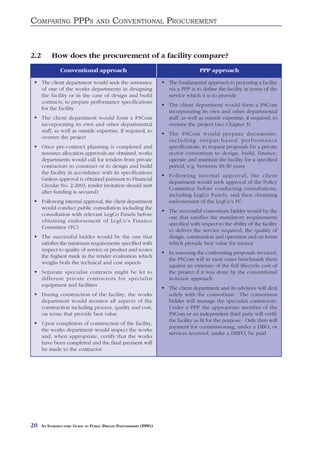
  • 19.
    WHAT IS A PPP AND WHAT ARE THE BENEFITS? Success Factors: High level support - Obtain top level support/commitment at an early stage Project champion - Assign a project leader at sufficiently high level (preferably at directorate level) to lead the project Maintain momentum - Set a realistic project plan with appropriate milestones for different stages of the project development process - Adhere to the project plan (which will help maintain the enthusiasm and confidence of both the management and staff) Market testing - Conduct a market testing exercise to assess private market interest and capability as well as to solicit market feedback Stakeholder consultation - Consider staffing issues at an early stage - Inform staff early and regularly of developments - Provide opportunity for staff to contribute to the development of PPP proposals - Conduct public consultation at the earliest possible stage and maintain on-going dialogue throughout the preparatory and implementation phases - Involve all interested parties in the consultation exercise. Obstacles: Problems with land use amendments - Consider shifting to the PPP partner the responsibility to seek land use amendments Lack of confidence in the PPP approach, and insufficient experience and expertise - Seek assistance/advice from the EU and other experts when considering the use of PPPs Long contract durations - Put in place procedures to manage change Technological changes - Be mindful of suitability of PPPs for projects involving rapid pace of technological change Lack of public acceptance on the use of PPPs - Avoid granting disproportionate property/commercial development rights - Set the strategy/plan for stakeholder consultation at the very beginning - Consult and enlist support of the public and LegCo at the earliest possible stage - Put emphasis on some key messages during the stakeholder consultation exercise. 18 AN INTRODUCTORY GUIDE TO PUBLIC PRIVATE PARTNERSHIPS (PPPS)
  • 20.
    WHAT IS A PPP AND WHAT ARE THE BENEFITS? 2 COMPARING PPPS AND CONVENTIONAL PROCUREMENT 2.1 How does the PPP approach compare with conventional procurement? Both approaches require the client department to start by: Establishing the need for a service, a facility or a set of facilities; in some instances ‘bundling’ a number of smaller projects may be used to secure economies of scale Identifying a likely location or locations for the service or facilities (this is occasionally not required for a PPP project delivering only a service, not a facility) Establishing whether there is general budgetary cover for any associated government expenditures, both capital and recurrent. Many projects will not be entirely self-financing Considering affordability and value for money issues. Thereafter, the two approaches may diverge considerably. A PPP focuses on the procurement of a service, even though commonly associated with the construction of a facility to deliver the service. The conventional approach starts with the main focus on acquiring a facility. There are also considerable differences as to the sequence of events. Procurement activities concerning design, construction, operation and maintenance of a facility, which are generally dealt with separately under the conventional approach, tend to be grouped under the PPP approach. The PPP approach also tends to shift some responsibilities from works departments such as Architectural Services Department (Arch SD) to the client department and/or the private partner. ETWB Technical Circular (Works) No. 4/2006 stipulates the guidelines and procedures for the delivery of projects in the Capital Works Programme (CWP). ETWB Technical Circular (Works) No. 32/2004 provides a reference guide on procurement approaches and associated project delivery techniques commonly adopted for public works. AN INTRODUCTORY GUIDE TO PUBLIC PRIVATE PARTNERSHIPS (PPPS) 19
  • 21.
    COMPARING PPPS AND CONVENTIONAL PROCUREMENT 2.2 How does the procurement of a facility compare? Conventional approach PPP approach The client department would seek the assistance The fundamental approach to procuring a facility of one of the works departments in designing via a PPP is to define the facility in terms of the the facility or in the case of design and build service which it is to provide contracts, to prepare performance specifications The client department would form a PSCom for the facility incorporating its own and other departmental The client department would form a PSCom staff, as well as outside expertise, if required, to incorporating its own and other departmental oversee the project (see Chapter 3) staff, as well as outside expertise, if required, to The PSCom would prepare documents, oversee the project including output-based performance Once pre-contract planning is completed and specifications, to request proposals for a private resource allocation approvals are obtained, works sector consortium to design, build, finance, departments would call for tenders from private operate and maintain the facility for a specified contractors to construct or to design and build period, e.g. between 10-30 years the facility in accordance with its specifications Following internal approval, the client (unless approval is obtained pursuant to Financial department would seek approval of the Policy Circular No. 2/2003, tender invitation should start Committee before conducting consultations, after funding is secured) including LegCo Panels, and then obtaining Following internal approval, the client department endorsement of the LegCo’s FC would conduct public consultation including the The successful consortium bidder would be the consultation with relevant LegCo Panels before one that satisfies the mandatory requirements obtaining endorsement of LegCo’s Finance specified with respect to the ability of the facility Committee (FC) to deliver the service required, the quality of The successful bidder would be the one that design, construction and operation and on terms satisfies the minimum requirements specified with which provide best value for money respect to quality of service or product and scores In assessing the conforming proposals received, the highest mark in the tender evaluation which the PSCom will in most cases benchmark them weighs both the technical and cost aspects against an estimate of the full lifecycle cost of Separate specialist contracts might be let to the project if it was done by the conventional different private contractors for specialist in-house approach equipment and facilities The client department and its advisors will deal During construction of the facility, the works solely with the consortium. The consortium department would monitor all aspects of the bidder will manage the specialist contractors. construction including process, quality and cost, Under a PPP, the appropriate member of the on terms that provide best value PSCom or an independent third party will verify the facility as fit for the purpose. Only then will Upon completion of construction of the facility, payment for commissioning, under a DBO, or the works department would inspect the works services received, under a DBFO, be paid and, when appropriate, certify that the works have been completed and the final payment will be made to the contractor 20 AN INTRODUCTORY GUIDE TO PUBLIC PRIVATE PARTNERSHIPS (PPPS)
  • 22.
    COMPARING PPPS AND CONVENTIONAL PROCUREMENT 2.3 How does the procurement of a service compare? Conventional approach PPP approach The service element of the project is divorced The PPP approach requires the client from the asset acquisition phase; any risk that department to focus on the long-term quality the facility will not deliver the service quality of the service outcomes required and structure required lies with the client department the procurement process accordingly. Consortium bidders will be provided with The client department would make arrangements targets and incentives to ensure that the for the operational aspects of the facility. This outcomes are achieved would include cleaning and security, and the maintenance and repair of the facility. This may As well as defining the facility acquired in terms involve a mixture of permanent and contract staff of service delivery, a range of further services from the client department, Electrical and will often be procured Mechanical Services Department (EMSD) and Sometimes these will be the subject of a works departments, and a mix of different separate ‘Operation and Maintenance (O&M)’ outsourcing contracts contract, which may include mid-life capital expenditure. Services such as operation of water supply/sewerage services, office cleaning, or road maintenance could be covered under these types of contract. Such contracts may also cover service with respect to existing assets 2.4 How does the funding of, and payment for, a facility/service differ? Conventional approach PPP approach The funding of the capital and recurrent costs The government would normally pay the would normally come from a range of different winning bidder only after the facility was sources within the government operational, and then payments would be only for “availability” and services provided according The costs of the preparatory design and to the contractual specifications supervisory work for the construction contracts and the capital costs of construction works would Payments under a PPP will most often be be met from the Capital Works Reserve Fund combined within a unitary charge, paid at regular (CWRF) intervals throughout the life of the project. The unitary charge will incorporate elements of Progress payments for the facility would be made amortised capital costs paid out of the CWRF upon certified completion of different stages of and/or recurrent costs paid out of the client design and construction department’s Recurrent Account The operational costs would be met from the An alternative, under a DBO, is for initial capital client department’s Recurrent Account costs to be paid during the construction/upon Occasional expenditure on replacement plant and commissioning of the facility, and only recurrent equipment would come under the department’s and capital replenishment costs to be covered Capital Account/CWRF as appropriate by the unitary charge AN INTRODUCTORY GUIDE TO PUBLIC PRIVATE PARTNERSHIPS (PPPS) 21
  • 23.
    COMPARING PPPS AND CONVENTIONAL PROCUREMENT Conventional approach (cont’d) PPP approach (cont’d) Similarly, in works departments, expenditure Payments would be subject to satisfactory under various departmental subheads would take performance in the provision of services on the place over the life of the facility part of the consortium Payments could include incentive elements where performance targets are set If the consortium fails to meet performance standards by delivering the services as specified in the contract, or fails to rectify defects at its own expense within specified timeframes, the payments will be abated, deferred, or halted in accordance with the terms of the contract 2.5 How in each case will the whole life costs be assessed? Conventional approach PPP approach Usually only direct incremental costs are assessed Estimates of the whole life costs of the facility/ service will be developed by the public sector, The government does not always prepare an for the purpose of benchmarking bids, and by assessment of the likely full costs of providing the private sector; using the same period of time services over the lifecycle of a facility to ensure a common basis for comparison The estimated cost is only an estimate, and cannot The bidder’s price will normally incorporate a be assured unless a binding contract for its formula to take account of inflation/deflation provision has been let Costs are expressed on a Net Present Value Subject to budgetary and management control, (NPV) basis to enable comparison between the costs of a new facility/service are open-ended options with different cashflow profiles The consortium is committed to the costs it submits in its bid, which are then included in the signed contract 2.6 Are PPPs more adversarial than conventional procurement? PPP projects are based on long-term relationships where a successful outcome is best achieved through partnership. This should be less adversarial. If it is to be so, it is essential that departments and contractors work together closely to achieve successful outcomes. The main elements of a successful relationship between the public and private sectors are to: Select a consortium that shares similar attitudes and approaches to key issues Adopt a partnership attitude supported by the right contractual framework and a high level of detail and clarity in the definition of service level requirements and risk allocation Have the right skills mix present at the right time Have the desire to make partnership work in practice Maintain transparency by all parties. 22 AN INTRODUCTORY GUIDE TO PUBLIC PRIVATE PARTNERSHIPS (PPPS)
  • 24.
    COMPARING PPPS AND CONVENTIONAL PROCUREMENT A PPP contract may become adversarial if these principles are not followed. Partnership does not mean the client department accepting poor performance; it means ensuring the consortium achieves its performance goals as specified in the contract (see Chapter 8). 2.7 Do PPP projects take longer to get underway? A PPP involves one set of contracts to cover the whole lifecycle of a service; conventional procurement is more sequential, involving first a design contract, then a construction contract (or a design and build contract), and finally one or more service contracts. As a result visible progress on a conventional project is often quicker. Experience elsewhere has shown that faster construction under a PPP recovers much of the time spent on the longer preparatory period. Annex A shows a typical timeline. Australian and UK experience in deal closure has seen dramatically reduced times for finalising PPP contracts. This is largely due to the development of detailed contractual terms over time which have evolved and represent an acceptable balance of risk and reward to both the public and private sectors. 2.8 If a PPP proposal does not provide value for money, will this lead to delay? In the absence of receiving a value for money PPP bid, the department should reconsider whether to continue with the PPP approach. If so, much of the preparatory work for the PPP procurement, e.g. outcome specifications and designs submitted by PPP bidders may be used for the conventional approach. Client departments should not assume they become the owner of designs submitted in bid documents (without any contract acceptance in place). One approach is to put in PPP procurement documents a clause to the effect that the client department can use submitted architectural and other designs even though the PPP approach itself was not accepted or the bid by that particular private sector proponent was not accepted. Such a clause must be carefully drafted and both the commercial and intellectual property rights issues should be addressed. Government must exercise good faith in this respect. Careless or reckless use of this contingency could easily damage the reputation of the Government’s PPP programme in the eyes of the business community. It should be noted that in other countries, bidders sometimes submit outline designs only (because of time and cost constraints) in response to the Request for Proposal (RFP). These are then developed into detailed designs during the negotiating phase. Departments would need to ensure that the issue of liability in case of design failure is addressed. AN INTRODUCTORY GUIDE TO PUBLIC PRIVATE PARTNERSHIPS (PPPS) 23
  • 25.
    ESTABLISHING A PPP PROJECT 3 ESTABLISHING A PPP PROJECT 3.1 When does the client department decide to use the PPP approach? Once the client department has identified a project or a service that is required, and is considered to have potential as a PPP, a feasibility study (a stage 1 business case study - see Chapter 4) should be conducted. A decision to proceed with the PPP approach would usually follow from the feasibility study recommendations which should address the following: Providing service specifications, which can be agreed upon by stakeholders and tested in the market Assessing the financial viability of the project Whether the client department has the necessary legal powers to let successfully a contract for the provision of the service in question and, if not, what can be done to address the absence of such powers e.g. amending existing legislation. 3.2 Do we need to create a Public Works Programme (PWP) item for PPP projects? For publicly-funded PPP projects, e.g. DBO contracts it is obvious that a PWP item should be created. However, it is equally important for a number of reasons that a PWP item should be created for privately financed projects, including those that are expected to be financially free standing: To ensure that funding support is secured for any capital or recurrent implications arising from the project To enable departments to proceed with the various technical and other studies that departments need to conduct prior to the RFP using the appropriate CWRF Block Votes (not exceeding $21M in cost) as in the conventional PWP process To demonstrate to potential bidders that government can procure the project in the conventional way if no value for money PPP bids are received or the PPP process does not result in a satisfactory outcome. 3.3 Must we decide on the PPP approach before creating a Category C PWP item? Departments are required to prepare a Project Definition Statement (PDS) (viz. project justifications and the user requirements/service specifications) and a Technical Feasibility Statement (TFS) (mainly to establish the technical feasibility on a prima facie basis with a reasonable cost estimate) which are prerequisites for creating a Category C PWP item. It is not necessary to have decided on the PPP approach by this stage. If the department intends to pursue a PPP approach it may conduct a PPP business case study either before upgrading a Category C project to Category B, if the departmental budget has funds available. Where appropriate, the cost of such studies can be charged to the relevant CWRF block votes after the project has Category B status. 24 AN INTRODUCTORY GUIDE TO PUBLIC PRIVATE PARTNERSHIPS (PPPS)
  • 26.
    ESTABLISHING A PPP PROJECT 3.4 Is there a minimum capital cost for a PPP project? The cost involved in procuring PPP projects dictates that it is not worthwhile to do so for small value projects. For example, the UK Treasury has indicated a minimum capital value of £20M is appropriate, whilst Singapore has set the bar at S$50M. As a rule of thumb, any proposed project with an expected capital cost of less than HK$300M would likely find the traditional procurement approach more suitable. Projects with a capital value of less than $300M can still be pursued as PPPs if, for example, two or more similar projects can be bundled into one PPP contract. Alternatively, a series of replicable smaller projects, e.g. schools (with capital costs of about $100M) may still be suitable as the costs of procurement will fall as more similar projects are implemented. 3.5 Do we need community endorsement of a project proposal? Like any project, the ultimate success of any PPP project is due, in part, to ensuring that those individuals or bodies who are directly interested in the project are kept fully informed and properly consulted at all stages of the project. Stakeholder consultation should therefore be: Extensive and involve all interested parties Open and transparent, providing as much information as possible Conducted at the earliest stage possible On-going, maintaining effective dialogue throughout the preparatory and implementation phases Comprehensive, covering all aspects of the project that are of interest to stakeholders. The Chief Executive, in his 2007 Election Platform Policy Blueprint, stated that the focus of decision making in the future Government would be public engagement. There is no hard and fast rule for conducting public engagement and bureaux/departments should tailor their engagement plans to suit individual circumstances. It is important to match different stages of the public engagement process into the development of a PPP project. Typical stakeholders in a PPP project include: Relevant policy bureaux/departments Service users Staff members being affected Politicians, interest/pressure groups Local community General public. The level of consultation for a PPP project may need to be greater than that for a conventional procurement. There can be considerable misunderstanding of the PPP process. The principles of transparency and accountability mean that it is important for the client department to explain the project to interested and affected parties. For example, using a PPP for the provision of a hospital may only involve the delivery of physical facilities and ancillary services, with the clinical services continuing to be publicly provided. However, the public and staff might fear that public health care was being privatised. Early and thorough communication with all stakeholders can minimise the likelihood of such misunderstandings. AN INTRODUCTORY GUIDE TO PUBLIC PRIVATE PARTNERSHIPS (PPPS) 25
  • 27.
    ESTABLISHING A PPP PROJECT The stakeholders in a prison redevelopment PPP project, for example, would include: Security Bureau Correctional Services Department Financial Services and the Treasury Bureau (FSTB) Prisoner welfare groups Prison visitors Correctional Services Department staff/staff associations LegCo Members Local communities near the prison site, e.g. relevant District Councils General public. Communication will require careful handling in those cases where existing services are to be transferred from the public to the private sector. 3.6 Is Legislative Council (LegCo) approval of a financially free- standing project necessary? A financially free-standing project would not require any formal financial approvals from LegCo. However, it should be borne in mind that most PPP contracts are likely to be lengthy and of relatively high value. Departments are advised to consult the appropriate LegCo Panel in line with policies on accountability and transparency. Potential bidders, and their financiers, would take into account the degree of political support for a project when considering whether to bid, and how to price their bid. Apart from the required approval from the Executive Council (ExCo), a project where the Government intends to grant land for less than the market value would normally require consultation with the LegCo. A further consideration is whether Government retains risks that would have consequences for the public purse. Such risks would include discriminatory changes in legislation or regulation, e.g. more stringent air emission standards for an incinerator, or higher quality standards for a water treatment works. Potential bidders would also see LegCo endorsement as providing greater certainty that the project will be successfully implemented. In privately financed projects lenders will wish to confirm as a condition precedent to the drawdown of any loans that all required approvals are in place. There should be no uncertainty surrounding the need for LegCo approval. Where a bidder requests loan guarantee or other forms of financial undertaking from Government, this requires FC’s approval. 3.7 What funding approvals are required? After establishing the stage 1 business case for a project, the client department should submit via its policy bureau a bid for funds through the Resource Allocation Exercise (RAE) process. For capital costs, the bureau will need to secure capital funding under the CWRF. For other costs required during the operation phase, the bureau will need to confirm whether it can absorb the recurrent funding or whether it needs topping up from the centre. The bureau may need to invite the Policy Committee and/or ExCo where appropriate, to approve the PPP proposal, having regard to the staff, land and financial implications. Specifically, the Policy Committee/ExCo paper will need to set out not only the costs involved but also in consultation with the Treasury Branch (TsyB) of FSTB, an assessment of whether and how the proposal will affect the budgetary expenditure guidelines, and whether revenue will be diverted to the private sector or otherwise hypothecated (see Question 7.5). 26 AN INTRODUCTORY GUIDE TO PUBLIC PRIVATE PARTNERSHIPS (PPPS)
  • 28.
    ESTABLISHING A PPP PROJECT The client department would normally present the project first to the relevant LegCo Panel. Thereafter, the department will need to seek approval from the Public Works Subcommittee (PWSC) and FC for the capital works funding involved. The recurrent funding required would be examined by TsyB in the context of the PWSC submission. FC’s approval is required for other forms of financial undertaking of Government, e.g. loan guarantee. A set of procedures, and a procurement flowchart are at Annexes B and C respectively. 3.8 Should client departments conduct technical assessments prior to inviting proposals? Departments will need to ensure that the relevant legislation, e.g. the Environmental Impact Assessment Ordinance (EIAO) (Cap 499), is complied with in respect of designated projects. Departments should conduct appropriate preliminary environmental, traffic and engineering feasibility assessments, sustainability, socio-economic, heritage and regulatory/business impact studies, as part of the business case exercise, before inviting proposals in order to assess the practicability, viability and justification of the desired facility or service. The information derived from these will help potential bidders in the preparation of realistic proposals, as well as guiding the client department on the standards that can be expected of bidders. It will also give comfort to potential bidders about the risks that they will have to bear, and will tend to lead to lower bid prices if those risks are identified and capable of quantification at an early stage. The client department will make available, with express provisions disclaiming liability, the data, information, and reports obtained from these assessments. Bidders will therefore carry the risk of making their own assessments and the time required for any studies that the successful bidder will have to conduct should be factored into the project timetable. 3.9 Are PPPs consistent with Government’s sustainable development policy? Yes. The Sustainability Assessment (SA) system integrates sustainability principles into the government’s decision-making process. It provides a structured framework for departments to identify the sustainability implications associated with a major proposal, including a PPP. Departments are required to use the SA as a planning tool as they commence the planning or formulation of new proposals that may bring about significant or prolonged implications on economic, social and/or environmental conditions. Departments are required to: Include a paragraph in their submissions to the Policy Committee or ExCo setting out the sustainability implications Conduct a SA of their proposals before public consultation, and incorporate the main SA findings into relevant consultation documents Incorporate the requirement for SA into their business case, planning or feasibility studies This requires prior clearance with the Sustainable Development Division (SDD). Departments are encouraged to consult the SDD as early as possible. The Guideline on Sustainability Assessment (SA No. 1/2006) can be downloaded by departments from http://sdu.host.ccgo.hksarg/index.htm . AN INTRODUCTORY GUIDE TO PUBLIC PRIVATE PARTNERSHIPS (PPPS) 27
  • 29.
    ESTABLISHING A PPP PROJECT 3.10 Can we encourage ‘green’ or ‘sustainable’ buildings? Experience in numerous PPP markets demonstrates that PPPs provide a good opportunity to encourage green or sustainable buildings. Green buildings are more environmentally friendly than the norm and, typically, will involve less wasteful construction, use less water and energy, and produce fewer polluting emissions and waste. Sustainable buildings embrace economic and social dimensions as well as being environmentally more friendly. Many traditionally procured buildings are neither green nor sustainable, largely because of the disconnection between designers, constructors and users. The whole of life approach used in PPPs encourages and incentivises the development of green and sustainable buildings. The Building Environmental Assessment Method Society provides advice and assistance to both public and private sectors. 3.11 Are green and sustainable buildings more expensive? The cost of designing and building green and sustainable buildings may be higher than traditional approaches. However, the lifecycle costs will often be lower, and a building’s productivity should be higher, producing better value for money. The greatest impact on producing green and sustainable buildings is achieved during the design stage. Over the lifetime of a typical office building the costs of running a public service constitute about 75% of the total cost, compared to less than 10% for the construction cost, including less than 1% for the design. A modest increase in upfront investment in the design can produce significant cost reductions and other benefits over the life of the facility. Apart from environmental benefits and cost reductions, well designed buildings can improve occupant comfort which, in turn, improves productivity, and reduces staff sick leave etc. 3.12 Do we need to take account of the rights of minority or disadvantaged groups? We expect all contractors to comply with any legislative requirements. There are also requirements for contractors to avoid exploitation of non-skilled workers. Please see the EU’s Policy and Practice Guide and the User Guide to Contract Management for details. In addition, client departments will seek to get a private partner that aligns with its own values and beliefs (see Question 5.1), which should include respect for the rights and needs of all members of the community. 3.13 Are there any specific gender issues? Any department considering legislation, public policy or programmes is required to promote the elimination of discrimination against women. In the PPP context this might, for example, involve ensuring that the contractor’s female employees are given equal employment opportunities and pay. The Labour and Welfare Bureau can advise details of gender mainstreaming requirements. 3.14 Can the private sector propose unsolicited projects? The private sector may bring unsolicited ideas to the Government but, usually, a competitive bidding procedure would still be required to demonstrate value for money and to guarantee probity. 28 AN INTRODUCTORY GUIDE TO PUBLIC PRIVATE PARTNERSHIPS (PPPS)
  • 30.
    ESTABLISHING A PPP PROJECT Although the risk of entering into a competitive process on the basis of a submitted idea might deter the private sector from bringing such ideas forward, only in limited circumstances would the Government grant a private party an exclusive mandate to fully develop a proposal on a non- competitive basis. Such circumstances would be rare, e.g. where the intellectual property in the proposal is of such outstanding value that a competitive market for the service would not exist. The client department would still have to satisfy itself that good value for money would be achieved and alternative means to deliver the same end result did not exist. 3.15 What should be the duration of a PPP contract? The underlying principle is that the duration selected should result in best value for money. Subject to circumstances, it is generally most efficient if the contract length is somewhere between a half and the whole of the useful life of the main assets. Factors such as service requirements of the client department and the likely terms of debt obtained by the private partner will also be relevant. A shorter contract duration might require debt to be paid off and equity returns to be earned over an artificially short period, putting upward pressure on the payments to be made by the client department. A longer duration would allow a longer debt service period. In some overseas PPP projects, contract periods are well short of the design life of the asset, to ensure that a valuable residual interest in the asset is available to the government at the end of the contract. The transfer conditions in the contract need to be crafted to this end. A positive aspect for the financial community in this scenario is that the asset and its residual value could then be used for redevelopment. If the client department’s period of service requirement is significantly shorter than the life of the main assets, the department would be advised to reconsider the whole project, not just the PPP approach. 3.16 What is the Project Steering Committee (PSCom)? This is similar to the ‘Project Steering Committee’ used in the management of multi-disciplinary projects by works departments. The role of the PSCom would be to oversee the progress of the project from start to finish, give general direction of the project and make major policy decisions. The PSCom is not a contract administrator for the day-to-day contract administration. The PSCom will either be chaired by or report to the officer in the client department with overall authority for the project. The composition of a PSCom should be limited to an optimal size for effective operation. For example, sub-groups on different expertise fields could be formed separately and only the sub-group chairman representing the interest and concerns of the corresponding sub- group members would be members of the PSCom. The PSCom should contain the experience and expertise appropriate to its needs, and include/ employ the services of an experienced Contract Manager responsible for day-to-day management and capable of ensuring adherence to the desired project timetable. In addition to members of the client department’s own staff, the PSCom might include architects, engineers with various specialisations, lawyers, and financial advisors; it may contain individuals from both within and outside the government; and its composition may change according to need at different stages of the project. Where advisors to the PSCom are employed from outside government, the client department will need to ensure against any conflict of interest arising. The client department should contractually prohibit advisors from later working on the same project for private sector bidders where this might risk the tailoring of advice or the use of inside information. AN INTRODUCTORY GUIDE TO PUBLIC PRIVATE PARTNERSHIPS (PPPS) 29
  • 31.
    ESTABLISHING A PPP PROJECT Under the conventional procurement approach the Works Branch and works departments may serve as the works agent of the client department. Under the PPP approach, the client department is responsible for forming its own PSCom which should possess the necessary skills and knowledge to manage the contract during different stages of the project. 3.17 Is there a role for the works departments on the PSCom? Departments should generally invite staff from works departments to join the PSCom, where they can act as technical advisors and assist in drawing up the output/outcome specifications, setting performance standards and advising on work practices. Works departments may also assist in a regulatory and monitoring role throughout the contract period. 3.18 Why appoint outside advisors to the PSCom? The public sector has limited experience and expertise in delivering PPP projects. External advisors can often offer a wider range of skills and commercial perspectives and experience than is available in-house, e.g. writing output/outcome specifications; negotiating complex infrastructure contracts that underpin PPP transactions; understanding the financial products that investment bankers promote to underwrite such transactions; and in contract management (see Chapter 8). Appointing the right consultants and making sensible use of them will help to address this skills deficit. Heads of Department should seek to transfer such skills to in-house staff wherever practicable, for example, by teaming up in-house staff with outside consultants. At each stage in the PPP approach, the client department should undertake a competitive tendering process to employ the necessary outside advisors. The EU will be able to provide help in assessing the need for and recruiting the necessary outside advisors. 30 AN INTRODUCTORY GUIDE TO PUBLIC PRIVATE PARTNERSHIPS (PPPS)
  • 32.
    ESTABLISHING A PPP PROJECT 4 MAKING THE BUSINESS CASE 4.1 How do we make the case for a PPP? As with any major government project that involves changing the way government business is done the first step is to ensure that there is a case (a business case) for proceeding. A business case addresses the issues that the proposal seeks to resolve. It will include the compelling case for change, in terms of the existing and future business needs; the options considered; the preferred option that represents the optimum balance of estimated expenditure and revenue, anticipated savings, expected benefits and the risks identified together with risk allocation and mitigation proposals; and an implementation plan to achieve the intended outcome. 4.2 How do we develop a business case? In the early stages it might not be clear whether a PPP or another delivery option will best resolve the issues being considered. Therefore, the development of the business case for a PPP will often be done in two stages. The stage 1 business case study involves a high level selection from among the different delivery options the one that best meets the service needs. In the stage 1 business case study, the options to be evaluated should include those of the public sector (e.g. in-house provision, contracting-in, trading fund, corporatisation, etc.) and private sector (e.g. contracting-out/outsourcing, PPP, etc.). To be considered as having a prima facie case, a PPP should meet most, if not all, of the following criteria: There is a major investment programme, requiring effective management of risks associated with construction and delivery The private sector has the expertise to deliver the programme and there is good reason to think that it will offer value for money The structure of the service is appropriate, allowing the public sector to define its needs as service outputs that can be adequately contracted for in a way that ensures effective, equitable and accountable delivery of public services in the long term Risk allocation between the public and private sectors can be clearly made and enforced The nature of the assets and services identified as part of the project are capable of being costed on a long-term, whole of life basis The value of the project is sufficiently large to ensure that procurement costs are not disproportionate The technology and other aspects are stable and not susceptible to short-term fast paced changes Planning horizons are long term, with assets intended to be used over long periods. If this exercise provides a prima facie case for a PPP, resources would then have to be invested in the stage 2 business case study. The stage 2 business case study focuses on confirming the justifications for the PPP option and setting out its details and requirements so that a final go ahead can be sought prior to the procurement. The stage 2 business case study should include a detailed analysis of the AN INTRODUCTORY GUIDE TO PUBLIC PRIVATE PARTNERSHIPS (PPPS) 31
  • 33.
    MAKING THE BUSINESS CASE likely costs, benefits and risks of the PPP option to the government, baseline costs, PSC, critical success factors, project management and implementation plan, procurement strategy, risk management strategy, benefits realisation plan, etc. It should be noted that some of the issues will be covered in both stages 1 and 2 of the business case study, e.g. evaluation of options, selection of the preferred option, etc. Stage 1 addresses the issues at a higher level and in less detail. With more information available, stage 2 will review, validate and update the assumptions and estimates made earlier and map out the way forward. For example high level cost estimates gathered from a market-testing exercise might be sufficient for comparing different options in stage 1; whereas a properly prepared PSC will be required to demonstrate value for money of a PPP in stage 2. The EU plans to issue a Government Business Case Guide in 2008 to provide more guidance on the conduct of business case studies. 4.3 What is value for money? As with other procurement methods, the lowest priced option does not necessarily offer the best value for money. Value for money refers to the best available outcome taking account of all benefits, costs, and risks over the whole life of the procurement. Value for money is determined through a comparative analysis of the benefits, costs and risks of the available procurement alternatives. Assessing the value of these variables requires a degree of judgment and the use of both quantitative and qualitative analysis. Value for money combines economy, efficiency and effectiveness. It can manifest itself as: Delivery of a service capability at a lower cost Greater certainty of an expected financial outcome due to less exposure to significant risk Increased benefits to the end user of a service due to the public sector’s focus on service delivery rather than asset procurement. Assessment of value for money is not in itself affected by the budget impact of alternative procurement methods. The assessment should also be independent of the accounting classification of a private financing arrangement i.e. whether or not any borrowing is off the government’s balance sheet. The budgetary implications of alternative procurement methods should be considered separately as part of the government resource management framework. PPP procurement inclusive of private financing should be used where it offers superior value for money compared with other procurement methods. 4.4 What is a Public Sector Comparator (PSC)? A PSC is an estimated, risk-adjusted, cost of the government itself delivering the project output. The PSC is expressed in terms of the net present cost to the government of providing the output under a public procurement, using a discounted cashflow analysis that adjusts the future value of the expected cashflow to a common reference date. This enables comparison with bids and makes allowance for the imputed cost of government borrowing. The PSC has three core components: Raw PSC: the base cost of delivering the services specified in the project brief under the public procurement method where the underlying asset is owned by and the service delivered by the public sector Competitive neutrality adjustment: this removes any net advantages or disadvantages that accrue to a government run service by virtue of its public ownership, e.g. the non- payment of insurance premiums or taxes by a government run transport service 32 AN INTRODUCTORY GUIDE TO PUBLIC PRIVATE PARTNERSHIPS (PPPS)
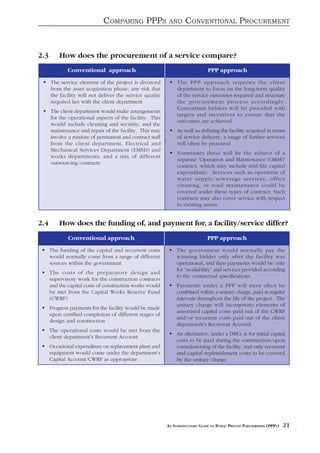
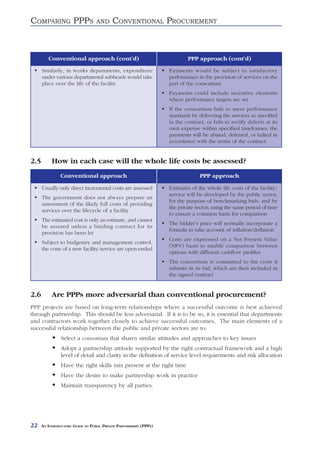
  • 34.
    MAKING THE BUSINESS CASE The value of transferable risks: risks which the government would bear under a public procurement but is likely to transfer to the private sector. A further component, the value of retained risks (risks that are likely to be retained by the government and are reflected in the Raw PSC) may be calculated and added to each private sector bid. This will be necessary if different bidders accept different levels of risk transfer. 4.5 Why do we need a PSC? While competition encourages the private sector to submit more efficient bids, there is often a need to have a PSC to objectively compare the costs of the best PPP option against the public sector alternative. In addition to providing the basis of comparison between the PPP and the public sector alternative, creating a PSC has the following benefits: Encourages the early appraisal of project risks and their allocation between the public and private sectors Improves bidder confidence in the tendering process and encourages bidder competition Encourages the closer alignment of private sector bids with government needs and risk transfer profiles, thus reducing bidding costs and timescales. The PSC is part of a broader value assessment of bids and bidders that takes into account qualitative as well as quantitative factors. 4.6 Must we always construct a PSC? A PSC need not be constructed where a firm decision has been made that the PPP approach is to be followed for policy or qualitative reasons, or where no public money is involved because the project is financially free-standing. Nonetheless, to establish value for money and make the business case for the project, a Raw PSC will normally be constructed, especially if there is to be some public contribution such as the creation of infrastructure, or if public land is to be provided at less than full market value. A further advantage to creating a PSC is to provide a benchmark of what the government believes is an appropriate level of investment. It is advisable to construct an initial PSC as early as possible. This allows the client department to ascertain the expected full cost of pursuing the project by traditional means. Second, it allows the client department to inform potential private partners of the scale of the project at an early stage. 4.7 How is the PSC developed? Annex D provides an outline of how to construct a PSC. External help from consultants will often be required. 4.8 How accurate are calculations of the PSC? The PSC is an estimate based on an outline Reference Project. Experience overseas indicates that the PSC cannot be calculated exactly. It should be expressed as a range of values (reflecting the accuracy and reliability of the available information) and used as only one component of the overall value assessment, not as a pass/fail test. Other components used in assessing the value for money of bids may include: AN INTRODUCTORY GUIDE TO PUBLIC PRIVATE PARTNERSHIPS (PPPS) 33
  • 35.
    MAKING THE BUSINESS CASE The quality/quantity/range of service deliverables The operational commencement date Any non-quantifiable risks absorbed by the private partner The reputation and financial standing of the private partner. These components may be evaluated prior to consideration of the costs. There is a general tendency worldwide for project estimates to be over optimistic both as to cost and time to complete. The UK National Audit Office has shown that this tendency is mitigated in more than three out of four cases when using a PPP. In Hong Kong, an EU analysis has shown that the tendency to over optimistic forecasting is more prevalent with regard to time than it is to cost; in any case care needs to be taken to ensure that the PSC uses valid and carefully constructed estimates for time, cost, etc. However, it is sometimes difficult to assess the on-costs in estimating the construction costs of certain facilities due to the lack of relevant examples. 4.9 Is it advisable to disclose the PSC to bidders? The PSC will often be public knowledge by the time of the RFP as it will normally have been disclosed to LegCo’s FC in the course of obtaining funding approval to proceed with the project. According to Stores and Procurement Regulations (SPR), if the estimated contract value has been disclosed to the public, departments should, in all fairness, inform bidders of the estimated contract value. However, if the information has not been disclosed publicly (e.g. in financially free-standing projects), it is not necessary to disclose the PSC. Providing the PSC to bidders will discourage them from submitting bids that are higher than what is in effect the project’s financial ceiling and, provided that there is sufficient competition among bidders, it would not discourage bidders from submitting low bid prices. 4.10 Can the PSC be updated during the procurement process? Once a business case is established, it may not be worthwhile to update the PSC (except for circumstances where there is a lengthy lapse of time) unless the bidding prices are much higher than the PSC and the client department has to reassess whether to proceed with the PPP project. Current practice in the UK is not to update the PSC as it is used only to determine the case for the project to be a PPP. The competitive bidding process is used to determine what is the best value for money proposal. 4.11 Should the client department allow additional services to be provided under the contract? Departments should consider whether to seek or be prepared to accept proposals for enhanced facilities/services or other commercial facilities on the site, having due regard to their impact on the delivery of the required services. The benefits of permitting the provision of facilities/services over and above those required by the client department may include: Better site utilisation The provision of additional facilities/services for the community Additional revenue for the consortium/government Cheaper public facilities/services. 34 AN INTRODUCTORY GUIDE TO PUBLIC PRIVATE PARTNERSHIPS (PPPS)
  • 36.
    MAKING THE BUSINESS CASE The provision of additional services/facilities might make a major contribution to the value for money and even the viability of a project. If so, bidders’ proposals for and proven abilities in providing such facilities should be a key factor in proposal evaluation. If the department is prepared to accept additional services/facilities, it should ensure that any constraints are made clear to all concerned in the process of developing the project, and should be made clear in the RFP documentation. Constraints might include: Compatibility with the zoning on the town plan Restrictions on the development parameters permitted for the site such as the Gross Floor Area (GFA), plot ratio, building height and site coverage Sensitivities over issues such as alcohol, tobacco and gambling-related or immoral activities The ratio of required to additional activities Other policy and political considerations. For some constraints, the department might wish to work with other government departments to minimise their effect on the project. If the consortium is allowed to keep income from the provision of additional facilities/services, then sufficient management controls and sanctions must be in place to ensure that the consortium will not be distracted from the delivery of the required services, which may be less profitable than the additional services, e.g. the relative share of the additional services and the timing of the revenue generated. Care should be taken to avoid any hypothecation of revenue. The client department may wish to provide sufficient flexibility for the consortium to introduce or change additional activities after the award of contract, subject to the client department’s agreement where appropriate. The client department will also wish to satisfy itself concerning sharing the benefits arising from the additional services, and the fees charged to the public. Departments will need to decide the status of additional services/facilities in the event of the termination of the PPP contract; whether at the contracted date or earlier due to the exercise of step-in rights. They should consider whether the additional services/facilities should or should not revert to the government along with the required services/facilities; and, if so, what conditions would apply and what would need to be done to manage the hand-over. Client departments should note that insofar as land sales are concerned, there is a policy regarding an administrative ban for major modifications within five years of a land sale. These refer to modification proposals for substantial changes/relaxation in respect of the user restriction or development parameters as specified in the land sale conditions. This is to safeguard against possible criticism from other developers i.e. those who were not successful could complain that they would have put in a much higher bid for the site if they had known that the government was prepared to grant such modifications. Other developers who had not submitted any bids previously might also make similar complaints. See also Question 7.15. AN INTRODUCTORY GUIDE TO PUBLIC PRIVATE PARTNERSHIPS (PPPS) 35
  • 37.
    GETTING THE RIGHT DEAL WITH THE RIGHT PRIVATE PARTNER 5 GETTING THE RIGHT DEAL WITH THE RIGHT PRIVATE PARTNER 5.1 How do departments get the right private partner? As with all private sector involvement exercises, a client department will seek to: Conduct market testing to discover if the private sector is willing and able to perform the required tasks Give potential bidders the opportunity to provide feedback on the proposed scheme Give sufficient publicity and time for potential bidders to prepare proposals Provide output/outcome performance specifications that clearly identify the service requirements Arrange briefings and site inspections to ensure potential bidders understand clearly the requirements before submitting their proposals Look for good alignment of the selected consortium with the client department’s values and beliefs Put in place an objective and fair bid assessment process Conduct thorough due diligence to substantiate the preferred bidders’ claims (capability, experience, expertise, financial position etc). The Government wants to encourage the further development of high quality service providers in the market for public services. This requires that a competitive selection process be used which insists on quality services, socially-responsible terms and conditions, and high safety standards. If the Government lays down reasonable expectations, abides by them over time, and provides a level playing field, quality firms will be attracted to the market. This will make it difficult for less socially- responsible service providers to survive. Experience shows that it is competition that delivers the benefits from PPPs, not private provision per se. 5.2 What are the key steps to take in selecting a PPP consortium? For most PPP projects, the following are the usual steps: Conduct a market testing exercise Issue request for Expression of Interest (EoI) from the private sector Pre-qualification of private sector companies including those that have submitted an EoI Issue RFP to pre-qualified private sector companies Exclude proposals not meeting mandatory essential requirements 36 AN INTRODUCTORY GUIDE TO PUBLIC PRIVATE PARTNERSHIPS (PPPS)
  • 38.
    GETTING THE RIGHT DEAL WITH THE RIGHT PRIVATE PARTNER Conduct assessment on the proposals. Negotiate with the one or two best conforming bidders to achieve improvements to bids whilst under competitive pressure. SPR 385(e) states that negotiations shall normally be conducted with only a single tenderer. SPR 300(a)(ii) allows departments to seek the Secretary for Financial Services and the Treasury’s (SFST) approval not to follow SPRs in respect of franchises, concessions etc. (most PPPs are franchises, concessions etc.) It is not normal government practice to negotiate the land premium, if any Select a preferred bidder or bidders to develop detailed, fully negotiated contract documents (reserve the right to revert to alternative bidders if contract negotiations break down) Request best and final offer Recommend the preferred bidder to the relevant bid evaluation committee. 5.3 What is the difference between market testing and Expression of Interest (EoI) exercises? Market testing is an exercise conducted early on, typically during the PPP business case study, where private sector companies are approached to see if the private sector is willing and able to participate in a project, and under what circumstances. Market testing is especially useful when a particular service is being considered as a PPP for the first time. Early disclosure of government’s intentions gives the private sector the necessary time to consider forming business relationships, recruiting staff, acquiring technology and so on. An EoI takes place after policy approval for the PPP approach has been granted. In response to an invitation, companies may indicate their interest in, and ideas for, a project with a view to being invited to submit a proposal at a later stage. 5.4 Do we need to conduct EoI and pre-qualification exercises? An EoI enables client departments to gauge the extent of the available market as well as tap the experience and expertise of interested parties before finalising the scope of basic requirements and additional services/facilities. EoIs are particularly useful when the client department is proposing a PPP approach in a new area. Departments should not expect potential bidders to disclose valuable or commercially sensitive information in an EoI submission. An EoI is not usually used to establish a bidder list; if it is this should be made very clear. A pre-qualification process can reduce the number of bidders to a manageable number. Best practice suggests that a short-list of three to four bidders is sufficient to create adequate competition and cover the risk of a party withdrawing, so long as there is adequate confidence in the capability and motivation of the bidders. A short-list of more than four is likely to lead to some bidders losing interest, as their chance of success (20% or less) may not warrant the significant investment of time and resources in preparing a bid. The proposal and selection processes for substantial PPP projects can be very costly, both for bidders and the client department. Bidders will be sensitive to costs, and should not be compelled to incur excessive costs as a result of unnecessary bid requirements. For some projects, if it can save time and effort all round, the EoI and pre-qualification exercises may be conducted in one go. Care will need to be taken to ensure that sufficiently detailed information can be provided to bidders to achieve the purpose of the combined exercise. AN INTRODUCTORY GUIDE TO PUBLIC PRIVATE PARTNERSHIPS (PPPS) 37
  • 39.
    GETTING THE RIGHT DEAL WITH THE RIGHT PRIVATE PARTNER The PSCom should recommend to the Head of Department, in the light of submissions received, which of those expressing an interest and/or pre-qualifying are to be invited to submit proposals. 5.5 What information should we give at the pre-qualification and Request for Proposal (RFP) stages? The objective must be to give potential partners as much accurate and pertinent information about the client department’s intentions as early as possible. This is to enable potential bidders to put together coherent, sound and innovative proposals, in the full knowledge of the requirements and risks involved, and reduce the likelihood of misunderstandings, withdrawal of bids etc. The most important document to be prepared when inviting proposals will be a properly scoped output/outcome based specification that clearly articulates the department’s needs and service objectives. A clear scope will result in a better assessment of the project’s feasibility and enhance the private sector’s ability to identify and offer best value for money. In many cases the client department will need to undertake some early studies and/or specific site investigation in order to expedite the contracting process and remove avoidable uncertainties that would otherwise affect the costs of the project. Achieving a balance between clear specifications and scope for innovation may be challenging; whatever firm requirements are identified should be clearly identified as such for conforming bids, whilst allowing and encouraging alternative proposals also. Information to be given to potential bidders may include: Carefully designed draft output/outcome-focused specifications A preliminary timeframe for delivery of the service/facility and whether early completion/ delivery is desired or not Land status (i.e. ownership) of the relevant site(s) Where a land lease is involved, the Tender Notice and the Conditions of Sale Zoning on the statutory town plan(s) Information on whether a planning application under the Town Planning Ordinance (Cap 131) or rezoning of the site(s) is required Environmental, traffic, SA or other assessments required from the contractor or already done Draft Service Level Agreement (SLA) Draft contract (also see Questions 5.7-5.9) Proposed performance indicators Proposed step-in and termination provisions Avenues of redress/appeal on the part of the private partner Matrix of proposed risk allocation Preliminary/final Raw PSC estimate Affordability constraints Bid evaluation criteria Insurance cover requirements 38 AN INTRODUCTORY GUIDE TO PUBLIC PRIVATE PARTNERSHIPS (PPPS)
  • 40.
    GETTING THE RIGHT DEAL WITH THE RIGHT PRIVATE PARTNER Whether bidders are required/encouraged to employ serving civil servants, and the terms of transfer requirements Whether bidders may be allowed/encouraged to provide additional services/facilities Whether a lump sum premium or other income/revenue is expected by the government Client department’s proposed payment mechanism(s) (including rewards and abatements) What opportunity there will be for bidders to comment/suggest amendments to the payment mechanism Whether more than one successful bidder is envisaged or desired. Clearly, the information to be provided at the pre-qualification stage may be less precise and comprehensive than that provided at the proposal stage. Information provided by the department must be carefully scrutinised prior to its issue. Client departments should take steps to protect themselves from liability for negligence by using appropriate disclaimer clauses. 5.6 What information do we want from the private sector at the pre- qualification and RFP stages? Clear statements of information such as: - Detailed refurbishment and replacement schedules for project assets - What insurances will be put in place - The terms of employment of project staff - Demonstration of a commitment to ethical practices - Relevant experience of consortium members - Qualifications and experience of key staff - Disclosure on possible conflicts of interest and the proposed mitigation measures - Probity issues - Consortium members’ financial standing - Record of compliance with labour ordinances - Delivery approach and methodologies - Record of innovation - Ideas on basis for remuneration of the consortium. 5.7 Why do PPPs require output/outcome performance specifications? Output/outcome-based performance specifications should be used in all types of private sector involvement projects. They allow the private sector as much flexibility as possible to produce innovative, cost-effective designs of services and infrastructure, on a whole-life cost basis, taking advantage of new and labour-saving technologies and techniques. For example, in a community facility project, instead of input specifications requiring the installation of permanent seating for 1 000 people, the output specifications might require that seating for 1 000 people shall be provided when required. This allows the use of temporary seating. At other times the space could be utilised for other purposes. Nonetheless, some aspects must be specified such as the means of escape and fire services requirements for the 1 000 people would have to be permanent features. AN INTRODUCTORY GUIDE TO PUBLIC PRIVATE PARTNERSHIPS (PPPS) 39
  • 41.
    GETTING THE RIGHT DEAL WITH THE RIGHT PRIVATE PARTNER Output/outcome specifications need to be carefully drafted to drive the behaviour and performance of the consortium and its contractors throughout the life of the project. They should also avoid setting unrealistically high standards; for an existing service if standards higher than those that are currently being achieved are requested then they should be reflected in the benchmarked estimated cost of conventional procurement (the PSC). 5.8 When might inputs need to be defined? Despite the desire to maximise flexibility, it is difficult to achieve 100% use of output/outcome specifications and it will usually be necessary to use some input-based specifications or even an outline design for reference or to ensure a specific need is met, where the facility interfaces with other facilities or there is an interaction with surroundings. Consideration should be given to the need for contracts to contain defined inputs so as to protect the Government’s interests in the event of disputes. For example, an input to provide an Olympic size swimming pool could contain the usual construction schedules and contracts requiring a certain aggregate mix, sand quality and prohibited use of open bags etc. If cracks appear later in the pool walls there are likely to be arguments advanced by the consortium as to the extent of its liability (it may claim mitigation of their liability under the contract due to relief events and possibly even force majeure and compensation events - see Chapter 11). The government will wish to point to and rely upon a breach of the input requirements as to aggregate mix, sand quality and use of open bags etc. 5.9 What are inputs, outputs and outcomes? Inputs refer to the resources deployed by the contractor in the production and delivery of services. Inputs commonly include labour, physical resources, administrative services and computer systems. A typical input specification might be “The contractor shall deploy one security guard at all times at each entrance of all buildings in the estate and security gates shall be locked between 11 pm - 6 am”. Outputs refer to the immediate result of the contractor’s activities. A typical output specification might be “The contractor shall ensure that each entrance of all buildings in the estate is monitored at all times by security staff, and that they respond to requests for assistance within one minute”. Outcomes refer to the longer term impacts of the contractor’s activities. A typical outcome specification might be “The contractor shall take steps to reduce the numbers of reported crimes within the estate by at least 1% each year”. Whilst the use of output/outcome specifications is strongly advocated it is acknowledged that, sometimes, it is necessary to use input specifications to ensure that the public and the department’s requirements are met. For example, in a housing estate it is likely that residents will want to see the physical presence of security guards even though their safety may well be achieved satisfactorily and cost-effectively by the use of electronic and mechanical means. Departments should not lose sight of the human touch. 5.10 What help can be given to bidders during the bidding process? Whilst care must be taken to ensure against actual or perceived favouritism during the bidding process, client departments must be diligent in ensuring that bidders have sufficient access to comprehensive information to provide the best possible proposals. Clarification of requirements should be provided on demand (and shared with all bidders). So long as probity requirements, including documentation of meetings and equality of access and information, are observed, such clarifications can be face-to-face as well as in writing. 40 AN INTRODUCTORY GUIDE TO PUBLIC PRIVATE PARTNERSHIPS (PPPS)
  • 42.
    GETTING THE RIGHT DEAL WITH THE RIGHT PRIVATE PARTNER Procurement should be managed carefully with communication between bidders and the client department going through a single central point. This should help avoid ambiguity, the provision of conflicting information, and duplicate or multiple requests for similar information. Proposal evaluation criteria, for example, should be provided clearly and unambiguously so that bidders are aware of the issues that are of most importance to client departments. At the pre-qualification and/or the initial competitive bidding stages, there may be drawbacks in providing certain information, such as a draft SLA and/or a detailed draft contract. If client departments inform bidders of the detailed contractual terms too early, the scope for negotiating will be limited; the government may be disadvantaged and may not get the best out of what is intended to be an innovative process. On the other hand nugatory work by bidders and client departments may result if bidders are not given clear indications of which items are non-negotiable. SPR 345(c) requires the tender documents to cover a number of things including general and special conditions of contracts. Departments are advised to consult the Department of Justice (DoJ) and FSTB in specific cases. 5.11 How is the principle of non-discrimination applied? All bidding exercises must be conducted in accordance with the principle of non-discrimination. The Government cannot negotiate with a non-conforming bidder with a view to modifying or waiving essential requirements. Otherwise, it would be unfair to other bidders and potential bidders. Depending on the nature of the particular PPP in question, the rules of the WTO GPA do not apply to a concession or franchise. However, it is still necessary for the Government to act fairly. Accordingly, the Government is not free to modify or waive the essential requirements or contractual terms after the closing of the tender exercise without regard to the principle of non-discrimination. For that reason the minimum mandatory/essential requirements specified should be limited to those that are truly essential. 5.12 Does the World Trade Organisation Government Procurement Agreement (WTO GPA) apply to PPPs? Hong Kong’s commitments under the WTO GPA do not cover franchise arrangements, BOT contracts and public works concession contracts. Accordingly, most PPPs complying with the recommended procedures in this Guide will not be covered by the WTO GPA. Departments may wish to check with the International Law Division of DoJ whether specific projects are covered by the WTO GPA. The object of the WTO GPA is to provide open and fair competition amongst domestic and foreign suppliers and service providers through procedures designed to ensure that all tenderers are treated by procurement entities covered by the WTO GPA on an equal footing. It prescribes a set of requirements regarding non-discriminatory treatment of goods, services and service suppliers, qualification of suppliers, tender procedures, tender specifications and challenge procedures. The government’s procurement principles of open and fair competition, transparency, value for money and public accountability are consistent with the spirit and objective of the WTO GPA. 5.13 How does the department negotiate a detailed contract? The negotiation process can involve the two parties physically meeting and negotiating face to face; it can involve the passing of draft documents backwards and forwards; or it can involve a combination of both. Passing draft documents between the two parties is the norm. AN INTRODUCTORY GUIDE TO PUBLIC PRIVATE PARTNERSHIPS (PPPS) 41
  • 43.
    GETTING THE RIGHT DEAL WITH THE RIGHT PRIVATE PARTNER The key objective of the procurement process is to select the right consortium for the project. The bidding and negotiation process must be carefully managed. Negotiating on the detailed terms of the project will only be possible if the Government avoids setting out overly detailed terms/ requirements in the procurement documents in the first place, i.e. if the Government only sets out minimum mandatory/essential requirements in the documents and leaves the detailed terms to be negotiated with the bidders. This flexible approach can encourage innovative solutions by inviting the private sector to come up with proposals but it departs from conventional practice in relation to procurement through an “invitation to tender” (ITT). For PPPs, the Government does not issue an ITT but a RFP. Accordingly, the words “tender” and “tenderers” should be avoided in the RFP documents. The challenge is to create a bidding environment that balances on the one hand the client department’s desire for certainty, the need to maintain competitive tension, and avoid deal creep, and on the other hand the bidders’ wishes to reduce bid costs, and have clear requirements against which to provide innovative solutions. In time the development of standardised contracts, based upon local PPP experience, may assist in these objectives. 5.14 Can we negotiate detailed contracts with more than one bidder? Negotiating detailed contracts with more than one bidder is common overseas to secure the most favourable terms for government, especially where two bids are similar. Approval from SFST is required to negotiate with more than one party. The aim is to maintain the competitive environment as long as possible, to find the right pricing structures and risk allocations and therefore to achieve the best terms. From the Government’s perspective this achieves a balance between certainty and competition, though care will be needed to guard against compensation claims from losing bidders. If detailed negotiations are conducted with more than one bidder, Government will normally negotiate with each bidder on the basis of a set of common terms. Doing so ensures greater simplicity for the client department in terms of its comparison of bids. However, it also carries some risk of loss of innovation and achieving optimum pricing proposals. Nonetheless, the client department should ensure that the RFPs provide clear, well drafted and market oriented requirements and risk allocations to reduce the probability of excessive or highly material variations between bidders. The department will normally use the same negotiating team for negotiations with different bidders and determine the baseline and the parameters before the start of the negotiation process. The department should be adequately resourced to be able to rapidly and thoroughly evaluate the variations proposed, and ensure that all material variations have been fully evaluated by the end of the negotiation phase. It is very important that the Government communicates the process to bidders at an early stage and does not deviate from it. If Government negotiates with only one bidder it should still retain at least one bidder in reserve and not announce the existence of a preferred bidder until the completion of negotiations. The cost of the procurement process - particularly the negotiation phase - can be extremely high, both for the private sector and the Government. If the costs are too high, taking the chance of success into account, many potential bidders will be discouraged from participation with the consequent loss of competition, innovation etc. An appropriate balance needs to be achieved. In some jurisdictions, compensation packages for short-listed bidders are set, or agreed, in advance to encourage full participation. This is not Hong Kong Government practice. 42 AN INTRODUCTORY GUIDE TO PUBLIC PRIVATE PARTNERSHIPS (PPPS)
  • 44.
    GETTING THE RIGHT DEAL WITH THE RIGHT PRIVATE PARTNER 5.15 Who should be in the Government’s negotiating team? One of the challenges facing departments is that few civil servants have experience in negotiating complex commercial contracts. Other jurisdictions faced similar problems when they started their PPP programmes. Whilst there are no fixed requirements on the make-up of the Government’s negotiating team there are a number of lessons learned from elsewhere: In the early projects senior departmental management must commit a considerable amount of their time and attention The lead negotiator must have the authority to negotiate (within the confines of the approved negotiating brief) One of the negotiating team members will often carry on as the Contract Manager (see Chapter 8) after the deal is closed, providing continuity and the institutional memory The lead negotiator may be brought in from either another department or the private sector if the client department does not have the experience and expertise. Departments will need to manage carefully real or potential conflict of interest. The negotiating team should be kept as small as possible to avoid becoming unwieldy. 5.16 Are bid preparation and contract management onerous and time- consuming? Structuring, assessing bids or, awarding and implementing a PPP contract will be a challenging process. Client departments will need a strong in-house team with appropriate external advisory support (see Chapter 8). The bidding process may involve inviting initial proposals from the private sector, evaluation of those proposals, discussion and negotiation with individual bidders in order to obtain best and final offers, and finally selection of the proposal offering the greatest value for money. Once the facility is in operation, the client department will focus on monitoring performance against defined criteria. 5.17 Can the client department select more than one successful bidder? The selection of one consortium, after a competitive bidding process, is the norm. However, there may be circumstances where the client department prefers more than one party to provide the required facilities/services. This might be to ensure that existing competition continues; to prevent the replacement of a public monopoly by a private monopoly; or to reduce the risk of service disruption in the event of staff disputes, bankruptcy etc. In such circumstances, the client department should make clear in the RFP that it is prepared to consider engaging with more than one partner; explain what those circumstances are; and request bidders to put in separate proposals for these different circumstances. Alternatively, client departments could, subject to legal clearance, break up the contract and state clearly that no bidder will be offered more than one contract. The method of determining which contract goes to whom should be clearly spelt out in the RFP document. The successful bidders would have well-defined service areas so that they were not required to compete directly with each other after the competitive bidding process. For example, the Hong Kong Hospital Authority has replaced some of its in-house catering with PPP arrangements at two of its five geographical ‘clusters’ of hospitals. AN INTRODUCTORY GUIDE TO PUBLIC PRIVATE PARTNERSHIPS (PPPS) 43
  • 45.
    GETTING THE RIGHT DEAL WITH THE RIGHT PRIVATE PARTNER 5.18 Can a project proceed if the lowest conforming bid exceeds the PSC? A PSC may be a range rather than an absolute number. If, for example, the lowest conforming bid fell within the range of costs for the PSC, and there were other benefits in terms of quality of service, additional services etc, then the client department would likely feel comfortable to proceed. If the lowest price conforming bid exceeds the PSC the client department would need to ascertain whether there were any other value for money justifications, apart from the price, that would warrant the project proceeding. 5.19 What if the successful bid is considered too expensive? Any successful bid must be better value for money than the other competing bids and provide at least equal value for money as the PSC. If it passes these two tests, there is no basis for saying that it is too expensive. If, for example, the client department’s expected budget is reduced it could always renegotiate the contract. But, the contractor is unlikely to drop the price without competitive pressures from other bidders and perhaps other contract conditions also being changed. For equity and probity it is important to maintain the integrity of the bidders’ offer prices and terms throughout the evaluation and negotiation process. Where the successful bid exceeds the approved project estimate, departments should revert to PWSC/FC on the additional funding required or seek approval of FSTB under delegated authority (if the amount does not exceed $15M). 5.20 How do we guard against artificially low bids? A well-constructed PPP contract will commit the successful bidder to an agreed price for the provision of specified services over a fixed time period. Resolving design flaws or poor construction will be the consortium’s responsibility - at its own cost. If such problems lead to the contracted performance service standards not being met, the consortium will face deferral, withholding or abatement of payments. The consortium’s ability to make claims will be very limited (unless the client department requests changes after the signing of the contract). A properly designed and executed PSC will be useful in alerting a client department to the submission of unreasonably low bids. 5.21 Should we impose a ‘performance bond’ or require other additional security? In some PPP projects, the Government will be contracting with a lowly capitalised consortium with its service delivery reliant on its consortium members and whose main asset will be its interest under the project documents. The Government may therefore require comfort that the consortium and its contractor(s) will be able to meet their contractual obligations. The Government will also wish to ensure that continuity of service is maintained even if a contractor becomes insolvent. The private sector will normally use a SPV to front a consortium or joint venture of private sector participants and their respective shareholders and finance suppliers. The Government will require copper-bottomed assurances that the SPV - a ‘man of straw’ in view of its extremely modest share capital - has and maintains parent company guarantees, bank performance bonds and suitable backing for liquidated damages. Insurance will also be required (see Chapter 6). It may be prudent in some circumstances to require that the consortium provides additional security, such as a fixed and floating charge over its assets. Such security will generally rank behind the security held by the financiers. The first ranking priority, however, may be negotiated for specific amounts owing to the Government, e.g. costs incurred by the Government in the exercise of step-in rights. Sponsor guarantees may also be desirable in some instances. 44 AN INTRODUCTORY GUIDE TO PUBLIC PRIVATE PARTNERSHIPS (PPPS)
  • 46.
    GETTING THE RIGHT DEAL WITH THE RIGHT PRIVATE PARTNER 5.22 What happens at the end of the contract? The land and any buildings thereon will normally revert to the Government at zero value or market rate. The department will have to consider whether it wants any removable assets, e.g. equipment at the end of the contract. The contract should specify the required condition of the assets that revert to Government at the end of the contract. There should be arrangements for joint inspection of the assets, say, two years before the end of the contract, with the private partner being required to make good any deficiencies. The client department will also be entitled to require part of the payments in the final years of the contract to be put into a sinking fund in an escrow account to protect against the possibility of non-performance of the rectification works. If a land lease is involved, the usual arrangement is that the grantee will be required to maintain all the structures and buildings on site in good and substantial repair condition with the same to be handed over to the government upon expiration of the lease term. If it is considered necessary that a vacant site must be returned to the Government, then specific provision will have to be made in the contract to oblige the consortium to demolish the facility before returning the site to the Government. In addition to the handing back of assets, uninterrupted provision of service may be an important consideration. The outgoing consortium may be required to provide training to staff of the client department or an incoming PPP consortium before the expiration of the contract in order to ensure a smooth transition. Appropriate provisions should be incorporated in the contract. Overseas, the assets are sometimes left with the private sector although this is unlikely to be appropriate in Hong Kong. It must be recognised that the requirements laid down for the end of the contract will be reflected in the bid price. The most crucial point is that the client department considers upfront what it wants at the end of the contract and includes this in the Project Agreement. AN INTRODUCTORY GUIDE TO PUBLIC PRIVATE PARTNERSHIPS (PPPS) 45
  • 47.
    MANAGING RISKS 6 MANAGINGRISKS 6.1 What problems may arise in the course of a contract? Well prepared and implemented projects will have a higher chance of avoiding and/or dealing with problems that may arise. Experience demonstrates that for both conventional and PPP procurements poor drafting of the contract/performance requirements and/or poor contract management can lead to problems downstream. Hong Kong is fortunate in being able to learn from the years of PPP experience elsewhere in order to minimise the likelihood of suffering such problems. The key in entering into contracts of all kinds is to be aware of such possibilities, take expert advice, and manage the contract letting and negotiation processes accordingly. As with any project involving investments, the due diligence, risk allocation, and negotiation processes inherent in letting a PPP contract give the opportunity for many potential problems to be identified and resolved prior to contract finalisation. Some potential problems and the means of addressing them are: Benefits not being shared with the Government - Rigorous negotiation by the Government for terms to protect the Government’s interests and adequate supervision Bottom line considerations assuming disproportionate importance - Avoidance of underbidding by consortia, equitable variation conditions Business culture co-existing uncomfortably with public service - Identification of consortia with a clear commitment to public service Buy-out costs of replacing a poorly performing operator - Rigorous selection of consortia, early identification and rectification of poor performance Disruption to service, and costs incurred, when exercising step-in rights - Rigorous selection of consortia, maintenance of an appropriate level of market competition, adequate contingency arrangements High financing costs - Appropriate allocation of risk and innovative financing arrangements Inadequate accountability - Rigorous selection of consortia and adequate supervision Lack of competition - Encouragement of the market through market testing/development and well managed contracting processes Lack of flexibility, especially over the longer term - Appropriate contractual change management/variations procedures 46 AN INTRODUCTORY GUIDE TO PUBLIC PRIVATE PARTNERSHIPS (PPPS)
  • 48.
    MANAGING RISKS Liquidation and use of company structure to avoid liability - Rigorous selection of consortia, strong step-in rights, linking payment to performance, requirement for parent company guarantees, additional security etc. Lock-in to an unsatisfactory contract - leading to costs of exercising a break clause - Rigorous output/outcome based definition of requirements and contractor selection Loss of control - Clear service definition, effective contract management, early identification and rectification of poor performance Unavailability of experienced/qualified PPP contractors - Encouragement of the market through well managed contracting processes and a continuing deal flow Unmitigated risks due to inappropriate allocation - Management of risk allocation, drawing on expert advice Unreliable levels of service - Rigorous selection of consortia and adequate supervision. 6.2 How does the PPP approach address the management of risks? Risks relate to the occurrence of events whose consequences will have an effect on the outcome, either positive or negative, of a project. Exposure to risks arises in all projects, whatever the approach. PPPs provide opportunities for the better management of such risks by allocating and sharing them appropriately between the public and the private sectors. It is important that the allocation of risks is defined in a clear, unambiguous contract that sets out the risks, who takes them, and what are the consequences of and actions to be taken when the risk event actually occurs. ETWB Technical Circular (Works) No.6/2005 on systematic risk management should be used in case of PWP projects. An example of a risk matrix for a water treatment plant is given at Annex E. This shows risks many of which are specific to that project. Expert advice should be sought in developing a risk matrix. Generically the key types of risk may be classified as follows: Demand risks: the risk that the projected numbers of users of a service will not materialise with consequent impact on revenues; or that the number of users may be excessive with consequent impact on costs Design and construction risks: the risk that there will be failure to meet performance specifications; and/or there will be cost and/or time overruns Operating and maintenance risk: the risk that operational failures or costs and/or maintenance costs are greater than anticipated Technology/obsolescence risk: the risk that the assets employed in the project will cease to be the best way of delivering the required service Finance risk: risk associated with the cost and availability of funds for the project Legislative risk: the risk that changes in legislation will affect the costs/viability of the project Approval risks: the risk that necessary approvals are difficult to obtain or are not forthcoming Hazard risks: the risk of accidents or natural disasters. AN INTRODUCTORY GUIDE TO PUBLIC PRIVATE PARTNERSHIPS (PPPS) 47
  • 49.
    MANAGING RISKS 6.3 Why transfer and share risk? The main benefit is that by being exposed to certain risks, the consortium is incentivised to supply cost-effective and high quality services on time. Reward should always be commensurate with risk, and value for money is most likely to be achieved by allocating risk to the party best able to manage it. So, for example, the consortium only starts to receive its payments when the services start to be delivered (see Figure 5), continued payment depends on continuing service, and the level of payment is linked to meeting agreed performance criteria. Figure 5: Cash Flow Patterns 6.4 Which party should carry the risks associated with the project? The theoretical golden rule is that the party best able to manage each risk should carry that risk. In practice, the allocation of risks is always subject to what could be achieved in competitive deal- making. In most projects this will mean that the client department retains some risks, the consortium carries other risks, and some risks are shared. Generally the client department would be expected to bear any risk arising from variations required by the Government, or discriminatory or specific changes in the law. The consortium would be expected to carry or share all other risks including general business risks. The willingness of a bidder to accept risks and the proposals for mitigating them can be an element in assessing and ranking bids. 6.5 Can all the risks be passed to the consortium? Appropriate allocation of risk between the public and private sectors is a key requirement for the achievement of value for money. Experience elsewhere indicates that risk transfer should be optimal, not maximum (see Figure 6). If the government seeks to impose excessive risk transfer on the consortium this will result in the consortium charging an excessively high premium; simply refusing to accept the risk altogether (i.e. it will not put in a bid); or failing to meet contract obligations. Some risks are exceptionally unmanageable or unpredictable; the Government cannot simply expect to pass off such risks to the private sector without having to pay an exceptional and probably unacceptable price. It is important to identify these latter risks and to make clear to bidders that the Government will at least share them so that bid prices are not over-inflated to cover them. The Government should take into account the political risk of failure in allocating risk between the public and private sectors. 48 AN INTRODUCTORY GUIDE TO PUBLIC PRIVATE PARTNERSHIPS (PPPS)
  • 50.
    MANAGING RISKS Figure 6: Cost Effective Risk Transfer 6.6 What common risk allocation mistakes are made? A common mistake is for a department to allocate a risk to a consortium, and then de facto take back the risk by excessive interference (e.g. micromanagement) in the private sector’s management of that risk. It is legitimate and necessary for the department to monitor a consortium’s performance, and to satisfy itself that the agreed outcomes/outputs are delivered, and to take necessary remedial measures (see Chapter 8). It must be remembered that in allocating a risk to a consortium, Government is paying the consortium to perform the task. There is no merit in paying someone else to do a job whilst still doing it oneself. 6.7 How can a monetary value be placed on risk? Risk is a possibility, not a certainty, which makes it difficult to clearly identify and estimate its costs. Conventionally, departments have not identified or managed risks in a sophisticated way. In contrast, the private sector has long included risk considerations and costings in project work. The appropriate method for quantifying risks will depend on the availability of relevant information. The best approach is to use empirical evidence. Analytical procedures based on expertise and experience may also be used. When neither is available, common sense estimates may be used. Some risks will be difficult to quantify. They should not, however, be ignored, but reconsidered and refined over time. The general methodological principles are: Assess the likelihood of a risk crystallising Assess the cost if it does occur AN INTRODUCTORY GUIDE TO PUBLIC PRIVATE PARTNERSHIPS (PPPS) 49
  • 51.
    MANAGING RISKS Assess the range of cost impacts (in the form of a frequency distribution, if possible) Assess the expected value of the risk. External advisors can advise departments on financial evaluation of risk. 6.8 Can a client department be protected from project transition risks? Where a PPP contract involves transition from an existing facility or service provider, whether public or private, the transition is likely to be best managed by contracting with a single party with responsibility for the migration as well as the design, construction and operation. Departments should also work out an emergency plan with the consortium in order to ensure uninterrupted provision of public service in case delayed commissioning is anticipated. Any liquidated damages for late completion may be based upon the ‘throw away’ costs of the client department in preparing itself for transition, e.g. labour hire, removal costs incurred etc. In addition, the liquidated damages should compensate for the Government being delayed in providing a seamless service, including claims against the Government. 6.9 Can a client department minimise the interface risks regarding technical equipment? Systems integration and potential technological obsolescence both need careful consideration in developing the project service requirements. There will be several sets of interface risks to be managed: between existing and new equipment; and between the equipment and the physical structure and systems in the new facility. The approach likely to work best is for the department to appoint a single private party - the consortium - to manage these risks. Otherwise the client department itself will, by default, have to manage them. The parties should identify and assess the special interface risks that may arise throughout the project and - irrespective of the underlying risk allocation position - acknowledge and agree that the provision of all services needs to be fully integrated. 6.10 Can insurance be used to manage risk? Generally, risk is best managed by a party able to influence relevant events. As mentioned above, in practice the allocation of risks is always subject to what could be achieved in competitive deal- making. Insurance may be used to mitigate a particular risk, e.g. the risk of disruption to services caused by natural events. However, the risk remains to be borne by one party or the other irrespective of insurance cover, either through the cost of the event or the cost of insurance. The difference in treatment of insurance may be one of the adjustments to be made in ensuring competitive neutrality (see Chapter 4). The consortium can generally be expected to insure in accordance with good industry practice. The client department will generally require the consortium to take out adequate insurance to cover all types of insurable events which are considered to be ‘usual’ in accordance with standard commercial practice and that the Government is a co-insured for these claims. This is primarily because the client department will want to be satisfied that continuity of service supply is maintained. These required insurances usually include third-party liability claims, construction all risks, material damage claims and employer’s liability insurance. 50 AN INTRODUCTORY GUIDE TO PUBLIC PRIVATE PARTNERSHIPS (PPPS)
  • 52.
    MANAGING RISKS The clientdepartment should seek professional insurance advice on what requirements should be imposed on the consortium at an early stage in the procurement process and during negotiations as bidders will reflect the cost of insurance in their bids. The contract should also address the issue of an insurable risk becoming uninsurable, or an uninsurable risk becoming insurable. In either of these circumstances the relationship between the parties to the contract may be affected; for example the extent to which the unitary charge may be adjusted to reflect insurance premiums, and the possibility of terminating the contract should a major uninsurable risk event take place. 6.11 What if the project asset is destroyed due to an insurable event? The consortium must reinstate the project facility and any insurance proceeds must be used for this purpose. However, there will be inevitable tension that arises between the external financiers and the Government in determining the extent of application of insurance proceeds for repair or reinstatement purposes. In traditional projects, if a project is damaged, the consortium and its financiers will determine the commercial viability of reinstating the project. There is usually no compulsion on them to reinstate if they elect not to do so. However, in the case of a PPP project, the position will generally be different if an insured event occurs and the project assets require replacement or reinstatement. The Government will normally have insisted that insurance cover be taken out to permit full reinstatement in the event of damage. Furthermore, the Government may wish to oblige the consortium to negotiate insurance to reflect the fact that the Government’s requirements may change after an insurance event occurs and it is possible that there will be a requirement for something other than full or exact reinstatement. In most PPP projects, the Government will have a genuine interest to ensure that any insurance proceeds received by the consortium under the physical damage policies are applied in reinstatement of the project. The Government will also want to ensure that, upon termination of the project contracts (either by effluxion of time or early termination), it receives the benefit of any insurance proceeds so that it can continue with the reinstatement of the project. The Government should therefore typically insist that the consortium will always be obliged to reinstate the project assets and the contracted service if an insurance event occurs. In some PPP projects, financiers may want to impose an economic viability test to determine whether reinstatement will enable them to recover their outstanding debt in full. If this economic viability test demonstrates that this is not possible, the financiers may prefer to appropriate the insurance proceeds as secured creditors under their first ranking securities, instead of allowing reinstatement. However, Government should accept this only in limited circumstances. The Government should argue that financiers should focus instead on ensuring that the amount insured under the advance loss of profits and business interruption insurances is sufficiently high or there is a sufficient equity buffer or other provision for contingencies in the consortium to address the financiers’ concerns. The Government should also normally argue that an economic viability test should not be necessary where there is a low risk of total destruction of the project assets (such as a large linear road or rail project, or a project comprising a large number of geographically diverse sites). AN INTRODUCTORY GUIDE TO PUBLIC PRIVATE PARTNERSHIPS (PPPS) 51
  • 53.
    MANAGING RISKS Where therisk exists (for example, in the case of a single site project), the Government may be prepared to accept an economic viability test, but only on the basis that the external financiers cannot abscond with the insurance proceeds and abandon the project if the economic viability test demonstrates that debt service is still achievable. Even then, the Government should often still insist that the consortium remain under an obligation to reinstate. If it is not financially able to do so, the consortium would be in breach of the contract and the Government could terminate for default in the usual way. The Government could then procure the rebuilding of the project assets through a new competitive tender with other interested private sector parties. 6.12 What is an ‘Owner Controlled Insurance Programme (OCIP)’? This is where the consortium takes out a single insurance contract covering all of the risks that need to be insured for one or more major construction projects. The adoption of an OCIP is advantageous to major construction projects that are being implemented in about the same time span, as different contracts relating to the projects can be insured under tailor-made insurance packages resulting in economies of scale. Apart from that, the insurance coverage can be tailor-made to suit individual project needs and avoid overlaps, gaps or conflicts between the terms of individual insurance policies. To implement an OCIP, the owner and contractor may need to engage a consultant insurance broker to formulate strategy; design the insurance proposal; incorporate its requirements into the relevant construction contract documents; and advise on the selection of insurer and the placement of insurance. During the construction phase of the projects, the consultant broker will advise on all insurance matters. OCIPs have been used successfully in the Airport Core Programme projects, the former Kowloon- Canton Railway Corporation’s and Mass Transit Railway Corporation Limited’s major railway projects, and for Highways Department’s major projects including Route 9, Route 10 and the Deep Bay Link. An insurance broker may be engaged to advise the Government on the placement of necessary insurances for the projects to suit the programme of tendering. If the client department wants the private sector to follow this practice, it should be encouraged to engage an insurance broker at an early stage in the procurement process. 6.13 What risks cannot be transferred? Government cannot transfer to the private sector its fundamental responsibility and accountability to the public for the delivery of services that it is legally obliged to deliver or which it has undertaken to provide to the community. The public and politicians will always hold Government responsible for public services irrespective of the mode of delivery. A PPP can both mitigate the likelihood of risk events occurring and provide some sharing of the consequences. Nonetheless, if high risk, high visibility services are being considered for delivery using the PPP approach, particular attention must be given to: Maximising transparency so as to maintain public confidence, e.g. evidence of risk assessment, control and mitigation Risk management plans Contingency plans A shared government/consortium approach to testing, monitoring etc Provision for periodic re-assessment of risks 52 AN INTRODUCTORY GUIDE TO PUBLIC PRIVATE PARTNERSHIPS (PPPS)
  • 54.
    MANAGING RISKS Incorporation in the project documentation some means of ensuring the price for the services that the Government has agreed to pay in future years will not be in excess of future market prices for such services. Benchmarking or market testing may be required for this purpose Opportunities for public participation in the monitoring/review processes Effective, on-going contract management. Some risks may not be transferable because they will make the project too commercially unattractive and financiers will be unwilling to fund the project. For example, there must be sufficient likelihood that the demand for the service (from the public or the client department) will generate sufficient income to meet the cost of provision of the service and provide a return on capital. The transfer of demand risk to the consortium may be unachievable where there is high uncertainty about the level of demand, constraints on the consortium in generating demand, or the client department is able to limit demand. 6.14 How do we deal with the heightened risk from terrorism? There is a hardening of the international insurance markets as a consequence of the emergence of terrorist groups and the threat that they pose to infrastructure assets which are perceived to be “soft targets”. To achieve affordable insurance, there is a need to consider building design and other mechanisms which will enhance physical security of the assets in question and the possible need to deploy security personnel to undertake surveillance of the assets to mitigate terrorism risks. AN INTRODUCTORY GUIDE TO PUBLIC PRIVATE PARTNERSHIPS (PPPS) 53
  • 55.
    FUNDING AND PAYMENT 7 FUNDING AND PAYMENT 7.1 Is the private sector interested in financing PPPs? Many PPP projects will generate strong and predictable cash flows over lengthy periods of time. This is attractive to both debt finance and equity funds seeking long term secure investments. Even if PPP projects are unsuccessful, debt financiers and equity investors will usually be compensated for the value-added they brought to the project. It is therefore essential to keep in mind that as PPPs are often very profitable financially and a “win-win” situation for the private sector, the Government needs to keep its feet on the ground to safeguard public revenue and expenditure and ensure the wider public interest also benefits. 7.2 How will a PPP be paid for? There are a number of different payment options, or combinations of options, depending on the nature of the specific project. The Government will normally propose the payment mechanism, although it is common to give bidders an opportunity to comment on the mechanism; and there should be a facility for bidders to do so in the RFP documents. The payment stream is critical to achieving value for money from a PPP. Whilst ensuring that the consortium is only rewarded for quality service, standards must be realistically achievable. The risks associated with the flow of payments must not be so great as to prevent the consortium realising sufficient funds from financiers and investors. Higher risks will require higher rewards and so increase the cost of funding. Payment will normally consist of a single amount, a ‘unitary charge’, e.g. monthly or annual comprising one or more of the following components: Amortised capital costs. The client department does not pay anything to the consortium until the construction works are certified as being completed and the service delivery commenced; at this time regular payments will start that include the amortised capital cost; payments will continue for as long as the facility/service is available, until the capital costs have been paid off. This will usually coincide with the end of the contract Service delivery. The contract will specify that the consortium delivers a range of services, and these will be measured by an agreed set of criteria e.g. opening hours, standards of cleanliness, lighting levels, customer service standards, and employment of appropriately qualified staff Headcount/shadow toll/throughput. The monthly payment could reflect the number of users of the facility, e.g. the number of swimmers using a swimming pool, or the vehicles using a bridge/tunnel Revenues received from users. The consortium could be paid a percentage or multiple of fees received from users. A multiple could apply where the Government intends to subsidise the service in excess of half the cost 54 AN INTRODUCTORY GUIDE TO PUBLIC PRIVATE PARTNERSHIPS (PPPS)
  • 56.
    FUNDING AND PAYMENT Retention of other revenues. The consortium may, in some circumstances identify other commercial opportunities within the site. Granting of commercial rights to perform other ancillary fee-generating services in the facility and retain the revenue so generated may be considered. However, this must not be the major incentive for the consortium to provide the facility/core service and must not undermine the normal competitive bidding procedures. Alternatively, the client department might demand a revenue/ profit turnover sharing arrangement, or might require a lump sum premium. The client department will be entitled to abate, defer, or withhold specified amounts of the payment if the consortium fails to perform as required, e.g. the roof leaks, or specified services are not performed as required. These must reflect genuine estimates of value of the services lost or the costs/damages incurred by the client department in rectifying the deficiency. This gives the consortium a powerful incentive to design and construct the facility to a high standard, to undertake repairs/ maintenance quickly if problems arise, and to ensure that specified services are delivered. The abatement, deferral, or withdrawal of payments should be proportionate to the performance failure. In some cases, client departments may wish to provide for increased payments, or bonuses, for exceeding certain targets. Different payment bases place differing degrees of risk upon the consortium. These different levels of revenue risk will be reflected in the bid prices received or, indeed, ultimately whether any bids are submitted. Allowing bidders to propose alternative payment bases to meet their various financing and investment criteria can result in significant value for the client department. If an alternative payment method is allowed, the RFP must set out clearly how different payment methods are to be compared and ranked to avoid complaint from losing bidders. Where payments are due from Government to the contractor, or vice versa, based on turnover, throughput, or net return, such figures should be subject to audit/certification by an independent party, agreed upon in accordance with the contract. 7.3 What is “availability”? It is important to emphasise that the essential ingredient of most PPP transactions is the procurement of a service. It follows, therefore, that unavailability of the service should result in a reduced payment by the government or, in certain circumstances, no payment at all. In order to raise project finance, the amounts payable under the PPP project documentation must be predictable. A key issue for PPP projects will therefore be what constitutes “availability”. Projects which are predicated upon availability based payments must therefore incorporate in the project documentation what is meant by “available”. The definition of availability will be more straightforward in some sectors than in others. From the consortium’s and its financier’s perspectives, this will give rise to a number of concerns which, if not addressed sensibly, may affect the bankability of the project. Departments should seek expert advice. 7.4 Will the Government be committed to long-term recurrent expenditure? Most government assets and infrastructure projects effectively commit the Government to a ‘lifetime’ of expenditure. In approaching new traditional projects, departments tend to focus on the cost of construction with less regard to lifetime expenditure implications. An important benefit of the PPP approach is that it forces client departments to adopt a strategic approach to procurement. Being long-term, PPP contracts encourage departments to carefully consider their future plans and the capital and recurrent funding requirements before making contractual commitments. AN INTRODUCTORY GUIDE TO PUBLIC PRIVATE PARTNERSHIPS (PPPS) 55
  • 57.
    FUNDING AND PAYMENT Certain elements of operational services may not be procured for the full contract term, e.g. mid-life costs associated with the replacement of key assets may be evaluated differently depending on the depreciation methods used and the timing; locking in insurance costs, for example, for lengthy periods is often problematical. 7.5 Can consortia keep revenue received from the use of the facility/ service? No, except with the necessary legislative backing. The Public Finance Ordinance (Cap 2) provides that any money raised or received for the Government shall form part of the General Revenue, unless provided for under other legislation. There should be no hypothecation of government revenue (i.e. revenues cannot be earmarked to offset particular expenditures) and no ‘netting off’ payments against revenues unless specifically provided for in legislation. The question of hypothecation can be avoided if the payment to the consortium is funded from the expenditure heads of client departments/bureaux, rather than from the revenue received from the use of the facility/service. Monies received by consortia in their capacity as a principal, i.e. not as an agent for the Government, are not ‘public monies’ and are therefore not covered by Cap 2. The client department should seek legal advice as to whether the particular circumstances of a PPP lead to the collection of public monies by the consortia. The merits of individual cases would dictate whether it would be desirable to legislate for hypothecation or netting off. 7.6 Are there any standard mechanisms for revenue or profit sharing? Revenue and profit sharing arrangements have been used in Hong Kong, e.g. Housing Authority retail premises. Precedents are available from the Commercial Unit of DoJ. Both the UK and Australia have developed profit sharing mechanisms over time, particularly with respect to refinancing gains and the on-sale of assets acquired under a PPP. Departments should seek guidance from their financial advisors on how to determine any re-financing gain before they embark on PPP projects. This should be reflected in the contractual documentation which should contain a detailed clause setting out the principles and mechanics by which a future gain will be measured and shared. Where there is a profit-sharing mechanism, there should be an “open book” provision in the contract, i.e. the consortium should allow Government to examine all its books and accounts in relation to the PPP project. Departments should not seek to place unnecessarily restrictive controls on ordinary business practice, particularly in the lending market. The definition of “re-financing” should be broadly drawn to capture a broad range of transactions that could possibly result in a re-financing gain. 7.7 Is there any guidance on when departments should use public or private finance for a PPP project? Departments should always consider both options. There is growing evidence that the use of private finance generates high levels of scrutiny of a project, resulting in more certain and improved outcomes. During the PPP feasibility/business case study, departments should explore whether the private sector is likely to be interested in financing a project incorporating the intended required facilities/ services. If it appears from the business case study that there will be sufficient interest to generate 56 AN INTRODUCTORY GUIDE TO PUBLIC PRIVATE PARTNERSHIPS (PPPS)
  • 58.
    FUNDING AND PAYMENT reasonable competition in the provision of project finance, that this would involve sufficient risk transfer to the private sector and a competitive deal may be obtained by the Government, the department should recommend to its bureaux/FSTB that this approach should be adopted. If there is little interest from the private sector the department should first consider whether there are any flaws in its proposal. If the department remains satisfied that its proposal is sound and justified it should recommend to its bureaux that the project should be publicly financed and seek the necessary resources through the RAE as appropriate. 7.8 Where do the Government funds come from in the case of a PPP project? For both a PPP and the conventional approach, the capital cost of a public works project is met from the CWRF, and the recurrent costs are met either by the centre through the client department’s head of expenditure or absorbed by the client department itself, the policy bureau or the lead bureau. The client department, via its policy bureau or lead bureau, will need to secure the capital and recurrent funding via the RAE process. This will normally take place after the initial PSC (see Chapter 5) has been constructed, and before any public consultation or EoI takes place. The capital funding requirement needs to be secured from the CWRF. The relevant bureaux will need to confirm whether any other costs required for the operational phase of the project can be absorbed by the bureau or needs topping up from the centre. The capital funding drawn from the CWRF may be paid out in regular instalments over the life of the contract (as part of the unitary charge) instead of one or more lump sums at the construction phase. It will be necessary to ensure that the capital element of payments is clearly identified so that only the construction related element is paid out of the CWRF. The CWRF must not be used to fund expenditure of a recurrent nature. For those PPP projects that create long-term financial commitments for the Government, the proposing bureaux would need to secure approval from the PWSC and the FC for the capital funding and the recurrent funding required should be sought through the relevant RAE process. In seeking financial approvals care must be taken not to give LegCo a false impression that their future oversight of government expenditure is being circumvented. LegCo will continue to have a legitimate interest in the expenditure of public funds, and delivery of public services throughout the life of the contract. If, as in the case of DBO, construction cost is paid upon successful commissioning of the facility, to be followed by a service charge to be paid at regular intervals, care should be taken to ensure an appropriate allocation by the consortium of the costs and charges between the capital and recurrent cost elements to avoid any back or front loading. 7.9 When will Public Works Subcommittee (PWSC) and Finance Committee (FC) approval be sought? Notwithstanding the requirements under SPR for the procuring departments to secure FC’s funding approval before inviting bids for works contracts, in the interests of time and in an effort to secure the best estimates before approaching the FC, departments have increasingly been making use of the flexibility to invite proposals prior to funding being secured. There are pros and cons to both approaches. Potential bidders want assurances that the Government is committed to a PPP project before embarking on an expensive and time-consuming bidding and negotiation process. Equally, however, the FC will wish to know exactly what it is approving before agreeing to pay the bill, AN INTRODUCTORY GUIDE TO PUBLIC PRIVATE PARTNERSHIPS (PPPS) 57
  • 59.
    FUNDING AND PAYMENT remembering that different bidders could put in considerably different ideas for both required and additional services, and that negotiations with the preferred bidder could result in more changes to the details of the project. Departments should be aware of the adverse reputational issues which will confront the Government if funding is subsequently disallowed. Significant costs will normally have been incurred by the private sector bidding consortia after detailed development proposals have been sought. There is also the risk that the courts may order restitution in favour of the bidding consortia in respect of their costs and expenses incurred up to the time of discontinuance of the proposed project, if it was not made clear to the bidding consortia at the outset that finance approval had not been obtained in respect of the proposed project, and all bidding costs were to be incurred at the sole risk of the bidding consortia. Client departments and proposing bureaux will have to take a view on a case-by-case basis as to the appropriate time to seek approvals from PWSC/FC. Whichever approach is taken, departments are advised to consult the relevant LegCo Panels, as well as other stakeholders, before seeking approval from PWSC/FC. 7.10 How will the consortium finance the project? Much will depend on the details of the project, but bidders are likely to be consortia. Whilst some equity investment in the project is likely to come from some of the major contractors in the consortia (typically 10%-30%), much of the financing is likely to be in the form of debt (typically 70%-90%), invested by third party financiers. To satisfy both their own shareholders and third party financiers, the consortium will need to demonstrate the contract’s ‘bankability’ (i.e. the contract must be capable and likely to both repay the capital investment and provide an acceptable return over the life of the contract). Client departments should be prepared for the bidders to be aggressive in negotiating stringent commercial terms to protect their interests for both successful and unsuccessful outcomes of the PPP. 7.11 Are private sector borrowing costs higher than government’s? On the face of it, government can borrow more cheaply than the private sector. Government’s ability to borrow more cheaply is a function of its capacity to levy taxes to repay borrowings. Credit markets perceive this power as reducing the risk of their investment and therefore will lend to governments at lower rates. However, when it comes to raising finance for a project, it is both the country risk and the risk of the individual project that determines the real cost of finance. Private sector capital markets explicitly price in the risks of a project into its sources of finance. This is not the case in the public sector, where the risks of cost overruns, time delays or performance failures are not priced into the government borrowing rate. 7.12 How can PPPs be cost-effective when private sector borrowing costs are higher than government’s? Most governments are able to borrow funds in the market at cheaper rates than the private sector. In Hong Kong’s case, there are adequate funds earmarked for Government’s capital works projects. It seems curious, therefore, that projects involving the provision of public services financed by the private sector can be cost effective. There are two factors that enable them to be so: First, the inherent risk of a project is fundamentally the same irrespective of the source of funding, public or private. In the public sector, the risk of cost overruns, time delays or performance failures are not priced into the government borrowing rate. Private sector capital markets explicitly price the risk of a project into the sources of finance. The value of the transfers of risk to the private sector can offset the higher cost of borrowing. 58 AN INTRODUCTORY GUIDE TO PUBLIC PRIVATE PARTNERSHIPS (PPPS)
  • 60.
    FUNDING AND PAYMENT Second, the cost difference between private and public sector borrowing is relatively small, and the cost of capital accounts on average for only 20%-25% of the full costs of a PPP project. PPPs will represent good value for money to the taxpayer if the efficiencies, productivity, and superior risk management that the private sector can achieve over the life of the project more than compensate for any higher cost of borrowing. These efficiencies may result from: Better management of risks Planning for and management of whole of life costs Innovative design and service provision Maximising asset utilisation. 7.13 What is the benefit of using third-party private funding? Projects using third-party funding, in addition to any equity injected by the consortium members, are usually subject to more intense scrutiny by the third-party financiers, which often result in the identification and resolution of potential problems prior to the letting of the contract. Third-party financiers will undertake vigorous due diligence, supported by legal, technical and insurance specialists, as they will be adopting much of the project risk. Lenders will wish to have rights to step-in and enforce security and if necessary transfer the rights under the concession to a third party if the original consortium defaults on its obligations. No-one other than the Government (e.g. a private partner creditor) can take control of the assets. 7.14 Should the Government use the PPP framework to pilot new financial and partnership structures? Since the introduction of the PPP model, the finance structures used for such projects have continued to evolve and become more sophisticated. New sources of capital have emerged e.g. private funds have been established to provide subordinated debt or additional equity. The emergence of various infrastructure investment funds has made it easier to finance viable infrastructure projects. These listed and unlisted funds have attracted investment from pension funds, large insurance companies and large international investors. The development of a secondary market in equity stakes in infrastructure projects offers institutional investors an appealing prospect; the possibility of strategic alliances between infrastructure investment and pension funds, both of which depend on stable, long-term revenue streams. However, one feature of this development of a secondary equity market has been increased liquidity and transfer of equity soon after construction completion. In structuring long term contractual arrangements, the Government should therefore not assume that it will be dealing with the same equity investors beyond the medium term. The possible ramifications of such an outcome need to be considered for each project. Nonetheless, it is senior debt provided by the lenders that has fuelled the PPP market overseas and contributes a substantially higher proportion of the project cost. 7.15 Can we finance a project by granting the successful bidder land development rights? If the required facilities on the site do not take up the permissible developable area and the land development rights beyond the required services cannot be tendered out separately, it may be appropriate to grant the successful bidder the right to develop compatible and agreed facilities, for AN INTRODUCTORY GUIDE TO PUBLIC PRIVATE PARTNERSHIPS (PPPS) 59
  • 61.
    FUNDING AND PAYMENT example if it produces additional facilities/services for the benefit of the community. It can also generate revenue for the successful bidder, which can help reduce the cost to the public of the required facilities. Nonetheless, it is important that there is a direct link, throughout the life of the contract, between the performance of the private partner in respect of the required services and the revenue it receives. The latter can be payments by Government, by end-users, or a combination of both. In other words, a project should not normally be financed entirely or largely by land development rights that could be disposed of, leaving the Government without effective sanctions against poor or non-performance. Paying for public amenities by giving land and/or development rights at less than full market value is not entirely in keeping with the spirit of the Public Finance Ordinance (Cap 2). If an amenity is desired, but is not a viable commercial proposition on a standalone basis, the amount of any shortfall should be prioritised and funded through the discipline of the annual RAE, rather than being indirectly subsidised by discounted land grants. Land premium waiver or development rights should not be used as the major incentive for the contractor to provide a facility/service. Otherwise, the well established tender procedures/policy will be in jeopardy and the project may be criticised for bypassing the proper procedure. Another cautionary factor is that investment in the Hong Kong property market is essentially of local interest. By financing a PPP project in this way will tend to exclude other sources of finance with consequent impacts on competition and rates of finance. 7.16 Can a PPP bid cost a department more, but still provide good value for money for Government? This is possible. For example, a department may examine whether to use a PPP approach to provide vehicular fleet services. The private sector bidder will have to include in its submission the cost of many factors that are not included in the department’s budget. These include accommodation, parking spaces, vehicle first registration tax, vehicle licencing, driver licencing, fuel duty and profits tax. These and other items should be included in the ‘Competitive Neutrality’ calculation of the PSC (see Chapter 4). Departments should discuss such instances and the implications on the operating expenditure allocations with the relevant resource division in FSTB after seeking endorsement from the respective policy bureau. 60 AN INTRODUCTORY GUIDE TO PUBLIC PRIVATE PARTNERSHIPS (PPPS)
  • 62.
    FUNDING AND PAYMENT 8 MANAGING PERFORMANCE 8.1 Can the client department be sure that it will get value for money? PPPs are not suitable for every project. However, projects of many types in other countries have been judged by third-party auditors to have offered better value for money than they would have done under a conventionally funded approach. The keys to realising this potential value for money gain are: Ensuring that the client department and bidders have a common, comprehensive and clear understanding of the requirements and constraints of the project Defining output/outcome requirements in a way that gives bidders the opportunity to innovate Allocating project risks optimally Running the bid process robustly, transparently, fairly and competitively Providing good contract documentation Appropriate reporting, liaison and supervision of the contract throughout its life Incorporating performance measures targeted at evaluating performance throughout the contract period. Best results are seen when contracts are managed in partnership rather than through an adversarial client-contractor approach. Nonetheless, the department must ensure that from the outset it prepares for the worst and makes plans for dispute resolution, including litigation. Among other things, this means ensuring the contract includes clear definitions of risk allocations, roles and responsibilities. Enhanced value for money can sometimes be achieved by including within the contract escalation clauses, linked either to general price indexes or to specific indexes/benchmarks for specific areas of cost. This removes the risk of inflation from the bidder and therefore avoids the likelihood that a bidder will include pessimistic inflation forecasts into the bid price. Similarly, cost/profit-sharing clauses can allow the public sector to benefit from better than anticipated outcomes and avoid unacceptable levels of windfall gains accruing to the consortium. 8.2 Why is contract management important in a PPP context? If implemented properly, effective contract management will identify, monitor and manage all risks over the life of the contract to assist in achieving project objectives. This will include: Identifying actual and potential risks and quantifying their likely impacts so that those risks can be managed over the life of the contract Developing management strategies to assume, control, mitigate or eliminate such risks. AN INTRODUCTORY GUIDE TO PUBLIC PRIVATE PARTNERSHIPS (PPPS) 61
  • 63.
    MANAGING PERFORMANCE While significantattention is given to the tender procurement, evaluation and contract negotiation phases, rather less consideration is often given to contract management issues during the service delivery phase. While performance can be driven through appropriately structured performance incentives or abatement regimes, sound contract management arrangements are required to ensure performance standards meet, and preferably exceed, expectations throughout the contract life. It is essential that the Contract Manager has a clear understanding of the requirements of the contract and the rationale for those contractual requirements. Departments should ensure that once the PPP contract is signed, the project team does not break up; otherwise a full understanding of the contractual requirements and their underlying justifications may be lost during the remainder of the contract term. Effective contract management supplements the allocation of project risk in project documentation. Failure to develop and implement an effective contract management strategy for the project is, in itself, a project risk that must be managed. One useful document is “a guide to contract management for PFI and PPP projects” (2007) produced by 4ps, the UK local government’s project delivery specialist. The 4ps website is www.4ps.gov.hk. 8.3 What is the role of the Contract Manager? The Contract Manager will, ideally, be involved in the early stages of developing the project proposal. He will: Oversee the design and construction phases Monitor the project once it becomes operational Establish and manage the day to day relationship with the consortium Keep abreast of developments in the field covered by the project and consider the need for change Manage the agreement of any changes during the life of the contract Monitor the achievement of key performance indicators Recommend and calculate payments/abatements Report regularly to the PSCom Advise the PSCom of any serious performance failures and the need for dispute resolution measures to be initiated. Over the life of a project the individuals holding key posts will inevitably change. It is vital therefore that comprehensive records are maintained of all interactions and, wherever possible, new post holders are fully briefed by the departing incumbent. Particular care must be taken if there is a handover of responsibilities at the time of commissioning the project facilities. The Contract Manager will usually need a support team. The make-up of the support team will vary at different times, and may include both civil servants and contract staff. They may not need to work full-time on a particular project. 8.4 What challenges do departments face in contract management? One of the major challenges is that using the PPP approach imposes many more demands on client departments that are not works departments. In the traditional procurement of a building or a facility, a works department takes responsibility for conducting or overseeing the design and 62 AN INTRODUCTORY GUIDE TO PUBLIC PRIVATE PARTNERSHIPS (PPPS)
  • 64.
    MANAGING PERFORMANCE construction beforehanding it over to the client department upon commissioning. As a result most client departments do not possess the necessary contract management skills. It is unreasonable to expect non-work departments staff to develop rapidly the necessary contract/ project management skills to manage large, complex, high value projects. It is more sensible, practical and cost-effective to employ someone who already has those skills. This will often involve engaging non-civil servants. 8.5 What is the relationship between the PSCom and the Contract Manager? The relationship between the Contract Manager, the PSCom and the consortium is shown in Figure 7. Figure 7: Structure of the Project Steering Committee Deputy/Assistant Director of Client Department (Chairman) Directorate/Senior Client Department’s Contract Professional of Manager Note Policy Bureaux Client Department Arch SD CSB DoJ External Advisors/Experts EU (Financial/Legal/Technical) FSTB ICAC In attendance IPD Lands D Plan D As neccessary, may vary over time Note: The Contract Manager, supported by a team of in-house/contract staff of the client department, will act as a single point of contact with the consortium in the daily operation. 8.6 What if the facility/service is not commissioned/commenced on time? The consortium will face a delay in the start of its payments from the client department. In practice, this will exert strong pressure – typically stronger than under conventional contracts – for on-time completion. PPP projects that are predicated upon availability-based payments must carefully define in the project documentation what is meant by ‘available’ for this purpose. A measure that has been adopted in some jurisdictions is to decrease the length of the operating concession and thus the amount of any availability payments in line with the length of the delay in commissioning. This has the effect of incentivising further on-time completion whilst at the same time automatically compensating the public sector for the loss of availability of the relevant service. AN INTRODUCTORY GUIDE TO PUBLIC PRIVATE PARTNERSHIPS (PPPS) 63
  • 65.
    MANAGING PERFORMANCE Where aland lease is involved, a bring-into-operation covenant will normally be included thereby imposing a positive obligation on the grantee such that the specified core facilities will be brought into operation by a specified date and on a scale and in a manner to the satisfaction of the client department. 8.7 Should early commissioning be allowed/encouraged? PPPs generally act as an incentive to complete a facility earlier than scheduled. Care should be taken that this does not cause problems for the client department if it is not able to start making early payments, or if there is no demand for early delivery of the facility’s services. If early completion is not wanted, this should be clearly stated. The contract should also make clear whether early commissioning will bring forward the end date of the contract by the same period of time. 8.8 How can a client department ensure long-term successful performance? Long-term successful performance depends upon: Getting the contract right in the first place. Departments should properly define performance requirements, they should avoid ambiguity but not flexibility, and not seek to impose unrealistic standards Putting in place procedures to manage change. Service needs will inevitably change over a 10-30 year life span and the contract should contain a clear, unambiguous basis for agreeing and paying for such changes (normally such changes will not be a radical departure from the contract). If a radical departure is required consideration should be given to cancelling the existing contract with appropriate compensation and seeking new tenders for the remainder of the contract term. In the UK, the National Audit Office said that too often officials had failed to ensure value for money in dealing with changes to PFI projects and that the public sector “has allowed itself to be taken for a ride” by managers with “insufficient commercial knowledge”. The HM Treasury has issued guidance to ensure that value for money is obtained in PFI projects, which can be found at www.hm-treasury.gov.uk Departments, whilst making sure that service requirements are met, should seek to avoid an adversarial approach. They should stress the sharing of risks and rewards and establish clear lines of communication between themselves and the contractor. 8.9 How can the client department monitor operational performance? The service provisions will be based largely on output/outcome-based performance specifications contained in a SLA. Whilst client departments should avoid setting up costly and elaborate supervision of contractors, they should ensure that each project has a suitably skilled and experienced Contract Manager, with the necessary support. To facilitate the Contract Managerís work, the contract should require the production and monitoring of suitable performance indicators by the consortium, which should be provided on a regular basis to the client department and be the subject of occasional spot checks, independent review and/or audit. To this end, the contract provisions should permit the department to: Require regular management committee meetings between the consortium and the Contract Manager Have physical access to the facility at all reasonable times 64 AN INTRODUCTORY GUIDE TO PUBLIC PRIVATE PARTNERSHIPS (PPPS)
  • 66.
    MANAGING PERFORMANCE Have access to the accounts and other records of the project Require user-satisfaction surveys to be conducted Require the publication of regular reports on contractual performance Appoint auditors and other agents for the purpose of independent reviews or audit. In some cases, the consortium may require licenses to operate the service. Consideration of licence applications, and their renewal/revocation may provide further opportunities to monitor operational performance. 8.10 Which member of the consortium should the client department approach? The consortium should be required to nominate one single point of contact for all dealings with the Contract Manager of the client department. This individual should have sufficient seniority and authority to make decisions and have access to, and influence over, consortium members. 8.11 Can the client department protect itself from serious or persistent performance failures? The client department, through the Contract Manager, should maintain close and regular contact with the consortium throughout the life of the contract. Potential problems should be identified early and acted upon. If problems appear to be serious and/or persistent, and if the consortium’s single point of contact cannot deal with them, the issue should be elevated to a more senior level(s). If problems persist, the matter may need to be brought to the attention of the consortium’s financiers. In the majority of cases, the Government will wish to include a liquidated damages clause in the contract. Liquidated damages must be a genuine pre-estimate of the innocent party’s losses. Where appropriate, the client department will be entitled to make deductions from the payments to the consortium in the event of poor performance or non-availability of the facilities. This should act as a strong incentive on the consortium to deal quickly with any shortfall in performance. Overly strict abatement regimes should however be avoided as they will make the cost of financing prohibitive and may result in a failure to let a contract. With BOT, BOOT, etc., contracts government has in the past resisted giving charges or security over public assets such as tunnels and roads. It is normal for government to take performance bonds, parent company guarantees, liquidated damages, as well as wide restrictions on alienation and change of investor so as to drive performance. The Government’s final recourse will be the exercise of step-in rights and/or the termination of the contract. These rights would be exercised in the event of prolonged, persistent or very serious performance failures – though the consortium’s financiers will normally first be given an opportunity to step in and rectify the problems. If appropriate, financiers may appoint (with the client department’s consent) a substitute consortium. When serious problems arise the client department should take the following steps: Request information for clarification Institute an investigation Require specific remedial measures AN INTRODUCTORY GUIDE TO PUBLIC PRIVATE PARTNERSHIPS (PPPS) 65
  • 67.
    MANAGING PERFORMANCE Require changes in the consortium’s procedures and practices Require changes in the consortium’s management personnel or contractor(s) Formally warn the consortium of unsatisfactory performance Issue a final, public warning If the situation remains uncorrected, recommend step-in or termination of the contract. Client departments should seek legal advice before acting. It is important that the Government reserves, and does not waive, its legal rights in such circumstances. There may also be confidentiality obligations under the project documents which must be observed. 8.12 Are there established guidelines for dispute resolution? The experience of other jurisdictions confirms that, as with conventional procurement contracts, there may be disputes between the client department and the consortium. Dispute resolution in PPPs takes many forms and should reflect the specific requirements of the project and the nature of the parties’ relationships. The modern approach is to move to “no blame” structures with more sharing of risk. In practice, many PPPs provide for ‘staged’ or escalating dispute resolution procedures, e.g. starting with conciliation, which provides flexibility to the parties and respects the need to maintain their commercial relationship in the face of their dispute. Most disputes are unlikely to lead to the cancellation of the contract, but will be smaller disputes that require resolution. Appropriate models need to be considered and chosen for each type of dispute. This is particularly so in respect of technical and financial issues which need some form of resolution, e.g. expert determination that is speedy and not too confrontational. The dispute resolution approaches to consider include: Benchmarking Conciliation/negotiation Expert determination Mediation Adjudication Arbitration Litigation. Departments should choose the method(s) they want to use to resolve potential disputes, and ensure the contract is drafted to cater for such dispute resolution methods. 8.13 What happens if a consortium collapses? The consortium will typically transfer all major consortium risks to its contractors - construction, operating, maintenance and so on. This means that the consortium is unlikely to collapse just because one of its contractors comes under commercial pressure. Its financiers will in any case closely monitor its performance (operational as well as financial). If they consider one or more of the consortium members, or a contractor, is in a vulnerable state they are likely to step in and - subject to the client department’s consent - replace the under performer with an alternative party better able to perform. Although this drastic step is likely to affect the delivery of services, this should only be for a limited period. 66 AN INTRODUCTORY GUIDE TO PUBLIC PRIVATE PARTNERSHIPS (PPPS)
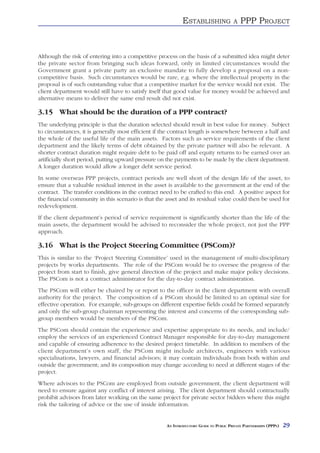
  • 68.
    MANAGING PERFORMANCE To protectagainst the collapse of the consortium company itself, PPP projects should be structured so that any assets would revert to the Government and the client department be able to engage an alternative service provider. 8.14 What happens if one of the consortium’s main contractors collapses? The consortium will still have the responsibility to deliver the services specified if one of its contractors collapses. It will be obliged to replace the contractor, and to absorb any additional costs that may arise. If the consortium fails to do so, it risks contract termination, with the reversion of the assets to the Government. Before signing the PPP contract, the client department will have sought to satisfy itself - by conducting due diligence checks - about the strength and reliability of the consortium’s contractors; and the financiers will insist on doing so too. Any subsequent change in a main contractor will require the client department’s approval. 8.15 If there is performance failure can the Government terminate the contract and/or sue for damages? A serious failure to perform may first lead to the exercise of step-in rights, agreed between the client department and the consortium’s financiers, for the financier to rectify the problems and/or to replace all or part of the consortium. In the absence of satisfactory rectification of the situation, the Government may terminate the contract and have the consortium moved off the site. In some jurisdictions, termination compensation is not payable (especially in the road and rail sectors where the prospect of default following construction is more remote) in the event of termination due to default of the consortium. The consortium’s financiers’ acceptance of such an arrangement will usually require a strongly protective direct/tripartite agreement between the financiers and the Government (incorporating a generous cure regime) and a high degree of confidence on their part as to the ability of the consortium to complete the project and perform its service obligations. However, various governments have been more sympathetic in other sectors to the application of a termination compensation regime in the case of contract default, especially where the project assets are to be transferred to the government on termination. Where the project assets are to be transferred to the government and it is considered appropriate to pay compensation, the preferred formula for compensation which appears to be emerging is: Where termination occurs during the construction phase, an amount sufficient to repay the consortium the amounts it has invested on completed works, adjusted for any increase in the costs to government to complete the facility, government’s break costs and any liquidated or other damages payable to the government Where termination occurs during the operations phase, the fair market value of the asset less the government’s break costs and any compensation or other amounts payable to the government (which may include additional service costs, rectification and re-tendering costs and any damages incurred as a result of the breach). AN INTRODUCTORY GUIDE TO PUBLIC PRIVATE PARTNERSHIPS (PPPS) 67
  • 69.
    CHANGES OF CIRCUMSTANCE 9 CHANGES OF CIRCUMSTANCE 9.1 During the contract, can the client department change the size of facilities; the level or nature of services; or the technical standards? Client departments should, as far as possible, structure their contracts in terms of capacity and technical standards on the basis of foreseeable, stable expectations. Ideally, changes should be avoided after finalisation of the contract. However, in the case of lengthy contracts changes in services involving both construction and operational changes are almost inevitable. The contract needs to address these issues. Measures could include: Formulae to take account of deflation/inflation and other price-related variables ensuring the service charges the Government has agreed to pay in future years will not be in excess of future market prices for such services Break clauses after a period of time Renegotiation clauses Periodic review mechanisms Referrals to mediation, arbitration, etc. In particular, the contract should show whether the department or the consortium assumes the risk of certain classes of change. For example, general changes in economic conditions, costs of labour and materials, as well as taxation and changes in general law may be met by the consortium; whereas discriminatory specific legislation affecting the project may be met by the department. However, consideration should be given to managing situations where such changes fall outside of normal bounds such that the consortium does not suffer unsustainable losses or enjoys unconscionable profits. Due to the uncertainties of inflation rates and the quantum of operating costs over a long term contract, the department will need to consider carefully the manner by which service charges are to be varied in certain specified circumstances. It would be unusual for prices to be fixed for the lengthy periods for which PPP projects are typically let. The Government should therefore only permit appropriate indexation mechanisms to be incorporated when service charges are to be reviewed. For example, choosing an index that may be short lived, or is not independently produced, is not a sensible approach. Nor is it prudent to have too narrow a focus on a particular industry or sector. There will, of course, be many other issues to consider in this context, including the circumstances where the particular index specified in the contract is no longer published or the basis upon which it is calculated is changed. 68 AN INTRODUCTORY GUIDE TO PUBLIC PRIVATE PARTNERSHIPS (PPPS)
  • 70.
    CHANGES OF CIRCUMSTANCE The Government should ensure that the price it has agreed to pay in future years will not be in excess of future market prices for comparable services. Some form of benchmarking or market testing may be required for this purpose. Benchmarking would typically involve the consortium comparing either its own costs or the costs of its contractor(s) against the market cost of such services. Market testing, on the other hand, might require the consortium to re-tender in the market any relevant contractor’s services to test the value for money of those services. Agreement between the department and the consortium may be required on: The amended method of services delivery The adjusted price for the services Whether there are capital payment implications Changes to the performance measurement system. The contract should contain clear terms and conditions governing the criteria for pricing a variation in the contract; any grounds on which the consortium may refuse to implement a variation; and any remedies available to the client department in the event of such a refusal. 9.2 Can the client department ensure that it benefits from technical upgrades? The department will specify the outputs that it requires from technical equipment/facilities, and the performance standards to be met, on the basis of known technologies and established standards. These standards will be set for a period for which the department is confident that they will remain valid - for example 10 years. Successive generations of equipment are likely to be developed which produce these outputs and meet these standards more efficiently and at a lower cost. Where the consortium believes that replacing equipment will lead to lower whole life costs, it will do so. It will not replace equipment that is functioning effectively and producing the required outputs where there is no economic justification for doing so - any more than the department would replace equipment in these circumstances. The department may make it a requirement of the contract that it shares in any realised costs savings from technology changes, or savings that might reasonably be expected from upgrades, which could have been implemented but were not. Whether such a provision is appropriate will depend on the likely impact on the contract price and other value for money considerations. 9.3 What if the contracting department is no longer responsible for the contract? The Government, rather than the client department, normally enters into an agreement with the contractor. If the client department’s functions are carried on by a different party within the government the contract will continue undisturbed. If the department’s functions are transferred to a quasi or non-government entity it may be necessary for the Government to underwrite the credit worthiness of the successor entity with respect to the contract. If a function were discontinued altogether, the Government would be faced with a service that it no longer needed. A break clause could be included in the contract to deal with this eventuality. If this had the effect of passing the risk of the service continuation to the consortium, it would be reflected in the contract price. In order for the contract to obtain financing, any break clause for the benefit of the Government would only be exercisable subject to compensating the consortium appropriately for the loss of the contract. AN INTRODUCTORY GUIDE TO PUBLIC PRIVATE PARTNERSHIPS (PPPS) 69
  • 71.
    CHANGES OF CIRCUMSTANCE 9.4 Can the department prevent ownership of the consortium passing into the wrong hands? PPP contracts typically contain provisions requiring the agreement of the client department to any changes in control of the consortium - with such agreement not to be unreasonably withheld. The approach generally adopted is that the client department should be able to prevent ownership changes that would undermine the ability of the consortium to deliver the required services reliably over the life of the contract, but not otherwise restrict the commercial freedom of the investors in the consortium company. A right to consent to a change in control is appropriate where the department takes comfort from the original sponsors maintaining their stake throughout the life of the project. It should invariably be the case that the client department will want to prevent entities whom they regard as “undesirable” from having an economic interest in the project, e.g. entities which had previously engaged in improper dealing, which have criminal associations, or have findings of having acted with a lack of candour or in breach of trust. Such conditions should be clearly stipulated in the RFP as well as in the contract. On the other hand, if the concern is primarily over the ability of the consortium to perform the contract after a change in its shareholding, other provisions in the contract, e.g. the payment mechanism and termination trigger, should be capable of addressing this. In permitting any change of shareholders, it will normally be necessary to confirm the continuing strength of commitments from other shareholders and consortium members, and if there are any performance bonds or guarantors the department should appraise and review them also. 9.5 What if the client department is corporatised/privatised? Most departments are not legal entities and the PPP contract will be made with the Government. The corporatisation/privatisation of the client department may result in the assignment or novation by statute or contract of the government’s rights and obligations. 9.6 Will the Government be locked into using particular equipment at the end of the contract or in replacement/upgrade exercises? The client department can require in the output specifications that the equipment should be interoperable with other equipment meeting the prevailing industry standards. An important part of the technical assessment of bids will be to assess to what extent any proprietary systems or software are proposed. It is at this stage that the risk of any ‘lock-in’ can be mitigated. It must be recognised, however, that in some specialist areas effective technical ‘lock-in’ may have to be accepted, even under a conventional procurement. 9.7 What if the consortium makes ‘windfall profits’? Given the prolonged duration of most PPP projects, client departments will need to anticipate the possibility of the declining risk profile of the project enabling the consortium to make windfall profits. There has been public criticism in some other countries where consortia have made unanticipated profits, particularly as a result of project refinancing or the sale of project assets. Provision can be made in the contract for these gains to be shared with the Government. The Government’s share of any gain could be taken as a cash lump sum at the time of the refinancing and/or as reduced service charges. Current practice in the UK, for example, is to share windfall profits 50:50 between the government and the consortium. 70 AN INTRODUCTORY GUIDE TO PUBLIC PRIVATE PARTNERSHIPS (PPPS)
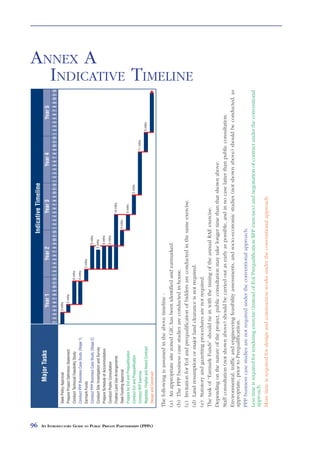
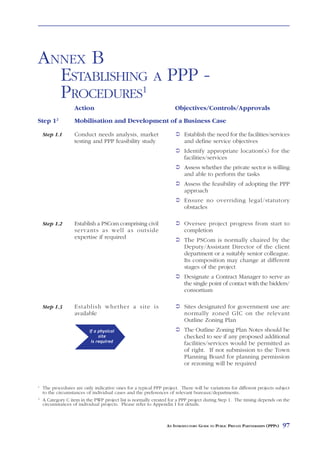
  • 72.
    CHANGES OF CIRCUMSTANCE 9.8 What if there are unforeseen changes in the consortium’s operating costs, e.g. change of law or insurability? This needs to be dealt with in the context of allocating risk. Consideration needs to be given as to what business risks should be allocated to the consortium, and what risks should be retained by the client department. For example, the effect of change of law during the life of the project. From the consortium’s perspective, the risk is that change of law will increase the cost of complying with its obligations. Social infrastructure projects where the Government pays the consortium on a fixed price basis may preclude the consortium from passing on the additional cost to the Government; and economic infrastructure projects may be subject to government price controls. The issue is thus the extent to which payments to, or prices set by, the consortium should be adjusted to reflect its increased or decreased costs. The Government’s starting point should be to propose that the consortium bears the risk of all legislative changes unless they are discriminatory or specific to the project. All businesses and persons are subject to general changes of law and it is commonplace for businesses to take legislative risk. Nonetheless, to ensure that consortia are not deterred by the strict application of this approach it may be advisable to have some sharing of this risk between the Government and the consortium. AN INTRODUCTORY GUIDE TO PUBLIC PRIVATE PARTNERSHIPS (PPPS) 71
  • 73.
    STAFFING ISSUES 10 STAFFINGISSUES 10.1 Do PPP projects pose industrial relations concerns to the civil service? Addressing the staff related issues can often be one of the most challenging tasks associated with a PPP project. Much will depend on the details of the individual PPP project, e.g. whether it affects existing services or new services. Care should be taken to draw up a manpower strategy that is most appropriate for the project in question. For example, if the PPP project involves building a replacement facility or affects existing services, it may be possible to redeploy staff elsewhere in government, including the client department, or for some of them to be transferred to the successful bidder. In many cases, the consortium is likely to want to employ specific government personnel due to their particular knowledge and skills. Clearly, the extent to which bidders are willing to employ staff, and the terms of their employment, will be relevant to the evaluation of bids. 10.2 When should staff be informed/consulted? A comprehensive communication strategy should be drawn up from the beginning and reviewed along with the PPP process. Experience has suggested a number of useful common approaches: Management should consider staffing issues at an early stage Management should inform staff early and regularly of developments Staff should be offered the opportunity to contribute to the development of PPP proposals. It is likely that staff will need to be informed and consulted on different aspects of a PPP proposal at a number of different stages. Senior management will need to carefully consider the details of these issues. Nonetheless, it goes without saying that staff should be informed of proposals before the first public airing of the subject. 10.3 How will staffing issues be addressed? In making the business case, evaluating the cost-benefit, and establishing the feasibility of a PPP project, the Government will have to take staffing issues into account, particularly those concerning serving staff. 10.4 Should civil servants be allowed to work for a PPP consortium? Any civil servant may leave the service on retirement, completion of agreement or resignation, as applicable, to work for a private company provided that they have followed prevailing rules governing post-service employment. Departments should consider whether serving civil servants should be encouraged to transfer from the civil service to the PPP consortium. 72 AN INTRODUCTORY GUIDE TO PUBLIC PRIVATE PARTNERSHIPS (PPPS)
  • 74.
    STAFFING ISSUES They mayfacilitate such transfers by requiring the consortium to employ minimum numbers of serving departmental staff, or giving bidders higher bid assessment scores for proposals involving the employment of such staff. The transfer of civil service staff can be accomplished through, for example: Secondment to the consortium in accordance with prevailing civil service regulations Offering an exit package with adequate severance terms and guaranteed employment by the consortium. Care should be taken to ensure that those transferring were not party to, or influential in, the process of selecting the winning bidder. To prevent conflict of interest, departments should prohibit consortia from offering employment to government officers who have participated in the selection process, unless approval is obtained from Government. 10.5 How are staffing issues dealt with in other jurisdictions? In some countries, including the UK and Ireland, staffing issues have been addressed using a combination of legislation such as the Transfer of Undertakings (Protection of Employment) (TUPE) regulations and contractual assurances. The TUPE regulations have often helped to overcome staff concerns about PPPs. The TUPE regulations cover the following issues: Employees transfer to the new employer on the same terms and conditions Representatives of employees have a right to be informed about the transfer Protection for individuals from unfair dismissal connected with the transfer. In other countries, such as Canada, there is no legislation covering staff transfer and such matters are handled using contractual means only. In many cases civil servants transferring to the private sector have enjoyed enhanced career prospects and the opportunity to become part of a growing business with export opportunities. AN INTRODUCTORY GUIDE TO PUBLIC PRIVATE PARTNERSHIPS (PPPS) 73
  • 75.
    LEGAL RIGHTS AND POWERS 11 LEGAL RIGHTS AND POWERS 11.1 How can Government’s interests be protected in a PPP project? In drawing up the detailed arrangements for a PPP project, the client department will need to ensure that Government’s interests are adequately protected. DoJ has conducted a review on the provisions protecting Government’s interests in the various tunnel ordinances as well as the Tung Chung Cable Car Ordinance (Cap 577). These provisions cover issues such as restrictions on assignment or disposal of rights and obligations, restrictions on mortgages and charges, claiming damages to make good defects/upon the service provider’s failure to perform obligations, compensation to the service provider for added value, control over change in equity ownership and shareholding etc. These provisions which the legislature has approved should normally be taken as the correct approach and standard for protecting Government’s interests and be reflected in the detailed arrangements for the PPP project. DoJ can advise on the drafting of these provisions. 11.2 What is the legal basis for PPP approaches? Subject to the proper construction and interpretation of any relevant legislation in any particular situation, the Government has extensive constitutional and common law powers to make commercial contracts including PPP contracts. Government cannot transfer to the consortium its basic accountability and responsibility to the public for the delivery of public services. In addition, Government may have a continuing, non- delegable duty of care to recipients of certain services provided by the consortium - particularly those recipients in a position of vulnerability, to whom Government owes a duty of care. This non- delegable duty of care may arise at common law or under legislation. The existence of non-delegable duties limits the extent to which Government can transfer legal responsibility for the provision of services to the consortium. This is the case even where the financial consequences of a breach of the duty can be transferred e.g. by indemnification from the consortium, adequately supported by insurance carried by the consortium. Where Government has a non-delegable duty in delivering a service, it may remain liable for any negligence on the part of the consortium engaged to provide the services on Government’s behalf. In this way, a non-delegable duty imposes a similar liability on Government for the acts of the consortium as for the acts of its own employees. Examples of non-delegable duties include the Housing Authority’s non-delegable duty to its tenants, and a school’s non-delegable duty to its pupils. 11.3 Are Government’s constitutional or common law powers qualified by legislation? To avoid legal complications leading to challenges and delays, it is vital before inviting bids to check the legal ability of Government to contract with the private sector in the envisaged circumstances, or to perform all of its obligations under the contract. In some circumstances, enabling or amending legislation may be required. 74 AN INTRODUCTORY GUIDE TO PUBLIC PRIVATE PARTNERSHIPS (PPPS)
  • 76.
    LEGAL RIGHTS AND POWERS Some ordinances contain provisions that may enlarge or restrict ‘the Authority’ to do acts that would be incorporated in many PPP contracts. The client department should seek legal advice at an early stage as to whether there are any ‘vires’ constraints on its proposed course of action. 11.4 Can Government’s enforcement powers be delegated to non-public officers? Despite the wide constitutional and common law powers of the Government, where an ordinance confers a power or a duty on a particular public officer, he must consider the exercise of the power or performance of the duty independently and judicially to the best of his ability. In other words the policy decision of a bureau is not a substitute for the consideration of the exercise of the power or duty by the office holder concerned. In addition, the nominated office holder must have compelling reasons not to exercise his statutory powers or duties which the legislature has expressly conferred on him. The non-exercise of any statutory power must be supported by good reasons. Whether a financial advantage by itself is sufficient is moot and depends on all the circumstances including statutory interpretation and whether the objects of the ordinance can be better attained otherwise. Everything turns on the interpretation of the particular legislation and its application to the particular facts of the case. 11.5 What if enforcement powers cannot be delegated to the consortium? The private sector may be able to manage many government PPP facilities without the delegation of legal enforcement powers. The private sector already operates a wide range of facilities (office and shopping complexes, factories, bars and restaurants, hotels, sports and recreation facilities etc) without the benefit of public behaviour enforcement powers given to departments under many ordinances. Potential PPP bidders would consider the risks involved before submitting proposals and may wish to discuss with the Government how necessary such powers are to the successful provision of the services. 11.6 Is there any general enabling legislation in Hong Kong similar to the UK? There is no such enabling legislation in Hong Kong. The Government’s constitutional power to contract is considered to be sufficiently extensive and flexible in many cases. Client departments should always seek legal advice on whether particular legislation enhances or restricts their powers to contract. 11.7 Are there any other legal constraints on a PPP? Each project will involve many forms of activity on the part of a consortium. Before a RFP is issued, an assessment will be needed as to whether the activities involved can be carried out - and carried out efficiently - within the framework of existing legislation. Legal advice should be sought. 11.8 Can staff be required to transfer to a private employer? In principle, an employer has no automatic right to require an employee to work for another employer, whether permanently or temporarily, unless the terms of his contract of employment provide for this. If the contract of employment does not contain such provision, there should be mutual agreement before a transfer of employment to the consortium can occur. AN INTRODUCTORY GUIDE TO PUBLIC PRIVATE PARTNERSHIPS (PPPS) 75
  • 77.
    LEGAL RIGHTS AND POWERS 11.9 What is the purpose of a Direct Agreement? A Direct Agreement is one of the principal legal documents for financiers in PPP projects and is also known as: Tripartite Deed Tripartite Agreement Step-in Agreement Consent Deed. Typically, a Direct Agreement is an agreement between the government, the consortium and the financiers funding the consortium. Under the Agreement the government usually will: Acknowledge that the benefit of the Project Agreement has been legally assigned to the financiers as security for the payment obligations of the consortium Notify the financiers of any material breach of the Project Agreement and will be obliged to send the financiers any notices it sends to the consortium at the same time, e.g. notices containing proposals for a variation to the service requirement or in connection with a deduction from the user charges or unitary payment Give the financiers a period of advance notice of any intended termination of the Project Agreement and offers the financiers an opportunity to: - Step in to remedy the position during the extended cure period - Take over from the consortium if the default is irremediable - Appoint a receiver and sell the project, including the rights and obligations of the consortium under the Project Agreement, to a substitute entity acceptable to the government in case of severe default, i.e. transfer of concession. It should be noted that under the Direct Agreement, the rights of the government to step in under any collateral warranty agreements with the sub-contractor(s) would be suspended until the financiers make a decision regarding their position. The consortium, its financiers and key sub-contractor(s) can also enter into a Direct Agreement, for example: Design & construction sub-contractor(s), project company, financiers Operation & management sub-contractor(s), project company, financiers. This Agreement will provide that the key sub-contractor(s) will not exercise any rights of termination without first giving notice to the financiers and then waiting for a defined period before terminating their contracts. 11.10 Will there be only one contract in a PPP project? Normally there will be several contracts including: The Project Agreement, which is the key document between the government and the consortium The Direct Agreement(s) 76 AN INTRODUCTORY GUIDE TO PUBLIC PRIVATE PARTNERSHIPS (PPPS)
  • 78.
    LEGAL RIGHTS AND POWERS Sponsor arrangements (equity; equity subscription and shareholders agreements) Debt: subordinated loan agreements, and credit and security documentation Back-to-back contracts e.g. design, constructor, operation and maintenance. See Figure 8. Figure 8: Key Contractual Relationships in a PPP Project (DBFO Model) Direct Agreement Consultancy Contract Government’s Government Consultants Project Consultancy Contract Consortium’s Agreement Consultants Loan Agreement Shareholders Agreement Funders Consortium Shareholders Security Package Construction Operation Facilities Contract Contract Management Contract Facilities Construction Fontline Service Management Contractor Deliverer Contractor Direct Agreements 11.11 Is there any ‘standardised’ contract documentation? A number of jurisdictions, including the UK and Australia, have produced some ‘standardised’ documents. These have taken into account a considerable amount of local experience and are often credited with speeding up, and reducing the cost, of the bidding/negotiating stages. We have not yet had sufficient local PPP projects on which to base our own ‘standardised’ documents. Nonetheless, at Annex F, is a checklist of Heads of Terms, or clauses, that departments should consider including in their Project Agreements. It must be noted that not all projects will require all of these clauses. Some projects may require clauses not included in the checklist. Question 12.5 explains what is normally included in a land lease document. 11.12 Can government penalize a consortium that does not meet its contractual obligations? It is a feature of the law of contract that the courts will strike down penalty clauses. However, it is only natural that the client department would want to ensure that a consortium does perform the tasks that have been agreed and paid for. There are means acceptable to the courts that can be employed: Liquidated damages do not fall foul of the rule that penalty clauses are unenforceable, provided the sum fixed represents a genuine attempt to estimate in advance the loss suffered as a result of the breach AN INTRODUCTORY GUIDE TO PUBLIC PRIVATE PARTNERSHIPS (PPPS) 77
  • 79.
    LEGAL RIGHTS AND POWERS Payment for measurable performance. The contract can be drafted so that the consortium is paid a particular fee in return for delivering a particular service. If he does not deliver satisfactorily a particular service, he does not receive the payment that goes with it. 11.13 What are ‘force majeure’, ‘relief events’ and ‘compensation events’? The consortium will be entitled to claim an extension of time to the dates in the phase-in timetable or the temporary suspension of its performance obligations relating to the provision of the service for the following three categories of delay: Relief Events - which arise at any stage of the contract term and for which the consortium bears the financial risk and receives no relief from liquidated damages or the performance regime, but in respect of which neither party will have rights of termination. However, the client department may require a unilateral right to terminate once a delay has persisted for a significant period. Whether a right to terminate is required and after what period it should be exercised are project specific decisions Compensation Events - events which arise prior to the in-service date, which are clearly the client department’s responsibility and in respect of which the consortium will be compensated Force Majeure Events - a narrowly defined and limited set of events which arise during the life of the contract through no fault of either party, which are best managed by the consortium (although not in its control) and in respect of which rights of termination for either party may arise after a significant delay (e.g. six months) has occurred. Relief events need to be extremely narrowly drafted and qualified by requiring the consortium to have taken all possible steps to prevent or mitigate such an occurrence (e.g. fire, loss or damage, failure by statutory undertakings, utilities companies etc). Similarly, only general strikes of the workforce (not site or project specific) should qualify as a relief event. Compensation events apply to variations required by the government and discriminatory changes in the law. Events of force majeure should be very narrowly defined (as they usually are in these cases) and not co-extensively with uninsurable risks. 11.14 Can Government acquire intellectual property rights or incur any liabilities? If any intellectual property is created during the course of a PPP or existing rights are used in the course of the contract, express provisions for the grant of rights to the Government are strongly advised. In the case of commissioned work, a statutory license is created with respect to copyright. The statutory license allows the use of such work by the commissioning body for purposes that could have been reasonably contemplated by the author of the work and by the commissioning body at the time the work was commissioned. Where a statutory license is not applicable, and rights are not acquired through express contractual provisions, there may nonetheless be other statutory provisions that protect the department from liability to the owners of intellectual property used under the contract. Legal advice should be sought in each case. 78 AN INTRODUCTORY GUIDE TO PUBLIC PRIVATE PARTNERSHIPS (PPPS)
  • 80.
    LEGAL RIGHTS AND POWERS 11.15 What types of intellectual property may be involved? Specific advice should be sought with respect to each contract. However, the more common types are: copyright, trademarks, and patents. Copyright protects original literary, dramatic, musical and artistic works as well as sound recordings, films, broadcast and cable programmes, and typographical arrangements of published works. Computer software, for example, is considered a literary work. See Copyright Ordinance (Cap 528). Trade Marks are signs that are capable of distinguishing the goods and services of one undertaking from another undertaking, and may be registered. Common law protection may also apply to unregistered trademarks. It may be an infringement if a sign similar to a registered trademark is used without permission in the course of business. See Trade Marks Ordinance (Cap 559). Patents protect new technology by giving the owner of the technology the right to prevent others from manufacturing, using, selling, or importing items using the patented technology. See Patents Ordinance (Cap 514). 11.16 How should the PPP contract address intellectual property? The Government may require the transfer of ownership or the grant of a license. In particular, when the Government engages a consortium to develop new IT systems, the ownership of intellectual property will be vested in the consortium unless there are exceptional circumstances under which the Government must retain the intellectual property rights. The Government will in turn be granted a licence to use the intellectual property. See OGCIO Circular No. 1/2006 and Guidelines for Opening Up Intellectual Property Rights of New IT Systems (September 2006). Where a licence is sought, it is important to set out clearly the extent of the rights to be granted including: whether exclusive or not; whether royalty-free or not; restricted as to time, territory, purpose or manner of use; and whether transferable or sub-licensable. The Government will usually require warranties and indemnities from the consortium with respect to any intellectual property rights used in the course of the contract. The consortium should also be required as necessary to assist in any registration procedures, the execution of any documents, or any other actions necessary to protect and indemnify the Government. AN INTRODUCTORY GUIDE TO PUBLIC PRIVATE PARTNERSHIPS (PPPS) 79
  • 81.
    LAND ISSUES 12 LANDISSUES 12.1 How do we deal with land issues? Land premium waiver or development rights should not be used as the major incentive for a consortium to provide the facility/service. Otherwise, the well established tender procedure/policy will be in jeopardy and projects may be criticised for bypassing the proper procedures. Land revenue will effectively be hypothecated. That said, where there are ancillary areas not needed by the required facility and the consortium identifies some commercial opportunities within the site, granting of commercial development rights may be considered but this again, must not be the major incentive and must not undermine the normal tender procedures. The treatment of land as an asset should be dealt with on a case-by-case basis. As a matter of principle, the disposal of land should be under a fair, transparent and competitive process. Depending on the length of tenure and nature of the service involved in a PPP project, the disposal of land can be by way of a Licence; Short Term Tenancy (STT); long lease in the form of a Private Treaty Grant (PTG) or granted by public tender; or an enabling ordinance. Client departments should consult the Lands Department (Lands D) and the DoJ at an early stage when considering a PPP. An indication of possible responses is given in the following questions and answers. 12.2 Can departments issue licences of land? Land allocated to a government department under a Government Land Allocation may be made available to the department’s consortium provided that: The department has obtained delegation from the Director of Lands under section 5 of the Land (Miscellaneous Provisions) Ordinance (Cap 28) to issue a licence of the land involved for the specific purpose and such licence is issued at the same time as the contract (‘the Contract’) between the department and its consortium The Contract is awarded through a competitive bidding process with the contract sum reflecting the full value of the rights (including the right to keep the revenue generated) and obligations attached. Land licence fees are stipulated in the Land (Miscellaneous Provisions) Regulations (Cap 28 sub. leg. A). An Authority under Cap 28 may delegate any of its powers and functions to any public officer or class of public officer by virtue of section 18A. However, there are a number of significant disadvantages to this approach: Although section 5 confers a power on the Authority to issue a licence, that will be a licence to occupy unleased land on payment of the ‘prescribed fee’. In most cases the ‘prescribed fee’ (in the Regulations under Cap 28) will be wholly inadequate The Buildings Ordinance (Cap 123) will not apply to licences of unleased land as it exempts ‘unleased land’ within the meaning given by section 2 of Cap 28. In other words, although the statutory requirements of Cap 123 could be applied under the contract between the parties, enforcement would be more problematical 80 AN INTRODUCTORY GUIDE TO PUBLIC PRIVATE PARTNERSHIPS (PPPS)
  • 82.
    LAND ISSUES It is for the potential PPP consortium to judge what length of term of a land licence is considered ‘tenable’ in the context of its investment sums and risks involved, and depending whether its needs legal title to the land. Cap 28 itself does not pose any restriction on the length of the term of a land licence. Licences issued by Lands D under Cap 28 are normally on a yearly basis, but can be for longer, e.g. certain utilities. Another example is that Cap 28 licences issued by EMSD for LPG filling stations are for a fixed term of 21 years. A land licence is rarely used nowadays and should be considered only under exceptional circumstances. Solid justifications are required if a land licence is to be used. 12.3 Can a Short Term Tenancy (STT) be used for PPPs? The Government sometimes grants STT for the construction phase of a project so as to bring the Buildings Ordinance (Cap 123) into operation. The Project Agreement can be drafted to provide that upon successful completion of the construction, the Government will accept a surrender of the STT and replace it with the grant of a long lease. Basic terms (including land premium) of a long lease must be taken into account in the bidding process and incorporated into the binding Project Agreement. 12.4 Will a single contract cover both land and other PPP issues? As explained in Chapter 11 there will be more than one contract involved, involving both the government and private sector. There are differences of opinion on whether it is best to have one unified contract, or two separate contracts that are cross-referenced to each other (one contract conferring the right to use the land/ facilities and the other relating to the other PPP issues). Those in favour of a unified document argue that there is no need for a ‘separate’ service agreement, and that the private sector commonly dispenses with a service agreement. The advantage of incorporating all the rights and obligations in one document is that there should be a consistency of drafting, and less chances of inconsistencies and omissions arising. Those in favour of keeping separate documentation argue that: The land disposal document should be kept reasonably lean and simple, focusing on the development and use of government land, and conferring title. It is not an appropriate document for setting out detailed operational arrangement such as fees, entrance charges, opening times etc The commercial arrangements in a complex PPP project can be very intricate and are best dealt with independent of the land documentation. Otherwise, preparation of the land document will take much longer and will still involve more than one drafter Under a PPP approach, many parameters and terms and conditions are determined through negotiations with the private partner. This process is not as open and competitive as the normal tendering process for land. Hence, giving up land development rights is theoretically less efficient. As the private partners are allowed to retain the incomes arising from the commercial facilities, revenues are hypothecated. Modification of even minor provisions in an executed land document requires formal legal documentation, which is a lengthy, complex process that will reduce flexibility in arrangements. It may have land premium or revenue implications that may not be acceptable to the consortium AN INTRODUCTORY GUIDE TO PUBLIC PRIVATE PARTNERSHIPS (PPPS) 81
  • 83.
    LAND ISSUES The usual remedy under a land grant, upon breach/non-fulfilment of terms, is re-entry under the Government Rights (Re-entry and Vesting Remedies) Ordinance (Cap 126); this may not best suit the purpose of the Government operating a PPP and is in any case far less timely and direct than alternative dispute resolution processes such as abatement of charges. Cap 126 also provides a statutory right of appeal, which process could have an adverse affect on service PPP issues such as profit-sharing are commercially sensitive and should not be incorporated into the land grant, which will be subject to public scrutiny through the Land Registry search facilities. It should be noted, however, that in many jurisdictions, the requirements for probity and transparency dictate that copies of the project documentation be made publicly available except for only limited commercially sensitive information. 12.5 What terms and conditions are normally included in a land lease document? The lease document confers legal title to and grants possession of the land. It generally controls the permitted use, development parameters, and timely completion of development, protecting the interests of Government as the landlord including the ability to charge premium for modifications and safeguarding the reversionary interest at the expiry of the lease term. Typically, therefore, the lease will stipulate requirements in connection with the permitted user and GFA for various purposes, building height, the period of time within which the development should be completed (the “building covenant”), compliance with ordinances, any restrictions on alienation (prior to completion and otherwise) including mortgaging, preservation of trees, provision of landscaping, and the provision of adequate car parking, loading and unloading spaces. Other more technical requirements, such as those relating to permitted vehicular access, drainage, any related slope works and their maintenance, any Deed of Mutual Covenant for property management and reservation of any rights-of-way to others are also commonly incorporated. Depending on the circumstances of a particular case, there may also be conditions requiring, for example, the formation of public roads and the construction of footbridges necessary to serve the new development. 12.6 Can PPP projects share sites with Government/Institution/ Community (GIC) facilities? Given the shortage of land in Hong Kong, and its high value, it makes sense to maximise land utilisation. There is no general objection in principle to the sharing of land by PPP and other GIC facilities. Each case should be examined on its own merits, taking into account the zoning of the site, related restrictions on development intensity, costs to Government and/or financial benefits to the consortium, and the type(s) of user under the PPP. The usual approaches would be: In the case of a land licence to be granted: reservation to Government of relevant rights in the licence document for construction, use and operation of the required GIC facilities on the land (some telecommunications facilities already provide for shared use) In the case of a land lease to be granted: inclusion of provisions in the lease requiring the lessee (the consortium) to construct the GIC facilities, in accordance with the government specifications supplied and at a specified amount to be reimbursed, and assign them to the Financial Secretary Incorporated, or surrender the portion of the lot upon satisfactory completion. 82 AN INTRODUCTORY GUIDE TO PUBLIC PRIVATE PARTNERSHIPS (PPPS)
  • 84.
    LAND ISSUES Legal adviceshould always be obtained to ensure that necessary government control and/or access is maintained. 12.7 Who owns the land/facilities? There are a number of possible scenarios with ownership resting with either Government or the private sector. Depending on the intention, the Government can form wholly-owned companies to hold the land and enter into partnership with private enterprises for the delivery of service. Where a consortium has been granted a lease of land it will not only have the right to use the land/facilities for the duration of the PPP contract, but can also be said to ‘own’ the land. If a consortium is granted ownership of land, provision should be incorporated in the grant for reversion of the land to the Government upon expiry or early termination of the PPP contract, or in the event of cessation or diminution of purpose for which the land is granted. Consideration should be given to build into the contract provision to require the consortium to return the site free of structures (i.e. a cleared site) to the Government upon expiry or early termination. In a DBO contract the Government will usually retain ownership of the land/facilities. 12.8 Can the consortium dispose of land granted for a PPP? With respect to the land occupied for the purposes of delivering the service, client departments must ensure that the consortium is not permitted to sell, sublet or otherwise dispose of the land, or reduce its economic value without the approval of the Government. If land has been granted by means of a concessionary grant, the Government should impose a resumption provision in the grant so that the consortium will not benefit from a statutory compensation on resumption of the land. In the case of PTG made on a concessionary basis, it is normal policy that alienation will be prohibited. On the other hand, where the land lease is disposed of through a competitive bidding process, it may be appropriate to allow alienation on the following basis: No alienation will be allowed before fulfilment of the building covenant and/or until the required facilities have been brought into operation in accordance with the requirements as specified in the land grant conditions Any alienation of the lot or any interest in the lot will not be allowed ‘except as whole’ i.e. no partitioning or subdivision of the lot will be allowed nor any assignment by way of undivided shares in the lot will be allowed Any disposal on the above basis will also be subject to the prior approval of the Government and, in the event that approval is given, the new consortium will be required to enter into a new SLA with the client department. 12.9 What zoning is appropriate for a PPP site? Most sites identified for government use are zoned GIC use on the relevant outline zoning plan. GIC use might continue to be appropriate for some PPP projects. However, in other cases the consortium might have proposed the provision of additional services on the site that are not merely ‘ancillary’ to the required use. It is important to check the land use zoning of the site and the provision in the ‘Notes’ for the respective land use zone to see if the additional services are permitted as of right or may be permitted upon application under section 16 of the Town Planning Ordinance (Cap 131) to the Town Planning Board. Otherwise a change of zoning will be necessary. Rezoning and/or planning applications may require public consultation, which may be time consuming and politically sensitive. Departments need to ensure that they have made allowance for this process. AN INTRODUCTORY GUIDE TO PUBLIC PRIVATE PARTNERSHIPS (PPPS) 83
  • 85.
    LAND ISSUES 12.10 Shouldthe consortium be charged a lump sum premium? This will depend on the circumstances of each case. If the client department invites consortia to provide no more than the department would otherwise have provided, there is little point in charging a lump sum premium as this will artificially inflate the contract price. If however, the consortium is allowed or encouraged to provide revenue-generating services, e.g. with the grant of development right, the client department needs to consider how to ensure that the public purse receives its fair share. This might involve a lump sum premium, revenue sharing, profit sharing, or the cross- subsidy of loss making services that the consortium must provide. As a general point, these arrangements should be as transparent as possible. If there are to be cross-subsidies, for example, it should be made possible for the extent of the subsidy to be determined. 12.11 Should the client department prescribe the land to be used? If necessary to expedite the selection and negotiation phases, the RFP may prescribe the land/ premises to be used. Sites may also be prescribed where the Government judges it necessary to make best use of scarce land resources within Hong Kong. Where the feasibility of the project does not depend on the location of the site concerned, bidders should be encouraged to offer innovative solutions in respect of land/premises, particularly at the EoI/pre-qualification stages. 12.12 Do land disposal documents allow step-in or early termination? Provisions can be incorporated into a land licence or land lease to enable the Government to take over the buildings erected on the land involved upon the expiry or sooner termination of the land licence/lease. The consortium is however entitled to remove his plant, equipment and facilities unless he is bound by other terms in the PPP contract. Government step-in rights are generally found in the Project Agreement rather than land leases. A land lease document will not cover performance related to the provision of services. The usual remedy available upon breach/non-fulfilment of terms is re-entry under the Government Rights (Re- entry and Vesting Remedies) Ordinance (Cap 126), through which Government takes back the land and cancels the legal title of the grantee to the land (subject to rights of appeal to the Court or petition the Chief Executive). This can be a time-consuming process. A licence can be terminated according to its terms and Government can demand possession of the land. 84 AN INTRODUCTORY GUIDE TO PUBLIC PRIVATE PARTNERSHIPS (PPPS)
  • 86.
    LAND ISSUES 13 PROBITY AND CORRUPTION 13.1 Can Government ensure transparency and fairness in the competitive bidding process? The Government should ensure that the competitive bidding process is truly competitive, independent, secure, transparent and accountable, that all bidders are treated fairly, and the confidentiality of sensitive information is maintained. The PPP process should be underpinned by probity practices that ensure the procedural integrity of the process is maintained. Client departments should have in place systems, policies and procedures able to withstand public scrutiny. Please refer to Annex G on the probity principles and measures. 13.2 How important is avoidance of ambiguity in seeking bids? There is risk that Government, in seeking to maintain as strong as possible a negotiating position, allows ambiguity to be present in the bidding process. Pre-contract documentation should be carefully drafted and clearly state the actual undertakings and legal obligations required to be met. This care should extend to any documents calling for revised proposals. In all cases, there should be certainty as to the nature of the obligations owed by both parties as a result of the process. Clear and well-drafted documentation will usually avoid the risk of protracted and costly litigation. Under the law of contract, an invitation document issued by the Government to invite persons to submit bids for a project is an “invitation to bid” and a bid submitted by a bidder is an “offer”. The Government is free to accept or reject the offer. Unless and until the Government has accepted the bid, there is no binding contract between the Government and the bidder in respect of the project. However, the mere fact that there is no binding contract, in respect of the project does not necessarily mean that there is no binding contract in respect of a different matter namely compliance with the terms of the invitation document by both Government and the bidder. It has been held by the courts that the issue of an invitation document by an inviter and the submission of a conforming bid by a bidder in response to the invitation could give rise to a binding contract pursuant to which both the inviter and the bidder agree to comply with the terms of the invitation document. Whether there is an implied term of fair dealing on the part of public bodies in conducting the bidding processes has not been settled in Hong Kong law. 13.3 How do we handle commercially sensitive bid information? While the Government is committed to an open and transparent process for PPP procurement, it is important to ensure that confidential information and intellectual property of private sector bidders is protected. Recipients of confidential information should sign a confidentiality agreement and clear security procedures should be established for handling procurement-related documents. These will be similar to existing practices that are in accordance with provisions under the SPR, Security Regulations, Financial Circulars, Independent Commission Against Corruption (ICAC) guidelines etc. AN INTRODUCTORY GUIDE TO PUBLIC PRIVATE PARTNERSHIPS (PPPS) 85
  • 87.
    PROBITY AND CORRUPTION 13.4 Can bidders’ probity during the bid process be encouraged? Bidders should be required to act in an ethical and honest manner through the requirements of the RFP. They should be reminded of their obligations under the law. As discussed in Annex G, probity checks may be carried out on bidders during the evaluation. To focus the attention of bidders on the need to adopt ethical practices, consideration should be given to require them to demonstrate their commitment to ethical practices as part of their bid submission. 13.5 What are the major corruption risks? Many of the corruption risks for which safeguards are required will lie with the consortium for the life of the project. Nonetheless, there are still areas of concern for the civil service. At the evaluation stage, these include the handling of sensitive/confidential information, the negotiations with bidders and the selection of the winning bid. At the construction and operation stage, these include the ordering and valuation of contract variations, and monitoring the consortium’s compliance with the contract requirements. To reduce these corruption risks, clear selection and assessment criteria and procedural guidelines will be needed. The Corruption Prevention Department of the ICAC can assist the departments involved to draw up these guidelines to mitigate the corruption risks. Transparent and open processes minimise the opportunity for, and the risk of, fraud and corruption. 13.6 Is it acceptable to negotiate with bidders? In many PPP projects it is necessary to negotiate before the preferred bidder is finalised in order to ensure that the client department obtains the best outcome possible both in financial and service respects. Negotiations should be used to pin down the commercial terms of the contract, with a view to ensuring that the contracted outputs will be delivered. To minimise corruption risks, any negotiation should be conducted in accordance with ICAC guidelines, the principle of non- discrimination and the provision of SPR and the WTO GPA as in the conventional procurement process. 13.7 Are there any ‘negotiating procedures’? The PSCom should establish and promulgate appropriate procedures to ensure that checks and balances are in place. A negotiating brief and associated negotiation procedures approved by the appropriate bid evaluation committee will have to be prepared. Negotiating teams need a clear negotiating strategy before negotiations begin, including the intended timetable. Negotiation meetings, if any, should be fully minuted. 13.8 Should a contract won by corrupt means be terminated? Client departments should include in the RFP documentation and the contract itself clauses to the effect that contracts won by means of corruption and/or performed in a corrupt manner are liable to termination. 13.9 Are any staff at particular risk? Members of the PSCom and the bid evaluation committee should be selected with due care. As far as possible, there should be independent oversight of officers involved in critical activities such as the drawing up of the procurement documents and the criteria for evaluation, negotiation with bidders, bid assessment and monitoring the performance of the consortium. 86 AN INTRODUCTORY GUIDE TO PUBLIC PRIVATE PARTNERSHIPS (PPPS)
  • 88.
    PROBITY AND CORRUPTION To maintain a high standard of integrity and conduct, and avoid any perceived conflict of interest, officers should maintain an arm’s-length business relationship with the bidders/consortium. Officers should avoid over-socialisation with and acceptance of excessive and lavish entertainment offered by the bidders/consortium. They should also avoid or declare any real or apparent conflict of interest that may arise or has arisen. Chapter 1A of the SPR sets out the requirements for avoidance of conflict of interest. 13.10 What about the consortium? The contracts appointing the consortium should include requirements such as on: Accepting advantages (because section 3 of the Prevention of Bribery Ordinance (Cap 201) does not apply to the private sector) Need for conducting security vetting on the consortium’s personnel, in compliance with the requirement of the Personal Data (Privacy) Ordinance (Cap 486) Misuse of confidential, official and secret information Conflict of interest, and taking up outside work If employment of non-skilled workers is involved, the consortium is required to enter into employment contracts in the form specified by Government with each of the non- skilled workers Remuneration levels for non-skilled workers not below the industry average. The Corruption Prevention Department of the ICAC also provides corruption prevention services to private sector companies and assists them in promulgating their staff code of conduct. 13.11 Should the consortium be subject to the Schedule to the Prevention of Bribery Ordinance (Cap 201)? In consultation with the Corruption Prevention Department of the ICAC and taking into account the importance of the public services to be provided, consideration should be given to including the consortium in the Schedule of Cap 201, thus designating it as a ‘public body’ for the purposes of the Ordinance. The Chief Executive-in-Council may by order amend the Schedule. The employee of a public body comes within stricter provisions of the Cap 201 dealing with bribery and offering, soliciting and accepting advantages. AN INTRODUCTORY GUIDE TO PUBLIC PRIVATE PARTNERSHIPS (PPPS) 87
  • 89.
    ABBREVIATIONS Arch SD Architectural Services Department BOO Build-Own-Operate BOT Build-Operate-Transfer BOOT Build-Own-Operate-Transfer CSB Civil Service Bureau CWP Capital Works Programme CWRF Capital Works Reserve Fund DBO Design-Build-Operate DBFO Design-Build-Finance-Operate DoJ Department of Justice EABFU Economic Analysis and Business Facilitation Unit EIAO Environmental Impact Assessment Ordinance (Cap 499) EoI Expression of Interest EMSD Electrical and Mechanical Services Department EU Efficiency Unit ExCo Executive Council FC Finance Committee (of the Legislative Council) FSTB Financial Services and the Treasury Bureau GFA Gross Floor Area GIC Government/Institution/Community ICAC Independent Commission Against Corruption IPD Intellectual Property Department IT Information Technology ITT Invitation to Tender Lands D Lands Department LegCo Legislative Council 88 AN INTRODUCTORY GUIDE TO PUBLIC PRIVATE PARTNERSHIPS (PPPS)
  • 90.
    ABBREVIATIONS NPV Net Present Value O&M Operation and Maintenance OCIP Owner Controlled Insurance Programme OGCIO Office of the Government Chief Information Officer PDS Project Definition Statement PFI Private Finance Initiative Plan D Planning Department PPP Public Private Partnership PSC Public Sector Comparator PSCom Project Steering Committee PTG Private Treaty Grant PWP Public Works Programme PWSC Public Works Subcommittee (of the Legislative Council) RAE Resource Allocation Exercise RFP Request for Proposal SA Sustainability Assessment SDD Sustainable Development Division SFST Secretary for Financial Services and the Treasury SLA Service Level Agreement SPR Stores and Procurement Regulations SPV Special Purpose Vehicle STT Short Term Tenancy TFS Technical Feasibility Statement TsyB Treasury Branch (of Financial Services and the Treasury Bureau) TUPE Transfer of Undertakings (Protection of Employment) UK United Kingdom WTO GPA World Trade Organisation Government Procurement Agreement AN INTRODUCTORY GUIDE TO PUBLIC PRIVATE PARTNERSHIPS (PPPS) 89
  • 91.
    GLOSSARY OF TERMS Benchmarking A procedure for testing whether the standard and price of services is consistent with the market standard (if any), without any formal competitive bidding. Business case In the context of government projects the business case encompasses more than commercial criteria. A Government Business Case is a detailed and structured proposal for improvement in terms of costs, benefits and risks, justified for changing the way that government business is conducted. Departments normally develop a business case prior to the initiation of a government project or programme that requires significant commitments, including those that involve non-recurrent expenditure in procuring systems and equipment, the construction of buildings and infrastructure, and the use of the private sector in delivering public services. Client department The department originating, and responsible for the intended project. Consortium In most PPP projects, the private sector partner is usually a consortium established to deliver the project. A consortium may be referred to as a Special Purpose Vehicle (SPV), a project company or concession company. The consortium will often sub-contract particular tasks to other companies/ contractors. Escrow account A special trust account held in the private partner’s name, in which a lawyer or escrow agent deposits money that does not belong to him or his firm to pay obligations if required. Expression of A document that the department will issue requesting information from Interest (EoI) prospective tenderers on the services they can provide and/or on the solutions available for satisfying the requirement. It is often used as a first step in the tendering process. Letters/e-mails to known interested parties, advertisements in the newspaper or an internet medium are good ways of issuing this. It is typically used in situations where the requirement cannot be adequately defined through lack of information on available solutions or when the market of service providers is not known. Gross Floor Area The area contained within the external walls of a building measured at each (GFA) floor level (including any floor below the level of the ground). Liquidated damages Stipulated amounts of money stated in the contract as compensation to the public partner under specified circumstances. The amounts should represent a genuine pre-estimate of loss suffered by the innocent party under these circumstances. Net Present Value The present value of the expected cash flows associated with a project after (NPV) discounting at a rate which reflects the value of the alternative use of the funds so as to enable comparison between options with different cashflow profiles. 90 AN INTRODUCTORY GUIDE TO PUBLIC PRIVATE PARTNERSHIPS (PPPS)
  • 92.
    GLOSSARY OF TERMS Market testing An exercise where private sector companies are approached to see if the private sector is willing and able to participate in a project, and under what circumstances. Novation Agreement of parties to a contract to substitute a new contract for the old one. Output-based Specifications upon which bidders are invited to bid which set out the client specifications department’s requirements in non-prescriptive terms, leaving the bidders with the responsibility for determining how to deliver those requirements. Performance bond A performance bond commits the bonding company (or a bank) to step in and complete the contract if the consortium defaults on the contract. The bonding company may complete this either by performing the work itself, or by obtaining bids for the balance of the work, and then paying for the balance of the work up to the total amount of the bond. Plot ratio The ratio of the floor space of a building to its site area. Policy Committee A committee comprising Principal Officials, co-chaired by the Chief Secretary for Administration and Financial Secretary, to consider major issues requiring policy approval. Pre-qualification A process to short-list private companies that meet the requirements to be invited to submit a proposal for a project. Project Steering A team to assist, advise and report to the Head of Department of the client Committee department for the management of the project. The team may comprise of (PSCom) members from the client department, other departmental staff and private sector experts/advisors. Its composition may change according to need at different stages of the project. Public Private An approach where the public and the private sectors both bring their Partnership (PPP) complimentary skills to a project, with varying levels of involvement and responsibility. Public Sector The risk-adjusted, estimated full lifecycle cost of a project if it was done by Comparator (PSC) conventional in-house means. It is expressed in terms of Net Present Value. Request for An invitation to (pre-qualified) private sector consortia to make an initial Proposal (RFP) proposal. Required and Required facilities/services are those specified by the client department. additional facilities/ Additional facilities/services are enhanced or additional features on the site, services usually proposed by the consortium, bringing additional benefits, e.g. better site utilisation, revenue generation. Other jurisdictions use different terms and definitions. In Australia, for example, services such as teaching, health care, and dispensing justice are considered core services that must be provided by government servants. Only non-core services such as the physical provision of schools, police stations, courthouses and hospitals can be provided by the consortium. AN INTRODUCTORY GUIDE TO PUBLIC PRIVATE PARTNERSHIPS (PPPS) 91
  • 93.
    GLOSSARY OF TERMS Risk Risks relate to the exposure to a peril, the occurrence of events and their consequences that differ, either positively or negatively, from those that were assumed (or not, as the case may be) in establishing a project. Risks are often categorised as strategic, financial, operational and hazard risks. They arise in all projects, irrespective of the approach adopted. Risk allocation The sharing of risk between the private and the public sectors for a project so that the risks are borne by the parties best able to manage them. Service Level An agreement setting out the standards to which the services in a contract Agreement (SLA) must be delivered, often accompanied by an agreed performance monitoring regime. Shadow toll The payment of a notional toll to the consortium by the public partner for each user using the PPP facility. Sinking fund A fund into which the public partner sets aside part of the contract payment over time. The lump sum will be released to the consortium if certain requirements are met at the end of the contract. Site coverage The proportion of a site that is covered by a building. Special Purpose A project company established by the bidders that has as its sole purpose Vehicle (SPV) the delivery of a specific project, often referred to as the consortium, project company or concession company. Step-in rights Rights relevant to both the private and the public sectors. In the case of the private sector, step-in rights will be a matter for the Direct Agreement between financiers, the client department and the consortium. Step-in rights for the public sector may be provided, entitling the client department, as a long-term or temporary ‘self-help’ remedy, to perform or get a third party to perform the consortium’s obligations under the Project Agreement in certain circumstances. Town plan A means to guide and control the development and use of land with the aim of promoting the health, safety, convenience and general welfare of the community. Whole life costs The full costs of a project including those incurred during the design, construction, operation and maintenance of the facility. 92 AN INTRODUCTORY GUIDE TO PUBLIC PRIVATE PARTNERSHIPS (PPPS)
  • 94.
    TAKING ADVICE AND GUIDANCE The private sector does not generally have the experience found in the Government of large infrastructure projects involving government, public law and land, legal, policy and general administrative issues. On the other hand, the public sector is less experienced, for example, in the commercial and financial aspects of PPPs. When establishing a PPP, a number of departments may need to be involved: Arch SD Provides technical advice and support, including relevant output specifications and performance standards, schedule of accommodation, preparation of the PSC, and other works practices Conducts technical feasibility studies and produces TFSs (prior to bidding funds from the Capital Works RAE) Conducts or advises on site investigations and surveys (if necessary) Assists in regulatory and monitoring roles throughout the contract period. CSB advises on issues affecting civil service staff. DoJ should be consulted on the drafting of PPP documentation, including the legal power to contract, contract terms, RFPs, output specifications and precedents for revenue and profit sharing arrangements vis-à-vis the Public Finance Ordinance (Cap 2). It can also: Advise on contract terms and conditions Draft procurement documents and contracts Vet procurement documents and contracts from the legal perspective. Economic Analysis Division of Economic Analysis and Business Facilitation Unit (EABFU) provides advice on discount rates to be used in calculating the NPV of a PSC. EMSD Provides technical advice and support in respect of electrical and mechanical services Provides advice on specifications of electrical and mechanical maintenance services. EU offers general advice on PPPs, other private sector involvement opportunities, and on external sources of advice. It can provide consultancy support by conducting business case/feasibility studies, as well as: Assist in preparation of procurement documents Organise and deliver training and seminars AN INTRODUCTORY GUIDE TO PUBLIC PRIVATE PARTNERSHIPS (PPPS) 93
  • 95.
    TAKING ADVICE AND GUIDANCE Publish guides and reference materials Provide help desk service (Tel: 2165 7255). FSTB (TsyB) should be consulted on the funding and procedures involved in seeking FC/PWSC endorsement. It will: Advise on funding issues Vet funding applications (for both capital funding and recurrent consequences) and earmark funding for projects in RAE Provide support to the process of seeking funding approvals from FC Advise on general procurement issues. Labour and Welfare Bureau advises on gender mainstreaming. The Corruption Prevention Department of the ICAC should be consulted during the planning, invitation, selection, assessment, negotiation, construction, management and operation stages, to ensure that corruption prevention safeguards and mechanisms to maintain a high standard of integrity and conduct are in place. It will advise on, among others, the probity requirements, the probity plan, and the procedures to be adopted at the various stages. It may also act as an observer at bid assessment meetings. Please contact ICAC at: Senior Staff Officer/Corruption Prevention Telephone 2826 3198 Fax 2521 8479 Email cpd@icac.org.hk Website www.icac.org.hk. IPD provides advice on protection of intellectual property rights. Labour Department provides advice on pay and employment conditions as they affect private sector staff. Lands D Provides advice on the status of relevant site(s) Approves land allocations under delegated authority or advises on procedures for seeking approval from ExCo/Secretary for Development Determines tenure and conditions for land disposal, land premium and relevant commercial arrangements Provides advice on the preparation of land disposal documents. OGCIO Provides technical advice and support in respect of IT services Provides advice on specifications of IT services. 94 AN INTRODUCTORY GUIDE TO PUBLIC PRIVATE PARTNERSHIPS (PPPS)
  • 96.
    TAKING ADVICE AND GUIDANCE Plan D Provides advice on land use issues Assists in seeking approval to rezone relevant site(s) under the Town Planning Ordinance (Cap 131) and/or in obtaining planning permission from the Town Planning Board. SDD advises on SAs and vets SA paragraphs in Policy Committee and ExCo submissions. Other Works Departments Provide technical advice and support in relevant specialist areas. Furthermore, departments should always seek advice from their policy bureaux if they encounter problems. Other Sources of Information There are many useful websites on the internet. The internet contains a wide range of case studies. Where these are written by parties involved in the individual projects, as opposed to independent commentators, particular care should be taken in drawing conclusions. Some of these websites and case studies may be viewed on the EU’s website at www.eu.gov.hk. AN INTRODUCTORY GUIDE TO PUBLIC PRIVATE PARTNERSHIPS (PPPS) 95
  • 97.
    96 ANNEX A AN INTRODUCTORY GUIDE TO PUBLIC PRIVATE PARTNERSHIPS (PPPS) The following is assumed in the above timeline - (a) An appropriate site zoned GIC has been identified and earmarked. (b) The PPP business case studies are conducted in-house. (c) Invitation for EoI and prequalification of bidders are conducted in the same exercise. INDICATIVE TIMELINE (d) Land resumption or major land clearance is not required. (e) Statutory and gazetting procedures are not required. The task of “Earmark Funds” should tie in with the timing of the annual RAE exercise. Depending on the nature of the project, public consultation may take longer time than that shown above. Staff consultation (not shown above) should be carried out as early as possible, and in no case latter than public consultation. Environmental, traffic and engineering feasibility assessments, and socio-economic studies (not shown above) should be conducted, as appropriate, prior to Prequalificatiion. PPP business case studies are not required under the conventional approach. Less time is required for tendering exercise (instead of EoI/Prequalification/RFP exercises) and negotiation of contract under the conventional approach. More time is required for design and construction works under the conventional approach.
  • 98.
    ANNEX B ESTABLISHING A PPP - PROCEDURES1 Action Objectives/Controls/Approvals Step 12 Mobilisation and Development of a Business Case Step 1.1 Conduct needs analysis, market Establish the need for the facilities/services testing and PPP feasibility study and define service objectives Identify appropriate location(s) for the facilities/services Assess whether the private sector is willing and able to perform the tasks Assess the feasibility of adopting the PPP approach Ensure no overriding legal/statutory obstacles Step 1.2 Establish a PSCom comprising civil Oversee project progress from start to servants as well as outside completion expertise if required The PSCom is normally chaired by the Deputy/Assistant Director of the client department or a suitably senior colleague. Its composition may change at different stages of the project Designate a Contract Manager to serve as the single point of contact with the bidders/ consortium Step 1.3 Establish whether a site is Sites designated for government use are available normally zoned GIC on the relevant Outline Zoning Plan If a physical The Outline Zoning Plan Notes should be site checked to see if any proposed additional is required facilities/services would be permitted as of right. If not submission to the Town Planning Board for planning permission or rezoning will be required 1 The procedures are only indicative ones for a typical PPP project. There will be variations for different projects subject to the circumstances of individual cases and the preferences of relevant bureaux/departments. 2 A Category C item in the PWP project list is normally created for a PPP project during Step 1. The timing depends on the circumstances of individual projects. Please refer to Appendix I for details. AN INTRODUCTORY GUIDE TO PUBLIC PRIVATE PARTNERSHIPS (PPPS) 97
  • 99.
    ESTABLISHING A PPP - PROCEDURES ANNEX B Action Objectives/Controls/Approvals Step 1 Mobilisation and Development of a Business Case (cont’d) Step 1.4 Establish what facilities/services Assessment is made with reference to: are required - Hong Kong Planning Standards and Guidelines - Requests/proposals for facilities made by relevant department(s)/organisation(s) - Popularity/utilisation rates of other facilities providing similar services - Surveys of potential users/service providers - Relevant population forecasts Step 1.5 Prepare a draft Statement of Draw up output specifications for the Requirements required facilities/services that the client department requires on the site, e.g. the outline technical specifications The Statement of Requirements should be sufficiently flexible to solicit innovative and cost-effective proposals while ensuring that statutory requirements, e.g. fire and building safety standards, are complied with Step 1.6 Consider whether to accept Constraints to acceptability must be made proposals for enhanced or other clear to all parties concerned including the additional commercial facilities/ potential bidders and during public services on the site consultation Step 1.7 Assess risks Assess all foreseeable risks and impacts; set out the risk matrix stipulating the appropriate parties responsible for managing and mitigating the risks Step 1.8 Prepare PSC with the assistance Benchmark whole life costs of required of other government departments, activities e.g. a works department, and seek PSC is expressed in net present value to policy endorsement enable comparison between options with different cashflow profiles (Subject to the circumstances of individual projects, e.g. availability of funding in the departmental budget, the business case can be developed at one go or in two stages. If it is conducted in two stages, the stage 2 business case study may be conducted after Step 2.) 98 AN INTRODUCTORY GUIDE TO PUBLIC PRIVATE PARTNERSHIPS (PPPS)
  • 100.
    ESTABLISHING A PPP - PROCEDURES ANNEX B Action Objectives/Controls/Approvals Step 23 Funding Submit a bid via the policy bureau Secure capital funding under CWRF and for funds through the RAE process ensure recurrent funding for the operation phase Step 3 Technical Assessments, Consultation and Land Requirements Step 3.1 Conduct appropriate technical Assess the practicability, viability and assessments and socio-economic justification of the facilities/services studies Ensure compliance with EIAO (Cap 499) Identify sustainability implications associated with the project Step 3.2 Conduct consultations Consult relevant stakeholders of the project in an extensive, comprehensive, open and transparent manner Ensure staff informed/consulted before public airing of the project Obtain support/approval in principle/initial commitments from Policy Committee and appropriate LegCo Panel Consult District Council and other statutory/ non-statutory local/territory-wide bodies Ensure on-going/regular consultation/ communications with relevant stakeholders at different stages of the project Step 3.3 Seek necessary authorities’ Ensure appropriate zoning on town plan agreement on land use Consider appropriate engineering conditions and/or the land allocation Consider if the land allocation needs to be considered by ExCo or whether it can be done by Secretary for Development or Director of Lands under delegated authority Step 4 Expression of Interest Exercise Initiate an EoI exercise Identify potentially interested parties Generate ideas for inclusion in the subsequent RFP exercise Pre-qualify companies for RFP exercise (Conduct EoI exercise after funding approval is obtained) 3 A PPP project is upgraded to a Category B PWP project during Step 2. Please refer to Appendix I for details. AN INTRODUCTORY GUIDE TO PUBLIC PRIVATE PARTNERSHIPS (PPPS) 99
  • 101.
    ESTABLISHING A PPP - PROCEDURES ANNEX B Action Objectives/Controls/Approvals Step 5 Policy and Funding Approvals Step 5.14 Consult and seek approvals of Justify the community need for the PWSC and FC facilities/services Demonstrate value for money Seek approval for funding as appropriate (Where necessary, bureaux can approve RFP before securing FC’s approval) Step 5.2 Determine detailed commercial Sort out detailed funding arrangements and arrangements commercial terms. Key issues include: - Payment mechanism - Contract duration - Land grant conditions, land premium, revenue, profit sharing - Principles/mechanism for measuring/ sharing windfall profits e.g. refinancing gain - End of contract arrangements Step 5.3 Seek draft land grant conditions Consult Legal Advisory and Conveyancing Office of Lands D on the drafting of land grant document Formalise land grant conditions Step 6 Procurement and Selection Step 6.1 Instruct DoJ on drafting of Consult DoJ on the legal issues and start procurement documents/contract drafting the RFP documents, SLA, contract terms and other legal documents Step 6.2 5 Finalise procurement documents Draw up output-based performance and seek approval from Central specifications Tender Board Step 6.3 Establish bid evaluation committee Develop mechanism for evaluation of bids including the necessary in a fair and objective manner departmental/technical/financial experts 4 A PPP project is upgraded to a Category A PWP project during Step 5.1. Please refer to Appendix I for details. 5 Departments may design and use their own non-standard contract forms to meet specific requirements of their contracts under SPR 345(b). Proposed marking schemes and tender reports require the approval of relevant tender boards. 100 AN INTRODUCTORY GUIDE TO PUBLIC PRIVATE PARTNERSHIPS (PPPS)
  • 102.
    ESTABLISHING A PPP - PROCEDURES ANNEX B Action Objectives/Controls/Approvals Step 6 Procurement and Selection (cont’d) Step 6.4 Issue RFP Publish notices in newspapers, government gazette, internet or invite companies/ consortia previously pre-qualified or short- listed in the EoI exercise to submit proposals Ensure potential bidders understand clearly the requirements through briefings and site inspections Step 6.5 Evaluate proposals Exclude proposals not meeting mandatory/ essential requirements Conduct 2-envelope (technical and financial proposals) or 3-envelope (required facilities, additional facilities and financial aspects) evaluation Compare bids with each other and with the PSC Identify preferred bidder(s) (the best combination of technical and financial proposals) Step 6.6 Negotiate with bidder(s) Consider how to maintain competitive pressure on bidders during negotiations Prepare and seek approval of negotiating brief Ensure the details of negotiations are fully recorded Ensure the selection of bidders for negotiations meets the WTO GPA requirements The process and procedures must fully comply with the provisions of relevant Financial Circulars and SPR Ensure that necessary checks and balances (e.g. set up clear selection and assessment criteria and procedural guidelines) are in place to reduce corruption risk. Consult ICAC where and when necessary Select from best and final offer(s) AN INTRODUCTORY GUIDE TO PUBLIC PRIVATE PARTNERSHIPS (PPPS) 101
  • 103.
    ESTABLISHING A PPP - PROCEDURES ANNEX B Action Objectives/Controls/Approvals Step 6 Procurement and Selection (cont’d) Step 6.7 Award contract Conduct due diligence checks to substantiate the bidder’s claim of its capability, experience, expertise, financial position and reliability etc before signing the contract Recommend the selection result to the relevant bid evaluation committee Finalise the contract documents Sign contract(s) on behalf of the Government, including those with third parties, e.g. financiers Step 7 Service Commencement Step 7.1 Commence construction PSCom changes its role to monitoring and reporting the progress of the construction works of the project If construction PSCom should satisfy itself that standards, is required specifications, quality of works and the operation of the facilities meet the minimum standards agreed in the contract Step 7.2 Commissioning of facility PSCom to facilitate commissioning PSCom to satisfy itself that the facility, where appropriate, is able to satisfy the delivery of contracted performance Step 7.3 Commence service delivery Contract Manager takes up the day-to-day monitoring role of the project once it becomes operational Establish and maintain close and regular contact (e.g. regular liaison meeting) with the consortium to resolve problems before they become serious Ensure comprehensive records of all interactions are kept properly 102 AN INTRODUCTORY GUIDE TO PUBLIC PRIVATE PARTNERSHIPS (PPPS)
  • 104.
    ESTABLISHING A PPP - PROCEDURES ANNEX B Action Objectives/Controls/Approvals Step 8 Payment and Contract Management Step 8.1 Make payment for the facilities/ Monitor performance regularly against services provided defined criteria and take action to address poor performance Re-negotiate with the consortium for changes and variations, if necessary Payment will be made for services provided according to the contract as measured against the performance specifications Step 8.2 Defer or reduce payment If the consortium fails to perform, or fails to rectify defects at its own expense, If performance payments will be reduced, deferred, or is unsatisfactory halted in accordance with the contract Step 8.3 Institute investigations and issue Request information for clarification, warning investigate the situation and require remedial measures to be taken by the Continuous consortium serious non- performance If necessary, demand changes in consortium’s procedures, practices and management personnel Issue warning and make it public when needed Consider/initiate dispute resolution procedures Consider private financier’s/Government’s ‘Step-in’ rights May recommend termination of contract Step 8.4 Terminate contract Seek legal advice in case of failure of the consortium to perform up to specified performance standard Failure to Consider: perform - Resumption of sites and taking over of facilities - Compensation negotiation - Needs and procedures to replace failed consortium AN INTRODUCTORY GUIDE TO PUBLIC PRIVATE PARTNERSHIPS (PPPS) 103
  • 105.
    ESTABLISHING A PPP - PROCEDURES ANNEX B Action Objectives/Controls/Approvals Step 8 Payment and Contract Management (cont’d) Step 8.5 Conduct joint inspection towards Arrange for joint inspection of the assets the end of the contract with the consortium, e.g. two years before contract expiry, and require the consortium to make good any deficiencies Consider establishing a sinking fund to protect against the possibility of non- performance of the rectification works Step 8.6 Hand over facilities (at the end of Assets revert to the Government the contract) The contract should specify the required conditions of the assets at the end of the contract; ensure that any deficiencies are rectified by the consortium Develop appropriate measures to ensure a smooth transition, e.g. access, training provided by the outgoing consortium to staff of the client department/the incoming consortium 104 AN INTRODUCTORY GUIDE TO PUBLIC PRIVATE PARTNERSHIPS (PPPS)
  • 106.
    ANNEX B APPENDIX I: FUNDING PROCEDURES FOR PPP PROJECTS This Appendix attempts to summarise the funding procedures to adopt for PPP projects. There is no separate PPP funding process and colleagues should familiarise themselves with the relevant Financial Circulars, Financial and Accounting Regulations and SPR. The funding procedures for PPP projects mainly follow those for the conventional ones under the CWP, as detailed in Financial Circular No. 11/2004 and other circulars relating to the CWP. Some important issues/additional information that should be addressed/provided at different funding status (i.e. Categories C, B and A) of a PPP project are highlighted in the following paragraphs. Category C A project may attain Category C status any time of the year upon submission of a PDS and a TFS approved by the Works Branch of Development Bureau. The requirements for the compilation of a PDS and TFS are set out in Financial Circular No. 11/2001. For a PPP project, the following additional information on “Feasibility of PPP Approach” should also be provided1: Assessment that a PPP approach is viable and beneficial for the Government, e.g. findings/ recommendations of preliminary feasibility studies Indications that the private sector is willing and able to take up the project, e.g. results of initial market testing exercise Assurance that there is no legal/statutory obstacle, or proposed measures to overcome such obstacles (if such exists). Category B A Category C project will be upgraded to Category B status when funding has been approved in the Capital Works RAE and earmarked in the CWRF. The RAE submission should include the project details, estimated capital expenditure, recurrent implications, forecast cashflow requirements, implementation programme and other information as set out in the relevant circular memorandum issued by FSTB on the exercise regularly. The construction of a PSC2, which is the estimated cost of the Government itself delivering the project output, can serve as an indication of the funding requirements of a PPP project for the bidding of resources. An itemised breakdown of the PSC components including the capital works elements (funding to be provided under the CWRF Account) and the recurrent/capital non-works elements (funding to be provided under the General Revenue Account) should be provided separately. 1 Subject to the circumstances of individual projects (e.g. availability of funding for the business case studies), these information can be provided at a later stage (e.g. before the upgrading to Category B or A). 2 For the purpose of resource bidding, it can be a Raw PSC, i.e. a base cost as if the project is to be funded by the Government under the conventional approach. AN INTRODUCTORY GUIDE TO PUBLIC PRIVATE PARTNERSHIPS (PPPS) 105
  • 107.
    APPENDIX I: FUNDINGPROCEDURES FOR PPP PROJECTS ANNEX B To substantiate the resource application, an appraisal on the recurrent consequences of a PPP project should be completed in accordance with Financial Circular No. 2/2005 in the same way as the conventional projects. These funding requirements will be scrutinised by FSTB before the submission of the project to PWSC/FC. Once a project has attained Category B status, bureaux/departments can undertake the necessary pre-construction work to render the project ready in all respects for upgrading to Category A and commencement of work. The costs of pre-construction work will be charged to the appropriate works-related block allocations under the CWRF subject to their expenditure ceiling, as detailed in Financial Circulars No. 8/2001 and 2/2007. If the funding required is estimated to exceed $21 million, it will be sought by upgrading part of the project to Category A. Category A When all necessary pre-construction preparation, including statutory requirements and public consultation, has been completed, a Category B project will be upgraded to Category A status by seeking the endorsement of PWSC and the approval of FC. Guidelines for preparing PWSC submissions are set out in Financial Circular No. 2/2006. For a PPP project, the following additional information should also be provided in the PWSC submission: Summary of the business case demonstrating how the PPP approach can achieve the best value for money Proposed commercial arrangements including contract duration, payment mechanism, and other partnership/financial arrangements Proposed allocation of responsibilities and risks between the Government and the private sector, with risk management/mitigation measures Results of any EoI exercise Staffing implications of the project and responses/comments received from staff consultation exercise(s) Sustainability implications of the project in accordance with the Guideline on Sustainability Assessment (SA No. 1/2006). After FC has approved the upgrading of a project to Category A, the procedures for allocation of funds and creation of a subhead in the CWRF Estimates (before any commitment of funds can be made) are the same for PPP and conventional projects, as stipulated in Financial Circular No. 23/82. For recurrent/capital non-works funding, as most PPP contracts are likely to be lengthy and of relatively high value, FC’s approval will be required before the actual allocation of the earmarked resources. Guidelines for preparing FC submissions are set out in Financial Circular No. 2/2006 and additional information should also be included similar to PWSC submissions as outlined above. Similar to the requirements stipulated for conventional projects in Financial Circular No. 11/2004, substantial changes in a Category A PPP project, including all changes causing an increase in the approved project estimate by more than $15 million and/or changes constituting a significant deviation from the approved project scope, require PWSC’s endorsement and FC’s approval. For minor changes to project scope and/or increase in approved project estimate which do not exceed $15 million, approval will be sought from FSTB under delegated authority from FC. Although public funding is not required for financially free-standing PPP projects, the above procedures should still be followed, for the purpose of better project monitoring by FSTB. 106 AN INTRODUCTORY GUIDE TO PUBLIC PRIVATE PARTNERSHIPS (PPPS)
  • 108.
    ANNEX C ESTABLISHING A PPP - FLOWCHART Conduct needs analysis, market testing Step 1.1 and PPP feasibility study Establish a PSCom and designate a Step 1.2 Contract Manager Step 1 Mobilisation and Is a physical site Development of a required? Business Case Yes No Step 1.3 Establish whether a site is available Step 1.4 Establish what facilities/services are required Step 1.5 Step 1.6 Consider whether to accept Prepare a draft proposals for enhanced or other Statement of Requirements additional commercial facilities/ services on the site Step 1.7 Assess risk Step 1.8 Prepare PSC and seek policy endorsement Step 2 Submit a bid via the policy bureau for funds Step 2 Funding through the RAE process Step 3.1 Step 3.2 Conduct appropriate technical Seek necessary authorities’ Step 3 assessments and socio-economic agreement on land use studies Technical Assessments, Consultation and Land Step 3.3 Requirements Conduct consultations with stakeholders, Policy Committee and LegCo Panel Step 4 Step 4 Initiate an EoI exercise EoI Exercise 1 AN INTRODUCTORY GUIDE TO PUBLIC PRIVATE PARTNERSHIPS (PPPS) 107
  • 109.
    ESTABLISHING A PPP - FLOWCHART ANNEX C 1 Step 5.1 Consult and seek approvals of PWSC and FC Step 5 Policy and Step 5.2 Determine detailed commercial arrangements Funding Approvals Step 5.3 Seek draft land grant conditions Instruct DoJ on drafting of procurement Step 6.1 documents/contract Step 6.2 Finalise procurement documents and seek approval from Central Tender Board Step 6.3 Establish bid evaluation committee Step 6 Procurement and Selection Step 6.4 Issue RFP and conduct briefings/ site inspections Step 6.5 Evaluate proposals Step 6.6 Negotiate with bidders and select from best and final offer(s) Step 6.7 Award contract Construction required? Yes No Step 7 Service Step 7.1 Commence construction Commencement Step 7.2 Commissioning of facility Step 7.3 Commence service delivery Establish and maintain close relationship with Step 7.4 the consortium 2 108 AN INTRODUCTORY GUIDE TO PUBLIC PRIVATE PARTNERSHIPS (PPPS)
  • 110.
    ESTABLISHING A PPP - FLOWCHART ANNEX C 2 Step 8.1 Monitor performance regularly Satisfactory performance? Yes No Step 8.1 Step 8.2 Make payment for the Defer or reduce payment facilities/services provided Continuous serious No non-performance? Yes Step 8.3 Step 8 Institute investigations and Payment and Contract issue warning Management No Failure to perform? Yes Step 8.3 Initiate dispute resolution procedures Yes Problems resolved? Step 8.3 No Step-in Step 8.5 Step 8.4 Conduct joint inspection Terminate contract towards the end of the contract Step 8.6 Hand over facilities at the end of the contract AN INTRODUCTORY GUIDE TO PUBLIC PRIVATE PARTNERSHIPS (PPPS) 109
  • 111.
    ANNEX D CONSTRUCTING A PUBLIC SECTOR COMPARATOR (PSC)(NOTE) The following paragraphs provide a brief outline of the key steps in constructing a PSC. A flexible approach should be adopted according to the specific characteristics and circumstances of individual projects. Step 1: Formulate Output Specifications The output specifications set out the range of services which the Government seeks to procure and the performance levels required for each of the services. Step 2: Define Reference Project The Reference Project should: Reflect the most efficient and achievable form of public sector delivery that can be employed to satisfy all elements of the output specifications, basing on current best practices Provide the same level and quality of services as expected to be provided by bidders to enable a like-with-like comparison Be framed to be a conforming bid as if it were part of the bidding process. Step 3: Identify All Raw PSC Components The Raw PSC represents the base cost to the Government of producing and delivering the Reference Project. It comprises the following components: Direct costs, which are costs that can be traced or assigned to a particular service, which include: - Capital costs, e.g. costs for design and construction of a new facility, procurement of the required equipments and purchase/lease of land, other development costs, etc. - Capital receipts, e.g. as a result of upfront sale/lease/disposal of assets not involved in the provision of services (such receipts should be deducted from the cash flows of the Raw PSC, basing on their expected timing, if the same opportunity is also available to bidders) - Maintenance costs, e.g. costs of raw materials, tools/equipments, labour, etc. required for maintenance - Operating costs, e.g. costs of inputs and staff directly involved in the provision of services, insurance, etc. Indirect costs, which are other costs incurred that are not directly related to the provision of services, i.e. costs that contribute to the provision of a service but are not incurred exclusively for that one service, which include: - Capital costs, e.g. costs for partial commitment of plants/equipments, partial usage of administration buildings, etc. 110 AN INTRODUCTORY GUIDE TO PUBLIC PRIVATE PARTNERSHIPS (PPPS)
  • 112.
    CONSTRUCTING A PUBLIC SECTOR COMPARATOR ANNEX D - Operating costs, including corporate overheads (e.g. ancillary running costs of power, cleansing, stationery, non-core IT and equipments for administration, etc.) and administrative overheads (e.g. costs for employees not directly involved in the service provision, facilities management and project management, etc.) Expected third-party revenue, which over the life of the Reference Project reduces the net cost to the Government and should be deducted from the operating costs in the Raw PSC. Third-party revenue may be generated where: - Third-party demand exists for the infrastructure or related services - Service capacity exists above the government requirements - The Government allows third-party utilisation. Step 4: Calculate Raw PSC The Raw PSC should be calculated using the following formula: Raw PSC = (Capital Costs - Capital Receipts) + Maintenance Costs + (Operating Costs - Third-Party Revenue) Expected cash flows of the components of the Raw PSC need to be forecast over the life of the Reference Project and should be expressed in terms of NPV using a discounted cash flow analysis that adjusts the future value of the expected cash flows to a common reference date. The following table is a simple example on the calculation of discounted cash flows (all figures are rounded to 2 decimal places). Cash Flow Discount Factor (1) Discounted Cash Flow Project Year (a) (b) (a)/(b) 1 100 1.00 100.00 2 80 1.05 76.19 3 70 1.10 63.49 4 70 1.16 60.47 5 50 1.22 41.14 6 45 1.28 35.26 7 30 1.34 22.39 8 25 1.41 17.77 9 25 1.48 16.92 10 20 1.55 12.89 NPV: 446.51 (1) Assuming a discount rate of 5% per year. A similar approach should be adopted in calculating other components of a PSC (i.e. Competitive Neutrality, Transferable Risk and Retained Risk) to facilitate comparison of the PSC and private bids, which may have different cash flow patterns, on a common basis. AN INTRODUCTORY GUIDE TO PUBLIC PRIVATE PARTNERSHIPS (PPPS) 111
  • 113.
    CONSTRUCTING A PUBLIC SECTOR COMPARATOR ANNEX D Advice should be sought from the Economic Analysis Division of EABFU on the appropriate discount rate(s) to be applied in the calculation of NPV. Step 5: Calculate Competitive Neutrality Adjustments Competitive Neutrality removes the net competitive advantages/disadvantages which accrue to a government business by virtue of its public sector ownership. By including equivalent costs which will be incurred by bidders, it allows a fair and equitable comparison between a PSC and other private bids. Competitive advantages from public sector ownership (amounts that should be added to a PSC) include exemption from rates, government rent, taxes, duties, fees and charges, accommodation costs, legislation/regulation, etc. which are only levied on or paid by private enterprises, while competitive disadvantages (amounts that should be deducted from a PSC) may also arise, e.g. heightened public scrutiny and reporting requirements which are not faced by private enterprises. Competitive neutrality costs should be identified and included as NPVs of the projected cash flows over the life of the Reference Project. Step 6: Identify All Material Risks In the context of a PSC, risks reflect the potential for additional costs above the base case assumed in the Raw PSC or for revenue below it. It is therefore necessary to include a comprehensive and realistic pricing of all quantifiable and material risks in the construction of a PSC. For valuation purpose, a PSC only includes quantifiable and material risks. However, efforts should be made to identify and document all risks associated with the project. It should be noted that a number of similar risks, which may be immaterial by themselves, may become material when aggregated. The reasons for excluding unquantifiable risks from a PSC should also be properly recorded. Step 7: Quantify Consequences of Risks Once all material risks have been identified, it is necessary to assess and quantify the possible consequences, both direct and indirect, of each risk eventuating, including the effect of any timing issues as different risks typically have different cost/time profiles over the term of a project. A useful tool for identifying the consequences and financial impacts of risks is a risk matrix, which should indicate how each risk should be allocated (transferred, retained or shared), and identify the main consequences, financial impacts and potential mitigation strategies for each risk. Step 8: Estimate Probabilities of Risks Having identified the material risks and assessed the variety of potential consequences, it is then necessary to estimate the probability of each of the consequences occurring and to consider whether the probability is expected to change over time. There are various risk valuation techniques which can be used to provide probability estimates, ranging from simple techniques that provide a subjective estimate of probability to more advanced multivariable statistical techniques. The technique that is adopted for a particular project or a particular risk depends on the significance of the project and the complexity of the risks within it. Step 9: Calculate Value of Risks As there is often more than one possible consequence for a particular risk, the value of each risk is then the sum of all these probability weighted consequences. 112 AN INTRODUCTORY GUIDE TO PUBLIC PRIVATE PARTNERSHIPS (PPPS)
  • 114.
    CONSTRUCTING A PUBLIC SECTOR COMPARATOR ANNEX D In addition, although a particular risk may be identifiable, it may be much more difficult to readily assess all the financial impacts associated with that risk. A contingency factor should therefore be included in each major risk category to account for any unobservable costs which will otherwise lead to undervaluation of the risk. The value of each risk should be calculated individually using the following formula: Value of Risk = (Consequence x Probability of Occurrence) + Contingency For example, when considering the construction risk of a new facility, the following consequences may arise: Increase in construction costs (cost overrun) Delay in construction schedule (time overrun) Additional costs for providing similar services during the delay period, generally from existing facilities (service maintenance). The value of construction risk can be calculated by working out the following tables (all figures are rounded to 2 decimal places): Table 1: Valuation of Consequences Additional Cost Probability Value Consequence Scenario ($M) ($M) Cost overrun (1) Below base cost (10%) -10 5% -0.50 No deviation 0 15% 0.00 Likely 10% overrun 10 40% 4.00 Moderate 15% overrun 15 25% 3.75 Extreme 25% overrun 25 15% 3.75 Sub-total: 11.00 Time overrun (2) On Time 0 15% 0.00 Likely 1-year delay 4 50% 2.00 Moderate 1½-year delay 6 25% 1.50 Extreme 2-year delay 8 10% 0.80 Sub-total: 4.30 Service On Time 0 15% 0.00 maintenance (3) Likely 1-year delay 2 50% 1.00 Moderate 1½-year delay 3 25% 0.75 Extreme 2-year delay 4 10% 0.40 Sub-total : 2.15 Contingency (4) - - - 2.00 Total: 19.45 (1) Assuming a total base cost of $100 million. (2) Assuming a cost of $4 million per year. (3) Assuming a cost of $2 million per year. (4) Assuming a factor of 2% of the total base cost. AN INTRODUCTORY GUIDE TO PUBLIC PRIVATE PARTNERSHIPS (PPPS) 113
  • 115.
    CONSTRUCTING A PUBLIC SECTOR COMPARATOR ANNEX D Table 2: Timing Weightings of Consequences Consequence Year 1 Year 2 Year 3 Total Cost overrun 70% 30% - 100% Time overrun 80% 20% - 100% Service maintenance - 80% 20% 100% Contingency 70% 30% - 100% Table 3: Weighted Valuation of Consequences Year 1 Year 2 Year 3 Total Consequence ($M) ($M) ($M) ($M) Cost overrun 7.70 3.30 - 11.00 (11 x 70%) (11 x 30%) Time overrun 3.44 0.86 - 4.30 (4.3 x 80%) (4.3 x 20%) Service maintenance - 1.72 0.43 2.15 (2.15 x 80%) (2.15 x 20%) Contingency 1.40 0.60 - 2.00 (2 x 70%) (2 x 30%) Total: 12.54 6.48 0.43 19.45 Table 4: Discounted Cash Flows of Construction Risk Item Year 1 Year 2 Year 3 Total ($M) ($M) ($M) ($M) Cash flow 12.54 6.48 0.43 19.45 Discount factor(1) 1.00 1.05 1.10 - Discounted cash flow 12.54 6.17 0.39 19.10 Construction risk in NPV: 19.10 (1) Assuming a discount rate of 5% per year. The above process should be repeated for all the material risks which have been identified and the total value of risk is then calculated by aggregating the value of all these material risks. Step 10: Identify Desired Risk Allocation It will then be necessary to classify these values into Transferable Risks, which the Government will allocate to bidders and Retained Risks, which risks the Government will bear itself, basing on an optimal level of risk transfer. 114 AN INTRODUCTORY GUIDE TO PUBLIC PRIVATE PARTNERSHIPS (PPPS)
  • 116.
    CONSTRUCTING A PUBLIC SECTOR COMPARATOR ANNEX D Step 11: Calculate Transferable Risk and Retained Risk The value of Transferable Risk measures the cost that the Government is willing to pay for those risks which it proposes to transfer to bidders. The value of Retained Risk measures the cost of those risks which the Government proposes to bear itself. Including the cost of Retained Risk in a PSC provides a comprehensive measure of the full cost to the Government for the Reference Project, and its value can be added to each of the private bids to allow a meaningful comparison, particularly when different bidders accept different levels of risk transfer. There may be situations where specific components of a particular risk are allocated between parties, or where an overall risk is shared. Under these circumstances, it is necessary to separate the risk into Transferable and Retained Risk components. Risk sharing may be dealt with according to an agreed formula contained in a negotiated contract. Once all the Transferable Risks and Retained Risks have been identified, the size and timing of the expected cash flows associated with each risk needs to be expressed as a NPV over the life of the Reference Project. Each of the risks should be included as a separate cash flow item and then aggregated to form the Transferable and Retained Risk components of a PSC. This allows for a detailed analysis of the key risks and their sensitivity to the overall PSC. Step 12: Calculate PSC Finally, a PSC should be calculated as the sum of the four components, in terms of NPV, as follows: PSC = Raw PSC + Competitive Neutrality + Transferable Risk + Retained Risk Note: With acknowledgements to ‘Partnerships Victoria Guidance Material: Public Sector Comparator - a technical note’ (June 2001) AN INTRODUCTORY GUIDE TO PUBLIC PRIVATE PARTNERSHIPS (PPPS) 115
  • 117.
    ANNEX E RISK MATRIX EXAMPLE Reprovisioning of a Government Water Treatment Plant under PPP Approach No Risk Type/ Consequence Most Preferred Risk Managing Commercial Risk Item Impacted Allocation Strategy: Principle/ Description Parties (Note 1) Avoid/ Contractual Terms High/ Minimise/ between Medium/ Transfer/ Government and Low Allocate (Note 2) Consortium Probability/ Impact Notes 1. In general, Government and consumers will be impacted by delay of service commencement; while Consortium will be impacted due to possible payment reduction or abatement, or even termination 2. Avoid - Avoid or ensure conditions that eliminate certain risks Minimise - Minimise by reducing the likelihood or severity of certain risks Transfer - Transfer of unavoidable risks to a third party to carry the risk Allocate - Accept and allocate the remaining risks to the party most able to carry it at the lowest overall cost Pre-Construction 1 Site Project delay Consortium, Government Government to Contract specifies Site not Government organise by clearly responsibility available due commencing of Government in to delay in L/M process well in arranging the lease granting of advance of lease contract signing 2 Site Increased Consortium, Consortium Consortium to Contract specifies Site conditions construction Government minimise by Consortium’s not suitable costs, project expert responsibility in this for proposed delay L/H investigation aspect way of with detailed reprovisioning information from Government 3 Site Consortium Consortium Government Government to Contract specifies Contamination needs extra minimise by Government’s of site costs to L/M expert responsibility in this rectify the investigation aspect site 116 AN INTRODUCTORY GUIDE TO PUBLIC PRIVATE PARTNERSHIPS (PPPS)
  • 118.
    RISK MATRIX EXAMPLE ANNEX E No Risk Type/ Consequence Most Preferred Risk Managing Commercial Risk Item Impacted Allocation Strategy: Principle/ Description Parties (Note 1) Avoid/ Contractual Terms Minimise/ between High/ Transfer/ Government and Medium/ Allocate (Note 2) Consortium Low Probability/ Impact Pre-Construction (cont’d) 4 Financing Cannot Consortium, Consortium Consortium to Government will Consortium achieve Government minimise require all bidders to cannot obtain financial through have fully adequate closure, and M/H engaging documented financing, no funding lenders early in financial either equity for the bidding commitments which or debt, or on construction stage are realistic and the anticipated achievable conditions 5 Financing Higher debt Consortium Consortium Consortium to Tariff payment will Interest rates servicing minimise not be adjusted in higher than cost M/H through accordance with anticipated engaging interest rate lenders early in fluctuation the bidding stage 6 Consortium Reprovisioning Government Government Minimise Government, Consortium cannot be and lender through careful Consortium and becomes completed selection of construction insolvent L/H Consortium contractor to enter before into tripartite completion agreement to ensure construction work can continue AN INTRODUCTORY GUIDE TO PUBLIC PRIVATE PARTNERSHIPS (PPPS) 117
  • 119.
    RISK MATRIX EXAMPLE ANNEX E No Risk Type/ Consequence Most Preferred Risk Managing Commercial Risk Item Impacted Allocation Strategy: Principle/ Description Parties (Note 1) Avoid/ Contractual Terms Minimise/ between High/ Transfer/ Government and Medium/ Allocate (Note 2) Consortium Low Probability/ Impact Design and Construction 7 Completion Consortium Government, Consortium Consortium can 1. Government will and cannot consumers transfer this to only pay if commissioning deliver water contractors. outcome of audit Inappropriate at required L/H Government to of technical design of plant quality or minimise completion is or associated quantity through satisfactory facilities monitoring 2. Government will provisions require warranties from Consortium regarding suitability of the design and construction work for the intended purpose 3. Government will approve the terms of construction contract between Consortium and the design/ construction contractor 4. Contract will provide for Government’s right in monitoring design 118 AN INTRODUCTORY GUIDE TO PUBLIC PRIVATE PARTNERSHIPS (PPPS)
  • 120.
    RISK MATRIX EXAMPLE ANNEX E No Risk Type/ Consequence Most Preferred Risk Managing Commercial Risk Item Impacted Allocation Strategy: Principle/ Description Parties (Note 1) Avoid/ Contractual Terms Minimise/ between High/ Transfer/ Government and Medium/ Allocate (Note 2) Consortium Low Probability/ Impact Design and Construction (cont’d) 8 Completion Reprovisioning Government, Consortium Consortium to Contract will provide and project consumers, minimise for Government's commissioning cannot be Consortium, through proper right in monitoring Delay of completed at lender selection of construction. Failure construction the agreed contractors and to meet the agreed Technical M/H fixed term Technical Completion contract. Completion Date Date Government to will constitute minimise default. Contractors through need to provide monitoring third party provisions performance bonds to Consortium, assignable to lenders 9 Completion Affect Consortium Consortium Consortium to Penalty provisions in and Consortium’s transfer to Consortium’s commissioning cash flow M/H construction construction contract Cost overrun and financial contractors with construction during viability through fixed contractor construction term, fixed price contract 10 Completion Reprovisioning Government, Consortium Consortium to Contract will specify and project consumers, minimise by all timing, scope and commissioning cannot be Consortium, conducting details of necessary Cannot completed at lender relevant tasks audits and complete the agreed well in advance inspections, etc. commissioning Technical L/H of the Government will test Completion commissioning only pay if outcome Date date of audit of technical completion is satisfactory AN INTRODUCTORY GUIDE TO PUBLIC PRIVATE PARTNERSHIPS (PPPS) 119
  • 121.
    RISK MATRIX EXAMPLE ANNEX E No Risk Type/ Consequence Most Preferred Risk Managing Commercial Risk Item Impacted Allocation Strategy: Principle/ Description Parties (Note 1) Avoid/ Contractual Terms Minimise/ between High/ Transfer/ Government and Medium/ Allocate (Note 2) Consortium Low Probability/ Impact Pre-Commissioning 11 Industrial Affect Consortium Government Government to While Government relations transition of and or Shared minimise could try to handle Government is plant to Government through proper all existing staff on unable to Consortium, consultation its own, it could also handle and project M/H and specify in the existing staff delay communication contract the to their minimum percentage satisfaction of existing staff to be transferred to the Consortium under specific employment terms Pre-Commissioning and Operation 12 Contract May require Consortium Government Government to Contract provides for variation changes in or Shared minimise tariff re-negotiation Changes in design, L/H through better to compensate for service additional planning, and additional capital requirements capacity or adopting investment or costs by new outcome of Consortium Government, technology specifications. or regulatory or process, Consortium to changes which will design facilities initiated by call for with scope for Government additional expansion or as a water capital technology authority investment upgrade or operating costs 13 Regulatory May result in Consortium Consortium Consortium Tariff payment will changes higher should factor in not be adjusted even General capital or L/H such changes in if regulatory changes regulatory operating their price result in higher costs changes costs estimation (including tax) applicable in general to most businesses 120 AN INTRODUCTORY GUIDE TO PUBLIC PRIVATE PARTNERSHIPS (PPPS)
  • 122.
    RISK MATRIX EXAMPLE ANNEX E No Risk Type/ Consequence Most Preferred Risk Managing Commercial Risk Item Impacted Allocation Strategy: Principle/ Description Parties (Note 1) Avoid/ Contractual Terms Minimise/ between High/ Transfer/ Government and Medium/ Allocate (Note 2) Consortium Low Probability/ Impact Pre-Commissioning and Operation (cont’d) 14 Consortium Uncertain of Government Government Minimise Contract provides for Change in new and lender through assignment of Consortium’s company’s appropriate contract, and ownership ability to L/M provisions/ restrictions on structure, e.g. execute the restrictions in changes in being acquired contract the contract Consortium’s equity by a third structure party 15 Consortium Incomplete Government Government Minimise Consortium to Consortium’s project or and lender through careful demonstrate its creditworthiness suspension selection of credit worthiness of treatment L/H Consortium through standby service credit facilities. Lender will require assets pledge of project assets and contractual rights. Proceeds of Government payments will be deposited in an escrow account for servicing debt 16 Consortium Incomplete Government Consortium Minimise Consortium to Consortium project or and lender through demonstrate its lacks suspension choosing commitment through commitment, of treatment L/H appropriate certain level of fails to execute service PPP model equity investment. contract or Contract provides for abandon the step in right of project Government and lender, warranties, performance guarantees, indemnities and liabilities AN INTRODUCTORY GUIDE TO PUBLIC PRIVATE PARTNERSHIPS (PPPS) 121
  • 123.
    RISK MATRIX EXAMPLE ANNEX E No Risk Type/ Consequence Most Preferred Risk Managing Commercial Risk Item Impacted Allocation Strategy: Principle/ Description Parties (Note 1) Avoid/ Contractual Terms Minimise/ between High/ Transfer/ Government and Medium/ Allocate (Note 2) Consortium Low Probability/ Impact Pre-Commissioning and Operation (cont’d) 17 Government Incomplete Consortium Government Minimise Contract provides for Government project through warranties, terminates L/M appropriate indemnities, project or PPP provisions in liabilities and agreement in the contract compensation accordance mechanism for early with changes termination of in Government contract policy 18 Dispute Suspension Government, Shared Minimise by Contract will specify Dispute arising of project or consumers, resolving dispute resolution during water and lender problems process including contract treatment before they escalation period service M/H become serious mechanism Construction and Operation 19 Financing Cannot Consortium Government Government to Government will Consortium complete or Shared minimise provide additional cannot secure further L/M (depending through better capital investment if additional works on the planning changes in financing for required contractual requirements is expansion of arrange- initiated by capacity or ments) Government subject rebuilding due to funding approval to changes in of FC service requirements 122 AN INTRODUCTORY GUIDE TO PUBLIC PRIVATE PARTNERSHIPS (PPPS)
  • 124.
    RISK MATRIX EXAMPLE ANNEX E No Risk Type/ Consequence Most Preferred Risk Managing Commercial Risk Item Impacted Allocation Strategy: Principle/ Description Parties (Note 1) Avoid/ Contractual Terms Minimise/ between High/ Transfer/ Government and Medium/ Allocate (Note 2) Consortium Low Probability/ Impact Operation 20 Completion Delay of Consortium Consortium Consortium to Government will and commissioning and lender or (if due minimise by only compensate for commissioning leading to to conducting delay in approvals Failure to delay in cost L/H Government’s relevant tasks under its own obtain recovery and action or well in advance control necessary debt inaction) of the approvals and servicing Shared commissioning licences date 21 Performance Shortage of Government, Consortium Government to Minimum output Treated water treated water consumers minimise required to be output fails to supply through specified in the meet required L/H monitoring contract. Failure to quantity provisions meet this will constitute default. Consortium needs to provide performance bonds. Contract will provide for Government’s right in monitoring 22 Performance Health Government, Consortium Government to Minimum quality Water fails to hazard consumers minimise standards specified meet required through in the contract. quality L/H monitoring Failure to meet provisions standards will constitute default. Consortium needs to provide performance bonds. Contract will provide for Government’s right in monitoring 23 Market/ Consortium Consortium, Government Government to Tariff payment will volume cannot Government minimise comprise fixed and Actual recover through better variable consumer capital M/H consumption components, with demand less investment forecast the fixed one being than guaranteed for anticipated payment for a minimum off take volume AN INTRODUCTORY GUIDE TO PUBLIC PRIVATE PARTNERSHIPS (PPPS) 123
  • 125.
    RISK MATRIX EXAMPLE ANNEX E No Risk Type/ Consequence Most Preferred Risk Managing Commercial Risk Item Impacted Allocation Strategy: Principle/ Description Parties (Note 1) Avoid/ Contractual Terms Minimise/ between High/ Transfer/ Government and Medium/ Allocate (Note 2) Consortium Low Probability/ Impact Operation (cont’d) 24 Market/ Consortium Consortium Government Government to Government will volume cannot minimise guarantee minimum Government recover L/H through better volume uptake of draws treated capital planning of treated water from water from investment new treatment reprovisioned plant competing facilities through the off take treatment agreement plants leading to lower demand from reprovisioned plant 25 Market/ Increased Consortium Shared Government to Contract provides for volume capital minimise tariff re-negotiation Higher investment L/L through better to compensate for consumption consumption additional capital than forecast investment of anticipated, Consortium calling for additional capacity 26 Market/ Either Government Shared Avoid through Contract will specify volume Government or specifying ways the ways to measure Dispute over overpays or Consortium of measurement volume/quality of volume/quality the treated water of treated Consortium L/L supplied to water supplied is underpaid Government, to including instrument Government type, method of measurement, calibration requirements, and ways to resolve disputes over measurement 124 AN INTRODUCTORY GUIDE TO PUBLIC PRIVATE PARTNERSHIPS (PPPS)
  • 126.
    RISK MATRIX EXAMPLE ANNEX E No Risk Type/ Consequence Most Preferred Risk Managing Commercial Risk Item Impacted Allocation Strategy: Principle/ Description Parties (Note 1) Avoid/ Contractual Terms Minimise/ between High/ Transfer/ Government and Medium/ Allocate (Note 2) Consortium Low Probability/ Impact Operation (cont’d) 27 Macro- Consortium Consortium Shared or Consortium If risk is shared, economic cannot Consortium should factor in variable part of the Cost variation recover M/M such changes in tariff payment will due to operating their price be indexed to inflation cost due to estimation Consumer Price inflation, or Index Government cannot lower costs despite deflation 28 Input costs Consortium Consortium Consortium Consortium to In general Cost variation cannot or Shared minimise Consortium will bear due to reasons recover M/M through risk of cost increase, other than operating factoring future but contract allows inflation cost if costs cost increase re-negotiation of increase, or into tariffs, and payment if there is Government through setting material changes to cannot up long term input costs (e.g. benefit due supply power costs). to cost contracts Contract clause to reduction allow efficiency gain to be shared with Government 29 Raw water Consortium Consortium Shared but Government to In the Raw Water supply bears higher with minimise Purchase Agreement Fluctuation of treatment M/M Government through quality with Consortium, quality of raw cost if having sole specifications in Government will water quality interface Raw Water commit quality deteriorates, with the Purchase standards and or raw water Agreement with specify Government supplier raw water consequences of not cannot supplier delivering quality up benefit cost to standards. reduction if Contract will allow quality re-negotiation of improves tariffs if raw water quality substantially improves or deteriorates on a permanent basis AN INTRODUCTORY GUIDE TO PUBLIC PRIVATE PARTNERSHIPS (PPPS) 125
  • 127.
    RISK MATRIX EXAMPLE ANNEX E No Risk Type/ Consequence Most Preferred Risk Managing Commercial Risk Item Impacted Allocation Strategy: Principle/ Description Parties (Note 1) Avoid/ Contractual Terms Minimise/ between High/ Transfer/ Government and Medium/ Allocate (Note 2) Consortium Low Probability/ Impact Operation (cont’d) 30 Raw water Consortium Consortium Government Government to In the Raw Water supply cannot minimise Purchase Agreement, Inadequate deliver L/M through long Government will supply of raw required term Raw Water commit volume and water from treated water Purchase specify sources output Agreement with consequences of not raw water delivering up to supplier committed volume 31 Raw water Increased Consortium Shared but Government to Contract provides for supply production with minimise tariff adjustment in Increase in cost of M/M Government through long relation to changes cost of raw treated water having sole term Raw Water in raw water prices water interface Purchase with the Agreement with raw water raw water supplier supplier 32 Maintenance Suspension Consortium Consortium Consortium to Consortium will Technical of service and transfer risk to secure performance failure due to due to Government contractor bonds and poor technical through long- warranties from maintenance failure L/H term contractors, which maintenance will last for a few contracts. years after Government to completion. After minimise that, repair risk will through be borne by monitoring Consortium provision 33 Technology Consortium Consortium Consortium Consortium to Output/outcome Technology cannot enjoy transfer risk to oriented service obsolescence efficiency L/L contractor specifications will gain from through long- allow Consortium to latest term upgrade technology. technology maintenance Contract provides for contracts Government to share efficiency gain through technology upgrade, and provides for technology transfer to Government 126 AN INTRODUCTORY GUIDE TO PUBLIC PRIVATE PARTNERSHIPS (PPPS)
  • 128.
    RISK MATRIX EXAMPLE ANNEX E No Risk Type/ Consequence Most Preferred Risk Managing Commercial Risk Item Impacted Allocation Strategy: Principle/ Description Parties (Note 1) Avoid/ Contractual Terms Minimise/ between High/ Transfer/ Government and Medium/ Allocate (Note 2) Consortium Low Probability/ Impact Operation (cont’d) 34 Financing Higher debt Consortium Consortium Minimise Tariff payment will Interest rate servicing through interest not be adjusted in fluctuation cost M/H rate hedging accordance with tools interest rate fluctuation 35 Financing Higher debt Consortium Shared or Consortium to If shared, contract Refinancing servicing Consortium minimise will provide for both results in cost H/M (depending through striving parties to re- higher interest on the for a longer negotiate tariffs if costs contractual term loan, and interest costs change arrange- to price the risk substantially due to ments) in through refinancing higher service fees 36 Financing Consortium Consortium Shared Government to Contract provides for Consortium lowers its (depending ensure the Government right to restructure financing L/L on the sharing of share the benefit project costs contractual benefit through through re- finances arrange- appropriate negotiating tariffs ments) provision in the contract 37 Consortium Consortium Lender Minimise Consortium will be Consortium fails to Lender through escrow required to set up an has short term service debt L/H account escrow account cash flow temporarily funded by proceeds problem from Government’s payment for repaying lender 38 Consortium Suspension Government Minimise Step in right of Consortium of water and lender Government through careful Government and becomes treatment selection of lender in case insolvent service and L/H Consortium Consortium cannot during failure to continue service operation service debt AN INTRODUCTORY GUIDE TO PUBLIC PRIVATE PARTNERSHIPS (PPPS) 127
  • 129.
    RISK MATRIX EXAMPLE ANNEX E No Risk Type/ Consequence Most Preferred Risk Managing Commercial Risk Item Impacted Allocation Strategy: Principle/ Description Parties (Note 1) Avoid/ Contractual Terms Minimise/ between High/ Transfer/ Government and Medium/ Allocate (Note 2) Consortium Low Probability/ Impact Operation (cont’d) 39 Government Consortium Consortium Government Minimise Contract provides for Government cannot and lender through clear payment terms fails to pay service debt payment terms (including Consortium on L/H and escrow consequences for time account late payment), and (Government’s requirement for creditworthiness Government to set is less an issue up escrow account compared with (with deposits from PPP projects in consumers’ tariff other payments) developing countries) 40 Government Change in Consortium Government Government to Government The Government minimise guarantees power of responsible credit rating L/M through department to department resulting in appropriate execute contract changes in higher provisions in even after changes organisation, interest rates the contract in minimisation status, e.g. status become privatised 41 Force Suspension Government Shared Minimise Consortium will not majeure of water and through be subject to default Emergency or treatment Consortium contingency regime provided that unforeseeable service plans and remedial steps are events caused L/H insurance taken within an by reasons of agreed timeframe. force majeure Consortium will not that prevent be paid during force normal majeure when water operation of treatment service is water suspended treatment plant 128 AN INTRODUCTORY GUIDE TO PUBLIC PRIVATE PARTNERSHIPS (PPPS)
  • 130.
    RISK MATRIX EXAMPLE ANNEX E No Risk Type/ Consequence Most Preferred Risk Managing Commercial Risk Item Impacted Allocation Strategy: Principle/ Description Parties (Note 1) Avoid/ Contractual Terms Minimise/ between High/ Transfer/ Government and Medium/ Allocate (Note 2) Consortium Low Probability/ Impact Decommissioning 42 Asset Government Government Consortium Government to Contract provides for Facilities/ cannot get avoid through renewal at end of equipment not back assets L/M appropriate contract, and allows maintained at at end-of-term Government to good anticipated arrangement recover costs from conditions conditions Consortium for repairing and maintaining assets not in specified conditions. This will discourage Consortium to run down assets towards end of contract AN INTRODUCTORY GUIDE TO PUBLIC PRIVATE PARTNERSHIPS (PPPS) 129
  • 131.
    HEADS OF TERMS ANNEX F ANNEX F (NOTE) HEADS OF TERMS PROJECT AGREEMENT Content Duration of Contract Service Government’s role Commencement Critical dates Submission of designs and information to Government Quality management systems Acceptance and service commencement Existing services Protections against Liquidated damages Late Service Performance bonds Commencement Parent company guarantees Long-stop date Bonus payments for early service commencement Supervening Events Compensation events - Calculation Relief events - Scope - Consequences Force majeure events - Scope - Consequences - Relief events, force majeure events and insurance Information Due diligence Warranties Government warranties - Exclusion Benefit of surveys and reports Latent defects risk 130 AN INTRODUCTORY GUIDE TO PUBLIC PRIVATE PARTNERSHIPS (PPPS)
  • 132.
    HEADS OF TERMS ANNEX F Service Requirements Definition of unavailability and Availability Payment for availability and weighting of critical areas When does availability commence? When does unavailability commence? Rectification of unavailability Service unavailable but used Restoration of availability Planned maintenance Maintenance Maintenance Sinking fund Expiry of contract Transfer of assets at end of contract Surveys Performance Setting performance level Monitoring Monitoring Commencement of performance monitoring Replacement of sub-contractors Who does the monitoring? Who pays for the monitoring? Addressing qualitative factors? Monitoring of sub-contractors Report the results of performance monitoring Consequences of poor performance Price and Payment Features Mechanism Direct financial incentives Indirect non-financial incentives Structuring the Payment Mechanism Financeability Payments and Set-off Scope of Government’s right to set off Timing of set-off Change in Service Government changes Means of payment Small work changes Contractor changes in service AN INTRODUCTORY GUIDE TO PUBLIC PRIVATE PARTNERSHIPS (PPPS) 131
  • 133.
    HEADS OF TERMS ANNEX F Change in Law Allocation of risk Mitigation Discriminatory, specific and general changes in law General change in law at contractor’s risk General change in law as a shared risk Changes in tax law Price Variations Indexation Benchmarking Market testing Sub-contractors and Control over sub-contractors Employees Control over employees Assignment Restrictions on the contractor Restrictions on the Government Restrictions on the senior lenders Change of Ownership Government’s concerns Shareholders’ concerns Exceptions to the general rule Treatment of Assets Assets where Government retains residual value on expiry on Expiry of Service Preserving the condition of the assets on expiry Period Handover provisions for assets which transfer to Government Transfer of residual value risk Valuation of terminal payments on expiry where residual value risk has been transferred Early Termination Termination on Government default - Contractor’s rights to terminate for Government default - Compensation on termination for Government default Termination on contractor default - Event leading to termination - Termination for persistent breach by the contractor - Rectification - Compensation on termination for contractor default - Market value - Retendering election and liquid market - Retendering procedure - No retendering 132 AN INTRODUCTORY GUIDE TO PUBLIC PRIVATE PARTNERSHIPS (PPPS)
  • 134.
    HEADS OF TERMS ANNEX F Early Termination Termination on force majeure (cont’d) - Failure to agree - Compensation Termination on corrupt gifts and fraud Voluntary termination by Government - Consequences - Compensation Termination for breach of the refinancing provisions - Compensation Calculation and Method of payment Payment of Early Retention of assets by contractor on termination Termination Payments Survey on Expiry Timing and Termination Retention fund Guarantees or bonds Indemnities, Guarantees Guarantees and Indemnities Contractual Claims Collateral warranties Financiers’ security Damages claims Insurance Government’s requirements Mechanism to increase insured amounts Ensuring the quality of the insurances Changes in the terms of insurance policies Reinstatement and change of requirement after insured event Application of insurance proceeds Risks that become uninsurable Control of the defence on litigation of an insured event Information and Government openness Confidentiality Recommended approach Nature of commercially sensitive information Intellectual Infringement by the contractor Property Rights Infringement by the Government Rights on expiry or termination AN INTRODUCTORY GUIDE TO PUBLIC PRIVATE PARTNERSHIPS (PPPS) 133
  • 135.
    HEADS OF TERMS ANNEX F Dispute Resolution Dispute resolution procedure Joinder of sub-contract disputes Delays caused by disputes Government Step-in Step-in without contractor breach Step-in on contractor breach Rights of access Miscellaneous Data protection Public relations and publicity Waiver Severability Counterparts Law of the contract and jurisdiction Third party rights Contractor’s records Interest on late payments Continuing obligations Direct Agreement Liability of senior lenders Recommended approach Liability for indemnity claims or claims for damages direct agreement Land and Property Land/Property transfer Interests Land/Property purchase Composite trader Alternatives to and Variants of Project Finance Due Diligence Financing documents Sub-contracts Refinancing Government consent Exemptions Method of calculating, sharing and paying benefits Audit rights and transaction costs Ethical Commitments Prevention of bribery Conflict of interest Note: With acknowledgements to HM Treasury’s “Standardisation of PFI Contracts Version 3 (April 2004)” 134 AN INTRODUCTORY GUIDE TO PUBLIC PRIVATE PARTNERSHIPS (PPPS)
  • 136.
    HEADS OF TERMS ANNEX F ANNEX G MANAGEMENT OF PROBITY Probity Principles Probity refers to the uprightness, honesty, proper and ethical conduct and propriety in dealings. To gain the confidence of all stakeholders in the outcomes, there are several generally accepted probity principles that serve to maintain integrity of the procurement process of a PPP project, including: Accountability - to be able to explain and account for the practices and decisions Transparency and fairness - to ensure the flow of information to/from all bidders, and the treatment of all bids, is conducted in an equitable, unbiased and consistent manner Confidentiality - to protect the competitive position of individual bidders by ensuring confidentiality of the commercially sensitive information provided in the proposals Management of conflicts of interest - to ensure that no individual associated with the project is influenced, or perceived to be influenced, by self-interest or personal gain. Probity measures adopted in a PPP project should avoid posing additional bureaucratic procedures and should not hinder the project from developing in a smooth and efficient manner. Probity Plan A probity plan establishing the probity guidelines and procedures to be followed should be prepared prior to the commencement of the competitive bidding process of a PPP project to deal with the following issues: Parties/committees responsible for making decisions and communicating with bidders Membership of government committees and their terms of reference Practices regarding documentation of communications with bidders Procedures for responding to probity problems/queries Procedures for handling sensitive/confidential information Procedures for evaluation of bids Procedures for identifying and addressing conflicts of interest. The Corruption Prevention Department of the ICAC would be pleased to assist in drawing up the probity plan. AN INTRODUCTORY GUIDE TO PUBLIC PRIVATE PARTNERSHIPS (PPPS) 135
  • 137.
    MANAGEMENT OF PROBITY ANNEX G Probity Check on Bidders In addition to ensuring the probity of the procurement process, the client department should also carry out probity checks on bidders, including all members of the consortium and their parent or affiliated companies, during the bid evaluation stage. The purpose is to ensure that the procuring department will not enter into a contract with a party which has a record of illegal or unethical activities. The probity check should examine the following corporate issues regarding the bidders’ current and previous operations: Financial soundness, e.g. any records of bad debts, or bankruptcy, etc. Professional conduct, e.g. any records of offence/conviction of professional misconduct, or serious breach of contract, etc. Ethical practices, e.g. any records of unfulfilled legal obligations (such as outstanding tax payment); exploitation of non-skilled workers; or fraud/corruption, etc. Upon selection of the successful bidder, appropriate probity measures should also be adopted on the side of the consortium. The procuring department should incorporate such requirements into the contracts to ensure the consortium’s probity over the life of the project. Please refer to Question 13.10 for details. 136 AN INTRODUCTORY GUIDE TO PUBLIC PRIVATE PARTNERSHIPS (PPPS)
  • 138.
    Efficiency Unit 13/F., WestWing, Central Government Offices 11 Ice House Street Central Hong Kong Email: euwm@eu.gov.hk Tel: 2165 7255 Fax: 2881 8447 website: www.eu.gov.hk AN INTRODUCTORY GUIDE TO PUBLIC PRIVATE PARTNERSHIPS (PPPS) 137