CASE-BASED
REASONING Vichhi Parth Hiteshbhai
4SH17IS015
Machine Learning
 Case-based reasoning (CBR) is a learning paradigm based on lazy learning methods and
they classify new query instances by analysing similar instances while ignoring instances
that are very different from the query.
 In CBR represent instances are not represented as real-valued points, but instead, they
use a rich symbolic representation.
 CBR has been applied to problems such as conceptual design of mechanical devices
based on a stored library of previous designs, reasoning about new legal cases based on
previous rulings, and solving planning and scheduling problems by reusing and
combining portions of previous solutions to similar problems
A prototypical example of a case-
based reasoning
 The CADET system employs case-based reasoning to assist in the
conceptual design of simple mechanical devices such as water faucets.
 It uses a library containing approximately 75 previous designs and design
fragments to suggest conceptual designs to meet the specifications of new
design problems.
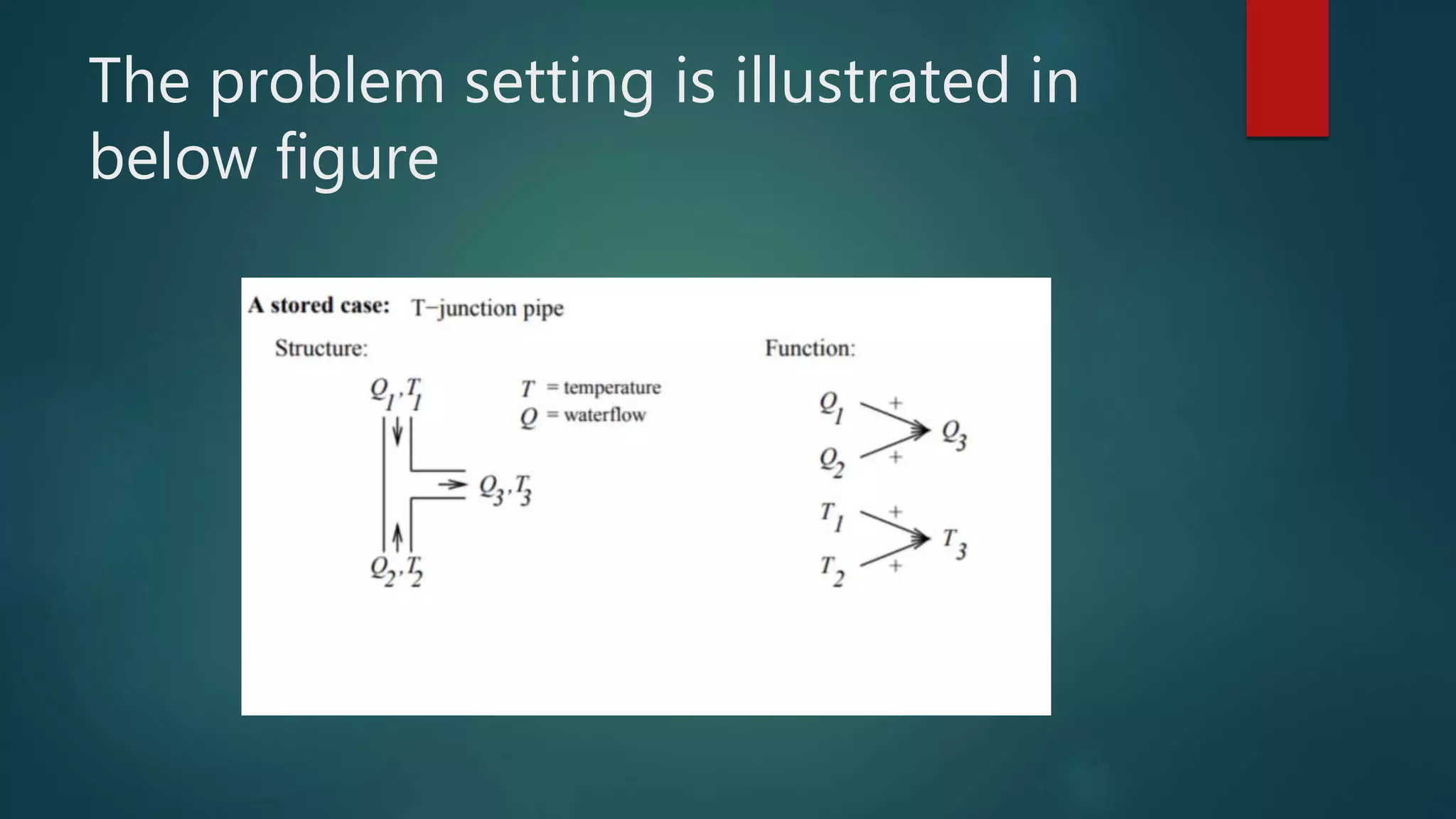
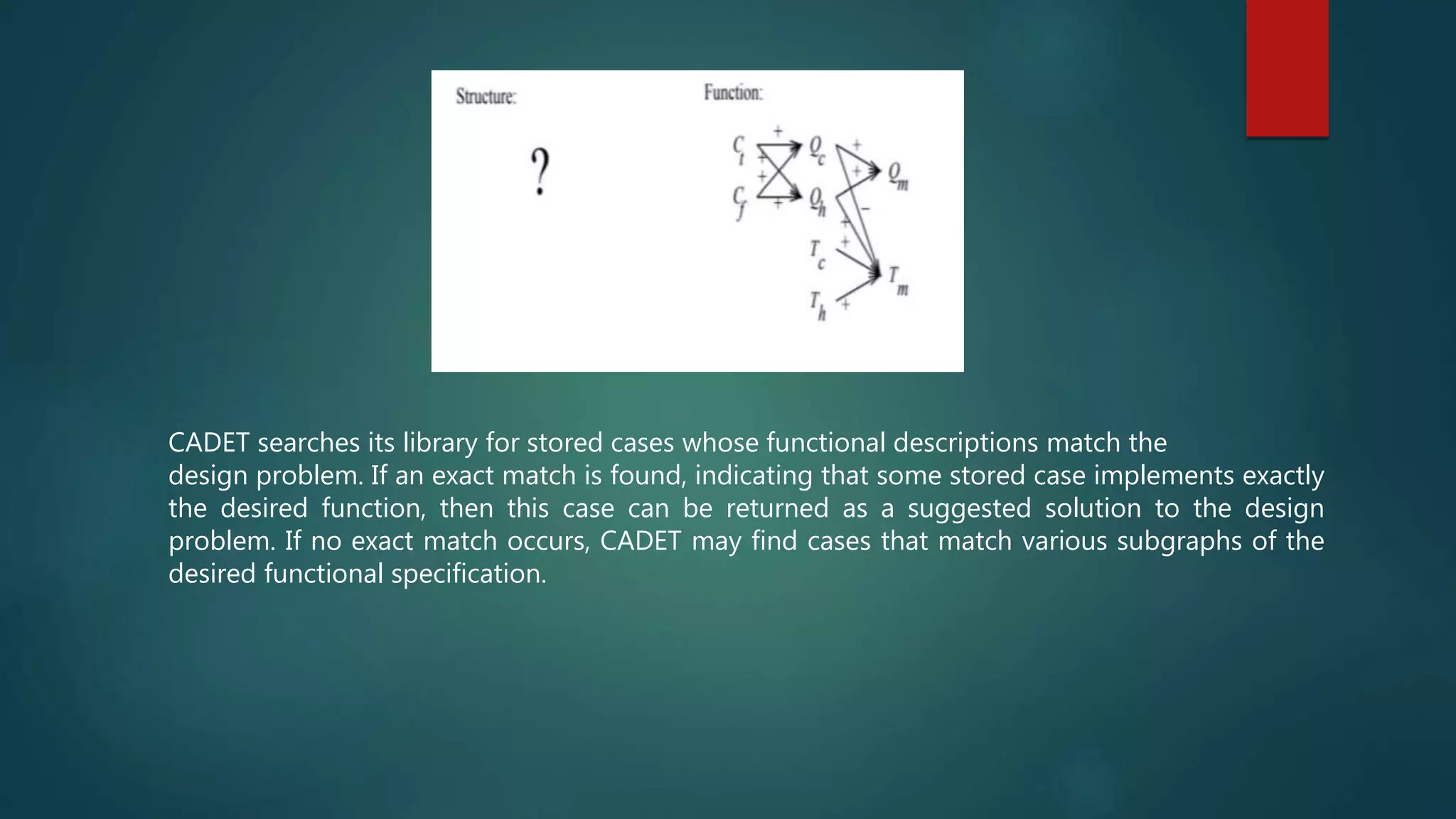
The problem setting is illustrated in
below figure
 The function is represented in terms of the qualitative relationships among the waterflow
levels and temperatures at its inputs and outputs.
 In the functional description, an arrow with a "+" label indicates that the variable at the
arrowhead increases with the variable at its tail. A "-" label indicates that the variable at
the head decreases with the variable at the tail.
 Here Qc refers to the flow of cold water into the faucet, Qh to the input flow of hot
water, and Qm to the single mixed flow out of the faucet.
 Tc, Th, and Tm refer to the temperatures of the cold water, hot water, and mixed water
respectively.
 The variable Ct denotes the control signal for temperature that is input to the faucet, and
Cf denotes the control signal for waterflow.
 The controls Ct and Cf are to influence the water flows Qc and Qh, thereby indirectly
influencing the faucet output flow Qm and temperature Tm.
CADET searches its library for stored cases whose functional descriptions match the
design problem. If an exact match is found, indicating that some stored case implements exactly
the desired function, then this case can be returned as a suggested solution to the design
problem. If no exact match occurs, CADET may find cases that match various subgraphs of the
desired functional specification.
THANK YOU

Case based reasoning

  • 1.
    CASE-BASED REASONING Vichhi ParthHiteshbhai 4SH17IS015 Machine Learning
  • 2.
     Case-based reasoning(CBR) is a learning paradigm based on lazy learning methods and they classify new query instances by analysing similar instances while ignoring instances that are very different from the query.  In CBR represent instances are not represented as real-valued points, but instead, they use a rich symbolic representation.  CBR has been applied to problems such as conceptual design of mechanical devices based on a stored library of previous designs, reasoning about new legal cases based on previous rulings, and solving planning and scheduling problems by reusing and combining portions of previous solutions to similar problems
  • 3.
    A prototypical exampleof a case- based reasoning  The CADET system employs case-based reasoning to assist in the conceptual design of simple mechanical devices such as water faucets.  It uses a library containing approximately 75 previous designs and design fragments to suggest conceptual designs to meet the specifications of new design problems.
  • 4.
    The problem settingis illustrated in below figure
  • 5.
     The functionis represented in terms of the qualitative relationships among the waterflow levels and temperatures at its inputs and outputs.  In the functional description, an arrow with a "+" label indicates that the variable at the arrowhead increases with the variable at its tail. A "-" label indicates that the variable at the head decreases with the variable at the tail.  Here Qc refers to the flow of cold water into the faucet, Qh to the input flow of hot water, and Qm to the single mixed flow out of the faucet.  Tc, Th, and Tm refer to the temperatures of the cold water, hot water, and mixed water respectively.  The variable Ct denotes the control signal for temperature that is input to the faucet, and Cf denotes the control signal for waterflow.  The controls Ct and Cf are to influence the water flows Qc and Qh, thereby indirectly influencing the faucet output flow Qm and temperature Tm.
  • 6.
    CADET searches itslibrary for stored cases whose functional descriptions match the design problem. If an exact match is found, indicating that some stored case implements exactly the desired function, then this case can be returned as a suggested solution to the design problem. If no exact match occurs, CADET may find cases that match various subgraphs of the desired functional specification.
  • 7.