Common Core in
Special Education
Caryl Miller, Ed.D.
Total School Solutions

Gail Angus, Ed.D.
Riverside County SELPA

Quentin Panek
Director Student Services

Total School Solutions®
Today’s Objectives


Connecting Special Education with
Common Core



Key factors to be considered when
developing a multi-year strategic plan



Share tools and resources

Total School Solutions®
3

3
Total School Solutions®
Continuum of Learning

Total School Solutions®
Fundamental Skills
Anchor Standards

Riding a Bike

What skills do you need to
master bike riding?
Total School Solutions®
How will CCSS Change Classroom
Practices?
Rothman (July/August 2012), Harvard Graduate School of Education, (V 28, 4).

Mathematics

English – Language Arts



Greater Focus



More Non-fiction



Coherence



Focus on evidence



Skills, understanding, and
application



“Staircase” of text complexity



Speaking and Listening

Emphasis on practices



Literacy in the Content Areas



Total School Solutions®
ELA Common Core Standards (pg. 5)
The Standards should also be read as allowing the
widest possible range of students to participate
fully from the outset and as permitting appropriate
accommodations to ensure maximum participation
by students with special education needs. For
example, for students with disabilities reading
should allow for the use of Braille, screen-reader
technology, or other assistive devices, while
writing should include the use of a scribe,
computer, or speech-to-text technology. In a
similar vein, speaking and listening should be
interpreted broadly to include the use of sign
language.
Total School Solutions®

• No API
• AYP based on
14-15
• Optional
STS 2-11
• EAP with SBAC
• SBAC
formative and
interim
assessments
• Gr. 2
diagnostic
• SBAC-ELA &
Math 3-8 and
11 except ELS
12 mos or less
• CELDT
• Computer
adaptive
• Paper Pencil

2016-2017

• No API
• AYP based on
12-13
• Optional
STS 2-11
• EAP with SBAC
• SBAC
formative and
interim
assessments
• Gr. 2
diagnostic
• SBAC-ELA &
Math 3-8 and
11 except ELS
12 mos or less
• CELDT
• Computer
adaptive
• Paper Pencil

2015-2016

• No API
• AYP based on
12-13
• Optional
STS 2-11
• Optional EAP
CST 11
• Science
CST/CMA5,8,10
• Scientific
sample 9-10
ELA & Math
• CAPA
• CELDT
• Computer
based-not
adaptive
• No pencil
paper

2014-2015

2013-2014

Assessments and Legislation
• No API
• AYP based on
15-16
• Optional
STS 2-11
• EAP with SBAC
• SBAC
formative and
interim
assessments
• Gr. 2
diagnostic
• SBAC-ELA &
Math 3-8 and
11 except ELS
12 mos or less
• ELPAC
• Computer
adaptive
• Paper Pencil
C u rric u lu m -In s tru c tio n -A s s e s s m e n t
• W h a t sh o u ld stu d e n ts k n o w a n d to b e a b le to d o ?
• W h a t sh o u ld stu den ts lea rn ?
• W h a t sh o u ld stu den ts b e ta u gh t?

C u rric u lu m

S tu d e n ts

In s tru c tio n

A ssessm ent

• W h a t a re stu d e n ts b e in g ta u g h t?
• H o w a re stu d e n ts b e in g ta u g h t?

• W h a t h a v e stu d e n ts le a rn e d ?
• W h a t h a v e n ’t stu d e n ts le a rn e d ?

Total School Solutions®
Expectation: Who Can Learn
Literature on expectations suggests students
learn what we expect them to learn.
Some students – with and without disabilities may not achieve to the levels we hope even
after high quality standards-based
instruction.
But we have no way to predict which ones so
we have to teach them ALL well!
National Center on Educational Outcomes, NASBE Regional Meeting August 12, 2011
http://www.ncscpartners.org/Media/Default/PDFs/Resources/Thurlow-CCSS-SWD-8-2011.pdf

Total School Solutions®
What are the complications
you Perceive with
implementing Common Core
for Special Education
students?

Total School Solutions®
DON’T DO THIS ALONE!

Total School Solutions®
Build on the General Education
Implementation Plan
Professional
Development
Technology
Curriculum/Instructional
Strategies

Total School Solutions®
CCSS Systems Implementation Phases
CCSS System Implementation Plan for California, April 2013, CDE

Awareness

Transition

Implementation
Total School Solutions®
Professional Development
Goal: Students have access to teachers who are prepared

• CCSS
• CCR
• Rigor
• Depth

Awareness

Total School Solutions®

Transition
• Instructional
Strategies
• Curriculum and
technology
• SBAC

• Access
• IEP Goals
• Service
Delivery
• Participation
in State
Assessment

Special
Education
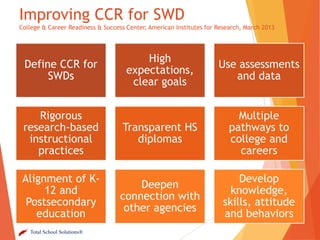
Improving CCR for SWD
College & Career Readiness & Success Center, American Institutes for Research, March 2013

High
expectations,
clear goals

Use assessments
and data

Rigorous
research-based
instructional
practices

Transparent HS
diplomas

Multiple
pathways to
college and
careers

Alignment of K12 and
Postsecondary
education

Deepen
connection with
other agencies

Develop
knowledge,
skills, attitude
and behaviors

Define CCR for
SWDs

Total School Solutions®
Group Activity
With your Elbow Partner–

 What

has your LEA (or the
LEAs you support, done to
prepare staff for the
implementation of the
Common Core State
Standards and for
students to be “College
and Career Ready”?
 Has the special education
staff been involved?
 What information do the
special education staff
still need?
Total School Solutions®
Differentiation for Special Education in
a Common Core World

Total School Solutions®
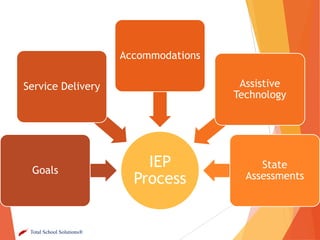
Accommodations
Assistive
Technology

Service Delivery

Goals

Total School Solutions®

IEP
Process

State
Assessments
The IEP Creates Access to the Curriculum
Science/
Social
Studies

Real Life
Skills

IEP
Goals

Reading

Math

Total School Solutions®

- But is not itself a curriculum
Where to set the goal…
Grade-level standards

Achievement level

Scaffolding to grade-level
Total School Solutions®
Select the Standard
Based on student’s need and grade-level
Fifth Grade Student who is able to use appropriate adjectives and
adverbs to describe.
Strand: Language - Vocabulary Acquisition and Use
Standard Six:
Acquire and use accurately grade-appropriate general academic
and domain-specific words and phrases, including those that signal
contrast, addition, and other logical relationships (e.g., however,
although, nevertheless, similarly, moreover, in addition).
Label the standard - L.5.6 or 5.L.6

Total School Solutions®
Scaffolding A Standard
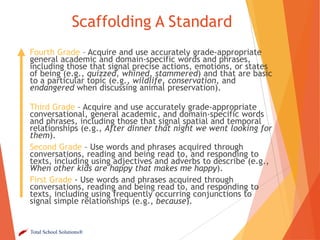
Fourth Grade – Acquire and use accurately grade-appropriate
general academic and domain-specific words and phrases,
including those that signal precise actions, emotions, or states
of being (e.g., quizzed, whined, stammered) and that are basic
to a particular topic (e.g., wildlife, conservation, and
endangered when discussing animal preservation).
Third Grade – Acquire and use accurately grade-appropriate
conversational, general academic, and domain-specific words
and phrases, including those that signal spatial and temporal
relationships (e.g., After dinner that night we went looking for
them).
Second Grade – Use words and phrases acquired through
conversations, reading and being read to, and responding to
texts, including using adjectives and adverbs to describe (e.g.,
When other kids are happy that makes me happy).
First Grade - Use words and phrases acquired through
conversations, reading and being read to, and responding to
texts, including using frequently occurring conjunctions to
signal simple relationships (e.g., because).

Total School Solutions®
So How Do I Write a Goal
Using CCSS?
Fifth Grade Student who is able to use appropriate
adjectives and adverbs to describe.


1st – What grade level is the student?



2nd – At which grade level is the student currently
functioning?


Which grade level skill will be targeted for the
IEP?

Total School Solutions®
Look At The Specific Skills
Identified At Each Grade-level
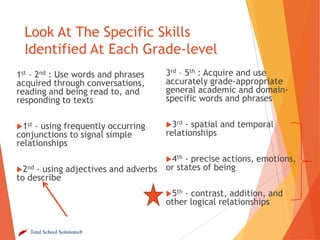
1st – 2nd : Use words and phrases
acquired through conversations,
reading and being read to, and
responding to texts

3rd – 5th : Acquire and use
accurately grade-appropriate
general academic and domainspecific words and phrases

1st

3rd

- using frequently occurring
conjunctions to signal simple
relationships

- spatial and temporal
relationships
4th

- precise actions, emotions,
2nd - using adjectives and adverbs or states of being
to describe
5th

- contrast, addition, and
other logical relationships

Total School Solutions®
Writing a Measurable Goal Using CCSS
By September 11, 2014, Judith will be able to
acquire and use accurately, grade-appropriate
general academic and domain-specific words
and phrases, including those that signal spatial
and temporal relationship as well as state of
being,
85% of the time when participating in a class
discussion or conversations, as measured by four
separate language samples taken during 30
minute trials by classroom teacher.
grade level access
target instruction for IEP Goal
Total School Solutions®
Select the Standard
Based on student’s need and grade-level
Eleventh Grade Student who is able to determine the
central idea of text at their reading level and provide
supporting details and is able to orally summarize what
they have read.
Strand: Key Ideas and Details

Standard two:
Determine two or more central ideas of a text and
analyze their development over the course of the text,
including how they interact and build on one another to
provide a complex analysis; provide an objective
summary of the text.
Label the standard – RI.2.11-12 or 11-12.RI.2
Total School Solutions®
Scaffolding A Standard


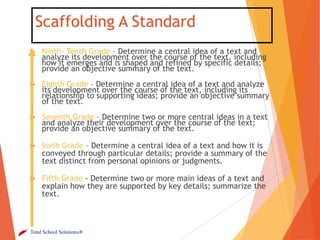
Ninth- Tenth Grade – Determine a central idea of a text and
analyze its development over the course of the text, including
how it emerges and is shaped and refined by specific details;
provide an objective summary of the text.



Eighth Grade – Determine a central idea of a text and analyze
its development over the course of the text, including its
relationship to supporting ideas; provide an objective summary
of the text.



Seventh Grade – Determine two or more central ideas in a text
and analyze their development over the course of the text;
provide an objective summary of the text.



Sixth Grade – Determine a central idea of a text and how it is
conveyed through particular details; provide a summary of the
text distinct from personal opinions or judgments.



Fifth Grade - Determine two or more main ideas of a text and
explain how they are supported by key details; summarize the
text.

Total School Solutions®
Look At The Specific Skills
Identified At Each Grade-level
5th - Determine two or more main
ideas of a text and explain how
they are supported by key
details; summarize the text.
6th – Determine a central idea of a
text and how it is conveyed
through particular details;
provide a summary of the text
distinct from personal opinions or
judgments.
7th – Determine two or more central
ideas in a text and analyze their
development over the course of
the text; provide an objective
summary of the text.

Total School Solutions®

8th – 12th: Determine a central
idea of a text and analyze its
development over the course of
the text, …... provide an
objective summary of the text.


8th - including its
relationship to supporting
ideas



9th – 10th - including how it
emerges and is shaped and
refined by specific details



11th – 12th – 2 or more
central ideas including
how they interact and
build on one another to
provide a complex analysis
Writing a Measurable Goal Using CCSS
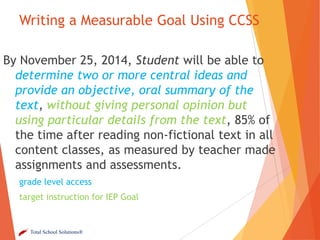
By November 25, 2014, Student will be able to
determine two or more central ideas and
provide an objective, oral summary of the
text, without giving personal opinion but
using particular details from the text, 85% of
the time after reading non-fictional text in all
content classes, as measured by teacher made
assignments and assessments.
grade level access

target instruction for IEP Goal

Total School Solutions®
Group Activity
With your Elbow Partner–

 How

is this process for
writing IEP goals different
from past (current)
practices?

 Who

do you need to share
the process of including
Common Core State
Standards into goals?
 Special

Education
Teachers

 Related

service providers

 Principals
Total School Solutions®
Access Regardless Of The
Student’s Disability!!!!

Total School Solutions®
Instruction and Services


Determine the special education services that will
lead toward grade level mastery and beyond.





Direct services needed
How is the instruction delivered? By whom? In which
environment?

Describe the specially designed instruction that will
lead to grade level mastery and beyond.


Instructional support/scaffolding needed so the student
can succeed in the general education classroom



Adaptations, accommodations, modifications or assistive
technology needed

Total School Solutions®
Classroom Variables and
Access to the General
Curriculum
Students who are included in
the general classroom have
greater access to the general
education curriculum.

 The

focus is on
access
 Instead

of “fixing”
the student, modify
the curriculum to
enable the student
to learn (Pugach and
Wagner, 2001)

Total School Solutions®

Soukup, J. H., Wehmeyer, M.L., Bashinski, S. M., Bovaird, J.A. (Fall 2007). Council for
Exceptional Children 74(1) pp. 101-120
Impact of Curriculum
Accommodations on Access

Available

Not Available

Students were more Conflicting behaviors
were observed
engaged in the GE
curriculum.
If a para-professional was the only
accommodation there was also the presence
of conflicting behaviors
Total School Solutions®

Lee, S.H.; Wehmeyer, M.L.; Soukup, J. H.; Palmer, S. B.,
(Winter, 2010). Exceptional Children 76( 2), pp. 213-233.
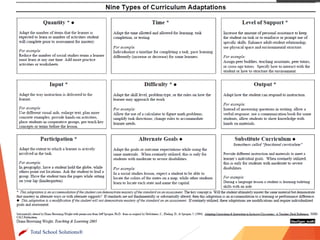
Curricular Adaptations


Adapting curriculum and instruction is….
 Appropriate

for all learners

 Demonstrate

respect for individual

differences
 Appropriate

 A rule

for all curriculum areas

rather than an exception

Total School Solutions®
The preponderance of evidence is that the
SYSTEM is responsible for limited access
to the general curriculum and the
resulting achievement gap –
not the student’s
disabilities, color,
SES, or whatever
excuse is given.

Total School Solutions®
Group Activity
With your Elbow Partner–

 Based

on what you heard
today, what changes to
service delivery do you
recommend so students
with disabilities can
access and master the
Common Core State
Standards and be “College
and Career Ready”?

What support and
information will speech
therapists need? School
psychologists?
Be ready to share out

Total School Solutions®
Does my
administrator
know/support
the process
for writing
CCSS in goals?

Does my
administrator
support a
co-teaching
model?

How will
CCSS impact
Child find
and
referrals?
Total School Solutions®

Will I get the
support to
alter my
delivery
model so I can
implement
CCSS?
State Assessments
How will the student participate
in grade level state testing?
 Are

the accommodations the same ones
used in classroom instruction?

 Do

the selected accommodations result in
getting the best measure of what the
student knows and can do on the skill being
tested?

Total School Solutions®
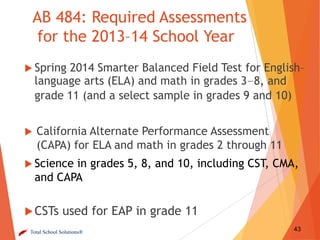
AB 484: Required Assessments
for the 2013–14 School Year
 Spring

2014 Smarter Balanced Field Test for English–
language arts (ELA) and math in grades 3–8, and
grade 11 (and a select sample in grades 9 and 10)



California Alternate Performance Assessment
(CAPA) for ELA and math in grades 2 through 11

 Science

in grades 5, 8, and 10, including CST, CMA,
and CAPA

 CSTs

used for EAP in grade 11

Total School Solutions®

43
SMARTER Balanced
Conceptual Framework
 All

students (including students
with disabilities, ELLs, and ELLs
with disabilities) are to be held
to the same expectations for
participation and performance
on State assessments.

Total School Solutions®
Access and Participation for ALL


Universal tools, designated supports, and
accommodations all yield valid scores
that count as participation in Statewide
assessments when used in a manner
consistent with the Guidelines.


A universal tool for one content focus may be an
accommodation for another content focus
(calculator)



Designated support may also be an accommodation,
depending on



The content target (scribe)

Total School Solutions®
Accommodations for All, Some, Few

http://www.smarterbalanced.org/wordpress/wpcontent/uploads/2013/09/SmarterBalanced_Guidelines_091113.pdf

Total School Solutions®
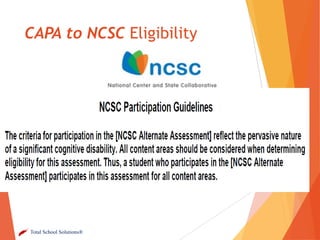
CAPA to NCSC Eligibility

Total School Solutions®
Group Activity
With your Elbow Partner–

 Based

on what you heard
today, what are you
planning on sharing with
others to support students
with disabilities to access
and master the Common
Core State Standards and
be “College and Career
Ready”?

Total School Solutions®

What support and
information will speech
therapists need? School
psychologists?
Resources
Special Education Resources on CDE Website


http://www.cde.ca.gov/sp/se/cc/

Total School Solutions®
Questions

Total School Solutions®
CONTACT INFORMATION
Total School Solutions®
4751 Mangels Boulevard
Fairfield, CA 94534
http://www.totalschoolsolutions.net
(707) 422-6393
info@totalschoolsolutions.net
(707) 422-6393

Total School Solutions®

Caryl miller

  • 1.
    Common Core in SpecialEducation Caryl Miller, Ed.D. Total School Solutions Gail Angus, Ed.D. Riverside County SELPA Quentin Panek Director Student Services Total School Solutions®
  • 2.
    Today’s Objectives  Connecting SpecialEducation with Common Core  Key factors to be considered when developing a multi-year strategic plan  Share tools and resources Total School Solutions®
  • 3.
  • 5.
    Continuum of Learning TotalSchool Solutions®
  • 6.
    Fundamental Skills Anchor Standards Ridinga Bike What skills do you need to master bike riding? Total School Solutions®
  • 7.
    How will CCSSChange Classroom Practices? Rothman (July/August 2012), Harvard Graduate School of Education, (V 28, 4). Mathematics English – Language Arts  Greater Focus  More Non-fiction  Coherence  Focus on evidence  Skills, understanding, and application  “Staircase” of text complexity  Speaking and Listening Emphasis on practices  Literacy in the Content Areas  Total School Solutions®
  • 8.
    ELA Common CoreStandards (pg. 5) The Standards should also be read as allowing the widest possible range of students to participate fully from the outset and as permitting appropriate accommodations to ensure maximum participation by students with special education needs. For example, for students with disabilities reading should allow for the use of Braille, screen-reader technology, or other assistive devices, while writing should include the use of a scribe, computer, or speech-to-text technology. In a similar vein, speaking and listening should be interpreted broadly to include the use of sign language. Total School Solutions®
  • 9.
    Total School Solutions® •No API • AYP based on 14-15 • Optional STS 2-11 • EAP with SBAC • SBAC formative and interim assessments • Gr. 2 diagnostic • SBAC-ELA & Math 3-8 and 11 except ELS 12 mos or less • CELDT • Computer adaptive • Paper Pencil 2016-2017 • No API • AYP based on 12-13 • Optional STS 2-11 • EAP with SBAC • SBAC formative and interim assessments • Gr. 2 diagnostic • SBAC-ELA & Math 3-8 and 11 except ELS 12 mos or less • CELDT • Computer adaptive • Paper Pencil 2015-2016 • No API • AYP based on 12-13 • Optional STS 2-11 • Optional EAP CST 11 • Science CST/CMA5,8,10 • Scientific sample 9-10 ELA & Math • CAPA • CELDT • Computer based-not adaptive • No pencil paper 2014-2015 2013-2014 Assessments and Legislation • No API • AYP based on 15-16 • Optional STS 2-11 • EAP with SBAC • SBAC formative and interim assessments • Gr. 2 diagnostic • SBAC-ELA & Math 3-8 and 11 except ELS 12 mos or less • ELPAC • Computer adaptive • Paper Pencil
  • 10.
    C u rricu lu m -In s tru c tio n -A s s e s s m e n t • W h a t sh o u ld stu d e n ts k n o w a n d to b e a b le to d o ? • W h a t sh o u ld stu den ts lea rn ? • W h a t sh o u ld stu den ts b e ta u gh t? C u rric u lu m S tu d e n ts In s tru c tio n A ssessm ent • W h a t a re stu d e n ts b e in g ta u g h t? • H o w a re stu d e n ts b e in g ta u g h t? • W h a t h a v e stu d e n ts le a rn e d ? • W h a t h a v e n ’t stu d e n ts le a rn e d ? Total School Solutions®
  • 11.
    Expectation: Who CanLearn Literature on expectations suggests students learn what we expect them to learn. Some students – with and without disabilities may not achieve to the levels we hope even after high quality standards-based instruction. But we have no way to predict which ones so we have to teach them ALL well! National Center on Educational Outcomes, NASBE Regional Meeting August 12, 2011 http://www.ncscpartners.org/Media/Default/PDFs/Resources/Thurlow-CCSS-SWD-8-2011.pdf Total School Solutions®
  • 12.
    What are thecomplications you Perceive with implementing Common Core for Special Education students? Total School Solutions®
  • 13.
    DON’T DO THISALONE! Total School Solutions®
  • 14.
    Build on theGeneral Education Implementation Plan Professional Development Technology Curriculum/Instructional Strategies Total School Solutions®
  • 15.
    CCSS Systems ImplementationPhases CCSS System Implementation Plan for California, April 2013, CDE Awareness Transition Implementation Total School Solutions®
  • 16.
    Professional Development Goal: Studentshave access to teachers who are prepared • CCSS • CCR • Rigor • Depth Awareness Total School Solutions® Transition • Instructional Strategies • Curriculum and technology • SBAC • Access • IEP Goals • Service Delivery • Participation in State Assessment Special Education
  • 17.
    Improving CCR forSWD College & Career Readiness & Success Center, American Institutes for Research, March 2013 High expectations, clear goals Use assessments and data Rigorous research-based instructional practices Transparent HS diplomas Multiple pathways to college and careers Alignment of K12 and Postsecondary education Deepen connection with other agencies Develop knowledge, skills, attitude and behaviors Define CCR for SWDs Total School Solutions®
  • 18.
    Group Activity With yourElbow Partner–  What has your LEA (or the LEAs you support, done to prepare staff for the implementation of the Common Core State Standards and for students to be “College and Career Ready”?  Has the special education staff been involved?  What information do the special education staff still need? Total School Solutions®
  • 19.
    Differentiation for SpecialEducation in a Common Core World Total School Solutions®
  • 20.
  • 21.
    The IEP CreatesAccess to the Curriculum Science/ Social Studies Real Life Skills IEP Goals Reading Math Total School Solutions® - But is not itself a curriculum
  • 22.
    Where to setthe goal… Grade-level standards Achievement level Scaffolding to grade-level Total School Solutions®
  • 23.
    Select the Standard Basedon student’s need and grade-level Fifth Grade Student who is able to use appropriate adjectives and adverbs to describe. Strand: Language - Vocabulary Acquisition and Use Standard Six: Acquire and use accurately grade-appropriate general academic and domain-specific words and phrases, including those that signal contrast, addition, and other logical relationships (e.g., however, although, nevertheless, similarly, moreover, in addition). Label the standard - L.5.6 or 5.L.6 Total School Solutions®
  • 24.
    Scaffolding A Standard FourthGrade – Acquire and use accurately grade-appropriate general academic and domain-specific words and phrases, including those that signal precise actions, emotions, or states of being (e.g., quizzed, whined, stammered) and that are basic to a particular topic (e.g., wildlife, conservation, and endangered when discussing animal preservation). Third Grade – Acquire and use accurately grade-appropriate conversational, general academic, and domain-specific words and phrases, including those that signal spatial and temporal relationships (e.g., After dinner that night we went looking for them). Second Grade – Use words and phrases acquired through conversations, reading and being read to, and responding to texts, including using adjectives and adverbs to describe (e.g., When other kids are happy that makes me happy). First Grade - Use words and phrases acquired through conversations, reading and being read to, and responding to texts, including using frequently occurring conjunctions to signal simple relationships (e.g., because). Total School Solutions®
  • 25.
    So How DoI Write a Goal Using CCSS? Fifth Grade Student who is able to use appropriate adjectives and adverbs to describe.  1st – What grade level is the student?  2nd – At which grade level is the student currently functioning?  Which grade level skill will be targeted for the IEP? Total School Solutions®
  • 26.
    Look At TheSpecific Skills Identified At Each Grade-level 1st – 2nd : Use words and phrases acquired through conversations, reading and being read to, and responding to texts 3rd – 5th : Acquire and use accurately grade-appropriate general academic and domainspecific words and phrases 1st 3rd - using frequently occurring conjunctions to signal simple relationships - spatial and temporal relationships 4th - precise actions, emotions, 2nd - using adjectives and adverbs or states of being to describe 5th - contrast, addition, and other logical relationships Total School Solutions®
  • 27.
    Writing a MeasurableGoal Using CCSS By September 11, 2014, Judith will be able to acquire and use accurately, grade-appropriate general academic and domain-specific words and phrases, including those that signal spatial and temporal relationship as well as state of being, 85% of the time when participating in a class discussion or conversations, as measured by four separate language samples taken during 30 minute trials by classroom teacher. grade level access target instruction for IEP Goal Total School Solutions®
  • 28.
    Select the Standard Basedon student’s need and grade-level Eleventh Grade Student who is able to determine the central idea of text at their reading level and provide supporting details and is able to orally summarize what they have read. Strand: Key Ideas and Details Standard two: Determine two or more central ideas of a text and analyze their development over the course of the text, including how they interact and build on one another to provide a complex analysis; provide an objective summary of the text. Label the standard – RI.2.11-12 or 11-12.RI.2 Total School Solutions®
  • 29.
    Scaffolding A Standard  Ninth-Tenth Grade – Determine a central idea of a text and analyze its development over the course of the text, including how it emerges and is shaped and refined by specific details; provide an objective summary of the text.  Eighth Grade – Determine a central idea of a text and analyze its development over the course of the text, including its relationship to supporting ideas; provide an objective summary of the text.  Seventh Grade – Determine two or more central ideas in a text and analyze their development over the course of the text; provide an objective summary of the text.  Sixth Grade – Determine a central idea of a text and how it is conveyed through particular details; provide a summary of the text distinct from personal opinions or judgments.  Fifth Grade - Determine two or more main ideas of a text and explain how they are supported by key details; summarize the text. Total School Solutions®
  • 30.
    Look At TheSpecific Skills Identified At Each Grade-level 5th - Determine two or more main ideas of a text and explain how they are supported by key details; summarize the text. 6th – Determine a central idea of a text and how it is conveyed through particular details; provide a summary of the text distinct from personal opinions or judgments. 7th – Determine two or more central ideas in a text and analyze their development over the course of the text; provide an objective summary of the text. Total School Solutions® 8th – 12th: Determine a central idea of a text and analyze its development over the course of the text, …... provide an objective summary of the text.  8th - including its relationship to supporting ideas  9th – 10th - including how it emerges and is shaped and refined by specific details  11th – 12th – 2 or more central ideas including how they interact and build on one another to provide a complex analysis
  • 31.
    Writing a MeasurableGoal Using CCSS By November 25, 2014, Student will be able to determine two or more central ideas and provide an objective, oral summary of the text, without giving personal opinion but using particular details from the text, 85% of the time after reading non-fictional text in all content classes, as measured by teacher made assignments and assessments. grade level access target instruction for IEP Goal Total School Solutions®
  • 32.
    Group Activity With yourElbow Partner–  How is this process for writing IEP goals different from past (current) practices?  Who do you need to share the process of including Common Core State Standards into goals?  Special Education Teachers  Related service providers  Principals Total School Solutions®
  • 33.
    Access Regardless OfThe Student’s Disability!!!! Total School Solutions®
  • 34.
    Instruction and Services  Determinethe special education services that will lead toward grade level mastery and beyond.    Direct services needed How is the instruction delivered? By whom? In which environment? Describe the specially designed instruction that will lead to grade level mastery and beyond.  Instructional support/scaffolding needed so the student can succeed in the general education classroom  Adaptations, accommodations, modifications or assistive technology needed Total School Solutions®
  • 35.
    Classroom Variables and Accessto the General Curriculum Students who are included in the general classroom have greater access to the general education curriculum.  The focus is on access  Instead of “fixing” the student, modify the curriculum to enable the student to learn (Pugach and Wagner, 2001) Total School Solutions® Soukup, J. H., Wehmeyer, M.L., Bashinski, S. M., Bovaird, J.A. (Fall 2007). Council for Exceptional Children 74(1) pp. 101-120
  • 36.
    Impact of Curriculum Accommodationson Access Available Not Available Students were more Conflicting behaviors were observed engaged in the GE curriculum. If a para-professional was the only accommodation there was also the presence of conflicting behaviors Total School Solutions® Lee, S.H.; Wehmeyer, M.L.; Soukup, J. H.; Palmer, S. B., (Winter, 2010). Exceptional Children 76( 2), pp. 213-233.
  • 37.
    Curricular Adaptations  Adapting curriculumand instruction is….  Appropriate for all learners  Demonstrate respect for individual differences  Appropriate  A rule for all curriculum areas rather than an exception Total School Solutions®
  • 38.
  • 39.
    The preponderance ofevidence is that the SYSTEM is responsible for limited access to the general curriculum and the resulting achievement gap – not the student’s disabilities, color, SES, or whatever excuse is given. Total School Solutions®
  • 40.
    Group Activity With yourElbow Partner–  Based on what you heard today, what changes to service delivery do you recommend so students with disabilities can access and master the Common Core State Standards and be “College and Career Ready”? What support and information will speech therapists need? School psychologists? Be ready to share out Total School Solutions®
  • 41.
    Does my administrator know/support the process forwriting CCSS in goals? Does my administrator support a co-teaching model? How will CCSS impact Child find and referrals? Total School Solutions® Will I get the support to alter my delivery model so I can implement CCSS?
  • 42.
    State Assessments How willthe student participate in grade level state testing?  Are the accommodations the same ones used in classroom instruction?  Do the selected accommodations result in getting the best measure of what the student knows and can do on the skill being tested? Total School Solutions®
  • 43.
    AB 484: RequiredAssessments for the 2013–14 School Year  Spring 2014 Smarter Balanced Field Test for English– language arts (ELA) and math in grades 3–8, and grade 11 (and a select sample in grades 9 and 10)  California Alternate Performance Assessment (CAPA) for ELA and math in grades 2 through 11  Science in grades 5, 8, and 10, including CST, CMA, and CAPA  CSTs used for EAP in grade 11 Total School Solutions® 43
  • 44.
    SMARTER Balanced Conceptual Framework All students (including students with disabilities, ELLs, and ELLs with disabilities) are to be held to the same expectations for participation and performance on State assessments. Total School Solutions®
  • 45.
    Access and Participationfor ALL  Universal tools, designated supports, and accommodations all yield valid scores that count as participation in Statewide assessments when used in a manner consistent with the Guidelines.  A universal tool for one content focus may be an accommodation for another content focus (calculator)  Designated support may also be an accommodation, depending on  The content target (scribe) Total School Solutions®
  • 46.
    Accommodations for All,Some, Few http://www.smarterbalanced.org/wordpress/wpcontent/uploads/2013/09/SmarterBalanced_Guidelines_091113.pdf Total School Solutions®
  • 47.
  • 48.
    CAPA to NCSCEligibility Total School Solutions®
  • 49.
    Group Activity With yourElbow Partner–  Based on what you heard today, what are you planning on sharing with others to support students with disabilities to access and master the Common Core State Standards and be “College and Career Ready”? Total School Solutions® What support and information will speech therapists need? School psychologists?
  • 50.
    Resources Special Education Resourceson CDE Website  http://www.cde.ca.gov/sp/se/cc/ Total School Solutions®
  • 51.
  • 52.
    CONTACT INFORMATION Total SchoolSolutions® 4751 Mangels Boulevard Fairfield, CA 94534 http://www.totalschoolsolutions.net (707) 422-6393 info@totalschoolsolutions.net (707) 422-6393 Total School Solutions®

Editor's Notes

  • #2 Introduce each other – Caryl will provide me with intro
  • #3 Caryl
  • #5 Here is the consistent message RCOE shares with all districtsUni - Internationally benchmarked from top performing countriesSame target Student expectations are clear to parents, teachers, and the general public. Bar set high in some states and low in others - Fordham university ranks state standards according to rigor – Rigor is the key to CCSRigor Relevance Relationships3 Rs – not what you think – Rigor, Relevance, Relationships -- Different rigor across states – until now – we have same target - 46 states will have the same rigor and expectations Allows for collaboration with other states on best practices, instructional materials, and professional development.Access for SWD taking AA with reduced depth, breadth and complexityFirst time – logical progression of standards from year to year, clear and concise descriptors of what students should know and be able to do.CCSS organized around Anchor standards outcomes for all students to be college and career ready
  • #8 Gail
  • #11 Gail
  • #12 Caryl
  • #13 Gail –Have them generate what they believe the implications are. Capture on Chart paper and refer back to see if it was addressed during the training and also for them to address in their plans.
  • #14 Gail - Flash Mob video - here
  • #15 Gail - In the early part of September, LEAs received the first installment of $1.25 billion that has been set aside for to support the implementation of CCSS the second installment is due in October. These monies are to support:Professional development for teachers, administrators, and paraprofessional educators or other classified employees involved in the direct instruction of pupils that is aligned to academic content standards.Instructional materials aligned to the academic content standards.Integration of the academic content standards through technology-based instruction, including expenditures necessary to support the administration of computer-based assessments.
  • #16 Gail – Awareness Phase – introduction, initial planning of systems, establishment of collaborationTransition phase – concentration on building foundation resources, needs assessments, establish new professional learning opportunities, collaboration between stakeholdersImplementation – new professional learning support, fully align curriculum, instruction and assessments, effectively integrates across the field
  • #17 Gail
  • #18 Caryl
  • #19 Gail
  • #20 Caryl will do intro
  • #21 gail
  • #22 gail
  • #26 gail
  • #28 gail
  • #33 Gail
  • #36 GailDefinition of InclusionWhat is taughtHow curriculum content is deliveredWhat supports are needed to ensure progress in the GE curriculum19 elementary studentsThree districts from the Mid-westAges 7-12 (grades 2-6)12 males; 7 femalesWhite (79%), Asian/Pacific Islander (10%), African American (5%), Hispanic (5%)Data collectionInterviews, review of IEPs, observationsLevel of support neededInclusion statusAccess to GE curriculumFocus of study:How does the following affect access to general education curriculuminclusion status (the amount of time in GE) Classroom setting (self-contained, general education) Classroom ecological variables (groupings, physical arrangement of class)Students who are in the GE for a majority of the day worked on standards linked to the grade level 83%-93%
  • #37 Caryl45 high school students11 school, 7 districts from Mid-west All in GE classroom – all content areas representedAge 14.2-19.2 (grades 9-12)29 males; 16 femalesWhite (67%), Hispanic (18%), Native American (4%), Asian (4%), African-American (2%)Data collected through observations and interview with teachers (GE & SE)Focus of StudyThe presence of modifications would have a positive affects on student access to GE curriculum and minimize classroom management issues.
  • #39 Gail
  • #40 caryl
  • #41 Gail
  • #50 Gail
  • #51 Caryl
  • #52 Gail and Caryl
  • #53 Our good by and thank you to you –Gail do video