



Students and Cyberspace
ACSA 2014 Every Child
Counts Symposium
Jonathan P. Read
January 16, 2014
1
What We’ll Cover Today
Sexting and Cell Phone Searches & Seizures
 Bullying and Cyberbullying


 Denial



of FAPE for Students with Disabilities

Disciplining Students for Cyber-Speech
 Case

Law: Balancing School Safety and Free
Speech in Making Decision to Discipline Students
 Rules Applicable to Students with Disabilities

2
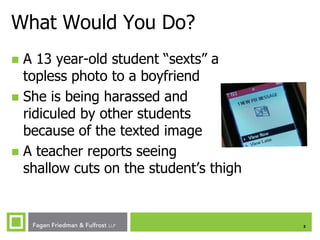
What Would You Do?
A 13 year-old student “sexts” a
topless photo to a boyfriend
 She is being harassed and
ridiculed by other students
because of the texted image
 A teacher reports seeing
shallow cuts on the student’s thigh


3
Witsell Case Example
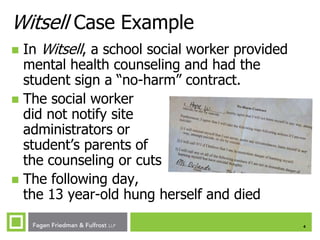
In Witsell, a school social worker provided
mental health counseling and had the
student sign a “no-harm” contract.
 The social worker
did not notify site
administrators or
student’s parents of
the counseling or cuts
 The following day,
the 13 year-old hung herself and died


4
Lessons Learned from Witsell
Sexting prevention
 Bullying prevention
 Search & seizure
 Protecting victims
 Negligent supervision liability


5
Sexting in Schools


School districts will
typically learn of
sexting from:
 Cell

phone search
& seizure
 Reports of
bullying

6
Cell Phone Search & Seizure


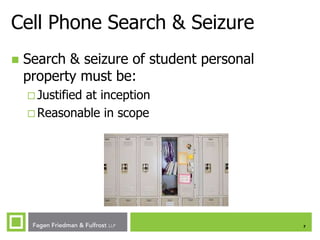
Search & seizure of student personal
property must be:
 Justified

at inception
 Reasonable in scope

7
Policy Pointer
 School district cell phone policies should not
permit search and seizure at any time for
any reason
 Klump v. Nazareth Area School District

8
What Would You Do?


What should a school district do if search &
seizure of a student’s cell phone reveals
evidence of sexting?
 Seal

the evidence and contact
police
 Child pornography implications
 Report to CPS?
 Don’t pass on!

9
Policy Pointer


School district cell phone policies should not
promise return of a confiscated cell phone at
the end of class or the end of day, because
confiscated cell phones may contain
evidence of a crime and must be turned
over to the police

10
Policy Pointer
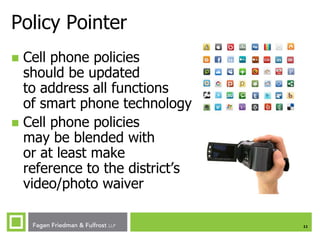
Cell phone policies
should be updated
to address all functions
of smart phone technology
 Cell phone policies
may be blended with
or at least make
reference to the district’s
video/photo waiver


11
Campus-Wide Search
of Student Cell Phones
Work with police
 Justified at inception
 Request voluntary deletion
 Education regarding
potential criminal punishment
for possession of sexting images


12
Cyber Misconduct as “Bullying”
If misconduct at issue does not meet the
definition of bullying, it may be grounds for
discipline as sexual harassment under the
Education Code.
 District should also consider alternative
means of intervention, i.e. counseling


13
Cyber Misconduct as “Bullying”


Bullying defined: Ed. Code § 48900(r)
 Severe

or pervasive physical or verbal conduct
 Has, or could have, the following effects:
 Places

a reasonable student in fear of harm to person
or property
 Substantially detrimental effect on physical
or mental health
 Substantial interference with academics
or with school services, activities, or privileges

14
“Bullying” – General Definition


Ed. Code§48900(r)
 What

is a “reasonable pupil”?
 One who exercises average care, skill and
judgment in conduct for a person of his or her
age, or for a person with his or her exceptional
needs

15
“Bullying” – Policy Requirements


AB 9 (became effective July 1, 2012,
amending Ed Code§234)
 Requires

schools to
adopt a policy
prohibiting bullying
 Requires a schools to
adopt a process for
receiving and investigating
complaints

16
One of the First Laws in the Nation to
Address Cyberbullying . . .


Assembly Bill 86
 Amended

Education Code §48900,
which identifies grounds
for suspensions and expulsions
 Provides school administrators
authority to suspend or
recommend for expulsion
those students who bully others by means
including, but not limited to, an “electronic act”

17
What Is an “Electronic Act”


Definition:
 Transmission

of a communication, including, but
not limited to, a message, text, sound or image,
by means of an electronic device, including, but
not limited to, a telephone, wireless telephone,
or other wireless communication device,
computer or pager
 AB 256 (effective January 1, 2014):
Transmission can originate either on or off the
school site
18
“Electronic Act”


Also includes, “posting on a social network
site” including:
 Posting

to or creating a burn page (Internet
Web site created for the purpose of bullying)
 Creating a credible impersonation of another
student
 Creating a false profile

19
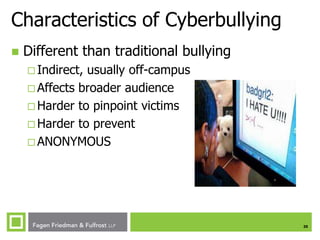
Characteristics of Cyberbullying


Different than traditional bullying
 Indirect,

usually off-campus
 Affects broader audience
 Harder to pinpoint victims
 Harder to prevent
 ANONYMOUS

20
Misconduct Related to School Activities




“A pupil may not be suspended or expelled . . .
unless that act is related to a school activity”
Related to a school activity includes, but is not
limited to:
While on school grounds
 While going or coming from school
 During lunch period on or off campus
 During, while going to or from, a school sponsored
activity


(Ed. Code, § 48900)

21
Misconduct Related to School Activities


When is misconduct via an electronic act
“related to a school activity”?
 Harassing

text messages by student while on-

campus?
 Misconduct on school e-mail account from
home?
 Threats posted on MySpace from home, which
causes victim to miss school?
 A student starts a blog from home computer to
post obscene jokes about another student?

22
Bullying, Students with Disabilities
and FAPE
Joint OSERS/OSEP August 2013 “Dear
Colleague” letter
 Encompasses cyberbullying
 Discussed FAPE impact in much more
significant detail than earlier guidance
 Three issues addressed:


 FAPE

standard
 IEP team responsibilities
 Placement considerations
23
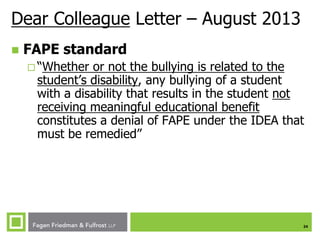
Dear Colleague Letter – August 2013


FAPE standard
 “Whether

or not the bullying is related to the
student’s disability, any bullying of a student
with a disability that results in the student not
receiving meaningful educational benefit
constitutes a denial of FAPE under the IDEA that
must be remedied”

24
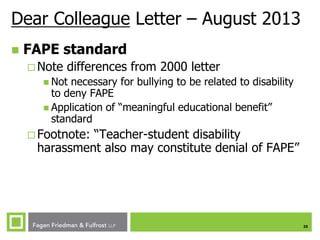
Dear Colleague Letter – August 2013


FAPE standard
 Note

differences from 2000 letter

 Not

necessary for bullying to be related to disability
to deny FAPE
 Application of “meaningful educational benefit”
standard
 Footnote:

“Teacher-student disability
harassment also may constitute denial of FAPE”

25
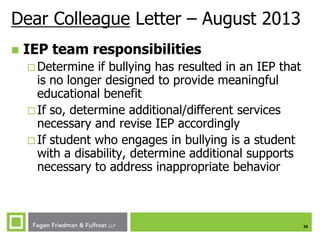
Dear Colleague Letter – August 2013


IEP team responsibilities
 Determine

if bullying has resulted in an IEP that
is no longer designed to provide meaningful
educational benefit
 If so, determine additional/different services
necessary and revise IEP accordingly
 If student who engages in bullying is a student
with a disability, determine additional supports
necessary to address inappropriate behavior

26
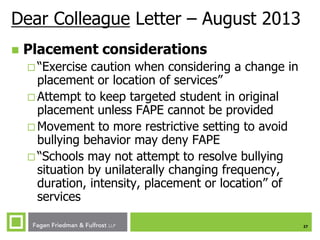
Dear Colleague Letter – August 2013


Placement considerations
 “Exercise

caution when considering a change in
placement or location of services”
 Attempt to keep targeted student in original
placement unless FAPE cannot be provided
 Movement to more restrictive setting to avoid
bullying behavior may deny FAPE
 “Schools may not attempt to resolve bullying
situation by unilaterally changing frequency,
duration, intensity, placement or location” of
services
27
Cyber-Speech Cases
 Courts

look at . . .

 True

threats to school safety
 Materially and substantially disruptive
 Sufficient nexus to school activity

28
True Threats






Schools can regulate student expression on web
pages or in emails in which they pose a “true
threat” to a person or group
“True threat” = statement where the speaker
means to communicate a serious expression of an
INTENT to commit an act of unlawful violence to a
person or group
Viewed in factual context

29
Wynar v. Douglas County SD








(9th Cir. 2013)

Students in Nevada high school turned in
classmate for graphic messages about school
violence posted on MySpace
Mentioned people he wanted to shoot
Brought to District’s attention by another student
Suspended for one semester
9th Cir – Not protected speech
 Applied “substantial disruption” test
 Distinguished case from those in which students
merely use the Internet to post mocking
remarks about school officials
30
Wynar v. Douglas County SD

(9th Cir. 2013)

9th Circuit’s rule…
 Schools can regulate off-campus speech
that:


 Substantially

disrupts or interferes with school

activities; or
 Interferes with rights of other students to be
secure and left alone

31
Off-Campus Sexting


Protected speech under Wynar?



Apply substantial disruption test/right of
other students to be secure

32
LaVine v. Blaine School District

(9th Cir. 2001)

 Student

wrote poem at home, titled “Last
Words”; not part of curriculum.

 Wrote

in first person, depicting feelings a
student has after killing several classmates

 Student

had expressed suicidal feelings to
counselor

 Counselor

knew student had a fight with his
father and recently broken up with his girlfriend

33
LaVine v. Blaine School District

(9th Cir. 2001)

Brought poem to school and showed teacher
 9th Cir -- Off-campus speech
 Applied “substantial disruption” test
 School rightfully expelled student
 Substantial likelihood of disruption
 “When considered in totality of other
relevant factors”
 Constituted a threat to himself or others


34
What Would You Do?


After school, students go to a restaurant



One student films others making derogatory
statements about a 13-year-old, calling her a
“slut” and “ugly,” among other insults



Student who filmed posts it to YouTube from
a home computer.

35
What Would You Do?







Next day, victim & parent bring video
to the school’s attention.
Parent and student are very upset.
Staff have heard “buzz” about the video, even
during class time, and fear that students on
campus are “taking sides” in the rift.
What would you do in response
to the video?

36
J.C. v. Beverly Hills USD

(711 F.Supp.2d 1094 (2010))



In J.C. v. Beverly Hills USD, the school
gave the student who created and
posted the You Tube video a two-day
suspension



The disciplined student sued the
school district alleging that the
discipline violated her 1st Amendment
right to free speech and prevailed
37
J.C. v. Beverly Hills USD (cont’d)







Court reasoned that there was no actual or
reasonably foreseeable risk of substantial
disruption
Unlike other cases where actual disruption was
found, the video was not violent and did not
contain threats
There was no evidence that the video had a
substantial effect on classroom activities; and
School officials’ fear of gossip, note passing and
students “taking sides” failed to rise to that level

38
School Safety v. Free Speech





School districts in difficult position of trying to prevent
bullying without infringing on free speech rights
Schools often err on the side of school safety, as the
consequences of bullying can be more severe than
infringing on free speech rights
If it is questionable whether off-campus speech is likely
to create a substantial disruption on campus, schools
should consider alternative means of intervention such
as counseling, parent involvements, and behavior
contracts

39
Additional Considerations . . .
Students with Disabilities


If student being suspended for cyber-speech
activities is a student with disabilities,
remember that:
 Manifestation

determination may be required
first if removal will constitute a change in
placement
 10

consecutive days
 More than 10 cumulative days that constitutes a
pattern

40
Manifestation Determination


Within 10 school days of removal decision that will
constitute change in placement:


School district, parents, and relevant members of IEP
team . . .



Must review all “relevant” information, including the
student’s IEP, teacher observations, and relevant
information provided by parents

41
Manifestation Determination


Based on that review, the district, parents,
and other IEP team members determine:






If the conduct in question was caused by, or had a
direct and substantial relationship to, the student’s
disability?
If the conduct in question was the direct result of the
school district’s failure to implement the IEP?

If answer to either question is yes, conduct
is a manifestation of disability
42
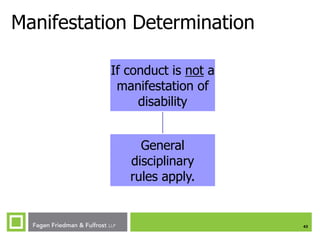
Manifestation Determination
If conduct is not a
manifestation of
disability
General
disciplinary
rules apply.

43
Manifestation of Disability


If conduct is manifestation of disability,
District must:
 Conduct

FBA (if not already done so)
 Develop and implement BIP
 If BIP already exists, review and modify as
necessary


Return Student to placement from which
he/she was removed, unless District and
Parents agree to change placement
44
Things to Consider. . .
True threat?
 Caused a substantial
disruption?
 Was a disruption highly
likely?
 Sufficient nexus to school
activities and attendance?
 Student with disabilities?


45
Balance . . .




School districts must understand the limitations
of their ability to monitor and discipline students
in cyber-space
Students retain 1st Amendment
protection for online speech that
does not create (or is not likely to
create) a substantial disruption to
school activities and does not
interfere with rights of other
students to be secure or left alone

46
Information in this presentation, including but not limited to PowerPoint handouts and the presenters' comments, is summary only and not legal advice.
We advise you to consult with legal counsel to determine how this information may apply to your specific facts and circumstances.

47
Information in this presentation, including but not limited to PowerPoint handouts and the presenters' comments, is summary only and not legal advice.
We advise you to consult with legal counsel to determine how this information may apply to your specific facts and circumstances.

48
Information in this presentation, including but not limited to PowerPoint handouts and the presenters' comments, is summary only and not legal advice.
We advise you to consult with legal counsel to determine how this information may apply to your specific facts and circumstances.

49

Jonathan read

  • 1.
    Students and Cyberspace ACSA2014 Every Child Counts Symposium Jonathan P. Read January 16, 2014 1
  • 2.
    What We’ll CoverToday Sexting and Cell Phone Searches & Seizures  Bullying and Cyberbullying   Denial  of FAPE for Students with Disabilities Disciplining Students for Cyber-Speech  Case Law: Balancing School Safety and Free Speech in Making Decision to Discipline Students  Rules Applicable to Students with Disabilities 2
  • 3.
    What Would YouDo? A 13 year-old student “sexts” a topless photo to a boyfriend  She is being harassed and ridiculed by other students because of the texted image  A teacher reports seeing shallow cuts on the student’s thigh  3
  • 4.
    Witsell Case Example InWitsell, a school social worker provided mental health counseling and had the student sign a “no-harm” contract.  The social worker did not notify site administrators or student’s parents of the counseling or cuts  The following day, the 13 year-old hung herself and died  4
  • 5.
    Lessons Learned fromWitsell Sexting prevention  Bullying prevention  Search & seizure  Protecting victims  Negligent supervision liability  5
  • 6.
    Sexting in Schools  Schooldistricts will typically learn of sexting from:  Cell phone search & seizure  Reports of bullying 6
  • 7.
    Cell Phone Search& Seizure  Search & seizure of student personal property must be:  Justified at inception  Reasonable in scope 7
  • 8.
    Policy Pointer  Schooldistrict cell phone policies should not permit search and seizure at any time for any reason  Klump v. Nazareth Area School District 8
  • 9.
    What Would YouDo?  What should a school district do if search & seizure of a student’s cell phone reveals evidence of sexting?  Seal the evidence and contact police  Child pornography implications  Report to CPS?  Don’t pass on! 9
  • 10.
    Policy Pointer  School districtcell phone policies should not promise return of a confiscated cell phone at the end of class or the end of day, because confiscated cell phones may contain evidence of a crime and must be turned over to the police 10
  • 11.
    Policy Pointer Cell phonepolicies should be updated to address all functions of smart phone technology  Cell phone policies may be blended with or at least make reference to the district’s video/photo waiver  11
  • 12.
    Campus-Wide Search of StudentCell Phones Work with police  Justified at inception  Request voluntary deletion  Education regarding potential criminal punishment for possession of sexting images  12
  • 13.
    Cyber Misconduct as“Bullying” If misconduct at issue does not meet the definition of bullying, it may be grounds for discipline as sexual harassment under the Education Code.  District should also consider alternative means of intervention, i.e. counseling  13
  • 14.
    Cyber Misconduct as“Bullying”  Bullying defined: Ed. Code § 48900(r)  Severe or pervasive physical or verbal conduct  Has, or could have, the following effects:  Places a reasonable student in fear of harm to person or property  Substantially detrimental effect on physical or mental health  Substantial interference with academics or with school services, activities, or privileges 14
  • 15.
    “Bullying” – GeneralDefinition  Ed. Code§48900(r)  What is a “reasonable pupil”?  One who exercises average care, skill and judgment in conduct for a person of his or her age, or for a person with his or her exceptional needs 15
  • 16.
    “Bullying” – PolicyRequirements  AB 9 (became effective July 1, 2012, amending Ed Code§234)  Requires schools to adopt a policy prohibiting bullying  Requires a schools to adopt a process for receiving and investigating complaints 16
  • 17.
    One of theFirst Laws in the Nation to Address Cyberbullying . . .  Assembly Bill 86  Amended Education Code §48900, which identifies grounds for suspensions and expulsions  Provides school administrators authority to suspend or recommend for expulsion those students who bully others by means including, but not limited to, an “electronic act” 17
  • 18.
    What Is an“Electronic Act”  Definition:  Transmission of a communication, including, but not limited to, a message, text, sound or image, by means of an electronic device, including, but not limited to, a telephone, wireless telephone, or other wireless communication device, computer or pager  AB 256 (effective January 1, 2014): Transmission can originate either on or off the school site 18
  • 19.
    “Electronic Act”  Also includes,“posting on a social network site” including:  Posting to or creating a burn page (Internet Web site created for the purpose of bullying)  Creating a credible impersonation of another student  Creating a false profile 19
  • 20.
    Characteristics of Cyberbullying  Differentthan traditional bullying  Indirect, usually off-campus  Affects broader audience  Harder to pinpoint victims  Harder to prevent  ANONYMOUS 20
  • 21.
    Misconduct Related toSchool Activities   “A pupil may not be suspended or expelled . . . unless that act is related to a school activity” Related to a school activity includes, but is not limited to: While on school grounds  While going or coming from school  During lunch period on or off campus  During, while going to or from, a school sponsored activity  (Ed. Code, § 48900) 21
  • 22.
    Misconduct Related toSchool Activities  When is misconduct via an electronic act “related to a school activity”?  Harassing text messages by student while on- campus?  Misconduct on school e-mail account from home?  Threats posted on MySpace from home, which causes victim to miss school?  A student starts a blog from home computer to post obscene jokes about another student? 22
  • 23.
    Bullying, Students withDisabilities and FAPE Joint OSERS/OSEP August 2013 “Dear Colleague” letter  Encompasses cyberbullying  Discussed FAPE impact in much more significant detail than earlier guidance  Three issues addressed:   FAPE standard  IEP team responsibilities  Placement considerations 23
  • 24.
    Dear Colleague Letter– August 2013  FAPE standard  “Whether or not the bullying is related to the student’s disability, any bullying of a student with a disability that results in the student not receiving meaningful educational benefit constitutes a denial of FAPE under the IDEA that must be remedied” 24
  • 25.
    Dear Colleague Letter– August 2013  FAPE standard  Note differences from 2000 letter  Not necessary for bullying to be related to disability to deny FAPE  Application of “meaningful educational benefit” standard  Footnote: “Teacher-student disability harassment also may constitute denial of FAPE” 25
  • 26.
    Dear Colleague Letter– August 2013  IEP team responsibilities  Determine if bullying has resulted in an IEP that is no longer designed to provide meaningful educational benefit  If so, determine additional/different services necessary and revise IEP accordingly  If student who engages in bullying is a student with a disability, determine additional supports necessary to address inappropriate behavior 26
  • 27.
    Dear Colleague Letter– August 2013  Placement considerations  “Exercise caution when considering a change in placement or location of services”  Attempt to keep targeted student in original placement unless FAPE cannot be provided  Movement to more restrictive setting to avoid bullying behavior may deny FAPE  “Schools may not attempt to resolve bullying situation by unilaterally changing frequency, duration, intensity, placement or location” of services 27
  • 28.
    Cyber-Speech Cases  Courts lookat . . .  True threats to school safety  Materially and substantially disruptive  Sufficient nexus to school activity 28
  • 29.
    True Threats    Schools canregulate student expression on web pages or in emails in which they pose a “true threat” to a person or group “True threat” = statement where the speaker means to communicate a serious expression of an INTENT to commit an act of unlawful violence to a person or group Viewed in factual context 29
  • 30.
    Wynar v. DouglasCounty SD      (9th Cir. 2013) Students in Nevada high school turned in classmate for graphic messages about school violence posted on MySpace Mentioned people he wanted to shoot Brought to District’s attention by another student Suspended for one semester 9th Cir – Not protected speech  Applied “substantial disruption” test  Distinguished case from those in which students merely use the Internet to post mocking remarks about school officials 30
  • 31.
    Wynar v. DouglasCounty SD (9th Cir. 2013) 9th Circuit’s rule…  Schools can regulate off-campus speech that:   Substantially disrupts or interferes with school activities; or  Interferes with rights of other students to be secure and left alone 31
  • 32.
    Off-Campus Sexting  Protected speechunder Wynar?  Apply substantial disruption test/right of other students to be secure 32
  • 33.
    LaVine v. BlaineSchool District (9th Cir. 2001)  Student wrote poem at home, titled “Last Words”; not part of curriculum.  Wrote in first person, depicting feelings a student has after killing several classmates  Student had expressed suicidal feelings to counselor  Counselor knew student had a fight with his father and recently broken up with his girlfriend 33
  • 34.
    LaVine v. BlaineSchool District (9th Cir. 2001) Brought poem to school and showed teacher  9th Cir -- Off-campus speech  Applied “substantial disruption” test  School rightfully expelled student  Substantial likelihood of disruption  “When considered in totality of other relevant factors”  Constituted a threat to himself or others  34
  • 35.
    What Would YouDo?  After school, students go to a restaurant  One student films others making derogatory statements about a 13-year-old, calling her a “slut” and “ugly,” among other insults  Student who filmed posts it to YouTube from a home computer. 35
  • 36.
    What Would YouDo?     Next day, victim & parent bring video to the school’s attention. Parent and student are very upset. Staff have heard “buzz” about the video, even during class time, and fear that students on campus are “taking sides” in the rift. What would you do in response to the video? 36
  • 37.
    J.C. v. BeverlyHills USD (711 F.Supp.2d 1094 (2010))  In J.C. v. Beverly Hills USD, the school gave the student who created and posted the You Tube video a two-day suspension  The disciplined student sued the school district alleging that the discipline violated her 1st Amendment right to free speech and prevailed 37
  • 38.
    J.C. v. BeverlyHills USD (cont’d)     Court reasoned that there was no actual or reasonably foreseeable risk of substantial disruption Unlike other cases where actual disruption was found, the video was not violent and did not contain threats There was no evidence that the video had a substantial effect on classroom activities; and School officials’ fear of gossip, note passing and students “taking sides” failed to rise to that level 38
  • 39.
    School Safety v.Free Speech    School districts in difficult position of trying to prevent bullying without infringing on free speech rights Schools often err on the side of school safety, as the consequences of bullying can be more severe than infringing on free speech rights If it is questionable whether off-campus speech is likely to create a substantial disruption on campus, schools should consider alternative means of intervention such as counseling, parent involvements, and behavior contracts 39
  • 40.
    Additional Considerations .. . Students with Disabilities  If student being suspended for cyber-speech activities is a student with disabilities, remember that:  Manifestation determination may be required first if removal will constitute a change in placement  10 consecutive days  More than 10 cumulative days that constitutes a pattern 40
  • 41.
    Manifestation Determination  Within 10school days of removal decision that will constitute change in placement:  School district, parents, and relevant members of IEP team . . .  Must review all “relevant” information, including the student’s IEP, teacher observations, and relevant information provided by parents 41
  • 42.
    Manifestation Determination  Based onthat review, the district, parents, and other IEP team members determine:    If the conduct in question was caused by, or had a direct and substantial relationship to, the student’s disability? If the conduct in question was the direct result of the school district’s failure to implement the IEP? If answer to either question is yes, conduct is a manifestation of disability 42
  • 43.
    Manifestation Determination If conductis not a manifestation of disability General disciplinary rules apply. 43
  • 44.
    Manifestation of Disability  Ifconduct is manifestation of disability, District must:  Conduct FBA (if not already done so)  Develop and implement BIP  If BIP already exists, review and modify as necessary  Return Student to placement from which he/she was removed, unless District and Parents agree to change placement 44
  • 45.
    Things to Consider.. . True threat?  Caused a substantial disruption?  Was a disruption highly likely?  Sufficient nexus to school activities and attendance?  Student with disabilities?  45
  • 46.
    Balance . ..   School districts must understand the limitations of their ability to monitor and discipline students in cyber-space Students retain 1st Amendment protection for online speech that does not create (or is not likely to create) a substantial disruption to school activities and does not interfere with rights of other students to be secure or left alone 46
  • 47.
    Information in thispresentation, including but not limited to PowerPoint handouts and the presenters' comments, is summary only and not legal advice. We advise you to consult with legal counsel to determine how this information may apply to your specific facts and circumstances. 47
  • 48.
    Information in thispresentation, including but not limited to PowerPoint handouts and the presenters' comments, is summary only and not legal advice. We advise you to consult with legal counsel to determine how this information may apply to your specific facts and circumstances. 48
  • 49.
    Information in thispresentation, including but not limited to PowerPoint handouts and the presenters' comments, is summary only and not legal advice. We advise you to consult with legal counsel to determine how this information may apply to your specific facts and circumstances. 49