Connecting Variable Solar To The Grid
               Carl Lenox
              Principal Engineer
          GW Solar Institute Symposium
                 April 26th 2011

                  © 2011 SunPower Corporation
Does PV Variability Present A Barrier?
Some have used the following argument:


                                                         BAD

However, this does beg a few important questions, such as:

•   How rapid are these changes, and how often do they occur?
•   Does the observed behavior of a single system scale? If so, how?
•   What are the impacts of variability on the utility infrastructure and the customer?
•   How do these impacts change as penetration increases?
•   What mitigations are available for these impacts? What are the best solutions?
                                                                         © 2011 SunPower Corporation


                                                                                                       2
Geographical Diversity Is A Crucial Factor
High Irradiance Variability At Single Sites Is Reduced With A Portfolio Of Sites
                        Single Location


                        20 Locations


                           Source:                                           Source:
                           Weimken                                           Mills et.
                           et. al.                                           al. 2010
                           2001


                                                                © 2011 SunPower Corporation


                                                                                              3
Operational Timeframes & Impacts of Variability
    M. Milligan, NREL             Timeframe         System        Local
                                                    Impacts       Impacts
                                  Seconds to        Regulation    Voltage
                                  Minutes                         Fluctuation

                                  10’s of Minutes   Load          Voltage
                                  to Hours          Following     Profile
                                  Hours to Days     Scheduling


   The Electrical System Is Designed To Manage Load Variability

           Variable Generation Is Not Fundamentally Different


                                                           © 2011 SunPower Corporation


                                                                                         4
System Level Impacts Of Short Duration Variability
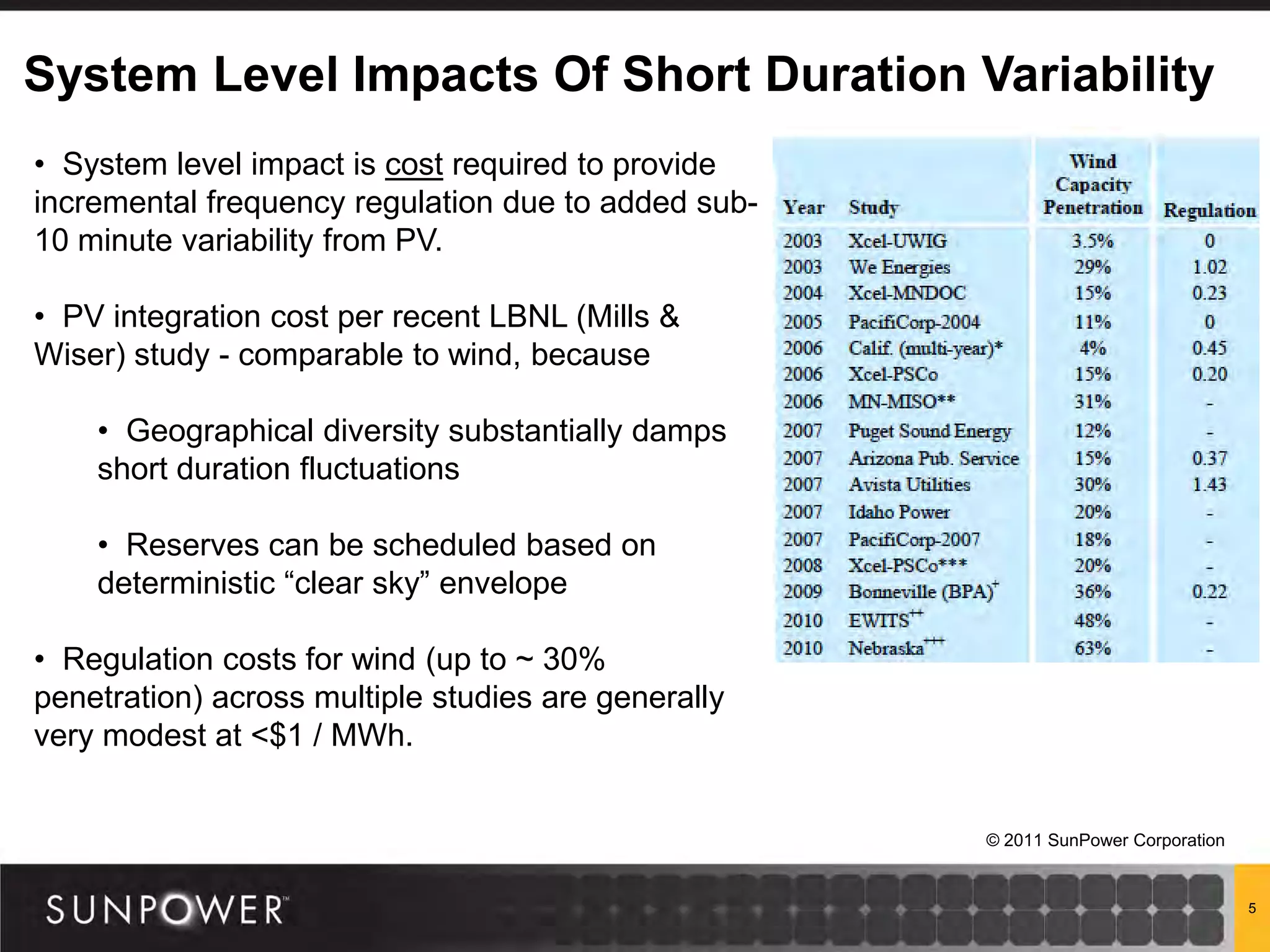
• System level impact is cost required to provide
incremental frequency regulation due to added sub-
10 minute variability from PV.

• PV integration cost per recent LBNL (Mills &
Wiser) study - comparable to wind, because

    • Geographical diversity substantially damps
    short duration fluctuations

    • Reserves can be scheduled based on
    deterministic “clear sky” envelope

• Regulation costs for wind (up to ~ 30%
penetration) across multiple studies are generally
very modest at <$1 / MWh.


                                                     © 2011 SunPower Corporation


                                                                                   5
Diurnal Variability Must Also Be Considered
• Daily solar cycle adds load following and unit
commitment integration costs; bigger ramps.

• LBNL, NREL (EWIS / WWIS) and others find
modest total integration cost up to ~30%
energy penetration: typically less than $5 /
MWh (for wind and solar).

• Forecast error dominates cost, PV                Denholm et al 2008 (% system energy)
forecasting is new, often assumed to be very
inaccurate in integration studies (5-20% error)

• However 4-5% RMSE is achieved in practice
for regional-level PV forecasts in Germany,
comparable to best in class wind forecasting.

• Example: Spain at ~16% VER energy: 14%
wind, 2% PV (3.4 GW), with limited interties         CPUC 33% RPS Reference Case:
but world-class operations. Peak of 54% of           ~25% energy from VERs ; 11% solar
                                                                        © 2011 SunPower Corporation
system demand served by wind.
                                                                                                      6
Cost Of Integrating PV Is A Function Of Flexibility
As VER penetration increases beyond
20-30% of energy:

• Marginal (offset) generation costs drop.

• Traditional flexible resources may be
displaced or dispatched “out of merit
order”; though flexibility may increase at
some penetrations due to part-load
operation.
                                                Denholm et al 2008
• Eventual conflict with “must run” base
load generation, leading to VER
curtailment (increased cost); though PV
load coincidence helps (compared to
wind).

• Fleet flexibility is key – more flexibility
means more room for VERs.                                            © 2011 SunPower Corporation


                                                                                                   7
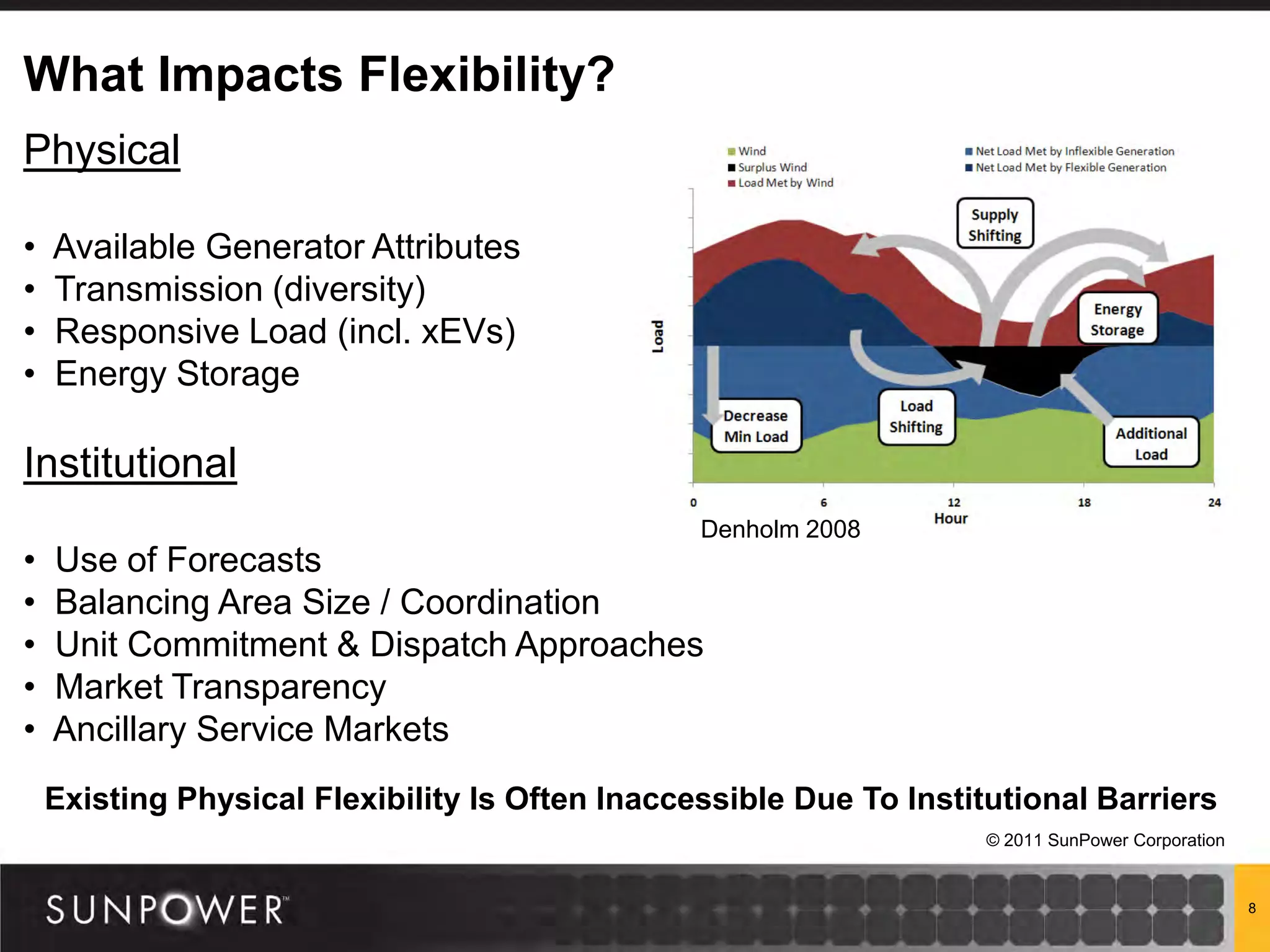
What Impacts Flexibility?
Physical

•   Available Generator Attributes
•   Transmission (diversity)
•   Responsive Load (incl. xEVs)
•   Energy Storage

Institutional
                                                 Denholm 2008
•   Use of Forecasts
•   Balancing Area Size / Coordination
•   Unit Commitment & Dispatch Approaches
•   Market Transparency
•   Ancillary Service Markets
    Existing Physical Flexibility Is Often Inaccessible Due To Institutional Barriers
                                                                     © 2011 SunPower Corporation


                                                                                                   8
PV Variability Is Not A Technical Barrier
 But PV variability is a real cost allocation challenge!

 The physical and institutional flexibility of a system has a significant impact of the cost
to integrate VERs…
…The same has always been true of the cost to integrate load variability, but no one
has previously considered charging conventional generators (coal, nuclear) for their
inflexibility.
 “High penetration” studies which assume BAU, deterministic planning and operations
practices, do not challenge institutional constraints, and do not adequately consider
flexibility will overstate integration costs (and will show that overbuilding of conventional
generation is ”needed” to “back up” wind and solar)
 Limitations on distribution system penetration of PV are dominated by issues related
to accommodating and managing DG generally, not due to variability. A systematic
approach to distribution upgrades (i.e. smart grid) could greatly increase DG
penetration levels, along with changes to interconnection standards and statutes.

                                                                        © 2011 SunPower Corporation


                                                                                                      9
Changes Are Coming!
 NERC Integration of Variable Generation Task Force (IVGTF)
    – Detailed reports addressing all of these topics and many more are in progress,
    or already published.
    – Focused on transmission interconnection, but addresses changes needed with
    high penetration DG that will impact bulk electrical systems.
 FERC Variable Energy Resource (VER) NOPR
    – Directly tackles interplay between operational practices and integration costs;
    proposes that TSOs be able to recover integration costs if operations are
    modernized.
 IEEE 1547 Updates
    – Addresses technical standards changes needed to better accommodate high
    penetration DG.
 FERC SGIP (model for California Rule 21 and many others)
    – IREC proposing updates to address PV specific issues that can pose
    unnecessary barriers to achieving higher penetration of distributed PV.
                                                                    © 2011 SunPower Corporation


                                                                                                  10
© 2011 SunPower Corporation
Local Impacts Of Variability
    Concerns about flicker and voltage regulation are often expressed, but have not been
          reported as issues in numerous high penetration circuits being studied:

Location            Description                    Penetration             Notes

Ota City, Japan     550 Sites / 2 MW               Not Reported            Residential energy storage
(2003)              residential, one circuit                               evaluated and removed; no issues
                                                                           reported post-removal.
Freiburg,           70 Sites / 440 kW multi-unit   110% on capacity (400   Minimal, correctable issues
Germany (2006)      residential                    kVA XFR)                reported (phase imbalance)
Kona, HI (2009)     700 kWac commercial            35% on capacity (2      No issues reported
                                                   MVA feeder), backfeed
                                                   up to 30% in low load
Lanai, HI (2009)    600 kWac commercial (1.2       ~12% on capacity,       No issues reported.
                    MW system, brought online      ~25% in low load,
                    incrementally)                 weak island system
Anatolia, CA        115 Sites / 238 kW             4% on capacity, 11-     No issues reported, PV variability
(2009)              residential                    13% low load            less than AC cycling variability.
Las Vegas, NV       > 10 MW commercial, 35         ~ 50% on capacity,      No issues reported
(2008)              kV interconnection             ~100% low load
Atlantic City, NJ   1.9 MW commercial, 23 kV       ~24% on capacity,       No issues reported
(2009)              interconnection                ~63% low load                      © 2011 SunPower Corporation


                                                                                                                    12
Local Impacts Of Variability
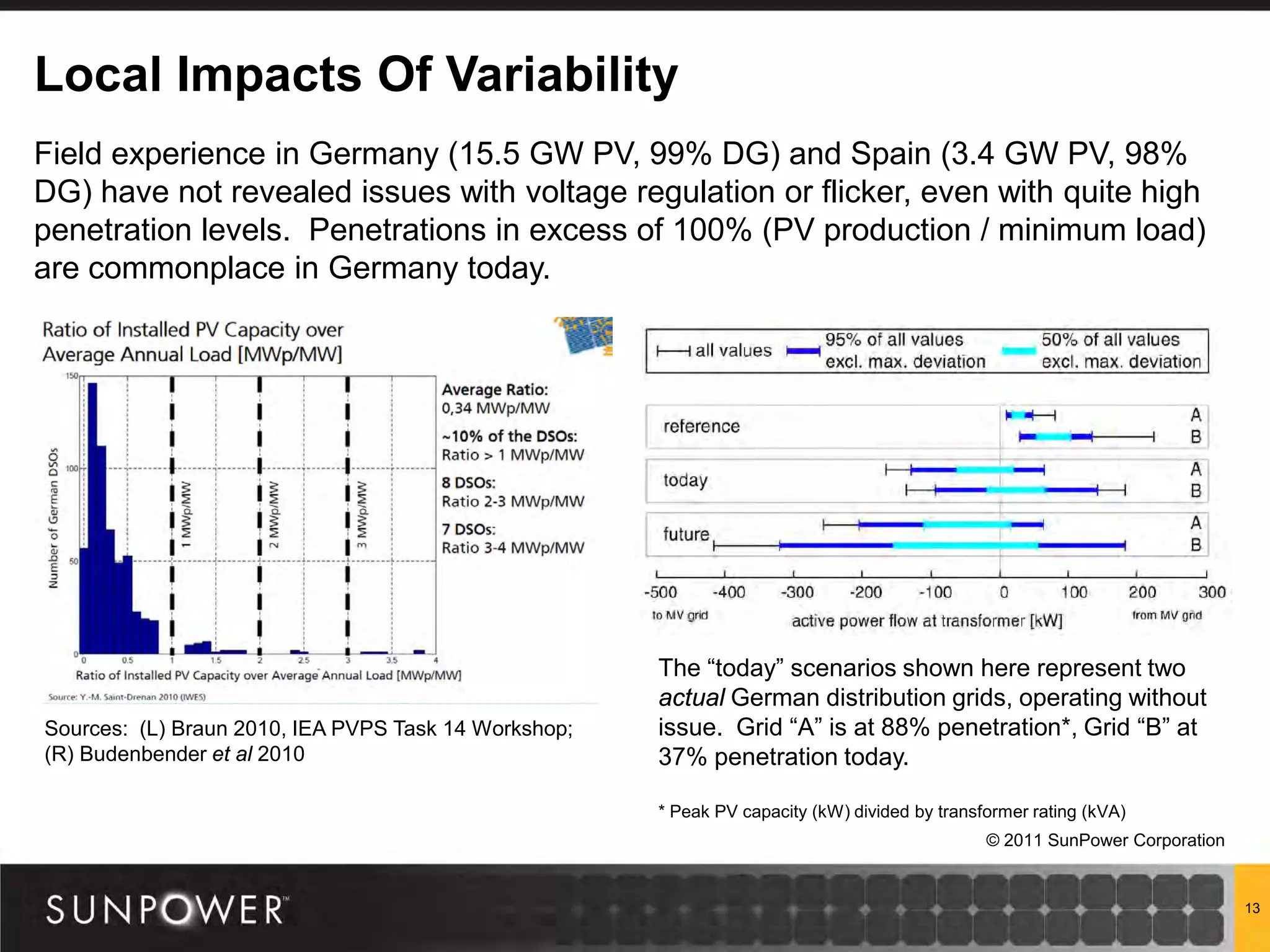
Field experience in Germany (15.5 GW PV, 99% DG) and Spain (3.4 GW PV, 98%
DG) have not revealed issues with voltage regulation or flicker, even with quite high
penetration levels. Penetrations in excess of 100% (PV production / minimum load)
are commonplace in Germany today.


                                                      The “today” scenarios shown here represent two
                                                      actual German distribution grids, operating without
Sources: (L) Braun 2010, IEA PVPS Task 14 Workshop;   issue. Grid “A” is at 88% penetration*, Grid “B” at
(R) Budenbender et al 2010                            37% penetration today.

                                                      * Peak PV capacity (kW) divided by transformer rating (kVA)
                                                                                               © 2011 SunPower Corporation


                                                                                                                             13
Mitigation Of Local Voltage Impacts
• Geographical diversity has a substantial          (1) Spike in
impact in mitigating variability over small        voltage at POI          (3) Voltage returns
                                                      detected                  to setpoint
distances, even within a distribution feeder.

• Though uncommon, voltage fluctuations
can result when a single, high penetration
system is interconnected to a circuit with
high impedance (such as a long rural
feeder).

• Reactive power control substantially
reduces the impacts of output variability on
                                                              (2) SunPower smart controller
voltage. Simply setting a fixed non-unity                       commands reactive power
power factor has been demonstrated to be                         change to reduce voltage
effective.
                                                     SunPower has pioneered the
• Active voltage regulation (AVR) is                implementation of AVR in large-
particularly effective, if mitigation is needed.          scale PV 2011 SunPower Corporation
                                                                     plants.
                                                                   ©

Carl Lenox | SunPower

  • 1.
    Connecting Variable SolarTo The Grid Carl Lenox Principal Engineer GW Solar Institute Symposium April 26th 2011 © 2011 SunPower Corporation
  • 2.
    Does PV VariabilityPresent A Barrier? Some have used the following argument: BAD However, this does beg a few important questions, such as: • How rapid are these changes, and how often do they occur? • Does the observed behavior of a single system scale? If so, how? • What are the impacts of variability on the utility infrastructure and the customer? • How do these impacts change as penetration increases? • What mitigations are available for these impacts? What are the best solutions? © 2011 SunPower Corporation 2
  • 3.
    Geographical Diversity IsA Crucial Factor High Irradiance Variability At Single Sites Is Reduced With A Portfolio Of Sites Single Location 20 Locations Source: Source: Weimken Mills et. et. al. al. 2010 2001 © 2011 SunPower Corporation 3
  • 4.
    Operational Timeframes &Impacts of Variability M. Milligan, NREL Timeframe System Local Impacts Impacts Seconds to Regulation Voltage Minutes Fluctuation 10’s of Minutes Load Voltage to Hours Following Profile Hours to Days Scheduling The Electrical System Is Designed To Manage Load Variability Variable Generation Is Not Fundamentally Different © 2011 SunPower Corporation 4
  • 5.
    System Level ImpactsOf Short Duration Variability • System level impact is cost required to provide incremental frequency regulation due to added sub- 10 minute variability from PV. • PV integration cost per recent LBNL (Mills & Wiser) study - comparable to wind, because • Geographical diversity substantially damps short duration fluctuations • Reserves can be scheduled based on deterministic “clear sky” envelope • Regulation costs for wind (up to ~ 30% penetration) across multiple studies are generally very modest at <$1 / MWh. © 2011 SunPower Corporation 5
  • 6.
    Diurnal Variability MustAlso Be Considered • Daily solar cycle adds load following and unit commitment integration costs; bigger ramps. • LBNL, NREL (EWIS / WWIS) and others find modest total integration cost up to ~30% energy penetration: typically less than $5 / MWh (for wind and solar). • Forecast error dominates cost, PV Denholm et al 2008 (% system energy) forecasting is new, often assumed to be very inaccurate in integration studies (5-20% error) • However 4-5% RMSE is achieved in practice for regional-level PV forecasts in Germany, comparable to best in class wind forecasting. • Example: Spain at ~16% VER energy: 14% wind, 2% PV (3.4 GW), with limited interties CPUC 33% RPS Reference Case: but world-class operations. Peak of 54% of ~25% energy from VERs ; 11% solar © 2011 SunPower Corporation system demand served by wind. 6
  • 7.
    Cost Of IntegratingPV Is A Function Of Flexibility As VER penetration increases beyond 20-30% of energy: • Marginal (offset) generation costs drop. • Traditional flexible resources may be displaced or dispatched “out of merit order”; though flexibility may increase at some penetrations due to part-load operation. Denholm et al 2008 • Eventual conflict with “must run” base load generation, leading to VER curtailment (increased cost); though PV load coincidence helps (compared to wind). • Fleet flexibility is key – more flexibility means more room for VERs. © 2011 SunPower Corporation 7
  • 8.
    What Impacts Flexibility? Physical • Available Generator Attributes • Transmission (diversity) • Responsive Load (incl. xEVs) • Energy Storage Institutional Denholm 2008 • Use of Forecasts • Balancing Area Size / Coordination • Unit Commitment & Dispatch Approaches • Market Transparency • Ancillary Service Markets Existing Physical Flexibility Is Often Inaccessible Due To Institutional Barriers © 2011 SunPower Corporation 8
  • 9.
    PV Variability IsNot A Technical Barrier But PV variability is a real cost allocation challenge!  The physical and institutional flexibility of a system has a significant impact of the cost to integrate VERs… …The same has always been true of the cost to integrate load variability, but no one has previously considered charging conventional generators (coal, nuclear) for their inflexibility.  “High penetration” studies which assume BAU, deterministic planning and operations practices, do not challenge institutional constraints, and do not adequately consider flexibility will overstate integration costs (and will show that overbuilding of conventional generation is ”needed” to “back up” wind and solar)  Limitations on distribution system penetration of PV are dominated by issues related to accommodating and managing DG generally, not due to variability. A systematic approach to distribution upgrades (i.e. smart grid) could greatly increase DG penetration levels, along with changes to interconnection standards and statutes. © 2011 SunPower Corporation 9
  • 10.
    Changes Are Coming! NERC Integration of Variable Generation Task Force (IVGTF) – Detailed reports addressing all of these topics and many more are in progress, or already published. – Focused on transmission interconnection, but addresses changes needed with high penetration DG that will impact bulk electrical systems.  FERC Variable Energy Resource (VER) NOPR – Directly tackles interplay between operational practices and integration costs; proposes that TSOs be able to recover integration costs if operations are modernized.  IEEE 1547 Updates – Addresses technical standards changes needed to better accommodate high penetration DG.  FERC SGIP (model for California Rule 21 and many others) – IREC proposing updates to address PV specific issues that can pose unnecessary barriers to achieving higher penetration of distributed PV. © 2011 SunPower Corporation 10
  • 11.
    © 2011 SunPowerCorporation
  • 12.
    Local Impacts OfVariability Concerns about flicker and voltage regulation are often expressed, but have not been reported as issues in numerous high penetration circuits being studied: Location Description Penetration Notes Ota City, Japan 550 Sites / 2 MW Not Reported Residential energy storage (2003) residential, one circuit evaluated and removed; no issues reported post-removal. Freiburg, 70 Sites / 440 kW multi-unit 110% on capacity (400 Minimal, correctable issues Germany (2006) residential kVA XFR) reported (phase imbalance) Kona, HI (2009) 700 kWac commercial 35% on capacity (2 No issues reported MVA feeder), backfeed up to 30% in low load Lanai, HI (2009) 600 kWac commercial (1.2 ~12% on capacity, No issues reported. MW system, brought online ~25% in low load, incrementally) weak island system Anatolia, CA 115 Sites / 238 kW 4% on capacity, 11- No issues reported, PV variability (2009) residential 13% low load less than AC cycling variability. Las Vegas, NV > 10 MW commercial, 35 ~ 50% on capacity, No issues reported (2008) kV interconnection ~100% low load Atlantic City, NJ 1.9 MW commercial, 23 kV ~24% on capacity, No issues reported (2009) interconnection ~63% low load © 2011 SunPower Corporation 12
  • 13.
    Local Impacts OfVariability Field experience in Germany (15.5 GW PV, 99% DG) and Spain (3.4 GW PV, 98% DG) have not revealed issues with voltage regulation or flicker, even with quite high penetration levels. Penetrations in excess of 100% (PV production / minimum load) are commonplace in Germany today. The “today” scenarios shown here represent two actual German distribution grids, operating without Sources: (L) Braun 2010, IEA PVPS Task 14 Workshop; issue. Grid “A” is at 88% penetration*, Grid “B” at (R) Budenbender et al 2010 37% penetration today. * Peak PV capacity (kW) divided by transformer rating (kVA) © 2011 SunPower Corporation 13
  • 14.
    Mitigation Of LocalVoltage Impacts • Geographical diversity has a substantial (1) Spike in impact in mitigating variability over small voltage at POI (3) Voltage returns detected to setpoint distances, even within a distribution feeder. • Though uncommon, voltage fluctuations can result when a single, high penetration system is interconnected to a circuit with high impedance (such as a long rural feeder). • Reactive power control substantially reduces the impacts of output variability on (2) SunPower smart controller voltage. Simply setting a fixed non-unity commands reactive power power factor has been demonstrated to be change to reduce voltage effective. SunPower has pioneered the • Active voltage regulation (AVR) is implementation of AVR in large- particularly effective, if mitigation is needed. scale PV 2011 SunPower Corporation plants. ©