EXPLOITATION WEBINAR
New electric mobility services
December 9th 2020
Francesco Pedol (E-VAI)
Head of business development and ICT systems
Who is E-Vai and its services
E-Vai is an 100% Italian company active since 2011 in sharing mobility sector. It offers sustainable and shared
mobility solutions to citizens, public administrations, commuters and private companies.
The distinctive features of E-Vai are:
E-Vai uses only low
environmental impact vehicles
in its business models (95% of
the electric fleet + 5% of the
hybrid fleet).
E-Vai is a company of the
Northern Italy Railway Group
and owns numerous stables,
columns and parking lots in
many stations in Lombardy.
E-Vai has always operated
within the Lombardy Region
offering shared and sustainable
mobility solutions to B2C and
B2B customers.
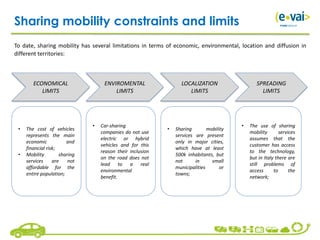
Sharing mobility constraints and limits
To date, sharing mobility has several limitations in terms of economic, environmental, location and diffusion in
different territories:
ECONOMICAL
LIMITS
ENVIROMENTAL
LIMITS
LOCALIZATION
LIMITS
SPREADING
LIMITS
• The cost of vehicles
represents the main
economic and
financial risk;
• Mobility sharing
services are not
affordable for the
entire population;
• Car-sharing
companies do not use
electric or hybrid
vehicles and for this
reason their inclusion
on the road does not
lead to a real
environmental
benefit.
• Sharing mobility
services are present
only in major cities,
which have at least
500k inhabitants, but
not in small
municipalities or
towns;
• The use of sharing
mobility services
assumes that the
customer has access
to the technology,
but in Italy there are
still problems of
access to the
network;
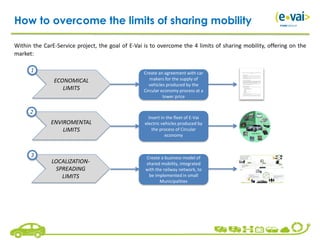
How to overcome the limits of sharing mobility
Within the CarE-Service project, the goal of E-Vai is to overcome the 4 limits of sharing mobility, offering on the
market:
ECONOMICAL
LIMITS
ENVIROMENTAL
LIMITS
LOCALIZATION-
SPREADING
LIMITS
Create an agreement with car
makers for the supply of
vehicles produced by the
Circular economy process at a
lower price
Insert in the fleet of E-Vai
electric vehicles produced by
the process of Circular
economy
Create a business model of
shared mobility, integrated
with the railway network, to
be implemented in small
Municipalities
1
2
3
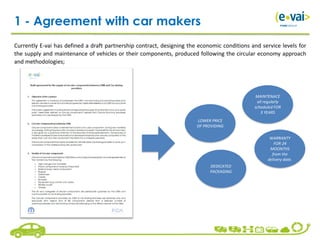
1 - Agreement with car makers
Currently E-vai has defined a draft partnership contract, designing the economic conditions and service levels for
the supply and maintenance of vehicles or their components, produced following the circular economy approach
and methodologies;
LOWER PRICE
OF PROVIDING
MAINTENACE
all regularly
scheduled FOR
3 YEARS
DEDICATED
PACKAGING
WARRANTY
FOR 24
MOONTHS
from the
delivery date.
2 - Insert in the fleet of E-Vai electric vehicles
produced by the process of Circular economy
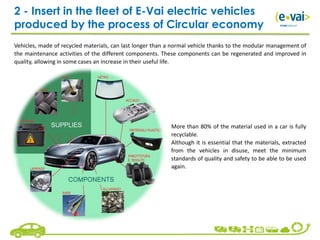
Vehicles, made of recycled materials, can last longer than a normal vehicle thanks to the modular management of
the maintenance activities of the different components. These components can be regenerated and improved in
quality, allowing in some cases an increase in their useful life.
More than 80% of the material used in a car is fully
recyclable.
Although it is essential that the materials, extracted
from the vehicles in disuse, meet the minimum
standards of quality and safety to be able to be used
again.
3 – Create a new sharing mobility model
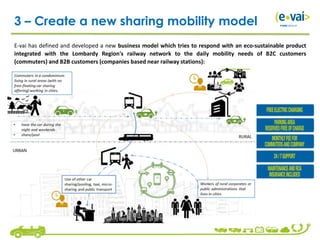
E-vai has defined and developed a new business model which tries to respond with an eco-sustainable product
integrated with the Lombardy Region's railway network to the daily mobility needs of B2C customers
(commuters) and B2B customers (companies based near railway stations):
Evolution of sharing mobility concept
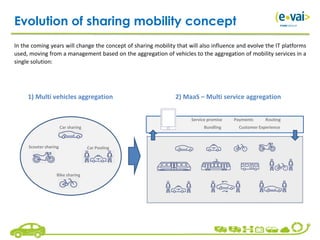
In the coming years will change the concept of sharing mobility that will also influence and evolve the IT platforms
used, moving from a management based on the aggregation of vehicles to the aggregation of mobility services in a
single solution:
Car sharing
Scooter sharing
Bike sharing
Car Pooling
Bundling Customer Experience
Payments
Service promise Routing
1) Multi vehicles aggregation 2) MaaS – Multi service aggregation
Matrix of risks
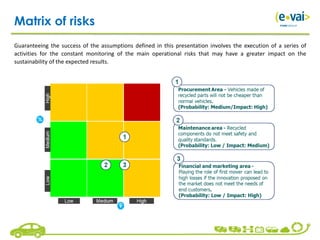
Guaranteeing the success of the assumptions defined in this presentation involves the execution of a series of
activities for the constant monitoring of the main operational risks that may have a greater impact on the
sustainability of the expected results.
THANK YOU FOR YOUR KIND
ATTENTION

CarE-Service Sharing Mobility Services by E-VAI

  • 1.
    EXPLOITATION WEBINAR New electricmobility services December 9th 2020 Francesco Pedol (E-VAI) Head of business development and ICT systems
  • 2.
    Who is E-Vaiand its services E-Vai is an 100% Italian company active since 2011 in sharing mobility sector. It offers sustainable and shared mobility solutions to citizens, public administrations, commuters and private companies. The distinctive features of E-Vai are: E-Vai uses only low environmental impact vehicles in its business models (95% of the electric fleet + 5% of the hybrid fleet). E-Vai is a company of the Northern Italy Railway Group and owns numerous stables, columns and parking lots in many stations in Lombardy. E-Vai has always operated within the Lombardy Region offering shared and sustainable mobility solutions to B2C and B2B customers.
  • 3.
    Sharing mobility constraintsand limits To date, sharing mobility has several limitations in terms of economic, environmental, location and diffusion in different territories: ECONOMICAL LIMITS ENVIROMENTAL LIMITS LOCALIZATION LIMITS SPREADING LIMITS • The cost of vehicles represents the main economic and financial risk; • Mobility sharing services are not affordable for the entire population; • Car-sharing companies do not use electric or hybrid vehicles and for this reason their inclusion on the road does not lead to a real environmental benefit. • Sharing mobility services are present only in major cities, which have at least 500k inhabitants, but not in small municipalities or towns; • The use of sharing mobility services assumes that the customer has access to the technology, but in Italy there are still problems of access to the network;
  • 4.
    How to overcomethe limits of sharing mobility Within the CarE-Service project, the goal of E-Vai is to overcome the 4 limits of sharing mobility, offering on the market: ECONOMICAL LIMITS ENVIROMENTAL LIMITS LOCALIZATION- SPREADING LIMITS Create an agreement with car makers for the supply of vehicles produced by the Circular economy process at a lower price Insert in the fleet of E-Vai electric vehicles produced by the process of Circular economy Create a business model of shared mobility, integrated with the railway network, to be implemented in small Municipalities 1 2 3
  • 5.
    1 - Agreementwith car makers Currently E-vai has defined a draft partnership contract, designing the economic conditions and service levels for the supply and maintenance of vehicles or their components, produced following the circular economy approach and methodologies; LOWER PRICE OF PROVIDING MAINTENACE all regularly scheduled FOR 3 YEARS DEDICATED PACKAGING WARRANTY FOR 24 MOONTHS from the delivery date.
  • 6.
    2 - Insertin the fleet of E-Vai electric vehicles produced by the process of Circular economy Vehicles, made of recycled materials, can last longer than a normal vehicle thanks to the modular management of the maintenance activities of the different components. These components can be regenerated and improved in quality, allowing in some cases an increase in their useful life. More than 80% of the material used in a car is fully recyclable. Although it is essential that the materials, extracted from the vehicles in disuse, meet the minimum standards of quality and safety to be able to be used again.
  • 7.
    3 – Createa new sharing mobility model E-vai has defined and developed a new business model which tries to respond with an eco-sustainable product integrated with the Lombardy Region's railway network to the daily mobility needs of B2C customers (commuters) and B2B customers (companies based near railway stations):
  • 8.
    Evolution of sharingmobility concept In the coming years will change the concept of sharing mobility that will also influence and evolve the IT platforms used, moving from a management based on the aggregation of vehicles to the aggregation of mobility services in a single solution: Car sharing Scooter sharing Bike sharing Car Pooling Bundling Customer Experience Payments Service promise Routing 1) Multi vehicles aggregation 2) MaaS – Multi service aggregation
  • 9.
    Matrix of risks Guaranteeingthe success of the assumptions defined in this presentation involves the execution of a series of activities for the constant monitoring of the main operational risks that may have a greater impact on the sustainability of the expected results.
  • 10.
    THANK YOU FORYOUR KIND ATTENTION