This project has received funding from the European Union’s Horizon 2020
research and innovation programme under grant agreement No 776851
This project has received funding from the European Union’s Horizon 2020
research and innovation programme under grant agreement No 776851
D1.5: Analysis and specifications
of re-use value-chains
Objectives
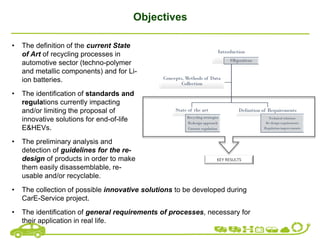
• The definition of the current State
of Art of recycling processes in
automotive sector (techno-polymer
and metallic components) and for Li-
ion batteries.
• The identification of standards and
regulations currently impacting
and/or limiting the proposal of
innovative solutions for end-of-life
E&HEVs.
• The preliminary analysis and
detection of guidelines for the re-
design of products in order to make
them easily disassemblable, re-
usable and/or recyclable.
• The collection of possible innovative solutions to be developed during
CarE-Service project.
• The identification of general requirements of processes, necessary for
their application in real life.
Objective
Task Task Leader Task Partners Duration
1.2: Analysis and technical specifications of re-use
value chains
CNR
LIU, ENV, PROD, CSIC,
COBAT, FCA, RAD,
Fraunhofer
M1-M6
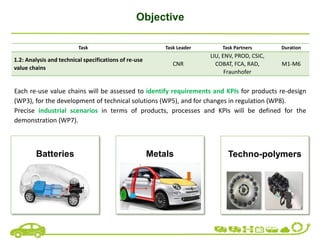
Each re-use value chains will be assessed to identify requirements and KPIs for products re-design
(WP3), for the development of technical solutions (WP5), and for changes in regulation (WP8).
Precise industrial scenarios in terms of products, processes and KPIs will be defined for the
demonstration (WP7).
Batteries Metals Techno-polymers
Re-design
Analysis of product re-design
to make components easier
to be reused or recycled:
• Analysis of State of Art on
current practices for
product re-design;
• Requirements for products
re-design in each
operation of batteries,
techno-polymer and metal
process-chain.
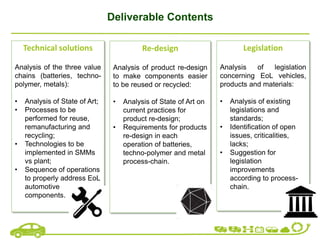
Deliverable Contents
Technical solutions
Analysis of the three value
chains (batteries, techno-
polymer, metals):
• Analysis of State of Art;
• Processes to be
performed for reuse,
remanufacturing and
recycling;
• Technologies to be
implemented in SMMs
vs plant;
• Sequence of operations
to properly address EoL
automotive
components.
Legislation
Analysis of legislation
concerning EoL vehicles,
products and materials:
• Analysis of existing
legislations and
standards;
• Identification of open
issues, criticalities,
lacks;
• Suggestion for
legislation
improvements
according to process-
chain.
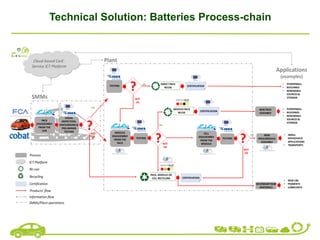
Technical Solution: Batteries Process-chain
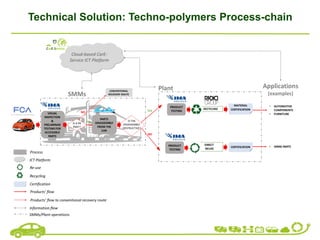
Technical Solution: Techno-polymers Process-chain
MATERIAL
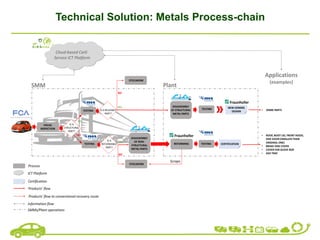
Technical Solution: Metals Process-chain
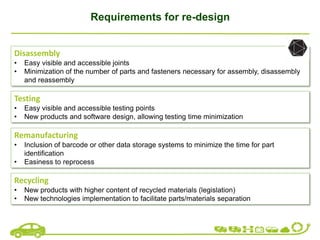
Disassembly
• Easy visible and accessible joints
• Minimization of the number of parts and fasteners necessary for assembly, disassembly
and reassembly
Requirements for re-design
Testing
• Easy visible and accessible testing points
• New products and software design, allowing testing time minimization
Remanufacturing
• Inclusion of barcode or other data storage systems to minimize the time for part
identification
• Easiness to reprocess
Recycling
• New products with higher content of recycled materials (legislation)
• New technologies implementation to facilitate parts/materials separation
Key messages
• Despite automobiles are the most recycled consumer products, EVs lead to new challenges in
terms of hazardous components, disassembly policies and regulations on materials
management and transport.
• A set of standardized safety, recycling or remanufacturing procedures for EV battery has not
been identified yet.
• The reintroduction of recycled techno-polymers into the market is not easy, therefore
currently polymeric and composite components are treated by energy recovery.
• Automotive metal parts are sent to process for metal recycling, while remanufacturing is not
occurring yet.
• CarE-Service project is aimed at facilitating EV components recycling, remanufacturing and
reuse through: i) semi-automated disassembly, ii) ad hoc testing of components to properly
assess their reusability; iii) technical and economical sustainable recycling of damaged parts; iv)
reassembly/reforming of specific components for re-use and v) certification of second life
products/parts or secondary raw materials.
• A proper re-design of components could allow an easier management of EoL products,
simplifying remanufacturing and recycling processes.
• The revision of existing legislations, not aligned with new products developments, and the
integration of new standards and procedures are necessary for the implementation of safe and
sustainable treatments for EoL EVs.
This project has received funding from the European Union’s Horizon 2020
research and innovation programme under grant agreement No 776851

Analysis and specifications of re-use value chains

  • 1.
    This project hasreceived funding from the European Union’s Horizon 2020 research and innovation programme under grant agreement No 776851
  • 2.
    This project hasreceived funding from the European Union’s Horizon 2020 research and innovation programme under grant agreement No 776851 D1.5: Analysis and specifications of re-use value-chains
  • 3.
    Objectives • The definitionof the current State of Art of recycling processes in automotive sector (techno-polymer and metallic components) and for Li- ion batteries. • The identification of standards and regulations currently impacting and/or limiting the proposal of innovative solutions for end-of-life E&HEVs. • The preliminary analysis and detection of guidelines for the re- design of products in order to make them easily disassemblable, re- usable and/or recyclable. • The collection of possible innovative solutions to be developed during CarE-Service project. • The identification of general requirements of processes, necessary for their application in real life.
  • 4.
    Objective Task Task LeaderTask Partners Duration 1.2: Analysis and technical specifications of re-use value chains CNR LIU, ENV, PROD, CSIC, COBAT, FCA, RAD, Fraunhofer M1-M6 Each re-use value chains will be assessed to identify requirements and KPIs for products re-design (WP3), for the development of technical solutions (WP5), and for changes in regulation (WP8). Precise industrial scenarios in terms of products, processes and KPIs will be defined for the demonstration (WP7). Batteries Metals Techno-polymers
  • 5.
    Re-design Analysis of productre-design to make components easier to be reused or recycled: • Analysis of State of Art on current practices for product re-design; • Requirements for products re-design in each operation of batteries, techno-polymer and metal process-chain. Deliverable Contents Technical solutions Analysis of the three value chains (batteries, techno- polymer, metals): • Analysis of State of Art; • Processes to be performed for reuse, remanufacturing and recycling; • Technologies to be implemented in SMMs vs plant; • Sequence of operations to properly address EoL automotive components. Legislation Analysis of legislation concerning EoL vehicles, products and materials: • Analysis of existing legislations and standards; • Identification of open issues, criticalities, lacks; • Suggestion for legislation improvements according to process- chain.
  • 6.
  • 7.
  • 8.
  • 9.
    Disassembly • Easy visibleand accessible joints • Minimization of the number of parts and fasteners necessary for assembly, disassembly and reassembly Requirements for re-design Testing • Easy visible and accessible testing points • New products and software design, allowing testing time minimization Remanufacturing • Inclusion of barcode or other data storage systems to minimize the time for part identification • Easiness to reprocess Recycling • New products with higher content of recycled materials (legislation) • New technologies implementation to facilitate parts/materials separation
  • 10.
    Key messages • Despiteautomobiles are the most recycled consumer products, EVs lead to new challenges in terms of hazardous components, disassembly policies and regulations on materials management and transport. • A set of standardized safety, recycling or remanufacturing procedures for EV battery has not been identified yet. • The reintroduction of recycled techno-polymers into the market is not easy, therefore currently polymeric and composite components are treated by energy recovery. • Automotive metal parts are sent to process for metal recycling, while remanufacturing is not occurring yet. • CarE-Service project is aimed at facilitating EV components recycling, remanufacturing and reuse through: i) semi-automated disassembly, ii) ad hoc testing of components to properly assess their reusability; iii) technical and economical sustainable recycling of damaged parts; iv) reassembly/reforming of specific components for re-use and v) certification of second life products/parts or secondary raw materials. • A proper re-design of components could allow an easier management of EoL products, simplifying remanufacturing and recycling processes. • The revision of existing legislations, not aligned with new products developments, and the integration of new standards and procedures are necessary for the implementation of safe and sustainable treatments for EoL EVs.
  • 11.
    This project hasreceived funding from the European Union’s Horizon 2020 research and innovation programme under grant agreement No 776851