This project has received funding from the European Union’s Horizon 2020
research and innovation programme under grant agreement No 776851
This project has received funding from the European Union’s Horizon 2020
research and innovation programme under grant agreement No 776851
Project concept,
objectives and structure
Giacomo Copani
Kick-off meeting
Milano, 12/06/2018
Summary
•  Project motivation and concept
•  Objectives and targets
•  Project structure and schedule
Summary
•  Project motivation and concept
•  Objectives and targets
•  Project structure and schedule
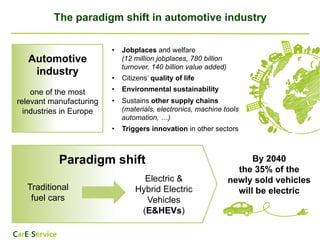
•  Jobplaces and welfare
(12 million jobplaces, 780 billion
turnover, 140 billion value added)
•  Citizens’ quality of life
•  Environmental sustainability
•  Sustains other supply chains
(materials, electronics, machine tools,
automation, …)
•  Triggers innovation in other sectors
The paradigm shift in automotive industry
Automotive
industry
one of the most
relevant manufacturing
industries in Europe
By 2040
the 35% of the
newly sold vehicles
will be electric
Paradigm shift
Traditional
fuel cars	
Electric &
Hybrid Electric
Vehicles
(E&HEVs)
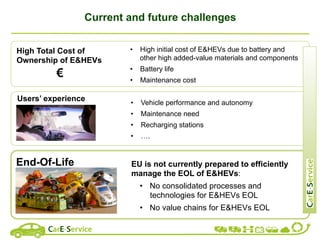
High Total Cost of
Ownership of E&HEVs
€
Current and future challenges
•  High initial cost of E&HEVs due to battery and
other high added-value materials and components
•  Battery life
•  Maintenance cost
Users’ experience •  Vehicle performance and autonomy
•  Maintenance need
•  Recharging stations
•  ….
End-Of-Life EU is not currently prepared to efficiently
manage the EOL of E&HEVs:
•  No consolidated processes and
technologies for E&HEVs EOL
•  No value chains for E&HEVs EOL
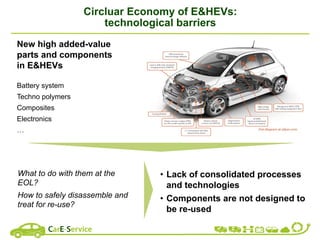
New high added-value
parts and components
in E&HEVs
Battery system
Techno polymers
Composites
Electronics
…
Circluar Economy of E&HEVs:
technological barriers
What to do with them at the
EOL?
How to safely disassemble and
treat for re-use?
•  Lack of consolidated processes
and technologies
•  Components are not designed to
be re-used
The concept of CarE-Service
•  What are the EU companies
able to treat E&HEVs parts?
•  Is the business convenient?
•  How to secure a sufficient
volume of post-used cars to
start the business at a large
scale?
•  What is the market for re-
used parts?
•  Are customers willing to
accept re-usable
components from E&HEVs?
•  Is the regulation supporting
the re-use of E&HEVs
parts?
•  Lack of consolidated
re-use chains
•  Unclear sustainability of re-use
business models
•  Limited number of post-use
cars in this ramp-up phase
•  Unexplored re-use market
•  Risk of market
un-acceptance
•  Regulation does not support
re-use
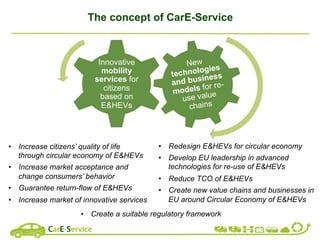
•  Redesign E&HEVs for circular economy
•  Develop EU leadership in advanced
technologies for re-use of E&HEVs
•  Reduce TCO of E&HEVs
•  Create new value chains and businesses in
EU around Circular Economy of E&HEVs
The concept of CarE-Service
New
technologies
and business
models for re-
use value
chains	
Innovative
mobility
services for
citizens
based on
E&HEVs	
•  Increase citizens’ quality of life
through circular economy of E&HEVs
•  Increase market acceptance and
change consumers’ behavior
•  Guarantee return-flow of E&HEVs
•  Increase market of innovative services
•  Create a suitable regulatory framework
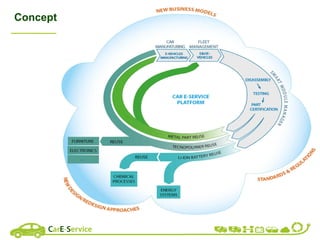
Concept
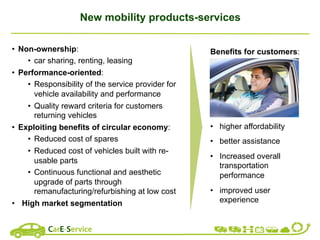
New mobility products-services
•  Non-ownership:
•  car sharing, renting, leasing
•  Performance-oriented:
•  Responsibility of the service provider for
vehicle availability and performance
•  Quality reward criteria for customers
returning vehicles
•  Exploiting benefits of circular economy:
•  Reduced cost of spares
•  Reduced cost of vehicles built with re-
usable parts
•  Continuous functional and aesthetic
upgrade of parts through
remanufacturing/refurbishing at low cost
•  High market segmentation
Benefits for customers:
•  higher affordability
•  better assistance
•  Increased overall
transportation
performance
•  improved user
experience
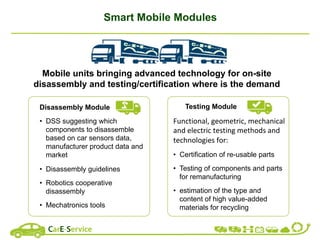
Smart Mobile Modules
Mobile units bringing advanced technology for on-site
disassembly and testing/certification where is the demand
Disassembly Module
•  DSS suggesting which
components to disassemble
based on car sensors data,
manufacturer product data and
market
•  Disassembly guidelines
•  Robotics cooperative
disassembly
•  Mechatronics tools
Testing Module
Functional,	geometric,	mechanical	
and	electric	testing	methods	and	
technologies	for:	
•  Certification of re-usable parts
•  Testing of components and parts
for remanufacturing
•  estimation of the type and
content of high value-added
materials for recycling
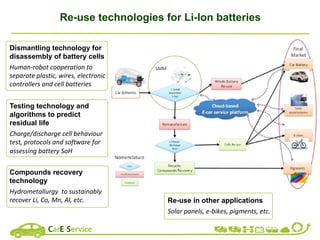
Re-use technologies for Li-Ion batteries
Dismantling technology for
disassembly of battery cells
Human-robot	cooperation	to	
separate	plastic,	wires,	electronic	
controllers	and	cell	batteries
Testing technology and
algorithms to predict
residual life
Charge/discharge	cell	behaviour	
test,	protocols	and	software	for	
assessing	battery	SoH	
Compounds recovery
technology
Hydrometallurgy		to	sustainably	
recover	Li,	Co,	Mn,	Al,	etc.		 Re-use in other applications
Solar	panels,	e-bikes,	pigments,	etc.
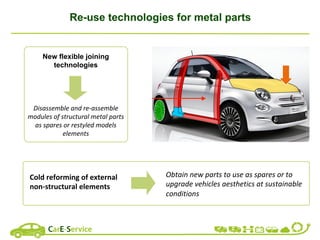
Re-use technologies for metal parts
New flexible joining
technologies
Disassemble	and	re-assemble	
modules	of	structural	metal	parts	
as	spares	or	restyled	models	
elements
Cold	reforming	of	external	
non-structural	elements	
Obtain	new	parts	to	use	as	spares	or	to	
upgrade	vehicles	aesthetics	at	sustainable	
conditions
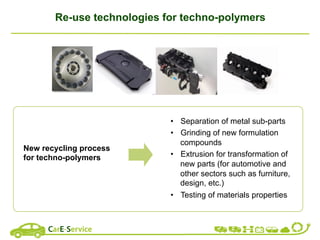
Re-use technologies for techno-polymers
New recycling process
for techno-polymers
•  Separation of metal sub-parts
•  Grinding of new formulation
compounds
•  Extrusion for transformation of
new parts (for automotive and
other sectors such as furniture,
design, etc.)
•  Testing of materials properties
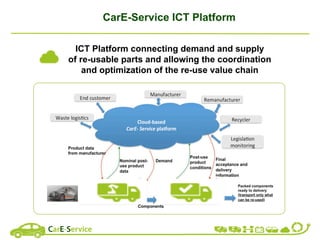
CarE-Service ICT Platform
ICT Platform connecting demand and supply
of re-usable parts and allowing the coordination
and optimization of the re-use value chain
Summary
•  Project motivation and concept
•  Objectives and targets
•  Project structure and schedule
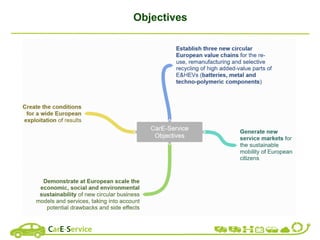
Objectives
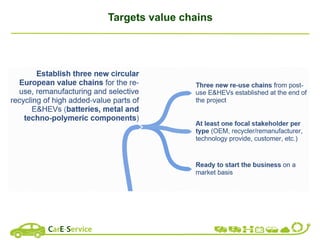
Targets value chains
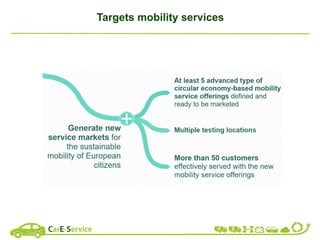
Targets mobility services
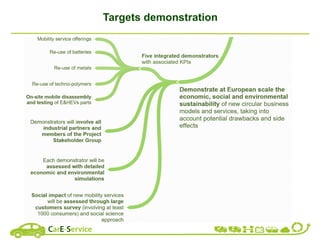
Targets demonstration
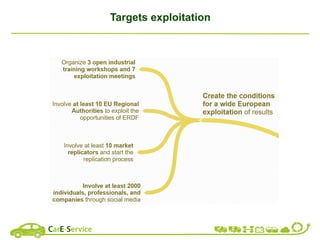
Targets exploitation
Summary
•  Project motivation and concept
•  Objectives and targets
•  Project structure and schedule
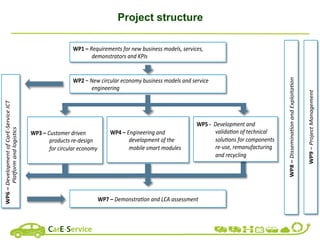
Project structure
WP1	–	Requirements	for	new	business	models,	services,	
demonstrators	and	KPIs	
WP2	–	New	circular	economy	business	models	and	service	
engineering	
WP3	–	Customer	driven	
products	re-design	
for	circular	economy	
WP4	–	Engineering	and	
development	of	the	
mobile	smart	modules	
WP7	–	DemonstraBon	and	LCA	assessment	
WP8	–	DisseminaBon	and	ExploitaBon	
WP9	–	Project	Management	
WP6	–	Development	of	CarE-Service	ICT	
PlaJorm	and	logisBcs	
WP5	-		Development	and	
validaBon	of	technical	
soluBons	for	components	
re-use,	remanufacturing	
and	recycling
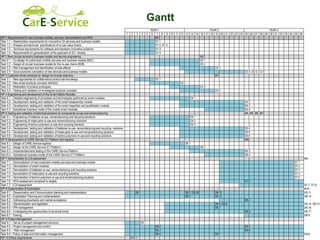
Gantt
1 2 3 4 5 6 7 8 9 10 11 12 13 14 15 16 17 18 19 20 21 22 23 24 25 26 27 28 29 30 31 32 33 34 35 36
WP 1 Requirements for new business models, services, demonstrators and KPIs M1
Task 1.1 – Stakeholders requirements for innovartive CE services and business models D1.1
Task 1.2 – Analysis and technical specifications of re-use value chains D1.2, D1.5
Task 1.3 – Technical requirements for software and hardware innovative solutions D1.3
Task 1.4 – Requirements for generalization of the approach to EU industry D1.4
WP 2 New circular economy business models and service engineering M2
Task 2.1 – Co-design of customized mobility services and business models (B2C) D2.1
Task 2.2 – Design of circular business models for the re-use chains (B2B) D2.2
Task 2.3 – Risk management and identification of side-effects D2.3
Task 2.4 – Socio-economic simulation of new services and business models D2.4, D2.5, D 2.6
WP 3 Customer-driven products re- design for circular economy M3
Task 3.1 – New approaches for collaborative product-service design D3.1
Task 3.2 – New smart products concepts definition D3.2
Task 3.3 – Realization of product prototypes D3.3
Task 3.4 – Testing and validation of re-designed products concepts D3.4
WP 4 Engineering and development of the Smart Mobile Modules
Task 4.1 – Detailed engineering of processes and technologies perfomed by smart modules D4.1
Task 4.2 – Development, testing and validation of the smart disassembly module D4.2
Task 4.3 – Development, testing and validation of the smart inspection and qualification module D4.3
Task 4.4 - Operational business model of the mobile smart modules. D4.4
WP 5 Testing and validation of technical solutions for components re-use and remanufacturing M4, M5, M6, M7
Task 5.1 – Engineering of batteries re-use, remanufacturing and recycling solutions D5.1
Task 5.2 – Engineering of metal parts re-use and remanufacturing solutions D5.2
Task 5.3 – Engineering of techno-polymers re-use and recycling solutions D5.3
Task 5.4 – Development, testing and validation of batteries re-use, remanufacturing and recycling solutions D5.4
Task 5.5 – Development, testing and validation of metal parts re-use and remanufacturing solutions D5.5
Task 5.6 – Development, testing and validation of techno-polymers re-use and recycling solutions D5.6
WP 6 Developmemt of CARE-Service ICT Platform and logistics M8
Task 6.1 – Design of CARE-Service logistics D6.1
Task 6.2 – Design of the CARE-Service ICT Platform D6.2
Task 6.3 – Implementationand testing of the CARE-Service Platform D6.3
Task 6.4 – Operational business model of the CARE-Service ICT Platform D6.4
WP 7 Demonstration & LCA assessnent M9
Task 7.1 – Demonstration of new customers mobility services and business models D7.1
Task 7.2 – Demostration of smart modules D7.2
Task 7.3 – Demostration of batteries re-use, remanufacturing and recycling solutions D7.3
Task 7.4 - Demostration of metal parts re-use and recycling solutions D7.4
Task 7.5 – Demostration of techno-polymers re-use and remanufacturing soutions D7.5
Task 7.6 – KPIs assessment compared to targets D7.6
Task 7.7 - LCA assessment D7.7, D7.8
WP 8 Dissemination & Exploitation M10
Task 8.1 – Dissemination and Communication planning and implementation D8.1 D8.2, D8.20 D8.10 D8.11
Task 8.2 – Exploitation Planning and implementation D8.3 D8.12 D8.13
Task 8.3 - Addressing drawbacks and market acceptance D8.4
Task 8.4 – Standardization and legislation D8.5, D8.6 D8.14, D8.15
Task 8.5 – IPR management D8.7 D8.16
Task 8.6 – Investigating the opportunities of structural funds D8.8 D8.17
Task 8.7 - Training D8.9
WP 9 Project Management
Task 9.1 – Set up of project management structure D9.1
Task 9.2 – Project management and control D9.2 D9.5
Task 9.3 – Risk management D9.3 D9.6
Task 9.4 – Policy of data and information management D9.4 D9.7 D9.8
WP 10 Ethics requirements D10.1
YEAR 1 YEAR 2 YEAR 3
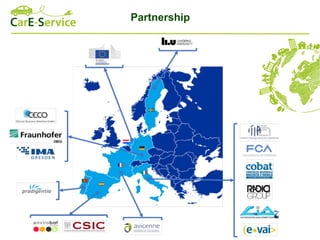
Partnership
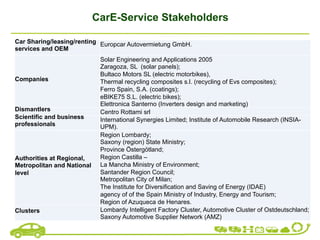
CarE-Service Stakeholders
Car Sharing/leasing/renting
services and OEM
Europcar Autovermietung GmbH.
Companies
Solar Engineering and Applications 2005
Zaragoza, SL (solar panels);
Bultaco Motors SL (electric motorbikes),
Thermal recycling composites s.l. (recycling of Evs composites);
Ferro Spain, S.A. (coatings);
eBIKE75 S.L. (electric bikes);
Elettronica Santerno (Inverters design and marketing)
Dismantlers Centro Rottami srl
Scientific and business
professionals
International Synergies Limited; Institute of Automobile Research (INSIA-
UPM).
Authorities at Regional,
Metropolitan and National
level
Region Lombardy;
Saxony (region) State Ministry;
Province Östergötland;
Region Castilla –
La Mancha Ministry of Environment;
Santander Region Council;
Metropolitan City of Milan;
The Institute for Diversification and Saving of Energy (IDAE)
agency of of the Spain Ministry of Industry, Energy and Tourism;
Region of Azuqueca de Henares.
Clusters Lombardy Intelligent Factory Cluster, Automotive Cluster of Ostdeutschland;
Saxony Automotive Supplier Network (AMZ)
This project has received funding from the European Union’s Horizon 2020
research and innovation programme under grant agreement No 776851

CarE-Service Project: Introduction general overview and objectives

  • 1.
    This project hasreceived funding from the European Union’s Horizon 2020 research and innovation programme under grant agreement No 776851
  • 2.
    This project hasreceived funding from the European Union’s Horizon 2020 research and innovation programme under grant agreement No 776851 Project concept, objectives and structure Giacomo Copani Kick-off meeting Milano, 12/06/2018
  • 3.
    Summary •  Project motivationand concept •  Objectives and targets •  Project structure and schedule
  • 4.
    Summary •  Project motivationand concept •  Objectives and targets •  Project structure and schedule
  • 5.
    •  Jobplaces andwelfare (12 million jobplaces, 780 billion turnover, 140 billion value added) •  Citizens’ quality of life •  Environmental sustainability •  Sustains other supply chains (materials, electronics, machine tools, automation, …) •  Triggers innovation in other sectors The paradigm shift in automotive industry Automotive industry one of the most relevant manufacturing industries in Europe By 2040 the 35% of the newly sold vehicles will be electric Paradigm shift Traditional fuel cars Electric & Hybrid Electric Vehicles (E&HEVs)
  • 6.
    High Total Costof Ownership of E&HEVs € Current and future challenges •  High initial cost of E&HEVs due to battery and other high added-value materials and components •  Battery life •  Maintenance cost Users’ experience •  Vehicle performance and autonomy •  Maintenance need •  Recharging stations •  …. End-Of-Life EU is not currently prepared to efficiently manage the EOL of E&HEVs: •  No consolidated processes and technologies for E&HEVs EOL •  No value chains for E&HEVs EOL
  • 7.
    New high added-value partsand components in E&HEVs Battery system Techno polymers Composites Electronics … Circluar Economy of E&HEVs: technological barriers What to do with them at the EOL? How to safely disassemble and treat for re-use? •  Lack of consolidated processes and technologies •  Components are not designed to be re-used
  • 8.
    The concept ofCarE-Service •  What are the EU companies able to treat E&HEVs parts? •  Is the business convenient? •  How to secure a sufficient volume of post-used cars to start the business at a large scale? •  What is the market for re- used parts? •  Are customers willing to accept re-usable components from E&HEVs? •  Is the regulation supporting the re-use of E&HEVs parts? •  Lack of consolidated re-use chains •  Unclear sustainability of re-use business models •  Limited number of post-use cars in this ramp-up phase •  Unexplored re-use market •  Risk of market un-acceptance •  Regulation does not support re-use
  • 9.
    •  Redesign E&HEVsfor circular economy •  Develop EU leadership in advanced technologies for re-use of E&HEVs •  Reduce TCO of E&HEVs •  Create new value chains and businesses in EU around Circular Economy of E&HEVs The concept of CarE-Service New technologies and business models for re- use value chains Innovative mobility services for citizens based on E&HEVs •  Increase citizens’ quality of life through circular economy of E&HEVs •  Increase market acceptance and change consumers’ behavior •  Guarantee return-flow of E&HEVs •  Increase market of innovative services •  Create a suitable regulatory framework
  • 10.
  • 11.
    New mobility products-services • Non-ownership: •  car sharing, renting, leasing •  Performance-oriented: •  Responsibility of the service provider for vehicle availability and performance •  Quality reward criteria for customers returning vehicles •  Exploiting benefits of circular economy: •  Reduced cost of spares •  Reduced cost of vehicles built with re- usable parts •  Continuous functional and aesthetic upgrade of parts through remanufacturing/refurbishing at low cost •  High market segmentation Benefits for customers: •  higher affordability •  better assistance •  Increased overall transportation performance •  improved user experience
  • 12.
    Smart Mobile Modules Mobileunits bringing advanced technology for on-site disassembly and testing/certification where is the demand Disassembly Module •  DSS suggesting which components to disassemble based on car sensors data, manufacturer product data and market •  Disassembly guidelines •  Robotics cooperative disassembly •  Mechatronics tools Testing Module Functional, geometric, mechanical and electric testing methods and technologies for: •  Certification of re-usable parts •  Testing of components and parts for remanufacturing •  estimation of the type and content of high value-added materials for recycling
  • 13.
    Re-use technologies forLi-Ion batteries Dismantling technology for disassembly of battery cells Human-robot cooperation to separate plastic, wires, electronic controllers and cell batteries Testing technology and algorithms to predict residual life Charge/discharge cell behaviour test, protocols and software for assessing battery SoH Compounds recovery technology Hydrometallurgy to sustainably recover Li, Co, Mn, Al, etc. Re-use in other applications Solar panels, e-bikes, pigments, etc.
  • 14.
    Re-use technologies formetal parts New flexible joining technologies Disassemble and re-assemble modules of structural metal parts as spares or restyled models elements Cold reforming of external non-structural elements Obtain new parts to use as spares or to upgrade vehicles aesthetics at sustainable conditions
  • 15.
    Re-use technologies fortechno-polymers New recycling process for techno-polymers •  Separation of metal sub-parts •  Grinding of new formulation compounds •  Extrusion for transformation of new parts (for automotive and other sectors such as furniture, design, etc.) •  Testing of materials properties
  • 16.
    CarE-Service ICT Platform ICTPlatform connecting demand and supply of re-usable parts and allowing the coordination and optimization of the re-use value chain
  • 17.
    Summary •  Project motivationand concept •  Objectives and targets •  Project structure and schedule
  • 18.
  • 19.
  • 20.
  • 21.
  • 22.
  • 23.
    Summary •  Project motivationand concept •  Objectives and targets •  Project structure and schedule
  • 24.
  • 25.
    Gantt 1 2 34 5 6 7 8 9 10 11 12 13 14 15 16 17 18 19 20 21 22 23 24 25 26 27 28 29 30 31 32 33 34 35 36 WP 1 Requirements for new business models, services, demonstrators and KPIs M1 Task 1.1 – Stakeholders requirements for innovartive CE services and business models D1.1 Task 1.2 – Analysis and technical specifications of re-use value chains D1.2, D1.5 Task 1.3 – Technical requirements for software and hardware innovative solutions D1.3 Task 1.4 – Requirements for generalization of the approach to EU industry D1.4 WP 2 New circular economy business models and service engineering M2 Task 2.1 – Co-design of customized mobility services and business models (B2C) D2.1 Task 2.2 – Design of circular business models for the re-use chains (B2B) D2.2 Task 2.3 – Risk management and identification of side-effects D2.3 Task 2.4 – Socio-economic simulation of new services and business models D2.4, D2.5, D 2.6 WP 3 Customer-driven products re- design for circular economy M3 Task 3.1 – New approaches for collaborative product-service design D3.1 Task 3.2 – New smart products concepts definition D3.2 Task 3.3 – Realization of product prototypes D3.3 Task 3.4 – Testing and validation of re-designed products concepts D3.4 WP 4 Engineering and development of the Smart Mobile Modules Task 4.1 – Detailed engineering of processes and technologies perfomed by smart modules D4.1 Task 4.2 – Development, testing and validation of the smart disassembly module D4.2 Task 4.3 – Development, testing and validation of the smart inspection and qualification module D4.3 Task 4.4 - Operational business model of the mobile smart modules. D4.4 WP 5 Testing and validation of technical solutions for components re-use and remanufacturing M4, M5, M6, M7 Task 5.1 – Engineering of batteries re-use, remanufacturing and recycling solutions D5.1 Task 5.2 – Engineering of metal parts re-use and remanufacturing solutions D5.2 Task 5.3 – Engineering of techno-polymers re-use and recycling solutions D5.3 Task 5.4 – Development, testing and validation of batteries re-use, remanufacturing and recycling solutions D5.4 Task 5.5 – Development, testing and validation of metal parts re-use and remanufacturing solutions D5.5 Task 5.6 – Development, testing and validation of techno-polymers re-use and recycling solutions D5.6 WP 6 Developmemt of CARE-Service ICT Platform and logistics M8 Task 6.1 – Design of CARE-Service logistics D6.1 Task 6.2 – Design of the CARE-Service ICT Platform D6.2 Task 6.3 – Implementationand testing of the CARE-Service Platform D6.3 Task 6.4 – Operational business model of the CARE-Service ICT Platform D6.4 WP 7 Demonstration & LCA assessnent M9 Task 7.1 – Demonstration of new customers mobility services and business models D7.1 Task 7.2 – Demostration of smart modules D7.2 Task 7.3 – Demostration of batteries re-use, remanufacturing and recycling solutions D7.3 Task 7.4 - Demostration of metal parts re-use and recycling solutions D7.4 Task 7.5 – Demostration of techno-polymers re-use and remanufacturing soutions D7.5 Task 7.6 – KPIs assessment compared to targets D7.6 Task 7.7 - LCA assessment D7.7, D7.8 WP 8 Dissemination & Exploitation M10 Task 8.1 – Dissemination and Communication planning and implementation D8.1 D8.2, D8.20 D8.10 D8.11 Task 8.2 – Exploitation Planning and implementation D8.3 D8.12 D8.13 Task 8.3 - Addressing drawbacks and market acceptance D8.4 Task 8.4 – Standardization and legislation D8.5, D8.6 D8.14, D8.15 Task 8.5 – IPR management D8.7 D8.16 Task 8.6 – Investigating the opportunities of structural funds D8.8 D8.17 Task 8.7 - Training D8.9 WP 9 Project Management Task 9.1 – Set up of project management structure D9.1 Task 9.2 – Project management and control D9.2 D9.5 Task 9.3 – Risk management D9.3 D9.6 Task 9.4 – Policy of data and information management D9.4 D9.7 D9.8 WP 10 Ethics requirements D10.1 YEAR 1 YEAR 2 YEAR 3
  • 26.
  • 27.
    CarE-Service Stakeholders Car Sharing/leasing/renting servicesand OEM Europcar Autovermietung GmbH. Companies Solar Engineering and Applications 2005 Zaragoza, SL (solar panels); Bultaco Motors SL (electric motorbikes), Thermal recycling composites s.l. (recycling of Evs composites); Ferro Spain, S.A. (coatings); eBIKE75 S.L. (electric bikes); Elettronica Santerno (Inverters design and marketing) Dismantlers Centro Rottami srl Scientific and business professionals International Synergies Limited; Institute of Automobile Research (INSIA- UPM). Authorities at Regional, Metropolitan and National level Region Lombardy; Saxony (region) State Ministry; Province Östergötland; Region Castilla – La Mancha Ministry of Environment; Santander Region Council; Metropolitan City of Milan; The Institute for Diversification and Saving of Energy (IDAE) agency of of the Spain Ministry of Industry, Energy and Tourism; Region of Azuqueca de Henares. Clusters Lombardy Intelligent Factory Cluster, Automotive Cluster of Ostdeutschland; Saxony Automotive Supplier Network (AMZ)
  • 28.
    This project hasreceived funding from the European Union’s Horizon 2020 research and innovation programme under grant agreement No 776851