Banking as a Career
BY
Dr.Narayan Kayarkatte
Director, MSNM Besant Institute of PG
Management Studies Mangalore 575008
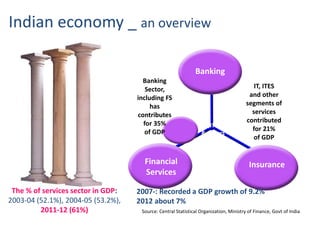
Banking
Financial
Services
InsuranceFee Based
Indian economy _ an overview
2007-: Recorded a GDP growth of 9.2%
2012 about 7%
The % of services sector in GDP:
2003-04 (52.1%), 2004-05 (53.2%),
2011-12 (61%) Source: Central Statistical Organization, Ministry of Finance, Govt of India
Banking
Sector,
including FS
has
contributes
for 35%
of GDP
IT,ITES
& Others
IT, ITES
and other
segments of
services
contributed
for 21%
of GDP
BFI Sector: Career Opportunities
• In all, more than 30 lakhs in the next 5
years at entry level
–Banking Operations: 6 lakhs
–Financial Services: 7 lakhs
–Insurance:09 lakhs
–ITES/BPO working on BFI projects: 6
lakhs
• Indirect employment and back office
support - additional
Source: India Today (Aug 2011 and Feb 2012)
Banking Industry
• Considered as a Sunrise Industry for job
seekers In the field of Commerce and
Management
• But Bank officers are from different streams of
education
• Management graduates, IT Engineers,CAs,LLBs
and CFAs as specialist officers,
Developments in Recruitment
• Nationalization of the major commercial banks in
India in 1969 and1980
• In 1980s and 90s large numbers of recruitments
were done by these Banks through Banking
Service Recruitment Board (BSRB)
• Later in 2005 onwards , campus selections
• Since 2011, the PSU Banks have started
recruiting on the basis of ranks obtained in the All
India tests conducted by Institute for Banking
Personnel Selection (IBPS).
Types of Banks
• The Reserve Bank of India
• The Public Sector Banks
• Old generation Private Sector Banks
• New generation technology Banks.
• Foreign Banks
• Cooperative banks
The Candidate Profile:
• Generally the banks look for good communication
skills, good interpersonal skills, the ability to deal
with customers, an alert nature, and basic
knowledge of the industry
• For higher level jobs specialization in some
specific areas like expertise in project analysis,
credit appraisal skills, special programming skills,
managing credit portfolios, foreign exchange
transactions etc Sound ability in IT
Clerical Employees
• Handle front office jobs in most of the banks along
with the supervisors who may be senior clerks(called
as Special Assistants)
• Clerks also work as cashiers, single window operators
and other technical works which attract additional
allowances
• Bank employees at clerical levels are highly unionized
and enjoy decent pay and perks as per the Bipartite
settlement arrived between Unions and Management
from time to time.
• The salary at the beginning and end of clerical scale
ranges from Rs 15000 to Rs50000.
Officer Cadres
• Joining the Bank as Probationary Officer in Scale I
on the basis of recruitment process or by
promotion from clerical cadre through promotion
tests.
• People with marketing and technological skills or
specialized knowledge like legal officers are
directly recruited through interview, sometimes
at higher levels also. The PSU Banks have seven
different pay scales
• The minimum and maximum in PSU Banks
Rising up in the Career
• Junior Management Grade 1- Supervisors, Asst managers and Head
of small rural branches
• Middle Management Grade 2- s Branch Managers of smaller
branches, Dy. Managers at Administrative Officers
• Middle Management Grade 3- Senior Branch Manager,
Departmental Heads etc
• Senior Management Grade 4 - Chief Manager of very large branches
• Senior Management Grade 5 – Asst. General Manager
• Top Management Grade 6– Dy. General Manager, Zonal Heads
• Top Management Grade 7 –. General Manager, Circle Heads,
Vertical Dept.Heads at HO
• General Managers are elevated to the positions of Executive
Directors and Managing Directors by the Government and to head
the Banks as such.
Role and Responsibilities
• A bank officer is responsible for profit, people
and resource management and strategic planning
to generate more business.
• The bank officer needs to be a person who has a
well-organized mind with an eye for detail. It
helps in maintenance of records accurately and
neatly. The person should have an aptitude for
numerical and common sense in abundance.. In
addition ,they should have man management
skills to lead, motivate and manage the staff.
Good verbal and written communication skills
Selection procedure for RBI-
• The Reserve Bank of India conducts tests for three
types of entry level positions Clerical, Grade A officers
and Grade B officers
• The entry point for clerical staff is in the various
departments ,generally in cash department as
examiners of coins and notes. They are promoted to
the next grade when they successfully clear promotion
examinations after five years of service.
• There is an All India Exam conducted for officer’s posts.
Graduates, Post Graduates, CA's, MBA's in the 21-26
years
Institute for Banking Personnel
Selection
• IBPS, an autonomous body, has been authorized by IBA and has
received a mandate from the 19 Public Sector Banks to conduct the
Common Written Examination.
• The CWE for Probationary Officer/ Management Trainee posts and
CWE for the position of clerks are being conducted twice a year by
IBPS.
• This system of Common Written Examination for recruitment of
Probationary Officers/Management Trainees has been approved by
the Government of India, has the consent of the Boards of each of
the participating Banks and the Managing Committee of the Indian
Banks’ Association (IBA).
• The grade sheet issued by IBPS to the candidates has a validity for
one year
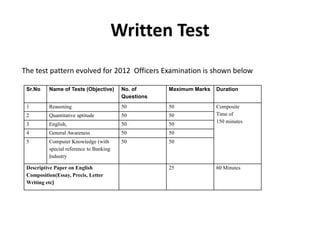
Written Test
Sr.No Name of Tests (Objective) No. of
Questions
Maximum Marks Duration
1 Reasoning 50 50 Composite
Time of
150 minutes
2 Quantitative aptitude 50 50
3 English, 50 50
4 General Awareness 50 50
5 Computer Knowledge (with
special reference to Banking
Industry
50 50
Descriptive Paper on English
Composition(Essay, Precis, Letter
Writing etc)
25 60 Minutes
The test pattern evolved for 2012 Officers Examination is shown below
Interviews
• Selection in the interview is based on the
knowledge of the subject of study, personality
and awareness. Candidate's communication
skills and leadership qualities are judged
during the interview. Typically 30% of the
candidates get selected after the interview.
What other personal attributes do employers
want?
• Commercial awareness
• willingness to learn
• flexibility and adaptability
• self-motivation
• Loyalty
• Commitment
• Honesty and integrity
• Personal presentation
• Positive self esteem
Career in bankiiing

Career in bankiiing

  • 1.
    Banking as aCareer BY Dr.Narayan Kayarkatte Director, MSNM Besant Institute of PG Management Studies Mangalore 575008
  • 2.
    Banking Financial Services InsuranceFee Based Indian economy_ an overview 2007-: Recorded a GDP growth of 9.2% 2012 about 7% The % of services sector in GDP: 2003-04 (52.1%), 2004-05 (53.2%), 2011-12 (61%) Source: Central Statistical Organization, Ministry of Finance, Govt of India Banking Sector, including FS has contributes for 35% of GDP IT,ITES & Others IT, ITES and other segments of services contributed for 21% of GDP
  • 3.
    BFI Sector: CareerOpportunities • In all, more than 30 lakhs in the next 5 years at entry level –Banking Operations: 6 lakhs –Financial Services: 7 lakhs –Insurance:09 lakhs –ITES/BPO working on BFI projects: 6 lakhs • Indirect employment and back office support - additional Source: India Today (Aug 2011 and Feb 2012)
  • 4.
    Banking Industry • Consideredas a Sunrise Industry for job seekers In the field of Commerce and Management • But Bank officers are from different streams of education • Management graduates, IT Engineers,CAs,LLBs and CFAs as specialist officers,
  • 5.
    Developments in Recruitment •Nationalization of the major commercial banks in India in 1969 and1980 • In 1980s and 90s large numbers of recruitments were done by these Banks through Banking Service Recruitment Board (BSRB) • Later in 2005 onwards , campus selections • Since 2011, the PSU Banks have started recruiting on the basis of ranks obtained in the All India tests conducted by Institute for Banking Personnel Selection (IBPS).
  • 6.
    Types of Banks •The Reserve Bank of India • The Public Sector Banks • Old generation Private Sector Banks • New generation technology Banks. • Foreign Banks • Cooperative banks
  • 7.
    The Candidate Profile: •Generally the banks look for good communication skills, good interpersonal skills, the ability to deal with customers, an alert nature, and basic knowledge of the industry • For higher level jobs specialization in some specific areas like expertise in project analysis, credit appraisal skills, special programming skills, managing credit portfolios, foreign exchange transactions etc Sound ability in IT
  • 8.
    Clerical Employees • Handlefront office jobs in most of the banks along with the supervisors who may be senior clerks(called as Special Assistants) • Clerks also work as cashiers, single window operators and other technical works which attract additional allowances • Bank employees at clerical levels are highly unionized and enjoy decent pay and perks as per the Bipartite settlement arrived between Unions and Management from time to time. • The salary at the beginning and end of clerical scale ranges from Rs 15000 to Rs50000.
  • 9.
    Officer Cadres • Joiningthe Bank as Probationary Officer in Scale I on the basis of recruitment process or by promotion from clerical cadre through promotion tests. • People with marketing and technological skills or specialized knowledge like legal officers are directly recruited through interview, sometimes at higher levels also. The PSU Banks have seven different pay scales • The minimum and maximum in PSU Banks
  • 10.
    Rising up inthe Career • Junior Management Grade 1- Supervisors, Asst managers and Head of small rural branches • Middle Management Grade 2- s Branch Managers of smaller branches, Dy. Managers at Administrative Officers • Middle Management Grade 3- Senior Branch Manager, Departmental Heads etc • Senior Management Grade 4 - Chief Manager of very large branches • Senior Management Grade 5 – Asst. General Manager • Top Management Grade 6– Dy. General Manager, Zonal Heads • Top Management Grade 7 –. General Manager, Circle Heads, Vertical Dept.Heads at HO • General Managers are elevated to the positions of Executive Directors and Managing Directors by the Government and to head the Banks as such.
  • 11.
    Role and Responsibilities •A bank officer is responsible for profit, people and resource management and strategic planning to generate more business. • The bank officer needs to be a person who has a well-organized mind with an eye for detail. It helps in maintenance of records accurately and neatly. The person should have an aptitude for numerical and common sense in abundance.. In addition ,they should have man management skills to lead, motivate and manage the staff. Good verbal and written communication skills
  • 12.
    Selection procedure forRBI- • The Reserve Bank of India conducts tests for three types of entry level positions Clerical, Grade A officers and Grade B officers • The entry point for clerical staff is in the various departments ,generally in cash department as examiners of coins and notes. They are promoted to the next grade when they successfully clear promotion examinations after five years of service. • There is an All India Exam conducted for officer’s posts. Graduates, Post Graduates, CA's, MBA's in the 21-26 years
  • 13.
    Institute for BankingPersonnel Selection • IBPS, an autonomous body, has been authorized by IBA and has received a mandate from the 19 Public Sector Banks to conduct the Common Written Examination. • The CWE for Probationary Officer/ Management Trainee posts and CWE for the position of clerks are being conducted twice a year by IBPS. • This system of Common Written Examination for recruitment of Probationary Officers/Management Trainees has been approved by the Government of India, has the consent of the Boards of each of the participating Banks and the Managing Committee of the Indian Banks’ Association (IBA). • The grade sheet issued by IBPS to the candidates has a validity for one year
  • 14.
    Written Test Sr.No Nameof Tests (Objective) No. of Questions Maximum Marks Duration 1 Reasoning 50 50 Composite Time of 150 minutes 2 Quantitative aptitude 50 50 3 English, 50 50 4 General Awareness 50 50 5 Computer Knowledge (with special reference to Banking Industry 50 50 Descriptive Paper on English Composition(Essay, Precis, Letter Writing etc) 25 60 Minutes The test pattern evolved for 2012 Officers Examination is shown below
  • 15.
    Interviews • Selection inthe interview is based on the knowledge of the subject of study, personality and awareness. Candidate's communication skills and leadership qualities are judged during the interview. Typically 30% of the candidates get selected after the interview.
  • 16.
    What other personalattributes do employers want? • Commercial awareness • willingness to learn • flexibility and adaptability • self-motivation • Loyalty • Commitment • Honesty and integrity • Personal presentation • Positive self esteem