
NHS
                                       NHS Improvement


CANCER


DIAGNOSTICS
              Heart Improvement

              Cardiac Rehabilitation -
HEART         National Priority Projects
              Lessons and learning one year on...
LUNG
              October 2009


STROKE
Cardiac Rehabilitation
Cardiac rehabilitation (CR) is a national priority project of NHS Improvement
focusing on increasing the access to, equity of provision and uptake of CR
services for heart attack, angioplasty and CABG patients.


The time scale for the projects varies, with some projects still in the initial
stages. Key learning from the project is available in brief in the introduction
to this document and in more detail in each of the project summaries.


Project summaries
Project summaries include issues to be addressed, baseline position, actions
taken, key learning and results to date from the 11 projects participating in
this work.


Contact details are included to provide additional information with regular
updates available on the website at www.improvement.nhs.uk/heart/rehab
Cardiac Rehabilitation - National Priority Projects    3


Contents
Foreword                                                                                 4

Introduction                                                                             6

Key Learning                                                                             7

Quality, Innovation, Productivity and Prevention                                         8

Project Summaries                                                                        9

Commissioning an equitable service across the county                                    10
Derbyshire County PCT

A sector wide approach to cardiac rehabilitation in South West London                   13
South West London Cardiac and Stroke Network

Rehabilitation triage assessment                                                        18
North Lincolnshire and Goole NHS Trust

Planning cardiac rehabilitation commissioning                                           22
Dorset Cardiac and Stroke Network

Modernising a cardiac rehabilitation service                                            26
NHS North of Tyne, North of England Cardiovascular Network

A redesigned service for North Staffordshire                                            30
Shropshire and Staffordshire Heart and Stroke Network

Improving access for Surrey patients                                                    33
Surrey Heart and Stroke Network

Audit on the uptake of phase three cardiac rehabilitation                               36
Black Country Cardiovascular Network

Referral to cardiac rehabilitation for PPCI patients                                    39
North West London Cardiac and Stroke Network

Vocational rehabilitation project                                                       41
North West London Cardiac and Stroke Network

Cardiac rehabilitation across the Peninsula                                             44
Peninsula Heart and Stroke Network

Project Team                                                                            47


                                                                     www.improvement.nhs.uk/heart
4       Cardiac Rehabilitation - National Priority Projects


        Foreword
                                      During this time of imminent financial constraint and commissioning
                                      pressures the national priority projects for cardiac rehabilitation (CR) have
                                      created a real sense of optimism within the clinical teams and have led to
                                      significant positive change which will become evident over the coming
                                      years. NHS Improvement - Heart has taken positive action towards
                                      ensuring that lessons learnt in one work stream become the building
                                      blocks for other teams. This critical mass approach is key to achieving
                                      the greatest impact in the shortest possible time which, for CR, is
                                      important because the challenge ahead is huge! Recent National Audit
        of Cardiac Rehabilitation (NACR) figures show that uptake remains low (mean 38%) and that average
        trends in uptake did not change in 2007-2008. The NACR report and the network survey of CR
        highlighted that referral to rehabilitation is one of the biggest hurdles to ensuring higher uptake.
        There is clearly plenty of work to do but I believe the CR priority projects have the right focus to
        tackle the problem, for example service redesign, innovations in commissioning and leadership
        development, which we all know are important issues and challenges facing practitioners and service
        providers.

        The national priority projects for CR are the test bed for tariff debate and collectively we are making
        a real contribution to shaping the future national tariffs for CR. One of the lessons, so far, is that
        tariff doesn’t bring new money but what is does is give commissioners and providers a clear
        framework for what CR costs. What we have learnt, through the CR projects, is that service
        specification is the key to commissioning best practice CR. NHS Improvement - Heart is primed to
        produce meaningful support structures to help commissioners and providers achieve this is their own
        localities.

        It is less than one year since the CR national projects started yet we already have some clear success
        stories from individual projects and we see similar promise as the present projects roll out. The CR
        projects are fully inclusive and thrive on close liaison with local commissioners, cardiologists, CR
        practitioners and cardiac networks all of whom are committed to innovations aimed at enhancing
        referral to CR and reducing inequalities in access over the next 12 months. The CR project team are
        tasked with making sure that the best possible outcomes prevail and that success is shared with
        others.

        My role as national clinical lead has been made possible and strengthened by close partnership with
        NHS Improvement - Heart and particularly Linda Binder and Dr Jane Flint both of whom have the
        skills and motivation to take the battle to where it counts. We look forward to even greater success
        over the next few years as we enable one of the most strongly supported clinical interventions, that
        brings substantial benefits to patients, to become a reality for those that require it.


        Professor Patrick Doherty
        National Clinical Lead for Cardiac Rehabilitation to NHS Improvement


www.improvement.nhs.uk/heart
Cardiac Rehabilitation - National Priority Projects          5


Foreword
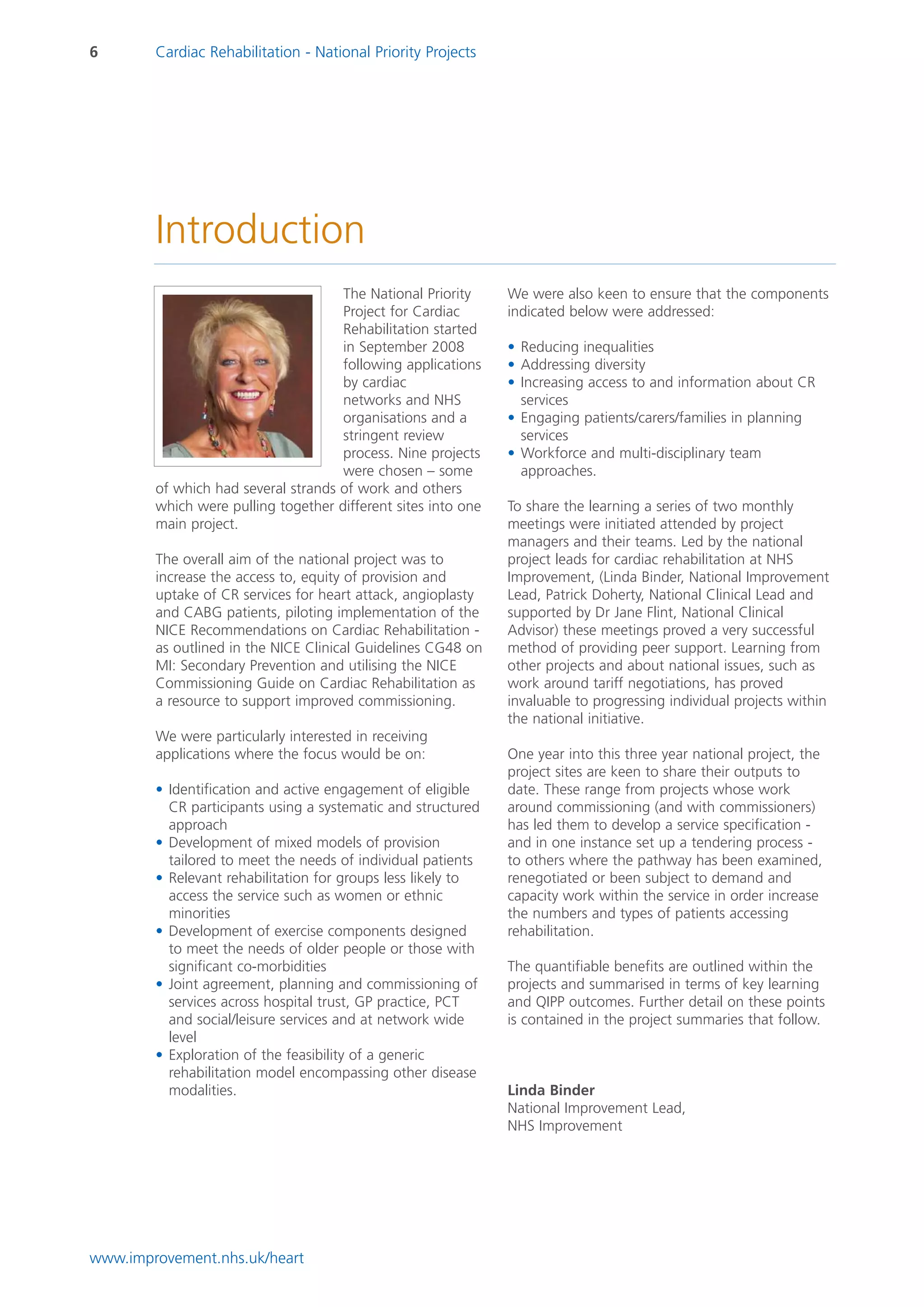
                             The cardiovascular networks always promised to be effective health
                             communities, across which sharing good practice and ultimately
                             redesigning ideal care pathways for patients, including cardiac
                             rehabilitation could be made. Commissioning against commitment to key
                             defined outcomes is important. Although only a minority of networks
                             has so far worked with the national team on priority projects, these
                             networks already show an appreciation of both achievements of
                             programmes, and most importantly, the challenges faced across their
                             respective territories.

Our first completed audit cycle of the network survey of cardiac rehabilitation development has
highlighted the minority view as yet of robust commissioning, but increasing opportunity with roll-out
of Primary PCI for STEMI to include cardiac rehabilitation within the business case. From North of
Tyne to Pan London down to Peninsula there has been real progress, through their projects, in the
relationship with commissioners, but the North West London Cardiac and Stroke Network has
identified the specially identified professional needed to effectively repatriate with documentation
patients receiving PPCI from surrounding districts to a ‘heart attack’ centre.

Commitment to submit data to National Audit of Cardiac Rehabilitation (NACR) is universal among
networks, and four of the projects make specific reference to network commitment to improve
submission of data. The vital need to interface NACR with other important cardiac databases is also
emphasised.

The inequalities’ agenda is ever reflected in access to cardiac rehabilitation. All projects have bravely
tackled variation both within and among programmes, and between different cardiac patient
pathways. Their innovative approaches involving all stakeholders bear witness to our network survey
outcome that the majority have been able to favourably influence cardiac rehabilitation across their
regions.

The 2008-2009 year has been a really stirring one, but there remains most yet to do! Best wishes
for the coming year!


Jane Flint BSc MD FRCP
National Clinical Advisor for Cardiac Rehabilitation to NHS Improvement


                                                                        www.improvement.nhs.uk/heart
6       Cardiac Rehabilitation - National Priority Projects


        Introduction
                                     The National Priority     We were also keen to ensure that the components
                                     Project for Cardiac       indicated below were addressed:
                                     Rehabilitation started
                                     in September 2008         • Reducing inequalities
                                     following applications    • Addressing diversity
                                     by cardiac                • Increasing access to and information about CR
                                     networks and NHS            services
                                     organisations and a       • Engaging patients/carers/families in planning
                                     stringent review            services
                                     process. Nine projects    • Workforce and multi-disciplinary team
                                     were chosen – some          approaches.
        of which had several strands of work and others
        which were pulling together different sites into one   To share the learning a series of two monthly
        main project.                                          meetings were initiated attended by project
                                                               managers and their teams. Led by the national
        The overall aim of the national project was to         project leads for cardiac rehabilitation at NHS
        increase the access to, equity of provision and        Improvement, (Linda Binder, National Improvement
        uptake of CR services for heart attack, angioplasty    Lead, Patrick Doherty, National Clinical Lead and
        and CABG patients, piloting implementation of the      supported by Dr Jane Flint, National Clinical
        NICE Recommendations on Cardiac Rehabilitation -       Advisor) these meetings proved a very successful
        as outlined in the NICE Clinical Guidelines CG48 on    method of providing peer support. Learning from
        MI: Secondary Prevention and utilising the NICE        other projects and about national issues, such as
        Commissioning Guide on Cardiac Rehabilitation as       work around tariff negotiations, has proved
        a resource to support improved commissioning.          invaluable to progressing individual projects within
                                                               the national initiative.
        We were particularly interested in receiving
        applications where the focus would be on:              One year into this three year national project, the
                                                               project sites are keen to share their outputs to
        • Identification and active engagement of eligible     date. These range from projects whose work
          CR participants using a systematic and structured    around commissioning (and with commissioners)
          approach                                             has led them to develop a service specification -
        • Development of mixed models of provision             and in one instance set up a tendering process -
          tailored to meet the needs of individual patients    to others where the pathway has been examined,
        • Relevant rehabilitation for groups less likely to    renegotiated or been subject to demand and
          access the service such as women or ethnic           capacity work within the service in order increase
          minorities                                           the numbers and types of patients accessing
        • Development of exercise components designed          rehabilitation.
          to meet the needs of older people or those with
          significant co-morbidities                           The quantifiable benefits are outlined within the
        • Joint agreement, planning and commissioning of       projects and summarised in terms of key learning
          services across hospital trust, GP practice, PCT     and QIPP outcomes. Further detail on these points
          and social/leisure services and at network wide      is contained in the project summaries that follow.
          level
        • Exploration of the feasibility of a generic
          rehabilitation model encompassing other disease
          modalities.                                          Linda Binder
                                                               National Improvement Lead,
                                                               NHS Improvement


www.improvement.nhs.uk/heart
Cardiac Rehabilitation - National Priority Projects    7


Key Learning
Outlined below are some of the key learning
identified by the projects after just one year:

• Ensure supportive and strong clinical
  leadership/engagement to champion the
  approach, aid decision making and manage
  clinical expectations of the group
• Ensure the right people are working on your
  project and that you are engaging with the right
  stakeholders from the outset
• Understand baseline activity of existing service
  provision and ensure there is robust data - crucial
  to help identify inequalities and to monitor
  progress of work
• Build analyst time into your project and make
  sure your finance team are also on board if
  necessary
• Understand your demand and capacity
• Ensure service reconfiguration does not create
  an alternative bottleneck
• Spend time defining your key performance
  indicators
• Good communication mechanisms (email /
  phone) helps resolve issues quickly
• Build sustainability into your service
• Learn from other trusts that are doing well,
  a site visit is often a good way of doing this
• Promote the ability of cardiac rehabilitation to
  reduce admissions and length of stay and
  generate cost savings into your business case
• Consider the implications of going out to tender
  and whether you will need to buy in external
  consultancy
• Dedicated project management time
• Multiagency partnerships can increase flexibility
  within your service
• Don’t forget the patients – their views are
  important and helpful in redesigning a service.


                                                                          www.improvement.nhs.uk/heart
8       Cardiac Rehabilitation - National Priority Projects


        Quality, Innovation, Productivity
        and Prevention (QIPP)
        Outlined below are some of the QIPP benefits          INNOVATION
        identified by the projects after just one year:
                                                              •   Rehab led follow up
        QUALITY                                               •   Looking at ways to include health checks
                                                              •   Drug therapy reviews
        Safety                                                •   Task group acting to coordinate all quality
        • Centralised referral and patient tracking               initiatives.
        • Standardised protocols and procedures assessed
          against evidence base                               PRODUCTIVITY
        • Risk stratification form
        • Criteria for shuttle testing patients               • Increased number of patients accessing rehab
        • Governance standards developed with                 • Reduced hand offs – integrated team with fewer
          metrics system                                        referral steps
        • Skills competency assessment.                       • Using and scheduling staff more effectively
                                                              • Rehab led follow up – reduces the need for
        Effectiveness                                           outpatient attendance
        • New community and home based programme              • Ensuring availability of MDT staff to
          for IHD                                               increase flow.
        • Cardiac rehabilitation outcome measures
          identified
        • Clear management plans
        • Effective use of staff and programmes – no
          shutdown of services.
        • ICD rehab (rolled out)
        • Rehab led follow up.

        Experience
        • Increased patient choice
        • Care provided closer to home
        • Relevant patient information
        • Discovery interviews, patient forums and patient
          questionnaires to inform development of services
          which meet patient needs.


www.improvement.nhs.uk/heart
Cardiac Rehabilitation - National Priority Projects           9


                                              Project Summaries
10      Cardiac Rehabilitation - National Priority Projects


        Commissioning an equitable service across the county
        Derbyshire County PCT


        Synopsis                                              • No clear funding streams. Historically the
                                                                majority of budgets have been tied up within
        Our challenge was to commission an effective,           acute trust contracts. The lack of clear funding
        consistent and equitable cardiac rehabilitation         streams has meant that the cost of cardiac
        service across Derbyshire PCT by providing care         rehabilitation varies across the PCT and does
        closer to patient’s homes and offering them a           not always represent good value for money.
        menu based service.                                   • Lack of data to support cardiac
        Over the course of two years we have aimed to           rehabilitation. Not all of the service providers
        identify our baseline, develop a new model of           that provide cardiac rehabilitation for
        service, ‘build’ a business case to secure funding,     Derbyshire patients use the NACR database
        develop a service specification and procure the         and data varies enormously in terms of quality.
        service through a formal tendering process.             The lack of a centralised system has meant
                                                                that data has not been able to be used to
        To date we have secured funding for the service         ensure everyone eligible for cardiac
        and we are preparing to go out to tender before         rehabilitation has been offered it.
        the end of 2009.

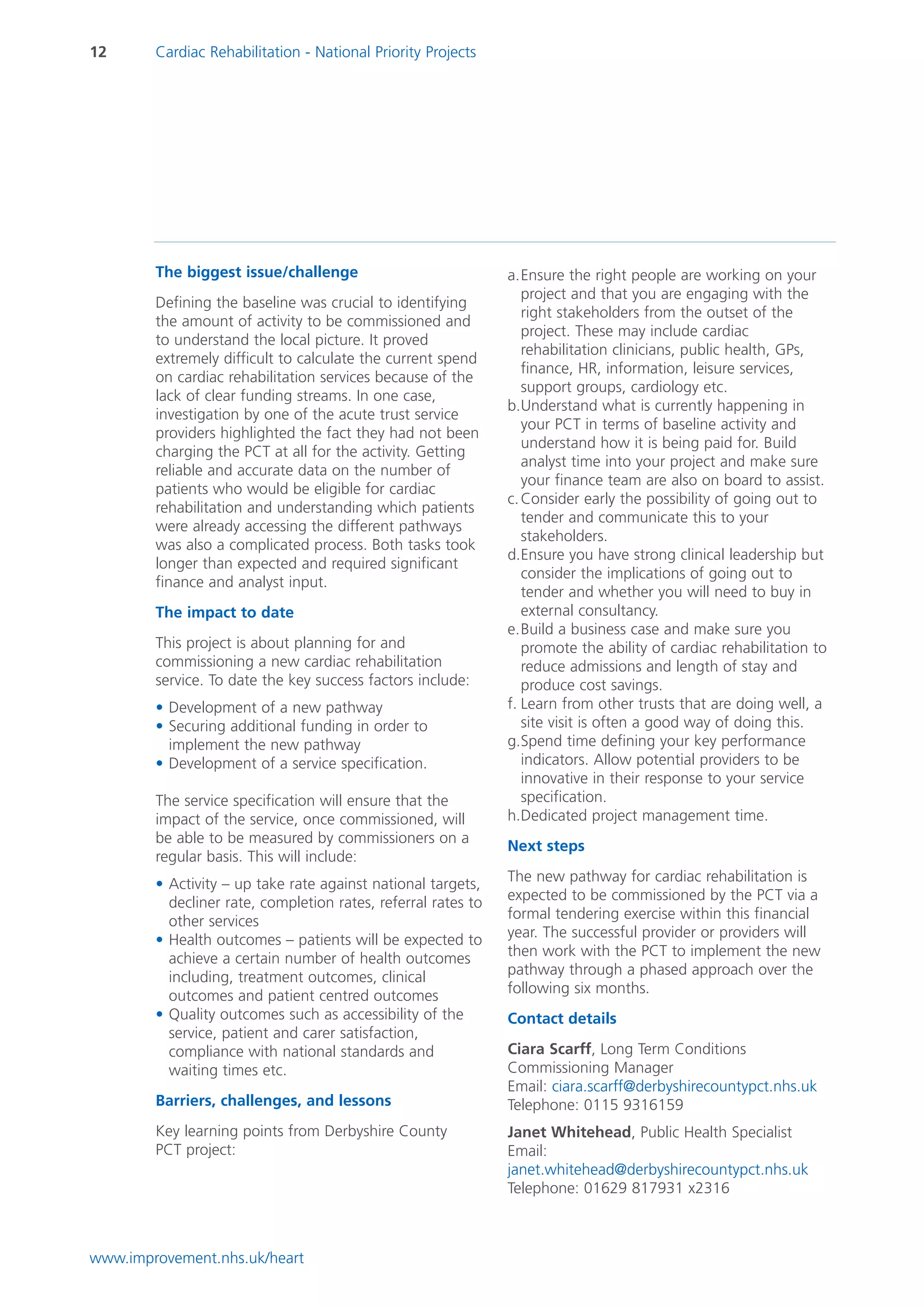
        Background                                              Current service provision for people
                                                                resident in Derbyshire
        The merger of six PCTs to form Derbyshire
        County Primary Care Trust (PCT) in 2006 led to a
        differing level of provision of cardiac
        rehabilitation across the health community. The
        large and diverse PCT has meant that patients
        have been receiving rehabilitation from a variety
        of service providers, many of which are located
        outside of the PCT boundary. In 2007 a strategy
        was developed to identify the main issues facing
        cardiac rehabilitation services in Derbyshire,
        these are summarised below:
        • Inequitable service. There is no consistent
          cardiac rehabilitation pathway across
          Derbyshire; therefore it is the geographical
          location of the patient that has determined
          the service received. The lack of a coordinated
          approach towards rehabilitation has meant
          that programmes have not been distributed             • The stars in blue are community services that
          equitably in response to need; analysis has             provide cardiac rehabilitation phase 3 only
          shown that in the area with the highest               • The green stars show the number of acute
          prevalence patients were expected to travel             provider services that our patients in
          some of the largest distances to access a               Derbyshire can access. Some of these also
          programme.                                              provide a phase 3 programme. However,
        • Poor uptake. In some areas of the county it             apart from the two main provider trusts in
          was identified that there was a poor uptake             the county many patients find the distance
          rate. This was most notable in the Bolsover             to travel back to the other provider trusts
                                                                  challenging and therefore for our patients
          Spearhead area, where it was calculated that
                                                                  there is little uptake of the phase 3
          as little as 16% of eligible patients were taking
                                                                  provision.
          up cardiac rehabilitation. Contributing factors
          are thought to be; distance to hospital based
          programmes, associated parking charges and
          lack of choice of programmes available.


www.improvement.nhs.uk/heart
Cardiac Rehabilitation - National Priority Projects         11


What we did                                             The steps taken to achieve the aim and planned
                                                        outcomes of the project are summarised below:
The aim of the project
The aim of the project is to commission an              a.Baseline measurement
effective, consistent and equitable cardiac                Work commenced to understand our current
rehabilitation service across Derbyshire in order          levels of activity and financial commitment.
to optimise uptake and maximise health                     This was challenging due to the number of
outcomes for the population.                               providers, complicated financial arrangements
                                                           and variation in data collection.
Planned outcomes for the project                        b.Development of a new cardiac
• Increased access: the service is moving                  rehabilitation pathway for Derbyshire
  towards a menu based model whereby                       A work group consisting of clinicians from the
  patients will be able to choose a service that           major providers, commissioners, public health
  meets their individual need. This will optimise          specialists and a patient representative came
  uptake and provide more patient centred care.            together to develop a new pathway for
  The planned increase in community based                  Derbyshire County PCT residents. A clinical
  provision will reduce the distances people               lead who works across both primary and
  currently are required to travel and as a result         secondary care was appointed and her role
  increase access. The referral criteria will include      was critical in leading the development. Some
  angina and heart failure patients, two groups            of the actions the group took to facilitate the
  who are not consistently offered cardiac                 development of the pathway included:
  rehabilitation at present.                               • Process mapping with clinicians and patients
• Reduction in health inequalities: service                • Brainstorming what an ideal pathway should
  provision will be planned in accordance with                look like against national evidence and best
  the greatest health need, taking into account               practice
  disease prevalence, deprivation and access. A            • A site trip to a cardiac rehabilitation service
  menu based service will ensure that people are              reporting high uptake and good outcomes
  not excluded from cardiac rehabilitation                 • A patient representative working with us
  because they choose not to attend a formal,                 throughout the project.
  group programme.                                      c. Identification of additional funding
• Increased links with primary care and long               A business case was developed by
  term maintenance options: community                      commissioners outlining the key issues and
  based services will support the development of           risks with the current service and identifying
  stronger links with the communities that                 potential benefits and savings to the PCT.
  patients live in. The new pathway will seek to        d.Development of a service specification
  ensure a seamless transfer of patients into              Additional funding was secured through the
  long term healthy lifestyle options as well as           PCTs Local Operating Plan for 2009-10 and
  making sure that all patients receive structured         work commenced to translate the pathway
  follow up by primary care.                               into a service specification and define key
• Increased effectiveness: the service will be             performance outcomes.
  commissioned with a focus on outcomes. This           e.Commencement of a procurement process
  will ensure delivery of the health benefits that         to drive improvement
  cardiac rehabilitation can provide.                      Due to the number of existing providers, the
• Increased financial effectiveness: the new               potential value of the contract and the level of
  pathway will seek to standardise the cost of             service redesign it was decided that a formal
  cardiac rehabilitation across Derbyshire so that         procurement process would be the best
  value for money can be achieved. It is                   method for securing the best health outcomes
  anticipated that by commissioning for both               and value for money service.
  activity and health outcomes service providers
  will be driven to deliver quality care and
  efficiencies.


                                                                          www.improvement.nhs.uk/heart
12      Cardiac Rehabilitation - National Priority Projects


        The biggest issue/challenge                            a.Ensure the right people are working on your
                                                                  project and that you are engaging with the
        Defining the baseline was crucial to identifying
                                                                  right stakeholders from the outset of the
        the amount of activity to be commissioned and
                                                                  project. These may include cardiac
        to understand the local picture. It proved
                                                                  rehabilitation clinicians, public health, GPs,
        extremely difficult to calculate the current spend
                                                                  finance, HR, information, leisure services,
        on cardiac rehabilitation services because of the
                                                                  support groups, cardiology etc.
        lack of clear funding streams. In one case,
                                                               b.Understand what is currently happening in
        investigation by one of the acute trust service
                                                                  your PCT in terms of baseline activity and
        providers highlighted the fact they had not been
                                                                  understand how it is being paid for. Build
        charging the PCT at all for the activity. Getting
                                                                  analyst time into your project and make sure
        reliable and accurate data on the number of
                                                                  your finance team are also on board to assist.
        patients who would be eligible for cardiac
                                                               c. Consider early the possibility of going out to
        rehabilitation and understanding which patients
                                                                  tender and communicate this to your
        were already accessing the different pathways
                                                                  stakeholders.
        was also a complicated process. Both tasks took
                                                               d.Ensure you have strong clinical leadership but
        longer than expected and required significant
                                                                  consider the implications of going out to
        finance and analyst input.
                                                                  tender and whether you will need to buy in
        The impact to date                                        external consultancy.
                                                               e.Build a business case and make sure you
        This project is about planning for and                    promote the ability of cardiac rehabilitation to
        commissioning a new cardiac rehabilitation                reduce admissions and length of stay and
        service. To date the key success factors include:         produce cost savings.
        • Development of a new pathway                         f. Learn from other trusts that are doing well, a
        • Securing additional funding in order to                 site visit is often a good way of doing this.
          implement the new pathway                            g.Spend time defining your key performance
        • Development of a service specification.                 indicators. Allow potential providers to be
                                                                  innovative in their response to your service
        The service specification will ensure that the            specification.
        impact of the service, once commissioned, will         h.Dedicated project management time.
        be able to be measured by commissioners on a
                                                               Next steps
        regular basis. This will include:
        • Activity – up take rate against national targets,    The new pathway for cardiac rehabilitation is
          decliner rate, completion rates, referral rates to   expected to be commissioned by the PCT via a
          other services                                       formal tendering exercise within this financial
        • Health outcomes – patients will be expected to       year. The successful provider or providers will
          achieve a certain number of health outcomes          then work with the PCT to implement the new
          including, treatment outcomes, clinical              pathway through a phased approach over the
          outcomes and patient centred outcomes                following six months.
        • Quality outcomes such as accessibility of the        Contact details
          service, patient and carer satisfaction,
          compliance with national standards and               Ciara Scarff, Long Term Conditions
          waiting times etc.                                   Commissioning Manager
                                                               Email: ciara.scarff@derbyshirecountypct.nhs.uk
        Barriers, challenges, and lessons                      Telephone: 0115 9316159
        Key learning points from Derbyshire County             Janet Whitehead, Public Health Specialist
        PCT project:                                           Email:
                                                               janet.whitehead@derbyshirecountypct.nhs.uk
                                                               Telephone: 01629 817931 x2316


www.improvement.nhs.uk/heart
NHS
                                                                            NHS Improvement


CANCER


DIAGNOSTICS


HEART


LUNG
              NHS Improvement

              With ten years practical service improvement experience in cancer,
              diagnostics and heart, NHS Improvement aims to achieve sustainable
STROKE        effective pathways and systems, share improvement resources and
              learning, increase impact and ensure value for money to improve the
              efficiency and quality of NHS services.
              Working with clinical networks and NHS organisations across England,
              NHS Improvement helps to transform, deliver and build sustainable
              improvements across the entire pathway of care in cancer, diagnostics,
              heart and stroke services.


              NHS Improvement
              3rd Floor | St John’s House | East Street | Leicester | LE1 6NB
              Telephone: 0116 222 5184 | Fax: 0116 222 5101

              www.improvement.nhs.uk


              Delivering tomorrow’s
              improvement agenda
              for the NHS


                                                                    ©NHS Improvement 2009 | All Rights Reserved - Publication Ref: IMP/heart09/02
Cardiac Rehabilitation - National Priority Projects        13


A sector wide approach to cardiac
rehabilitation in South West London
South West London Cardiac and Stroke Network


Synopsis
What was the problem, challenge or issue
you were trying to resolve?
The network’s cardiac rehabilitation task group
had agreed on a high level pathway for cardiac
rehab services (see appendix 1) and wanted
support from the network to implement this
across the sector. In addition, they sought
support in establishing robust commissioning
arrangements for their programmes.
What were you trying to achieve in the
time available?
As the scope of this project is broad (covering all
cardiac rehab programmes in the sector) we felt
it was realistic to focus on project planning and       was successful, with a lot of positive feedback
starting to pilot initiatives during the first year,    received and work is now progressing to agree a
with ongoing evaluation and roll-out of                 pan London set of outcomes for cardiac rehab.
successful initiatives running into the second          What would you do differently?
and third years of the project.                         The initial focus of the project was on the
What was your solution(s) or approach                   incoming phase one tariff as programmes in the
to this?                                                sector were keen to look at implications of this.
Our approach has been two-pronged. New                  In retrospect, the initial work should have
initiatives are being trialled using a PDSA cycle       focused on ensuring all teams had robust data
based approach (plan, pilot, review, and                to inform commissioners and to support shadow
roll-out). In addition, the network team agreed         modelling of tariff once agreed.
to support service redesign work that had               Also, tighter project planning in the early phases
already commenced, ensuring that the agreed             for elements which are reliant on others to
pathway was firmly embedded in this work.               deliver would have enabled us to be clearer
What worked/ didn’t work to date?                       about roles and responsibilities and manage the
So far, the approach we have taken to piloting          process more firmly.
and rolling out initiatives has been successful.
We have had been able to implement initiatives          Background
that have worked well in other areas, using the         The idea for this project arose from the findings
learning from pilot sites to support this. We have      of a retrospective audit of cardiac rehab
also trialled some initiatives in one or two sites      programmes in South West London, and an
(such as ward staff delivering phase one) and           assessment of these programmes against the
found these to be less successful and therefore         NSF and the BACR standards (appendix 4).
these have not been picked up post-pilot.               These indicated that there was a range of rehab
Involvement in the national priority project has        provision across the sector, with inequalities in
been very valuable to stay abreast of what’s            provision for different groups. In addition,
going on both at a national level and in other          cardiac rehab services across the country are
organisations from across the country.                  striving to provide a ‘menu’ of rehab options, to
                                                        promote onward referral to existing prevention
Work on the commissioning and tariff                    services, and to increase the range of settings in
workstream has been slow, partly due to the             which rehab is provided. The aim of this is to
lack of information available about the tariff.         provide services which are more flexible and can
However, a pan London event focusing on the             be tailored to fit patient needs more easily,
commissioning of cardiac rehab services in May          thereby increasing uptake.


                                                                          www.improvement.nhs.uk/heart
14      Cardiac Rehabilitation - National Priority Projects


        Research findings and local patient feedback          Metrics have been developed for the cardiac
        indicate that patients feel most vulnerable in        rehab workstreams of both South London
        the early post discharge phase and this is most       network workstreams, which will be reviewed
        evident in patients who spend short periods of        for sign off in September 2009. These have
        time in hospital (such as primary angioplasty         been aligned with the project measures to
        patients who have an average length of stay           enable ongoing measurement of impact and
        of three days). The network task group                monitoring to ensure sustainability (see
        therefore developed a high level pathway for          appendix 3 for the draft dashboard).
        implementation (see appendix 1). The key
        features of this pathway are the emphasis on          This project has taken a sector wide approach
        the early post discharge phase, the range of          which has been beneficial in working towards
        options available, the range of settings available,   reducing inequalities and supporting programme
        and the links with existing prevention services.      leads to progress service improvement work.
        The aims and anticipated benefits of the project      Pan London work has also commenced to
        are outlined in appendix 2.                           develop a joined up approach to the key issues
                                                              for rehab services, promote networking, to
        What we did                                           support joined up working between providers
                                                              in different sectors, and to ensure some
        The baseline data for this project was taken          standardisation in the commissioning of
        from the retrospective audit and baseline             CR services.
        assessment conducted in 2007. Workstreams
        were developed in conjunction with the task           The aims of this project were:
        group, and have evolved as the project has gone       • To improve access to cardiac rehab for all
        on to reflect changes locally (i.e. within existing     groups of cardiac patients
        services) and nationally (i.e. tariff development).   • To reduce inequalities throughout the sector
        Pilot sites for initiatives were selected based on    • To improve uptake by providing a sector-wide
        enthusiasm of programme leads, fit with                 service that is responsive to the needs of
        ongoing work (redesign work and other                   patients and clinicians
        initiatives currently underway) and an                • To ensure providers and commissioners are
        assessment of need (e.g. drug therapy review            working together to plan, develop and
        pilots will be selected based on audit results).        commission appropriate services for local
                                                                populations.
        Initiatives are being implemented through a
        pilot, evaluate and roll-out approach and             The key high level outcome of this project was
        through integration with service development          that all communities in the sector have high
        and service redesign work already underway.           quality, robustly commissioned CR services
        It is anticipated that the pathway will be            providing a range of activities in a range of
        embedded throughout the sector once                   settings that can be equitably accessed by all
        workstreams have been evaluated and the               groups of patients that can benefit. The aims
        learning from these shared amongst the                and anticipated benefits of the project are
        organisations in our sector. The project leads        outlined in appendix 2.
        plan to drive and embed ongoing service
        improvements through supporting robust
        commissioning of CR services in our sector.


www.improvement.nhs.uk/heart
Cardiac Rehabilitation - National Priority Projects        15


The biggest issue/challenge                            Work to reduce inequalities in access to CR for
                                                       different patient groups is progressing well in
The network task group has a quality assurance         many areas, including the development of a
role for rehab programmes in the sector and this       number of new programmes.
has led to unplanned involvement in
programmes undergoing changes which have               • A successful ICD CR pilot has enabled sector
destabilised other local programmes. However,            wide roll out to commence
this has clear links to the project as ensures         • A new community IHD CR programme has
equity of provision across the sector.                   commenced targeted specifically at hard to
                                                         reach populations
The quality assurance role has been essential to       • A new community programme incorporating
the delivery of the project as services in               heart failure rehab has been developed with
development and those undergoing significant             network support (recruitment almost
change are taken to the network task group to            complete, programme to commence autumn
enable them the group to have oversight of CR            2009)
services in our sector, allowing them to assess        • A local PCT has agreement to develop a stable
equity of provision. This role was signed off by         angina community CR programme, supported
chief executives in the sector and enables our           by discovery interviews conducted by network
task group (professionally and organisationally          leads.
representative) to input to local decision making
from a clinical perspective.                           In addition, existing programmes have begun to
                                                       broaden their inclusion criteria, enabling more
Involvement of the project leads in quality            patients who can benefits from cardiac rehab to
assurance activities has been particularly time        access services.
consuming and has adversely affected time
scales for the project as several initiatives have     The scope of this project means that lead in time
had to be placed on hold while issues are              for delivery is much longer than for projects with
resolved. This has, however, been essential to         a more discrete focus, however this means that
achieving the project objectives and although          the impact and benefits of this work once
some of this work has been unplanned, and              realised will be much broader. It is anticipated
something we were unable to anticipate, it is          that this project will impact on patient outcomes
has been important in helping us to achieve the        (such as quality of life, knowledge of their
end project goals.                                     condition, risk factor modification, etc as well as
                                                       mortality and morbidity), process of care
The impact to date                                     outcomes, resource utilisation outcomes (such as
                                                       onward referral to services such as smoking
The scope of this project means that many              cessation) and cost outcomes. It is envisaged
initiatives are still at the planning or early         that the impact of the project of some of these
implementation stage. Preparatory work has             outcome measures may not be noticeable in the
included:                                              short term but these will be reviewed one year
• Business case development                            after project work has finished.
• Project planning for drug therapy review             The impact of this project is being measured
  (including South London audit) and rehab led         through the South London cardiac rehab
  follow up (pilots to commence later this year)       workstreams dashboard. This measures the
• Skills competency assessment tool                    impact at a high level as the scope of the project
  development using Skills for Health CHD              is broad (sector wide), with the recommendation
  competencies (used with two teams to identify        that local / workstream level data be measured
  training needs in relation to the new pathway        and monitored locally through NACR. For
  and has been shared with national priority           example, the dashboard monitors which groups
  project colleagues).                                 of patients are able to access cardiac rehab in


                                                                         www.improvement.nhs.uk/heart
16      Cardiac Rehabilitation - National Priority Projects


        each borough, with a recommendation that              Key challenges/ barriers to
        programmes use NACR to monitor activity data          implementation/ risks to delivery
        for different patient groups.                         and how you overcame them
                                                              A major challenge for this project has been the
        Barriers, challenges, and lessons                     lack of robust data available to us. Better data
                                                              would have been immensely helpful to support
        What worked and what didn’t work; what                commissioning discussions. A lack of
        you would do differently/ the same;                   understanding by individual programmes
        Pan London working has been very useful,              regarding their funding streams has been a
        enabling us to minimise duplication, develop          particular hurdle as this has had to be clarified
        contacts and network effectively, and provide         whilst trying to avoid leaving unfunded
        the London networks with an approach to               programmes in a vulnerable position. The pan
        tackling inequalities in cardiac rehab provision      London work on developing outcomes for
        more easily. A pan London cardiac rehab               cardiac rehab has also been hindered due to the
        conference was successful, with positive              lack of robust data and the approach altered to
        feedback from delegates who felt that this            allow for a ‘shadow period’ to help identify
        improved their knowledge of the commissioning         realistic parameters for outcome measures.
        process. Delegates also felt that developing a
        pan London set of outcomes for cardiac                Key learning/sharing points
        rehabilitation was an important piece of work
        and that networks were in a position to support       Leadership and planning
        this.                                                 Our clinical lead has been very supportive of this
                                                              project and has been involved in project decision
        An initiative to pilot role changes for phases one    making and championing the approach. We
        and two was not successful. The aim of this was       have a cardiology lead on our group who has
        to have ward nurses provide phase one input,          helped us with applying our quality assurance
        thereby freeing up the time of the rehab team         role to programme changes in the sector.
        to focus on a delivering a more comprehensive
        phase two service. This was unsuccessful due to       Joined up working with other network
        the lack of time for the ward nurses to provide a     workstreams has been very productive. For
        full phase one service. In addition, it became        example, our patient diaries project has run
        evident that this did not fit well with incoming      across the revascularisation and rehab
        tariff once the tariff costs were confirmed. In       workstreams, with the diaries being completed
        retrospect, it would have been better to assess       from pre-assessment, through the inpatient stay
        more closely staff capacity on the wards, to wait     and throughout the rehab phase, giving us a full
        until tariff information was clearer, and to run a    picture of the pathway and not just the rehab
        skills competency assessment with key staff           element.
        before commencing this initiative.
                                                              Clinical engagement
        This project has taken a broad approach to            Clinical engagement has been essential in
        patient involvement and this has been very            driving this project. Involvement of local cardiac
        helpful in informing the project direction to         rehab clinicians in the development of the
        date. A decision was made not to have a patient       pathway prior to the project commenced
        representative on the task group but to have a        definitely helped to achieve early buy-in. This has
        liaison member from network patient group and         also ensured that programmes in the sector had
        to have a range of mechanisms for patient             early consensus on the project goal/end point.
        involvement tailored as appropriate. The aim of       In addition, the group has an enthusiastic and
        this was to gain a broader picture of the patient     supportive clinical, and is organisationally and
        and carer perspective of rehab services and           professionally representative, both factors which
        pathways, and to avoid tokenistic                     have been essential to decision making and
        representation. Appendix 4 outlines this              implementation.
        approach.


www.improvement.nhs.uk/heart
Cardiac Rehabilitation - National Priority Projects      17


Information transfer                                  Work to address health inequalities
Our task group meets every six-eight weeks            We have found that having a good baseline of
and this has been the forum for project issues        existing service provision and robust data is
to be discussed. We have found interim                crucial to help identify inequalities and to
communication (email / phone) as well as being        monitoring progress of work aimed at
available for ad hoc discussion has helped            reducing these.
resolve issues quickly. Within the network team
we have used our NPP monthly reports and the          Next steps
NHS Improvement System to communicate
project progress.                                     We will continue with the approach outlined
                                                      previously, ensuring that this is supported by
For initiatives that have multiple leads and          robust evaluation processes and that the
multiple organisations involved we have found         learning from each initiative is shared
it really useful to have a set of communication       appropriately. We plan to monitor progress at a
tools that clearly articulate the background,         sector wide level through the South London
approach and plan for the work. For example,          dashboard, which will be signed off in autumn
the drug therapy reviews pilot is being set up by     2009, along with a set of governance
network leads from South East and South West          requirements. A South London leads group will
London along with the pharmacy lead that              be established to support this and to take a
works across these networks. Early in the project     strategic overview and to help align the
we produced a PID and a briefing paper that           workstreams.
have been used for meetings with network task
groups, potential pilot sites, and industry links,    We will continue to review progress in an
ensuring consistency of communication and             ongoing manner with pilot and roll out sites to
minimising duplication of effort.                     help embed and sustain this work. We anticipate
                                                      the task group as having a key role in sustaining
Provision in community settings                       changes and rolling out good practice.
There are a number of community cardiac rehab
services in our sector now, with several more in      Contact details
development. An important learning point for us
has been around ensuring that these are joined        Alice Jenner,
up with other programmes (e.g. hospital based         Project Manager,
programme and existing prevention schemes)            South West London Cardiac and Stroke Network
right from the beginning. Wherever possible           Email: alice.jenner@stgeorges.nhs.uk
teams should be in a position to cross-cover to       Tel: 020 8725 0956
maintain flexibility and consistency in provision.    Michelle Bull,
For small teams these links can also help prevent     Senior Project Manager,
professionals feeling isolated by promoting           South West London Cardiac and Stroke Network
shared learning and peer support. In boroughs         Email: michelle.bull@stgeorges.nhs.uk
with multiple CR providers it is also very            Tel: 020 8725 1192
important to ensure there is clarity and good
communication about patient choice and referral
routes. The project team are currently producing
a strategic vision paper to inform commissioners
                                                        NB: Appendices 1-4 are available from
at hub level regarding cardiac rehab provision.
                                                        the NHS Improvement website at:
                                                        www.improvement.nhs.uk/heart/
                                                        rehabprojectsummaries


                                                                        www.improvement.nhs.uk/heart
18      Cardiac Rehabilitation - National Priority Projects


        Rehabilitation triage assessment
        North Lincolnshire and Goole Hospitals NHS Trust


        Synopsis                                              into two sections one is looking at current
                                                              demand and one looking at attendance against
        What was the problem, challenge or issue              attendance.
        you were trying to resolve?
        We noted that patients were not getting timely        Background
        access to their cardiac rehabilitation. This
        appears to have resulted from the fact that we        The priority project initiative is to triage
        as nurses have stopped attending a secondary          participants into appropriate cardiac
        prevention clinic run by the medical team; and        rehabilitation, using a structured pre-assessment
        also as patients are transferred to other hospitals   and follow up evaluation. Prior to the project
        for intervention they are not always referred         patients were put on a waiting list for exercise.
        back in a timely manner.                              The waiting list dates back to 2001, we have
                                                              made several attempts to try to address waiting
        What were you trying to achieve in                    times, but have been unsuccessful. However,
        the time available?                                   during this time the service has expanded to
        We were trying to ensure that patients receive        include angioplasty and heart failure patients,
        timely and appropriate access through triage to       with a year on year increase in service users. Due
        phase three cardiac rehabilitation. This will         to the time on the waiting list we find that some
        reduce inequalities in accessing the service and      patients have declined to undertake exercise by
        so improve patient’s quality of life. To be able to   the time we are able to bring them into the
        give patients a date for pre-assessment in            programme, either because they have started
        advanced without having to be added to a              exercising on their own, or they are back at
        waiting list.                                         work and do not feel that they would benefit
        What was your solution(s) or approach                 from an exercise programme. We have increased
        to this?                                              our capacity for exercise by now providing
        • We intend to use the national audit for             community based exercise programmes and a
          cardiac rehabilitation database as a backup         home based programme from a British Heart
          for those patient’s who have had a procedure        Foundation/Big Lottery grant. We initially
          in another hospital                                 thought that this would help us to address these
        • We have changed our paperwork                       issues in people having to wait to start the
        • We have developed a flow chart to ensure            exercise programme; however, we have found
          that we are all working to the same guidelines      that we now have a longer wait to access the
          and standards so that all patients have equal       programmes. Our team felt the national priority
          access at the appropriate time.                     project initiative would give us the required
                                                              framework to look at our service and help us to
        What worked/didn’t work to date?                      highlight the relevant issues in order for us to
        We attempted in spring 2009 to undertake a            make the appropriate changes.
        piece of demand and capacity work which was
        supported by our cardiac network. However, due        What we did
        to staffing issues within the department we
        were unable to complete this piece of work            The aims and objectives of our project are to
        successfully. Since June 2009 these issues have       triage participants into appropriate cardiac
        been resolved. We have not attempted to               rehabilitation, using a structured pre-assessment
        recreate the original piece of demand and             and follow up evaluation. This will benefit the
        capacity work as our service configuration has        patients by enabling them to have timely and
        changed.                                              appropriate access through triage to physical
                                                              activity; improved quality of life for individuals, it
        What would you do differently?                        will provide an ideal opportunity to signpost
        Capacity and demand work would have been              individuals to other aspects of the cardiac
        managed differently, we feel that this was too        rehabilitation service, and provide an opportunity
        large a piece of work and should have been split      to re-enforce key health care messages.
        into two smaller pieces. We have now broken it


www.improvement.nhs.uk/heart
Cardiac Rehabilitation - National Priority Projects       19


The expected outcome measures are:                     Demand and capacity
• An improved quality of life measured via             We have now revised the demand and capacity
  hospital anxiety and depression (HAD) score          work; as this was not as successful as we had
• A reduction in service utilisation by this group     originally hoped, due to staffing issues, and the
  of individuals, (reduction in readmission, out       need to change our service configuration. We
  patient follow up and consultations)                 have changed our registers for the programmes,
• Flexibility of waiting time to attend the cardiac    so that we are continually monitoring
  rehabilitation programme to meet the                 demand/capacity/uptake and unused capacity
  individuals needs                                    on a weekly basis.
• Improved physical function by an appropriate
  tool                                                 Allocation of pre-assessment appointment
• A clear management plan for each individual          We have now allocated designated slots for pre-
  which will be informed by discussion with the        assessments, as we felt that with offering seven
  patient and their carers.                            different exercise programmes, the management
                                                       of allocating these patients was left to one
We have added some health outcomes into our            person which often became overwhelming with
guidelines for referral and entry into the cardiac     other work commitments. At pre-assessment we
rehabilitation programme, for those who                are able to discuss with the patient and their
complete 70% of the phase three cardiac                relative what their needs are, and make an
rehabilitation exercise programme there should         appropriate plan to meet their needs. We do this
be evidence of benefit in two out of four of:          through an assessment of their lifestyle; record
• Improvement in functional capacity test              their blood pressure and pulse; undertake a
  by 10%                                               functional capacity test; all patients complete a
• Improvement in HAD score by four points              NACR questionnaire, and a risk assessment is
• A measure of continued exercise either by            carried out using the BACR risk assessment tool.
  referral to phase four sessions or individual        Once we have all this information we discuss
  programmes                                           with the patient and relative where is the most
• Attainment of more than one risk factor              appropriate place for them to exercise.
  treatment goal (eg stopping smoking,
  reducing cholesterol, reduction in blood             Individual programme manager
  pressure).                                           We now have split up the management of the
                                                       exercise programmes, and pre-assessment
Process mapping                                        allocation, so that each member of the team has
Firstly we process mapped our service with the         a specific programme that they manage. The
help from the cardiac network. The process map         team then meets on a weekly basis and each
highlighted the fact that we needed to                 program leader updates the rest of the team on
undertake some demand and capacity work, as            their specific programme. We also discuss each
we were not able to highlight where the barriers       patient who has been highlighted as fit and
were regarding the patients having timely access       interested to undertake the exercise component
to their cardiac rehabilitation. It also highlighted   of cardiac rehabilitation. If we notice at these
the issues we have in relation to those of our         meetings that there is a wait starting to develop
patients who have a complex journey, which             at one particular programme, we will discuss if
prevents us from identifying the point at which        there is any capacity elsewhere and offer the
they are suitable to undertake the exercise            patients an alternative site. Each programme
programme. This is often due to patients being         leader will then make an appointment for the
transferred to our tertiary centre for further         patients that are relevant to their programme in
investigations and procedures, and they are not        order for the patient to be assessed fully.
always referred back to us. This has lead to
further work which is network wide to focus
around referrals back to each hospital, the
cardiac network are assisting and supporting us
in this work (see appendix 5).


                                                                         www.improvement.nhs.uk/heart
20      Cardiac Rehabilitation - National Priority Projects


        The biggest issue/challenge
        Challenges remain regarding identification of
        patients who are ready to exercise but who
        experience a complex patient journey. We feel
        that one reason for this is because our main
        tertiary centre has a high patient workload but a
        limited cardiac rehabilitation service. The referral
        of our patients back into our service is not seen
        as a priority by their nursing teams.
        One issue identified through the project was our
        inability to quantify demand against capacity.
        As already identified we were unable to
        successfully complete this piece of work. We
        have not attempted to recreate the original
        piece of demand and capacity work but have
        changed the focus to monitor attendance
        against capacity and unutilised capacity.
        Work undertaken during the project has
        identified the programmes running with unused
        capacity. We were able to identify that this was
        due to our management of the existing patient          The waiting list for the seated exercise
        pathway. The impact of our action/inaction             programme will remain as this group of patient’s
        created a waiting list and caused us to ‘fire fight’   ability to exercise can be affected by non cardiac
        to reduce waiting times rather than having a           reasons causing the group to change at short
        clear long term strategy to promptly identify          notice. However to optimise attendance we have
        patients who are ready to attend an exercise           developed a 10 week rota.
        programme.                                             We are now able to consider the introduction of
        Prior to the project one person managed all the        a programme specifically for heart failure
        exercise programmes. This created an issue             patients. By managing our demand and capacity
        when workload increased. The identification of         better will enable us to utilise our resources
        patients suitable for exercise became                  differently to enable us to offer our Heart Failure
        inconsistent, pre-assessment dates were not            patients a specific programme in the future
        requested in a timely manner and if patients           rather than including them in the gym with non
        cancelled their appointment we were not                heart failure patients.
        consistently reallocating the appointment to           Working in partnership with local service
        another individual.                                    providers has enabled us to fast track patients
                                                               through Phase three exercise onto phase four
        The impact to date                                     programmes when appropriate resulting in
        We no longer have a waiting list for our               increased capacity in the Phase three
        Scunthorpe and community programmes. All               programmes.
        patients are allocated a pre-assessment date           We are currently developing flow charts by
        within one week of being identified as being           which all team members can identify which
        suitable for exercise.                                 programme is appropriate for each patient. The
        The issues which created a waiting list at the         flow chart will identify a pathway for complex
        Goole programme are almost resolved. Our               patients to enable us to identify when they are
        target is that by 31 October 2009 there will be        ready to attend an exercise programme.
        no waiting list at the Goole programme.


www.improvement.nhs.uk/heart
Cardiac Rehabilitation - National Priority Projects      21


Each programme has an identified programme             partnership with our local cardiac network and
coordinator who manages and monitors                   partner agencies to work out a long term
demand, capacity, waiting times and attendance         strategy to address this challenge.
on a weekly basis.
                                                       Key learning /sharing points
At our weekly team meeting each programme              • Understand your demand and capacity
coordinator updates the rest of the team on            • Ensure service reconfiguration does not create
their programme. If a programme is not                   an alternative bottleneck
running at available capacity we discuss the           • Build sustainability into your service
related issues and agree a strategy to prevent         • Multiagency partnerships can increase
capacity wastage. (see appendix 6)                       flexibility within your service.

Barriers, challenges and Lessons                       Next steps
What worked/what didn’t work                           • Our ability to assess health outcomes and
The process mapping exercise plus demand and             develop a strategy for follow up evaluation has
capacity work has given us a better                      been hampered by staffing issues within our
understanding of patient flow through our                department and the need to reconfigure our
service. The team can now see how our                    demand and capacity work
action/inaction impact on waiting times for            • Our team together with our local cardiac
patients ready to access cardiac rehabilitation.         network is developing a prompt and reliable
                                                         referral pathway for post intervention patients
We have revised our demand and capacity work             discharged from our tertiary centre
to reflect current practice. Staffing issues within    • We intend to commence collecting health
the department, which are currently in the               outcome measure data
process of being resolved, resulted in                 • The second year of the project will concentrate
reconfiguration and suspension of some                   on these elements of our project.
programmes in spring 2009. Although the team
recognize this was not ideal we felt it was better     Contact details
to offer the majority of patients some rather
than no rehabilitation.                                Louise Bevington
                                                       Acting Lead Cardiac Specialist Nurse
Challenges/barriers                                    Cardiac Rehabilitation
A challenge for the future success of our project
is to ensure that when making changes to our           Email: Louise.Bevington@nlg.nhs.uk
service to meet the project aims and objectives        Tel: 01724 290093
that we do not create an alternative bottle neck
in the patient journey.
Our cardiac rehabilitation team has been stable
                                                         NB: Appendices 5-6 are available from
for several years however there have been recent
                                                         the NHS Improvement website at:
unavoidable changes within the team. One
                                                         www.improvement.nhs.uk/heart/
consequence has been the need to re-evaluate             rehabprojectsummaries
the sustainability of our service. The team feel
that these issues and changes prevented us
making the progress in the project that we
envisaged in the first year of the project.
A long term barrier to the success of the project
is the continued delay in the referral pathway
from our local tertiary centre. We are working in


                                                                         www.improvement.nhs.uk/heart
22      Cardiac Rehabilitation - National Priority Projects


        Planning cardiac rehabilitation commissioning
        Dorset Cardiac and Stroke Network


        Synopsis                                               Background
        What was the problem, challenge or issue               Pan-Dorset serves a population of 758,000 and
        you were trying to resolve?                            this project involves three Acute Trusts: Royal
        To fully understand the current cardiac                Bournemouth NHS Foundation Trust, Poole
        rehabilitation service across Dorset so that           Hospital NHS Foundation Trust and Dorset
        all programmes are supported to reach the              County NHS Foundation Trust. The three cardiac
        minimum BACR Standards and Core                        rehabilitation programmes vary in length,
        Components (2007).                                     content and the place of delivery. All
                                                               programmes access cardiac rehabilitation phase
        What are you trying to achieve in the time             one and two in secondary care.
        available?
        The project will take into account the NICE            Dorset is a rural location and offers phase three
        Commissioning Guide for Cardiac Rehabilitation         programmes in four community sites.
        (2008) in terms of determining local service           Bournemouth offers phase three in secondary
        levels, developing a service specification and         care only and Poole offers phase three in both
        building on mechanisms for quality assurance.          secondary care and in the community.
        What was your solution(s) or approach
        to this                                                Cardiac rehabilitation across Dorset is offered
        The cardiac rehabilitation service across Dorset       routinely to only three of the many diagnostic
        will jointly agree a minimum service specification     groups who might benefit. Such as those who
        which will form a basis by which all future            undergo cardiac surgery, have a heart attack,
        services will be commissioned to ensure equity         and those who have percutaneous coronary
        for all patients who require cardiac rehabilitation    Intervention. Patients with heart failure, angina,
        across Dorset                                          valve disease and have cardiac implantable
                                                               devices are not routinely offered cardiac
        What worked/did not work to date?                      rehabilitation.
        The project has been well supported by
        commissioners and clinician from primary and           What we did
        secondary care. The cardiac lead nurses have
        also shown commitment and enthusiasm for               We set up a Dorset wide cardiac rehabilitation
        driving the project forward and implementing           sub-group to promote joint working and steer
        changes that have improved cardiac                     the project. The sub-group members involved in
        rehabilitation services. The national peer support     the project include clinicians, commissioners,
        meetings have been well attended by the                local authority, cardiac network team and
        nurses and by our patient representative.              patient and carer representatives.

        What would you do differently?                         The Dorset Cardiac Network embraces the
        Have a clear project plan from the start, with         principle that Patient and Public Involvement
        timeframes and specific roles and                      (PPI) should be central to service provision and
        responsibilities formulised. The initial bid and the   development. The Dorset Cardiac Network has
        first six months of the project was managed by         produced a paper detailing the PPI plans for this
        two different project managers. Learning service       project (see appendix 7). In brief it includes how
        improvement methodologies has been valuable            representatives will be empowered and
        to drive the project.                                  supported in their role as members of the
                                                               project team and also describes how various
                                                               methodologies will be employed throughout the
                                                               duration of the project to ensure that the views
                                                               of local patients and carers inform the work of
                                                               the project team on an ongoing basis.


www.improvement.nhs.uk/heart
Cardiac Rehabilitation - National Priority Projects       23


The key aims of the project – using a phased          4. Links should be improved with local
approach is to:                                          community leisure services to support the
• To improve access for all groups of cardiac            provision of suitable phase four exercise
  patients                                               programmes for cardiac patients in the
• To increase uptake of cardiac rehabilitation           community.
• To minimise inequalities across Dorset
• To meet the South West ambitions target             The second step was to undertake an uptake
  which says:                                         and access audit to identify the number of
                                                      people receiving cardiac rehabilitation and the
“By March 2011 at least 85% of people                 reasons why people did not take up cardiac
with a heart attack, bypass surgery or                rehabilitation or complete the course. The two
                                                      baseline assessments will form the basis of
coronary angioplasty will receive cardiac             ongoing work.
rehabilitation.”
In order to fully understand the local cardiac        Each phase three cardiac rehabilitation
rehabilitation services between September 2008        programme across Dorset was asked to collect
– April 2009 an extensive audit and analysis of       data on patients who had a cardiac event during
the cardiac rehabilitation programmes across          the sample period of 1 January - 31 March
Dorset was benchmarked against the British            2009. The analysis started in August when all
Association for Cardiac Rehabilitation (BACR)         patients in the sample group should have
Standards and Core Components (2007).                 completed the programme. Full results of the
                                                      audit will be completed by the 30 September
The key findings from the audit received              and published on the NHS Improvement
comments from members of the cardiac                  website. Preliminary results are available
rehabilitation sub-group and recommendations          (see appendix 7).
have been planned to address inequalities
and aid service improvement.                          The biggest issue/challenge
                                                      • Defining the South West ambition target was
Recommendations from the BACR Audit                     a challenge and caused much debate – the
1. Patients should be offered choice of home,           team were unsure if it meant 85% of patients
   community or hospital cardiac rehabilitation         offered cardiac rehabilitation or 85% should
   programmes. The delivery of cardiac                  receive phase three cardiac rehabilitation.
   rehabilitation should be predominately based       • There is no direct guidance that exists on what
   in the community, particularly for those             proportion of a programme needs to be
   patients with mild to moderate risk. For             completed to ensure efficacy. Comments from
   patients with more complex needs, referral           Patrick Doherty National Clinical Lead by email
   to hospital based rehabilitation programmes          are helpful to aid discussion:
   should be available. In both cases
   programmes should be arranged to maximise
   patient choice with regard to day, time and
                                                      “If you are fortunate to run a
   venue.                                             programme twice weekly for eight
2. On completing the cardiac rehabilitation           weeks or more then you could use 80%
   programme all patients should be provided          because it will keep you within the 12
   with information regarding existing voluntary      sessions threshold (two sessions per
   groups, networks, psychological support so
   that patients can access for ongoing support.
                                                      week for six weeks) which, via the NSF
3. On completion of the cardiac rehabilitation        for CHD and Joliffe et al's review, is
   programme all patients should be provided          considered the minimum a number of
   with a discharge management summary                sessions related to efficacy.
   explaining diagnosis, recent blood pressure,
   cholesterol result, list of medications and
   recommended medication optimisation plan
   for the GP to follow.
                                                                        www.improvement.nhs.uk/heart
24      Cardiac Rehabilitation - National Priority Projects


        The difficulty comes when you have set
        goals that require more time to achieve
        such as smoking cessation and weight
        reduction. Equally if you have patients
        with high levels depression/anxiety or
        those with difficulties taking on board
        secondary risk management behaviours
        it is important to ensure that they
        attend all sessions.
        It is easier to make up for a drop in
        exercise sessions in the community but
        less so for the education sessions.                    • Patient referral and pre-assessment letters have
        Programmes should try and ensure that                    been improved in response to patient
        all educational components are delivered                 information from patient discovery interviews
        prior to discharge”.                                   • A pilot using the Heart Manual as a basis for
                                                                 phase three rehabilitation has been funded by
        Professor Patrick Doherty                                Dorset Cardiac and Stroke Network and is due
        National Clinical Lead, NHS Improvement - Heart
                                                                 to start in November 2009.
                                                               • All three programmes are inputting data to the
        • Understanding the cardiac rehabilitation tariff        National Audit of Cardiac Rehabilitation and
          has been difficult and remains a focus at the          communication between the three sites has
          sub-group meetings.                                    improved.
        • Nurses reported that although the network            • A resource folder for services that patients can
          has funded staff ‘back fill’ for the project; the      access has been updated at each site and
          nurses did not have the extra staff to fill whilst     information of patient services across Dorset
          attending the national peer support meeting            are shared.
          and local meetings. The nurses also found            • Psychological services have been mapped
          allocating time for project work difficult at          across Dorset and referral pathways to these
          times, specifically whilst undertaking the             services have been identified.
          audits.
        • The nurses reported that the BACR and uptake         Next steps
          audit was very time consuming and collecting
          the data was not easy as the information             • Complete uptake and access audit and share
          needed was not accessible from the National            results with the NHS Heart Improvement
          Audit of Cardiac Rehabilitation (NACR) data            Team. Key findings from the audit will form
          base.                                                  recommendations that will aid service
                                                                 improvement and increase uptake and access
        The impact to date                                       to cardiac rehabilitation.
        The project is still at its early stage of             • Undertake Geo mapping exercise to identify
        development and many of the recommendations              if any locations across Dorset show variation
        are at the planning stage or early                       in uptake.
        implementation stage.

        • All patients discharged from a programme will
          receive a management plan and this will be
          copied to the GP.


www.improvement.nhs.uk/heart
Cardiac Rehabilitation - National Priority Projects   25


• Introduce the Heart Manual as an additional
  method of delivery to support those patients
  who could not attend a traditional
  rehabilitation programme. It was agreed that
  this would be a pilot in the rural parts of
  Dorset. The patient experience and views
  will be recorded using discovery interviews.
• Invite Leisure Services to join sub-group and
  be involved in the project to forge
  partnership working to expand the provision
  of phase four in the community.
• Invite primary care colleagues to be involved
  in the project to improve seamless discharge
  from cardiac rehabilitation to the community.
• Provide training to primary care colleagues on
  coronary heart disease lifestyle management
  to increase knowledge and awareness in
  order to empower patients to self manage.

Contact details
Tracy Stoodley,
Project Lead, Service Improvement Manager,
Dorset Cardiac and Stroke Network.
Email: tracy.stoodley@bp-pct.nhs.uk


 NB: Appendices 7-8 are available from
 the NHS Improvement website at:
 www.improvement.nhs.uk/heart/
 rehabprojectsummaries


                                                                       www.improvement.nhs.uk/heart
26      Cardiac Rehabilitation - National Priority Projects


        Modernising a cardiac rehabilitation service
        North of Tyne, North of England Cardiovascular Network


        Synopsis                                              of the project. However, as the project
                                                              progressed, it was recognised that sustained and
        What was the problem, challenge or issue              frequent meaningful engagement with both
        you were trying to resolve?                           patients and professionals led to the project
        The North of Tyne area is geographically diverse,     report being fully representative from a wide
        with densely populated inner city and remote          range of stakeholders.
        rural communities, and includes spearhead areas
        of deprivation. The project aims to inform NHS        What would you do differently?
        North of Tyne, to assist commissioning of a           As previously mentioned, communication would
        patient centred, cost effective, equitable CR         be more explicit at the outset as there was an
        service for patients having PCI, CABG and MI,         element of uncertainty and concern about what
        acknowledging there are other groups who              the review would entail – fears about tendering
        would benefit from rehab (HF, angina etc.). The       for total service change and potential job losses
        objective is to resolve the differences in the        were real issues for provider staff. It should have
        cardiac rehabilitation services already established   been clearer at the start of the project that it
        in the three PCO areas and to move towards            was a scoping exercise to produce a report to
        more individualised and accessible services.          inform commissioning decisions rather than an
                                                              end in itself.
        What were you trying to achieve in the
        time available?                                       Background
        The current cardiac rehabilitation service was to
        be reviewed with a view to informing                  The project was a joint collaboration between
        commissioning decisions and addressing any            the North of England Cardiovascular Network
        gaps and inequities in services, whilst actively      and NHS North of Tyne. NHS North of Tyne is a
        engaging with stakeholders and patients in the        joint management structure encompassing
        process. Alongside staff and patient involvement,     three PCOs – North Tyneside, Newcastle and
        the project had to correspond and adhere to           Northumberland Care Trust. It also covers two
        national policy drivers for the core standards of a   acute trusts – Northumbria Healthcare NHS
        cardiac rehabilitation service. The next stage of     Foundation Trust and Newcastle upon Tyne
        the project involves benchmarking providers           Hospitals NHS Foundation Trust. NHS North of
        against the new service specification. Good           Tyne commissions cardiac rehabilitation services
        practice would be highlighted and shared and          for a large and diverse population of around
        any duplication in the patient pathways between       775,000 people and covers a geographically
        the different stages of care were to be               diverse area including inner city and remote rural
        addressed.                                            areas. NHS North of Tyne as a commissioning
                                                              organisation has experienced the commissioner-
        What was your solution(s) or approach                 provider split at an early stage and as such the
        to this?                                              commissioning functions of the PCOs are well
        Both patients and professional stakeholders           established.
        representing community and acute settings were
        consulted with on a regular basis. Several            The scope of the project was to map current
        stakeholder events were held to discuss the           cardiac rehabilitation services and to include
        proposed service specification and also to            patients who had MI, CABG and PCI ensuring
        comment on the ongoing project report.                they had timely and equitable access to
        Patient focus groups within cardiac rehabilitation    rehabilitation services in line with national
        services were also held along with GP interviews.     policies and guidelines. This service was to be
                                                              tailored to the individual and also needed to
        What worked/ didn’t work to date?                     respond to the requirements of a very diverse
        Communication with service providers in the           population. The project spanned the entire
        initial stages of the review could have been          patient pathway and focussed on the
        improved as it was felt that commissioners did        community element of this, i.e. discharge from
        not keep professional stakeholders fully              hospital. Each cardiac rehabilitation team was
        informed of the scope and proposed outcomes           structured differently with some elements of the

www.improvement.nhs.uk/heart
Cardiac Rehabilitation - National Priority Projects        27


service duplicated at different stages of the         These recommendations will ensure that:
patient pathway and as such, a revised and            • The current pathway for cardiac rehabilitation
overarching service specification was written           will be enhanced and changed where appropriate
alongside a project report, with both documents       • Cardiac rehabilitation is tailored to the needs
going out to consultation with stakeholders and         of the individual patient and encourages
which would inform commissioning decisions for          patients to identify their own goals
2009/10.                                              • Access to the service is equitable for the
                                                        diverse population across North of Tyne
What we did                                           • The needs of patients with co-morbidities are
                                                        addressed in the best possible way
In spring 2008, a scoping workshop was                • Existing local training and education provision
undertaken with the three cardiac rehabilitation        is built upon with competency based
teams from across the North of Tyne PCO areas.          assessment, ensuring a skilled, knowledgeable
The workshop identified that:                           and sustainable workforce throughout the
• The models of service vary across the                 cardiac rehabilitation pathway
  three areas                                         • Robust systems are in place to measure
• The team that provide the service are                 sustainability and evaluate the service provision.
  structured and resourced differently                To achieve this we:
• There is duplication of service provision within    • Held interviews with staff from within the cardiac
  existing programmes.                                  rehabilitation pathway across secondary care and
These outcomes led to the conclusion that it            community services (NECVN)
would be beneficial to explore the options for        • Interviewed a sample of GPs from across North
modernising the service from a one-size fits all        of Tyne (NECVN)
programme to a menu-based rehabilitation              • Held patient and carer group discussions
programme tailored to individuals needs.                within Phase three cardiac rehabilitation groups,
                                                        using a sample of groups that represented the
The project team consisted of:                          diversity of the three PCO localities within North
• Commissioning representation from NHS                 of Tyne (NHS North of Tyne)
  North of Tyne (project manager).                    • Held patient and carer focus groups that
• North of England Cardiovascular Network               particularly centred on the patient experience
• Clinical champion - consultant cardiologist.          after Primary PCI (NECVN)
                                                      • Received professional stakeholder feedback on
The aims of this project are:
                                                        current service provision which was compared
• To ensure all that patients after MI, PCI and
                                                        against patient and carer views and also
  CABG across the North of Tyne area have
                                                        referenced against National Policies and
  equitable access to high quality and timely
                                                        Standards (NHS North of Tyne)
  cardiac rehabilitation that identifies and meets
                                                      • Using all of the information and feedback
  the needs of the individual, encourages
                                                        gathered, a service specification was drafted.
  engagement with patients and also ensures
                                                        We engaged with professional stakeholders to
  that the needs of a widely diverse population
                                                        progress the specification into an agreed
  are met
                                                        document that was both realistic and met the
• To explore the potential of extending routine
                                                        required national standards. The agreed service
  cardiac rehabilitation to other groups such as
                                                        specification will ensure that cardiac
  heart failure, angina and implantable
                                                        rehabilitation will be provided in a high quality,
  cardioverter defibrillators
                                                        consistent and equitable manner to accomplish
• To secure an agreed model of service for
                                                        the ultimate intention of ensuring patients
  cardiac rehabilitation that can be
                                                        achieve better outcomes after participating in
  commissioned across North of Tyne.
                                                        the cardiac rehabilitation programme (NHS
The intended outcomes of this project are to            North of Tyne and clinical champion).
generate recommendations that inform
commissioning decisions for the forthcoming
financial year.
                                                                        www.improvement.nhs.uk/heart
28      Cardiac Rehabilitation - National Priority Projects


        All of the information is currently being               Attendance at Phase 3 versus number
        compiled into a draft report to be submitted to         of episodes 2008/08
        the NHS North of Tyne Executive Commissioning
        Team as recommendations for commissioning                3000
        decisions for 2010/11.                                   2500

        The biggest issue/challenge                              2000

                                                                 1500
        The biggest issue that the project team has
        sought to address is inequity of service across          1000
        the three localities and identifying the barriers to      500
        providing a menu-based, personalised service.
                                                                    0
        There is currently a wide variation in how                        Episodes       Attendance at Phase 3
        services are provided such as waiting lists, input
        from acute and community staff and the use of
        the home based programme to name a few.                The impact to date
        Having engaged with service providers to
        develop a standard service specification for all       The objective of this project is to make
        three PCO localities across North of Tyne to work      recommendations to inform commissioning
        within, we have been able to identify these            decisions. Therefore, none of these changes
        variances and address them locally. One                have been implemented at present so there are
        identified barrier to ensuring that all cardiac        no outcomes to be identified as a result.
        rehabilitation patients receive the same quality,      Arrangements for collecting information,
        personalised service is the inconsistency of           performance monitoring and evaluating the
        expertise in staff. It is acknowledged that all        changes to the service are currently being
        staff provide a high quality service. However, it is   identified through the benchmarking process
        also recognised that without established               and will be established within the final service
        protocols, the needs of patients who have              specification. One current benefit from this
        additional needs over and above the cardiac            project has been the development of the
        rehabilitation programme would more likely be          relationship between the commissioners and
        identified by staff with specialist skills. For        providers of the service. Although this is an
        example, if a member of staff has additional           outcome from the project itself rather than an
        training in psychological interventions, they are      outcome of the development of the service, we
        more likely to recognise the need for a referral       felt that this was significant to mention.
        to a clinical psychologist.
                                                               Barriers, challenges and lessons

         North of Tyne total episodes 2007/08                  What worked and what didn’t work; what
         MI, PCI, CABG                                         you would do differently or the same
                                                               • Set clearer tasks within the project group and
          1400                                                   ensure that mechanisms for reporting back
          1200                                                   into the project team are more robust
                                                               • By engaging with both professional
          1000
                                                                 stakeholders and service users to understand
           800                                                   the requirements of the service, we have been
           600                                                   able to develop a realistic yet high quality
                                                                 service specification with buy-in from service
           400
                                                                 providers
           200                                                 • Clearer definition of organisational roles and
             0                                                   their input into the project.
                   PCI          CABG         MI only


www.improvement.nhs.uk/heart
Cardiac Rehabilitation - National Priority Projects       29


Key challenges/ barriers to implementation/           Next steps
risks to delivery and how you overcame
them                                                  • A bench marking tool has been developed and
• A recognised challenge in implementing the            we are currently bench- marking services
  service specification is the requirement for          against the proposed service specification
  robust staff training to ensure consistent, high      standards
  quality service delivery                            • All areas in North of Tyne (Newcastle,
• The potential bid for additional funding may          Northumberland and North Tyneside) are to
  not be supported, however we envisage that            agree a service specification and protocols in
  the work undertaken in the project will               order to provide a service that is equitable and
  strongly underpin the business case and               accessible to all members of the population
  reduce this risk.                                   • There is a need to identify workforce training
                                                        requirements
Key learning and sharing points                       • Cardiac rehabilitation is provided by different
                                                        staff groups in different areas e.g. cardiac
Leadership and planning                                 rehabilitation nurses or district nurses. An
Commissioners leading the project have ensured          important aspect of future work will be
that the project feeds directly into the                ensuring that individuals have access to the
commissioning cycle.                                    same high quality training
Clinical engagement                                   • Outcomes of the project will inform
A consultant cardiologist who is well respected         commissioning decisions for the coming year.
by service providers in community and secondary         The bench-marking exercise is to be completed
care settings across all PCO boundaries                 and the gaps and areas identified for
championed the project. This has provided               development will provide the basis for a bid
significant benefit when engaging with                  for the Annual Operating Plan 2009/10
professional stakeholders, particularly when          • Commissioners will continue with this work
negotiating the service specification.                  with a view to implementing changes in
                                                        2010/11.
Information transfer
The outcomes of the project are yet to be             Contact details
implemented and information transfer is being
addressed through the service specification.          Tara Twigg
                                                      Service Improvement Officer
Provision in community settings                       NHS North of Tyne
The localities within NHS North of Tyne provide a     Email: tara.twigg@newcastle-pct.nhs.uk
good range of cardiac rehabilitation services in      Tel: 0191 2172773
the community however any identified
deficiencies will addressed through the               Carole Dodd
commissioning process.                                CHD Service Improvement Manager
                                                      North of England Cardiovascular Network
Work to address health inequalities                   Email: carole.dodd@nhs.net
The service specification and pathway approach        Tel: 07876508194
will ensure equity in service provision and
eliminate organisational barriers.


                                                                        www.improvement.nhs.uk/heart
30      Cardiac Rehabilitation - National Priority Projects


        A redesigned service for North Staffordshire
        Shropshire and Staffordshire Heart and Stroke Network


                                                              initiatives from other areas and to ensure that
                                                              they received timely updates regarding national
                                                              initiatives within the field of cardiac
                                                              rehabilitation.

                                                              What we did
                                                              When we joined the national priority project the
                                                              network had already started a baseline audit of
                                                              cardiac rehabilitation services available across
                                                              Shropshire and Staffordshire.
                                                              From the audit, gaps were identified and the
        Synopsis                                              following aims and objectives agreed with the
                                                              rehabilitation project group.
        The network formed a cardiac rehabilitation
        group in February 2008.                               • Improve the cardiac rehabilitation pathway
                                                                across services within Shropshire and
        At the first meeting it was agreed that a               Staffordshire
        baseline audit would be undertaken to highlight       • Share information and skills
        good practice and identify gaps in service.           • Increase equity of access to rehabilitation.
                                                              • Work with commissioners and trusts to
        The main project identified from the baseline
                                                                provide plans to reform rehabilitation services
        work was the redesign of cardiac rehabilitation
                                                                where required
        service in North Staffordshire. Increased capacity
                                                              • Assist organisations in the implementation of
        was required in order to offer all cardiac patients
                                                                electronic submission to NACR
        rehabilitation.
                                                              • Support organisations in the implementation
                                                                of the myocardial infarction guideline
        Background
                                                              • Provide an overview of models currently being
        The Shropshire and Staffordshire Network                followed across the network.
        consists of four acute trusts (one tertiary centre
        and three district general hospitals), five primary   The outcomes of the project will be:
        care trusts (PCTs) and one ambulance trust.           • A redesigned service at North Staffordshire
                                                                which provides a patient menu driven
        Two of the acute trusts work with the model of          approach to cardiac rehabilitation ensuring
        a combined cardiac rehabilitation and heart             that rehabilitation is also provided in the
        failure teams and the remaining trusts have             community
        separate teams.                                       • Improved uptake of cardiac rehabilitation in
        When the baseline was completed a detailed              North Staffordshire
        document was drawn up of the services within          • Regular opportunities to share information and
        the Network and all the documents can be                skills across the cardiac rehabilitation
        found in the document store.                            community
                                                              • All trusts submitting electronic data to NACR
        The network had completed a project initiation        • Equity in provision and access to cardiac
        document detailing the aims and objectives for a        rehabilitation across the network.
        cardiac rehabilitation project and was keen to
        join the national priority project initiative.
        Having worked with the national team on
        previous priority projects, the network knew that
        this would provide rehabilitation colleagues with
        a chance to exchange ideas and discuss


www.improvement.nhs.uk/heart
Cardiac Rehabilitation - National Priority Projects                             31


The main project identified from the baseline          The need to create capacity is demonstrated in
data was the redesign of services at North             the graphs below:
Staffordshire. This has now started and the new
cardiac rehabilitation lead manager has been           The number of patients who have received
appointed and commenced in post from July              phase one rehabilitation is falling whilst the
2009. The service improvement manager has              amount of work at the trust is growing. This
had initial discussions with the commissioners         highlighted the need for training to be provided
regarding their involvement in the rehabilitation      to the nurses on the cardiac ward so that they
project and the cardiac rehabilitation lead is         can provide phase one rehabilitation to patients
setting up meetings with the commissioners to          who are discharged out of the teams normal
take this work forward. Cardiac rehabilitation at      working hours:
Stoke will be part of the fit for the future
programme which will see both PCTs working                                Received Phase 1 Rehabilitation
together with the acute trust and the Network
to deliver a reformed service over the next few
months.
Paula Wells, the public and patient partnership
lead for the network, has been in contact with
local groups to provide links to cardiac
rehabilitation. A DVD is currently being trialled
for asian women and will be rolled out across
the country if successful.
There are two sites within the network who
currently submit data to NACR manually and                Number of patients who attended Phase 3 Rehabilitation Services

work is in progress to ensure that both sites can
submit information electronically by April 2010.
A module has been purchased for one hospital
that is being installed on their computer system
which will allow data to be input and sent to
NACR. At the other hospital trust the network
information manager is working with staff to
ensure that their existing database can upload
data to NACR.

The biggest issue/challenge
The main priority is the redesign of services at
North Staffordshire.                                   Similarly this graph demonstrates that with the
From the baseline audit it was noted that a            number of procedures being undertaken at the
redesign of service and an increase in workforce       trust, cardiac rehabilitation should be offered to
was required to ensure that the team provided          a larger number of patients.
equity of access into cardiac rehabilitation for all   The service redesign will include:
appropriate cardiac patients to meet national
guidelines of best practice. This will require the     • Review of current practice relating to
team to increase capacity by redesigning the             phase three care
service and reviewing the workforce skill mix and      • Rapid access into phase three rehabilitation
numbers. This notion was also eluded to in the         • Risk stratification for patients to identify
analysis of the patient satisfaction surveys             location of phase three care
completed from 2006 to 2009.                           • Ensure additional capacity in the community
                                                         for phase four cardiac rehabilitation


                                                                              www.improvement.nhs.uk/heart
32      Cardiac Rehabilitation - National Priority Projects


        • Increase in workforce and review of skill mix        Barriers, challenges and lessons
        • Access into cardiac rehabilitation for heart
          failure and patients post elective coronary          One of the biggest barriers for the main project
          revascularisation.                                   was not having the lead rehab manager in post
                                                               until July 2009. However, the project is now
        Dr R Butler, consultant cardiologist and James         gathering pace in terms of proposed new service
        Rushton, the cardiac rehabilitation lead manager       models. Yet for these to be successfully
        will be leading the work and a paper has been          implemented the support and vision of the
        produced detailing the additional resources            commissioners is vital to provide synchrony of
        required to ensure that the rehabilitation service     services across North Staffordshire.
        meets the needs of its patients.
                                                               The provision of cardiac rehabilitation within the
        Within Northern Staffordshire the two PCTs are         community is key to the plans for the future of
        committed to a programme of developing                 the service. This will bring rehabilitation closer
        services through the initial work and liaise with      to the patient and free up additional space
        the commissioning leads. The next round of             within the cardiac gym to accommodate all
        investment will include cardiac rehabilitation.        patients who require rehabilitation.
        This work will commence in September and due
        to the background work already completed               Next steps
        should move fairly rapidly.
                                                               The project is fully integrated into the working
        The Impact to date                                     life of the staff at University Hospital of North
                                                               Staffordshire and will be sustained once
        The main project is still in its infancy and data is   completed as it will be a totally new way of
        being collected on a monthly basis to monitor          working for the team. Once the new pathway
        the take up of cardiac rehabilitation so that as       has been agreed, protocols and revised
        the service and additional capacity is available       documentation will be produced in line with the
        this can be recorded as a measure of success of        new ways of working. The network information
        the project.                                           manager is working with the lead for
        The analysis of the patient satisfaction               rehabilitation to look at introducing documents
        questionnaires has been a very powerful tool           that can be scanned both for providing
        and will be used to inform the project of areas        information to NACR and the department
        that need to be improved. The questionnaire is         database and also for the patient satisfaction
        sent to all patients and will be used as an            surveys. This will free up clinician time from
        ongoing measure (see appendix 9).                      administrative chores.

        The project will also monitor the uptake of            Contact details
        rehabilitation within the community once this
        facility is available to patients.                     James Rushton,
                                                               Cardiac Rehabilitation Lead
        Feedback from patients who attended the                Tel: 01782 553361
        Stafford Saturday education group has been
        obtained. The group is run for patients by             Jane Barnes,
        patients and provides an informal atmosphere           Service Improvement Manager
        where patients can chat and provide support to         Tel: 07768 710697
        each other. Members of the cardiac
        rehabilitation team are also in attendance to
        provide support and advice and education is
        provided by a dietician, consultant cardiologist,       NB: Appendix 9 is available from
        etc. There are four programmes per year that            the NHS Improvement website at:
                                                                www.improvement.nhs.uk/heart/
        last for four weeks. This is an excellent example
                                                                rehabprojectsummaries
        of good practice and has been fed back to the
        national priority project lead.


www.improvement.nhs.uk/heart
Cardiac Rehabilitation - National Priority Projects           33


Improving access for Surrey patients
Surrey Heart and Stroke Network


Synopsis
This project reviewed current cardiac
rehabilitation services offered to the Surrey
population, to enable the delivery of equitable
services, in preparation for the commissioning
intentions of Surrey PCT and development of a
local tariff.
To address the inequities in service provision for
Surrey patients a project group, involving key
stakeholders, was formed by Surrey Heart and
Stroke Network. Services were mapped against
an agreed ‘ideal cardiac rehabilitation pathway’,
following review of national guidelines by
project group. Gaps in service provision were
identified and service specification and business
case agreed to enable the development of a
more patient centred comprehensive
rehabilitation service, in particular to enable
rehabilitation closer to home.
                                                      facilitated manual based programmes.
Key challenges included development of robust         In addition service varied in access to patients
methods of data collection to assess uptake of        groups, nature, and duration and information
patients to phases, gaining consensus on              management.
defining rehabilitation phases and overcoming
public and professional perceptions regarding         In addition, there was no network wide
safety of patients receiving phase three              agreement on a minimum standard for operation
programmes in community and leisure centre            of cardiac rehabilitation. Consequently, it was felt
venues.                                               important that in preparation for the development
                                                      of an agreed service model and specification and
Background                                            base lining of services against this standard to
                                                      identify gaps in service provision and agree
Surrey has five acute hospital providers who          development plans.
offer cardiac rehabilitation phase one, two and
three. Two of the acute hospital providers serve      Funds had been identified for cardiac
two neighbouring PCTs. Patients following             rehabilitation across Surrey, however during the
cardiac surgery or cardiac events in Tertiary         life of project it had become increasingly apparent
centres are referred back to acute hospital           that such funds were now limited. As a result the
providers for rehabilitation.                         minimum output for the project was an agreed
                                                      standard for cardiac rehabilitation services and
All providers had limited experience of               identification of gaps in service provision and a
networking across Surrey and sharing practices.       development plan for each provider.
A significant difference in cardiac service
provision has led to known inequalities in service    What we did
provision for Surrey patients. However, there
was no previous evidence of base lining of all        • A project group was formed and chaired by a
services in one report. Two out of the five             consultant cardiologist who also attends
hospital localities provide community based             Surrey Cardiac Clinical Reference Group. Key
phase three services. One out of the five               stakeholders from all providers and disciplines
localities provides a comprehensive cardiac             were invited. Four meetings were held
rehabilitation programme, including a choice of         between June and September 2009
hospital, community or home programmes using


                                                                        www.improvement.nhs.uk/heart
34      Cardiac Rehabilitation - National Priority Projects


        • An ideal cardiac rehabilitation pathway was         Impact to date
          developed and agreed, in collaboration with
          key stakeholders from current providers in          Key outcomes of the project included:
          Surrey. Pathway was developed following             1. The cardiac rehabilitation base lining
          review of current literature and guidelines on         document was presented to Surrey PCT
          cardiac rehabilitation                                 which identified the gaps and gave
        • Services were benchmarked against key                  recommendations.
          elements of the ideal cardiac rehabilitation
          pathway. Mappings were carried out by               Key findings included:
          visiting each provider and by presentations of      • Gaps in current service provision across all
          providers at each meeting. Patient pathways           providers, in particular community based
          for all phases were mapped                            rehabilitation programmes (see appendix 10,
        • Each provider was requested to provide                tables 1 and 2)
          referral, activity data and coded data per          • Variation in robust methods for data collection
          primary diagnosis and PCT e.g. patients with          – not all providers’ sign up to one year follow
          angina, MI, PCI, heart failure, cardiac surgery,      up questionnaire. Not all providers can report
          and with implantable cardiac devices                  activity per diagnostic group therefore have
        • Patients views are being gained by comment            difficulty in reporting % uptake of patients to
          cards of patients who have attended services          each phase (see appendix 10, tables 3 and 4).
          to determine comments regarding preferred           • Variation in governance arrangements – not
          choice of venue for phase three rehabilitation        all providers have operational procedures
        • Patients who did not attend for phase three           documented with lines of responsibility to
          were sent ‘reasons why’ letter                        consultant cardiologists. Those services that
        • Cardiac rehabilitation specification currently        were able to provide guidelines were not
          being consulted with Surrey Cardiac Clinical          outlined as an integrated service to all phases
          Reference Group and via patient groups.               (see appendix 10, table 5).

        The biggest issue/challenge                           2. Network wide minimum standard for cardiac
                                                                 rehabilitation services phase one, two and
        • Development of services with no investment             three, agreed by project group (can be
        • Development of a local tariff – as services            viewed on NHS Improvement website at:
          involve professionals from a variety of                www.improvement.nhs.uk/heart).
          organisations and because all services are          3. Network wide model for cardiac
          included in block contracts the development            rehabilitation agreed by project group.
          of a local tariff will mean monies will be taken    4. Network wide monitoring and evaluation
          out of acute trust contracts, this may                 criteria agreed.
          destabilise existing services as workforce          5. Robust methods for data collection
          usually undertake other cardiology services            implemented across all providers
          such as Rapid Access Chest Pain Clinics or          6. Networking of all cardiac rehabilitation
          support other rehabilitation services                  services across Surrey and willingness to
        • Development of robust methods of data                  share and develop practice.
          collection – concerns were raised at an early       7. All providers agreed to undertake one year
          stage that many providers were unable to               NACR follow up.
          present activity for all phases per diagnostic      8. All providers agreed to use DNA evaluation
          group and PCT. Data was also collected                 form for those patients who do not attend.
          differently by providers. Many providers also       9. Methods for consulting with user’s agreed,
          had different interpretation for input of data         comment cards, support groups, organisation
          to NACR.                                               of cardiac rehabilitation public awareness
                                                                 event November 2009.


www.improvement.nhs.uk/heart
Cardiac Rehabilitation - National Priority Projects   35


Barriers, challenges and lessons learnt               Contact details
• Changing perceptions of clinicians regarding        Sue Cottle
  traditional versus new ways of working when         Service Improvement Manager
  new service model could threaten role/ job.         Surrey Heart and Stroke Network
  This was overcome by always trying to get           Email: sue.cottle@improvement.nhs.uk
  clinicians to ’think outside of the box’ and
  wearing the ‘hat of the patient’                    Felicity Dennis
• Changing perceptions of patients – many             Network Manager
  patients did not understand that they are not       Surrey Heart and Stroke Network
  at risk by undertaking phase three                  Tel: 07894599644
  programmes at other centres outside of              Email: felicity.dennis.nhs.net
  hospital. This could bias obtaining user views.
  Hence, we have planned public awareness
  sessions on cardiac rehabilitation
• Managing clinician expectation of the project        NB: Appendix 10 is available from
  group in a climate of PCT financial constraint.      the NHS Improvement website at:
  Needed to demonstrate some quick wins,               www.improvement.nhs.uk/heart/
  frequent monthly meetings enabled                    rehabprojectsummaries
  networking and sharing of work. Every
  meeting had a product and tangible
  milestone outcome. The group did not fully
  understand commissioning processes and
  challenges. Therefore were initially defensive
  and reactive to any base lining work and
  defining model of rehabilitation. In hindsight,
  it would have helped if clinicians could have
  attended more NHS Improvement support
  days but it was difficult to gain commitment
  from organisations but we did manage to
  network with neighbouring PCTs to obtain
  information and support.

Next steps
• The group is to continue to meet to develop
  a plan of how individual providers will meet
  minimal standard of specification
• Surrey Heart and Stroke Network to facilitate
  all providers to develop plans to streamline
  services to meet standard and to monitor
  achievements of plans
• Cardiac rehabilitation data to be reported
  quarterly and Surrey Cardiac Clinical Reference
  Group
• Public awareness day to celebrate
  achievements and consult on model of cardiac
  rehabilitation
• Specification/ business case to be supported by
  PEC within Surrey PCT and to be progressed to
  obtain increased community based
  rehabilitation services.


                                                                        www.improvement.nhs.uk/heart
36      Cardiac Rehabilitation - National Priority Projects


        Audit on the uptake of phase
        three cardiac rehabilitation
        Black Country Cardiovascular Network


        Synopsis                                               What would you do differently?
                                                               • The audit numbers (555) allowed us to
        What was the problem, challenge or issue                 interrogate the data on a network level but
        you were trying to resolve?                              not on a locality level. Accordingly, the
        The challenge was to increase the uptake of              baseline audit was a successful ‘pilot’ but we
        phase three cardiac rehabilitation across the            would ideally increase the audit sample size to
        Black Country Cardiovascular Network (BCCN)              allow us to look at the data on a locality level
        and ensure that all eligible patients are being        • Ensure that staff collect more accurate
        offered cardiac rehabilitation.                          information on non-referral and non-uptake.
                                                               • Ensure that staff complete all audit questions.
        What were you trying to achieve in the
        time available?                                        Background
        We are hoping to identify reasons/barriers why
        patients are declining cardiac rehabilitation and      The Black Country Cardiovascular Network
        determining whether there is a significant             has three mature and comprehensive CR
        difference in the level of rehabilitation uptake       programmes that are well respected by the
        between various demographics. If time permits,         network and its component PCTs. The network
        interventions to address any barriers identified       covers Dudley, Walsall and Wolverhampton.
        will be trialled.                                      The rehabilitation services are based at:
        What was your solution(s) or approach                  • Russells Hall Hospital, Dudley
        to this?                                               • Heart Care Walsall
        A three month audit was undertaken of all post         • New Cross Hospital, Wolverhampton.
        MI and revascularisation patients discharged
        from hospital in the BCCN. This formed the             Accordingly, the PCTs are keen to encourage all
        baseline data for:                                     patients to participate in the CR services.
                                                               However, in line with national statistics, the
        • Current uptake                                       programmes were aware that the general
        • Reasons for decline                                  uptake of CR services remains frustratingly stable
        • Possible inequalities likely to result in patients   and sub-optimal.
          not being referred or declining their invitation.
                                                               The network was already embarking on its audit
        What worked/didn’t work to date?                       project at the time of the national priority
        The three month baseline audit was a success           project being announced. The network project
        and proved to be very thought provoking with           met the criteria of the national project and it
        respect to the referral process, trends in uptake      was felt that signing up as part of the national
        and the quality of information collected. In           project would be more beneficial than carrying
        particular, the baseline audit has helped to:          out the project solely within the network. By
                                                               signing up nationally it would allow us to:
        • Identify potential inequalities in the referral
          process                                              •   Keep up to date with the national picture
        • Identify potential inequalities in uptake,           •   Attend peer support meetings
          particularly with respect to age and gender          •   Look at outcomes of project and address actions
        • Identify that some of the data are ambiguous,        •   Receive training on use of improvement
          with respect to both non-referral and non-               reporting system, demand and capacity etc
          uptake                                               •   Share learning
        • Improve our audit forms to enable us to collect      •   Pick up ideas
          better quality data                                  •   Get national clinical director expertise
        • Raise the profile of cardiac rehabilitation          •   Showcase work in publications/conferences
          within the care pathway.                             •   Have improvements written up and published
                                                                   nationally
                                                               •   Work directly with NACR
                                                               •   Influence commissioners.


www.improvement.nhs.uk/heart
Cardiac Rehabilitation - National Priority Projects          37


                                                       improved audit which will attempt to eliminate
                                                       the ambiguity of the data and provide the
                                                       power required to interrogate the results on
                                                       both a locality and network level.
                                                       Support of the network was duly confirmed for
                                                       the audit and preparations were put in place;
                                                       the preparations included, the improvement of
                                                       the referral form, education of the referral staff
                                                       to ensure complete and accurate data collection,
                                                       education of referral staff to ensure appropriate
                                                       referral/non-referral.
                                                       During this time it has also been decided to
                                                       focus on the female and elderly groups that
                                                       declined their invitation to CR, as these data are
                                                       fairly unequivocal and are very much inline with
                                                       national trends. Accordingly, the reasons for
What we did                                            decline will be investigated further in case any
                                                       common issues can already be identified.
The Network Standard Group for Rehabilitation
embarked on a three month audit to obtain              A one month trial of the new audit form was
baseline data for referral and uptake trends. This     successfully completed in June 2009 and the
would generate enough numbers to allow                 starting date for the nine month audit confirmed
statistical analysis and a short enough period of      as 1 September 2009.
time to detect any ‘flaws’ in the audit process.
All three programmes fully complied with the           The project aim is to help identify barriers and
audit and referral/uptake information was              inequalities that may exist within the BCCNs CR
collected on 555 patients.                             services that result in lower than optimal uptake
                                                       of these services. In the first instance, the project
Wolverhampton City PCTs Public Health                  will focus on post MI patients and patients
Department kindly agreed to take responsibility        having undergone revascularisation. The project
for the statistical analysis of the data and this      will then attempt to address any barriers/
was duly undertaken.                                   inequalities identified in a bid to increase
                                                       uptake.
The project team considered the results which
did highlight potential issues with both referral      It is anticipated that the project will, as a
and uptake to CR services. For example, the            minimum, inform commissioners whether all
audit demonstrated unequivocally that elderly          eligible patients with the above diagnoses within
and female patients were less likely to accept         the BCCN are being offered CR services. This
their invitation to CR. However, it also became        will, in the process, reveal whether the referral
evident from the audit that some of the data           process is responsible for introducing any
were ‘ambiguous’ and thus potentially                  inequalities. The project will then investigate
misleading.                                            whether the reasons given by patients declining
                                                       their invitation identify any common
The project team presented the results of the          barriers/inequalities in the current CR services.
audit widely amongst colleagues and patient            On the assumption that certain barriers
representatives within the network, gathering          /inequalities are identified the project will
feedback at every opportunity. The project team,       attempt to address these with new initiatives.
having had time to reflect, sought permission
from the network to prepare for a nine month


                                                                         www.improvement.nhs.uk/heart
38      Cardiac Rehabilitation - National Priority Projects


        The biggest issue/challenge                           Information transfer
                                                              The information obtained from the project has
        The main issue that the project sought to             been shared at network and locality meetings to
        address was to identify potential ‘groups’ of         help maintain the profile of the project. This
        patients that were either not being referred or       appears to have worked well and also with the
        were not accepting their invitation to CR             clinicians directly involved in the project. The
        services. The ultimate challenge is to eliminate      information has also been presented more widely
        health inequalities within the referral system and    at ‘opportunistic’ events that were interested in
        to increase the percentage take up of CR              our results.
        services in the BCCN.
                                                              It has been very beneficial to have an identified
        The impact to date                                    person in charge of data/information collection to
                                                              ensure appropriate safekeeping/analysis and spread.
        Changing the audit form and having discussions
        with the referring health professionals, has          Work to address health inequalities
        already resulted in fewer non-referrals and more      The project has already clarified that there is
        patients being offered home exercise                  nothing that beats having a look at your own
        programmes. For further information and results       data! The data collected to date, and their
        on the audit see appendix 11.                         subsequent analysis, has already proved to be
                                                              thought provoking, highlighting a number of
        Barriers, challenges and lessons                      potential issues with respect to health inequalities.

        Leadership and planning                               It has been useful to include the MOSAIC
        The project enjoyed effective leadership and          software in our data collection as this enables an
        planning from the following, to start the project     insight to potential correlations between levels of
        and to sustain it:                                    deprivation and referral/uptake patterns.
                                                              The project has already confirmed the national
        •   Rehabilitation leads
                                                              trend that elderly and female patients are less
        •   NCA for CR to NHS Improvement
                                                              likely to accept their invitation to rehabilitation.
        •   Cardiac nehab network standard group
        •   Audit project team                                Next steps
        •   Network facilitator.
                                                              We have agreed to undertake a nine month
        The involvement of the above has been                 audit, using the new and improved audit form,
        extremely useful in maintaining the high profile      from September 2009. This audit will give us the
        and commitment to the project.                        numbers required to interrogate the data on a
                                                              locality level as well as on a Network level and
        Clinical engagement                                   allow us to identify service improvements so that
        It was essential to obtain clinical engagement; in    we can introduce any new initiatives to improve
        this project this was particularly the case for the   the uptake to cardiac rehabilitation.
        project team and for the clinicians that were
        making referral decisions and collecting data.        Contact details
        The baseline audit has also confirmed this to be
                                                              Ruba Miah
        the case, particularly as we are asking the
                                                              Network Facilitator
        clinicians to take on additional tasks during the
                                                              E-mail: ruba.miah@rwh-tr.nhs.uk
        life of the project.
                                                              Tel: 01902 694410
        The inclusion of these clinicians in project
        feedback has been appreciated and will,
        hopefully, help to maintain their commitment           NB: Appendix 11 is available from
        for the duration of the project.                       the NHS Improvement website at:
                                                               www.improvement.nhs.uk/heart/
                                                               rehabprojectsummaries


www.improvement.nhs.uk/heart
Cardiac Rehabilitation - National Priority Projects          39


Referral to cardiac rehabilitation for PPCI patients
North West London Cardiac and Stroke Network


Synopsis                                               Background
This project was collaboration between the             There had been a successful primary angioplasty
North West London Cardiac and Stroke                   service running at Hammersmith Hospital since
Network and Imperial College Healthcare NHS            2003. However, there had been an issue with
Trust. It involved the cardiac prevention and          the cardiac rehabilitation team (based at
rehabilitation team for Charring Cross and             Charring Cross Hospital) not always picking up
Hammersmith Hospitals. There had been a gap            these patients and referring them on for
identified in the cardiac rehabilitation services      rehabilitation. The cardiac rehabilitation team at
offered to PPCI patients that came into                Charring Cross decided to set up a new system
Hammersmith Hospital. These patients were              for identifying these patients and ensuring that
from a wide geographic area covering North             they were appropriately referred for cardiac
West London and beyond. It was felt that those         rehabilitation.
PPCI patients from outside the hospital’s local
population were not being picked up and                The project aims were as follows:
referred on for cardiac rehabilitation. The project    • To look at ways of identifying all patients
aimed to ascertain whether these cohorts of              admitted to the primary angioplasty service
PPCI patients were receiving cardiac                   • To ensure that they receive Phase one cardiac
rehabilitation. It also aimed to make changes to         rehabilitation and onward referral to their
improve the service, through increasing staffing         chosen cardiac rehabilitation centre
to ensure that these patients were picked up           • To follow up referred patients to establish
and setting up a system to audit and monitor             whether they were offered cardiac
their onward referral.                                   rehabilitation, if they took up the offer, and if
                                                         they completed their programme
                                                       • To map the type of CR programme the patient
                                                         was offered and to provide a clear picture of
                                                         CR provision across the sector
                                                       • To develop close working with the referring
                                                         centre’s and having up-to-date information on
                                                         service availability and type so that patients
                                                         can be fully informed of what is available to
                                                         them.

                                                       What we did
                                                       A new nursing post was appointed to the
                                                       cardiac rehab team, whose remit was to pick up
                                                       all of the patients that required cardiac
                                                       rehabilitation and yet who lived beyond the
                                                       boundaries of the local primary care trust.
                                                       A new database was set up to record the
                                                       patient’s details and where they should be
                                                       referred to for their cardiac rehabilitation.
                                                       A detailed patient information leaflet was
                                                       created to give all patients information about
                                                       rehabilitation as well as contact details for all of
                                                       the fourteen different rehab centres in North
                                                       West London (see appendix 12). This would
                                                       enable these patients to be able to choose
                                                       which centre they could be referred onto.


                                                                         www.improvement.nhs.uk/heart
40      Cardiac Rehabilitation - National Priority Projects


        There is therefore now a clear system for             Next steps
        identifying out-of-area patients, offering them a
        choice of CR provider and tracking their referral     The cardiac rehabilitation department at
        to the provider to ensure they are followed up.       Charring Cross Hospital will continue to use this
        There was also a telephone audit undertaken in        system for monitoring cardiac rehabilitation
        order to ascertain how many patients were             referrals for PPCI patients across the sector.
        receiving rehab prior to this system was              North West London Cardiac and Stroke Network
        introduced. This audit showed that as few as          will ensure that the other centres offering PPCI
        20% of patients were receiving rehab prior to         in North West London also have systems in place
        this system being introduced – although the           for this cohort of patients. In addition, the
        response rate to this audit was lower than            information leaflet used for this project will
        expected due to difficulties in getting through to    continue to be used and may well be rolled out
        many patients.                                        across the sector.

        Barriers, challenges, and lessons                     Contact details

        Cardiac rehabilitation departments use different      Antoinette Scott
        data systems for collecting patient data and          Assistant Director, Cardiac Services
        making referrals. It was therefore difficult to       North West London Cardiac and Stroke Network
        receive up-to-date data on whether this cohort        Email: Antoinette.Scott@nhs.net
        of patients had received rehab at the different
        centres of North West London. To be sure of
        monitoring what happened with these PPCI
        patients, it was therefore necessary to set up a       NB: Appendix 12 is available from
        separate excel database for tracking this cohort       the NHS Improvement website at:
        of patients.                                           www.improvement.nhs.uk/heart/
                                                               rehabprojectsummaries
        The impact to date
        During a six month period from January to June
        2009, 150 PPCI patients have been picked up
        and either offered rehab at the department at
        Charring Cross Hospital or referred onto another
        centre where appropriate.


www.improvement.nhs.uk/heart
Cardiac Rehabilitation - National Priority Projects      41


Vocational rehabilitation project
North West London Cardiac and Stroke Network


Synopsis                                               The project aims were:
• A cardiac rehabilitation service baseline            • To provide a vocational rehabilitation pathway
  assessment completed in December 2007 and              as an additional resource within a cardiac
  a stroke service baseline assessment                   rehabilitation menu
  completed in July 2008 within North West             • To allow patients to receive specialist
  London highlighted that vocational                     information and guidance on vocational
  rehabilitation was a missing factor within the         rehabilitation
  package of care across the majority of the           • To increase the number of patients (if eligible
  serviced PCTs by the North West London                 for the service) within a working age returning
  Cardiac and Stroke Network (NWLCSN)                    to employment having received specialist
• This project aimed to design a pathway for             support based on their post cardiac event
  vocational rehabilitation that is cost neutral for     needs
  providers to pilot                                   • To support those patients who were previously
• In the time available a pathway was designed           not employed (if eligible for the service) to
  with referral templates and criteria and               seek methods for coming off state benefits
  established referral links between NHS                 and attaining full time employment based on
  providers and specialist department of work            their post cardiac event needs
  and pensions funded vocational rehab                 • To increase the vocational rehabilitation
  providers                                              knowledge of the healthcare professionals
• The NHS organisations involved were                    involved in the pilot
  • Imperial College Healthcare NHS Trust:             • To increase the number of resources available
    Charing Cross and Hammersmith Hospitals,             within the remit of cardiac rehabilitation
    Cardiac Prevention and Rehabilitation Team         • To allow patients to receive more continuity
  • Ealing Hospital NHS Trust: Cardiac Prevention        of care.
    and Rehabilitation Team
  • Shaw Trust                                         What we did
  • NHS Improvement Heart Team                         A detailed pathway document was designed to
• The main outcome of the project was that a           allow patients with vocational need to be
  cost neutral pathway was designed which can          referred onto independent sector support
  be shared to organisations to pilot within any       organisations (see appendix 13).
  remit of healthcare. The limitation to this
  project is that NHS providers learnt key             Pathways were designed to allow the patient to
  information from the project set up stage            access one of three services: a job retention
  which was passed onto the patient, resulting         programme for those at risk of loosing their job
  in fewer referrals and therefore data                due to their medical event, a job start
  collection. The uncontrollable factor was that       programme for those who wish to engage in
  the type of patients accessing rehab services        employment and a group education programme
  often did not require vocational rehab support       for those patients who may not want to engage
  for various reasons.                                 with support agencies, preferring to attend
                                                       group education settings within the outpatient
Background                                             setting.
The project comprised a simple referral pathway
between cardiac rehabilitation and an external         The project aims were:
vocational rehabilitation provider. This provider      • To provide a vocational rehabilitation pathway
was Shaw Trust, a national charity organisation          as an additional resource within a cardiac
which has supported disadvantaged individuals            rehabilitation menu
in the labour market due to disability, ill health     • To allow patients to receive specialist
or other social circumstances over the last 25           information and guidance on vocational
years. In the last year alone 60,055 individuals         rehabilitation
were supported nationwide (Shaw Trust, Year
End Report 2006-07).

                                                                         www.improvement.nhs.uk/heart
42      Cardiac Rehabilitation - National Priority Projects


        • To increase the number of patients (if eligible
          for the service) within a working age returning
          to employment having received specialist
          support based on their post cardiac event
          needs
        • To support those patients who were previously
          not employed (if eligible for the service) to
          seek methods for coming off state benefits
          and attaining full time employment based on
          their post cardiac event needs
        • To increase the vocational rehabilitation
          knowledge of the healthcare professionals
          involved in the pilot
        • To increase the number of resources available
          within the remit of cardiac rehabilitation
        • To allow patients to receive more continuity
          of care.
                                                              Several meetings were set up between providers
        Expected outcomes
                                                              and Shaw Trust to develop the pathway ready
        • A greater synergy between vocational services       for a six month service evaluation period. Once
          and the cardiac rehabilitation teams will exist     referrals were live within this time frame,
          so that patients are better prepared and have       providers found it difficult to locate appropriate
          a continual reinforcement when returning to         patients suitable for the service, and once
          employment                                          located patients often did not require the service
        • Involved organisations will acquire up to date      or did not fit the referral criteria. As a
          information from service collaboration              consequence referral criteria and documentation
        • Coping strategies will be established amongst       was simplified.
          identified patients to aid their return to
          employment process and to reduce the                The biggest issue/challenge
          number of stressful episodes
                                                              The biggest challenge was locating appropriate
        • A reduction in inequalities of service related to
                                                              patients to refer to this service. As it was funded
          vocational rehabilitation within cardiac
                                                              via the Department of Work and Pensions
          rehabilitation programmes
                                                              (DWP), strict eligibility criteria was in place to
        • Existing time recourses for cardiac
                                                              allow government funding to follow each
          rehabilitation services can focus on enhancing
                                                              patient once accepted for vocational
          other aspects of their service
                                                              rehabilitation. This resulted in no successful
        • Improved quality of life for those receiving
                                                              referral and episodes of vocational rehabilitation
          this service
                                                              completed. Patients were referred, screened and
        • Referred patients receive specialist vocational
                                                              found to be either not suitable or gained the
          advice and support.
                                                              appropriate information to reduce their
                                                              employment issues and that an episode of
                                                              vocational rehab was not required.


www.improvement.nhs.uk/heart
Cardiac Rehabilitation - National Priority Projects   43


The impact to date
By establishing this pathway healthcare
professionals at the pilot sites gained further
knowledge of vocational advice and were able
to relay this information to their patients
without the need for specialist support.
This pathway would positively impact an
organisation as it does not require a set up cost
- it is a simple referral process completed within
usual outpatients settings, and the eligible
patients are funded via DWP revenue streams.

Barriers, challenges, and lessons
The main barriers initially were the requirement
to increase the skills of healthcare providers in
the terminology associated with vocational
support.
Repeating this project, to ensure that referrals
were adequate more pilot sites were recruited.
This was not permitted within the pilot time
period as Shaw Trust could only designate one
employee to accept referrals with limited
geographical scope
Continuing the project, suggestions would be to
switch vocational rehab providers to ones with
an increased capacity to service the sector,
recruit more pilot sites and/or open the pathway
to other areas of healthcare rehabilitation.

Next steps
The project requires a re-launch to gather
evaluation data or issue the pathway design to
other networks to pilot.

Contact details
Jason Antrobus
Senior Project Manager
North West London Cardiac and Stroke Network
Email: jason.antrobus@nhs.net


 NB: Appendix 13 is available from
 the NHS Improvement website at:
 www.improvement.nhs.uk/heart/
 rehabprojectsummaries


                                                                         www.improvement.nhs.uk/heart
44      Cardiac Rehabilitation - National Priority Projects


        Cardiac rehabilitation across the Peninsula
        Peninsula Heart and Stroke Network


        Synopsis                                               PCI patients, and provide commissioners
                                                               sufficient information and advice to enable them
        Cardiac rehabilitation is proven to be value for       to address the inequity of cardiac rehabilitation
        money and is aligned with Chapter 7, CHD NSF.          services across the peninsula.
        The Peninsula Heart and Stroke Network aims to
        provide commissioners current, relevant                A scoping exercise was undertaken to review
        information to inform local decision making on         current service provision for Devon, Torbay,
        the provision and delivery of high quality cardiac     Plymouth and Cornwall PCTs. Compared with
        rehabilitation services across the Peninsula in line   the vast body of evidence being collated
        with new national guidance, based on best              nationally, it was evident that cardiac
        practice and value for money, and to ultimately        rehabilitation was not only good for patients,
        benefit people diagnosed with Coronary Heart           but value for money. However, in scoping
        Disease (CHD) and their carers.                        current local services, it was clear that to meet
                                                               the full demand, new ways of working had to
        Background                                             be considered for the future.
        Despite the publication of the evidence there          As a network, cardiac rehabilitation has always
        has always been patchy development of cardiac          been one of our main priorities and this is
        rehabilitation services both nationally and across     largely due to our highly motivated Peninsula
        the SW Peninsula. This is chiefly due to the fact      wide patient group ably led by Liz Clark. The
        that funds were subsumed by more pressing              network is often required to provide updates to
        CHD priorities such as the achievement of hard         the PPISG regarding both national and local
        targets associated with revascularisation. At this     cardiac rehabilitation issues which include the
        time there was no national tariff for cardiac          tariff implications.
        rehabilitation making it difficult to understand
        the costing implications. Few NHS organisations        Throughout this work, the network has
        have developed tight commissioning                     considered the excellent work being provided by
        specifications for cardiac rehabilitation or have      other cardiac rehabilitation services across the
        audit data enabling them to understand the             country and this has provided us valuable insight
        exact cost of cardiac rehabilitation and what          to better understand how cardiac rehabilitation
        value is being delivered for their investment.         services can be developed in the future.
        Patients derive immense comfort and support
        from cardiac rehabilitation and December 2007,         Proposal model
        thousands of heart patients around England             The cardiac rehabilitation paper proposes a new
        campaigned to local MPS and PCT Chief                  model for delivering services offering all that
        Executive Officers (CEOs), for the increase of         people admitted to hospital suffering from
        service provision, to allow all heart patients who     coronary heart disease (CHD) have been invited,
        can benefit to have access to high-quality             prior to leaving hospital, to participate in a
        cardiac rehabilitation. A number of patients           multidisciplinary programme of cardiac
        lobbied and campaigned for better cardiac              rehabilitation based on their individual level of
        rehabilitation services both nationally and locally    risk and need, through a menu of services
        which raised the profile of cardiac rehabilitation     available locally.
        with PCTs across the South West.

        What we did
        In 2008, the Peninsula Cardiac Network was
        commissioned by the Peninsula Commissioning
        Group to undertake a review of existing cardiac
        rehabilitation services within the peninsula and
        to draw up a new proposal which incorporates


www.improvement.nhs.uk/heart
Cardiac Rehabilitation - National Priority Projects         45


Menu-based approach (also known                         Endorsement
as menu-driven model)                                   The cardiac rehabilitation paper was drafted and
This approach still comprises the core                  submitted to for the Peninsula Cardiac
components required of a comprehensive                  Commissioning group where it received full
cardiac rehabilitation service:                         endorsement. The document was also submitted
                                                        to the NHS Improvement Programme – from
• BACR Standards and Core Components 2007)              which, Professor Patrick Doherty, National
  taking into account patient individual needs          Clinical Lead, NHS Improvement, expressed an
  (i.e. not every patient requires every element        interest in the work and requested the network
  of the programme) also disease complexity,            to further consider writing a risk stratification to
  therefore offering a more inclusive model of          combine with the model.
  care, with greater patient choice and flexibility.
  Therefore, this model is based on an individual       Risk Stratification Working Group
  person’s assessment of physical, psychological        The network implemented a small working
  and social needs for cardiac rehabilitation           group from each sector of the peninsula to
  using a risk stratification and guidance.             provide a generic risk stratification document
                                                        that would be used in conjunction with a
Proposed recommendations                                generic service specification.
• Cardiac rehabilitation should be provided as a
  central service across both the acute and             This group consists of; cardiac rehabilitation
  primary care with a 'one point of contact' to         nurses, cardiac rehabilitation physio, a manager,
  accept all referrals. It should be developed in       a service improvement manager and community
  accordance with national standards and                service provider for phase four. The group has
  competencies, such as those set out by NICE           access to both GPSI and cardiologist (network
  and BACR including the implementation of the          clinical lead) and has met twice to agree an
  NACR database                                         outline of what the risk stratification should
• All patients should receive an individually           include.
  designed menu driven programme relevant for
  their needs
• PCTs should develop a commissioning
  specification for cardiac rehabilitation services
  with key performance indicators (KPIs) and
  quality markers that will need to be achieved
• Cardiac rehabilitation including secondary
  prevention should overlap where appropriate
  with the management of other diseases
• PCTs should develop a service directory, giving
  a clear description of all relevant programmes
  and services including content of the service
  and referral pathways
• The PCT should develop a provider lead such
  as ‘life style’ service co-ordinator to work
  closely with commissioners to ensure services
  are commissioned in a co-ordinated manner
  and relevant schemes are integrated.


                                                                          www.improvement.nhs.uk/heart
46      Cardiac Rehabilitation - National Priority Projects


        This is in the process of nearing completion          Next steps
        where is will be examined by the network
        clinical lead cardiologist before submission to the   The network is currently scoping and developing
        commissioning group. It will also be given            a skills competency framework based on the
        consideration by the national team and Patrick        competencies Skills for Health. This is to
        Doherty.                                              enhance the proposed model and provide
                                                              commissioners a full comprehensive option of
        Next steps                                            choice for setting up cardiac rehabilitation
        As a result of this, commissioners requested a        services which may provide further scope for
        shell service specification be written to draw the    future ‘prevention’ service developments.
        model together.
        Shell Service Specification (SS)                      Contact details
        A ‘shell’ service specification to define minimum     Chrissie Bennett
        standards, performance indicators and                 Peninsula Heart and Stroke Network,
        monitoring/audit has been drafted and will be         Email: christine.bennett@phnt.swest.nhs.uk
        reviewed by a commissioner led sub group to           Tel: 01752 434945
        discuss all aspects of providing comprehensive
        cardiac rehabilitation services.

        The biggest issue/ challenge
        This model poses a challenge for existing phased
        models but also offers great opportunities to
        give consideration to all cardio and vascular
        disease prevention. It suggests the alignment of
        both secondary and primary prevention and
        supports integration of existing services using a
        lifestyle lead role to co-ordinate these services.

        Barriers, challenges and lessons
        The concept of using an individual risk
        stratification method to provide and offer
        patients a choice has brought many challenges
        from cardiac rehabilitation teams. Breaking
        down barriers to change mindsets has taken
        time and quite often require reminding that
        patients should be provided appropriate services
        based on their individual level of risk. An
        example would be that not all PCI patients
        require a full programme of cardiac
        rehabilitation, however, they still require
        lifestyle modification advice.


www.improvement.nhs.uk/heart
National Project Leads                           Tracy Stoodley,
                                                 Service Improvement Manager,
                                                 Dorset Cardiac and Stroke Network
Linda Binder
                                                 Email: tracy.stoodley@bp-pct.nhs.uk
National Improvement Lead
NHS Improvement
                                                 Tara Twigg
Email: linda.binder@improvement.nhs.uk
                                                 Service Improvement Officer,
                                                 NHS North of Tyne
Professor Patrick Doherty
                                                 Email: tara.twigg@newcastle-pct.nhs.uk
National Clinical Lead to NHS Improvement
Email: P.Doherty@yorksj.ac.uk
                                                 Jane Barnes
                                                 Service Improvement Manager,
Dr Jane Flint
                                                 Shropshire and Staffordshire Heart
National Clinical Advisor to NHS Improvement
                                                 and Stroke Network
Email: Jane.Flint@dgoh.nhs.uk
                                                 Email: j.barnes@nhs.net

                                                 Felicity Dennis
Project Managers                                 Network Manager,
                                                 Surrey Heart and Stroke Network
Ciara Scarff                                     Email: Felicity.dennis@nhs.net
Long Term Conditions Commissioning Manager,
Derbyshire PCT                                   Antoinette Scott
Email: ciara.scarff@derbyshirecountypct.nhs.uk   Assistant Director,
                                                 Cardiac Services North West London
Alice Jenner                                     Cardiac and Stroke Network
Project Manager,                                 Email: Antoinette.Scott@nhs.net
South West London Cardiac and Stroke Network
Email: Alice.jenner@stgeorges.nhs.uk             Jason Antrobus
                                                 Senior Project Manager,
Michelle Bull                                    North West London Cardiac and Stroke Network
Senior Project Manager,                          Email: Jason.antrobus@nhs.net
South West London Cardiac and Stroke Network
Email: Michelle.bull@stgeorges.nhs.uk            Chrissie Bennett
                                                 Service Improvement Manager,
Louise Bevington                                 Peninsula Heart and Stroke Network,
Acting Lead Cardiac Specialist Nurse,            Email: christine.bennett@phnt.swest.nhs.uk
Scunthorpe General Hospital
Email: Louise.Bevington@nlg.nhs.uk

Cardiac Rehabilitation - National Priority Projects: Lessons and learning one year on...

  • 1.
    NHS NHS Improvement CANCER DIAGNOSTICS Heart Improvement Cardiac Rehabilitation - HEART National Priority Projects Lessons and learning one year on... LUNG October 2009 STROKE
  • 2.
    Cardiac Rehabilitation Cardiac rehabilitation(CR) is a national priority project of NHS Improvement focusing on increasing the access to, equity of provision and uptake of CR services for heart attack, angioplasty and CABG patients. The time scale for the projects varies, with some projects still in the initial stages. Key learning from the project is available in brief in the introduction to this document and in more detail in each of the project summaries. Project summaries Project summaries include issues to be addressed, baseline position, actions taken, key learning and results to date from the 11 projects participating in this work. Contact details are included to provide additional information with regular updates available on the website at www.improvement.nhs.uk/heart/rehab
  • 3.
    Cardiac Rehabilitation -National Priority Projects 3 Contents Foreword 4 Introduction 6 Key Learning 7 Quality, Innovation, Productivity and Prevention 8 Project Summaries 9 Commissioning an equitable service across the county 10 Derbyshire County PCT A sector wide approach to cardiac rehabilitation in South West London 13 South West London Cardiac and Stroke Network Rehabilitation triage assessment 18 North Lincolnshire and Goole NHS Trust Planning cardiac rehabilitation commissioning 22 Dorset Cardiac and Stroke Network Modernising a cardiac rehabilitation service 26 NHS North of Tyne, North of England Cardiovascular Network A redesigned service for North Staffordshire 30 Shropshire and Staffordshire Heart and Stroke Network Improving access for Surrey patients 33 Surrey Heart and Stroke Network Audit on the uptake of phase three cardiac rehabilitation 36 Black Country Cardiovascular Network Referral to cardiac rehabilitation for PPCI patients 39 North West London Cardiac and Stroke Network Vocational rehabilitation project 41 North West London Cardiac and Stroke Network Cardiac rehabilitation across the Peninsula 44 Peninsula Heart and Stroke Network Project Team 47 www.improvement.nhs.uk/heart
  • 4.
    4 Cardiac Rehabilitation - National Priority Projects Foreword During this time of imminent financial constraint and commissioning pressures the national priority projects for cardiac rehabilitation (CR) have created a real sense of optimism within the clinical teams and have led to significant positive change which will become evident over the coming years. NHS Improvement - Heart has taken positive action towards ensuring that lessons learnt in one work stream become the building blocks for other teams. This critical mass approach is key to achieving the greatest impact in the shortest possible time which, for CR, is important because the challenge ahead is huge! Recent National Audit of Cardiac Rehabilitation (NACR) figures show that uptake remains low (mean 38%) and that average trends in uptake did not change in 2007-2008. The NACR report and the network survey of CR highlighted that referral to rehabilitation is one of the biggest hurdles to ensuring higher uptake. There is clearly plenty of work to do but I believe the CR priority projects have the right focus to tackle the problem, for example service redesign, innovations in commissioning and leadership development, which we all know are important issues and challenges facing practitioners and service providers. The national priority projects for CR are the test bed for tariff debate and collectively we are making a real contribution to shaping the future national tariffs for CR. One of the lessons, so far, is that tariff doesn’t bring new money but what is does is give commissioners and providers a clear framework for what CR costs. What we have learnt, through the CR projects, is that service specification is the key to commissioning best practice CR. NHS Improvement - Heart is primed to produce meaningful support structures to help commissioners and providers achieve this is their own localities. It is less than one year since the CR national projects started yet we already have some clear success stories from individual projects and we see similar promise as the present projects roll out. The CR projects are fully inclusive and thrive on close liaison with local commissioners, cardiologists, CR practitioners and cardiac networks all of whom are committed to innovations aimed at enhancing referral to CR and reducing inequalities in access over the next 12 months. The CR project team are tasked with making sure that the best possible outcomes prevail and that success is shared with others. My role as national clinical lead has been made possible and strengthened by close partnership with NHS Improvement - Heart and particularly Linda Binder and Dr Jane Flint both of whom have the skills and motivation to take the battle to where it counts. We look forward to even greater success over the next few years as we enable one of the most strongly supported clinical interventions, that brings substantial benefits to patients, to become a reality for those that require it. Professor Patrick Doherty National Clinical Lead for Cardiac Rehabilitation to NHS Improvement www.improvement.nhs.uk/heart
  • 5.
    Cardiac Rehabilitation -National Priority Projects 5 Foreword The cardiovascular networks always promised to be effective health communities, across which sharing good practice and ultimately redesigning ideal care pathways for patients, including cardiac rehabilitation could be made. Commissioning against commitment to key defined outcomes is important. Although only a minority of networks has so far worked with the national team on priority projects, these networks already show an appreciation of both achievements of programmes, and most importantly, the challenges faced across their respective territories. Our first completed audit cycle of the network survey of cardiac rehabilitation development has highlighted the minority view as yet of robust commissioning, but increasing opportunity with roll-out of Primary PCI for STEMI to include cardiac rehabilitation within the business case. From North of Tyne to Pan London down to Peninsula there has been real progress, through their projects, in the relationship with commissioners, but the North West London Cardiac and Stroke Network has identified the specially identified professional needed to effectively repatriate with documentation patients receiving PPCI from surrounding districts to a ‘heart attack’ centre. Commitment to submit data to National Audit of Cardiac Rehabilitation (NACR) is universal among networks, and four of the projects make specific reference to network commitment to improve submission of data. The vital need to interface NACR with other important cardiac databases is also emphasised. The inequalities’ agenda is ever reflected in access to cardiac rehabilitation. All projects have bravely tackled variation both within and among programmes, and between different cardiac patient pathways. Their innovative approaches involving all stakeholders bear witness to our network survey outcome that the majority have been able to favourably influence cardiac rehabilitation across their regions. The 2008-2009 year has been a really stirring one, but there remains most yet to do! Best wishes for the coming year! Jane Flint BSc MD FRCP National Clinical Advisor for Cardiac Rehabilitation to NHS Improvement www.improvement.nhs.uk/heart
  • 6.
    6 Cardiac Rehabilitation - National Priority Projects Introduction The National Priority We were also keen to ensure that the components Project for Cardiac indicated below were addressed: Rehabilitation started in September 2008 • Reducing inequalities following applications • Addressing diversity by cardiac • Increasing access to and information about CR networks and NHS services organisations and a • Engaging patients/carers/families in planning stringent review services process. Nine projects • Workforce and multi-disciplinary team were chosen – some approaches. of which had several strands of work and others which were pulling together different sites into one To share the learning a series of two monthly main project. meetings were initiated attended by project managers and their teams. Led by the national The overall aim of the national project was to project leads for cardiac rehabilitation at NHS increase the access to, equity of provision and Improvement, (Linda Binder, National Improvement uptake of CR services for heart attack, angioplasty Lead, Patrick Doherty, National Clinical Lead and and CABG patients, piloting implementation of the supported by Dr Jane Flint, National Clinical NICE Recommendations on Cardiac Rehabilitation - Advisor) these meetings proved a very successful as outlined in the NICE Clinical Guidelines CG48 on method of providing peer support. Learning from MI: Secondary Prevention and utilising the NICE other projects and about national issues, such as Commissioning Guide on Cardiac Rehabilitation as work around tariff negotiations, has proved a resource to support improved commissioning. invaluable to progressing individual projects within the national initiative. We were particularly interested in receiving applications where the focus would be on: One year into this three year national project, the project sites are keen to share their outputs to • Identification and active engagement of eligible date. These range from projects whose work CR participants using a systematic and structured around commissioning (and with commissioners) approach has led them to develop a service specification - • Development of mixed models of provision and in one instance set up a tendering process - tailored to meet the needs of individual patients to others where the pathway has been examined, • Relevant rehabilitation for groups less likely to renegotiated or been subject to demand and access the service such as women or ethnic capacity work within the service in order increase minorities the numbers and types of patients accessing • Development of exercise components designed rehabilitation. to meet the needs of older people or those with significant co-morbidities The quantifiable benefits are outlined within the • Joint agreement, planning and commissioning of projects and summarised in terms of key learning services across hospital trust, GP practice, PCT and QIPP outcomes. Further detail on these points and social/leisure services and at network wide is contained in the project summaries that follow. level • Exploration of the feasibility of a generic rehabilitation model encompassing other disease modalities. Linda Binder National Improvement Lead, NHS Improvement www.improvement.nhs.uk/heart
  • 7.
    Cardiac Rehabilitation -National Priority Projects 7 Key Learning Outlined below are some of the key learning identified by the projects after just one year: • Ensure supportive and strong clinical leadership/engagement to champion the approach, aid decision making and manage clinical expectations of the group • Ensure the right people are working on your project and that you are engaging with the right stakeholders from the outset • Understand baseline activity of existing service provision and ensure there is robust data - crucial to help identify inequalities and to monitor progress of work • Build analyst time into your project and make sure your finance team are also on board if necessary • Understand your demand and capacity • Ensure service reconfiguration does not create an alternative bottleneck • Spend time defining your key performance indicators • Good communication mechanisms (email / phone) helps resolve issues quickly • Build sustainability into your service • Learn from other trusts that are doing well, a site visit is often a good way of doing this • Promote the ability of cardiac rehabilitation to reduce admissions and length of stay and generate cost savings into your business case • Consider the implications of going out to tender and whether you will need to buy in external consultancy • Dedicated project management time • Multiagency partnerships can increase flexibility within your service • Don’t forget the patients – their views are important and helpful in redesigning a service. www.improvement.nhs.uk/heart
  • 8.
    8 Cardiac Rehabilitation - National Priority Projects Quality, Innovation, Productivity and Prevention (QIPP) Outlined below are some of the QIPP benefits INNOVATION identified by the projects after just one year: • Rehab led follow up QUALITY • Looking at ways to include health checks • Drug therapy reviews Safety • Task group acting to coordinate all quality • Centralised referral and patient tracking initiatives. • Standardised protocols and procedures assessed against evidence base PRODUCTIVITY • Risk stratification form • Criteria for shuttle testing patients • Increased number of patients accessing rehab • Governance standards developed with • Reduced hand offs – integrated team with fewer metrics system referral steps • Skills competency assessment. • Using and scheduling staff more effectively • Rehab led follow up – reduces the need for Effectiveness outpatient attendance • New community and home based programme • Ensuring availability of MDT staff to for IHD increase flow. • Cardiac rehabilitation outcome measures identified • Clear management plans • Effective use of staff and programmes – no shutdown of services. • ICD rehab (rolled out) • Rehab led follow up. Experience • Increased patient choice • Care provided closer to home • Relevant patient information • Discovery interviews, patient forums and patient questionnaires to inform development of services which meet patient needs. www.improvement.nhs.uk/heart
  • 9.
    Cardiac Rehabilitation -National Priority Projects 9 Project Summaries
  • 10.
    10 Cardiac Rehabilitation - National Priority Projects Commissioning an equitable service across the county Derbyshire County PCT Synopsis • No clear funding streams. Historically the majority of budgets have been tied up within Our challenge was to commission an effective, acute trust contracts. The lack of clear funding consistent and equitable cardiac rehabilitation streams has meant that the cost of cardiac service across Derbyshire PCT by providing care rehabilitation varies across the PCT and does closer to patient’s homes and offering them a not always represent good value for money. menu based service. • Lack of data to support cardiac Over the course of two years we have aimed to rehabilitation. Not all of the service providers identify our baseline, develop a new model of that provide cardiac rehabilitation for service, ‘build’ a business case to secure funding, Derbyshire patients use the NACR database develop a service specification and procure the and data varies enormously in terms of quality. service through a formal tendering process. The lack of a centralised system has meant that data has not been able to be used to To date we have secured funding for the service ensure everyone eligible for cardiac and we are preparing to go out to tender before rehabilitation has been offered it. the end of 2009. Background Current service provision for people resident in Derbyshire The merger of six PCTs to form Derbyshire County Primary Care Trust (PCT) in 2006 led to a differing level of provision of cardiac rehabilitation across the health community. The large and diverse PCT has meant that patients have been receiving rehabilitation from a variety of service providers, many of which are located outside of the PCT boundary. In 2007 a strategy was developed to identify the main issues facing cardiac rehabilitation services in Derbyshire, these are summarised below: • Inequitable service. There is no consistent cardiac rehabilitation pathway across Derbyshire; therefore it is the geographical location of the patient that has determined the service received. The lack of a coordinated approach towards rehabilitation has meant that programmes have not been distributed • The stars in blue are community services that equitably in response to need; analysis has provide cardiac rehabilitation phase 3 only shown that in the area with the highest • The green stars show the number of acute prevalence patients were expected to travel provider services that our patients in some of the largest distances to access a Derbyshire can access. Some of these also programme. provide a phase 3 programme. However, • Poor uptake. In some areas of the county it apart from the two main provider trusts in was identified that there was a poor uptake the county many patients find the distance rate. This was most notable in the Bolsover to travel back to the other provider trusts challenging and therefore for our patients Spearhead area, where it was calculated that there is little uptake of the phase 3 as little as 16% of eligible patients were taking provision. up cardiac rehabilitation. Contributing factors are thought to be; distance to hospital based programmes, associated parking charges and lack of choice of programmes available. www.improvement.nhs.uk/heart
  • 11.
    Cardiac Rehabilitation -National Priority Projects 11 What we did The steps taken to achieve the aim and planned outcomes of the project are summarised below: The aim of the project The aim of the project is to commission an a.Baseline measurement effective, consistent and equitable cardiac Work commenced to understand our current rehabilitation service across Derbyshire in order levels of activity and financial commitment. to optimise uptake and maximise health This was challenging due to the number of outcomes for the population. providers, complicated financial arrangements and variation in data collection. Planned outcomes for the project b.Development of a new cardiac • Increased access: the service is moving rehabilitation pathway for Derbyshire towards a menu based model whereby A work group consisting of clinicians from the patients will be able to choose a service that major providers, commissioners, public health meets their individual need. This will optimise specialists and a patient representative came uptake and provide more patient centred care. together to develop a new pathway for The planned increase in community based Derbyshire County PCT residents. A clinical provision will reduce the distances people lead who works across both primary and currently are required to travel and as a result secondary care was appointed and her role increase access. The referral criteria will include was critical in leading the development. Some angina and heart failure patients, two groups of the actions the group took to facilitate the who are not consistently offered cardiac development of the pathway included: rehabilitation at present. • Process mapping with clinicians and patients • Reduction in health inequalities: service • Brainstorming what an ideal pathway should provision will be planned in accordance with look like against national evidence and best the greatest health need, taking into account practice disease prevalence, deprivation and access. A • A site trip to a cardiac rehabilitation service menu based service will ensure that people are reporting high uptake and good outcomes not excluded from cardiac rehabilitation • A patient representative working with us because they choose not to attend a formal, throughout the project. group programme. c. Identification of additional funding • Increased links with primary care and long A business case was developed by term maintenance options: community commissioners outlining the key issues and based services will support the development of risks with the current service and identifying stronger links with the communities that potential benefits and savings to the PCT. patients live in. The new pathway will seek to d.Development of a service specification ensure a seamless transfer of patients into Additional funding was secured through the long term healthy lifestyle options as well as PCTs Local Operating Plan for 2009-10 and making sure that all patients receive structured work commenced to translate the pathway follow up by primary care. into a service specification and define key • Increased effectiveness: the service will be performance outcomes. commissioned with a focus on outcomes. This e.Commencement of a procurement process will ensure delivery of the health benefits that to drive improvement cardiac rehabilitation can provide. Due to the number of existing providers, the • Increased financial effectiveness: the new potential value of the contract and the level of pathway will seek to standardise the cost of service redesign it was decided that a formal cardiac rehabilitation across Derbyshire so that procurement process would be the best value for money can be achieved. It is method for securing the best health outcomes anticipated that by commissioning for both and value for money service. activity and health outcomes service providers will be driven to deliver quality care and efficiencies. www.improvement.nhs.uk/heart
  • 12.
    12 Cardiac Rehabilitation - National Priority Projects The biggest issue/challenge a.Ensure the right people are working on your project and that you are engaging with the Defining the baseline was crucial to identifying right stakeholders from the outset of the the amount of activity to be commissioned and project. These may include cardiac to understand the local picture. It proved rehabilitation clinicians, public health, GPs, extremely difficult to calculate the current spend finance, HR, information, leisure services, on cardiac rehabilitation services because of the support groups, cardiology etc. lack of clear funding streams. In one case, b.Understand what is currently happening in investigation by one of the acute trust service your PCT in terms of baseline activity and providers highlighted the fact they had not been understand how it is being paid for. Build charging the PCT at all for the activity. Getting analyst time into your project and make sure reliable and accurate data on the number of your finance team are also on board to assist. patients who would be eligible for cardiac c. Consider early the possibility of going out to rehabilitation and understanding which patients tender and communicate this to your were already accessing the different pathways stakeholders. was also a complicated process. Both tasks took d.Ensure you have strong clinical leadership but longer than expected and required significant consider the implications of going out to finance and analyst input. tender and whether you will need to buy in The impact to date external consultancy. e.Build a business case and make sure you This project is about planning for and promote the ability of cardiac rehabilitation to commissioning a new cardiac rehabilitation reduce admissions and length of stay and service. To date the key success factors include: produce cost savings. • Development of a new pathway f. Learn from other trusts that are doing well, a • Securing additional funding in order to site visit is often a good way of doing this. implement the new pathway g.Spend time defining your key performance • Development of a service specification. indicators. Allow potential providers to be innovative in their response to your service The service specification will ensure that the specification. impact of the service, once commissioned, will h.Dedicated project management time. be able to be measured by commissioners on a Next steps regular basis. This will include: • Activity – up take rate against national targets, The new pathway for cardiac rehabilitation is decliner rate, completion rates, referral rates to expected to be commissioned by the PCT via a other services formal tendering exercise within this financial • Health outcomes – patients will be expected to year. The successful provider or providers will achieve a certain number of health outcomes then work with the PCT to implement the new including, treatment outcomes, clinical pathway through a phased approach over the outcomes and patient centred outcomes following six months. • Quality outcomes such as accessibility of the Contact details service, patient and carer satisfaction, compliance with national standards and Ciara Scarff, Long Term Conditions waiting times etc. Commissioning Manager Email: ciara.scarff@derbyshirecountypct.nhs.uk Barriers, challenges, and lessons Telephone: 0115 9316159 Key learning points from Derbyshire County Janet Whitehead, Public Health Specialist PCT project: Email: janet.whitehead@derbyshirecountypct.nhs.uk Telephone: 01629 817931 x2316 www.improvement.nhs.uk/heart
  • 13.
    NHS NHS Improvement CANCER DIAGNOSTICS HEART LUNG NHS Improvement With ten years practical service improvement experience in cancer, diagnostics and heart, NHS Improvement aims to achieve sustainable STROKE effective pathways and systems, share improvement resources and learning, increase impact and ensure value for money to improve the efficiency and quality of NHS services. Working with clinical networks and NHS organisations across England, NHS Improvement helps to transform, deliver and build sustainable improvements across the entire pathway of care in cancer, diagnostics, heart and stroke services. NHS Improvement 3rd Floor | St John’s House | East Street | Leicester | LE1 6NB Telephone: 0116 222 5184 | Fax: 0116 222 5101 www.improvement.nhs.uk Delivering tomorrow’s improvement agenda for the NHS ©NHS Improvement 2009 | All Rights Reserved - Publication Ref: IMP/heart09/02
  • 14.
    Cardiac Rehabilitation -National Priority Projects 13 A sector wide approach to cardiac rehabilitation in South West London South West London Cardiac and Stroke Network Synopsis What was the problem, challenge or issue you were trying to resolve? The network’s cardiac rehabilitation task group had agreed on a high level pathway for cardiac rehab services (see appendix 1) and wanted support from the network to implement this across the sector. In addition, they sought support in establishing robust commissioning arrangements for their programmes. What were you trying to achieve in the time available? As the scope of this project is broad (covering all cardiac rehab programmes in the sector) we felt it was realistic to focus on project planning and was successful, with a lot of positive feedback starting to pilot initiatives during the first year, received and work is now progressing to agree a with ongoing evaluation and roll-out of pan London set of outcomes for cardiac rehab. successful initiatives running into the second What would you do differently? and third years of the project. The initial focus of the project was on the What was your solution(s) or approach incoming phase one tariff as programmes in the to this? sector were keen to look at implications of this. Our approach has been two-pronged. New In retrospect, the initial work should have initiatives are being trialled using a PDSA cycle focused on ensuring all teams had robust data based approach (plan, pilot, review, and to inform commissioners and to support shadow roll-out). In addition, the network team agreed modelling of tariff once agreed. to support service redesign work that had Also, tighter project planning in the early phases already commenced, ensuring that the agreed for elements which are reliant on others to pathway was firmly embedded in this work. deliver would have enabled us to be clearer What worked/ didn’t work to date? about roles and responsibilities and manage the So far, the approach we have taken to piloting process more firmly. and rolling out initiatives has been successful. We have had been able to implement initiatives Background that have worked well in other areas, using the The idea for this project arose from the findings learning from pilot sites to support this. We have of a retrospective audit of cardiac rehab also trialled some initiatives in one or two sites programmes in South West London, and an (such as ward staff delivering phase one) and assessment of these programmes against the found these to be less successful and therefore NSF and the BACR standards (appendix 4). these have not been picked up post-pilot. These indicated that there was a range of rehab Involvement in the national priority project has provision across the sector, with inequalities in been very valuable to stay abreast of what’s provision for different groups. In addition, going on both at a national level and in other cardiac rehab services across the country are organisations from across the country. striving to provide a ‘menu’ of rehab options, to promote onward referral to existing prevention Work on the commissioning and tariff services, and to increase the range of settings in workstream has been slow, partly due to the which rehab is provided. The aim of this is to lack of information available about the tariff. provide services which are more flexible and can However, a pan London event focusing on the be tailored to fit patient needs more easily, commissioning of cardiac rehab services in May thereby increasing uptake. www.improvement.nhs.uk/heart
  • 15.
    14 Cardiac Rehabilitation - National Priority Projects Research findings and local patient feedback Metrics have been developed for the cardiac indicate that patients feel most vulnerable in rehab workstreams of both South London the early post discharge phase and this is most network workstreams, which will be reviewed evident in patients who spend short periods of for sign off in September 2009. These have time in hospital (such as primary angioplasty been aligned with the project measures to patients who have an average length of stay enable ongoing measurement of impact and of three days). The network task group monitoring to ensure sustainability (see therefore developed a high level pathway for appendix 3 for the draft dashboard). implementation (see appendix 1). The key features of this pathway are the emphasis on This project has taken a sector wide approach the early post discharge phase, the range of which has been beneficial in working towards options available, the range of settings available, reducing inequalities and supporting programme and the links with existing prevention services. leads to progress service improvement work. The aims and anticipated benefits of the project Pan London work has also commenced to are outlined in appendix 2. develop a joined up approach to the key issues for rehab services, promote networking, to What we did support joined up working between providers in different sectors, and to ensure some The baseline data for this project was taken standardisation in the commissioning of from the retrospective audit and baseline CR services. assessment conducted in 2007. Workstreams were developed in conjunction with the task The aims of this project were: group, and have evolved as the project has gone • To improve access to cardiac rehab for all on to reflect changes locally (i.e. within existing groups of cardiac patients services) and nationally (i.e. tariff development). • To reduce inequalities throughout the sector Pilot sites for initiatives were selected based on • To improve uptake by providing a sector-wide enthusiasm of programme leads, fit with service that is responsive to the needs of ongoing work (redesign work and other patients and clinicians initiatives currently underway) and an • To ensure providers and commissioners are assessment of need (e.g. drug therapy review working together to plan, develop and pilots will be selected based on audit results). commission appropriate services for local populations. Initiatives are being implemented through a pilot, evaluate and roll-out approach and The key high level outcome of this project was through integration with service development that all communities in the sector have high and service redesign work already underway. quality, robustly commissioned CR services It is anticipated that the pathway will be providing a range of activities in a range of embedded throughout the sector once settings that can be equitably accessed by all workstreams have been evaluated and the groups of patients that can benefit. The aims learning from these shared amongst the and anticipated benefits of the project are organisations in our sector. The project leads outlined in appendix 2. plan to drive and embed ongoing service improvements through supporting robust commissioning of CR services in our sector. www.improvement.nhs.uk/heart
  • 16.
    Cardiac Rehabilitation -National Priority Projects 15 The biggest issue/challenge Work to reduce inequalities in access to CR for different patient groups is progressing well in The network task group has a quality assurance many areas, including the development of a role for rehab programmes in the sector and this number of new programmes. has led to unplanned involvement in programmes undergoing changes which have • A successful ICD CR pilot has enabled sector destabilised other local programmes. However, wide roll out to commence this has clear links to the project as ensures • A new community IHD CR programme has equity of provision across the sector. commenced targeted specifically at hard to reach populations The quality assurance role has been essential to • A new community programme incorporating the delivery of the project as services in heart failure rehab has been developed with development and those undergoing significant network support (recruitment almost change are taken to the network task group to complete, programme to commence autumn enable them the group to have oversight of CR 2009) services in our sector, allowing them to assess • A local PCT has agreement to develop a stable equity of provision. This role was signed off by angina community CR programme, supported chief executives in the sector and enables our by discovery interviews conducted by network task group (professionally and organisationally leads. representative) to input to local decision making from a clinical perspective. In addition, existing programmes have begun to broaden their inclusion criteria, enabling more Involvement of the project leads in quality patients who can benefits from cardiac rehab to assurance activities has been particularly time access services. consuming and has adversely affected time scales for the project as several initiatives have The scope of this project means that lead in time had to be placed on hold while issues are for delivery is much longer than for projects with resolved. This has, however, been essential to a more discrete focus, however this means that achieving the project objectives and although the impact and benefits of this work once some of this work has been unplanned, and realised will be much broader. It is anticipated something we were unable to anticipate, it is that this project will impact on patient outcomes has been important in helping us to achieve the (such as quality of life, knowledge of their end project goals. condition, risk factor modification, etc as well as mortality and morbidity), process of care The impact to date outcomes, resource utilisation outcomes (such as onward referral to services such as smoking The scope of this project means that many cessation) and cost outcomes. It is envisaged initiatives are still at the planning or early that the impact of the project of some of these implementation stage. Preparatory work has outcome measures may not be noticeable in the included: short term but these will be reviewed one year • Business case development after project work has finished. • Project planning for drug therapy review The impact of this project is being measured (including South London audit) and rehab led through the South London cardiac rehab follow up (pilots to commence later this year) workstreams dashboard. This measures the • Skills competency assessment tool impact at a high level as the scope of the project development using Skills for Health CHD is broad (sector wide), with the recommendation competencies (used with two teams to identify that local / workstream level data be measured training needs in relation to the new pathway and monitored locally through NACR. For and has been shared with national priority example, the dashboard monitors which groups project colleagues). of patients are able to access cardiac rehab in www.improvement.nhs.uk/heart
  • 17.
    16 Cardiac Rehabilitation - National Priority Projects each borough, with a recommendation that Key challenges/ barriers to programmes use NACR to monitor activity data implementation/ risks to delivery for different patient groups. and how you overcame them A major challenge for this project has been the Barriers, challenges, and lessons lack of robust data available to us. Better data would have been immensely helpful to support What worked and what didn’t work; what commissioning discussions. A lack of you would do differently/ the same; understanding by individual programmes Pan London working has been very useful, regarding their funding streams has been a enabling us to minimise duplication, develop particular hurdle as this has had to be clarified contacts and network effectively, and provide whilst trying to avoid leaving unfunded the London networks with an approach to programmes in a vulnerable position. The pan tackling inequalities in cardiac rehab provision London work on developing outcomes for more easily. A pan London cardiac rehab cardiac rehab has also been hindered due to the conference was successful, with positive lack of robust data and the approach altered to feedback from delegates who felt that this allow for a ‘shadow period’ to help identify improved their knowledge of the commissioning realistic parameters for outcome measures. process. Delegates also felt that developing a pan London set of outcomes for cardiac Key learning/sharing points rehabilitation was an important piece of work and that networks were in a position to support Leadership and planning this. Our clinical lead has been very supportive of this project and has been involved in project decision An initiative to pilot role changes for phases one making and championing the approach. We and two was not successful. The aim of this was have a cardiology lead on our group who has to have ward nurses provide phase one input, helped us with applying our quality assurance thereby freeing up the time of the rehab team role to programme changes in the sector. to focus on a delivering a more comprehensive phase two service. This was unsuccessful due to Joined up working with other network the lack of time for the ward nurses to provide a workstreams has been very productive. For full phase one service. In addition, it became example, our patient diaries project has run evident that this did not fit well with incoming across the revascularisation and rehab tariff once the tariff costs were confirmed. In workstreams, with the diaries being completed retrospect, it would have been better to assess from pre-assessment, through the inpatient stay more closely staff capacity on the wards, to wait and throughout the rehab phase, giving us a full until tariff information was clearer, and to run a picture of the pathway and not just the rehab skills competency assessment with key staff element. before commencing this initiative. Clinical engagement This project has taken a broad approach to Clinical engagement has been essential in patient involvement and this has been very driving this project. Involvement of local cardiac helpful in informing the project direction to rehab clinicians in the development of the date. A decision was made not to have a patient pathway prior to the project commenced representative on the task group but to have a definitely helped to achieve early buy-in. This has liaison member from network patient group and also ensured that programmes in the sector had to have a range of mechanisms for patient early consensus on the project goal/end point. involvement tailored as appropriate. The aim of In addition, the group has an enthusiastic and this was to gain a broader picture of the patient supportive clinical, and is organisationally and and carer perspective of rehab services and professionally representative, both factors which pathways, and to avoid tokenistic have been essential to decision making and representation. Appendix 4 outlines this implementation. approach. www.improvement.nhs.uk/heart
  • 18.
    Cardiac Rehabilitation -National Priority Projects 17 Information transfer Work to address health inequalities Our task group meets every six-eight weeks We have found that having a good baseline of and this has been the forum for project issues existing service provision and robust data is to be discussed. We have found interim crucial to help identify inequalities and to communication (email / phone) as well as being monitoring progress of work aimed at available for ad hoc discussion has helped reducing these. resolve issues quickly. Within the network team we have used our NPP monthly reports and the Next steps NHS Improvement System to communicate project progress. We will continue with the approach outlined previously, ensuring that this is supported by For initiatives that have multiple leads and robust evaluation processes and that the multiple organisations involved we have found learning from each initiative is shared it really useful to have a set of communication appropriately. We plan to monitor progress at a tools that clearly articulate the background, sector wide level through the South London approach and plan for the work. For example, dashboard, which will be signed off in autumn the drug therapy reviews pilot is being set up by 2009, along with a set of governance network leads from South East and South West requirements. A South London leads group will London along with the pharmacy lead that be established to support this and to take a works across these networks. Early in the project strategic overview and to help align the we produced a PID and a briefing paper that workstreams. have been used for meetings with network task groups, potential pilot sites, and industry links, We will continue to review progress in an ensuring consistency of communication and ongoing manner with pilot and roll out sites to minimising duplication of effort. help embed and sustain this work. We anticipate the task group as having a key role in sustaining Provision in community settings changes and rolling out good practice. There are a number of community cardiac rehab services in our sector now, with several more in Contact details development. An important learning point for us has been around ensuring that these are joined Alice Jenner, up with other programmes (e.g. hospital based Project Manager, programme and existing prevention schemes) South West London Cardiac and Stroke Network right from the beginning. Wherever possible Email: alice.jenner@stgeorges.nhs.uk teams should be in a position to cross-cover to Tel: 020 8725 0956 maintain flexibility and consistency in provision. Michelle Bull, For small teams these links can also help prevent Senior Project Manager, professionals feeling isolated by promoting South West London Cardiac and Stroke Network shared learning and peer support. In boroughs Email: michelle.bull@stgeorges.nhs.uk with multiple CR providers it is also very Tel: 020 8725 1192 important to ensure there is clarity and good communication about patient choice and referral routes. The project team are currently producing a strategic vision paper to inform commissioners NB: Appendices 1-4 are available from at hub level regarding cardiac rehab provision. the NHS Improvement website at: www.improvement.nhs.uk/heart/ rehabprojectsummaries www.improvement.nhs.uk/heart
  • 19.
    18 Cardiac Rehabilitation - National Priority Projects Rehabilitation triage assessment North Lincolnshire and Goole Hospitals NHS Trust Synopsis into two sections one is looking at current demand and one looking at attendance against What was the problem, challenge or issue attendance. you were trying to resolve? We noted that patients were not getting timely Background access to their cardiac rehabilitation. This appears to have resulted from the fact that we The priority project initiative is to triage as nurses have stopped attending a secondary participants into appropriate cardiac prevention clinic run by the medical team; and rehabilitation, using a structured pre-assessment also as patients are transferred to other hospitals and follow up evaluation. Prior to the project for intervention they are not always referred patients were put on a waiting list for exercise. back in a timely manner. The waiting list dates back to 2001, we have made several attempts to try to address waiting What were you trying to achieve in times, but have been unsuccessful. However, the time available? during this time the service has expanded to We were trying to ensure that patients receive include angioplasty and heart failure patients, timely and appropriate access through triage to with a year on year increase in service users. Due phase three cardiac rehabilitation. This will to the time on the waiting list we find that some reduce inequalities in accessing the service and patients have declined to undertake exercise by so improve patient’s quality of life. To be able to the time we are able to bring them into the give patients a date for pre-assessment in programme, either because they have started advanced without having to be added to a exercising on their own, or they are back at waiting list. work and do not feel that they would benefit What was your solution(s) or approach from an exercise programme. We have increased to this? our capacity for exercise by now providing • We intend to use the national audit for community based exercise programmes and a cardiac rehabilitation database as a backup home based programme from a British Heart for those patient’s who have had a procedure Foundation/Big Lottery grant. We initially in another hospital thought that this would help us to address these • We have changed our paperwork issues in people having to wait to start the • We have developed a flow chart to ensure exercise programme; however, we have found that we are all working to the same guidelines that we now have a longer wait to access the and standards so that all patients have equal programmes. Our team felt the national priority access at the appropriate time. project initiative would give us the required framework to look at our service and help us to What worked/didn’t work to date? highlight the relevant issues in order for us to We attempted in spring 2009 to undertake a make the appropriate changes. piece of demand and capacity work which was supported by our cardiac network. However, due What we did to staffing issues within the department we were unable to complete this piece of work The aims and objectives of our project are to successfully. Since June 2009 these issues have triage participants into appropriate cardiac been resolved. We have not attempted to rehabilitation, using a structured pre-assessment recreate the original piece of demand and and follow up evaluation. This will benefit the capacity work as our service configuration has patients by enabling them to have timely and changed. appropriate access through triage to physical activity; improved quality of life for individuals, it What would you do differently? will provide an ideal opportunity to signpost Capacity and demand work would have been individuals to other aspects of the cardiac managed differently, we feel that this was too rehabilitation service, and provide an opportunity large a piece of work and should have been split to re-enforce key health care messages. into two smaller pieces. We have now broken it www.improvement.nhs.uk/heart
  • 20.
    Cardiac Rehabilitation -National Priority Projects 19 The expected outcome measures are: Demand and capacity • An improved quality of life measured via We have now revised the demand and capacity hospital anxiety and depression (HAD) score work; as this was not as successful as we had • A reduction in service utilisation by this group originally hoped, due to staffing issues, and the of individuals, (reduction in readmission, out need to change our service configuration. We patient follow up and consultations) have changed our registers for the programmes, • Flexibility of waiting time to attend the cardiac so that we are continually monitoring rehabilitation programme to meet the demand/capacity/uptake and unused capacity individuals needs on a weekly basis. • Improved physical function by an appropriate tool Allocation of pre-assessment appointment • A clear management plan for each individual We have now allocated designated slots for pre- which will be informed by discussion with the assessments, as we felt that with offering seven patient and their carers. different exercise programmes, the management of allocating these patients was left to one We have added some health outcomes into our person which often became overwhelming with guidelines for referral and entry into the cardiac other work commitments. At pre-assessment we rehabilitation programme, for those who are able to discuss with the patient and their complete 70% of the phase three cardiac relative what their needs are, and make an rehabilitation exercise programme there should appropriate plan to meet their needs. We do this be evidence of benefit in two out of four of: through an assessment of their lifestyle; record • Improvement in functional capacity test their blood pressure and pulse; undertake a by 10% functional capacity test; all patients complete a • Improvement in HAD score by four points NACR questionnaire, and a risk assessment is • A measure of continued exercise either by carried out using the BACR risk assessment tool. referral to phase four sessions or individual Once we have all this information we discuss programmes with the patient and relative where is the most • Attainment of more than one risk factor appropriate place for them to exercise. treatment goal (eg stopping smoking, reducing cholesterol, reduction in blood Individual programme manager pressure). We now have split up the management of the exercise programmes, and pre-assessment Process mapping allocation, so that each member of the team has Firstly we process mapped our service with the a specific programme that they manage. The help from the cardiac network. The process map team then meets on a weekly basis and each highlighted the fact that we needed to program leader updates the rest of the team on undertake some demand and capacity work, as their specific programme. We also discuss each we were not able to highlight where the barriers patient who has been highlighted as fit and were regarding the patients having timely access interested to undertake the exercise component to their cardiac rehabilitation. It also highlighted of cardiac rehabilitation. If we notice at these the issues we have in relation to those of our meetings that there is a wait starting to develop patients who have a complex journey, which at one particular programme, we will discuss if prevents us from identifying the point at which there is any capacity elsewhere and offer the they are suitable to undertake the exercise patients an alternative site. Each programme programme. This is often due to patients being leader will then make an appointment for the transferred to our tertiary centre for further patients that are relevant to their programme in investigations and procedures, and they are not order for the patient to be assessed fully. always referred back to us. This has lead to further work which is network wide to focus around referrals back to each hospital, the cardiac network are assisting and supporting us in this work (see appendix 5). www.improvement.nhs.uk/heart
  • 21.
    20 Cardiac Rehabilitation - National Priority Projects The biggest issue/challenge Challenges remain regarding identification of patients who are ready to exercise but who experience a complex patient journey. We feel that one reason for this is because our main tertiary centre has a high patient workload but a limited cardiac rehabilitation service. The referral of our patients back into our service is not seen as a priority by their nursing teams. One issue identified through the project was our inability to quantify demand against capacity. As already identified we were unable to successfully complete this piece of work. We have not attempted to recreate the original piece of demand and capacity work but have changed the focus to monitor attendance against capacity and unutilised capacity. Work undertaken during the project has identified the programmes running with unused capacity. We were able to identify that this was due to our management of the existing patient The waiting list for the seated exercise pathway. The impact of our action/inaction programme will remain as this group of patient’s created a waiting list and caused us to ‘fire fight’ ability to exercise can be affected by non cardiac to reduce waiting times rather than having a reasons causing the group to change at short clear long term strategy to promptly identify notice. However to optimise attendance we have patients who are ready to attend an exercise developed a 10 week rota. programme. We are now able to consider the introduction of Prior to the project one person managed all the a programme specifically for heart failure exercise programmes. This created an issue patients. By managing our demand and capacity when workload increased. The identification of better will enable us to utilise our resources patients suitable for exercise became differently to enable us to offer our Heart Failure inconsistent, pre-assessment dates were not patients a specific programme in the future requested in a timely manner and if patients rather than including them in the gym with non cancelled their appointment we were not heart failure patients. consistently reallocating the appointment to Working in partnership with local service another individual. providers has enabled us to fast track patients through Phase three exercise onto phase four The impact to date programmes when appropriate resulting in We no longer have a waiting list for our increased capacity in the Phase three Scunthorpe and community programmes. All programmes. patients are allocated a pre-assessment date We are currently developing flow charts by within one week of being identified as being which all team members can identify which suitable for exercise. programme is appropriate for each patient. The The issues which created a waiting list at the flow chart will identify a pathway for complex Goole programme are almost resolved. Our patients to enable us to identify when they are target is that by 31 October 2009 there will be ready to attend an exercise programme. no waiting list at the Goole programme. www.improvement.nhs.uk/heart
  • 22.
    Cardiac Rehabilitation -National Priority Projects 21 Each programme has an identified programme partnership with our local cardiac network and coordinator who manages and monitors partner agencies to work out a long term demand, capacity, waiting times and attendance strategy to address this challenge. on a weekly basis. Key learning /sharing points At our weekly team meeting each programme • Understand your demand and capacity coordinator updates the rest of the team on • Ensure service reconfiguration does not create their programme. If a programme is not an alternative bottleneck running at available capacity we discuss the • Build sustainability into your service related issues and agree a strategy to prevent • Multiagency partnerships can increase capacity wastage. (see appendix 6) flexibility within your service. Barriers, challenges and Lessons Next steps What worked/what didn’t work • Our ability to assess health outcomes and The process mapping exercise plus demand and develop a strategy for follow up evaluation has capacity work has given us a better been hampered by staffing issues within our understanding of patient flow through our department and the need to reconfigure our service. The team can now see how our demand and capacity work action/inaction impact on waiting times for • Our team together with our local cardiac patients ready to access cardiac rehabilitation. network is developing a prompt and reliable referral pathway for post intervention patients We have revised our demand and capacity work discharged from our tertiary centre to reflect current practice. Staffing issues within • We intend to commence collecting health the department, which are currently in the outcome measure data process of being resolved, resulted in • The second year of the project will concentrate reconfiguration and suspension of some on these elements of our project. programmes in spring 2009. Although the team recognize this was not ideal we felt it was better Contact details to offer the majority of patients some rather than no rehabilitation. Louise Bevington Acting Lead Cardiac Specialist Nurse Challenges/barriers Cardiac Rehabilitation A challenge for the future success of our project is to ensure that when making changes to our Email: Louise.Bevington@nlg.nhs.uk service to meet the project aims and objectives Tel: 01724 290093 that we do not create an alternative bottle neck in the patient journey. Our cardiac rehabilitation team has been stable NB: Appendices 5-6 are available from for several years however there have been recent the NHS Improvement website at: unavoidable changes within the team. One www.improvement.nhs.uk/heart/ consequence has been the need to re-evaluate rehabprojectsummaries the sustainability of our service. The team feel that these issues and changes prevented us making the progress in the project that we envisaged in the first year of the project. A long term barrier to the success of the project is the continued delay in the referral pathway from our local tertiary centre. We are working in www.improvement.nhs.uk/heart
  • 23.
    22 Cardiac Rehabilitation - National Priority Projects Planning cardiac rehabilitation commissioning Dorset Cardiac and Stroke Network Synopsis Background What was the problem, challenge or issue Pan-Dorset serves a population of 758,000 and you were trying to resolve? this project involves three Acute Trusts: Royal To fully understand the current cardiac Bournemouth NHS Foundation Trust, Poole rehabilitation service across Dorset so that Hospital NHS Foundation Trust and Dorset all programmes are supported to reach the County NHS Foundation Trust. The three cardiac minimum BACR Standards and Core rehabilitation programmes vary in length, Components (2007). content and the place of delivery. All programmes access cardiac rehabilitation phase What are you trying to achieve in the time one and two in secondary care. available? The project will take into account the NICE Dorset is a rural location and offers phase three Commissioning Guide for Cardiac Rehabilitation programmes in four community sites. (2008) in terms of determining local service Bournemouth offers phase three in secondary levels, developing a service specification and care only and Poole offers phase three in both building on mechanisms for quality assurance. secondary care and in the community. What was your solution(s) or approach to this Cardiac rehabilitation across Dorset is offered The cardiac rehabilitation service across Dorset routinely to only three of the many diagnostic will jointly agree a minimum service specification groups who might benefit. Such as those who which will form a basis by which all future undergo cardiac surgery, have a heart attack, services will be commissioned to ensure equity and those who have percutaneous coronary for all patients who require cardiac rehabilitation Intervention. Patients with heart failure, angina, across Dorset valve disease and have cardiac implantable devices are not routinely offered cardiac What worked/did not work to date? rehabilitation. The project has been well supported by commissioners and clinician from primary and What we did secondary care. The cardiac lead nurses have also shown commitment and enthusiasm for We set up a Dorset wide cardiac rehabilitation driving the project forward and implementing sub-group to promote joint working and steer changes that have improved cardiac the project. The sub-group members involved in rehabilitation services. The national peer support the project include clinicians, commissioners, meetings have been well attended by the local authority, cardiac network team and nurses and by our patient representative. patient and carer representatives. What would you do differently? The Dorset Cardiac Network embraces the Have a clear project plan from the start, with principle that Patient and Public Involvement timeframes and specific roles and (PPI) should be central to service provision and responsibilities formulised. The initial bid and the development. The Dorset Cardiac Network has first six months of the project was managed by produced a paper detailing the PPI plans for this two different project managers. Learning service project (see appendix 7). In brief it includes how improvement methodologies has been valuable representatives will be empowered and to drive the project. supported in their role as members of the project team and also describes how various methodologies will be employed throughout the duration of the project to ensure that the views of local patients and carers inform the work of the project team on an ongoing basis. www.improvement.nhs.uk/heart
  • 24.
    Cardiac Rehabilitation -National Priority Projects 23 The key aims of the project – using a phased 4. Links should be improved with local approach is to: community leisure services to support the • To improve access for all groups of cardiac provision of suitable phase four exercise patients programmes for cardiac patients in the • To increase uptake of cardiac rehabilitation community. • To minimise inequalities across Dorset • To meet the South West ambitions target The second step was to undertake an uptake which says: and access audit to identify the number of people receiving cardiac rehabilitation and the “By March 2011 at least 85% of people reasons why people did not take up cardiac with a heart attack, bypass surgery or rehabilitation or complete the course. The two baseline assessments will form the basis of coronary angioplasty will receive cardiac ongoing work. rehabilitation.” In order to fully understand the local cardiac Each phase three cardiac rehabilitation rehabilitation services between September 2008 programme across Dorset was asked to collect – April 2009 an extensive audit and analysis of data on patients who had a cardiac event during the cardiac rehabilitation programmes across the sample period of 1 January - 31 March Dorset was benchmarked against the British 2009. The analysis started in August when all Association for Cardiac Rehabilitation (BACR) patients in the sample group should have Standards and Core Components (2007). completed the programme. Full results of the audit will be completed by the 30 September The key findings from the audit received and published on the NHS Improvement comments from members of the cardiac website. Preliminary results are available rehabilitation sub-group and recommendations (see appendix 7). have been planned to address inequalities and aid service improvement. The biggest issue/challenge • Defining the South West ambition target was Recommendations from the BACR Audit a challenge and caused much debate – the 1. Patients should be offered choice of home, team were unsure if it meant 85% of patients community or hospital cardiac rehabilitation offered cardiac rehabilitation or 85% should programmes. The delivery of cardiac receive phase three cardiac rehabilitation. rehabilitation should be predominately based • There is no direct guidance that exists on what in the community, particularly for those proportion of a programme needs to be patients with mild to moderate risk. For completed to ensure efficacy. Comments from patients with more complex needs, referral Patrick Doherty National Clinical Lead by email to hospital based rehabilitation programmes are helpful to aid discussion: should be available. In both cases programmes should be arranged to maximise patient choice with regard to day, time and “If you are fortunate to run a venue. programme twice weekly for eight 2. On completing the cardiac rehabilitation weeks or more then you could use 80% programme all patients should be provided because it will keep you within the 12 with information regarding existing voluntary sessions threshold (two sessions per groups, networks, psychological support so that patients can access for ongoing support. week for six weeks) which, via the NSF 3. On completion of the cardiac rehabilitation for CHD and Joliffe et al's review, is programme all patients should be provided considered the minimum a number of with a discharge management summary sessions related to efficacy. explaining diagnosis, recent blood pressure, cholesterol result, list of medications and recommended medication optimisation plan for the GP to follow. www.improvement.nhs.uk/heart
  • 25.
    24 Cardiac Rehabilitation - National Priority Projects The difficulty comes when you have set goals that require more time to achieve such as smoking cessation and weight reduction. Equally if you have patients with high levels depression/anxiety or those with difficulties taking on board secondary risk management behaviours it is important to ensure that they attend all sessions. It is easier to make up for a drop in exercise sessions in the community but less so for the education sessions. • Patient referral and pre-assessment letters have Programmes should try and ensure that been improved in response to patient all educational components are delivered information from patient discovery interviews prior to discharge”. • A pilot using the Heart Manual as a basis for phase three rehabilitation has been funded by Professor Patrick Doherty Dorset Cardiac and Stroke Network and is due National Clinical Lead, NHS Improvement - Heart to start in November 2009. • All three programmes are inputting data to the • Understanding the cardiac rehabilitation tariff National Audit of Cardiac Rehabilitation and has been difficult and remains a focus at the communication between the three sites has sub-group meetings. improved. • Nurses reported that although the network • A resource folder for services that patients can has funded staff ‘back fill’ for the project; the access has been updated at each site and nurses did not have the extra staff to fill whilst information of patient services across Dorset attending the national peer support meeting are shared. and local meetings. The nurses also found • Psychological services have been mapped allocating time for project work difficult at across Dorset and referral pathways to these times, specifically whilst undertaking the services have been identified. audits. • The nurses reported that the BACR and uptake Next steps audit was very time consuming and collecting the data was not easy as the information • Complete uptake and access audit and share needed was not accessible from the National results with the NHS Heart Improvement Audit of Cardiac Rehabilitation (NACR) data Team. Key findings from the audit will form base. recommendations that will aid service improvement and increase uptake and access The impact to date to cardiac rehabilitation. The project is still at its early stage of • Undertake Geo mapping exercise to identify development and many of the recommendations if any locations across Dorset show variation are at the planning stage or early in uptake. implementation stage. • All patients discharged from a programme will receive a management plan and this will be copied to the GP. www.improvement.nhs.uk/heart
  • 26.
    Cardiac Rehabilitation -National Priority Projects 25 • Introduce the Heart Manual as an additional method of delivery to support those patients who could not attend a traditional rehabilitation programme. It was agreed that this would be a pilot in the rural parts of Dorset. The patient experience and views will be recorded using discovery interviews. • Invite Leisure Services to join sub-group and be involved in the project to forge partnership working to expand the provision of phase four in the community. • Invite primary care colleagues to be involved in the project to improve seamless discharge from cardiac rehabilitation to the community. • Provide training to primary care colleagues on coronary heart disease lifestyle management to increase knowledge and awareness in order to empower patients to self manage. Contact details Tracy Stoodley, Project Lead, Service Improvement Manager, Dorset Cardiac and Stroke Network. Email: tracy.stoodley@bp-pct.nhs.uk NB: Appendices 7-8 are available from the NHS Improvement website at: www.improvement.nhs.uk/heart/ rehabprojectsummaries www.improvement.nhs.uk/heart
  • 27.
    26 Cardiac Rehabilitation - National Priority Projects Modernising a cardiac rehabilitation service North of Tyne, North of England Cardiovascular Network Synopsis of the project. However, as the project progressed, it was recognised that sustained and What was the problem, challenge or issue frequent meaningful engagement with both you were trying to resolve? patients and professionals led to the project The North of Tyne area is geographically diverse, report being fully representative from a wide with densely populated inner city and remote range of stakeholders. rural communities, and includes spearhead areas of deprivation. The project aims to inform NHS What would you do differently? North of Tyne, to assist commissioning of a As previously mentioned, communication would patient centred, cost effective, equitable CR be more explicit at the outset as there was an service for patients having PCI, CABG and MI, element of uncertainty and concern about what acknowledging there are other groups who the review would entail – fears about tendering would benefit from rehab (HF, angina etc.). The for total service change and potential job losses objective is to resolve the differences in the were real issues for provider staff. It should have cardiac rehabilitation services already established been clearer at the start of the project that it in the three PCO areas and to move towards was a scoping exercise to produce a report to more individualised and accessible services. inform commissioning decisions rather than an end in itself. What were you trying to achieve in the time available? Background The current cardiac rehabilitation service was to be reviewed with a view to informing The project was a joint collaboration between commissioning decisions and addressing any the North of England Cardiovascular Network gaps and inequities in services, whilst actively and NHS North of Tyne. NHS North of Tyne is a engaging with stakeholders and patients in the joint management structure encompassing process. Alongside staff and patient involvement, three PCOs – North Tyneside, Newcastle and the project had to correspond and adhere to Northumberland Care Trust. It also covers two national policy drivers for the core standards of a acute trusts – Northumbria Healthcare NHS cardiac rehabilitation service. The next stage of Foundation Trust and Newcastle upon Tyne the project involves benchmarking providers Hospitals NHS Foundation Trust. NHS North of against the new service specification. Good Tyne commissions cardiac rehabilitation services practice would be highlighted and shared and for a large and diverse population of around any duplication in the patient pathways between 775,000 people and covers a geographically the different stages of care were to be diverse area including inner city and remote rural addressed. areas. NHS North of Tyne as a commissioning organisation has experienced the commissioner- What was your solution(s) or approach provider split at an early stage and as such the to this? commissioning functions of the PCOs are well Both patients and professional stakeholders established. representing community and acute settings were consulted with on a regular basis. Several The scope of the project was to map current stakeholder events were held to discuss the cardiac rehabilitation services and to include proposed service specification and also to patients who had MI, CABG and PCI ensuring comment on the ongoing project report. they had timely and equitable access to Patient focus groups within cardiac rehabilitation rehabilitation services in line with national services were also held along with GP interviews. policies and guidelines. This service was to be tailored to the individual and also needed to What worked/ didn’t work to date? respond to the requirements of a very diverse Communication with service providers in the population. The project spanned the entire initial stages of the review could have been patient pathway and focussed on the improved as it was felt that commissioners did community element of this, i.e. discharge from not keep professional stakeholders fully hospital. Each cardiac rehabilitation team was informed of the scope and proposed outcomes structured differently with some elements of the www.improvement.nhs.uk/heart
  • 28.
    Cardiac Rehabilitation -National Priority Projects 27 service duplicated at different stages of the These recommendations will ensure that: patient pathway and as such, a revised and • The current pathway for cardiac rehabilitation overarching service specification was written will be enhanced and changed where appropriate alongside a project report, with both documents • Cardiac rehabilitation is tailored to the needs going out to consultation with stakeholders and of the individual patient and encourages which would inform commissioning decisions for patients to identify their own goals 2009/10. • Access to the service is equitable for the diverse population across North of Tyne What we did • The needs of patients with co-morbidities are addressed in the best possible way In spring 2008, a scoping workshop was • Existing local training and education provision undertaken with the three cardiac rehabilitation is built upon with competency based teams from across the North of Tyne PCO areas. assessment, ensuring a skilled, knowledgeable The workshop identified that: and sustainable workforce throughout the • The models of service vary across the cardiac rehabilitation pathway three areas • Robust systems are in place to measure • The team that provide the service are sustainability and evaluate the service provision. structured and resourced differently To achieve this we: • There is duplication of service provision within • Held interviews with staff from within the cardiac existing programmes. rehabilitation pathway across secondary care and These outcomes led to the conclusion that it community services (NECVN) would be beneficial to explore the options for • Interviewed a sample of GPs from across North modernising the service from a one-size fits all of Tyne (NECVN) programme to a menu-based rehabilitation • Held patient and carer group discussions programme tailored to individuals needs. within Phase three cardiac rehabilitation groups, using a sample of groups that represented the The project team consisted of: diversity of the three PCO localities within North • Commissioning representation from NHS of Tyne (NHS North of Tyne) North of Tyne (project manager). • Held patient and carer focus groups that • North of England Cardiovascular Network particularly centred on the patient experience • Clinical champion - consultant cardiologist. after Primary PCI (NECVN) • Received professional stakeholder feedback on The aims of this project are: current service provision which was compared • To ensure all that patients after MI, PCI and against patient and carer views and also CABG across the North of Tyne area have referenced against National Policies and equitable access to high quality and timely Standards (NHS North of Tyne) cardiac rehabilitation that identifies and meets • Using all of the information and feedback the needs of the individual, encourages gathered, a service specification was drafted. engagement with patients and also ensures We engaged with professional stakeholders to that the needs of a widely diverse population progress the specification into an agreed are met document that was both realistic and met the • To explore the potential of extending routine required national standards. The agreed service cardiac rehabilitation to other groups such as specification will ensure that cardiac heart failure, angina and implantable rehabilitation will be provided in a high quality, cardioverter defibrillators consistent and equitable manner to accomplish • To secure an agreed model of service for the ultimate intention of ensuring patients cardiac rehabilitation that can be achieve better outcomes after participating in commissioned across North of Tyne. the cardiac rehabilitation programme (NHS The intended outcomes of this project are to North of Tyne and clinical champion). generate recommendations that inform commissioning decisions for the forthcoming financial year. www.improvement.nhs.uk/heart
  • 29.
    28 Cardiac Rehabilitation - National Priority Projects All of the information is currently being Attendance at Phase 3 versus number compiled into a draft report to be submitted to of episodes 2008/08 the NHS North of Tyne Executive Commissioning Team as recommendations for commissioning 3000 decisions for 2010/11. 2500 The biggest issue/challenge 2000 1500 The biggest issue that the project team has sought to address is inequity of service across 1000 the three localities and identifying the barriers to 500 providing a menu-based, personalised service. 0 There is currently a wide variation in how Episodes Attendance at Phase 3 services are provided such as waiting lists, input from acute and community staff and the use of the home based programme to name a few. The impact to date Having engaged with service providers to develop a standard service specification for all The objective of this project is to make three PCO localities across North of Tyne to work recommendations to inform commissioning within, we have been able to identify these decisions. Therefore, none of these changes variances and address them locally. One have been implemented at present so there are identified barrier to ensuring that all cardiac no outcomes to be identified as a result. rehabilitation patients receive the same quality, Arrangements for collecting information, personalised service is the inconsistency of performance monitoring and evaluating the expertise in staff. It is acknowledged that all changes to the service are currently being staff provide a high quality service. However, it is identified through the benchmarking process also recognised that without established and will be established within the final service protocols, the needs of patients who have specification. One current benefit from this additional needs over and above the cardiac project has been the development of the rehabilitation programme would more likely be relationship between the commissioners and identified by staff with specialist skills. For providers of the service. Although this is an example, if a member of staff has additional outcome from the project itself rather than an training in psychological interventions, they are outcome of the development of the service, we more likely to recognise the need for a referral felt that this was significant to mention. to a clinical psychologist. Barriers, challenges and lessons North of Tyne total episodes 2007/08 What worked and what didn’t work; what MI, PCI, CABG you would do differently or the same • Set clearer tasks within the project group and 1400 ensure that mechanisms for reporting back 1200 into the project team are more robust • By engaging with both professional 1000 stakeholders and service users to understand 800 the requirements of the service, we have been 600 able to develop a realistic yet high quality service specification with buy-in from service 400 providers 200 • Clearer definition of organisational roles and 0 their input into the project. PCI CABG MI only www.improvement.nhs.uk/heart
  • 30.
    Cardiac Rehabilitation -National Priority Projects 29 Key challenges/ barriers to implementation/ Next steps risks to delivery and how you overcame them • A bench marking tool has been developed and • A recognised challenge in implementing the we are currently bench- marking services service specification is the requirement for against the proposed service specification robust staff training to ensure consistent, high standards quality service delivery • All areas in North of Tyne (Newcastle, • The potential bid for additional funding may Northumberland and North Tyneside) are to not be supported, however we envisage that agree a service specification and protocols in the work undertaken in the project will order to provide a service that is equitable and strongly underpin the business case and accessible to all members of the population reduce this risk. • There is a need to identify workforce training requirements Key learning and sharing points • Cardiac rehabilitation is provided by different staff groups in different areas e.g. cardiac Leadership and planning rehabilitation nurses or district nurses. An Commissioners leading the project have ensured important aspect of future work will be that the project feeds directly into the ensuring that individuals have access to the commissioning cycle. same high quality training Clinical engagement • Outcomes of the project will inform A consultant cardiologist who is well respected commissioning decisions for the coming year. by service providers in community and secondary The bench-marking exercise is to be completed care settings across all PCO boundaries and the gaps and areas identified for championed the project. This has provided development will provide the basis for a bid significant benefit when engaging with for the Annual Operating Plan 2009/10 professional stakeholders, particularly when • Commissioners will continue with this work negotiating the service specification. with a view to implementing changes in 2010/11. Information transfer The outcomes of the project are yet to be Contact details implemented and information transfer is being addressed through the service specification. Tara Twigg Service Improvement Officer Provision in community settings NHS North of Tyne The localities within NHS North of Tyne provide a Email: tara.twigg@newcastle-pct.nhs.uk good range of cardiac rehabilitation services in Tel: 0191 2172773 the community however any identified deficiencies will addressed through the Carole Dodd commissioning process. CHD Service Improvement Manager North of England Cardiovascular Network Work to address health inequalities Email: carole.dodd@nhs.net The service specification and pathway approach Tel: 07876508194 will ensure equity in service provision and eliminate organisational barriers. www.improvement.nhs.uk/heart
  • 31.
    30 Cardiac Rehabilitation - National Priority Projects A redesigned service for North Staffordshire Shropshire and Staffordshire Heart and Stroke Network initiatives from other areas and to ensure that they received timely updates regarding national initiatives within the field of cardiac rehabilitation. What we did When we joined the national priority project the network had already started a baseline audit of cardiac rehabilitation services available across Shropshire and Staffordshire. From the audit, gaps were identified and the Synopsis following aims and objectives agreed with the rehabilitation project group. The network formed a cardiac rehabilitation group in February 2008. • Improve the cardiac rehabilitation pathway across services within Shropshire and At the first meeting it was agreed that a Staffordshire baseline audit would be undertaken to highlight • Share information and skills good practice and identify gaps in service. • Increase equity of access to rehabilitation. • Work with commissioners and trusts to The main project identified from the baseline provide plans to reform rehabilitation services work was the redesign of cardiac rehabilitation where required service in North Staffordshire. Increased capacity • Assist organisations in the implementation of was required in order to offer all cardiac patients electronic submission to NACR rehabilitation. • Support organisations in the implementation of the myocardial infarction guideline Background • Provide an overview of models currently being The Shropshire and Staffordshire Network followed across the network. consists of four acute trusts (one tertiary centre and three district general hospitals), five primary The outcomes of the project will be: care trusts (PCTs) and one ambulance trust. • A redesigned service at North Staffordshire which provides a patient menu driven Two of the acute trusts work with the model of approach to cardiac rehabilitation ensuring a combined cardiac rehabilitation and heart that rehabilitation is also provided in the failure teams and the remaining trusts have community separate teams. • Improved uptake of cardiac rehabilitation in When the baseline was completed a detailed North Staffordshire document was drawn up of the services within • Regular opportunities to share information and the Network and all the documents can be skills across the cardiac rehabilitation found in the document store. community • All trusts submitting electronic data to NACR The network had completed a project initiation • Equity in provision and access to cardiac document detailing the aims and objectives for a rehabilitation across the network. cardiac rehabilitation project and was keen to join the national priority project initiative. Having worked with the national team on previous priority projects, the network knew that this would provide rehabilitation colleagues with a chance to exchange ideas and discuss www.improvement.nhs.uk/heart
  • 32.
    Cardiac Rehabilitation -National Priority Projects 31 The main project identified from the baseline The need to create capacity is demonstrated in data was the redesign of services at North the graphs below: Staffordshire. This has now started and the new cardiac rehabilitation lead manager has been The number of patients who have received appointed and commenced in post from July phase one rehabilitation is falling whilst the 2009. The service improvement manager has amount of work at the trust is growing. This had initial discussions with the commissioners highlighted the need for training to be provided regarding their involvement in the rehabilitation to the nurses on the cardiac ward so that they project and the cardiac rehabilitation lead is can provide phase one rehabilitation to patients setting up meetings with the commissioners to who are discharged out of the teams normal take this work forward. Cardiac rehabilitation at working hours: Stoke will be part of the fit for the future programme which will see both PCTs working Received Phase 1 Rehabilitation together with the acute trust and the Network to deliver a reformed service over the next few months. Paula Wells, the public and patient partnership lead for the network, has been in contact with local groups to provide links to cardiac rehabilitation. A DVD is currently being trialled for asian women and will be rolled out across the country if successful. There are two sites within the network who currently submit data to NACR manually and Number of patients who attended Phase 3 Rehabilitation Services work is in progress to ensure that both sites can submit information electronically by April 2010. A module has been purchased for one hospital that is being installed on their computer system which will allow data to be input and sent to NACR. At the other hospital trust the network information manager is working with staff to ensure that their existing database can upload data to NACR. The biggest issue/challenge The main priority is the redesign of services at North Staffordshire. Similarly this graph demonstrates that with the From the baseline audit it was noted that a number of procedures being undertaken at the redesign of service and an increase in workforce trust, cardiac rehabilitation should be offered to was required to ensure that the team provided a larger number of patients. equity of access into cardiac rehabilitation for all The service redesign will include: appropriate cardiac patients to meet national guidelines of best practice. This will require the • Review of current practice relating to team to increase capacity by redesigning the phase three care service and reviewing the workforce skill mix and • Rapid access into phase three rehabilitation numbers. This notion was also eluded to in the • Risk stratification for patients to identify analysis of the patient satisfaction surveys location of phase three care completed from 2006 to 2009. • Ensure additional capacity in the community for phase four cardiac rehabilitation www.improvement.nhs.uk/heart
  • 33.
    32 Cardiac Rehabilitation - National Priority Projects • Increase in workforce and review of skill mix Barriers, challenges and lessons • Access into cardiac rehabilitation for heart failure and patients post elective coronary One of the biggest barriers for the main project revascularisation. was not having the lead rehab manager in post until July 2009. However, the project is now Dr R Butler, consultant cardiologist and James gathering pace in terms of proposed new service Rushton, the cardiac rehabilitation lead manager models. Yet for these to be successfully will be leading the work and a paper has been implemented the support and vision of the produced detailing the additional resources commissioners is vital to provide synchrony of required to ensure that the rehabilitation service services across North Staffordshire. meets the needs of its patients. The provision of cardiac rehabilitation within the Within Northern Staffordshire the two PCTs are community is key to the plans for the future of committed to a programme of developing the service. This will bring rehabilitation closer services through the initial work and liaise with to the patient and free up additional space the commissioning leads. The next round of within the cardiac gym to accommodate all investment will include cardiac rehabilitation. patients who require rehabilitation. This work will commence in September and due to the background work already completed Next steps should move fairly rapidly. The project is fully integrated into the working The Impact to date life of the staff at University Hospital of North Staffordshire and will be sustained once The main project is still in its infancy and data is completed as it will be a totally new way of being collected on a monthly basis to monitor working for the team. Once the new pathway the take up of cardiac rehabilitation so that as has been agreed, protocols and revised the service and additional capacity is available documentation will be produced in line with the this can be recorded as a measure of success of new ways of working. The network information the project. manager is working with the lead for The analysis of the patient satisfaction rehabilitation to look at introducing documents questionnaires has been a very powerful tool that can be scanned both for providing and will be used to inform the project of areas information to NACR and the department that need to be improved. The questionnaire is database and also for the patient satisfaction sent to all patients and will be used as an surveys. This will free up clinician time from ongoing measure (see appendix 9). administrative chores. The project will also monitor the uptake of Contact details rehabilitation within the community once this facility is available to patients. James Rushton, Cardiac Rehabilitation Lead Feedback from patients who attended the Tel: 01782 553361 Stafford Saturday education group has been obtained. The group is run for patients by Jane Barnes, patients and provides an informal atmosphere Service Improvement Manager where patients can chat and provide support to Tel: 07768 710697 each other. Members of the cardiac rehabilitation team are also in attendance to provide support and advice and education is provided by a dietician, consultant cardiologist, NB: Appendix 9 is available from etc. There are four programmes per year that the NHS Improvement website at: www.improvement.nhs.uk/heart/ last for four weeks. This is an excellent example rehabprojectsummaries of good practice and has been fed back to the national priority project lead. www.improvement.nhs.uk/heart
  • 34.
    Cardiac Rehabilitation -National Priority Projects 33 Improving access for Surrey patients Surrey Heart and Stroke Network Synopsis This project reviewed current cardiac rehabilitation services offered to the Surrey population, to enable the delivery of equitable services, in preparation for the commissioning intentions of Surrey PCT and development of a local tariff. To address the inequities in service provision for Surrey patients a project group, involving key stakeholders, was formed by Surrey Heart and Stroke Network. Services were mapped against an agreed ‘ideal cardiac rehabilitation pathway’, following review of national guidelines by project group. Gaps in service provision were identified and service specification and business case agreed to enable the development of a more patient centred comprehensive rehabilitation service, in particular to enable rehabilitation closer to home. facilitated manual based programmes. Key challenges included development of robust In addition service varied in access to patients methods of data collection to assess uptake of groups, nature, and duration and information patients to phases, gaining consensus on management. defining rehabilitation phases and overcoming public and professional perceptions regarding In addition, there was no network wide safety of patients receiving phase three agreement on a minimum standard for operation programmes in community and leisure centre of cardiac rehabilitation. Consequently, it was felt venues. important that in preparation for the development of an agreed service model and specification and Background base lining of services against this standard to identify gaps in service provision and agree Surrey has five acute hospital providers who development plans. offer cardiac rehabilitation phase one, two and three. Two of the acute hospital providers serve Funds had been identified for cardiac two neighbouring PCTs. Patients following rehabilitation across Surrey, however during the cardiac surgery or cardiac events in Tertiary life of project it had become increasingly apparent centres are referred back to acute hospital that such funds were now limited. As a result the providers for rehabilitation. minimum output for the project was an agreed standard for cardiac rehabilitation services and All providers had limited experience of identification of gaps in service provision and a networking across Surrey and sharing practices. development plan for each provider. A significant difference in cardiac service provision has led to known inequalities in service What we did provision for Surrey patients. However, there was no previous evidence of base lining of all • A project group was formed and chaired by a services in one report. Two out of the five consultant cardiologist who also attends hospital localities provide community based Surrey Cardiac Clinical Reference Group. Key phase three services. One out of the five stakeholders from all providers and disciplines localities provides a comprehensive cardiac were invited. Four meetings were held rehabilitation programme, including a choice of between June and September 2009 hospital, community or home programmes using www.improvement.nhs.uk/heart
  • 35.
    34 Cardiac Rehabilitation - National Priority Projects • An ideal cardiac rehabilitation pathway was Impact to date developed and agreed, in collaboration with key stakeholders from current providers in Key outcomes of the project included: Surrey. Pathway was developed following 1. The cardiac rehabilitation base lining review of current literature and guidelines on document was presented to Surrey PCT cardiac rehabilitation which identified the gaps and gave • Services were benchmarked against key recommendations. elements of the ideal cardiac rehabilitation pathway. Mappings were carried out by Key findings included: visiting each provider and by presentations of • Gaps in current service provision across all providers at each meeting. Patient pathways providers, in particular community based for all phases were mapped rehabilitation programmes (see appendix 10, • Each provider was requested to provide tables 1 and 2) referral, activity data and coded data per • Variation in robust methods for data collection primary diagnosis and PCT e.g. patients with – not all providers’ sign up to one year follow angina, MI, PCI, heart failure, cardiac surgery, up questionnaire. Not all providers can report and with implantable cardiac devices activity per diagnostic group therefore have • Patients views are being gained by comment difficulty in reporting % uptake of patients to cards of patients who have attended services each phase (see appendix 10, tables 3 and 4). to determine comments regarding preferred • Variation in governance arrangements – not choice of venue for phase three rehabilitation all providers have operational procedures • Patients who did not attend for phase three documented with lines of responsibility to were sent ‘reasons why’ letter consultant cardiologists. Those services that • Cardiac rehabilitation specification currently were able to provide guidelines were not being consulted with Surrey Cardiac Clinical outlined as an integrated service to all phases Reference Group and via patient groups. (see appendix 10, table 5). The biggest issue/challenge 2. Network wide minimum standard for cardiac rehabilitation services phase one, two and • Development of services with no investment three, agreed by project group (can be • Development of a local tariff – as services viewed on NHS Improvement website at: involve professionals from a variety of www.improvement.nhs.uk/heart). organisations and because all services are 3. Network wide model for cardiac included in block contracts the development rehabilitation agreed by project group. of a local tariff will mean monies will be taken 4. Network wide monitoring and evaluation out of acute trust contracts, this may criteria agreed. destabilise existing services as workforce 5. Robust methods for data collection usually undertake other cardiology services implemented across all providers such as Rapid Access Chest Pain Clinics or 6. Networking of all cardiac rehabilitation support other rehabilitation services services across Surrey and willingness to • Development of robust methods of data share and develop practice. collection – concerns were raised at an early 7. All providers agreed to undertake one year stage that many providers were unable to NACR follow up. present activity for all phases per diagnostic 8. All providers agreed to use DNA evaluation group and PCT. Data was also collected form for those patients who do not attend. differently by providers. Many providers also 9. Methods for consulting with user’s agreed, had different interpretation for input of data comment cards, support groups, organisation to NACR. of cardiac rehabilitation public awareness event November 2009. www.improvement.nhs.uk/heart
  • 36.
    Cardiac Rehabilitation -National Priority Projects 35 Barriers, challenges and lessons learnt Contact details • Changing perceptions of clinicians regarding Sue Cottle traditional versus new ways of working when Service Improvement Manager new service model could threaten role/ job. Surrey Heart and Stroke Network This was overcome by always trying to get Email: sue.cottle@improvement.nhs.uk clinicians to ’think outside of the box’ and wearing the ‘hat of the patient’ Felicity Dennis • Changing perceptions of patients – many Network Manager patients did not understand that they are not Surrey Heart and Stroke Network at risk by undertaking phase three Tel: 07894599644 programmes at other centres outside of Email: felicity.dennis.nhs.net hospital. This could bias obtaining user views. Hence, we have planned public awareness sessions on cardiac rehabilitation • Managing clinician expectation of the project NB: Appendix 10 is available from group in a climate of PCT financial constraint. the NHS Improvement website at: Needed to demonstrate some quick wins, www.improvement.nhs.uk/heart/ frequent monthly meetings enabled rehabprojectsummaries networking and sharing of work. Every meeting had a product and tangible milestone outcome. The group did not fully understand commissioning processes and challenges. Therefore were initially defensive and reactive to any base lining work and defining model of rehabilitation. In hindsight, it would have helped if clinicians could have attended more NHS Improvement support days but it was difficult to gain commitment from organisations but we did manage to network with neighbouring PCTs to obtain information and support. Next steps • The group is to continue to meet to develop a plan of how individual providers will meet minimal standard of specification • Surrey Heart and Stroke Network to facilitate all providers to develop plans to streamline services to meet standard and to monitor achievements of plans • Cardiac rehabilitation data to be reported quarterly and Surrey Cardiac Clinical Reference Group • Public awareness day to celebrate achievements and consult on model of cardiac rehabilitation • Specification/ business case to be supported by PEC within Surrey PCT and to be progressed to obtain increased community based rehabilitation services. www.improvement.nhs.uk/heart
  • 37.
    36 Cardiac Rehabilitation - National Priority Projects Audit on the uptake of phase three cardiac rehabilitation Black Country Cardiovascular Network Synopsis What would you do differently? • The audit numbers (555) allowed us to What was the problem, challenge or issue interrogate the data on a network level but you were trying to resolve? not on a locality level. Accordingly, the The challenge was to increase the uptake of baseline audit was a successful ‘pilot’ but we phase three cardiac rehabilitation across the would ideally increase the audit sample size to Black Country Cardiovascular Network (BCCN) allow us to look at the data on a locality level and ensure that all eligible patients are being • Ensure that staff collect more accurate offered cardiac rehabilitation. information on non-referral and non-uptake. • Ensure that staff complete all audit questions. What were you trying to achieve in the time available? Background We are hoping to identify reasons/barriers why patients are declining cardiac rehabilitation and The Black Country Cardiovascular Network determining whether there is a significant has three mature and comprehensive CR difference in the level of rehabilitation uptake programmes that are well respected by the between various demographics. If time permits, network and its component PCTs. The network interventions to address any barriers identified covers Dudley, Walsall and Wolverhampton. will be trialled. The rehabilitation services are based at: What was your solution(s) or approach • Russells Hall Hospital, Dudley to this? • Heart Care Walsall A three month audit was undertaken of all post • New Cross Hospital, Wolverhampton. MI and revascularisation patients discharged from hospital in the BCCN. This formed the Accordingly, the PCTs are keen to encourage all baseline data for: patients to participate in the CR services. However, in line with national statistics, the • Current uptake programmes were aware that the general • Reasons for decline uptake of CR services remains frustratingly stable • Possible inequalities likely to result in patients and sub-optimal. not being referred or declining their invitation. The network was already embarking on its audit What worked/didn’t work to date? project at the time of the national priority The three month baseline audit was a success project being announced. The network project and proved to be very thought provoking with met the criteria of the national project and it respect to the referral process, trends in uptake was felt that signing up as part of the national and the quality of information collected. In project would be more beneficial than carrying particular, the baseline audit has helped to: out the project solely within the network. By signing up nationally it would allow us to: • Identify potential inequalities in the referral process • Keep up to date with the national picture • Identify potential inequalities in uptake, • Attend peer support meetings particularly with respect to age and gender • Look at outcomes of project and address actions • Identify that some of the data are ambiguous, • Receive training on use of improvement with respect to both non-referral and non- reporting system, demand and capacity etc uptake • Share learning • Improve our audit forms to enable us to collect • Pick up ideas better quality data • Get national clinical director expertise • Raise the profile of cardiac rehabilitation • Showcase work in publications/conferences within the care pathway. • Have improvements written up and published nationally • Work directly with NACR • Influence commissioners. www.improvement.nhs.uk/heart
  • 38.
    Cardiac Rehabilitation -National Priority Projects 37 improved audit which will attempt to eliminate the ambiguity of the data and provide the power required to interrogate the results on both a locality and network level. Support of the network was duly confirmed for the audit and preparations were put in place; the preparations included, the improvement of the referral form, education of the referral staff to ensure complete and accurate data collection, education of referral staff to ensure appropriate referral/non-referral. During this time it has also been decided to focus on the female and elderly groups that declined their invitation to CR, as these data are fairly unequivocal and are very much inline with national trends. Accordingly, the reasons for What we did decline will be investigated further in case any common issues can already be identified. The Network Standard Group for Rehabilitation embarked on a three month audit to obtain A one month trial of the new audit form was baseline data for referral and uptake trends. This successfully completed in June 2009 and the would generate enough numbers to allow starting date for the nine month audit confirmed statistical analysis and a short enough period of as 1 September 2009. time to detect any ‘flaws’ in the audit process. All three programmes fully complied with the The project aim is to help identify barriers and audit and referral/uptake information was inequalities that may exist within the BCCNs CR collected on 555 patients. services that result in lower than optimal uptake of these services. In the first instance, the project Wolverhampton City PCTs Public Health will focus on post MI patients and patients Department kindly agreed to take responsibility having undergone revascularisation. The project for the statistical analysis of the data and this will then attempt to address any barriers/ was duly undertaken. inequalities identified in a bid to increase uptake. The project team considered the results which did highlight potential issues with both referral It is anticipated that the project will, as a and uptake to CR services. For example, the minimum, inform commissioners whether all audit demonstrated unequivocally that elderly eligible patients with the above diagnoses within and female patients were less likely to accept the BCCN are being offered CR services. This their invitation to CR. However, it also became will, in the process, reveal whether the referral evident from the audit that some of the data process is responsible for introducing any were ‘ambiguous’ and thus potentially inequalities. The project will then investigate misleading. whether the reasons given by patients declining their invitation identify any common The project team presented the results of the barriers/inequalities in the current CR services. audit widely amongst colleagues and patient On the assumption that certain barriers representatives within the network, gathering /inequalities are identified the project will feedback at every opportunity. The project team, attempt to address these with new initiatives. having had time to reflect, sought permission from the network to prepare for a nine month www.improvement.nhs.uk/heart
  • 39.
    38 Cardiac Rehabilitation - National Priority Projects The biggest issue/challenge Information transfer The information obtained from the project has The main issue that the project sought to been shared at network and locality meetings to address was to identify potential ‘groups’ of help maintain the profile of the project. This patients that were either not being referred or appears to have worked well and also with the were not accepting their invitation to CR clinicians directly involved in the project. The services. The ultimate challenge is to eliminate information has also been presented more widely health inequalities within the referral system and at ‘opportunistic’ events that were interested in to increase the percentage take up of CR our results. services in the BCCN. It has been very beneficial to have an identified The impact to date person in charge of data/information collection to ensure appropriate safekeeping/analysis and spread. Changing the audit form and having discussions with the referring health professionals, has Work to address health inequalities already resulted in fewer non-referrals and more The project has already clarified that there is patients being offered home exercise nothing that beats having a look at your own programmes. For further information and results data! The data collected to date, and their on the audit see appendix 11. subsequent analysis, has already proved to be thought provoking, highlighting a number of Barriers, challenges and lessons potential issues with respect to health inequalities. Leadership and planning It has been useful to include the MOSAIC The project enjoyed effective leadership and software in our data collection as this enables an planning from the following, to start the project insight to potential correlations between levels of and to sustain it: deprivation and referral/uptake patterns. The project has already confirmed the national • Rehabilitation leads trend that elderly and female patients are less • NCA for CR to NHS Improvement likely to accept their invitation to rehabilitation. • Cardiac nehab network standard group • Audit project team Next steps • Network facilitator. We have agreed to undertake a nine month The involvement of the above has been audit, using the new and improved audit form, extremely useful in maintaining the high profile from September 2009. This audit will give us the and commitment to the project. numbers required to interrogate the data on a locality level as well as on a Network level and Clinical engagement allow us to identify service improvements so that It was essential to obtain clinical engagement; in we can introduce any new initiatives to improve this project this was particularly the case for the the uptake to cardiac rehabilitation. project team and for the clinicians that were making referral decisions and collecting data. Contact details The baseline audit has also confirmed this to be Ruba Miah the case, particularly as we are asking the Network Facilitator clinicians to take on additional tasks during the E-mail: ruba.miah@rwh-tr.nhs.uk life of the project. Tel: 01902 694410 The inclusion of these clinicians in project feedback has been appreciated and will, hopefully, help to maintain their commitment NB: Appendix 11 is available from for the duration of the project. the NHS Improvement website at: www.improvement.nhs.uk/heart/ rehabprojectsummaries www.improvement.nhs.uk/heart
  • 40.
    Cardiac Rehabilitation -National Priority Projects 39 Referral to cardiac rehabilitation for PPCI patients North West London Cardiac and Stroke Network Synopsis Background This project was collaboration between the There had been a successful primary angioplasty North West London Cardiac and Stroke service running at Hammersmith Hospital since Network and Imperial College Healthcare NHS 2003. However, there had been an issue with Trust. It involved the cardiac prevention and the cardiac rehabilitation team (based at rehabilitation team for Charring Cross and Charring Cross Hospital) not always picking up Hammersmith Hospitals. There had been a gap these patients and referring them on for identified in the cardiac rehabilitation services rehabilitation. The cardiac rehabilitation team at offered to PPCI patients that came into Charring Cross decided to set up a new system Hammersmith Hospital. These patients were for identifying these patients and ensuring that from a wide geographic area covering North they were appropriately referred for cardiac West London and beyond. It was felt that those rehabilitation. PPCI patients from outside the hospital’s local population were not being picked up and The project aims were as follows: referred on for cardiac rehabilitation. The project • To look at ways of identifying all patients aimed to ascertain whether these cohorts of admitted to the primary angioplasty service PPCI patients were receiving cardiac • To ensure that they receive Phase one cardiac rehabilitation. It also aimed to make changes to rehabilitation and onward referral to their improve the service, through increasing staffing chosen cardiac rehabilitation centre to ensure that these patients were picked up • To follow up referred patients to establish and setting up a system to audit and monitor whether they were offered cardiac their onward referral. rehabilitation, if they took up the offer, and if they completed their programme • To map the type of CR programme the patient was offered and to provide a clear picture of CR provision across the sector • To develop close working with the referring centre’s and having up-to-date information on service availability and type so that patients can be fully informed of what is available to them. What we did A new nursing post was appointed to the cardiac rehab team, whose remit was to pick up all of the patients that required cardiac rehabilitation and yet who lived beyond the boundaries of the local primary care trust. A new database was set up to record the patient’s details and where they should be referred to for their cardiac rehabilitation. A detailed patient information leaflet was created to give all patients information about rehabilitation as well as contact details for all of the fourteen different rehab centres in North West London (see appendix 12). This would enable these patients to be able to choose which centre they could be referred onto. www.improvement.nhs.uk/heart
  • 41.
    40 Cardiac Rehabilitation - National Priority Projects There is therefore now a clear system for Next steps identifying out-of-area patients, offering them a choice of CR provider and tracking their referral The cardiac rehabilitation department at to the provider to ensure they are followed up. Charring Cross Hospital will continue to use this There was also a telephone audit undertaken in system for monitoring cardiac rehabilitation order to ascertain how many patients were referrals for PPCI patients across the sector. receiving rehab prior to this system was North West London Cardiac and Stroke Network introduced. This audit showed that as few as will ensure that the other centres offering PPCI 20% of patients were receiving rehab prior to in North West London also have systems in place this system being introduced – although the for this cohort of patients. In addition, the response rate to this audit was lower than information leaflet used for this project will expected due to difficulties in getting through to continue to be used and may well be rolled out many patients. across the sector. Barriers, challenges, and lessons Contact details Cardiac rehabilitation departments use different Antoinette Scott data systems for collecting patient data and Assistant Director, Cardiac Services making referrals. It was therefore difficult to North West London Cardiac and Stroke Network receive up-to-date data on whether this cohort Email: Antoinette.Scott@nhs.net of patients had received rehab at the different centres of North West London. To be sure of monitoring what happened with these PPCI patients, it was therefore necessary to set up a NB: Appendix 12 is available from separate excel database for tracking this cohort the NHS Improvement website at: of patients. www.improvement.nhs.uk/heart/ rehabprojectsummaries The impact to date During a six month period from January to June 2009, 150 PPCI patients have been picked up and either offered rehab at the department at Charring Cross Hospital or referred onto another centre where appropriate. www.improvement.nhs.uk/heart
  • 42.
    Cardiac Rehabilitation -National Priority Projects 41 Vocational rehabilitation project North West London Cardiac and Stroke Network Synopsis The project aims were: • A cardiac rehabilitation service baseline • To provide a vocational rehabilitation pathway assessment completed in December 2007 and as an additional resource within a cardiac a stroke service baseline assessment rehabilitation menu completed in July 2008 within North West • To allow patients to receive specialist London highlighted that vocational information and guidance on vocational rehabilitation was a missing factor within the rehabilitation package of care across the majority of the • To increase the number of patients (if eligible serviced PCTs by the North West London for the service) within a working age returning Cardiac and Stroke Network (NWLCSN) to employment having received specialist • This project aimed to design a pathway for support based on their post cardiac event vocational rehabilitation that is cost neutral for needs providers to pilot • To support those patients who were previously • In the time available a pathway was designed not employed (if eligible for the service) to with referral templates and criteria and seek methods for coming off state benefits established referral links between NHS and attaining full time employment based on providers and specialist department of work their post cardiac event needs and pensions funded vocational rehab • To increase the vocational rehabilitation providers knowledge of the healthcare professionals • The NHS organisations involved were involved in the pilot • Imperial College Healthcare NHS Trust: • To increase the number of resources available Charing Cross and Hammersmith Hospitals, within the remit of cardiac rehabilitation Cardiac Prevention and Rehabilitation Team • To allow patients to receive more continuity • Ealing Hospital NHS Trust: Cardiac Prevention of care. and Rehabilitation Team • Shaw Trust What we did • NHS Improvement Heart Team A detailed pathway document was designed to • The main outcome of the project was that a allow patients with vocational need to be cost neutral pathway was designed which can referred onto independent sector support be shared to organisations to pilot within any organisations (see appendix 13). remit of healthcare. The limitation to this project is that NHS providers learnt key Pathways were designed to allow the patient to information from the project set up stage access one of three services: a job retention which was passed onto the patient, resulting programme for those at risk of loosing their job in fewer referrals and therefore data due to their medical event, a job start collection. The uncontrollable factor was that programme for those who wish to engage in the type of patients accessing rehab services employment and a group education programme often did not require vocational rehab support for those patients who may not want to engage for various reasons. with support agencies, preferring to attend group education settings within the outpatient Background setting. The project comprised a simple referral pathway between cardiac rehabilitation and an external The project aims were: vocational rehabilitation provider. This provider • To provide a vocational rehabilitation pathway was Shaw Trust, a national charity organisation as an additional resource within a cardiac which has supported disadvantaged individuals rehabilitation menu in the labour market due to disability, ill health • To allow patients to receive specialist or other social circumstances over the last 25 information and guidance on vocational years. In the last year alone 60,055 individuals rehabilitation were supported nationwide (Shaw Trust, Year End Report 2006-07). www.improvement.nhs.uk/heart
  • 43.
    42 Cardiac Rehabilitation - National Priority Projects • To increase the number of patients (if eligible for the service) within a working age returning to employment having received specialist support based on their post cardiac event needs • To support those patients who were previously not employed (if eligible for the service) to seek methods for coming off state benefits and attaining full time employment based on their post cardiac event needs • To increase the vocational rehabilitation knowledge of the healthcare professionals involved in the pilot • To increase the number of resources available within the remit of cardiac rehabilitation • To allow patients to receive more continuity of care. Several meetings were set up between providers Expected outcomes and Shaw Trust to develop the pathway ready • A greater synergy between vocational services for a six month service evaluation period. Once and the cardiac rehabilitation teams will exist referrals were live within this time frame, so that patients are better prepared and have providers found it difficult to locate appropriate a continual reinforcement when returning to patients suitable for the service, and once employment located patients often did not require the service • Involved organisations will acquire up to date or did not fit the referral criteria. As a information from service collaboration consequence referral criteria and documentation • Coping strategies will be established amongst was simplified. identified patients to aid their return to employment process and to reduce the The biggest issue/challenge number of stressful episodes The biggest challenge was locating appropriate • A reduction in inequalities of service related to patients to refer to this service. As it was funded vocational rehabilitation within cardiac via the Department of Work and Pensions rehabilitation programmes (DWP), strict eligibility criteria was in place to • Existing time recourses for cardiac allow government funding to follow each rehabilitation services can focus on enhancing patient once accepted for vocational other aspects of their service rehabilitation. This resulted in no successful • Improved quality of life for those receiving referral and episodes of vocational rehabilitation this service completed. Patients were referred, screened and • Referred patients receive specialist vocational found to be either not suitable or gained the advice and support. appropriate information to reduce their employment issues and that an episode of vocational rehab was not required. www.improvement.nhs.uk/heart
  • 44.
    Cardiac Rehabilitation -National Priority Projects 43 The impact to date By establishing this pathway healthcare professionals at the pilot sites gained further knowledge of vocational advice and were able to relay this information to their patients without the need for specialist support. This pathway would positively impact an organisation as it does not require a set up cost - it is a simple referral process completed within usual outpatients settings, and the eligible patients are funded via DWP revenue streams. Barriers, challenges, and lessons The main barriers initially were the requirement to increase the skills of healthcare providers in the terminology associated with vocational support. Repeating this project, to ensure that referrals were adequate more pilot sites were recruited. This was not permitted within the pilot time period as Shaw Trust could only designate one employee to accept referrals with limited geographical scope Continuing the project, suggestions would be to switch vocational rehab providers to ones with an increased capacity to service the sector, recruit more pilot sites and/or open the pathway to other areas of healthcare rehabilitation. Next steps The project requires a re-launch to gather evaluation data or issue the pathway design to other networks to pilot. Contact details Jason Antrobus Senior Project Manager North West London Cardiac and Stroke Network Email: jason.antrobus@nhs.net NB: Appendix 13 is available from the NHS Improvement website at: www.improvement.nhs.uk/heart/ rehabprojectsummaries www.improvement.nhs.uk/heart
  • 45.
    44 Cardiac Rehabilitation - National Priority Projects Cardiac rehabilitation across the Peninsula Peninsula Heart and Stroke Network Synopsis PCI patients, and provide commissioners sufficient information and advice to enable them Cardiac rehabilitation is proven to be value for to address the inequity of cardiac rehabilitation money and is aligned with Chapter 7, CHD NSF. services across the peninsula. The Peninsula Heart and Stroke Network aims to provide commissioners current, relevant A scoping exercise was undertaken to review information to inform local decision making on current service provision for Devon, Torbay, the provision and delivery of high quality cardiac Plymouth and Cornwall PCTs. Compared with rehabilitation services across the Peninsula in line the vast body of evidence being collated with new national guidance, based on best nationally, it was evident that cardiac practice and value for money, and to ultimately rehabilitation was not only good for patients, benefit people diagnosed with Coronary Heart but value for money. However, in scoping Disease (CHD) and their carers. current local services, it was clear that to meet the full demand, new ways of working had to Background be considered for the future. Despite the publication of the evidence there As a network, cardiac rehabilitation has always has always been patchy development of cardiac been one of our main priorities and this is rehabilitation services both nationally and across largely due to our highly motivated Peninsula the SW Peninsula. This is chiefly due to the fact wide patient group ably led by Liz Clark. The that funds were subsumed by more pressing network is often required to provide updates to CHD priorities such as the achievement of hard the PPISG regarding both national and local targets associated with revascularisation. At this cardiac rehabilitation issues which include the time there was no national tariff for cardiac tariff implications. rehabilitation making it difficult to understand the costing implications. Few NHS organisations Throughout this work, the network has have developed tight commissioning considered the excellent work being provided by specifications for cardiac rehabilitation or have other cardiac rehabilitation services across the audit data enabling them to understand the country and this has provided us valuable insight exact cost of cardiac rehabilitation and what to better understand how cardiac rehabilitation value is being delivered for their investment. services can be developed in the future. Patients derive immense comfort and support from cardiac rehabilitation and December 2007, Proposal model thousands of heart patients around England The cardiac rehabilitation paper proposes a new campaigned to local MPS and PCT Chief model for delivering services offering all that Executive Officers (CEOs), for the increase of people admitted to hospital suffering from service provision, to allow all heart patients who coronary heart disease (CHD) have been invited, can benefit to have access to high-quality prior to leaving hospital, to participate in a cardiac rehabilitation. A number of patients multidisciplinary programme of cardiac lobbied and campaigned for better cardiac rehabilitation based on their individual level of rehabilitation services both nationally and locally risk and need, through a menu of services which raised the profile of cardiac rehabilitation available locally. with PCTs across the South West. What we did In 2008, the Peninsula Cardiac Network was commissioned by the Peninsula Commissioning Group to undertake a review of existing cardiac rehabilitation services within the peninsula and to draw up a new proposal which incorporates www.improvement.nhs.uk/heart
  • 46.
    Cardiac Rehabilitation -National Priority Projects 45 Menu-based approach (also known Endorsement as menu-driven model) The cardiac rehabilitation paper was drafted and This approach still comprises the core submitted to for the Peninsula Cardiac components required of a comprehensive Commissioning group where it received full cardiac rehabilitation service: endorsement. The document was also submitted to the NHS Improvement Programme – from • BACR Standards and Core Components 2007) which, Professor Patrick Doherty, National taking into account patient individual needs Clinical Lead, NHS Improvement, expressed an (i.e. not every patient requires every element interest in the work and requested the network of the programme) also disease complexity, to further consider writing a risk stratification to therefore offering a more inclusive model of combine with the model. care, with greater patient choice and flexibility. Therefore, this model is based on an individual Risk Stratification Working Group person’s assessment of physical, psychological The network implemented a small working and social needs for cardiac rehabilitation group from each sector of the peninsula to using a risk stratification and guidance. provide a generic risk stratification document that would be used in conjunction with a Proposed recommendations generic service specification. • Cardiac rehabilitation should be provided as a central service across both the acute and This group consists of; cardiac rehabilitation primary care with a 'one point of contact' to nurses, cardiac rehabilitation physio, a manager, accept all referrals. It should be developed in a service improvement manager and community accordance with national standards and service provider for phase four. The group has competencies, such as those set out by NICE access to both GPSI and cardiologist (network and BACR including the implementation of the clinical lead) and has met twice to agree an NACR database outline of what the risk stratification should • All patients should receive an individually include. designed menu driven programme relevant for their needs • PCTs should develop a commissioning specification for cardiac rehabilitation services with key performance indicators (KPIs) and quality markers that will need to be achieved • Cardiac rehabilitation including secondary prevention should overlap where appropriate with the management of other diseases • PCTs should develop a service directory, giving a clear description of all relevant programmes and services including content of the service and referral pathways • The PCT should develop a provider lead such as ‘life style’ service co-ordinator to work closely with commissioners to ensure services are commissioned in a co-ordinated manner and relevant schemes are integrated. www.improvement.nhs.uk/heart
  • 47.
    46 Cardiac Rehabilitation - National Priority Projects This is in the process of nearing completion Next steps where is will be examined by the network clinical lead cardiologist before submission to the The network is currently scoping and developing commissioning group. It will also be given a skills competency framework based on the consideration by the national team and Patrick competencies Skills for Health. This is to Doherty. enhance the proposed model and provide commissioners a full comprehensive option of Next steps choice for setting up cardiac rehabilitation As a result of this, commissioners requested a services which may provide further scope for shell service specification be written to draw the future ‘prevention’ service developments. model together. Shell Service Specification (SS) Contact details A ‘shell’ service specification to define minimum Chrissie Bennett standards, performance indicators and Peninsula Heart and Stroke Network, monitoring/audit has been drafted and will be Email: christine.bennett@phnt.swest.nhs.uk reviewed by a commissioner led sub group to Tel: 01752 434945 discuss all aspects of providing comprehensive cardiac rehabilitation services. The biggest issue/ challenge This model poses a challenge for existing phased models but also offers great opportunities to give consideration to all cardio and vascular disease prevention. It suggests the alignment of both secondary and primary prevention and supports integration of existing services using a lifestyle lead role to co-ordinate these services. Barriers, challenges and lessons The concept of using an individual risk stratification method to provide and offer patients a choice has brought many challenges from cardiac rehabilitation teams. Breaking down barriers to change mindsets has taken time and quite often require reminding that patients should be provided appropriate services based on their individual level of risk. An example would be that not all PCI patients require a full programme of cardiac rehabilitation, however, they still require lifestyle modification advice. www.improvement.nhs.uk/heart
  • 48.
    National Project Leads Tracy Stoodley, Service Improvement Manager, Dorset Cardiac and Stroke Network Linda Binder Email: tracy.stoodley@bp-pct.nhs.uk National Improvement Lead NHS Improvement Tara Twigg Email: linda.binder@improvement.nhs.uk Service Improvement Officer, NHS North of Tyne Professor Patrick Doherty Email: tara.twigg@newcastle-pct.nhs.uk National Clinical Lead to NHS Improvement Email: P.Doherty@yorksj.ac.uk Jane Barnes Service Improvement Manager, Dr Jane Flint Shropshire and Staffordshire Heart National Clinical Advisor to NHS Improvement and Stroke Network Email: Jane.Flint@dgoh.nhs.uk Email: j.barnes@nhs.net Felicity Dennis Project Managers Network Manager, Surrey Heart and Stroke Network Ciara Scarff Email: Felicity.dennis@nhs.net Long Term Conditions Commissioning Manager, Derbyshire PCT Antoinette Scott Email: ciara.scarff@derbyshirecountypct.nhs.uk Assistant Director, Cardiac Services North West London Alice Jenner Cardiac and Stroke Network Project Manager, Email: Antoinette.Scott@nhs.net South West London Cardiac and Stroke Network Email: Alice.jenner@stgeorges.nhs.uk Jason Antrobus Senior Project Manager, Michelle Bull North West London Cardiac and Stroke Network Senior Project Manager, Email: Jason.antrobus@nhs.net South West London Cardiac and Stroke Network Email: Michelle.bull@stgeorges.nhs.uk Chrissie Bennett Service Improvement Manager, Louise Bevington Peninsula Heart and Stroke Network, Acting Lead Cardiac Specialist Nurse, Email: christine.bennett@phnt.swest.nhs.uk Scunthorpe General Hospital Email: Louise.Bevington@nlg.nhs.uk