Cardiac failure
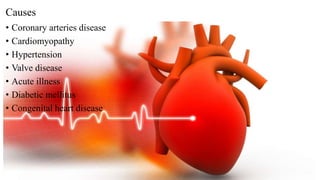
Causes
• Coronary arteries disease
• Cardiomyopathy
• Hypertension
• Valve disease
• Acute illness
• Diabetic mellitus
• Congenital heart disease
Cont…
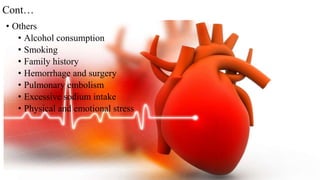
• Others
• Alcohol consumption
• Smoking
• Family history
• Hemorrhage and surgery
• Pulmonary embolism
• Excessive sodium intake
• Physical and emotional stress
• Echocardiogram
• ECG
• Chest x-ray
Nursing diagnosis
• Decrease cardiac output related to heart failure.
• Excess fluid volume related to reduce glomerular filtration, decrease cardiac
output, sodium and water retention.
• Impaired gas exchange r/t fluid in alveoli.
• Risk for activity intolerance r/t decrease cardiac output
• Risk of anxiety r/t cardiac output, hypoxia, diagnosis of heart failure and fear of
death.
Nursing intervention
• Assess for presence of peripheral edema, jugular vein distention, hepatomegaly
and abdominal pain
• Follow low sodium diet or fluid restriction.
• Assess the blood pressure for hypotension or hypertension and respiratory rate for
tachypnea.
• Auscultate breath sound every 2 hours and encourage the client to turn, cough
and deep breathing.
• Note color and temperature of skin 4 hourly and monitor peripheral pulses.
• Increase the client to avoid activities that increase the cardiac workload.
• Provide clam environment and explain in advance all procedures and routine.
Cardiac failure
Cardiac failure
Cardiac failure
Cardiac failure
Cardiac failure
Cardiac failure
Cardiac failure
Cardiac failure
Cardiac failure
Cardiac failure
Cardiac failure
Cardiac failure

Cardiac failure

  • 1.
  • 4.
    Causes • Coronary arteriesdisease • Cardiomyopathy • Hypertension • Valve disease • Acute illness • Diabetic mellitus • Congenital heart disease
  • 5.
    Cont… • Others • Alcoholconsumption • Smoking • Family history • Hemorrhage and surgery • Pulmonary embolism • Excessive sodium intake • Physical and emotional stress
  • 8.
  • 12.
    Nursing diagnosis • Decreasecardiac output related to heart failure. • Excess fluid volume related to reduce glomerular filtration, decrease cardiac output, sodium and water retention. • Impaired gas exchange r/t fluid in alveoli. • Risk for activity intolerance r/t decrease cardiac output • Risk of anxiety r/t cardiac output, hypoxia, diagnosis of heart failure and fear of death.
  • 13.
    Nursing intervention • Assessfor presence of peripheral edema, jugular vein distention, hepatomegaly and abdominal pain • Follow low sodium diet or fluid restriction. • Assess the blood pressure for hypotension or hypertension and respiratory rate for tachypnea. • Auscultate breath sound every 2 hours and encourage the client to turn, cough and deep breathing. • Note color and temperature of skin 4 hourly and monitor peripheral pulses. • Increase the client to avoid activities that increase the cardiac workload. • Provide clam environment and explain in advance all procedures and routine.