



CAQDAS   Computer Assisted Qualitative  Data Analysis Software G. Andrew Page University of Alaska Anchorage
The Problem Stress from  data analysis
What is  CAQDAS ?  (pronounced “ cactus ”) CAQDAS searches, organizes, categorizes, and annotates textual and visual data. Programs of this type usually support theory-building through the visualization of relationships between data and/or theoretical constructs.
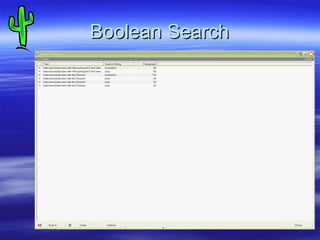
What will CAQDAS do? Organize —  Better organization correlates to better analysis Boolean Searches  Generation of code book Text mining  Lemmatization  text analysis Flexibility –  greater ease an maneuverability of the data,
The Approach CAQDAS can assist in the tasks of coding indexing, sorting, retrieving and manipulating data. Miles and Huberman (1994), for example, see data analysis as involving data reduction, data display, and drawing conclusions - a process parallel to quantitative analysis.
Platform, URL’s & Demos ATLAS/ ti   (dos)  =  Demo HyperRESEARCH  =  Demo   QSR NUD*IST    =  Demo   Max QDA    =  Demo  21-day full version AnSWR   = Open Source software for PC:  IDEA Notes :  Free!
Coding The key question is always, ‘What is this piece of data an example of?’ Open coding is putting labels or codes on pieces of data.   There is no  a priori  coding scheme that is imposed: the codes emerge from, are generated by, the data;
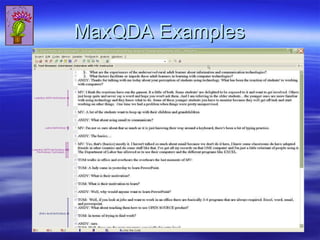
MaxQDA Examples
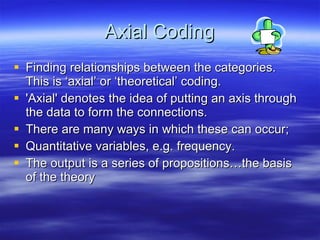
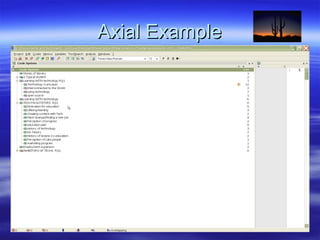
Axial Coding Finding relationships between the categories. This is ‘axial’ or ‘theoretical’ coding. 'Axial' denotes the idea of putting an axis through the data to form the connections. There are many ways in which these can occur;  Quantitative variables, e.g. frequency. The output is a series of propositions…the basis of the theory
Axial Example
Selective Coding Account for the relationships at a higher level of abstraction. This is ‘selective’ coding in which 'core' categories are selected.  These are the central phenomena about which the categories are integrated.
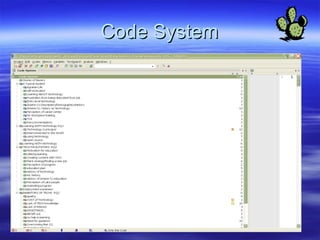
Code System
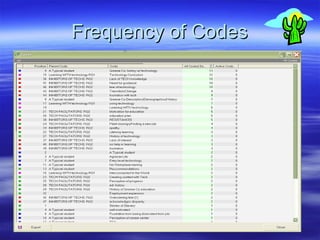
Frequency of Codes
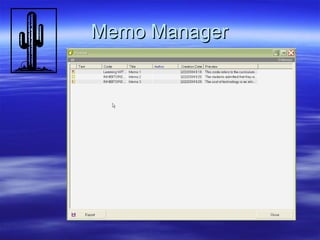
Memo Manager
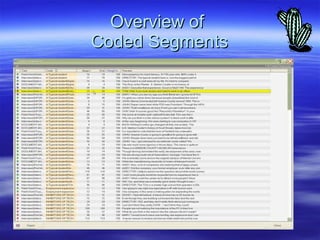
Overview of  Coded Segments
Boolean Search
In conclusion… CAQDAS won’t do the analysis for you but it will help increase your organization of data. CAQDAS has the ability to maneuver data so that you can view it from different approaches. Weigh the learning curve of the program and compare it to analyzing data with colored pens, scissors, and the “old-fashioned way of deciphering data  If this fails….see next screen.
Stress Redux
It’s “W” time You never know what will happen when conducting research!
Below: Air Force One and Pres. George W. Bush, April 2, 2004 in the county where I was conducting my dissertation research.

Caqdas

  • 1.
    CAQDAS Computer Assisted Qualitative Data Analysis Software G. Andrew Page University of Alaska Anchorage
  • 2.
    The Problem Stressfrom data analysis
  • 3.
    What is CAQDAS ? (pronounced “ cactus ”) CAQDAS searches, organizes, categorizes, and annotates textual and visual data. Programs of this type usually support theory-building through the visualization of relationships between data and/or theoretical constructs.
  • 4.
    What will CAQDASdo? Organize — Better organization correlates to better analysis Boolean Searches Generation of code book Text mining Lemmatization text analysis Flexibility – greater ease an maneuverability of the data,
  • 5.
    The Approach CAQDAScan assist in the tasks of coding indexing, sorting, retrieving and manipulating data. Miles and Huberman (1994), for example, see data analysis as involving data reduction, data display, and drawing conclusions - a process parallel to quantitative analysis.
  • 6.
    Platform, URL’s &Demos ATLAS/ ti (dos) = Demo HyperRESEARCH = Demo QSR NUD*IST = Demo Max QDA = Demo 21-day full version AnSWR = Open Source software for PC: IDEA Notes : Free!
  • 7.
    Coding The keyquestion is always, ‘What is this piece of data an example of?’ Open coding is putting labels or codes on pieces of data. There is no a priori coding scheme that is imposed: the codes emerge from, are generated by, the data;
  • 8.
  • 9.
    Axial Coding Findingrelationships between the categories. This is ‘axial’ or ‘theoretical’ coding. 'Axial' denotes the idea of putting an axis through the data to form the connections. There are many ways in which these can occur; Quantitative variables, e.g. frequency. The output is a series of propositions…the basis of the theory
  • 10.
  • 11.
    Selective Coding Accountfor the relationships at a higher level of abstraction. This is ‘selective’ coding in which 'core' categories are selected. These are the central phenomena about which the categories are integrated.
  • 12.
  • 13.
  • 14.
  • 15.
    Overview of Coded Segments
  • 16.
  • 17.
    In conclusion… CAQDASwon’t do the analysis for you but it will help increase your organization of data. CAQDAS has the ability to maneuver data so that you can view it from different approaches. Weigh the learning curve of the program and compare it to analyzing data with colored pens, scissors, and the “old-fashioned way of deciphering data If this fails….see next screen.
  • 18.
  • 19.
    It’s “W” timeYou never know what will happen when conducting research!
  • 20.
    Below: Air ForceOne and Pres. George W. Bush, April 2, 2004 in the county where I was conducting my dissertation research.