Introduction
Music plays a significant role in improving and elevating one's mood as it is one of the important source of
entertainment and inspiration to move forward. Recent studies have shown that humans respond as well as react
to music in a very positive manner and that music has a high impact on human's brain activity. Nowadays,
people often prefer to listen to music based on their moods and interests. This work focuses on a system that
suggests songs to the users, based on their state of mind. Once the emotion is recognized using chatbot
conversation, the system suggests a song for that emotion, saving a lot of time for a user over selecting and
playing songs manually.
Music is an integral part of our lives. However, since the social media platforms like TikTok and Instagram have
a huge influence on the music charts worldwide, users are exposed solely to mainstream music, therefore the
recommendations on music streaming platforms are not very personalized. An song and emotion-based
recommendation system permits the users to listen to music based on their emotions. Existing systems use audio
signals using the CNN approach and collaborative filtering to recommend songs based on the user's history. The
proposed research work develops a personalized system, where the user's current emotion is analyzed with the
help of the chat-bot. The chat-bot identifies the user's sentiment. Based on the input provided by the user, current
emotion or mood is analyzed by the chat-bot and it will play the song.
Motivation
The motivation behind selecting this project is as follows
The proposed system work develops a personalized system, where the user's current emotion is analyzed with
the help of the chatbot. The chatbot identifies the user's sentiment by chat conversation with the user. Based on
the input provided by the user, current emotion or mood is analyzed by the chatbot and it will Suggest song to
the user.
Problem Defination
The problem definition of this project is as follows:
“A Machine Learning Based Chatbot Song Recommender System.”
Our application solves the basic needs of music listeners without troubling them as existing applications do. In
order to recommend a music to a user, first step is to classify the music according to the user’s history.
Traditional classifiers such as the support vector machine and linear regression classify the music by extracting
the mel-frequency cepstral coefficients (MFCC) from the audio signal of the music. As the structural complexity
of the music is more, the efficiency of traditional classifiers reduces in classifying the music from different
genres. To solve the above research issues, researchers use deep neural networks (DNN) approaches for music
classification. The DNN approaches have shown efficient results in the tasks related to the pattern recognition
(e.g., image processing, video processing etc.). These approaches have the capability to extract the classified
information presented in the data.
Objectives
Following are the objectives of our system
• ‘Chatbot Song Recommender System’ is used to facilitate the use by physically challenged people to
automate and give them better music player experience.
• The application solves the basic needs of music listeners without troubling them as existing applications do.
• Based on the input provided by the user, current emotion or mood is analyzed by the chatbot and it will
Suggest song to the user.
• The chatbot identifies the user's sentiment by chat conversation with the user.
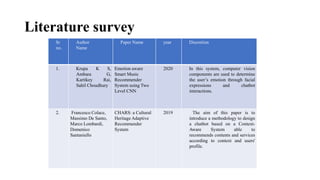
Literature survey
Sr
no.
Author
Name
Paper Name year Discretion
1. Krupa K S,
Ambara G,
Kartikey Rai,
Sahil Choudhury
Emotion aware
Smart Music
Recommender
System using Two
Level CNN
2020 In this system, computer vision
components are used to determine
the user’s emotion through facial
expressions and chatbot
interactions.
2. Francesco Colace,
Massimo De Santo,
Marco Lombardi,
Domenico
Santaniello
CHARS: a Cultural
Heritage Adaptive
Recommender
System
2019 The aim of this paper is to
introduce a methodology to design
a chatbot based on a Context-
Aware System able to
recommends contents and services
according to context and users'
profile.
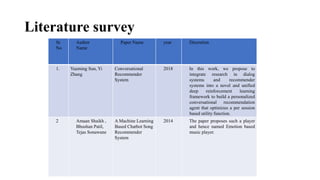
Literature survey
Sr.
No
Author
Name
Paper Name year Discretion
1. Yueming Sun, Yi
Zhang
Conversational
Recommender
System
2018 In this work, we propose to
integrate research in dialog
systems and recommender
systems into a novel and unified
deep reinforcement learning
framework to build a personalized
conversational recommendation
agent that optimizes a per session
based utility function.
2 Amaan Shaikh ,
Bhushan Patil,
Tejas Sonawane
A Machine Learning
Based Chatbot Song
Recommender
System
2014 The paper proposes such a player
and hence named Emotion based
music player.
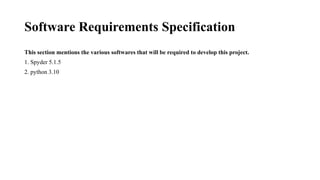
Software Requirements Specification
This section mentions the various softwares that will be required to develop this project.
1. Spyder 5.1.5
2. python 3.10
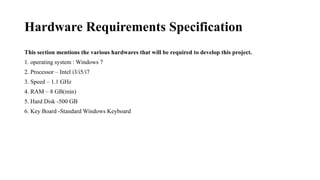
Hardware Requirements Specification
This section mentions the various hardwares that will be required to develop this project.
1. operating system : Windows 7
2. Processor – Intel i3/i5/i7
3. Speed – 1.1 GHz
4. RAM – 8 GB(min)
5. Hard Disk -500 GB
6. Key Board -Standard Windows Keyboard
Project Scope
Music plays a major role in handling the stressful situations and emotions triggers of the user. So, it is required
to recommend music that suits the current emotional needs of the user. There already exists widely used audio
and video recommender systems like Spotify, Netflix, Gaana, YouTube etc which work based on search queries
and not emotional needs of the user. So, the proposed CNN based model detects the emotion and recommend
song accordingly with the help of chatbot conversation.
Project Timeline chart
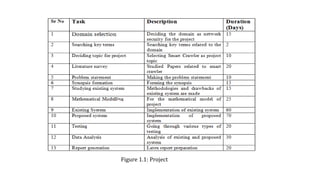
The project plan uptil the design phase over the course of 12 weeks is shown in Figure 1.1. The phases of the
project are color coded in the figure. The group formation, domain submission, title submission, title
finalisation and the one page proposal submission was in done by the sixth week. Later, the Problem
Statement and Objectives were finalised in the next week. The Literature Review with the reference papers
and designing the system architecture was done by the end of the ninth week. After that, the model diagrams
were designed and the report was completed by the end of the twelth week.
Figure 1.1: Project
Assumption and Dependancies
Assumption
It is assumed that answer data will be made available for the project in some phase of its completion. Until then,
test data will be used for providing the demo for the presentations. It is assumed that the user is familiar with an
internet browser and also familiar with handling the keyboard and mouse. Since the application is a web based
application there is a need for the internet browser. It will be assumed that the users will possess decent internet
connectivity.
Dependencies
The dependencies in this project are as follows.
A stable internet connection.
Installing packages
Using installed packages
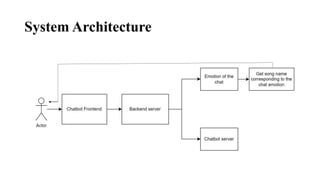
System Architecture
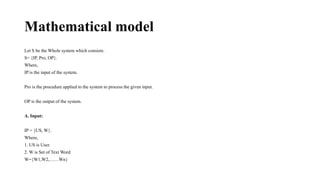
Mathematical model
Let S be the Whole system which consists:
S= {IP, Pro, OP}.
Where,
IP is the input of the system.
Pro is the procedure applied to the system to process the given input.
OP is the output of the system.
A. Input:
IP = {US, W}.
Where,
1. US is User.
2. W is Set of Text Word
W={W1,W2,……Wn}
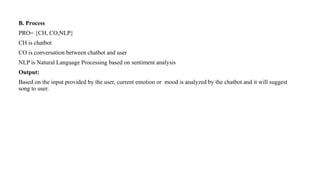
B. Process
PRO= {CH, CO,NLP}
CH is chatbot
CO is conversation between chatbot and user
NLP is Natural Language Processing based on sentiment analysis
Output:
Based on the input provided by the user, current emotion or mood is analyzed by the chatbot and it will suggest
song to user.
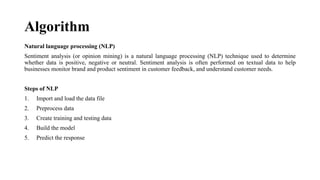
Algorithm
Natural language processing (NLP)
Sentiment analysis (or opinion mining) is a natural language processing (NLP) technique used to determine
whether data is positive, negative or neutral. Sentiment analysis is often performed on textual data to help
businesses monitor brand and product sentiment in customer feedback, and understand customer needs.
Steps of NLP
1. Import and load the data file
2. Preprocess data
3. Create training and testing data
4. Build the model
5. Predict the response
Natural Language Processing: Chatbot’s NLP works off the following keys: utterances (ways the user refers to a
specific intent), intent (the meaning behind the words a user types), entity (details that are important to the intent
like dates and locations), context (which helps to save and share parameters across a session), and session (one
conversation from start to finish, even if interrupted). NLP helps us to ask questions about any subject and get a
direct response within seconds. It offers exact answers to the question means it does not offer unnecessary and
unwanted information. NLP helps computers to communicate with humans in their languages. It is very time
efficient.
How NLP is used in sentiment analysis?
Sentiment Analysis is a procedure used to determine if a chunk of text is positive, negative or neutral. This allows
the chatbot to understand the user's emotions and adapt the conversation accordingly. In text analytics, natural
language processing (NLP) and machine learning (ML) techniques are combined to assign sentiment scores to the
topics, categories or entities within a phrase
There are five major steps involved—tokenizing, normalizing, recognizing entities, dependency parsing, and
generation—for the chatbot to read, interpret, understand, and formulate and send a response. Let’s take a closer
look.
Tokenizing: Our chatbot starts by chopping up text into pieces (also called ‘tokens’) and removing punctuation.
Normalizing: Next, the bot finds common misspellings, slang, or typos in the text and converts these to its
“normal” version.
Recognizing Entities: Now that the words are all normalized, the chatbot seeks to identify which type of thing is
being referred to. For example, it would identify North America as a location, 67% as a percentage, and Google
as an organization.
Dependency Parsing: For the next step, the bot splits the sentence into nouns, verbs, objects, punctuation, and
common phrases.
Generation: Finally, the chatbot generates a number of responses using the information determined in all the
other steps and selects the most appropriate response to send to the user.
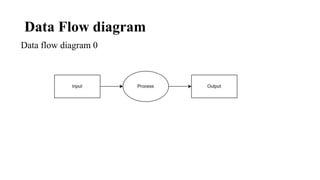
Data Flow diagram
Data flow diagram 0
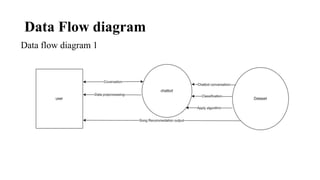
Data Flow diagram
Data flow diagram 1
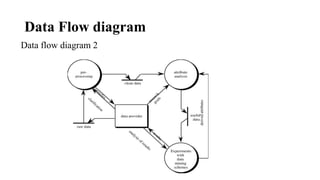
Data Flow diagram
Data flow diagram 2
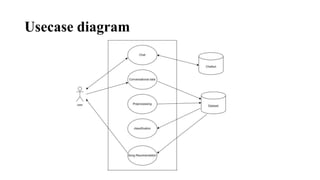
Usecase diagram
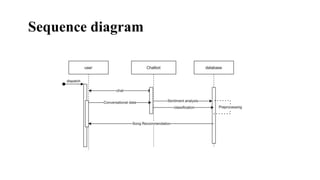
Sequence diagram
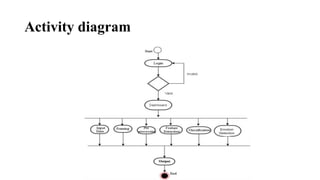
Activity diagram
Conclusion
We have presented a survey and methodology for building the chatbot song recommender system. To perform
this, we first identified various approaches for building a chatbot known to date. We then evaluated the
considered algorithms which are useful in building of our system in terms of their ability to work on the
recommendation process of the system. We also gathered all the requirements needed for building our system
and studied the overall process involved in chatbot's working. Lastly we summarized the deployment
requirements of our system. On the conclusion note our ‘Chatbot Song Recommender System’ is used to
facilitate the use by physically challenged people to automate and give them better music player experience. The
application solves the basic needs of music listeners without troubling them as existing applications do.
Conclusion
[1] Z. Hyung, J. S. Park, and K. Lee, “Utilizing context-relevant keywords extracted from a large collection of user-generated documents for
music discovery,” Info. Processing and Management, vol. 53, no. 5, pp. 1185-1200, 2017.
[2] J. B. Schafer, D. Frankowski, J. Herlocker, and S. Sen, “Collaborative filtering recommender systems,” The Adaptive Web: Methods and
Strategies of Web Personalization, pp. 291-324, 2007.
[3] M. J. Pazzani and D. Billsus, “Content based recommendation systems,” The Adaptive Web: Methods and Strategies of Web Personalization,
pp. 325-341, 2007.
[4] E. J. Humphrey, J. P. Bello, and Y. LeCun, “Moving beyond feature design: deep architectures and automatic feature learning in music
informatics,” in Proc. 13th Int’l Conf. Music Info. Retrieval, pp. 403-408, October 2012.
[5] C. W. Hsu, and C. J. Lin, “A comparison of methods for multiclass support vector machines,” IEEE Tran. Neural Networks, vol. 13, no. 2,
pp. 415-425, 2002.
[6] R. E. Fan, K. W. Chang, C. J. Hsieh, X. R. Wang, and C. J. Lin, “LIBLINEAR: a library for large linear classification,” J. Machine Learning
Research, vol. 9, pp. 1871-1874, 2008.
[7] A. V. Oord, S. Dieleman, and B. Schrauwen, “Deep content-based music recommendation,” in Proc. 26th Int'l Conf. Neural Info. Process.
Systems, pp. 2643-2651, December 2013.
[8] J. Salamon, and J. P. Bello, “Deep convolutional neural networks and data augmentation for environmental sound classification,” IEEE Sig.
Processing Letters, vol. 24, no. 3, pp. 279-283, March 2017.
[9] A. Krizhevsky, I. Sutskever, and G. E. Hinton, “Imagenet classification with deep convolutional neural networks,” Advances in Neural Info.
Processing Sys, pp. 1097-1105, 2012.
[10] R. Jozefowicz, W. Zaremba, and I. Sutskever, “An empirical exploration of recurrent network architectures,” in Int’l Conf. Machine
Learning, pp. 2342-2350, June 2015.

chatbot ppt.pptx

  • 1.
    Introduction Music plays asignificant role in improving and elevating one's mood as it is one of the important source of entertainment and inspiration to move forward. Recent studies have shown that humans respond as well as react to music in a very positive manner and that music has a high impact on human's brain activity. Nowadays, people often prefer to listen to music based on their moods and interests. This work focuses on a system that suggests songs to the users, based on their state of mind. Once the emotion is recognized using chatbot conversation, the system suggests a song for that emotion, saving a lot of time for a user over selecting and playing songs manually. Music is an integral part of our lives. However, since the social media platforms like TikTok and Instagram have a huge influence on the music charts worldwide, users are exposed solely to mainstream music, therefore the recommendations on music streaming platforms are not very personalized. An song and emotion-based recommendation system permits the users to listen to music based on their emotions. Existing systems use audio signals using the CNN approach and collaborative filtering to recommend songs based on the user's history. The proposed research work develops a personalized system, where the user's current emotion is analyzed with the help of the chat-bot. The chat-bot identifies the user's sentiment. Based on the input provided by the user, current emotion or mood is analyzed by the chat-bot and it will play the song.
  • 2.
    Motivation The motivation behindselecting this project is as follows The proposed system work develops a personalized system, where the user's current emotion is analyzed with the help of the chatbot. The chatbot identifies the user's sentiment by chat conversation with the user. Based on the input provided by the user, current emotion or mood is analyzed by the chatbot and it will Suggest song to the user.
  • 3.
    Problem Defination The problemdefinition of this project is as follows: “A Machine Learning Based Chatbot Song Recommender System.” Our application solves the basic needs of music listeners without troubling them as existing applications do. In order to recommend a music to a user, first step is to classify the music according to the user’s history. Traditional classifiers such as the support vector machine and linear regression classify the music by extracting the mel-frequency cepstral coefficients (MFCC) from the audio signal of the music. As the structural complexity of the music is more, the efficiency of traditional classifiers reduces in classifying the music from different genres. To solve the above research issues, researchers use deep neural networks (DNN) approaches for music classification. The DNN approaches have shown efficient results in the tasks related to the pattern recognition (e.g., image processing, video processing etc.). These approaches have the capability to extract the classified information presented in the data.
  • 4.
    Objectives Following are theobjectives of our system • ‘Chatbot Song Recommender System’ is used to facilitate the use by physically challenged people to automate and give them better music player experience. • The application solves the basic needs of music listeners without troubling them as existing applications do. • Based on the input provided by the user, current emotion or mood is analyzed by the chatbot and it will Suggest song to the user. • The chatbot identifies the user's sentiment by chat conversation with the user.
  • 5.
    Literature survey Sr no. Author Name Paper Nameyear Discretion 1. Krupa K S, Ambara G, Kartikey Rai, Sahil Choudhury Emotion aware Smart Music Recommender System using Two Level CNN 2020 In this system, computer vision components are used to determine the user’s emotion through facial expressions and chatbot interactions. 2. Francesco Colace, Massimo De Santo, Marco Lombardi, Domenico Santaniello CHARS: a Cultural Heritage Adaptive Recommender System 2019 The aim of this paper is to introduce a methodology to design a chatbot based on a Context- Aware System able to recommends contents and services according to context and users' profile.
  • 6.
    Literature survey Sr. No Author Name Paper Nameyear Discretion 1. Yueming Sun, Yi Zhang Conversational Recommender System 2018 In this work, we propose to integrate research in dialog systems and recommender systems into a novel and unified deep reinforcement learning framework to build a personalized conversational recommendation agent that optimizes a per session based utility function. 2 Amaan Shaikh , Bhushan Patil, Tejas Sonawane A Machine Learning Based Chatbot Song Recommender System 2014 The paper proposes such a player and hence named Emotion based music player.
  • 7.
    Software Requirements Specification Thissection mentions the various softwares that will be required to develop this project. 1. Spyder 5.1.5 2. python 3.10
  • 8.
    Hardware Requirements Specification Thissection mentions the various hardwares that will be required to develop this project. 1. operating system : Windows 7 2. Processor – Intel i3/i5/i7 3. Speed – 1.1 GHz 4. RAM – 8 GB(min) 5. Hard Disk -500 GB 6. Key Board -Standard Windows Keyboard
  • 9.
    Project Scope Music playsa major role in handling the stressful situations and emotions triggers of the user. So, it is required to recommend music that suits the current emotional needs of the user. There already exists widely used audio and video recommender systems like Spotify, Netflix, Gaana, YouTube etc which work based on search queries and not emotional needs of the user. So, the proposed CNN based model detects the emotion and recommend song accordingly with the help of chatbot conversation.
  • 10.
    Project Timeline chart Theproject plan uptil the design phase over the course of 12 weeks is shown in Figure 1.1. The phases of the project are color coded in the figure. The group formation, domain submission, title submission, title finalisation and the one page proposal submission was in done by the sixth week. Later, the Problem Statement and Objectives were finalised in the next week. The Literature Review with the reference papers and designing the system architecture was done by the end of the ninth week. After that, the model diagrams were designed and the report was completed by the end of the twelth week.
  • 11.
  • 12.
    Assumption and Dependancies Assumption Itis assumed that answer data will be made available for the project in some phase of its completion. Until then, test data will be used for providing the demo for the presentations. It is assumed that the user is familiar with an internet browser and also familiar with handling the keyboard and mouse. Since the application is a web based application there is a need for the internet browser. It will be assumed that the users will possess decent internet connectivity. Dependencies The dependencies in this project are as follows. A stable internet connection. Installing packages Using installed packages
  • 13.
  • 14.
    Mathematical model Let Sbe the Whole system which consists: S= {IP, Pro, OP}. Where, IP is the input of the system. Pro is the procedure applied to the system to process the given input. OP is the output of the system. A. Input: IP = {US, W}. Where, 1. US is User. 2. W is Set of Text Word W={W1,W2,……Wn}
  • 15.
    B. Process PRO= {CH,CO,NLP} CH is chatbot CO is conversation between chatbot and user NLP is Natural Language Processing based on sentiment analysis Output: Based on the input provided by the user, current emotion or mood is analyzed by the chatbot and it will suggest song to user.
  • 16.
    Algorithm Natural language processing(NLP) Sentiment analysis (or opinion mining) is a natural language processing (NLP) technique used to determine whether data is positive, negative or neutral. Sentiment analysis is often performed on textual data to help businesses monitor brand and product sentiment in customer feedback, and understand customer needs. Steps of NLP 1. Import and load the data file 2. Preprocess data 3. Create training and testing data 4. Build the model 5. Predict the response
  • 17.
    Natural Language Processing:Chatbot’s NLP works off the following keys: utterances (ways the user refers to a specific intent), intent (the meaning behind the words a user types), entity (details that are important to the intent like dates and locations), context (which helps to save and share parameters across a session), and session (one conversation from start to finish, even if interrupted). NLP helps us to ask questions about any subject and get a direct response within seconds. It offers exact answers to the question means it does not offer unnecessary and unwanted information. NLP helps computers to communicate with humans in their languages. It is very time efficient. How NLP is used in sentiment analysis? Sentiment Analysis is a procedure used to determine if a chunk of text is positive, negative or neutral. This allows the chatbot to understand the user's emotions and adapt the conversation accordingly. In text analytics, natural language processing (NLP) and machine learning (ML) techniques are combined to assign sentiment scores to the topics, categories or entities within a phrase
  • 18.
    There are fivemajor steps involved—tokenizing, normalizing, recognizing entities, dependency parsing, and generation—for the chatbot to read, interpret, understand, and formulate and send a response. Let’s take a closer look. Tokenizing: Our chatbot starts by chopping up text into pieces (also called ‘tokens’) and removing punctuation. Normalizing: Next, the bot finds common misspellings, slang, or typos in the text and converts these to its “normal” version. Recognizing Entities: Now that the words are all normalized, the chatbot seeks to identify which type of thing is being referred to. For example, it would identify North America as a location, 67% as a percentage, and Google as an organization. Dependency Parsing: For the next step, the bot splits the sentence into nouns, verbs, objects, punctuation, and common phrases. Generation: Finally, the chatbot generates a number of responses using the information determined in all the other steps and selects the most appropriate response to send to the user.
  • 19.
    Data Flow diagram Dataflow diagram 0
  • 20.
    Data Flow diagram Dataflow diagram 1
  • 21.
    Data Flow diagram Dataflow diagram 2
  • 22.
  • 23.
  • 24.
  • 25.
    Conclusion We have presenteda survey and methodology for building the chatbot song recommender system. To perform this, we first identified various approaches for building a chatbot known to date. We then evaluated the considered algorithms which are useful in building of our system in terms of their ability to work on the recommendation process of the system. We also gathered all the requirements needed for building our system and studied the overall process involved in chatbot's working. Lastly we summarized the deployment requirements of our system. On the conclusion note our ‘Chatbot Song Recommender System’ is used to facilitate the use by physically challenged people to automate and give them better music player experience. The application solves the basic needs of music listeners without troubling them as existing applications do.
  • 26.
    Conclusion [1] Z. Hyung,J. S. Park, and K. Lee, “Utilizing context-relevant keywords extracted from a large collection of user-generated documents for music discovery,” Info. Processing and Management, vol. 53, no. 5, pp. 1185-1200, 2017. [2] J. B. Schafer, D. Frankowski, J. Herlocker, and S. Sen, “Collaborative filtering recommender systems,” The Adaptive Web: Methods and Strategies of Web Personalization, pp. 291-324, 2007. [3] M. J. Pazzani and D. Billsus, “Content based recommendation systems,” The Adaptive Web: Methods and Strategies of Web Personalization, pp. 325-341, 2007. [4] E. J. Humphrey, J. P. Bello, and Y. LeCun, “Moving beyond feature design: deep architectures and automatic feature learning in music informatics,” in Proc. 13th Int’l Conf. Music Info. Retrieval, pp. 403-408, October 2012. [5] C. W. Hsu, and C. J. Lin, “A comparison of methods for multiclass support vector machines,” IEEE Tran. Neural Networks, vol. 13, no. 2, pp. 415-425, 2002. [6] R. E. Fan, K. W. Chang, C. J. Hsieh, X. R. Wang, and C. J. Lin, “LIBLINEAR: a library for large linear classification,” J. Machine Learning Research, vol. 9, pp. 1871-1874, 2008. [7] A. V. Oord, S. Dieleman, and B. Schrauwen, “Deep content-based music recommendation,” in Proc. 26th Int'l Conf. Neural Info. Process. Systems, pp. 2643-2651, December 2013. [8] J. Salamon, and J. P. Bello, “Deep convolutional neural networks and data augmentation for environmental sound classification,” IEEE Sig. Processing Letters, vol. 24, no. 3, pp. 279-283, March 2017. [9] A. Krizhevsky, I. Sutskever, and G. E. Hinton, “Imagenet classification with deep convolutional neural networks,” Advances in Neural Info. Processing Sys, pp. 1097-1105, 2012. [10] R. Jozefowicz, W. Zaremba, and I. Sutskever, “An empirical exploration of recurrent network architectures,” in Int’l Conf. Machine Learning, pp. 2342-2350, June 2015.