Jon R. Cavicchi
Professor & IP Librarian
        ©2012
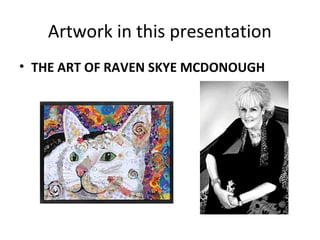
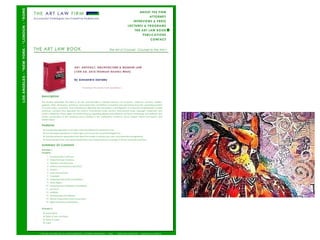
Artwork in this presentation
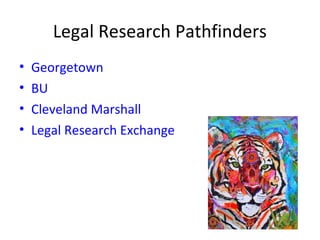
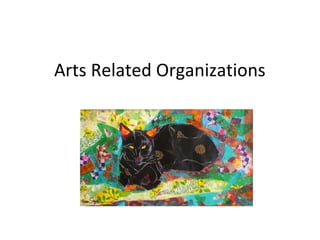
• THE ART OF RAVEN SKYE MCDONOUGH
According to the U.S. National Central Bureaus of Interpol, a branch of the
U.S. Department of Justice, the annual dollar value of art theft is exceeded
only by the trafficking of illegal drugs and arms. And often, the criminal
networks that traffics the sale of art are the same networks that deal in other
illegal transactions.
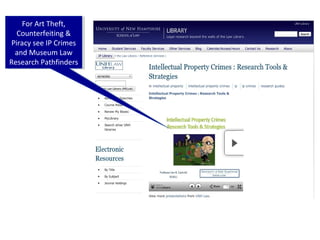
For Art Theft,
     For Art Theft,
  Counterfeiting &
   Counterfeiting &
Piracy see IP Crimes
 Piracy see IP Crimes
  and Museum Law
   and Museum Law
Research Pathfinders
 Research Pathfinders
Attorneys
• West Legal Directory
  – 1300+ list art as area of practice
  – 1000+ publish on art topics
  – 900+ affiliated with lawyers for arts groups
  – 4000+ are affiliated with arts organizations
Think about what’s inside the
box , then think outside the box
Most fun area of law to practice
            research skills
• Content is distributed globally
• Spectrum of from information
  overload to no legal authorities at
  your disposal
• Resort to Berring “Commando Legal
  Research Rules
  – Use a Human Being
  – Any Port in a Storm
• Often have to back into art law
  research through news
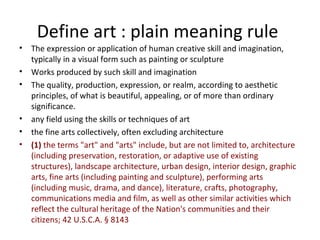
Define art : plain meaning rule
•   The expression or application of human creative skill and imagination,
    typically in a visual form such as painting or sculpture
•   Works produced by such skill and imagination
•   The quality, production, expression, or realm, according to aesthetic
    principles, of what is beautiful, appealing, or of more than ordinary
    significance.
•   any field using the skills or techniques of art
•   the fine arts collectively, often excluding architecture
•   (1) the terms "art" and "arts" include, but are not limited to, architecture
    (including preservation, restoration, or adaptive use of existing
    structures), landscape architecture, urban design, interior design, graphic
    arts, fine arts (including painting and sculpture), performing arts
    (including music, drama, and dance), literature, crafts, photography,
    communications media and film, as well as other similar activities which
    reflect the cultural heritage of the Nation's communities and their
    citizens; 42 U.S.C.A. § 8143
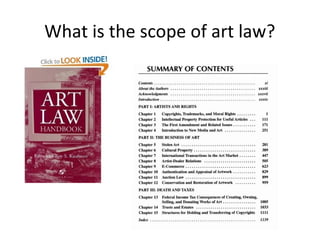
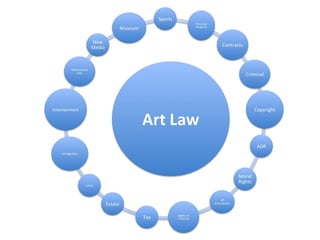
What is the scope of art law?
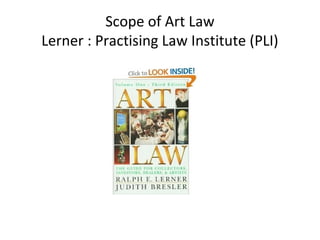
Scope of Art Law
Lerner : Practising Law Institute (PLI)
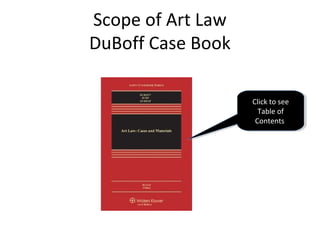
Scope of Art Law
DuBoff Case Book

                   Click to see
                    Click to see
                     Table of
                      Table of
                    Contents
                     Contents
Legal Research
Tools and Strategies
So what type of project are you working
                      on?
• Legal Research
     – Transactional
     – Litigation
•   How to / training materials
•   Client awareness and education
•   Public Policy
•   News
•   Statistics
•   Public relations
•   Fundraising
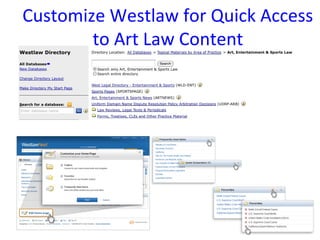
Customize Westlaw for Quick Access
        to Art Law Content
Legal Research Pathfinders
•   Georgetown
•   BU
•   Cleveland Marshall
•   Legal Research Exchange
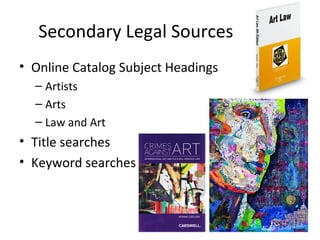
Secondary Legal Sources
• Online Catalog Subject Headings
  – Artists
  – Arts
  – Law and Art
• Title searches
• Keyword searches
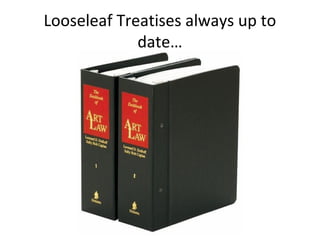
Looseleaf Treatises always up to
             date…
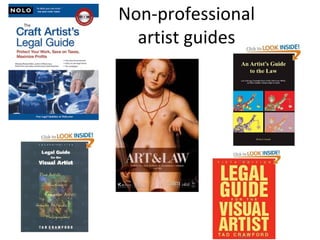
Non-professional
  artist guides
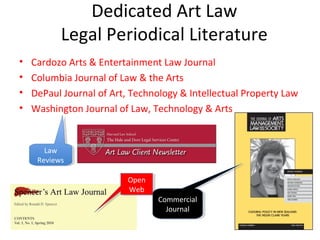
Dedicated Art Law
           Legal Periodical Literature
•   Cardozo Arts & Entertainment Law Journal
•   Columbia Journal of Law & the Arts
•   DePaul Journal of Art, Technology & Intellectual Property Law
•   Washington Journal of Law, Technology & Arts


       Law
        Law
     Reviews
      Reviews

                          Open
                          Open
                          Web
                           Web
                                 Commercial
                                  Commercial
                                   Journal
                                    Journal
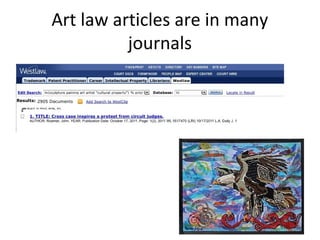
Art law articles are in many
          journals
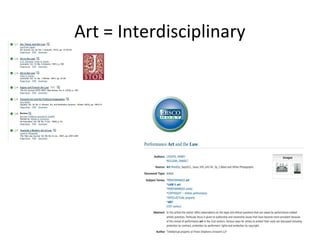
Art = Interdisciplinary
New Sources
General Open Web Portals
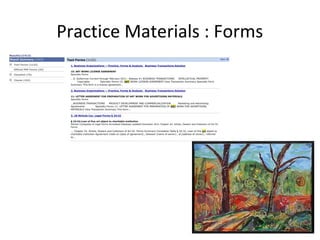
Practice Materials : Forms
• Public records
• Court Dockets, Records, Briefs and Filings
• Expert Witness Analysis, Jury Verdicts &
  Settlements
• Bill tracking
• Use alerts & RSS
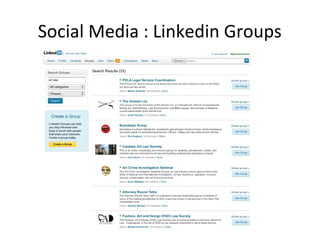
Social Media : Linkedin Groups
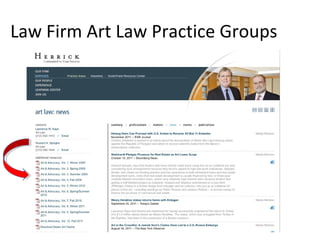
Law Firm Art Law Practice Groups
Links to art law firms
 Links to art law firms
  & other resources
   & other resources
Spectrum from open web to
     premium content
Look for compiled case law
sources
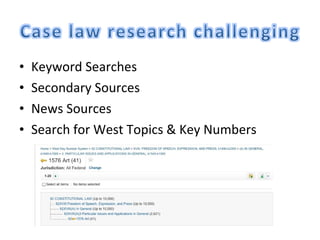
•   Keyword Searches
•   Secondary Sources
•   News Sources
•   Search for West Topics & Key Numbers
•   16 U.S.C. secs. 461 to 470aaa-11 (includes the Archaeological Resources Protection Act)
    These sections of Title 16 ("Conservation") concern the preservation and protection of important historic sites, buildings, objects, and antiquities.

    Convention on Cultural Property Implementation Act, Pub. L. No. 97-446, secs. 301-15, 96 Stat. 2329, 2350-63 (1983) (codified at 19 U.S.C.
    secs. 2601-2613)
    This act implements the Convention on the Means of Prohibiting and Preventing the Illicit Import, Export, and Transfer of Ownership of Cultural
    Property and authorizes the President to enter into bilateral agreements with party nations to prevent the import of certain "archaeological or
    ethnological material."

    National Stolen Property Act, 18 U.S.C. secs. 2314-15
    This act prohibits, among other things, the knowing transportation or sale of stolen or fraudulently obtained merchandise (e.g., a work of art)
    worth $5,000 or more.

    Abandoned Shipwreck Act of 1987, Pub. L. No. 100-298, 102 Stat. 432 (1988) (codified at 43 U.S.C. secs. 2101-2106)
    This act applies to abandoned shipwrecks in submerged state lands. It abrogates the law of finds and salvage; the United States takes title to
    these shipwrecks and then ownership is transferred to the state where the shipwreck is located.

    18 U.S.C. sec. 668
    Prohibits the theft of major works of art and cultural objects from museums in the United States.

    19 U.S.C. secs. 2091-2095
    Prohibits the importation of certain stone carvings and wall art that is the "product of a pre-Columbian Indian culture of Mexico, Central America,
    South America, or the Caribbean Islands."

    Native American Graves Protection and Repatriation Act, Pub. L. No. 101-601, 104 Stat. 3048 (1990) (codified at 25 U.S.C. secs. 3001-13, 18
    U.S.C. sec. 1170)
    This act protects Native American burial sites by prohibiting unauthorized excavation and trafficking in certain items, such as human remains and
    funerary objects. It also establishes a system for the repatriation of items removed prior to the effective date of the act.

    22 U.S.C. sec. 2459
    Protects certain works of art and "other objects of cultural significance" imported into the United States for temporary exhibition at a museum or
    similar institution from seizure under judicial process.

    Copyright Act of 1976, Pub. L. No. 94-553, 90 Stat. 2541 (codified as amended at 17 U.S.C. secs. 101-805)
    Works of art are protected by U.S. copyright law. Provisions of this act apply to the creation, ownership, reproduction, and dissemination of
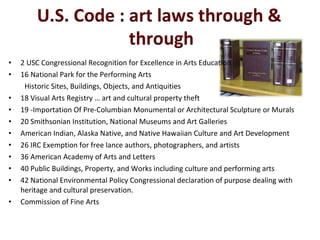
•   2 USC Congressional Recognition for Excellence in Arts Education
•   16 National Park for the Performing Arts
     Historic Sites, Buildings, Objects, and Antiquities
•   18 Visual Arts Registry … art and cultural property theft
•   19 -Importation Of Pre-Columbian Monumental or Architectural Sculpture or Murals
•   20 Smithsonian Institution, National Museums and Art Galleries
•   American Indian, Alaska Native, and Native Hawaiian Culture and Art Development
•   26 IRC Exemption for free lance authors, photographers, and artists
•   36 American Academy of Arts and Letters
•   40 Public Buildings, Property, and Works including culture and performing arts
•   42 National Environmental Policy Congressional declaration of purpose dealing with
    heritage and cultural preservation.
•   Commission of Fine Arts
–   18 C.F.R. secs. 1312.1-1312.21
    Regulations related to archaeological resources protection.

–   19 C.F.R. secs. 12.104-12.109
    Regulations governing the import of certain cultural property and pre-Columbian sculptures and
    murals.

–   25 C.F.R. secs. 262.1-262.8
    Regulations on Native American archaeological resources.

–   36 C.F.R. secs. 73.1-73.17
    World Heritage Convention regulations.

–   37 C.F.R. secs. 201.2-212.8
    Regulations promulgated by the U.S. Copyright Office governing copyright registration and other
    procedures, including regulations regarding the Visual Arts Registry and specific requirements for the
    registration of pictorial, graphic, and sculptural works.

–   43 C.F.R. secs. 3.1-3.17, 7.1-7.37, 10.1-10.17
    Regulations from the Department of the Interior regarding cultural property.

–   45 C.F.R. secs. 1100.1-1186.670
    Regulations related to the National Foundation on the Arts and Humanities.
• Title 19 Customs DutiesU.S. Customs and Border Protection
• Title 22 Foreign RelationsStateVisas: Documentation of
  Nonimmigrants
• Title 25 IndiansIndian Arts and Crafts Board
• Title 28 Bureau of Prisons, Department of Justice Inmate
  RecreationArt
• Title 32. National DefenseNavy Art Collection
• Title 36. Parks, Forests, and Public PropertyFine Arts
• Title 41. Public Contracts and Property ManagementArt-in-
  Architecture
• Title 45. Public WelfareFederal Council on the Arts and the
  Humanities
Arts Related Organizations
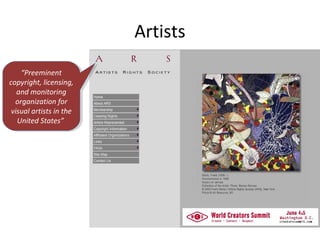
Artists
     “Preeminent
      “Preeminent
copyright, licensing,
 copyright, licensing,
   and monitoring
    and monitoring
   organization for
    organization for
 visual artists in the
  visual artists in the
   United States”
    United States”
Volunteer Lawyers for the Arts
Professional Associations
Trade Related Resources
NGOs
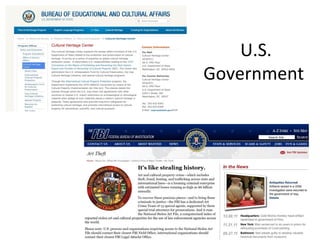
U.S.
Government
Academic
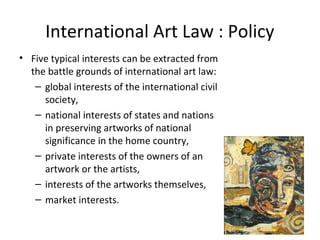
International Art Law : Policy
• Five typical interests can be extracted from
  the battle grounds of international art law:
   – global interests of the international civil
     society,
   – national interests of states and nations
     in preserving artworks of national
     significance in the home country,
   – private interests of the owners of an
     artwork or the artists,
   – interests of the artworks themselves,
   – market interests.
International Organizations
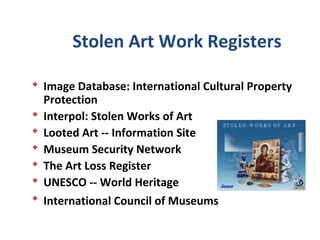
Stolen Art Work Registers

 Image Database: International Cultural Property
  Protection
 Interpol: Stolen Works of Art
 Looted Art -- Information Site
 Museum Security Network
 The Art Loss Register
 UNESCO -- World Heritage
 International Council of Museums
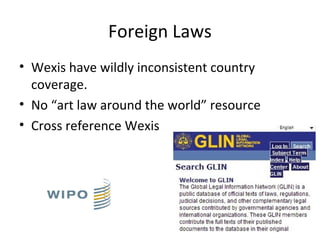
Foreign Laws
• Wexis have wildly inconsistent country
  coverage.
• No “art law around the world” resource
• Cross reference Wexis
Staying up to date
• Develop you art law toolkit
    – Review on a regular basis
•   Email newsletters
•   Blogs
•   RSS Feeds
•   Alerts
    – premium & open web
• Social networking
       • Face to face and Web 2.0
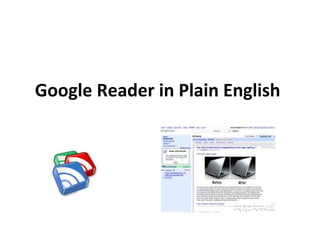
Google Reader in Plain English
In conclusion, change is constant so
   stay in touch with the Library…

Capacitizing Yourself as an Art Law Professional

  • 1.
    Jon R. Cavicchi Professor& IP Librarian ©2012
  • 2.
    Artwork in thispresentation • THE ART OF RAVEN SKYE MCDONOUGH
  • 4.
    According to theU.S. National Central Bureaus of Interpol, a branch of the U.S. Department of Justice, the annual dollar value of art theft is exceeded only by the trafficking of illegal drugs and arms. And often, the criminal networks that traffics the sale of art are the same networks that deal in other illegal transactions.
  • 5.
    For Art Theft, For Art Theft, Counterfeiting & Counterfeiting & Piracy see IP Crimes Piracy see IP Crimes and Museum Law and Museum Law Research Pathfinders Research Pathfinders
  • 6.
    Attorneys • West LegalDirectory – 1300+ list art as area of practice – 1000+ publish on art topics – 900+ affiliated with lawyers for arts groups – 4000+ are affiliated with arts organizations
  • 8.
    Think about what’sinside the box , then think outside the box
  • 9.
    Most fun areaof law to practice research skills • Content is distributed globally • Spectrum of from information overload to no legal authorities at your disposal • Resort to Berring “Commando Legal Research Rules – Use a Human Being – Any Port in a Storm • Often have to back into art law research through news
  • 10.
    Define art :plain meaning rule • The expression or application of human creative skill and imagination, typically in a visual form such as painting or sculpture • Works produced by such skill and imagination • The quality, production, expression, or realm, according to aesthetic principles, of what is beautiful, appealing, or of more than ordinary significance. • any field using the skills or techniques of art • the fine arts collectively, often excluding architecture • (1) the terms "art" and "arts" include, but are not limited to, architecture (including preservation, restoration, or adaptive use of existing structures), landscape architecture, urban design, interior design, graphic arts, fine arts (including painting and sculpture), performing arts (including music, drama, and dance), literature, crafts, photography, communications media and film, as well as other similar activities which reflect the cultural heritage of the Nation's communities and their citizens; 42 U.S.C.A. § 8143
  • 11.
    What is thescope of art law?
  • 12.
    Scope of ArtLaw Lerner : Practising Law Institute (PLI)
  • 14.
    Scope of ArtLaw DuBoff Case Book Click to see Click to see Table of Table of Contents Contents
  • 17.
  • 18.
    So what typeof project are you working on? • Legal Research – Transactional – Litigation • How to / training materials • Client awareness and education • Public Policy • News • Statistics • Public relations • Fundraising
  • 19.
    Customize Westlaw forQuick Access to Art Law Content
  • 20.
    Legal Research Pathfinders • Georgetown • BU • Cleveland Marshall • Legal Research Exchange
  • 21.
    Secondary Legal Sources •Online Catalog Subject Headings – Artists – Arts – Law and Art • Title searches • Keyword searches
  • 22.
  • 23.
  • 24.
    Dedicated Art Law Legal Periodical Literature • Cardozo Arts & Entertainment Law Journal • Columbia Journal of Law & the Arts • DePaul Journal of Art, Technology & Intellectual Property Law • Washington Journal of Law, Technology & Arts Law Law Reviews Reviews Open Open Web Web Commercial Commercial Journal Journal
  • 25.
    Art law articlesare in many journals
  • 26.
  • 27.
  • 28.
  • 29.
  • 30.
    • Public records •Court Dockets, Records, Briefs and Filings • Expert Witness Analysis, Jury Verdicts & Settlements • Bill tracking • Use alerts & RSS
  • 35.
    Social Media :Linkedin Groups
  • 38.
    Law Firm ArtLaw Practice Groups
  • 39.
    Links to artlaw firms Links to art law firms & other resources & other resources
  • 40.
    Spectrum from openweb to premium content
  • 41.
    Look for compiledcase law sources
  • 42.
    Keyword Searches • Secondary Sources • News Sources • Search for West Topics & Key Numbers
  • 43.
    16 U.S.C. secs. 461 to 470aaa-11 (includes the Archaeological Resources Protection Act) These sections of Title 16 ("Conservation") concern the preservation and protection of important historic sites, buildings, objects, and antiquities. Convention on Cultural Property Implementation Act, Pub. L. No. 97-446, secs. 301-15, 96 Stat. 2329, 2350-63 (1983) (codified at 19 U.S.C. secs. 2601-2613) This act implements the Convention on the Means of Prohibiting and Preventing the Illicit Import, Export, and Transfer of Ownership of Cultural Property and authorizes the President to enter into bilateral agreements with party nations to prevent the import of certain "archaeological or ethnological material." National Stolen Property Act, 18 U.S.C. secs. 2314-15 This act prohibits, among other things, the knowing transportation or sale of stolen or fraudulently obtained merchandise (e.g., a work of art) worth $5,000 or more. Abandoned Shipwreck Act of 1987, Pub. L. No. 100-298, 102 Stat. 432 (1988) (codified at 43 U.S.C. secs. 2101-2106) This act applies to abandoned shipwrecks in submerged state lands. It abrogates the law of finds and salvage; the United States takes title to these shipwrecks and then ownership is transferred to the state where the shipwreck is located. 18 U.S.C. sec. 668 Prohibits the theft of major works of art and cultural objects from museums in the United States. 19 U.S.C. secs. 2091-2095 Prohibits the importation of certain stone carvings and wall art that is the "product of a pre-Columbian Indian culture of Mexico, Central America, South America, or the Caribbean Islands." Native American Graves Protection and Repatriation Act, Pub. L. No. 101-601, 104 Stat. 3048 (1990) (codified at 25 U.S.C. secs. 3001-13, 18 U.S.C. sec. 1170) This act protects Native American burial sites by prohibiting unauthorized excavation and trafficking in certain items, such as human remains and funerary objects. It also establishes a system for the repatriation of items removed prior to the effective date of the act. 22 U.S.C. sec. 2459 Protects certain works of art and "other objects of cultural significance" imported into the United States for temporary exhibition at a museum or similar institution from seizure under judicial process. Copyright Act of 1976, Pub. L. No. 94-553, 90 Stat. 2541 (codified as amended at 17 U.S.C. secs. 101-805) Works of art are protected by U.S. copyright law. Provisions of this act apply to the creation, ownership, reproduction, and dissemination of
  • 44.
    2 USC Congressional Recognition for Excellence in Arts Education • 16 National Park for the Performing Arts Historic Sites, Buildings, Objects, and Antiquities • 18 Visual Arts Registry … art and cultural property theft • 19 -Importation Of Pre-Columbian Monumental or Architectural Sculpture or Murals • 20 Smithsonian Institution, National Museums and Art Galleries • American Indian, Alaska Native, and Native Hawaiian Culture and Art Development • 26 IRC Exemption for free lance authors, photographers, and artists • 36 American Academy of Arts and Letters • 40 Public Buildings, Property, and Works including culture and performing arts • 42 National Environmental Policy Congressional declaration of purpose dealing with heritage and cultural preservation. • Commission of Fine Arts
  • 46.
    18 C.F.R. secs. 1312.1-1312.21 Regulations related to archaeological resources protection. – 19 C.F.R. secs. 12.104-12.109 Regulations governing the import of certain cultural property and pre-Columbian sculptures and murals. – 25 C.F.R. secs. 262.1-262.8 Regulations on Native American archaeological resources. – 36 C.F.R. secs. 73.1-73.17 World Heritage Convention regulations. – 37 C.F.R. secs. 201.2-212.8 Regulations promulgated by the U.S. Copyright Office governing copyright registration and other procedures, including regulations regarding the Visual Arts Registry and specific requirements for the registration of pictorial, graphic, and sculptural works. – 43 C.F.R. secs. 3.1-3.17, 7.1-7.37, 10.1-10.17 Regulations from the Department of the Interior regarding cultural property. – 45 C.F.R. secs. 1100.1-1186.670 Regulations related to the National Foundation on the Arts and Humanities.
  • 47.
    • Title 19Customs DutiesU.S. Customs and Border Protection • Title 22 Foreign RelationsStateVisas: Documentation of Nonimmigrants • Title 25 IndiansIndian Arts and Crafts Board • Title 28 Bureau of Prisons, Department of Justice Inmate RecreationArt • Title 32. National DefenseNavy Art Collection • Title 36. Parks, Forests, and Public PropertyFine Arts • Title 41. Public Contracts and Property ManagementArt-in- Architecture • Title 45. Public WelfareFederal Council on the Arts and the Humanities
  • 48.
  • 49.
    Artists “Preeminent “Preeminent copyright, licensing, copyright, licensing, and monitoring and monitoring organization for organization for visual artists in the visual artists in the United States” United States”
  • 50.
  • 51.
  • 52.
  • 53.
  • 54.
  • 55.
  • 56.
    International Art Law: Policy • Five typical interests can be extracted from the battle grounds of international art law: – global interests of the international civil society, – national interests of states and nations in preserving artworks of national significance in the home country, – private interests of the owners of an artwork or the artists, – interests of the artworks themselves, – market interests.
  • 57.
  • 59.
    Stolen Art WorkRegisters  Image Database: International Cultural Property Protection  Interpol: Stolen Works of Art  Looted Art -- Information Site  Museum Security Network  The Art Loss Register  UNESCO -- World Heritage  International Council of Museums
  • 60.
    Foreign Laws • Wexishave wildly inconsistent country coverage. • No “art law around the world” resource • Cross reference Wexis
  • 62.
    Staying up todate • Develop you art law toolkit – Review on a regular basis • Email newsletters • Blogs • RSS Feeds • Alerts – premium & open web • Social networking • Face to face and Web 2.0
  • 63.
    Google Reader inPlain English
  • 64.
    In conclusion, changeis constant so stay in touch with the Library…