CHAPTER 1 PAGES 15-21
By: Ashley,Courtney,Yojanda,and Jahniece
Chapter overview
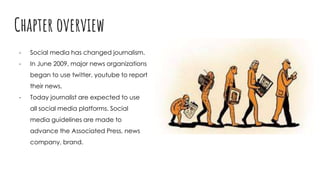
- Social media has changed journalism.
- In June 2009, major news organizations
began to use twitter, youtube to report
their news.
- Today journalist are expected to use
all social media platforms. Social
media guidelines are made to
advance the Associated Press, news
company, brand.
Overview Continued.
- Researchers are studying the
difference between news reception
and friend behavior. Friending and
reception are highly predictive of
spreading news. Journalism is being
challenged because you can publish
so freely online. Blogging blurs the line
between news and opinion.
- At its core social media is a way of
distributing rumors & news that hasn't
been fact checked. Which can lead
to false information being spread at a
very rapid level. This is turn can make
very hard for journalist to push forward
the real stories, as most people won’t
bother to distinguish between those
who are false.
Key Terms...
Citizen Journalism: Individuals use
online platforms to distribute news
created as non-professional
citizen journalists. Content may be
hyperlocal which does not attract
large enough audiences to
interest mainstream media.
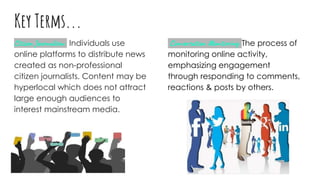
Conversation Monitoring: The process of
monitoring online activity,
emphasizing engagement
through responding to comments,
reactions & posts by others.
...
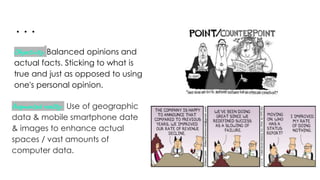
Objectivity: Balanced opinions and
actual facts. Sticking to what is
true and just as opposed to using
one's personal opinion.
Augmented reality: Use of geographic
data & mobile smartphone date
& images to enhance actual
spaces / vast amounts of
computer data.
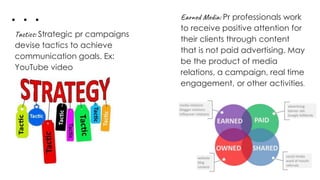
Tactics: Strategic pr campaigns
devise tactics to achieve
communication goals. Ex:
YouTube video
Earned Media: Pr professionals work
to receive positive attention for
their clients through content
that is not paid advertising. May
be the product of media
relations, a campaign, real time
engagement, or other activities.
. . .

Chapter 1 pages 15 21

  • 1.
    CHAPTER 1 PAGES15-21 By: Ashley,Courtney,Yojanda,and Jahniece
  • 2.
    Chapter overview - Socialmedia has changed journalism. - In June 2009, major news organizations began to use twitter, youtube to report their news. - Today journalist are expected to use all social media platforms. Social media guidelines are made to advance the Associated Press, news company, brand.
  • 3.
    Overview Continued. - Researchersare studying the difference between news reception and friend behavior. Friending and reception are highly predictive of spreading news. Journalism is being challenged because you can publish so freely online. Blogging blurs the line between news and opinion. - At its core social media is a way of distributing rumors & news that hasn't been fact checked. Which can lead to false information being spread at a very rapid level. This is turn can make very hard for journalist to push forward the real stories, as most people won’t bother to distinguish between those who are false.
  • 4.
    Key Terms... Citizen Journalism:Individuals use online platforms to distribute news created as non-professional citizen journalists. Content may be hyperlocal which does not attract large enough audiences to interest mainstream media. Conversation Monitoring: The process of monitoring online activity, emphasizing engagement through responding to comments, reactions & posts by others.
  • 5.
    ... Objectivity: Balanced opinionsand actual facts. Sticking to what is true and just as opposed to using one's personal opinion. Augmented reality: Use of geographic data & mobile smartphone date & images to enhance actual spaces / vast amounts of computer data.
  • 6.
    Tactics: Strategic prcampaigns devise tactics to achieve communication goals. Ex: YouTube video Earned Media: Pr professionals work to receive positive attention for their clients through content that is not paid advertising. May be the product of media relations, a campaign, real time engagement, or other activities. . . .