Contents…
Introduction
Problem statement
In India
Cancer pattern
Environmental factors
genetic factors
Cancer control
Breast cancer
Cervical cancer
Cancer may regarded as a group of diseases characterized by an
Abnormal growth of cells
Ability to invade tissue and even distant organs
The eventually death of the affected patient if the tumor has
progressed beyond the stage when it can be successfully
removed
Introduction
Major categories of cancer are
Carcinoma
Arises from the epithelial cells lining the internal surface of
various organs (e.g. mouth, oesophagus, uterus)
Sarcoma
Arises from the mesodermal cells constituting the various
connective tissues (e.g. fibrous tissue, bone)
Lymphoma, myeloma and leukemia
Arising from the cells of the bone marrow and immune
system
Worldwide
Every year 10 million people are diagnosed and more
then 6 million die
22.4 million peoples were living with cancer in 2000
Most common cancer worldwide are
Lungs cancer (12.3%)
Breast cancer (10.4%)
Colorectal cancer (9.4%)
Problem statement
Respiratory tract cancer is most common site of
cancer in India, Indonesia, srilanka and Thailand
Cancer of cervix is most common in India and
Indonesia
Cancer associated with tobacco constitute 44.6% of
cancer in men and 20% in female
The four most common cancer in India are
Male-oropharynx, esophagus, stomach and lower
respiratory tract
Female-breast, cervix, oropharynx and esophagus
Tabaco is used widely used in India
91% cases of oropharynx is due to Tabaco use
60% cases in female are breast, cervix and ovary
cancer
India…
There are lot of international variations in the pattern
of cancer which are attributed to a number of factors
such as
environmental factors
food habit
lifestyle
genetic factor
inadequacy in detection and reporting of cases
Cancer patterns
Tobacco
Tobacco in various forms of usage can cause cancer of
lungs, larynx, mouth, pharynx, esophagus, bladder, pancreas
and probably kidney
Cigarette smoking is now responsible for more than 1 million
death each year
Alcohol
Excess intake of alcohol can cause esophageal and liver
cancer
Beer consumption may be associated with rectal cancer
Alcohol contributes about 3 % of all cancer deaths
Environmental factors
Dietary factor
Smoked fish is related to stomach cancer
Dietary fiber to intestinal cancer
Beef consumption to bowel cancer
High fat diet to breast cancer
Food additives and contaminants have fallen under
suspicion as causative agents
Occupational exposures
These includes exposure to
benzene, cadmium, arsenic, chromium, vinyl
chloride, asbestos, polycyclic hydrocarbons, etc.
The risk of occupational exposure is said to be increased
if the individual also smokes cigarette
Occupational exposure is usually reported 1-5% of human
cancer
Virus
Hepatitis B & C - hepatocarcinoma
HIV infection – kaposi’s carcinoma
AIDS – non Hodgkin’s lymphoma
Epstein – bar virus – Burkitts lymphoma and naso –
pharyngial carcinoma
Cytomegalovirus – Kaposi’s Sa
Pappiloma virus – cervix cancer
Human T cell leukemia virus – T cell leukemia
Parasite
May be a cause of cancer
Schistosomiasis can produce Ca of bladder
Customs, habits and life style
May be associated with an increased risk of cancer
Smoking and lung cancer
Tobacco and beetle chewing and oral cancer
Others
Sunlight, radiation, water and air pollution, medication
and pesticides
These are related to cancer as environmental factors
Genetic influences have long been suspected
Retinoblastoma occurs in children of the same parent
Mongols are more likely to develop leukemia
There is probably a complex relationship between
hereditary susceptibility and environmental
carcinogenic stimuli in the causation of cancer
Genetic factors
It consists of
prevention, detection, diagnosis, treatment, after
care and rehabilitation, reducing incidence and
prevalence
Primary control
Reducing the exposure to the risk factors
Control of Tabaco and alcohol consumption
Control of these two will reduce the total burden of cancer
by 1 million cases per year
Cancer control
Personal hygiene
Improvement in hygiene may decline the incidence of certain
types of cancers
Radiation
Effort should be made to reduce the amount of radiation
received by each individuals to a minimum without reducing
the benefits
Occupational Exposure
Should protect workers from exposure to industrial
carcinogens
Food, drugs, and cosmetics
Should be tested for carcinogens
Air pollutions
Control of air pollution is a preventive measure
Treatment of pre cancerous lesions
Early detection and prompt treatment of precanerous
lesions
Legislation
It comes under primary prevention
Cancer Education
Should be directed in high risk groups
To motivate people for early diagnosis and treatment
Remind early warning symptoms
A lump or hard area in the breast
A change in a wart or mole
A persistent change in digestive and bowel habits
A persistent cough or hoarseness
Excessive loss of blood at the monthly period or loss of blood
outside the usual dates
Blood loss from any natural orifice
A swelling or sore that does not get better
Unexplained loss of weight
Cancer registration
Hospital-based registries
Population based registries
Early detection of cases
Treatment
Secondary Prevention
Breast cancer
Commonest cause of death in middle aged women
Causes 5,19,000 deaths a year worldwide
About 9 lakh women are diagnosed every year
Mortality rates have increased during the past 60
years in all countries
Age
Uncommon below the age of 35
Incidence increased rapidly between ages of 35 and 50
There is a dip in incidence at the time of menopause
A secondary rise in frequency occurs after the age of 65
Women who developed their first breast cancer under
the age of 40 have 3 times the risk of developing a
second breast cancer
Mean age of occurrence in Indian women is 42
Risk factors
Family history
High in those with positive history in their family
Esp. if mother or sister has developed breast cancer when
premenopausal
Parity
Related to age at which women bear their first child
Those who had their first child in the late thirties are at a
higher risk than multiparous women
Unmarried women tend to have more breast tumors than
married
Single women and nulliparous women have the same risk
Age at menarche and menopause
Early menarche and late menopause are risk factors
Risk is reduced for those with surgically induced
menopause
Forty or more years of menstruation doubles the risk of
breast cancer as compared with 30 years
Hormonal factor
Elevated levels of estrogen and progesteron are
important factor in increasing breast cancer risk
Prior breast biopsy
Prior breast biopsy for beningn breast diseases is
associated with increased risk of breast cancer
Diet
Breast cancer can be linked with high fat diet and
obesity
Socio-economic status
It is higher in socio-economic groups
Age factor
Other
Radiation
Women exposed to radiation may develop breast cancer
Oral contraceptic pills
Prolonged use of pills before first pregnancy and before
the age of 25yrs can cause breast cancer
Primary Prevention
Aim should be towards elimination of risk factors
Promotion of cancer education
Increase the average of menarche by reducing
childhood obesity and increased stannous physical
activities
Or decrease the frequency of ovulation by increased
stannous physical activities
Prevention
Secondary Prevention
Screening leads to early diagnosis which influences
treatment
To detect recurrence as early as possible
To detect cancer in opposite breast at an early stage
To generate research data that might be usefull
Cancer Of The Cervix
Second most common disease in women
5,24,000 estimated new cases in in 1995
Most common in developing countries
Which accounts around 80% of cases
Cases and death rates are declined markedly in the
last 40 yrs due to reduction of the risk factors and
extensive screening programs
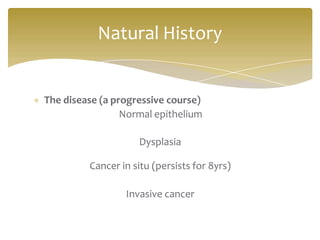
The disease (a progressive course)
Normal epithelium
Dysplasia
Cancer in situ (persists for 8yrs)
Invasive cancer
Natural History
Causative agnt
Human papiloma virus-sexually transmitted-cancer
This virus is found in more then 95% of the cancers
Age-
Affects relatively young women
Age of 25-45 yrs has increased incidence
Genital warts
Past or present occurrence of clinical genital warts has
been found to be a important risk factor
Early marriage
Early marriage, early coitus, early childbearing and
repeated childbirth have increased risk
Risk Factor
Oral contraceptive pills
Using of pills can cause cancer of cervix
It is because of high level of estrogen
Socio-economic class
More common in lower socio-economic groups
It is because of poor genital hygiene
Primary Prevention
Personal hygiene and birth control
Secondary Prevention
Early detect of cases through screening
Treatment by radical surgery and radiotheropy
It is difficult to cure once the symptoms are develop
Prevention
Thank you…

cancer-ppt.pptx

  • 2.
    Contents… Introduction Problem statement In India Cancerpattern Environmental factors genetic factors Cancer control Breast cancer Cervical cancer
  • 3.
    Cancer may regardedas a group of diseases characterized by an Abnormal growth of cells Ability to invade tissue and even distant organs The eventually death of the affected patient if the tumor has progressed beyond the stage when it can be successfully removed Introduction
  • 4.
    Major categories ofcancer are Carcinoma Arises from the epithelial cells lining the internal surface of various organs (e.g. mouth, oesophagus, uterus) Sarcoma Arises from the mesodermal cells constituting the various connective tissues (e.g. fibrous tissue, bone) Lymphoma, myeloma and leukemia Arising from the cells of the bone marrow and immune system
  • 5.
    Worldwide Every year 10million people are diagnosed and more then 6 million die 22.4 million peoples were living with cancer in 2000 Most common cancer worldwide are Lungs cancer (12.3%) Breast cancer (10.4%) Colorectal cancer (9.4%) Problem statement
  • 6.
    Respiratory tract canceris most common site of cancer in India, Indonesia, srilanka and Thailand Cancer of cervix is most common in India and Indonesia Cancer associated with tobacco constitute 44.6% of cancer in men and 20% in female
  • 7.
    The four mostcommon cancer in India are Male-oropharynx, esophagus, stomach and lower respiratory tract Female-breast, cervix, oropharynx and esophagus Tabaco is used widely used in India 91% cases of oropharynx is due to Tabaco use 60% cases in female are breast, cervix and ovary cancer India…
  • 8.
    There are lotof international variations in the pattern of cancer which are attributed to a number of factors such as environmental factors food habit lifestyle genetic factor inadequacy in detection and reporting of cases Cancer patterns
  • 9.
    Tobacco Tobacco in variousforms of usage can cause cancer of lungs, larynx, mouth, pharynx, esophagus, bladder, pancreas and probably kidney Cigarette smoking is now responsible for more than 1 million death each year Alcohol Excess intake of alcohol can cause esophageal and liver cancer Beer consumption may be associated with rectal cancer Alcohol contributes about 3 % of all cancer deaths Environmental factors
  • 10.
    Dietary factor Smoked fishis related to stomach cancer Dietary fiber to intestinal cancer Beef consumption to bowel cancer High fat diet to breast cancer Food additives and contaminants have fallen under suspicion as causative agents
  • 11.
    Occupational exposures These includesexposure to benzene, cadmium, arsenic, chromium, vinyl chloride, asbestos, polycyclic hydrocarbons, etc. The risk of occupational exposure is said to be increased if the individual also smokes cigarette Occupational exposure is usually reported 1-5% of human cancer
  • 12.
    Virus Hepatitis B &C - hepatocarcinoma HIV infection – kaposi’s carcinoma AIDS – non Hodgkin’s lymphoma Epstein – bar virus – Burkitts lymphoma and naso – pharyngial carcinoma Cytomegalovirus – Kaposi’s Sa Pappiloma virus – cervix cancer Human T cell leukemia virus – T cell leukemia
  • 13.
    Parasite May be acause of cancer Schistosomiasis can produce Ca of bladder Customs, habits and life style May be associated with an increased risk of cancer Smoking and lung cancer Tobacco and beetle chewing and oral cancer
  • 14.
    Others Sunlight, radiation, waterand air pollution, medication and pesticides These are related to cancer as environmental factors
  • 15.
    Genetic influences havelong been suspected Retinoblastoma occurs in children of the same parent Mongols are more likely to develop leukemia There is probably a complex relationship between hereditary susceptibility and environmental carcinogenic stimuli in the causation of cancer Genetic factors
  • 16.
    It consists of prevention,detection, diagnosis, treatment, after care and rehabilitation, reducing incidence and prevalence Primary control Reducing the exposure to the risk factors Control of Tabaco and alcohol consumption Control of these two will reduce the total burden of cancer by 1 million cases per year Cancer control
  • 17.
    Personal hygiene Improvement inhygiene may decline the incidence of certain types of cancers Radiation Effort should be made to reduce the amount of radiation received by each individuals to a minimum without reducing the benefits Occupational Exposure Should protect workers from exposure to industrial carcinogens

  • 18.
    Food, drugs, andcosmetics Should be tested for carcinogens Air pollutions Control of air pollution is a preventive measure Treatment of pre cancerous lesions Early detection and prompt treatment of precanerous lesions Legislation It comes under primary prevention
  • 19.
    Cancer Education Should bedirected in high risk groups To motivate people for early diagnosis and treatment Remind early warning symptoms A lump or hard area in the breast A change in a wart or mole A persistent change in digestive and bowel habits A persistent cough or hoarseness Excessive loss of blood at the monthly period or loss of blood outside the usual dates Blood loss from any natural orifice A swelling or sore that does not get better Unexplained loss of weight
  • 20.
    Cancer registration Hospital-based registries Populationbased registries Early detection of cases Treatment Secondary Prevention
  • 21.
  • 22.
    Commonest cause ofdeath in middle aged women Causes 5,19,000 deaths a year worldwide About 9 lakh women are diagnosed every year Mortality rates have increased during the past 60 years in all countries
  • 23.
    Age Uncommon below theage of 35 Incidence increased rapidly between ages of 35 and 50 There is a dip in incidence at the time of menopause A secondary rise in frequency occurs after the age of 65 Women who developed their first breast cancer under the age of 40 have 3 times the risk of developing a second breast cancer Mean age of occurrence in Indian women is 42 Risk factors
  • 24.
    Family history High inthose with positive history in their family Esp. if mother or sister has developed breast cancer when premenopausal Parity Related to age at which women bear their first child Those who had their first child in the late thirties are at a higher risk than multiparous women Unmarried women tend to have more breast tumors than married Single women and nulliparous women have the same risk
  • 25.
    Age at menarcheand menopause Early menarche and late menopause are risk factors Risk is reduced for those with surgically induced menopause Forty or more years of menstruation doubles the risk of breast cancer as compared with 30 years
  • 26.
    Hormonal factor Elevated levelsof estrogen and progesteron are important factor in increasing breast cancer risk Prior breast biopsy Prior breast biopsy for beningn breast diseases is associated with increased risk of breast cancer Diet Breast cancer can be linked with high fat diet and obesity
  • 27.
    Socio-economic status It ishigher in socio-economic groups Age factor Other Radiation Women exposed to radiation may develop breast cancer Oral contraceptic pills Prolonged use of pills before first pregnancy and before the age of 25yrs can cause breast cancer
  • 28.
    Primary Prevention Aim shouldbe towards elimination of risk factors Promotion of cancer education Increase the average of menarche by reducing childhood obesity and increased stannous physical activities Or decrease the frequency of ovulation by increased stannous physical activities Prevention
  • 29.
    Secondary Prevention Screening leadsto early diagnosis which influences treatment To detect recurrence as early as possible To detect cancer in opposite breast at an early stage To generate research data that might be usefull
  • 30.
  • 31.
    Second most commondisease in women 5,24,000 estimated new cases in in 1995 Most common in developing countries Which accounts around 80% of cases Cases and death rates are declined markedly in the last 40 yrs due to reduction of the risk factors and extensive screening programs
  • 32.
    The disease (aprogressive course) Normal epithelium Dysplasia Cancer in situ (persists for 8yrs) Invasive cancer Natural History
  • 33.
    Causative agnt Human papilomavirus-sexually transmitted-cancer This virus is found in more then 95% of the cancers
  • 34.
    Age- Affects relatively youngwomen Age of 25-45 yrs has increased incidence Genital warts Past or present occurrence of clinical genital warts has been found to be a important risk factor Early marriage Early marriage, early coitus, early childbearing and repeated childbirth have increased risk Risk Factor
  • 35.
    Oral contraceptive pills Usingof pills can cause cancer of cervix It is because of high level of estrogen Socio-economic class More common in lower socio-economic groups It is because of poor genital hygiene
  • 36.
    Primary Prevention Personal hygieneand birth control Secondary Prevention Early detect of cases through screening Treatment by radical surgery and radiotheropy It is difficult to cure once the symptoms are develop Prevention
  • 37.