FEBRUARY 4
World cancer day
THEME: CLOSE THE CARE GAP
AMEENA KADAR K.A
Dept. of Pharmacy Practice
Sanjo College of Pharmaceutical Studies
What is Cancer?
 Cancer is a large group of diseases that can start in almost any organ or
tissue of the body when abnormal cells grow uncontrollably, go beyond
their usual boundaries to invade adjoining parts of the body and/or
spread to other organs.
 A neoplasm and malignant tumor are other common names for cancer.
 Cancer is the second leading cause of death globally, accounting for an
estimated 9.6 million deaths, or one in six deaths.
Most Common cancers are:
Cervical Cancer
Bladder Cancer
Breast Cancer
Colon and Rectal Cancer
Endometrial Cancer
Kidney Cancer
Leukemia
Liver
Lung Cancer
Hodgkin Lymphoma
Pancreatic Cancer
Prostate Cancer
Thyroid Cancer
Skin Cancer
EPIDEMIOLOGY
 One woman dies of cervical cancer every 8 minutes in India.
 For every 2 women newly diagnosed with breast cancer, one woman dies of it in India.
 Mortality due to tobacco use in India is estimated at upwards of 3500 persons every day.
 Tobacco (smoked and smokeless) use accounted for 3,17,928 deaths (approx) in men and
women in 2018.
 Estimated number of people with cancer: around 2.7 million (2020)
 Every year, new cancer patients registered: 13.9 lakhs
 Cancer-related deaths: 8.5 lakhs
 Cancers of oral cavity, stomach and lungs account for over 25% of cancer deaths in males
and cancer of uterine cervix, breast and oral cavity account for 25% cancers in females.
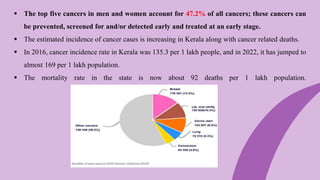
 The top five cancers in men and women account for 47.2% of all cancers; these cancers can
be prevented, screened for and/or detected early and treated at an early stage.
 The estimated incidence of cancer cases is increasing in Kerala along with cancer related deaths.
 In 2016, cancer incidence rate in Kerala was 135.3 per 1 lakh people, and in 2022, it has jumped to
almost 169 per 1 lakh population.
 The mortality rate in the state is now about 92 deaths per 1 lakh population.
CAUSES OF CANCER
 Cancer arises from the transformation of normal cells into tumor cells in a multi-stage process
that generally progresses from a pre-cancerous lesion to a malignant tumor.
 These changes are the result of the interaction between a person's genetic factors and three
categories of external agents, including:
 Physical carcinogens, such as ultraviolet and ionizing radiation
 Chemical carcinogens, such as asbestos, components of tobacco smoke, alcohol, aflatoxin (a
food contaminant), and arsenic (a drinking water contaminant)
 Biological carcinogens, such as infections from certain viruses, bacteria, or parasites.
 WHO, through its cancer research agency, the International Agency for Research on Cancer (IARC),
maintains a classification of cancer-causing agents.
 The incidence of cancer rises dramatically with age, most likely due to a build-up of risks for specific
cancers that increase with age.
 The overall risk accumulation is combined with the tendency for cellular repair mechanisms to be
less effective as a person grows older.
RISK FACTORS
 Approximately 13% of cancers diagnosed in 2018 globally were attributed to carcinogenic
infections, including Helicobacter pylori, human papillomavirus (HPV), hepatitis B virus, hepatitis
C virus, and Epstein-Barr virus.
 Hepatitis B and C viruses and some types of HPV increase the risk for liver and cervical cancer,
respectively.
 Infection with HIV increases the risk of developing cervical cancer six-fold and substantially
increases the risk of developing select other cancers such as Kaposi sarcoma.
PATHOPHYSIOLOGY
PREVENTION OF CANCER
DIAGNOSIS
 Cancer mortality is reduced when cases are detected and treated early.
 There are two components of early detection: early diagnosis and screening.
 Early diagnosis
Early diagnosis consists of three components:
1. Being aware of the symptoms of different forms of cancer and of the importance of seeking medical
advice when abnormal findings are observed
2. Access to clinical evaluation and diagnostic services
3. Timely referral to treatment services.
 Early diagnosis of symptomatic cancers is relevant in all settings and the majority of cancers.
 Screening
 Screening aims to identify individuals with findings suggestive of a specific cancer or pre-cancer
before they have developed symptoms.
 Screening programs are effective for some but not all cancer types and in general are far more
complex and resource-intensive than early diagnosis as they require special equipment and
dedicated personnel.
 Examples of screening methods are:
 HPV test (including HPV DNA and mRNA test), as preferred modality for cervical cancer
screening
 Mammography screening for breast cancer for women aged 50–69 residing in settings with strong
or relatively strong health systems.
TREATMENT OF CANCER
Palliativecare
 Palliative care is treatment to relieve, rather than cure, symptoms and suffering caused by cancer
and to improve the quality of life of patients and their families.
 Palliative care can help people live more comfortably.
 Relief from physical, psychosocial, and spiritual problems through palliative care is possible for
more than 90% of patients with advanced stages of cancer.
 Effective public health strategies, comprising community- and home-based care, are essential to
provide pain relief and palliative care for patients and their families.
 Improved access to oral morphine is strongly recommended for the treatment of moderate to severe
cancer pain, suffered by over 80% of people with cancer in the terminal phase.
BREAST CANCER
CERVICAL CANCER
LATEST INFO
• A study in India has found that an ultra-low dose of
the immunotherapy drug nivolumab (Opdivo) helped people
with advanced head and neck cancer live longer.
• And because the dose is 6% of what’s typically used in the
United States and Europe, it is potentially more affordable.
ROLE OF PHARMACIST IN CANCER MANAGEMENT
Let your faith be bigger than your fear
Thank you!

cancer day.pptx

  • 1.
    FEBRUARY 4 World cancerday THEME: CLOSE THE CARE GAP AMEENA KADAR K.A Dept. of Pharmacy Practice Sanjo College of Pharmaceutical Studies
  • 2.
    What is Cancer? Cancer is a large group of diseases that can start in almost any organ or tissue of the body when abnormal cells grow uncontrollably, go beyond their usual boundaries to invade adjoining parts of the body and/or spread to other organs.  A neoplasm and malignant tumor are other common names for cancer.  Cancer is the second leading cause of death globally, accounting for an estimated 9.6 million deaths, or one in six deaths.
  • 3.
    Most Common cancersare: Cervical Cancer Bladder Cancer Breast Cancer Colon and Rectal Cancer Endometrial Cancer Kidney Cancer Leukemia Liver Lung Cancer Hodgkin Lymphoma Pancreatic Cancer Prostate Cancer Thyroid Cancer Skin Cancer
  • 4.
    EPIDEMIOLOGY  One womandies of cervical cancer every 8 minutes in India.  For every 2 women newly diagnosed with breast cancer, one woman dies of it in India.  Mortality due to tobacco use in India is estimated at upwards of 3500 persons every day.  Tobacco (smoked and smokeless) use accounted for 3,17,928 deaths (approx) in men and women in 2018.  Estimated number of people with cancer: around 2.7 million (2020)  Every year, new cancer patients registered: 13.9 lakhs  Cancer-related deaths: 8.5 lakhs  Cancers of oral cavity, stomach and lungs account for over 25% of cancer deaths in males and cancer of uterine cervix, breast and oral cavity account for 25% cancers in females.
  • 5.
     The topfive cancers in men and women account for 47.2% of all cancers; these cancers can be prevented, screened for and/or detected early and treated at an early stage.  The estimated incidence of cancer cases is increasing in Kerala along with cancer related deaths.  In 2016, cancer incidence rate in Kerala was 135.3 per 1 lakh people, and in 2022, it has jumped to almost 169 per 1 lakh population.  The mortality rate in the state is now about 92 deaths per 1 lakh population.
  • 6.
    CAUSES OF CANCER Cancer arises from the transformation of normal cells into tumor cells in a multi-stage process that generally progresses from a pre-cancerous lesion to a malignant tumor.  These changes are the result of the interaction between a person's genetic factors and three categories of external agents, including:  Physical carcinogens, such as ultraviolet and ionizing radiation  Chemical carcinogens, such as asbestos, components of tobacco smoke, alcohol, aflatoxin (a food contaminant), and arsenic (a drinking water contaminant)  Biological carcinogens, such as infections from certain viruses, bacteria, or parasites.
  • 7.
     WHO, throughits cancer research agency, the International Agency for Research on Cancer (IARC), maintains a classification of cancer-causing agents.  The incidence of cancer rises dramatically with age, most likely due to a build-up of risks for specific cancers that increase with age.  The overall risk accumulation is combined with the tendency for cellular repair mechanisms to be less effective as a person grows older.
  • 9.
    RISK FACTORS  Approximately13% of cancers diagnosed in 2018 globally were attributed to carcinogenic infections, including Helicobacter pylori, human papillomavirus (HPV), hepatitis B virus, hepatitis C virus, and Epstein-Barr virus.  Hepatitis B and C viruses and some types of HPV increase the risk for liver and cervical cancer, respectively.  Infection with HIV increases the risk of developing cervical cancer six-fold and substantially increases the risk of developing select other cancers such as Kaposi sarcoma.
  • 11.
  • 12.
  • 14.
    DIAGNOSIS  Cancer mortalityis reduced when cases are detected and treated early.  There are two components of early detection: early diagnosis and screening.  Early diagnosis Early diagnosis consists of three components: 1. Being aware of the symptoms of different forms of cancer and of the importance of seeking medical advice when abnormal findings are observed 2. Access to clinical evaluation and diagnostic services 3. Timely referral to treatment services.  Early diagnosis of symptomatic cancers is relevant in all settings and the majority of cancers.
  • 15.
     Screening  Screeningaims to identify individuals with findings suggestive of a specific cancer or pre-cancer before they have developed symptoms.  Screening programs are effective for some but not all cancer types and in general are far more complex and resource-intensive than early diagnosis as they require special equipment and dedicated personnel.  Examples of screening methods are:  HPV test (including HPV DNA and mRNA test), as preferred modality for cervical cancer screening  Mammography screening for breast cancer for women aged 50–69 residing in settings with strong or relatively strong health systems.
  • 17.
  • 18.
    Palliativecare  Palliative careis treatment to relieve, rather than cure, symptoms and suffering caused by cancer and to improve the quality of life of patients and their families.  Palliative care can help people live more comfortably.  Relief from physical, psychosocial, and spiritual problems through palliative care is possible for more than 90% of patients with advanced stages of cancer.  Effective public health strategies, comprising community- and home-based care, are essential to provide pain relief and palliative care for patients and their families.  Improved access to oral morphine is strongly recommended for the treatment of moderate to severe cancer pain, suffered by over 80% of people with cancer in the terminal phase.
  • 19.
  • 20.
  • 21.
    LATEST INFO • Astudy in India has found that an ultra-low dose of the immunotherapy drug nivolumab (Opdivo) helped people with advanced head and neck cancer live longer. • And because the dose is 6% of what’s typically used in the United States and Europe, it is potentially more affordable.
  • 22.
    ROLE OF PHARMACISTIN CANCER MANAGEMENT
  • 23.
    Let your faithbe bigger than your fear
  • 24.