WELCOME TO SDN NATION
SDN TECHNOLOGY EVOLVEMENT
Telkom University, August 2017
Stanford University – Clean Slate Project
“…explore what kind of Internet we would design if we were to start with a
clean slate and 20-30 years of hindsight.”
http://cleanslate.stanford.edu
With SDN, Control
Plane is separated
from the physical
device
NOT ALL PROCESSING HAPPENS INSIDE DEVICE
In “traditional” network
Control Plane and Data
Plane reside in the
same physical device
Software	defined	networking	(SDN) is	an	approach	to	computer	
networking	that	allows	network	administrators	to	manage	network	
services	through	abstraction	of	lower-level	functionality
What	is	SDN?
(per	Wikipedia	definition)
SDN	is	not	(only)	OpenFlow,	but	for	most	people	that’s	how	it	started
FOUR PARTS OF OPENFLOW
• Controller – resides on a server
and provides control plane
function for the network
• OpenFlow Agent – resides on a
network devices and fulfill
requests from the Controller
• Northbound APIs – enable
applications to interface with the
Controller
• OpenFlow Protocol – the Layer 2
protocol that the Controller and
Agents use to communicate
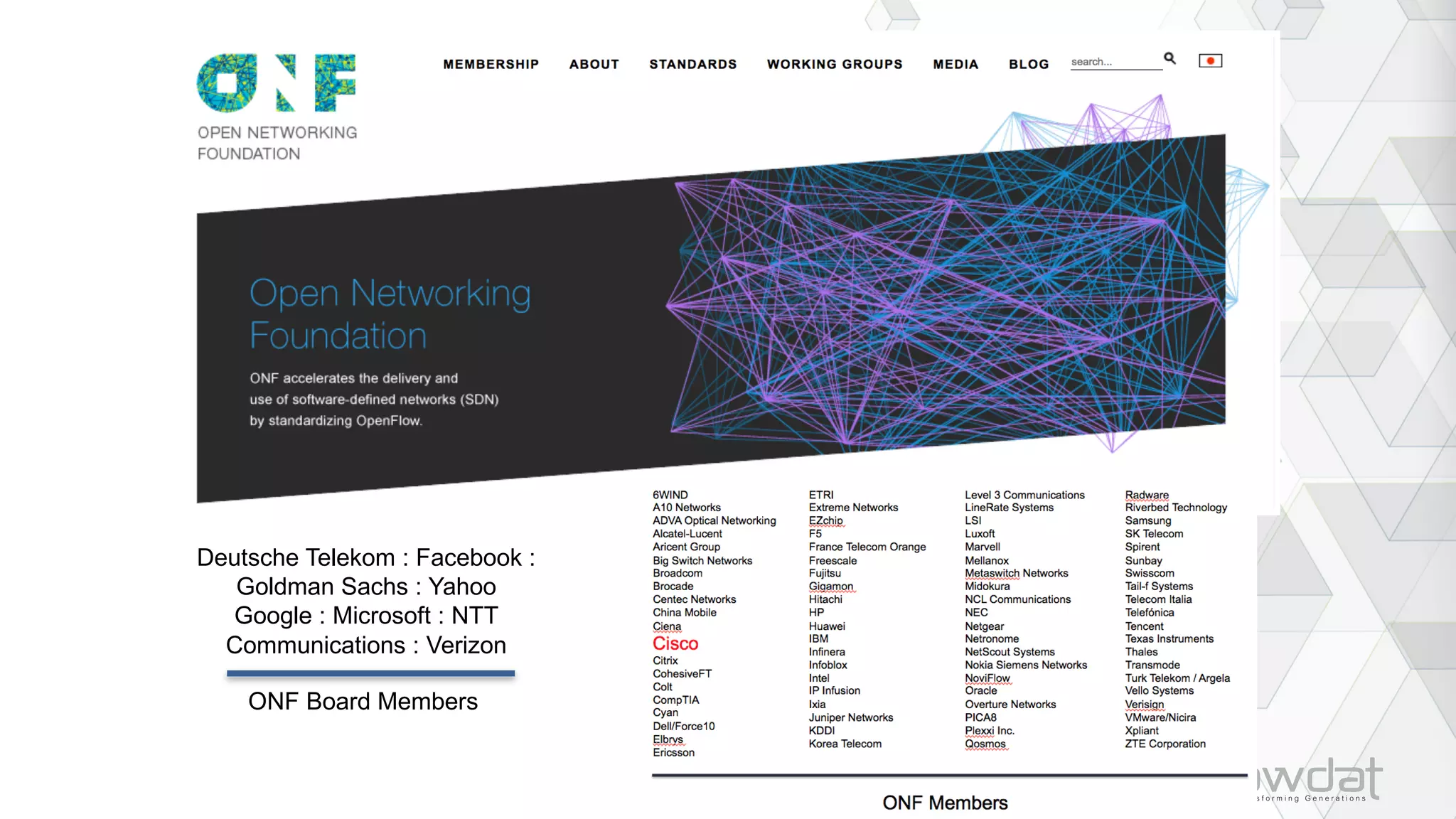
ONF Board Members
Deutsche Telekom : Facebook :
Goldman Sachs : Yahoo
Google : Microsoft : NTT
Communications : Verizon
OPENDAYLIGHT SDN CONTROLLER
OpenFlow-enabled	
devices	that	are	
configured	to	this	
controller	
automatically	show	
up	in	the	topology
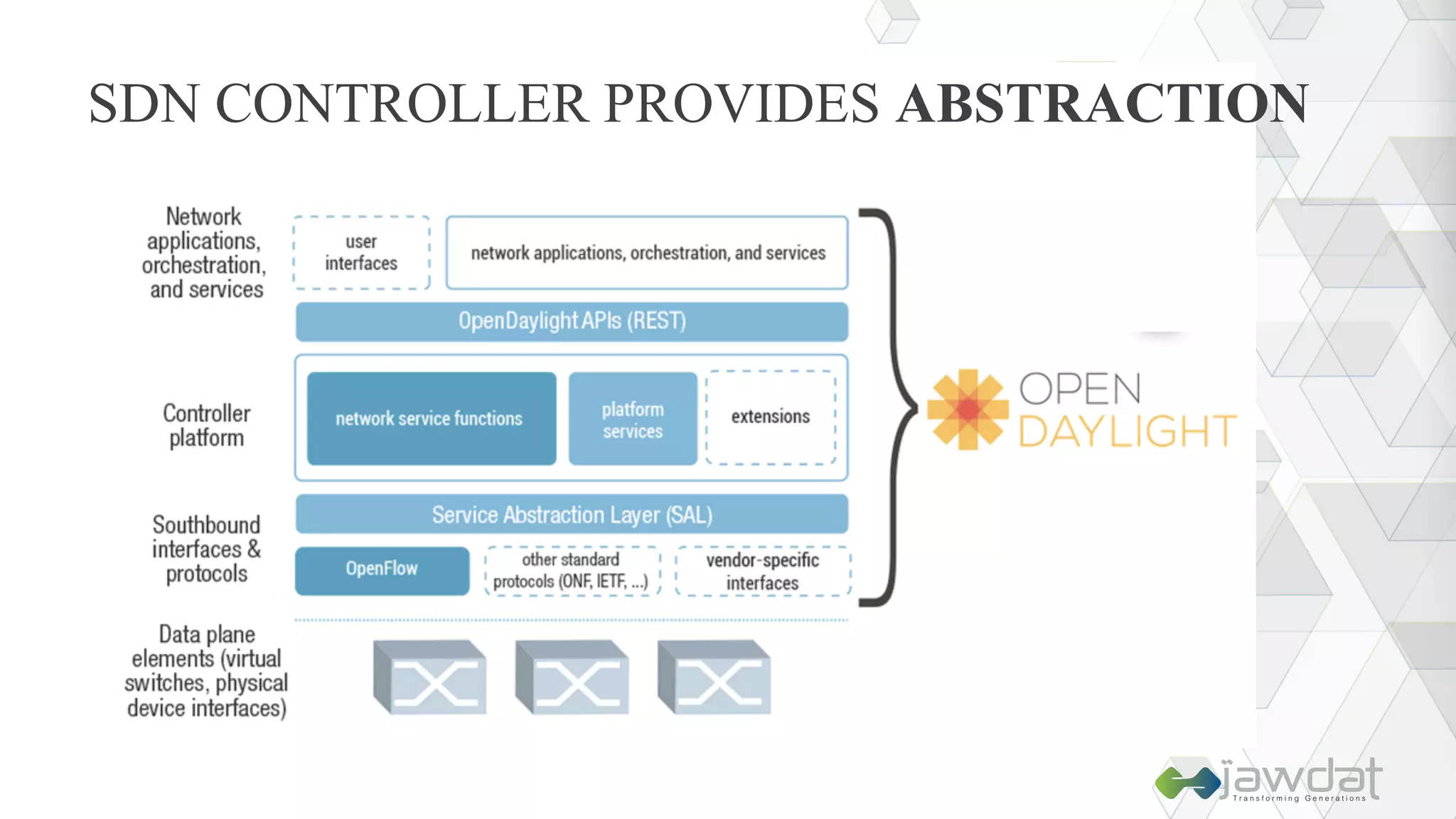
SDN CONTROLLER PROVIDES ABSTRACTION
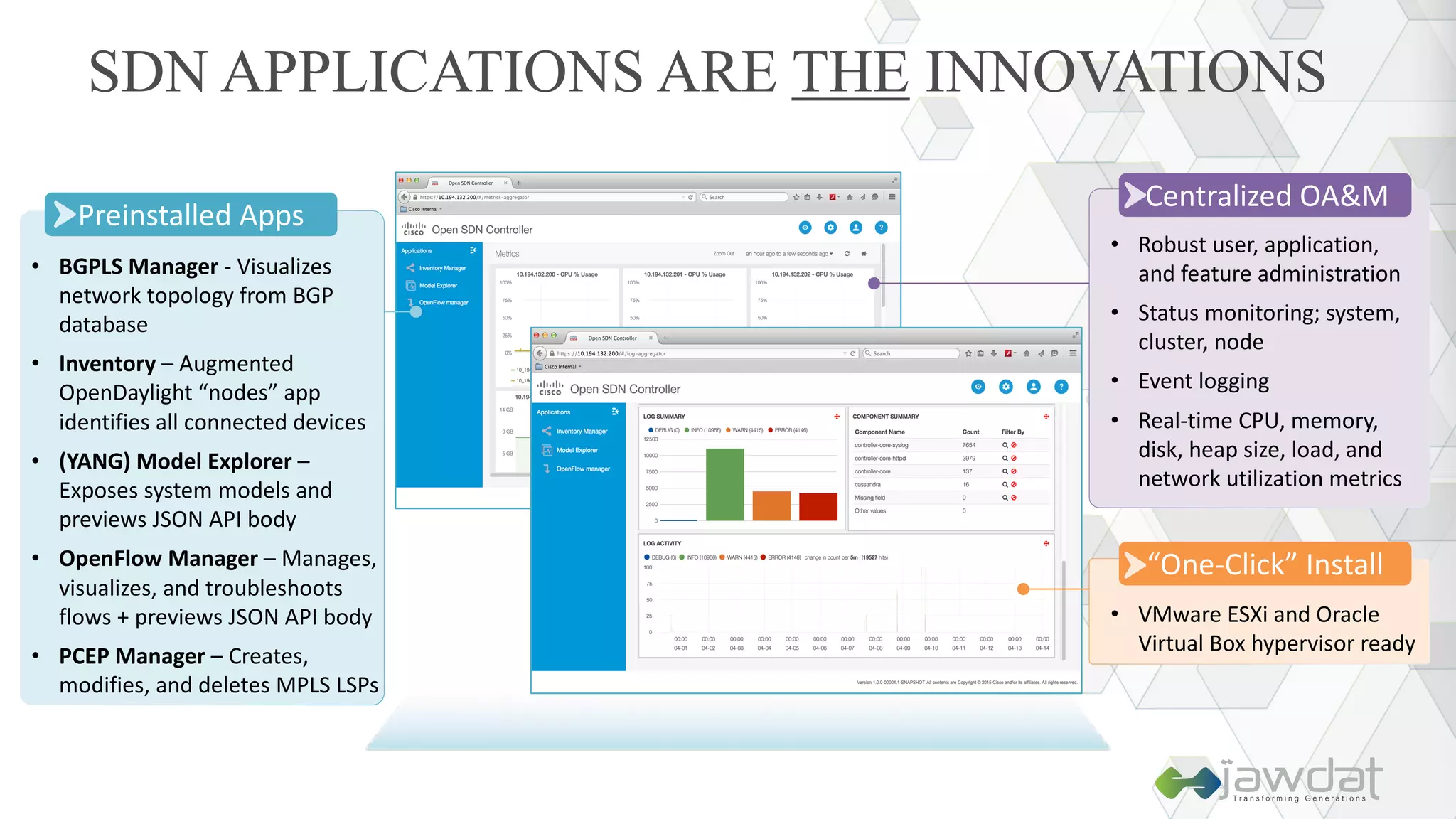
Preinstalled	Apps
• BGPLS	Manager - Visualizes	
network	topology	from	BGP	
database
• Inventory – Augmented	
OpenDaylight	“nodes”	app	
identifies	all	connected	devices
• (YANG)	Model	Explorer –
Exposes	system	models	and	
previews	JSON	API	body	
• OpenFlow	Manager – Manages,	
visualizes,	and	troubleshoots	
flows	+	previews	JSON	API	body
• PCEP	Manager – Creates,	
modifies,	and	deletes	MPLS	LSPs
Centralized	OA&M
• Robust	user,	application,	
and	feature	administration
• Status	monitoring;	system,	
cluster,	node
• Event	logging
• Real-time	CPU,	memory,	
disk,	heap	size,	load,	and	
network	utilization	metrics
“One-Click”	Install
• VMware	ESXi	and	Oracle	
Virtual	Box	hypervisor	ready	
SDN APPLICATIONS ARE THE INNOVATIONS
Urs	Holzle,	Senior	Vice	President	of	Technology	Infrastructure	at	Google
speaking	in	a	keynote	at	the	
second	annual	Open	Networking	Summit	(April	2012)
http://www.eetimes.com/electronics-news/4371179/Google-describes-its-OpenFlow-network
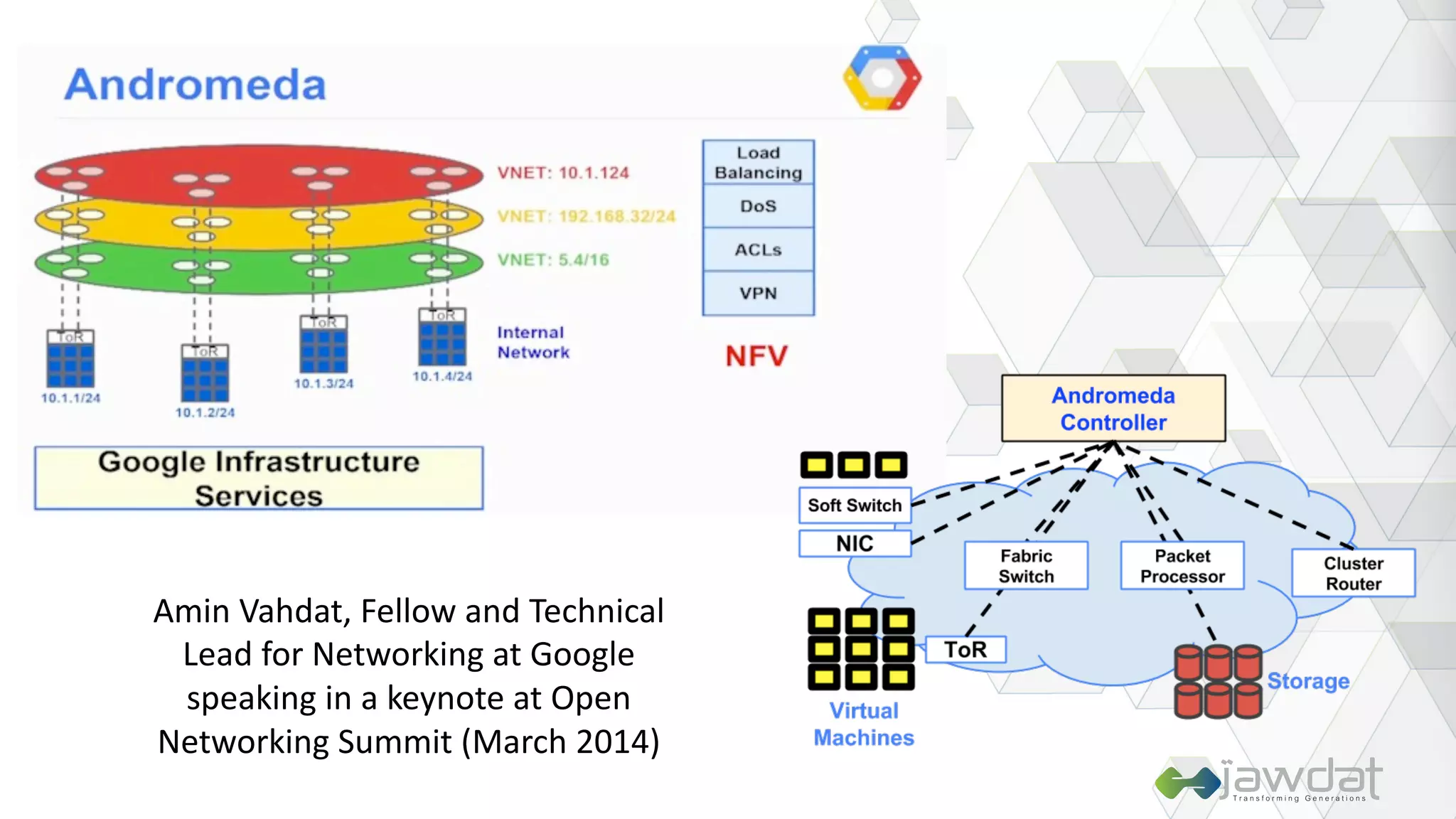
Amin	Vahdat,	Fellow	and	Technical	
Lead	for	Networking	at	Google
speaking	in	a	keynote	at	Open	
Networking	Summit	(March	2014)
Controller
Data Plane
Applications
Open APIs
OpenFlow,
PCEP,
I2RS,
Netconf
2a Pure SDN
Vendor
Specific
(e.g. Nexus

API)
Applications
Virtual Switch
Overlays
Overlay
Protocols
(e.g. VXLAN)
Open APIs
3 Overlays Networks
Control Plane
Data Plane
Overlays
Vendor-
specific APIs
Applications
1 Programmable APIs
Control Plane
Data Plane
Vendor
Specific
(e.g. Nexus
API)
Controller
Data Plane
Applications
Open APIs
OpenFlow,
PCEP,
I2RS,
Netconf
Control Plane
2b Hybrid SDN
Vendor
Specific
(e.g. Nexus
API)
Control Plane
Data Plane
CLI,
SNMP,
Netflow,
…
Applications
(Network Mgmt,
Monitoring, …)
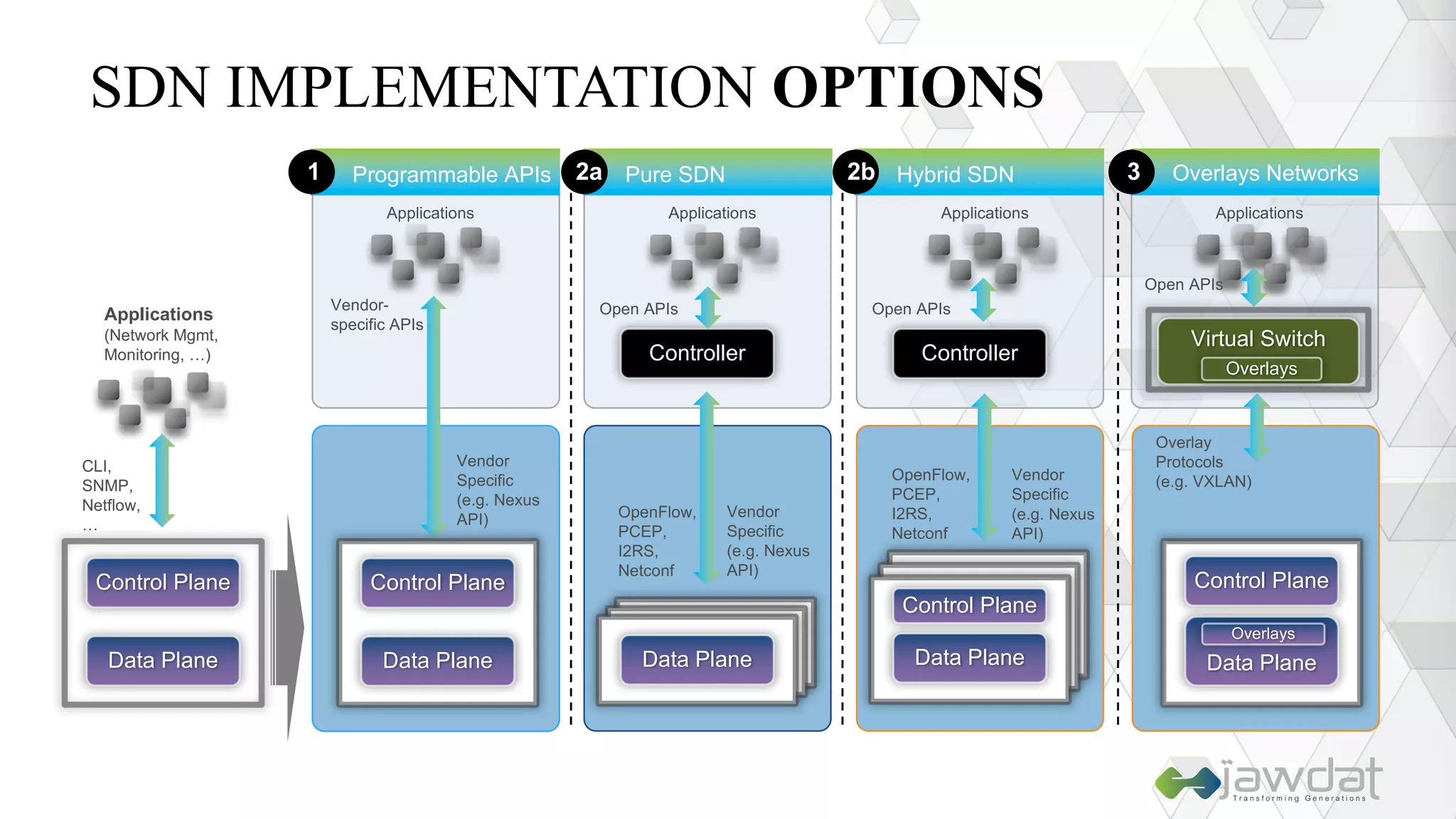
SDN IMPLEMENTATION OPTIONS
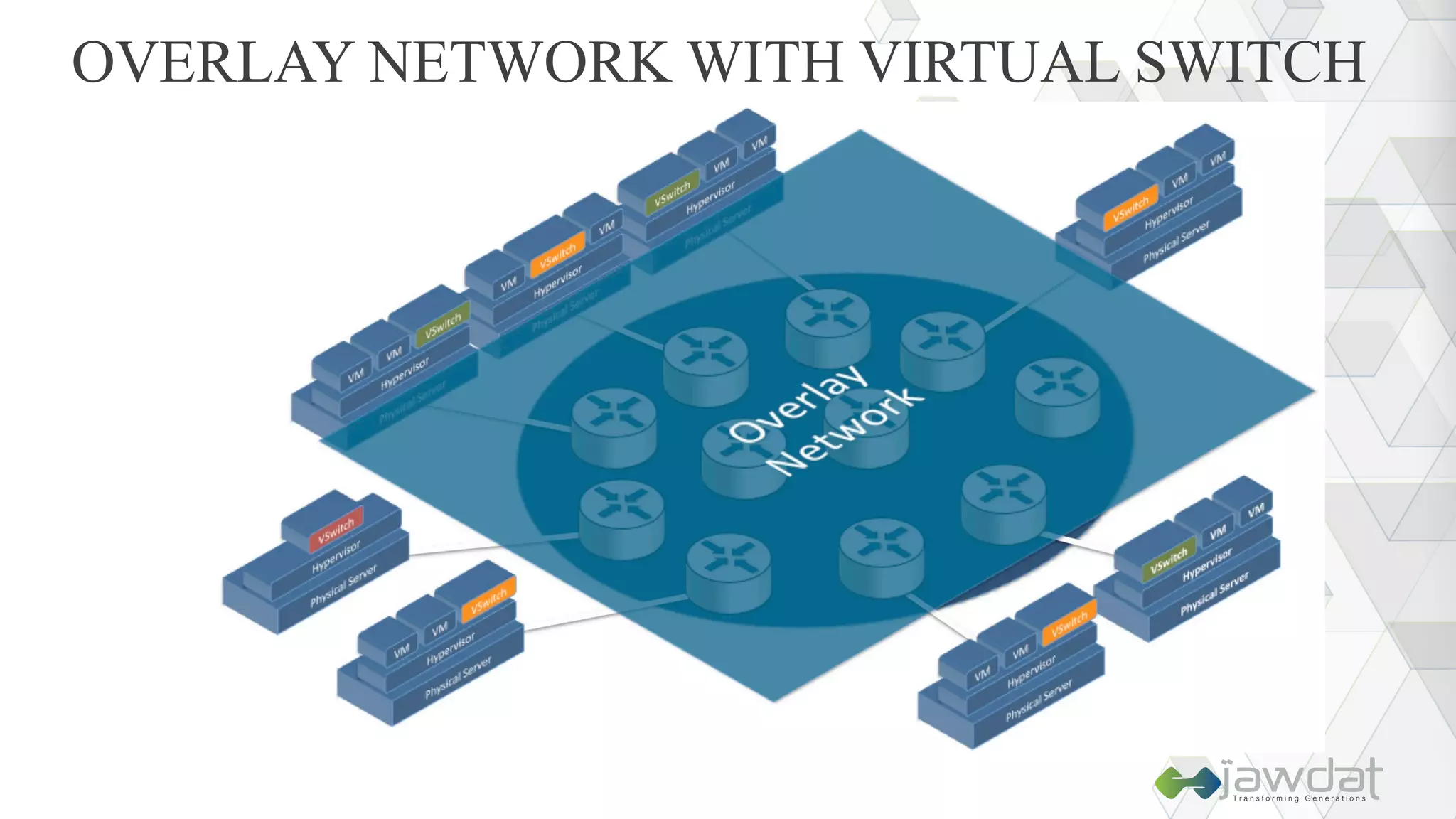
Logical	“switch”	devices	overlay	the	
physical	network
Underlying	physical	network	carries	data	
traffic	for	overlay	network
They	define	their	own	topology
OVERLAY 101
OVERLAY NETWORK WITH VIRTUAL SWITCH
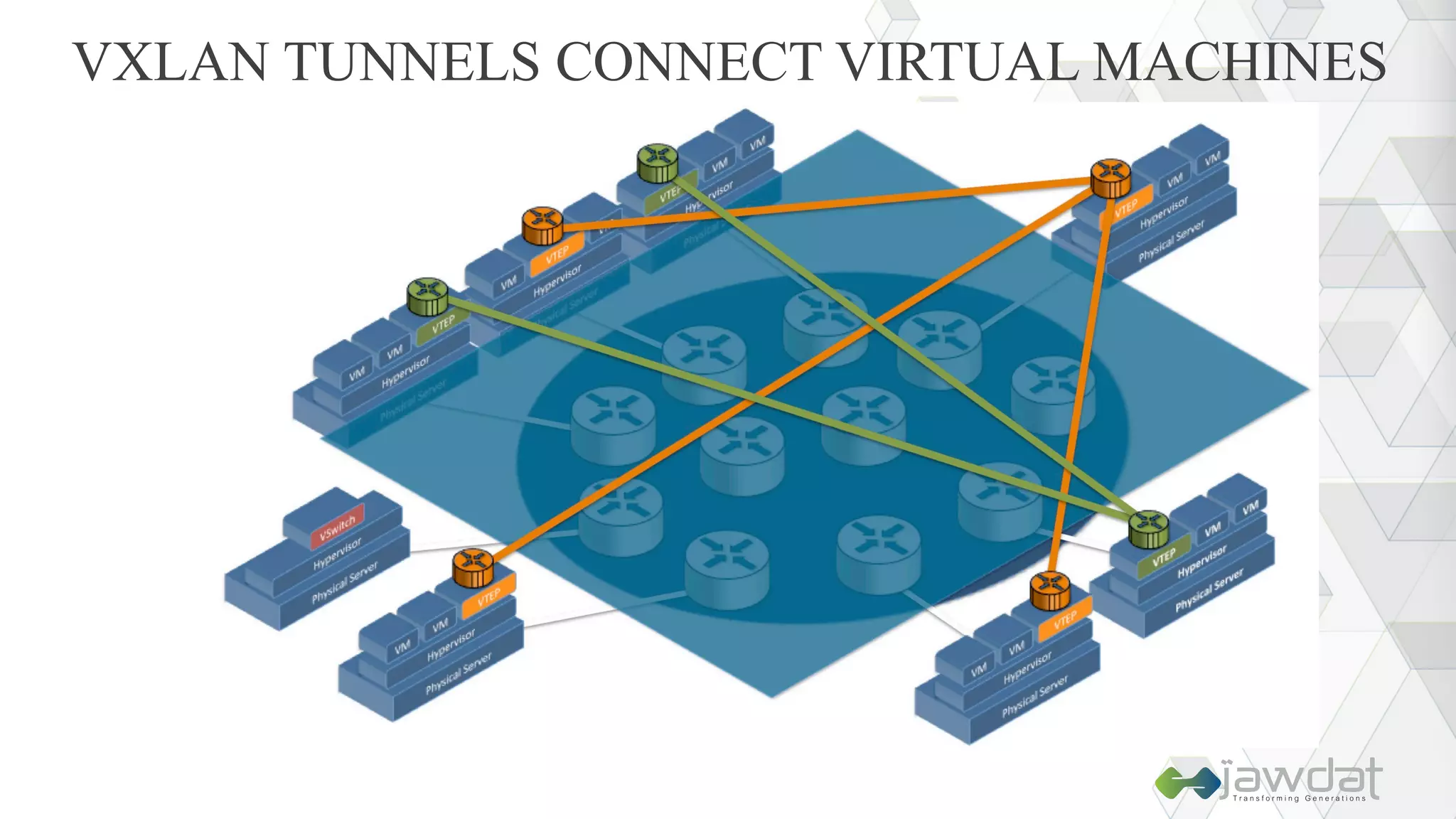
VXLAN TUNNELS CONNECT VIRTUAL MACHINES
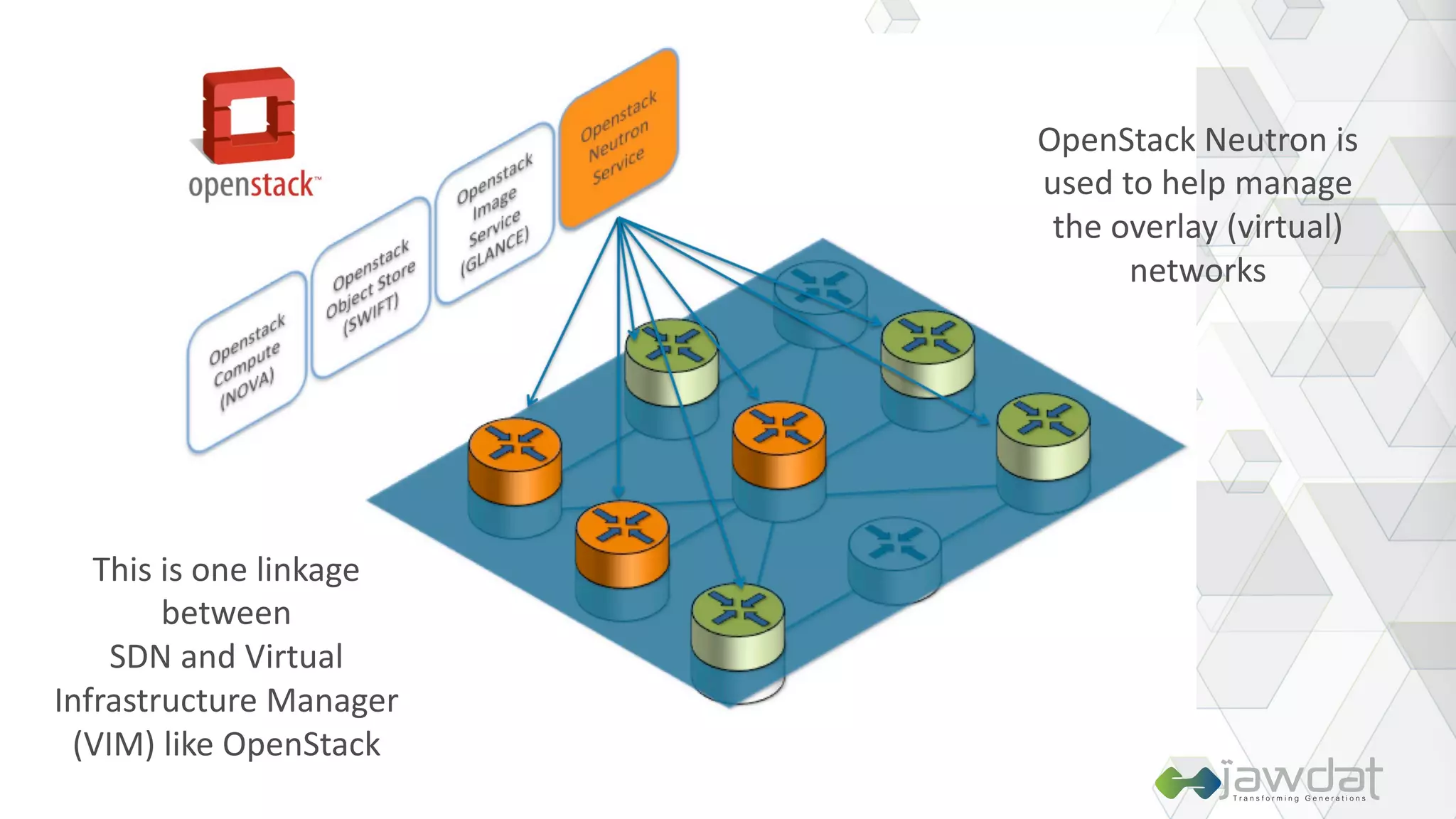
OpenStack	Neutron	is	
used	to	help	manage	
the	overlay	(virtual)	
networks
This	is	one	linkage	
between
SDN	and	Virtual	
Infrastructure	Manager	
(VIM)	like	OpenStack
NETWORK FUNCTIONS VIRTUALIZATION:
WHY, HOW, WHEN?
Disaggregation	of	
Network	Functions	from	
the	underlying	Hardware
Network Functions running inside VM on
x86 Server Platform (Virtual Network Functions)
NAT
VM
Firewall
VM
SBC
VM
dDOS
VM
Virus
Scan
VM
IPS
VM
DPI
VM
CGN
VM
Portal
VM
PCRF
VM
DNS
VM
DHCP
VM
BRAS
VM
SDN
Control
VM
RaaS
VM
WLC
VM
WAAS
VM
CDN
VM
Caching
VM
NMS
VM
Hardware
(x86	Server)
Cloud	Operating	
System
Virtual	Network	
Functions
Existing	Hardware	/	Appliance
based	Network	Functions	(PNFs)
Hardware
(ASIC/NPU/GPU)
Operating	System
Apps	
(e.g.	Routing)
How?Why?
• Hypervisor	&	cloud	technology
• Improving	x86	h/w	performance
• SDN	based	orchestration
• Speed	and	Agility
• Monetization	with	new	services
• Reduced	total	cost	of	ownership
When?
• Performance	Requirements
• Physical	Design	Requirements
• Economics	of	on-boarding
Depends On
18
• e.g.	IPv6/v4,	MPLS,	VPNs,	Optical
• High	throughput	/	BW
• Stateless	functions
• Mostly	predictable	traffic
• Many	flows	needing	isolation,	significant	traffic	
management	needed
• Interface-specific	functions	(2-stage	forwarding)
Network	
Forwarding	(L0-
3)
• e.g.	DPI,	FW,	CGN,	BNG,	Mobility	S/PGW,	AAA,	DNS,	
DDOS
• Low	to	Med	Throughput	
• Stateful	functions
• Unpredictable	traffic
• #	of	flows	(traffic	management)	– varies
• No	interface-specific	functions
Network	
Services						
(L4+)
Better fit for NPU
Compute
Bandwidth
Better fit for x86
(Virtualization)
Compute
Bandwidth
VIRTUALIZING NETWORK FUNCTIONS
X86 VS. CUSTOM CPU
(MANO)
Virtualized	Network	
Function,	actual	NF	
application	(ex.	vFR,	
vCPE,vLB)
Traditional	Element	
Manager	
Virtualisation layer,	
Server	(hypervisor),	
Network,	Storage
Physical	
hardware
Resource	Mgr,	
Operations
Lifecycle	mgmt for	VNFs	
(upgrade,	scale,	
termination,	etc.)
Orchestration	of	overall	
solution
Deployment	templates,	
forwarding	graph,	service-related	
information
OSS	(CMDB,	Montoring,	
Alarming,	IPAM/DNS/DHCP)
BSS	(CRM,	Billing,	Order	
Mgmt)
ETSI NFV REFERENCE ARCHITECTURE
Jawdat Juragan
SAMPLE PRODUCTS MAPPED TO ETSI NFV
VMware Big
Switch
VNF Manager
Service,	VNF	and	
Infrastructure	
Description
Service	Catalog
Cisco	Network	Services	Orchestrator	(Based	on	Tail-F	NCS)
VNF	Library	(sample	list)
SP’s	Existing	
OSS/Catalog
OpenStack
CSR1kvCSR1kv
CSR1kv
NFF
3rd Party	
vNFASAvASAv
ASAv
QvPC SIQvPC SI
vWAAS
QvPC DIQvPC DI
vWSA
Virtual	Infra.	
Managers	(VIM)
NFV
Orchestrator
Service	Lifecycle	Management Service	Provisioning
ODLCisco	APIC,	VTC
(Compute	and	Storage	VIMs)
Jawdat JongOS
Cisco	VNF	Manager
REST	API
Physical	&	
Virtual
Network
(Network	VIMs)
Service	Lifecycle	Management
(ESC)
OVS
Cisco	VTF,	VPP,	AVS
Software Defined Network
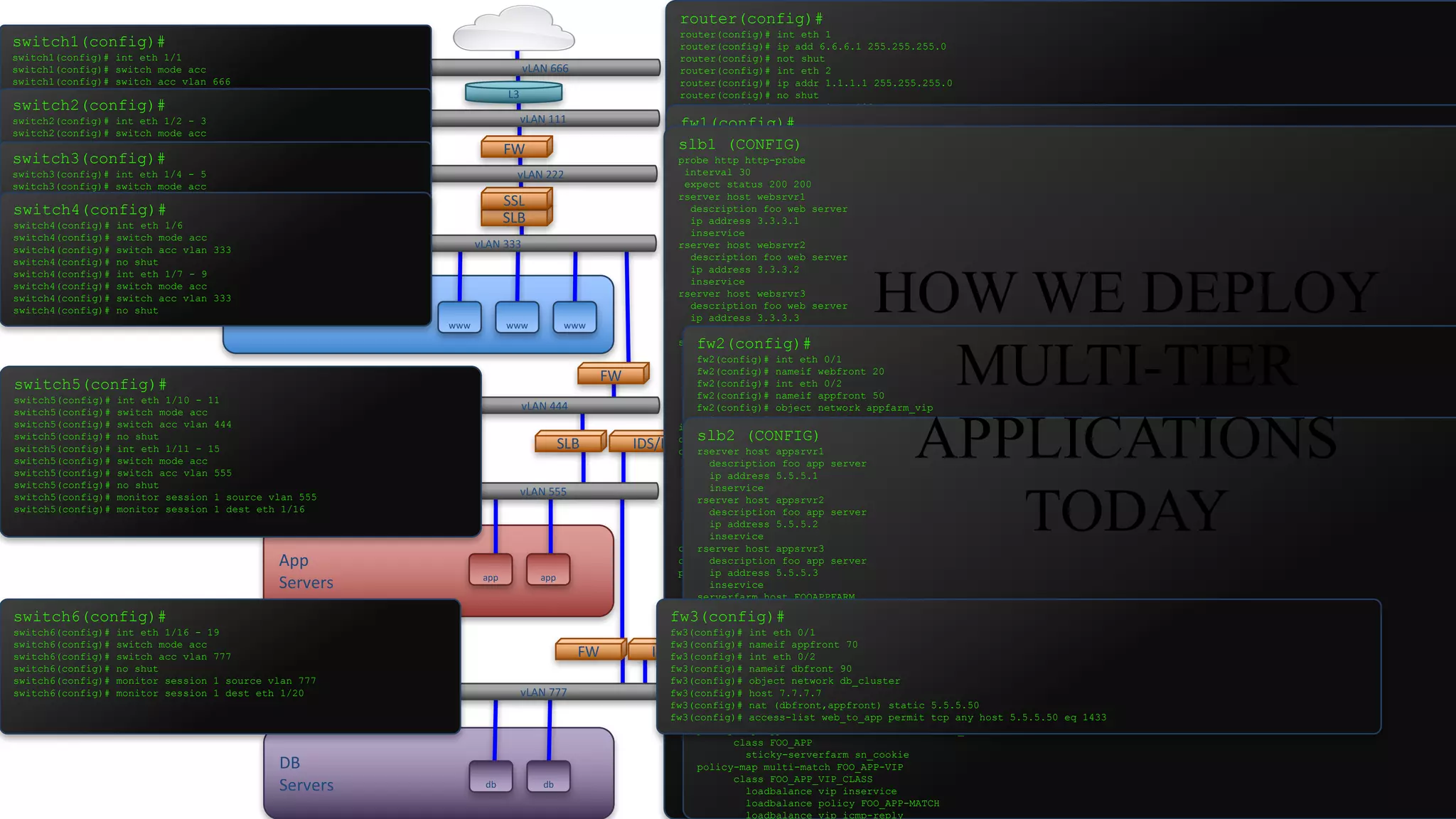
TRADITIONAL NETWORK HAS BECOME COMPLEX
Web	
Servers
vLAN	666
L3
FW
SLB
SSL
DB	
Servers
vLAN	111	
vLAN	222	
www www www
vLAN	444
App	
Servers
FW
SLB
app app
FW
db db
switch1(config)#
switch1(config)# int eth 1/1
switch1(config)# switch mode acc
switch1(config)# switch acc vlan 666
switch1(config)# no shut
router(config)#
router(config)# int eth 1
router(config)# ip add 6.6.6.1 255.255.255.0
router(config)# not shut
router(config)# int eth 2
router(config)# ip addr 1.1.1.1 255.255.255.0
router(config)# no shut
router(config)# router eigrp 100
router(config)# network 6.6.6.0 mask 255.255.255.0
router(config)# network 1.1.1.0 mask 255.255.255.0
router(config)# ip route 0.0.0.0 0.0.0.0 6.6.6.254
switch2(config)#
switch2(config)# int eth 1/2 - 3
switch2(config)# switch mode acc
switch2(config)# switch acc vlan 111
switch2(config)# no shut
fw1(config)#
fw1(config)# int eth 0/1
fw1(config)# nameif outside 0
fw1(config)# int eth 0/2
fw1(config)# nameif webfront 20
fw1(config)# object network webfront_vip
fw1(config)# host 6.6.6.6
fw1(config)# static (webfront,outside) 1.1.1.6
fw1(config)# access-list outside_web permit tcp any host 6.6.6.6 eq 80
fw1(config)# access-list outside_web permit tcp any host 6.6.6.6 eq 443
fw1(config)# access-group outside_web in interface outside
switch3(config)#
switch3(config)# int eth 1/4 - 5
switch3(config)# switch mode acc
switch3(config)# switch acc vlan 222
switch3(config)# no shut
vLAN	333	
switch4(config)#
switch4(config)# int eth 1/6
switch4(config)# switch mode acc
switch4(config)# switch acc vlan 333
switch4(config)# no shut
switch4(config)# int eth 1/7 - 9
switch4(config)# switch mode acc
switch4(config)# switch acc vlan 333
switch4(config)# no shut
IDS/IPS
vLAN	555
IDS/IPS
vLAN	777
switch5(config)#
switch5(config)# int eth 1/10 - 11
switch5(config)# switch mode acc
switch5(config)# switch acc vlan 444
switch5(config)# no shut
switch5(config)# int eth 1/11 - 15
switch5(config)# switch mode acc
switch5(config)# switch acc vlan 555
switch5(config)# no shut
switch5(config)# monitor session 1 source vlan 555
switch5(config)# monitor session 1 dest eth 1/16
switch6(config)#
switch6(config)# int eth 1/16 - 19
switch6(config)# switch mode acc
switch6(config)# switch acc vlan 777
switch6(config)# no shut
switch6(config)# monitor session 1 source vlan 777
switch6(config)# monitor session 1 dest eth 1/20
slb1 (CONFIG)
probe http http-probe
interval 30
expect status 200 200
rserver host websrvr1
description foo web server
ip address 3.3.3.1
inservice
rserver host websrvr2
description foo web server
ip address 3.3.3.2
inservice
rserver host websrvr3
description foo web server
ip address 3.3.3.3
inservice
serverfarm host FOOWEBFARM
probe http-probe
rserver websrvr1 80
inservice
rserver websrvr2 80
inservice
rserver websrvr3 80
inservice
crypto generate key 1024 fooyou.key
crypto csr-params testparms
country US
state California
locality San Jose
organization-name foo
organization-unit you
common-name www.fooyou.com
serial-number crisco123
crypto generate csr testparms fooyou.key
crypto import ftp 12.13.14.15 anonymous fooyou.cer
parameter-map type ssl SSL_PARAMETERS
cipher RSA_WITH_RC4_128_MD5
version TLS1
ssl-proxy service FOOWEB_SSL
key fooyou.key
cert fooyou.cer
class-map match-all FOOSSL_VIP_CLASS
2 match virtual-address 2.2.2.22 tcp eq https
policy-map type loadbalance first-match L7-SSL-MATCH
class L7_WEB
sticky-serverfarm sn_cookie
policy-map multi-match FOOWEB-VIP
class FOOWEB_VIP_CLASS
loadbalance vip inservice
loadbalance policy FOOWEB-MATCH
loadbalance vip icmp-reply
loadbalance vip advertise active
class FOOSSL_VIP_CLASS
loadbalance vip inservice
loadbalance policy FOOSSL-MATCH
loadbalance vip icmp-reply
fw2(config)#
fw2(config)# int eth 0/1
fw2(config)# nameif webfront 20
fw2(config)# int eth 0/2
fw2(config)# nameif appfront 50
fw2(config)# object network appfarm_vip
fw2(config)# host 5.5.5.5
fw2(config)# nat (appfront,webfront) static 4.4.4.4
fw2(config)# access-list web_to_app permit tcp any host 4.4.4.4 eq 8081
slb2 (CONFIG)
rserver host appsrvr1
description foo app server
ip address 5.5.5.1
inservice
rserver host appsrvr2
description foo app server
ip address 5.5.5.2
inservice
rserver host appsrvr3
description foo app server
ip address 5.5.5.3
inservice
serverfarm host FOOAPPFARM
probe http-probe
rserver appsrvr1 8081
inservice
rserver appsrvr2 8081
inservice
rserver appsrvr3 8081
inservice
class-map type http loadbalance match-any FOO_APP
2 match http virtual-address 4.4.4.44 tcp eq 8081
class-map match-all FOO_APP_VIP_CLASS
policy-map type loadbalance first-match FOO_APP-MATCH
class FOO_APP
sticky-serverfarm sn_cookie
policy-map multi-match FOO_APP-VIP
class FOO_APP_VIP_CLASS
loadbalance vip inservice
loadbalance policy FOO_APP-MATCH
loadbalance vip icmp-reply
fw3(config)#
fw3(config)# int eth 0/1
fw3(config)# nameif appfront 70
fw3(config)# int eth 0/2
fw3(config)# nameif dbfront 90
fw3(config)# object network db_cluster
fw3(config)# host 7.7.7.7
fw3(config)# nat (dbfront,appfront) static 5.5.5.50
fw3(config)# access-list web_to_app permit tcp any host 5.5.5.50 eq 1433
HOW WE DEPLOY
MULTI-TIER
APPLICATIONS
TODAY
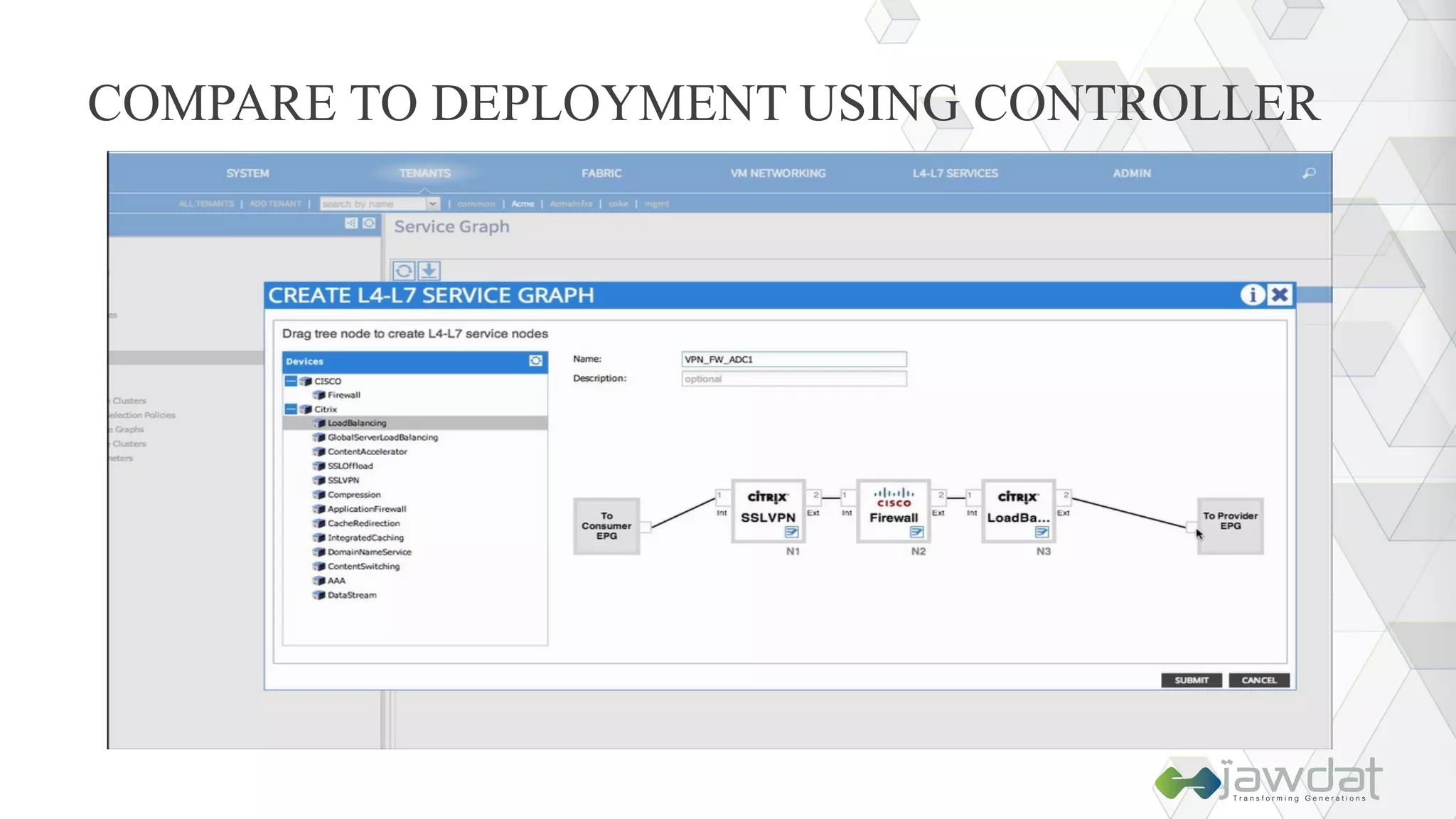
COMPARE TO DEPLOYMENT USING CONTROLLER
Big	Cloud	Fabric
Controller
RACK NRACK N-1RACK 2RACK 1
INGRESS/
EGRESS
Source: Big Switch Network
Source: Gartner (July 2015)
SDWAN AND
VCPE (X86)
FROM 2%
TODAY
40%
BY END OF
2018
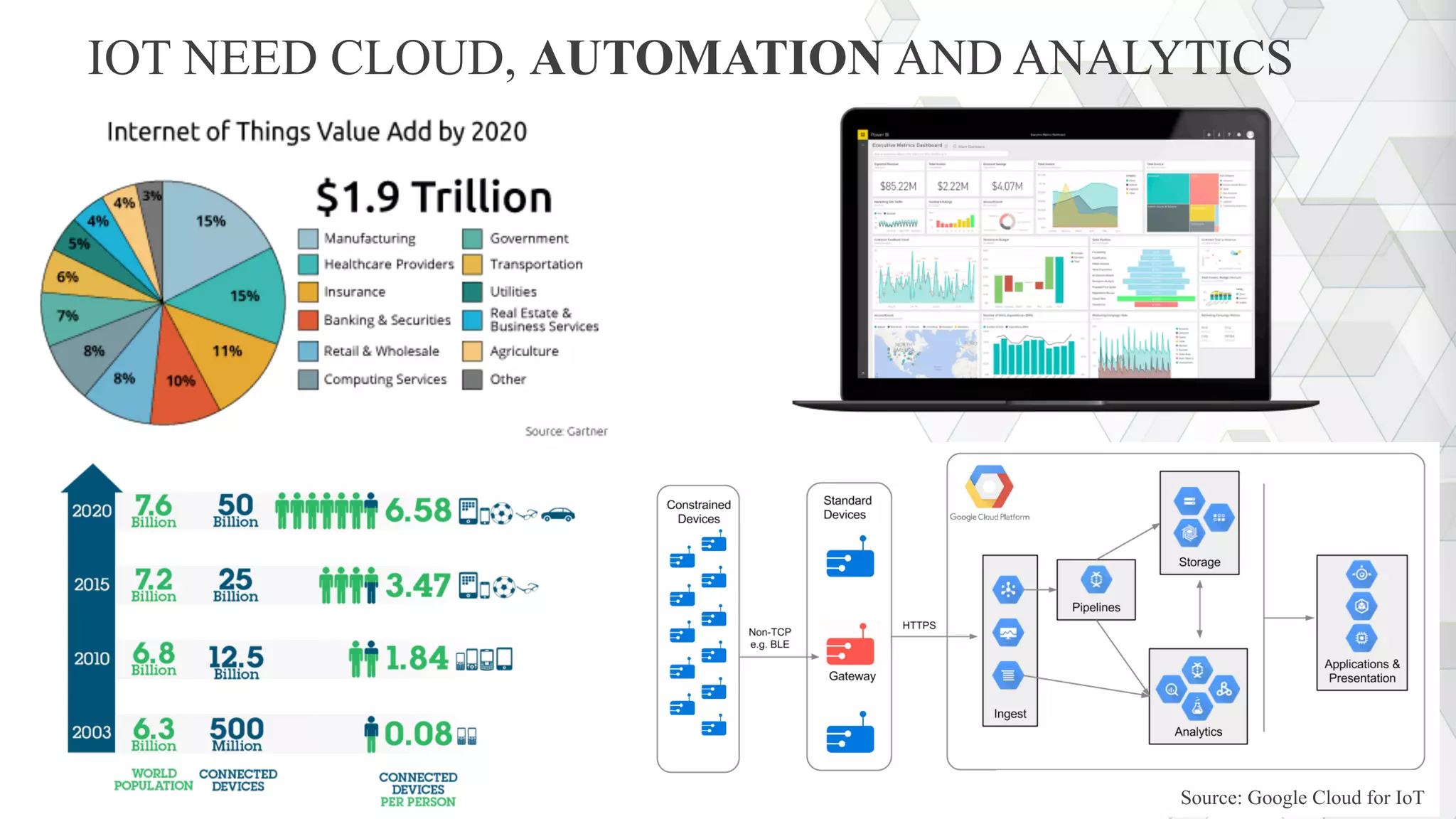
IOT NEED CLOUD, AUTOMATION AND ANALYTICS
Source: Google Cloud for IoT
WHERE ARE WE GOING FROM HERE?
29
EVERYTHING STARTS WITH INTENT
Source: Big Switch Network
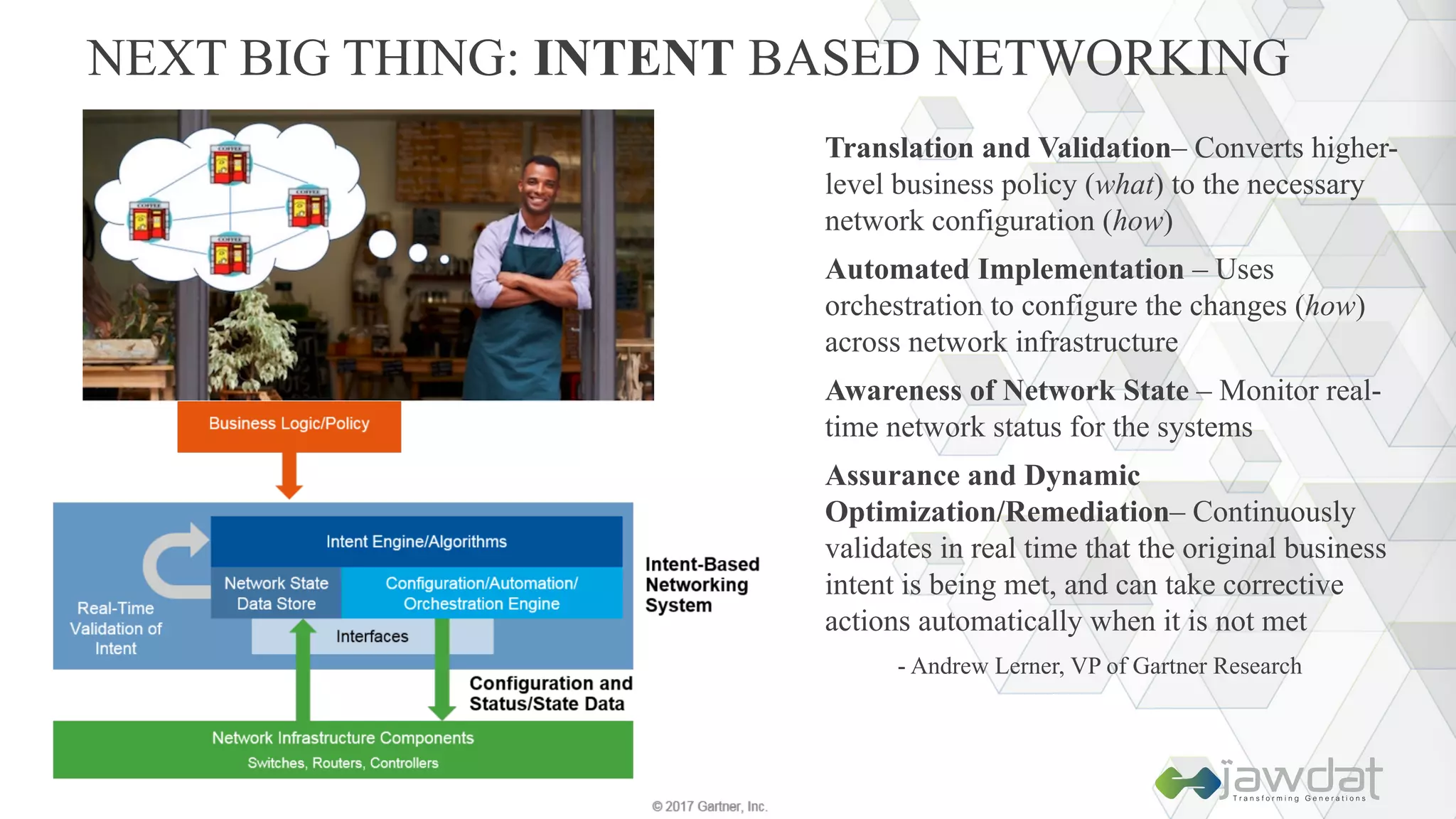
NEXT BIG THING: INTENT BASED NETWORKING
Translation and Validation– Converts higher-
level business policy (what) to the necessary
network configuration (how)
Automated Implementation – Uses
orchestration to configure the changes (how)
across network infrastructure
Awareness of Network State – Monitor real-
time network status for the systems
Assurance and Dynamic
Optimization/Remediation– Continuously
validates in real time that the original business
intent is being met, and can take corrective
actions automatically when it is not met
- Andrew Lerner, VP of Gartner Research
IS INTENT-
BASED
NETWORK
JUST
ANOTHER
NAME FOR
NETWORK
AUTOMATION
?
HOW GOOGLE DOES IT: MODEL DRIVEN
Source: Google, SDN in Management Plane
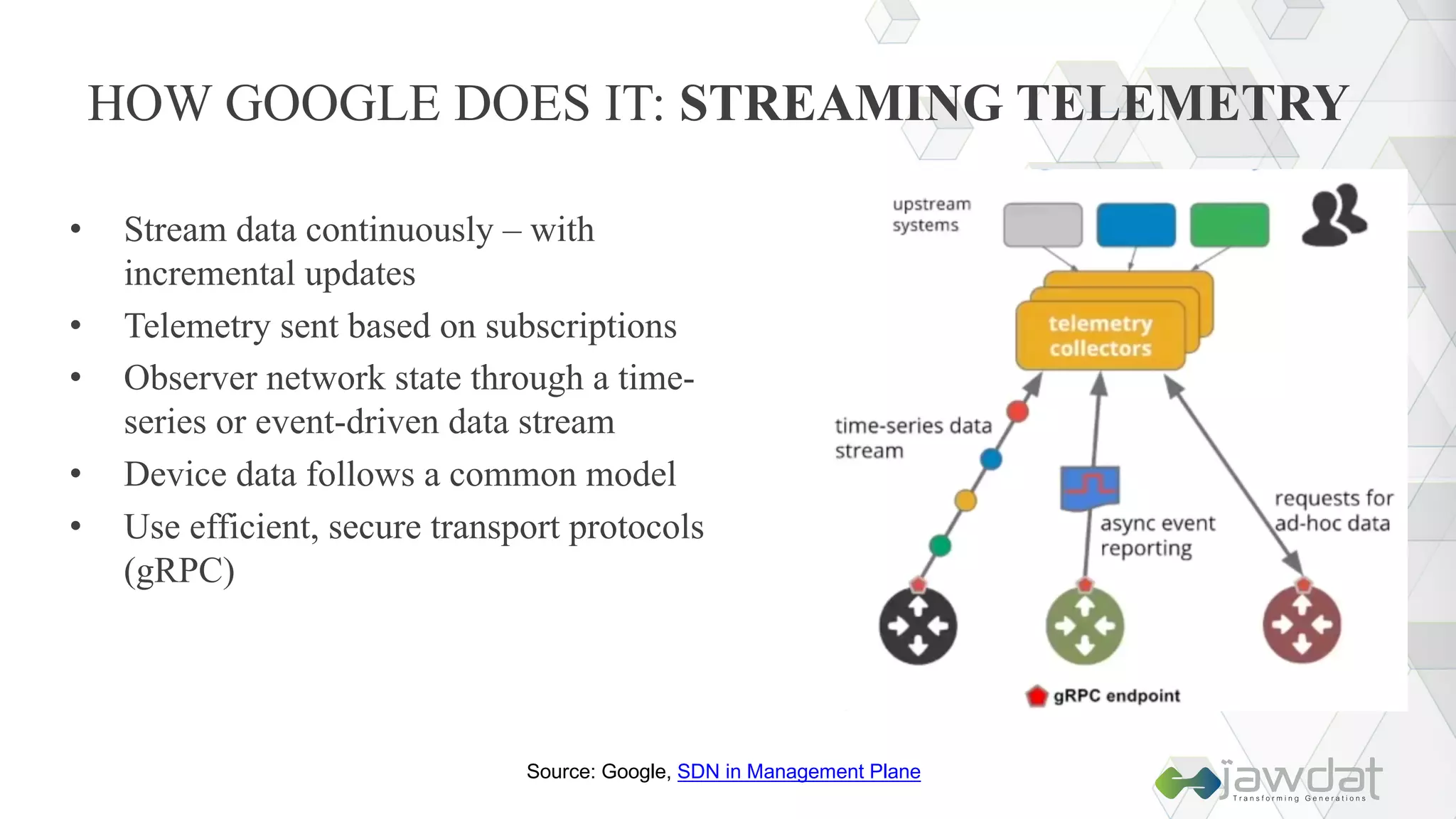
HOW GOOGLE DOES IT: STREAMING TELEMETRY
• Stream data continuously – with
incremental updates
• Telemetry sent based on subscriptions
• Observer network state through a time-
series or event-driven data stream
• Device data follows a common model
• Use efficient, secure transport protocols
(gRPC)
Source: Google, SDN in Management Plane
HOW GOOGLE DOES IT: CONFIG WORKFLOW
Source: Google, SDN in Management Plane
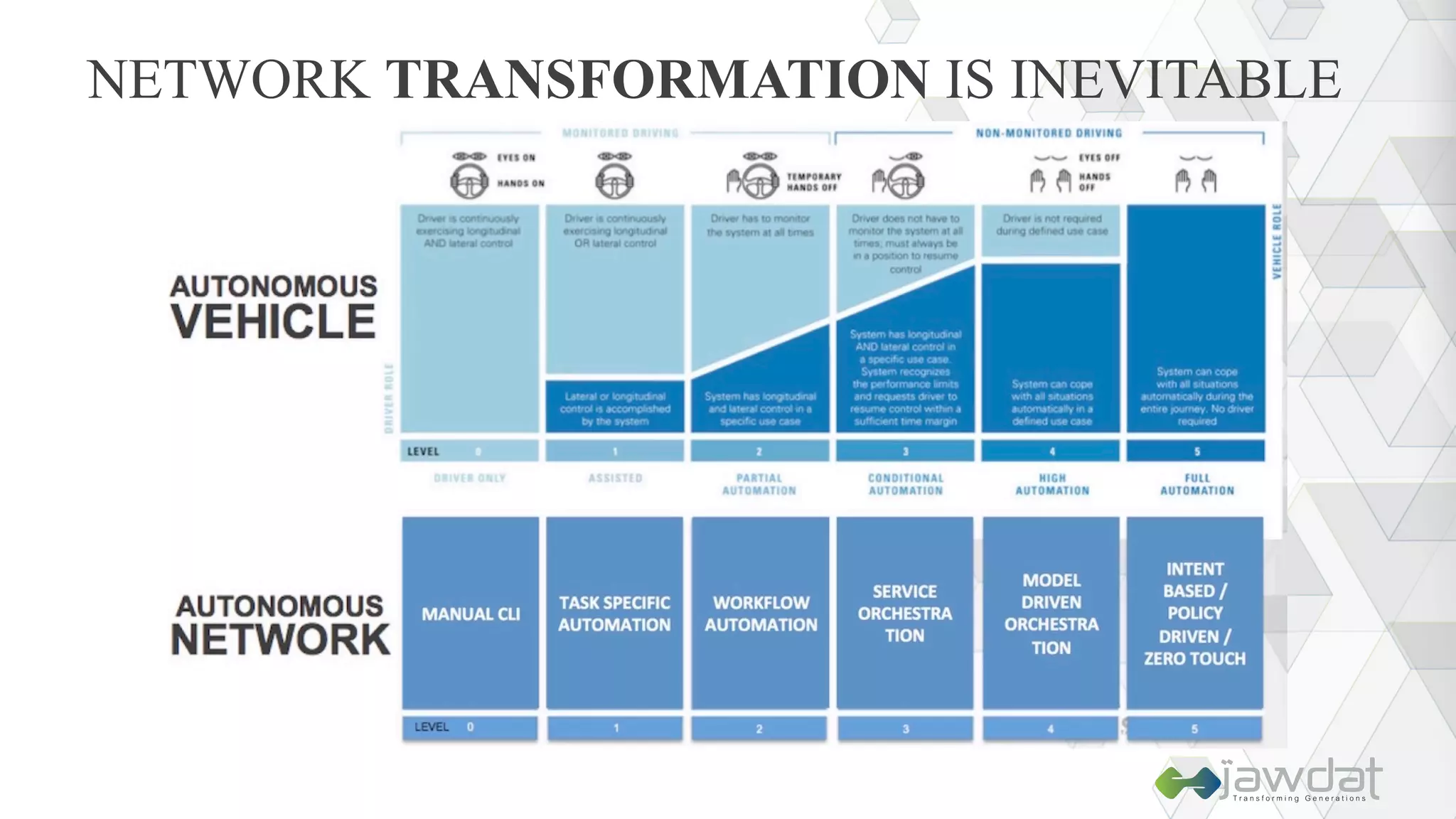
NETWORK TRANSFORMATION IS INEVITABLE
TODAY: RUNNING NETWORK IN SILOS
TOMORROW: DEVOPS, INTENT BASED,
POLICY-DRIVEN AND ZERO TOUCH
THANK YOU

CampusSDN2017 - Jawdat: SDN Technology Evolvement

  • 1.
  • 2.
    SDN TECHNOLOGY EVOLVEMENT TelkomUniversity, August 2017
  • 3.
    Stanford University –Clean Slate Project “…explore what kind of Internet we would design if we were to start with a clean slate and 20-30 years of hindsight.” http://cleanslate.stanford.edu
  • 4.
    With SDN, Control Planeis separated from the physical device NOT ALL PROCESSING HAPPENS INSIDE DEVICE In “traditional” network Control Plane and Data Plane reside in the same physical device
  • 5.
  • 6.
    FOUR PARTS OFOPENFLOW • Controller – resides on a server and provides control plane function for the network • OpenFlow Agent – resides on a network devices and fulfill requests from the Controller • Northbound APIs – enable applications to interface with the Controller • OpenFlow Protocol – the Layer 2 protocol that the Controller and Agents use to communicate
  • 7.
    ONF Board Members DeutscheTelekom : Facebook : Goldman Sachs : Yahoo Google : Microsoft : NTT Communications : Verizon
  • 8.
  • 9.
  • 10.
    Preinstalled Apps • BGPLS Manager -Visualizes network topology from BGP database • Inventory – Augmented OpenDaylight “nodes” app identifies all connected devices • (YANG) Model Explorer – Exposes system models and previews JSON API body • OpenFlow Manager – Manages, visualizes, and troubleshoots flows + previews JSON API body • PCEP Manager – Creates, modifies, and deletes MPLS LSPs Centralized OA&M • Robust user, application, and feature administration • Status monitoring; system, cluster, node • Event logging • Real-time CPU, memory, disk, heap size, load, and network utilization metrics “One-Click” Install • VMware ESXi and Oracle Virtual Box hypervisor ready SDN APPLICATIONS ARE THE INNOVATIONS
  • 11.
  • 12.
  • 13.
    Controller Data Plane Applications Open APIs OpenFlow, PCEP, I2RS, Netconf 2aPure SDN Vendor Specific (e.g. Nexus API) Applications Virtual Switch Overlays Overlay Protocols (e.g. VXLAN) Open APIs 3 Overlays Networks Control Plane Data Plane Overlays Vendor- specific APIs Applications 1 Programmable APIs Control Plane Data Plane Vendor Specific (e.g. Nexus API) Controller Data Plane Applications Open APIs OpenFlow, PCEP, I2RS, Netconf Control Plane 2b Hybrid SDN Vendor Specific (e.g. Nexus API) Control Plane Data Plane CLI, SNMP, Netflow, … Applications (Network Mgmt, Monitoring, …) SDN IMPLEMENTATION OPTIONS
  • 14.
  • 15.
    OVERLAY NETWORK WITHVIRTUAL SWITCH
  • 16.
    VXLAN TUNNELS CONNECTVIRTUAL MACHINES
  • 17.
  • 18.
    NETWORK FUNCTIONS VIRTUALIZATION: WHY,HOW, WHEN? Disaggregation of Network Functions from the underlying Hardware Network Functions running inside VM on x86 Server Platform (Virtual Network Functions) NAT VM Firewall VM SBC VM dDOS VM Virus Scan VM IPS VM DPI VM CGN VM Portal VM PCRF VM DNS VM DHCP VM BRAS VM SDN Control VM RaaS VM WLC VM WAAS VM CDN VM Caching VM NMS VM Hardware (x86 Server) Cloud Operating System Virtual Network Functions Existing Hardware / Appliance based Network Functions (PNFs) Hardware (ASIC/NPU/GPU) Operating System Apps (e.g. Routing) How?Why? • Hypervisor & cloud technology • Improving x86 h/w performance • SDN based orchestration • Speed and Agility • Monetization with new services • Reduced total cost of ownership When? • Performance Requirements • Physical Design Requirements • Economics of on-boarding Depends On 18
  • 19.
    • e.g. IPv6/v4, MPLS, VPNs, Optical • High throughput / BW •Stateless functions • Mostly predictable traffic • Many flows needing isolation, significant traffic management needed • Interface-specific functions (2-stage forwarding) Network Forwarding (L0- 3) • e.g. DPI, FW, CGN, BNG, Mobility S/PGW, AAA, DNS, DDOS • Low to Med Throughput • Stateful functions • Unpredictable traffic • # of flows (traffic management) – varies • No interface-specific functions Network Services (L4+) Better fit for NPU Compute Bandwidth Better fit for x86 (Virtualization) Compute Bandwidth VIRTUALIZING NETWORK FUNCTIONS X86 VS. CUSTOM CPU
  • 20.
  • 21.
    Jawdat Juragan SAMPLE PRODUCTSMAPPED TO ETSI NFV VMware Big Switch VNF Manager Service, VNF and Infrastructure Description Service Catalog Cisco Network Services Orchestrator (Based on Tail-F NCS) VNF Library (sample list) SP’s Existing OSS/Catalog OpenStack CSR1kvCSR1kv CSR1kv NFF 3rd Party vNFASAvASAv ASAv QvPC SIQvPC SI vWAAS QvPC DIQvPC DI vWSA Virtual Infra. Managers (VIM) NFV Orchestrator Service Lifecycle Management Service Provisioning ODLCisco APIC, VTC (Compute and Storage VIMs) Jawdat JongOS Cisco VNF Manager REST API Physical & Virtual Network (Network VIMs) Service Lifecycle Management (ESC) OVS Cisco VTF, VPP, AVS Software Defined Network
  • 23.
  • 24.
    Web Servers vLAN 666 L3 FW SLB SSL DB Servers vLAN 111 vLAN 222 www www www vLAN 444 App Servers FW SLB appapp FW db db switch1(config)# switch1(config)# int eth 1/1 switch1(config)# switch mode acc switch1(config)# switch acc vlan 666 switch1(config)# no shut router(config)# router(config)# int eth 1 router(config)# ip add 6.6.6.1 255.255.255.0 router(config)# not shut router(config)# int eth 2 router(config)# ip addr 1.1.1.1 255.255.255.0 router(config)# no shut router(config)# router eigrp 100 router(config)# network 6.6.6.0 mask 255.255.255.0 router(config)# network 1.1.1.0 mask 255.255.255.0 router(config)# ip route 0.0.0.0 0.0.0.0 6.6.6.254 switch2(config)# switch2(config)# int eth 1/2 - 3 switch2(config)# switch mode acc switch2(config)# switch acc vlan 111 switch2(config)# no shut fw1(config)# fw1(config)# int eth 0/1 fw1(config)# nameif outside 0 fw1(config)# int eth 0/2 fw1(config)# nameif webfront 20 fw1(config)# object network webfront_vip fw1(config)# host 6.6.6.6 fw1(config)# static (webfront,outside) 1.1.1.6 fw1(config)# access-list outside_web permit tcp any host 6.6.6.6 eq 80 fw1(config)# access-list outside_web permit tcp any host 6.6.6.6 eq 443 fw1(config)# access-group outside_web in interface outside switch3(config)# switch3(config)# int eth 1/4 - 5 switch3(config)# switch mode acc switch3(config)# switch acc vlan 222 switch3(config)# no shut vLAN 333 switch4(config)# switch4(config)# int eth 1/6 switch4(config)# switch mode acc switch4(config)# switch acc vlan 333 switch4(config)# no shut switch4(config)# int eth 1/7 - 9 switch4(config)# switch mode acc switch4(config)# switch acc vlan 333 switch4(config)# no shut IDS/IPS vLAN 555 IDS/IPS vLAN 777 switch5(config)# switch5(config)# int eth 1/10 - 11 switch5(config)# switch mode acc switch5(config)# switch acc vlan 444 switch5(config)# no shut switch5(config)# int eth 1/11 - 15 switch5(config)# switch mode acc switch5(config)# switch acc vlan 555 switch5(config)# no shut switch5(config)# monitor session 1 source vlan 555 switch5(config)# monitor session 1 dest eth 1/16 switch6(config)# switch6(config)# int eth 1/16 - 19 switch6(config)# switch mode acc switch6(config)# switch acc vlan 777 switch6(config)# no shut switch6(config)# monitor session 1 source vlan 777 switch6(config)# monitor session 1 dest eth 1/20 slb1 (CONFIG) probe http http-probe interval 30 expect status 200 200 rserver host websrvr1 description foo web server ip address 3.3.3.1 inservice rserver host websrvr2 description foo web server ip address 3.3.3.2 inservice rserver host websrvr3 description foo web server ip address 3.3.3.3 inservice serverfarm host FOOWEBFARM probe http-probe rserver websrvr1 80 inservice rserver websrvr2 80 inservice rserver websrvr3 80 inservice crypto generate key 1024 fooyou.key crypto csr-params testparms country US state California locality San Jose organization-name foo organization-unit you common-name www.fooyou.com serial-number crisco123 crypto generate csr testparms fooyou.key crypto import ftp 12.13.14.15 anonymous fooyou.cer parameter-map type ssl SSL_PARAMETERS cipher RSA_WITH_RC4_128_MD5 version TLS1 ssl-proxy service FOOWEB_SSL key fooyou.key cert fooyou.cer class-map match-all FOOSSL_VIP_CLASS 2 match virtual-address 2.2.2.22 tcp eq https policy-map type loadbalance first-match L7-SSL-MATCH class L7_WEB sticky-serverfarm sn_cookie policy-map multi-match FOOWEB-VIP class FOOWEB_VIP_CLASS loadbalance vip inservice loadbalance policy FOOWEB-MATCH loadbalance vip icmp-reply loadbalance vip advertise active class FOOSSL_VIP_CLASS loadbalance vip inservice loadbalance policy FOOSSL-MATCH loadbalance vip icmp-reply fw2(config)# fw2(config)# int eth 0/1 fw2(config)# nameif webfront 20 fw2(config)# int eth 0/2 fw2(config)# nameif appfront 50 fw2(config)# object network appfarm_vip fw2(config)# host 5.5.5.5 fw2(config)# nat (appfront,webfront) static 4.4.4.4 fw2(config)# access-list web_to_app permit tcp any host 4.4.4.4 eq 8081 slb2 (CONFIG) rserver host appsrvr1 description foo app server ip address 5.5.5.1 inservice rserver host appsrvr2 description foo app server ip address 5.5.5.2 inservice rserver host appsrvr3 description foo app server ip address 5.5.5.3 inservice serverfarm host FOOAPPFARM probe http-probe rserver appsrvr1 8081 inservice rserver appsrvr2 8081 inservice rserver appsrvr3 8081 inservice class-map type http loadbalance match-any FOO_APP 2 match http virtual-address 4.4.4.44 tcp eq 8081 class-map match-all FOO_APP_VIP_CLASS policy-map type loadbalance first-match FOO_APP-MATCH class FOO_APP sticky-serverfarm sn_cookie policy-map multi-match FOO_APP-VIP class FOO_APP_VIP_CLASS loadbalance vip inservice loadbalance policy FOO_APP-MATCH loadbalance vip icmp-reply fw3(config)# fw3(config)# int eth 0/1 fw3(config)# nameif appfront 70 fw3(config)# int eth 0/2 fw3(config)# nameif dbfront 90 fw3(config)# object network db_cluster fw3(config)# host 7.7.7.7 fw3(config)# nat (dbfront,appfront) static 5.5.5.50 fw3(config)# access-list web_to_app permit tcp any host 5.5.5.50 eq 1433 HOW WE DEPLOY MULTI-TIER APPLICATIONS TODAY
  • 25.
    COMPARE TO DEPLOYMENTUSING CONTROLLER
  • 26.
    Big Cloud Fabric Controller RACK NRACK N-1RACK2RACK 1 INGRESS/ EGRESS Source: Big Switch Network
  • 27.
    Source: Gartner (July2015) SDWAN AND VCPE (X86) FROM 2% TODAY 40% BY END OF 2018
  • 28.
    IOT NEED CLOUD,AUTOMATION AND ANALYTICS Source: Google Cloud for IoT
  • 29.
    WHERE ARE WEGOING FROM HERE? 29
  • 30.
    EVERYTHING STARTS WITHINTENT Source: Big Switch Network
  • 31.
    NEXT BIG THING:INTENT BASED NETWORKING Translation and Validation– Converts higher- level business policy (what) to the necessary network configuration (how) Automated Implementation – Uses orchestration to configure the changes (how) across network infrastructure Awareness of Network State – Monitor real- time network status for the systems Assurance and Dynamic Optimization/Remediation– Continuously validates in real time that the original business intent is being met, and can take corrective actions automatically when it is not met - Andrew Lerner, VP of Gartner Research
  • 32.
  • 33.
    HOW GOOGLE DOESIT: MODEL DRIVEN Source: Google, SDN in Management Plane
  • 34.
    HOW GOOGLE DOESIT: STREAMING TELEMETRY • Stream data continuously – with incremental updates • Telemetry sent based on subscriptions • Observer network state through a time- series or event-driven data stream • Device data follows a common model • Use efficient, secure transport protocols (gRPC) Source: Google, SDN in Management Plane
  • 35.
    HOW GOOGLE DOESIT: CONFIG WORKFLOW Source: Google, SDN in Management Plane
  • 36.
  • 37.
  • 38.
    TOMORROW: DEVOPS, INTENTBASED, POLICY-DRIVEN AND ZERO TOUCH
  • 39.