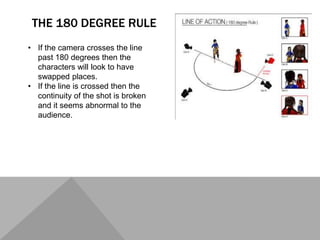
THE 180 DEGREE RULE
• If the camera crosses the line
past 180 degrees then the
characters will look to have
swapped places.
• If the line is crossed then the
continuity of the shot is broken
and it seems abnormal to the
audience.
MATCH-ON-ACTION
• This is a shot that can make
the action look like it is
happening more quickly.
• It also allows the audience to
focus more on the action that
is happening.
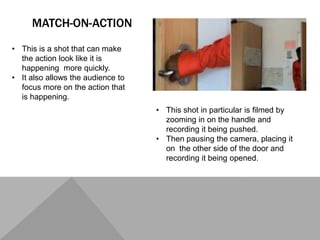
• This shot in particular is filmed by
zooming in on the handle and
recording it being pushed.
• Then pausing the camera, placing it
on the other side of the door and
recording it being opened.
PAN
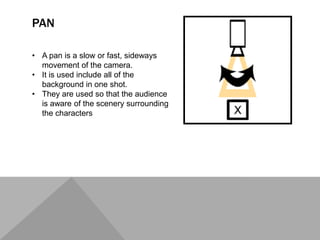
• A pan is a slow or fast, sideways
movement of the camera.
• It is used include all of the
background in one shot.
• They are used so that the audience
is aware of the scenery surrounding
the characters
TILT SHOT
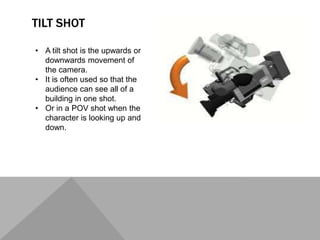
• A tilt shot is the upwards or
downwards movement of
the camera.
• It is often used so that the
audience can see all of a
building in one shot.
• Or in a POV shot when the
character is looking up and
down.
SHOT REVERSE SHOT
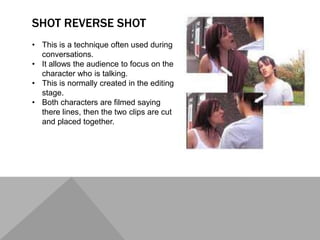
• This is a technique often used during
conversations.
• It allows the audience to focus on the
character who is talking.
• This is normally created in the editing
stage.
• Both characters are filmed saying
there lines, then the two clips are cut
and placed together.
OVER THE SHOULDER SHOT
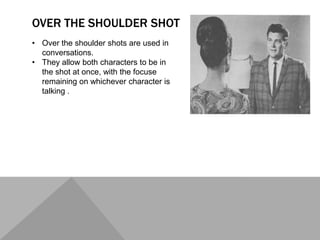
• Over the shoulder shots are used in
conversations.
• They allow both characters to be in
the shot at once, with the focuse
remaining on whichever character is
talking .
POV (POINT OF VIEW)
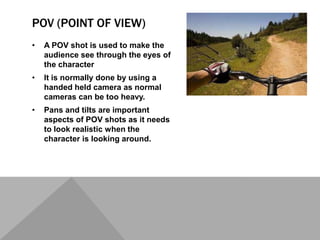
• A POV shot is used to make the
audience see through the eyes of
the character
• It is normally done by using a
handed held camera as normal
cameras can be too heavy.
• Pans and tilts are important
aspects of POV shots as it needs
to look realistic when the
character is looking around.

Camerawork

  • 2.
    THE 180 DEGREERULE • If the camera crosses the line past 180 degrees then the characters will look to have swapped places. • If the line is crossed then the continuity of the shot is broken and it seems abnormal to the audience.
  • 3.
    MATCH-ON-ACTION • This isa shot that can make the action look like it is happening more quickly. • It also allows the audience to focus more on the action that is happening. • This shot in particular is filmed by zooming in on the handle and recording it being pushed. • Then pausing the camera, placing it on the other side of the door and recording it being opened.
  • 4.
    PAN • A panis a slow or fast, sideways movement of the camera. • It is used include all of the background in one shot. • They are used so that the audience is aware of the scenery surrounding the characters
  • 5.
    TILT SHOT • Atilt shot is the upwards or downwards movement of the camera. • It is often used so that the audience can see all of a building in one shot. • Or in a POV shot when the character is looking up and down.
  • 6.
    SHOT REVERSE SHOT •This is a technique often used during conversations. • It allows the audience to focus on the character who is talking. • This is normally created in the editing stage. • Both characters are filmed saying there lines, then the two clips are cut and placed together.
  • 7.
    OVER THE SHOULDERSHOT • Over the shoulder shots are used in conversations. • They allow both characters to be in the shot at once, with the focuse remaining on whichever character is talking .
  • 8.
    POV (POINT OFVIEW) • A POV shot is used to make the audience see through the eyes of the character • It is normally done by using a handed held camera as normal cameras can be too heavy. • Pans and tilts are important aspects of POV shots as it needs to look realistic when the character is looking around.