Welcome to the
California Community Care
Coordination Collaborative
June 4, 2013
• Introduction and Welcome
• Icebreaker
• Updates and Discussion
– Contra Costa County – 7C’s
– Orange County – OC C3 for Kids
– Shasta, Siskiyou, Trinity Counties – Rural Children’s Special Health Coalition
– San Mateo County – SMC Care Coordination Learning Community
– Fresno County – Central California Care Coordination Project
– Kern County – Medically Vulnerable Care Coordination Project
• Evaluation
• Learning Collaborative Planning
AGENDA
• Your name
• Your organization and position
• If you could spend a weekend anywhere in
California, where would you go and why?
ICEBREAKER
Contra Costa California Community Care
Coordination Collaborative (7C’s)
Barbara Sheehy, MS
Administrator
California Children's Services Contra Costa County
UPDATE
Seven Cs Project
CONTRA COSTA CALIFORNIA
COMMUNITY CARE COORDINATION
COLLABORATIVE
Seven Cs Coalition Members
 California Children’s Services
 CARE Parent Network
 Regional Center of the East Bay
 First 5 Contra Costa
 Clinic Services/Public Health Nursing
 Contra Costa Behavioral/Mental Health
 Head Start/Early Head Start
 Children’s Hospital & Research Center Oakland
 Contra Costa Health Plan
 Early Childhood Mental Health
 West Contra Costa SELPA
 Contra Costa Regional Medical Center, Dept of Pediatrics
 Kern County Medically Vulnerable Care Coordination
Project
 Kaiser Permanente
 John Muir Health
Seven Cs Project Goals
1. Determine the specific needs of CSHCN, birth to 5 years of
age, and their families, for the Seven Cs Project.
2. Align the organizational structure to implement the Seven
Cs Project for CSHCN, birth to 5 years of age, and their
families, providers and communities.
3. Conduct a 3-month pilot program of the Seven Cs initiative
to work through and validate procedures, tools, costs and
processes before full implementation.
4. Create and implement a financial sustainability plan to
secure Care Coordination staff and other resources to fully
implement the Seven Cs Project for CSHCN, birth to 5 years
of age, their families, providers and communities.
Seven Cs Main Activities
 Convene monthly Seven Cs partner meetings to develop,
pilot and support an county-wide CSHCN care
coordination system.
 Learn about the Kern County, MVCCP model, history,
Acuity Form and tools.
 Compile and analyze Contra Costa CSHCN data to
identify projected population to be served by care
coordiation initiative.
 Develop a county-specific resource list of pediatric special
needs services for families and providers.
 Develop and implement a county-wide outreach and
education plan for families and providers.
 Create, implement, and monitor role of Care Coordinator
to support county-wide CSHCN care coordination system.
Seven Cs Anticipated Challenges
 Some partners have limited experience
working together collaboratively.
 Assuring family centered care is
institutionalized in care coordination
system.
Seven Cs Progress
 Hired excellent Facilitator and Project
Coordinator.
 Honing in on our target population and
care coordination model.
 Added needed Project Partners.
Seven Cs Current Challenges
 Difficulty getting School/Special
Education Partner participation.
 May be difficult to develop two
additional Round Table groups to flesh
out County-wide care coordination
system.
Orange County Care Coordination
Collaborative for Kids
(OC C3 For Kids)
Rebecca Hernandez, MSEd
Program Manager
Help Me Grow Orange County
UPDATE
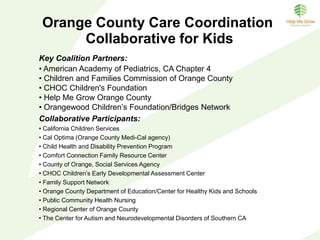
Key Coalition Partners:
• American Academy of Pediatrics, CA Chapter 4
• Children and Families Commission of Orange County
• CHOC Children's Foundation
• Help Me Grow Orange County
• Orangewood Children’s Foundation/Bridges Network
Collaborative Participants:
• California Children Services
• Cal Optima (Orange County Medi-Cal agency)
• Child Health and Disability Prevention Program
• Comfort Connection Family Resource Center
• County of Orange, Social Services Agency
• CHOC Children’s Early Developmental Assessment Center
• Family Support Network
• Orange County Department of Education/Center for Healthy Kids and Schools
• Public Community Health Nursing
• Regional Center of Orange County
• The Center for Autism and Neurodevelopmental Disorders of Southern CA
Orange County Care Coordination
Collaborative for Kids
OC C3 For Kids Goals
Overarching goal: To improve overall care for children and families with
special health care needs by creating a collaborative care coordination
system in Orange County.
1. To identify the specific needs of the Orange County care coordination
collaborative starting with children birth to 5 years of age who have special
health care needs (CSHCN) and their families.
2. To determine the organizational structure of the Orange County care
coordination system for children birth to five years with special health care
needs (CSHCN) and their families.
3. To conduct a pilot of the proposed Orange County Care Coordination model
to validate the efficacy and refine team based development of procedures,
tools, costs and processes before full implementation.
4. To create and implement a sustainability plan to secure resources to
implement a care coordination countywide system with scalability and
potential to expand to other age groups.
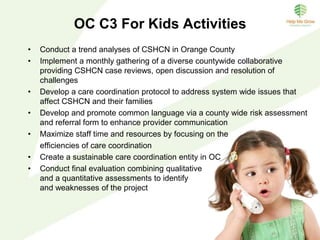
OC C3 For Kids Activities
• Conduct a trend analyses of CSHCN in Orange County
• Implement a monthly gathering of a diverse countywide collaborative
providing CSHCN case reviews, open discussion and resolution of
challenges
• Develop a care coordination protocol to address system wide issues that
affect CSHCN and their families
• Develop and promote common language via a county wide risk assessment
and referral form to enhance provider communication
• Maximize staff time and resources by focusing on the
efficiencies of care coordination
• Create a sustainable care coordination entity in OC
• Conduct final evaluation combining qualitative
and a quantitative assessments to identify strengths
and weaknesses of the project
16
Anticipated Orange County Challenges
As our project was developed, the core planning
team identified several challenges that may be
encountered. These include:
• Time constraints of the current OC C3 for
Kids participants
• Recruitment of additional organizations who
provide services for CSHCN
• Financial constraints as there has been
tremendous cutbacks to organizations
therefore limited staff to participate
Thank you
Rebecca Hernandez, MSEd
Project Director, OC C3 For Kids
Rhernan2@uci.edu
Progress Made To Date
• Meaningful engagement of multiple stakeholders with commitment to a
regular monthly meeting schedule
• Hired facilitator for coordination of collaborative meetings and trend
analysis fulfillment
• Identified trend analysis indicators
• Initial understanding and standards in place for confidentiality
• Initiation of case reviews intended to inform system gaps and barriers
– Initial structure and template in place
– Begun identification of system issues
– Begun identification of opportunities for additional collaborative
efforts
Challenges Being Faced
• Ensuring the right representatives from each agency are at the table
• Engaging other payers beyond CalOptima
• Missing representation from Public Health
• Understanding how the system will function as the Affordable
Care Act is implemented
• Gathering the actual data from the identified
agencies for the trend analysis
• Encouraging appropriate participation by
parent representatives while respecting
their personal experiences
Rural Children’s Special Health Coalition
Siskiyou, Shasta and Trinity Counties
Wendy Longwell
Parent Health Consultant
Rowell Family Empowerment of Northern California
UPDATE
Rowell Family Empowerment
of Northern CA. (RFENC)
• The mission of RFENC is to
empower people with diverse
abilities, and their families, to live
as respected and valued members
throughout their communities by
providing support, education and
advocacy services.
• RFENC is a parent founded, parent
run agency that assists families in
navigating systems, understanding
the laws and regulations that
govern these systems, and provides
parent to parent support.
Rural Children’s Special
Health Coalition (RCSHC)
• Key Coalition Members will
include:
 CA. Children Services
 Far Northern Regional Center
 Community Health Centers
 Health and Human Services
 First 5
 Dept. of Health and Human
Services
 3-5 Family Members from Shasta,
Siskiyou, and Trinity counties
• RCSHC is dedicated to bringing
families and health professionals
together to improve health
coordination in Shasta, Siskiyou,
and Trinity counties.
Rural Children’s Special Health
Coalition Goals!
• Professionals are more
knowledgeable about community
service systems and the family
perspective.
• Family members are more
knowledgeable about community
service systems and how to navigate
them.
• All participants see increased
collaboration and communication
among agencies to solve problems.
• All participants finds the training
provided has quality, is
valuable, relevant, and useful.
• Problem solve any issues we find
around the transition to the new
managed care Medi-Cal.
• Improving and updating the Medical
Home Binder.
• All participants believe relationships
have been strengthened.
RCSHC Project Activities
• Schedule 10 phone and/or face to face meetings per year
• Create Methods to track changes in the systems
• Develop a trainings needs plan and hire speakers and trainers to educate
everyone involved on improving care coordination and developing a clearer
understanding of the transition to the new managed MediCal model
• Coordinate regular convening of a broad range of stakeholders in the targeted 3
counties to define issues, identify local unmet needs, explore resources, and
develop action plans to solve problems
• Work on plans and projects the coalition decide are areas we need to work on.
RCSHC Anticipated Challenges
• To get all required coalition members to attend meetings from all three counties.
Challenges we may face include:
 Distance to travel in unsafe weather conditions from the pioneer communities
 Time commitment, with travel, for professionals who may have a tight schedule
• To keep coalition members focused on the goals and activities outlined in the
grant, staying true to the specific agenda
• Finding professional guest speakers/trainers who are willing to travel to the
rural and pioneer communities to provide required educational topics that align
with the RCSHC goals and objectives.
• Keeping the training to be disseminated at a level that can be easily understood
by all. Such as keeping it at a 6th grade reading level
Accomplishments
• Meetings held
– 1 face to face meeting
– 1 conference call
– Next meeting: conference call
• Members of coalition have attended Partnership Health Meetings and State-
Level managed Care meetings.
• Other meetings in the community helping spread information on the transition
• Outreach
– Poster distribution
– Facebook
– Email
– Community partners- Head Start, Non-Profit Coalition, local businesses, Area 2
Board, CCS, Far Northern Regional Center, Local Schools and School Districts
Hospital representatives, Community Health Representatives, Local Providers,
Parents.
Future Activities
• Next Face to Face meeting guest speakers:
– Partnership Health Representative
– Lucille Packard Representative
– State Department of Health and Human Services Representative
• Wendy Longwell will be joining the Partnership Health Community
Representative Body
– Also will be applying to become a Partnership Health Board Member
• Additional informational materials will be distributed as they become available.
– Ex: input from community of information that Partnership Health should include in
their documents
• State of California has been updated on the developments and issues that arise
as we go through the transition.
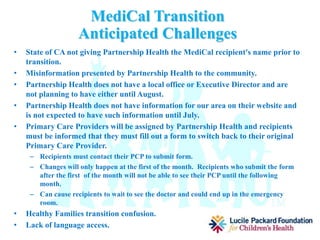
MediCal Transition
Anticipated Challenges
• State of CA not giving Partnership Health the MediCal recipient's name prior to
transition.
• Misinformation presented by Partnership Health to the community.
• Partnership Health does not have a local office or Executive Director and are
not planning to have either until August.
• Partnership Health does not have information for our area on their website and
is not expected to have such information until July.
• Primary Care Providers will be assigned by Partnership Health and recipients
must be informed that they must fill out a form to switch back to their original
Primary Care Provider.
– Recipients must contact their PCP to submit form.
– Changes will only happen at the first of the month. Recipients who submit the form
after the first of the month will not be able to see their PCP until the following
month.
– Can cause recipients to wait to see the doctor and could end up in the emergency
room.
• Healthy Families transition confusion.
• Lack of language access.
Possible Solutions
• What worked for your counties?
• What strategies did you use to combat these issues?
• Any ideas???
All input greatly appreciated!
• Orzo pasta with spinach, feta cheese, kalmata olives, red
onion and toasted pine nuts in balsamic vinaigrette
• Fresh mixed greens topped with crumbled blue
cheese, dried cranberries, spiced nuts and balsamic
vinaigrette
• Mediterranean platter of hummus, dolmas, tabbouleh, feta
cheese, olives and pita
• Grilled squash (vegan), shrimp, and chicken skewers
• Beverages and Cookies
LUNCH
San Mateo County Care Coordination
Learning Community
Cheryl Oku
Program Manager
Watch Me Grow Demonstration Site
Community Gatepath
UPDATE
• Community Gatepath
• First 5 San Mateo County
• Golden Gate Regional Center
• Lucile Packard Children’s Hospital
• San Mateo Co. Community College District
• San Mateo County Office of Education
• San Mateo Medical System: CCS, MCH, Clinics,
Family Health Services
PARTNERS
• Children Now
• Child Care Coordinating Council
• Fair Oaks Children’s Clinic
• IHSD: Head Start/Early Head Start
• Legal Aid Society
• Lifesteps Foundation
• Parca
• Ravenswood Family Health Center
• Silicon Valley Community Foundation
• StarVista
PARTICIPANTS
• Strengthen the existing system of care coordination
for CSHCN through a collaborative learning
community
• Increase access to coordinated, effective, family-
centered services for CSHCN within the medical
home
• Develop a model of care coordination for CSHCN in
the medical home that is replicable and sustainable
PROJECT GOALS
• Policy Group
• Mapping care coordination resources
• Assessment and referral protocol
• Policy recommendations
• Practitioner Group
• Best practices for care coordination
• Care coordinator handbook or tool
MAIN PROJECT ACTIVITIES
• Integrating care coordination models and information
across different systems
• Changing availability of community resources for
provision of care coordination
• Co-location of community care coordinator in the
medical home
MAJOR CHALLENGES ANTICIPATED
• Leveraged technical assistance from LPFCH to
obtain additional funding to continue the work of
the learning community
• Convened 2 meetings focused on developing a
shared understanding of the system of care
coordination and needs in San Mateo County
• Began mapping local care coordination resources
and services for CSHCN
PROGRESS MADE TO DATE
• Uncovering gaps in the local system of care that
need to be addressed to create a system of
coordinated care
• Addressing a wide range, intensity and diversity of
care coordination needs of CSHCN
• Establishing protocols for co-location of care
coordination services in the medical home
CHALLENGES
Central California Care Coordination Project
Marion Karian
Executive Director
Exceptional Parents Unlimited Children’s Center
UPDATE
Central California Care
Coordination Project
EPU Children’s Center
Fresno, California
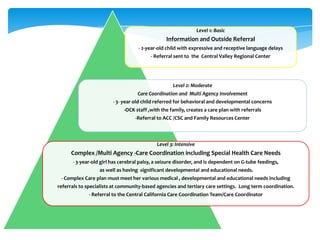
Level 1: Basic
Information and Outside Referral
- 2-year-old child with expressive and receptive language delays
- Referral sent to the Central Valley Regional Center
Level 2: Moderate
Care Coordination and Multi Agency Involvement
- 3- year old child referred for behavioral and developmental concerns
-OCK staff ,with the family, creates a care plan with referrals
-Referral to ACC /CSC and Family Resources Center
Level 3: Intensive
Complex /Multi Agency -Care Coordination including Special Health Care Needs
- 3-year-old girl has cerebral palsy, a seizure disorder, and is dependent on G-tube feedings,
as well as having significant developmental and educational needs.
- Complex Care plan must meet her various medical , developmental and educational needs including
referrals to specialists at community-based agencies and tertiary care settings. Long term coordination.
- Referral to the Central California Care Coordination Team/Care Coordinator
Fresno County Department of Social Services
Fresno County Department of Behavioral Health
Fresno County Department of Public Health—Public Health Nursing,
Children’s Medical Services
Central Valley Regional Center
Fresno Unified School District
First 5 Fresno
Children’s Hospital Central California
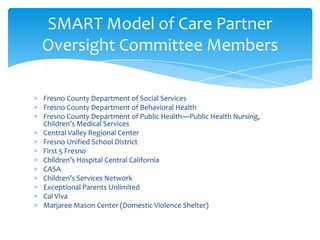
CASA
Children’s Services Network
Exceptional Parents Unlimited
Cal Viva
Marjaree Mason Center (Domestic Violence Shelter)
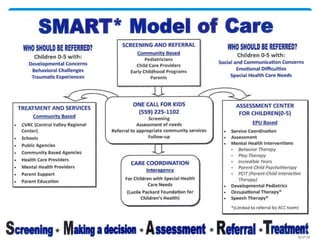
SMART Model of Care Partner
Oversight Committee Members
To establish an active, interdisciplinary multi-agency
team to receive referrals and coordinate the care of
children with special health care needs.
To provide outreach and information regarding care
coordination to hospital discharge planning/care
coordination staff, NICU discharge staff, private
pediatricians, and Federally Qualified Health Clinics.
Project Goals
Convene the Care Coordination Planning Team including
representatives from:
California Children’s Services
Central Valley Regional Center
Children’s Hospital—specialty primary care clinic
Children’s Hospital—High Risk Newborn Follow Up
EPU Children’s Center
Parents
Conducting Outreach to various providers
Attending the SMART—MOCPOC
Visiting Kern Medically Vulnerable Project
Studying models of care coordination
Main Project Activities
The complexities of the reimbursement systems
The vast-ness of the medical systems
The fragmentation and super-specialization of
medical care
Focusing our efforts on the ways in which we can
have the greatest impact
Determining how the Care Coordination Project can
fit into the existing SMART Model of Care
Challenges
Difficulties working with collaborative partners
Complexity of eligibility requirements
Private insurance limitations
Inter-agency consents
More Challenges
Care Coordination Team has been meeting monthly
Referral procedures are in place
Case presentation format has been established
A complex case has been presented
Beginning outreach presentations
o Children’s Hospital “Charlie Mitchell Clinic”
o CVRC Baby Clinic
o Children’s Hospital High Risk Infant Follow-up Program
Progress
Kern County Medically Vulnerable
Care Coordination Project
Marc Thibault, MA
Project Director
UPDATE
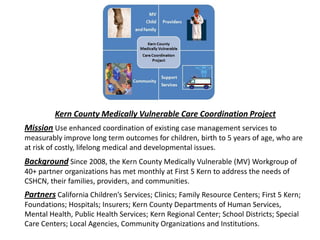
Kern County Medically Vulnerable Care Coordination Project
Mission Use enhanced coordination of existing case management services to
measurably improve long term outcomes for children, birth to 5 years of age, who are
at risk of costly, lifelong medical and developmental issues.
Background Since 2008, the Kern County Medically Vulnerable (MV) Workgroup of
40+ partner organizations has met monthly at First 5 Kern to address the needs of
CSHCN, their families, providers, and communities.
Partners California Children’s Services; Clinics; Family Resource Centers; First 5 Kern;
Foundations; Hospitals; Insurers; Kern County Departments of Human
Services, Mental Health, Public Health Services; Kern Regional Center; School Districts;
Special Care Centers; Local Agencies, Community Organizations and Institutions.
MVCCP Objectives
Key Components of the Care Coordination Process
• Use an accepted Acuity Form to quickly identify and treat more
conditions earlier to make a measurable difference in a child’s life.
• Support local services that already exist.
• Focus on individual cases, working together through a Case Review
Committee, to develop best practices of care coordination.
• Streamline access to, and maintenance of, health insurance and a
medical home, to reduce unnecessary ER visits and hospitalizations.
• Build strong, long-term provider partnerships to sustain a
system of care coordination that is practical, affordable, and responsive
to changing conditions.
• Use longitudinal data to document results.
• Conduct Cost Benefit Analyses to demonstrate savings on at-risk
infants and children to better serve all children in the county.
The LPFCH grant to MVCCP provides free technical assistance in
2013 and 2014 to help implement care coordination in 3 counties by:
• facilitating a series of face to face and webinar meetings to assist
local care coordination collaboratives
• sharing the MVCCP Acuity Scale Form to quickly help identify and
refer Children with Special Health Care Needs (CSHCN)
• implementing a process for jointly addressing CSHCN cases
• working together, through a locally selected Care Coordinator
• finding local solutions and resolving care coordination barriers
• using evaluation results from the Kern County MVCCP
• developing best practices, learned in all four counties, and
• jointly addressing the overall system of health care for CSHCN in
these counties.
MVCCP Replication Process and Potential Challenges
Replication Process
• MVCCP implemented a “first come, first served” approach, to engage with
early adopter counties.
• Two counties – Contra Costa and Orange – have been actively engaged,
learning about MVCCP Replication, and building their local collaboratives.
• A third county is still in the process of being selected, with outreach occurring
with several counties through the MVCCP Advisory Committee.
Challenges
• Counties understand how big an undertaking it is to take on care coordination
for CSHCN. Budgetary constraints and uncertainties due to local, state and
federal policy and funding changes can affect the level of commitment.
• Must always remain aware of, and sensitive to, the political and historical
dynamics that can differentiate each county in the implementation process.
• Previous or ongoing local collaboration efforts can impact the vision and the
commitment to cooperation, especially depending how competitive the
atmosphere is among potential partner organizations.
• A local governance plan must reflect the collaborative nature of the initiative,
provide accountability and transparency to its work, and result in an inclusive
decision-making process to achieve optimum results.
Kern County MVCCP Developments
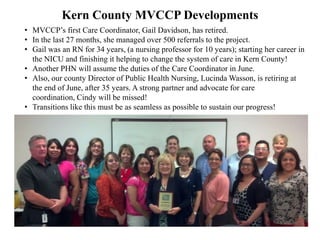
• MVCCP’s first Care Coordinator, Gail Davidson, has retired.
• In the last 27 months, she managed over 500 referrals to the project.
• Gail was an RN for 34 years, (a nursing professor for 10 years); starting her career in
the NICU and finishing it helping to change the system of care in Kern County!
• Another PHN will assume the duties of the Care Coordinator in June.
• Also, our county Director of Public Health Nursing, Lucinda Wasson, is retiring at
the end of June, after 35 years. A strong partner and advocate for care coordination,
Cindy will be missed!
• Transitions like this must be as seamless as possible to sustain our progress!

California Community Care Coordination Collaborative - June 4, 2013

  • 1.
    Welcome to the CaliforniaCommunity Care Coordination Collaborative June 4, 2013
  • 2.
    • Introduction andWelcome • Icebreaker • Updates and Discussion – Contra Costa County – 7C’s – Orange County – OC C3 for Kids – Shasta, Siskiyou, Trinity Counties – Rural Children’s Special Health Coalition – San Mateo County – SMC Care Coordination Learning Community – Fresno County – Central California Care Coordination Project – Kern County – Medically Vulnerable Care Coordination Project • Evaluation • Learning Collaborative Planning AGENDA
  • 3.
    • Your name •Your organization and position • If you could spend a weekend anywhere in California, where would you go and why? ICEBREAKER
  • 4.
    Contra Costa CaliforniaCommunity Care Coordination Collaborative (7C’s) Barbara Sheehy, MS Administrator California Children's Services Contra Costa County UPDATE
  • 5.
    Seven Cs Project CONTRACOSTA CALIFORNIA COMMUNITY CARE COORDINATION COLLABORATIVE
  • 6.
    Seven Cs CoalitionMembers  California Children’s Services  CARE Parent Network  Regional Center of the East Bay  First 5 Contra Costa  Clinic Services/Public Health Nursing  Contra Costa Behavioral/Mental Health  Head Start/Early Head Start  Children’s Hospital & Research Center Oakland  Contra Costa Health Plan  Early Childhood Mental Health  West Contra Costa SELPA  Contra Costa Regional Medical Center, Dept of Pediatrics  Kern County Medically Vulnerable Care Coordination Project  Kaiser Permanente  John Muir Health
  • 7.
    Seven Cs ProjectGoals 1. Determine the specific needs of CSHCN, birth to 5 years of age, and their families, for the Seven Cs Project. 2. Align the organizational structure to implement the Seven Cs Project for CSHCN, birth to 5 years of age, and their families, providers and communities. 3. Conduct a 3-month pilot program of the Seven Cs initiative to work through and validate procedures, tools, costs and processes before full implementation. 4. Create and implement a financial sustainability plan to secure Care Coordination staff and other resources to fully implement the Seven Cs Project for CSHCN, birth to 5 years of age, their families, providers and communities.
  • 8.
    Seven Cs MainActivities  Convene monthly Seven Cs partner meetings to develop, pilot and support an county-wide CSHCN care coordination system.  Learn about the Kern County, MVCCP model, history, Acuity Form and tools.  Compile and analyze Contra Costa CSHCN data to identify projected population to be served by care coordiation initiative.  Develop a county-specific resource list of pediatric special needs services for families and providers.  Develop and implement a county-wide outreach and education plan for families and providers.  Create, implement, and monitor role of Care Coordinator to support county-wide CSHCN care coordination system.
  • 9.
    Seven Cs AnticipatedChallenges  Some partners have limited experience working together collaboratively.  Assuring family centered care is institutionalized in care coordination system.
  • 10.
    Seven Cs Progress Hired excellent Facilitator and Project Coordinator.  Honing in on our target population and care coordination model.  Added needed Project Partners.
  • 11.
    Seven Cs CurrentChallenges  Difficulty getting School/Special Education Partner participation.  May be difficult to develop two additional Round Table groups to flesh out County-wide care coordination system.
  • 12.
    Orange County CareCoordination Collaborative for Kids (OC C3 For Kids) Rebecca Hernandez, MSEd Program Manager Help Me Grow Orange County UPDATE
  • 13.
    Key Coalition Partners: •American Academy of Pediatrics, CA Chapter 4 • Children and Families Commission of Orange County • CHOC Children's Foundation • Help Me Grow Orange County • Orangewood Children’s Foundation/Bridges Network Collaborative Participants: • California Children Services • Cal Optima (Orange County Medi-Cal agency) • Child Health and Disability Prevention Program • Comfort Connection Family Resource Center • County of Orange, Social Services Agency • CHOC Children’s Early Developmental Assessment Center • Family Support Network • Orange County Department of Education/Center for Healthy Kids and Schools • Public Community Health Nursing • Regional Center of Orange County • The Center for Autism and Neurodevelopmental Disorders of Southern CA Orange County Care Coordination Collaborative for Kids
  • 14.
    OC C3 ForKids Goals Overarching goal: To improve overall care for children and families with special health care needs by creating a collaborative care coordination system in Orange County. 1. To identify the specific needs of the Orange County care coordination collaborative starting with children birth to 5 years of age who have special health care needs (CSHCN) and their families. 2. To determine the organizational structure of the Orange County care coordination system for children birth to five years with special health care needs (CSHCN) and their families. 3. To conduct a pilot of the proposed Orange County Care Coordination model to validate the efficacy and refine team based development of procedures, tools, costs and processes before full implementation. 4. To create and implement a sustainability plan to secure resources to implement a care coordination countywide system with scalability and potential to expand to other age groups.
  • 15.
    OC C3 ForKids Activities • Conduct a trend analyses of CSHCN in Orange County • Implement a monthly gathering of a diverse countywide collaborative providing CSHCN case reviews, open discussion and resolution of challenges • Develop a care coordination protocol to address system wide issues that affect CSHCN and their families • Develop and promote common language via a county wide risk assessment and referral form to enhance provider communication • Maximize staff time and resources by focusing on the efficiencies of care coordination • Create a sustainable care coordination entity in OC • Conduct final evaluation combining qualitative and a quantitative assessments to identify strengths and weaknesses of the project
  • 16.
    16 Anticipated Orange CountyChallenges As our project was developed, the core planning team identified several challenges that may be encountered. These include: • Time constraints of the current OC C3 for Kids participants • Recruitment of additional organizations who provide services for CSHCN • Financial constraints as there has been tremendous cutbacks to organizations therefore limited staff to participate Thank you Rebecca Hernandez, MSEd Project Director, OC C3 For Kids Rhernan2@uci.edu
  • 17.
    Progress Made ToDate • Meaningful engagement of multiple stakeholders with commitment to a regular monthly meeting schedule • Hired facilitator for coordination of collaborative meetings and trend analysis fulfillment • Identified trend analysis indicators • Initial understanding and standards in place for confidentiality • Initiation of case reviews intended to inform system gaps and barriers – Initial structure and template in place – Begun identification of system issues – Begun identification of opportunities for additional collaborative efforts
  • 18.
    Challenges Being Faced •Ensuring the right representatives from each agency are at the table • Engaging other payers beyond CalOptima • Missing representation from Public Health • Understanding how the system will function as the Affordable Care Act is implemented • Gathering the actual data from the identified agencies for the trend analysis • Encouraging appropriate participation by parent representatives while respecting their personal experiences
  • 19.
    Rural Children’s SpecialHealth Coalition Siskiyou, Shasta and Trinity Counties Wendy Longwell Parent Health Consultant Rowell Family Empowerment of Northern California UPDATE
  • 20.
    Rowell Family Empowerment ofNorthern CA. (RFENC) • The mission of RFENC is to empower people with diverse abilities, and their families, to live as respected and valued members throughout their communities by providing support, education and advocacy services. • RFENC is a parent founded, parent run agency that assists families in navigating systems, understanding the laws and regulations that govern these systems, and provides parent to parent support. Rural Children’s Special Health Coalition (RCSHC) • Key Coalition Members will include:  CA. Children Services  Far Northern Regional Center  Community Health Centers  Health and Human Services  First 5  Dept. of Health and Human Services  3-5 Family Members from Shasta, Siskiyou, and Trinity counties • RCSHC is dedicated to bringing families and health professionals together to improve health coordination in Shasta, Siskiyou, and Trinity counties.
  • 21.
    Rural Children’s SpecialHealth Coalition Goals! • Professionals are more knowledgeable about community service systems and the family perspective. • Family members are more knowledgeable about community service systems and how to navigate them. • All participants see increased collaboration and communication among agencies to solve problems. • All participants finds the training provided has quality, is valuable, relevant, and useful. • Problem solve any issues we find around the transition to the new managed care Medi-Cal. • Improving and updating the Medical Home Binder. • All participants believe relationships have been strengthened.
  • 22.
    RCSHC Project Activities •Schedule 10 phone and/or face to face meetings per year • Create Methods to track changes in the systems • Develop a trainings needs plan and hire speakers and trainers to educate everyone involved on improving care coordination and developing a clearer understanding of the transition to the new managed MediCal model • Coordinate regular convening of a broad range of stakeholders in the targeted 3 counties to define issues, identify local unmet needs, explore resources, and develop action plans to solve problems • Work on plans and projects the coalition decide are areas we need to work on.
  • 23.
    RCSHC Anticipated Challenges •To get all required coalition members to attend meetings from all three counties. Challenges we may face include:  Distance to travel in unsafe weather conditions from the pioneer communities  Time commitment, with travel, for professionals who may have a tight schedule • To keep coalition members focused on the goals and activities outlined in the grant, staying true to the specific agenda • Finding professional guest speakers/trainers who are willing to travel to the rural and pioneer communities to provide required educational topics that align with the RCSHC goals and objectives. • Keeping the training to be disseminated at a level that can be easily understood by all. Such as keeping it at a 6th grade reading level
  • 24.
    Accomplishments • Meetings held –1 face to face meeting – 1 conference call – Next meeting: conference call • Members of coalition have attended Partnership Health Meetings and State- Level managed Care meetings. • Other meetings in the community helping spread information on the transition • Outreach – Poster distribution – Facebook – Email – Community partners- Head Start, Non-Profit Coalition, local businesses, Area 2 Board, CCS, Far Northern Regional Center, Local Schools and School Districts Hospital representatives, Community Health Representatives, Local Providers, Parents.
  • 25.
    Future Activities • NextFace to Face meeting guest speakers: – Partnership Health Representative – Lucille Packard Representative – State Department of Health and Human Services Representative • Wendy Longwell will be joining the Partnership Health Community Representative Body – Also will be applying to become a Partnership Health Board Member • Additional informational materials will be distributed as they become available. – Ex: input from community of information that Partnership Health should include in their documents • State of California has been updated on the developments and issues that arise as we go through the transition.
  • 26.
    MediCal Transition Anticipated Challenges •State of CA not giving Partnership Health the MediCal recipient's name prior to transition. • Misinformation presented by Partnership Health to the community. • Partnership Health does not have a local office or Executive Director and are not planning to have either until August. • Partnership Health does not have information for our area on their website and is not expected to have such information until July. • Primary Care Providers will be assigned by Partnership Health and recipients must be informed that they must fill out a form to switch back to their original Primary Care Provider. – Recipients must contact their PCP to submit form. – Changes will only happen at the first of the month. Recipients who submit the form after the first of the month will not be able to see their PCP until the following month. – Can cause recipients to wait to see the doctor and could end up in the emergency room. • Healthy Families transition confusion. • Lack of language access.
  • 27.
    Possible Solutions • Whatworked for your counties? • What strategies did you use to combat these issues? • Any ideas??? All input greatly appreciated!
  • 28.
    • Orzo pastawith spinach, feta cheese, kalmata olives, red onion and toasted pine nuts in balsamic vinaigrette • Fresh mixed greens topped with crumbled blue cheese, dried cranberries, spiced nuts and balsamic vinaigrette • Mediterranean platter of hummus, dolmas, tabbouleh, feta cheese, olives and pita • Grilled squash (vegan), shrimp, and chicken skewers • Beverages and Cookies LUNCH
  • 29.
    San Mateo CountyCare Coordination Learning Community Cheryl Oku Program Manager Watch Me Grow Demonstration Site Community Gatepath UPDATE
  • 30.
    • Community Gatepath •First 5 San Mateo County • Golden Gate Regional Center • Lucile Packard Children’s Hospital • San Mateo Co. Community College District • San Mateo County Office of Education • San Mateo Medical System: CCS, MCH, Clinics, Family Health Services PARTNERS
  • 31.
    • Children Now •Child Care Coordinating Council • Fair Oaks Children’s Clinic • IHSD: Head Start/Early Head Start • Legal Aid Society • Lifesteps Foundation • Parca • Ravenswood Family Health Center • Silicon Valley Community Foundation • StarVista PARTICIPANTS
  • 32.
    • Strengthen theexisting system of care coordination for CSHCN through a collaborative learning community • Increase access to coordinated, effective, family- centered services for CSHCN within the medical home • Develop a model of care coordination for CSHCN in the medical home that is replicable and sustainable PROJECT GOALS
  • 33.
    • Policy Group •Mapping care coordination resources • Assessment and referral protocol • Policy recommendations • Practitioner Group • Best practices for care coordination • Care coordinator handbook or tool MAIN PROJECT ACTIVITIES
  • 34.
    • Integrating carecoordination models and information across different systems • Changing availability of community resources for provision of care coordination • Co-location of community care coordinator in the medical home MAJOR CHALLENGES ANTICIPATED
  • 35.
    • Leveraged technicalassistance from LPFCH to obtain additional funding to continue the work of the learning community • Convened 2 meetings focused on developing a shared understanding of the system of care coordination and needs in San Mateo County • Began mapping local care coordination resources and services for CSHCN PROGRESS MADE TO DATE
  • 36.
    • Uncovering gapsin the local system of care that need to be addressed to create a system of coordinated care • Addressing a wide range, intensity and diversity of care coordination needs of CSHCN • Establishing protocols for co-location of care coordination services in the medical home CHALLENGES
  • 37.
    Central California CareCoordination Project Marion Karian Executive Director Exceptional Parents Unlimited Children’s Center UPDATE
  • 38.
    Central California Care CoordinationProject EPU Children’s Center Fresno, California
  • 40.
    Level 1: Basic Informationand Outside Referral - 2-year-old child with expressive and receptive language delays - Referral sent to the Central Valley Regional Center Level 2: Moderate Care Coordination and Multi Agency Involvement - 3- year old child referred for behavioral and developmental concerns -OCK staff ,with the family, creates a care plan with referrals -Referral to ACC /CSC and Family Resources Center Level 3: Intensive Complex /Multi Agency -Care Coordination including Special Health Care Needs - 3-year-old girl has cerebral palsy, a seizure disorder, and is dependent on G-tube feedings, as well as having significant developmental and educational needs. - Complex Care plan must meet her various medical , developmental and educational needs including referrals to specialists at community-based agencies and tertiary care settings. Long term coordination. - Referral to the Central California Care Coordination Team/Care Coordinator
  • 41.
    Fresno County Departmentof Social Services Fresno County Department of Behavioral Health Fresno County Department of Public Health—Public Health Nursing, Children’s Medical Services Central Valley Regional Center Fresno Unified School District First 5 Fresno Children’s Hospital Central California CASA Children’s Services Network Exceptional Parents Unlimited Cal Viva Marjaree Mason Center (Domestic Violence Shelter) SMART Model of Care Partner Oversight Committee Members
  • 42.
    To establish anactive, interdisciplinary multi-agency team to receive referrals and coordinate the care of children with special health care needs. To provide outreach and information regarding care coordination to hospital discharge planning/care coordination staff, NICU discharge staff, private pediatricians, and Federally Qualified Health Clinics. Project Goals
  • 43.
    Convene the CareCoordination Planning Team including representatives from: California Children’s Services Central Valley Regional Center Children’s Hospital—specialty primary care clinic Children’s Hospital—High Risk Newborn Follow Up EPU Children’s Center Parents Conducting Outreach to various providers Attending the SMART—MOCPOC Visiting Kern Medically Vulnerable Project Studying models of care coordination Main Project Activities
  • 44.
    The complexities ofthe reimbursement systems The vast-ness of the medical systems The fragmentation and super-specialization of medical care Focusing our efforts on the ways in which we can have the greatest impact Determining how the Care Coordination Project can fit into the existing SMART Model of Care Challenges
  • 45.
    Difficulties working withcollaborative partners Complexity of eligibility requirements Private insurance limitations Inter-agency consents More Challenges
  • 46.
    Care Coordination Teamhas been meeting monthly Referral procedures are in place Case presentation format has been established A complex case has been presented Beginning outreach presentations o Children’s Hospital “Charlie Mitchell Clinic” o CVRC Baby Clinic o Children’s Hospital High Risk Infant Follow-up Program Progress
  • 47.
    Kern County MedicallyVulnerable Care Coordination Project Marc Thibault, MA Project Director UPDATE
  • 48.
    Kern County MedicallyVulnerable Care Coordination Project Mission Use enhanced coordination of existing case management services to measurably improve long term outcomes for children, birth to 5 years of age, who are at risk of costly, lifelong medical and developmental issues. Background Since 2008, the Kern County Medically Vulnerable (MV) Workgroup of 40+ partner organizations has met monthly at First 5 Kern to address the needs of CSHCN, their families, providers, and communities. Partners California Children’s Services; Clinics; Family Resource Centers; First 5 Kern; Foundations; Hospitals; Insurers; Kern County Departments of Human Services, Mental Health, Public Health Services; Kern Regional Center; School Districts; Special Care Centers; Local Agencies, Community Organizations and Institutions.
  • 49.
    MVCCP Objectives Key Componentsof the Care Coordination Process • Use an accepted Acuity Form to quickly identify and treat more conditions earlier to make a measurable difference in a child’s life. • Support local services that already exist. • Focus on individual cases, working together through a Case Review Committee, to develop best practices of care coordination. • Streamline access to, and maintenance of, health insurance and a medical home, to reduce unnecessary ER visits and hospitalizations. • Build strong, long-term provider partnerships to sustain a system of care coordination that is practical, affordable, and responsive to changing conditions. • Use longitudinal data to document results. • Conduct Cost Benefit Analyses to demonstrate savings on at-risk infants and children to better serve all children in the county.
  • 50.
    The LPFCH grantto MVCCP provides free technical assistance in 2013 and 2014 to help implement care coordination in 3 counties by: • facilitating a series of face to face and webinar meetings to assist local care coordination collaboratives • sharing the MVCCP Acuity Scale Form to quickly help identify and refer Children with Special Health Care Needs (CSHCN) • implementing a process for jointly addressing CSHCN cases • working together, through a locally selected Care Coordinator • finding local solutions and resolving care coordination barriers • using evaluation results from the Kern County MVCCP • developing best practices, learned in all four counties, and • jointly addressing the overall system of health care for CSHCN in these counties.
  • 51.
    MVCCP Replication Processand Potential Challenges Replication Process • MVCCP implemented a “first come, first served” approach, to engage with early adopter counties. • Two counties – Contra Costa and Orange – have been actively engaged, learning about MVCCP Replication, and building their local collaboratives. • A third county is still in the process of being selected, with outreach occurring with several counties through the MVCCP Advisory Committee. Challenges • Counties understand how big an undertaking it is to take on care coordination for CSHCN. Budgetary constraints and uncertainties due to local, state and federal policy and funding changes can affect the level of commitment. • Must always remain aware of, and sensitive to, the political and historical dynamics that can differentiate each county in the implementation process. • Previous or ongoing local collaboration efforts can impact the vision and the commitment to cooperation, especially depending how competitive the atmosphere is among potential partner organizations. • A local governance plan must reflect the collaborative nature of the initiative, provide accountability and transparency to its work, and result in an inclusive decision-making process to achieve optimum results.
  • 52.
    Kern County MVCCPDevelopments • MVCCP’s first Care Coordinator, Gail Davidson, has retired. • In the last 27 months, she managed over 500 referrals to the project. • Gail was an RN for 34 years, (a nursing professor for 10 years); starting her career in the NICU and finishing it helping to change the system of care in Kern County! • Another PHN will assume the duties of the Care Coordinator in June. • Also, our county Director of Public Health Nursing, Lucinda Wasson, is retiring at the end of June, after 35 years. A strong partner and advocate for care coordination, Cindy will be missed! • Transitions like this must be as seamless as possible to sustain our progress!

Editor's Notes

  • #34 Parent involvement at all levels- family centered approach
  • #55 COLLABORATIVE/LPFCH GOALS:- Brief Participant Survey: - Administered anonymously through SurveyMonkey (post-only – done in SEPTEMBER 2014)- Evaluate each TA Event immediately after using a short questionnaire- Process Measures: - Attendance/Participation (done through monitoring spreadsheet – Stacey) - Fidelity to original schedule of meeting events - Additional Technical Assistance offered as a result of coalition requests - Communications via Google Groups - Data from Interim and Final Reports  - Exit Interviews - Learning Collaborative Meeting Worksheet: To be done 4 times over the 18-month period – at the close of each meetingCOALITION GOALS:Process Measures:AttendanceCoalition members at regional meetingsParticipation levelInternal tracking system or data base used by organization - Fidelity to WorkplanIntermediate Outcomes:Data from Interim and Final Reports- Meeting Worksheet – to assess actions/take-aways as a result of work from each 5C’s in-person meetingCollaboration Checklist from Marc Thibault – how does group change over time?Administer in June 2013, December 2013, August 2014- Shared 5C’s outcome – same indicator across coalitions – to be determined collaboratively 
  • #57 Measurement can be done in different ways - If so, you can show improvement, but you cannot compare across groupsDecide how it will be measured and emphasize need for baseline information in order to assess change over time