Calculating Non-adiabatic Pressure
  Perturbations during Multi-field
             Inflation

                Ian Huston
         Astronomy Unit, Queen Mary, University of London

IH, A Christopherson, arXiv:1111.6919 (PRD85 063507)
    Software available at http://pyflation.ianhuston.net
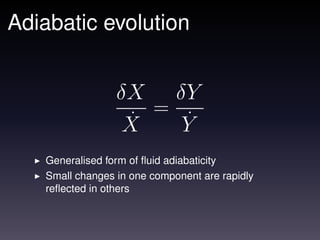
Adiabatic evolution


                 δX δY
                    =
                  ˙
                  X   ˙
                      Y
   Generalised form of fluid adiabaticity
   Small changes in one component are rapidly
   reflected in others
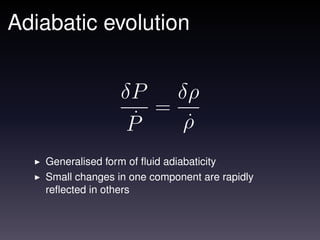
Adiabatic evolution


                  δP    δρ
                      =
                   P˙    ρ
                         ˙
   Generalised form of fluid adiabaticity
   Small changes in one component are rapidly
   reflected in others
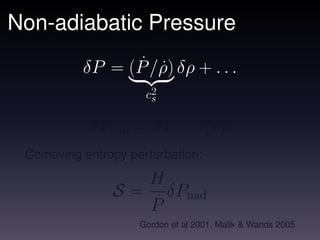
Non-adiabatic Pressure
                 ˙ ˙
          δP = (P /ρ) δρ + . . .
                     c2
                      s

           δPnad = δP − c2δρ
                         s
 Comoving entropy perturbation:

                      H
               S=       δP
                      P˙ nad
                    Gordon et al 2001, Malik & Wands 2005
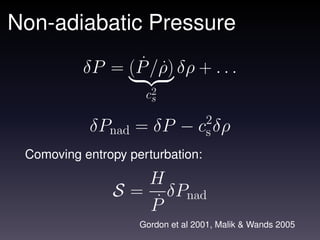
Non-adiabatic Pressure
                 ˙ ˙
          δP = (P /ρ) δρ + . . .
                     c2
                      s

           δPnad = δP − c2δρ
                         s
 Comoving entropy perturbation:

                      H
               S=       δP
                      P˙ nad
                    Gordon et al 2001, Malik & Wands 2005
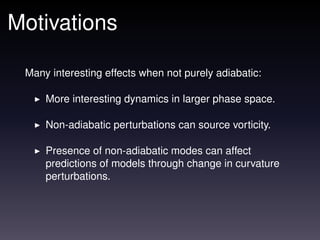
Motivations

 Many interesting effects when not purely adiabatic:

     More interesting dynamics in larger phase space.

     Non-adiabatic perturbations can source vorticity.

     Presence of non-adiabatic modes can affect
     predictions of models through change in curvature
     perturbations.
Motivations

 Many interesting effects when not purely adiabatic:

     More interesting dynamics in larger phase space.

     Non-adiabatic perturbations can source vorticity.

     Presence of non-adiabatic modes can affect
     predictions of models through change in curvature
     perturbations.
Motivations

 Many interesting effects when not purely adiabatic:

     More interesting dynamics in larger phase space.

     Non-adiabatic perturbations can source vorticity.

     Presence of non-adiabatic modes can affect
     predictions of models through change in curvature
     perturbations.
Vorticity generation
 Vorticity can be sourced at second order from
 non-adiabatic pressure:


        ω2ij − Hω2ij ∝ δρ,[j δPnad,i]
        ˙

  ⇒ Vorticity can then source B-mode polarisation and/or
    magnetic fields.
  ⇒ Possibly detectable in CMB.


                   Christopherson, Malik & Matravers 2009, 2011
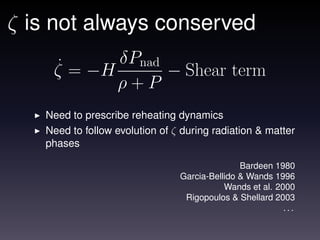
ζ is not always conserved
    ˙ = −H δPnad − Shear term
    ζ
           ρ+P
   Need to prescribe reheating dynamics
   Need to follow evolution of ζ during radiation & matter
   phases

                                               Bardeen 1980
                                Garcia-Bellido & Wands 1996
                                           Wands et al. 2000
                                 Rigopoulos & Shellard 2003
                                                          ...
ζ is not always conserved
    ˙ = −H δPnad − Shear term
    ζ
           ρ+P
   Need to prescribe reheating dynamics
   Need to follow evolution of ζ during radiation & matter
   phases

                                               Bardeen 1980
                                Garcia-Bellido & Wands 1996
                                           Wands et al. 2000
                                 Rigopoulos & Shellard 2003
                                                          ...
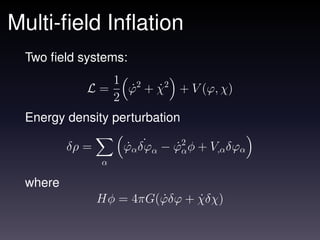
Multi-field Inflation
 Two field systems:
                    1 2
            L=        ϕ + χ2 + V (ϕ, χ)
                      ˙   ˙
                    2
 Energy density perturbation

         δρ =        ˙ ˙
                     ϕα δϕα − ϕ2 φ + V,α δϕα
                              ˙α
                α

 where
                Hφ = 4πG(ϕδϕ + χδχ)
                         ˙     ˙
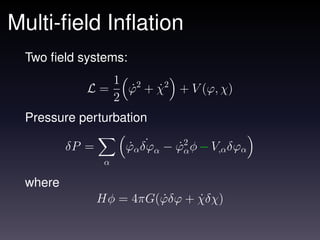
Multi-field Inflation
 Two field systems:
                     1 2
            L=         ϕ + χ2 + V (ϕ, χ)
                       ˙   ˙
                     2
 Pressure perturbation

         δP =         ˙ ˙
                      ϕα δϕα − ϕ2 φ − V,α δϕα
                               ˙α
                 α

 where
                Hφ = 4πG(ϕδϕ + χδχ)
                         ˙     ˙
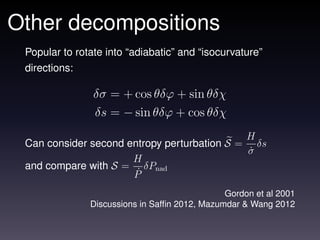
Other decompositions
 Popular to rotate into “adiabatic” and “isocurvature”
 directions:

                δσ = + cos θδϕ + sin θδχ
                δs = − sin θδϕ + cos θδχ
                                             H
 Can consider second entropy perturbation S = δs
                                             σ˙
                      H
 and compare with S = δPnad
                      P˙

                                               Gordon et al 2001
               Discussions in Saffin 2012, Mazumdar & Wang 2012
Numerical Results

   Three different potentials

   Check adiabatic and non-adiabatic
   perturbations

   Compare S and S evolution

   Consider isocurvature at end of inflation
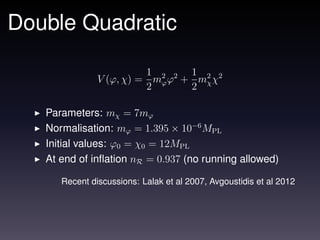
Double Quadratic

                         1       1
               V (ϕ, χ) = m2 ϕ2 + m2 χ2
                           ϕ
                         2       2 χ

   Parameters: mχ = 7mϕ
   Normalisation: mϕ = 1.395 × 10⁻⁶ MPL
   Initial values: ϕ0 = χ0 = 12MPL
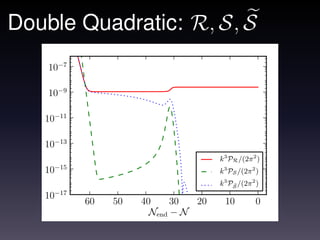
   At end of inflation nR = 0.937 (no running allowed)

      Recent discussions: Lalak et al 2007, Avgoustidis et al 2012
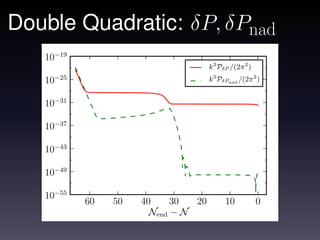
Double Quadratic: δP, δPnad
   10−19
                                     k3 PδP /(2π 2 )
   10−25                             k3 PδPnad /(2π 2 )


   10−31

   10−37

   10−43

   10−49

   10−55
           60   50   40     30  20        10           0
                       Nend − N
Double Quadratic: R, S, S
    10−7

    10−9

   10−11

   10−13
                                        k3 PR /(2π 2 )
        −15
   10                                   k3 PS /(2π 2 )
                                        k3 PS /(2π 2 )
   10−17
              60   50   40     30  20    10         0
                          Nend − N
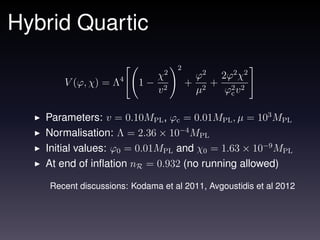
Hybrid Quartic
                                   2
                            χ2             ϕ2 2ϕ2 χ2
       V (ϕ, χ) = Λ4      1− 2         +      + 2 2
                            v              µ2  ϕc v

   Parameters: v = 0.10MPL , ϕc = 0.01MPL , µ = 103 MPL
   Normalisation: Λ = 2.36 × 10⁻⁴ MPL
   Initial values: ϕ0 = 0.01MPL and χ0 = 1.63 × 10⁻⁹ MPL
   At end of inflation nR = 0.932 (no running allowed)

    Recent discussions: Kodama et al 2011, Avgoustidis et al 2012
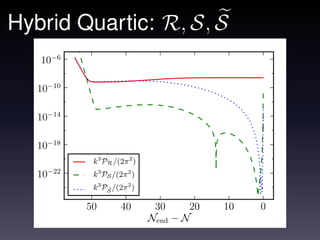
Hybrid Quartic: R, S, S
   10−6

   10−10

   10−14

   10−18
            k3 PR /(2π 2 )
   10−22    k3 PS /(2π 2 )
            k3 PS /(2π 2 )

           50        40       30     20   10   0
                             Nend − N
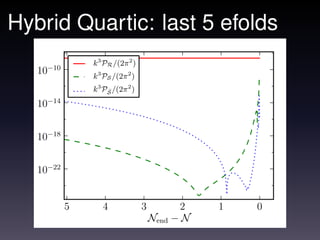
Hybrid Quartic: last 5 efolds
               k3 PR /(2π 2 )
   10−10       k3 PS /(2π 2 )
               k3 PS /(2π 2 )
   10−14


   10−18


   10−22


           5      4             3         2    1   0
                                    Nend − N
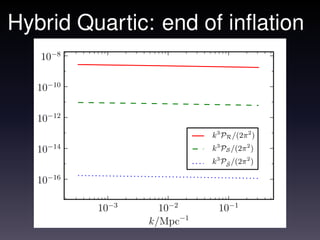
Hybrid Quartic: end of inflation
   10−8

   10−10

   10−12
                            k3 PR /(2π 2 )
   10−14                    k3 PS /(2π 2 )
                            k3 PS /(2π 2 )

   10−16

           10−3     10−2      10−1
                  k/Mpc−1
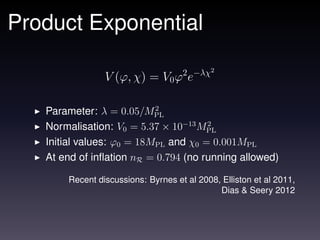
Product Exponential
                                            2
                V (ϕ, χ) = V0 ϕ2 e−λχ

                           2
   Parameter: λ = 0.05/MPL
   Normalisation: V0 = 5.37 × 10⁻¹³ MPL
                                      2

   Initial values: ϕ0 = 18MPL and χ0 = 0.001MPL
   At end of inflation nR = 0.794 (no running allowed)

       Recent discussions: Byrnes et al 2008, Elliston et al 2011,
                                             Dias & Seery 2012
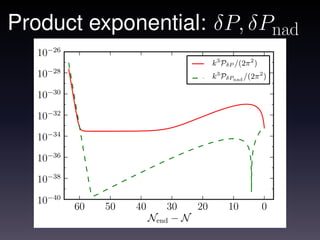
Product exponential: δP, δPnad
   10−26
                                           k3 PδP /(2π 2 )
        −28
   10                                      k3 PδPnad /(2π 2 )

   10−30

   10−32

   10−34

   10−36

   10−38

   10−40
              60   50   40       30   20        10           0
                             Nend − N
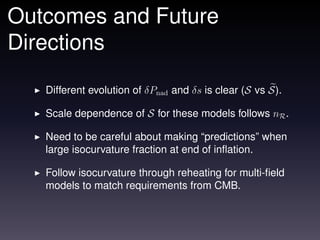
Outcomes and Future
Directions

   Different evolution of δPnad and δs is clear (S vs S).

   Scale dependence of S for these models follows nR .

   Need to be careful about making “predictions” when
   large isocurvature fraction at end of inflation.

   Follow isocurvature through reheating for multi-field
   models to match requirements from CMB.
Reproducibility

    Download Pyflation at http://pyflation.ianhuston.net

 Code is also available as a git repository:

 $ git clone git@bitbucket.org:ihuston/pyflation.git

     Open Source (2-clause BSD license)
     Documentation for each function
     Can submit any changes to be added
     Sign up for the ScienceCodeManifesto.org
Summary
  Non-adiabatic perturbations can change curvature
  perturbations & source vorticity

  Performed a non slow-roll calculation of δPnad

  Showed difference in evolution with δs
  parametrisation, especially at late times

  arXiv:1111.6919 now in Phys Rev D85, 063507

  Download code from http://pyflation.ianhuston.net

Calculating Non-adiabatic Pressure Perturbations during Multi-field Inflation

  • 1.
    Calculating Non-adiabatic Pressure Perturbations during Multi-field Inflation Ian Huston Astronomy Unit, Queen Mary, University of London IH, A Christopherson, arXiv:1111.6919 (PRD85 063507) Software available at http://pyflation.ianhuston.net
  • 2.
    Adiabatic evolution δX δY = ˙ X ˙ Y Generalised form of fluid adiabaticity Small changes in one component are rapidly reflected in others
  • 3.
    Adiabatic evolution δP δρ = P˙ ρ ˙ Generalised form of fluid adiabaticity Small changes in one component are rapidly reflected in others
  • 4.
    Non-adiabatic Pressure ˙ ˙ δP = (P /ρ) δρ + . . . c2 s δPnad = δP − c2δρ s Comoving entropy perturbation: H S= δP P˙ nad Gordon et al 2001, Malik & Wands 2005
  • 5.
    Non-adiabatic Pressure ˙ ˙ δP = (P /ρ) δρ + . . . c2 s δPnad = δP − c2δρ s Comoving entropy perturbation: H S= δP P˙ nad Gordon et al 2001, Malik & Wands 2005
  • 6.
    Motivations Many interestingeffects when not purely adiabatic: More interesting dynamics in larger phase space. Non-adiabatic perturbations can source vorticity. Presence of non-adiabatic modes can affect predictions of models through change in curvature perturbations.
  • 7.
    Motivations Many interestingeffects when not purely adiabatic: More interesting dynamics in larger phase space. Non-adiabatic perturbations can source vorticity. Presence of non-adiabatic modes can affect predictions of models through change in curvature perturbations.
  • 8.
    Motivations Many interestingeffects when not purely adiabatic: More interesting dynamics in larger phase space. Non-adiabatic perturbations can source vorticity. Presence of non-adiabatic modes can affect predictions of models through change in curvature perturbations.
  • 9.
    Vorticity generation Vorticitycan be sourced at second order from non-adiabatic pressure: ω2ij − Hω2ij ∝ δρ,[j δPnad,i] ˙ ⇒ Vorticity can then source B-mode polarisation and/or magnetic fields. ⇒ Possibly detectable in CMB. Christopherson, Malik & Matravers 2009, 2011
  • 10.
    ζ is notalways conserved ˙ = −H δPnad − Shear term ζ ρ+P Need to prescribe reheating dynamics Need to follow evolution of ζ during radiation & matter phases Bardeen 1980 Garcia-Bellido & Wands 1996 Wands et al. 2000 Rigopoulos & Shellard 2003 ...
  • 11.
    ζ is notalways conserved ˙ = −H δPnad − Shear term ζ ρ+P Need to prescribe reheating dynamics Need to follow evolution of ζ during radiation & matter phases Bardeen 1980 Garcia-Bellido & Wands 1996 Wands et al. 2000 Rigopoulos & Shellard 2003 ...
  • 12.
    Multi-field Inflation Twofield systems: 1 2 L= ϕ + χ2 + V (ϕ, χ) ˙ ˙ 2 Energy density perturbation δρ = ˙ ˙ ϕα δϕα − ϕ2 φ + V,α δϕα ˙α α where Hφ = 4πG(ϕδϕ + χδχ) ˙ ˙
  • 13.
    Multi-field Inflation Twofield systems: 1 2 L= ϕ + χ2 + V (ϕ, χ) ˙ ˙ 2 Pressure perturbation δP = ˙ ˙ ϕα δϕα − ϕ2 φ − V,α δϕα ˙α α where Hφ = 4πG(ϕδϕ + χδχ) ˙ ˙
  • 14.
    Other decompositions Popularto rotate into “adiabatic” and “isocurvature” directions: δσ = + cos θδϕ + sin θδχ δs = − sin θδϕ + cos θδχ H Can consider second entropy perturbation S = δs σ˙ H and compare with S = δPnad P˙ Gordon et al 2001 Discussions in Saffin 2012, Mazumdar & Wang 2012
  • 15.
    Numerical Results Three different potentials Check adiabatic and non-adiabatic perturbations Compare S and S evolution Consider isocurvature at end of inflation
  • 16.
    Double Quadratic 1 1 V (ϕ, χ) = m2 ϕ2 + m2 χ2 ϕ 2 2 χ Parameters: mχ = 7mϕ Normalisation: mϕ = 1.395 × 10⁻⁶ MPL Initial values: ϕ0 = χ0 = 12MPL At end of inflation nR = 0.937 (no running allowed) Recent discussions: Lalak et al 2007, Avgoustidis et al 2012
  • 17.
    Double Quadratic: δP,δPnad 10−19 k3 PδP /(2π 2 ) 10−25 k3 PδPnad /(2π 2 ) 10−31 10−37 10−43 10−49 10−55 60 50 40 30 20 10 0 Nend − N
  • 18.
    Double Quadratic: R,S, S 10−7 10−9 10−11 10−13 k3 PR /(2π 2 ) −15 10 k3 PS /(2π 2 ) k3 PS /(2π 2 ) 10−17 60 50 40 30 20 10 0 Nend − N
  • 19.
    Hybrid Quartic 2 χ2 ϕ2 2ϕ2 χ2 V (ϕ, χ) = Λ4 1− 2 + + 2 2 v µ2 ϕc v Parameters: v = 0.10MPL , ϕc = 0.01MPL , µ = 103 MPL Normalisation: Λ = 2.36 × 10⁻⁴ MPL Initial values: ϕ0 = 0.01MPL and χ0 = 1.63 × 10⁻⁹ MPL At end of inflation nR = 0.932 (no running allowed) Recent discussions: Kodama et al 2011, Avgoustidis et al 2012
  • 20.
    Hybrid Quartic: R,S, S 10−6 10−10 10−14 10−18 k3 PR /(2π 2 ) 10−22 k3 PS /(2π 2 ) k3 PS /(2π 2 ) 50 40 30 20 10 0 Nend − N
  • 21.
    Hybrid Quartic: last5 efolds k3 PR /(2π 2 ) 10−10 k3 PS /(2π 2 ) k3 PS /(2π 2 ) 10−14 10−18 10−22 5 4 3 2 1 0 Nend − N
  • 22.
    Hybrid Quartic: endof inflation 10−8 10−10 10−12 k3 PR /(2π 2 ) 10−14 k3 PS /(2π 2 ) k3 PS /(2π 2 ) 10−16 10−3 10−2 10−1 k/Mpc−1
  • 23.
    Product Exponential 2 V (ϕ, χ) = V0 ϕ2 e−λχ 2 Parameter: λ = 0.05/MPL Normalisation: V0 = 5.37 × 10⁻¹³ MPL 2 Initial values: ϕ0 = 18MPL and χ0 = 0.001MPL At end of inflation nR = 0.794 (no running allowed) Recent discussions: Byrnes et al 2008, Elliston et al 2011, Dias & Seery 2012
  • 24.
    Product exponential: δP,δPnad 10−26 k3 PδP /(2π 2 ) −28 10 k3 PδPnad /(2π 2 ) 10−30 10−32 10−34 10−36 10−38 10−40 60 50 40 30 20 10 0 Nend − N
  • 25.
    Outcomes and Future Directions Different evolution of δPnad and δs is clear (S vs S). Scale dependence of S for these models follows nR . Need to be careful about making “predictions” when large isocurvature fraction at end of inflation. Follow isocurvature through reheating for multi-field models to match requirements from CMB.
  • 26.
    Reproducibility Download Pyflation at http://pyflation.ianhuston.net Code is also available as a git repository: $ git clone git@bitbucket.org:ihuston/pyflation.git Open Source (2-clause BSD license) Documentation for each function Can submit any changes to be added Sign up for the ScienceCodeManifesto.org
  • 27.
    Summary Non-adiabaticperturbations can change curvature perturbations & source vorticity Performed a non slow-roll calculation of δPnad Showed difference in evolution with δs parametrisation, especially at late times arXiv:1111.6919 now in Phys Rev D85, 063507 Download code from http://pyflation.ianhuston.net