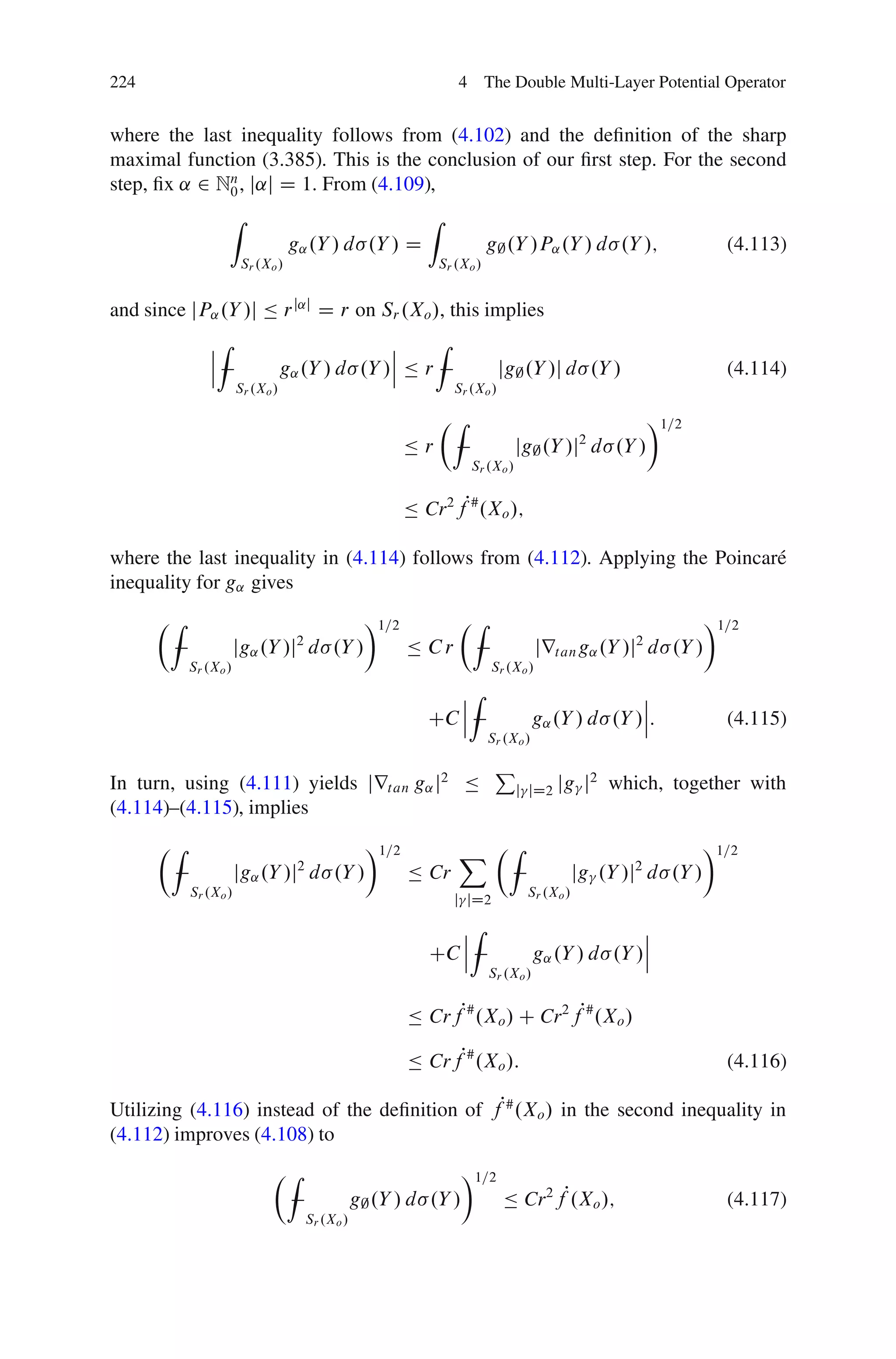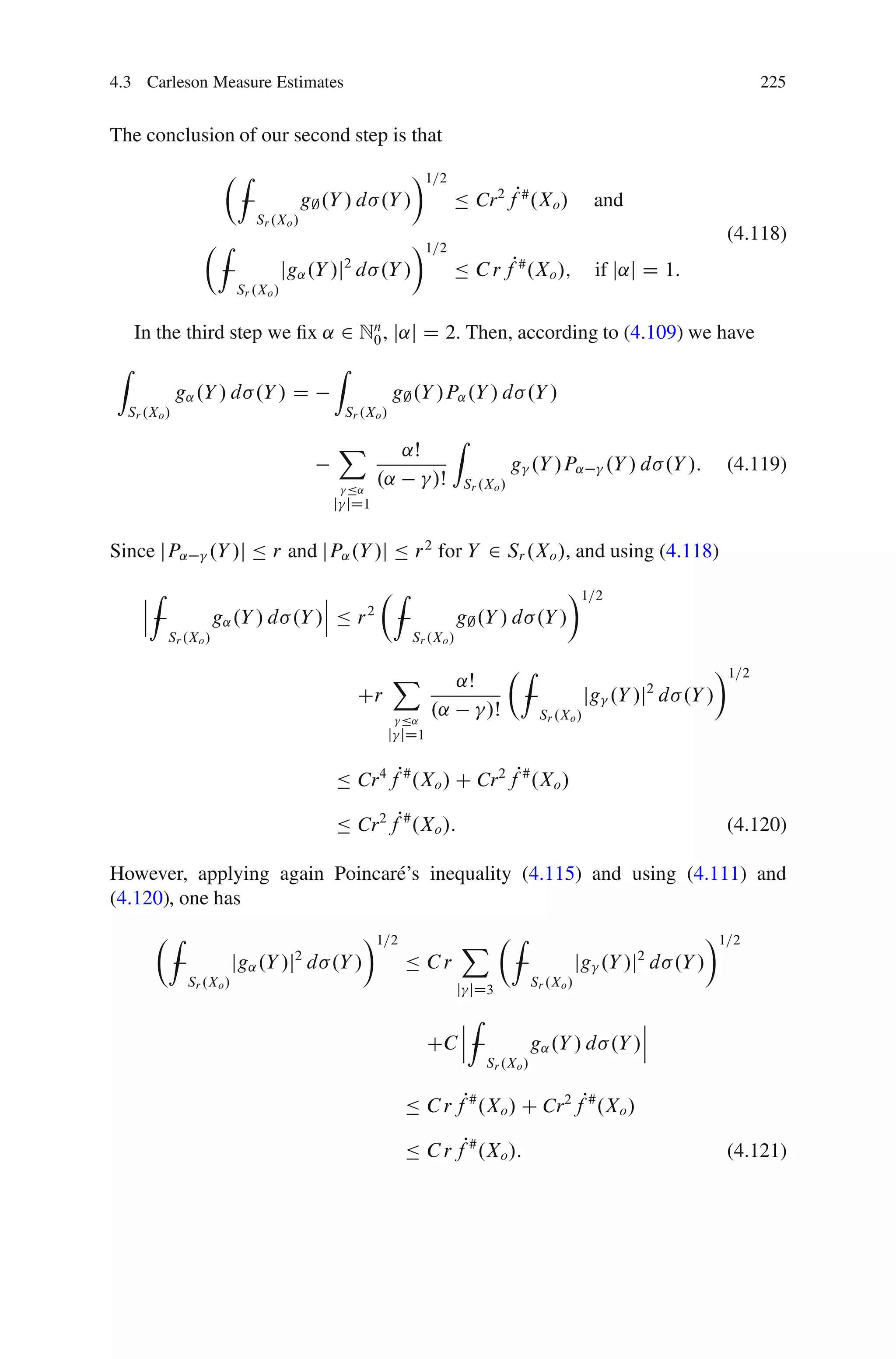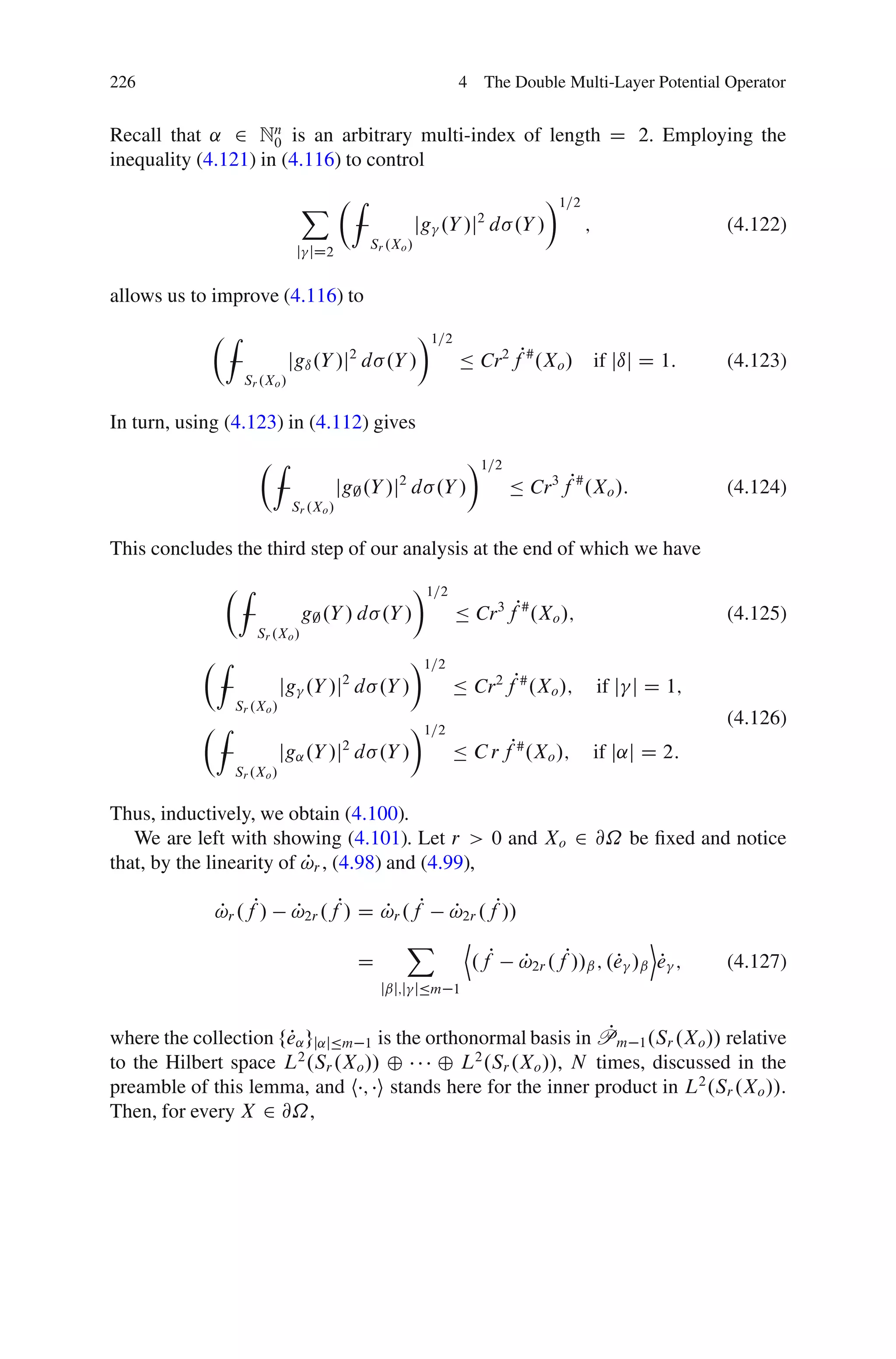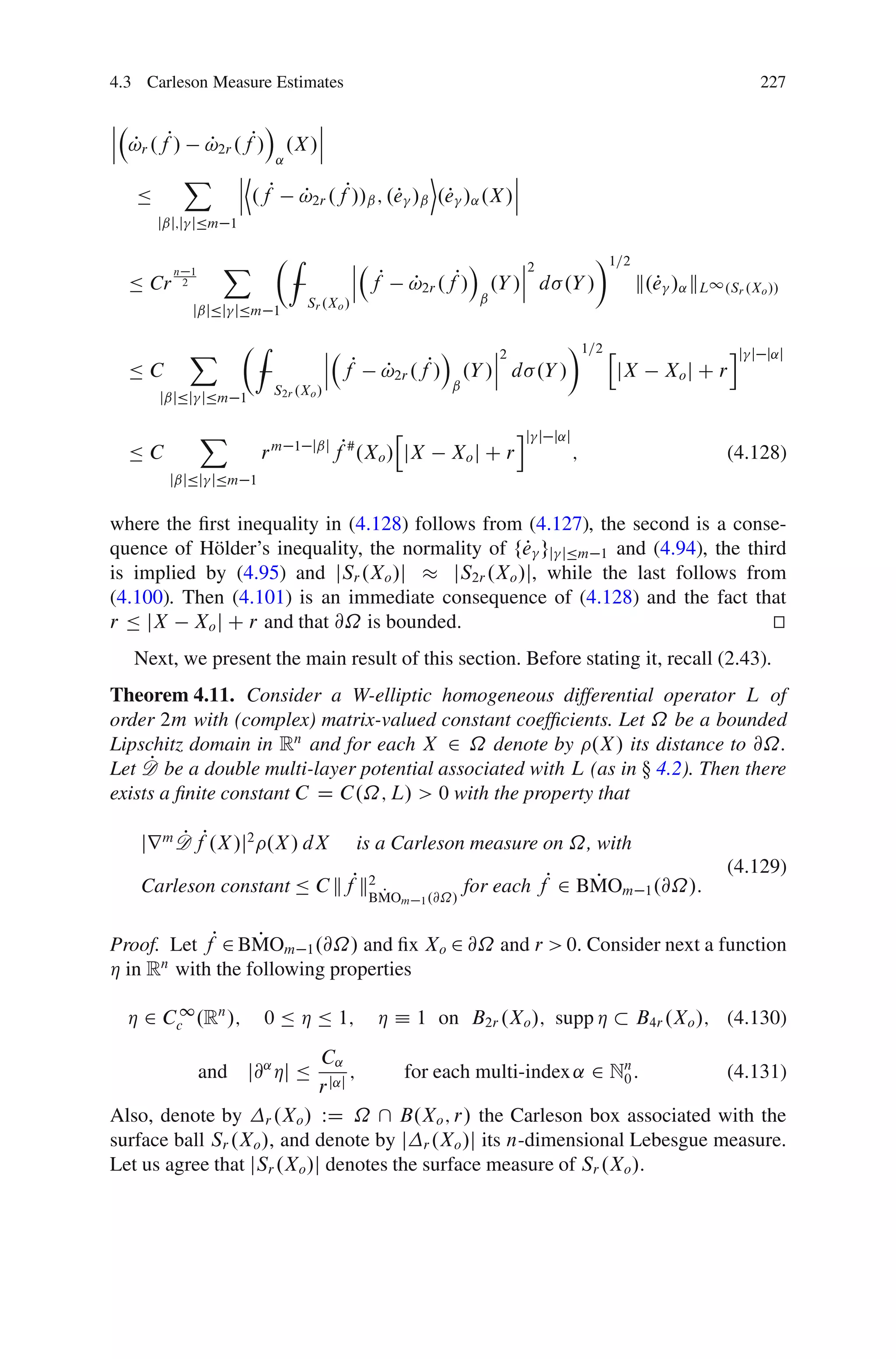
Chapter 4
The Double Multi-Layer Potential Operator


In this chapter we take on the task of introducing and studying what we call
double multi-layer potential operators, associated with arbitrary elliptic, higher-
order, homogeneous, constant (complex) matrix-valued coefficients. As a preamble,
we first take a look at the nature of fundamental solutions associated with such
operators.


4.1 Differential Operators and Fundamental Solutions

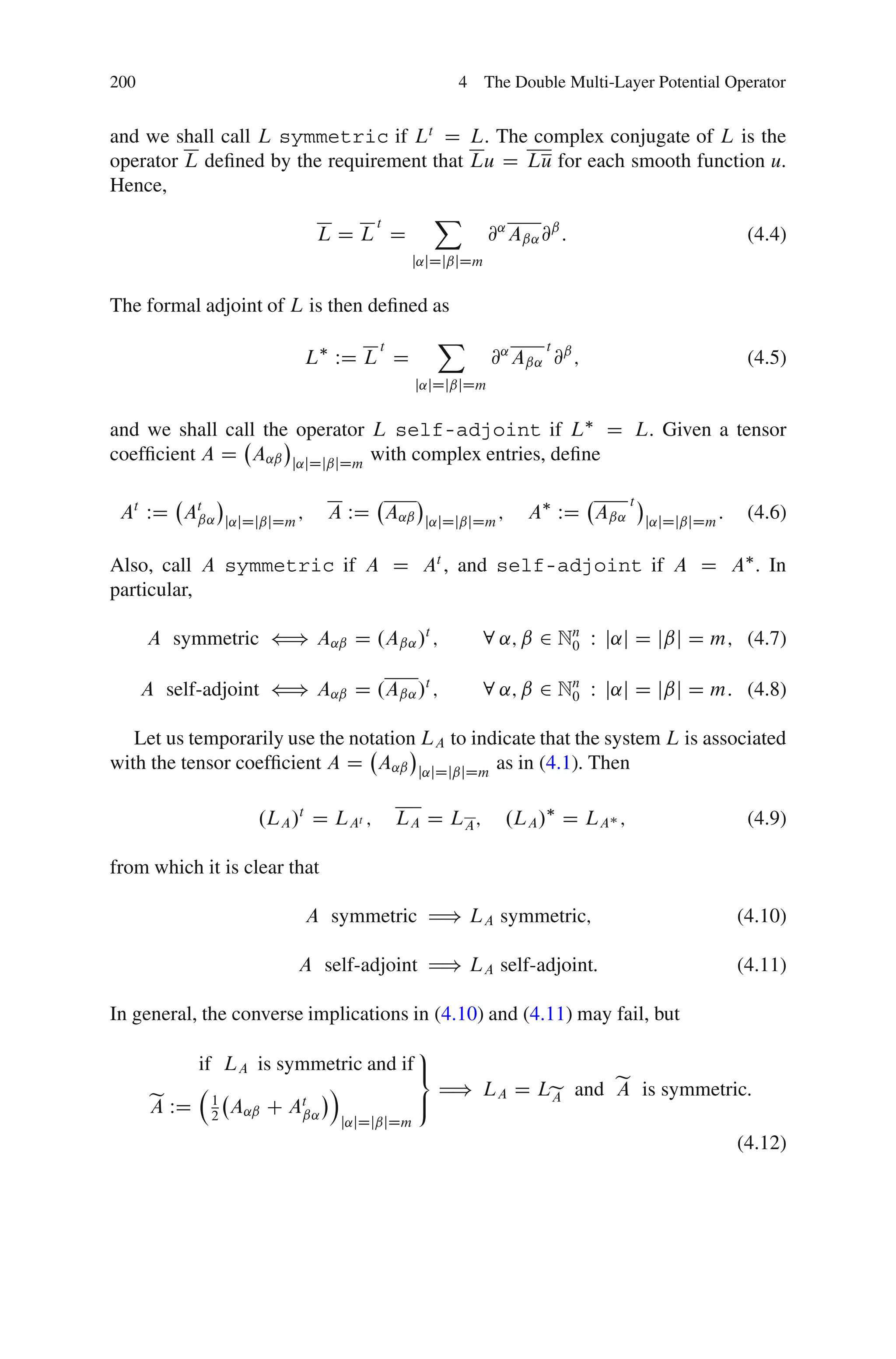
Fix an Euclidean space dimension n 2 N. For some fixed M 2 N and m 2 N, consider
a M M system of homogeneous differential operators of order 2m in Rn with
complex constant coefficients:
                                 X
                        LD               @˛ A˛ˇ @ˇ D Lj k     1Äj;kÄM
                                                                                              (4.1)
                             j˛jDjˇjDm


where, for each multi-indices ˛; ˇ 2 Nn of length m,
                                      0
                        Á                                            X
                   ˛ˇ                                                              ˛ˇ
       A˛ˇ WD aj k                2 CM     M
                                                and      Lj k WD               @˛ aj k @ˇ ;   (4.2)
                        1Äj;kÄM
                                                                   j˛jDjˇjDm

                            ˛ˇ
for some coefficients aj k 2 C, j; k 2 f1; : : : ; M g. Throughout, we shall use the
superscript t to indicate transposition. In particular,
                                           X
                                 Lt WD               @˛ At @ˇ ;
                                                         ˇ˛                                   (4.3)
                                         j˛jDjˇjDm


I. Mitrea and M. Mitrea, Multi-Layer Potentials and Boundary Problems, Lecture Notes           199
in Mathematics 2063, DOI 10.1007/978-3-642-32666-0 4,
© Springer-Verlag Berlin Heidelberg 2013
200                                                4 The Double Multi-Layer Potential Operator


and we shall call L symmetric if Lt D L. The complex conjugate of L is the
operator L defined by the requirement that Lu D Lu for each smooth function u.
Hence,
                               t     X
                       LDL D               @˛ Aˇ˛ @ˇ :                  (4.4)
                                           j˛jDjˇjDm


The formal adjoint of L is then defined as
                                      t         X                  t
                               L WD L D                   @˛ Aˇ˛ @ˇ ;                              (4.5)
                                              j˛jDjˇjDm


and we shall call the operator L self-adjoint if L D L. Given a tensor
coefficient A D A˛ˇ j˛jDjˇjDm with complex entries, define

                                                                              t
 At WD At
        ˇ˛     j˛jDjˇjDm
                           ;     A WD A˛ˇ      j˛jDjˇjDm
                                                           ;     A WD Aˇ˛         j˛jDjˇjDm
                                                                                              :    (4.6)

Also, call A symmetric if A D At , and self-adjoint if A D A . In
particular,

      A symmetric ” A˛ˇ D .Aˇ˛ /t ;                   8 ˛; ˇ 2 Nn W j˛j D jˇj D m; (4.7)
                                                                0


      A self-adjoint ” A˛ˇ D .Aˇ˛ /t ;                8 ˛; ˇ 2 Nn W j˛j D jˇj D m: (4.8)
                                                                0


   Let us temporarily use the notation LA to indicate that the system L is associated
with the tensor coefficient A D A˛ˇ j˛jDjˇjDm as in (4.1). Then

                   .LA /t D LAt ;         LA D LA ;            .LA / D LA ;                        (4.9)

from which it is clear that

                               A symmetric H) LA symmetric;                                       (4.10)

                           A self-adjoint H) LA self-adjoint:                                     (4.11)

In general, the converse implications in (4.10) and (4.11) may fail, but
                                     9
           if LA is symmetric and if =
                         Á             H) LA D Le and e is symmetric:
                                                      A
       e WD 1 A˛ˇ C At
       A                             ;          A
             2        ˇ˛
                                  j˛jDjˇjDm
                                                                                                  (4.12)
4.1 Differential Operators and Fundamental Solutions                                            201


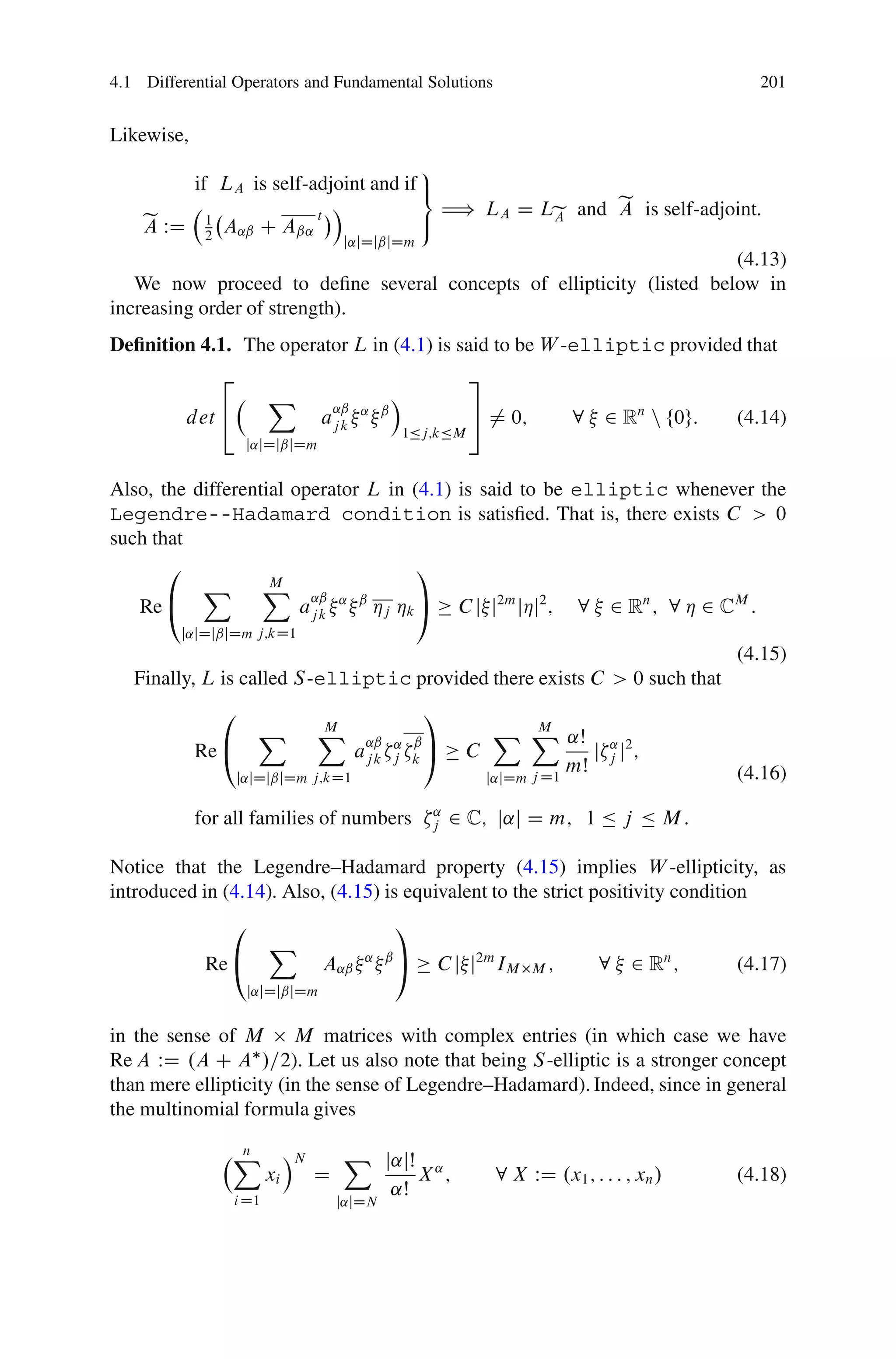
Likewise,
                                     9
        if LA is self-adjoint and if =
                         Á             H) LA D Le and e is self-adjoint:
                                                      A
    e WD 1 A˛ˇ C Aˇ˛ t
    A                                ;          A
          2                           j˛jDjˇjDm
                                                                      (4.13)
   We now proceed to define several concepts of ellipticity (listed below in
increasing order of strength).
Definition 4.1. The operator L in (4.1) is said to be W -elliptic provided that
               2                                             3
                       X                       Á
          det 4                                              5 ¤ 0;
                                     ˛ˇ ˛ ˇ
                                 aj k                                         8 2 Rn n f0g:   (4.14)
                                                   1Äj;kÄM
                    j˛jDjˇjDm


Also, the differential operator L in (4.1) is said to be elliptic whenever the
Legendre--Hadamard condition is satisfied. That is, there exists C > 0
such that
       0                               1
           X X ˛ˇ   M
   Re @                 aj k ˛ ˇ Áj Ák A C j j2m jÁj2 ; 8 2 Rn ; 8 Á 2 CM :
         j˛jDjˇjDm j;kD1
                                                                                              (4.15)
   Finally, L is called S -elliptic provided there exists C > 0 such that
               0                                     1
                     X           X
                                 M                               X X ˛Š
                                                                    M
            Re @
                                         ˛ˇ ˛ ˇ A
                                        aj kj k              C            j ˛ j2 ;
                                                                   j D1
                                                                        mŠ j                  (4.16)
                   j˛jDjˇjDm j;kD1                               j˛jDm

            for all families of numbers               ˛
                                                      j   2 C; j˛j D m; 1 Ä j Ä M :

Notice that the Legendre–Hadamard property (4.15) implies W -ellipticity, as
introduced in (4.14). Also, (4.15) is equivalent to the strict positivity condition
                0                              1
                       X
             Re @                A˛ˇ     ˛ ˇA
                                                      C j j2m IM         M;      8 2 Rn ;     (4.17)
                    j˛jDjˇjDm


in the sense of M M matrices with complex entries (in which case we have
Re A WD .A C A /=2). Let us also note that being S -elliptic is a stronger concept
than mere ellipticity (in the sense of Legendre–Hadamard). Indeed, since in general
the multinomial formula gives

                X
                n           ÁN        X j˛jŠ
                       xi        D           X˛;                  8 X WD .x1 ; : : : ; xn /   (4.18)
                i D1
                                         ˛Š
                                     j˛jDN
202                                                  4 The Double Multi-Layer Potential Operator


we conclude
                                                !m
                X mŠ                X
                                    n
                           2˛
                                D           2
                                            k        D j j2m ;      8 2 Rn ;             (4.19)
                  ˛Š
               j˛jDm                kD1


so (4.16) reduces to (4.15) when j WD ˛ Áj with 2 Rn and Á D .Áj /1Äj ÄM 2
                                   ˛

CM .
   Finally, we remark that we will occasionally require only a much weaker
condition than (4.16), namely the semi-positivity condition to the effect
that
     0                         1
          X      X ˛ˇ
                  M
  Re @                aj k j k A 0; 8 j 2 C; j˛j D m; 1 Ä j Ä M: (4.20)
                           ˛ ˇ           ˛

       j˛jDjˇjDm j;kD1


   We wish to note that given a differential operator L D LA as in (4.1),
corresponding to some tensor coefficient A D A˛ˇ j˛jDjˇjDm , there exist infinitely
many other tensor coefficients B D B˛ˇ j˛jDjˇjDm such that L D LB . In turn, the
choice of these B’s may affect some of the properties of the operator L discussed
above. Concretely, while the quality of being W-elliptic (cf. (4.14)) or satisfying
the Legendre–Hadamard condition (4.15) are unaffected by the choice of tensor
coefficient B used in the writing of the given operator L, the property of being
S-elliptic (cf. (4.16)) and the semi-positivity condition (4.20) may fail for LB .
   A few examples of homogeneous, constant coefficient, higher-order elliptic
operators are as follows. First, the polyharmonic operator
                                            X mŠ
                                    m
                                        D        @2 ;                                    (4.21)
                                               Š
                                            j jDm


has been extensively studied in the literature. In the three-dimensional setting, the
fourth order operator

                                        @4 C @4 C @4
                                         1    2    3                                     (4.22)

has been considered by I. Fredholm who has computed an explicit fundamental
solution for it in [48]. More generally, an explicit fundamental solution for the
operator

                       @4 C @4 C @4 C c @2 @2 C @2 @2 C @2 @2
                        1    2    3      1 2     1 3     2 3                             (4.23)

which is elliptic if c 2 . 1 ; 1/ has been found in [130] (where elliptic operators
            P                 2
of the form 3              2 2
               j;kD1 aj k @j @k have also been considered).
4.1 Differential Operators and Fundamental Solutions                                               203


   Moving on, recall that the classical Malgrange–Ehrenpreis theorem asserts that
                                               P
any differential operator of the form P .@/ D    j˛jÄm a˛ @ , with a˛ 2 C not all
                                                           ˛
                                         0
zero, has a fundamental solution E 2 D .R / in R . In fact, as noted in [100], one
                                            n     n

may take
                                     Z
                          1                                                 P .i C zÁ/ Á d z
        E.X / WD                                      zm e zhÁ;X i F   1
                                                                       !X                    :   (4.24)
                   2 i Pm .Á/            z2C; jzjD1                         P .i C zÁ/ z

Above, F !X is the inverse of the Fourier transform, originally defined by the
             1
                            R
formula FX ! . / WD Rn e i hX; i .X / dX for              2 Cc1 .Rn / and
                                                                        P      2 Rn ,
then extended by continuity to tempered distributions. Also, P . / D j˛jÄm a˛ ˛ ,
  2 Cn , is the characteristic polynomial of P .@/, and Pm stands for the principal
part of P . Finally, Á 2 Cn is a fixed vector with the property that Pm .Á/ 6D 0.
   We shall need a result of a somewhat similar nature for systems of differential
operators. The theorem below is essentially a collection of results proved in [60,
pp. 72–76], [57, p. 169], [114], and [95, p. 104], in various degrees of generality.
However, we feel that it is useful to have a unifying statement, accompanied by a
fairly self-contained proof, presented here.

Theorem 4.2. Let L be a homogeneous differential operator L in Rn of order 2m,
m 2 N, with complex matrix-valued constant coefficients as in (4.1) which satisfies
(4.14). Then, there exists a matrix of tempered distributions, E D Ej k 1Äj;kÄM ,
such that the following hold:
(1) For each 1 Ä j; k Ä M ,

      Ej k 2 C 1 .Rn n f0g/ and Ej k . X / D Ej k .X /                        8 X 2 Rn n f0g: (4.25)

(2) For each 1 Ä j; k Ä M ,
                                                            (
                    X
                    M           h                      i        0      if j ¤ k;
                          LX
                           jr       Erk .X       Y/ D                                            (4.26)
                    rD1                                         ıY .X /     if j D k;

    where ı stands for the Dirac delta distribution at 0 and the superscript X
    denotes the fact that the operator Ljs in (4.26) is applied in the variable X .
(3) If 1 Ä j; k Ä M , then
                                             Á
             Ej k .X / D ˚j k .X / C log jX j Pj k .X /;                      X 2 Rn n f0g;      (4.27)

    where ˚j k 2 C 1 .Rn n f0g/ is a homogeneous function of degree 2m n, and
    Pj k is identically zero when either n is odd, or n > 2m, and is a homogeneous
    polynomial of degree 2m n when n Ä 2m. In fact,
204                                                          4 The Double Multi-Layer Potential Operator

                 Á                                           Z                          X                  Á
                                            1                                                                   1
      Pj k .X/                 D                                     .X /2m    n               ˛Cˇ
                                                                                                     A˛ˇ            d
                     1Äj;kÄM       .2 i/n .2m         n/Š
                                                            Sn 1                   j˛jDjˇjDm
                                                                                                               (4.28)
    for X 2 Rn .
(4) For each ˛ 2 Nn there exists C˛ > 0 such that
                  0

                       8     C˛
                       ˆ
                       ˆ                         if either n is odd, or n > 2m, or if j˛j > 2m                      n;
                       ˆ jXjn 2mCj˛j
                       <
      j@ E.X/j Ä
       ˛
                       ˆ C .1 C j log jXjj/
                       ˆ ˛
                       ˆ
                       :                                 if 0 Ä j˛j Ä 2m               n;
                           jXjn 2mCj˛j
                                                                                                               (4.29)

    uniformly for X 2 Rn n f0g.
(5) One can assign to each differential operator L as in (4.1)–(4.14) a fundamental
    solution EL which satisfies (1)-(4) above and, in addition,
                                   t
                           EL          D ELt ;      EL D EL ;             EL       D EL :                      (4.30)

(6) The matrix-valued distribution E has entries which are tempered distributions
                                                                         b
    in Rn . When restricted to Rn n f0g, the matrix-valued distribution E (with
                                                                  1
    “hat” denoting the Fourier transform, defined as before) is a C function and,
    moreover,
                                          X                      Á    1
           b
           E. / D . 1/m                             ˛Cˇ
                                                          A˛ˇ             for each          2 Rn n f0g: (4.31)
                                       j˛jDjˇjDm


(7) For each multi-index ˛ 2 Nn with j˛j D 2m 1, the function @˛ E is odd, C 1
                              0
    smooth, and homogeneous of degree n 1 in Rn n f0g.
Proof. Let P j k . /       1Äj;kÄM
                                          be the inverse of the characteristic matrix
                                         X
                       L. / WD                     A˛ˇ   ˛Cˇ
                                                                 ;         2 Rn n f0g:                         (4.32)
                                       j˛jDjˇjDm


Following [60, p. 76], if n is odd, define
                                                             Z h                                i
                         1                         .n 1/=2
Ej k .X / WD           n 1 .2m                     X                  .X /2m       1
                                                                                       sign .X / P j k . / d ;
               4.2 i /                     1/Š
                                                            Sn   1
                                                                                                               (4.33)
for X 2 Rn n f0g. Note that this expression is homogeneous of degree 2m                                        n. On
the other hand, if n is even, set
4.1 Differential Operators and Fundamental Solutions                                                                      205

                                          Z            h                                    i
                        1         n=2
  Ej k .X / WD                    X                        .X        /2m log jX            j P jk. / d             ; (4.34)
                 .2 i /n .2m/Š                Sn   1


where X 2 Rn n f0g. It is also clear from (4.33)–(4.34) that E is an even function.
   Alternatively, transferring one Laplacian under the integral sign when n is odd,
                             Á
using the fact that log Xi      D log jX j         i
                                                  2 sign .X     / and simple parity
considerations, it can be checked that
                                         Z h
                      1          .nCq/=2                        X Ái j k
Ej k .X / D                                  .X /2mCq log               P . /d ;
            .2 i /n .2m C q/Š X                                   i
                                                       Sn    1
                                                                                (4.35)
for X 2 Rn n f0g, where q WD 0 if n is even and q WD 1 if n is odd.
   As a preamble to checking (4.26), consider F .t/ WD t 2mCq log .t= i /, t 2 R n f0g,
and note that there exists a constant Cm;q such that

                       d Á2m         .2m C q/Š q   t
                             F .t/ D          t log C Cm;q t q :                                                        (4.36)
                       dt               qŠ         i

Consequently,
                           h .2m C q/Š                                X                               i
        LX F .X       /D                      .X            /q log             C Cm;q .X            /q L. / (4.37)
                                 qŠ                                       i

and, further,
                                 Z            h                                            Ái                       Á
                     1                                                             X
   LX             n .2m C q/Š
                                                  .X        /2mCq log                           ŒL. /     1
                                                                                                               d
           .2 i /                    Sn   1                                            i
                                                                 Á
                      D B.nCq/=2 .X / C Pq .X /                       IM      M;                                        (4.38)

where
                                                       Z                                           Á
                                     1                                                     X
           B.nCq/=2 .X / WD                                          .X       /q log                   d                (4.39)
                                  .2 i /n qŠ                Sn   1                             i

is a fundamental solution for .nCq/=2 (cf., e.g., Lemma 4.2 on p. 123 in [122]),
Pq .X / is a homogeneous polynomial of degree q, and IM M is the identity matrix.
             .nCq/=2
Applying X           to both sides of (4.38) then gives

                                          LE D ı IM                   M                                                 (4.40)

i.e., (4.26) holds.
206                                                                              4 The Double Multi-Layer Potential Operator


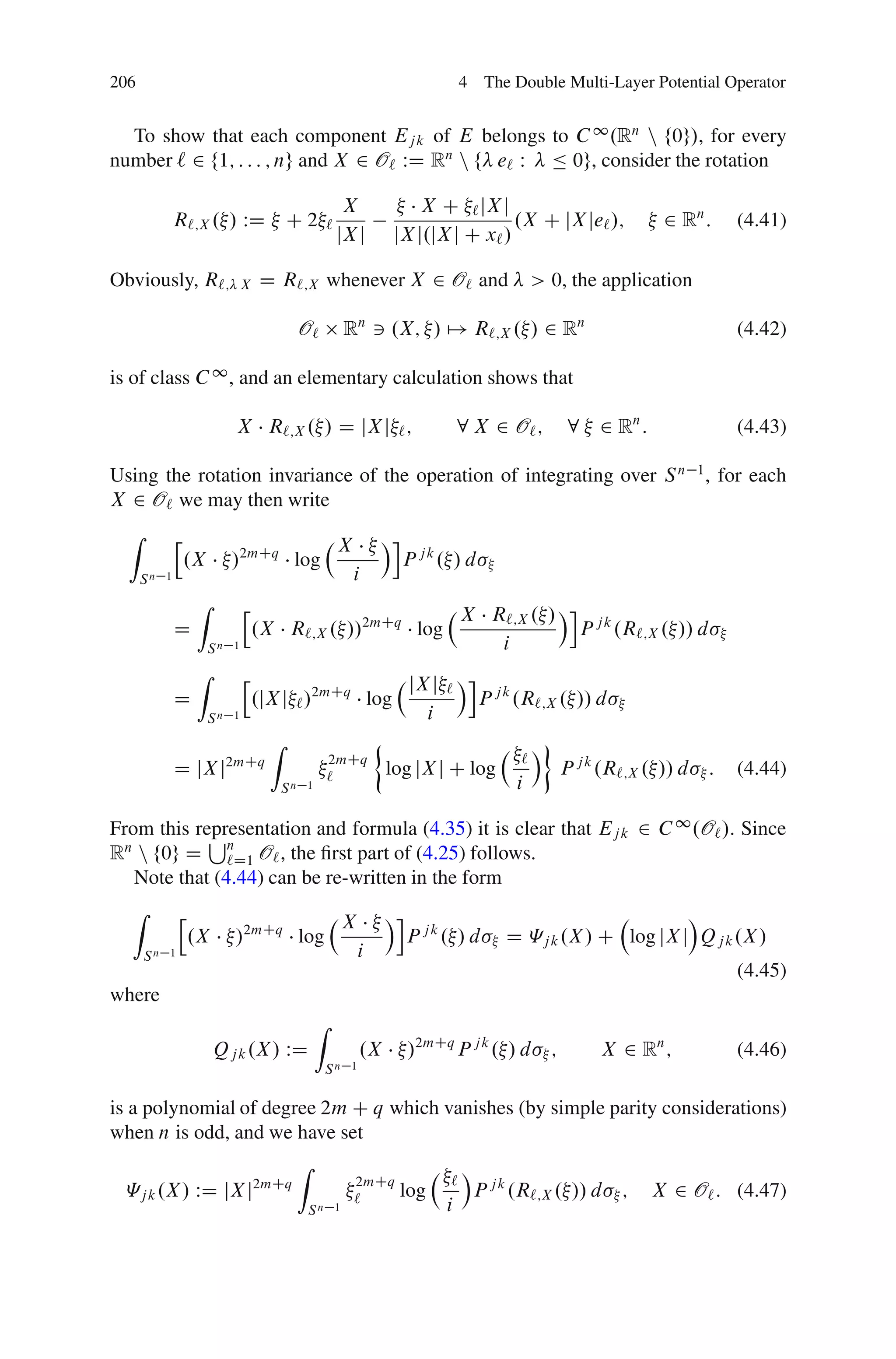
  To show that each component Ej k of E belongs to C 1 .Rn n f0g/, for every
number ` 2 f1; : : : ; ng and X 2 O` WD Rn n f e` W Ä 0g, consider the rotation

                                                           X              X C ` jX j
               R`;X . / WD                 C2         `                                .X C jX je` /;               2 Rn :     (4.41)
                                                          jX j        jX j.jX j C x` /

Obviously, R`;                   X   D R`;X whenever X 2 O` and                              > 0, the application

                                             O`           Rn 3 .X; / 7! R`;X . / 2 Rn                                          (4.42)

is of class C 1 , and an elementary calculation shows that

                             X R`;X . / D jX j ` ;                              8 X 2 O` ;             8 2 Rn :                (4.43)

Using the rotation invariance of the operation of integrating over S n 1 , for each
X 2 O` we may then write
  Z            h                                                    Ái
                                                          X
                   .X        /2mCq log                                   P jk. / d
      Sn   1                                                  i
                    Z            h                                               X R`;X . / Ái j k
               D                     .X R`;X . //2mCq log                                     P .R`;X . // d
                        Sn   1                                                      i
                    Z            h                                        jX j ` Ái j k
               D                     .jX j ` /2mCq log                             P .R`;X . // d
                        Sn   1                                              i
                                       Z                                                      Á
                                                      2mCq                               `
               D jX j2mCq                             `              log jX j C log                   P j k .R`;X . // d   :   (4.44)
                                           Sn 1                                          i

From this representation and formula (4.35) it is clear that Ej k 2 C 1 .O` /. Since
            S
Rn n f0g D n O` , the first part of (4.25) follows.
               `D1
   Note that (4.44) can be re-written in the form
  Z            h                                                     Ái                                      Á
                                                          X
                .X           /2mCq log                                    P jk. / d    D «j k .X / C log jX j Qj k .X /
      Sn   1                                                    i
                                                                                                                               (4.45)
where
                                                  Z
                        Qj k .X / WD                            .X        /2mCq P j k . / d       ;        X 2 Rn ;            (4.46)
                                                  Sn        1


is a polynomial of degree 2m C q which vanishes (by simple parity considerations)
when n is odd, and we have set
                        Z                  Á
                               2mCq      `
  «j k .X / WD jX j2mCq        `    log     P j k .R`;X . // d ; X 2 O` : (4.47)
                          Sn 1          i
4.2 The Definition of Double Multi-Layer and Non-tangential Maximal Estimates     207


Let us observe that, thanks to S     (4.45)–(4.47), «j k is actually a smooth,
unambiguously defined function in n O` D Rn n f0g. In particular, the decom-
                                      `D1
position (4.27) follows from the above discussion in concert with (4.45) and (4.35).
  Concerning (4.28), we first observe that
                                              Z
                             1        .nCq/=2
       Pj k .X / D                                   .X /2mCq P j k . / d ; (4.48)
                   .2 i /n .2m C q/Š X          Sn 1

as seen from (4.35), (4.27), (4.45)–(4.46), and the identity
                                           NŠ
                    K
                    X Œ.X    /N  D              .X    /N   2K
                                                                 j j2K ;       (4.49)
                                      .N    2K/Š
valid for any N; K 2 N with N 2K.
   The estimates in (4.29) are a direct consequence of the structure formula (4.27).
Finally, (4.33)–(4.34) readily account for the transposition identity (4.30).
   The proof of (6) relies on (4.27) which we shall abbreviate as E D ˚ C « , where
we have set ˚.X / WD ˚j k .X / j;k and « .X / WD log jX j Pj k .X / j;k . First, we
note that ˚ 2 C 1 .Rn n f0g/  L1 .Rn / is a homogeneous function and so, by
                                     loc
Theorem 7.1.18 on p. 168 of [57], ˚ is a (matrix-valued) tempered distribution
                                  b
in Rn whose Fourier transform ˚ coincides with a C 1 function on Rn n f0g. As
for « , pick a function  2 Cc1 .B.0; 2// such that  Á 1 on B.0; 1/ and write
« D «1 C «2 with «1 WD .1 Â/« 2 C 1 .Rn /, a matrix-valued tempered
                                                      b
distribution, and «2 WD « 2 L1 .Rn /. Hence, « 2 2 C 1 .Rn /. Also, for every
                                  comp
multi-index ˇ 2 N0 , the function X @ «1 .X / belongs to L1 .Rn / if ˛ 2 Nn is
                     n                  ˇ ˛
                                                                                0
such that j˛j is large enough. This readily implies that for any k 2 N there exists
                    b                                                   b
˛ 2 Nn such that @˛ «1 2 C k .Rn /. Thus, the function Rn 3 7! ˛ « 1 . / belongs
        0
      k   n                                              b1 2 C 1 .Rn n f0g/.
to C .R / if j˛j is large enough, relative to k, forcing «
   The above reasoning shows that E is a matrix-valued tempered distribution in
          b
Rn with E a function of class C 1 , when restricted to Rn n f0g. Having established
                                                                              b
this, taking the Fourier transforms of both sides of (4.40) gives . 1/m L. /E. / D
IM M in the sense of tempered distributions in R . Restricting this identity to
                                                       n

Rn n f0g gives (4.31).
   Finally, the claim in part .7/ is a direct consequence of (1) and (3), and this
completes the proof of Theorem 4.2.                                               t
                                                                                  u


4.2 The Definition of Double Multi-Layer and
    Non-tangential Maximal Estimates

Let L be a homogeneous differential operator of order 2m, with constant (possibly
matrix-valued) coefficients:
                                   X
                            L WD          @˛ A˛ˇ @ˇ                        (4.50)
                                      j˛jDjˇjDm
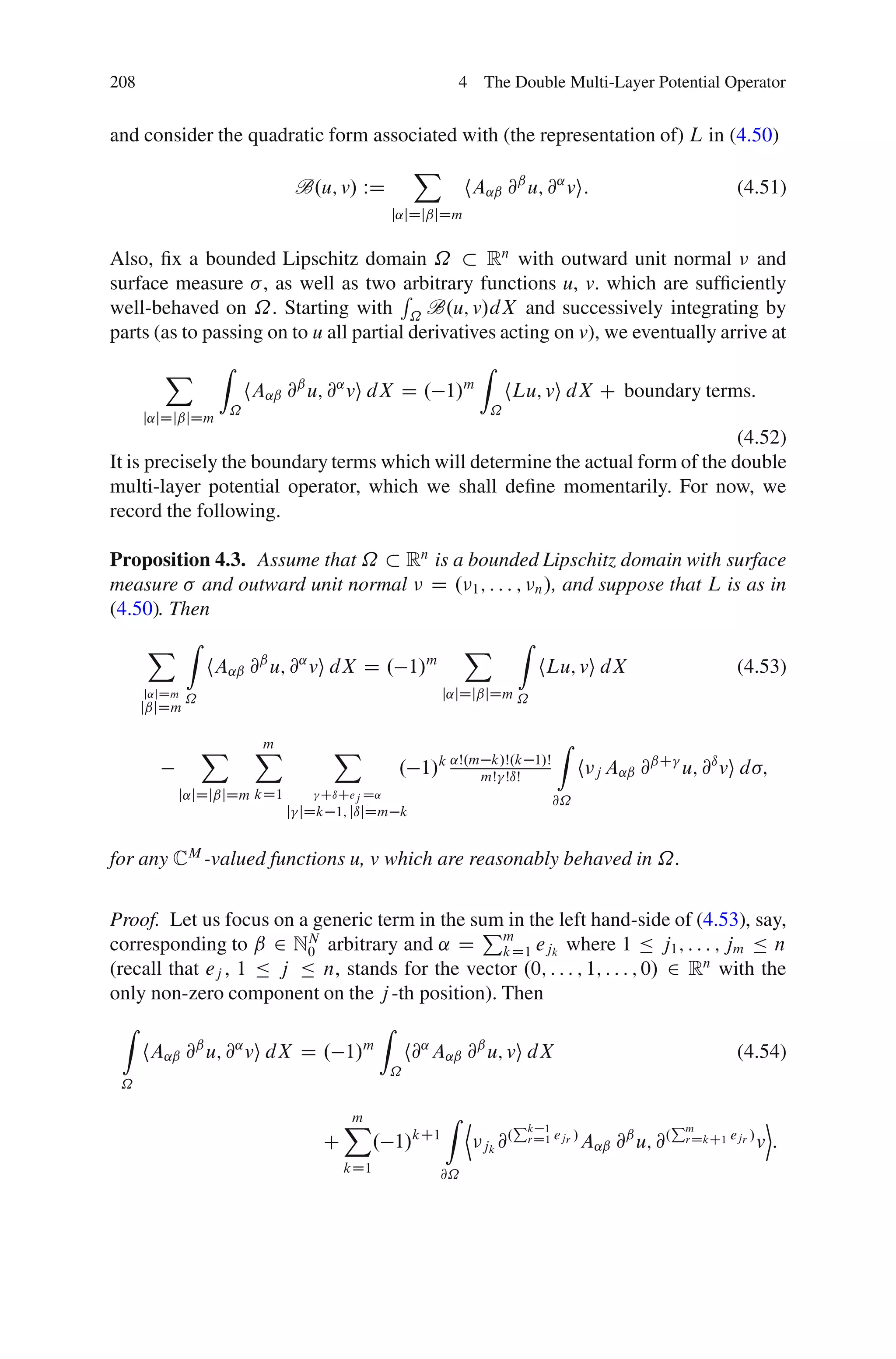
208                                                         4 The Double Multi-Layer Potential Operator


and consider the quadratic form associated with (the representation of) L in (4.50)
                                                      X
                                B.u; v/ WD                    hA˛ˇ @ˇ u; @˛ vi:                                  (4.51)
                                                 j˛jDjˇjDm


Also, fix a bounded Lipschitz domain ˝              Rn with outward unit normal and
surface measure , as well as two R      arbitrary functions u, v. which are sufficiently
well-behaved on ˝. Starting with ˝ B.u; v/dX and successively integrating by
parts (as to passing on to u all partial derivatives acting on v), we eventually arrive at
        X         Z                                             Z
                          hA˛ˇ @ˇ u; @˛ vi dX D . 1/m                   hLu; vi dX C boundary terms:
                      ˝                                             ˝
      j˛jDjˇjDm
                                                                                (4.52)
It is precisely the boundary terms which will determine the actual form of the double
multi-layer potential operator, which we shall define momentarily. For now, we
record the following.

Proposition 4.3. Assume that ˝ Rn is a bounded Lipschitz domain with surface
measure and outward unit normal D . 1 ; : : : ; n /, and suppose that L is as in
(4.50). Then
    X Z                                 X Z
            hA˛ˇ @ˇ u; @˛ vi dX D . 1/m         hLu; vi dX                (4.53)
      j˛jDm
              ˝                                           j˛jDjˇjDm ˝
      jˇjDm

                  X        X
                           m         X                                              Z
                                                 . 1/k ˛Š.m mŠ ŠıŠ
                                                             k/Š.k            1/Š
                                                                                         h j A˛ˇ @ˇC u; @ı vi d ;
          j˛jDjˇjDm kD1            CıCej D˛
                                                                                    @˝
                               j jDk 1; jıjDm k


for any CM -valued functions u, v which are reasonably behaved in ˝.

Proof. Let us focus on a generic term in the sum in the left hand-side of (4.53), say,
                                              P
corresponding to ˇ 2 NN arbitrary and ˛ D m ejk where 1 Ä j1 ; : : : ; jm Ä n
                         0                      kD1
(recall that ej , 1 Ä j Ä n, stands for the vector .0; : : : ; 1; : : : ; 0/ 2 Rn with the
only non-zero component on the j -th position). Then
 Z                                           Z
      hA˛ˇ @ˇ u; @˛ vi dX D . 1/m                    h@˛ A˛ˇ @ˇ u; vi dX                                         (4.54)
                                                 ˝
 ˝

                                       X
                                       m                  Z D            Pk                             Pm              E
                                                                            1
                                   C         . 1/kC1            jk @
                                                                    .     rD1 ejr /      A˛ˇ @ˇ u; @.    rDkC1 ejr /   v:
                                       kD1               @˝
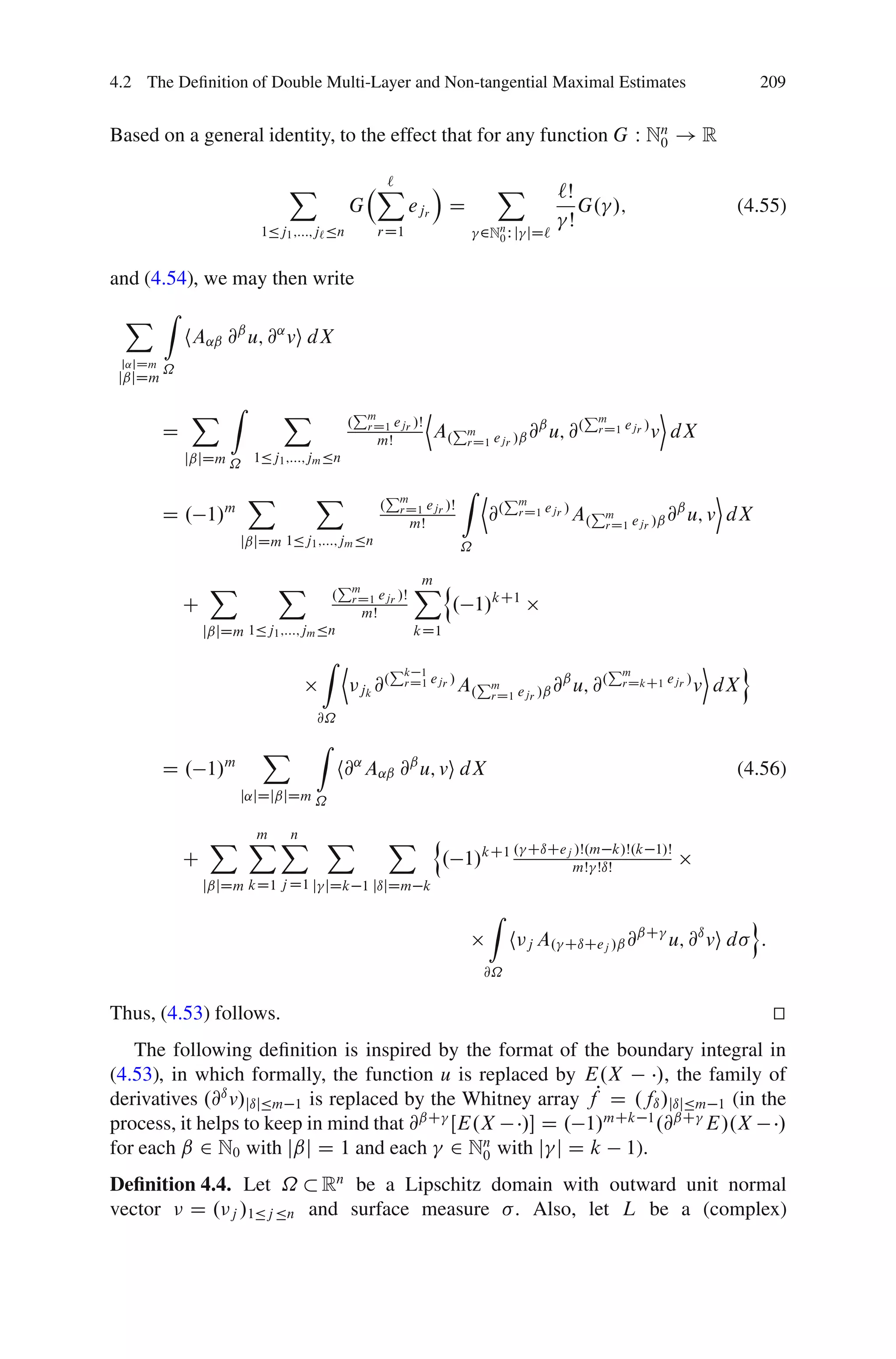
4.2 The Definition of Double Multi-Layer and Non-tangential Maximal Estimates                                                   209


Based on a general identity, to the effect that for any function G W Nn ! R
                                                                      0


                              X                   X
                                                  `           Á               X             `Š
                                            G              ejr D                               G. /;                      (4.55)
                          1Äj1 ;:::;j` Än
                                                                                             Š
                                                     rD1                   2Nn W j
                                                                             0        jD`


and (4.54), we may then write
 X Z
             hA˛ˇ @ˇ u; @˛ vi dX
 j˛jDm
         ˝
 jˇjDm

             X Z             X              .
                                                Pm             D                                  Pm             E
                                                 rD1 ejr /Š
         D                                           mŠ
                                                                   A.Pm ejr /ˇ @ˇ u; @.
                                                                      rD1
                                                                                                    rD1 ejr /   v dX
             jˇjDm ˝ 1Äj1 ;:::;jm Än

                        X          X                     Pm            Z D        Pm                                E
                                                     .    rD1 ejr /Š
         D . 1/m                                              mŠ
                                                                             @.      rD1 ejr /   A.Pm ejr /ˇ @ˇ u; v dX
                                                                                                    rD1
                      jˇjDm 1Äj1 ;:::;jm Än                            ˝

                  X          X         .
                                           Pm                 Xn
                                                              m
                                            rD1 ejr /Š
             C                                  mŠ                   . 1/kC1
                 jˇjDm 1Äj1 ;:::;jm Än                        kD1
                                    Z D                  Pk                                            Pm              E   o
                                                            1
                                                jk @
                                                    .     rD1 ejr /    A.Pm ejr /ˇ @ˇ u; @.
                                                                          rD1
                                                                                                        rDkC1 ejr /   v dX
                                   @˝

                          X        Z
         D . 1/m                        h@˛ A˛ˇ @ˇ u; vi dX                                                               (4.56)
                      j˛jDjˇjDm ˝


                  X XX X
                    m n                                  X n                      . CıCej /Š.m k/Š.k 1/Š
             C                                                      . 1/kC1              mŠ ŠıŠ
                 jˇjDm kD1 j D1 j jDk 1 jıjDm k
                                                                             Z                                                o
                                                                                  h j A.     CıCej /ˇ @
                                                                                                       ˇC
                                                                                                                 u; @ı vi d    :
                                                                           @˝

Thus, (4.53) follows.                                                                                                              t
                                                                                                                                   u
   The following definition is inspired by the format of the boundary integral in
(4.53), in which formally, the function u is replaced by E.X       /, the family of
derivatives .@ı v/jıjÄm 1 is replaced by the Whitney array fP D .fı /jıjÄm 1 (in the
process, it helps to keep in mind that @ˇC ŒE.X / D . 1/mCk 1 .@ˇC E/.X /
for each ˇ 2 N0 with jˇj D 1 and each 2 Nn with j j D k 1).
                                              0

Definition 4.4. Let ˝ Rn be a Lipschitz domain with outward unit normal
vector D . j /1Äj Än and surface measure . Also, let L be a (complex)
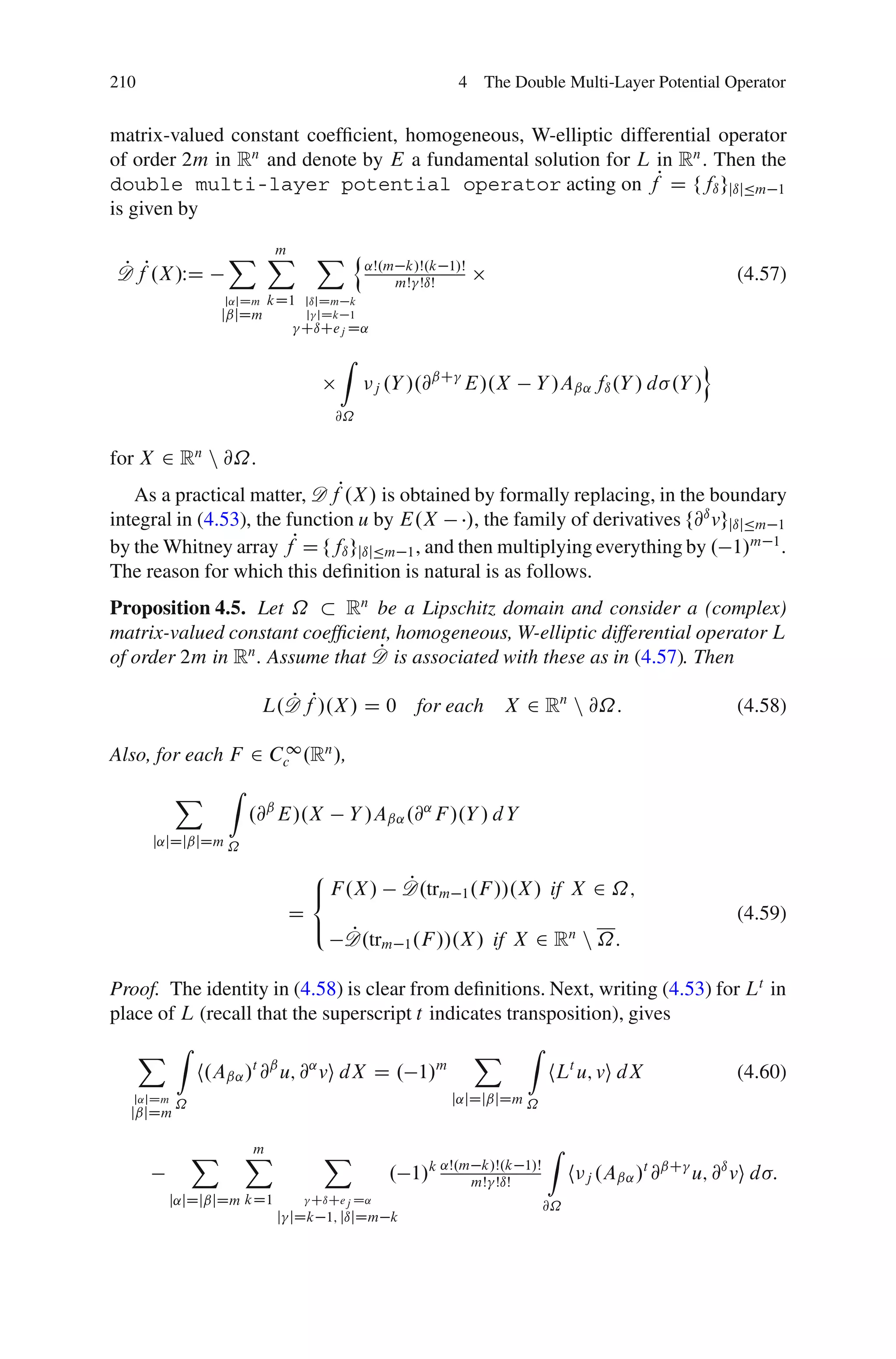
210                                                     4 The Double Multi-Layer Potential Operator


matrix-valued constant coefficient, homogeneous, W-elliptic differential operator
of order 2m in Rn and denote by E a fundamental solution for L in Rn . Then the
double multi-layer potential operator acting on fP D ffı gjıjÄm 1
is given by

                   X X
                     m            X n ˛Š.m
D fP.X /WD
P                                               k/Š.k 1/Š
                                               mŠ ŠıŠ                                              (4.57)
                   j˛jDm   kD1   jıjDm k
                   jˇjDm         j jDk 1
                                 CıCej D˛

                                      Z                                                        o
                                                     ˇC
                                             j .Y /.@   E/.X        Y /Aˇ˛ fı .Y / d .Y /
                                      @˝


for X 2 Rn n @˝.
   As a practical matter, D fP.X / is obtained by formally replacing, in the boundary
integral in (4.53), the function u by E.X /, the family of derivatives f@ı vgjıjÄm 1
by the Whitney array fP D ffı gjıjÄm 1 , and then multiplying everything by . 1/m 1 .
The reason for which this definition is natural is as follows.
Proposition 4.5. Let ˝       Rn be a Lipschitz domain and consider a (complex)
matrix-valued constant coefficient, homogeneous, W-elliptic differential operator L
                                P
of order 2m in Rn . Assume that D is associated with these as in (4.57). Then

                           L.D fP/.X / D 0
                             P                    for each X 2 Rn n @˝:                            (4.58)

Also, for each F 2 Cc1 .Rn /,
           X       Z
                       .@ˇ E/.X        Y /Aˇ˛ .@˛ F /.Y / d Y
      j˛jDjˇjDm ˝

                                  8
                                  < F .X /      P
                                                D.trm 1 .F //.X / if X 2 ˝;
                             D                                                                     (4.59)
                                  :   P
                                      D.trm 1 .F //.X / if X 2 Rn n ˝:

Proof. The identity in (4.58) is clear from definitions. Next, writing (4.53) for Lt in
place of L (recall that the superscript t indicates transposition), gives
      X Z                                                   X     Z
               h.Aˇ˛ / @ u; @ vi dX D . 1/
                       t ˇ       ˛                  m
                                                                        hLt u; vi dX               (4.60)
   j˛jDm
           ˝                                            j˛jDjˇjDm ˝
  jˇjDm

               X       X
                       m             X                                  Z
                                              . 1/k ˛Š.m mŠ ŠıŠ
                                                          k/Š.k   1/Š
                                                                             h j .Aˇ˛ /t @ˇC u; @ı vi d :
        j˛jDjˇjDm kD1             CıCej D˛
                                                                        @˝
                            j jDk 1; jıjDm k
4.2 The Definition of Double Multi-Layer and Non-tangential Maximal Estimates                  211


Specializing this identity to the case when the function v WD F 2 Cc1 .Rn / and
u WD ELt .Xo        /Á where Xo 2 ˝ is a fixed point and Á 2 CM is an arbitrary
vector, yields, after some simple algebraic manipulations,
       D        X Z                                           E
           Á;               .@ˇ E/.Xo     /Aˇ˛ .@˛ F / dX                                   (4.61)
                j˛jDm
                        ˝
                jˇjDm

                                         D           E   D                      E
                                        D Á; F .Xo /            P
                                                             Á; D.trm 1 F /.Xo / :

Above, property (5) in Theorem 4.2 is also used. Since Á 2 CM was arbitrary, the
version of (4.59) corresponding to Xo 2 ˝ is proved. The case when Xo 2 Rn n ˝
is treated similarly, completing the proof of the proposition.                 t
                                                                               u
Given k 2 N0 , recall that Pk stands for the space of polynomials of degree Ä k
in Rn .
Proposition 4.6. Suppose that ˝ Rn is a bounded Lipschitz domain and consider
a (complex) matrix-valued constant coefficient, homogeneous, W-elliptic differential
                                            P
operator L of order 2m in Rn . Assume that D is associated with these as in (4.57).
Then for any u 2 Pm 1

                                        P
                                    u D D.trm 1 u/        in ˝:                             (4.62)

Proof. Fix a function 2 Cc1 .Rn / with      Á 1 in a neighborhood of ˝. If u 2
Pm 1 , set F WD u 2 Cc1 .Rn /. Since F Á u near ˝, we have @˛ F D 0 in ˝
whenever j˛j D m, by trivial degree considerations. Then (4.62) is a consequence
of the first line in (4.59).                                                   t
                                                                              u
  We now proceed to establish non-tangential maximal function estimates for the
                            P
double multi-layer operator D.
Theorem 4.7. Given a Lipschitz domain ˝         Rn and a (complex) matrix-valued
constant coefficient, homogeneous, W-elliptic differential operator L of order 2m
in Rn , consider the double multi-layer potential operator defined in (4.57). Then
for each p 2 .1; 1/ there exists a finite constant C D C.˝; p; L/ > 0 with the
property that

   X
   m 1
           kN .r j D fP/kLp .@˝/ Ä C kfPkLp
                   P                                               8 fP 2 Lm
                                                                          P p
                                         P                    ;                 1;0 .@˝/;   (4.63)
                                                 m 1;0 .@˝/
   j D0


   X
   m
           kN .r j D fP/kLp .@˝/ Ä C kfPkLp
                   P                                               8 fP 2 Lm
                                                                          P p
                                         P                    ;                 1;1 .@˝/:   (4.64)
                                                 m 1;1 .@˝/
   j D0
212                                                                       4 The Double Multi-Layer Potential Operator


Furthermore,
                                         j
                              @ D fP
                                P                     exists for every fP 2 Lm
                                                                            Pp
                                                                                          1;0 .@˝/
                                             @˝                                                                          (4.65)
                                   whenever                2 Nn satisfies j j Ä m
                                                              0                               1;

and
                                         j
                              @ D fP
                                P                     exists for every fP 2 Lm
                                                                            Pp
                                                                                          1;1 .@˝/
                                             @˝                                                                          (4.66)
                                    whenever                    2   Nn
                                                                     0   satisfies j j Ä m:

Proof. The starting point is the identity
                                   X         Z
      D.fP/.X / D
      P                                                    .@ˇ E/.X         Y /Aˇ˛ .@˛ F /.Y / d Y;          8 X 2 ˝;
                                                 Rn n˝
                              j˛jDjˇjDm
                                                                                                                         (4.67)
valid whenever F 2 Cc1 .Rn / and fP WD trm 1 .F /. This is readily seen from (4.59)
with the roles of ˝ and Rn n ˝ reversed (here it is useful to keep in mind that the
outward unit normal of the latter domain is  ).
                                             Pj j
   Consider next 2 N0 , j j Ä m 1, D rD1 ejr , with 1 Ä j1 ; : : : ; jn Ä n,
                         n

and using (4.55), for each X 2 ˝ write
                              X            Z
@ D.fP/.X/ D
  P                                                .@      Cˇ
                                                                E/.X      Y /Aˇ˛ .@˛ F /.Y / d Y                         (4.68)
                      j˛jDjˇjDm
                                         Rn n˝


         X          Pm               Z             Pj                                                   Pm            Á
                                                       j
                .    sD1 eks /Š
D                                            .@.      rD1 ejr /Cˇ    E/.X      Y /Aˇ.Pm ek         @.    sD1 eks /   F .Y / d Y:
                         mŠ                                                           sD1     s/
        jˇjDm
    1Äk1 ;:::;km Än                Rn n˝


Integrating in (4.68) by parts (to move @ek1 from F on to E) and taking into account
that the outward unit normal vector to Rn n ˝ is     further leads to

                                   X             Pm
  @ D.fP/.X / D
    P                                        .     sD1 eks /Š
                                                      mŠ
                                                                                                                         (4.69)
                                 jˇjDm
                              1Äk1 ;:::;km Än

         8
         ˆ Z
         <                    Pj j
                      .@.       rD1 ejr /Cek1 Cˇ           E/.X          Y /Aˇ.Pm eks /
         ˆ
         :
                                                                                sD1

             Rn n˝
4.2 The Definition of Double Multi-Layer and Non-tangential Maximal Estimates                                     213

               Pm            Á                     Z                      Pjj
          @.    sD2 eks /   F .Y / d Y                       k1 .Y /.@
                                                                      .    rD1 ejr /Cˇ   E/.X        Y/
                                                   @˝
                                                                                                               9
                                                                                       Pm          Á           >
                                                                                                               =
                                                                Aˇ.Pm eks /          @. sD2 eks / F .Y / d .Y / :
                                                                    sD1                                        >
                                                                                                               ;

We further integrate by parts in the first term in the curly brackets in the right hand-
side of (4.69) and move @ej1 from E onto F . This gives
                                       X           Pm
         @ D.fP/.X / D
           P                                   .    sD1 eks /Š
                                                        mŠ                                                     (4.70)
                                       jˇjDm
                                1Äk1 ;:::;km Än

                8
                ˆ Z
                <                 Pjj
                            .@.    rD2 ejr /Cek1 Cˇ          E/.X         Y/
                ˆ
                :
                    Rn n˝

                                                                                Pm                 Á
                                                       Aˇ.Pm eks / @.
                                                           sD1
                                                                                  sD2 eks /Cej1   F .Y / d Y

                          Z                    Pj   j
                                           .       rD1 ejr /Cˇ
                                  k1 .Y /.@                        E/.X          Y/
                          @˝

                                                                                Pm             Á
                                                       Aˇ.Pm eks / @.
                                                           sD1
                                                                                  sD2 eks /   F .Y / d .Y /

                            Z                  Pj    j
                      C                    .        rD2 ejr /Cek1 Cˇ
                                  j1 .Y /.@                               E/.X         Y/
                          @˝

                                                                                                         9
                                                                                Pm           Á           >
                                                                                                         =
                                                        Aˇ.Pm eks /            @. sD2 eks /
                                                                                            F .Y / d .Y / :
                                                            sD1                                          >
                                                                                                         ;

Next, recall that @ k1 j1 WD k1 @ej1        ek
                                        j1 @ 1 and notice that the sum of the last two
terms in the curly brackets in (4.70) is
   Z                      Pj                                     Á              Pm          Á
                              j
       @ k1 j1 .Y / .@.      rD2 ejr /Cˇ   E/.X               Y / Aˇ.Pm eks / @. sD2 eks / F .Y / d .Y /:
                                                                      sD1

  @˝
                                                                                                               (4.71)
214                                                                4 The Double Multi-Layer Potential Operator


Therefore,
                                   X          Pm
     @ D.fP/.X / D
       P                                  .    sD1 eks /Š
                                                   mŠ
                                                                                                                  (4.72)
                               jˇjDm
                            1Äk1 ;:::;km Än
           8
           ˆ Z
           <                Pj   j
                      .@.       rD2 ejr /Cek1 Cˇ        E/.X      Y/
           ˆ
           :
             Rn n˝

                                                                        Pm                   Á
                                                  Aˇ.Pm eks / @.
                                                      sD1
                                                                            sD2 eks /Cej1   F .Y / d Y
                      Z                       Pj                                  Á
                                                    j
                  C        @ k1 j1 .Y / .@.        rD2 ejr /Cˇ   E/.X        Y/
                   @˝
                                                                                               9
                                                                         P         Á           >
                                                                                               =
                                                                        . m eks /
                                                   Aˇ.Pm eks /         @  sD2     F .Y / d .Y / :
                                                       sD1                                     >
                                                                                               ;

   Starting with the first integral inside the curly brackets in the right-hand side
of (4.72), we now repeat the procedure described in (4.68)–(4.72) until we swap
     Pjj                                 Pj    j
@.    rD1 ejr /   from E with @.              sD1 eks /   from F . In this fashion, we obtain
                                  X          Pm
     @ D .fP/.X / D
       P                                 .     sD1 eks /Š
                                                  mŠ                                                              (4.73)
                              jˇjDm
                           1Äk1 ;:::;km Än

          n Z             Pjj
                   .@.     sD1 eks /Cˇ   E/.X             Y/
          Rn n˝

                                                                       Pj j         Pm                Á
                                                Aˇ.Pm eks / @.
                                                    sD1
                                                                         rD1 ejr /C. sDj jC1 eks /   F .Y / d Y

                  XZ
                  j j                             P`  1        Pj j                                  Á
            C                  @ k` j` .Y / .@.     sD1 eks /C. rD`C1 ejr /Cˇ         E/.X      Y/
                  `D1@˝

                                                                       P`  1        Pm              Á           o
                                                Aˇ.Pm eks / @.
                                                    sD1
                                                                         rD1 ejr /C. sD`C1 eks /   F .Y / d .Y / :

At this point we use repeated integration by parts in the first integral inside the
curly brackets in the right-hand side of (4.73) in order to move the remaining partial
              Pm
derivatives @. sDj jC1 eks / from F onto E. Using that .LE/.X Y / D 0 for X 6D Y ,
this gives
4.2 The Definition of Double Multi-Layer and Non-tangential Maximal Estimates                                    215

                           X             Pm
   @ D.fP/.X / D
     P                               .       sD1 eks /Š
                                              mŠ
                                                                                                            (4.74)
                        jˇjDm
                     1Äk1 ;:::;km Än


       nX Z
        j j                         P` 1        Pj j                                         Á
                 @ k` j` .Y / .@.    sD1 eks /C. rD`C1 ejr /Cˇ             E/.X         Y/
         `D1@˝

                                                                  P`    1        Pm               Á
                                         Aˇ.Pm eks / @.
                                             sD1
                                                                      rD1 ejr /C. sD`C1 eks /    F .Y / d .Y /

                  X Z
                  m                                P`    1
                               k` .Y /.@
                                        .              sD1 eks /Cˇ   E/.X       Y /Aˇ.Pm eks /
                                                                                       sD1
                 `Dj jC1@˝

                                                  Pjj         Pm                Á           o
                                             @.    rD1 ejr /C. sD`C1 eks /     F .Y / d .Y / :

From the identity (4.74), Proposition 3.3 and a limiting argument, we can finally
deduce that if X 2 Rn n @˝ and if fP D ffı gjıjÄm 1 2 Lm 1;0 .@˝/, 1 < p < 1,
                                                       Pp

                            X                Pm
     @ D.fP/.X / D
       P                                 .    sD1 eks /Š
                                                  mŠ                                                        (4.75)
                          jˇjDm
                       1Äk1 ;:::;km Än


          nX Z
           j j                               P` 1        Pj j                                     Á
                     @ k` j` .Y / .@.         sD1 eks /C. rD`C1 ejr /Cˇ         E/.X         Y/
           `D1 @˝


                                              Aˇ.Pm eks / f.P`           1        Pm              .Y / d .Y /
                                                  sD1                  rD1 ejr /C. sD`C1 eks /


                      X
                      m        Z                          P`  1
                                         k` .Y /.@
                                                  .         sD1 eks /Cˇ   E/.X         Y /Aˇ.Pm eks /
                                                                                              sD1
                    `Dj jC1 @˝

                                                                                            o
                                              f.Pj      j         Pm             .Y / d .Y / :
                                                       rD1 ejr /C. sD`C1 eks /


Based on the identity (4.55) we may write

                    j j
                    X          X                  X .ıCÁCe
                                                  n
 @ D.fP/.X / D
   P                                                             k /Š.m
                                                                  mŠıŠÁŠ
                                                                           `/Š.` 1/Š

                    `D1    jˇjDm    kD1
                      jıjD` 1;jÁjDm `
                       Z                                                     Á
                           @ kj` .Y / .@ıC!` Cˇ E/.X                      Y / Aˇ.ıCÁCek / fÂ` CÁ .Y / d .Y /
                      @˝
216                                                      4 The Double Multi-Layer Potential Operator


         X
         m          X         X .ıCÁCe
                              n
                                            k /Š.m    `/Š.` 1/Š
                                             mŠıŠÁŠ
        `Dj jC1    jˇjDm    kD1
              jıjD` 1;jÁjDm `
                      Z
                                    ıCˇ
                            k .Y /.@    E/.X             Y /Aˇ.ıCÁCek / f        CÁ .Y / d   .Y /:     (4.76)
                     @˝

                                                     P` 1            Pj j
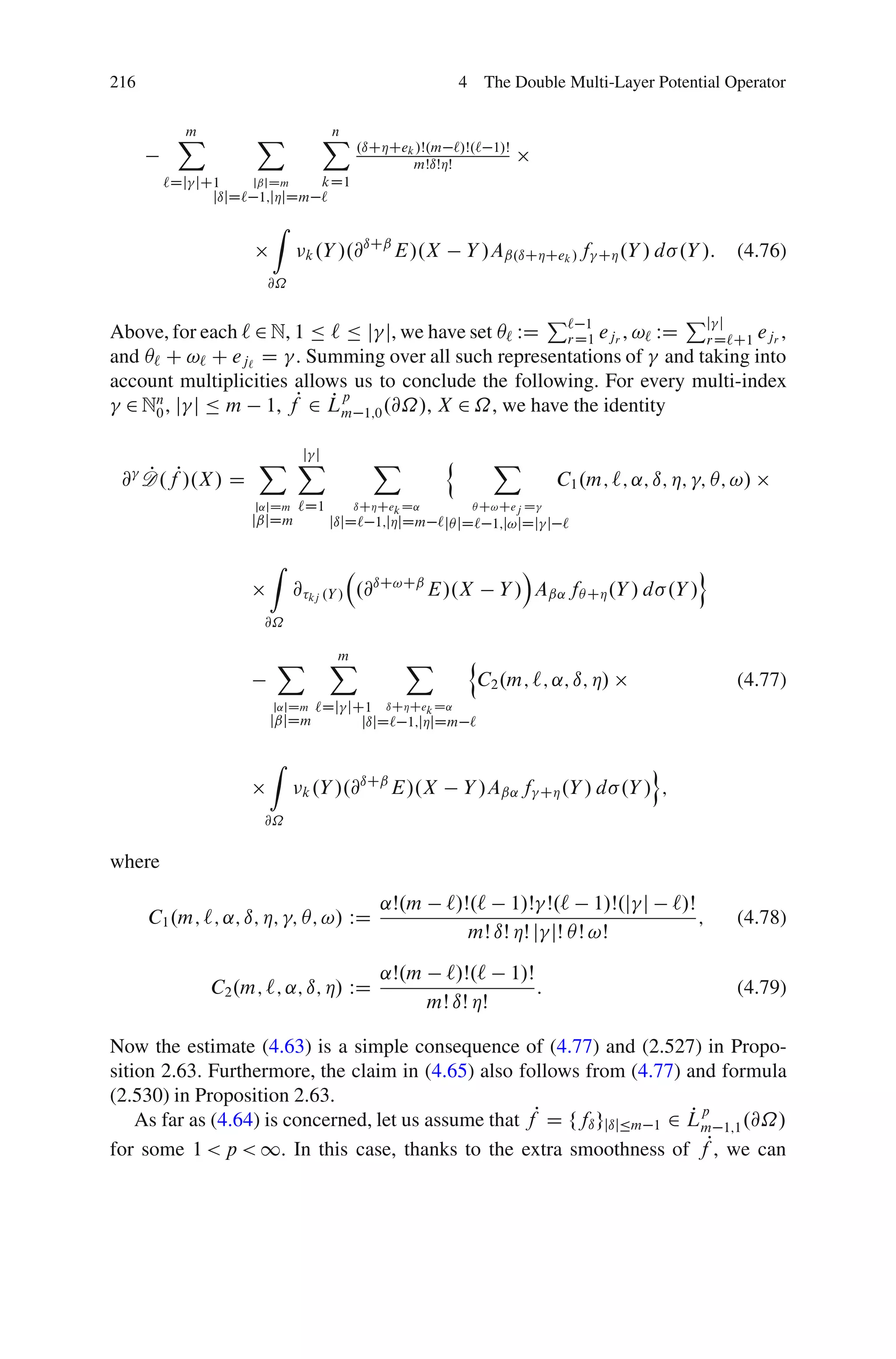
Above, for each ` 2 N, 1 Ä ` Ä j j, we have set Â` WD rD1 ejr , !` WD rD`C1 ejr ,
and Â` C !` C ej` D . Summing over all such representations of and taking into
account multiplicities allows us to conclude the following. For every multi-index
  2 Nn , j j Ä m 1, fP 2 Lm 1;0 .@˝/, X 2 ˝, we have the identity
     0
                           Pp

                      j j
                    X X                X             n       X
 @ D .fP/.X / D
   P                                                                        C1 .m; `; ˛; ı; Á; ; Â; !/
                   j˛jDm   `D1      ıCÁCek D˛             Â C!Cej D
                   jˇjDm         jıjD` 1;jÁjDm ` j jD` 1;j!jDj j `

                     Z                                           Á                      o
                           @ kj .Y / .@ıC!Cˇ E/.X             Y / Aˇ˛ f CÁ .Y / d .Y /
                     @˝

                      X          X
                                 m         X              n
                                                           C2 .m; `; ˛; ı; Á/                          (4.77)
                      j˛jDm`Dj jC1 ıCÁCek D˛
                     jˇjDm       jıjD` 1;jÁjDm `

                     Z                                                                  o
                                    ıCˇ
                            k .Y /.@    E/.X             Y /Aˇ˛ f       CÁ .Y / d   .Y / ;
                     @˝

where

                                        ˛Š.m         `/Š.` 1/Š Š.` 1/Š.j j                   `/Š
      C1 .m; `; ˛; ı; Á; ; Â; !/ WD                                                                ;   (4.78)
                                                        mŠ ıŠ ÁŠ j jŠ ÂŠ !Š

                                        ˛Š.m      `/Š.`           1/Š
              C2 .m; `; ˛; ı; Á/ WD                                     :                              (4.79)
                                                mŠ ıŠ ÁŠ

Now the estimate (4.63) is a simple consequence of (4.77) and (2.527) in Propo-
sition 2.63. Furthermore, the claim in (4.65) also follows from (4.77) and formula
(2.530) in Proposition 2.63.
    As far as (4.64) is concerned, let us assume that fP D ffı gjıjÄm 1 2 Lm 1;1 .@˝/
                                                                          Pp
for some 1 < p < 1. In this case, thanks to the extra smoothness of fP, we can
4.2 The Definition of Double Multi-Layer and Non-tangential Maximal Estimates                                         217


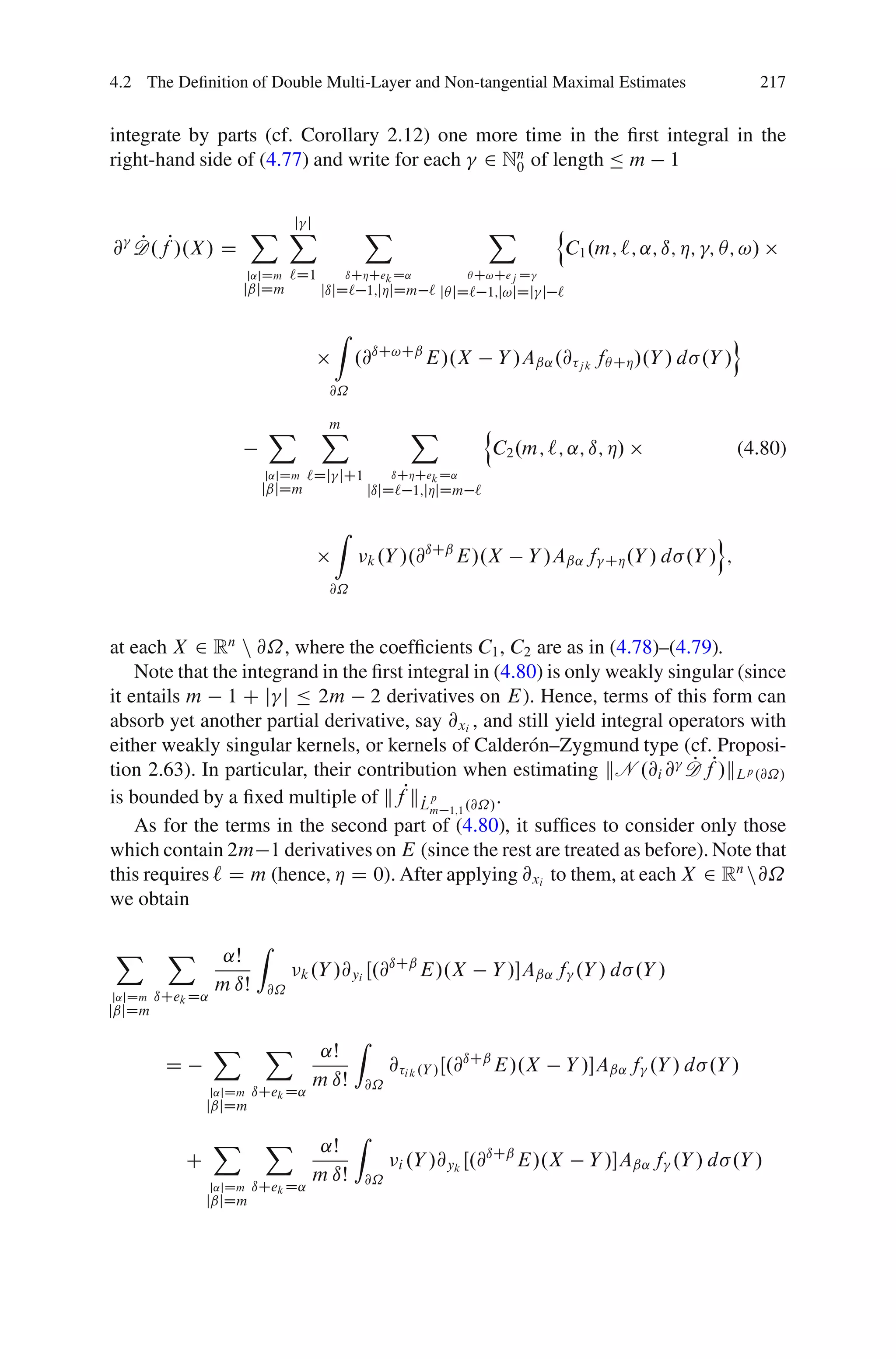
integrate by parts (cf. Corollary 2.12) one more time in the first integral in the
right-hand side of (4.77) and write for each 2 Nn of length Ä m 1
                                                0


                            j j
                          X X                    X                     X           n
@ D.fP/.X / D
  P                                                                                    C1 .m; `; ˛; ı; Á; ; Â; !/
                          j˛jDm     `D1        ıCÁCek D˛             Â C!Cej D
                      jˇjDm               jıjD` 1;jÁjDm ` j jD` 1;j!jDj j `

                                           Z                                                                     o
                                                .@ıC!Cˇ E/.X               Y /Aˇ˛ .@ j k f CÁ /.Y / d .Y /
                                           @˝

                               X          X
                                          m                 X          n
                                                                           C2 .m; `; ˛; ı; Á/                    (4.80)
                            j˛jDm    `Dj jC1             ıCÁCek D˛
                            jˇjDm                   jıjD` 1;jÁjDm `

                                           Z                                                                o
                                                            ıCˇ
                                                    k .Y /.@    E/.X           Y /Aˇ˛ f     CÁ .Y / d   .Y / ;
                                           @˝


at each X 2 Rn n @˝, where the coefficients C1 , C2 are as in (4.78)–(4.79).
    Note that the integrand in the first integral in (4.80) is only weakly singular (since
it entails m 1 C j j Ä 2m 2 derivatives on E). Hence, terms of this form can
absorb yet another partial derivative, say @xi , and still yield integral operators with
either weakly singular kernels, or kernels of Calder´ n–Zygmund type (cf. Proposi-
                                                         o
tion 2.63). In particular, their contribution when estimating kN .@i @ D fP/kLp .@˝/
                                                                             P
is bounded by a fixed multiple of kf L  Pk P p          .
                                            m 1;1 .@˝/
    As for the terms in the second part of (4.80), it suffices to consider only those
which contain 2m 1 derivatives on E (since the rest are treated as before). Note that
this requires ` D m (hence, Á D 0). After applying @xi to them, at each X 2 Rn n@˝
we obtain

X        X                 Z
                   ˛Š                             ıCˇ
                                     k .Y /@yi Œ.@    E/.X              Y /Aˇ˛ f .Y / d .Y /
                  m ıŠ         @˝
j˛jDm   ıCek D˛
jˇjDm

                  X         X                   Z
                                       ˛Š
         D                                               @ i k .Y / Œ.@ıCˇ E/.X        Y /Aˇ˛ f .Y / d .Y /
                                      m ıŠ          @˝
                  j˛jDm   ıCek D˛
                 jˇjDm

                  X         X                   Z
                                       ˛Š
             C                                            i .Y /@yk Œ.@
                                                                       ıCˇ
                                                                           E/.X           Y /Aˇ˛ f .Y / d .Y /
                                      m ıŠ          @˝
                  j˛jDm   ıCek D˛
                 jˇjDm
218                                                      4 The Double Multi-Layer Potential Operator

            X       X                  Z
                               ˛Š
      D                                         .@ıCˇ E/.X       Y /Aˇ˛ .@ ki f /.Y / d .Y /
                              m ıŠ         @˝
           j˛jDm   ıCek D˛
           jˇjDm

           X        X                Z
                               ˛Š                        ıCˇCek
                                                 i .Y /.@       E/.X            Y /Aˇ˛ f .Y / d .Y /
                              m ıŠ       @˝
           j˛jDm   ıCek D˛
           jˇjDm

      DW A C B:                                                                                      (4.81)

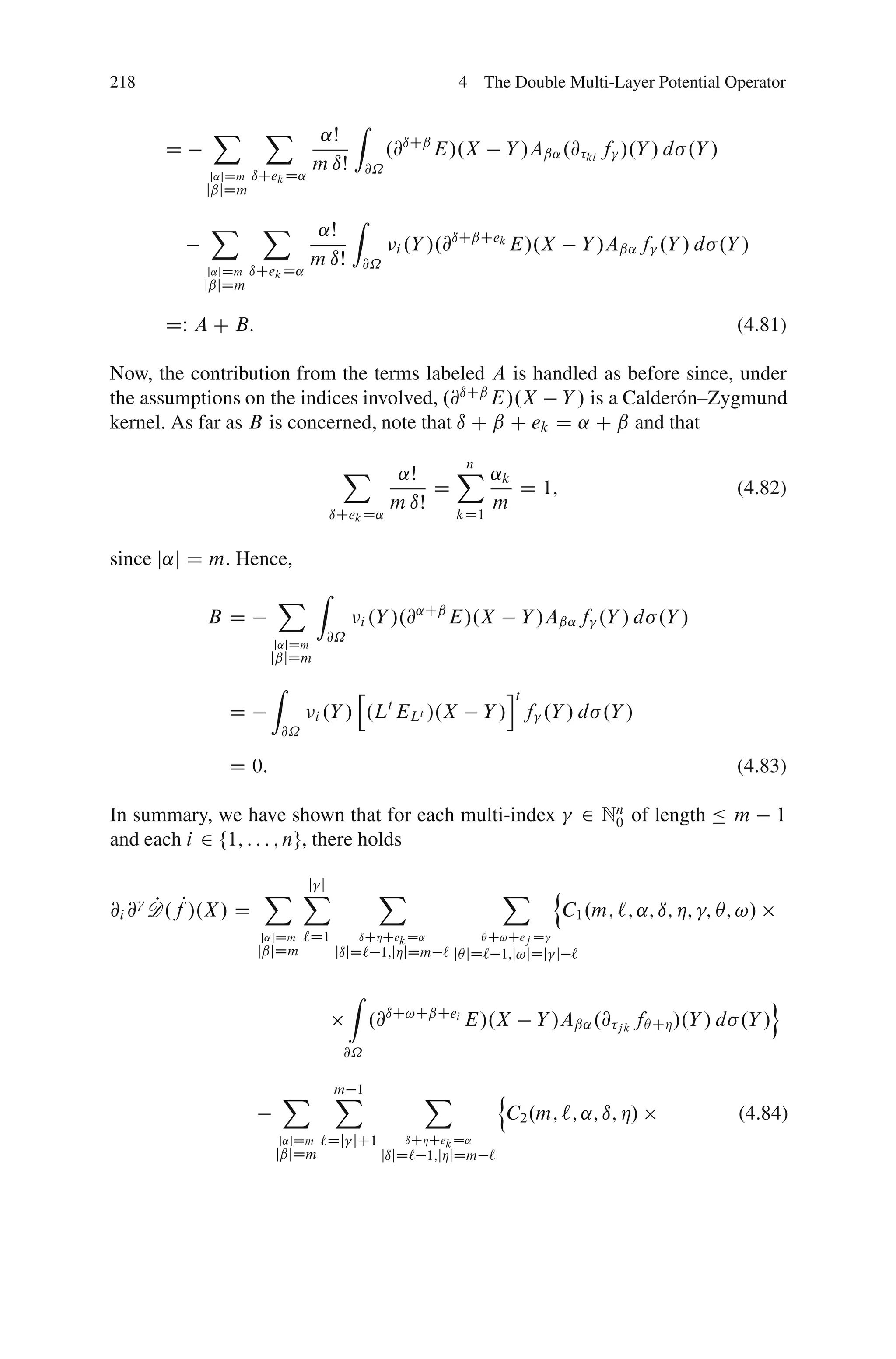
Now, the contribution from the terms labeled A is handled as before since, under
the assumptions on the indices involved, .@ıCˇ E/.X Y / is a Calder´ n–Zygmund
                                                                    o
kernel. As far as B is concerned, note that ı C ˇ C ek D ˛ C ˇ and that

                                   X             ˛Š    X ˛k
                                                          n
                                                     D      D 1;                                     (4.82)
                                                m ıŠ     m
                                ıCek D˛                 kD1


since j˛j D m. Hence,
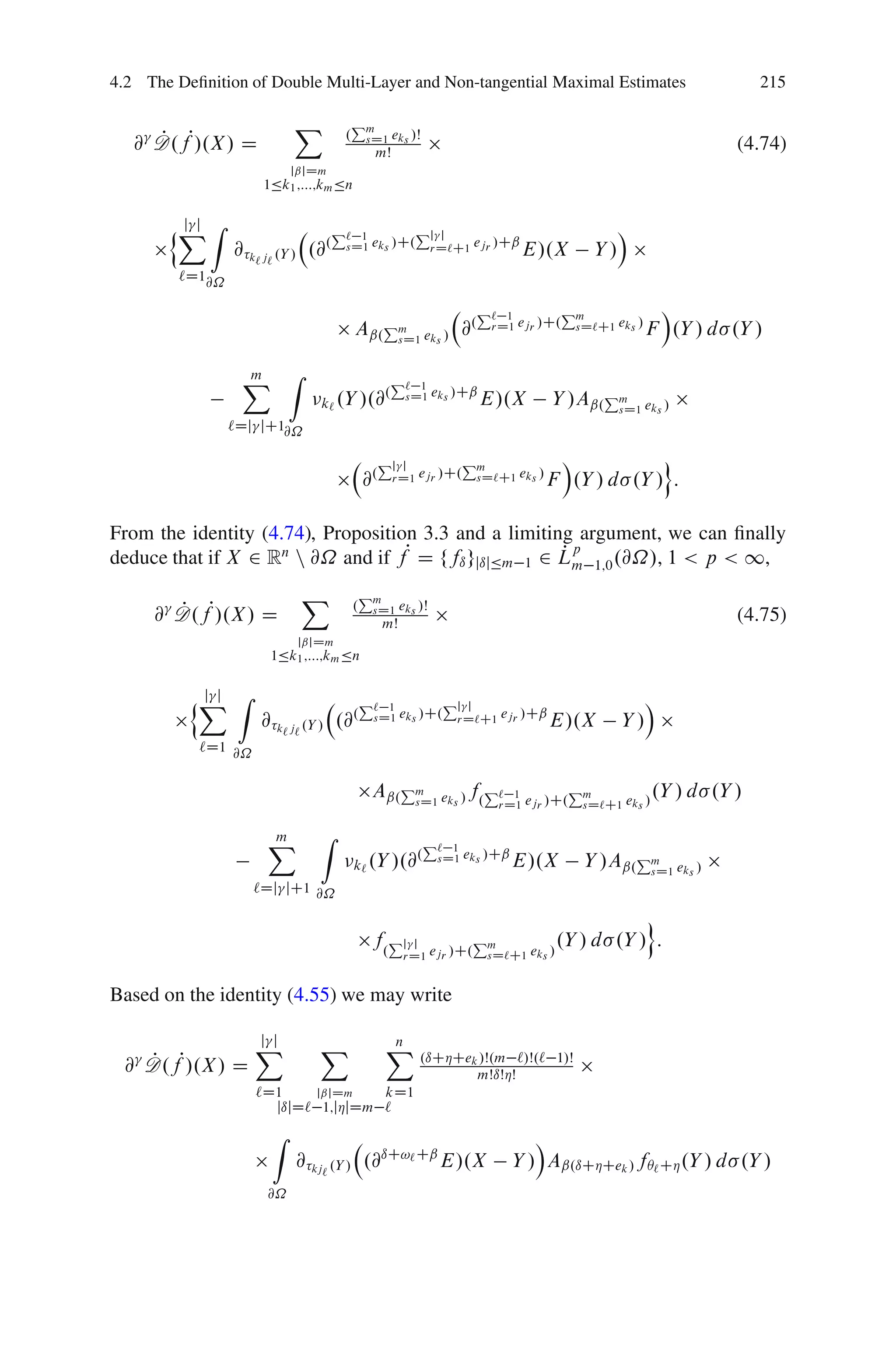
                      X Z
           BD                            i .Y /.@
                                                 ˛Cˇ
                                                     E/.X          Y /Aˇ˛ f .Y / d .Y /
                      j˛jDm
                               @˝
                     jˇjDm
                     Z                 h                         it
              D               i .Y /       .Lt ELt /.X        Y / f .Y / d .Y /
                       @˝

              D 0:                                                                                   (4.83)

In summary, we have shown that for each multi-index                             2 Nn of length Ä m
                                                                                   0                       1
and each i 2 f1; : : : ; ng, there holds

                      j j
                    X X                     X                   X         n
@i @ D.fP/.X / D
     P                                                                        C1 .m; `; ˛; ı; Á; ; Â; !/
                    j˛jDm   `D1          ıCÁCek D˛            Â C!Cej D
                    jˇjDm         jıjD` 1;jÁjDm ` j jD` 1;j!jDj j `

                                     Z                                                                     o
                                           .@ıC!CˇCei E/.X           Y /Aˇ˛ .@ j k f CÁ /.Y / d .Y /
                                   @˝


                         X        X
                                  m 1               X           n
                                                                 C2 .m; `; ˛; ı; Á/                  (4.84)
                      j˛jDm    `Dj jC1            ıCÁCek D˛
                      jˇjDm                 jıjD` 1;jÁjDm `
4.2 The Definition of Double Multi-Layer and Non-tangential Maximal Estimates                           219

                                 Z                                                                     o
                                                ıCˇCei
                                        k .Y /.@       E/.X         Y /Aˇ˛ f        CÁ .Y / d   .Y /
                                @˝


                      X         X              Z
                                         ˛Š
                                                     .@ıCˇ E/.X      Y /Aˇ˛ .@ ki f /.Y / d .Y /
                                        m ıŠ    @˝
                      j˛jDm   ıCek D˛
                     jˇjDm


at each X 2 Rn n @˝, where the coefficients C1 , C2 are as in (4.78)–(4.79). This
justifies (4.64). To finish the proof of Theorem 4.7 there remains to observe that the
claim made in (4.66) follows from (4.84) and formula (2.530) in Proposition 2.63.
                                                                                   t
                                                                                   u
  The formulas for the derivatives of the double multi-layer deduced during the
course of the proof of Theorem 4.7 are also useful to establish the following
smoothing properties of the double multi-layer, measured on the Besov scale.

Proposition 4.8. Retain the same context as in Theorem 4.7. Then for each number
p 2 .1; 1/ there exists a finite constant C D C.˝; L; p/ > 0 such that

          kD fPkB p;p_2
           P                    Ä C kfPkLp
                                        P                   ;   8 fP 2 Lm
                                                                       Pp
                                                                                   1;0 .@˝/;     (4.85)
                  m 1C1=p .˝/                  m 1;0 .@˝/


            kD fPkB p;p_2 .˝/ Ä C kfPkLp
             P                        P                     ;   8 fP 2 Lm
                                                                       Pp
                                                                                   1;1 .@˝/:     (4.86)
                    mC1=p                      m 1;1 .@˝/


Proof. Estimate (4.85) is a consequence of the (quantitative) lifting result from
Proposition 2.24, Proposition 2.68, and formula (4.77). Likewise, estimate (4.86)
is implied by Propositions 2.24, 2.68, and formula (4.80).                      t
                                                                                u

  Finally, we consider the action of the double multi-layer operator on the
                     Pp
Whitney–Hardy spaces hm 1;1 .@˝/.

Theorem 4.9. Retain the same background assumptions as in Theorem 4.7. Then
for any p 2 n n 1 ; 1 there holds

                    X
                    m
                           kN .r j D fP/kLp .@˝/ Ä C kfPkhp
                                   P                     P                     ;                 (4.87)
                                                                  m 1;1 .@˝/
                    j D0


for some finite constant C > 0 independent of fP 2 hm
                                                  Pp
                                                                   1;1 .@˝/.


Proof. This is a consequence of the boundedness of the operator (2.482), the
identities (4.80)–(4.83), and (2.528).                                     t
                                                                           u
220                                                                  4 The Double Multi-Layer Potential Operator


4.3 Carleson Measure Estimates

Fix a bounded Lipschitz domain ˝ in Rn , along with a natural number m 2 N. As
usual, let trm 1 denote the multi-trace operator onto the boundary of ˝. Finally,
recall (3.383), (3.384) and Definition 3.49. To proceed, for each r > 0 and Xo 2 @˝,
define

                       Pm 1 .@˝/ 3 !r .fP/ WD the best fit polynomial array
                        P          P

                                                             to fP 2 L2
                                                                     Pm         1;0 .@˝/   on Sr .Xo /;     (4.88)

i.e., the orthogonal projection of fPjSr .Xo / onto Pm 1 .Sr .Xo // with respect to the
                                                     P
natural inner product in L2 .Sr .Xo // ˚ ˚ L2 .Sr .Xo //, N times, where

                                                           X       n C k 1Á
                                                           m 1
                                                N WD                                                        (4.89)
                                                                     n 1
                                                           kD0


is the cardinality of f˛ 2 Nn W j˛j Ä m
                            0                                       1g. In particular, for each r > 0,
      Z
                     jfP.Q/      !r .fP/.Q/j2 d .Q/
                                 P                                                                          (4.90)
          Sr .Xo /
                                                              Z
                                      D          inf                         jfP.Q/    P
                                                                                      P .Q/j2 d .Q/;
                                            P P
                                           P 2Pm     1 .@˝/       Sr .Xo /


and (recall (3.385)), we have
                                           ÂZ                                                    Ã1=2
                     fP# .Xo / D sup                       jfP.Q/        !r .fP/.Q/j2 d .Q/
                                                                         P                              :   (4.91)
                                     r>0        Sr .Xo /


                          P
   Next, recall that Pm 1 .Sr .Xo // stands for the space of restrictions of arrays
in PP m 1 .@˝/ to Sr .Xo /. Thus, any element fP in Pm 1 .Sr .Xo // is of the form
                                                         P
.trm 1 P /jSr .Xo / for some P 2 Pm 1 . It is important to note that such a polynomial
P is unique. Indeed, by linearity, this is an immediate consequence of the fact that

                     P 2 Pm       1   and .trm 1 P /jSr .Xo / D 0 H) P Á 0 in Rn :                          (4.92)

In turn, this is obvious from the fact that all derivatives of P vanish at, say, Xo . We
shall refer to P as the polynomial extension to Rn of fP. In summary,

               trm    1   W Pm   1
                                         P
                                      ! Pm 1 .Sr .Xo // is an algebraic isomorphism:                        (4.93)
4.3 Carleson Measure Estimates                                                                        221


In the sequel, we shall frequently identify a generic element fP from Pm 1 .Sr .Xo //
                                                                         P
with its canonical extension to the entire boundary @˝. By definition, the latter is
                          P
taken to be trm 1 P 2 Pm 1 .@˝/, where P 2 Pm 1 is the polynomial extension to
Rn of fP. We emphasize that, by design, the canonical extension of elements from
  P                               P
Pm 1 .Sr .Xo // to elements in Pm 1 .@˝/ is unique.
                  P
    The space Pm 1 .Sr .Xo // has a Hilbert structure when equipped with the inner
product naturally inherited from L2 .Sr .Xo // ˚       ˚ L2 .Sr .Xo //, N times (with
N as in (4.89)). Then, given (4.93), the restrictions to Sr .Xo / of the Whitney
         P
arrays p˛ .X / WD trm 1 Œ.X Xo /˛ , ˛ 2 Nn with j˛j Ä m 1, form a basis in
                                                0
P P m 1 .Sr .Xo //. Applying the Gram–Schmidt process to fp˛ gj˛jÄm 1 then yields an
                                                              P
                                                                        P
orthonormal (relative to L2 .Sr .Xo // ˚ ˚ L2 .Sr .Xo //) basis for Pm 1 .Sr .Xo //.
We denote this basis by fe˛ gj˛jÄm 1 and, for each multi-index ˛ 2 Nn of length Ä
                            P                                             0
m 1, we let e˛ 2 Pj˛j be the polynomial extension to Rn of e˛ . That is, e˛ is a
                                                                    P
polynomial of degree j˛j such that e˛ D Œtrm 1 e˛ jSr .Xo / . Then, for each ˇ 2 Nn ,
                                      P                                            0
jˇj Ä m 1, it follows that at points in Sr .Xo /

                    P
                   .e˛ /ˇ D .trm 1 e˛ /ˇ D @ˇ e˛ D 0                    if   jˇj > j˛j;            (4.94)

by degree considerations. Also, by carefully keeping track of bounds for the
various expressions appearing in the Gram–Schmidt orthonormalization process (as
presented on, e.g., p. 120 of [121]) we obtain

                      C        h                     ij˛j    jˇj
 j.e˛ /ˇ .X /j Ä
   P                               jX     Xo j C r                 if jˇj Ä j˛j;         8 X 2 @˝: (4.95)
                   r .n 1/=2
  The point of the above considerations is to facilitate discussing a number of
important properties of the best fit polynomial array (cf. (4.88)). To begin with,
we agree that !r .fP/ is always identified with its canonical extension to @˝. Thus,
              P

                    !r .fP/ 2 Pm 1 .@˝/;
                    P          P                              8 fP 2 L2
                                                                     Pm      1;0 .@˝/:             (4.96)

Let us also observe that

                          !r .fP/ D fP;
                          P                            8 fP 2 Pm 1 .@˝/;
                                                               P                                   (4.97)

since, by definition, !r .fP/ coincides with fPjSr .Xo / and any fP 2 Pm 1 .@˝/ is the
                     P                                                P
canonical extension of fPjSr .Xo / . As an immediate corollary of (4.96)–(4.97), we
note that

                   !r .!2r .fP// D !2r .fP/;
                   P P             P                           8 fP 2 L2
                                                                      Pm      1;0 .@˝/:            (4.98)

Finally, for each fP D ffˇ gjˇjÄm            1
                                                   P
                                                 2 L2m      1;0 .@˝/,   we have
                                           X
                      !r .fP/ D
                      P                               hfˇ ; .e˛ /ˇ i e˛
                                                             P       P       on @˝;                (4.99)
                                        j˛j;jˇjÄm 1
222                                                                 4 The Double Multi-Layer Potential Operator


where fe˛ gj˛jÄm 1 is as above and h ; i stands here for the inner product in
          P
L2 .Sr .Xo //. At points in Sr .Xo / this follows straight from definitions, so the desired
result is implied by the uniqueness of the canonical extension to @˝.
   Next, we augment the list of algebraic properties of the best fit polynomial array
with some useful estimates, contained in the lemma below.

Lemma 4.10. Consider a bounded Lipschitz domain ˝         Rn , and fix Xo 2 @˝
and r > 0. Then, for each fP 2 BMOm 1 .@˝/ and any multi-index ˛ 2 Nn of length
                                P
                                                                      0
Ä m 1,
      ÂZ                 ˇ                          Á ˇ2       Ã1=2
                         ˇ P                          ˇ
                         ˇ f .Y /   !r .fP/.Y /
                                    P                 ˇ d .Y /      Ä Cr m                 1 j˛j
                                                                                                   fP# .Xo /;   (4.100)
              Sr .Xo /                               ˛


and
                                                     h                               im   1 j˛j
  j.!r .fP/
    P                  !2r .fP//˛ .X /j Ä C fP# .Xo / jX
                       P                                                  Xo j C r                ;        8 X 2 @˝:
                                                                                                                (4.101)

Proof. Fix r > 0, Xo 2 @˝ and consider the array g D fg˛ gj˛jÄm
                                                 P                                                    1   given by

                                             g WD fP
                                             P                      !r .fP/:
                                                                    P                                           (4.102)

Then, since the best fit polynomial array !r .fP/ is the projection of fPjSr .Xo / onto
                                            P
 P
Pm 1 .Sr .Xo // with respect to the natural inner product in the space

                                    L2 .Sr .Xo // ˚                 ˚ L2 .Sr .Xo //;                            (4.103)

for each ˛ 2 Nn multi-index of length Ä m
              0                                                          1 we have
      Z                                              Z                  X
                              P
                     hg.Y /; P˛ .Y /i d .Y / D
                      P                                                                  P
                                                                                 g .Y /.P˛ / .Y / d .Y / D 0;
          Sr .Xo /                                       Sr .Xo /
                                                                     j jÄm 1
                                                                                                                (4.104)
where

                 P˛ .X / WD .X         X o /˛            P                P
                                                    and P˛ WD trm 1 P˛ 2 Pm 1 .@˝/:                             (4.105)

Note that for each X 2 Rn we have
                                                8
                                                < 0;          if        > ˛;
                                P
                              .P˛ / .X / D                                                                      (4.106)
                                                :        ˛Š
                                                                   P˛    .X /;     if     Ä ˛:
                                                    .˛        /Š
4.3 Carleson Measure Estimates                                                                                                223


Therefore, from (4.104) and (4.106), we conclude that for each j˛j Ä m 1 there
holds
          Z                                 Z   X
      0D         hg.Y /; P
                  P       P˛ .Y /i d .Y / D                  P
                                                    g .Y /.P˛ / .Y / d .Y /
                    Sr .Xo /                                             Sr .Xo / IJ


                Z              X        ˛Š
         D                                         g .Y /P˛           .Y / d .Y /:                                         (4.107)
                    Sr .Xo / IJ    .˛        /Š

In particular, making ˛ D .0; 0;         ; 0/ in (4.107) implies (recall that the subindex
; denotes the multi-index .0; 0; : : : ; 0/)
                                             Z
                                                            g; .Y / d .Y / D 0;                                            (4.108)
                                                 Sr .Xo /


and recursively,
         Z                                              X                         Z
                                                                       ˛Š
    ˛Š                  g˛ .Y / d .Y / D                                                         g .Y /P˛    .Y / d .Y /:
             Sr .Xo /                                       IJ
                                                                 .˛         /Š        Sr .Xo /
                                                      j j<j˛j
                                                                                                                           (4.109)

   Using (4.108) and applying Poincar´ ’s inequality we obtain
                                     e
   ÂZ                                    Ã1=2                    ÂZ                                          Ã1=2
                     g; .Y / d .Y /                 Ä Cr                         jrt an g; .Y /j d .Y /
                                                                                                     2
                                                                                                                     : (4.110)
         Sr .Xo /                                                     Sr .Xo /


In turn, using the compatibility conditions (3.2),

                                X
                                n                     Á
             rt an g˛ D                 k @ kj g˛                                                                          (4.111)
                                                        1Äj Än
                                kD1

                                X
                                n                                                Á
                          D             k . k g˛Cej               j g˛Cek /                     ;   if j˛j Ä m       2:
                                                                                  1Äj Än
                                kD1

Therefore,
         ÂZ                                       Ã1=2                X ÂZ
                                                                      n                                             Ã1=2
                             g; .Y / d .Y /                 Ä Cr                                jgek .Y /j d .Y /
                                                                                                         2
                  Sr .Xo /                                            kD1            Sr .Xo /


                                                            Ä CrfP# .Xo /;                                                 (4.112)
224                                                                 4 The Double Multi-Layer Potential Operator


where the last inequality follows from (4.102) and the definition of the sharp
maximal function (3.385). This is the conclusion of our first step. For the second
step, fix ˛ 2 Nn , j˛j D 1. From (4.109),
              0
                   Z                                         Z
                                  g˛ .Y / d .Y / D                          g; .Y /P˛ .Y / d .Y /;                 (4.113)
                       Sr .Xo /                                  Sr .Xo /


and since jP˛ .Y /j Ä r j˛j D r on Sr .Xo /, this implies
              ˇZ                               ˇ     Z
              ˇ                                ˇ
              ˇ                  g˛ .Y / d .Y /ˇ Ä r                          jg; .Y /j d .Y /                     (4.114)
                      Sr .Xo /                                     Sr .Xo /

                                                                 ÂZ                                      Ã1=2
                                                          Är                      jg; .Y /j d .Y /
                                                                                              2
                                                                       Sr .Xo /


                                                          Ä Cr 2 fP# .Xo /;

where the last inequality in (4.114) follows from (4.112). Applying the Poincar´
                                                                               e
inequality for g˛ gives
      ÂZ                                           Ã1=2             ÂZ                                           Ã1=2
                      jg˛ .Y /j d .Y /
                                   2
                                                          Ä Cr                         jrt an g˛ .Y /j d .Y /
                                                                                                     2
           Sr .Xo /                                                         Sr .Xo /

                                                                ˇZ                                   ˇ
                                                                ˇ                                    ˇ
                                                             CC ˇ                      g˛ .Y / d .Y /ˇ:            (4.115)
                                                                            Sr .Xo /

                                                                             P
In turn, using (4.111) yields jrt an g˛ j2 Ä                                      j jD2   jg j2 which, together with
(4.114)–(4.115), implies
      ÂZ                                           Ã1=2             X ÂZ                                         Ã1=2
                      jg˛ .Y /j2 d .Y /                   Ä Cr                                jg .Y /j2 d .Y /
           Sr .Xo /                                                                Sr .Xo /
                                                                   j jD2

                                                                ˇZ                                   ˇ
                                                                ˇ                                    ˇ
                                                             CC ˇ                      g˛ .Y / d .Y /ˇ
                                                                            Sr .Xo /


                                                          Ä CrfP# .Xo / C Cr 2 fP# .Xo /

                                                          Ä CrfP# .Xo /:                                           (4.116)

Utilizing (4.116) instead of the definition of fP# .Xo / in the second inequality in
(4.112) improves (4.108) to
                             ÂZ                                      Ã1=2
                                                  g; .Y / d .Y /              Ä Cr 2 fP.Xo /;                      (4.117)
                                       Sr .Xo /
4.3 Carleson Measure Estimates                                                                                                   225


The conclusion of our second step is that
                     ÂZ                                      Ã1=2
                                       g; .Y / d .Y /                  Ä Cr 2 fP# .Xo /                 and
                            Sr .Xo /
                 ÂZ                                          Ã1=2                                                          (4.118)
                                    jg˛ .Y /j d .Y /
                                            2
                                                                       Ä C r f .Xo /; P#                if j˛j D 1:
                         Sr .Xo /


    In the third step we fix ˛ 2 Nn , j˛j D 2. Then, according to (4.109) we have
                                 0
Z                                          Z
             g˛ .Y / d .Y / D                             g; .Y /P˛ .Y / d .Y /
  Sr .Xo /                                     Sr .Xo /

                                           X                           Z
                                                           ˛Š
                                                                                      g .Y /P˛           .Y / d .Y /:      (4.119)
                                               IJ
                                                    .˛            /Š       Sr .Xo /
                                           j jD1


Since jP˛         .Y /j Ä r and jP˛ .Y /j Ä r 2 for Y 2 Sr .Xo /, and using (4.118)

    ˇZ                            ˇ       ÂZ                                                     Ã1=2
    ˇ                             ˇ
    ˇ               g˛ .Y / d .Y /ˇ Ä r 2
                                                                        g; .Y / d .Y /
         Sr .Xo /                                            Sr .Xo /

                                                          X                           ÂZ                                  Ã1=2
                                                                        ˛Š
                                                 Cr                                                    jg .Y /j2 d .Y /
                                                           IJ
                                                                  .˛           /Š           Sr .Xo /
                                                          j jD1


                                           Ä Cr 4 fP# .Xo / C Cr 2 fP# .Xo /

                                           Ä Cr 2 fP# .Xo /:                                                               (4.120)

However, applying again Poincar´ ’s inequality (4.115) and using (4.111) and
                               e
(4.120), one has
       ÂZ                                         Ã1=2                  X ÂZ                                             Ã1=2
                         jg˛ .Y /j2 d .Y /                  Ä Cr                                      jg .Y /j2 d .Y /
              Sr .Xo /                                                                     Sr .Xo /
                                                                        j jD3

                                                                     ˇZ                                  ˇ
                                                                     ˇ                                   ˇ
                                                                  CC ˇ                     g˛ .Y / d .Y /ˇ
                                                                               Sr .Xo /


                                                            Ä C r fP# .Xo / C Cr 2 fP# .Xo /

                                                            Ä C r fP# .Xo /:                                               (4.121)
226                                                          4 The Double Multi-Layer Potential Operator


Recall that ˛ 2 Nn is an arbitrary multi-index of length D 2. Employing the
                     0
inequality (4.121) in (4.116) to control

                               X ÂZ                                       Ã1=2
                                                      jg .Y /j d .Y /
                                                                2
                                                                                 ;                 (4.122)
                                           Sr .Xo /
                             j jD2


allows us to improve (4.116) to
            ÂZ                                        Ã1=2
                            jgı .Y /j2 d .Y /                Ä Cr2 fP# .Xo /         if jıj D 1:   (4.123)
                 Sr .Xo /


In turn, using (4.123) in (4.112) gives
                    ÂZ                                        Ã1=2
                                       jg; .Y /j d .Y /
                                                 2
                                                                     Ä Cr 3 fP# .Xo /:             (4.124)
                            Sr .Xo /


This concludes the third step of our analysis at the end of which we have
              ÂZ                                     Ã1=2
                               g; .Y / d .Y /                Ä Cr 3 fP# .Xo /;                     (4.125)
                    Sr .Xo /
           ÂZ                                        Ã1=2
                           jg .Y /j2 d .Y /                 Ä Cr 2 fP# .Xo /;        if j j D 1;
                Sr .Xo /
           ÂZ                                        Ã1=2                                          (4.126)
                           jg˛ .Y /j d .Y /
                                       2
                                                            Ä C r fP# .Xo /;         if j˛j D 2:
                Sr .Xo /


Thus, inductively, we obtain (4.100).
   We are left with showing (4.101). Let r > 0 and Xo 2 @˝ be fixed and notice
                          P
that, by the linearity of !r , (4.98) and (4.99),

             !r .fP/
             P              !2r .fP/ D !r .fP
                            P          P           !2r .fP//
                                                    P
                                                  X D                       E
                                           D          .fP !2r .fP//ˇ ; .e /ˇ e ;
                                                             P          P     P                    (4.127)
                                               jˇj;j jÄm 1


                                                               P
where the collection fe˛ gj˛jÄm 1 is the orthonormal basis in Pm 1 .Sr .Xo // relative
                      P
to the Hilbert space L2 .Sr .Xo // ˚      ˚ L2 .Sr .Xo //, N times, discussed in the
preamble of this lemma, and h ; i stands here for the inner product in L2 .Sr .Xo //.
Then, for every X 2 @˝,
4.3 Carleson Measure Estimates                                                                             227

ˇ                    Á    ˇ
ˇ                         ˇ
ˇ !r .fP/
  P          !2r .fP/ .X /ˇ
             P
                      ˛
            X ˇD  ˇ P
                                         E          ˇ
                                                    ˇ
   Ä              ˇ .f !2r .fP//ˇ ; .e /ˇ .e /˛ .X /ˇ
                        P            P     P
       jˇj;j jÄm 1

                 X        ÂZ               ˇ                 Á         ˇ2       Ã1=2
                                           ˇ P                         ˇ
                                                 !2r .fP/
         n 1
  Ä Cr    2                                ˇ f   P                 .Y /ˇ d .Y /      k.e /˛ kL1 .Sr .Xo //
                                                                                       P
                                Sr .Xo /                       ˇ
             jˇjÄj jÄm 1

            X        ÂZ               ˇ                 Á        ˇ2       Ã1=2 h                     ij
                                      ˇ P                        ˇ                                        j j˛j
  ÄC                                  ˇ f    !2r .fP/
                                             P               .Y /ˇ d .Y /        jX       Xo j C r
                          S2r .Xo /                      ˇ
       jˇjÄj jÄm 1

               X                               h                      ij   j j˛j
  ÄC                  rm     1 jˇj
                                      fP# .Xo / jX       Xo j C r                  ;               (4.128)
        jˇjÄj jÄm 1


where the first inequality in (4.128) follows from (4.127), the second is a conse-
quence of H¨ lder’s inequality, the normality of fe gj jÄm 1 and (4.94), the third
            o                                       P
is implied by (4.95) and jSr .Xo /j       jS2r .Xo /j, while the last follows from
(4.100). Then (4.101) is an immediate consequence of (4.128) and the fact that
r Ä jX Xo j C r and that @˝ is bounded.                                          t
                                                                                 u
   Next, we present the main result of this section. Before stating it, recall (2.43).
Theorem 4.11. Consider a W-elliptic homogeneous differential operator L of
order 2m with (complex) matrix-valued constant coefficients. Let ˝ be a bounded
Lipschitz domain in Rn and for each X 2 ˝ denote by .X / its distance to @˝.
     P
Let D be a double multi-layer potential associated with L (as in  4.2). Then there
exists a finite constant C D C.˝; L/ > 0 with the property that

   jr m D fP.X /j2 .X / dX
        P                                  is a Carleson measure on ˝, with
                                                                                                   (4.129)
   Carleson constant Ä C kfPk2 P
                             BMO                       .@˝/
                                                            for each fP 2 BMOm 1 .@˝/:
                                                                           P
                                                 m 1


Proof. Let fP 2 BMOm 1 .@˝/ and fix Xo 2 @˝ and r > 0. Consider next a function
                 P
Á in R with the following properties
      n


  Á 2 Cc1 .Rn /;      0 Ä Á Ä 1;             Á Á 1 on B2r .Xo /; supp Á                B4r .Xo /; (4.130)
                            C˛
               and j@˛ Áj Ä       ;    for each multi-index ˛ 2 Nn :
                                                                 0          (4.131)
                            r j˛j
Also, denote by r .Xo / WD ˝  B.Xo ; r/ the Carleson box associated with the
surface ball Sr .Xo /, and denote by j r .Xo /j its n-dimensional Lebesgue measure.
Let us agree that jSr .Xo /j denotes the surface measure of Sr .Xo /.
228                                                                 4 The Double Multi-Layer Potential Operator


   Throughout the proof, we shall abbreviate !r .fP/, !2r .fP/, etc., as !r , !2r , etc.
                                             P        P                  P P
Recall (3.9). Writing now fP D Á.fP !2r / C .1 Á/.fP !2r / C !2r and using the
                                     P                     P        P
                               P
reproducing property (4.62) of D we obtain

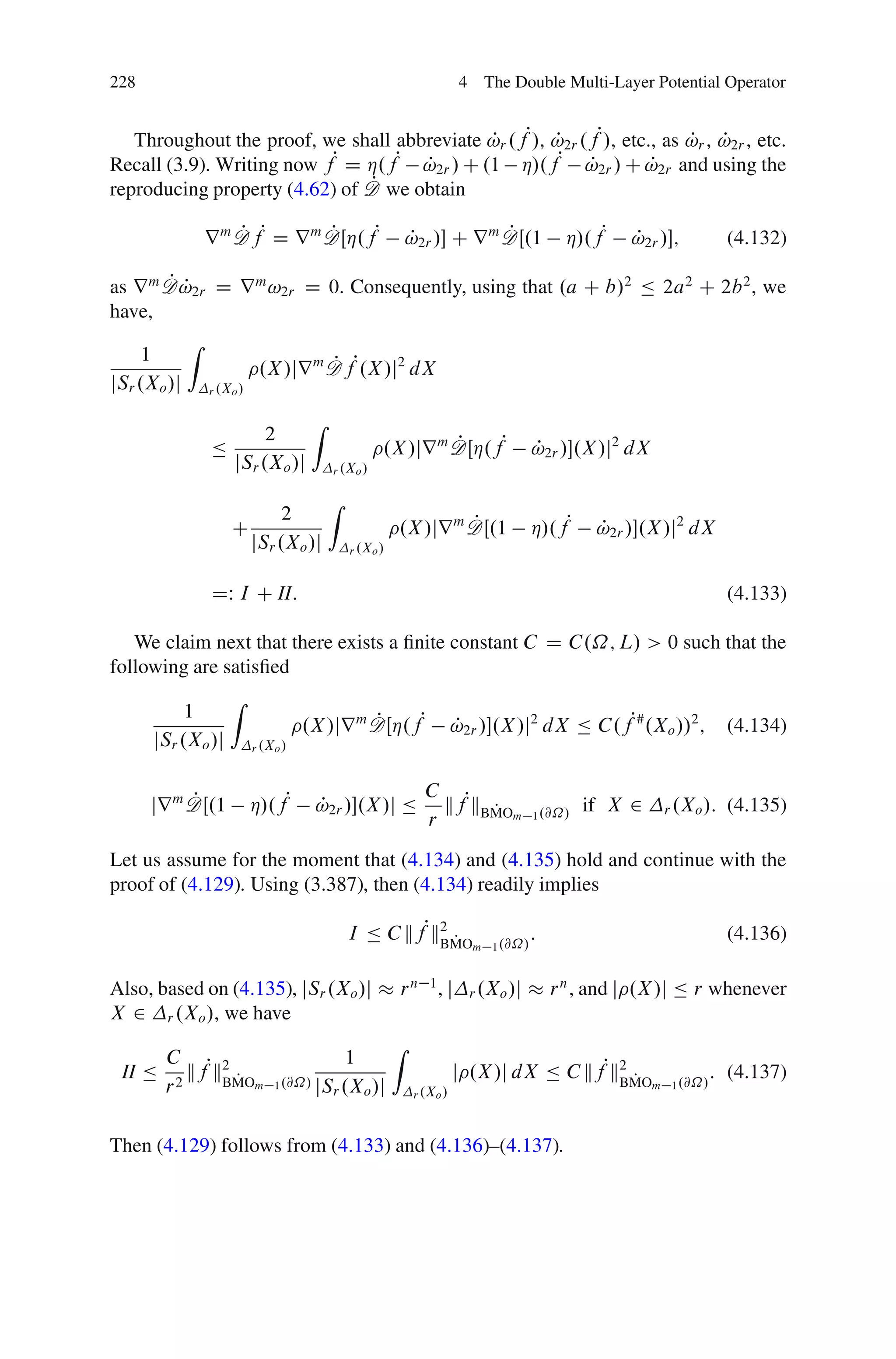
             r m D fP D r m DŒÁ.fP
                 P          P                                        P
                                                        !2r / C r m DŒ.1
                                                        P                             Á/.fP   P
                                                                                              !2r /;          (4.132)

        PP
as r m D !2r D r m !2r D 0. Consequently, using that .a C b/2 Ä 2a2 C 2b 2 , we
have,
          Z
     1
                   .X /jr m D fP.X /j2 dX
                            P
jSr .Xo /j r .Xo /
                                  Z
                        2
              Ä                                 .X /jr m DŒÁ.fP
                                                         P                      P
                                                                                !2r /.X /j2 dX
                   jSr .Xo /j         r .Xo /

                                      Z
                            2
                   C                                         P
                                                    .X /jr m DŒ.1               Á/.fP     P
                                                                                          !2r /.X /j2 dX
                       jSr .Xo /j         r .Xo /


              DW I C II:                                                                                       (4.133)

   We claim next that there exists a finite constant C D C.˝; L/ > 0 such that the
following are satisfied
                   Z
           1
                                 .X /jr m DŒÁ.fP
                                          P                        !2r /.X /j2 dX Ä C.fP# .Xo //2 ;
                                                                   P                                           (4.134)
      jSr .Xo /j       r .Xo /


                                                           C P
           P
      jr m DŒ.1        Á/.fP      P
                                  !2r /.X /j Ä              kf kBMOm
                                                                  P             1 .@˝/
                                                                                         if X 2    r .Xo /:    (4.135)
                                                           r
Let us assume for the moment that (4.134) and (4.135) hold and continue with the
proof of (4.129). Using (3.387), then (4.134) readily implies

                                          I Ä C kfPk2 P                         :                              (4.136)
                                                    BMO              m 1 .@˝/


Also, based on (4.135), jSr .Xo /j                  r n 1, j         r .Xo /j       r n , and j .X /j Ä r whenever
X 2 r .Xo /, we have
                                                    Z
     C                                1
 II Ä 2 kfPk2 P                                                    j .X /j dX Ä C kfPk2 P                    : (4.137)
     r      BMOm           1 .@˝/ jS .X /j                                            BMO         m 1 .@˝/
                                    r   o                r .Xo /


Then (4.129) follows from (4.133) and (4.136)–(4.137).
4.3 Carleson Measure Estimates                                                                                  229


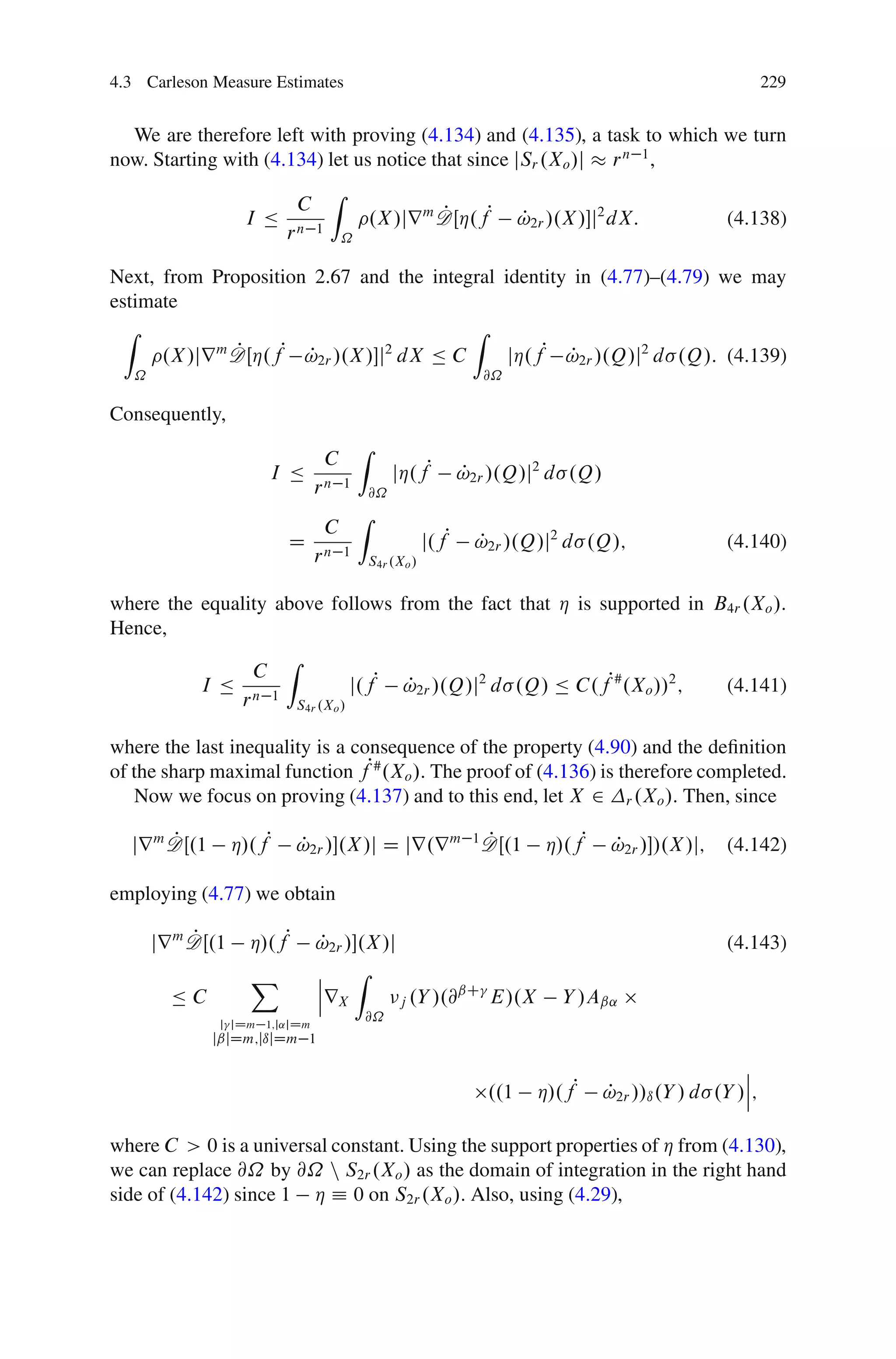
  We are therefore left with proving (4.134) and (4.135), a task to which we turn
now. Starting with (4.134) let us notice that since jSr .Xo /j r n 1 ,
                                     Z
                             C
                    I Ä                          .X /jr m DŒÁ.fP
                                                          P                  P
                                                                             !2r /.X /j2 dX:            (4.138)
                           rn    1
                                         ˝

Next, from Proposition 2.67 and the integral identity in (4.77)–(4.79) we may
estimate
  Z                                      Z
            m P    P !2r /.X /j2 dX Ä C
      .X /jr DŒÁ.f P                          jÁ.fP !2r /.Q/j2 d .Q/: (4.139)
                                                     P
   ˝                                                                  @˝

Consequently,
                                             Z
                                     C
                       I Ä                            jÁ.fP         P
                                                                    !2r /.Q/j2 d .Q/
                                 rn      1
                                                 @˝
                                             Z
                                     C
                           D                                 j.fP    P
                                                                     !2r /.Q/j2 d .Q/;                   (4.140)
                                 rn      1
                                                 S4r .Xo /


where the equality above follows from the fact that Á is supported in B4r .Xo /.
Hence,
                    Z
                C
          I Ä n 1              j.fP !2r /.Q/j2 d .Q/ Ä C.fP# .Xo //2 ;
                                    P                                  (4.141)
              r      S4r .Xo /


where the last inequality is a consequence of the property (4.90) and the definition
of the sharp maximal function fP# .Xo /. The proof of (4.136) is therefore completed.
   Now we focus on proving (4.137) and to this end, let X 2 r .Xo /. Then, since

       P
  jr m DŒ.1        Á/.fP                            P
                             !2r /.X /j D jr.r m 1 DŒ.1
                             P                                                  Á/.fP    P
                                                                                         !2r //.X /j;   (4.142)

employing (4.77) we obtain

            P
       jr m DŒ.1     Á/.fP       P
                                 !2r /.X /j                                                             (4.143)
                     X           ˇ    Z
                                 ˇ
         ÄC                      ˇrX         j .Y /.@
                                                     ˇC
                                                        E/.X                      Y /Aˇ˛
               j jDm 1;j˛jDm
                                             @˝
              jˇjDm;jıjDm 1

                                                                                                           ˇ
                                                                                                           ˇ
                                                                       ..1     Á/.fP    P
                                                                                        !2r //ı .Y / d .Y /ˇ;

where C > 0 is a universal constant. Using the support properties of Á from (4.130),
we can replace @˝ by @˝ n S2r .Xo / as the domain of integration in the right hand
side of (4.142) since 1 Á Á 0 on S2r .Xo /. Also, using (4.29),
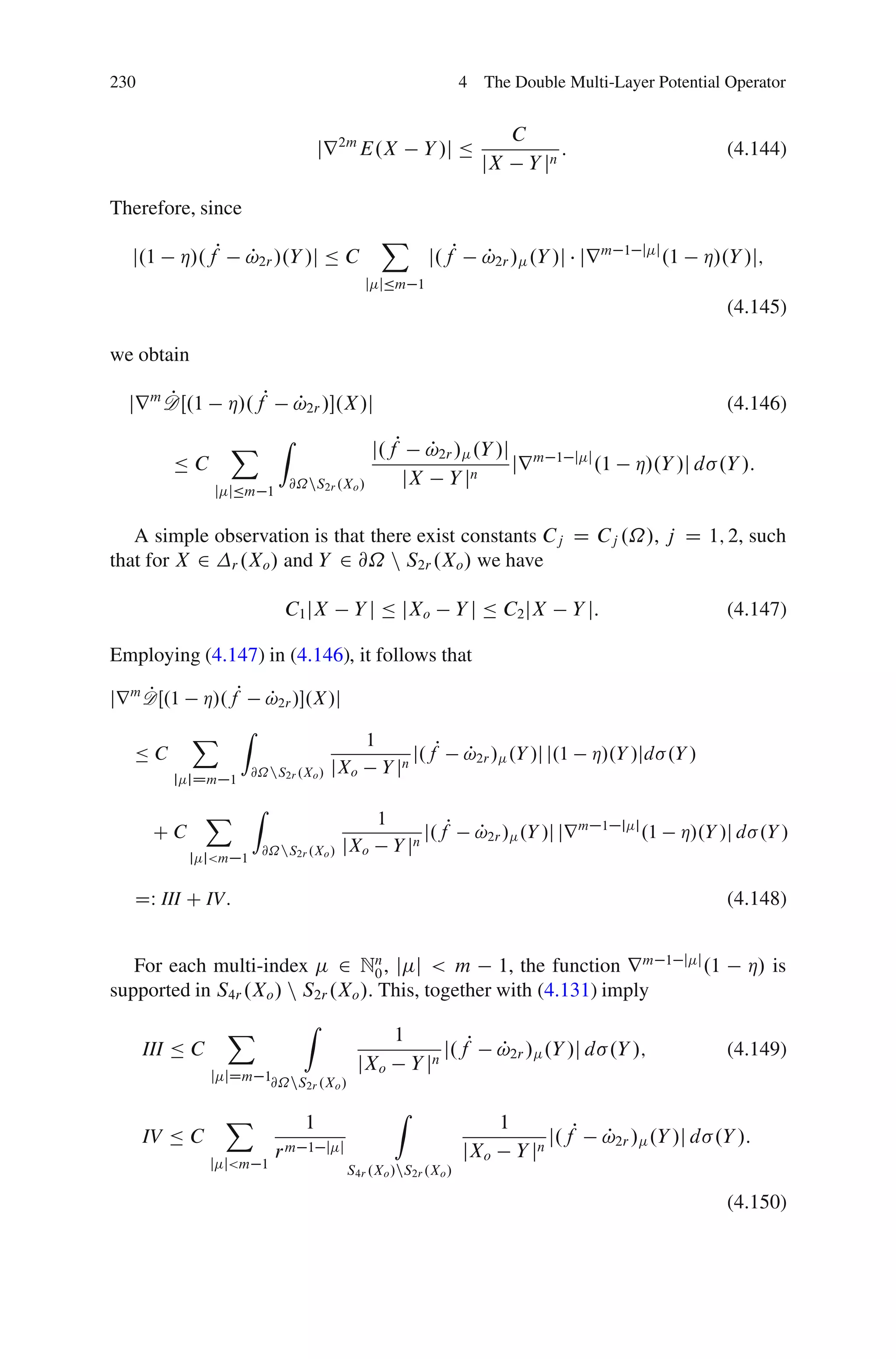
230                                                               4 The Double Multi-Layer Potential Operator


                                                                             C
                                   jr 2m E.X               Y /j Ä                       :                                    (4.144)
                                                                      jX         Y jn

Therefore, since
                                                X
   j.1    Á/.fP     !2r /.Y /j Ä C
                    P                                      j.fP       !2r / .Y /j jr m
                                                                      P                              1 j j
                                                                                                                .1      Á/.Y /j;
                                            j jÄm 1
                                                                                                                             (4.145)

we obtain

       P
  jr m DŒ.1       Á/.fP      P
                             !2r /.X /j                                                                                     (4.146)

                  X Z                        j.fP      P
                                                       !2r / .Y /j m                1 j j
         ÄC                                                       jr                           .1      Á/.Y /j d .Y /:
                             @˝nS2r .Xo /            jX Y jn
                j jÄm 1


   A simple observation is that there exist constants Cj D Cj .˝/, j D 1; 2, such
that for X 2 r .Xo / and Y 2 @˝ n S2r .Xo / we have

                            C1 jX        Y j Ä jXo                Y j Ä C2 jX               Y j:                             (4.147)

Employing (4.147) in (4.146), it follows that
     P
jr m D Œ.1   Á/.fP !2r /.X/j
                    P
             X    Z
                                            1
   ÄC                                                   j.fP       !2r / .Y /j j.1
                                                                   P                          Á/.Y /jd .Y /
                       @˝nS2r .Xo /   jXo       Y jn
         j jDm 1

                X Z                             1
       CC                                                  j.fP       !2r / .Y /j jr m
                                                                      P                            1 j j
                                                                                                           .1        Á/.Y /j d .Y /
                        @˝nS2r .Xo /   jXo          Y jn
             j j<m 1


   DW III C IV:                                                                                                              (4.148)

                                                                                                                1 j j
   For each multi-index 2 Nn , j j < m 1, the function r m
                                   0                                                                                    .1     Á/ is
supported in S4r .Xo / n S2r .Xo /. This, together with (4.131) imply
                  X            Z
                                                    1
      III Ä C                                                  j.fP      P
                                                                         !2r / .Y /j d .Y /;                                 (4.149)
                                         jXo            Y jn
                j jDm 1@˝nS .X /
                           2r o


                  X                                 Z
                               1                                         1
      IV Ä C                                                                        j.fP           P
                                                                                                   !2r / .Y /j d .Y /:
                          rm    1 j j                             jXo        Y jn
                j j<m 1                 S4r .Xo /nS2r .Xo /

                                                                                                                             (4.150)
4.3 Carleson Measure Estimates                                                                                           231


Using that jS4r .Xo /j r n 1 and for each point Y 2 S4r .Xo / n S2r .Xo / we have
2r Ä j Xo Y j Ä 4r, (4.150) gives
                  X                                       Z
                              1              1
     IV Ä C                                                                  j.fP       P
                                                                                        !2r / .Y /j d .Y /:         (4.151)
                           rm     j j   jS4r .Xo /j           S4r .Xo /
               j j<m 1

                  X                     Â                  Z                                                 Ã1=2
                              1                  1
        ÄC                                                                     j.fP     P
                                                                                        !2r / .Y /j d .Y /           :
                           rm     j j       jS4r .Xo /j        S4r .Xo /
               j j<m 1


Now (4.100) allows us to conclude,
                                             X          1
                           IV Ä C                                         rm    1 j j
                                                                                        fP# .Xo /
                                                      rm j        j
                                        j jÄm 1

                                      C P#        C P
                                Ä       f .Xo / Ä   kf kBMOm
                                                         P                              1 .@˝/
                                                                                                 :                  (4.152)
                                      r           r
   As for III, by writing the domain of integration in the right-hand side (4.149) as
the union of disjoint annuli S2j C1 r .Xo / n S2j r .Xo /, j 1, we have

               X XZ
                 1
                                                                 1
   III Ä C                                                            j.fP               P
                                                                                         !2r / .Y /j d .Y /; (4.153)
                                S2j C1 r.X / nS2j r .Xo /     .2j r/n
             j jDm 1 j D1                    o


since, for each j        1 and Y 2 S2j C1 r n S2j r , one has 2j r Ä jXo                             Y j. We then write

                    X X 1 Z
                       1                                          h
       III Ä C                                                        j.fP       P
                                                                                 !2j C1 r / .Y /j
                      j D1
                           2j r                  S2j C1 r .Xo /
                  j jDm 1


                  X
                  j                                      i
              C          j.!2i C1 r
                           P                P
                                            !2i r / .Y /j d .Y /
                  i D1

                    X Xh 1 Z
                       1                                                                                       Á1
                                                                       j.fP
                                                                                                                2
          ÄC                                                                        P
                                                                                    !2j C1 r / .Y /j2 d .Y /
                      j D1
                           2j r                     S2j C1 r .Xo /
                  j jDm 1


                  X 1 Z
                    j                                                                                i
              C                                    j.!2i C1 r
                                                     P                    P
                                                                          !2i r / .Y /j d .Y /
                  i D1
                       2j r       S2j C1 r .Xo /

                    X XÂ 1
                       1                                Ã
          ÄC                    fP# .Xo / C j fP# .Xo /
                      j D1
                           2j r            2j r
                  j jDm 1

              C P#       C
          Ä     f .Xo / Ä kfPkBMOm
                               P                          1 .@˝/
                                                                      :                                             (4.154)
              r          r
232                                                                4 The Double Multi-Layer Potential Operator


Above, the first inequality in (4.154) follows from (4.153) by writing fP !2r as
                                                                            P
a telescoping sum and applying the triangle inequality, while the second one is
obtained from H¨ lder’s inequality. The third inequality follows from Lemma 4.10,
                 o
whereas the last inequality is a consequence of (3.387). Now, (4.154), (4.152) and
(4.148) give (4.135) and complete the proof of Theorem 4.11.                     t
                                                                                 u
  We conclude by establishing the counterpart of Theorem 4.11 in the VMO
context. Specifically, we have:
Theorem 4.12. Retain the setting of Theorem 4.11. Then

                           jr m D fP.X /j2 .X / dX is a vanishing Carleson
                                P
                                                                                                                (4.155)
                           measure on ˝ for each fP 2 VMOm 1 .@˝/:
                                                          P

Proof. Fix an arbitrary fP 2 VMOm 1 .@˝/ along with a threshold " > 0. Pick
                                 P
                                                          P 1;1
a number s 2 .0; 1/ such that s > n2n1 , and choose g 2 Bm 1;s .@˝/ such that
                                                     P
kfP gkBMOm 1 .@˝/ < ". That this is possible is ensured by Definition 3.52 and
       P P
Proposition 3.53. Then, for every Xo 2 @˝ and 0 < r < diam .˝/, we have
          Z                                             Z
 r1   n
                        jr m D fPj2 dX Ä 2r 1
                             P                      n
                                                                       jr m D .fP
                                                                            P             P
                                                                                          g/j2 dX
              .Xo ;r/                                        .Xo ;r/
                                                             Z
                                          C 2r 1         n                       PP
                                                                            jr m D gj2 dX DW I C II:
                                                                  .Xo ;r/
                                                                                                                (4.156)

Now, Theorem 4.11 gives that

      I Ä 2k jr m D.fP
                  P               g/j2 dX kC ar Ä C kfP
                                  P                                            P BMO
                                                                               gk2 P                 Ä C "2 :   (4.157)
                                                                                          m 1 .@˝/


As for term II, anticipating an estimate which will be proved later, we remark that
                        PP
the function u WD jr m D gj2 satisfies juj Ä C 2s 1 in ˝, thanks to (4.243), where
C WD kgk2P 1;1 .@˝/ is a finite constant. Consequently, by (2.58), WD u dX is a
         P B
                   m 1;s
vanishing Carleson measure, since 2s 1 >                                    1=n by our choice of s. In turn, this
entails that there exists R > 0 such that

                                         II Ä " if 0 < r < R;                                                   (4.158)

uniformly in Xo 2 @˝. Altogether, (4.156)–(4.158) show that
                                                         Z                                      !
                        lim        sup         r   1 n
                                                                           jr D fPj
                                                                              P
                                                                              m       2
                                                                                           dX        D 0:       (4.159)
                    R!0C       0<r<R; Xo 2@˝                     .Xo ;r/


This proves (4.155).                                                                                                 t
                                                                                                                     u
4.4 Jump Relations                                                                                       233


4.4 Jump Relations

Throughout this section we define and study the boundary principal-value version
                                             P
of the double multi-layer potential operator D introduced in (4.57).
Definition 4.13. Assume that ˝            Rn is a bounded Lipschitz domain, and
that L is a (complex) matrix-valued constant coefficient, homogeneous, W-elliptic
differential operator L of order 2m in Rn . For each fP 2 Lm 1;0 .@˝/, 1 < p < 1,
                                                          Pp
define
                                     n        o
                             K fP WD K fP
                              P         P                                   (4.160)
                                                          j jÄm 1


where, for each      2 Nn of length Ä m
                        0                         1, we have set

                    j j
                  X X                   X                 X             n
 K fP .X / WD
  P                                                                         C1 .m; `; ˛; ı; Á; ; Â; !/
                  j˛jDm   `D1       ıCÁCek D˛          Â C!Cej D
                  jˇjDm         jıjD` 1;jÁjDm ` j jD` 1;j!jDj j `

                                Z                                                 Á                      o
                     lim                @ kj .Y / .@ıC!Cˇ E/.X                 Y / Aˇ˛ f CÁ .Y / d .Y /
                     "!0C
                              Y 2@˝
                             jX Y j>"

                     X          X
                                m            X            n
                                                              C2 .m; `; ˛; ı; Á/                   (4.161)
                     j˛jDm   `Dj jC1       ıCÁCek D˛
                     jˇjDm              jıjD` 1;jÁjDm `

                                Z                                                                 o
                                                 ıCˇ
                     lim                 k .Y /.@    E/.X               Y /Aˇ˛ f    CÁ .Y / d .Y / ;
                     "!0C
                              Y 2@˝
                             jX Y j>"


for X 2 @˝. Above C1 , C2 are as in (4.78)–(4.79).
   To state our next result, recall the non-tangential boundary multi-trace from
(3.272). Also, recall the double multi-layer potential operator defined in (4.57), the
convention (2.11), and set
                                                    Áˇ
                                      P         P ˇ
                                      D ˙ fP WD D fP ˇ              :                              (4.162)
                                                               ˝˙


                                           P      P
In the sequel we will sometimes abbreviate D C by D. Also, I will denote the
identity operator.
Theorem 4.14. Let ˝ Rn be a bounded Lipschitz domain and consider a
(complex) matrix-valued constant coefficient, homogeneous, W-elliptic differential
234                                                   4 The Double Multi-Layer Potential Operator


                                              P
operator L of order 2m in Rn . Assume that K is associated with these as in
(4.160)–(4.161).
   Then for each fP 2 Lm 1;0 .@˝/, 1 < p < 1, the expression K fP.X / is
                         Pp                                       P
meaningful at almost every point X 2 @˝. Moreover, the operator

                                 P Pp
                                K W Lm                  P
                                                      ! Lm
                                                          p
                                           1;0 .@˝/            1;0 .@˝/                  (4.163)

is well-defined, linear and bounded for each p 2 .1; 1/, and the following jump-
relation holds
                                          ˇm 1
                                          ˇ
                                    D ˙ fPˇ
                                    P          D .˙ 1 I C K/fP;
                                                    2
                                                          P                              (4.164)
                                           @˝


for each fP 2 Lm 1;0 .@˝/, 1 < p < 1.
              Pp

   Furthermore, for each p 2 .1; 1/, the operator

                                 P Pp
                                K W Lm                  P
                                                      ! Lm
                                                          p
                                           1;1 .@˝/            1;1 .@˝/                  (4.165)

is also well-defined, linear and bounded. As a corollary,
                                                  Á                         Á
                        P  Pp
                       K W Lm                           Pp
                                                      ! Lm
                                       1;0 .@˝/                  1;0 .@˝/
                                                                                         (4.166)
                                                  Á                         Á
                        P  Pp
                       K W Lm                           Pp
                                                      ! Lm
                                       1;1 .@˝/                  1;1 .@˝/


are also well-defined, linear, bounded operators for each p 2 .1; 1/.
Proof. The fact that the limits in (4.161) exist at a.e. X 2 @˝ is a consequence of
Proposition 2.63. This proposition also gives that
                            X
                                    k.K fP/ kLp .@˝/ Ä C kfPkLp
                                       P                     P                           (4.167)
                                                                   m 1;0 .@˝/
                       j jÄm 1


for some finite constant C D C.˝; L; p/ > 0.
   We shall now prove that (4.164) holds which requires that
                   j            h               i
        .D ˙ fP/
         P                  D       ˙ 1 I C K fP ;
                                      2
                                             P             8     2 Nn ; j j Ä m
                                                                    0               1:   (4.168)
                       @˝


We consider first the case of superscript C in (4.168) and fix for the moment 2 Nn
                                                                               0
with length Ä m 1. Notice that in (4.77), a typical kernel for the first group of
integral operators is of the type
                                           Á
 k.X; Y / D @ kj .Y / ko .X           Y/        where ko .Z/ WD .@ıC!Cˇ E/.Z/Aˇ˛ ; (4.169)
4.4 Jump Relations                                                                                       235


where ˛; ˇ; ı; ! 2 Nn , j˛j D jˇj D m, jıj D ` 1 and j!j D j j `, for some
                        0
number ` 2 f1; : : : ; j jg. In particular jıj C j!j C jˇj D m C j j 1 Ä 2m 2
and, consequently, the kernel k.X; Y / is either weakly singular, or amenable to the
Calder´ n–Zygmund theory reviewed in  2.8. The integral operators with weakly
        o
singular kernels do not jump thus, when restricted to the boundary, they contribute
to the left-hand side of (4.168) the boundary operators in the first part of (4.161). In
the case when the multi-index 2 Nn satisfies j j D m 1, we employ the jump
                                         0
relations (2.530) to write

        Z                                                         Á
                 @ j k .Y / Œko .        Y /g.Y / d .Y /                  .X /
            @˝                                                        @˝


                            1                         b                   b
                         D p Œ                j k ko .      /      k j ko .    /.X /g.X /
                          2   1
                                                  Z
                             C lim                        @ j k .Y / Œko .X     Y /g.Y / d .Y /
                                    "!0C
                                              Y 2@˝
                                          jX Y j>"

                                              Z
                         D lim                        @ j k .Y / Œko .X       Y /g.Y / d .Y /:       (4.170)
                             "!0C
                                          Y 2@˝
                                      jX Y j>"


for each g 2 Lp .@˝/ and almost every X 2 @˝. This shows that the restriction to
the boundary of the first part in (4.77) gives precisely the first part of (4.161).
   Let us now focus on the restriction to the boundary of the second part of (4.77).
Notice that whenever ` < m the kernels in the second part of (4.77) are weakly
singular and hence the integral operators with these kernels do not jump. In turn,
the restriction to the boundary of these operators give the corresponding terms (i.e.,
with ` < m) in the second part of (4.161).
   Finally, we are left with considering the boundary behavior of the following sum
of integral operators (corresponding to the choice ` D m in the second part of
(4.77)):

        X          X                 Z
                             ˛Š                           ıCˇ
                                                  k .Y /.@    E/.X            Y /Aˇ˛ f .Y / d .Y /:   (4.171)
                            m ıŠ         @˝
        j˛jDm    ıCek D˛
       jˇjDm


Since jˇj C jıj D 2m 1, the kernels in (4.171) are Calder´ n–Zygmund and
                                                               o
employing (2.530) the non-tangential limit on @˝ of (4.171) is
236                                                                4 The Double Multi-Layer Potential Operator


                   p
                    1        X        X         ˛Š
                                                         k .X /.@
                                                                   2
                                                                 ıCˇ
                                                                     E/.         .X //Aˇ˛ f .X /        (4.172)
               2         1                     m ıŠ
                             j˛jDm   ıCek D˛
                             jˇjDm

                             X       X               Z
                                             ˛Š                       ıCˇ
               lim                                            k .Y /.@    E/.X         Y /Aˇ˛ f .Y / d .Y /;
               "!0C                         m ıŠ      @˝
                          j˛jDm   ıCek D˛
                         jˇjDm


where as before “hat” denotes the Fourier transform. Based on (4.77) and (4.161),
in the light of our previous analysis, in order to prove (4.168) it suffices to show


          p
           1        X          X        ˛Š
                                                k .X /.@
                                                          2
                                                        ıCˇ
                                                            E/.        .X //Aˇ˛ f .X / D 1 f .X /: (4.173)
                                                                                         2
      2        1                       m ıŠ
                    j˛jDm    ıCek D˛
                   jˇjDm


Using that

                             2
                             .@ıCˇ E/. .X // D
                                                         p
                                                               1
                                                                jıjCjˇj
                                                                                      b
                                                                              .X /ıCˇ E. .X //
                                                          p
                                                     D.         1/2m      1           b
                                                                              .X /ıCˇ E. .X //;         (4.174)

we obtain

   p1
               X         X         ˛Š
                                          k .X /.@
                                                    2
                                                  ıCˇ
                                                      E/.          .X //Aˇ˛ f .X /                      (4.175)
  2   1                           m ıŠ
           j˛jDm        ıCek D˛
           jˇjDm

                                       X        X          ˛Š
                    D 1 . 1/m                                             b
                                                               .X /ıCˇCek E. .X //Aˇ˛ f .X /
                      2                                   m ıŠ
                                       j˛jDm   ıCek D˛
                                      jˇjDm

                                               0                   1
                                       X            X          ˛Š A
                    D 1 . 1/m                  @                            b
                                                                    .X /˛Cˇ E. .X //Aˇ˛ f .X /
                      2
                                                              m ıŠ
                                       j˛jDm       ıCek D˛
                                      jˇjDm

                                       X
                    D 1 . 1/m                           b
                                                .X /˛Cˇ E. .X //Aˇ˛ f .X /
                      2
                                       j˛jDm
                                      jˇjDm

                                                    hX                    i
                              b
                    D 1 . 1/m E. .X //                         .X /˛Cˇ A˛ˇ f .X /;
                      2
                                                      j˛jDm
                                                     jˇjDm
4.4 Jump Relations                                                               237


where the next-to-last identity follows from (4.82). Finally, (4.31) gives

                                      h     X                       i   1
                  b
                  E. .X // D . 1/m                    .X /˛Cˇ A˛ˇ            (4.176)
                                          j˛jDjˇjDm


so the identity (4.173) readily follows. This in turn gives (4.168) and finishes the
proof of (4.164).
   In order to complete the proof of (4.163) it remains to show that for each
Whitney array fP 2 Lm 1;0 .@˝/ for some p 2 .1; 1/ we have that K fP 2 C C . This
                    Pp                                               P
is however a direct consequence of (4.164), the non-tangential maximal function
estimate (4.63) and (3.275) in Proposition 3.29.
   We turn now to proving that the operator (4.165) is also well-defined and
bounded. To this end, fix p 2 .1; 1/. Then, for each fP 2 Lm 1;1 .@˝/ the jump
                                                               Pp
formula (4.164) holds. Then, the desired properties of the operator (4.165) are a
consequence of the non-tangential maximal function estimates (4.64), (3.279) from
Proposition 3.30 and (3.265).                                                     t
                                                                                  u

Theorem 4.15. Retain the same background assumptions as in Theorem 4.14. Then
the operator

                         P Pp
                        K W hm                  Pp
                                              ! hm
                                 1;1 .@˝/              1;1 .@˝/              (4.177)

is well-defined, linear and bounded for each p 2 . n n 1 ; 1/.

                                                  Pp              Pp
Proof. When 1 < p < 1, it follows that hm 1;1 .@˝/ D Lm 1;1 .@˝/ and
                                                                    Pp
(4.177) follows from (4.165). On the other hand, the embedding hm 1;1 .@˝/ ,!
 Pp
Lm 1;0 .@˝/ holds if n n 1 < p Ä 1, where p is as in (2.433). Hence, in either case,
(4.164) holds for fP 2 hm 1;1 .@˝/, so the boundedness of (4.163) is a consequence
                         Pp
of this, (4.87), and (3.279) from Proposition 3.30.                               t
                                                                                  u
  We continue by presenting a structure theorem for the principal-value double
multi-layer in the case when the underlying differential operator factors through the
Laplacian.

Theorem 4.16. Retain the same background assumptions as in Theorem 4.14 and,
in addition, assume that L is a W-elliptic differential operator which factors as

                                     LD        Q
                                               L;                            (4.178)

       Q
where L is a constant coefficient differential operator of order 2m 2. Then, for
each 2 Nn , with j j Ä m 1, and fP D ff gj jÄm 1 2 Lm 1;0 .@˝/, 1 < p < 1,
           0
                                                         Pp
one has
238                                                                4 The Double Multi-Layer Potential Operator


                       X          X
                                  n                  Z                                                Á
.K fP/ .X/ D
  P                                       lim                @   j k .Y /   Œp   ;Â;j;k .@/E.X    Y / f .Y / d .Y /
                                         "!0C
                     j jÄm 1 j;kD1                Y 2@˝
                                               jX    Y j>"

                     C K f .X/ C lower order terms;                                                             (4.179)

where each p         ;Â;j;k .@/   is a differential operator of order 2m                      2.
Proof. Fix 2 Nn such that j j Ä m
                   0                                         1. A simple analysis of (4.161) reveals that
for (4.179) it suffices to show that

        X        X
                 m                 X
                                                   C2 .m; `; ˛; ı; Á/                                           (4.180)
       j˛jDm   `Dj jC1        ıCÁCek D˛
       jˇjDm               jıjD` 1;jÁjDm `
                                               Z
                                                                   ıCˇ
                                   lim                     k .Y /.@    E/.X              Y /Aˇ˛ f   CÁ .Y / d   .Y /;
                                  "!0C
                                           Y 2@˝
                                         jX Y j>"


can be written as in the right-hand side of (4.179) as the remaining terms in (4.161)
are already in this form. As for (4.180), we notice that whenever ` ¤ m in (4.180)
one obtains a lower order term. Therefore matters are reduced to showing that if
               X        X ˛k                        Z
 I WD                        lim                              k .Y /.@
                                                                      ıCˇ
                                                                          E/.X              Y /Aˇ˛ f .Y / d .Y /
                          m "!0C
             j˛jDm    ıCek D˛                      Y 2@˝
             jˇjDm                             jX Y j>"
                                                                                                                (4.181)
then

              X         X
                        n                  Z                                                     Á
      I D                         lim                @ j k .Y / Œp      ;Â;j;k .@/E.X        Y / f .Y / d .Y /
                              "!0C
            j jÄm 1 j;kD1               Y 2@˝
                                        jX Y j>"

            CK f .X / C lower order terms ;                                                                     (4.182)

with p   ;Â;j;k .@/   as in the hypothesis. Above we have used the fact that

                                                           ˛k
                       C2 .m; m; ˛; ı; ;/ D                   whenever ı C ek D ˛:                              (4.183)
                                                           m
However, based on the definition of I ,

             X X ˛k
               n                            Z
 I D                lim                                  k .Y /.@
                                                                 ˛Cˇ ek
                                                                        E/.X               Y /Aˇ˛ f .Y / d .Y /;
                 m "!0C
             j˛jDm   kD1                  Y 2@˝
            jˇjDm                       jX Y j>"
                                                                                                                (4.184)
4.4 Jump Relations                                                                                             239


where we make the convention that @˛Cˇ ek E D 0 if any of the components of the
multi-index ˛ C ˇ ek is negative.
                                                            Q
  Consider next a generic homogeneous differential operator L of order 2m 2,

                                                 X                 0           0
                                Q
                                L WD                           @˛ B˛0 ˇ0 @ˇ :                             (4.185)
                                           j˛ 0 jDjˇ 0 jDm 1


Then, due to (4.178), we have

                    X                                  X               X
                                                                       n
                                                                                       0    0
                              A˛ˇ @˛Cˇ D                                   B˛0 ˇ0 @˛ Cˇ C2ej :            (4.186)
                  j˛jDjˇjDm                     j˛ 0 jDjˇ 0 jDm 1 j D1


A moment’s reflection shows then that, for each ˛; ˇ 2 Nn , with j˛j D jˇj D m,
                                                       0
we have

                                                X
                                                n
                                   A˛ˇ D               B.˛     ej /.ˇ ej / ;                              (4.187)
                                                j D1


where B.˛ ej /.ˇ ej / D 0 whenever either ˛ ei or ˇ ei fails to be a multi-index
in Nn , otherwise they are as in (4.185). Employing (4.187) in (4.184) we obtain
    0


           X X ˛k
             n                         Z                   X
                                                           n
 I D              lim                            k .Y /           .@.˛   ej /C.ˇ ej /C2ej ek
                                                                                                 E/.X     Y/
               m "!0C                                      j D1
          j˛jDm   kD1              Y 2@˝
          jˇjDm                  jX Y j>"


                                                               B.ˇ     ej /.˛ ei / f   .Y / d .Y /:       (4.188)

Writing    k@
             ej
                   D @ kj C     j@
                                  ek
                                       we get

                                              I D II C III;                                               (4.189)

where

          X X ˛k
            n                       Z                      X
                                                           n
  II WD          lim                           @ kj .Y /     .@.˛        ej /C.ˇ ej /Cej ek
                                                                                                E/.X      Y/
              m "!0C                                       j D1
          j˛jDm   kD1             Y 2@˝
          jˇjDm                  jX Y j>"

                                                                  B.ˇ    ej /.˛ ej / f     .Y / d .Y /;   (4.190)
240                                                            4 The Double Multi-Layer Potential Operator


and

               X X ˛k
                 n                           Z      X
                                                    n
                                                                   ej
      III WD          lim                                   j .Y /@Y .@
                                                                       .˛ ej /C.ˇ ej /
                                                                                       E/.X       Y/
                   m "!0C                           j D1
               j˛jDm   kD1                  Y 2@˝
               jˇjDm                    jX Y j>"

                                                         B.ˇ   ej /.˛ ej / f   .Y / d .Y /:        (4.191)

Observe next that II is of the form

      X        X
               n                  Z                                                Á
                       lim              @ j k .Y / Œp     ;Â;j;k .@/E.X        Y / f .Y / d .Y /: (4.192)
                      "!0C
  j jÄm 1 j;kD1               Y 2@˝
                             jX Y j>"


Pm as III is concerned, notice first that for a fixed ˛ 2 N0 , j˛j D m we have that
                                                          n
As far
  kD1 m
       ˛k
          D 1. Also, based on (4.185), for each fixed j 2 f1; : : : ; ng we have
                                      X
                                             B.˛    ej /.ˇ ej / @
                                                                 ˛Cˇ 2ej         Q
                                                                               D L:                (4.193)
                               j˛jDjˇjDm


Finally, (4.191) and the preceding observations imply

              X
              n               Z                     h                       it
      III D          lim
                                               ej
                                        j .Y /@Y
                                                         Q
                                                        .Lt ELt /.X      Y / f .Y / d .Y /;        (4.194)
                     "!0C
              j D1           Y 2@˝
                           jX Y j>"


          Q                         Q
and since Lt ELt D (as Lt D Lt ), where                               is the fundamental solution of the
Laplacian, (4.194) readily gives that

                                              III D K f .X /:                                      (4.195)

This finishes the proof of (4.182) and completes the proof of Theorem 4.16.                               t
                                                                                                         u
   Our next theorem addresses the issue of the boundedness of the principal-value
double multi-layer on Whitney–BMO spaces. As a preamble, we shall prove the
following useful result.
Proposition 4.17. Let ˝ Rn be a bounded Lipschitz domain and consider a
(complex) matrix-valued constant coefficient, homogeneous, W-elliptic differential
                                                       P
operator L of order 2m in Rn . In this context, define K as in (4.160)–(4.161). Then

                     P
                     K.trm 1 u/ D       1
                                            trm 1 u on @˝; for any u 2 Pm 1 :                      (4.196)
                                        2

Proof. This follows by taking the non-tangential limit in (4.62) and using the
jump-formula (4.164).                                                        t
                                                                             u
4.4 Jump Relations                                                                             241


   The action of the principal-value double multi-layer on Whitney–BMO spaces is
considered next. The theorem below extends work done in the case when n D 2 and
L D 2 in [24] and answers the question posed by J. Cohen at the top of page 111
in [24].

Theorem 4.18. Assume that ˝ Rn is a bounded Lipschitz domain, L is a
(complex) matrix-valued constant coefficient, homogeneous, W-elliptic differential
                                             P
operator L of order 2m in Rn , and consider K as in (4.160)–(4.161). Then

                             P   P             P
                            K W BMOm 1 .@˝/ ! BMOm 1 .@˝/;                                 (4.197)

is well-defined, linear and bounded.
Proof. The first observation is that, given an arbitrary fP 2 BMOm 1 .@˝/, due to
                                                              P
(4.163),

                                       K fP 2 L2
                                        P     Pm     1;0 .@˝/:                             (4.198)

Therefore matters reduce to showing

                                        .K fP/# 2 L1 .@˝/:
                                          P                                                (4.199)

To this end, fix Xo 2 @˝, r > 0 and fP 2 BMOm 1 .@˝/. For each R > 0, recall the
                                              P
                           P
best fit polynomial array !R .f  P/ introduced as in (4.88). We consider next a function
Á in Rn as in (4.130). In particular the following hold

     Á 2 Cc1 .Rn /;          0 Ä Á Ä 1; Á Á 1 on S2r .Xo /; suppÁ                S4r .Xo /; (4.200)

                C˛
     j@˛ Áj Ä         ;        for each ˛ 2 Nn :
                                             0                                             (4.201)
                r j˛j

We write

                          fP D Á.fP     !2r / C .1
                                        P             Á/.fP      !2r / C !2r ;
                                                                 P       P                 (4.202)

                      P                     P
where for an array g, the multiplication Ág is in the sense of (3.309). Using the
                           P
linearity of the operator K on L2 1;0 .@˝/, formulas (4.202) and (4.196) give
                                m

                                                                  Á
                1
                2
                  I   C K fP D
                         P             1
                                       2
                                         I    P
                                             CK   Á.fP    P
                                                          !2r /

                                                                           Á
                                      C 1I C K
                                        2
                                              P      .1   Á/.fP       !2r / C 3 !2r :
                                                                      P       2
                                                                                P          (4.203)
242                                                                          4 The Double Multi-Layer Potential Operator


Therefore
                                                                                  Á                                        Á
. 1 I C K/fP
  2
        P                   3
                              P
                            2 !2r   D . 1 I C K/ Á.fP
                                        2
                                              P                              P         2
                                                                                             P
                                                                             !2r / C . 1 I C K/ .1         Á/.fP   P
                                                                                                                   !2r /

                                    D W I C II:                                                                    (4.204)

     We claim that there exists C > 0, independent of Xo , fP and r > 0 such that
                                  ÂZ                                          Ã1=2
                                                   jI.Y /j d .Y /2
                                                                                     Ä C fP# .Xo /;                (4.205)
                                       Sr .Xo /


and that

                                          P   P
                            there exists P 2 Pm 1 .@˝/ with the property that

                            ÂZ                                                       Ã1=2                          (4.206)
                                            jII.Y /           P
                                                             P .Y /j2 d .Y /             Ä C fP# .Xo /:
                                 Sr .Xo /


We start with showing (4.205) and, in this regard, first notice that
Z                                            Z              ˇ                                               Áˇ2
                                                            ˇ 1                                              ˇ
               jI.Y /j d .Y / D
                        2
                                                            ˇ. 2 I C K/ Á.Y /.fP.Y /
                                                                     P                             P
                                                                                                   !2r .Y // ˇ d .Y /
    Sr .Xo /                                     Sr .Xo /
                                             Z        ˇ                                               Áˇ2
                                                      ˇ 1                                              ˇ
                                       Ä              ˇ. 2 I C K/ Á.Y /.fP.Y /
                                                               P                             P
                                                                                             !2r .Y // ˇ d .Y /:
                                                 @˝
                                                                                                                   (4.207)

                                                  P
Based on Theorem 4.14, the operator 1 I C K is bounded on L2 1;0 .@˝/, and
                                           2                           m
together with (4.207), this implies that there exists a finite constant C > 0 such that
      Z
                     jI.Y /j2 d .Y /                                                                               (4.208)
          Sr .Xo /
                       Z
               ÄC               jÁ.Y /.fP.Y /               P
                                                            !2r .Y //j2 d .Y /
                           @˝

                            X        X                      Z
                                                   ˛Š
               ÄC                                                           j@ˇ Á.Y /j2 j fP.Y /    !2r .Y / j2 d .Y /:
                                                                                                    P
                                                  ˇŠ Š          S2r .Xo /
                       j˛jÄm 1 ˇC D˛


The last identity above follows from (3.309) and the Leibniz rule of differentiation.
Employing next (4.201), we have j@ˇ Á.Y /j Ä Cr jˇj and hence
4.4 Jump Relations                                                                                                     243

Z                                       X         X               Z
                                                              1
               jI.Y /j2 d .Y / Ä C                                                j.fP.Y / !2r .Y // j2 d .Y /:
                                                                                           P
    Sr .Xo /                                             r 2jˇj       S2r .Xo /
                                      j˛jÄm 1 ˇC D˛
                                                                                                                   (4.209)
Due to (4.100) from Lemma 4.10 the above further gives
       Z                                     X         X r 2.m 1 j                 j/                   Á2
                      jI.Y /j2 d .Y / Ä C                                                   fP# .Xo /        jS2r .Xo /j
           Sr .Xo /                                   ˇC D˛
                                                             r 2jˇj
                                            j˛jÄm 1

                                             X                                              Á2
                                     ÄC               r 2.m   1 j˛j/
                                                                           fP# .Xo /              jSr .Xo /j;      (4.210)
                                            j˛jÄm 1


where in the last inequality in (4.210) we have used that jˇj C j j D j˛j as well
as jSr .Xo /j jS2r .Xo /j. Finally (4.205) now readily follows from (4.210) and the
fact that r 2.m 1 j˛j/ Ä C D C.@˝/, since j˛j Ä m 1.
   We shall focus next on proving (4.206). For each array g 2 L2 1;0 .@˝/, g D
                                                             P     m           P
fg gj jÄm 1 and ˛ 2 Nn , multi-index of length Ä m 1, we introduce
                         0

                                        X         1
               P˛ .gI X; Xo / WD
                   P                                 g˛Cˇ .Xo /.X                  X o /ˇ ;        X 2 @˝; (4.211)
                                                  ˇŠ
                                    jˇjÄm 1 j˛j


and

                         R˛ .gI X; Xo / WD g˛ .X /
                             P                              P
                                                        P˛ .gI X; Xo /;                 X 2 @˝:                    (4.212)

Going further, we set
                                                                       Á
                             P P
                            P .gI X; Xo / WD P˛ .gI X; Xo /
                                                 P                                          and
                                                                           j˛jÄm 1
                                                                       Á                                           (4.213)
                            P P
                            R.gI X; Xo / WD R˛ .gI X; Xo /
                                                P                                       ;
                                                                         j˛jÄm 1


                                                            P P
and straightforward algebraic manipulations show that P .gI X; Xo / satisfies the
compatibility conditions (3.2). This and degree considerations guarantee that the
        P P             P
array P .gI X; Xo / 2 Pm 1 .@˝/, where as before the latter stands for the set of
polynomial arrays of degree less than or equal to m 1. In turn, based on (4.212),
 P P
R.gI X; Xo / also satisfies the compatibility conditions (3.2). In the notation we just
introduced,
                              Á                                             Á
  . 1 I C K/ .1 Á/.fP !2r / D P . 1 I C K/ .1 Á/.fP !2r / I X; Xo (4.214)
    2
          P               P        P
                                       2
                                              P                 P
                                                                                                               Á
                                                P         P
                                              C R . 1 I C K/ .1
                                                    2
                                                                                  Á/.fP           !2r / I X; Xo ;
                                                                                                  P
244                                                                4 The Double Multi-Layer Potential Operator


and we claim that there exists C > 0 (independent of fP, Xo , r > 0) such that for
each multi-index ˛ 2 Nn , j˛j Ä m 1, we have
                       0
             ˇ                                                            Áˇ
             ˇ                                                             ˇ
                         P
             ˇR˛ . 1 I C K/ .1
                   2
                                                 Á/.fP       !2r / I X; Xo ˇ Ä C fP# .Xo /:
                                                             P                                            (4.215)

The starting point for proving (4.215) is the observation that, based on (4.212) and
the jump relations (4.164), for a given g 2 L2 1;0 .@˝/ and for almost every point
                                        P      m
X 2 @˝, we have

                    P P
         R˛ . 1 I C K/gI X; Xo                                                                            (4.216)
              2
                 h                                                                              i
           D Tr Taylor remainder of order m                             1              PP
                                                                             j˛j of @˛ D g at Xo .X /:

         P
Next, if g vanishes near Xo , the Taylor formula implies
ˇ                      ˇ
ˇ           P P        ˇ
ˇR˛ . 1 I C K/gI X; Xo ˇ
      2
                                                                                                          (4.217)

                     X       Z      1                         ˇ             Á                         ˇ
                                                           j˛j ˇ      C˛   P P                        ˇ
            ÄC                          jX       X o jm       ˇ @          D g.Xo C t.X          Xo //ˇ dt:
                               0
                 j jDm j˛j


                                                                               PP
It is important to point out that Taylor’s formula require that the function D g be
                                                           PP
sufficiently smooth in a neighborhood of Xo . In general, D g is not even continuous
                               P
near Xo , however, it is so if g vanishes near Xo . Now, based on (4.57), (4.144) and
the support condition on Á,
ˇ           Á                                ˇ
ˇ     C˛   P P                               ˇ
ˇ @        D g.Xo C t.X                 Xo //ˇ                                                            (4.218)
                 Z                                                               X
                                                   1
            ÄC                                                                            jgı .Y /j d .Y /:
                                                                                           P
                     @˝nS2r .Xo /   jY       .Xo C t.X                Xo //jn
                                                                                jıjÄm 1


Furthermore, a simple inspection reveals that there exist Cj > 0, j D 1; 2,
independent of r, Xo and X 2 Sr .Xo /, such that for each X 2 Sr .Xo / the following
holds

 C1 jY     .Xo C t.X         Xo //j Ä jXo                 Y j Ä C2 jY        .Xo C t.X          Xo //j:   (4.219)

Collectively, (4.217)–(4.219) further imply
   ˇ                      ˇ     Z                                                    X
   ˇ           P P        ˇ                                             r m j˛j
   ˇR˛ . 1 I C K/gI X; Xo ˇ Ä C                                                              jgı .Y /j d .Y /;
         2
                                                    @˝nS2r .Xo /      jY Xo jn
                                                                                   jıjÄm 1
                                                                                                          (4.220)
4.5 Estimates on Besov, Triebel–Lizorkin, and Weighted Sobolev Spaces                             245


whenever X 2 Sr .Xo /. However, proceeding as in the proof of Theorem 4.11 when
having to estimate the right hand side of (4.137), we have
Z                                X
                   1                                                            C
                                         j.1 Á.Y //.fP.Y / !2r .Y //ı j d .Y / Ä fP# .Xo /:
                                                           P
 @˝nS2r .Xo /   jY Xo jn                                                        r
                               jıjÄm 1
                                                                              (4.221)
Above we considered g D .1 Á/.fP !2r / which vanishes in a neighborhood of
                        P                   P
Xo due to the fact that Á Á 1 on S2r .Xo /. Then, from (4.220) and (4.221) we deduce
         ˇ                                                    Áˇ
         ˇ                                                     ˇ
                     P
         ˇR˛ . 1 I C K/ .1
               2
                                         Á/.fP   !2r / I X; Xo ˇ Ä C r m
                                                 P                         1 j˛j
                                                                                   fP# .Xo /

                                                                Ä C fP# .Xo /:                 (4.222)

   That (4.206) holds can now be justified by invoking (4.214) and (4.222). Finally,
                                        P   P
(4.204)–(4.206) give that there exists P 2 Pm 1 .@˝/ such that
           ÂZ               ˇ                          ˇ2       Ã1=2
                            ˇ 1                        ˇ
                            ˇ. 2 I C K/fP.Y /
                                     P            P
                                                 P .Y /ˇ d .Y /      Ä C fP# .Xo /;            (4.223)
                 Sr .Xo /


from which (4.199) readily follows. This finishes the proof of Theorem 4.18.                         t
                                                                                                    u


4.5 Estimates on Besov, Triebel–Lizorkin, and Weighted
    Sobolev Spaces

                                                                            P     P
The aim of this section is to study the action of the multi-layer operators D and K,
introduced in Definition 4.4 and Definition 4.13, respectively, on Besov and Triebel–
Lizorkin scales in Lipschitz domains.
Theorem 4.19. Suppose that ˝ is a bounded Lipschitz domain in Rn , and assume
that L is a W-elliptic homogeneous differential operator of order 2m with (complex)
matrix-valued constant coefficients. Then if the numbers p; q; s satisfy the inequali-
ties n n 1 < p Ä 1, 0 < q Ä 1, .n 1/. p 1/C < s < 1, the operator
                                          1


                              P P p;q            p;q
                              D W Bm 1;s .@˝/ ! Bm 1CsC1=p .˝/                                 (4.224)

is well-defined, linear and bounded. Moreover,

                              P P p;p            p;q
                              D W Bm 1;s .@˝/ ! Fm 1CsC1=p .˝/                                 (4.225)

is also well-defined, linear and bounded (with the additional convention that q D 1
if p D 1).
246                                                      4 The Double Multi-Layer Potential Operator


   Finally, similar properties hold for                P
                                                       D      (cf. the convention (4.162)), for any
cutoff function 2 Cc1 .Rn /.
Proof. Consider the task of proving that the operator (4.224) is well-defined and
bounded when p; q 6D 1. In this case, fix fP D ffı gjıjÄm 1 2 Bm 1;s .@˝/ and note
                                                             P p;q
that, by (3.224), it suffices to show that

             @˛ D fP 2 B 1CsC1=p .˝/;
                P       p;q
                                                            8 ˛ 2 Nn ; j˛j Ä m;
                                                                   0                           (4.226)

with appropriate control of the norm. Let us indicate how this is done in the case
when j˛j D m. Pick i 2 f1; : : : ; ng and write ˛ D ei C where has length m 1.
In particular, the discussion in the next couple of paragraphs following (4.80) shows
that @˛ .D fP/.X / can be written in the form
         P

        X       X       X Z
                        n
                                       .@ˇ E/.X         Y /Cˇ;ı;j;k .@ j k fı /.Y / d .Y /;    (4.227)
                             @˝
      jˇjD2m 1 jıjÄm 1 j;kD1

                                                                                              p;q
where Cˇ;ı;j;k are suitable matrices. Since Proposition 2.58 gives @ j k fı 2 Bs 1 .@˝/,
for every ı, j; k, it suffices to show that the assignment
                       p;q                                        p;q
                      Bs 1 .@˝/ 3 f 7! rRˇ0 f 2 B                  1CsC1=p .˝/                 (4.228)

is bounded, where for each ˇ 0 2 Nn of length 2m
                                  0                                 2 we have set
                                   Z
               R f .X / WD
                 ˇ0                         k.X       Y /f .Y / d .Y /;    X 2 ˝:              (4.229)
                                       @˝

                                                  0
where k.X / is a generic entry in .@ˇ E/.X                      Y /. We shall show that, whenever
jˇ 0 j D 2m 2,
                             p;q                      p;q
                  Rˇ0 W Bs 1 .@˝/ ! BsC1=p .˝/                      boundedly;                 (4.230)

from which (4.228) follows.
   In turn, via real interpolation, (4.230) will be a consequence of the fact that
                             p;p                      p;p
                  Rˇ0 W Bs 1 .@˝/ ! BsC1=p .˝/                      boundedly;                 (4.231)

for each multi-index ˇ 0 2 NN with jˇ 0 j D 2m 2, if n n 1 < p Ä 1, as well as
                              0
.n 1/. p 1/C < s < 1. Finally, given that L.Rˇ0 f / D 0 in ˝, the claim (4.231)
         1

follows from Proposition 2.64 and Theorem 2.41. This finishes the treatment of the
case when j˛j D m. The case when j˛j Ä m 1 is similar and simpler, completing
the proof of (4.224) in the case when p; q 6D 1.
   The case when p 6D 1 and 0 < q Ä 1 can then be covered from what we have
proved so far and real interpolation; cf. (3.314) and (3.317). By the same token,
4.5 Estimates on Besov, Triebel–Lizorkin, and Weighted Sobolev Spaces                            247


matters can be reduced to considering the case when p D q D 1. To this end, let
us fix fP D ffÁ gjÁjÄm 1 2 Bm 1;s .@˝/ of norm one, and abbreviate (4.4) as
                          P 1;1

                X                   Z
D fP.X/ D
P                            ˛;ˇ
                         C   ;Á;j          j .Y   /.@ˇC E/.X        Y /Aˇ˛ fÁ .Y / d .Y /;    X 2 ˝;
             j˛jDjˇjDm
                                     @˝
             CÁCej D˛
                                                                                            (4.232)
             ˛;ˇ
where the C ;Á;j ’s are real constants. For each multi-index                2 Nn of length Ä m 1,
                                                                               0
consider next, in analogy with (3.78) and (3.73),
                         X              1
    P .X; Y / WD                           fıC .Y /.X      Y /ı ;     X 2 Rn ; Y 2 @˝; (4.233)
                                        ıŠ
                      jıjÄm 1 j j

    R .X; Y / WD f .X /             P .X; Y /;          X; Y 2 @˝:                            (4.234)

For ease of reference, for each Y 2 @˝ let us also set

         P
        P . ; Y / WD fP . ; Y /gj         jÄm 1 ;
                                                        P
                                                        R. ; Y / WD fR . ; Y /gj    jÄm 1 :   (4.235)

                                  P
A direct calculation shows that P . ; Y / 2 C C for every Y 2 @˝ (cf. (3.81), or the
discussion on p. 177 in [119]). Since f .X / D P .X; Z/CR .X; Z/ if j j Ä m 1
and X; Z 2 @˝, we have

                         fP D P . ; Z/ C R. ; Z/;
                               P         P                    8 Z 2 @˝:                       (4.236)

               P                                                    P
In particular, R. ; Y / 2 C C for every Y 2 @˝. Furthermore, since P . ; Z/ D
has polynomial components of degree Ä m 1, it follows from (4.236) and the
reproducing property (4.62) that

                      D fP.X / D D.P . ; Z//.X / C D.R. ; Z//.X /
                      P          P P               P P

                                                          P P
                                    D P.0;:::;0/ .X; Z/ C D.R. ; Z//.X /                      (4.237)

for every X 2 ˝ and Z 2 @˝. Consequently, for each multi-index  2 Nn with
                                                                    0
jÂj D m, we arrive at the identity

@Â D fP.X / D @Â D.R. ; Z//.X /
   P             P P                                                                          (4.238)
                 X             Z
                         ˛;ˇ                           ˇC CÂ
            D           C ;Á;j                 j .Y /.@      E/.X         Y /Aˇ˛ RÁ .Y; Z/ d .Y /;
                   j˛jDjˇjDm
                                          @˝
                   CÁCej D˛


valid for each X 2 ˝ and Z 2 @˝. Next, given a point X 2 ˝, we specialize
(4.238) by choosing Z WD .X /, where W ˝ ! @˝ is a mapping chosen with the
248                                                                    4 The Double Multi-Layer Potential Operator


property that dist .X; @˝/   jX     .X /j, uniformly for X 2 ˝. In turn, for each
 2 Nn with jÂj D m, this and (4.29) entail
      0

                              X Z                            1
  j@Â D fP.X /j Ä C
      P
                                                                        1Cm jÁj
                                                                                      jRÁ .Y; .X //j d .Y /;                      (4.239)
                                          @˝   jX         Y jn
                          jÁjÄm 1


for every X 2 ˝. We may therefore estimate

                                      X         Z
                                                                        .X/1 s
  1 s
        .X/j@Â D fP.X/j Ä C
               P                                                                                 jRÁ .Y; .X//j d .Y /
                                                @˝        jX           Y jn 1Cm            jÁj
                                    jÁjÄm 1


                                      X         Z
                                                                                            .X/1        s
                          ÄC                                                                                                      d .Y /
                                                @˝        jX           Y jn 1Cm jÁj jY                      .X/jm     1 jÁjCs
                                    jÁjÄm 1


                                      X         Z                                                     X        Z
                          DC                                                            CC                                            :::
                                                    jY        .X /j>c .X /                                     jY      .X /j<c .X /
                                    jÁjÄm 1                                                          jÁjÄm 1


                          DW I1 C I2 ;                                                                                            (4.240)

where the second inequality above utilizes (3.75). Localizing and passing from
graph to local (Euclidean) coordinates, we see that

             X            Z
                                            t1 s                                                        1 jÁjCs
 I1 Ä C                                                           1Cm jÁj
                                                                                    jx           yjm                dy            (4.241)
                                    Œt C jx yjn
           jÁjÄm 1   jy xj>ct
                     y2Rn   1


             X                                                                      Z                              jÁjCs
                          t1    s
                                                1 jÁjCs                                             jzjm 1
      ÄC                  1Cm jÁj
                                          tm                          tn      1
                                                                                                                   1Cm jÁj
                                                                                                                                d z Ä C;
                     tn                                                                          Œ1 C jzjn
           jÁjÄm 1                                                                 jzj c
                                                                                  z2Rn     1


where in the second step we have changed variables twice (first from y                                                             x to y,
then from y to tz). In a similar fashion,
                          X               Z
                                                          t       s
                                                                    jy xj                                    1 jÁjCs
            I2 Ä C                                                            jx                      yjm                  dy
                                                     jx           yjn 1Cm jÁj
                      jÁjÄm 1 jy xj<ct


                          X                s                           Z
                                      t                                              dz
               ÄC                                   tn        1
                                                                                                     Ä C:                         (4.242)
                                     tn   1 s                                     jzjn 1         s
                      jÁjÄm 1                                         jzjÄc
                                                                  z2Rn        1
4.5 Estimates on Besov, Triebel–Lizorkin, and Weighted Sobolev Spaces                                    249


Altogether, (4.240)–(4.242) show that there exists C D C.˝; L; s/ such that
                            h                         i
                      sup       .X /1 s jr m D fP.X /j Ä C kfPkB 1;1 .@˝/ :
                                             P                 P                                      (4.243)
                                                                           m 1;s
                     X 2˝

Next, we remark that for each 0 < s < 1,

                                                 P
                                              rj D
   P 1;1          P p;p
   Bm 1;s .@˝/ ,! Bm 1;r .@˝/
                                                       p;p
                                                    ! Bm                           ,! L1 .˝/;
                                                          1 j CrC1=p .˝/                              (4.244)

whenever j 2 f1; : : : ; m 1g, 0 < r < s and n r 1 < p < 1 Indeed, the first
inclusion in (4.244) is a consequence of Proposition 2.51, the boundedness of the
second arrow is based (4.224), and the last inclusion is a standard embedding result.
Consequently, there exists C > 0 such that for each fP 2 Bm 1;s .@˝/,
                                                             P 1;1

                                hm 1
                                 X                   i
                        sup            jr j D fP.X /j Ä C kfPkB 1;1 .@˝/ :
                                            P                 P                                       (4.245)
                                                                         m 1;s
                        X 2˝ j D0


Together, estimates (4.243), (4.245) and (2.227) give that r m 1 D fP 2 C s .˝/.
                                                                     P
Hence D P fP 2 C m 1Cs .˝/ which, by (2.185), gives D fP 2 B 1;1 .˝/, as desired.
                                                      P
                                                              m 1Cs
   Moving on, (4.225) is a consequence of (4.224) with p D q, the fact that the
diagonal of the Besov scale coincides with the diagonal of the Triebel–Lizorkin
scale, and (2.265) from Theorem 2.41.
   Consider now the last claim in the statement of Theorem 4.19. Given a function
                                                                    N
   2 Cc1 .Rn /, pick R > 0 large enough so that BR .0/ contains ˝ [ supp . Set
now DR WD BR .0/ n ˝ and denote by D      P R the double multi-layer associated with
the bounded Lipschitz domain DR Rn . Finally, let

        P p;q         P p;q         P p;q              P p;q
   ÃR W Bm 1;s .@˝/ ! Bm 1;s .@˝/ ˚ Bm 1;s .@BR .0// Á Bm 1;s .@DR /;

           P
           p;q
         W Bm                   P
                              Á Bm
                                   p;q                Pp;q
                                                    ˚ Bm                       P
                                                                             ! Bm
                                                                                    p;q
                                                                                                      (4.246)
     R           1;s .@DR /              1;s .@˝/            1;s .@BR .0//                1;s .@˝/;


   act according to ÃR .fP/ WD .fP; 0/ and
                                    P                   R .f
                                                               P; g/ WD fP; for every fP:
                                                                  P

Based on definitions, it is straightforward to check that, when acting on Whitney–
Besov spaces,

                                  P
                                  D D            P
                                               . DR / ı ÃR        in DR :                             (4.247)

With this in hand, the desired conclusions about                    DP      follow from what we have
established in the first part of the proof.                                                        t
                                                                                                  u
250                                         4 The Double Multi-Layer Potential Operator


   In the following result we establish mapping properties for the double multi-layer
acting on Whitney–Besov spaces and taking values in the weighted Sobolev spaces
introduced in  2.5.
Theorem 4.20. Retain the same background hypotheses as in Theorem 4.19. In
addition, assume that 1 < p < 1, 0 < s < 1, and set a WD 1 s 1=p 2
. 1=p; 1 1=p/. Then the operator

                             P P p;q
                             D W Bm 1;s .@˝/ ! Wam;p .˝/                       (4.248)

is well-defined, linear and bounded. Moreover, a similar boundedness result holds
       P
for D (cf. the convention (4.162)), for any cutoff function 2 Cc1 .Rn /.
Proof. This is a consequence of Proposition 2.64 (used with k D 1) and the fact that
for each fP D ffı gjıjÄm 1 2 Bm 1;s .@˝/ and each ˛ 2 Nn with j˛j Ä m we may
                                 P p;q
                                                             0
represent @˛ D fP as a finite linear combination of terms of the form (4.227).
             P                                                                    t
                                                                                  u
   Our next result deals with the mapping properties of the boundary multiple layer
 P                         P
K and its relation with D, when considered on Whitney–Besov spaces. Recall
(4.162).
Theorem 4.21. Let ˝ be a bounded Lipschitz domain in Rn , and assume that L is
a W-elliptic homogeneous differential operator of order 2m with (complex) matrix-
valued constant coefficients.
                                                P
   Then the boundary layer potential operator K, originally introduced in Defini-
tion 4.13, extends to a bounded mapping

                         P P p;q           P p;q
                         K W Bm 1;s .@˝/ ! Bm 1;s .@˝/                         (4.249)

whenever n n 1 < p Ä 1, .n 1/ 1=p 1         C
                                                < s < 1, and 0 < q Ä 1. In addition,
with the same assumptions on p, q and s,

                   trm   1
                               P              P   P p;q
                             ı D ˙ D ˙ 1 I C K in Bm 1;s .@˝/:                 (4.250)
                                       2


Proof. Consider first the case when 1 < p D q < 1, and 0 < s < 1. The
fact that the operator (4.249) is bounded in this situation follows by interpolating
by the real method (cf. (3.319) in Theorem 3.39 between (4.163) and (4.165)
in Theorem 4.14). Furthermore, the jump formula (4.250) holds since the two
                                    P p;p                        Pp
operators involved are bounded on Bm 1;s .@˝/ and coincide on Lm 1;1 .@˝/ which,
                                                                        P p;p
under the current assumptions on the indices, is densely embedded into Bm 1;s .@˝/,
thanks to (3.118). Once (4.249)–(4.250) have been dealt with in the range of indices
1 < p D q < 1, 0 < s < 1, their validity can be further extended to the case when
n 1
  n
     < p D q < 1 and .n 1/.1=p 1/C < s < 1 by arguing as follows. First, for
4.5 Estimates on Besov, Triebel–Lizorkin, and Weighted Sobolev Spaces                          251


each such indices p; s, it is possible to find indices p 2 .1; 1/ and s 2 .0; 1/ with
                     P p;p             P p ;p
the property that Bm 1;s .@˝/ ,! Bm 1;s .@˝/ in a bounded fashion. As a result,
for each fP 2 Bm 1;s .@˝/ we may write
               P p;p

   .˙ 1 I C K/fP
            P       P p;p         D trm 1 D ˙ fP
                                          P
                                                   P p;p         Ä C kfPkB p;p
                                                                         P                ; (4.251)
      2             Bm 1;s .@˝/                    Bm 1;s .@˝/               m 1;s .@˝/


where C > 0 is a constant that does not depend on fP. The identity in (4.251) follows
from the fact that fP 2 Bm 1;s .@˝/ while the inequality follows from the fact that
                          P p ;q
fP belongs to Bm 1;s .@˝/, Theorems 4.19 and 3.9.
               P p;q
   Going further, the range n n 1 < p D q < 1 and .n 1/ p 1 C < s < 1,
                                                                 1

where (4.249)–(4.250) are valid, can be extended to n n 1 < p < 1, 0 < q Ä 1 and
         1
.n 1/ p 1 C < s < 1, by invoking Theorem 3.39. In fact, by employing the same
interpolation result, there only remains to deal with the case when p D q D 1 and
0 < s < 1.
   However, if fP 2 Bm 1;s .@˝/ then fP 2 Lm 1;0 .@˝/ for any p 2 .1; 1/. Conse-
                       P 1;1                 Pp
quently,
                                          ˇm
                                          ˇ         1
                    .˙ 1 I C K/fP D D ˙ fPˇ
                       2
                             P      P                   D trm 1 D ˙ fP;
                                                                P                           (4.252)
                                               @˝

                          P P 1;1                    N
by (4.164), the fact that D W Bm 1;s .@˝/ ! C m 1Cs .˝/ boundedly (plus a similar
statement for ˝ ), and (3.102) with p D q D 1. This concludes the proof of the
theorem.                                                                       t
                                                                               u
   For further reference, let us also record here the following useful result.
Corollary 4.22. In the same setting as in Theorem 4.21, the adjoint of the boundary
                          P
layer potential operator K extends to a bounded mapping
                                          Á                          Á
                     P  P p;q
                    K W Bm 1;s .@˝/             P p;q
                                              ! Bm 1;s .@˝/              ;                  (4.253)

whenever 1 Ä p; q Ä 1 and 0 < s < 1.
Proof. This is an immediate consequence of Theorem 4.21 and duality.                             t
                                                                                                 u
For later use, let us point out that, by taking boundary traces in (4.247) and duality,
we obtain

                      P   P
                ÃR ı K D K R ı ÃR             P
                                          and K ı ÃR D                   P
                                                                   ÃR ı K R ;               (4.254)

        P
where KR is the boundary-to-boundary version of the double multi-layer integral
operator for the domain DR D BR .0/ n ˝.
                                                                      P
   Our next result deals with the mapping properties of the operator K on the space
  P
VMOm 1 .@˝/. Specifically we have
252                                         4 The Double Multi-Layer Potential Operator


Theorem 4.23. Assume that ˝ is a bounded Lipschitz domain in Rn , and that
L is a W-elliptic homogeneous differential operator of order 2m with (complex)
                                                                               P
matrix-valued constant coefficients. Then the boundary layer potential operator K,
originally introduced in Definition 4.13, induces a mapping

                       P   P             P
                      K W VMOm 1 .@˝/ ! VMOm 1 .@˝/                            (4.255)

which is well-defined, linear and bounded.
Proof. This is an immediate consequence of Theorems 4.21 and 4.18 and the
                        P
definition of the space VMOm 1 .@˝/ given in (3.413).                    t
                                                                        u
   The last result in this section deals with the limiting cases s D 0 and s D 1 in
(4.224), (4.225). To state it, recall that p _ 2 D max fp; 2g.
Theorem 4.24. Let ˝ be a bounded Lipschitz domain in Rn , and suppose that L is
a W-elliptic homogeneous differential operator of order 2m with (complex) matrix-
valued constant coefficients. Then the operators

      P Pp
      D W Lm
                             p;p_2
                          ! Bm                     1 < p < 1;
               1;s .@˝/         1CsC1=p .˝/;                                   (4.256)

      P Pp
      D W Lm
                             p;q
                          ! Fm                  2 Ä p < 1; 0 < q Ä 1; (4.257)
               1;s .@˝/         1CsC1=p .˝/;

are well-defined, linear and bounded if either s D 0, or s D 1.
Proof. Consider first (4.256) in which case, by Proposition 2.24, it suffices to
show that r m 1Cs D fP 2 B1=p .˝/ for each fP 2 Lm 1;s .@˝/ (assuming that
                     P                                  Pp
                               p;p_2

s 2 f0; 1g). This, however, is a consequence of (4.80)–(4.83) and Proposition 2.68.
   Next, the claim about (4.257) is a consequence of what we have just proved, the
            p;p_2                 p;p
fact that Bm 1CsC1=p .˝/ ,! Fm 1CsC1=p .˝/ if 2 Ä p < 1, and the last part in
Theorem 2.41.                                                                     t
                                                                                  u
http://www.springer.com/978-3-642-32665-3

Multi layer potentials and boundary problems

  • 1.
    Chapter 4 The DoubleMulti-Layer Potential Operator In this chapter we take on the task of introducing and studying what we call double multi-layer potential operators, associated with arbitrary elliptic, higher- order, homogeneous, constant (complex) matrix-valued coefficients. As a preamble, we first take a look at the nature of fundamental solutions associated with such operators. 4.1 Differential Operators and Fundamental Solutions Fix an Euclidean space dimension n 2 N. For some fixed M 2 N and m 2 N, consider a M M system of homogeneous differential operators of order 2m in Rn with complex constant coefficients: X LD @˛ A˛ˇ @ˇ D Lj k 1Äj;kÄM (4.1) j˛jDjˇjDm where, for each multi-indices ˛; ˇ 2 Nn of length m, 0 Á X ˛ˇ ˛ˇ A˛ˇ WD aj k 2 CM M and Lj k WD @˛ aj k @ˇ ; (4.2) 1Äj;kÄM j˛jDjˇjDm ˛ˇ for some coefficients aj k 2 C, j; k 2 f1; : : : ; M g. Throughout, we shall use the superscript t to indicate transposition. In particular, X Lt WD @˛ At @ˇ ; ˇ˛ (4.3) j˛jDjˇjDm I. Mitrea and M. Mitrea, Multi-Layer Potentials and Boundary Problems, Lecture Notes 199 in Mathematics 2063, DOI 10.1007/978-3-642-32666-0 4, © Springer-Verlag Berlin Heidelberg 2013
  • 2.
    200 4 The Double Multi-Layer Potential Operator and we shall call L symmetric if Lt D L. The complex conjugate of L is the operator L defined by the requirement that Lu D Lu for each smooth function u. Hence, t X LDL D @˛ Aˇ˛ @ˇ : (4.4) j˛jDjˇjDm The formal adjoint of L is then defined as t X t L WD L D @˛ Aˇ˛ @ˇ ; (4.5) j˛jDjˇjDm and we shall call the operator L self-adjoint if L D L. Given a tensor coefficient A D A˛ˇ j˛jDjˇjDm with complex entries, define t At WD At ˇ˛ j˛jDjˇjDm ; A WD A˛ˇ j˛jDjˇjDm ; A WD Aˇ˛ j˛jDjˇjDm : (4.6) Also, call A symmetric if A D At , and self-adjoint if A D A . In particular, A symmetric ” A˛ˇ D .Aˇ˛ /t ; 8 ˛; ˇ 2 Nn W j˛j D jˇj D m; (4.7) 0 A self-adjoint ” A˛ˇ D .Aˇ˛ /t ; 8 ˛; ˇ 2 Nn W j˛j D jˇj D m: (4.8) 0 Let us temporarily use the notation LA to indicate that the system L is associated with the tensor coefficient A D A˛ˇ j˛jDjˇjDm as in (4.1). Then .LA /t D LAt ; LA D LA ; .LA / D LA ; (4.9) from which it is clear that A symmetric H) LA symmetric; (4.10) A self-adjoint H) LA self-adjoint: (4.11) In general, the converse implications in (4.10) and (4.11) may fail, but 9 if LA is symmetric and if = Á H) LA D Le and e is symmetric: A e WD 1 A˛ˇ C At A ; A 2 ˇ˛ j˛jDjˇjDm (4.12)
  • 3.
    4.1 Differential Operatorsand Fundamental Solutions 201 Likewise, 9 if LA is self-adjoint and if = Á H) LA D Le and e is self-adjoint: A e WD 1 A˛ˇ C Aˇ˛ t A ; A 2 j˛jDjˇjDm (4.13) We now proceed to define several concepts of ellipticity (listed below in increasing order of strength). Definition 4.1. The operator L in (4.1) is said to be W -elliptic provided that 2 3 X Á det 4 5 ¤ 0; ˛ˇ ˛ ˇ aj k 8 2 Rn n f0g: (4.14) 1Äj;kÄM j˛jDjˇjDm Also, the differential operator L in (4.1) is said to be elliptic whenever the Legendre--Hadamard condition is satisfied. That is, there exists C > 0 such that 0 1 X X ˛ˇ M Re @ aj k ˛ ˇ Áj Ák A C j j2m jÁj2 ; 8 2 Rn ; 8 Á 2 CM : j˛jDjˇjDm j;kD1 (4.15) Finally, L is called S -elliptic provided there exists C > 0 such that 0 1 X X M X X ˛Š M Re @ ˛ˇ ˛ ˇ A aj kj k C j ˛ j2 ; j D1 mŠ j (4.16) j˛jDjˇjDm j;kD1 j˛jDm for all families of numbers ˛ j 2 C; j˛j D m; 1 Ä j Ä M : Notice that the Legendre–Hadamard property (4.15) implies W -ellipticity, as introduced in (4.14). Also, (4.15) is equivalent to the strict positivity condition 0 1 X Re @ A˛ˇ ˛ ˇA C j j2m IM M; 8 2 Rn ; (4.17) j˛jDjˇjDm in the sense of M M matrices with complex entries (in which case we have Re A WD .A C A /=2). Let us also note that being S -elliptic is a stronger concept than mere ellipticity (in the sense of Legendre–Hadamard). Indeed, since in general the multinomial formula gives X n ÁN X j˛jŠ xi D X˛; 8 X WD .x1 ; : : : ; xn / (4.18) i D1 ˛Š j˛jDN
  • 4.
    202 4 The Double Multi-Layer Potential Operator we conclude !m X mŠ X n 2˛ D 2 k D j j2m ; 8 2 Rn ; (4.19) ˛Š j˛jDm kD1 so (4.16) reduces to (4.15) when j WD ˛ Áj with 2 Rn and Á D .Áj /1Äj ÄM 2 ˛ CM . Finally, we remark that we will occasionally require only a much weaker condition than (4.16), namely the semi-positivity condition to the effect that 0 1 X X ˛ˇ M Re @ aj k j k A 0; 8 j 2 C; j˛j D m; 1 Ä j Ä M: (4.20) ˛ ˇ ˛ j˛jDjˇjDm j;kD1 We wish to note that given a differential operator L D LA as in (4.1), corresponding to some tensor coefficient A D A˛ˇ j˛jDjˇjDm , there exist infinitely many other tensor coefficients B D B˛ˇ j˛jDjˇjDm such that L D LB . In turn, the choice of these B’s may affect some of the properties of the operator L discussed above. Concretely, while the quality of being W-elliptic (cf. (4.14)) or satisfying the Legendre–Hadamard condition (4.15) are unaffected by the choice of tensor coefficient B used in the writing of the given operator L, the property of being S-elliptic (cf. (4.16)) and the semi-positivity condition (4.20) may fail for LB . A few examples of homogeneous, constant coefficient, higher-order elliptic operators are as follows. First, the polyharmonic operator X mŠ m D @2 ; (4.21) Š j jDm has been extensively studied in the literature. In the three-dimensional setting, the fourth order operator @4 C @4 C @4 1 2 3 (4.22) has been considered by I. Fredholm who has computed an explicit fundamental solution for it in [48]. More generally, an explicit fundamental solution for the operator @4 C @4 C @4 C c @2 @2 C @2 @2 C @2 @2 1 2 3 1 2 1 3 2 3 (4.23) which is elliptic if c 2 . 1 ; 1/ has been found in [130] (where elliptic operators P 2 of the form 3 2 2 j;kD1 aj k @j @k have also been considered).
  • 5.
    4.1 Differential Operatorsand Fundamental Solutions 203 Moving on, recall that the classical Malgrange–Ehrenpreis theorem asserts that P any differential operator of the form P .@/ D j˛jÄm a˛ @ , with a˛ 2 C not all ˛ 0 zero, has a fundamental solution E 2 D .R / in R . In fact, as noted in [100], one n n may take Z 1 P .i C zÁ/ Á d z E.X / WD zm e zhÁ;X i F 1 !X : (4.24) 2 i Pm .Á/ z2C; jzjD1 P .i C zÁ/ z Above, F !X is the inverse of the Fourier transform, originally defined by the 1 R formula FX ! . / WD Rn e i hX; i .X / dX for 2 Cc1 .Rn / and P 2 Rn , then extended by continuity to tempered distributions. Also, P . / D j˛jÄm a˛ ˛ , 2 Cn , is the characteristic polynomial of P .@/, and Pm stands for the principal part of P . Finally, Á 2 Cn is a fixed vector with the property that Pm .Á/ 6D 0. We shall need a result of a somewhat similar nature for systems of differential operators. The theorem below is essentially a collection of results proved in [60, pp. 72–76], [57, p. 169], [114], and [95, p. 104], in various degrees of generality. However, we feel that it is useful to have a unifying statement, accompanied by a fairly self-contained proof, presented here. Theorem 4.2. Let L be a homogeneous differential operator L in Rn of order 2m, m 2 N, with complex matrix-valued constant coefficients as in (4.1) which satisfies (4.14). Then, there exists a matrix of tempered distributions, E D Ej k 1Äj;kÄM , such that the following hold: (1) For each 1 Ä j; k Ä M , Ej k 2 C 1 .Rn n f0g/ and Ej k . X / D Ej k .X / 8 X 2 Rn n f0g: (4.25) (2) For each 1 Ä j; k Ä M , ( X M h i 0 if j ¤ k; LX jr Erk .X Y/ D (4.26) rD1 ıY .X / if j D k; where ı stands for the Dirac delta distribution at 0 and the superscript X denotes the fact that the operator Ljs in (4.26) is applied in the variable X . (3) If 1 Ä j; k Ä M , then Á Ej k .X / D ˚j k .X / C log jX j Pj k .X /; X 2 Rn n f0g; (4.27) where ˚j k 2 C 1 .Rn n f0g/ is a homogeneous function of degree 2m n, and Pj k is identically zero when either n is odd, or n > 2m, and is a homogeneous polynomial of degree 2m n when n Ä 2m. In fact,
  • 6.
    204 4 The Double Multi-Layer Potential Operator Á Z X Á 1 1 Pj k .X/ D .X /2m n ˛Cˇ A˛ˇ d 1Äj;kÄM .2 i/n .2m n/Š Sn 1 j˛jDjˇjDm (4.28) for X 2 Rn . (4) For each ˛ 2 Nn there exists C˛ > 0 such that 0 8 C˛ ˆ ˆ if either n is odd, or n > 2m, or if j˛j > 2m n; ˆ jXjn 2mCj˛j < j@ E.X/j Ä ˛ ˆ C .1 C j log jXjj/ ˆ ˛ ˆ : if 0 Ä j˛j Ä 2m n; jXjn 2mCj˛j (4.29) uniformly for X 2 Rn n f0g. (5) One can assign to each differential operator L as in (4.1)–(4.14) a fundamental solution EL which satisfies (1)-(4) above and, in addition, t EL D ELt ; EL D EL ; EL D EL : (4.30) (6) The matrix-valued distribution E has entries which are tempered distributions b in Rn . When restricted to Rn n f0g, the matrix-valued distribution E (with 1 “hat” denoting the Fourier transform, defined as before) is a C function and, moreover, X Á 1 b E. / D . 1/m ˛Cˇ A˛ˇ for each 2 Rn n f0g: (4.31) j˛jDjˇjDm (7) For each multi-index ˛ 2 Nn with j˛j D 2m 1, the function @˛ E is odd, C 1 0 smooth, and homogeneous of degree n 1 in Rn n f0g. Proof. Let P j k . / 1Äj;kÄM be the inverse of the characteristic matrix X L. / WD A˛ˇ ˛Cˇ ; 2 Rn n f0g: (4.32) j˛jDjˇjDm Following [60, p. 76], if n is odd, define Z h i 1 .n 1/=2 Ej k .X / WD n 1 .2m X .X /2m 1 sign .X / P j k . / d ; 4.2 i / 1/Š Sn 1 (4.33) for X 2 Rn n f0g. Note that this expression is homogeneous of degree 2m n. On the other hand, if n is even, set
  • 7.
    4.1 Differential Operatorsand Fundamental Solutions 205 Z h i 1 n=2 Ej k .X / WD X .X /2m log jX j P jk. / d ; (4.34) .2 i /n .2m/Š Sn 1 where X 2 Rn n f0g. It is also clear from (4.33)–(4.34) that E is an even function. Alternatively, transferring one Laplacian under the integral sign when n is odd, Á using the fact that log Xi D log jX j i 2 sign .X / and simple parity considerations, it can be checked that Z h 1 .nCq/=2 X Ái j k Ej k .X / D .X /2mCq log P . /d ; .2 i /n .2m C q/Š X i Sn 1 (4.35) for X 2 Rn n f0g, where q WD 0 if n is even and q WD 1 if n is odd. As a preamble to checking (4.26), consider F .t/ WD t 2mCq log .t= i /, t 2 R n f0g, and note that there exists a constant Cm;q such that d Á2m .2m C q/Š q t F .t/ D t log C Cm;q t q : (4.36) dt qŠ i Consequently, h .2m C q/Š X i LX F .X /D .X /q log C Cm;q .X /q L. / (4.37) qŠ i and, further, Z h Ái Á 1 X LX n .2m C q/Š .X /2mCq log ŒL. / 1 d .2 i / Sn 1 i Á D B.nCq/=2 .X / C Pq .X / IM M; (4.38) where Z Á 1 X B.nCq/=2 .X / WD .X /q log d (4.39) .2 i /n qŠ Sn 1 i is a fundamental solution for .nCq/=2 (cf., e.g., Lemma 4.2 on p. 123 in [122]), Pq .X / is a homogeneous polynomial of degree q, and IM M is the identity matrix. .nCq/=2 Applying X to both sides of (4.38) then gives LE D ı IM M (4.40) i.e., (4.26) holds.
  • 8.
    206 4 The Double Multi-Layer Potential Operator To show that each component Ej k of E belongs to C 1 .Rn n f0g/, for every number ` 2 f1; : : : ; ng and X 2 O` WD Rn n f e` W Ä 0g, consider the rotation X X C ` jX j R`;X . / WD C2 ` .X C jX je` /; 2 Rn : (4.41) jX j jX j.jX j C x` / Obviously, R`; X D R`;X whenever X 2 O` and > 0, the application O` Rn 3 .X; / 7! R`;X . / 2 Rn (4.42) is of class C 1 , and an elementary calculation shows that X R`;X . / D jX j ` ; 8 X 2 O` ; 8 2 Rn : (4.43) Using the rotation invariance of the operation of integrating over S n 1 , for each X 2 O` we may then write Z h Ái X .X /2mCq log P jk. / d Sn 1 i Z h X R`;X . / Ái j k D .X R`;X . //2mCq log P .R`;X . // d Sn 1 i Z h jX j ` Ái j k D .jX j ` /2mCq log P .R`;X . // d Sn 1 i Z Á 2mCq ` D jX j2mCq ` log jX j C log P j k .R`;X . // d : (4.44) Sn 1 i From this representation and formula (4.35) it is clear that Ej k 2 C 1 .O` /. Since S Rn n f0g D n O` , the first part of (4.25) follows. `D1 Note that (4.44) can be re-written in the form Z h Ái Á X .X /2mCq log P jk. / d D «j k .X / C log jX j Qj k .X / Sn 1 i (4.45) where Z Qj k .X / WD .X /2mCq P j k . / d ; X 2 Rn ; (4.46) Sn 1 is a polynomial of degree 2m C q which vanishes (by simple parity considerations) when n is odd, and we have set Z Á 2mCq ` «j k .X / WD jX j2mCq ` log P j k .R`;X . // d ; X 2 O` : (4.47) Sn 1 i
  • 9.
    4.2 The Definitionof Double Multi-Layer and Non-tangential Maximal Estimates 207 Let us observe that, thanks to S (4.45)–(4.47), «j k is actually a smooth, unambiguously defined function in n O` D Rn n f0g. In particular, the decom- `D1 position (4.27) follows from the above discussion in concert with (4.45) and (4.35). Concerning (4.28), we first observe that Z 1 .nCq/=2 Pj k .X / D .X /2mCq P j k . / d ; (4.48) .2 i /n .2m C q/Š X Sn 1 as seen from (4.35), (4.27), (4.45)–(4.46), and the identity NŠ K X Œ.X /N  D .X /N 2K j j2K ; (4.49) .N 2K/Š valid for any N; K 2 N with N 2K. The estimates in (4.29) are a direct consequence of the structure formula (4.27). Finally, (4.33)–(4.34) readily account for the transposition identity (4.30). The proof of (6) relies on (4.27) which we shall abbreviate as E D ˚ C « , where we have set ˚.X / WD ˚j k .X / j;k and « .X / WD log jX j Pj k .X / j;k . First, we note that ˚ 2 C 1 .Rn n f0g/ L1 .Rn / is a homogeneous function and so, by loc Theorem 7.1.18 on p. 168 of [57], ˚ is a (matrix-valued) tempered distribution b in Rn whose Fourier transform ˚ coincides with a C 1 function on Rn n f0g. As for « , pick a function  2 Cc1 .B.0; 2// such that  Á 1 on B.0; 1/ and write « D «1 C «2 with «1 WD .1 Â/« 2 C 1 .Rn /, a matrix-valued tempered b distribution, and «2 WD « 2 L1 .Rn /. Hence, « 2 2 C 1 .Rn /. Also, for every comp multi-index ˇ 2 N0 , the function X @ «1 .X / belongs to L1 .Rn / if ˛ 2 Nn is n ˇ ˛ 0 such that j˛j is large enough. This readily implies that for any k 2 N there exists b b ˛ 2 Nn such that @˛ «1 2 C k .Rn /. Thus, the function Rn 3 7! ˛ « 1 . / belongs 0 k n b1 2 C 1 .Rn n f0g/. to C .R / if j˛j is large enough, relative to k, forcing « The above reasoning shows that E is a matrix-valued tempered distribution in b Rn with E a function of class C 1 , when restricted to Rn n f0g. Having established b this, taking the Fourier transforms of both sides of (4.40) gives . 1/m L. /E. / D IM M in the sense of tempered distributions in R . Restricting this identity to n Rn n f0g gives (4.31). Finally, the claim in part .7/ is a direct consequence of (1) and (3), and this completes the proof of Theorem 4.2. t u 4.2 The Definition of Double Multi-Layer and Non-tangential Maximal Estimates Let L be a homogeneous differential operator of order 2m, with constant (possibly matrix-valued) coefficients: X L WD @˛ A˛ˇ @ˇ (4.50) j˛jDjˇjDm
  • 10.
    208 4 The Double Multi-Layer Potential Operator and consider the quadratic form associated with (the representation of) L in (4.50) X B.u; v/ WD hA˛ˇ @ˇ u; @˛ vi: (4.51) j˛jDjˇjDm Also, fix a bounded Lipschitz domain ˝ Rn with outward unit normal and surface measure , as well as two R arbitrary functions u, v. which are sufficiently well-behaved on ˝. Starting with ˝ B.u; v/dX and successively integrating by parts (as to passing on to u all partial derivatives acting on v), we eventually arrive at X Z Z hA˛ˇ @ˇ u; @˛ vi dX D . 1/m hLu; vi dX C boundary terms: ˝ ˝ j˛jDjˇjDm (4.52) It is precisely the boundary terms which will determine the actual form of the double multi-layer potential operator, which we shall define momentarily. For now, we record the following. Proposition 4.3. Assume that ˝ Rn is a bounded Lipschitz domain with surface measure and outward unit normal D . 1 ; : : : ; n /, and suppose that L is as in (4.50). Then X Z X Z hA˛ˇ @ˇ u; @˛ vi dX D . 1/m hLu; vi dX (4.53) j˛jDm ˝ j˛jDjˇjDm ˝ jˇjDm X X m X Z . 1/k ˛Š.m mŠ ŠıŠ k/Š.k 1/Š h j A˛ˇ @ˇC u; @ı vi d ; j˛jDjˇjDm kD1 CıCej D˛ @˝ j jDk 1; jıjDm k for any CM -valued functions u, v which are reasonably behaved in ˝. Proof. Let us focus on a generic term in the sum in the left hand-side of (4.53), say, P corresponding to ˇ 2 NN arbitrary and ˛ D m ejk where 1 Ä j1 ; : : : ; jm Ä n 0 kD1 (recall that ej , 1 Ä j Ä n, stands for the vector .0; : : : ; 1; : : : ; 0/ 2 Rn with the only non-zero component on the j -th position). Then Z Z hA˛ˇ @ˇ u; @˛ vi dX D . 1/m h@˛ A˛ˇ @ˇ u; vi dX (4.54) ˝ ˝ X m Z D Pk Pm E 1 C . 1/kC1 jk @ . rD1 ejr / A˛ˇ @ˇ u; @. rDkC1 ejr / v: kD1 @˝
  • 11.
    4.2 The Definitionof Double Multi-Layer and Non-tangential Maximal Estimates 209 Based on a general identity, to the effect that for any function G W Nn ! R 0 X X ` Á X `Š G ejr D G. /; (4.55) 1Äj1 ;:::;j` Än Š rD1 2Nn W j 0 jD` and (4.54), we may then write X Z hA˛ˇ @ˇ u; @˛ vi dX j˛jDm ˝ jˇjDm X Z X . Pm D Pm E rD1 ejr /Š D mŠ A.Pm ejr /ˇ @ˇ u; @. rD1 rD1 ejr / v dX jˇjDm ˝ 1Äj1 ;:::;jm Än X X Pm Z D Pm E . rD1 ejr /Š D . 1/m mŠ @. rD1 ejr / A.Pm ejr /ˇ @ˇ u; v dX rD1 jˇjDm 1Äj1 ;:::;jm Än ˝ X X . Pm Xn m rD1 ejr /Š C mŠ . 1/kC1 jˇjDm 1Äj1 ;:::;jm Än kD1 Z D Pk Pm E o 1 jk @ . rD1 ejr / A.Pm ejr /ˇ @ˇ u; @. rD1 rDkC1 ejr / v dX @˝ X Z D . 1/m h@˛ A˛ˇ @ˇ u; vi dX (4.56) j˛jDjˇjDm ˝ X XX X m n X n . CıCej /Š.m k/Š.k 1/Š C . 1/kC1 mŠ ŠıŠ jˇjDm kD1 j D1 j jDk 1 jıjDm k Z o h j A. CıCej /ˇ @ ˇC u; @ı vi d : @˝ Thus, (4.53) follows. t u The following definition is inspired by the format of the boundary integral in (4.53), in which formally, the function u is replaced by E.X /, the family of derivatives .@ı v/jıjÄm 1 is replaced by the Whitney array fP D .fı /jıjÄm 1 (in the process, it helps to keep in mind that @ˇC ŒE.X / D . 1/mCk 1 .@ˇC E/.X / for each ˇ 2 N0 with jˇj D 1 and each 2 Nn with j j D k 1). 0 Definition 4.4. Let ˝ Rn be a Lipschitz domain with outward unit normal vector D . j /1Äj Än and surface measure . Also, let L be a (complex)
  • 12.
    210 4 The Double Multi-Layer Potential Operator matrix-valued constant coefficient, homogeneous, W-elliptic differential operator of order 2m in Rn and denote by E a fundamental solution for L in Rn . Then the double multi-layer potential operator acting on fP D ffı gjıjÄm 1 is given by X X m X n ˛Š.m D fP.X /WD P k/Š.k 1/Š mŠ ŠıŠ (4.57) j˛jDm kD1 jıjDm k jˇjDm j jDk 1 CıCej D˛ Z o ˇC j .Y /.@ E/.X Y /Aˇ˛ fı .Y / d .Y / @˝ for X 2 Rn n @˝. As a practical matter, D fP.X / is obtained by formally replacing, in the boundary integral in (4.53), the function u by E.X /, the family of derivatives f@ı vgjıjÄm 1 by the Whitney array fP D ffı gjıjÄm 1 , and then multiplying everything by . 1/m 1 . The reason for which this definition is natural is as follows. Proposition 4.5. Let ˝ Rn be a Lipschitz domain and consider a (complex) matrix-valued constant coefficient, homogeneous, W-elliptic differential operator L P of order 2m in Rn . Assume that D is associated with these as in (4.57). Then L.D fP/.X / D 0 P for each X 2 Rn n @˝: (4.58) Also, for each F 2 Cc1 .Rn /, X Z .@ˇ E/.X Y /Aˇ˛ .@˛ F /.Y / d Y j˛jDjˇjDm ˝ 8 < F .X / P D.trm 1 .F //.X / if X 2 ˝; D (4.59) : P D.trm 1 .F //.X / if X 2 Rn n ˝: Proof. The identity in (4.58) is clear from definitions. Next, writing (4.53) for Lt in place of L (recall that the superscript t indicates transposition), gives X Z X Z h.Aˇ˛ / @ u; @ vi dX D . 1/ t ˇ ˛ m hLt u; vi dX (4.60) j˛jDm ˝ j˛jDjˇjDm ˝ jˇjDm X X m X Z . 1/k ˛Š.m mŠ ŠıŠ k/Š.k 1/Š h j .Aˇ˛ /t @ˇC u; @ı vi d : j˛jDjˇjDm kD1 CıCej D˛ @˝ j jDk 1; jıjDm k
  • 13.
    4.2 The Definitionof Double Multi-Layer and Non-tangential Maximal Estimates 211 Specializing this identity to the case when the function v WD F 2 Cc1 .Rn / and u WD ELt .Xo /Á where Xo 2 ˝ is a fixed point and Á 2 CM is an arbitrary vector, yields, after some simple algebraic manipulations, D X Z E Á; .@ˇ E/.Xo /Aˇ˛ .@˛ F / dX (4.61) j˛jDm ˝ jˇjDm D E D E D Á; F .Xo / P Á; D.trm 1 F /.Xo / : Above, property (5) in Theorem 4.2 is also used. Since Á 2 CM was arbitrary, the version of (4.59) corresponding to Xo 2 ˝ is proved. The case when Xo 2 Rn n ˝ is treated similarly, completing the proof of the proposition. t u Given k 2 N0 , recall that Pk stands for the space of polynomials of degree Ä k in Rn . Proposition 4.6. Suppose that ˝ Rn is a bounded Lipschitz domain and consider a (complex) matrix-valued constant coefficient, homogeneous, W-elliptic differential P operator L of order 2m in Rn . Assume that D is associated with these as in (4.57). Then for any u 2 Pm 1 P u D D.trm 1 u/ in ˝: (4.62) Proof. Fix a function 2 Cc1 .Rn / with Á 1 in a neighborhood of ˝. If u 2 Pm 1 , set F WD u 2 Cc1 .Rn /. Since F Á u near ˝, we have @˛ F D 0 in ˝ whenever j˛j D m, by trivial degree considerations. Then (4.62) is a consequence of the first line in (4.59). t u We now proceed to establish non-tangential maximal function estimates for the P double multi-layer operator D. Theorem 4.7. Given a Lipschitz domain ˝ Rn and a (complex) matrix-valued constant coefficient, homogeneous, W-elliptic differential operator L of order 2m in Rn , consider the double multi-layer potential operator defined in (4.57). Then for each p 2 .1; 1/ there exists a finite constant C D C.˝; p; L/ > 0 with the property that X m 1 kN .r j D fP/kLp .@˝/ Ä C kfPkLp P 8 fP 2 Lm P p P ; 1;0 .@˝/; (4.63) m 1;0 .@˝/ j D0 X m kN .r j D fP/kLp .@˝/ Ä C kfPkLp P 8 fP 2 Lm P p P ; 1;1 .@˝/: (4.64) m 1;1 .@˝/ j D0
  • 14.
    212 4 The Double Multi-Layer Potential Operator Furthermore, j @ D fP P exists for every fP 2 Lm Pp 1;0 .@˝/ @˝ (4.65) whenever 2 Nn satisfies j j Ä m 0 1; and j @ D fP P exists for every fP 2 Lm Pp 1;1 .@˝/ @˝ (4.66) whenever 2 Nn 0 satisfies j j Ä m: Proof. The starting point is the identity X Z D.fP/.X / D P .@ˇ E/.X Y /Aˇ˛ .@˛ F /.Y / d Y; 8 X 2 ˝; Rn n˝ j˛jDjˇjDm (4.67) valid whenever F 2 Cc1 .Rn / and fP WD trm 1 .F /. This is readily seen from (4.59) with the roles of ˝ and Rn n ˝ reversed (here it is useful to keep in mind that the outward unit normal of the latter domain is ). Pj j Consider next 2 N0 , j j Ä m 1, D rD1 ejr , with 1 Ä j1 ; : : : ; jn Ä n, n and using (4.55), for each X 2 ˝ write X Z @ D.fP/.X/ D P .@ Cˇ E/.X Y /Aˇ˛ .@˛ F /.Y / d Y (4.68) j˛jDjˇjDm Rn n˝ X Pm Z Pj Pm Á j . sD1 eks /Š D .@. rD1 ejr /Cˇ E/.X Y /Aˇ.Pm ek @. sD1 eks / F .Y / d Y: mŠ sD1 s/ jˇjDm 1Äk1 ;:::;km Än Rn n˝ Integrating in (4.68) by parts (to move @ek1 from F on to E) and taking into account that the outward unit normal vector to Rn n ˝ is further leads to X Pm @ D.fP/.X / D P . sD1 eks /Š mŠ (4.69) jˇjDm 1Äk1 ;:::;km Än 8 ˆ Z < Pj j .@. rD1 ejr /Cek1 Cˇ E/.X Y /Aˇ.Pm eks / ˆ : sD1 Rn n˝
  • 15.
    4.2 The Definitionof Double Multi-Layer and Non-tangential Maximal Estimates 213 Pm Á Z Pjj @. sD2 eks / F .Y / d Y k1 .Y /.@ . rD1 ejr /Cˇ E/.X Y/ @˝ 9 Pm Á > = Aˇ.Pm eks / @. sD2 eks / F .Y / d .Y / : sD1 > ; We further integrate by parts in the first term in the curly brackets in the right hand- side of (4.69) and move @ej1 from E onto F . This gives X Pm @ D.fP/.X / D P . sD1 eks /Š mŠ (4.70) jˇjDm 1Äk1 ;:::;km Än 8 ˆ Z < Pjj .@. rD2 ejr /Cek1 Cˇ E/.X Y/ ˆ : Rn n˝ Pm Á Aˇ.Pm eks / @. sD1 sD2 eks /Cej1 F .Y / d Y Z Pj j . rD1 ejr /Cˇ k1 .Y /.@ E/.X Y/ @˝ Pm Á Aˇ.Pm eks / @. sD1 sD2 eks / F .Y / d .Y / Z Pj j C . rD2 ejr /Cek1 Cˇ j1 .Y /.@ E/.X Y/ @˝ 9 Pm Á > = Aˇ.Pm eks / @. sD2 eks / F .Y / d .Y / : sD1 > ; Next, recall that @ k1 j1 WD k1 @ej1 ek j1 @ 1 and notice that the sum of the last two terms in the curly brackets in (4.70) is Z Pj Á Pm Á j @ k1 j1 .Y / .@. rD2 ejr /Cˇ E/.X Y / Aˇ.Pm eks / @. sD2 eks / F .Y / d .Y /: sD1 @˝ (4.71)
  • 16.
    214 4 The Double Multi-Layer Potential Operator Therefore, X Pm @ D.fP/.X / D P . sD1 eks /Š mŠ (4.72) jˇjDm 1Äk1 ;:::;km Än 8 ˆ Z < Pj j .@. rD2 ejr /Cek1 Cˇ E/.X Y/ ˆ : Rn n˝ Pm Á Aˇ.Pm eks / @. sD1 sD2 eks /Cej1 F .Y / d Y Z Pj Á j C @ k1 j1 .Y / .@. rD2 ejr /Cˇ E/.X Y/ @˝ 9 P Á > = . m eks / Aˇ.Pm eks / @ sD2 F .Y / d .Y / : sD1 > ; Starting with the first integral inside the curly brackets in the right-hand side of (4.72), we now repeat the procedure described in (4.68)–(4.72) until we swap Pjj Pj j @. rD1 ejr / from E with @. sD1 eks / from F . In this fashion, we obtain X Pm @ D .fP/.X / D P . sD1 eks /Š mŠ (4.73) jˇjDm 1Äk1 ;:::;km Än n Z Pjj .@. sD1 eks /Cˇ E/.X Y/ Rn n˝ Pj j Pm Á Aˇ.Pm eks / @. sD1 rD1 ejr /C. sDj jC1 eks / F .Y / d Y XZ j j P` 1 Pj j Á C @ k` j` .Y / .@. sD1 eks /C. rD`C1 ejr /Cˇ E/.X Y/ `D1@˝ P` 1 Pm Á o Aˇ.Pm eks / @. sD1 rD1 ejr /C. sD`C1 eks / F .Y / d .Y / : At this point we use repeated integration by parts in the first integral inside the curly brackets in the right-hand side of (4.73) in order to move the remaining partial Pm derivatives @. sDj jC1 eks / from F onto E. Using that .LE/.X Y / D 0 for X 6D Y , this gives
  • 17.
    4.2 The Definitionof Double Multi-Layer and Non-tangential Maximal Estimates 215 X Pm @ D.fP/.X / D P . sD1 eks /Š mŠ (4.74) jˇjDm 1Äk1 ;:::;km Än nX Z j j P` 1 Pj j Á @ k` j` .Y / .@. sD1 eks /C. rD`C1 ejr /Cˇ E/.X Y/ `D1@˝ P` 1 Pm Á Aˇ.Pm eks / @. sD1 rD1 ejr /C. sD`C1 eks / F .Y / d .Y / X Z m P` 1 k` .Y /.@ . sD1 eks /Cˇ E/.X Y /Aˇ.Pm eks / sD1 `Dj jC1@˝ Pjj Pm Á o @. rD1 ejr /C. sD`C1 eks / F .Y / d .Y / : From the identity (4.74), Proposition 3.3 and a limiting argument, we can finally deduce that if X 2 Rn n @˝ and if fP D ffı gjıjÄm 1 2 Lm 1;0 .@˝/, 1 < p < 1, Pp X Pm @ D.fP/.X / D P . sD1 eks /Š mŠ (4.75) jˇjDm 1Äk1 ;:::;km Än nX Z j j P` 1 Pj j Á @ k` j` .Y / .@. sD1 eks /C. rD`C1 ejr /Cˇ E/.X Y/ `D1 @˝ Aˇ.Pm eks / f.P` 1 Pm .Y / d .Y / sD1 rD1 ejr /C. sD`C1 eks / X m Z P` 1 k` .Y /.@ . sD1 eks /Cˇ E/.X Y /Aˇ.Pm eks / sD1 `Dj jC1 @˝ o f.Pj j Pm .Y / d .Y / : rD1 ejr /C. sD`C1 eks / Based on the identity (4.55) we may write j j X X X .ıCÁCe n @ D.fP/.X / D P k /Š.m mŠıŠÁŠ `/Š.` 1/Š `D1 jˇjDm kD1 jıjD` 1;jÁjDm ` Z Á @ kj` .Y / .@ıC!` Cˇ E/.X Y / Aˇ.ıCÁCek / fÂ` CÁ .Y / d .Y / @˝
  • 18.
    216 4 The Double Multi-Layer Potential Operator X m X X .ıCÁCe n k /Š.m `/Š.` 1/Š mŠıŠÁŠ `Dj jC1 jˇjDm kD1 jıjD` 1;jÁjDm ` Z ıCˇ k .Y /.@ E/.X Y /Aˇ.ıCÁCek / f CÁ .Y / d .Y /: (4.76) @˝ P` 1 Pj j Above, for each ` 2 N, 1 Ä ` Ä j j, we have set Â` WD rD1 ejr , !` WD rD`C1 ejr , and Â` C !` C ej` D . Summing over all such representations of and taking into account multiplicities allows us to conclude the following. For every multi-index 2 Nn , j j Ä m 1, fP 2 Lm 1;0 .@˝/, X 2 ˝, we have the identity 0 Pp j j X X X n X @ D .fP/.X / D P C1 .m; `; ˛; ı; Á; ; Â; !/ j˛jDm `D1 ıCÁCek D˛  C!Cej D jˇjDm jıjD` 1;jÁjDm ` j jD` 1;j!jDj j ` Z Á o @ kj .Y / .@ıC!Cˇ E/.X Y / Aˇ˛ f CÁ .Y / d .Y / @˝ X X m X n C2 .m; `; ˛; ı; Á/ (4.77) j˛jDm`Dj jC1 ıCÁCek D˛ jˇjDm jıjD` 1;jÁjDm ` Z o ıCˇ k .Y /.@ E/.X Y /Aˇ˛ f CÁ .Y / d .Y / ; @˝ where ˛Š.m `/Š.` 1/Š Š.` 1/Š.j j `/Š C1 .m; `; ˛; ı; Á; ; Â; !/ WD ; (4.78) mŠ ıŠ ÁŠ j jŠ ÂŠ !Š ˛Š.m `/Š.` 1/Š C2 .m; `; ˛; ı; Á/ WD : (4.79) mŠ ıŠ ÁŠ Now the estimate (4.63) is a simple consequence of (4.77) and (2.527) in Propo- sition 2.63. Furthermore, the claim in (4.65) also follows from (4.77) and formula (2.530) in Proposition 2.63. As far as (4.64) is concerned, let us assume that fP D ffı gjıjÄm 1 2 Lm 1;1 .@˝/ Pp for some 1 < p < 1. In this case, thanks to the extra smoothness of fP, we can
  • 19.
    4.2 The Definitionof Double Multi-Layer and Non-tangential Maximal Estimates 217 integrate by parts (cf. Corollary 2.12) one more time in the first integral in the right-hand side of (4.77) and write for each 2 Nn of length Ä m 1 0 j j X X X X n @ D.fP/.X / D P C1 .m; `; ˛; ı; Á; ; Â; !/ j˛jDm `D1 ıCÁCek D˛  C!Cej D jˇjDm jıjD` 1;jÁjDm ` j jD` 1;j!jDj j ` Z o .@ıC!Cˇ E/.X Y /Aˇ˛ .@ j k f CÁ /.Y / d .Y / @˝ X X m X n C2 .m; `; ˛; ı; Á/ (4.80) j˛jDm `Dj jC1 ıCÁCek D˛ jˇjDm jıjD` 1;jÁjDm ` Z o ıCˇ k .Y /.@ E/.X Y /Aˇ˛ f CÁ .Y / d .Y / ; @˝ at each X 2 Rn n @˝, where the coefficients C1 , C2 are as in (4.78)–(4.79). Note that the integrand in the first integral in (4.80) is only weakly singular (since it entails m 1 C j j Ä 2m 2 derivatives on E). Hence, terms of this form can absorb yet another partial derivative, say @xi , and still yield integral operators with either weakly singular kernels, or kernels of Calder´ n–Zygmund type (cf. Proposi- o tion 2.63). In particular, their contribution when estimating kN .@i @ D fP/kLp .@˝/ P is bounded by a fixed multiple of kf L Pk P p . m 1;1 .@˝/ As for the terms in the second part of (4.80), it suffices to consider only those which contain 2m 1 derivatives on E (since the rest are treated as before). Note that this requires ` D m (hence, Á D 0). After applying @xi to them, at each X 2 Rn n@˝ we obtain X X Z ˛Š ıCˇ k .Y /@yi Œ.@ E/.X Y /Aˇ˛ f .Y / d .Y / m ıŠ @˝ j˛jDm ıCek D˛ jˇjDm X X Z ˛Š D @ i k .Y / Œ.@ıCˇ E/.X Y /Aˇ˛ f .Y / d .Y / m ıŠ @˝ j˛jDm ıCek D˛ jˇjDm X X Z ˛Š C i .Y /@yk Œ.@ ıCˇ E/.X Y /Aˇ˛ f .Y / d .Y / m ıŠ @˝ j˛jDm ıCek D˛ jˇjDm
  • 20.
    218 4 The Double Multi-Layer Potential Operator X X Z ˛Š D .@ıCˇ E/.X Y /Aˇ˛ .@ ki f /.Y / d .Y / m ıŠ @˝ j˛jDm ıCek D˛ jˇjDm X X Z ˛Š ıCˇCek i .Y /.@ E/.X Y /Aˇ˛ f .Y / d .Y / m ıŠ @˝ j˛jDm ıCek D˛ jˇjDm DW A C B: (4.81) Now, the contribution from the terms labeled A is handled as before since, under the assumptions on the indices involved, .@ıCˇ E/.X Y / is a Calder´ n–Zygmund o kernel. As far as B is concerned, note that ı C ˇ C ek D ˛ C ˇ and that X ˛Š X ˛k n D D 1; (4.82) m ıŠ m ıCek D˛ kD1 since j˛j D m. Hence, X Z BD i .Y /.@ ˛Cˇ E/.X Y /Aˇ˛ f .Y / d .Y / j˛jDm @˝ jˇjDm Z h it D i .Y / .Lt ELt /.X Y / f .Y / d .Y / @˝ D 0: (4.83) In summary, we have shown that for each multi-index 2 Nn of length Ä m 0 1 and each i 2 f1; : : : ; ng, there holds j j X X X X n @i @ D.fP/.X / D P C1 .m; `; ˛; ı; Á; ; Â; !/ j˛jDm `D1 ıCÁCek D˛  C!Cej D jˇjDm jıjD` 1;jÁjDm ` j jD` 1;j!jDj j ` Z o .@ıC!CˇCei E/.X Y /Aˇ˛ .@ j k f CÁ /.Y / d .Y / @˝ X X m 1 X n C2 .m; `; ˛; ı; Á/ (4.84) j˛jDm `Dj jC1 ıCÁCek D˛ jˇjDm jıjD` 1;jÁjDm `
  • 21.
    4.2 The Definitionof Double Multi-Layer and Non-tangential Maximal Estimates 219 Z o ıCˇCei k .Y /.@ E/.X Y /Aˇ˛ f CÁ .Y / d .Y / @˝ X X Z ˛Š .@ıCˇ E/.X Y /Aˇ˛ .@ ki f /.Y / d .Y / m ıŠ @˝ j˛jDm ıCek D˛ jˇjDm at each X 2 Rn n @˝, where the coefficients C1 , C2 are as in (4.78)–(4.79). This justifies (4.64). To finish the proof of Theorem 4.7 there remains to observe that the claim made in (4.66) follows from (4.84) and formula (2.530) in Proposition 2.63. t u The formulas for the derivatives of the double multi-layer deduced during the course of the proof of Theorem 4.7 are also useful to establish the following smoothing properties of the double multi-layer, measured on the Besov scale. Proposition 4.8. Retain the same context as in Theorem 4.7. Then for each number p 2 .1; 1/ there exists a finite constant C D C.˝; L; p/ > 0 such that kD fPkB p;p_2 P Ä C kfPkLp P ; 8 fP 2 Lm Pp 1;0 .@˝/; (4.85) m 1C1=p .˝/ m 1;0 .@˝/ kD fPkB p;p_2 .˝/ Ä C kfPkLp P P ; 8 fP 2 Lm Pp 1;1 .@˝/: (4.86) mC1=p m 1;1 .@˝/ Proof. Estimate (4.85) is a consequence of the (quantitative) lifting result from Proposition 2.24, Proposition 2.68, and formula (4.77). Likewise, estimate (4.86) is implied by Propositions 2.24, 2.68, and formula (4.80). t u Finally, we consider the action of the double multi-layer operator on the Pp Whitney–Hardy spaces hm 1;1 .@˝/. Theorem 4.9. Retain the same background assumptions as in Theorem 4.7. Then for any p 2 n n 1 ; 1 there holds X m kN .r j D fP/kLp .@˝/ Ä C kfPkhp P P ; (4.87) m 1;1 .@˝/ j D0 for some finite constant C > 0 independent of fP 2 hm Pp 1;1 .@˝/. Proof. This is a consequence of the boundedness of the operator (2.482), the identities (4.80)–(4.83), and (2.528). t u
  • 22.
    220 4 The Double Multi-Layer Potential Operator 4.3 Carleson Measure Estimates Fix a bounded Lipschitz domain ˝ in Rn , along with a natural number m 2 N. As usual, let trm 1 denote the multi-trace operator onto the boundary of ˝. Finally, recall (3.383), (3.384) and Definition 3.49. To proceed, for each r > 0 and Xo 2 @˝, define Pm 1 .@˝/ 3 !r .fP/ WD the best fit polynomial array P P to fP 2 L2 Pm 1;0 .@˝/ on Sr .Xo /; (4.88) i.e., the orthogonal projection of fPjSr .Xo / onto Pm 1 .Sr .Xo // with respect to the P natural inner product in L2 .Sr .Xo // ˚ ˚ L2 .Sr .Xo //, N times, where X n C k 1Á m 1 N WD (4.89) n 1 kD0 is the cardinality of f˛ 2 Nn W j˛j Ä m 0 1g. In particular, for each r > 0, Z jfP.Q/ !r .fP/.Q/j2 d .Q/ P (4.90) Sr .Xo / Z D inf jfP.Q/ P P .Q/j2 d .Q/; P P P 2Pm 1 .@˝/ Sr .Xo / and (recall (3.385)), we have ÂZ Ã1=2 fP# .Xo / D sup jfP.Q/ !r .fP/.Q/j2 d .Q/ P : (4.91) r>0 Sr .Xo / P Next, recall that Pm 1 .Sr .Xo // stands for the space of restrictions of arrays in PP m 1 .@˝/ to Sr .Xo /. Thus, any element fP in Pm 1 .Sr .Xo // is of the form P .trm 1 P /jSr .Xo / for some P 2 Pm 1 . It is important to note that such a polynomial P is unique. Indeed, by linearity, this is an immediate consequence of the fact that P 2 Pm 1 and .trm 1 P /jSr .Xo / D 0 H) P Á 0 in Rn : (4.92) In turn, this is obvious from the fact that all derivatives of P vanish at, say, Xo . We shall refer to P as the polynomial extension to Rn of fP. In summary, trm 1 W Pm 1 P ! Pm 1 .Sr .Xo // is an algebraic isomorphism: (4.93)
  • 23.
    4.3 Carleson MeasureEstimates 221 In the sequel, we shall frequently identify a generic element fP from Pm 1 .Sr .Xo // P with its canonical extension to the entire boundary @˝. By definition, the latter is P taken to be trm 1 P 2 Pm 1 .@˝/, where P 2 Pm 1 is the polynomial extension to Rn of fP. We emphasize that, by design, the canonical extension of elements from P P Pm 1 .Sr .Xo // to elements in Pm 1 .@˝/ is unique. P The space Pm 1 .Sr .Xo // has a Hilbert structure when equipped with the inner product naturally inherited from L2 .Sr .Xo // ˚ ˚ L2 .Sr .Xo //, N times (with N as in (4.89)). Then, given (4.93), the restrictions to Sr .Xo / of the Whitney P arrays p˛ .X / WD trm 1 Œ.X Xo /˛ , ˛ 2 Nn with j˛j Ä m 1, form a basis in 0 P P m 1 .Sr .Xo //. Applying the Gram–Schmidt process to fp˛ gj˛jÄm 1 then yields an P P orthonormal (relative to L2 .Sr .Xo // ˚ ˚ L2 .Sr .Xo //) basis for Pm 1 .Sr .Xo //. We denote this basis by fe˛ gj˛jÄm 1 and, for each multi-index ˛ 2 Nn of length Ä P 0 m 1, we let e˛ 2 Pj˛j be the polynomial extension to Rn of e˛ . That is, e˛ is a P polynomial of degree j˛j such that e˛ D Œtrm 1 e˛ jSr .Xo / . Then, for each ˇ 2 Nn , P 0 jˇj Ä m 1, it follows that at points in Sr .Xo / P .e˛ /ˇ D .trm 1 e˛ /ˇ D @ˇ e˛ D 0 if jˇj > j˛j; (4.94) by degree considerations. Also, by carefully keeping track of bounds for the various expressions appearing in the Gram–Schmidt orthonormalization process (as presented on, e.g., p. 120 of [121]) we obtain C h ij˛j jˇj j.e˛ /ˇ .X /j Ä P jX Xo j C r if jˇj Ä j˛j; 8 X 2 @˝: (4.95) r .n 1/=2 The point of the above considerations is to facilitate discussing a number of important properties of the best fit polynomial array (cf. (4.88)). To begin with, we agree that !r .fP/ is always identified with its canonical extension to @˝. Thus, P !r .fP/ 2 Pm 1 .@˝/; P P 8 fP 2 L2 Pm 1;0 .@˝/: (4.96) Let us also observe that !r .fP/ D fP; P 8 fP 2 Pm 1 .@˝/; P (4.97) since, by definition, !r .fP/ coincides with fPjSr .Xo / and any fP 2 Pm 1 .@˝/ is the P P canonical extension of fPjSr .Xo / . As an immediate corollary of (4.96)–(4.97), we note that !r .!2r .fP// D !2r .fP/; P P P 8 fP 2 L2 Pm 1;0 .@˝/: (4.98) Finally, for each fP D ffˇ gjˇjÄm 1 P 2 L2m 1;0 .@˝/, we have X !r .fP/ D P hfˇ ; .e˛ /ˇ i e˛ P P on @˝; (4.99) j˛j;jˇjÄm 1
  • 24.
    222 4 The Double Multi-Layer Potential Operator where fe˛ gj˛jÄm 1 is as above and h ; i stands here for the inner product in P L2 .Sr .Xo //. At points in Sr .Xo / this follows straight from definitions, so the desired result is implied by the uniqueness of the canonical extension to @˝. Next, we augment the list of algebraic properties of the best fit polynomial array with some useful estimates, contained in the lemma below. Lemma 4.10. Consider a bounded Lipschitz domain ˝ Rn , and fix Xo 2 @˝ and r > 0. Then, for each fP 2 BMOm 1 .@˝/ and any multi-index ˛ 2 Nn of length P 0 Ä m 1, ÂZ ˇ Á ˇ2 Ã1=2 ˇ P ˇ ˇ f .Y / !r .fP/.Y / P ˇ d .Y / Ä Cr m 1 j˛j fP# .Xo /; (4.100) Sr .Xo / ˛ and h im 1 j˛j j.!r .fP/ P !2r .fP//˛ .X /j Ä C fP# .Xo / jX P Xo j C r ; 8 X 2 @˝: (4.101) Proof. Fix r > 0, Xo 2 @˝ and consider the array g D fg˛ gj˛jÄm P 1 given by g WD fP P !r .fP/: P (4.102) Then, since the best fit polynomial array !r .fP/ is the projection of fPjSr .Xo / onto P P Pm 1 .Sr .Xo // with respect to the natural inner product in the space L2 .Sr .Xo // ˚ ˚ L2 .Sr .Xo //; (4.103) for each ˛ 2 Nn multi-index of length Ä m 0 1 we have Z Z X P hg.Y /; P˛ .Y /i d .Y / D P P g .Y /.P˛ / .Y / d .Y / D 0; Sr .Xo / Sr .Xo / j jÄm 1 (4.104) where P˛ .X / WD .X X o /˛ P P and P˛ WD trm 1 P˛ 2 Pm 1 .@˝/: (4.105) Note that for each X 2 Rn we have 8 < 0; if > ˛; P .P˛ / .X / D (4.106) : ˛Š P˛ .X /; if Ä ˛: .˛ /Š
  • 25.
    4.3 Carleson MeasureEstimates 223 Therefore, from (4.104) and (4.106), we conclude that for each j˛j Ä m 1 there holds Z Z X 0D hg.Y /; P P P˛ .Y /i d .Y / D P g .Y /.P˛ / .Y / d .Y / Sr .Xo / Sr .Xo / IJ Z X ˛Š D g .Y /P˛ .Y / d .Y /: (4.107) Sr .Xo / IJ .˛ /Š In particular, making ˛ D .0; 0; ; 0/ in (4.107) implies (recall that the subindex ; denotes the multi-index .0; 0; : : : ; 0/) Z g; .Y / d .Y / D 0; (4.108) Sr .Xo / and recursively, Z X Z ˛Š ˛Š g˛ .Y / d .Y / D g .Y /P˛ .Y / d .Y /: Sr .Xo / IJ .˛ /Š Sr .Xo / j j<j˛j (4.109) Using (4.108) and applying Poincar´ ’s inequality we obtain e ÂZ Ã1=2 ÂZ Ã1=2 g; .Y / d .Y / Ä Cr jrt an g; .Y /j d .Y / 2 : (4.110) Sr .Xo / Sr .Xo / In turn, using the compatibility conditions (3.2), X n Á rt an g˛ D k @ kj g˛ (4.111) 1Äj Än kD1 X n Á D k . k g˛Cej j g˛Cek / ; if j˛j Ä m 2: 1Äj Än kD1 Therefore, ÂZ Ã1=2 X ÂZ n Ã1=2 g; .Y / d .Y / Ä Cr jgek .Y /j d .Y / 2 Sr .Xo / kD1 Sr .Xo / Ä CrfP# .Xo /; (4.112)
  • 26.
    224 4 The Double Multi-Layer Potential Operator where the last inequality follows from (4.102) and the definition of the sharp maximal function (3.385). This is the conclusion of our first step. For the second step, fix ˛ 2 Nn , j˛j D 1. From (4.109), 0 Z Z g˛ .Y / d .Y / D g; .Y /P˛ .Y / d .Y /; (4.113) Sr .Xo / Sr .Xo / and since jP˛ .Y /j Ä r j˛j D r on Sr .Xo /, this implies ˇZ ˇ Z ˇ ˇ ˇ g˛ .Y / d .Y /ˇ Ä r jg; .Y /j d .Y / (4.114) Sr .Xo / Sr .Xo / ÂZ Ã1=2 Är jg; .Y /j d .Y / 2 Sr .Xo / Ä Cr 2 fP# .Xo /; where the last inequality in (4.114) follows from (4.112). Applying the Poincar´ e inequality for g˛ gives ÂZ Ã1=2 ÂZ Ã1=2 jg˛ .Y /j d .Y / 2 Ä Cr jrt an g˛ .Y /j d .Y / 2 Sr .Xo / Sr .Xo / ˇZ ˇ ˇ ˇ CC ˇ g˛ .Y / d .Y /ˇ: (4.115) Sr .Xo / P In turn, using (4.111) yields jrt an g˛ j2 Ä j jD2 jg j2 which, together with (4.114)–(4.115), implies ÂZ Ã1=2 X ÂZ Ã1=2 jg˛ .Y /j2 d .Y / Ä Cr jg .Y /j2 d .Y / Sr .Xo / Sr .Xo / j jD2 ˇZ ˇ ˇ ˇ CC ˇ g˛ .Y / d .Y /ˇ Sr .Xo / Ä CrfP# .Xo / C Cr 2 fP# .Xo / Ä CrfP# .Xo /: (4.116) Utilizing (4.116) instead of the definition of fP# .Xo / in the second inequality in (4.112) improves (4.108) to ÂZ Ã1=2 g; .Y / d .Y / Ä Cr 2 fP.Xo /; (4.117) Sr .Xo /
  • 27.
    4.3 Carleson MeasureEstimates 225 The conclusion of our second step is that ÂZ Ã1=2 g; .Y / d .Y / Ä Cr 2 fP# .Xo / and Sr .Xo / ÂZ Ã1=2 (4.118) jg˛ .Y /j d .Y / 2 Ä C r f .Xo /; P# if j˛j D 1: Sr .Xo / In the third step we fix ˛ 2 Nn , j˛j D 2. Then, according to (4.109) we have 0 Z Z g˛ .Y / d .Y / D g; .Y /P˛ .Y / d .Y / Sr .Xo / Sr .Xo / X Z ˛Š g .Y /P˛ .Y / d .Y /: (4.119) IJ .˛ /Š Sr .Xo / j jD1 Since jP˛ .Y /j Ä r and jP˛ .Y /j Ä r 2 for Y 2 Sr .Xo /, and using (4.118) ˇZ ˇ ÂZ Ã1=2 ˇ ˇ ˇ g˛ .Y / d .Y /ˇ Ä r 2 g; .Y / d .Y / Sr .Xo / Sr .Xo / X ÂZ Ã1=2 ˛Š Cr jg .Y /j2 d .Y / IJ .˛ /Š Sr .Xo / j jD1 Ä Cr 4 fP# .Xo / C Cr 2 fP# .Xo / Ä Cr 2 fP# .Xo /: (4.120) However, applying again Poincar´ ’s inequality (4.115) and using (4.111) and e (4.120), one has ÂZ Ã1=2 X ÂZ Ã1=2 jg˛ .Y /j2 d .Y / Ä Cr jg .Y /j2 d .Y / Sr .Xo / Sr .Xo / j jD3 ˇZ ˇ ˇ ˇ CC ˇ g˛ .Y / d .Y /ˇ Sr .Xo / Ä C r fP# .Xo / C Cr 2 fP# .Xo / Ä C r fP# .Xo /: (4.121)
  • 28.
    226 4 The Double Multi-Layer Potential Operator Recall that ˛ 2 Nn is an arbitrary multi-index of length D 2. Employing the 0 inequality (4.121) in (4.116) to control X ÂZ Ã1=2 jg .Y /j d .Y / 2 ; (4.122) Sr .Xo / j jD2 allows us to improve (4.116) to ÂZ Ã1=2 jgı .Y /j2 d .Y / Ä Cr2 fP# .Xo / if jıj D 1: (4.123) Sr .Xo / In turn, using (4.123) in (4.112) gives ÂZ Ã1=2 jg; .Y /j d .Y / 2 Ä Cr 3 fP# .Xo /: (4.124) Sr .Xo / This concludes the third step of our analysis at the end of which we have ÂZ Ã1=2 g; .Y / d .Y / Ä Cr 3 fP# .Xo /; (4.125) Sr .Xo / ÂZ Ã1=2 jg .Y /j2 d .Y / Ä Cr 2 fP# .Xo /; if j j D 1; Sr .Xo / ÂZ Ã1=2 (4.126) jg˛ .Y /j d .Y / 2 Ä C r fP# .Xo /; if j˛j D 2: Sr .Xo / Thus, inductively, we obtain (4.100). We are left with showing (4.101). Let r > 0 and Xo 2 @˝ be fixed and notice P that, by the linearity of !r , (4.98) and (4.99), !r .fP/ P !2r .fP/ D !r .fP P P !2r .fP// P X D E D .fP !2r .fP//ˇ ; .e /ˇ e ; P P P (4.127) jˇj;j jÄm 1 P where the collection fe˛ gj˛jÄm 1 is the orthonormal basis in Pm 1 .Sr .Xo // relative P to the Hilbert space L2 .Sr .Xo // ˚ ˚ L2 .Sr .Xo //, N times, discussed in the preamble of this lemma, and h ; i stands here for the inner product in L2 .Sr .Xo //. Then, for every X 2 @˝,
  • 29.
    4.3 Carleson MeasureEstimates 227 ˇ Á ˇ ˇ ˇ ˇ !r .fP/ P !2r .fP/ .X /ˇ P ˛ X ˇD ˇ P E ˇ ˇ Ä ˇ .f !2r .fP//ˇ ; .e /ˇ .e /˛ .X /ˇ P P P jˇj;j jÄm 1 X ÂZ ˇ Á ˇ2 Ã1=2 ˇ P ˇ !2r .fP/ n 1 Ä Cr 2 ˇ f P .Y /ˇ d .Y / k.e /˛ kL1 .Sr .Xo // P Sr .Xo / ˇ jˇjÄj jÄm 1 X ÂZ ˇ Á ˇ2 Ã1=2 h ij ˇ P ˇ j j˛j ÄC ˇ f !2r .fP/ P .Y /ˇ d .Y / jX Xo j C r S2r .Xo / ˇ jˇjÄj jÄm 1 X h ij j j˛j ÄC rm 1 jˇj fP# .Xo / jX Xo j C r ; (4.128) jˇjÄj jÄm 1 where the first inequality in (4.128) follows from (4.127), the second is a conse- quence of H¨ lder’s inequality, the normality of fe gj jÄm 1 and (4.94), the third o P is implied by (4.95) and jSr .Xo /j jS2r .Xo /j, while the last follows from (4.100). Then (4.101) is an immediate consequence of (4.128) and the fact that r Ä jX Xo j C r and that @˝ is bounded. t u Next, we present the main result of this section. Before stating it, recall (2.43). Theorem 4.11. Consider a W-elliptic homogeneous differential operator L of order 2m with (complex) matrix-valued constant coefficients. Let ˝ be a bounded Lipschitz domain in Rn and for each X 2 ˝ denote by .X / its distance to @˝. P Let D be a double multi-layer potential associated with L (as in  4.2). Then there exists a finite constant C D C.˝; L/ > 0 with the property that jr m D fP.X /j2 .X / dX P is a Carleson measure on ˝, with (4.129) Carleson constant Ä C kfPk2 P BMO .@˝/ for each fP 2 BMOm 1 .@˝/: P m 1 Proof. Let fP 2 BMOm 1 .@˝/ and fix Xo 2 @˝ and r > 0. Consider next a function P Á in R with the following properties n Á 2 Cc1 .Rn /; 0 Ä Á Ä 1; Á Á 1 on B2r .Xo /; supp Á B4r .Xo /; (4.130) C˛ and j@˛ Áj Ä ; for each multi-index ˛ 2 Nn : 0 (4.131) r j˛j Also, denote by r .Xo / WD ˝ B.Xo ; r/ the Carleson box associated with the surface ball Sr .Xo /, and denote by j r .Xo /j its n-dimensional Lebesgue measure. Let us agree that jSr .Xo /j denotes the surface measure of Sr .Xo /.
  • 30.
    228 4 The Double Multi-Layer Potential Operator Throughout the proof, we shall abbreviate !r .fP/, !2r .fP/, etc., as !r , !2r , etc. P P P P Recall (3.9). Writing now fP D Á.fP !2r / C .1 Á/.fP !2r / C !2r and using the P P P P reproducing property (4.62) of D we obtain r m D fP D r m DŒÁ.fP P P P !2r / C r m DŒ.1 P Á/.fP P !2r /; (4.132) PP as r m D !2r D r m !2r D 0. Consequently, using that .a C b/2 Ä 2a2 C 2b 2 , we have, Z 1 .X /jr m D fP.X /j2 dX P jSr .Xo /j r .Xo / Z 2 Ä .X /jr m DŒÁ.fP P P !2r /.X /j2 dX jSr .Xo /j r .Xo / Z 2 C P .X /jr m DŒ.1 Á/.fP P !2r /.X /j2 dX jSr .Xo /j r .Xo / DW I C II: (4.133) We claim next that there exists a finite constant C D C.˝; L/ > 0 such that the following are satisfied Z 1 .X /jr m DŒÁ.fP P !2r /.X /j2 dX Ä C.fP# .Xo //2 ; P (4.134) jSr .Xo /j r .Xo / C P P jr m DŒ.1 Á/.fP P !2r /.X /j Ä kf kBMOm P 1 .@˝/ if X 2 r .Xo /: (4.135) r Let us assume for the moment that (4.134) and (4.135) hold and continue with the proof of (4.129). Using (3.387), then (4.134) readily implies I Ä C kfPk2 P : (4.136) BMO m 1 .@˝/ Also, based on (4.135), jSr .Xo /j r n 1, j r .Xo /j r n , and j .X /j Ä r whenever X 2 r .Xo /, we have Z C 1 II Ä 2 kfPk2 P j .X /j dX Ä C kfPk2 P : (4.137) r BMOm 1 .@˝/ jS .X /j BMO m 1 .@˝/ r o r .Xo / Then (4.129) follows from (4.133) and (4.136)–(4.137).
  • 31.
    4.3 Carleson MeasureEstimates 229 We are therefore left with proving (4.134) and (4.135), a task to which we turn now. Starting with (4.134) let us notice that since jSr .Xo /j r n 1 , Z C I Ä .X /jr m DŒÁ.fP P P !2r /.X /j2 dX: (4.138) rn 1 ˝ Next, from Proposition 2.67 and the integral identity in (4.77)–(4.79) we may estimate Z Z m P P !2r /.X /j2 dX Ä C .X /jr DŒÁ.f P jÁ.fP !2r /.Q/j2 d .Q/: (4.139) P ˝ @˝ Consequently, Z C I Ä jÁ.fP P !2r /.Q/j2 d .Q/ rn 1 @˝ Z C D j.fP P !2r /.Q/j2 d .Q/; (4.140) rn 1 S4r .Xo / where the equality above follows from the fact that Á is supported in B4r .Xo /. Hence, Z C I Ä n 1 j.fP !2r /.Q/j2 d .Q/ Ä C.fP# .Xo //2 ; P (4.141) r S4r .Xo / where the last inequality is a consequence of the property (4.90) and the definition of the sharp maximal function fP# .Xo /. The proof of (4.136) is therefore completed. Now we focus on proving (4.137) and to this end, let X 2 r .Xo /. Then, since P jr m DŒ.1 Á/.fP P !2r /.X /j D jr.r m 1 DŒ.1 P Á/.fP P !2r //.X /j; (4.142) employing (4.77) we obtain P jr m DŒ.1 Á/.fP P !2r /.X /j (4.143) X ˇ Z ˇ ÄC ˇrX j .Y /.@ ˇC E/.X Y /Aˇ˛ j jDm 1;j˛jDm @˝ jˇjDm;jıjDm 1 ˇ ˇ ..1 Á/.fP P !2r //ı .Y / d .Y /ˇ; where C > 0 is a universal constant. Using the support properties of Á from (4.130), we can replace @˝ by @˝ n S2r .Xo / as the domain of integration in the right hand side of (4.142) since 1 Á Á 0 on S2r .Xo /. Also, using (4.29),
  • 32.
    230 4 The Double Multi-Layer Potential Operator C jr 2m E.X Y /j Ä : (4.144) jX Y jn Therefore, since X j.1 Á/.fP !2r /.Y /j Ä C P j.fP !2r / .Y /j jr m P 1 j j .1 Á/.Y /j; j jÄm 1 (4.145) we obtain P jr m DŒ.1 Á/.fP P !2r /.X /j (4.146) X Z j.fP P !2r / .Y /j m 1 j j ÄC jr .1 Á/.Y /j d .Y /: @˝nS2r .Xo / jX Y jn j jÄm 1 A simple observation is that there exist constants Cj D Cj .˝/, j D 1; 2, such that for X 2 r .Xo / and Y 2 @˝ n S2r .Xo / we have C1 jX Y j Ä jXo Y j Ä C2 jX Y j: (4.147) Employing (4.147) in (4.146), it follows that P jr m D Œ.1 Á/.fP !2r /.X/j P X Z 1 ÄC j.fP !2r / .Y /j j.1 P Á/.Y /jd .Y / @˝nS2r .Xo / jXo Y jn j jDm 1 X Z 1 CC j.fP !2r / .Y /j jr m P 1 j j .1 Á/.Y /j d .Y / @˝nS2r .Xo / jXo Y jn j j<m 1 DW III C IV: (4.148) 1 j j For each multi-index 2 Nn , j j < m 1, the function r m 0 .1 Á/ is supported in S4r .Xo / n S2r .Xo /. This, together with (4.131) imply X Z 1 III Ä C j.fP P !2r / .Y /j d .Y /; (4.149) jXo Y jn j jDm 1@˝nS .X / 2r o X Z 1 1 IV Ä C j.fP P !2r / .Y /j d .Y /: rm 1 j j jXo Y jn j j<m 1 S4r .Xo /nS2r .Xo / (4.150)
  • 33.
    4.3 Carleson MeasureEstimates 231 Using that jS4r .Xo /j r n 1 and for each point Y 2 S4r .Xo / n S2r .Xo / we have 2r Ä j Xo Y j Ä 4r, (4.150) gives X Z 1 1 IV Ä C j.fP P !2r / .Y /j d .Y /: (4.151) rm j j jS4r .Xo /j S4r .Xo / j j<m 1 X Â Z Ã1=2 1 1 ÄC j.fP P !2r / .Y /j d .Y / : rm j j jS4r .Xo /j S4r .Xo / j j<m 1 Now (4.100) allows us to conclude, X 1 IV Ä C rm 1 j j fP# .Xo / rm j j j jÄm 1 C P# C P Ä f .Xo / Ä kf kBMOm P 1 .@˝/ : (4.152) r r As for III, by writing the domain of integration in the right-hand side (4.149) as the union of disjoint annuli S2j C1 r .Xo / n S2j r .Xo /, j 1, we have X XZ 1 1 III Ä C j.fP P !2r / .Y /j d .Y /; (4.153) S2j C1 r.X / nS2j r .Xo / .2j r/n j jDm 1 j D1 o since, for each j 1 and Y 2 S2j C1 r n S2j r , one has 2j r Ä jXo Y j. We then write X X 1 Z 1 h III Ä C j.fP P !2j C1 r / .Y /j j D1 2j r S2j C1 r .Xo / j jDm 1 X j i C j.!2i C1 r P P !2i r / .Y /j d .Y / i D1 X Xh 1 Z 1 Á1 j.fP 2 ÄC P !2j C1 r / .Y /j2 d .Y / j D1 2j r S2j C1 r .Xo / j jDm 1 X 1 Z j i C j.!2i C1 r P P !2i r / .Y /j d .Y / i D1 2j r S2j C1 r .Xo / X XÂ 1 1 Ã ÄC fP# .Xo / C j fP# .Xo / j D1 2j r 2j r j jDm 1 C P# C Ä f .Xo / Ä kfPkBMOm P 1 .@˝/ : (4.154) r r
  • 34.
    232 4 The Double Multi-Layer Potential Operator Above, the first inequality in (4.154) follows from (4.153) by writing fP !2r as P a telescoping sum and applying the triangle inequality, while the second one is obtained from H¨ lder’s inequality. The third inequality follows from Lemma 4.10, o whereas the last inequality is a consequence of (3.387). Now, (4.154), (4.152) and (4.148) give (4.135) and complete the proof of Theorem 4.11. t u We conclude by establishing the counterpart of Theorem 4.11 in the VMO context. Specifically, we have: Theorem 4.12. Retain the setting of Theorem 4.11. Then jr m D fP.X /j2 .X / dX is a vanishing Carleson P (4.155) measure on ˝ for each fP 2 VMOm 1 .@˝/: P Proof. Fix an arbitrary fP 2 VMOm 1 .@˝/ along with a threshold " > 0. Pick P P 1;1 a number s 2 .0; 1/ such that s > n2n1 , and choose g 2 Bm 1;s .@˝/ such that P kfP gkBMOm 1 .@˝/ < ". That this is possible is ensured by Definition 3.52 and P P Proposition 3.53. Then, for every Xo 2 @˝ and 0 < r < diam .˝/, we have Z Z r1 n jr m D fPj2 dX Ä 2r 1 P n jr m D .fP P P g/j2 dX .Xo ;r/ .Xo ;r/ Z C 2r 1 n PP jr m D gj2 dX DW I C II: .Xo ;r/ (4.156) Now, Theorem 4.11 gives that I Ä 2k jr m D.fP P g/j2 dX kC ar Ä C kfP P P BMO gk2 P Ä C "2 : (4.157) m 1 .@˝/ As for term II, anticipating an estimate which will be proved later, we remark that PP the function u WD jr m D gj2 satisfies juj Ä C 2s 1 in ˝, thanks to (4.243), where C WD kgk2P 1;1 .@˝/ is a finite constant. Consequently, by (2.58), WD u dX is a P B m 1;s vanishing Carleson measure, since 2s 1 > 1=n by our choice of s. In turn, this entails that there exists R > 0 such that II Ä " if 0 < r < R; (4.158) uniformly in Xo 2 @˝. Altogether, (4.156)–(4.158) show that Z ! lim sup r 1 n jr D fPj P m 2 dX D 0: (4.159) R!0C 0<r<R; Xo 2@˝ .Xo ;r/ This proves (4.155). t u
  • 35.
    4.4 Jump Relations 233 4.4 Jump Relations Throughout this section we define and study the boundary principal-value version P of the double multi-layer potential operator D introduced in (4.57). Definition 4.13. Assume that ˝ Rn is a bounded Lipschitz domain, and that L is a (complex) matrix-valued constant coefficient, homogeneous, W-elliptic differential operator L of order 2m in Rn . For each fP 2 Lm 1;0 .@˝/, 1 < p < 1, Pp define n o K fP WD K fP P P (4.160) j jÄm 1 where, for each 2 Nn of length Ä m 0 1, we have set j j X X X X n K fP .X / WD P C1 .m; `; ˛; ı; Á; ; Â; !/ j˛jDm `D1 ıCÁCek D˛  C!Cej D jˇjDm jıjD` 1;jÁjDm ` j jD` 1;j!jDj j ` Z Á o lim @ kj .Y / .@ıC!Cˇ E/.X Y / Aˇ˛ f CÁ .Y / d .Y / "!0C Y 2@˝ jX Y j>" X X m X n C2 .m; `; ˛; ı; Á/ (4.161) j˛jDm `Dj jC1 ıCÁCek D˛ jˇjDm jıjD` 1;jÁjDm ` Z o ıCˇ lim k .Y /.@ E/.X Y /Aˇ˛ f CÁ .Y / d .Y / ; "!0C Y 2@˝ jX Y j>" for X 2 @˝. Above C1 , C2 are as in (4.78)–(4.79). To state our next result, recall the non-tangential boundary multi-trace from (3.272). Also, recall the double multi-layer potential operator defined in (4.57), the convention (2.11), and set Áˇ P P ˇ D ˙ fP WD D fP ˇ : (4.162) ˝˙ P P In the sequel we will sometimes abbreviate D C by D. Also, I will denote the identity operator. Theorem 4.14. Let ˝ Rn be a bounded Lipschitz domain and consider a (complex) matrix-valued constant coefficient, homogeneous, W-elliptic differential
  • 36.
    234 4 The Double Multi-Layer Potential Operator P operator L of order 2m in Rn . Assume that K is associated with these as in (4.160)–(4.161). Then for each fP 2 Lm 1;0 .@˝/, 1 < p < 1, the expression K fP.X / is Pp P meaningful at almost every point X 2 @˝. Moreover, the operator P Pp K W Lm P ! Lm p 1;0 .@˝/ 1;0 .@˝/ (4.163) is well-defined, linear and bounded for each p 2 .1; 1/, and the following jump- relation holds ˇm 1 ˇ D ˙ fPˇ P D .˙ 1 I C K/fP; 2 P (4.164) @˝ for each fP 2 Lm 1;0 .@˝/, 1 < p < 1. Pp Furthermore, for each p 2 .1; 1/, the operator P Pp K W Lm P ! Lm p 1;1 .@˝/ 1;1 .@˝/ (4.165) is also well-defined, linear and bounded. As a corollary, Á Á P Pp K W Lm Pp ! Lm 1;0 .@˝/ 1;0 .@˝/ (4.166) Á Á P Pp K W Lm Pp ! Lm 1;1 .@˝/ 1;1 .@˝/ are also well-defined, linear, bounded operators for each p 2 .1; 1/. Proof. The fact that the limits in (4.161) exist at a.e. X 2 @˝ is a consequence of Proposition 2.63. This proposition also gives that X k.K fP/ kLp .@˝/ Ä C kfPkLp P P (4.167) m 1;0 .@˝/ j jÄm 1 for some finite constant C D C.˝; L; p/ > 0. We shall now prove that (4.164) holds which requires that j h i .D ˙ fP/ P D ˙ 1 I C K fP ; 2 P 8 2 Nn ; j j Ä m 0 1: (4.168) @˝ We consider first the case of superscript C in (4.168) and fix for the moment 2 Nn 0 with length Ä m 1. Notice that in (4.77), a typical kernel for the first group of integral operators is of the type Á k.X; Y / D @ kj .Y / ko .X Y/ where ko .Z/ WD .@ıC!Cˇ E/.Z/Aˇ˛ ; (4.169)
  • 37.
    4.4 Jump Relations 235 where ˛; ˇ; ı; ! 2 Nn , j˛j D jˇj D m, jıj D ` 1 and j!j D j j `, for some 0 number ` 2 f1; : : : ; j jg. In particular jıj C j!j C jˇj D m C j j 1 Ä 2m 2 and, consequently, the kernel k.X; Y / is either weakly singular, or amenable to the Calder´ n–Zygmund theory reviewed in  2.8. The integral operators with weakly o singular kernels do not jump thus, when restricted to the boundary, they contribute to the left-hand side of (4.168) the boundary operators in the first part of (4.161). In the case when the multi-index 2 Nn satisfies j j D m 1, we employ the jump 0 relations (2.530) to write Z Á @ j k .Y / Œko . Y /g.Y / d .Y / .X / @˝ @˝ 1 b b D p Œ j k ko . / k j ko . /.X /g.X / 2 1 Z C lim @ j k .Y / Œko .X Y /g.Y / d .Y / "!0C Y 2@˝ jX Y j>" Z D lim @ j k .Y / Œko .X Y /g.Y / d .Y /: (4.170) "!0C Y 2@˝ jX Y j>" for each g 2 Lp .@˝/ and almost every X 2 @˝. This shows that the restriction to the boundary of the first part in (4.77) gives precisely the first part of (4.161). Let us now focus on the restriction to the boundary of the second part of (4.77). Notice that whenever ` < m the kernels in the second part of (4.77) are weakly singular and hence the integral operators with these kernels do not jump. In turn, the restriction to the boundary of these operators give the corresponding terms (i.e., with ` < m) in the second part of (4.161). Finally, we are left with considering the boundary behavior of the following sum of integral operators (corresponding to the choice ` D m in the second part of (4.77)): X X Z ˛Š ıCˇ k .Y /.@ E/.X Y /Aˇ˛ f .Y / d .Y /: (4.171) m ıŠ @˝ j˛jDm ıCek D˛ jˇjDm Since jˇj C jıj D 2m 1, the kernels in (4.171) are Calder´ n–Zygmund and o employing (2.530) the non-tangential limit on @˝ of (4.171) is
  • 38.
    236 4 The Double Multi-Layer Potential Operator p 1 X X ˛Š k .X /.@ 2 ıCˇ E/. .X //Aˇ˛ f .X / (4.172) 2 1 m ıŠ j˛jDm ıCek D˛ jˇjDm X X Z ˛Š ıCˇ lim k .Y /.@ E/.X Y /Aˇ˛ f .Y / d .Y /; "!0C m ıŠ @˝ j˛jDm ıCek D˛ jˇjDm where as before “hat” denotes the Fourier transform. Based on (4.77) and (4.161), in the light of our previous analysis, in order to prove (4.168) it suffices to show p 1 X X ˛Š k .X /.@ 2 ıCˇ E/. .X //Aˇ˛ f .X / D 1 f .X /: (4.173) 2 2 1 m ıŠ j˛jDm ıCek D˛ jˇjDm Using that 2 .@ıCˇ E/. .X // D p 1 jıjCjˇj b .X /ıCˇ E. .X // p D. 1/2m 1 b .X /ıCˇ E. .X //; (4.174) we obtain p1 X X ˛Š k .X /.@ 2 ıCˇ E/. .X //Aˇ˛ f .X / (4.175) 2 1 m ıŠ j˛jDm ıCek D˛ jˇjDm X X ˛Š D 1 . 1/m b .X /ıCˇCek E. .X //Aˇ˛ f .X / 2 m ıŠ j˛jDm ıCek D˛ jˇjDm 0 1 X X ˛Š A D 1 . 1/m @ b .X /˛Cˇ E. .X //Aˇ˛ f .X / 2 m ıŠ j˛jDm ıCek D˛ jˇjDm X D 1 . 1/m b .X /˛Cˇ E. .X //Aˇ˛ f .X / 2 j˛jDm jˇjDm hX i b D 1 . 1/m E. .X // .X /˛Cˇ A˛ˇ f .X /; 2 j˛jDm jˇjDm
  • 39.
    4.4 Jump Relations 237 where the next-to-last identity follows from (4.82). Finally, (4.31) gives h X i 1 b E. .X // D . 1/m .X /˛Cˇ A˛ˇ (4.176) j˛jDjˇjDm so the identity (4.173) readily follows. This in turn gives (4.168) and finishes the proof of (4.164). In order to complete the proof of (4.163) it remains to show that for each Whitney array fP 2 Lm 1;0 .@˝/ for some p 2 .1; 1/ we have that K fP 2 C C . This Pp P is however a direct consequence of (4.164), the non-tangential maximal function estimate (4.63) and (3.275) in Proposition 3.29. We turn now to proving that the operator (4.165) is also well-defined and bounded. To this end, fix p 2 .1; 1/. Then, for each fP 2 Lm 1;1 .@˝/ the jump Pp formula (4.164) holds. Then, the desired properties of the operator (4.165) are a consequence of the non-tangential maximal function estimates (4.64), (3.279) from Proposition 3.30 and (3.265). t u Theorem 4.15. Retain the same background assumptions as in Theorem 4.14. Then the operator P Pp K W hm Pp ! hm 1;1 .@˝/ 1;1 .@˝/ (4.177) is well-defined, linear and bounded for each p 2 . n n 1 ; 1/. Pp Pp Proof. When 1 < p < 1, it follows that hm 1;1 .@˝/ D Lm 1;1 .@˝/ and Pp (4.177) follows from (4.165). On the other hand, the embedding hm 1;1 .@˝/ ,! Pp Lm 1;0 .@˝/ holds if n n 1 < p Ä 1, where p is as in (2.433). Hence, in either case, (4.164) holds for fP 2 hm 1;1 .@˝/, so the boundedness of (4.163) is a consequence Pp of this, (4.87), and (3.279) from Proposition 3.30. t u We continue by presenting a structure theorem for the principal-value double multi-layer in the case when the underlying differential operator factors through the Laplacian. Theorem 4.16. Retain the same background assumptions as in Theorem 4.14 and, in addition, assume that L is a W-elliptic differential operator which factors as LD Q L; (4.178) Q where L is a constant coefficient differential operator of order 2m 2. Then, for each 2 Nn , with j j Ä m 1, and fP D ff gj jÄm 1 2 Lm 1;0 .@˝/, 1 < p < 1, 0 Pp one has
  • 40.
    238 4 The Double Multi-Layer Potential Operator X X n Z Á .K fP/ .X/ D P lim @ j k .Y / Œp ;Â;j;k .@/E.X Y / f .Y / d .Y / "!0C j jÄm 1 j;kD1 Y 2@˝ jX Y j>" C K f .X/ C lower order terms; (4.179) where each p ;Â;j;k .@/ is a differential operator of order 2m 2. Proof. Fix 2 Nn such that j j Ä m 0 1. A simple analysis of (4.161) reveals that for (4.179) it suffices to show that X X m X C2 .m; `; ˛; ı; Á/ (4.180) j˛jDm `Dj jC1 ıCÁCek D˛ jˇjDm jıjD` 1;jÁjDm ` Z ıCˇ lim k .Y /.@ E/.X Y /Aˇ˛ f CÁ .Y / d .Y /; "!0C Y 2@˝ jX Y j>" can be written as in the right-hand side of (4.179) as the remaining terms in (4.161) are already in this form. As for (4.180), we notice that whenever ` ¤ m in (4.180) one obtains a lower order term. Therefore matters are reduced to showing that if X X ˛k Z I WD lim k .Y /.@ ıCˇ E/.X Y /Aˇ˛ f .Y / d .Y / m "!0C j˛jDm ıCek D˛ Y 2@˝ jˇjDm jX Y j>" (4.181) then X X n Z Á I D lim @ j k .Y / Œp ;Â;j;k .@/E.X Y / f .Y / d .Y / "!0C j jÄm 1 j;kD1 Y 2@˝ jX Y j>" CK f .X / C lower order terms ; (4.182) with p ;Â;j;k .@/ as in the hypothesis. Above we have used the fact that ˛k C2 .m; m; ˛; ı; ;/ D whenever ı C ek D ˛: (4.183) m However, based on the definition of I , X X ˛k n Z I D lim k .Y /.@ ˛Cˇ ek E/.X Y /Aˇ˛ f .Y / d .Y /; m "!0C j˛jDm kD1 Y 2@˝ jˇjDm jX Y j>" (4.184)
  • 41.
    4.4 Jump Relations 239 where we make the convention that @˛Cˇ ek E D 0 if any of the components of the multi-index ˛ C ˇ ek is negative. Q Consider next a generic homogeneous differential operator L of order 2m 2, X 0 0 Q L WD @˛ B˛0 ˇ0 @ˇ : (4.185) j˛ 0 jDjˇ 0 jDm 1 Then, due to (4.178), we have X X X n 0 0 A˛ˇ @˛Cˇ D B˛0 ˇ0 @˛ Cˇ C2ej : (4.186) j˛jDjˇjDm j˛ 0 jDjˇ 0 jDm 1 j D1 A moment’s reflection shows then that, for each ˛; ˇ 2 Nn , with j˛j D jˇj D m, 0 we have X n A˛ˇ D B.˛ ej /.ˇ ej / ; (4.187) j D1 where B.˛ ej /.ˇ ej / D 0 whenever either ˛ ei or ˇ ei fails to be a multi-index in Nn , otherwise they are as in (4.185). Employing (4.187) in (4.184) we obtain 0 X X ˛k n Z X n I D lim k .Y / .@.˛ ej /C.ˇ ej /C2ej ek E/.X Y/ m "!0C j D1 j˛jDm kD1 Y 2@˝ jˇjDm jX Y j>" B.ˇ ej /.˛ ei / f .Y / d .Y /: (4.188) Writing k@ ej D @ kj C j@ ek we get I D II C III; (4.189) where X X ˛k n Z X n II WD lim @ kj .Y / .@.˛ ej /C.ˇ ej /Cej ek E/.X Y/ m "!0C j D1 j˛jDm kD1 Y 2@˝ jˇjDm jX Y j>" B.ˇ ej /.˛ ej / f .Y / d .Y /; (4.190)
  • 42.
    240 4 The Double Multi-Layer Potential Operator and X X ˛k n Z X n ej III WD lim j .Y /@Y .@ .˛ ej /C.ˇ ej / E/.X Y/ m "!0C j D1 j˛jDm kD1 Y 2@˝ jˇjDm jX Y j>" B.ˇ ej /.˛ ej / f .Y / d .Y /: (4.191) Observe next that II is of the form X X n Z Á lim @ j k .Y / Œp ;Â;j;k .@/E.X Y / f .Y / d .Y /: (4.192) "!0C j jÄm 1 j;kD1 Y 2@˝ jX Y j>" Pm as III is concerned, notice first that for a fixed ˛ 2 N0 , j˛j D m we have that n As far kD1 m ˛k D 1. Also, based on (4.185), for each fixed j 2 f1; : : : ; ng we have X B.˛ ej /.ˇ ej / @ ˛Cˇ 2ej Q D L: (4.193) j˛jDjˇjDm Finally, (4.191) and the preceding observations imply X n Z h it III D lim ej j .Y /@Y Q .Lt ELt /.X Y / f .Y / d .Y /; (4.194) "!0C j D1 Y 2@˝ jX Y j>" Q Q and since Lt ELt D (as Lt D Lt ), where is the fundamental solution of the Laplacian, (4.194) readily gives that III D K f .X /: (4.195) This finishes the proof of (4.182) and completes the proof of Theorem 4.16. t u Our next theorem addresses the issue of the boundedness of the principal-value double multi-layer on Whitney–BMO spaces. As a preamble, we shall prove the following useful result. Proposition 4.17. Let ˝ Rn be a bounded Lipschitz domain and consider a (complex) matrix-valued constant coefficient, homogeneous, W-elliptic differential P operator L of order 2m in Rn . In this context, define K as in (4.160)–(4.161). Then P K.trm 1 u/ D 1 trm 1 u on @˝; for any u 2 Pm 1 : (4.196) 2 Proof. This follows by taking the non-tangential limit in (4.62) and using the jump-formula (4.164). t u
  • 43.
    4.4 Jump Relations 241 The action of the principal-value double multi-layer on Whitney–BMO spaces is considered next. The theorem below extends work done in the case when n D 2 and L D 2 in [24] and answers the question posed by J. Cohen at the top of page 111 in [24]. Theorem 4.18. Assume that ˝ Rn is a bounded Lipschitz domain, L is a (complex) matrix-valued constant coefficient, homogeneous, W-elliptic differential P operator L of order 2m in Rn , and consider K as in (4.160)–(4.161). Then P P P K W BMOm 1 .@˝/ ! BMOm 1 .@˝/; (4.197) is well-defined, linear and bounded. Proof. The first observation is that, given an arbitrary fP 2 BMOm 1 .@˝/, due to P (4.163), K fP 2 L2 P Pm 1;0 .@˝/: (4.198) Therefore matters reduce to showing .K fP/# 2 L1 .@˝/: P (4.199) To this end, fix Xo 2 @˝, r > 0 and fP 2 BMOm 1 .@˝/. For each R > 0, recall the P P best fit polynomial array !R .f P/ introduced as in (4.88). We consider next a function Á in Rn as in (4.130). In particular the following hold Á 2 Cc1 .Rn /; 0 Ä Á Ä 1; Á Á 1 on S2r .Xo /; suppÁ S4r .Xo /; (4.200) C˛ j@˛ Áj Ä ; for each ˛ 2 Nn : 0 (4.201) r j˛j We write fP D Á.fP !2r / C .1 P Á/.fP !2r / C !2r ; P P (4.202) P P where for an array g, the multiplication Ág is in the sense of (3.309). Using the P linearity of the operator K on L2 1;0 .@˝/, formulas (4.202) and (4.196) give m Á 1 2 I C K fP D P 1 2 I P CK Á.fP P !2r / Á C 1I C K 2 P .1 Á/.fP !2r / C 3 !2r : P 2 P (4.203)
  • 44.
    242 4 The Double Multi-Layer Potential Operator Therefore Á Á . 1 I C K/fP 2 P 3 P 2 !2r D . 1 I C K/ Á.fP 2 P P 2 P !2r / C . 1 I C K/ .1 Á/.fP P !2r / D W I C II: (4.204) We claim that there exists C > 0, independent of Xo , fP and r > 0 such that ÂZ Ã1=2 jI.Y /j d .Y /2 Ä C fP# .Xo /; (4.205) Sr .Xo / and that P P there exists P 2 Pm 1 .@˝/ with the property that ÂZ Ã1=2 (4.206) jII.Y / P P .Y /j2 d .Y / Ä C fP# .Xo /: Sr .Xo / We start with showing (4.205) and, in this regard, first notice that Z Z ˇ Áˇ2 ˇ 1 ˇ jI.Y /j d .Y / D 2 ˇ. 2 I C K/ Á.Y /.fP.Y / P P !2r .Y // ˇ d .Y / Sr .Xo / Sr .Xo / Z ˇ Áˇ2 ˇ 1 ˇ Ä ˇ. 2 I C K/ Á.Y /.fP.Y / P P !2r .Y // ˇ d .Y /: @˝ (4.207) P Based on Theorem 4.14, the operator 1 I C K is bounded on L2 1;0 .@˝/, and 2 m together with (4.207), this implies that there exists a finite constant C > 0 such that Z jI.Y /j2 d .Y / (4.208) Sr .Xo / Z ÄC jÁ.Y /.fP.Y / P !2r .Y //j2 d .Y / @˝ X X Z ˛Š ÄC j@ˇ Á.Y /j2 j fP.Y / !2r .Y / j2 d .Y /: P ˇŠ Š S2r .Xo / j˛jÄm 1 ˇC D˛ The last identity above follows from (3.309) and the Leibniz rule of differentiation. Employing next (4.201), we have j@ˇ Á.Y /j Ä Cr jˇj and hence
  • 45.
    4.4 Jump Relations 243 Z X X Z 1 jI.Y /j2 d .Y / Ä C j.fP.Y / !2r .Y // j2 d .Y /: P Sr .Xo / r 2jˇj S2r .Xo / j˛jÄm 1 ˇC D˛ (4.209) Due to (4.100) from Lemma 4.10 the above further gives Z X X r 2.m 1 j j/ Á2 jI.Y /j2 d .Y / Ä C fP# .Xo / jS2r .Xo /j Sr .Xo / ˇC D˛ r 2jˇj j˛jÄm 1 X Á2 ÄC r 2.m 1 j˛j/ fP# .Xo / jSr .Xo /j; (4.210) j˛jÄm 1 where in the last inequality in (4.210) we have used that jˇj C j j D j˛j as well as jSr .Xo /j jS2r .Xo /j. Finally (4.205) now readily follows from (4.210) and the fact that r 2.m 1 j˛j/ Ä C D C.@˝/, since j˛j Ä m 1. We shall focus next on proving (4.206). For each array g 2 L2 1;0 .@˝/, g D P m P fg gj jÄm 1 and ˛ 2 Nn , multi-index of length Ä m 1, we introduce 0 X 1 P˛ .gI X; Xo / WD P g˛Cˇ .Xo /.X X o /ˇ ; X 2 @˝; (4.211) ˇŠ jˇjÄm 1 j˛j and R˛ .gI X; Xo / WD g˛ .X / P P P˛ .gI X; Xo /; X 2 @˝: (4.212) Going further, we set Á P P P .gI X; Xo / WD P˛ .gI X; Xo / P and j˛jÄm 1 Á (4.213) P P R.gI X; Xo / WD R˛ .gI X; Xo / P ; j˛jÄm 1 P P and straightforward algebraic manipulations show that P .gI X; Xo / satisfies the compatibility conditions (3.2). This and degree considerations guarantee that the P P P array P .gI X; Xo / 2 Pm 1 .@˝/, where as before the latter stands for the set of polynomial arrays of degree less than or equal to m 1. In turn, based on (4.212), P P R.gI X; Xo / also satisfies the compatibility conditions (3.2). In the notation we just introduced, Á Á . 1 I C K/ .1 Á/.fP !2r / D P . 1 I C K/ .1 Á/.fP !2r / I X; Xo (4.214) 2 P P P 2 P P Á P P C R . 1 I C K/ .1 2 Á/.fP !2r / I X; Xo ; P
  • 46.
    244 4 The Double Multi-Layer Potential Operator and we claim that there exists C > 0 (independent of fP, Xo , r > 0) such that for each multi-index ˛ 2 Nn , j˛j Ä m 1, we have 0 ˇ Áˇ ˇ ˇ P ˇR˛ . 1 I C K/ .1 2 Á/.fP !2r / I X; Xo ˇ Ä C fP# .Xo /: P (4.215) The starting point for proving (4.215) is the observation that, based on (4.212) and the jump relations (4.164), for a given g 2 L2 1;0 .@˝/ and for almost every point P m X 2 @˝, we have P P R˛ . 1 I C K/gI X; Xo (4.216) 2 h i D Tr Taylor remainder of order m 1 PP j˛j of @˛ D g at Xo .X /: P Next, if g vanishes near Xo , the Taylor formula implies ˇ ˇ ˇ P P ˇ ˇR˛ . 1 I C K/gI X; Xo ˇ 2 (4.217) X Z 1 ˇ Á ˇ j˛j ˇ C˛ P P ˇ ÄC jX X o jm ˇ @ D g.Xo C t.X Xo //ˇ dt: 0 j jDm j˛j PP It is important to point out that Taylor’s formula require that the function D g be PP sufficiently smooth in a neighborhood of Xo . In general, D g is not even continuous P near Xo , however, it is so if g vanishes near Xo . Now, based on (4.57), (4.144) and the support condition on Á, ˇ Á ˇ ˇ C˛ P P ˇ ˇ @ D g.Xo C t.X Xo //ˇ (4.218) Z X 1 ÄC jgı .Y /j d .Y /: P @˝nS2r .Xo / jY .Xo C t.X Xo //jn jıjÄm 1 Furthermore, a simple inspection reveals that there exist Cj > 0, j D 1; 2, independent of r, Xo and X 2 Sr .Xo /, such that for each X 2 Sr .Xo / the following holds C1 jY .Xo C t.X Xo //j Ä jXo Y j Ä C2 jY .Xo C t.X Xo //j: (4.219) Collectively, (4.217)–(4.219) further imply ˇ ˇ Z X ˇ P P ˇ r m j˛j ˇR˛ . 1 I C K/gI X; Xo ˇ Ä C jgı .Y /j d .Y /; 2 @˝nS2r .Xo / jY Xo jn jıjÄm 1 (4.220)
  • 47.
    4.5 Estimates onBesov, Triebel–Lizorkin, and Weighted Sobolev Spaces 245 whenever X 2 Sr .Xo /. However, proceeding as in the proof of Theorem 4.11 when having to estimate the right hand side of (4.137), we have Z X 1 C j.1 Á.Y //.fP.Y / !2r .Y //ı j d .Y / Ä fP# .Xo /: P @˝nS2r .Xo / jY Xo jn r jıjÄm 1 (4.221) Above we considered g D .1 Á/.fP !2r / which vanishes in a neighborhood of P P Xo due to the fact that Á Á 1 on S2r .Xo /. Then, from (4.220) and (4.221) we deduce ˇ Áˇ ˇ ˇ P ˇR˛ . 1 I C K/ .1 2 Á/.fP !2r / I X; Xo ˇ Ä C r m P 1 j˛j fP# .Xo / Ä C fP# .Xo /: (4.222) That (4.206) holds can now be justified by invoking (4.214) and (4.222). Finally, P P (4.204)–(4.206) give that there exists P 2 Pm 1 .@˝/ such that ÂZ ˇ ˇ2 Ã1=2 ˇ 1 ˇ ˇ. 2 I C K/fP.Y / P P P .Y /ˇ d .Y / Ä C fP# .Xo /; (4.223) Sr .Xo / from which (4.199) readily follows. This finishes the proof of Theorem 4.18. t u 4.5 Estimates on Besov, Triebel–Lizorkin, and Weighted Sobolev Spaces P P The aim of this section is to study the action of the multi-layer operators D and K, introduced in Definition 4.4 and Definition 4.13, respectively, on Besov and Triebel– Lizorkin scales in Lipschitz domains. Theorem 4.19. Suppose that ˝ is a bounded Lipschitz domain in Rn , and assume that L is a W-elliptic homogeneous differential operator of order 2m with (complex) matrix-valued constant coefficients. Then if the numbers p; q; s satisfy the inequali- ties n n 1 < p Ä 1, 0 < q Ä 1, .n 1/. p 1/C < s < 1, the operator 1 P P p;q p;q D W Bm 1;s .@˝/ ! Bm 1CsC1=p .˝/ (4.224) is well-defined, linear and bounded. Moreover, P P p;p p;q D W Bm 1;s .@˝/ ! Fm 1CsC1=p .˝/ (4.225) is also well-defined, linear and bounded (with the additional convention that q D 1 if p D 1).
  • 48.
    246 4 The Double Multi-Layer Potential Operator Finally, similar properties hold for P D (cf. the convention (4.162)), for any cutoff function 2 Cc1 .Rn /. Proof. Consider the task of proving that the operator (4.224) is well-defined and bounded when p; q 6D 1. In this case, fix fP D ffı gjıjÄm 1 2 Bm 1;s .@˝/ and note P p;q that, by (3.224), it suffices to show that @˛ D fP 2 B 1CsC1=p .˝/; P p;q 8 ˛ 2 Nn ; j˛j Ä m; 0 (4.226) with appropriate control of the norm. Let us indicate how this is done in the case when j˛j D m. Pick i 2 f1; : : : ; ng and write ˛ D ei C where has length m 1. In particular, the discussion in the next couple of paragraphs following (4.80) shows that @˛ .D fP/.X / can be written in the form P X X X Z n .@ˇ E/.X Y /Cˇ;ı;j;k .@ j k fı /.Y / d .Y /; (4.227) @˝ jˇjD2m 1 jıjÄm 1 j;kD1 p;q where Cˇ;ı;j;k are suitable matrices. Since Proposition 2.58 gives @ j k fı 2 Bs 1 .@˝/, for every ı, j; k, it suffices to show that the assignment p;q p;q Bs 1 .@˝/ 3 f 7! rRˇ0 f 2 B 1CsC1=p .˝/ (4.228) is bounded, where for each ˇ 0 2 Nn of length 2m 0 2 we have set Z R f .X / WD ˇ0 k.X Y /f .Y / d .Y /; X 2 ˝: (4.229) @˝ 0 where k.X / is a generic entry in .@ˇ E/.X Y /. We shall show that, whenever jˇ 0 j D 2m 2, p;q p;q Rˇ0 W Bs 1 .@˝/ ! BsC1=p .˝/ boundedly; (4.230) from which (4.228) follows. In turn, via real interpolation, (4.230) will be a consequence of the fact that p;p p;p Rˇ0 W Bs 1 .@˝/ ! BsC1=p .˝/ boundedly; (4.231) for each multi-index ˇ 0 2 NN with jˇ 0 j D 2m 2, if n n 1 < p Ä 1, as well as 0 .n 1/. p 1/C < s < 1. Finally, given that L.Rˇ0 f / D 0 in ˝, the claim (4.231) 1 follows from Proposition 2.64 and Theorem 2.41. This finishes the treatment of the case when j˛j D m. The case when j˛j Ä m 1 is similar and simpler, completing the proof of (4.224) in the case when p; q 6D 1. The case when p 6D 1 and 0 < q Ä 1 can then be covered from what we have proved so far and real interpolation; cf. (3.314) and (3.317). By the same token,
  • 49.
    4.5 Estimates onBesov, Triebel–Lizorkin, and Weighted Sobolev Spaces 247 matters can be reduced to considering the case when p D q D 1. To this end, let us fix fP D ffÁ gjÁjÄm 1 2 Bm 1;s .@˝/ of norm one, and abbreviate (4.4) as P 1;1 X Z D fP.X/ D P ˛;ˇ C ;Á;j j .Y /.@ˇC E/.X Y /Aˇ˛ fÁ .Y / d .Y /; X 2 ˝; j˛jDjˇjDm @˝ CÁCej D˛ (4.232) ˛;ˇ where the C ;Á;j ’s are real constants. For each multi-index 2 Nn of length Ä m 1, 0 consider next, in analogy with (3.78) and (3.73), X 1 P .X; Y / WD fıC .Y /.X Y /ı ; X 2 Rn ; Y 2 @˝; (4.233) ıŠ jıjÄm 1 j j R .X; Y / WD f .X / P .X; Y /; X; Y 2 @˝: (4.234) For ease of reference, for each Y 2 @˝ let us also set P P . ; Y / WD fP . ; Y /gj jÄm 1 ; P R. ; Y / WD fR . ; Y /gj jÄm 1 : (4.235) P A direct calculation shows that P . ; Y / 2 C C for every Y 2 @˝ (cf. (3.81), or the discussion on p. 177 in [119]). Since f .X / D P .X; Z/CR .X; Z/ if j j Ä m 1 and X; Z 2 @˝, we have fP D P . ; Z/ C R. ; Z/; P P 8 Z 2 @˝: (4.236) P P In particular, R. ; Y / 2 C C for every Y 2 @˝. Furthermore, since P . ; Z/ D has polynomial components of degree Ä m 1, it follows from (4.236) and the reproducing property (4.62) that D fP.X / D D.P . ; Z//.X / C D.R. ; Z//.X / P P P P P P P D P.0;:::;0/ .X; Z/ C D.R. ; Z//.X / (4.237) for every X 2 ˝ and Z 2 @˝. Consequently, for each multi-index  2 Nn with 0 jÂj D m, we arrive at the identity @ D fP.X / D @ D.R. ; Z//.X / P P P (4.238) X Z ˛;ˇ ˇC C D C ;Á;j j .Y /.@ E/.X Y /Aˇ˛ RÁ .Y; Z/ d .Y /; j˛jDjˇjDm @˝ CÁCej D˛ valid for each X 2 ˝ and Z 2 @˝. Next, given a point X 2 ˝, we specialize (4.238) by choosing Z WD .X /, where W ˝ ! @˝ is a mapping chosen with the
  • 50.
    248 4 The Double Multi-Layer Potential Operator property that dist .X; @˝/ jX .X /j, uniformly for X 2 ˝. In turn, for each  2 Nn with jÂj D m, this and (4.29) entail 0 X Z 1 j@ D fP.X /j Ä C P 1Cm jÁj jRÁ .Y; .X //j d .Y /; (4.239) @˝ jX Y jn jÁjÄm 1 for every X 2 ˝. We may therefore estimate X Z .X/1 s 1 s .X/j@ D fP.X/j Ä C P jRÁ .Y; .X//j d .Y / @˝ jX Y jn 1Cm jÁj jÁjÄm 1 X Z .X/1 s ÄC d .Y / @˝ jX Y jn 1Cm jÁj jY .X/jm 1 jÁjCs jÁjÄm 1 X Z X Z DC CC ::: jY .X /j>c .X / jY .X /j<c .X / jÁjÄm 1 jÁjÄm 1 DW I1 C I2 ; (4.240) where the second inequality above utilizes (3.75). Localizing and passing from graph to local (Euclidean) coordinates, we see that X Z t1 s 1 jÁjCs I1 Ä C 1Cm jÁj jx yjm dy (4.241) Œt C jx yjn jÁjÄm 1 jy xj>ct y2Rn 1 X Z jÁjCs t1 s 1 jÁjCs jzjm 1 ÄC 1Cm jÁj tm tn 1 1Cm jÁj d z Ä C; tn Œ1 C jzjn jÁjÄm 1 jzj c z2Rn 1 where in the second step we have changed variables twice (first from y x to y, then from y to tz). In a similar fashion, X Z t s jy xj 1 jÁjCs I2 Ä C jx yjm dy jx yjn 1Cm jÁj jÁjÄm 1 jy xj<ct X s Z t dz ÄC tn 1 Ä C: (4.242) tn 1 s jzjn 1 s jÁjÄm 1 jzjÄc z2Rn 1
  • 51.
    4.5 Estimates onBesov, Triebel–Lizorkin, and Weighted Sobolev Spaces 249 Altogether, (4.240)–(4.242) show that there exists C D C.˝; L; s/ such that h i sup .X /1 s jr m D fP.X /j Ä C kfPkB 1;1 .@˝/ : P P (4.243) m 1;s X 2˝ Next, we remark that for each 0 < s < 1, P rj D P 1;1 P p;p Bm 1;s .@˝/ ,! Bm 1;r .@˝/ p;p ! Bm ,! L1 .˝/; 1 j CrC1=p .˝/ (4.244) whenever j 2 f1; : : : ; m 1g, 0 < r < s and n r 1 < p < 1 Indeed, the first inclusion in (4.244) is a consequence of Proposition 2.51, the boundedness of the second arrow is based (4.224), and the last inclusion is a standard embedding result. Consequently, there exists C > 0 such that for each fP 2 Bm 1;s .@˝/, P 1;1 hm 1 X i sup jr j D fP.X /j Ä C kfPkB 1;1 .@˝/ : P P (4.245) m 1;s X 2˝ j D0 Together, estimates (4.243), (4.245) and (2.227) give that r m 1 D fP 2 C s .˝/. P Hence D P fP 2 C m 1Cs .˝/ which, by (2.185), gives D fP 2 B 1;1 .˝/, as desired. P m 1Cs Moving on, (4.225) is a consequence of (4.224) with p D q, the fact that the diagonal of the Besov scale coincides with the diagonal of the Triebel–Lizorkin scale, and (2.265) from Theorem 2.41. Consider now the last claim in the statement of Theorem 4.19. Given a function N 2 Cc1 .Rn /, pick R > 0 large enough so that BR .0/ contains ˝ [ supp . Set now DR WD BR .0/ n ˝ and denote by D P R the double multi-layer associated with the bounded Lipschitz domain DR Rn . Finally, let P p;q P p;q P p;q P p;q ÃR W Bm 1;s .@˝/ ! Bm 1;s .@˝/ ˚ Bm 1;s .@BR .0// Á Bm 1;s .@DR /; P p;q W Bm P Á Bm p;q Pp;q ˚ Bm P ! Bm p;q (4.246) R 1;s .@DR / 1;s .@˝/ 1;s .@BR .0// 1;s .@˝/; act according to ÃR .fP/ WD .fP; 0/ and P R .f P; g/ WD fP; for every fP: P Based on definitions, it is straightforward to check that, when acting on Whitney– Besov spaces, P D D P . DR / ı ÃR in DR : (4.247) With this in hand, the desired conclusions about DP follow from what we have established in the first part of the proof. t u
  • 52.
    250 4 The Double Multi-Layer Potential Operator In the following result we establish mapping properties for the double multi-layer acting on Whitney–Besov spaces and taking values in the weighted Sobolev spaces introduced in  2.5. Theorem 4.20. Retain the same background hypotheses as in Theorem 4.19. In addition, assume that 1 < p < 1, 0 < s < 1, and set a WD 1 s 1=p 2 . 1=p; 1 1=p/. Then the operator P P p;q D W Bm 1;s .@˝/ ! Wam;p .˝/ (4.248) is well-defined, linear and bounded. Moreover, a similar boundedness result holds P for D (cf. the convention (4.162)), for any cutoff function 2 Cc1 .Rn /. Proof. This is a consequence of Proposition 2.64 (used with k D 1) and the fact that for each fP D ffı gjıjÄm 1 2 Bm 1;s .@˝/ and each ˛ 2 Nn with j˛j Ä m we may P p;q 0 represent @˛ D fP as a finite linear combination of terms of the form (4.227). P t u Our next result deals with the mapping properties of the boundary multiple layer P P K and its relation with D, when considered on Whitney–Besov spaces. Recall (4.162). Theorem 4.21. Let ˝ be a bounded Lipschitz domain in Rn , and assume that L is a W-elliptic homogeneous differential operator of order 2m with (complex) matrix- valued constant coefficients. P Then the boundary layer potential operator K, originally introduced in Defini- tion 4.13, extends to a bounded mapping P P p;q P p;q K W Bm 1;s .@˝/ ! Bm 1;s .@˝/ (4.249) whenever n n 1 < p Ä 1, .n 1/ 1=p 1 C < s < 1, and 0 < q Ä 1. In addition, with the same assumptions on p, q and s, trm 1 P P P p;q ı D ˙ D ˙ 1 I C K in Bm 1;s .@˝/: (4.250) 2 Proof. Consider first the case when 1 < p D q < 1, and 0 < s < 1. The fact that the operator (4.249) is bounded in this situation follows by interpolating by the real method (cf. (3.319) in Theorem 3.39 between (4.163) and (4.165) in Theorem 4.14). Furthermore, the jump formula (4.250) holds since the two P p;p Pp operators involved are bounded on Bm 1;s .@˝/ and coincide on Lm 1;1 .@˝/ which, P p;p under the current assumptions on the indices, is densely embedded into Bm 1;s .@˝/, thanks to (3.118). Once (4.249)–(4.250) have been dealt with in the range of indices 1 < p D q < 1, 0 < s < 1, their validity can be further extended to the case when n 1 n < p D q < 1 and .n 1/.1=p 1/C < s < 1 by arguing as follows. First, for
  • 53.
    4.5 Estimates onBesov, Triebel–Lizorkin, and Weighted Sobolev Spaces 251 each such indices p; s, it is possible to find indices p 2 .1; 1/ and s 2 .0; 1/ with P p;p P p ;p the property that Bm 1;s .@˝/ ,! Bm 1;s .@˝/ in a bounded fashion. As a result, for each fP 2 Bm 1;s .@˝/ we may write P p;p .˙ 1 I C K/fP P P p;p D trm 1 D ˙ fP P P p;p Ä C kfPkB p;p P ; (4.251) 2 Bm 1;s .@˝/ Bm 1;s .@˝/ m 1;s .@˝/ where C > 0 is a constant that does not depend on fP. The identity in (4.251) follows from the fact that fP 2 Bm 1;s .@˝/ while the inequality follows from the fact that P p ;q fP belongs to Bm 1;s .@˝/, Theorems 4.19 and 3.9. P p;q Going further, the range n n 1 < p D q < 1 and .n 1/ p 1 C < s < 1, 1 where (4.249)–(4.250) are valid, can be extended to n n 1 < p < 1, 0 < q Ä 1 and 1 .n 1/ p 1 C < s < 1, by invoking Theorem 3.39. In fact, by employing the same interpolation result, there only remains to deal with the case when p D q D 1 and 0 < s < 1. However, if fP 2 Bm 1;s .@˝/ then fP 2 Lm 1;0 .@˝/ for any p 2 .1; 1/. Conse- P 1;1 Pp quently, ˇm ˇ 1 .˙ 1 I C K/fP D D ˙ fPˇ 2 P P D trm 1 D ˙ fP; P (4.252) @˝ P P 1;1 N by (4.164), the fact that D W Bm 1;s .@˝/ ! C m 1Cs .˝/ boundedly (plus a similar statement for ˝ ), and (3.102) with p D q D 1. This concludes the proof of the theorem. t u For further reference, let us also record here the following useful result. Corollary 4.22. In the same setting as in Theorem 4.21, the adjoint of the boundary P layer potential operator K extends to a bounded mapping Á Á P P p;q K W Bm 1;s .@˝/ P p;q ! Bm 1;s .@˝/ ; (4.253) whenever 1 Ä p; q Ä 1 and 0 < s < 1. Proof. This is an immediate consequence of Theorem 4.21 and duality. t u For later use, let us point out that, by taking boundary traces in (4.247) and duality, we obtain P P ÃR ı K D K R ı ÃR P and K ı ÃR D P ÃR ı K R ; (4.254) P where KR is the boundary-to-boundary version of the double multi-layer integral operator for the domain DR D BR .0/ n ˝. P Our next result deals with the mapping properties of the operator K on the space P VMOm 1 .@˝/. Specifically we have
  • 54.
    252 4 The Double Multi-Layer Potential Operator Theorem 4.23. Assume that ˝ is a bounded Lipschitz domain in Rn , and that L is a W-elliptic homogeneous differential operator of order 2m with (complex) P matrix-valued constant coefficients. Then the boundary layer potential operator K, originally introduced in Definition 4.13, induces a mapping P P P K W VMOm 1 .@˝/ ! VMOm 1 .@˝/ (4.255) which is well-defined, linear and bounded. Proof. This is an immediate consequence of Theorems 4.21 and 4.18 and the P definition of the space VMOm 1 .@˝/ given in (3.413). t u The last result in this section deals with the limiting cases s D 0 and s D 1 in (4.224), (4.225). To state it, recall that p _ 2 D max fp; 2g. Theorem 4.24. Let ˝ be a bounded Lipschitz domain in Rn , and suppose that L is a W-elliptic homogeneous differential operator of order 2m with (complex) matrix- valued constant coefficients. Then the operators P Pp D W Lm p;p_2 ! Bm 1 < p < 1; 1;s .@˝/ 1CsC1=p .˝/; (4.256) P Pp D W Lm p;q ! Fm 2 Ä p < 1; 0 < q Ä 1; (4.257) 1;s .@˝/ 1CsC1=p .˝/; are well-defined, linear and bounded if either s D 0, or s D 1. Proof. Consider first (4.256) in which case, by Proposition 2.24, it suffices to show that r m 1Cs D fP 2 B1=p .˝/ for each fP 2 Lm 1;s .@˝/ (assuming that P Pp p;p_2 s 2 f0; 1g). This, however, is a consequence of (4.80)–(4.83) and Proposition 2.68. Next, the claim about (4.257) is a consequence of what we have just proved, the p;p_2 p;p fact that Bm 1CsC1=p .˝/ ,! Fm 1CsC1=p .˝/ if 2 Ä p < 1, and the last part in Theorem 2.41. t u
  • 55.