Understanding Your Data Flow
Using Tokenization to Secure Data
Ulf Mattsson
CTO Protegrity
1
2
03
4
• 20 years with IBM Development & Global Services
• Started Protegrity 1994
• Inventor of 22 patents – Encryption and
Tokenization
• Member of
– PCI Security Standards Council (PCI SSC)
– American National Standards Institute (ANSI) X9
– International Federation for Information Processing (IFIP) WG
11.3 Data and Application Security
– ISACA (Information Systems Audit and Control Association)
– Information Systems Security Association (ISSA)
– Cloud Security Alliance (CSA)
Ulf Mattsson, CTO Protegrity
Session topics
• Discuss threats against data
• Review solutions for securing data
– Evaluate different options for data tokenization and
encryption
• Review case studies
– Discuss how to stay out of scope for PCI DSS
• Review data protection cost efficiency
– Introduce a business risk approach
• Discuss cloud and outsourced environments
5
THIEVES ARE
STEALING
OUR DATA!
6
Albert Gonzalez
20 Years In US Federal Prison
7
Source: http://www.youtube.com/user/ProtegrityUSA
US Federal indictments:
1. Dave & Busters
2. TJ Maxx
3. Heartland HPS
•Breach expenses
$140M
Source: http://en.wikipedia.org/wiki/Albert_Gonzalez
8
What about Breaches & PCI?
Was Data Protected?
Based on post-breach reviews. Relevant Organizations in Compliance with PCI DSS. Verizon Study
%
0 10 20 30 40 50 60 70 80 90 100
3: Protect Stored Data
7: Restrict access to data by business need-to-know
11: Regularly test security systems and processes
10: Track and monitor all access to network resources and data
6: Develop and maintain secure systems and applications
8: Assign a unique ID to each person with computer access
1: Install and maintain a firewall configuration to protect data
12: Maintain a policy that addresses information security
2: Do not use vendor-supplied defaults for security parameters
4: Encrypt transmission of cardholder data
5: Use and regularly update anti-virus software
9: Restrict physical access to cardholder data
WHAT TYPES OF DATA
ARE UNDER ATTACK
NOW?
9
10
What Data is Compromised?
By percent of records. Source: 2012, http://www.verizonbusiness.com/Products/security/dbir/
0 20 40 60 80 100 120
Authentication credentials (usernames, pwds,…
Sensitive organizational data (reports, plans, etc.)
Bank account numbers/data
System information (config, svcs, sw, etc.)
Copyrighted/Trademarked material
Trade secrets
Classified information
Medical records Medical
Unknown (specific type is not known)
Payment card numbers/data
Personal information (Name, SS#, Addr, etc.)
%
11
Today “Hacktivism” is Dominating
0 10 20 30 40 50 60 70
Unknown
Unaffiliated person(s)
Former employee (no longer had access)
Relative or acquaintance of employee
Organized criminal group
Activist group
By percent of records
Source: 2012, http://www.verizonbusiness.com/Products/security/dbir/
%
12
Source: 2012, http://www.verizonbusiness.com/Products/security/dbir/, http://en.wikipedia.org/wiki/Timeline_of_events_involving_Anonymous
Growing Threat of “hacktivism” by
Groups such as Anonymous
Attacks by Anonymous include
• 2012: CIA and Interpol
• 2011: Sony, Stratfor and HBGary Federal
April 2011 May 2011 Jun 2011 Jul 2011 Aug 2011
13
Attack
Type,
Time
and
Impact
$
Source: IBM 2012 Security Breaches Trend and Risk Report
Let’s Review Some Major Recent Breaches
• Lost 100 million passwords and personal details
stored in clear
• Spent $171 million related to the data breach
• Sony's stock price has fallen 40 percent
• For three pennies an hour, hackers can rent
Amazon.com to wage cyber attacks such as the
one that crippled Sony
• Attack via SQL Injection
14
The Sony Breach & Cloud
Q1 2011 Q2 2011 Q3 2011
15
SQL Injection Attacks are Increasing
25,000
20,000
15,000
10,000
5,000
Source: IBM 2012 Security Breaches Trend and Risk Report
WHAT IS
SQL INJECTION?
16
What is an SQL Injection Attack?
Application
SQL Command Injected
Data
Store
17
WHO IS
THE NEXT TARGET?
18
19
New Industry Groups are Targets
0 10 20 30 40 50 60
Information
Other
Health Care and Social Assistance
Finance and Insurance
Retail Trade
Accommodation and Food Services
By percent of breaches
Source: 2012, http://www.verizonbusiness.com/Products/security/dbir/
%
The Changing Threat Landscape
 Some issues have stayed constant:
 Threat landscape continues to gain sophistication
 Attackers will always be a step ahead of the defenders
 We are fighting highly organized, well-funded crime
syndicates and nations
 Move from detective to preventative controls needed
Source: http://www.csoonline.com/article/602313/the-changing-threat-landscape?page=2
21
How are Breaches Discovered?
0 10 20 30 40 50 60 70
Unusual system behavior or performance
Log analysis and/or review process
Financial audit and reconciliation process
Internal fraud detection mechanism
Other(s)
Witnessed and/or reported by employee
Unknown
Brag or blackmail by perpetrator
Reported by customer/partner affected
Third-party fraud detection (e.g., CPP)
Notified by law enforcement
By percent of breaches . Source: 2012, http://www.verizonbusiness.com/Products/security/dbir/
%
WHERE IS
DATA LOST?
22
23
What Assets are Compromised?
By percent of records
Source: 2012, http://www.verizonbusiness.com/Products/security/dbir/
0 20 40 60 80 100 120
POS server (store controller)
POS terminal User devices
Automated Teller Machine (ATM)
Regular employee/end-user People
Payment card (credit, debit, etc.) Offline data
Cashier/Teller/Waiter People
Pay at the Pump terminal User devices
File server
Laptop/Netbook
Remote Access server
Call Center Staff People
Mail server
Desktop/Workstation
Web/application server
Database server
%
24
Threat Action Categories
0 50 100 150
Environmental
Error
Misuse
Physical
Social
Malware
Hacking
By percent of records
Source: 2012, http://www.verizonbusiness.com/Products/security/dbir/
%
Hacking and Malware are Leading
Thieves Are Attacking the Data Flow
025
Application Application
THIS IS A
CATCH 22!
26
Thieves Can't Steal What's Not There:
Fake Data
Application Application
???-??-????
27
HOW CAN WE SECURE
THE DATA FLOW?
28
Securing The Data Flow with Tokenization
Retail
Store
Bank
Payment
Network
9999 9999 Corporate
Systems
29
WHAT HAS
THE INDUSTRY
DONE TO
SECURE DATA?
30
Time
Total Cost of
Ownership
Total Cost of Ownership
1. System Integration
2. Performance Impact
3. Key Management
4. Policy Management
5. Reporting
6. Paper Handling
7. Compliance Audit
8. …
Strong Encryption:
3DES, AES …
I
2010
I
1970
What Has The Industry Done?
I
2005
I
2000
Format Preserving Encryption:
FPE, DTP …
Basic Tokenization
Vaultless Tokenization
High -
Low -
31
Case Study: Large Chain Store
Why? Reduce compliance cost by 50%
– 50 million Credit Cards, 700 million daily transactions
– Performance Challenge: 30 days with Basic to 90 minutes with Vaultless
Tokenization
– End-to-End Tokens: Started with the D/W and expanding to stores
– Lower maintenance cost – don’t have to apply all 12 requirements
– Better security – able to eliminate several business and daily reports
– Qualified Security Assessors had no issues
• “With encryption, implementations can spawn dozens of questions”
• “There were no such challenges with tokenization”
32
HOW CAN WE
POSITION
DIFFERENT
SECURITY OPTIONS?
33
10 000 000 -
1 000 000 -
100 000 -
10 000 -
1 000 -
100 -
Transactions per second
I
Format
Preserving
Encryption
Speed of Different Protection Methods
I
Vaultless
Data
Tokenization
I
AES CBC
Encryption
Standard
I
Basic
Data
Tokenization
Speed will depend on
the configuration
34
WHAT IS
VAULT-LESS
DATA TOKENIZATION?
35
Different Tokenization Approaches
Basic Tokenization Vault-less Tokenization*
Footprint Large, Expanding. Small, Static.
High Availability,
Disaster Recovery
Complex, expensive
replication required.
No replication required.
Distribution Practically impossible to
distribute geographically.
Easy to deploy at different
geographically distributed locations.
Reliability Prone to collisions. No collisions.
Performance,
Latency, and
Scalability
Will adversely impact
performance & scalability.
Little or no latency. Fastest industry
tokenization.
Extendibility Practically impossible. Unlimited Tokenization Capability.
*: Validated by 3rd party experts
36
HOW IMPORTANT
IS COST?
37
123456 777777 1234
123456 123456 1234
aVdSaH 1F4hJ 1D3a
!@#$%a^///&*B()..,,,gft_+!@4#$2%p^&*Hashing -
Strong Encryption -
Alpha -
Numeric -
Partial -
Clear Text Data -
Intrusiveness (to Applications and Databases)
I
Original
!@#$%a^.,mhu7///&*B()_+!@
666666 777777 8888
Tokenizing or
Formatted
Encryption
Data
Length
Standard
Encryption
Encoding
38
DataType&Format
Impact of Different Protection Methods
WHEN CAN I
USE
TOKENIZATION?
39
Type of
Data
Use
Case
I
Structured
How Should I Secure Different Data?
I
Un-structured
Simple -
Complex -
PCI
PHI
PII
File
Encryption
Card
Holder
Data
Field
Tokenization
Protected
Health
Information
40
Tokenizing Different Types of
Data
Type of Data Input Token Comment
Credit Card 3872 3789 1620 3675 8278 2789 2990 2789 Numeric
Medical ID 29M2009ID 497HF390D Alpha-Numeric
Date 10/30/1955 12/25/2034 Date
E-mail
Address
Ulf.mattsson@protegrit
y.com
empo.snaugs@svtiensnni
.snk
Alpha Numeric,
delimiters in input
preserved
SSN delimiters 075-67-2278 287-38-2567 Numeric, delimiters in
input
Credit Card 3872 3789 1620 3675 8278 2789 2990 3675 Numeric, Last 4 digits
exposed
41
ANY
TOKENIZATION
GUIDELINES?
42
43
Token Generation Token Types
Single Use
Token
Multi Use
Token
Algorithm
and Key
Reversible
Known strong
algorithm
One way
Irreversible
Function
Unique Sequence
Number
Hash
Randomly
generated value

 
 
Secret per
transaction
Secret per
merchant
Tokenization Guidelines, Visa
No
Tokenization vs. Encryption
44
Used Approach Cipher System Code System
Cryptographic algorithms
Cryptographic keys
Code books
Index tokens
Source: McGraw-HILL ENCYPLOPEDIA OF SCIENCE & TECHNOLOGY
TokenizationEncryption
HOW SECURE IS
ENCRYPTION?
45
Many Broken Algorithms
KEYS
EVERYWHERE!
47
PCI DSS : Tokenization and
Encryption are Different
48
No Scope
Reduction
If the token is
mathematically
derived from the
original PAN
through the use of
an encryption
algorithm and
cryptographic key
TOKENS ARE
RANDOM
49
50
Source: http://www.securosis.com
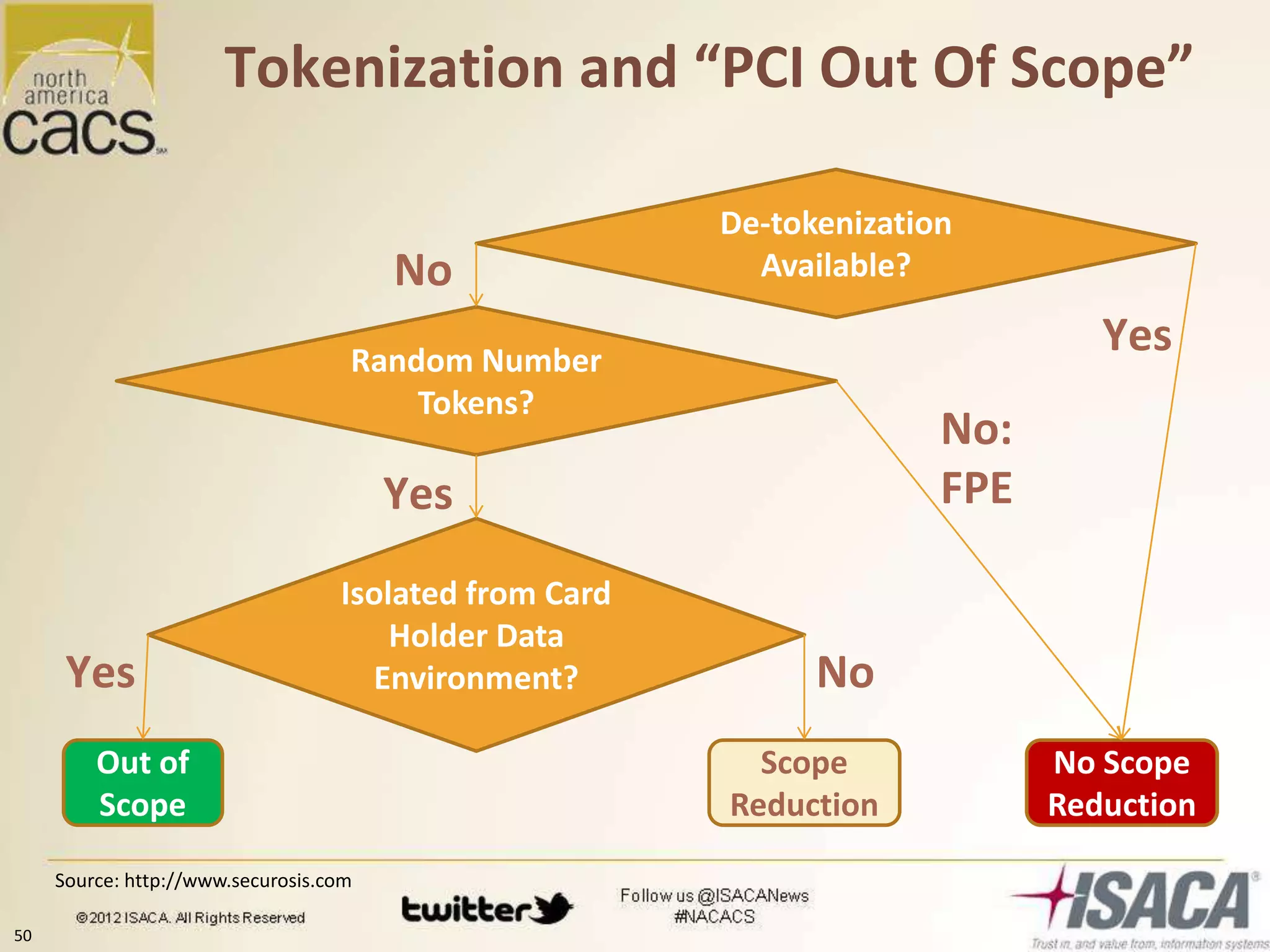
Tokenization and “PCI Out Of Scope”
De-tokenization
Available?
Random Number
Tokens?
Isolated from Card
Holder Data
Environment?
Out of
Scope
Scope
Reduction
No Scope
Reduction
No
No:
FPE
Yes
Yes
Yes No
Case Study: Energy Industry
Why? Reduce PCI Scope
• Best way to handle legacy, we got most of it out of PCI
• Get rid of unwanted paper copies
• No need to rewrite/redevelop or restructure business
applications
• A VERY efficient way of PCI Reduction of Scope
• Better understanding of your data flow
• Better understanding of business flow
• Opportunity to clean up a few business oddities
51
Best
Area Criteria
Database
File
Encryption
Database
Column
Encryption
Basic
Tokenization
Vaultless
Tokenization
Scalability
Availability
Latency
CPU Consumption
Security
Data Flow
Protection
Compliance Scoping
Key Management
Data Collisions
Separation of Duties
Evaluating Encryption & Tokenization
Case Studies: Retail
Customer 1: Why? Three major concerns solved
– Performance Challenge; Initial tokenization
– Vendor Lock-In: What if we want to switch payment processor
– Extensive Enterprise End-to-End Credit Card Data Protection
Customer 2: Why? Desired single vendor to provide data
protection
– Combined use of tokenization and encryption
– Looking to expand tokens beyond CCN to PII
Customer 3: Why? Remove compensating controls from the
mainframe
– Tokens on the mainframe to avoid compensating controls
53
WHAT IS
THE CURRENT USE
OF ENABLING
TECHNOLOGIES?
54
Use of Enabling Technologies
1%
18%
30%
21%
28%
7%
22%
91%
47%
35%
39%
28%
29%
23%
Access controls
Database activity monitoring
Database encryption
Backup / Archive encryption
Data masking
Application-level encryption
Tokenization
Evaluating
55
System
Type
Risk
Data display
Masking
I
Production
I
Test / dev
High –
Low -
Data at rest
Masking
I
Integration
testing
I
Trouble
shooting
Exposure:
Data in clear
before masking
Exposure:
Data is only
obfuscated
56
Is Data Masking Secure?
System
Type
Risk
Data Tokens
I
Production
I
Test / dev
Data Tokens = Lower Risk
High –
Low -
I
Integration
testing
I
Trouble
shooting
57
Data display
Masking
Data at rest
Masking
Exposure:
Data in clear
before masking
Exposure:
Data is only
obfuscated
CAN SECURITY
HELP CREATIVITY?
58
Access
Right Level
Risk
Traditional
Access
Control
I
More
I
Less
High
Low
Source: InformationWeek Aug 15, 2011
Old Security = Less Creativity
59
Access
Right Level
Risk
Traditional
Access
Control
I
More
I
Less
High
Low
Source: InformationWeek Aug 15, 2011
New Data Security = More Creativity
60
Data Tokens
New:
Creativity
Happens
At the edge
WHAT IS THE IMPACT ON
RISK MANAGEMENT?
61
Protection
Option
Cost
Optimal
Risk
Expected Losses
from the Risk
Cost of Aversion –
Protection of Data
Total Cost
I
Monitoring
I
Data
Lockdown
Choose Your Defenses
62
DATA SECURITY
ADVANCES ARE
CHANGING
THE BALANCE
63
Matching Data Protection with Risk Level
Risk Level Solution
Monitoring
Monitoring,
masking, format
controlling
encryption
Tokenization,
strong
encryption
Low Risk
(1-5)
Medium Risk
(6-15)
High Risk
(16-25)
Data
Field
Risk
Level
Credit Card Number 25
Social Security Number 20
Email Address 20
Customer Name 12
Secret Formula 10
Employee Name 9
Employee Health Record 6
Zip Code 3
64
SEPARATION OF
DUTIES!
65
I
Format
Preserving
Encryption
Security of Different Protection Methods
I
Vaultless
Data
Tokenization
I
AES CBC
Encryption
Standard
I
Basic
Data
Tokenization
66
High
Low
Security Level
HOW CAN I
SECURE DATA IN
CLOUD?
67
Risks with Cloud Computing
Source: The evolving role of IT managers and CIOs Findings from the 2010 IBM Global IT Risk Study
0 10 20 30 40 50 60 70
Inability to customize applications
Financial strength of the cloud…
Uptime/business continuity
Weakening of corporate network…
Threat of data breach or loss
Handing over sensitive data to a third…
%
68
PCI & Cloud
• The PCI council's security caution over
virtualization is justified, because virtualized
environments are susceptible to types of
attacks not seen in any other environment
– Bob Russo, general manager of the PCI Security
Standards Council
Amazon’s PCI Compliance
• PCI-DSS 2.0 doesn't address multi-tenancy concerns
• You can store PAN data on S3, but it still needs to be
encrypted in accordance with PCI-DSS requirements
• Amazon doesn't do this for you -- it's something you need to
implement yourself; including key management, rotation,
logging, etc.
• If you deploy a server instance in EC2 it still needs to be assessed
by your QSA
• Your organization's assessment scope isn't necessarily
reduced
• It might be when you move to something like a tokenization
service where you reduce your handling of PAN data
Source: securosis.com
070
Securing The Data Flow with Tokenization
Retail
Store
Bank
Payment
Network
9999 9999 Corporate
Systems
71
Why Tokenization?
Why Tokenization
1. No Masking
2. No Encryption
3. No Key Management
Why Vaultless Tokenization
1. Lower Cost / TCO
2. Better
3. Faster
$
72
Conclusion
• Organizations need to understand their data flow
and current security technologies
– Determine most significant security exposures
– Target budgets toward addressing the most critical issues
– Strengthen security and compliance profiles
• Achieve the right balance between business needs
and security demands
– I increasingly important as companies are changing their
security strategies to better protect sensitive data
– Following continuing attacks
73
About Protegrity
• Proven enterprise data security software and innovation leader
– Sole focus on the protection of data
– Patented Technology, Continuing to Drive Innovation
• Growth driven by compliance and risk management
– PCI (Payment Card Industry), PII (Personally Identifiable Information), PHI
(Protected Health Information)
– US State and Foreign Privacy Laws, Breach Notification Laws
• Cross-industry applicability
– Retail, Hospitality, Travel and Transportation
– Financial Services, Insurance, Banking
– Healthcare, Telecommunications, Media and Entertainment
– Manufacturing and Government
74
Thank you!
Q&A
ulf.mattsson@protegrity.com
www.protegrity.com
203-326-7200
75

Cacs na isaca session 414 ulf mattsson may 10 final

  • 1.
    Understanding Your DataFlow Using Tokenization to Secure Data Ulf Mattsson CTO Protegrity 1
  • 2.
  • 3.
  • 4.
    4 • 20 yearswith IBM Development & Global Services • Started Protegrity 1994 • Inventor of 22 patents – Encryption and Tokenization • Member of – PCI Security Standards Council (PCI SSC) – American National Standards Institute (ANSI) X9 – International Federation for Information Processing (IFIP) WG 11.3 Data and Application Security – ISACA (Information Systems Audit and Control Association) – Information Systems Security Association (ISSA) – Cloud Security Alliance (CSA) Ulf Mattsson, CTO Protegrity
  • 5.
    Session topics • Discussthreats against data • Review solutions for securing data – Evaluate different options for data tokenization and encryption • Review case studies – Discuss how to stay out of scope for PCI DSS • Review data protection cost efficiency – Introduce a business risk approach • Discuss cloud and outsourced environments 5
  • 6.
  • 7.
    Albert Gonzalez 20 YearsIn US Federal Prison 7 Source: http://www.youtube.com/user/ProtegrityUSA US Federal indictments: 1. Dave & Busters 2. TJ Maxx 3. Heartland HPS •Breach expenses $140M Source: http://en.wikipedia.org/wiki/Albert_Gonzalez
  • 8.
    8 What about Breaches& PCI? Was Data Protected? Based on post-breach reviews. Relevant Organizations in Compliance with PCI DSS. Verizon Study % 0 10 20 30 40 50 60 70 80 90 100 3: Protect Stored Data 7: Restrict access to data by business need-to-know 11: Regularly test security systems and processes 10: Track and monitor all access to network resources and data 6: Develop and maintain secure systems and applications 8: Assign a unique ID to each person with computer access 1: Install and maintain a firewall configuration to protect data 12: Maintain a policy that addresses information security 2: Do not use vendor-supplied defaults for security parameters 4: Encrypt transmission of cardholder data 5: Use and regularly update anti-virus software 9: Restrict physical access to cardholder data
  • 9.
    WHAT TYPES OFDATA ARE UNDER ATTACK NOW? 9
  • 10.
    10 What Data isCompromised? By percent of records. Source: 2012, http://www.verizonbusiness.com/Products/security/dbir/ 0 20 40 60 80 100 120 Authentication credentials (usernames, pwds,… Sensitive organizational data (reports, plans, etc.) Bank account numbers/data System information (config, svcs, sw, etc.) Copyrighted/Trademarked material Trade secrets Classified information Medical records Medical Unknown (specific type is not known) Payment card numbers/data Personal information (Name, SS#, Addr, etc.) %
  • 11.
    11 Today “Hacktivism” isDominating 0 10 20 30 40 50 60 70 Unknown Unaffiliated person(s) Former employee (no longer had access) Relative or acquaintance of employee Organized criminal group Activist group By percent of records Source: 2012, http://www.verizonbusiness.com/Products/security/dbir/ %
  • 12.
    12 Source: 2012, http://www.verizonbusiness.com/Products/security/dbir/,http://en.wikipedia.org/wiki/Timeline_of_events_involving_Anonymous Growing Threat of “hacktivism” by Groups such as Anonymous Attacks by Anonymous include • 2012: CIA and Interpol • 2011: Sony, Stratfor and HBGary Federal
  • 13.
    April 2011 May2011 Jun 2011 Jul 2011 Aug 2011 13 Attack Type, Time and Impact $ Source: IBM 2012 Security Breaches Trend and Risk Report Let’s Review Some Major Recent Breaches
  • 14.
    • Lost 100million passwords and personal details stored in clear • Spent $171 million related to the data breach • Sony's stock price has fallen 40 percent • For three pennies an hour, hackers can rent Amazon.com to wage cyber attacks such as the one that crippled Sony • Attack via SQL Injection 14 The Sony Breach & Cloud
  • 15.
    Q1 2011 Q22011 Q3 2011 15 SQL Injection Attacks are Increasing 25,000 20,000 15,000 10,000 5,000 Source: IBM 2012 Security Breaches Trend and Risk Report
  • 16.
  • 17.
    What is anSQL Injection Attack? Application SQL Command Injected Data Store 17
  • 18.
    WHO IS THE NEXTTARGET? 18
  • 19.
    19 New Industry Groupsare Targets 0 10 20 30 40 50 60 Information Other Health Care and Social Assistance Finance and Insurance Retail Trade Accommodation and Food Services By percent of breaches Source: 2012, http://www.verizonbusiness.com/Products/security/dbir/ %
  • 20.
    The Changing ThreatLandscape  Some issues have stayed constant:  Threat landscape continues to gain sophistication  Attackers will always be a step ahead of the defenders  We are fighting highly organized, well-funded crime syndicates and nations  Move from detective to preventative controls needed Source: http://www.csoonline.com/article/602313/the-changing-threat-landscape?page=2
  • 21.
    21 How are BreachesDiscovered? 0 10 20 30 40 50 60 70 Unusual system behavior or performance Log analysis and/or review process Financial audit and reconciliation process Internal fraud detection mechanism Other(s) Witnessed and/or reported by employee Unknown Brag or blackmail by perpetrator Reported by customer/partner affected Third-party fraud detection (e.g., CPP) Notified by law enforcement By percent of breaches . Source: 2012, http://www.verizonbusiness.com/Products/security/dbir/ %
  • 22.
  • 23.
    23 What Assets areCompromised? By percent of records Source: 2012, http://www.verizonbusiness.com/Products/security/dbir/ 0 20 40 60 80 100 120 POS server (store controller) POS terminal User devices Automated Teller Machine (ATM) Regular employee/end-user People Payment card (credit, debit, etc.) Offline data Cashier/Teller/Waiter People Pay at the Pump terminal User devices File server Laptop/Netbook Remote Access server Call Center Staff People Mail server Desktop/Workstation Web/application server Database server %
  • 24.
    24 Threat Action Categories 050 100 150 Environmental Error Misuse Physical Social Malware Hacking By percent of records Source: 2012, http://www.verizonbusiness.com/Products/security/dbir/ % Hacking and Malware are Leading
  • 25.
    Thieves Are Attackingthe Data Flow 025 Application Application
  • 26.
  • 27.
    Thieves Can't StealWhat's Not There: Fake Data Application Application ???-??-???? 27
  • 28.
    HOW CAN WESECURE THE DATA FLOW? 28
  • 29.
    Securing The DataFlow with Tokenization Retail Store Bank Payment Network 9999 9999 Corporate Systems 29
  • 30.
    WHAT HAS THE INDUSTRY DONETO SECURE DATA? 30
  • 31.
    Time Total Cost of Ownership TotalCost of Ownership 1. System Integration 2. Performance Impact 3. Key Management 4. Policy Management 5. Reporting 6. Paper Handling 7. Compliance Audit 8. … Strong Encryption: 3DES, AES … I 2010 I 1970 What Has The Industry Done? I 2005 I 2000 Format Preserving Encryption: FPE, DTP … Basic Tokenization Vaultless Tokenization High - Low - 31
  • 32.
    Case Study: LargeChain Store Why? Reduce compliance cost by 50% – 50 million Credit Cards, 700 million daily transactions – Performance Challenge: 30 days with Basic to 90 minutes with Vaultless Tokenization – End-to-End Tokens: Started with the D/W and expanding to stores – Lower maintenance cost – don’t have to apply all 12 requirements – Better security – able to eliminate several business and daily reports – Qualified Security Assessors had no issues • “With encryption, implementations can spawn dozens of questions” • “There were no such challenges with tokenization” 32
  • 33.
  • 34.
    10 000 000- 1 000 000 - 100 000 - 10 000 - 1 000 - 100 - Transactions per second I Format Preserving Encryption Speed of Different Protection Methods I Vaultless Data Tokenization I AES CBC Encryption Standard I Basic Data Tokenization Speed will depend on the configuration 34
  • 35.
  • 36.
    Different Tokenization Approaches BasicTokenization Vault-less Tokenization* Footprint Large, Expanding. Small, Static. High Availability, Disaster Recovery Complex, expensive replication required. No replication required. Distribution Practically impossible to distribute geographically. Easy to deploy at different geographically distributed locations. Reliability Prone to collisions. No collisions. Performance, Latency, and Scalability Will adversely impact performance & scalability. Little or no latency. Fastest industry tokenization. Extendibility Practically impossible. Unlimited Tokenization Capability. *: Validated by 3rd party experts 36
  • 37.
  • 38.
    123456 777777 1234 123456123456 1234 aVdSaH 1F4hJ 1D3a !@#$%a^///&*B()..,,,gft_+!@4#$2%p^&*Hashing - Strong Encryption - Alpha - Numeric - Partial - Clear Text Data - Intrusiveness (to Applications and Databases) I Original !@#$%a^.,mhu7///&*B()_+!@ 666666 777777 8888 Tokenizing or Formatted Encryption Data Length Standard Encryption Encoding 38 DataType&Format Impact of Different Protection Methods
  • 39.
  • 40.
    Type of Data Use Case I Structured How ShouldI Secure Different Data? I Un-structured Simple - Complex - PCI PHI PII File Encryption Card Holder Data Field Tokenization Protected Health Information 40
  • 41.
    Tokenizing Different Typesof Data Type of Data Input Token Comment Credit Card 3872 3789 1620 3675 8278 2789 2990 2789 Numeric Medical ID 29M2009ID 497HF390D Alpha-Numeric Date 10/30/1955 12/25/2034 Date E-mail Address Ulf.mattsson@protegrit y.com empo.snaugs@svtiensnni .snk Alpha Numeric, delimiters in input preserved SSN delimiters 075-67-2278 287-38-2567 Numeric, delimiters in input Credit Card 3872 3789 1620 3675 8278 2789 2990 3675 Numeric, Last 4 digits exposed 41
  • 42.
  • 43.
    43 Token Generation TokenTypes Single Use Token Multi Use Token Algorithm and Key Reversible Known strong algorithm One way Irreversible Function Unique Sequence Number Hash Randomly generated value      Secret per transaction Secret per merchant Tokenization Guidelines, Visa No
  • 44.
    Tokenization vs. Encryption 44 UsedApproach Cipher System Code System Cryptographic algorithms Cryptographic keys Code books Index tokens Source: McGraw-HILL ENCYPLOPEDIA OF SCIENCE & TECHNOLOGY TokenizationEncryption
  • 45.
  • 46.
  • 47.
  • 48.
    PCI DSS :Tokenization and Encryption are Different 48 No Scope Reduction If the token is mathematically derived from the original PAN through the use of an encryption algorithm and cryptographic key
  • 49.
  • 50.
    50 Source: http://www.securosis.com Tokenization and“PCI Out Of Scope” De-tokenization Available? Random Number Tokens? Isolated from Card Holder Data Environment? Out of Scope Scope Reduction No Scope Reduction No No: FPE Yes Yes Yes No
  • 51.
    Case Study: EnergyIndustry Why? Reduce PCI Scope • Best way to handle legacy, we got most of it out of PCI • Get rid of unwanted paper copies • No need to rewrite/redevelop or restructure business applications • A VERY efficient way of PCI Reduction of Scope • Better understanding of your data flow • Better understanding of business flow • Opportunity to clean up a few business oddities 51
  • 52.
    Best Area Criteria Database File Encryption Database Column Encryption Basic Tokenization Vaultless Tokenization Scalability Availability Latency CPU Consumption Security DataFlow Protection Compliance Scoping Key Management Data Collisions Separation of Duties Evaluating Encryption & Tokenization
  • 53.
    Case Studies: Retail Customer1: Why? Three major concerns solved – Performance Challenge; Initial tokenization – Vendor Lock-In: What if we want to switch payment processor – Extensive Enterprise End-to-End Credit Card Data Protection Customer 2: Why? Desired single vendor to provide data protection – Combined use of tokenization and encryption – Looking to expand tokens beyond CCN to PII Customer 3: Why? Remove compensating controls from the mainframe – Tokens on the mainframe to avoid compensating controls 53
  • 54.
    WHAT IS THE CURRENTUSE OF ENABLING TECHNOLOGIES? 54
  • 55.
    Use of EnablingTechnologies 1% 18% 30% 21% 28% 7% 22% 91% 47% 35% 39% 28% 29% 23% Access controls Database activity monitoring Database encryption Backup / Archive encryption Data masking Application-level encryption Tokenization Evaluating 55
  • 56.
    System Type Risk Data display Masking I Production I Test /dev High – Low - Data at rest Masking I Integration testing I Trouble shooting Exposure: Data in clear before masking Exposure: Data is only obfuscated 56 Is Data Masking Secure?
  • 57.
    System Type Risk Data Tokens I Production I Test /dev Data Tokens = Lower Risk High – Low - I Integration testing I Trouble shooting 57 Data display Masking Data at rest Masking Exposure: Data in clear before masking Exposure: Data is only obfuscated
  • 58.
  • 59.
  • 60.
    Access Right Level Risk Traditional Access Control I More I Less High Low Source: InformationWeekAug 15, 2011 New Data Security = More Creativity 60 Data Tokens New: Creativity Happens At the edge
  • 61.
    WHAT IS THEIMPACT ON RISK MANAGEMENT? 61
  • 62.
    Protection Option Cost Optimal Risk Expected Losses from theRisk Cost of Aversion – Protection of Data Total Cost I Monitoring I Data Lockdown Choose Your Defenses 62
  • 63.
  • 64.
    Matching Data Protectionwith Risk Level Risk Level Solution Monitoring Monitoring, masking, format controlling encryption Tokenization, strong encryption Low Risk (1-5) Medium Risk (6-15) High Risk (16-25) Data Field Risk Level Credit Card Number 25 Social Security Number 20 Email Address 20 Customer Name 12 Secret Formula 10 Employee Name 9 Employee Health Record 6 Zip Code 3 64
  • 65.
  • 66.
    I Format Preserving Encryption Security of DifferentProtection Methods I Vaultless Data Tokenization I AES CBC Encryption Standard I Basic Data Tokenization 66 High Low Security Level
  • 67.
    HOW CAN I SECUREDATA IN CLOUD? 67
  • 68.
    Risks with CloudComputing Source: The evolving role of IT managers and CIOs Findings from the 2010 IBM Global IT Risk Study 0 10 20 30 40 50 60 70 Inability to customize applications Financial strength of the cloud… Uptime/business continuity Weakening of corporate network… Threat of data breach or loss Handing over sensitive data to a third… % 68
  • 69.
    PCI & Cloud •The PCI council's security caution over virtualization is justified, because virtualized environments are susceptible to types of attacks not seen in any other environment – Bob Russo, general manager of the PCI Security Standards Council
  • 70.
    Amazon’s PCI Compliance •PCI-DSS 2.0 doesn't address multi-tenancy concerns • You can store PAN data on S3, but it still needs to be encrypted in accordance with PCI-DSS requirements • Amazon doesn't do this for you -- it's something you need to implement yourself; including key management, rotation, logging, etc. • If you deploy a server instance in EC2 it still needs to be assessed by your QSA • Your organization's assessment scope isn't necessarily reduced • It might be when you move to something like a tokenization service where you reduce your handling of PAN data Source: securosis.com 070
  • 71.
    Securing The DataFlow with Tokenization Retail Store Bank Payment Network 9999 9999 Corporate Systems 71
  • 72.
    Why Tokenization? Why Tokenization 1.No Masking 2. No Encryption 3. No Key Management Why Vaultless Tokenization 1. Lower Cost / TCO 2. Better 3. Faster $ 72
  • 73.
    Conclusion • Organizations needto understand their data flow and current security technologies – Determine most significant security exposures – Target budgets toward addressing the most critical issues – Strengthen security and compliance profiles • Achieve the right balance between business needs and security demands – I increasingly important as companies are changing their security strategies to better protect sensitive data – Following continuing attacks 73
  • 74.
    About Protegrity • Provenenterprise data security software and innovation leader – Sole focus on the protection of data – Patented Technology, Continuing to Drive Innovation • Growth driven by compliance and risk management – PCI (Payment Card Industry), PII (Personally Identifiable Information), PHI (Protected Health Information) – US State and Foreign Privacy Laws, Breach Notification Laws • Cross-industry applicability – Retail, Hospitality, Travel and Transportation – Financial Services, Insurance, Banking – Healthcare, Telecommunications, Media and Entertainment – Manufacturing and Government 74
  • 75.