Caching – Methodology & Strategies
By Vu Van Tiep
Manager, Head Of Web Platform - VNG
Skype: tiepvv
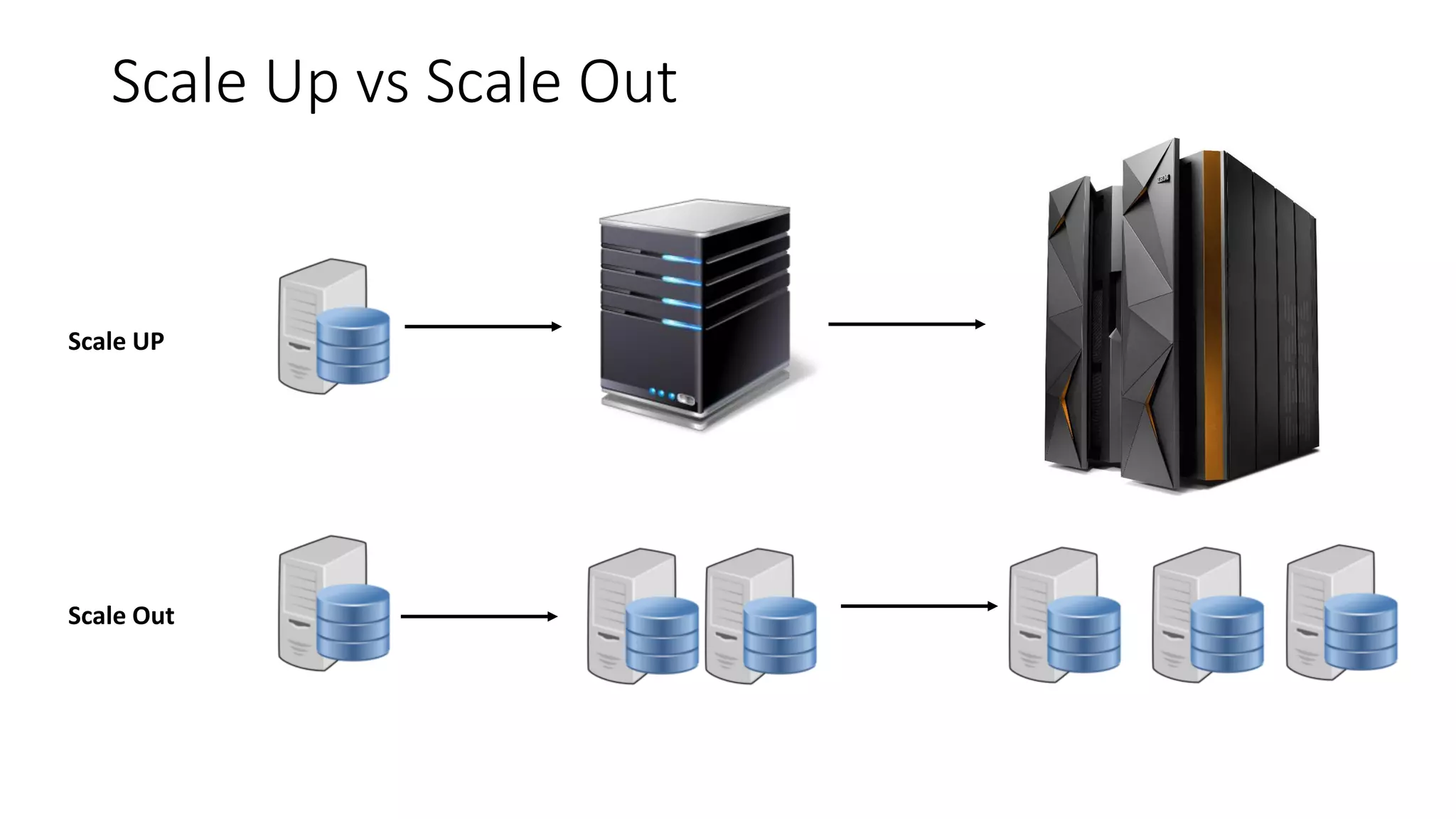
Scale Up vs Scale Out
Scale UP
Scale Out
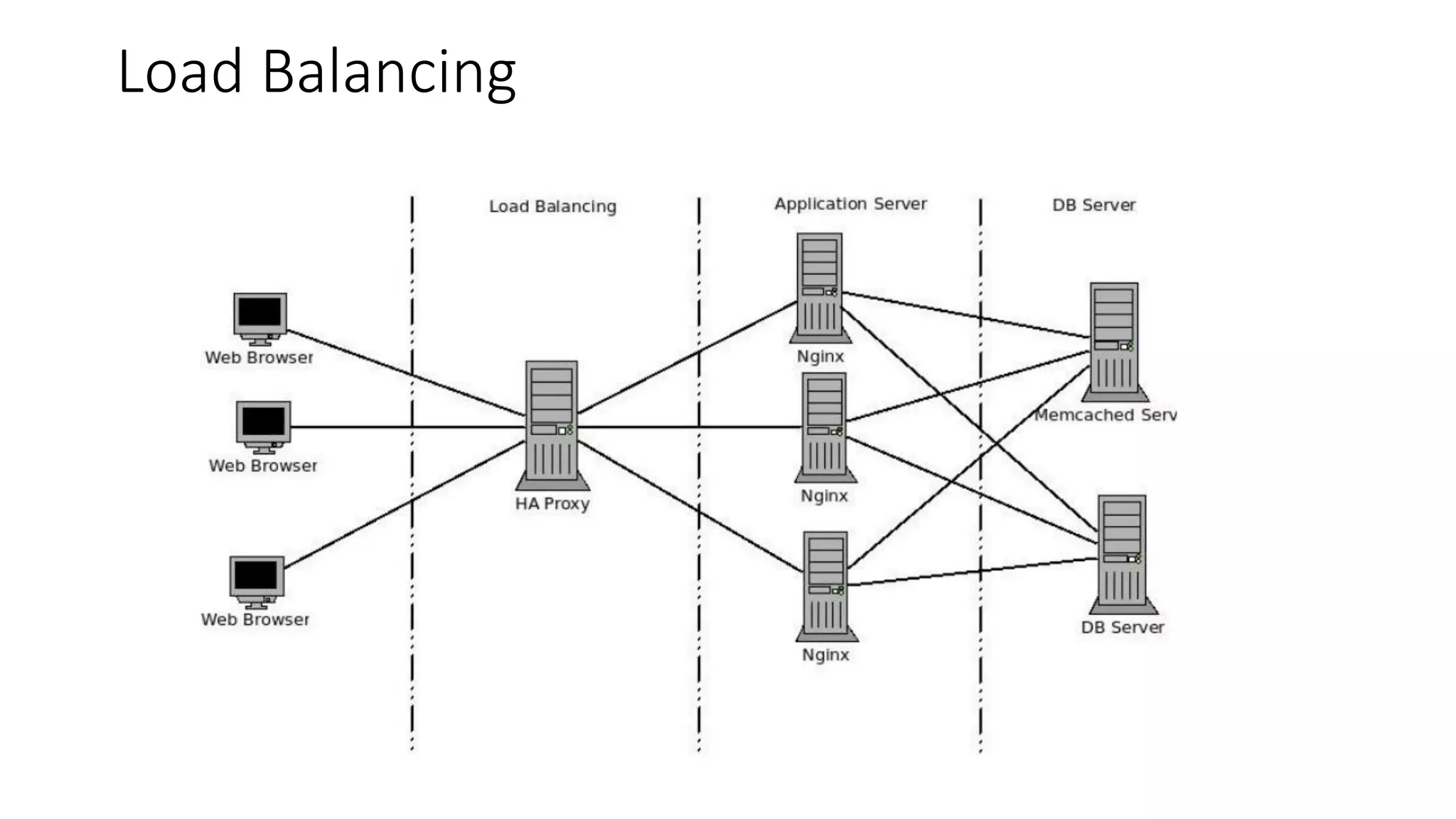
Load Balancing
Agenda
• What
• Cache Layer
• Cache Application/Service
• Methodology
• Strategies
• Performance?
• Demo
• Q&A
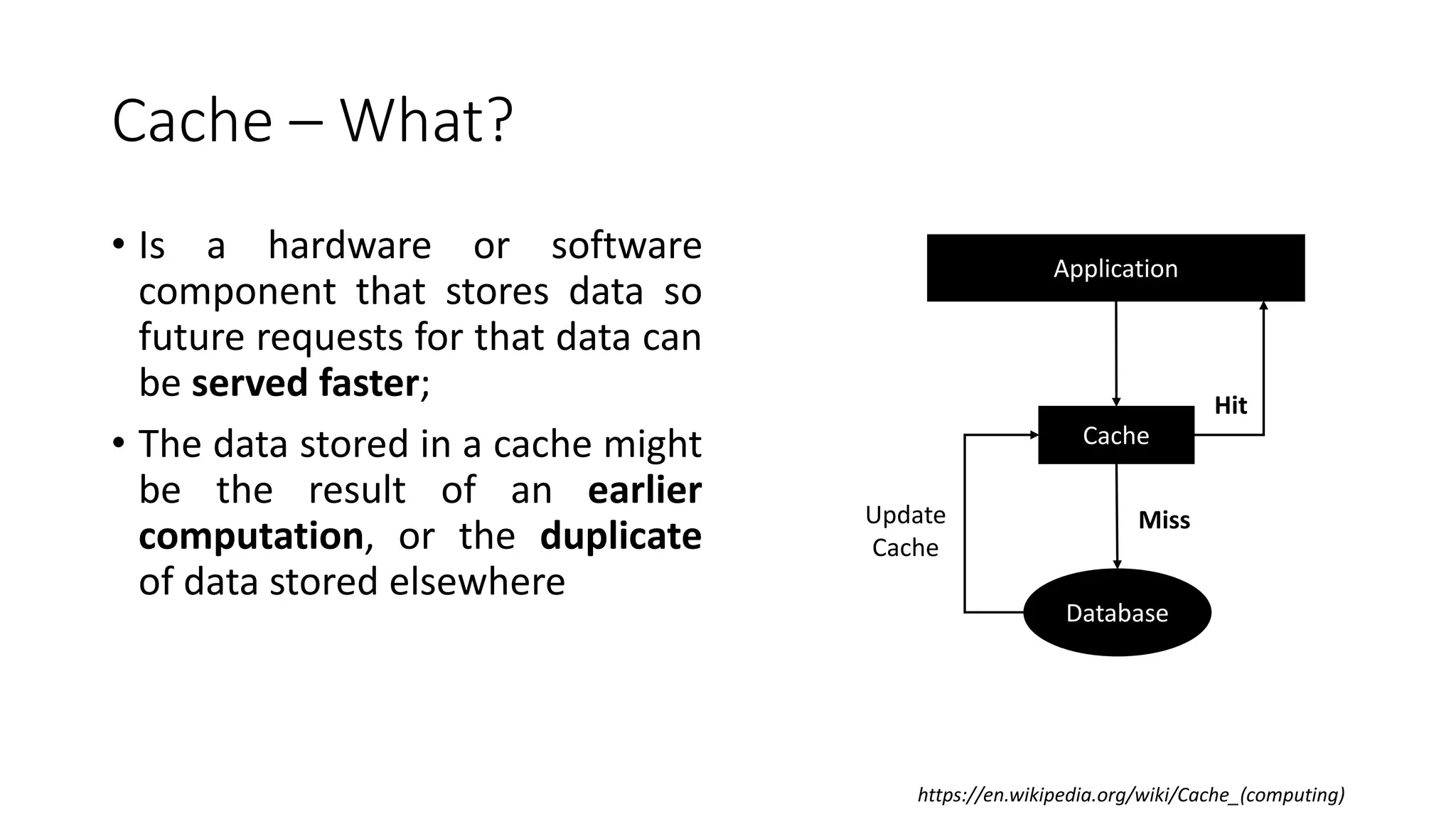
Cache – What?
• Is a hardware or software
component that stores data so
future requests for that data can
be served faster;
• The data stored in a cache might
be the result of an earlier
computation, or the duplicate
of data stored elsewhere
https://en.wikipedia.org/wiki/Cache_(computing)
Application
Cache
Database
Hit
MissUpdate
Cache
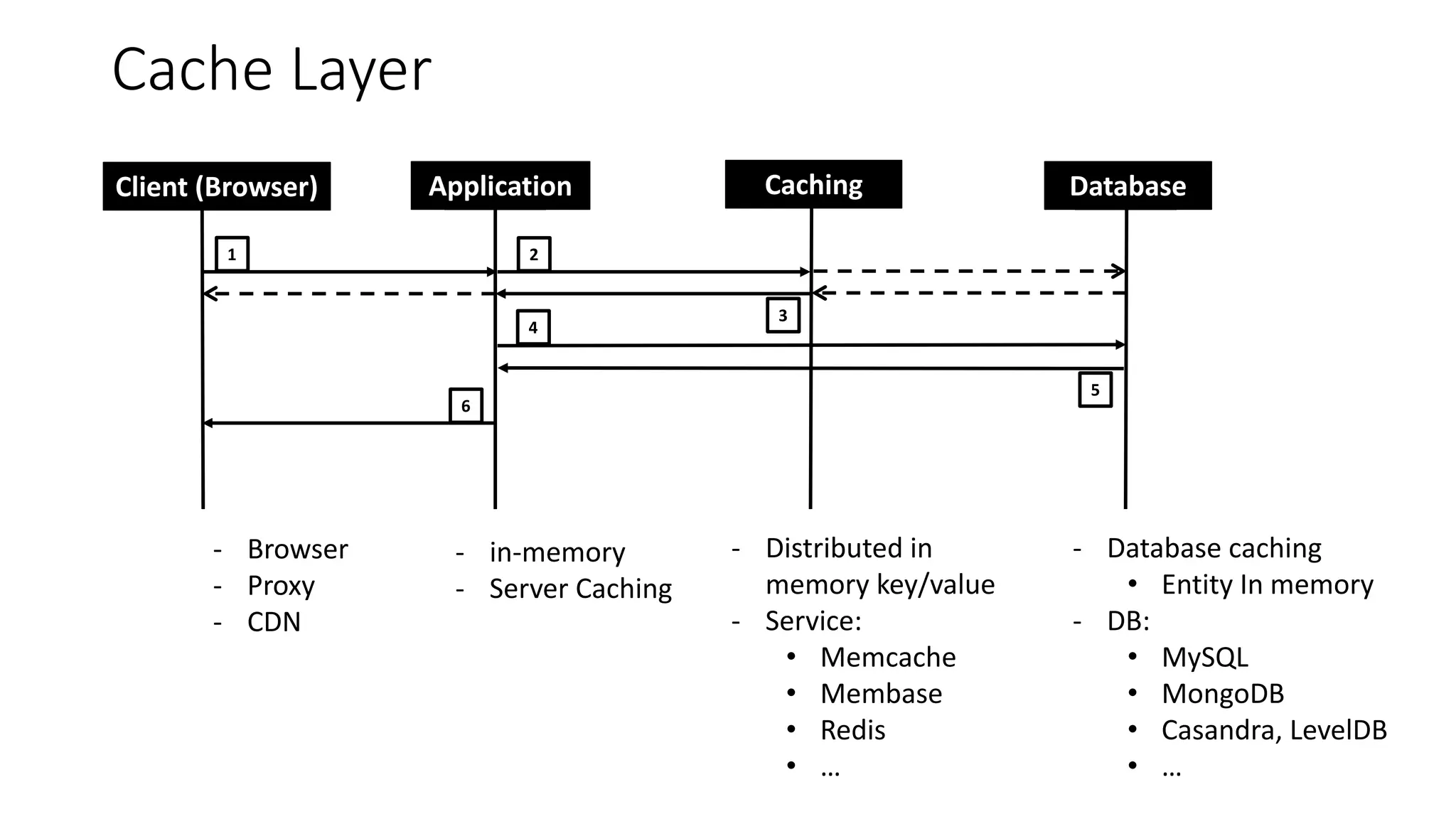
Cache Layer
Client (Browser) Application Caching Database
- Browser
- Proxy
- CDN
- in-memory
- Server Caching
- Distributed in
memory key/value
- Service:
• Memcache
• Membase
• Redis
• …
- Database caching
• Entity In memory
- DB:
• MySQL
• MongoDB
• Casandra, LevelDB
• …
1 2
3
4
5
6
Http Layer Caching
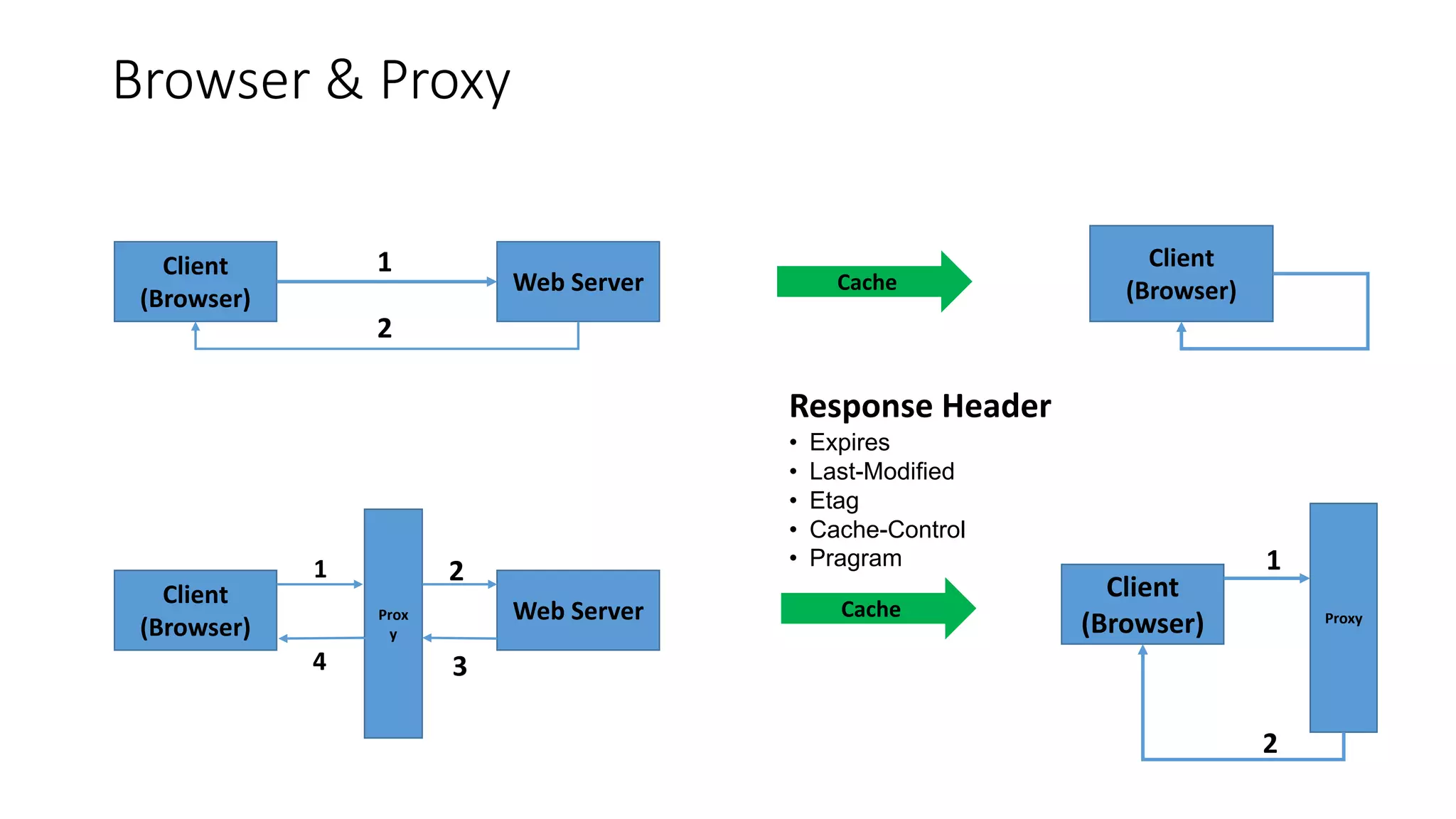
Browser & Proxy
Client
(Browser)
Web Server
1
2
Client
(Browser)
Client
(Browser)
Web ServerProx
y
Client
(Browser) ProxyCache
Cache
1
2
1 2
34
Response Header
• Expires
• Last-Modified
• Etag
• Cache-Control
• Pragram
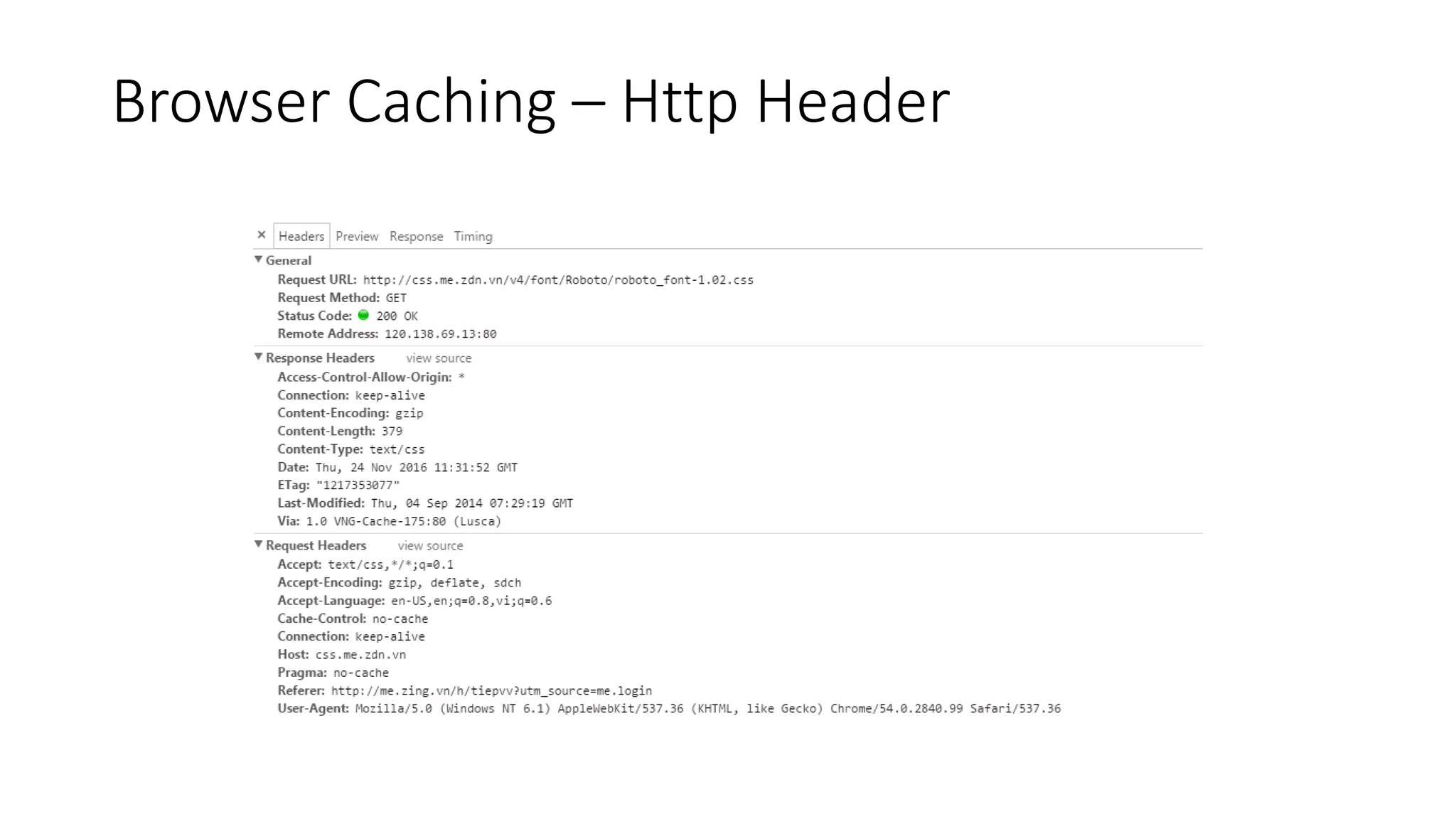
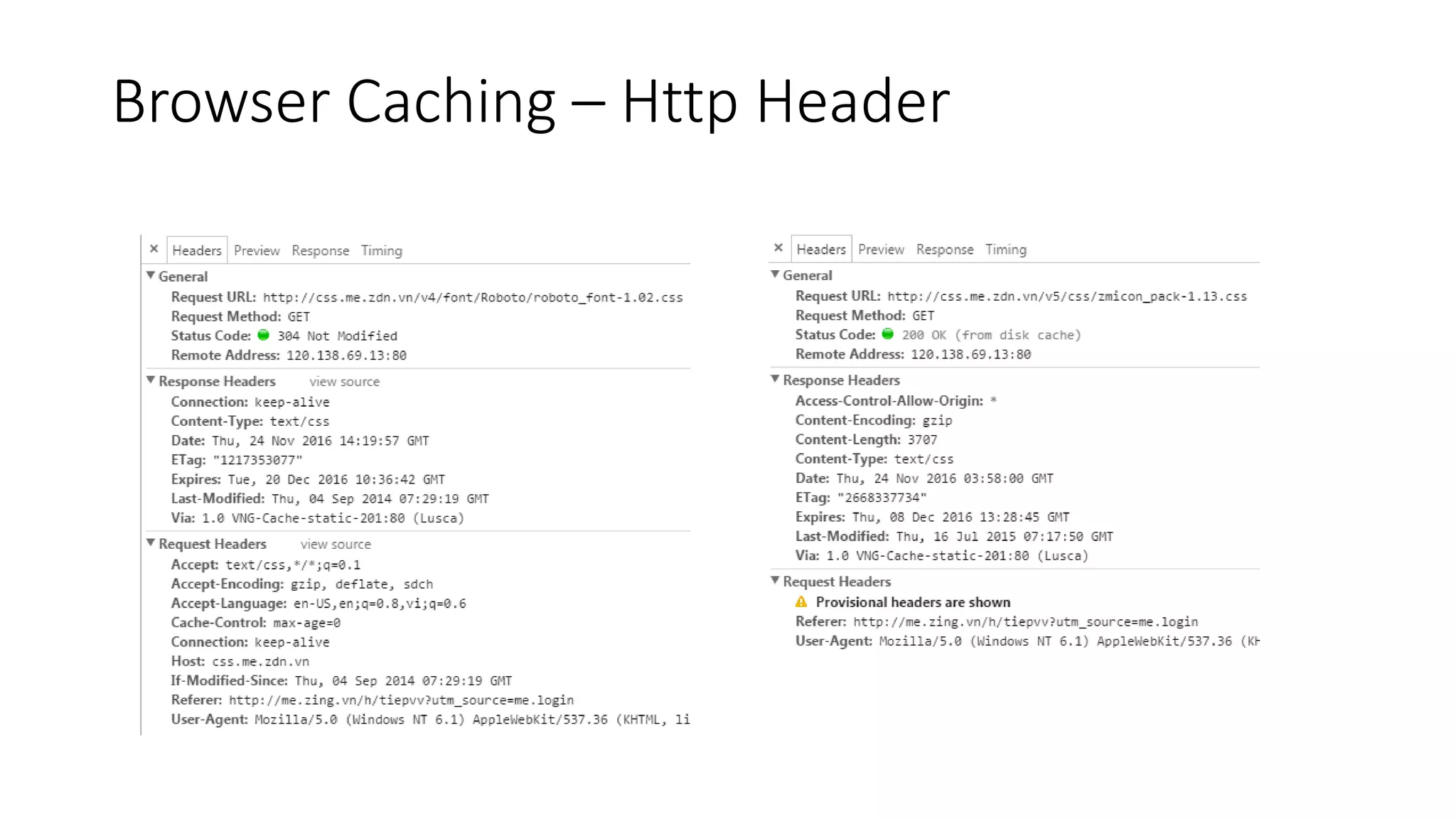
Browser Caching – Http Header
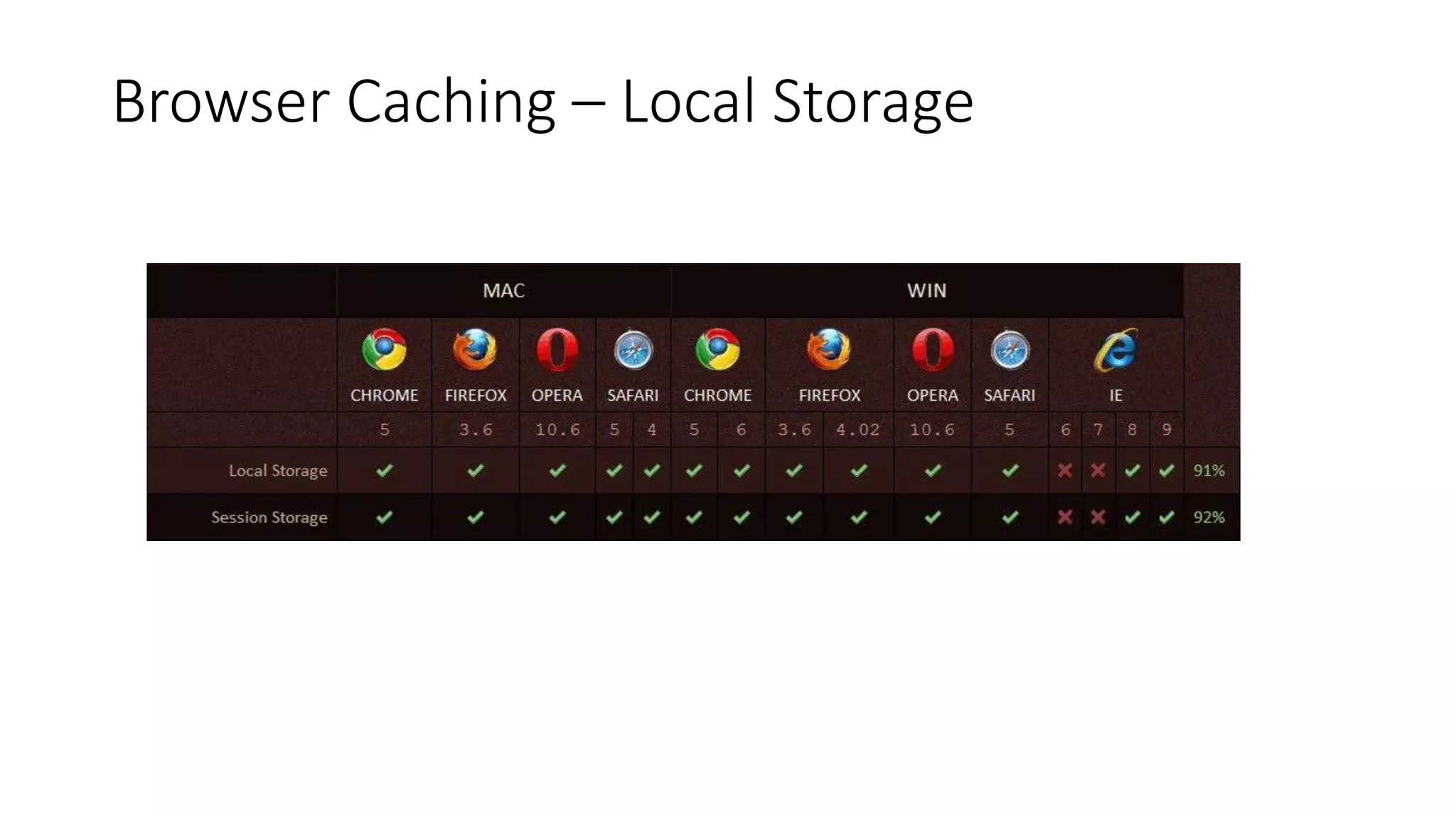
Browser Caching – Local Storage
Application Layer Caching
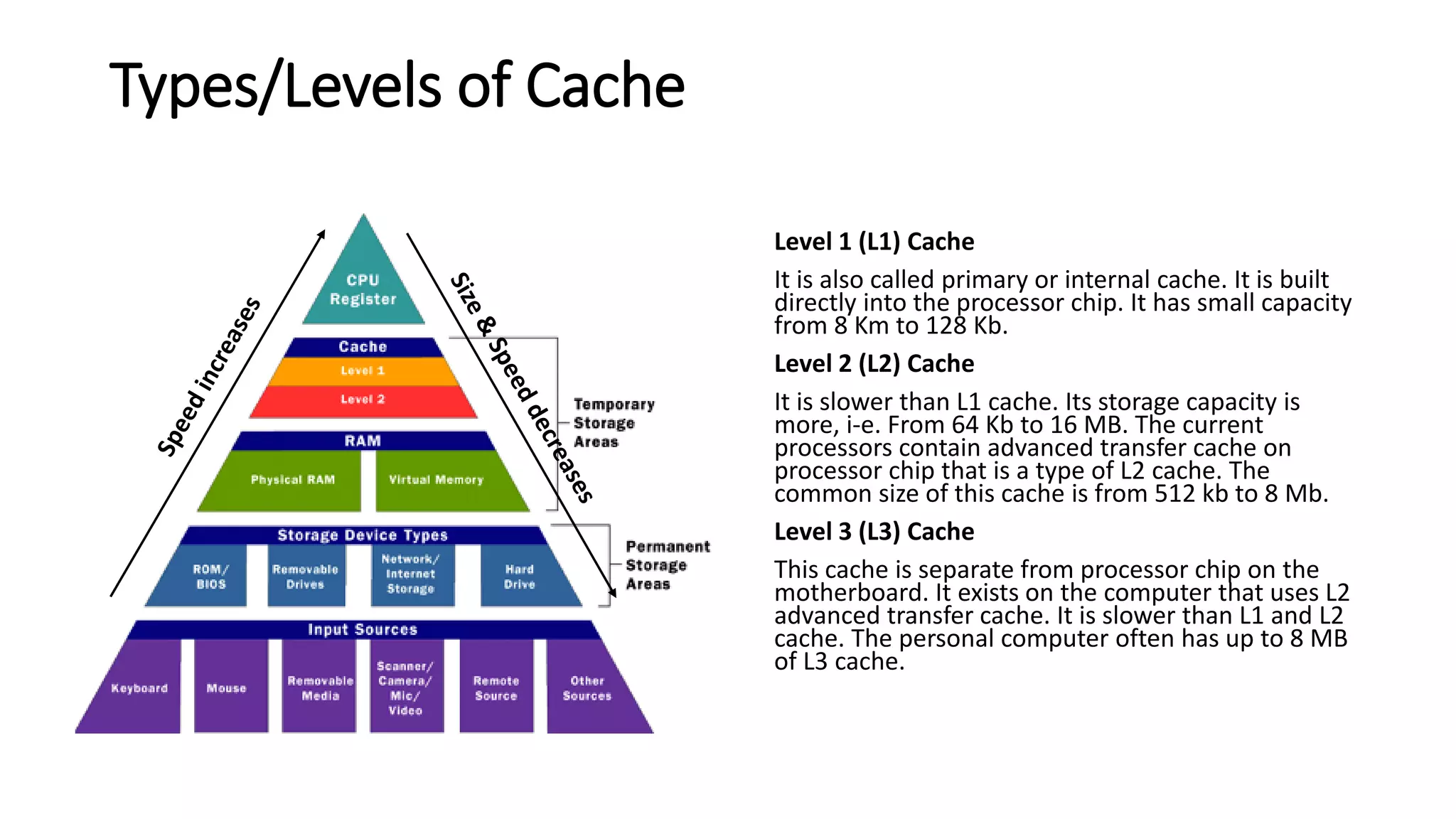
Types/Levels of Cache
Level 1 (L1) Cache
It is also called primary or internal cache. It is built
directly into the processor chip. It has small capacity
from 8 Km to 128 Kb.
Level 2 (L2) Cache
It is slower than L1 cache. Its storage capacity is
more, i-e. From 64 Kb to 16 MB. The current
processors contain advanced transfer cache on
processor chip that is a type of L2 cache. The
common size of this cache is from 512 kb to 8 Mb.
Level 3 (L3) Cache
This cache is separate from processor chip on the
motherboard. It exists on the computer that uses L2
advanced transfer cache. It is slower than L1 and L2
cache. The personal computer often has up to 8 MB
of L3 cache.
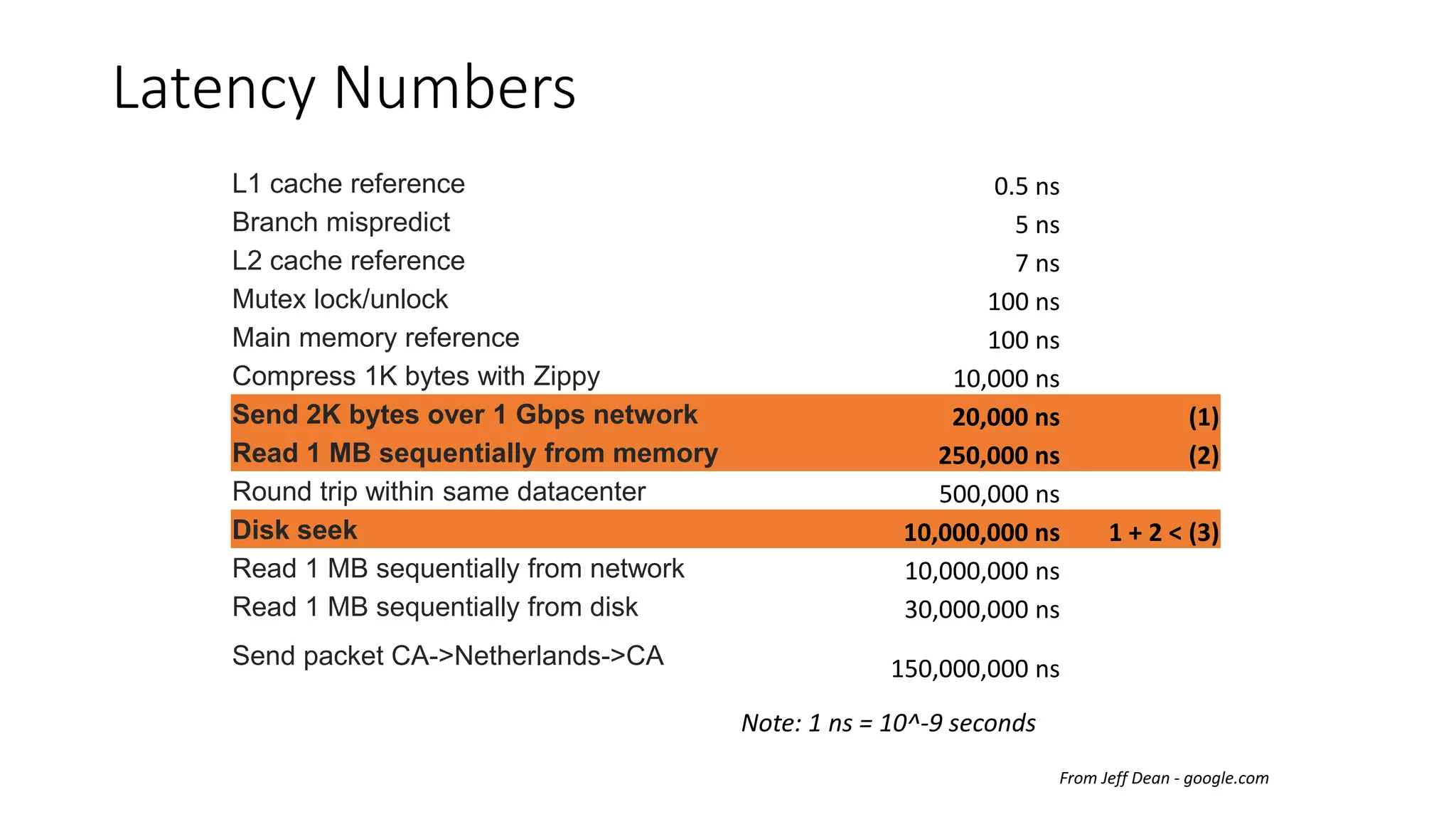
L1 cache reference 0.5 ns
Branch mispredict 5 ns
L2 cache reference 7 ns
Mutex lock/unlock 100 ns
Main memory reference 100 ns
Compress 1K bytes with Zippy 10,000 ns
Send 2K bytes over 1 Gbps network 20,000 ns (1)
Read 1 MB sequentially from memory 250,000 ns (2)
Round trip within same datacenter 500,000 ns
Disk seek 10,000,000 ns 1 + 2 < (3)
Read 1 MB sequentially from network 10,000,000 ns
Read 1 MB sequentially from disk 30,000,000 ns
Send packet CA->Netherlands->CA 150,000,000 ns
From Jeff Dean - google.com
Latency Numbers
Note: 1 ns = 10^-9 seconds
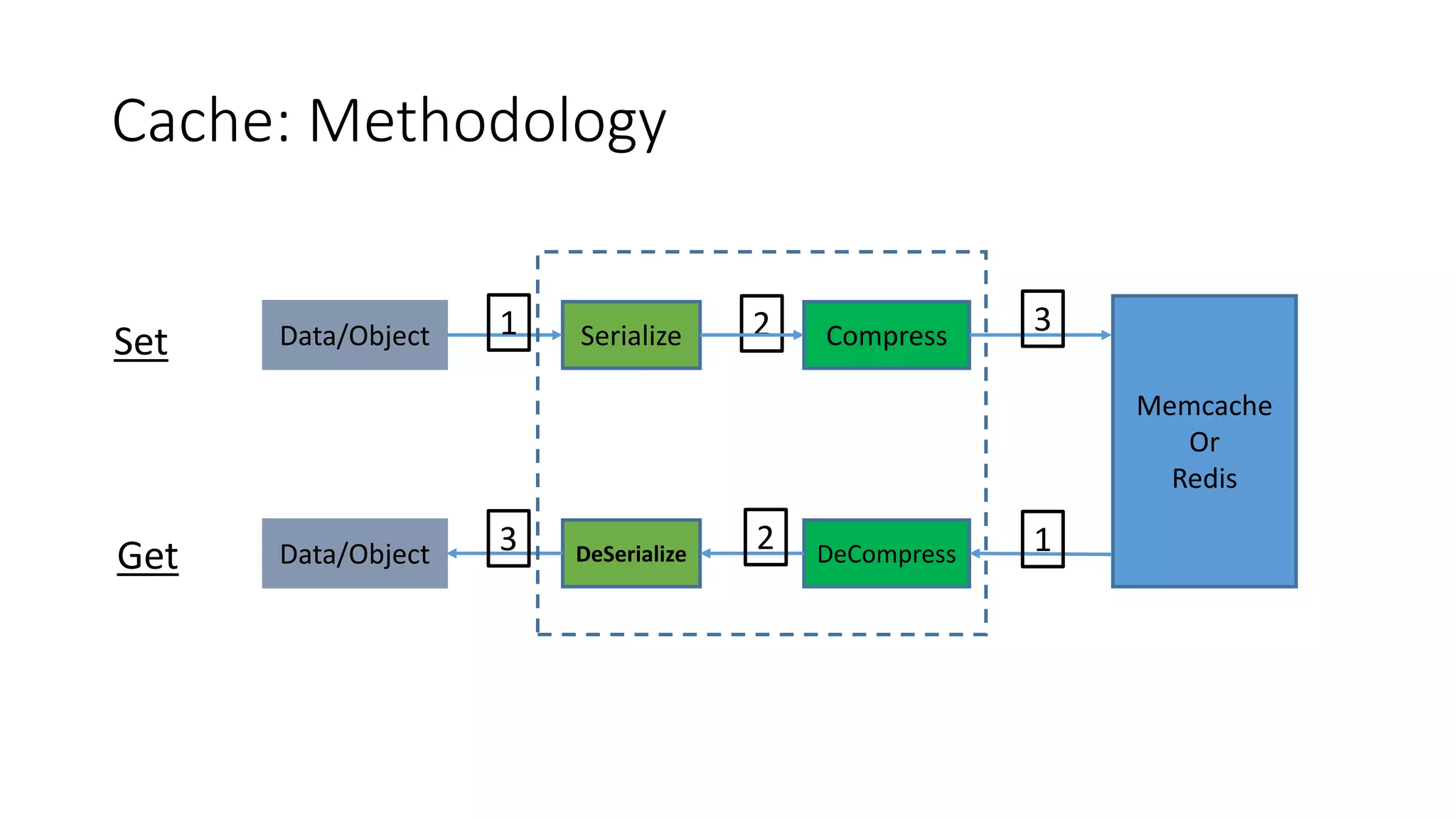
Cache: Methodology
Data/Object
Data/Object
Serialize
DeSerialize
Compress
DeCompress
Memcache
Or
Redis
Set
Get
1 2 3
123
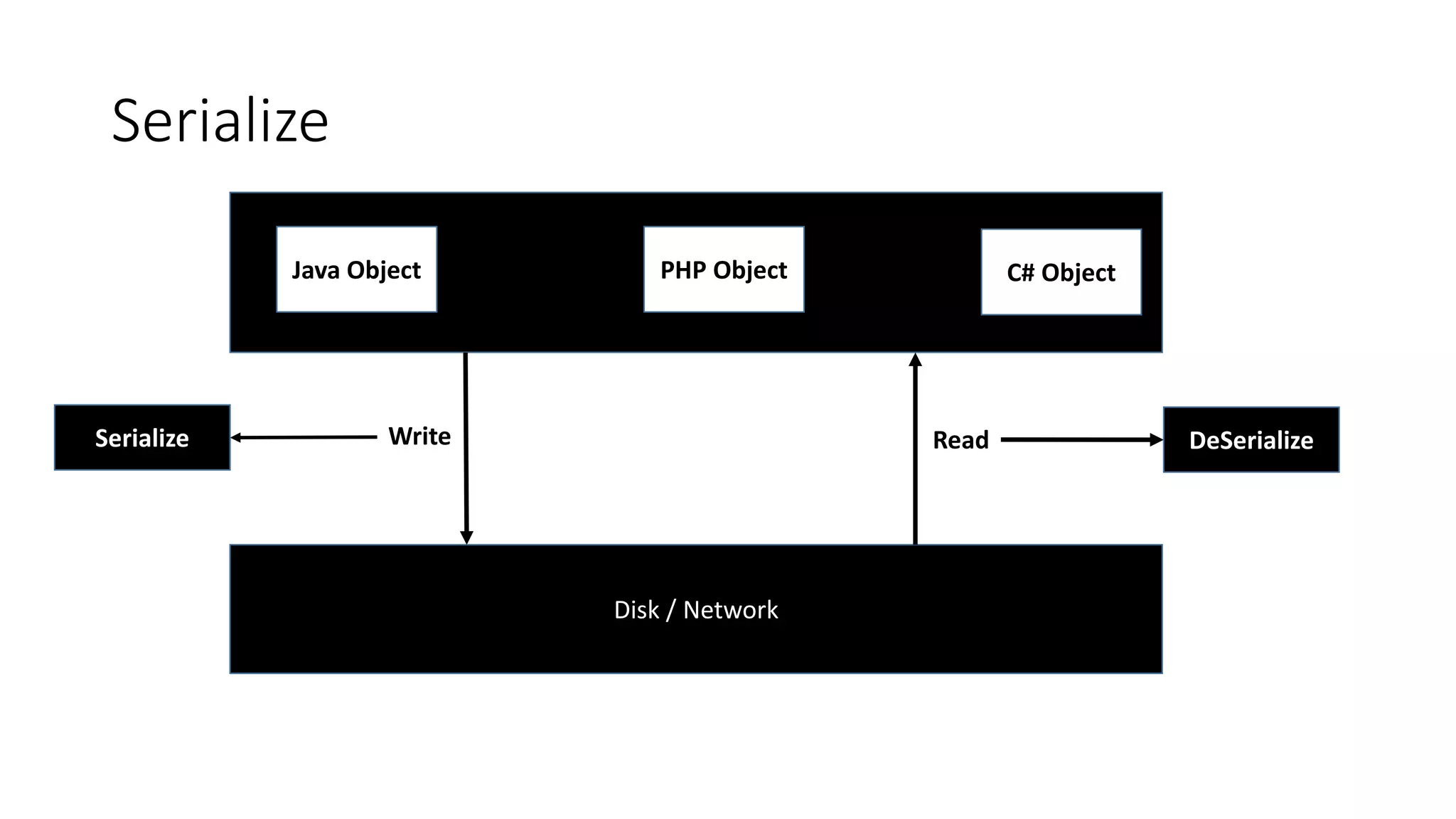
Serialize
Disk / Network
Java Object PHP Object C# Object
Write ReadSerialize DeSerialize
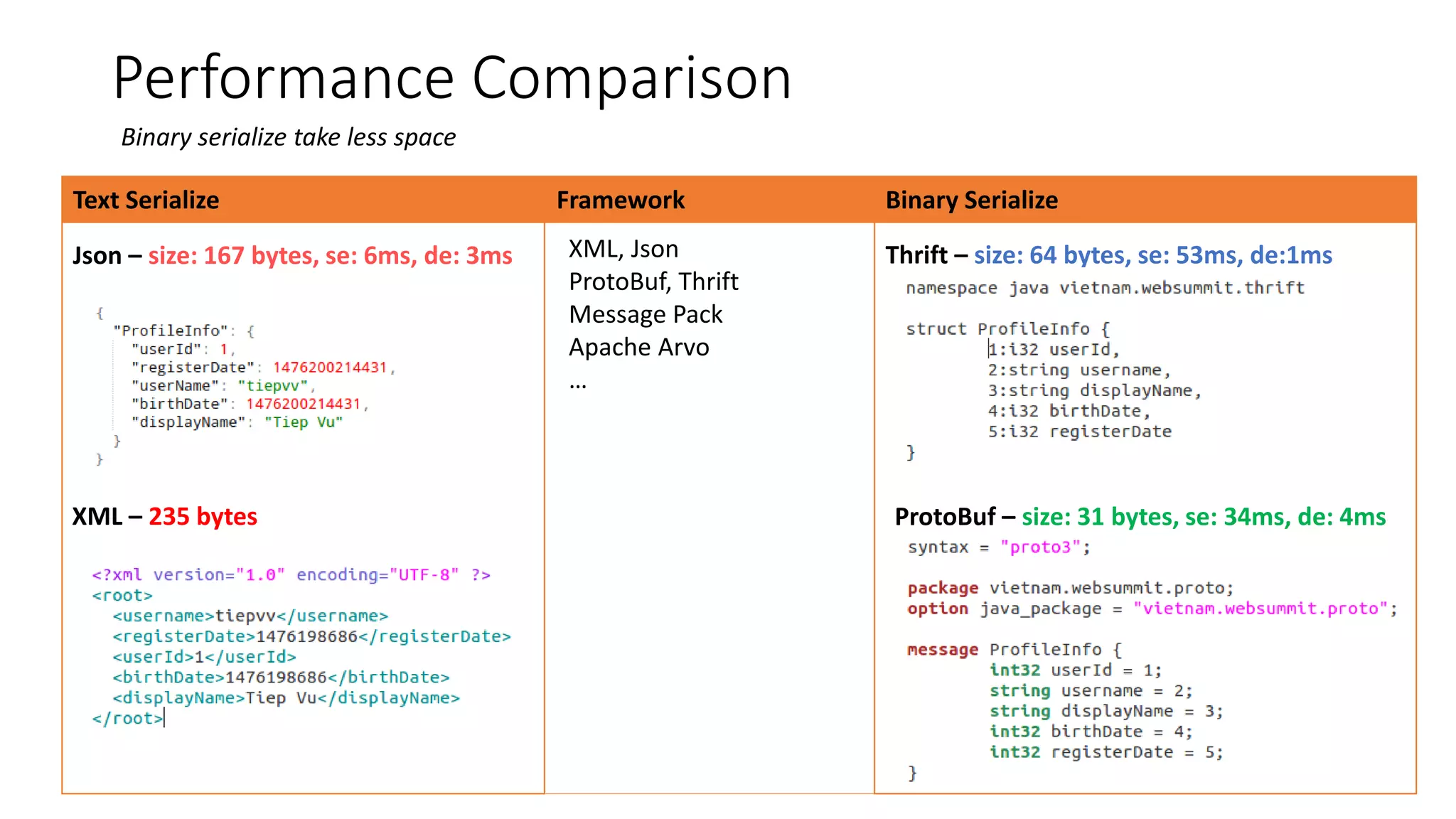
Performance Comparison
Text Serialize
Json – size: 167 bytes, se: 6ms, de: 3ms
XML – 235 bytes
Binary Serialize
Thrift – size: 64 bytes, se: 53ms, de:1ms
ProtoBuf – size: 31 bytes, se: 34ms, de: 4ms
Binary serialize take less space
XML, Json
ProtoBuf, Thrift
Message Pack
Apache Arvo
…
Framework
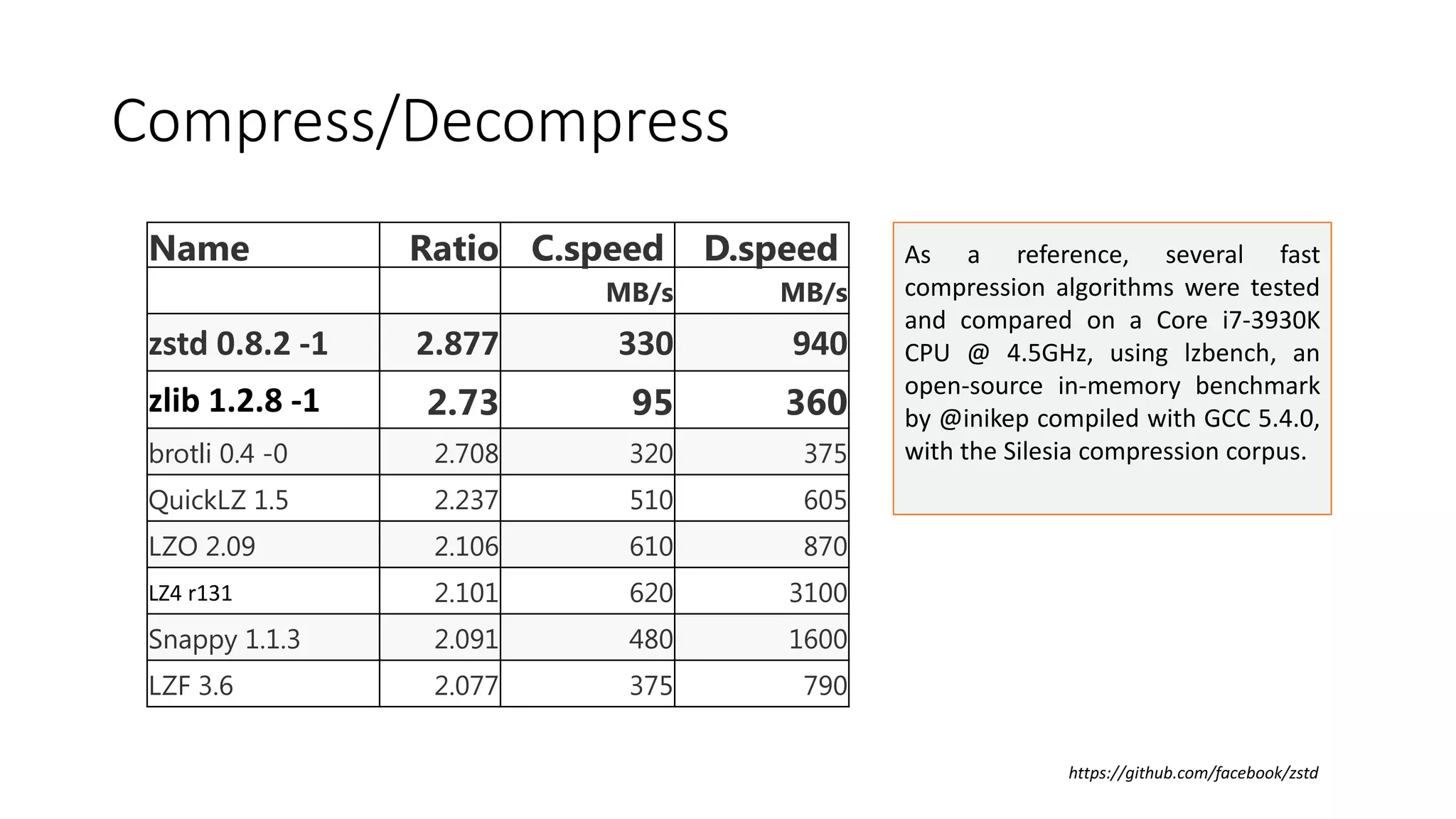
Compress/Decompress
Name Ratio C.speed D.speed
MB/s MB/s
zstd 0.8.2 -1 2.877 330 940
zlib 1.2.8 -1 2.73 95 360
brotli 0.4 -0 2.708 320 375
QuickLZ 1.5 2.237 510 605
LZO 2.09 2.106 610 870
LZ4 r131 2.101 620 3100
Snappy 1.1.3 2.091 480 1600
LZF 3.6 2.077 375 790
As a reference, several fast
compression algorithms were tested
and compared on a Core i7-3930K
CPU @ 4.5GHz, using lzbench, an
open-source in-memory benchmark
by @inikep compiled with GCC 5.4.0,
with the Silesia compression corpus.
https://github.com/facebook/zstd
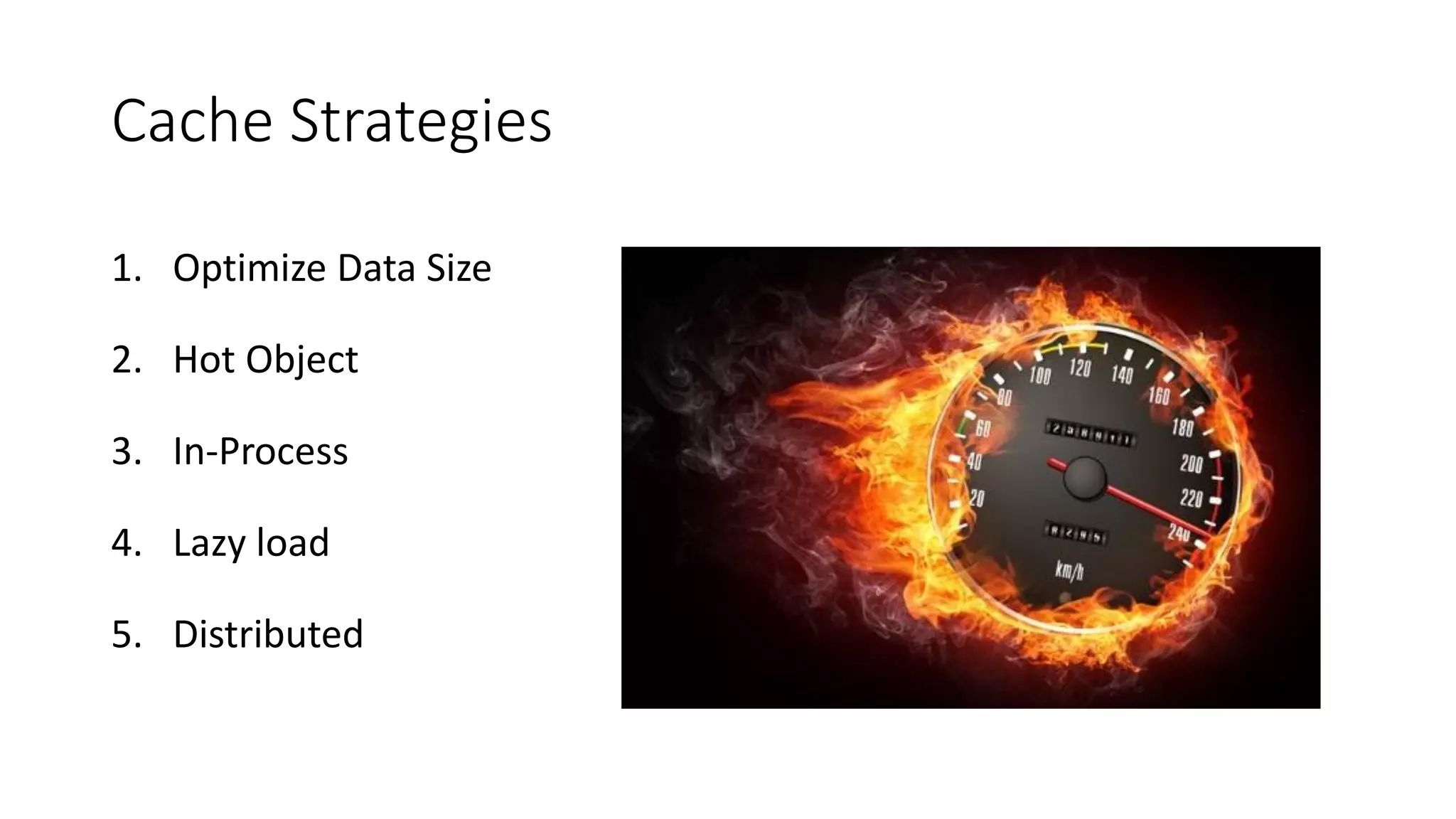
Caching Strategies
Cache Strategies
1. Optimize Data Size
2. Hot Object
3. In-Process
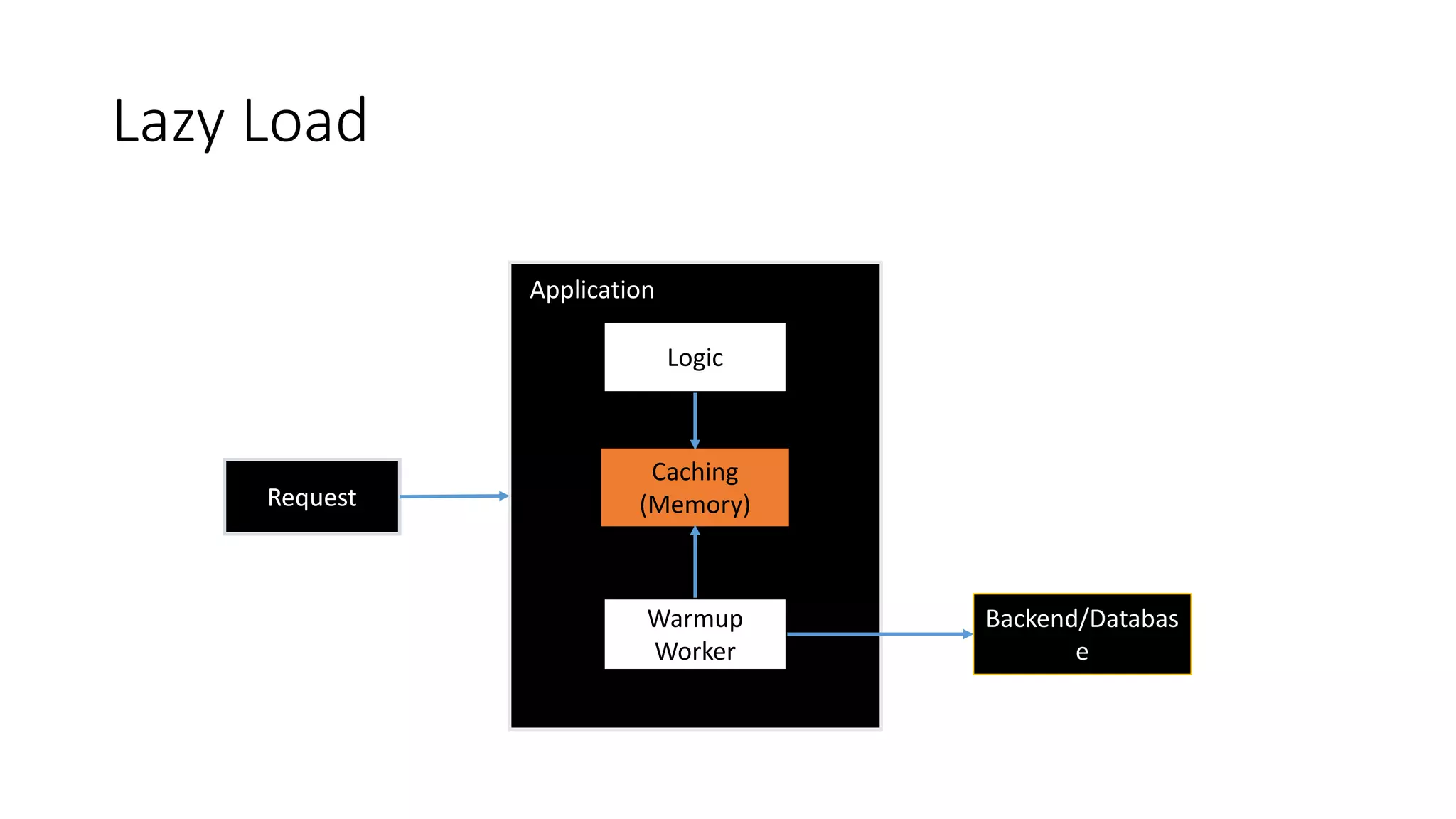
4. Lazy load
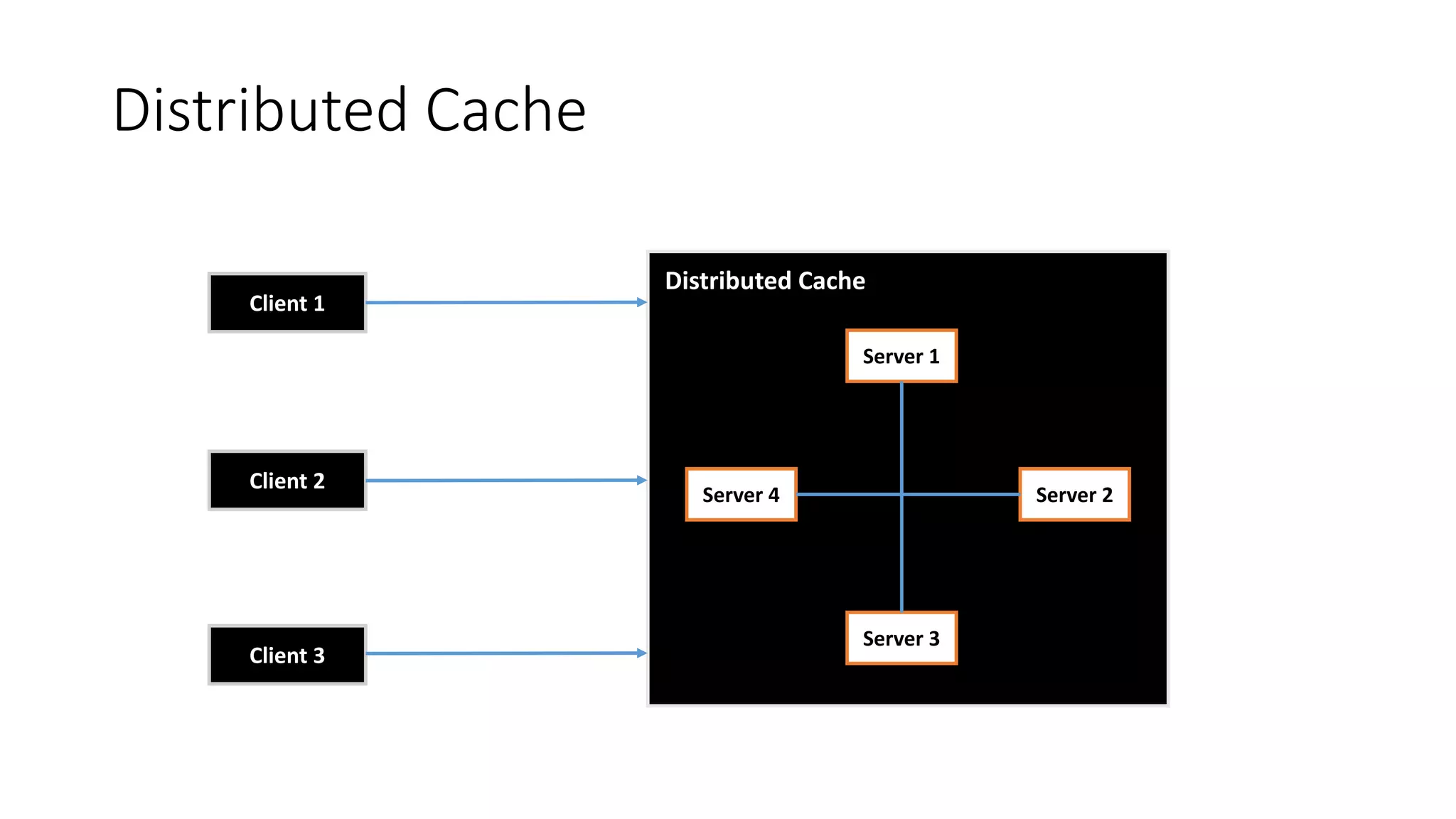
5. Distributed
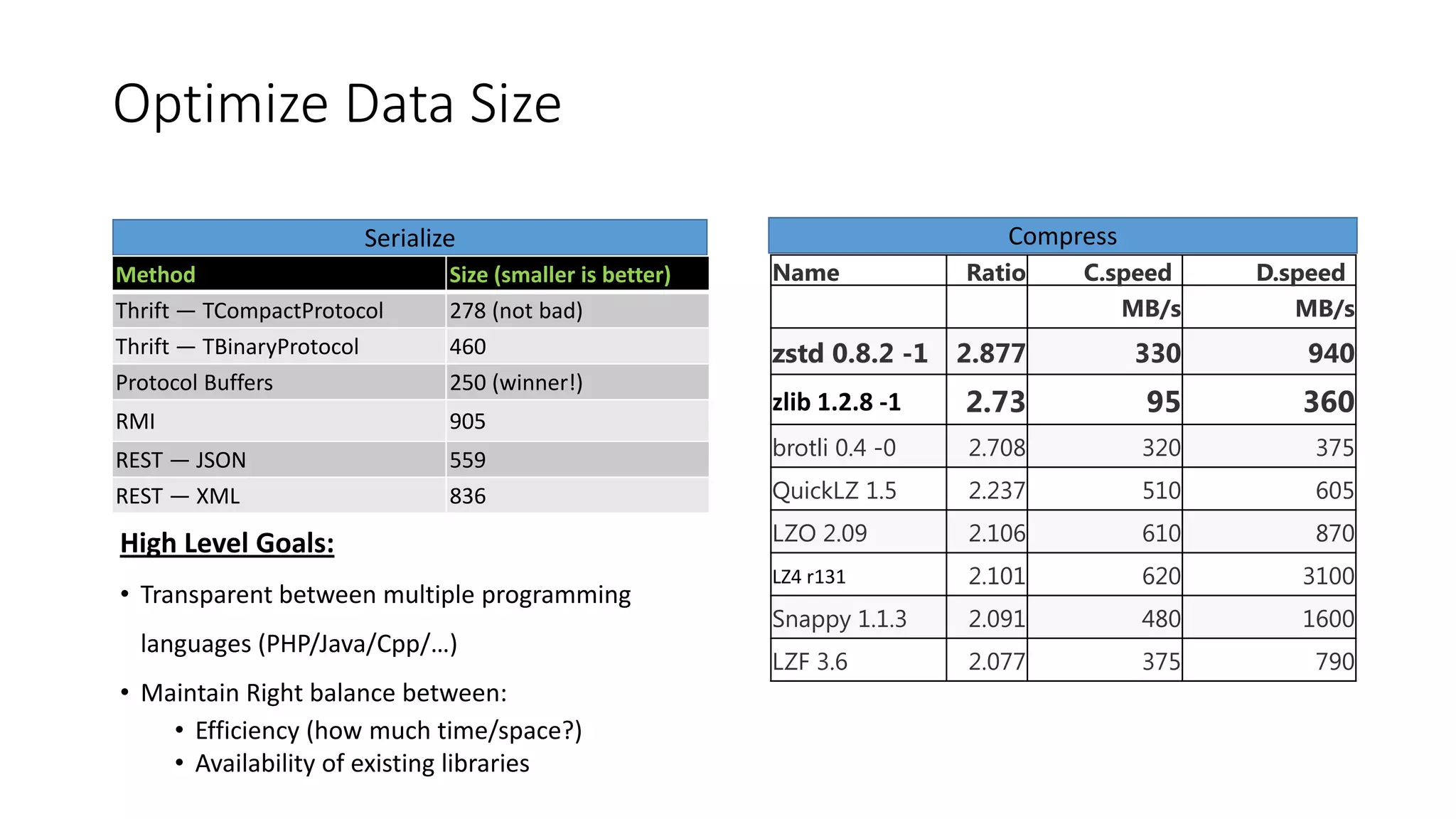
Optimize Data Size
Name Ratio C.speed D.speed
MB/s MB/s
zstd 0.8.2 -1 2.877 330 940
zlib 1.2.8 -1 2.73 95 360
brotli 0.4 -0 2.708 320 375
QuickLZ 1.5 2.237 510 605
LZO 2.09 2.106 610 870
LZ4 r131 2.101 620 3100
Snappy 1.1.3 2.091 480 1600
LZF 3.6 2.077 375 790
CompressSerialize
Method Size (smaller is better)
Thrift — TCompactProtocol 278 (not bad)
Thrift — TBinaryProtocol 460
Protocol Buffers 250 (winner!)
RMI 905
REST — JSON 559
REST — XML 836
High Level Goals:
• Transparent between multiple programming
languages (PHP/Java/Cpp/…)
• Maintain Right balance between:
• Efficiency (how much time/space?)
• Availability of existing libraries
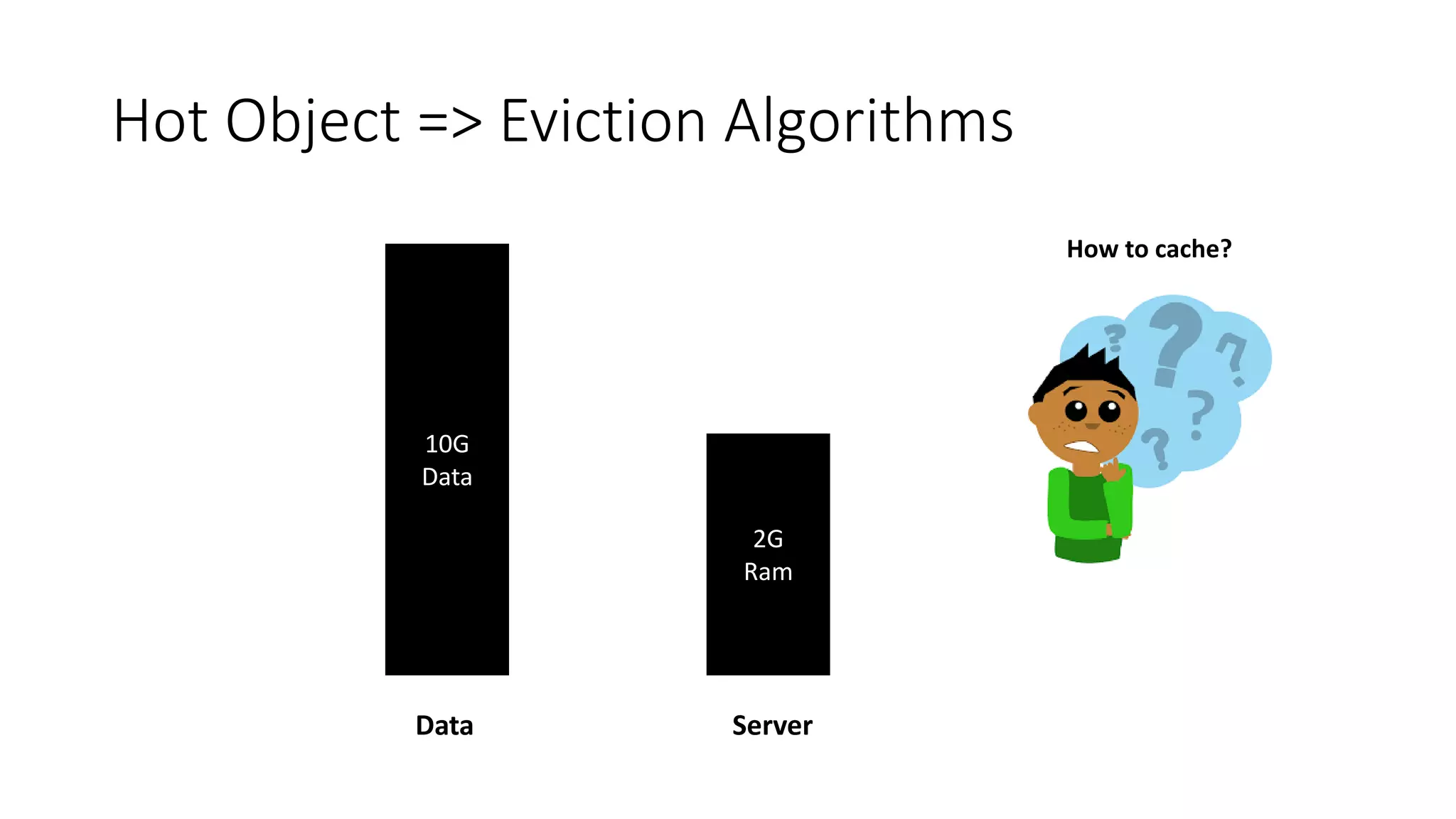
Hot Object => Eviction Algorithms
2G
Ram
10G
Data
ServerData
How to cache?
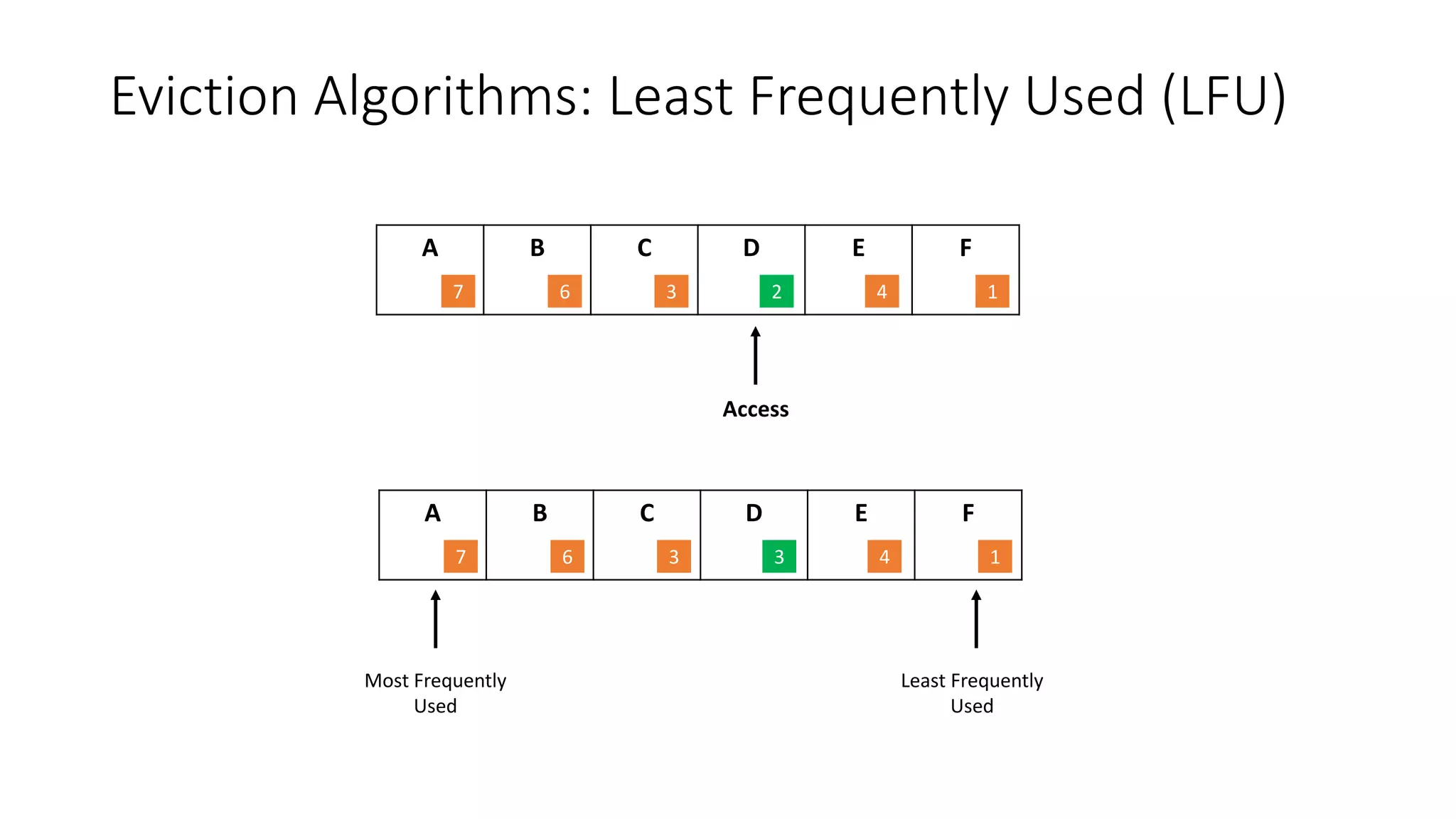
Eviction Algorithms: Least Frequently Used (LFU)
A B C D E F
7 6 3 2 4 1
A B C D E F
7 6 3 3 4 1
Access
Most Frequently
Used
Least Frequently
Used
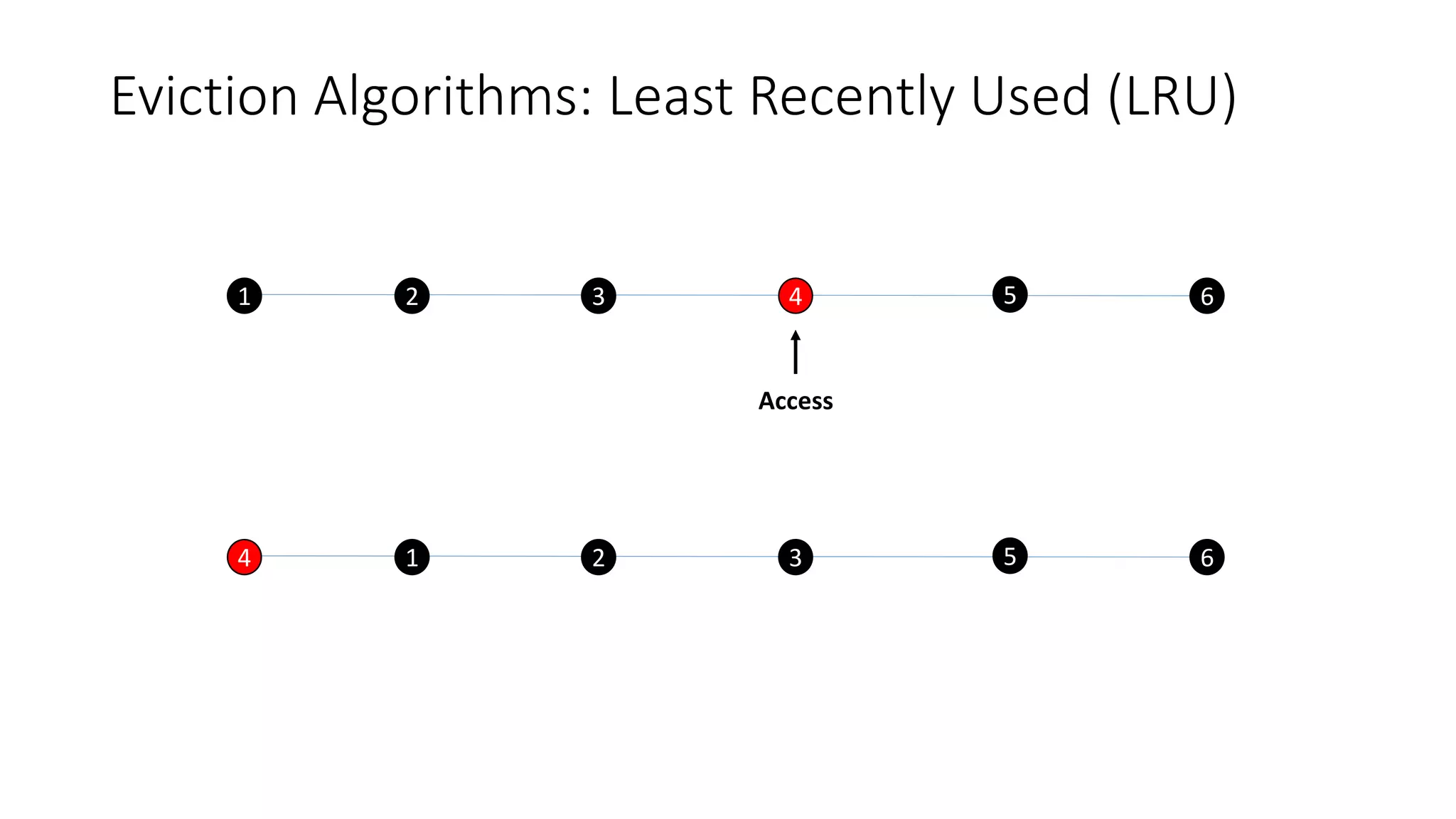
Eviction Algorithms: Least Recently Used (LRU)
1 2 3 4 5 6
4 1 2 3 5 6
Access
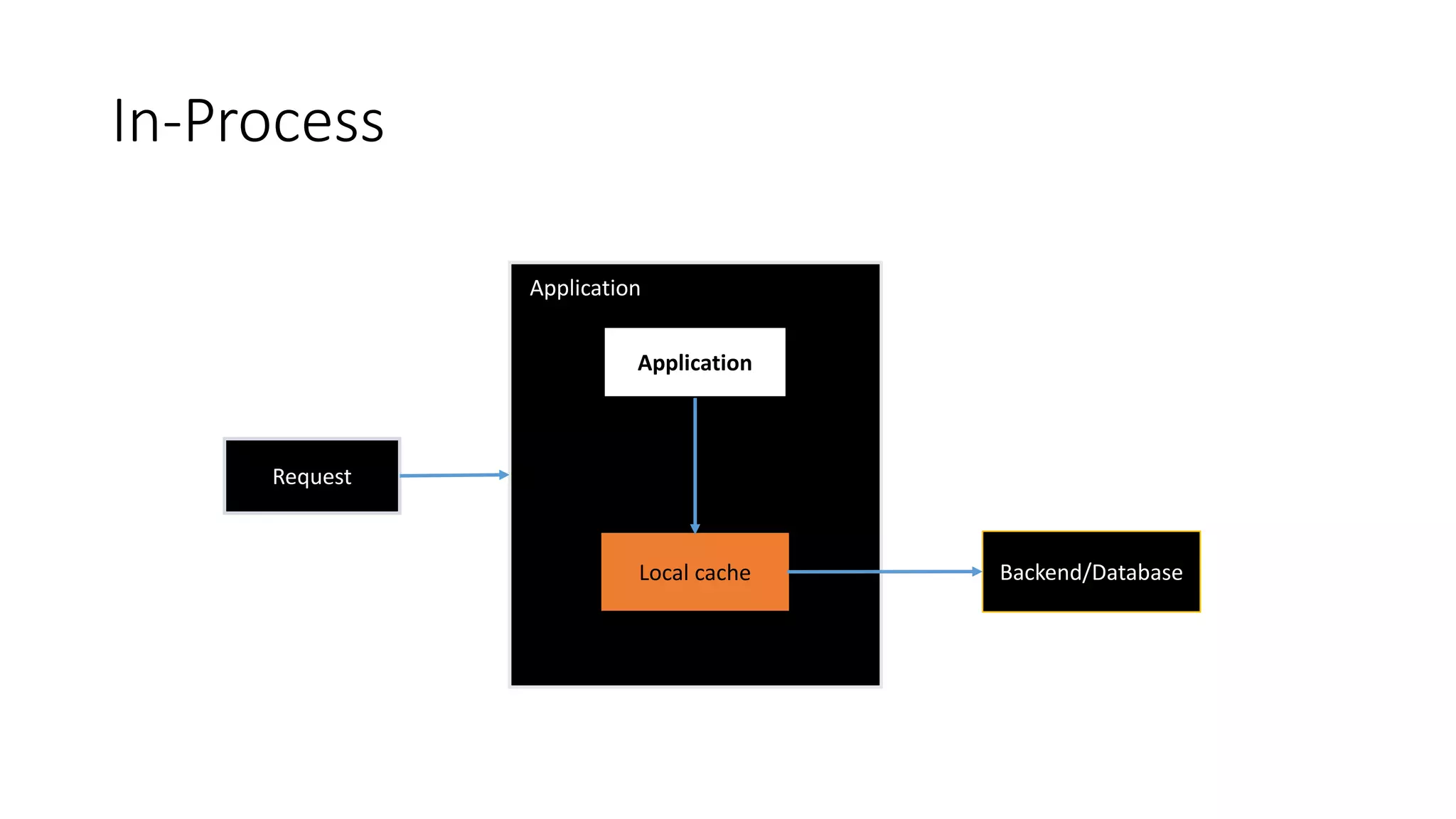
In-Process
Request
Application
Local cache Backend/Database
Application
Lazy Load
Request
Logic
Caching
(Memory)
Backend/Databas
e
Application
Warmup
Worker
Distributed Cache
Server 1
Server 3
Server 2Server 4
Distributed Cache
Client 1
Client 2
Client 3
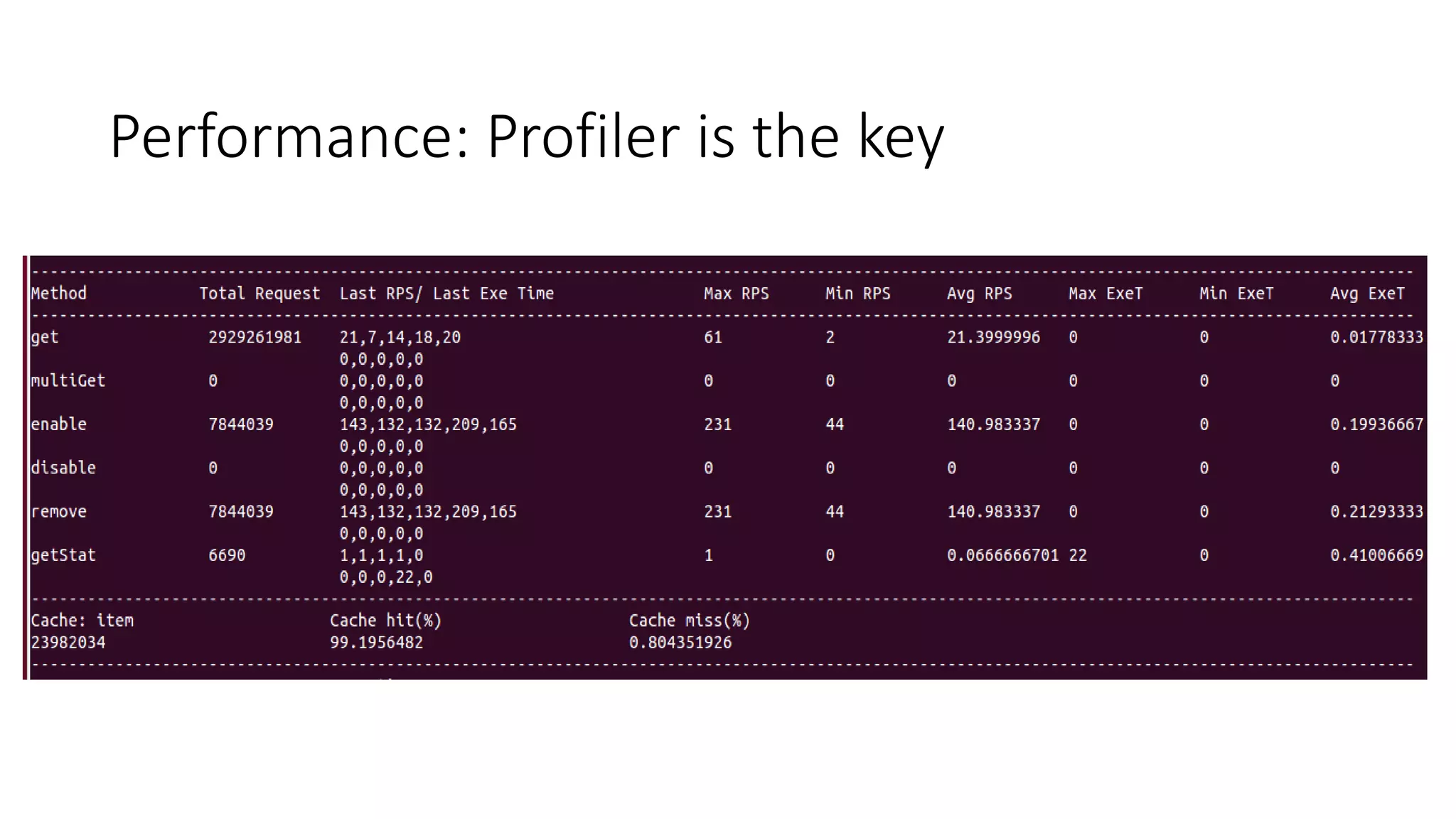
Performance: Profiler is the key
Demo
Contact info:
• Name: Vu Van Tiep
• Email: tiepvv@vng.com.vn / vuvantiep@gmail.com
• Skype: tiepvv
Q&A
Thank You!
Reference
• https://en.wikipedia.org/wiki/Cache_(computing)
• http://www.slideshare.net/IgorAnishchenko/pb-vs-thrift-vs-avro
• https://github.com/facebook/zstd
• http://www.codeproject.com/Articles/56138/Consistent-hashing

Caching Methodology & Strategies

  • 1.
    Caching – Methodology& Strategies By Vu Van Tiep Manager, Head Of Web Platform - VNG Skype: tiepvv
  • 2.
    Scale Up vsScale Out Scale UP Scale Out
  • 3.
  • 4.
    Agenda • What • CacheLayer • Cache Application/Service • Methodology • Strategies • Performance? • Demo • Q&A
  • 5.
    Cache – What? •Is a hardware or software component that stores data so future requests for that data can be served faster; • The data stored in a cache might be the result of an earlier computation, or the duplicate of data stored elsewhere https://en.wikipedia.org/wiki/Cache_(computing) Application Cache Database Hit MissUpdate Cache
  • 6.
    Cache Layer Client (Browser)Application Caching Database - Browser - Proxy - CDN - in-memory - Server Caching - Distributed in memory key/value - Service: • Memcache • Membase • Redis • … - Database caching • Entity In memory - DB: • MySQL • MongoDB • Casandra, LevelDB • … 1 2 3 4 5 6
  • 7.
  • 8.
    Browser & Proxy Client (Browser) WebServer 1 2 Client (Browser) Client (Browser) Web ServerProx y Client (Browser) ProxyCache Cache 1 2 1 2 34 Response Header • Expires • Last-Modified • Etag • Cache-Control • Pragram
  • 9.
  • 10.
  • 11.
    Browser Caching –Local Storage
  • 12.
  • 13.
    Types/Levels of Cache Level1 (L1) Cache It is also called primary or internal cache. It is built directly into the processor chip. It has small capacity from 8 Km to 128 Kb. Level 2 (L2) Cache It is slower than L1 cache. Its storage capacity is more, i-e. From 64 Kb to 16 MB. The current processors contain advanced transfer cache on processor chip that is a type of L2 cache. The common size of this cache is from 512 kb to 8 Mb. Level 3 (L3) Cache This cache is separate from processor chip on the motherboard. It exists on the computer that uses L2 advanced transfer cache. It is slower than L1 and L2 cache. The personal computer often has up to 8 MB of L3 cache.
  • 14.
    L1 cache reference0.5 ns Branch mispredict 5 ns L2 cache reference 7 ns Mutex lock/unlock 100 ns Main memory reference 100 ns Compress 1K bytes with Zippy 10,000 ns Send 2K bytes over 1 Gbps network 20,000 ns (1) Read 1 MB sequentially from memory 250,000 ns (2) Round trip within same datacenter 500,000 ns Disk seek 10,000,000 ns 1 + 2 < (3) Read 1 MB sequentially from network 10,000,000 ns Read 1 MB sequentially from disk 30,000,000 ns Send packet CA->Netherlands->CA 150,000,000 ns From Jeff Dean - google.com Latency Numbers Note: 1 ns = 10^-9 seconds
  • 15.
  • 16.
    Serialize Disk / Network JavaObject PHP Object C# Object Write ReadSerialize DeSerialize
  • 17.
    Performance Comparison Text Serialize Json– size: 167 bytes, se: 6ms, de: 3ms XML – 235 bytes Binary Serialize Thrift – size: 64 bytes, se: 53ms, de:1ms ProtoBuf – size: 31 bytes, se: 34ms, de: 4ms Binary serialize take less space XML, Json ProtoBuf, Thrift Message Pack Apache Arvo … Framework
  • 18.
    Compress/Decompress Name Ratio C.speedD.speed MB/s MB/s zstd 0.8.2 -1 2.877 330 940 zlib 1.2.8 -1 2.73 95 360 brotli 0.4 -0 2.708 320 375 QuickLZ 1.5 2.237 510 605 LZO 2.09 2.106 610 870 LZ4 r131 2.101 620 3100 Snappy 1.1.3 2.091 480 1600 LZF 3.6 2.077 375 790 As a reference, several fast compression algorithms were tested and compared on a Core i7-3930K CPU @ 4.5GHz, using lzbench, an open-source in-memory benchmark by @inikep compiled with GCC 5.4.0, with the Silesia compression corpus. https://github.com/facebook/zstd
  • 19.
  • 20.
    Cache Strategies 1. OptimizeData Size 2. Hot Object 3. In-Process 4. Lazy load 5. Distributed
  • 21.
    Optimize Data Size NameRatio C.speed D.speed MB/s MB/s zstd 0.8.2 -1 2.877 330 940 zlib 1.2.8 -1 2.73 95 360 brotli 0.4 -0 2.708 320 375 QuickLZ 1.5 2.237 510 605 LZO 2.09 2.106 610 870 LZ4 r131 2.101 620 3100 Snappy 1.1.3 2.091 480 1600 LZF 3.6 2.077 375 790 CompressSerialize Method Size (smaller is better) Thrift — TCompactProtocol 278 (not bad) Thrift — TBinaryProtocol 460 Protocol Buffers 250 (winner!) RMI 905 REST — JSON 559 REST — XML 836 High Level Goals: • Transparent between multiple programming languages (PHP/Java/Cpp/…) • Maintain Right balance between: • Efficiency (how much time/space?) • Availability of existing libraries
  • 22.
    Hot Object =>Eviction Algorithms 2G Ram 10G Data ServerData How to cache?
  • 23.
    Eviction Algorithms: LeastFrequently Used (LFU) A B C D E F 7 6 3 2 4 1 A B C D E F 7 6 3 3 4 1 Access Most Frequently Used Least Frequently Used
  • 24.
    Eviction Algorithms: LeastRecently Used (LRU) 1 2 3 4 5 6 4 1 2 3 5 6 Access
  • 25.
  • 26.
  • 27.
    Distributed Cache Server 1 Server3 Server 2Server 4 Distributed Cache Client 1 Client 2 Client 3
  • 28.
  • 29.
  • 30.
    Contact info: • Name:Vu Van Tiep • Email: tiepvv@vng.com.vn / vuvantiep@gmail.com • Skype: tiepvv Q&A Thank You!
  • 31.
    Reference • https://en.wikipedia.org/wiki/Cache_(computing) • http://www.slideshare.net/IgorAnishchenko/pb-vs-thrift-vs-avro •https://github.com/facebook/zstd • http://www.codeproject.com/Articles/56138/Consistent-hashing