Orthodontics
Introduction and Brief History
Dr. Poorvi Harmani
MDS (ORTHO)
• “Heritages of the past are the seeds that bring forth the harvest
of the future.”
• “not to know what has been transacted in former times is to
continue always as a child. If no use is made of the labors of the
past ages, the world must remain in the infancy of Knowledge.”
Cicero, the great Roman
• Orthodontic: Greek derivative
– Ortho – Straight
– Dontic -- dentition
Definition
• -- A Branch/ specialty of Dental science that deals
with genetic variations, development and growth
of the facial form.
• -- It is also concerned with factors affecting
occlusion and function of associated organs.
Thus Orthodontic is concerned with
1.Treatment of Irregularities
2.Growth, development and function of the whole
Oro-facial complex
:. Aim is to have improved occlusal function
by correcting and better the dental health
and improved esthetics
Possible Types of harms DUE TO
ORTHO TX
1. Worsened dental arrangement
2. Worsened facial profile
3. Unsighty residual gaps resulting from
inappropriate extractions
4. Non-compliance of patient
Patient Non-Compliance
RESULTS IN:
1. Cavities damaging the teeth
2. Gingival damage resulting in periodontal
problems
3. Decalcification of enamel due to poor oral
hygiene
Role of the General
Dentist in Dental wellbeing
1. Monitoring and managing the developing
dentition
2. Knowing when to intervene for improved
arrangement
3. Knowing best time to refer for specialist opinion
or more complex treatment
Aims of Orthodontic
treatment
Jackson’s Triad
1. Structural balance
2. Aesthetic Harmony
3. Functional efficiency
Riedel
1. Beauty
2. Utility
3. Stability
Structural Balance
The oro-facial region consist of the dento-alveolar
system, skeletal tissue and soft tissue including
musculature.
Stable orthodontic treatment is best achieved by
maintaining balance between these three tissue
systems
Esthetic Harmony
By far the most common reason for seeking
orthodontic tx is to improve the appearance of the
teeth and face. Many malocclusion are
associated with unsightly appearance of teeth
and can thus affect the individual’s self image,
well being and success in society. Thus the
orthodontic treatment should aim at improving the
esthetics of an individual.
Functional Efficiency
Many malocclusion affect normal functioning of
the stomatognathic system. The orthodontic
treatment should thus aim at improving the
functioning of the orofacial apparatus.
Branches of orthodontics
PREVENTIVE
ORTHODONTICS
INTERCEPTIVE
ORTHODONTICS
CORRECTIVE
ORTHODONTICS SURGICAL ORTHODONTICS
History of orthodontics
1600 BC – Desire for prefect smile
traced back to Egypt.
Archaeologists have discovered
mummies with teeth wrapped in
cords made of catgut or animal
intestines – similar to how modern
orthodontic wire is used.
 770 – 270 BC – Etruscans made
bridges out of gold and placed in
the mouths of the dead so they
would have straight teeth in their
after life.
 40 AD– Roman medical writer Celsus documented attempts at
straightening teeth using finger pressure at regular intervals
 1500 – Leonardo Da Vinci was first to recognize tooth form and
realize the relation of teeth with each other and opposing jaw.
 “those teeth farthest from the line of the temporomandibular
articulation are at a mechanical disadvantage compared to those
nearest.”
 1728 – Fauchard, made the first modern attempt at orthodontia
using a horseshoe shaped piece of precious metal and silk
threads to tie it to the teeth to straighten. Publishes Book with
special chapter on straightening teeth.
 1841 – the word Orthodontia is coined by Joachim La Foulon
to describe orthodontics
 Late 1800s – Norman Kingsley writes first book for
orthodontics and is one of the first to use extra-oral forces for
straightening teeth. Included extraction of teeth to straighten.
 1890s – Edward Angle –”father of Orthodontics” – developed
his postulate for ideal occlusion.
 Early 1900s – move towards treating malocclusion and
achieve Angle’s “ideal”. Also reduced extractions and extra-
oral forces for corrections
 1930s – reintroduction of extractions if it helped in
esthetics
 Post WWII – use of cephalometry helped
understand the skeletal and dental relationship.
Now possible to see that orthodontic treatment
could affect jaw development.
 In Europe there was a move towards using
“functional jaw orthopedics” and in America move
towards use of extra-oral forces.
 Early 21st century – changes in three important
ways
I. More emphasis on dental and facial
appearance
II. Patients now have more involvement in
treatment planning
III. More often offered as part of multidisciplinary
treatment plan.
What is Ideal Occlusion
 A hypothetical concept
 Very rarely exists in nature
 But gives a yardstick to compare against
Definition of ideal occlusion
Defined by Edward Angle
Also known as normal occlusion/ perfect
occlusion
Defined as when the mesiobuccal cusp
of maxillary first molar settles in the
buccal groove of the mandibular first
molar and when the teeth arrange into a
smooth curving line.
In this case the maxillary canine lands distal
to its mandibular counterpart
Angle’s Classification
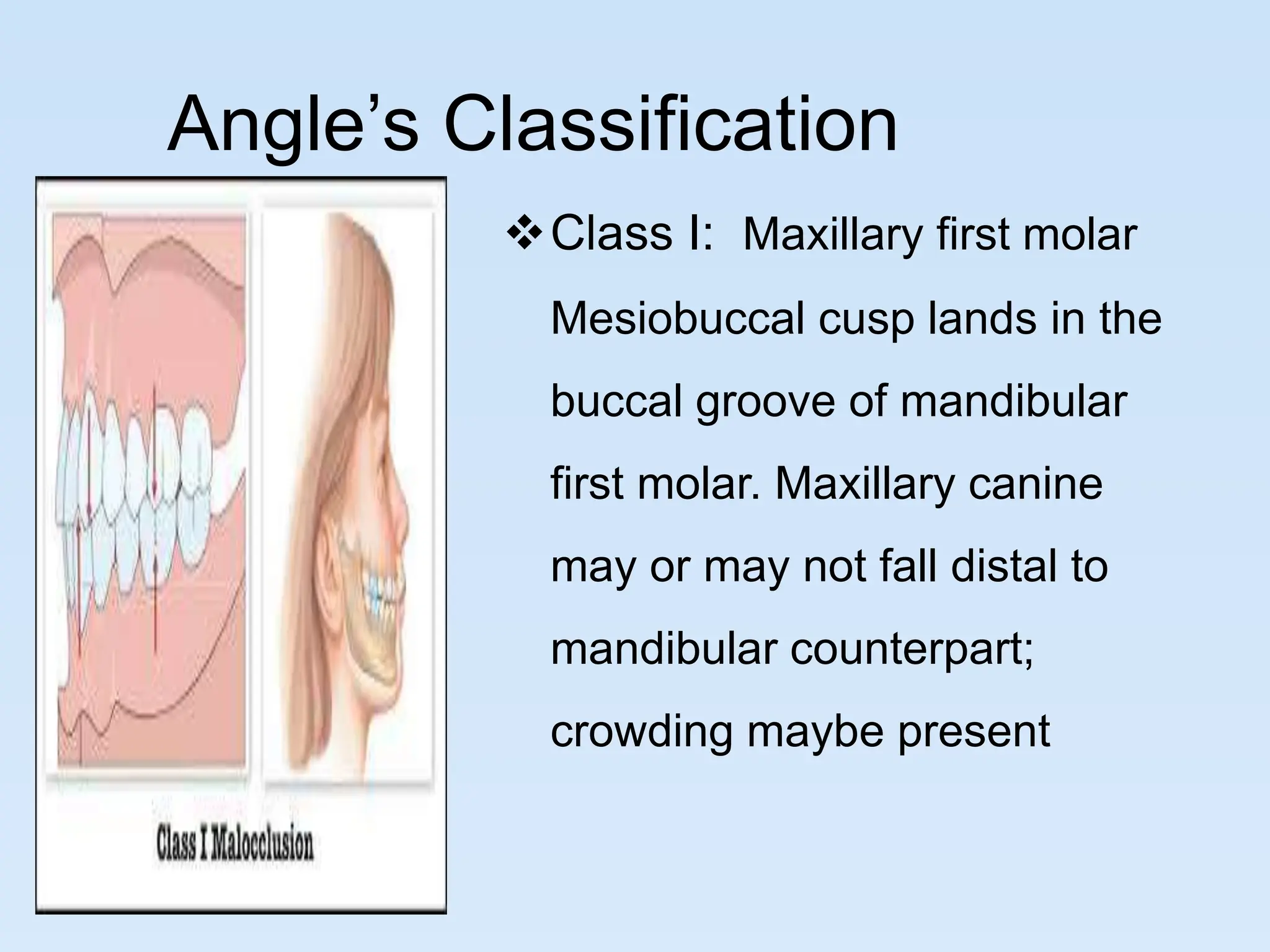
Class I: Maxillary first molar
Mesiobuccal cusp lands in the
buccal groove of mandibular
first molar. Maxillary canine
may or may not fall distal to
mandibular counterpart;
crowding maybe present
• Class II Division 1: maxillary
MB cusp is mesical to the
mandibular buccal groove.
Maxillary canines are mesial to
the mandibular ones.
• Class II Division 2: maxillary
MB cusp is mesial to the
mandibular buccal groove.
The Maxillary Central
Incisors are lingually
inclined
• Class III: maxillary MB cusp is
distal to the mandibular buccal
groove. In this case the
maxillay canines maybe distal
to the Premolars.
Angle’s Classification of
occlusion
Malocclusion
1. Definition: any irregularity in occlusion outside the accepted
range of normal is known as Malocclusion
• It is Important to realize that treatment is not always
warranted if malocclusion is present
• Very important to realize that treatment is only done if it is
evident with certainty that the patient will benefit functionally
and esthetically
Prevalence of
malocclusion
• Malocclusion is more prevalent now than was earlier.
• Crowding and malocclusion was not the norm.
• Crowding and malocclusion less prevalent in groups
unaffected by modern development such as Australian
aborigines
• So indications towards modern changes in lifestyle
Causes of malocclusion
• Genetic – may inheret small mouth from mother and
larger tooth size from father. Lineage association and
discrepancies seen
• Tooth Loss – if tooth is lost by any means, remaining
teeth may shift toward empty space
• Bad Habits – such as thumbsucking can shift teeth or
cause them to erupt irregularly
• Malnutrition – nutritional deficits restrict jaw
development and growth thus leading to
malocclusions
Evolutionary changes
 Decrease in tooth size
 Decrease in tooth number
 Decrease in jaw size
 Changes in Jaw function
Need and demand
 Discrimination due to facial appearance
 Social handicap
 Oral function problems
 Mastication, swallowing and speech problems
 Dental trauma
 Fratured teeth, devitialized pulps
Increased awareness
Treatment Options
1. No treatment
2. Extraction only
3. Removable appliance therapy
4. Single arch fixed appliance
5. Full upper and lower arch fixed
6. Functional appliances/ Orthopedics
7. Orthognathic surgery
Timings for treatment
1. Deciduous dentition
2. Early mixed
3. Late mixed and early permanent
4. Late permanent
Other scopes of
orthodontics
1. Alignment of mal-positioned teeth before
prosthetic treatment – fixed or removable
2. Alignment of periodontically compromised teeth
prior to splinting
3. Alignment and planned positioning of teeth prior
to orthognathic surgery
Summary of scopes and
aims of Orthodontic
treatment
1. Improvement of facial and dental esthetics
2. Alignment of teeth to eliminate stagnation areas
3. Elimination of premature contacts
4. Elimination of traumatic irregularities
5. Reduce damage to prominant teeth by way of alignment
6. Assist in eruption and alignment of displaced teeth
Lecture 1.  Orthodontics introductory lecture

Lecture 1. Orthodontics introductory lecture

  • 2.
    Orthodontics Introduction and BriefHistory Dr. Poorvi Harmani MDS (ORTHO)
  • 3.
    • “Heritages ofthe past are the seeds that bring forth the harvest of the future.” • “not to know what has been transacted in former times is to continue always as a child. If no use is made of the labors of the past ages, the world must remain in the infancy of Knowledge.” Cicero, the great Roman
  • 4.
    • Orthodontic: Greekderivative – Ortho – Straight – Dontic -- dentition
  • 5.
    Definition • -- ABranch/ specialty of Dental science that deals with genetic variations, development and growth of the facial form. • -- It is also concerned with factors affecting occlusion and function of associated organs.
  • 6.
    Thus Orthodontic isconcerned with 1.Treatment of Irregularities 2.Growth, development and function of the whole Oro-facial complex
  • 7.
    :. Aim isto have improved occlusal function by correcting and better the dental health and improved esthetics
  • 8.
    Possible Types ofharms DUE TO ORTHO TX 1. Worsened dental arrangement 2. Worsened facial profile 3. Unsighty residual gaps resulting from inappropriate extractions 4. Non-compliance of patient
  • 9.
    Patient Non-Compliance RESULTS IN: 1.Cavities damaging the teeth 2. Gingival damage resulting in periodontal problems 3. Decalcification of enamel due to poor oral hygiene
  • 10.
    Role of theGeneral Dentist in Dental wellbeing 1. Monitoring and managing the developing dentition 2. Knowing when to intervene for improved arrangement 3. Knowing best time to refer for specialist opinion or more complex treatment
  • 11.
    Aims of Orthodontic treatment Jackson’sTriad 1. Structural balance 2. Aesthetic Harmony 3. Functional efficiency Riedel 1. Beauty 2. Utility 3. Stability
  • 12.
    Structural Balance The oro-facialregion consist of the dento-alveolar system, skeletal tissue and soft tissue including musculature. Stable orthodontic treatment is best achieved by maintaining balance between these three tissue systems
  • 13.
    Esthetic Harmony By farthe most common reason for seeking orthodontic tx is to improve the appearance of the teeth and face. Many malocclusion are associated with unsightly appearance of teeth and can thus affect the individual’s self image, well being and success in society. Thus the orthodontic treatment should aim at improving the esthetics of an individual.
  • 14.
    Functional Efficiency Many malocclusionaffect normal functioning of the stomatognathic system. The orthodontic treatment should thus aim at improving the functioning of the orofacial apparatus.
  • 16.
  • 17.
  • 19.
  • 20.
    1600 BC –Desire for prefect smile traced back to Egypt. Archaeologists have discovered mummies with teeth wrapped in cords made of catgut or animal intestines – similar to how modern orthodontic wire is used.  770 – 270 BC – Etruscans made bridges out of gold and placed in the mouths of the dead so they would have straight teeth in their after life.
  • 21.
     40 AD–Roman medical writer Celsus documented attempts at straightening teeth using finger pressure at regular intervals  1500 – Leonardo Da Vinci was first to recognize tooth form and realize the relation of teeth with each other and opposing jaw.  “those teeth farthest from the line of the temporomandibular articulation are at a mechanical disadvantage compared to those nearest.”  1728 – Fauchard, made the first modern attempt at orthodontia using a horseshoe shaped piece of precious metal and silk threads to tie it to the teeth to straighten. Publishes Book with special chapter on straightening teeth.
  • 22.
     1841 –the word Orthodontia is coined by Joachim La Foulon to describe orthodontics  Late 1800s – Norman Kingsley writes first book for orthodontics and is one of the first to use extra-oral forces for straightening teeth. Included extraction of teeth to straighten.  1890s – Edward Angle –”father of Orthodontics” – developed his postulate for ideal occlusion.  Early 1900s – move towards treating malocclusion and achieve Angle’s “ideal”. Also reduced extractions and extra- oral forces for corrections
  • 23.
     1930s –reintroduction of extractions if it helped in esthetics  Post WWII – use of cephalometry helped understand the skeletal and dental relationship. Now possible to see that orthodontic treatment could affect jaw development.  In Europe there was a move towards using “functional jaw orthopedics” and in America move towards use of extra-oral forces.
  • 24.
     Early 21stcentury – changes in three important ways I. More emphasis on dental and facial appearance II. Patients now have more involvement in treatment planning III. More often offered as part of multidisciplinary treatment plan.
  • 26.
    What is IdealOcclusion  A hypothetical concept  Very rarely exists in nature  But gives a yardstick to compare against
  • 27.
    Definition of idealocclusion Defined by Edward Angle Also known as normal occlusion/ perfect occlusion Defined as when the mesiobuccal cusp of maxillary first molar settles in the buccal groove of the mandibular first molar and when the teeth arrange into a smooth curving line. In this case the maxillary canine lands distal to its mandibular counterpart
  • 30.
    Angle’s Classification Class I:Maxillary first molar Mesiobuccal cusp lands in the buccal groove of mandibular first molar. Maxillary canine may or may not fall distal to mandibular counterpart; crowding maybe present
  • 31.
    • Class IIDivision 1: maxillary MB cusp is mesical to the mandibular buccal groove. Maxillary canines are mesial to the mandibular ones.
  • 32.
    • Class IIDivision 2: maxillary MB cusp is mesial to the mandibular buccal groove. The Maxillary Central Incisors are lingually inclined
  • 33.
    • Class III:maxillary MB cusp is distal to the mandibular buccal groove. In this case the maxillay canines maybe distal to the Premolars.
  • 34.
  • 35.
    Malocclusion 1. Definition: anyirregularity in occlusion outside the accepted range of normal is known as Malocclusion • It is Important to realize that treatment is not always warranted if malocclusion is present • Very important to realize that treatment is only done if it is evident with certainty that the patient will benefit functionally and esthetically
  • 37.
    Prevalence of malocclusion • Malocclusionis more prevalent now than was earlier. • Crowding and malocclusion was not the norm. • Crowding and malocclusion less prevalent in groups unaffected by modern development such as Australian aborigines • So indications towards modern changes in lifestyle
  • 38.
    Causes of malocclusion •Genetic – may inheret small mouth from mother and larger tooth size from father. Lineage association and discrepancies seen • Tooth Loss – if tooth is lost by any means, remaining teeth may shift toward empty space • Bad Habits – such as thumbsucking can shift teeth or cause them to erupt irregularly • Malnutrition – nutritional deficits restrict jaw development and growth thus leading to malocclusions
  • 39.
    Evolutionary changes  Decreasein tooth size  Decrease in tooth number  Decrease in jaw size  Changes in Jaw function
  • 40.
    Need and demand Discrimination due to facial appearance  Social handicap  Oral function problems  Mastication, swallowing and speech problems  Dental trauma  Fratured teeth, devitialized pulps Increased awareness
  • 43.
    Treatment Options 1. Notreatment 2. Extraction only 3. Removable appliance therapy 4. Single arch fixed appliance 5. Full upper and lower arch fixed 6. Functional appliances/ Orthopedics 7. Orthognathic surgery
  • 44.
    Timings for treatment 1.Deciduous dentition 2. Early mixed 3. Late mixed and early permanent 4. Late permanent
  • 45.
    Other scopes of orthodontics 1.Alignment of mal-positioned teeth before prosthetic treatment – fixed or removable 2. Alignment of periodontically compromised teeth prior to splinting 3. Alignment and planned positioning of teeth prior to orthognathic surgery
  • 46.
    Summary of scopesand aims of Orthodontic treatment 1. Improvement of facial and dental esthetics 2. Alignment of teeth to eliminate stagnation areas 3. Elimination of premature contacts 4. Elimination of traumatic irregularities 5. Reduce damage to prominant teeth by way of alignment 6. Assist in eruption and alignment of displaced teeth

Editor's Notes

  • #4 Why is History important?
  • #5 Origin of the word is Greek. First coined in 1839 by Le Foulin
  • #6 In 1922, definition included study of growth and development of the jaws and face in particular, and body in general as influencing position of teeth; Included the study of the action and reaction of internal and external influences on development and prevention and correction of arrested and perverted occlusion. (British society of Orthodontics) As per the American Board of Orthodontics, orthodontics is that specific area of dental practice that has as its responsibility the study and supervision of the growth and development of the dentition and its related anatomical structures from birth to dental maturity, including all preventive and corrective procedures of dental irregularities requiring repositioning of teeth by functional or mechanical means to establish normal occlusion and pleasing facial contours.
  • #9 Unfavorable Sequalae following improper ortho Tx Poor facial appearance Risk of caries Predisposition to perio diseases Psychological disturbances Trauma risk Functional abnormality TMJ problems
  • #17 Preventive orthodontics: treatment is intended to prevent a malocclusion (“bad bite” or crooked teeth) from developing in an otherwise normal mouth. The goal is to provide adequate space for permanent teeth to come in. Interceptive orthodontics: simply means diagnosing and treating malocclusions as soon as they are detected. The American Academy of Orthodontics now says all children should have an orthodontic assessment no later than the age of seven.
  • #18 Corrective orthodontics is the use of full orthodontic appliances in the permanent dentition to treat a malocclusion in either adolescents or adults. Surgical orthodontics is a combination of orthodontic treatment and orthognathic (jaw) surgery to correct severe bite abnormalities that are caused by underlying skeletal and musculature.
  • #35 Class I teeth crooked; 72% prevalence Class II 22% prevalence; Class II div 1 as shown; class II div 2 max anteriors are lingualized and canines and laterals splayed forward. Class III 6% prevalance
  • #37 Open bite: open space between max and mand anteriors; often caused by thumbsucking Overbite: when max ant cover more than 30% of the mand ant; aka deep bite when coverageis 70% or more. More common in class II div 2 Crossbite: ant: when mand ant overlap max ant.; post: when PM and M close so that mand teeth are outside the arch in buccal groove Underbite: when mand teeth close in front of max. “bulldog” feature seen in class III Overjet: “buckteeth” upper teeth are too far out… class II mal. Norm is 1-2 mm