Climate Change:  What does FP/RH have to do with it? Karen Hardee Hardee Associates and Population Reference Bureau  Clive Mutunga and Kathleen Mogelgaard ,  Population Action International Global Health Mini University  Washignton DC ,  October 8, 2010 HARDEE   ASSOCIATES  LLC
Outline Climate Change 101 Climate Change and Population:  the macro  Climate Change and FP/RH:  the micro  What are NAPAs and Where is FP/RH?  Climate Change and Development Financing:  Implications for FP/RH Discussion
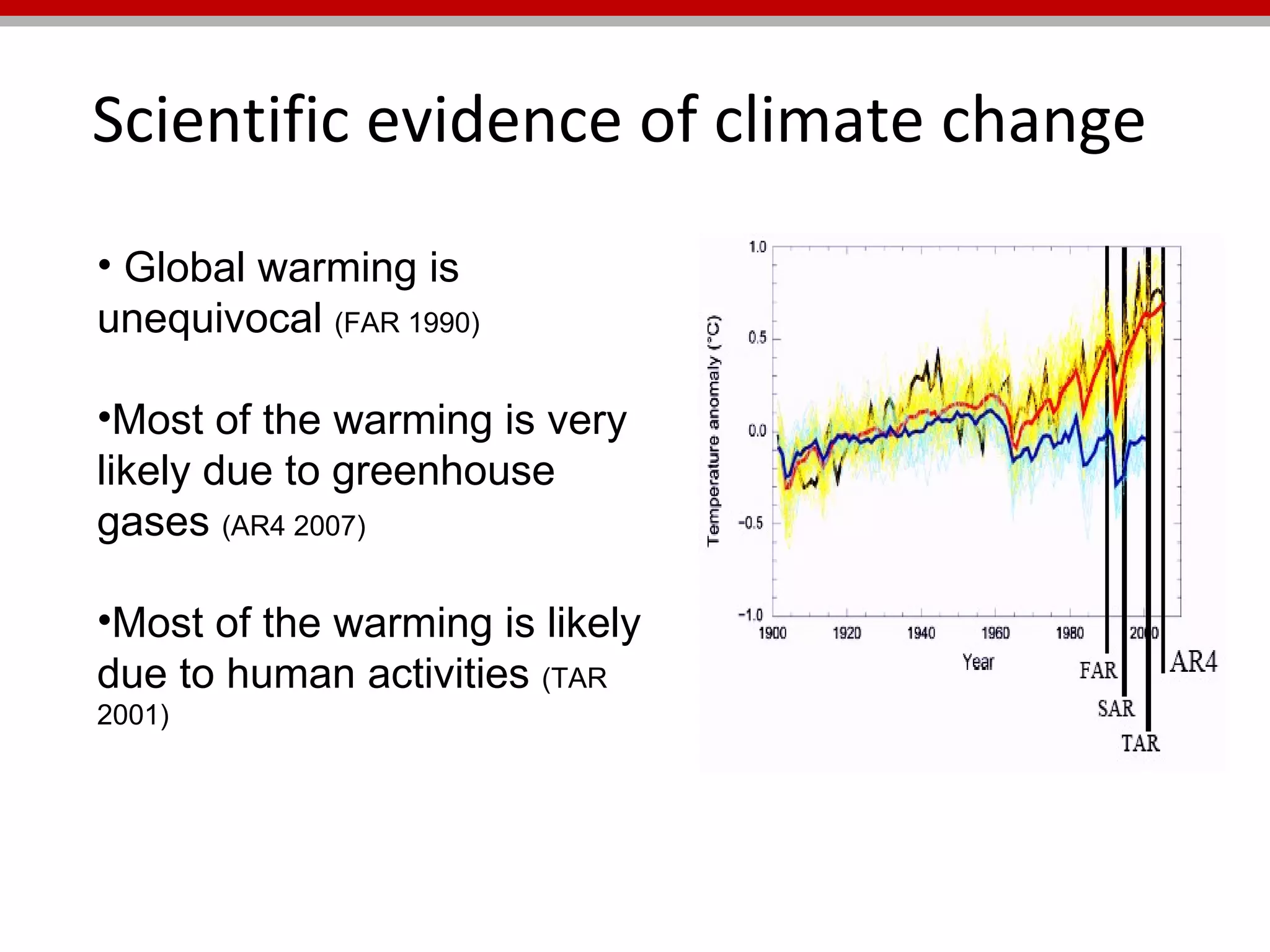
Scientific evidence of climate change Global warming is unequivocal  (FAR 1990)  Most of the warming is very likely due to greenhouse gases  (AR4 2007) Most of the warming is likely  due to human activities  (TAR 2001)
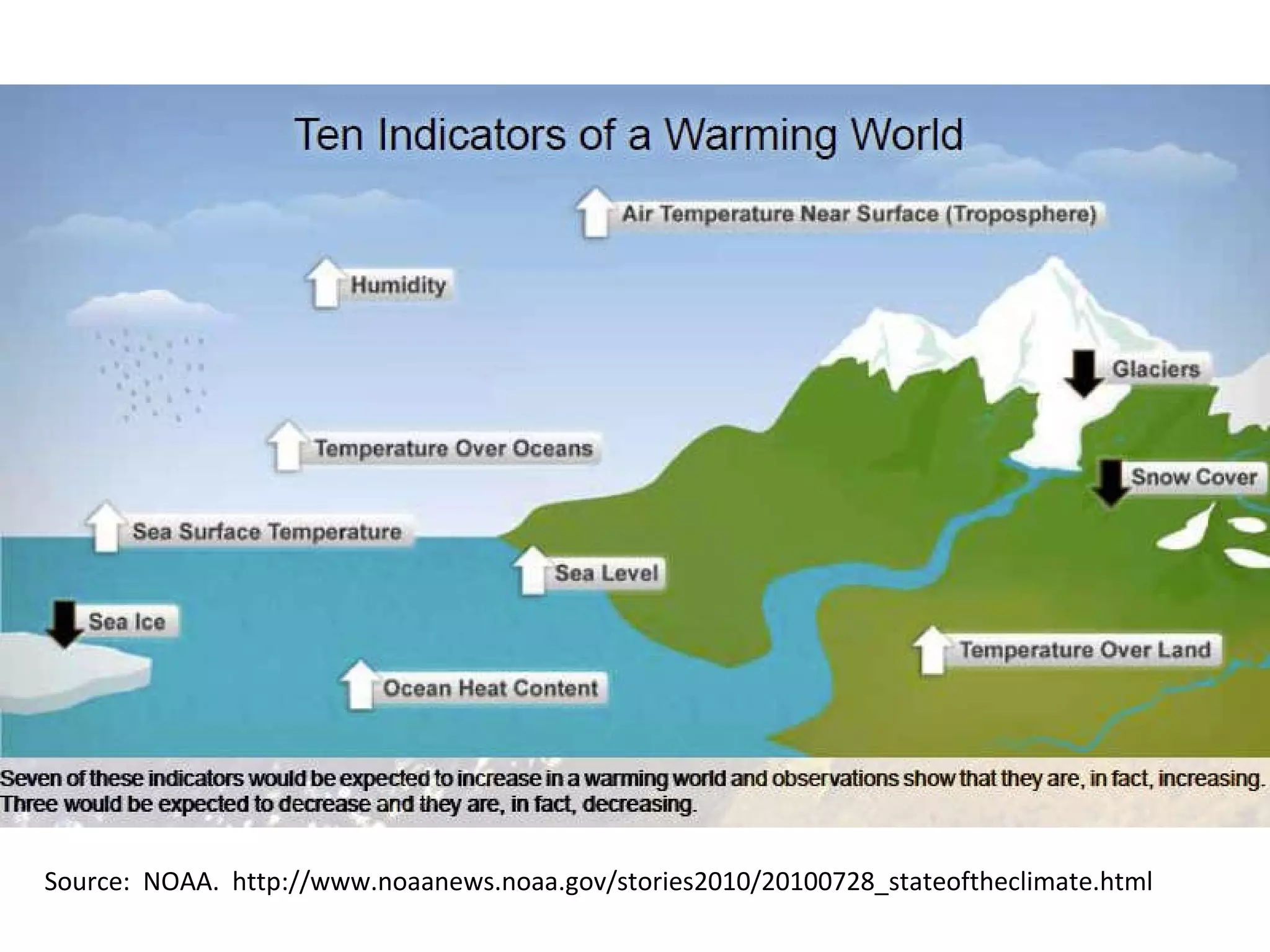
Source:  NOAA.  http://www.noaanews.noaa.gov/stories2010/20100728_stateoftheclimate.html
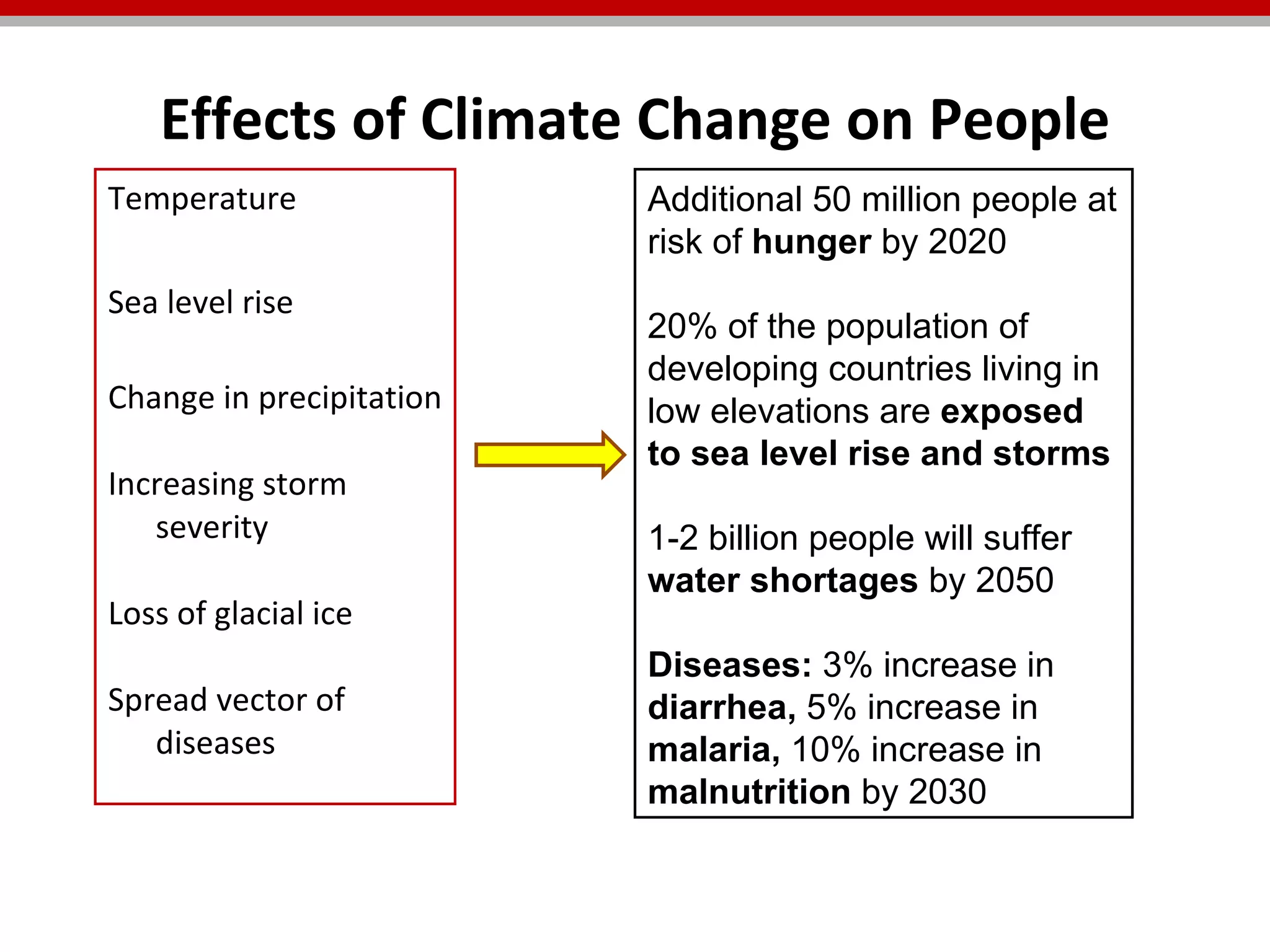
Effects of Climate Change on People Temperature Sea level rise Change in precipitation Increasing storm severity Loss of glacial ice Spread vector of diseases Additional 50 million people at risk of  hunger  by 2020 20% of the population of developing countries living in low elevations are  exposed to sea level rise and storms 1-2 billion people will suffer  water shortages  by 2050 Diseases:  3% increase in  diarrhea,  5% increase in  malaria,  10% increase in  malnutrition  by 2030
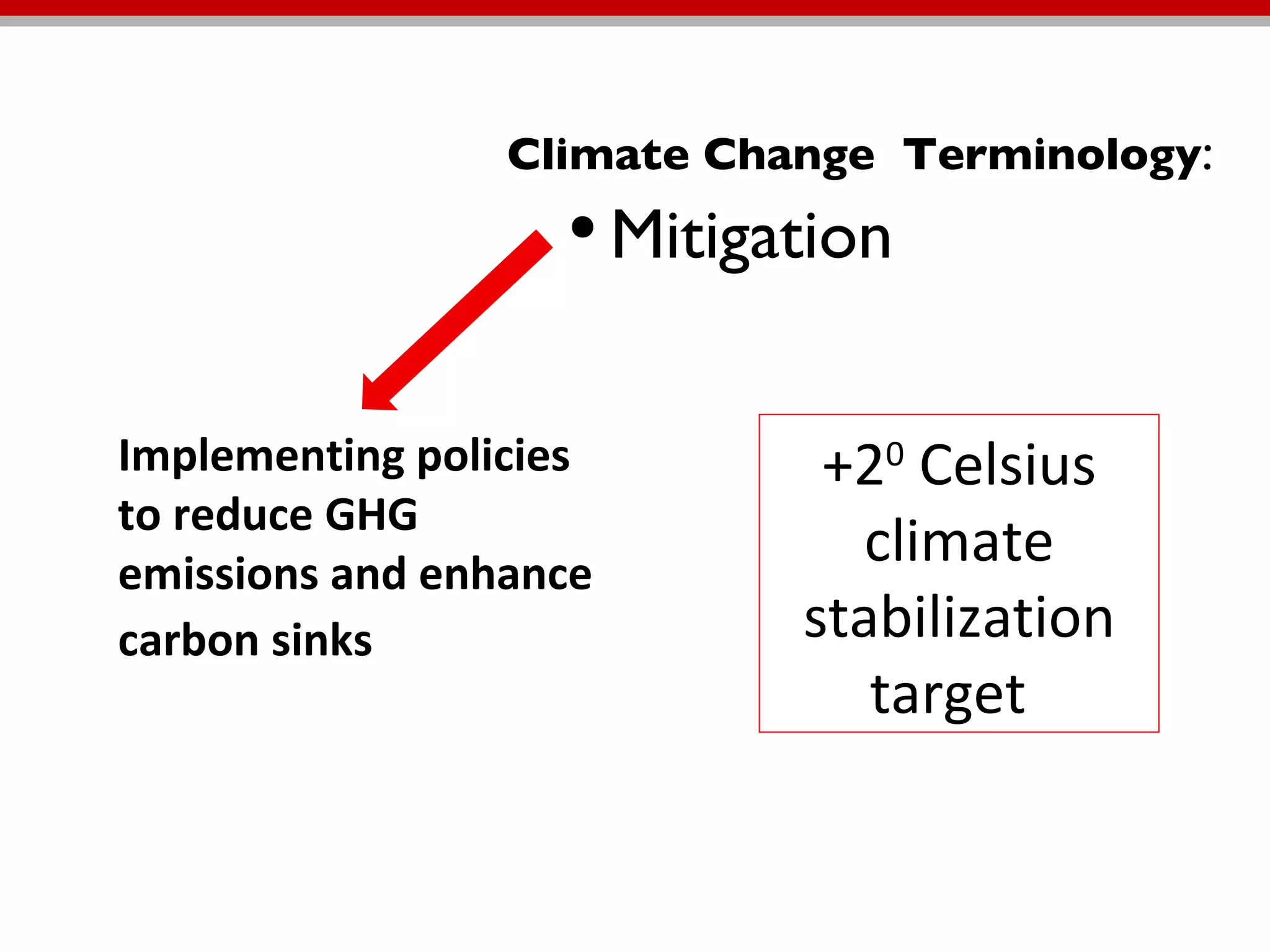
Climate Change  Terminology : Mitigation  Implementing policies to reduce GHG emissions and enhance carbon sinks   +2 0  Celsius climate stabilization target
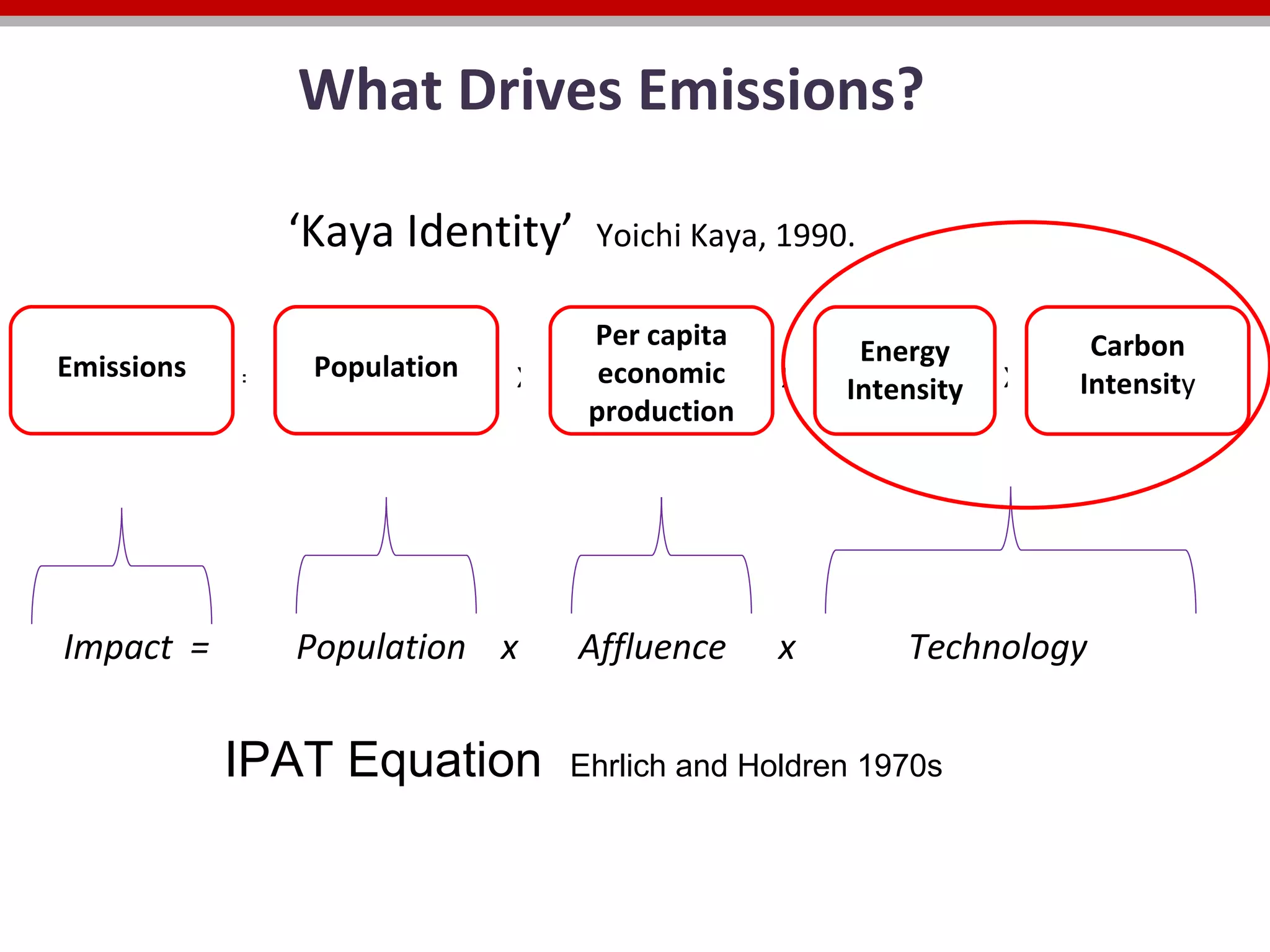
What Drives Emissions?  ‘ Kaya Identity’  Yoichi Kaya, 1990.  = X X X IPAT Equation  Ehrlich and Holdren 1970s Per capita economic production Energy Intensity Carbon Intensit y Population Emissions Impact  =  Population  x  Affluence  x  Technology
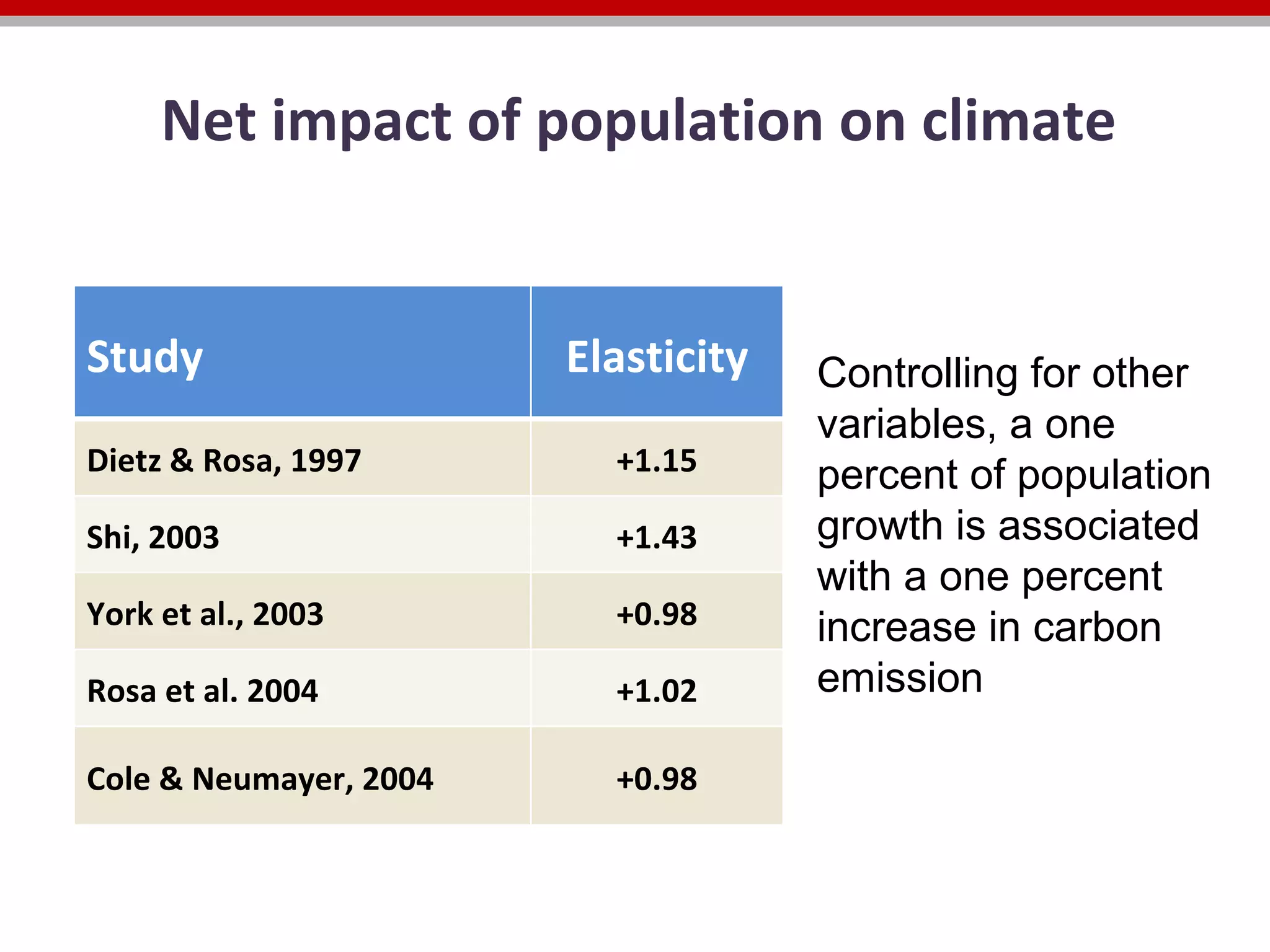
Net impact of population on climate Controlling for other variables, a one percent of population growth is associated with a one percent increase in carbon emission Study Elasticity Dietz & Rosa, 1997 +1.15 Shi, 2003 +1.43 York et al., 2003 +0.98 Rosa et al. 2004 +1.02 Cole & Neumayer, 2004 +0.98
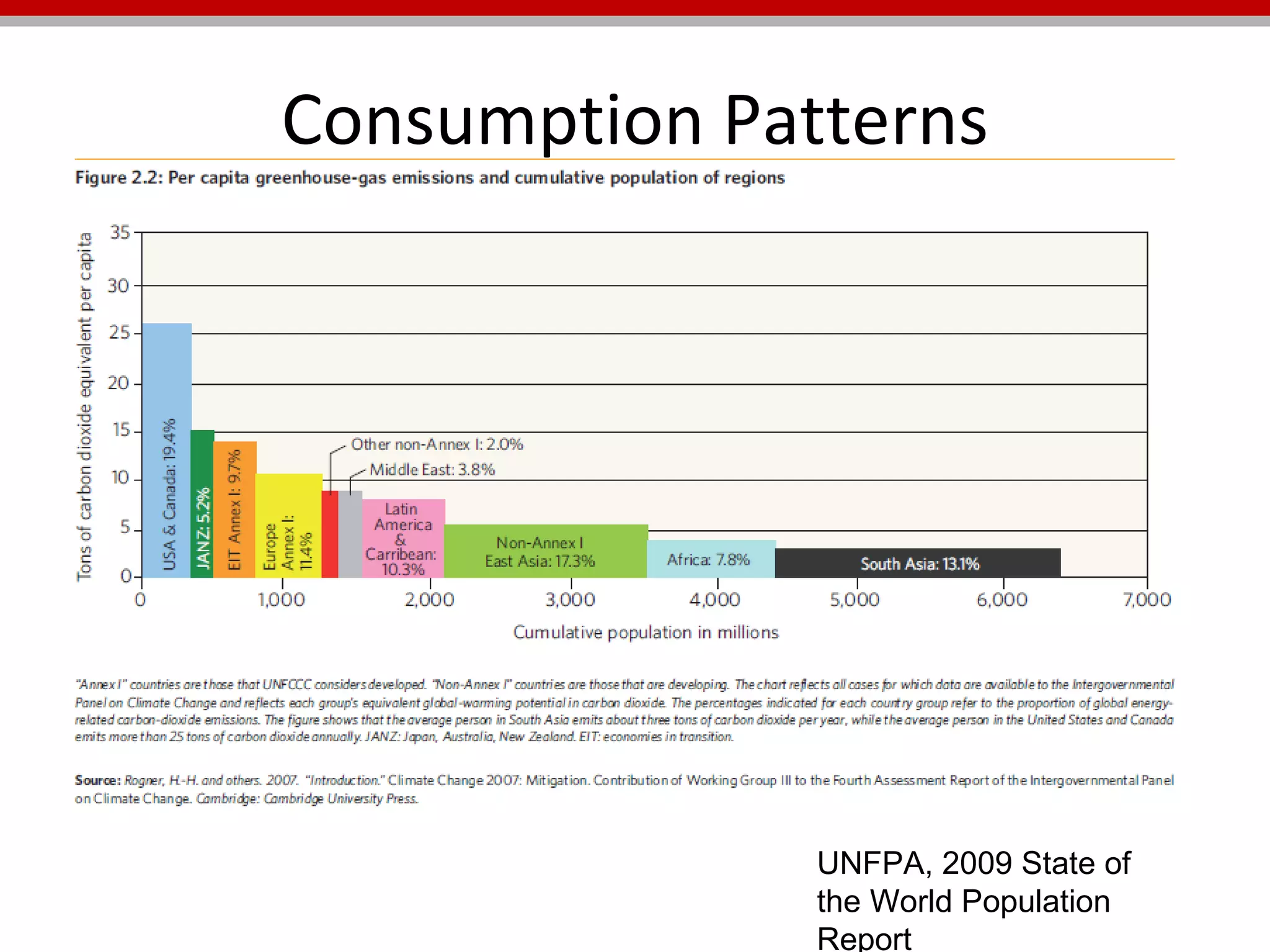
Consumption Patterns UNFPA, 2009 State of the World Population Report
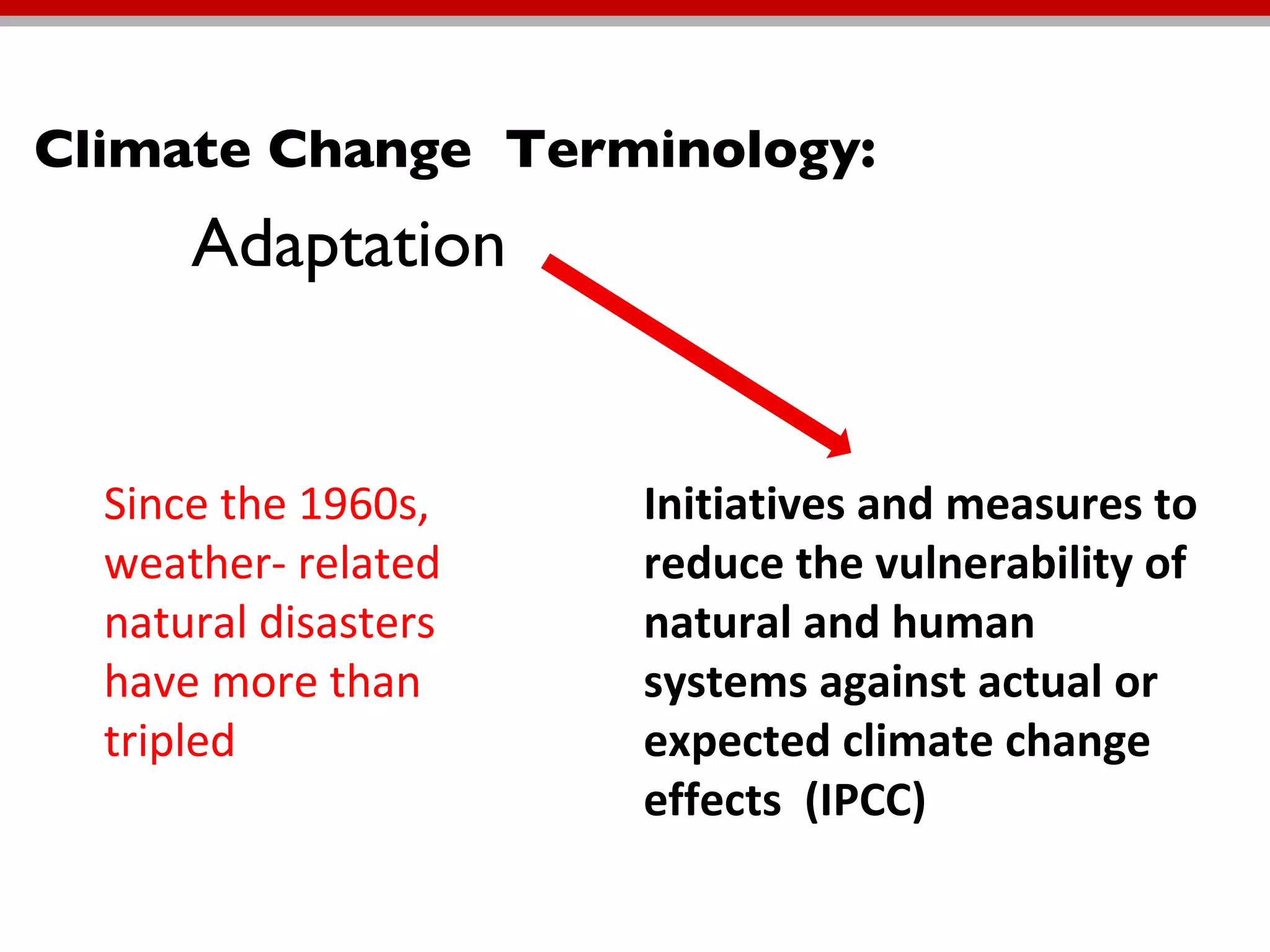
Climate Change  Terminology:  Adaptation  Initiatives and measures to reduce the vulnerability of natural and human systems against actual or expected climate change effects  (IPCC) Since the 1960s, weather- related natural disasters have more than tripled
 
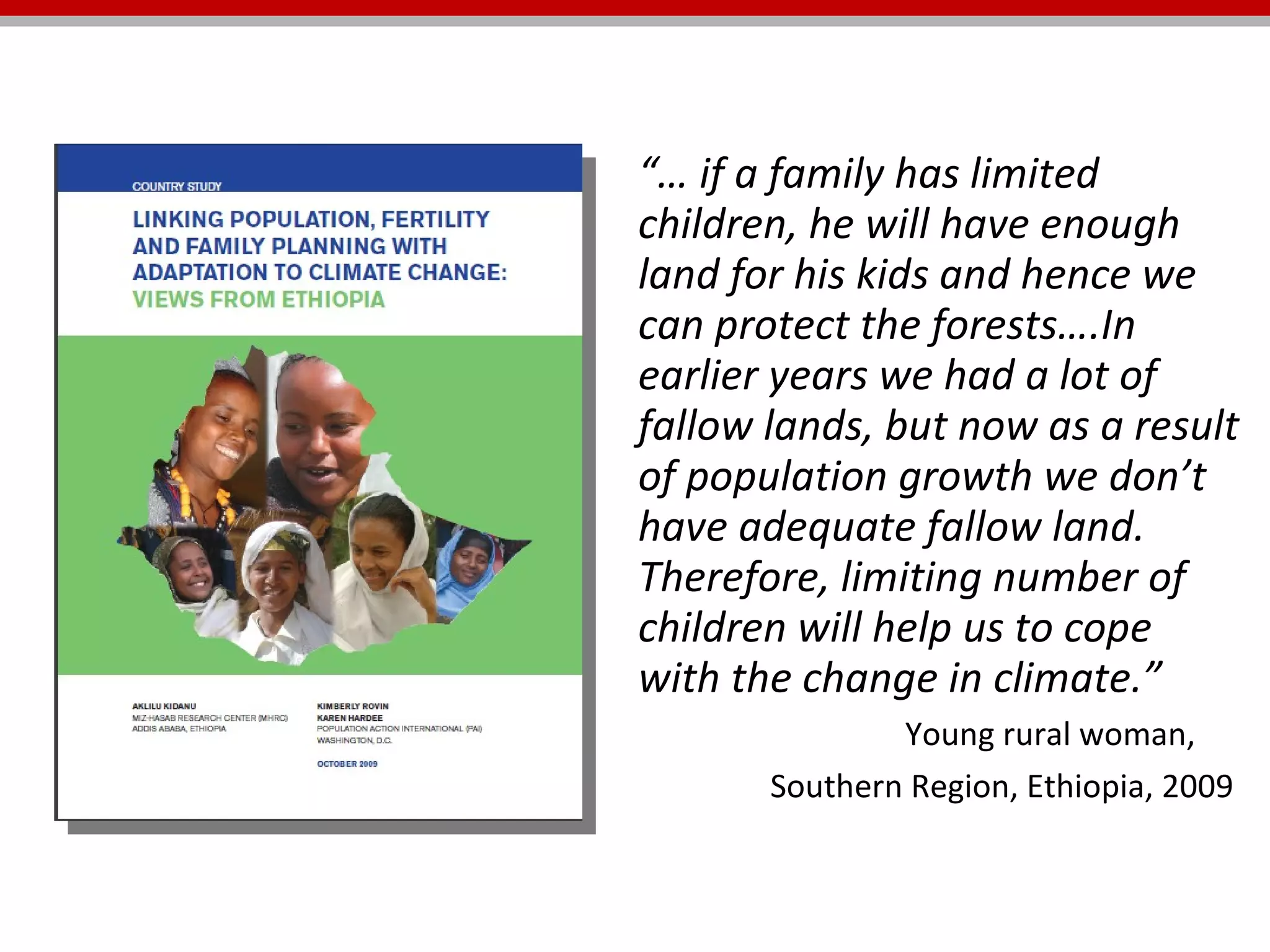
“…  if a family has limited children, he will have enough land for his kids and hence we can protect the forests….In earlier years we had a lot of fallow lands, but now as a result of population growth we don’t have adequate fallow land. Therefore, limiting number of children will help us to cope with the change in climate.”    Young rural woman,  Southern Region, Ethiopia, 2009
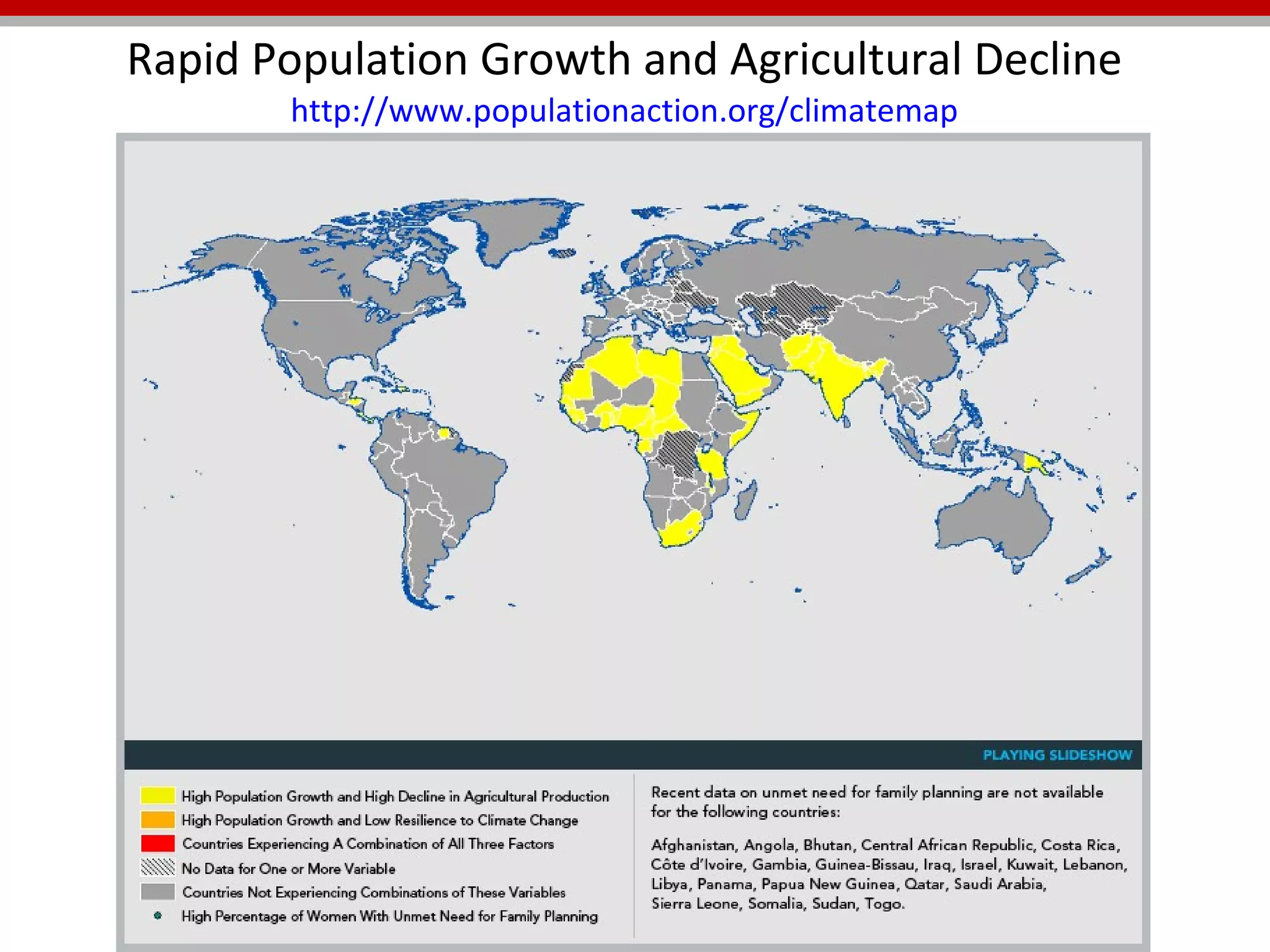
Rapid Population Growth and Agricultural Decline  http://www.populationaction.org/climatemap
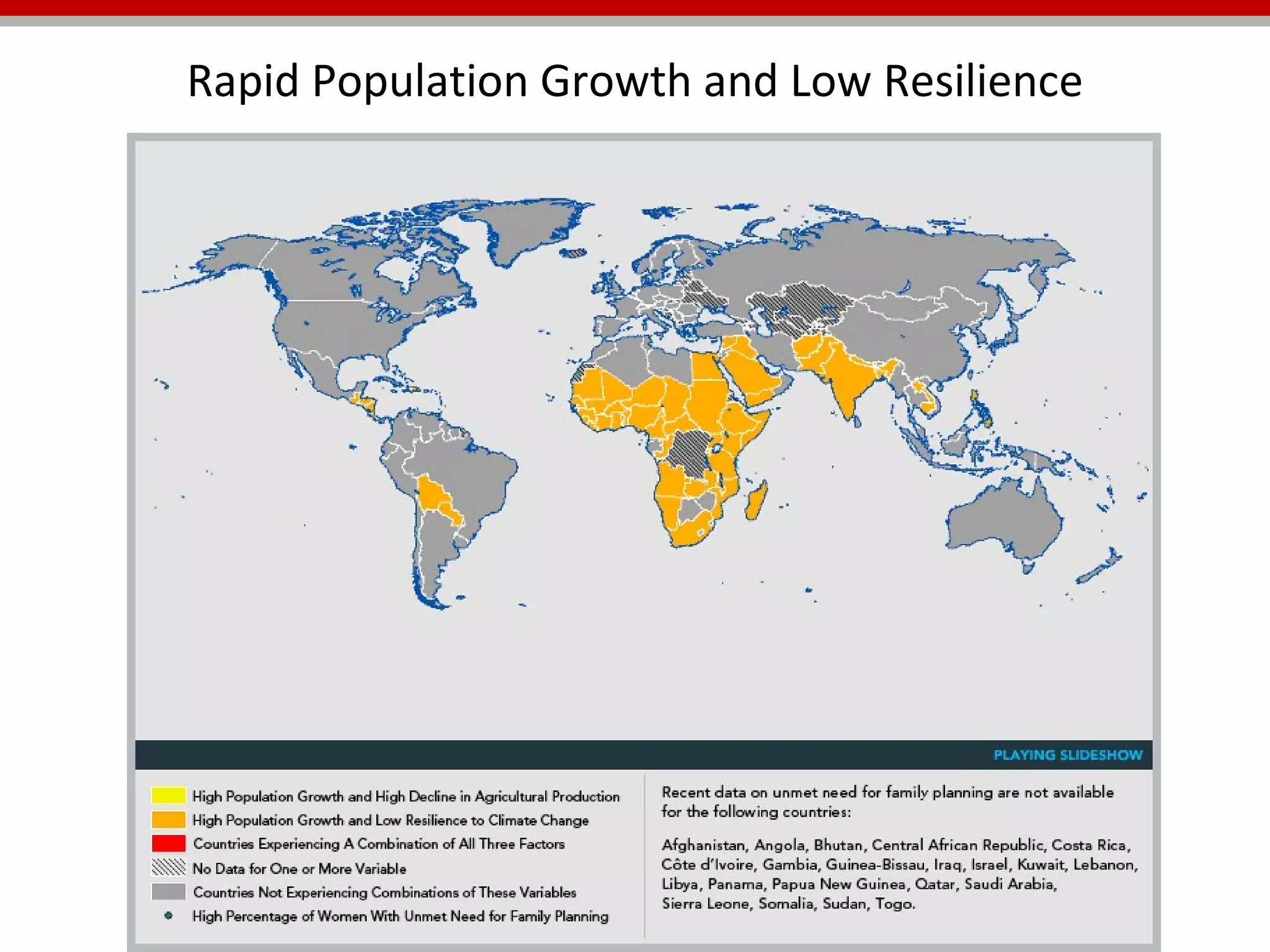
Rapid Population Growth and Low Resilience
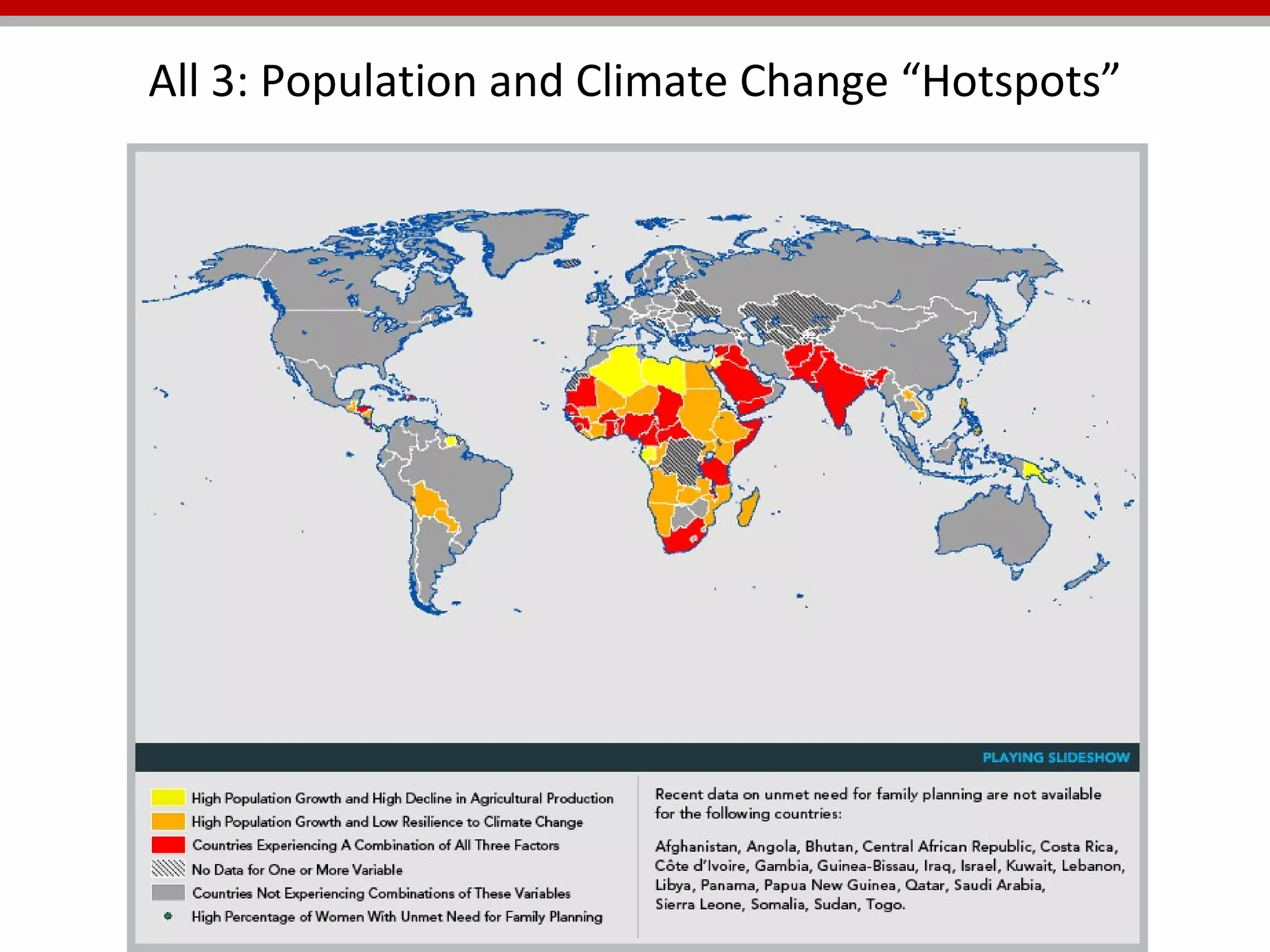
All 3: Population and Climate Change “Hotspots”
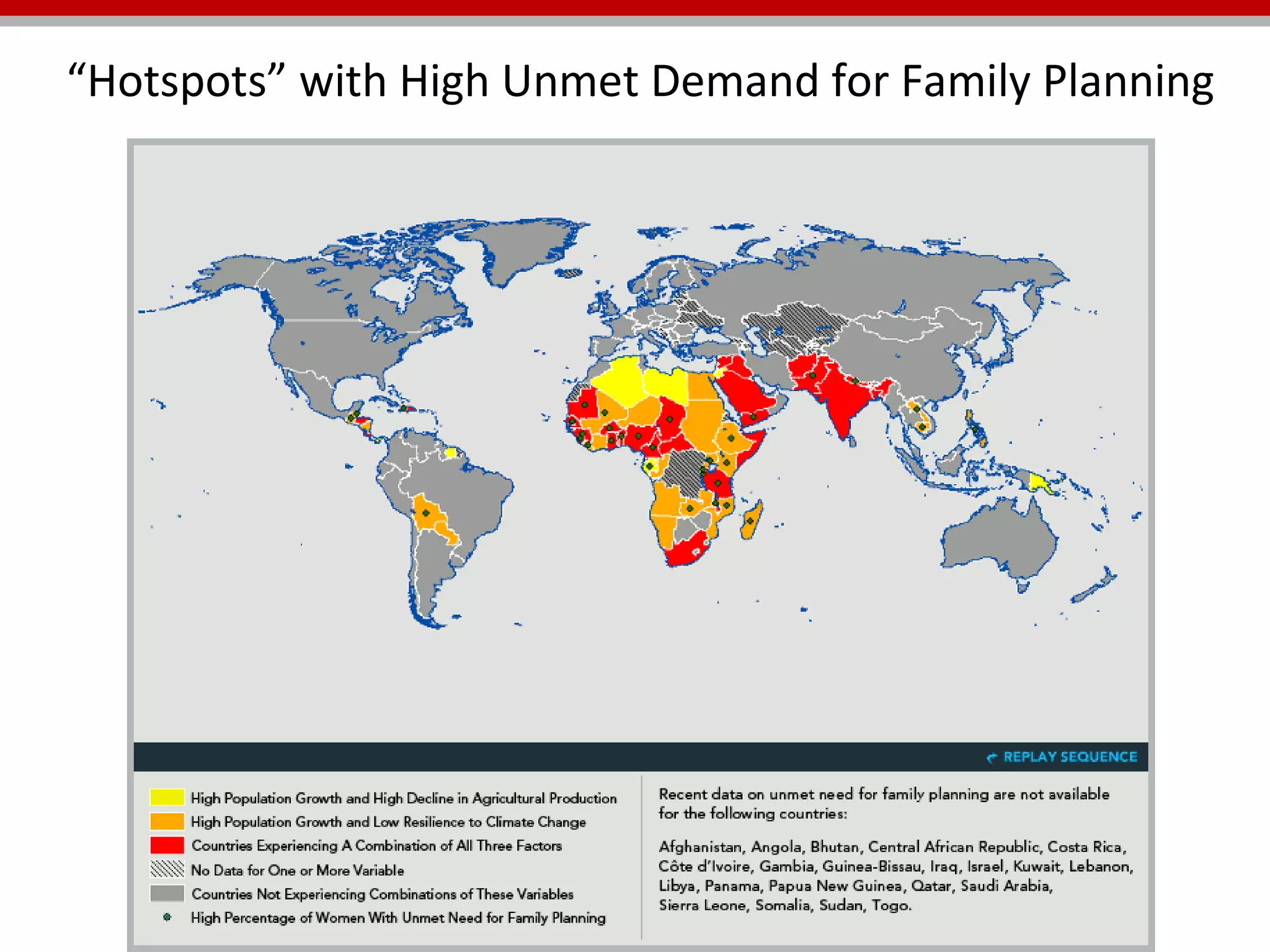
“ Hotspots” with High Unmet Demand for Family Planning
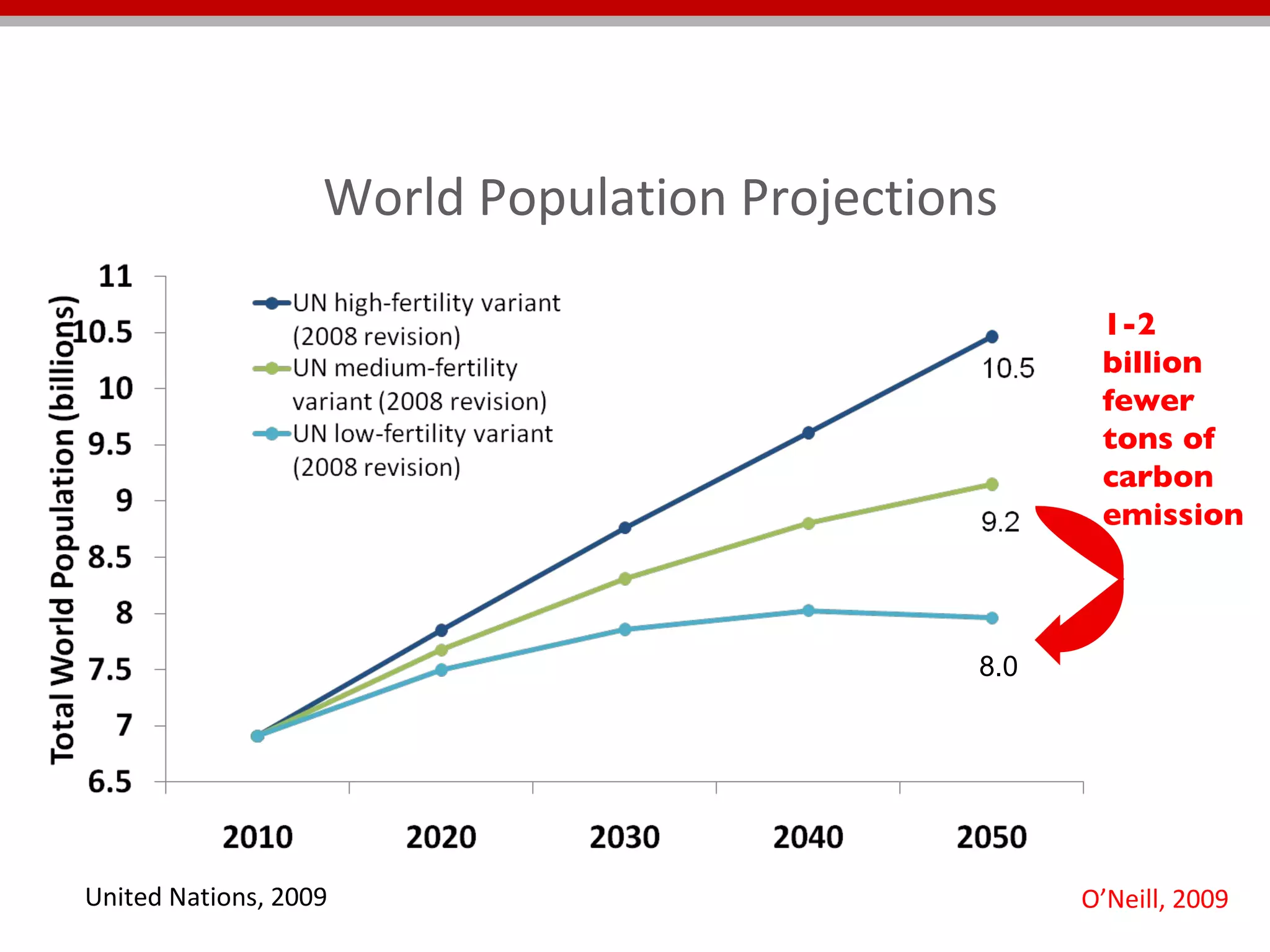
World Population Projections  United Nations, 2009 1-2 billion fewer tons of carbon emissions O’Neill, 2009 8.0
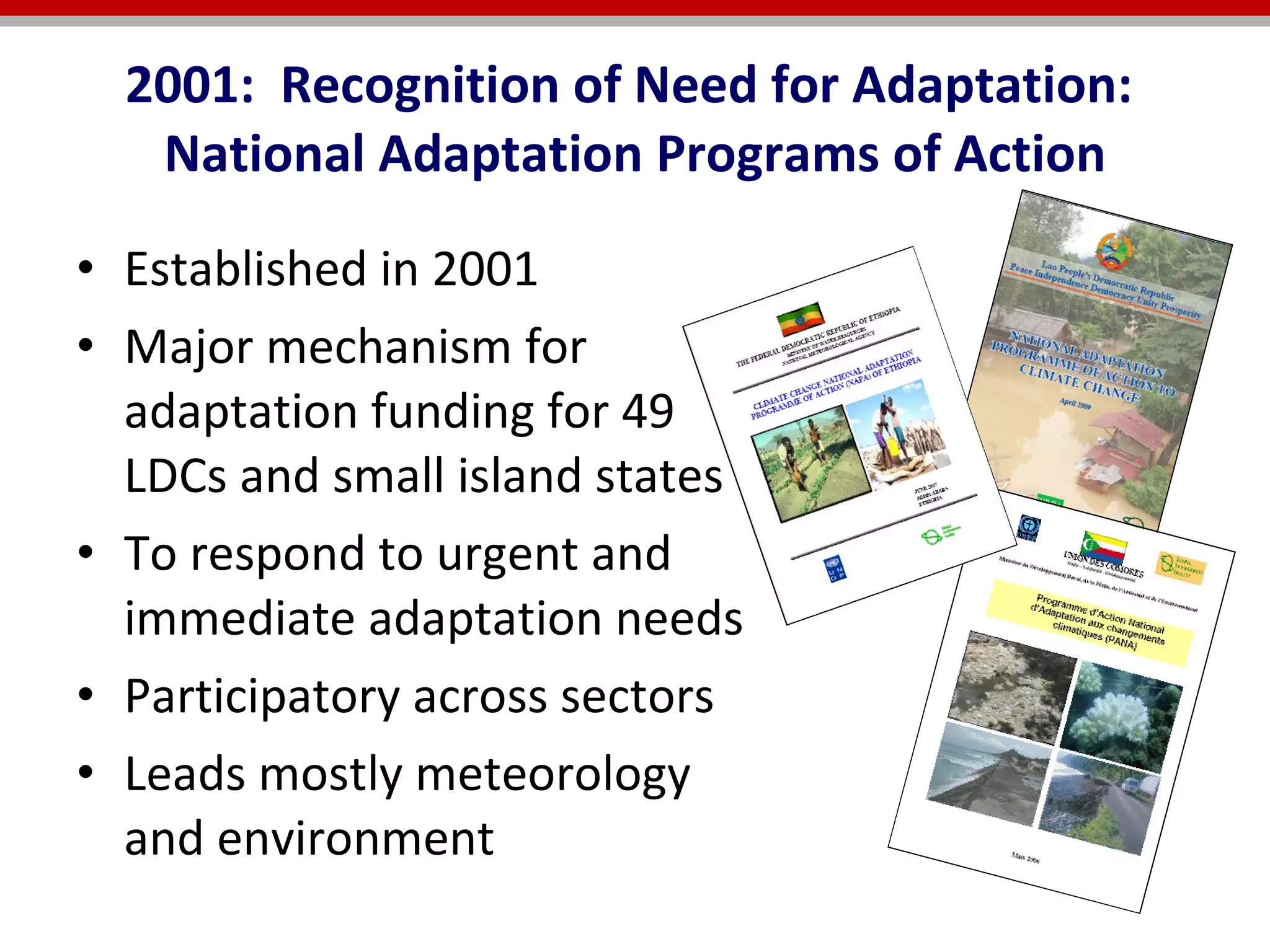
2001:  Recognition of Need for Adaptation:  National Adaptation Programs of Action Established in 2001  Major mechanism for adaptation funding for 49 LDCs and small island states  To respond to urgent and immediate adaptation needs Participatory across sectors Leads mostly meteorology and environment
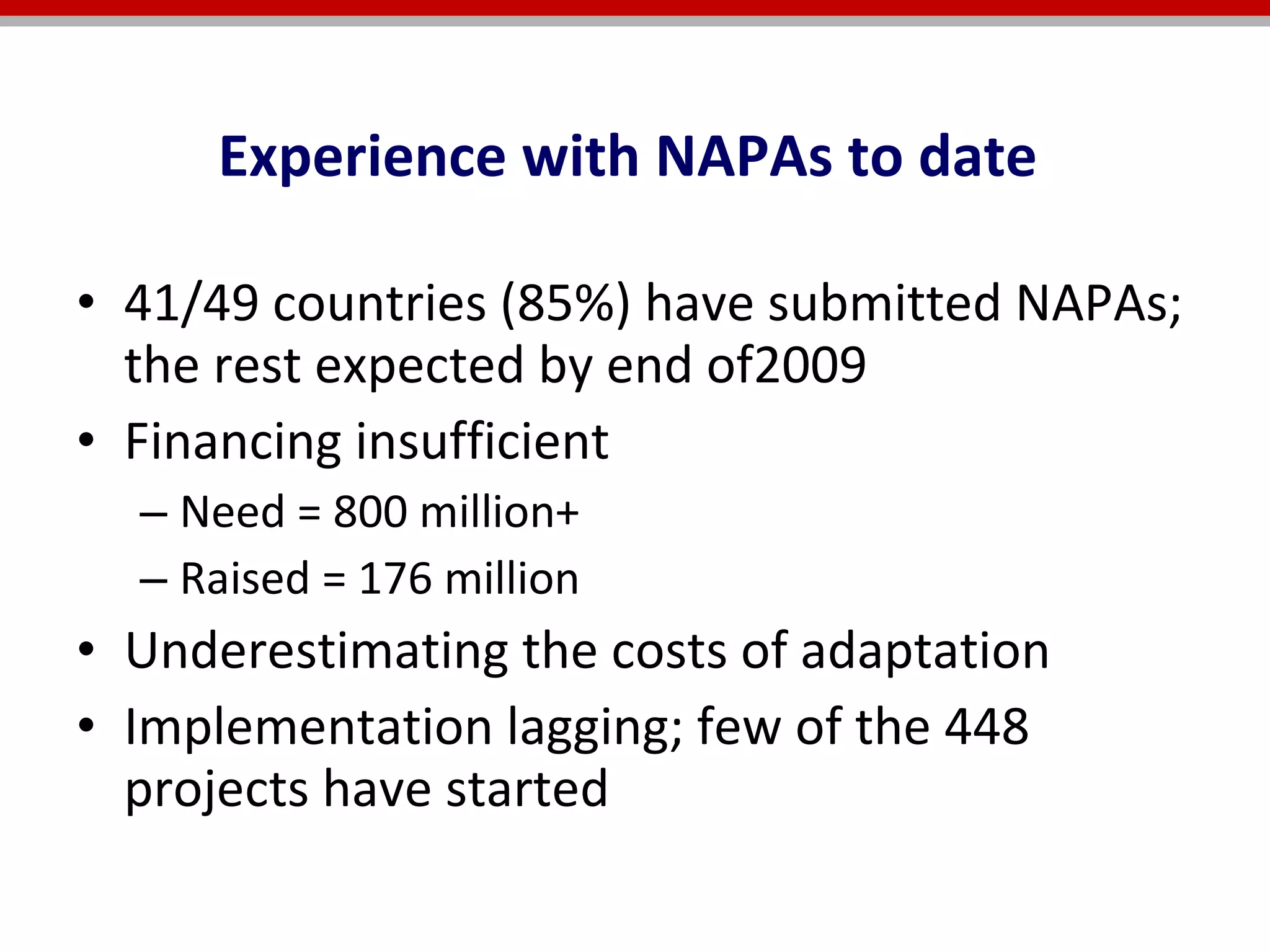
Experience with NAPAs  41/49 countries (85%) have submitted NAPAs; the rest expected by end of2009 Financing insufficient  Need = 800 million+  Raised = 176 million  Underestimating the costs of adaptation Implementation lagging; few of the 448 projects have started Experience with NAPAs to date
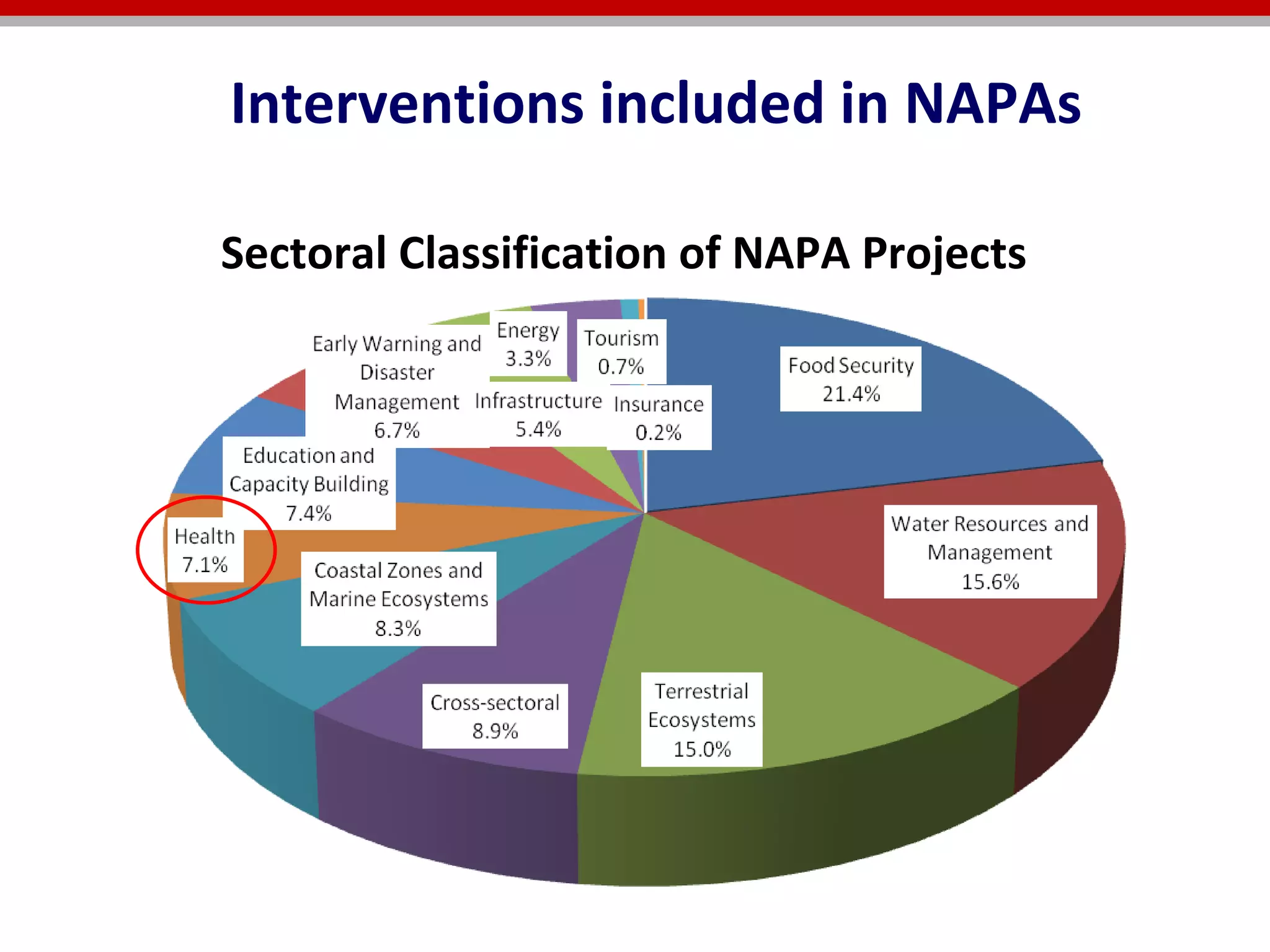
    Sectoral Classification of NAPA Projects  Interventions included in NAPAs
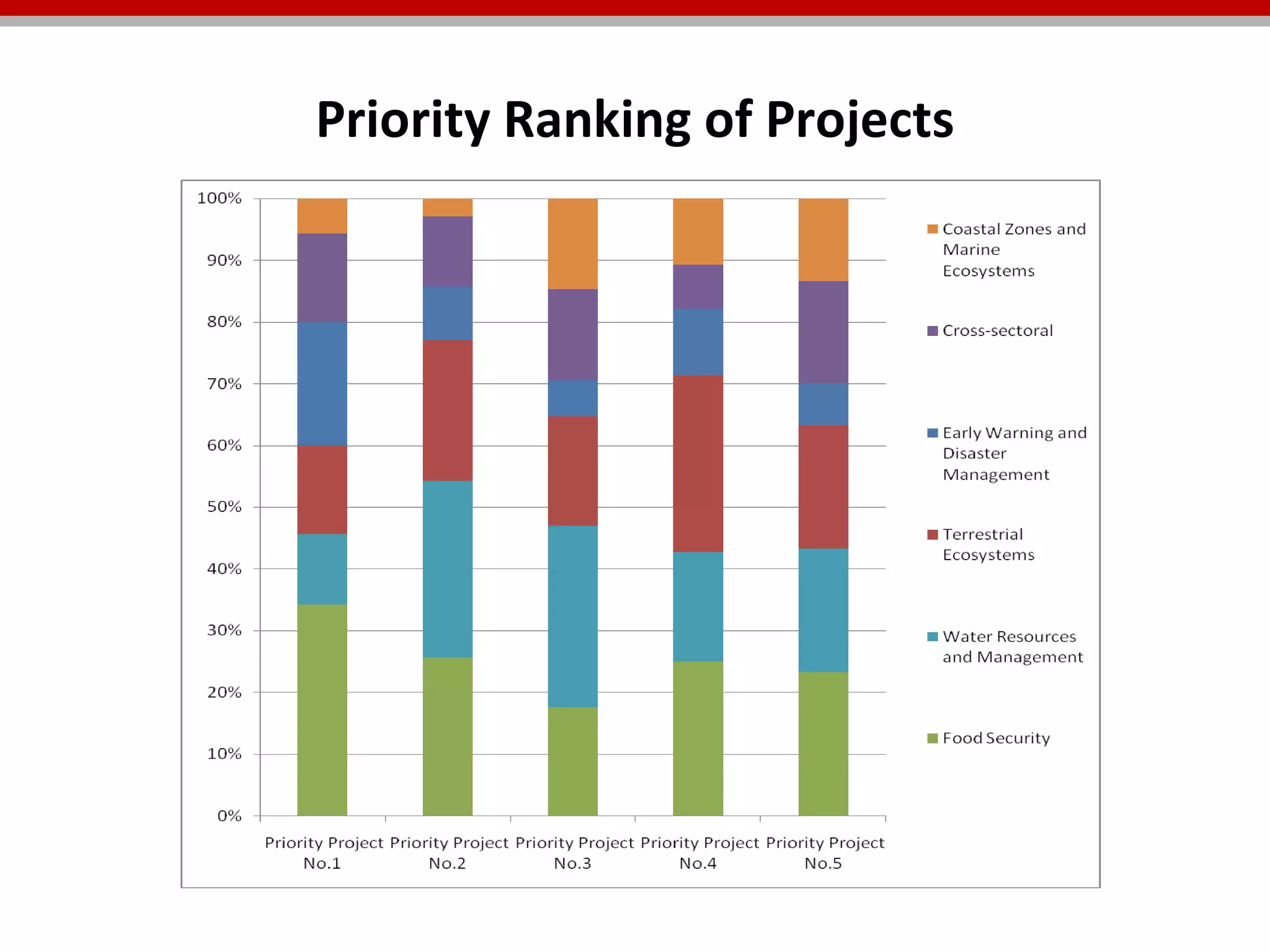
Priority Ranking of Projects
37/41 NAPAs address population growth  Acting in tandem with other factors, rapid population growth causes or increases:   Vulnerability to food insecurity  Water resources scarcity Natural resource degradation or depletion  Poor human health  Migration Is population adressed in NAPAs?
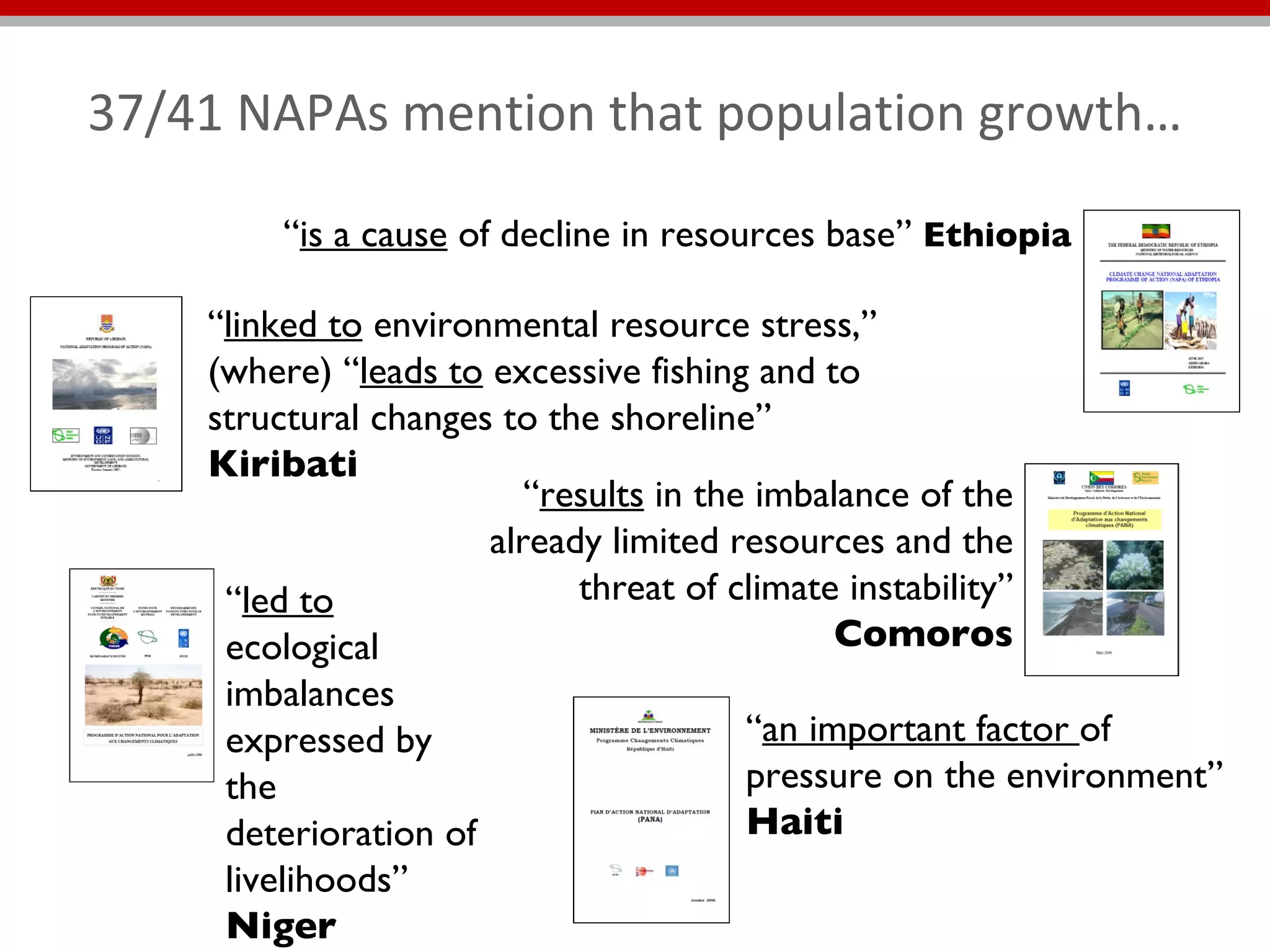
37/41 NAPAs mention that population growth… “ is a cause  of decline in resources base”  Ethiopia “ linked to  environmental resource stress,” (where) “ leads to  excessive fishing and to structural changes to the shoreline”  Kiribati “ results  in the imbalance of the already limited resources and the threat of climate instability”  Comoros “ led to  ecological imbalances expressed by the deterioration of livelihoods”  Niger “ an important factor  of pressure on the environment”  Haiti
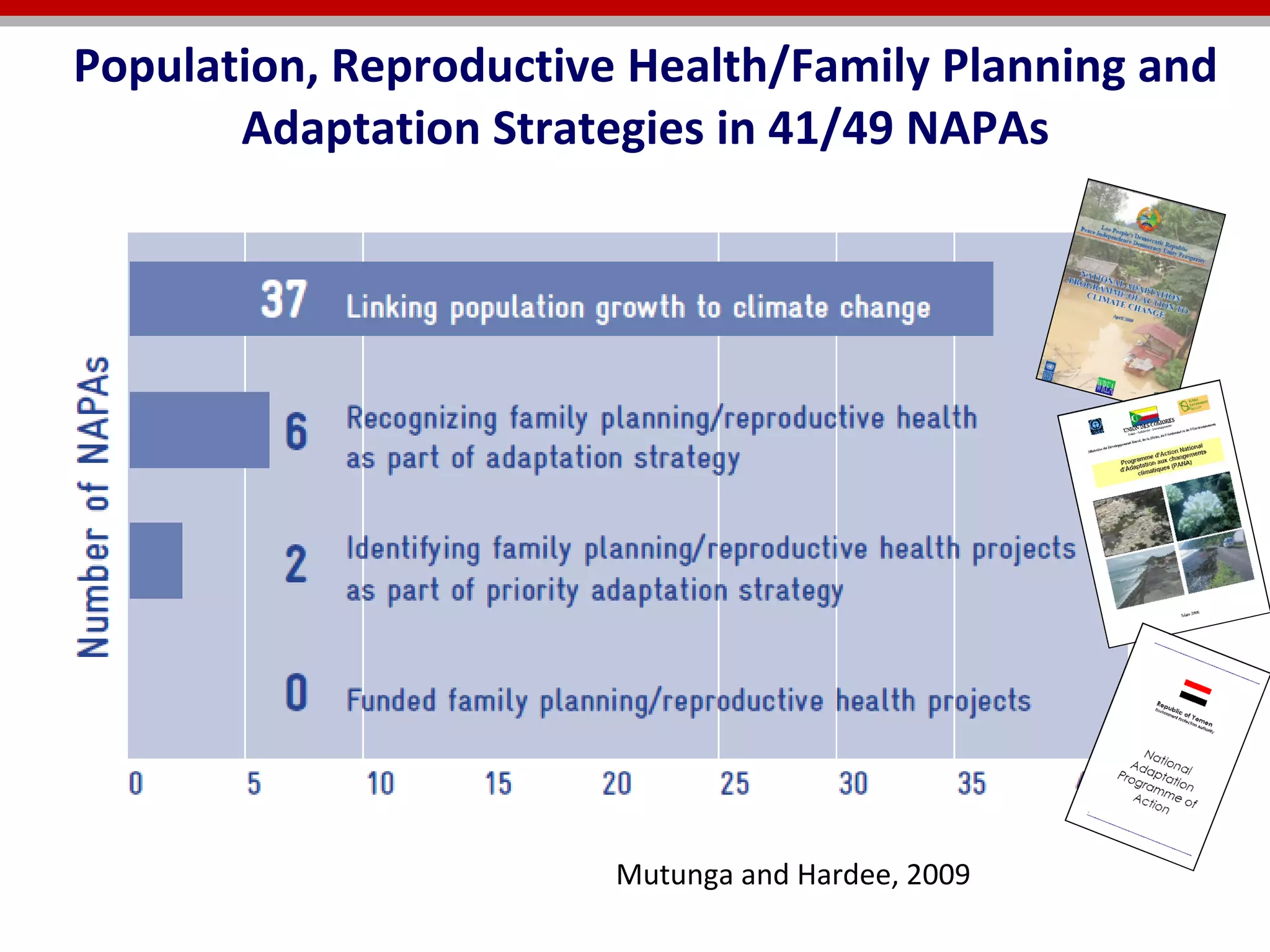
Population, Reproductive Health/Family Planning and Adaptation Strategies in 41/49 NAPAs Mutunga and Hardee, 2009
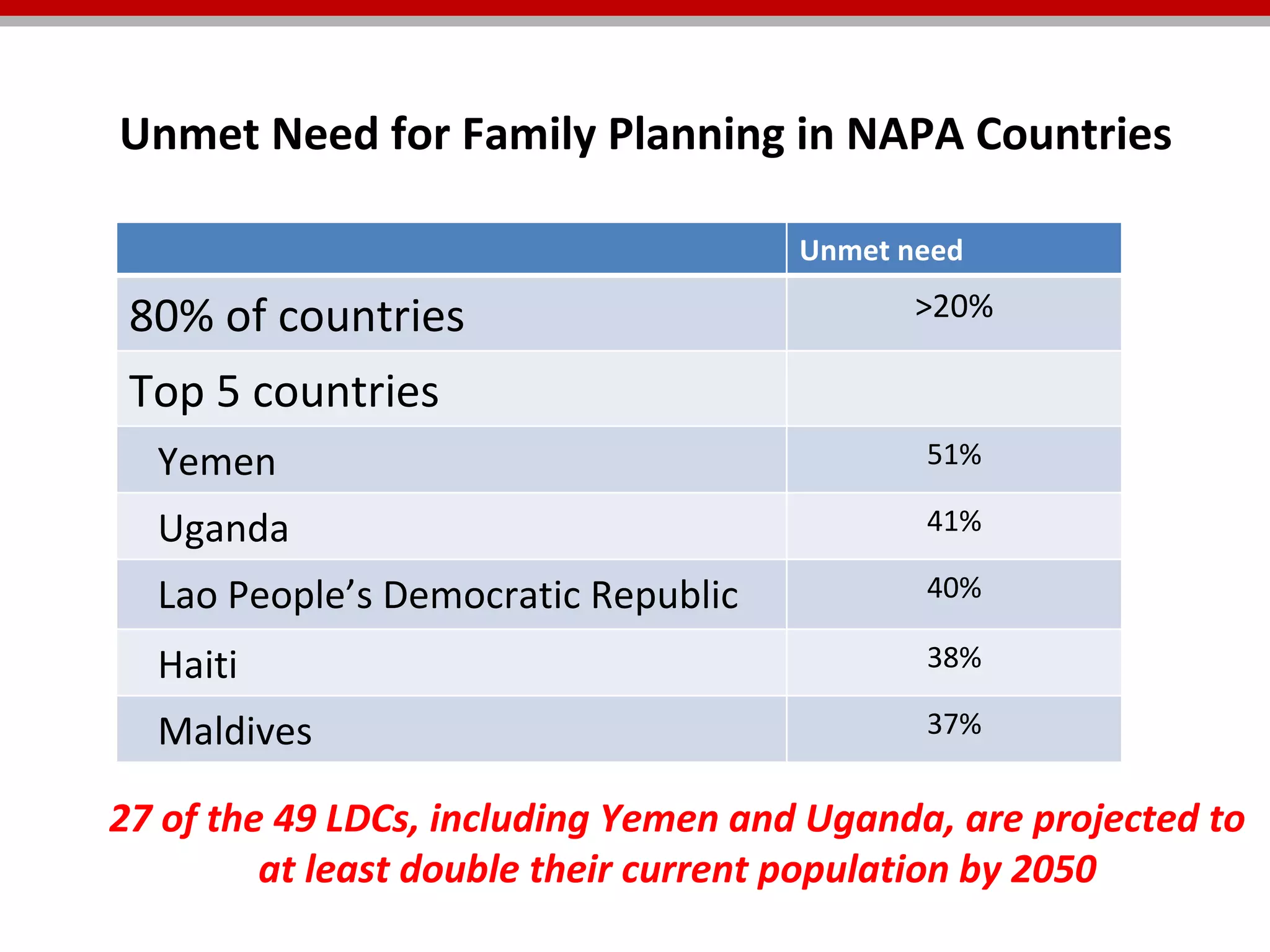
Unmet Need for Family Planning in NAPA Countries 27 of the 49 LDCs, including Yemen and Uganda, are projected to at least double their current population by 2050 Unmet need 80% of countries  >20% Top 5 countries Yemen 51% Uganda 41% Lao People’s Democratic Republic 40% Haiti 38% Maldives 37%
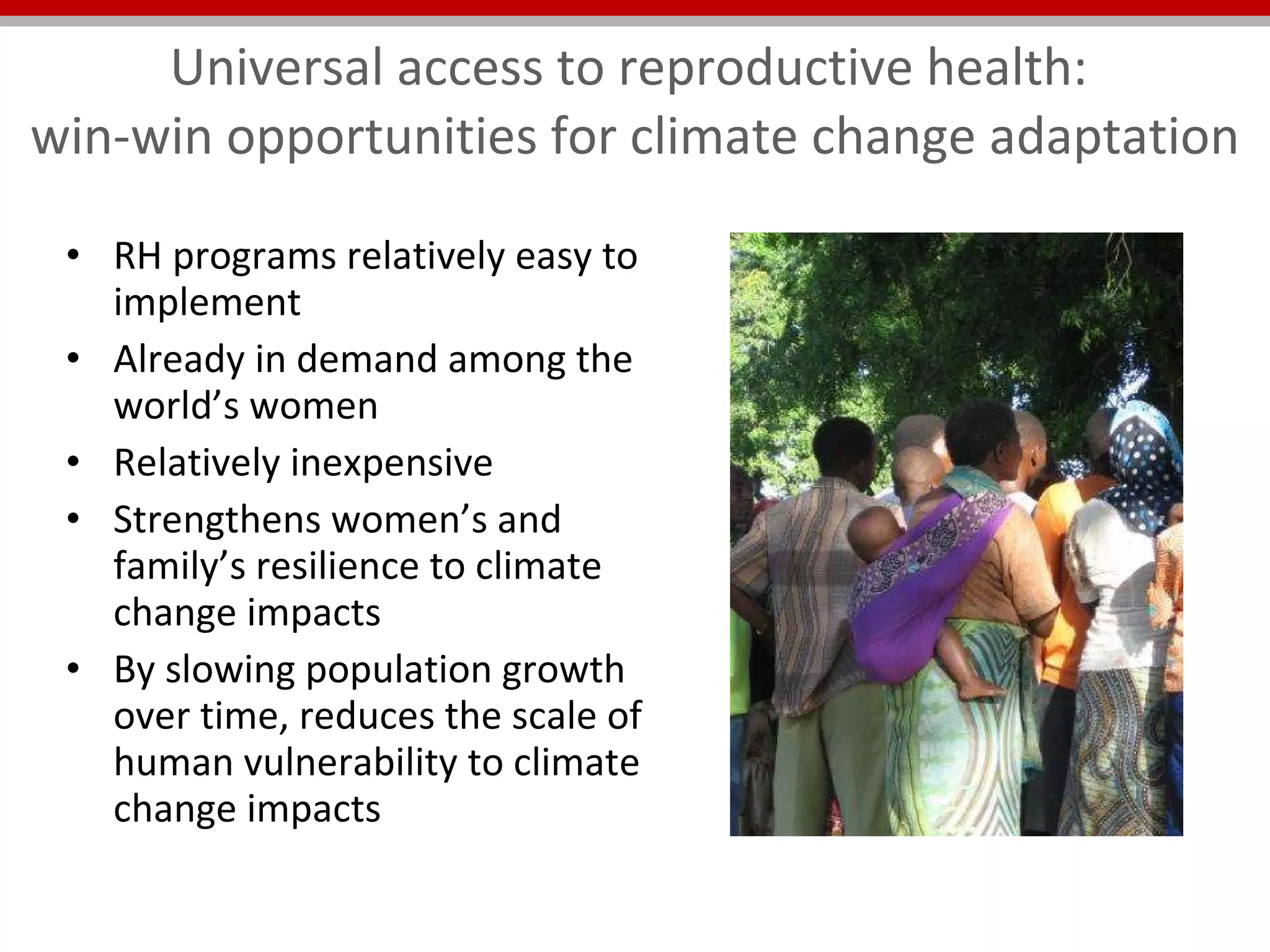
Universal access to reproductive health:  win-win opportunities for climate change adaptation RH programs relatively easy to implement Already in demand among the world’s women Relatively inexpensive Strengthens women’s and family’s resilience to climate change impacts By slowing population growth over time, reduces the scale of human vulnerability to climate change impacts
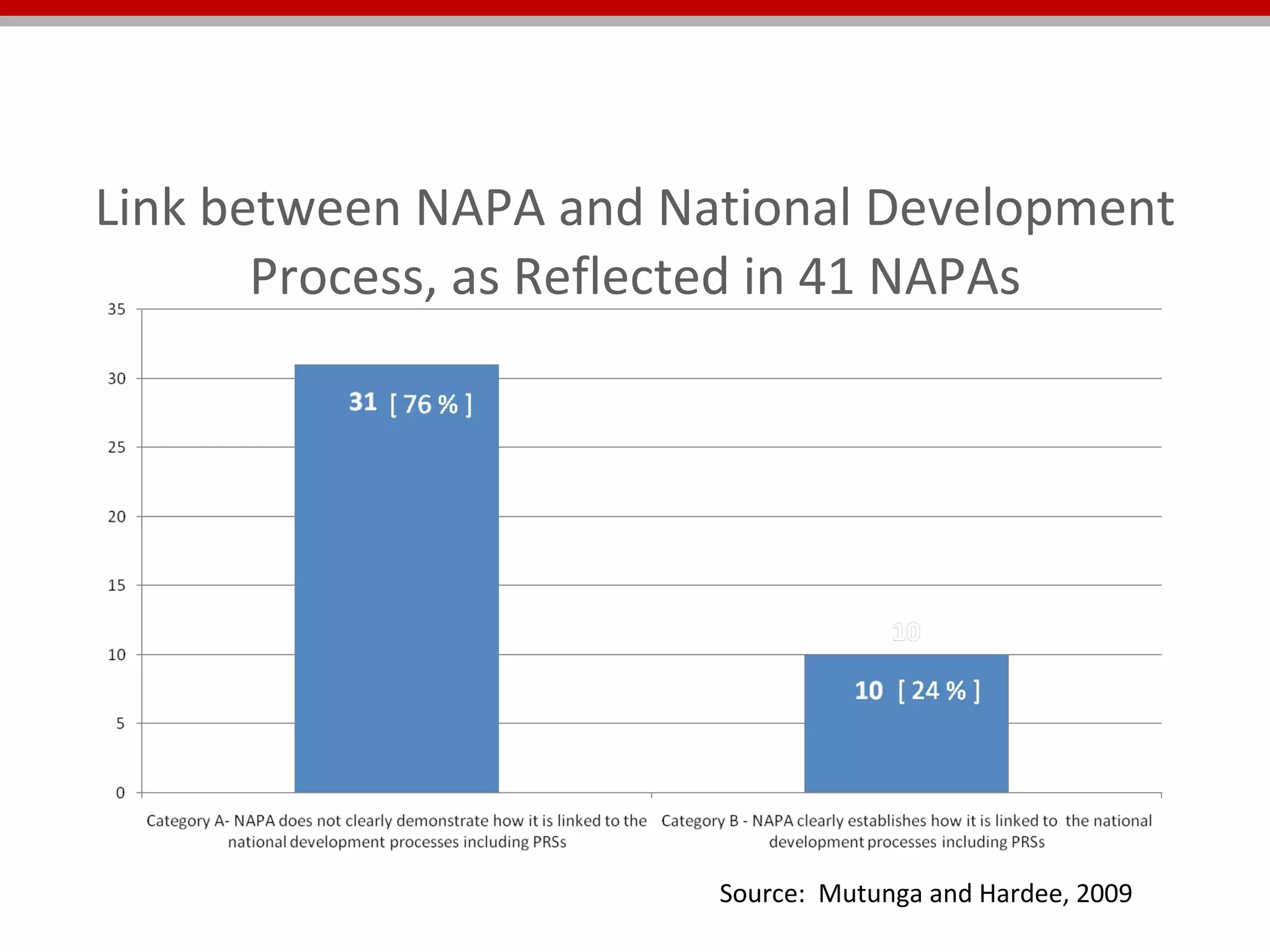
Link between NAPA and National Development Process, as Reflected in 41 NAPAs Source:  Mutunga and Hardee, 2009
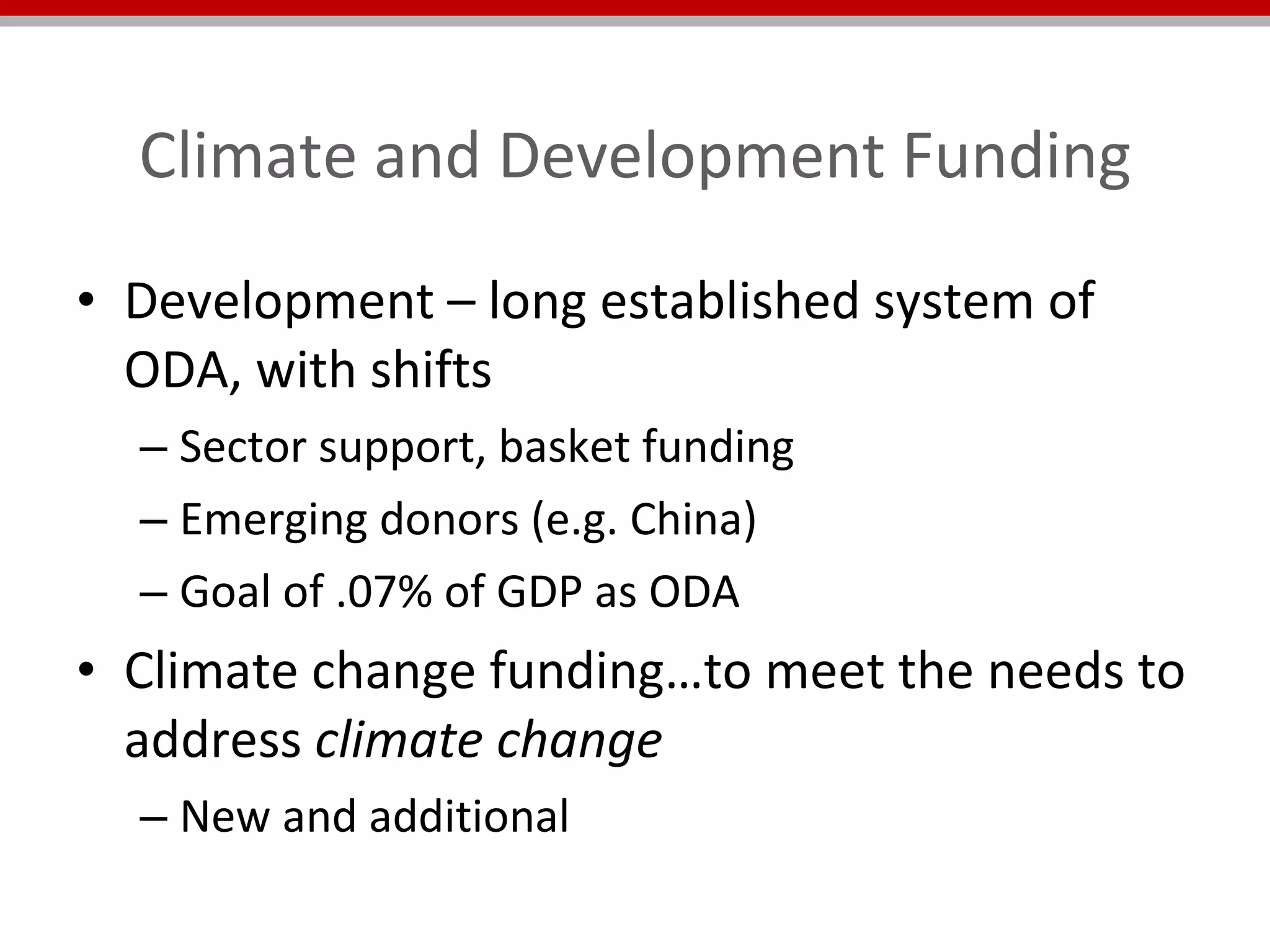
Climate and Development Funding Development – long established system of ODA, with shifts Sector support, basket funding Emerging donors (e.g. China) Goal of .07% of GDP as ODA Climate change funding…to meet the needs to address  climate change  New and additional
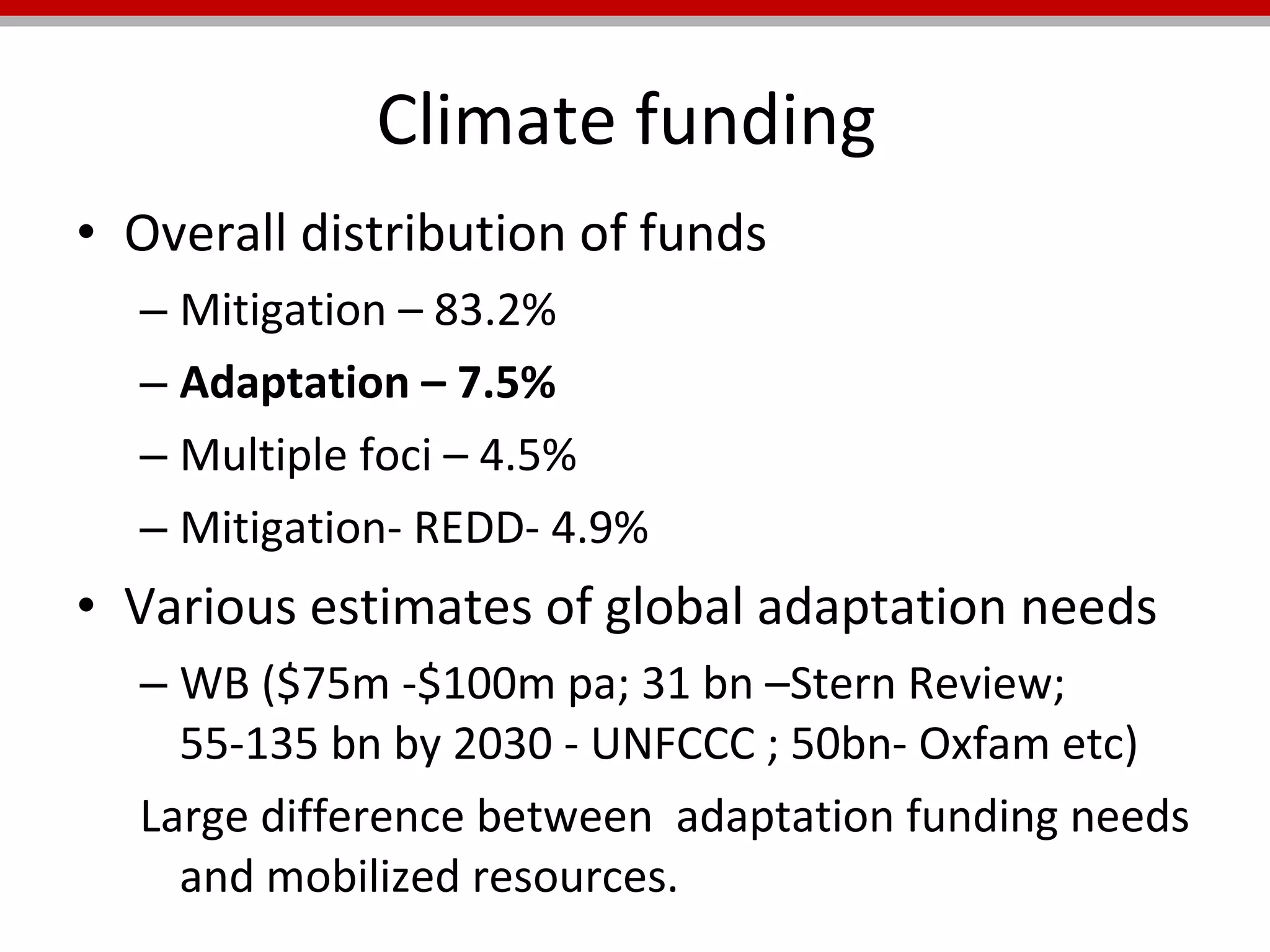
Climate funding  Overall distribution of funds Mitigation – 83.2% Adaptation – 7.5% Multiple foci – 4.5% Mitigation- REDD- 4.9% Various estimates of global adaptation needs WB ($75m -$100m pa; 31 bn –Stern Review; 55-135 bn by 2030 - UNFCCC ; 50bn- Oxfam etc) Large difference between  adaptation funding needs and mobilized resources.
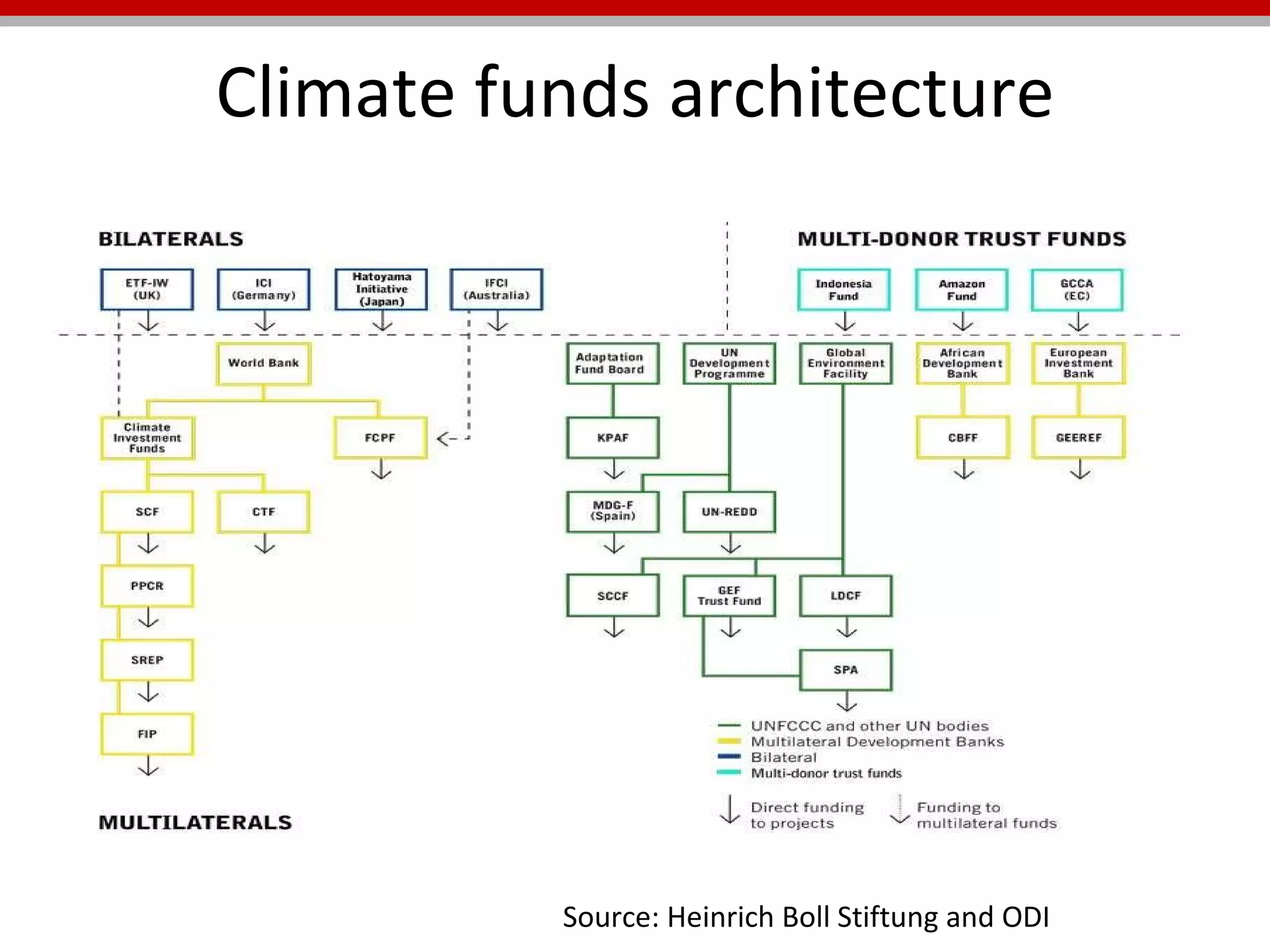
Climate funds architecture Source: Heinrich Boll Stiftung and ODI
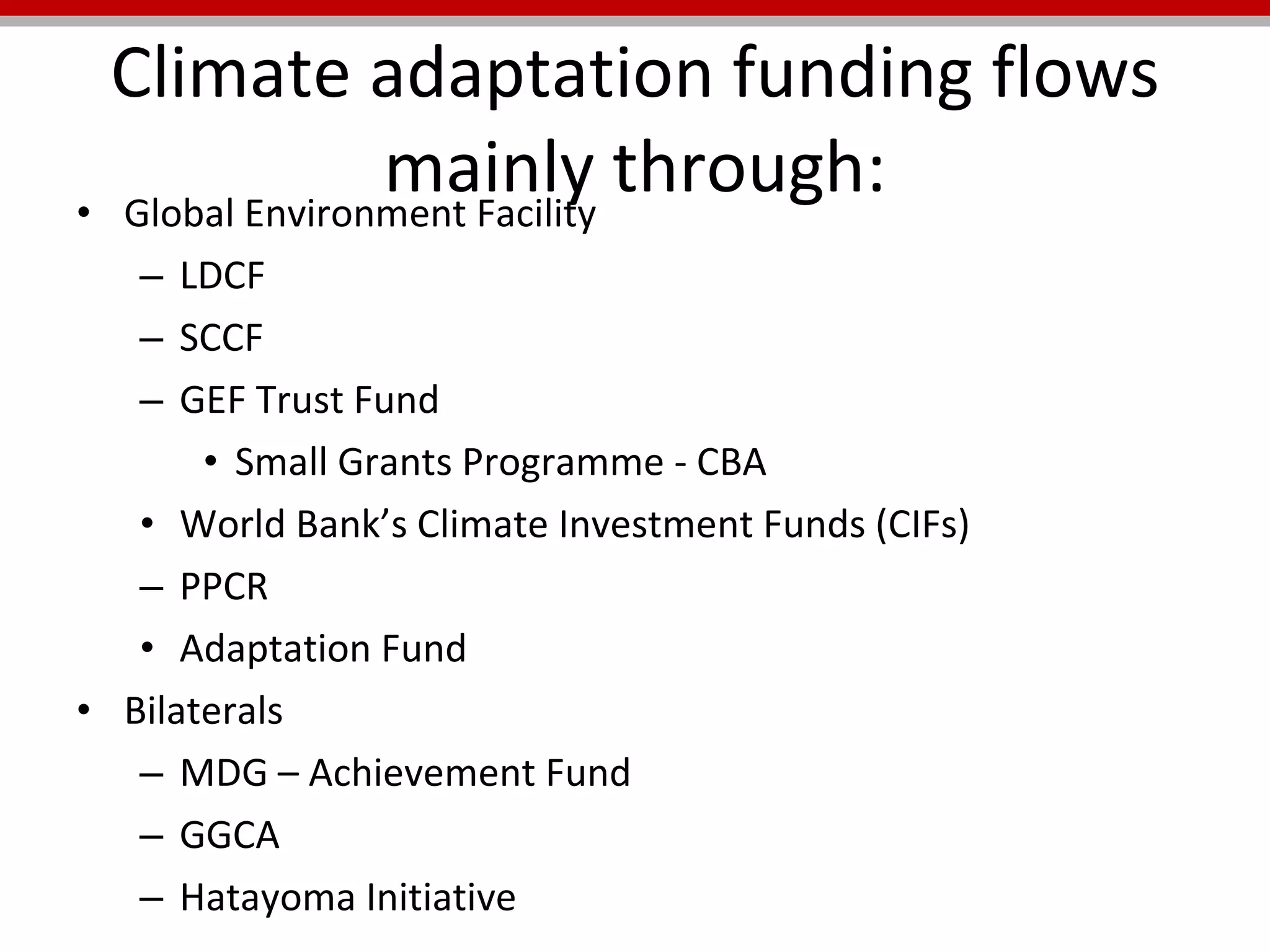
Climate adaptation funding flows mainly through: Global Environment Facility LDCF SCCF GEF Trust Fund Small Grants Programme - CBA World Bank’s Climate Investment Funds (CIFs)  PPCR Adaptation Fund Bilaterals MDG – Achievement Fund GGCA Hatayoma Initiative
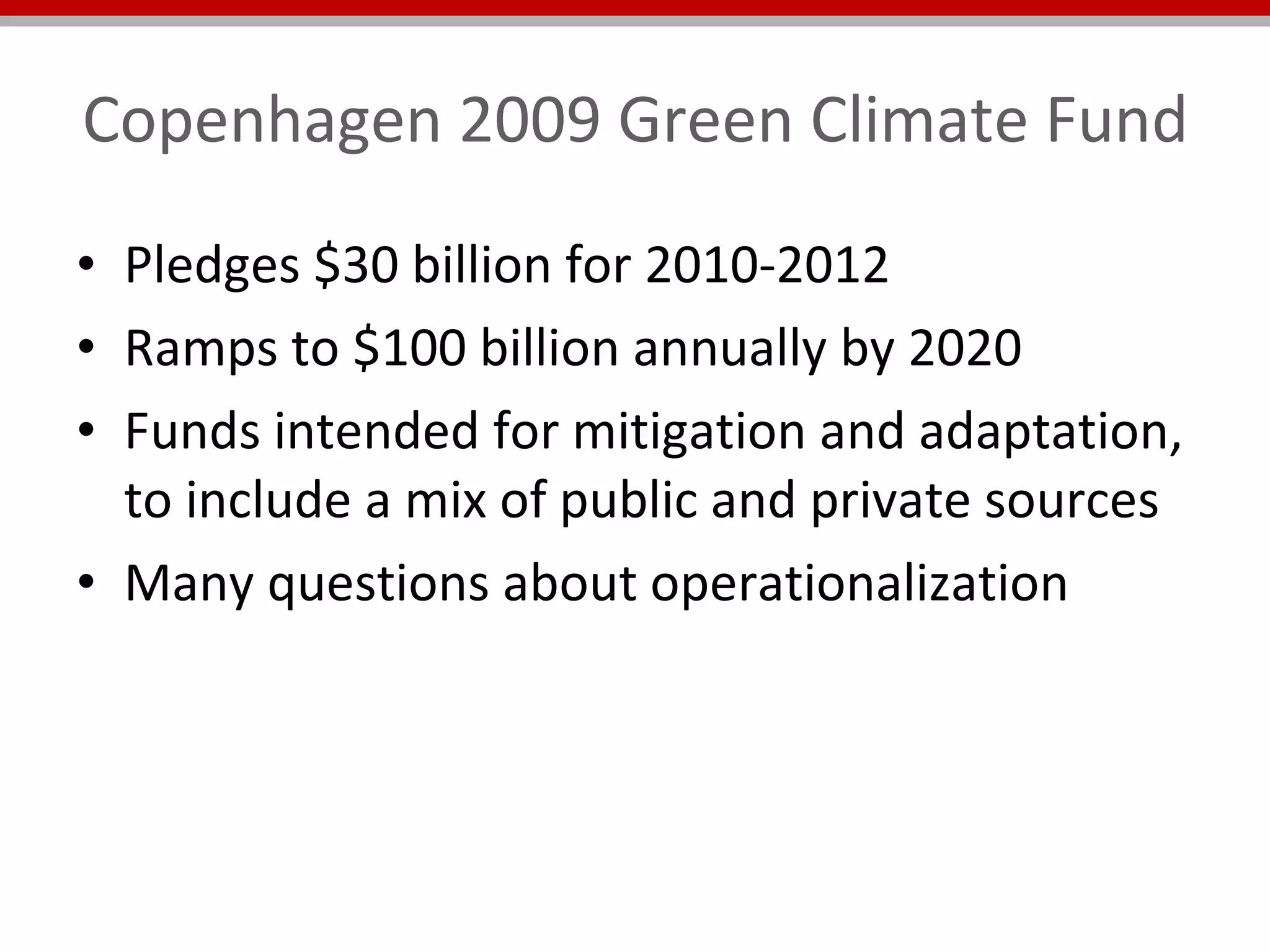
Copenhagen 2009 Green Climate Fund Pledges $30 billion for 2010-2012 Ramps to $100 billion annually by 2020 Funds intended for mitigation and adaptation, to include a mix of public and private sources Many questions about operationalization
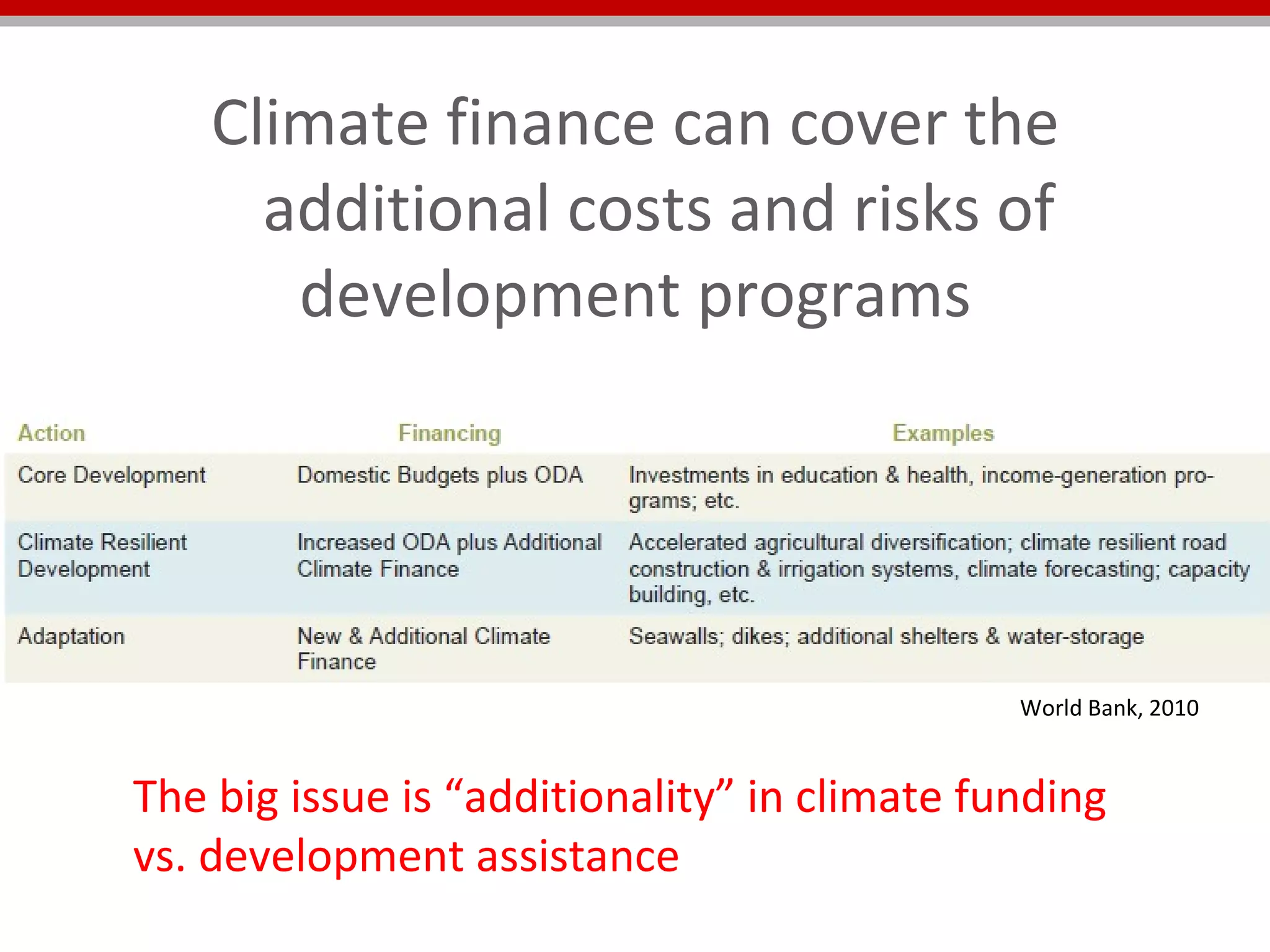
Climate finance can cover the additional costs and risks of development programs  World Bank, 2010 The big issue is “additionality” in climate funding vs. development assistance
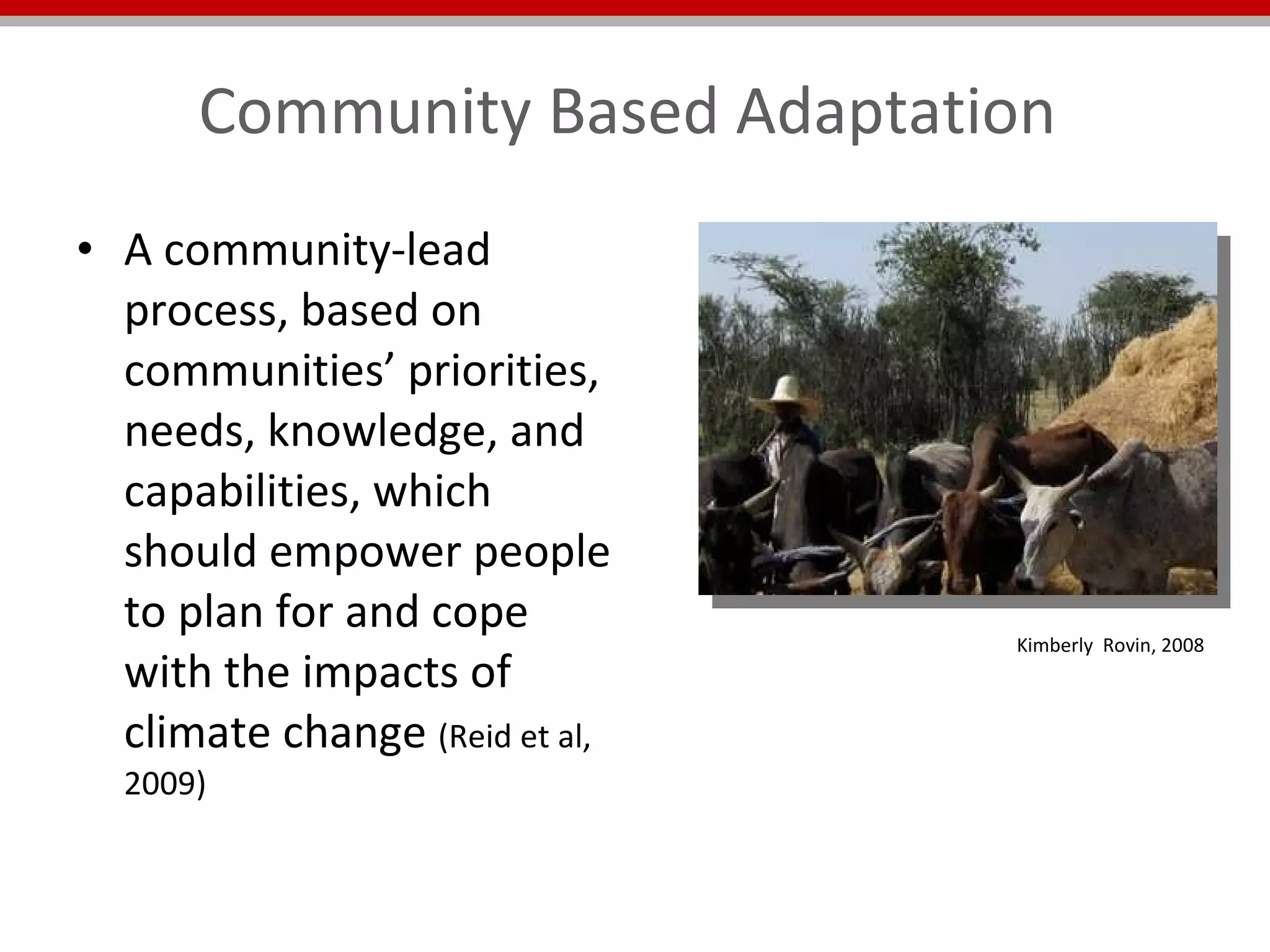
Community Based Adaptation  A community-lead process, based on communities’ priorities, needs, knowledge, and capabilities, which should empower people to plan for and cope with the impacts of climate change  (Reid et al, 2009) Kimberly  Rovin, 2008
CBA Projects  10 pilot countries, diversity of ecosystems, socioeconomic contexts and climate change impacts , administered by UNDP Each project:  $50,000 in climate change funds (GEF support), plus co-financing    Natural resources management approach to build resilience to climate impacts into resource-based livelihoods  Generate lessons learned for scale up Many other CBA projects, e.g. CARE, Oxfam, etc
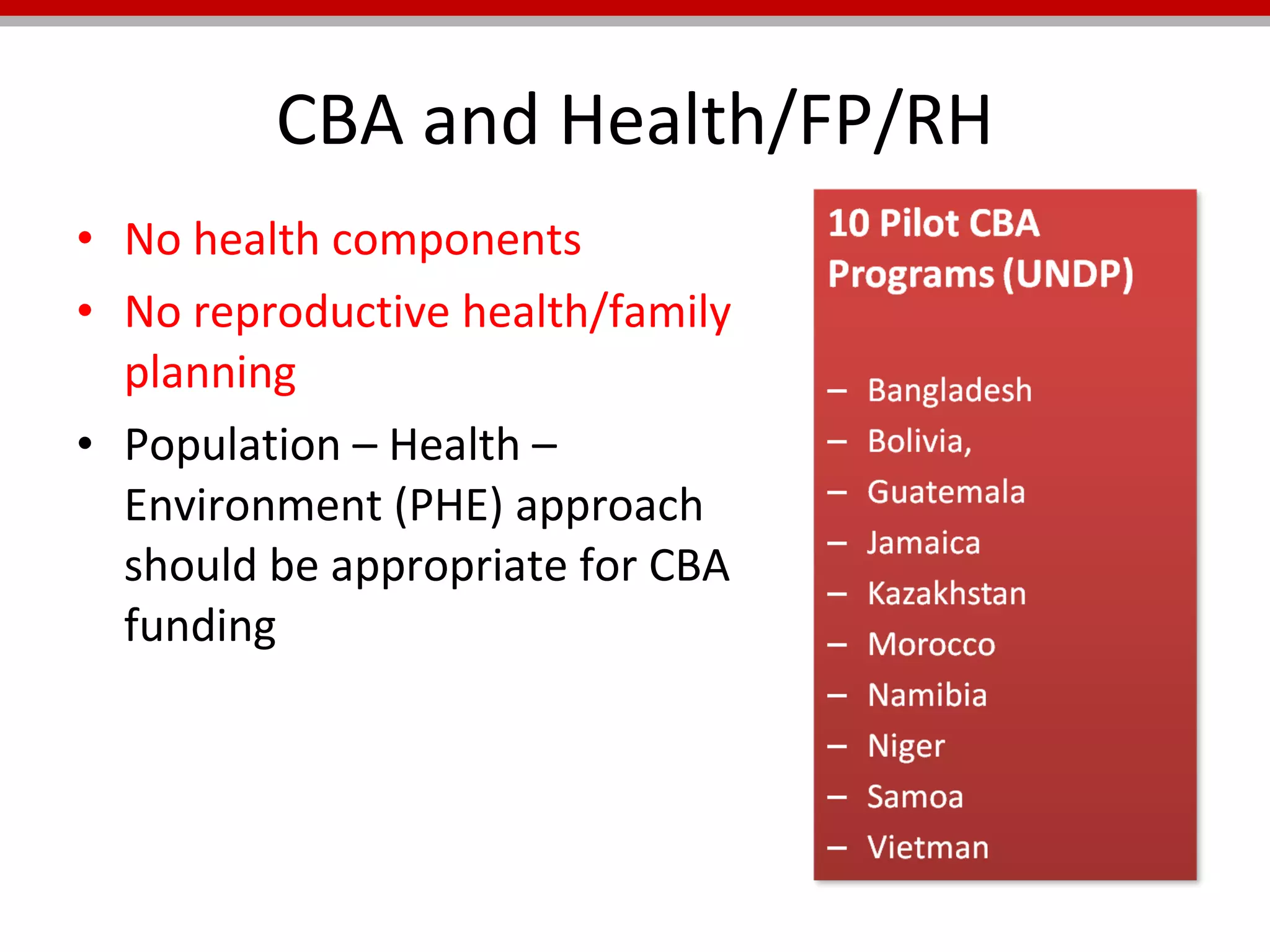
CBA and Health/FP/RH No health components No reproductive health/family planning Population – Health – Environment (PHE) approach should be appropriate for CBA funding
Translate recognition of population pressure and unmet need for FP/RH into relevant project activities Expedite development and implementation of RH/FP projects already identified in NAPAs Include focus on health and FP/RH in CBA Include attention to population and integrated strategies as part of the longer-term adaptation planning Recommendations for Integrated Approaches
Thank you [email_address] [email_address] [email_address]

Climate Change: What Does FP/RH Have to Do With It?

  • 1.
    Climate Change: What does FP/RH have to do with it? Karen Hardee Hardee Associates and Population Reference Bureau Clive Mutunga and Kathleen Mogelgaard , Population Action International Global Health Mini University Washignton DC , October 8, 2010 HARDEE ASSOCIATES LLC
  • 2.
    Outline Climate Change101 Climate Change and Population: the macro Climate Change and FP/RH: the micro What are NAPAs and Where is FP/RH? Climate Change and Development Financing: Implications for FP/RH Discussion
  • 3.
    Scientific evidence ofclimate change Global warming is unequivocal (FAR 1990) Most of the warming is very likely due to greenhouse gases (AR4 2007) Most of the warming is likely due to human activities (TAR 2001)
  • 4.
    Source: NOAA. http://www.noaanews.noaa.gov/stories2010/20100728_stateoftheclimate.html
  • 5.
    Effects of ClimateChange on People Temperature Sea level rise Change in precipitation Increasing storm severity Loss of glacial ice Spread vector of diseases Additional 50 million people at risk of hunger by 2020 20% of the population of developing countries living in low elevations are exposed to sea level rise and storms 1-2 billion people will suffer water shortages by 2050 Diseases: 3% increase in diarrhea, 5% increase in malaria, 10% increase in malnutrition by 2030
  • 6.
    Climate Change Terminology : Mitigation Implementing policies to reduce GHG emissions and enhance carbon sinks +2 0 Celsius climate stabilization target
  • 7.
    What Drives Emissions? ‘ Kaya Identity’ Yoichi Kaya, 1990. = X X X IPAT Equation Ehrlich and Holdren 1970s Per capita economic production Energy Intensity Carbon Intensit y Population Emissions Impact = Population x Affluence x Technology
  • 8.
    Net impact ofpopulation on climate Controlling for other variables, a one percent of population growth is associated with a one percent increase in carbon emission Study Elasticity Dietz & Rosa, 1997 +1.15 Shi, 2003 +1.43 York et al., 2003 +0.98 Rosa et al. 2004 +1.02 Cole & Neumayer, 2004 +0.98
  • 9.
    Consumption Patterns UNFPA,2009 State of the World Population Report
  • 10.
    Climate Change Terminology: Adaptation Initiatives and measures to reduce the vulnerability of natural and human systems against actual or expected climate change effects (IPCC) Since the 1960s, weather- related natural disasters have more than tripled
  • 11.
  • 12.
    “… ifa family has limited children, he will have enough land for his kids and hence we can protect the forests….In earlier years we had a lot of fallow lands, but now as a result of population growth we don’t have adequate fallow land. Therefore, limiting number of children will help us to cope with the change in climate.” Young rural woman, Southern Region, Ethiopia, 2009
  • 13.
    Rapid Population Growthand Agricultural Decline http://www.populationaction.org/climatemap
  • 14.
    Rapid Population Growthand Low Resilience
  • 15.
    All 3: Populationand Climate Change “Hotspots”
  • 16.
    “ Hotspots” withHigh Unmet Demand for Family Planning
  • 17.
    World Population Projections United Nations, 2009 1-2 billion fewer tons of carbon emissions O’Neill, 2009 8.0
  • 18.
    2001: Recognitionof Need for Adaptation: National Adaptation Programs of Action Established in 2001 Major mechanism for adaptation funding for 49 LDCs and small island states To respond to urgent and immediate adaptation needs Participatory across sectors Leads mostly meteorology and environment
  • 19.
    Experience with NAPAs 41/49 countries (85%) have submitted NAPAs; the rest expected by end of2009 Financing insufficient Need = 800 million+ Raised = 176 million Underestimating the costs of adaptation Implementation lagging; few of the 448 projects have started Experience with NAPAs to date
  • 20.
        SectoralClassification of NAPA Projects Interventions included in NAPAs
  • 21.
  • 22.
    37/41 NAPAs addresspopulation growth Acting in tandem with other factors, rapid population growth causes or increases:   Vulnerability to food insecurity Water resources scarcity Natural resource degradation or depletion Poor human health Migration Is population adressed in NAPAs?
  • 23.
    37/41 NAPAs mentionthat population growth… “ is a cause of decline in resources base” Ethiopia “ linked to environmental resource stress,” (where) “ leads to excessive fishing and to structural changes to the shoreline” Kiribati “ results in the imbalance of the already limited resources and the threat of climate instability” Comoros “ led to ecological imbalances expressed by the deterioration of livelihoods” Niger “ an important factor of pressure on the environment” Haiti
  • 24.
    Population, Reproductive Health/FamilyPlanning and Adaptation Strategies in 41/49 NAPAs Mutunga and Hardee, 2009
  • 25.
    Unmet Need forFamily Planning in NAPA Countries 27 of the 49 LDCs, including Yemen and Uganda, are projected to at least double their current population by 2050 Unmet need 80% of countries >20% Top 5 countries Yemen 51% Uganda 41% Lao People’s Democratic Republic 40% Haiti 38% Maldives 37%
  • 26.
    Universal access toreproductive health: win-win opportunities for climate change adaptation RH programs relatively easy to implement Already in demand among the world’s women Relatively inexpensive Strengthens women’s and family’s resilience to climate change impacts By slowing population growth over time, reduces the scale of human vulnerability to climate change impacts
  • 27.
    Link between NAPAand National Development Process, as Reflected in 41 NAPAs Source: Mutunga and Hardee, 2009
  • 28.
    Climate and DevelopmentFunding Development – long established system of ODA, with shifts Sector support, basket funding Emerging donors (e.g. China) Goal of .07% of GDP as ODA Climate change funding…to meet the needs to address climate change New and additional
  • 29.
    Climate funding Overall distribution of funds Mitigation – 83.2% Adaptation – 7.5% Multiple foci – 4.5% Mitigation- REDD- 4.9% Various estimates of global adaptation needs WB ($75m -$100m pa; 31 bn –Stern Review; 55-135 bn by 2030 - UNFCCC ; 50bn- Oxfam etc) Large difference between adaptation funding needs and mobilized resources.
  • 30.
    Climate funds architectureSource: Heinrich Boll Stiftung and ODI
  • 31.
    Climate adaptation fundingflows mainly through: Global Environment Facility LDCF SCCF GEF Trust Fund Small Grants Programme - CBA World Bank’s Climate Investment Funds (CIFs) PPCR Adaptation Fund Bilaterals MDG – Achievement Fund GGCA Hatayoma Initiative
  • 32.
    Copenhagen 2009 GreenClimate Fund Pledges $30 billion for 2010-2012 Ramps to $100 billion annually by 2020 Funds intended for mitigation and adaptation, to include a mix of public and private sources Many questions about operationalization
  • 33.
    Climate finance cancover the additional costs and risks of development programs World Bank, 2010 The big issue is “additionality” in climate funding vs. development assistance
  • 34.
    Community Based Adaptation A community-lead process, based on communities’ priorities, needs, knowledge, and capabilities, which should empower people to plan for and cope with the impacts of climate change (Reid et al, 2009) Kimberly Rovin, 2008
  • 35.
    CBA Projects 10 pilot countries, diversity of ecosystems, socioeconomic contexts and climate change impacts , administered by UNDP Each project: $50,000 in climate change funds (GEF support), plus co-financing   Natural resources management approach to build resilience to climate impacts into resource-based livelihoods Generate lessons learned for scale up Many other CBA projects, e.g. CARE, Oxfam, etc
  • 36.
    CBA and Health/FP/RHNo health components No reproductive health/family planning Population – Health – Environment (PHE) approach should be appropriate for CBA funding
  • 37.
    Translate recognition ofpopulation pressure and unmet need for FP/RH into relevant project activities Expedite development and implementation of RH/FP projects already identified in NAPAs Include focus on health and FP/RH in CBA Include attention to population and integrated strategies as part of the longer-term adaptation planning Recommendations for Integrated Approaches
  • 38.
    Thank you [email_address][email_address] [email_address]